

SIST EN 14995:2007
(Main)Plastics - Evaluation of compostability - Test scheme and specifications
- Abstract
This European Standard specifies requirements and procedures to determine the compostability or anaerobic treatability of plastic materials by addressing four characteristics:
I) biodegradability,
II) disintegration during biological treatment,
III) effect on the biological treatment process and
IV) effect on the quality of the resulting compost.
NOTE For packaging EN 13432 applies.
- Status
- Published
- Publication Date
- 31-Mar-2007
- Technical Committee
- IPMA - Polimer materials and products
- Current Stage
- 6060 - National Implementation/Publication (Adopted Project)
- Start Date
- 01-Apr-2007
- Due Date
- 01-Apr-2007
- Completion Date
- 01-Apr-2007



SIST EN 14995:2007 is the Slovenian adoption of EN 14995:2006 from SIST, titled Plastics - Evaluation of compostability - Test scheme and specifications. It specifies how to assess whether plastic materials are compostable or anaerobically treatable by checking biodegradability, disintegration, effects on the biological treatment process, and the quality of the resulting compost. It is intended for people who need a test-based basis for claims about organic recovery of plastics.
What does SIST EN 14995:2007 specify?
SIST EN 14995:2007 sets out the scope, the assessment path, and the acceptance criteria for plastic materials intended for organic recovery. The document notes that for packaging, EN 13432 applies.
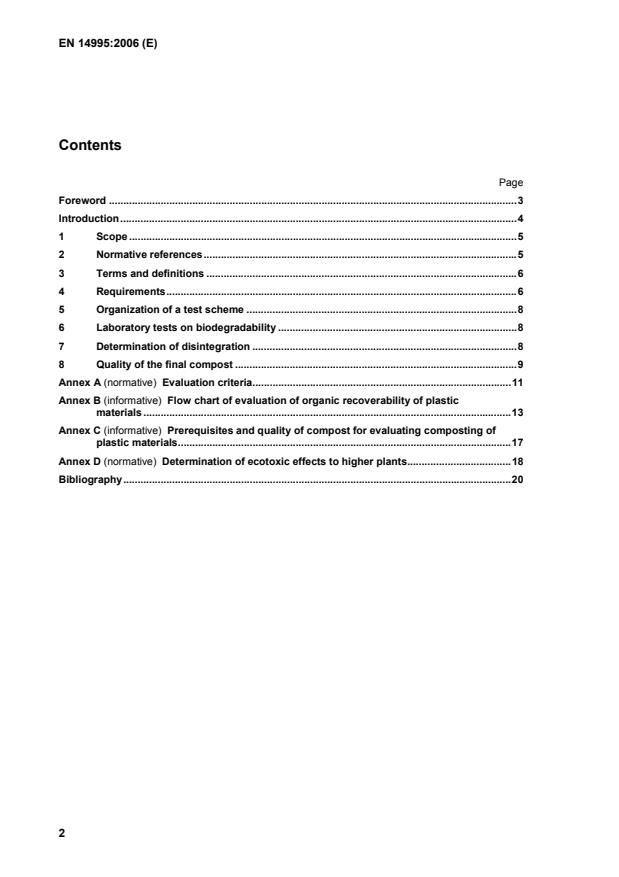
The standard is organized into Clauses 1 to 8, with supporting Annexes A to D:
| Annex | What it covers |
|---|---|
| Annex A | Normative evaluation criteria and pass levels |
| Annex B | Informative flow chart for evaluating organic recoverability |
| Annex C | Informative prerequisites and compost quality considerations |
| Annex D | Normative ecotoxicity test for higher plants |
What are the key requirements of SIST EN 14995:2007?
SIST EN 14995:2007 requires a structured assessment of a plastic material before it can be described as organically recoverable. In practice, the standard asks for evidence on the material itself, then on how it behaves in composting or anaerobic treatment, and finally on whether the resulting compost remains acceptable.
Control of constituents and characterization
Clause 4 requires control of constituents that could be harmful during biological treatment. Clause 4.2.2 requires identification of the material and checks on constituents, hazardous substances such as heavy metals, and the organic carbon content, total dry solids, and volatile solids used for testing. For a supplier, this means the material must be known well enough to judge whether it is suitable for composting claims.
Biodegradability
Clause 4.2.3 and Annex A require inherent and ultimate biodegradability to be shown in laboratory tests. Annex A limits aerobic test duration to 6 months and requires at least 90% biodegradation, or 90% of the maximum degradation of a suitable reference substance after both have reached a plateau. For anaerobic biodegradation, where used, the test period is limited to 2 months and the result must reach 50% or more of the theoretical value. This gives a clear pass/fail basis for lab results.
Disintegration in treatment
Clause 4.2.4 and Clause 7 require disintegration in a biological waste treatment process, normally in the form in which the material will be used. The reference test is ISO 16929 for controlled pilot-scale composting, and a full-scale facility may be accepted as equivalent. Annex A limits aerobic composting to 12 weeks and requires no more than 10% of the original dry weight to remain above a 2 mm sieve. For anaerobic biogasification, the optional route allows 5 weeks and uses a different sieve criterion. This matters because a material can biodegrade slowly but still leave visible residues.
Effect on the process and compost quality
Clause 4.2.4 and Clause 8 require that the material not create observable negative effects on the treatment process or compost quality. Clause 8 points to comparison of compost made with and without the plastic material, including physical-chemical checks and ecotoxicity to higher plants. Annex D uses the OECD 208 plant growth test with modifications for compost samples. For users, this shows whether the material changes compost performance or plant response.
Recognizability, equivalent forms, and records
Clause 4.2.6 requires materials entering the biowaste stream to be recognizable as compostable or biodegradable by the end user. Clause 4.3 allows an equivalent form to be accepted if it has the same or smaller mass-to-surface ratio and maximum wall thickness. Clause 4.4 requires a checklist and supporting documentation to be retained. That means the decision must be traceable, not just based on a test report.
What terms does SIST EN 14995:2007 define?
- Constituent of a plastic material - any pure chemical material or substance that makes up the plastic.
- Disintegration - physical falling apart into very small fragments.
- Ultimate biodegradation - microbial breakdown of an organic compound to end products such as carbon dioxide, water, mineral salts, methane, and new biomass, depending on oxygen availability.
- Total dry solids - the dry residue remaining after drying a known sample to constant weight at about 105 °C.
- Volatile solids - the part lost after incineration at about 550 °C, used here as an indication of organic matter.
Who uses SIST EN 14995:2007?
SIST EN 14995:2007 is used by plastics manufacturers, material suppliers, and laboratories that test compostability claims. It is also relevant to composting and anaerobic treatment operators who need to understand how a plastic material behaves in their process. Quality managers, buyers, and technical reviewers use it to check whether supporting evidence is complete and whether a material can reasonably be described as organically recoverable.
What changed in SIST EN 14995:2007 from the previous edition?
SIST EN 14995:2007 is identical with EN 14995:2006.
Which standards are used with SIST EN 14995:2007?
SIST EN 14995:2007 uses several referenced standards and methods to carry out its tests:
- EN ISO 14851 - aerobic biodegradation in aqueous medium by oxygen demand.
- EN ISO 14852 - aerobic biodegradation in aqueous medium by evolved carbon dioxide.
- EN ISO 14855 - controlled composting test for aerobic biodegradability and disintegration.
- ISO 16929 - pilot-scale composting disintegration test.
- OECD Guidelines for Testing of Chemicals 208 - plant growth test used for ecotoxicity in Annex D.
- EN 13432 - noted for packaging, where that standard applies instead.
What does the SIST EN 14995:2007 document contain?
SIST EN 14995:2007 contains a test scheme, acceptance criteria, and supporting methods for evaluating compostability and anaerobic treatability of plastic materials. Clause 5 presents the organization of the test scheme, and Annex B gives a flow chart that shows the sequence of checks. Annex A provides the numerical evaluation criteria, while Annex D gives the plant ecotoxicity procedure, including sample preparation, plant selection, and result comparison.
The document also describes how to compare compost made with and without the plastic material, how to check for process effects, and how to document the final decision. Annex C adds practical prerequisites for composting plastics, including compostability of related products and residue handling.
Relations
- Effective Date
- 28-Jan-2026
- Effective Date
- 28-Jan-2026
- Effective Date
- 28-Jan-2026
- Effective Date
- 28-Jan-2026
- Effective Date
- 28-Jan-2026
Get Certified
Connect with accredited certification bodies for this standard

DIN CERTCO
DIN Group product certification.
CIS Institut d.o.o.
Personal Protective Equipment (PPE) certification body. Notified Body NB-2890 for EU Regulation 2016/425 PPE.

Kiwa BDA Testing
Building and construction product certification.
Sponsored listings
Frequently Asked Questions
SIST EN 14995:2007 is a standard published by the Slovenian Institute for Standardization (SIST). Its full title is "Plastics - Evaluation of compostability - Test scheme and specifications". This standard covers: This European Standard specifies requirements and procedures to determine the compostability or anaerobic treatability of plastic materials by addressing four characteristics: I) biodegradability, II) disintegration during biological treatment, III) effect on the biological treatment process and IV) effect on the quality of the resulting compost. NOTE For packaging EN 13432 applies.
This European Standard specifies requirements and procedures to determine the compostability or anaerobic treatability of plastic materials by addressing four characteristics: I) biodegradability, II) disintegration during biological treatment, III) effect on the biological treatment process and IV) effect on the quality of the resulting compost. NOTE For packaging EN 13432 applies.
SIST EN 14995:2007 is classified under the following ICS (International Classification for Standards) categories: 13.030.99 - Other standards related to wastes; 83.080.01 - Plastics in general. The ICS classification helps identify the subject area and facilitates finding related standards.
SIST EN 14995:2007 has the following relationships with other standards: It is inter standard links to SIST EN ISO 14852:2021, SIST EN 934-3:2009, SIST EN ISO 14851:2019, SIST EN ISO 14855-1:2013, SIST-TS CEN/TS 16398:2014. Understanding these relationships helps ensure you are using the most current and applicable version of the standard.
SIST EN 14995:2007 is associated with the following European legislation: EU Directives/Regulations: 2013-01-3557, 2014-01-4040. When a standard is cited in the Official Journal of the European Union, products manufactured in conformity with it benefit from a presumption of conformity with the essential requirements of the corresponding EU directive or regulation.
SIST EN 14995:2007 is available in PDF format for immediate download after purchase. The document can be added to your cart and obtained through the secure checkout process. Digital delivery ensures instant access to the complete standard document.
Standards Content (Sample)
2003-01.Slovenski inštitut za standardizacijo. Razmnoževanje celote ali delov tega standarda ni dovoljeno.Plastics - Evaluation of compostability - Test scheme and specificationsPolimerni materiali - Vrednotenje primernosti za kompostiranje - Preskusna shema in specifikacijeMatieres plastiques - Evaluation de la compostabilité - Programme d'essais et spécificationsKunststoffe - Bewertung der Kompostierbarkeit - Prüfschema und SpezifikationenTa slovenski standard je istoveten z:EN 14995:2006SIST EN 14995:2007en;fr;de83.080.01Polimerni materiali na splošnoPlastics in general13.030.99Drugi standardi v zvezi z odpadkiOther standards related to wastesICS:SLOVENSKI
STANDARDSIST EN 14995:200701-april-2007
EUROPEAN STANDARDNORME EUROPÉENNEEUROPÄISCHE NORMEN 14995December 2006ICS 13.030.99; 83.080.01 English VersionPlastics - Evaluation of compostability - Test scheme andspecificationsMatières plastiques - Evaluation de la compostabilité -Programme d'essais et spécificationsKunststoffe - Bewertung der Kompostierbarkeit -Prüfschema und SpezifikationenThis European Standard was approved by CEN on 9 November 2006.CEN members are bound to comply with the CEN/CENELEC Internal Regulations which stipulate the conditions for giving this EuropeanStandard the status of a national standard without any alteration. Up-to-date lists and bibliographical references concerning such nationalstandards may be obtained on application to the Central Secretariat or to any CEN member.This European Standard exists in three official versions (English, French, German). A version in any other language made by translationunder the responsibility of a CEN member into its own language and notified to the Central Secretariat has the same status as the officialversions.CEN members are the national standards bodies of Austria, Belgium, Cyprus, Czech Republic, Denmark, Estonia, Finland, France,Germany, Greece, Hungary, Iceland, Ireland, Italy, Latvia, Lithuania, Luxembourg, Malta, Netherlands, Norway, Poland, Portugal, Romania,Slovakia, Slovenia, Spain, Sweden, Switzerland and United Kingdom.EUROPEAN COMMITTEE FOR STANDARDIZATIONCOMITÉ EUROPÉEN DE NORMALISATIONEUROPÄISCHES KOMITEE FÜR NORMUNGManagement Centre: rue de Stassart, 36
B-1050 Brussels© 2006 CENAll rights of exploitation in any form and by any means reservedworldwide for CEN national Members.Ref. No. EN 14995:2006: E
Evaluation criteria.11 Annex B (informative)
Flow chart of evaluation of organic recoverability of plastic materials.13 Annex C (informative)
Prerequisites and quality of compost for evaluating composting of plastic materials.17 Annex D (normative)
Determination of ecotoxic effects to higher plants.18 Bibliography.20
biodegradability, II)
disintegration during biological treatment, III)
effect on the biological treatment process and IV)
effect on the quality of the resulting compost. NOTE For packaging EN 13432 applies. 2 Normative references The following referenced documents are indispensable for the application of this document. For dated references, only the edition cited applies. For undated references, the latest edition of the referenced document (including any amendments) applies. EN ISO 14851, Determination of the ultimate aerobic biodegradability of plastic materials in an aqueous medium - Method by measuring the oxygen demand in a closed respirometer (ISO 14851:1999)
EN ISO 14852, Determination of the ultimate aerobic biodegradability of plastic materials in an aqueous medium — Method by analysis of evolved carbon dioxide (ISO 14852:1999) EN ISO 14855, Determination of the ultimate aerobic biodegradability and disintegration of plastic materials under controlled composting conditions — Method by analysis of evolved carbon dioxide (ISO 14855:1999) ISO 16929, Plastics — Determination of the degree of disintegration of plastic materials under defined composting conditions in a pilot-scale test OECD Guidelines for Testing of Chemicals 208: Terrestrial Plants, Growth Test; Organisation for Economic Co-operation and Development, 2 rue André Pascal, F - 75775 Paris
Control of constituents Constituents known to be, or expected to become, harmful to the environment during the biological treatment process (see Clause 8), in excess of the limits given in A.1, shall not be deliberately introduced into plastic materials intended to be designated as suitable for organic recovery. 4.2
Assessment 4.2.1 General Except as identified in 4.3, assessment of the biological treatability of plastic materials shall include the following 5 assessment procedures as a minimum: characterization (4.2.2); biodegradability (4.2.3); disintegration including effects on the biological treatment process (4.2.4); compost quality (4.2.5); recognizability (4.2.6).
...