


SIST EN 12999:2011+A1:2012
(Main)Cranes - Loader cranes
Cranes - Loader cranes
This European Standard specifies minimum requirements for design, calculation, examinations and tests of hydraulic powered loader cranes and their mountings on vehicles or static foundations.
This European Standard does not apply to loader cranes used on board ships or floating structures or to articulated boom system cranes which are designed as total integral parts of special equipment such as forwarders.
The hazards covered by this standard are identified in Clause 4.
This European Standard does not cover hazards related to the lifting of persons.
This European Standard is not applicable to loader cranes which are manufactured before the date of its publication as EN.
NOTE The use of cranes for lifting of persons can be subject to specific national regulations.
Krane - Ladekrane
Appareils de levage à charge suspendue - Grues de chargement
La présente Norme européenne spécifie les prescriptions minimales relatives à la conception, au calcul, aux examens et aux essais des grues de chargement hydrauliques et à leur montage sur des véhicules ou massifs pour montage à poste fixe.
La présente Norme européenne ne s'applique pas aux grues de chargement utilisées à bord des navires ou structures flottantes et aux appareils de levage à charge suspendue à flèche articulée qui sont conçus comme faisant partie intégrante d’un équipement spécial tel que des débardeuses.
Les phénomènes dangereux couverts par la présente norme européenne sont identifiés à l'Article 4.
La présente Norme européenne ne couvre pas les phénomènes dangereux relatifs au levage de personnes.
La présente Norme s’applique aux grues de chargement fabriquées après la date d'approbation de cette norme par le CEN.
NOTE L’utilisation d’appareils de levage pour le levage de personnes peut être soumise à des réglementations nationales spécifiques.
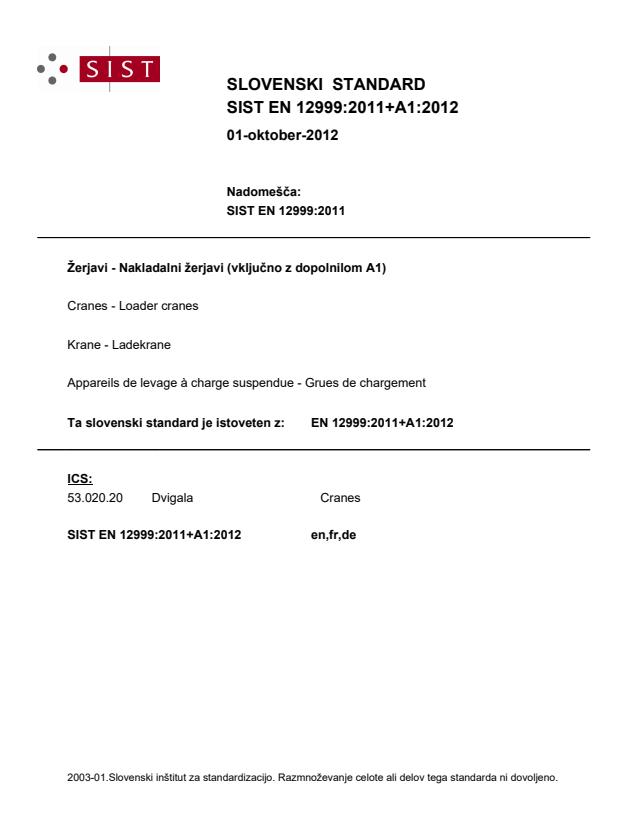
Žerjavi - Nakladalni žerjavi (vključno z dopolnilom A1)
Ta evropski standard določa minimalne zahteve za konstrukcijo, izračun, preglede in preskuse hidravličnih nakladalnih žerjavov ter njihovih elementov za pritrditev na vozila ali statične podlage. Ta evropski standard se ne uporablja za nakladalne žerjave, ki se uporabljajo na krovu ladij ali plavajočih konstrukcij, ali žerjave s členjeno roko, ki so konstruirani kot skupni sestavni deli posebne opreme, kot so zgibni polpriklopniki. Nevarnosti, ki jih zajema ta standard, so opredeljene v točki 4. Ta evropski standard ne zajema nevarnosti v zvezi z dviganjem oseb. Ta evropski standard se ne uporablja za nakladalne žerjave, ki so bili izdelani, preden je bil objavljen kot standard EN.
General Information
- Status
- Withdrawn
- Publication Date
- 14-Oct-2012
- Withdrawal Date
- 21-Aug-2024
- Technical Committee
- DTN - Lift and transport appliances
- Current Stage
- 9900 - Withdrawal (Adopted Project)
- Start Date
- 21-Aug-2024
- Due Date
- 13-Sep-2024
- Completion Date
- 22-Aug-2024
Relations
- Effective Date
- 01-Oct-2012
- Consolidated By
SIST EN 12999:2011+A2:2018 - Cranes - Loader cranes - Effective Date
- 22-Feb-2017

Frequently Asked Questions
SIST EN 12999:2011+A1:2012 is a standard published by the Slovenian Institute for Standardization (SIST). Its full title is "Cranes - Loader cranes". This standard covers: This European Standard specifies minimum requirements for design, calculation, examinations and tests of hydraulic powered loader cranes and their mountings on vehicles or static foundations. This European Standard does not apply to loader cranes used on board ships or floating structures or to articulated boom system cranes which are designed as total integral parts of special equipment such as forwarders. The hazards covered by this standard are identified in Clause 4. This European Standard does not cover hazards related to the lifting of persons. This European Standard is not applicable to loader cranes which are manufactured before the date of its publication as EN. NOTE The use of cranes for lifting of persons can be subject to specific national regulations.
This European Standard specifies minimum requirements for design, calculation, examinations and tests of hydraulic powered loader cranes and their mountings on vehicles or static foundations. This European Standard does not apply to loader cranes used on board ships or floating structures or to articulated boom system cranes which are designed as total integral parts of special equipment such as forwarders. The hazards covered by this standard are identified in Clause 4. This European Standard does not cover hazards related to the lifting of persons. This European Standard is not applicable to loader cranes which are manufactured before the date of its publication as EN. NOTE The use of cranes for lifting of persons can be subject to specific national regulations.
SIST EN 12999:2011+A1:2012 is classified under the following ICS (International Classification for Standards) categories: 53.020.20 - Cranes. The ICS classification helps identify the subject area and facilitates finding related standards.
SIST EN 12999:2011+A1:2012 has the following relationships with other standards: It is inter standard links to SIST EN 12999:2011, SIST EN 12999:2011+A2:2018. Understanding these relationships helps ensure you are using the most current and applicable version of the standard.
SIST EN 12999:2011+A1:2012 is associated with the following European legislation: EU Directives/Regulations: 2006/42/EC. When a standard is cited in the Official Journal of the European Union, products manufactured in conformity with it benefit from a presumption of conformity with the essential requirements of the corresponding EU directive or regulation.
You can purchase SIST EN 12999:2011+A1:2012 directly from iTeh Standards. The document is available in PDF format and is delivered instantly after payment. Add the standard to your cart and complete the secure checkout process. iTeh Standards is an authorized distributor of SIST standards.
Standards Content (Sample)
2003-01.Slovenski inštitut za standardizacijo. Razmnoževanje celote ali delov tega standarda ni dovoljeno.Krane - LadekraneAppareils de levage à charge suspendue - Grues de chargementCranes - Loader cranes53.020.20DvigalaCranesICS:Ta slovenski standard je istoveten z:EN 12999:2011+A1:2012SIST EN 12999:2011+A1:2012en,fr,de01-oktober-2012SIST EN 12999:2011+A1:2012SLOVENSKI
STANDARDSIST EN 12999:20111DGRPHãþD
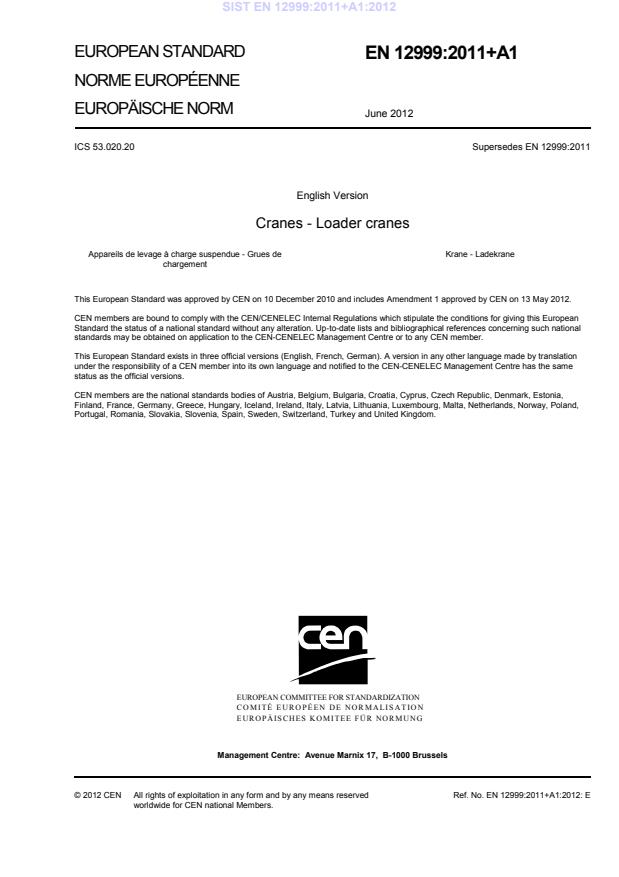
EUROPEAN STANDARD NORME EUROPÉENNE EUROPÄISCHE NORM
EN 12999:2011+A1
June 2012 ICS 53.020.20 Supersedes EN 12999:2011English Version
Cranes - Loader cranes
Appareils de levage à charge suspendue - Grues de chargement
Krane - Ladekrane This European Standard was approved by CEN on 10 December 2010 and includes Amendment 1 approved by CEN on 13 May 2012.
CEN members are bound to comply with the CEN/CENELEC Internal Regulations which stipulate the conditions for giving this European Standard the status of a national standard without any alteration. Up-to-date lists and bibliographical references concerning such national standards may be obtained on application to the CEN-CENELEC Management Centre or to any CEN member.
This European Standard exists in three official versions (English, French, German). A version in any other language made by translation under the responsibility of a CEN member into its own language and notified to the CEN-CENELEC Management Centre has the same status as the official versions.
CEN members are the national standards bodies of Austria, Belgium, Bulgaria, Croatia, Cyprus, Czech Republic, Denmark, Estonia, Finland, France, Germany, Greece, Hungary, Iceland, Ireland, Italy, Latvia, Lithuania, Luxembourg, Malta, Netherlands, Norway, Poland, Portugal, Romania, Slovakia, Slovenia, Spain, Sweden, Switzerland, Turkey and United Kingdom.
EUROPEAN COMMITTEE FOR STANDARDIZATION
COMITÉ EUROPÉEN DE NORMALISATION EUROPÄISCHES KOMITEE FÜR NORMUNG
Management Centre:
Avenue Marnix 17,
B-1000 Brussels © 2012 CEN All rights of exploitation in any form and by any means reserved worldwide for CEN national Members. Ref. No. EN 12999:2011+A1:2012: ESIST EN 12999:2011+A1:2012
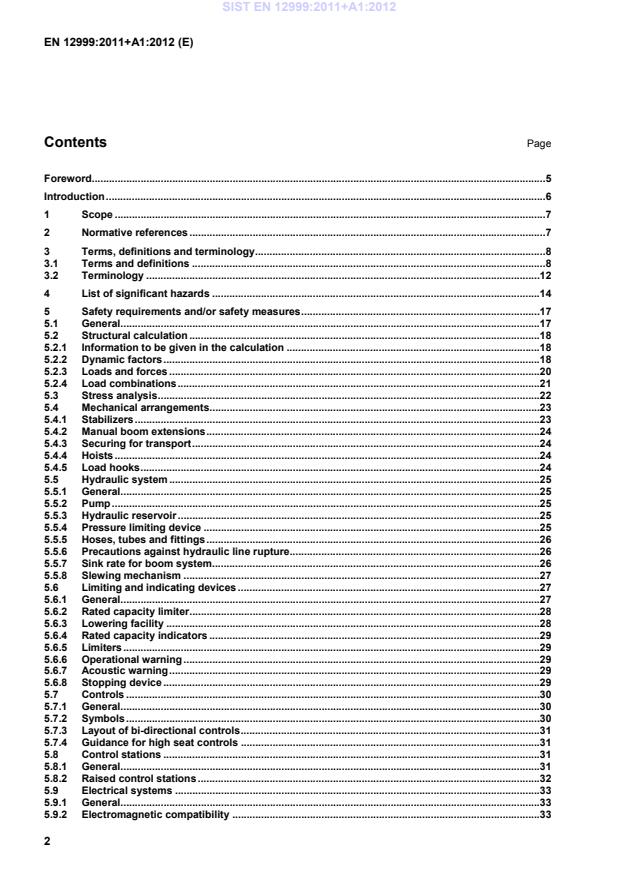
Examples of configurations and mountings . 51A.1Boom systems . 51A.1.1Loader cranes with straight boom system . 51A.1.2Loader cranes with articulated boom system . 51A.2Examples of loader crane mountings . 52Annex B (informative)
Stress history parameter s and stress history classes S. 56Annex C (informative)
Explanatory notes . 58C.1Rated capacity limiters . 58C.2Timber handling cranes - Line rupture . 58C.3Control stations . 58Annex D (informative)
Examples of dangerous movements . 59Annex E (normative)
Symbols for working and setting-up functions . 60Annex F (informative)
Control system – Preferred vertical layout for controls operated from the ground . 62Annex G (informative)
Control system - Horizontal layout order . 64Annex H (informative)
Control levers for high seats and remote controls . 67H.1High seat controls . 67H.1.1Multidirectional (joy-stick) controls . 67H.1.2Bi-directional controls . 67H.2Remote controls . 67Annex I (not used) . 70SIST EN 12999:2011+A1:2012
Cabins fitted on vehicle mounted loader cranes up to a net lifting moment of 250 kNm . 71Annex K (informative)
Examples of raised control stations . 74Annex L (normative)
Raised control stations - Measures regarding hand rails and hand holds, ladders and steps . 76Annex M (informative)
Installation of a loader crane on a vehicle . 79M.1General . 79M.2Installation: minimum data . 79M.2.1Crane dimensions in transport position: data . 79M.2.2Crane data (see Figure M.2) . 80M.2.3Mounting data . 80M.2.4Power requirements . 80M.2.5Stability calculations: data . 80M.3Power take off (PTO) and pump displacement . 81M.4Calculation method for determination of sub-frame dimensions . 82M.4.1General considerations . 82M.4.2Stresses . 82M.4.3Material and limit states . 82M.4.4Symbols and equations . 83Annex N (informative)
Selection of a suitable set of crane standards for a given application . 85Annex ZA (informative)
Relationship between this European Standard and the Essential Requirements of EU Directive 2006/42/EC . 86Bibliography . 87 SIST EN 12999:2011+A1:2012
!". This document has been prepared under a mandate given to CEN by the European Commission and the European Free Trade Association, and supports essential requirements of EU Directive(s). For relationship with EU Directive(s), see informative Annex ZA, which is an integral part of this document. According to the CEN/CENELEC Internal Regulations, the national standards organizations of the following countries are bound to implement this European Standard: Austria, Belgium, Bulgaria, Croatia, Cyprus, Czech Republic, Denmark, Estonia, Finland, France, Germany, Greece, Hungary, Iceland, Ireland, Italy, Latvia, Lithuania, Luxembourg, Malta, Netherlands, Norway, Poland, Portugal, Romania, Slovakia, Slovenia, Spain, Sweden, Switzerland, Turkey and the United Kingdom.
The hazards covered by this standard are identified in Clause 4. This European Standard does not cover hazards related to the lifting of persons. This European Standard is not applicable to loader cranes which are manufactured before the date of its publication as EN. NOTE The use of cranes for lifting of persons can be subject to specific national regulations. 2 Normative references !The following documents, in whole or in part, are normatively referenced in this document and are indispensable for its application. For dated references, only the edition cited applies. For undated references, the latest edition of the referenced document (including any amendments) applies." EN 349:1993+A1:2008, Safety of machinery — Minimum gaps to avoid crushing of parts of the human body EN 12077-2:1998+A1:2008, Cranes safety — Requirements for health and safety — Part 2: Limiting and indicating devices EN 14492-2:2006+A1:2009, Cranes — Power driven winches and hoists — Part 2: Power driven hoists EN 12644-1:2001+A1:2008, Cranes – Information for use and testing — Part 1: Instructions EN 12644-2:2000+A1:2008, Cranes — Information for use and testing — Part 2: Marking EN 13001-1:2004+A1:2009, Cranes — General design — Part 1: General principles and requirements EN 13001-2:2004+A3:2009, Cranes safety — General design — Part 2: Load effects prEN 13001-3-1:2010, Cranes — General design — Part 3-1: Limit states and proof competence of steel structure EN 13557:2003+A2:2008, Cranes — Controls and control stations EN 13586:2004+A1:2008, Cranes — Access EN 61000-6-2:2005, Electromagnetic compatibility (EMC) — Part 6-2: Generic standards — Immunity for industrial environments (IEC 61000-6-2:2005) EN 61000-6-4:2007, Electromagnetic compatibility (EMC) — Part 6-4: Generic standards — Emission standard for industrial environments (IEC 61000-6-4:2006) EN 60204-32:2008, Safety of machinery — Electrical equipment of machines — Part 32: Requirements for hoisting machines (IEC 60204-32:2008) EN 954-1:1996, Safety of machinery — Safety related parts of control systems — Part 1: General principles for design SIST EN 12999:2011+A1:2012
1) For convenience of reference the definitions are - with the exception of 3.1.1 loader crane - grouped in alphabetical order in the English version. SIST EN 12999:2011+A1:2012
The largest load appearing in the load plate. 3.1.24 maximum working pressure maximum pressure in pump circuit or individual working function 3.1.25 net lifting moment rated capacity multiplied by outreach 3.1.26 non-fixed load lifting attachment lifting accessory which can be fitted directly or indirectly to the hook or any other coupling device of a crane by the user without affecting its integrity 3.1.27 outreach horizontal distance between the axis of rotation of the column and point of load attachment 3.1.28 outreach, hydraulic outreach which can be obtained with hydraulically actuated parts of the boom system 3.1.29 payload load which is lifted by the crane and suspended from the non-fixed load-lifting attachment(s) or, if such an attachment is not used, directly from the fixed load-lifting attachment(s) 3.1.30 port relief valve valve which limits the pressure supplied to a hydraulic actuator SIST EN 12999:2011+A1:2012
6 1st boom 12 boom extension, manual 18 3rd boom cylinder
Figure 1 — Main parts of a loader crane SIST EN 12999:2011+A1:2012
- Inadequacy of mechanical strength of the crane and its parts 5.1, 5.2, 5.3, 5.4, 5.5.1, 5.5.4, 5.5.5, 5.5.8, 5.8.2.1, 5.8.2.2, 5.10.2 1.1 Crushing hazard 5.8.1, 5.8.2.2, 5.8.2.3, 5.10.2.31.2 Shearing hazard
1.3 Cutting or severing hazard
1.4 Entanglement hazard
1.5 Drawing-in or trapping hazard
1.6 Impact hazard
1.7 Stabbing or puncture hazard
1.8 Friction or abrasion hazard
1.9 High pressure fluid injection or ejection hazard 5.5.1, 5.5.5, 5.10.7, 7.2.3.6, 7.2.4.2 1.10 Ejection of parts 5.4.1.2, 5.4.1.3, 5.4.2, 5.4.3 1.11 Loss of stability 5.4.1, 5.6.1.1, 5.6.1.2, 5.6.1.8, 5.6.3, 5.10.2.1, 5.10.3 1.12 Slip, trip, fall 5.8.2.2, 5.8.2.3, 5.8.2.4, 5.10.82 Electrical hazards due to: 2.1 Contact of persons with live parts (direct contact) 5.9, 5.10.6, 7.2.3.1 d) 2.2 Contact of persons with parts which have become live under faulty conditions (indirect contact)
3.1 Burns, scalds and other injuries by possible contact of persons with objects or materials with an extreme high or low temperature, by flames or explosions and also by radiation of heat sources 5.5.5, 5.10.2.3 3.2 Damage to health by hot or cold working environment 7.2.3.8 4 Hazards generated by noise5.10.4, 7.2.3.9 5 Hazards generated by vibration5.10.5 7 Hazards generated by materials and substances (and their constituent elements) processed or used by the machinery 5.10.2.3 7.1 Hazards from contact with or inhalation of harmful fluids, gases, mists, fumes and dusts 7.2.4.1 8 Hazards generated by neglecting ergonomic principles in machinery design, as e.g. hazards from:
8.1 Unhealthy postures or excessive effort 5.4.1.3, 5.4.2, 5.7, 5.8, 5.10.8 8.2 Inadequate consideration of hand-arm or foot-leg anatomy 5.7, 5.8 8.3 Neglected use of personal protective equipment
8.4 Inadequate local lighting 7.2.3.7 f) 8.6 Human error, human behaviour 5.6, 5.7.1, 5.7.2, 7.2.3, 7.2.4 SIST EN 12999:2011+A1:2012
10.1 Failure/disorder of the control system 5.5.6.1, 5.5.6.2, 5.5.7, 5.6.6, 5.6.8, 5.7.1 11 Hazards caused by missing and/or incorrectly positioned safety related measures/ means
11.1 Guards 5.5.5, 5.7.1, 5.8.2.2, 5.8.2.3, 5.10.2.3 11.2 Safety related (protection) devices 5.4.1, 5.4.3, 5.6.3, 5.6.6, 5.6.7 11.4 Safety signs, signals, symbols 5.4.1.3, 5.6.7, 5.7.2, 7.3.4, 7.3.5 11.5 Information or warning devices 5.6.1, 5.6.4, 5.6.7, 7.1, 7.2, 7.311.6 Visibility 5.4.3, 5.8.1, 7.3.4.1 11.7 Emergency devices 5.6.3, 5.6.8 15 Assembly errors7.2.2, 7.2.4 18 Loss of stability/overturning of machine5.4.1, 5.6.1, 5.6.2, 5.6.4, 5.6.5, 5.6.6, 5.10.3 SIST EN 12999:2011+A1:2012
27 Mechanical hazards and hazardous events
27.1 From load falls, collisions, machine tipping caused by:
27.1.1 Lack of stability 5.10.3, 6.2.5 27.1.2 Uncontrolled loading – overloading – stabilizing moment exceeded 5.5.4, 5.6.1, 5.6.2, 5.6.3, 5.6.4, 5.6.5 27.1.3 Uncontrolled amplitude of movements 5.6.6 27.1.4 Unexpected/unintended movement of loads 5.5.6, 5.5.7, 5.5.8 27.1.5 Inadequate holding devices/ accessories 5.4.2, 7.2.3.7 27.2 From access of persons to load support 7.2.3.1 e) 27.4 From insufficient mechanical strength of parts 5.1, 5.2, 5.3, 5.5.8, 5.10.2 27.8 From abnormal conditions of assembly/testing/use/maintenance 5.10, 7.1, 7.2. 7.3 29 Hazards generated by neglecting ergonomic principles 29.1 Insufficient visibility from the driving position 5.8.1
5 Safety requirements and/or safety measures 5.1 General Machinery shall conform to the safety requirements and/or measures of this clause. In addition, the machine shall be designed in accordance with the principles of EN ISO 12100 for hazards relevant but not significant which are not dealt with by this European Standard. The rated capacity shall be calculated from the following: a) the working pressure in the cylinders; b) the area of the load carrying cylinders; c) the geometry; d) dead loads; SIST EN 12999:2011+A1:2012
Table 2b — Values of vh Load combination Type of hoist drive and its operation method HD1 HD4 HD5 A1, B1 vh,max 0,5 × vh,max vh = 0 C1 vh,max vh,max 0,5 × vh,max
where HD1 is the hoist drive can only be operated at a fixed speed; HD4 is the start of the lift is performed with continuously increasing speed; HD5 is the hoist drive control is automatic and ensures that the speed influence on the dynamic force is negligible; vh,max is the maximum vertical hook speed. In load combinations A1 and B1, vh,max is the maximum vertical hook speed that is given by any single hydraulic drive action. In load combination C1, vh,max is the maximum vertical hook speed from all articulation hydraulic drives acting simultaneously. NOTE
In load combinations A and B it is assumed that the dynamic peaks from simultaneous movements do not coincide. The unlikely event that the dynamic peaks coincide and are superimposed is covered by load combination C1. 5.2.2.3 Effect of sudden release of a part of the gross load For cranes that release or drop a part of the gross load as a working procedure during intended use, such as when grabs or magnets are used, the peak dynamic effect on the crane can be simulated by multiplying the gross load by the factor Φ3. The value is given by: Φ3 = 1 - ∆m × (1 + β) /m
where m
is the mass of the gross load; ∆m
is the released or dropped part of the gross load; SIST EN 12999:2011+A1:2012
= 0,5
for cranes equipped with grabs or similar slow-release devices; β
= 1,0 for cranes equipped with magnets or similar rapid-release devices. 5.2.2.4 Effects caused by acceleration/deceleration of the slewing drive The dynamic factor Φ5h shall have the value 1,05 for hook duty and 1,3 for bucket or grapple duty. 5.2.3 Loads and forces 5.2.3.1 General The following loads and forces shall be taken into account: a) regular loads: 1) dead loa
...
Questions, Comments and Discussion
Ask us and Technical Secretary will try to provide an answer. You can facilitate discussion about the standard in here.
Loading comments...