

kSIST FprEN 17773:2026
(Main)Organic and organo-mineral fertilizers - Determination of the dry matter content
- Abstract
This document specifies the procedure for the determination and calculation of the dry matter content of organic and organo-mineral fertilizers for which the results of the performed analysis are to be calculated to the dry matter content basis.
This document is applicable and validated for several types of matrices as indicated in Annex A.
This document is applicable to the component materials “by-products”, “thermal oxidation materials and derivatives”, or “recovered high-purity materials”, when used as components of fertilizing products, as well as the fertilizing products blends where a blend is a mix of at least two of the following components: fertilizers, liming materials, soil improvers, growing media, inhibitors, plant biostimulants and where the following category organic fertilizers, organo-mineral fertilizers is the highest % in the blend by mass or volume, or in the case of liquid form by dry mass. If the organic fertilizer or the organo-mineral fertilizers is not the highest % in the blend, the European Standard for the highest % of the blend applies. In case a fertilizing product blend is composed of components in equal quantity, the user decides which standard to apply. Variations in analytical methods for fertilizing product blends can lead to differing results as some components or matrix interactions can affect the outcome. Validation procedures have shown that developed standard methods are robust and reliable across diverse product compositions, but possible interferences and unexpected results when analysing fertilizing product blends are possible.
- Status
- Not Published
- Public Enquiry End Date
- 01-Apr-2026
- Technical Committee
- KAT - Soil quality
- Current Stage
- 5020 - Formal vote (FV) (Adopted Project)
- Start Date
- 02-Nov-2026
- Due Date
- 21-Dec-2026
- Completion Date
- 17-Nov-2026

kSIST FprEN 17773:2026 is the SIST publication of draft European Standard prEN 17773 from CEN. It specifies a gravimetric procedure for determining and calculating the dry matter content of organic and organo-mineral fertilizers, including certain component materials and qualifying fertilizing product blends. It is intended for laboratories, fertilizer manufacturers, and quality teams that need results reported on a dry-matter basis.
What does kSIST FprEN 17773:2026 specify?
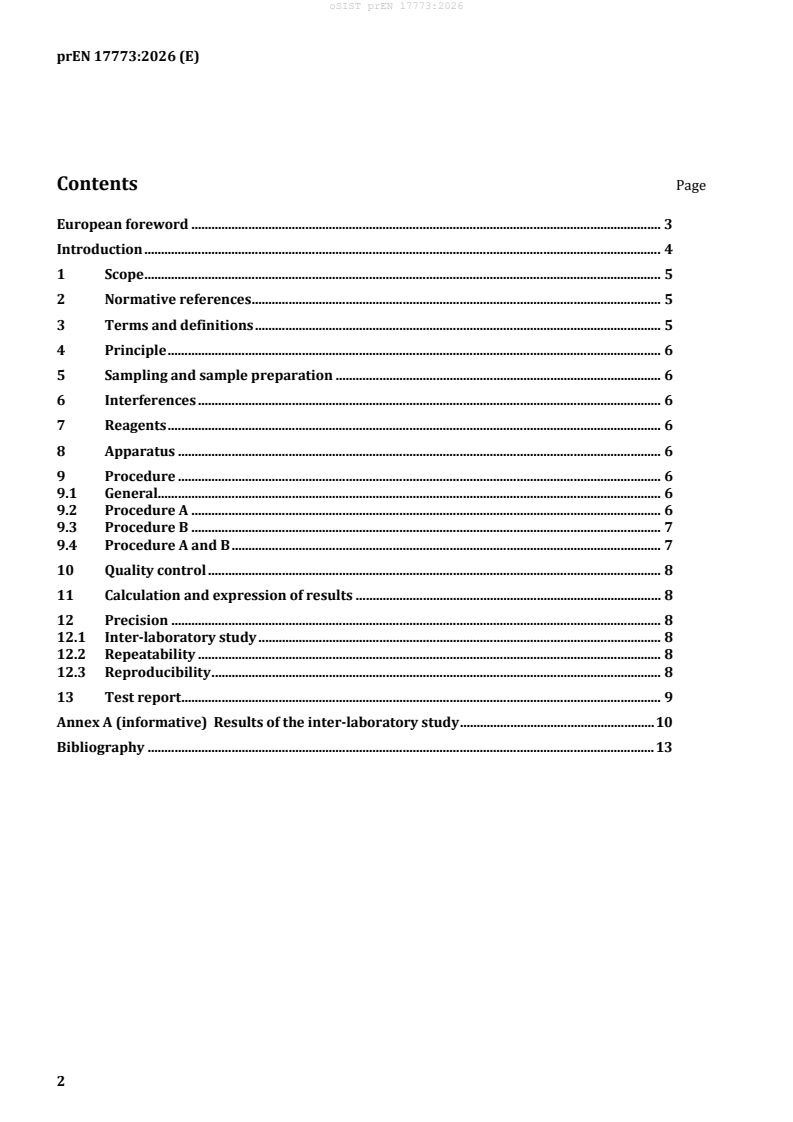
kSIST FprEN 17773:2026 specifies the dry matter determination method for organic and organo-mineral fertilizers and for several validated matrix types. The main body is organized into Clauses 1 to 13, covering scope, normative references, terms, principle, sampling and sample preparation, interferences, reagents, apparatus, procedure, quality control, calculation and expression of results, precision, and test report.
Sampling is handled separately, while sample preparation is tied to EN 1482-2.
| Annex | What it covers |
|---|---|
| Annex A (informative) | Results of the inter-laboratory study used to support the method, including the sample set and precision evaluation. |
What are the key requirements of kSIST FprEN 17773:2026?
Which products and samples are in scope?
Clause 1 applies the method to organic and organo-mineral fertilizers whose results are to be calculated on a dry matter basis. It also applies to the component materials "by-products", "thermal oxidation materials and derivatives", and "recovered high-purity materials", and to fertilizing product blends when organic fertilizers or organo-mineral fertilizers are the dominant component. In practice, the user must check that the product composition matches the validated range before using this method.
How is the dry matter content measured?
Clause 4 states the principle: dry the sample in an oven at (105 ± 2) °C and determine dry matter from the mass loss. The method applies to solid samples and to samples that become solid during drying, and it treats material lost at the drying temperature as water for the purpose of the calculation. This matters because the result depends on controlled drying, not on a fixed time alone.
What sample preparation and procedure does the method require?
Clause 5 says sampling is not part of the method and that the laboratory should receive a representative sample that has not been altered in transport or storage; sample preparation follows EN 1482-2. Clause 9 gives two procedures: Procedure A for solid samples and many liquid samples, and Procedure B for liquid samples that may form a crust or foam, using sand or another heat-stable inert material. The choice of procedure affects whether the sample dries evenly and whether the result is reliable.
How is constant mass confirmed?
Clause 9.4 requires re-drying and re-weighing until the mass change after 1 h is within 0.5% or 2 mg, whichever is greater. If the mass is still unstable after three cycles, drying may stop after at least 16 h, and the last weighing is recorded. Alternative techniques such as infrared or halogen drying are allowed only when comparable results are demonstrated and the chosen technique is reported.
What controls and calculations are required?
Clause 10 recommends duplicate analysis when the sample is heterogeneous or its behaviour is uncertain, and at least one duplicate in each batch. Clause 11 calculates dry matter from the empty vessel mass, the loaded vessel mass, and the dried residue mass, with results expressed as % or g/kg. The same sub-sample should be used for related dry-matter determinations, so the reported values are directly comparable.
How are precision and reporting handled?
Clause 12 gives repeatability and reproducibility information based on an inter-laboratory study and ISO 5725-2. Clause 13 requires the test report to identify the sample, state the result and the method used, record the sampling date and procedure if known, give the completion date, and note any deviations or incidents that could affect the result. This supports traceability when results are compared between laboratories or used for product release.
What terms does kSIST FprEN 17773:2026 define?
- Dry residue - the remaining mass fraction of a sample after drying under specified conditions.
- Dry matter content - the mass fraction calculated from the dry residue determination and reported as the test result.
- CMC 11 - the category for by-products mentioned in the introduction as a validated matrix type for this method.
- CMC 13 - the category for thermal oxidation materials and derivatives mentioned in the introduction.
- CMC 15 - the category for recovered high-purity materials mentioned in the introduction.
Who uses kSIST FprEN 17773:2026?
kSIST FprEN 17773:2026 is used by testing laboratories, fertilizer producers, quality assurance teams, and conformity assessment bodies working with organic and organo-mineral fertilizers. It is also relevant for users handling fertilizing product blends and component materials such as by-products, thermal oxidation materials and derivatives, and recovered high-purity materials. They use it to measure dry matter for batch control, product comparison, and reporting on a common basis.
What changed in kSIST FprEN 17773:2026 from the previous edition?
Compared with CEN/TS 17773:2022, kSIST FprEN 17773:2026 includes these stated changes:
- the Technical Specification has been adopted as a European Standard;
- the scope has been updated, including clarification for fertilizing product blends;
- normative references to sampling have been added;
- the terms and definitions have been revised and updated;
- precision has been added in Clause 12;
- the test report requirements in Clause 13 have been revised;
- the bibliography has been revised;
- Annex A on the inter-laboratory study has been added.
Which standards are used with kSIST FprEN 17773:2026?
| Standard | What it contributes |
|---|---|
| EN 12944-1 | General vocabulary for fertilizers and liming materials. |
| EN 12944-2 | Terms relating to fertilizers. |
| EN 1482-2 | General sample preparation provisions. |
| EN 1482-1 | General sampling provisions, cited for recommended sampling methods. |
| EN 1482-3 | Sampling of static heaps, cited for recommended sampling methods. |
| ISO 5725-2 | Basis for calculating repeatability and reproducibility. |
The introduction also points to EN 12048, EN 14787, EN 13040, EN 15934, ISO 11465 and EN 17704 as background standards for dry matter or water-related methods in related matrices.
What does the kSIST FprEN 17773:2026 document contain?
kSIST FprEN 17773:2026 contains the drying principle, the required apparatus, and two practical procedures for different sample behaviours. It also includes the constant-mass check, an alternative for other drying techniques when equivalence is shown, and the calculation method for reporting results. Clause 12 and Table 1 provide precision data, while Annex A documents the inter-laboratory study, the sample set, and the statistical evaluation used to support the method.
Relations
- Effective Date
- 01-Mar-2026
Get Certified
Connect with accredited certification bodies for this standard

Control Union Certifications
Global certification for agriculture and sustainability.

ECOCERT
Organic and sustainability certification.

FSC International
Forest Stewardship Council certification.
Sponsored listings
Frequently Asked Questions
kSIST FprEN 17773:2026 is a draft published by the Slovenian Institute for Standardization (SIST). Its full title is "Organic and organo-mineral fertilizers - Determination of the dry matter content". This standard covers: This document specifies the procedure for the determination and calculation of the dry matter content of organic and organo-mineral fertilizers for which the results of the performed analysis are to be calculated to the dry matter content basis. This document is applicable and validated for several types of matrices as indicated in Annex A. This document is applicable to the component materials “by-products”, “thermal oxidation materials and derivatives”, or “recovered high-purity materials”, when used as components of fertilizing products, as well as the fertilizing products blends where a blend is a mix of at least two of the following components: fertilizers, liming materials, soil improvers, growing media, inhibitors, plant biostimulants and where the following category organic fertilizers, organo-mineral fertilizers is the highest % in the blend by mass or volume, or in the case of liquid form by dry mass. If the organic fertilizer or the organo-mineral fertilizers is not the highest % in the blend, the European Standard for the highest % of the blend applies. In case a fertilizing product blend is composed of components in equal quantity, the user decides which standard to apply. Variations in analytical methods for fertilizing product blends can lead to differing results as some components or matrix interactions can affect the outcome. Validation procedures have shown that developed standard methods are robust and reliable across diverse product compositions, but possible interferences and unexpected results when analysing fertilizing product blends are possible.
This document specifies the procedure for the determination and calculation of the dry matter content of organic and organo-mineral fertilizers for which the results of the performed analysis are to be calculated to the dry matter content basis. This document is applicable and validated for several types of matrices as indicated in Annex A. This document is applicable to the component materials “by-products”, “thermal oxidation materials and derivatives”, or “recovered high-purity materials”, when used as components of fertilizing products, as well as the fertilizing products blends where a blend is a mix of at least two of the following components: fertilizers, liming materials, soil improvers, growing media, inhibitors, plant biostimulants and where the following category organic fertilizers, organo-mineral fertilizers is the highest % in the blend by mass or volume, or in the case of liquid form by dry mass. If the organic fertilizer or the organo-mineral fertilizers is not the highest % in the blend, the European Standard for the highest % of the blend applies. In case a fertilizing product blend is composed of components in equal quantity, the user decides which standard to apply. Variations in analytical methods for fertilizing product blends can lead to differing results as some components or matrix interactions can affect the outcome. Validation procedures have shown that developed standard methods are robust and reliable across diverse product compositions, but possible interferences and unexpected results when analysing fertilizing product blends are possible.
kSIST FprEN 17773:2026 is classified under the following ICS (International Classification for Standards) categories: 65.080 - Fertilizers. The ICS classification helps identify the subject area and facilitates finding related standards.
kSIST FprEN 17773:2026 has the following relationships with other standards: It is inter standard links to SIST-TS CEN/TS 17773:2023. Understanding these relationships helps ensure you are using the most current and applicable version of the standard.
kSIST FprEN 17773:2026 is associated with the following European legislation: EU Directives/Regulations: 2019/1009; Standardization Mandates: M/564. When a standard is cited in the Official Journal of the European Union, products manufactured in conformity with it benefit from a presumption of conformity with the essential requirements of the corresponding EU directive or regulation.
kSIST FprEN 17773:2026 is available in PDF format for immediate download after purchase. The document can be added to your cart and obtained through the secure checkout process. Digital delivery ensures instant access to the complete standard document.
Standards Content (Sample)
Contents
- Introduction
- 1 Scope
- 2 Normative references
- 3 Terms and definitions
- 3.1 dry residue
- 3.2 dry matter content
- 4 Principle
- 5 Sampling and sample preparation
- 6 Interferences
- 7 Reagents
- 8 Apparatus
- 8.1 Drying system, thermostatically controlled and capable of maintaining temperature of
- 8.4 Evaporating dish or crucible. Temperature tolerant laboratory vessel withstanding at least
- 9 Procedure
- 9.1 General
- 9.2 Procedure A
- 9.3 Procedure B
- 9.4 Procedure A and B
- 10 Quality control
- 11 Calculation and expression of results
- 12 Precision
- 12.1 Inter-laboratory study
- 12.2 Repeatability
- 12.3 Reproducibility
- 13 Test report
- Annex A
- Bibliography
Introduction
NOTE 1 Regulation (EU) 2019/1009 [1] specifies safety and quality requirements for component materials and component material categories (CMCs) of fertilizing products available on the EU market. NOTE 2 By-products within the meaning of Directive 2008/98/EC have been classified as CMC 11, thermal oxidation materials or derivatives as CMC 13 and recovered high purity materials as CMC 15 in Regulation (EU) 2019/1009 [1].
The other standards for determination of dry matter in solid fertilizers and liming materials [2, 3], in soil improvers and growing media [4] and sludge, soil and other solid matrices [5, 6] were studied as a basis of the described method. The sand pan technique suitable for liquid fertilizers where there is a risk of a cake surface formation or foam formation was based on the method of food analysis [7]. WARNING — Persons using this document should be familiar with usual laboratory practice. This document does not purport to address all of the safety issues, if any, associated with its use. It is the responsibility of the user to establish appropriate health and safety practices and to ensure compliance with any national regulatory conditions.
IMPORTANT — It is absolutely essential that tests conducted according to this document are carried out by suitably trained staff.
oSIST prEN 17773:2026 prEN 17773:2026 (E)
1 Scope
This document specifies the procedure for the determination and calculation of the dry matter content of organic and organo-mineral fertilizers for which the results of the performed analysis are to be calculated to the dry matter content basis.
This document is applicable and validated for several types of matrices as indicated in Annex A. This document is applicable to the component materials “by-products”, “thermal oxidation materials and derivatives”, or “recovered high-purity materials”, when used as components of fertilizing products, as well as the fertilizing products blends where a blend is a mix of at least two of the following components:
fertilizers, liming materials, soil improvers, growing media, inhibitors, plant biostimulants and where the following category organic fertilizers, organo-mineral fertilizers is the highest % in the blend by mass or volume, or in the case of liquid form by dry mass. If the organic fertilizer or the organo-mineral fertilizers is not the highest % in the blend, the European Standard for the highest % of the blend applies. In case a fertilizing product blend is composed of components in equal quantity, the user decides which standard to apply. Variations in analytical methods for fertilizing product blends can lead to differing results as some components or matrix interactions can affect the outcome. Validation procedures have shown that developed standard methods are robust and reliable across diverse product compositions, but possible interferences and unexpected results when analysing fertilizing product blends are possible.
2 Normative references
The following documents are referred to in the text in such a way that some or all of their content constitutes requirements of this document. For dated references, only the edition cited applies. For undated references, the latest edition of the referenced document (including any amendments) applies. EN 12944-1, Fertilizers and liming materials — Vocabulary — Part 1: General terms EN 12944-2, Fertilizers and liming materials — Vocabulary — Part 2: Terms relating to fertilizers EN 1482-2, Fertilizers, liming materials and inhibitors — Sampling and sample preparation — Part 2:
General sample preparation provisions
3 Terms and definitions
For the purposes of this document, the terms and definitions given in EN 12944-1 and EN 12944-2 and the following apply.
ISO and IEC maintain terminology databases for use in standardization at the following addresses:
- ISO Online browsing platform: available at https://www.iso.org/obp/
- IEC Electropedia: available at https://www.electropedia.org/
3.1 dry residue
remaining mass fraction of a sample after a drying process under specified conditions
3.2 dry matter content
mass fraction of a sample calculated by the determination of dry residue
oSIST prEN 17773:2026 prEN 17773:2026 (E)
4 Principle
The samples are dried to a constant mass in an oven at (105 ± 2) °C. The difference in mass before and after the drying process is used to determine dry matter content. This method applies to solid samples and samples which become solid during the drying process. Volatile compounds volatilizing at temperatures up to and including (105 ± 2) °C are expressed as water using this procedure.
5 Sampling and sample preparation
Sampling is not part of the method specified in this document. Recommended sampling methods are given in EN 1482-1 [10] and in EN 1482-3 [11].
It is important that the laboratory receives a sample that is representative of both the product under consideration and the given analysis. The sample should not have been damaged or changed during transport or storage.
Sample preparation shall be carried out in accordance with EN 1482-2.
6 Interferences
The samples can change during the drying process, e.g. by absorption of carbon dioxide in the case of alkaline samples, or of oxygen by reducing substances.
7 Reagents
7.1 Sand, CAS 14808-60-7.
NOTE Other heat stable inert materials, e.g. pumice stone, diatomaceous earth, etc. are also suitable.
8 Apparatus
8.1 Drying system, thermostatically controlled and capable of maintaining temperature of
(105 ± 2) °C.
8.2 Desiccator, with an active drying agent such as silica gel. 8.3 Analytical balance, capable of weighing to the nearest 1 mg or better.
8.4 Evaporating dish or crucible. Temperature tolerant laboratory vessel withstanding at least
110 °C. Suitable materials are nickel, platinum, aluminium, ceramic, borosilicate glass or quartz, porcelain, etc.
9 Procedure
9.1 General
CAUTION — Flammable or explosive gases can be released from some samples during the drying process.
9.2 Procedure A
This procedure is suitable for solid or liquid organic and organo-mineral fertilizers. The procedure is not suitable for some liquid or semi-liquid samples where there is a risk of a cake surface formation or foam formation which hinders an even drying. For these samples Procedure B (9.3) is preferable.
...