

FprEN 17773
(Main)Organic and organo-mineral fertilizers - Determination of the dry matter content
- Abstract
This document specifies the procedure for the determination and calculation of the dry matter content of organic and organo-mineral fertilizers for which the results of the performed analysis are to be calculated to the dry matter content basis.
This document is applicable and validated for several types of matrices as indicated in Annex A.
This document is applicable to the component materials “by-products”, “thermal oxidation materials and derivatives”, or “recovered high-purity materials”, when used as components of fertilizing products, as well as the fertilizing products blends where a blend is a mix of at least two of the following components: fertilizers, liming materials, soil improvers, growing media, inhibitors, plant biostimulants and where the following category organic fertilizers, organo-mineral fertilizers is the highest % in the blend by mass or volume, or in the case of liquid form by dry mass. If the organic fertilizer or the organo-mineral fertilizers is not the highest % in the blend, the European Standard for the highest % of the blend applies. In case a fertilizing product blend is composed of components in equal quantity, the user decides which standard to apply. Variations in analytical methods for fertilizing product blends can lead to differing results as some components or matrix interactions can affect the outcome. Validation procedures have shown that developed standard methods are robust and reliable across diverse product compositions, but possible interferences and unexpected results when analysing fertilizing product blends are possible.
- Status
- Not Published
- Publication Date
- 03-Feb-2027
- Technical Committee
- CEN/TC 260 - Fertilizers and liming materials
- Drafting Committee
- CEN/TC 260/WG 8 - Organic and organo-mineral fertilizers
- Current Stage
- 5020 - Submission to Vote - Formal Approval
- Start Date
- 15-Oct-2026
- Due Date
- 23-May-2027
- Completion Date
- 23-May-2027

FprEN 17773 is a CEN draft European standard for organic and organo-mineral fertilizers. It specifies a laboratory procedure to determine and calculate dry matter content so results can be reported on a dry matter basis. The method is intended for laboratories and others who test these fertilizers, certain component materials, and some fertilizing product blends.
What does FprEN 17773 specify?
FprEN 17773 specifies the procedure for dry matter determination in organic and organo-mineral fertilizers, together with the way results are calculated and reported. It also shows how the method is organized across sampling, preparation, measurement, calculation, precision, and reporting.
| Annex | What it covers |
|---|---|
| Annex A | Results of the inter-laboratory study used to support method precision |
The scope also states that the method is validated for several matrix types listed in Annex A. For fertilizing product blends, the standard applies when organic fertilizers or organo-mineral fertilizers are the highest share in the blend. If another component is dominant, the European Standard for that highest-share component applies instead, and for equal mixtures the user chooses the standard to use.
What are the key requirements of FprEN 17773?
FprEN 17773 determines dry matter by drying a test portion at a controlled oven temperature and comparing the mass before and after drying. In practice, the user must control sample handling, drying conditions, and weighing closely, because the result depends on mass loss during drying.
Principle and sample handling
Clause 4 sets the principle: dry the sample to constant mass at (105 ± 2) °C and use the mass difference to calculate dry matter content. The method applies to solid samples and to samples that become solid during drying, which matters because the same approach is not suited to every liquid behavior.
Clause 5 says sampling itself is outside the method. Sample preparation follows EN 1482-2, and the laboratory should receive a representative sample that has not been changed during transport or storage. This is important because a poor sample gives a poor result even if the analysis is done correctly.
Interferences, reagents, and apparatus
Clause 6 notes that drying can change some samples, for example by carbon dioxide uptake in alkaline samples or oxygen uptake in reducing samples. Clause 7 allows sand, or another heat-stable inert material, for samples that need dispersion during drying. Clause 8 requires a thermostatically controlled drying system at the specified temperature, a desiccator, an analytical balance to the nearest 1 mg or better, and a suitable evaporating dish or crucible.
Procedure A and Procedure B
Clause 9 gives two procedures. Procedure A is for solid and liquid organic and organo-mineral fertilizers in general. Procedure B is for liquids that may form a surface crust or foam, because sand helps distribute the sample and prevents uneven drying.
Both procedures dry the sample until the mass is constant. The standard accepts other drying techniques, such as infrared or halogen lamp drying, if they are shown to give comparable results. The chosen technique has to be recorded in the test report, which matters when results are compared between laboratories.
Quality control, calculation, and precision
Clause 10 recommends duplicate analysis when sample homogeneity or behavior is uncertain, and at least one duplicate in each batch. Clause 11 gives the calculation of dry matter fraction from the empty vessel mass, loaded mass, and dried mass, with results expressed as % or g/kg. Clause 12 defines repeatability and reproducibility from an inter-laboratory study, and Annex A summarizes that study for the matrices tested.
Clause 13 requires the test report to identify the sample, give the result, state the method and year, record sampling information if known, give the completion date, and note any optional steps or incidents that could have influenced the result.
What terms does FprEN 17773 define?
FprEN 17773 uses a small set of technical terms that are central to the method.
- Dry residue - the remaining mass fraction after drying under the specified conditions.
- Dry matter content - the sample mass fraction calculated from the measured dry residue.
- Constant mass - the point reached when further drying changes the mass only within the stated limit.
- Procedure A - the general drying procedure for solid or liquid fertilizers.
- Procedure B - the sand-assisted drying procedure for liquids that may crust or foam.
- Repeatability - closeness of results from the same method, laboratory, operator, equipment, and short time interval.
- Reproducibility - closeness of results from the same method used in different laboratories with different operators and equipment.
Who uses FprEN 17773?
FprEN 17773 is used by laboratories testing organic and organo-mineral fertilizers, by fertilizer manufacturers checking product quality, and by organizations that need dry matter data on a dry matter basis. It is also relevant for labs handling certain component materials and qualifying fertilizing product blends. Because the procedure requires trained staff, it is mainly a laboratory method rather than a field test.
What changed in FprEN 17773 from the previous edition?
FprEN 17773 will supersede CEN/TS 17773:2022. The foreword lists these changes:
- the Technical Specification was adopted as a European Standard;
- the scope was updated, including clarification for fertilizing product blends;
- normative references to sampling were added;
- terms and definitions were revised and updated;
- precision was added in Clause 12;
- the test report clause was revised;
- the bibliography was revised;
- Annex A with inter-laboratory study results was added.
Which standards are used with FprEN 17773?
FprEN 17773 depends on vocabulary, sampling, sample preparation, and precision standards used alongside the method.
| Standard | What it contributes |
|---|---|
| EN 12944-1 | General fertilizer and liming materials vocabulary |
| EN 12944-2 | Fertilizer-specific vocabulary |
| EN 1482-2 | General sample preparation provisions |
| EN 1482-1 | Recommended sampling methods for general sampling |
| EN 1482-3 | Sampling of static heaps |
| ISO 5725-2 | Repeatability and reproducibility calculations used for precision |
What does the FprEN 17773 document contain?
FprEN 17773 contains the full test method structure from scope through test report, plus precision information and an informative inter-laboratory study annex. Clause 9 separates the practical work into Procedure A and Procedure B, while Clause 12 and Annex A provide the statistical basis for repeatability and reproducibility. The document also includes a calculation clause, a quality control clause, and a reporting clause so laboratories can produce comparable results and document how they were obtained.
Relations
- Revises
CEN/TS 17773:2022 - Organic and organo-mineral fertilizers - Determination of the dry matter content - Effective Date
- 11-Jun-2025
Get Certified
Connect with accredited certification bodies for this standard

Control Union Certifications
Global certification for agriculture and sustainability.

ECOCERT
Organic and sustainability certification.

FSC International
Forest Stewardship Council certification.
Sponsored listings
Frequently Asked Questions
FprEN 17773 is a draft published by the European Committee for Standardization (CEN). Its full title is "Organic and organo-mineral fertilizers - Determination of the dry matter content". This standard covers: This document specifies the procedure for the determination and calculation of the dry matter content of organic and organo-mineral fertilizers for which the results of the performed analysis are to be calculated to the dry matter content basis. This document is applicable and validated for several types of matrices as indicated in Annex A. This document is applicable to the component materials “by-products”, “thermal oxidation materials and derivatives”, or “recovered high-purity materials”, when used as components of fertilizing products, as well as the fertilizing products blends where a blend is a mix of at least two of the following components: fertilizers, liming materials, soil improvers, growing media, inhibitors, plant biostimulants and where the following category organic fertilizers, organo-mineral fertilizers is the highest % in the blend by mass or volume, or in the case of liquid form by dry mass. If the organic fertilizer or the organo-mineral fertilizers is not the highest % in the blend, the European Standard for the highest % of the blend applies. In case a fertilizing product blend is composed of components in equal quantity, the user decides which standard to apply. Variations in analytical methods for fertilizing product blends can lead to differing results as some components or matrix interactions can affect the outcome. Validation procedures have shown that developed standard methods are robust and reliable across diverse product compositions, but possible interferences and unexpected results when analysing fertilizing product blends are possible.
This document specifies the procedure for the determination and calculation of the dry matter content of organic and organo-mineral fertilizers for which the results of the performed analysis are to be calculated to the dry matter content basis. This document is applicable and validated for several types of matrices as indicated in Annex A. This document is applicable to the component materials “by-products”, “thermal oxidation materials and derivatives”, or “recovered high-purity materials”, when used as components of fertilizing products, as well as the fertilizing products blends where a blend is a mix of at least two of the following components: fertilizers, liming materials, soil improvers, growing media, inhibitors, plant biostimulants and where the following category organic fertilizers, organo-mineral fertilizers is the highest % in the blend by mass or volume, or in the case of liquid form by dry mass. If the organic fertilizer or the organo-mineral fertilizers is not the highest % in the blend, the European Standard for the highest % of the blend applies. In case a fertilizing product blend is composed of components in equal quantity, the user decides which standard to apply. Variations in analytical methods for fertilizing product blends can lead to differing results as some components or matrix interactions can affect the outcome. Validation procedures have shown that developed standard methods are robust and reliable across diverse product compositions, but possible interferences and unexpected results when analysing fertilizing product blends are possible.
FprEN 17773 is classified under the following ICS (International Classification for Standards) categories: 65.080 - Fertilizers. The ICS classification helps identify the subject area and facilitates finding related standards.
FprEN 17773 has the following relationships with other standards: It is inter standard links to CEN/TS 17773:2022. Understanding these relationships helps ensure you are using the most current and applicable version of the standard.
FprEN 17773 is associated with the following European legislation: EU Directives/Regulations: 2019/1009; Standardization Mandates: M/564, M/564 Amd 1, M/564 Amd 2. When a standard is cited in the Official Journal of the European Union, products manufactured in conformity with it benefit from a presumption of conformity with the essential requirements of the corresponding EU directive or regulation.
FprEN 17773 is available in PDF format for immediate download after purchase. The document can be added to your cart and obtained through the secure checkout process. Digital delivery ensures instant access to the complete standard document.
Standards Content (Sample)
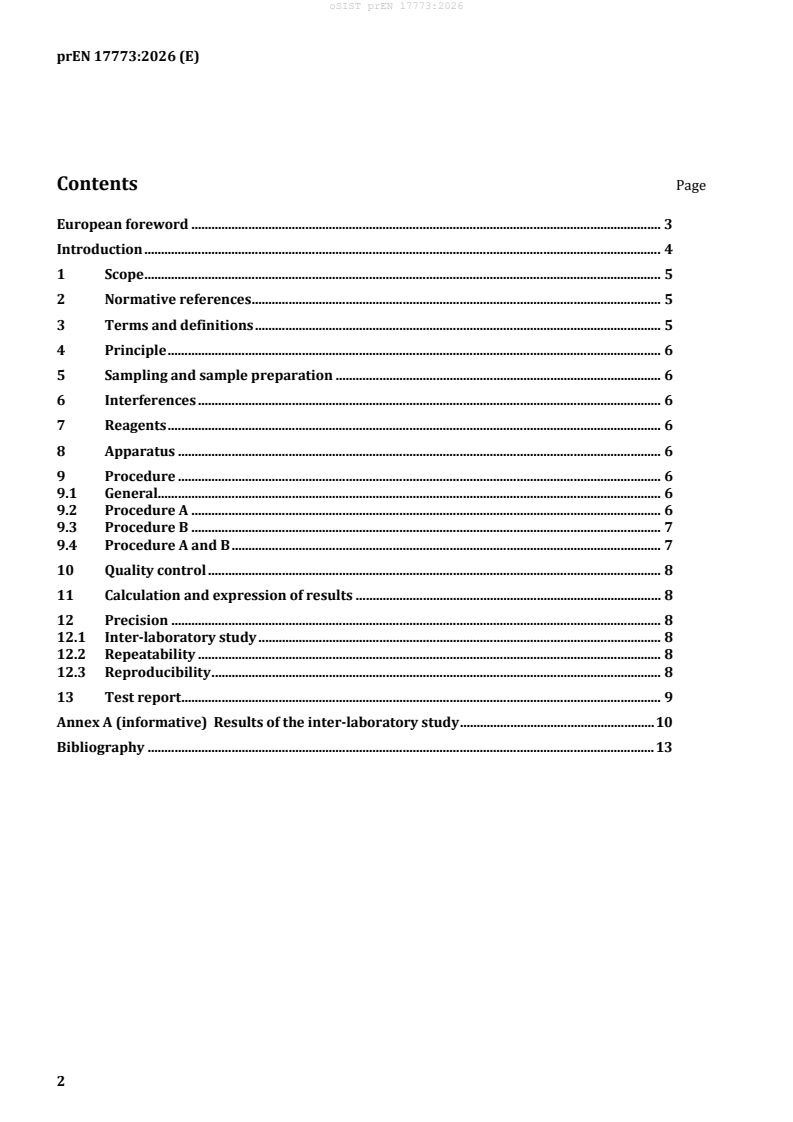
Contents
- Introduction
- 1 Scope
- 2 Normative references
- 3 Terms and definitions
- 3.1 dry residue
- 3.2 dry matter content
- 4 Principle
- 5 Sampling and sample preparation
- 6 Interferences
- 7 Reagents
- 8 Apparatus
- 8.1 Drying system, thermostatically controlled and capable of maintaining temperature of
- 8.4 Evaporating dish or crucible. Temperature tolerant laboratory vessel withstanding at least
- 9 Procedure
- 9.1 General
- 9.2 Procedure A
- 9.3 Procedure B
- 9.4 Procedure A and B
- 10 Quality control
- 11 Calculation and expression of results
- 12 Precision
- 12.1 Inter-laboratory study
- 12.2 Repeatability
- 12.3 Reproducibility
- 13 Test report
- Annex A
- Bibliography
Introduction
NOTE 1 Regulation (EU) 2019/1009 [1] specifies safety and quality requirements for component materials and component material categories (CMCs) of fertilizing products available on the EU market. NOTE 2 By-products within the meaning of Directive 2008/98/EC have been classified as CMC 11, thermal oxidation materials or derivatives as CMC 13 and recovered high purity materials as CMC 15 in Regulation (EU) 2019/1009 [1].
The other standards for determination of dry matter in solid fertilizers and liming materials [2, 3], in soil improvers and growing media [4] and sludge, soil and other solid matrices [5, 6] were studied as a basis of the described method. The sand pan technique suitable for liquid fertilizers where there is a risk of a cake surface formation or foam formation was based on the method of food analysis [7]. WARNING — Persons using this document should be familiar with usual laboratory practice. This document does not purport to address all of the safety issues, if any, associated with its use. It is the responsibility of the user to establish appropriate health and safety practices and to ensure compliance with any national regulatory conditions.
IMPORTANT — It is absolutely essential that tests conducted according to this document are carried out by suitably trained staff.
oSIST prEN 17773:2026 prEN 17773:2026 (E)
1 Scope
This document specifies the procedure for the determination and calculation of the dry matter content of organic and organo-mineral fertilizers for which the results of the performed analysis are to be calculated to the dry matter content basis.
This document is applicable and validated for several types of matrices as indicated in Annex A. This document is applicable to the component materials “by-products”, “thermal oxidation materials and derivatives”, or “recovered high-purity materials”, when used as components of fertilizing products, as well as the fertilizing products blends where a blend is a mix of at least two of the following components:
fertilizers, liming materials, soil improvers, growing media, inhibitors, plant biostimulants and where the following category organic fertilizers, organo-mineral fertilizers is the highest % in the blend by mass or volume, or in the case of liquid form by dry mass. If the organic fertilizer or the organo-mineral fertilizers is not the highest % in the blend, the European Standard for the highest % of the blend applies. In case a fertilizing product blend is composed of components in equal quantity, the user decides which standard to apply. Variations in analytical methods for fertilizing product blends can lead to differing results as some components or matrix interactions can affect the outcome. Validation procedures have shown that developed standard methods are robust and reliable across diverse product compositions, but possible interferences and unexpected results when analysing fertilizing product blends are possible.
2 Normative references
The following documents are referred to in the text in such a way that some or all of their content constitutes requirements of this document. For dated references, only the edition cited applies. For undated references, the latest edition of the referenced document (including any amendments) applies. EN 12944-1, Fertilizers and liming materials — Vocabulary — Part 1: General terms EN 12944-2, Fertilizers and liming materials — Vocabulary — Part 2: Terms relating to fertilizers EN 1482-2, Fertilizers, liming materials and inhibitors — Sampling and sample preparation — Part 2:
General sample preparation provisions
3 Terms and definitions
For the purposes of this document, the terms and definitions given in EN 12944-1 and EN 12944-2 and the following apply.
ISO and IEC maintain terminology databases for use in standardization at the following addresses:
- ISO Online browsing platform: available at https://www.iso.org/obp/
- IEC Electropedia: available at https://www.electropedia.org/
3.1 dry residue
remaining mass fraction of a sample after a drying process under specified conditions
3.2 dry matter content
mass fraction of a sample calculated by the determination of dry residue
oSIST prEN 17773:2026 prEN 17773:2026 (E)
4 Principle
The samples are dried to a constant mass in an oven at (105 ± 2) °C. The difference in mass before and after the drying process is used to determine dry matter content. This method applies to solid samples and samples which become solid during the drying process. Volatile compounds volatilizing at temperatures up to and including (105 ± 2) °C are expressed as water using this procedure.
5 Sampling and sample preparation
Sampling is not part of the method specified in this document. Recommended sampling methods are given in EN 1482-1 [10] and in EN 1482-3 [11].
It is important that the laboratory receives a sample that is representative of both the product under consideration and the given analysis. The sample should not have been damaged or changed during transport or storage.
Sample preparation shall be carried out in accordance with EN 1482-2.
6 Interferences
The samples can change during the drying process, e.g. by absorption of carbon dioxide in the case of alkaline samples, or of oxygen by reducing substances.
7 Reagents
7.1 Sand, CAS 14808-60-7.
NOTE Other heat stable inert materials, e.g. pumice stone, diatomaceous earth, etc. are also suitable.
8 Apparatus
8.1 Drying system, thermostatically controlled and capable of maintaining temperature of
(105 ± 2) °C.
8.2 Desiccator, with an active drying agent such as silica gel. 8.3 Analytical balance, capable of weighing to the nearest 1 mg or better.
8.4 Evaporating dish or crucible. Temperature tolerant laboratory vessel withstanding at least
110 °C. Suitable materials are nickel, platinum, aluminium, ceramic, borosilicate glass or quartz, porcelain, etc.
9 Procedure
9.1 General
CAUTION — Flammable or explosive gases can be released from some samples during the drying process.
9.2 Procedure A
This procedure is suitable for solid or liquid organic and organo-mineral fertilizers. The procedure is not suitable for some liquid or semi-liquid samples where there is a risk of a cake surface formation or foam formation which hinders an even drying. For these samples Procedure B (9.3) is preferable.
...