

SIST EN 50310:2016/A1:2020
(Amendment)Telecommunications bonding networks for buildings and other structures
General Information
- Abstract
This project will implement some changes to EN 50310:2016.
- Status
- Published
- Publication Date
- 10-Mar-2020
- Technical Committee
- ELI - Electrical and communication installations
- Current Stage
- 6060 - National Implementation/Publication (Adopted Project)
- Start Date
- 04-Mar-2020
- Due Date
- 09-May-2020
- Completion Date
- 11-Mar-2020


Overview
SIST EN 50310:2016/A1:2020 is an amendment to the European standard EN 50310:2016, focusing on telecommunications bonding networks for buildings and other structures. Developed by the Slovenian Institute for Standardization (SIST), this standard sets out best practices for potential equalization and earthing in facilities equipped with information technology systems. Implemented across many European countries, it defines new requirements and brings updates that enhance the safety, performance, and resilience of telecommunications infrastructures, especially where high-performance IT equipment is installed.
The standard outlines essential considerations for implementing telecommunications bonding networks, ensuring electrical safety, reducing electromagnetic interference (EMI), and supporting the interoperability of telecommunications systems within different building environments.
Key Topics
- Potential Equalization and Earthing: The standard emphasizes robust equipotential bonding and earthing for secure operation of IT and telecommunications equipment.
- Telecommunications Bonding Networks: Provides guidance on mesh bonding and protective bonding networks, detailing their application and efficiency at both high and low frequencies.
- Lightning Protection Integration: Discusses the compatibility of bonding networks with integrated or isolated lightning protection systems according to EN 62305.
- DC Resistance Requirements: Updates permissible DC resistance values for different network configurations, promoting safety and performance.
- System Reference Potential Plane: Sets out requirements for system reference potential in telecommunication rooms and throughout buildings.
- Equipment Testing: Specifies the use of EN 61557-4 and EN 61557-5 compliant devices for verifying bonding network effectiveness.
- Cabling and Space Considerations: Addresses the impact of bonding conductors on cable management and space planning.
Applications
The guidance of SIST EN 50310:2016/A1:2020 is vital for a wide range of commercial and industrial facilities where reliable telecommunications infrastructure is critical. The standard is applicable for:
- Office Buildings: Ensures dependable network operations and minimizes risk of electrical hazards and EMI in high-density IT environments.
- Data Centers and Server Rooms: Provides enhanced bonding strategies for sensitive electronic equipment, supporting stable IT services.
- Healthcare Facilities: Supports resilient communication systems, vital for patient care and safety.
- Educational Campuses: Delivers robust telecommunications grounding in buildings with extensive networked IT resources.
- Critical Infrastructure: Facilitates safety and reliability for telecommunications underpinning transportation, utilities, and finance sectors.
For both new construction and refurbishment projects, implementing the recommendations from EN 50310 and its amendment helps optimize network performance, comply with current regulations, and future-proof infrastructure against evolving technology requirements.
Related Standards
SIST EN 50310:2016/A1:2020 references and aligns with several key European and international standards, ensuring comprehensive and harmonized technical guidance:
- EN 50173 Series: Information technology - Generic cabling systems
- EN 50174 Series: Information technology - Cabling installation standards
- EN 50700: Replaces the previous EN 50098 series for cabling requirements
- HD 60364-4-444: Electrical installations – Protection against electromagnetic disturbances
- EN 62305 (all parts): Protection against lightning
- EN 61557-4 & EN 61557-5: Equipment for testing, measuring, or monitoring protective measures in low voltage systems
- CLC/TR 50174-99-1: Information technology – Cabling installation – Remote powering
By following SIST EN 50310:2016/A1:2020 and the associated standards, building designers, facility managers, and IT professionals can ensure safer, more reliable, and standards-compliant telecommunications installations.
Implementing robust bonding networks is a key step toward resilient and efficient telecommunications infrastructure in modern buildings.
Relations
- Effective Date
- 01-Apr-2020
Get Certified
Connect with accredited certification bodies for this standard

BSI Group
BSI (British Standards Institution) is the business standards company that helps organizations make excellence a habit.

DIBt (Deutsches Institut für Bautechnik)
German Institute for Building Technology.
DIN CERTCO
DIN Group product certification.
Sponsored listings
Frequently Asked Questions
SIST EN 50310:2016/A1:2020 is a amendment published by the Slovenian Institute for Standardization (SIST). Its full title is "Telecommunications bonding networks for buildings and other structures". This standard covers: This project will implement some changes to EN 50310:2016.
This project will implement some changes to EN 50310:2016.
SIST EN 50310:2016/A1:2020 is classified under the following ICS (International Classification for Standards) categories: 35.020 - Information technology (IT) in general; 91.140.50 - Electricity supply systems. The ICS classification helps identify the subject area and facilitates finding related standards.
SIST EN 50310:2016/A1:2020 has the following relationships with other standards: It is inter standard links to SIST EN 50310:2016. Understanding these relationships helps ensure you are using the most current and applicable version of the standard.
SIST EN 50310:2016/A1:2020 is available in PDF format for immediate download after purchase. The document can be added to your cart and obtained through the secure checkout process. Digital delivery ensures instant access to the complete standard document.
Standards Content (Sample)
SLOVENSKI STANDARD
01-april-2020
Izenačitev potencialov in ozemljevanje v stavbah z opremo informacijske
tehnologije - Dopolnilo A1
Telecommunications bonding networks for buildings and other structures
Anwendung von Maßnahmen für Erdung und Potentialausgleich in Gebäuden mit
Einrichtungen der Informationstechnik
Application de liaison équipotentielle et de la mise à la terre dans les locaux avec
équipement de technologie de l'information
Ta slovenski standard je istoveten z: EN 50310:2016/A1:2020
ICS:
35.020 Informacijska tehnika in Information technology (IT) in
tehnologija na splošno general
91.140.50 Sistemi za oskrbo z elektriko Electricity supply systems
2003-01.Slovenski inštitut za standardizacijo. Razmnoževanje celote ali delov tega standarda ni dovoljeno.
EUROPEAN STANDARD EN 50310:2016/A1
NORME EUROPÉENNE
EUROPÄISCHE NORM
February 2020
ICS 29.120.50; 91.140.50
English Version
Telecommunications bonding networks for buildings and other
structures
Application de liaison équipotentielle et de la mise à la terre Anwendung von Maßnahmen für Erdung und
dans les locaux avec équipement de technologie de Potentialausgleich in Gebäuden mit Einrichtungen der
l'information Informationstechnik
This amendment A1 modifies the European Standard EN 50310:2016; it was approved by CENELEC on 2019-12-13. CENELEC members
are bound to comply with the CEN/CENELEC Internal Regulations which stipulate the conditions for giving this amendment the status of a
national standard without any alteration.
Up-to-date lists and bibliographical references concerning such national standards may be obtained on application to the CEN-CENELEC
Management Centre or to any CENELEC member.
This amendment exists in three official versions (English, French, German). A version in any other language made by translation under the
responsibility of a CENELEC member into its own language and notified to the CEN-CENELEC Management Centre has the same status as
the official versions.
CENELEC members are the national electrotechnical committees of Austria, Belgium, Bulgaria, Croatia, Cyprus, the Czech Republic,
Denmark, Estonia, Finland, France, Germany, Greece, Hungary, Iceland, Ireland, Italy, Latvia, Lithuania, Luxembourg, Malta, the
Netherlands, Norway, Poland, Portugal, Republic of North Macedonia, Romania, Serbia, Slovakia, Slovenia, Spain, Sweden, Switzerland,
Turkey and the United Kingdom.
European Committee for Electrotechnical Standardization
Comité Européen de Normalisation Electrotechnique
Europäisches Komitee für Elektrotechnische Normung
CEN-CENELEC Management Centre: Rue de la Science 23, B-1040 Brussels
© 2020 CENELEC All rights of exploitation in any form and by any means reserved worldwide for CENELEC Members.
Ref. No. EN 50310:2016/A1:2020 E
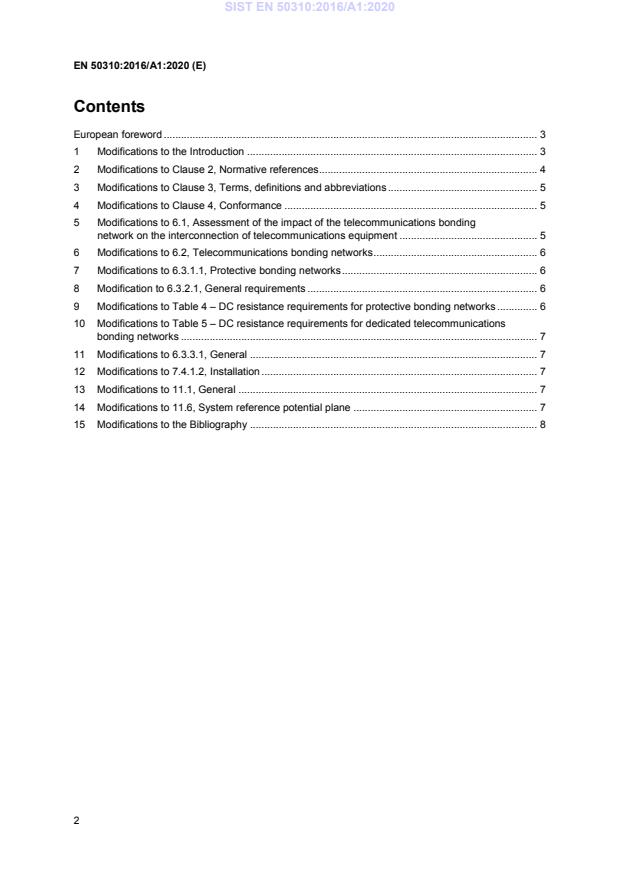
Contents
European foreword . 3
1 Modifications to the Introduction . 3
2 Modifications to Clause 2, Normative references. 4
3 Modifications to Clause 3, Terms, definitions and abbreviations . 5
4 Modifications to Clause 4, Conformance . 5
5 Modifications to 6.1, Assessment of the impact of the telecommunications bonding
network on the interconnection of telecommunications equipment . 5
6 Modifications to 6.2, Telecommunications bonding networks . 6
7 Modifications to 6.3.1.1, Protective bonding networks . 6
8 Modification to 6.3.2.1, General requirements . 6
9 Modifications to Table 4 – DC resistance requirements for protective bonding networks . 6
10 Modifications to Table 5 – DC resistance requirements for dedicated telecommunications
bonding networks . 7
11 Modifications to 6.3.3.1, General . 7
12 Modifications to 7.4.1.2, Installation . 7
13 Modifications to 11.1, General . 7
14 Modifications to 11.6, System reference potential plane . 7
15 Modifications to the Bibliography . 8
European foreword
This document (EN 50310:2016/A1:2020) has been prepared by CLC/TC 215 “Electrotechnical
aspects of telecommunication equipment”.
The following dates are fixed:
• latest date by which this document has (dop) 2020-12-13
to be implemented at national level by
publication of an identical national
standard or by endorsement
• latest date by which the national (dow) 2022-12-13
standards conflicting with this document
have to be withdrawn
Attention is drawn to the possibility that some of the elements of this document may be the subject of
patent rights. CENELEC shall not be held responsible for identifying any or all such patent rights.
1 Modifications to the Introduction
Amend list of bullets in 4th paragraph as follows:
• replace “EN 50098 series” with “EN 50700”:
Replace Figure 1 with
Replace Table 1 with
Building design Generic cabling Specification Installation Operation phase
phase design phase phase phase
EN 50173-2 EN 50174-1
EN 50173-3
Planning phase
EN 50173-4
EN 50174-2
EN 50173-5
EN 50310 EN 50174-3 EN 50174-1
EN 50173-6
EN 50174-2
EN 50310
EN 50174-3
(these ENs
EN 50310
reference general
requirements of
EN 50173-1)
2 Modifications to Clause 2, Normative references
Add the following new references:
EN 61557-4, Electrical safety in low voltage distribution systems up to 1 000 V a.c. and 1 500 V d.c. -
Equipment for testing, measuring or monitoring of protective measures - Part 4: Resistance of earth
connection and equipotential bonding (IEC 61557-4)
EN 61557-5, Electrical safety in low voltage distribution systems up to 1 000 V a.c. and 1 500 V d.c. -
Equipment for testing, measuring or monitoring of protective measures - Part 5: Resistance to earth
(
...