

SIST EN 334:2019+A1:2025
(Main)Gas pressure regulators for inlet pressure up to 10 MPa (100 bar)
General Information
- Abstract
This European Standard specifies constructional, functional, testing, marking, sizing and documentation requirements of gas pressure regulators:
- for inlet pressures up to 100 bar and nominal diameters up to DN 400;
- for an operating temperature range from - 20 °C to +60 °C,
which operate with fuel gases of the 1st and 2nd family as defined in EN 437:2003+A1:2009, used in the pressure regulating stations in accordance with EN 12186 or EN 12279, in transmission and distribution networks and also in commercial and industrial installations.
"Gas pressure regulators" hereafter will be called "regulators" except in the titles.
For standard regulators when used in pressure regulating stations complying with EN 12186 or EN 12279, the Annex ZA lists all applicable essential safety requirements of the European legislation on pressure equipment except external and internal corrosion resistance for applications in corrosive environment.
This document considers the following temperature classes/types of regulators:
- temperature class 1: operating temperature range from −10 °C to 60 °C;
- temperature class 2: operating temperature range from −20 °C to 60 °C;
- type IS: (integral strength type);
- type DS: (differential strength type).
This document applies to regulators which use the pipeline gas as a source of control energy unassisted by any external power source.
The regulator may incorporate a second regulator, used as monitor, complying with the requirements in this document.
The regulator may incorporate a safety shut off device (SSD) complying with the requirements of EN 14382.
The regulator may incorporate a creep (venting) relief device, complying with the requirements in Annex E and/or a vent limiter, complying with the requirements in Annex I.
This document does not apply to:
- regulators upstream from/on/in domestic gas-consuming appliances which are installed downstream of domestic gas meters;
- regulators designed to be incorporated into pressure control systems used in service lines ) with volumetric flow rate ≤ 200 m3/h at normal conditions and inlet pressure ≤ 5 bar;
- regulators for which a specific document exists (e.g. EN 88-1 and EN 88-2, etc.);
- industrial process control valves in accordance with EN 1349.
The normative Annex G of this document lists some suitable materials for pressure bearing parts, inner metallic partition walls, auxiliary devices, integral process and sensing lines, connectors and fasteners. Other materials may be used when complying with the restrictions given in Table 5.
Continued integrity of gas pressure regulators is ensured by suitable surveillance checks and maintenance. For periodic functional checks and maintenance it is common to refer to national regulations/standards where existing or users/manufacturers practices.
This document has introduced the reaction of the pressure regulators to the specified reasonable expected failures in terms of "fail close" and "fail open" pressure regulator types, but it should be considered that there are other types of failures whose consequences can bring to the same reactions (these risks are covered via redundancy as per EN 12186) and that residual hazards will be reduced by a suitable surveillance in use / maintenance.
In this document, both pressure regulators that can be classified as "safety accessories" by themselves (monitors) according to European legislation on pressure equipment as well as regulators that can be used to provide the necessary pressure protection through redundancy (e.g. pressure regulator with integrated safety shut-off device, pressure regulator + in-line monitor, pressure regulator + safety shut off device) are considered.
The provisions in this document are in line with the state of art at the moment of writing.
- Status
- Published
- Publication Date
- 07-Jan-2025
- Technical Committee
- DPL - Gas supply
- Current Stage
- 6060 - National Implementation/Publication (Adopted Project)
- Start Date
- 14-Nov-2024
- Due Date
- 19-Jan-2025
- Completion Date
- 08-Jan-2025

Overview
SIST EN 334:2019+A1:2025 is a harmonized European Standard published by CEN that specifies the requirements for gas pressure regulators operating with inlet pressures up to 10 MPa (100 bar) and nominal diameters up to DN 400. The document addresses regulators used with 1st and 2nd family fuel gases as defined in EN 437, covering their use in pressure regulating stations, gas transmission and distribution networks, as well as in commercial and industrial applications.
This standard provides a comprehensive framework for the construction, functional performance, testing, marking, sizing, and documentation of pressure regulators. It covers both integral strength (IS) and differential strength (DS) regulator types and considers different temperature classes to address operational needs from −20°C up to +60°C. The document aligns with essential safety requirements from EU directives on pressure equipment and offers guidance for ongoing integrity and maintenance.
Key Topics
Scope and Applicability
- Regulators for inlet pressures up to 100 bar and DN 400
- Temperature classes: Class 1 (−10°C to 60°C), Class 2 (−20°C to 60°C)
- Use with 1st and 2nd family gases (as per EN 437)
- Operation in transmission/distribution networks and industrial/commercial settings
Regulator Types and Accessories
- Integral strength and differential strength regulators
- Regulators using pipeline gas as control energy without external power
- Options for integrated safety shut-off devices (SSD), monitors, creep (venting) relief devices, and vent limiters
Exclusions
- Not applicable to domestic appliance regulators downstream of gas meters
- Not for service line regulators with small flow and pressure ratings
- Excludes regulators already covered by specific standards (e.g., EN 88-1/88-2) and process control valves per EN 1349
Technical and Safety Requirements
- Construction and material requirements for pressure-bearing parts and auxiliary components
- Testing protocols for strength, tightness (external/internal), and performance
- Marking and traceability requirements for identification and compliance
- Sizing equations and methods to calculate appropriate regulator dimensions and flow rates
Performance and Functionality
- Requirements for stable accuracy, lock-up behavior, and antistatic properties
- Guidance on reaction to failure modes (fail close/fail open)
- Maintenance and field surveillance for continued safety and performance
Applications
SIST EN 334:2019+A1:2025 plays a crucial role in the safe and efficient management of gas pressure within extensive gas transmission and distribution networks. Typical areas of application include:
- Gas transmission and distribution networks
- Ensures stable and safe pressure reduction across large-scale pipelines
- Pressure regulating stations
- Used in compliance with EN 12186 and EN 12279 for pressure management infrastructure
- Commercial and industrial installations
- Regulates supply pressure for processes and equipment requiring precise gas delivery
- Redundant and Safety Setups
- Supports integration with monitors, safety shut-off, venting, and relief devices for system resilience
- International Compliance
- Adheres to the Pressure Equipment Directive (PED) 2014/68/EU, facilitating market access across Europe
Related Standards
For effective implementation and compliance, SIST EN 334:2019+A1:2025 references and is complemented by several key standards:
- EN 437:2003+A1:2009 - Defines fuel gas families for which the regulators are designed
- EN 12186 & EN 12279 - Requirements for pressure regulating stations with and without safety devices
- EN 14382 - Safety shut-off devices in gas pressure regulating stations
- EN 88-1, EN 88-2 - Pressure regulators specifically for domestic or certain commercial applications
- EN 1349 - Industrial process control valves, not covered by the scope of EN 334
- EN 549 - Rubber materials for seals and diaphragms in gas equipment
Other related documents include various EN standards for flanges (EN 1092 series, EN 1759 series) and material certification (EN 10204).
SIST EN 334:2019+A1:2025 provides a robust foundation for ensuring safety, reliability, and regulatory compliance for gas pressure regulators in diverse gas supply and industrial networks, supporting both current operational needs and facilitating future technical advancements.
Relations
- Effective Date
- 01-Jan-2025
- Effective Date
- 09-Feb-2026
- Effective Date
- 09-Feb-2026
- Effective Date
- 09-Feb-2026
- Effective Date
- 28-Jan-2026
- Effective Date
- 28-Jan-2026
- Effective Date
- 28-Jan-2026
- Effective Date
- 28-Jan-2026
- Effective Date
- 28-Jan-2026
- Effective Date
- 28-Jan-2026
- Effective Date
- 28-Jan-2026
- Effective Date
- 28-Jan-2026
- Effective Date
- 28-Jan-2026
- Effective Date
- 28-Jan-2026
- Refers
SIST EN 549:1996 - Rubber materials for seals and diaphragms for gas appliances and gas equipment - Effective Date
- 28-Jan-2026
Get Certified
Connect with accredited certification bodies for this standard

Institut za varilstvo d.o.o. (Welding Institute)
Slovenia's leading welding institute since 1952. ISO 3834, EN 1090, pressure equipment certification, NDT personnel, welder qualification. Only IIW Au
Sponsored listings
Frequently Asked Questions
SIST EN 334:2019+A1:2025 is a standard published by the Slovenian Institute for Standardization (SIST). Its full title is "Gas pressure regulators for inlet pressure up to 10 MPa (100 bar)". This standard covers: This European Standard specifies constructional, functional, testing, marking, sizing and documentation requirements of gas pressure regulators: - for inlet pressures up to 100 bar and nominal diameters up to DN 400; - for an operating temperature range from - 20 °C to +60 °C, which operate with fuel gases of the 1st and 2nd family as defined in EN 437:2003+A1:2009, used in the pressure regulating stations in accordance with EN 12186 or EN 12279, in transmission and distribution networks and also in commercial and industrial installations. "Gas pressure regulators" hereafter will be called "regulators" except in the titles. For standard regulators when used in pressure regulating stations complying with EN 12186 or EN 12279, the Annex ZA lists all applicable essential safety requirements of the European legislation on pressure equipment except external and internal corrosion resistance for applications in corrosive environment. This document considers the following temperature classes/types of regulators: - temperature class 1: operating temperature range from −10 °C to 60 °C; - temperature class 2: operating temperature range from −20 °C to 60 °C; - type IS: (integral strength type); - type DS: (differential strength type). This document applies to regulators which use the pipeline gas as a source of control energy unassisted by any external power source. The regulator may incorporate a second regulator, used as monitor, complying with the requirements in this document. The regulator may incorporate a safety shut off device (SSD) complying with the requirements of EN 14382. The regulator may incorporate a creep (venting) relief device, complying with the requirements in Annex E and/or a vent limiter, complying with the requirements in Annex I. This document does not apply to: - regulators upstream from/on/in domestic gas-consuming appliances which are installed downstream of domestic gas meters; - regulators designed to be incorporated into pressure control systems used in service lines ) with volumetric flow rate ≤ 200 m3/h at normal conditions and inlet pressure ≤ 5 bar; - regulators for which a specific document exists (e.g. EN 88-1 and EN 88-2, etc.); - industrial process control valves in accordance with EN 1349. The normative Annex G of this document lists some suitable materials for pressure bearing parts, inner metallic partition walls, auxiliary devices, integral process and sensing lines, connectors and fasteners. Other materials may be used when complying with the restrictions given in Table 5. Continued integrity of gas pressure regulators is ensured by suitable surveillance checks and maintenance. For periodic functional checks and maintenance it is common to refer to national regulations/standards where existing or users/manufacturers practices. This document has introduced the reaction of the pressure regulators to the specified reasonable expected failures in terms of "fail close" and "fail open" pressure regulator types, but it should be considered that there are other types of failures whose consequences can bring to the same reactions (these risks are covered via redundancy as per EN 12186) and that residual hazards will be reduced by a suitable surveillance in use / maintenance. In this document, both pressure regulators that can be classified as "safety accessories" by themselves (monitors) according to European legislation on pressure equipment as well as regulators that can be used to provide the necessary pressure protection through redundancy (e.g. pressure regulator with integrated safety shut-off device, pressure regulator + in-line monitor, pressure regulator + safety shut off device) are considered. The provisions in this document are in line with the state of art at the moment of writing.
This European Standard specifies constructional, functional, testing, marking, sizing and documentation requirements of gas pressure regulators: - for inlet pressures up to 100 bar and nominal diameters up to DN 400; - for an operating temperature range from - 20 °C to +60 °C, which operate with fuel gases of the 1st and 2nd family as defined in EN 437:2003+A1:2009, used in the pressure regulating stations in accordance with EN 12186 or EN 12279, in transmission and distribution networks and also in commercial and industrial installations. "Gas pressure regulators" hereafter will be called "regulators" except in the titles. For standard regulators when used in pressure regulating stations complying with EN 12186 or EN 12279, the Annex ZA lists all applicable essential safety requirements of the European legislation on pressure equipment except external and internal corrosion resistance for applications in corrosive environment. This document considers the following temperature classes/types of regulators: - temperature class 1: operating temperature range from −10 °C to 60 °C; - temperature class 2: operating temperature range from −20 °C to 60 °C; - type IS: (integral strength type); - type DS: (differential strength type). This document applies to regulators which use the pipeline gas as a source of control energy unassisted by any external power source. The regulator may incorporate a second regulator, used as monitor, complying with the requirements in this document. The regulator may incorporate a safety shut off device (SSD) complying with the requirements of EN 14382. The regulator may incorporate a creep (venting) relief device, complying with the requirements in Annex E and/or a vent limiter, complying with the requirements in Annex I. This document does not apply to: - regulators upstream from/on/in domestic gas-consuming appliances which are installed downstream of domestic gas meters; - regulators designed to be incorporated into pressure control systems used in service lines ) with volumetric flow rate ≤ 200 m3/h at normal conditions and inlet pressure ≤ 5 bar; - regulators for which a specific document exists (e.g. EN 88-1 and EN 88-2, etc.); - industrial process control valves in accordance with EN 1349. The normative Annex G of this document lists some suitable materials for pressure bearing parts, inner metallic partition walls, auxiliary devices, integral process and sensing lines, connectors and fasteners. Other materials may be used when complying with the restrictions given in Table 5. Continued integrity of gas pressure regulators is ensured by suitable surveillance checks and maintenance. For periodic functional checks and maintenance it is common to refer to national regulations/standards where existing or users/manufacturers practices. This document has introduced the reaction of the pressure regulators to the specified reasonable expected failures in terms of "fail close" and "fail open" pressure regulator types, but it should be considered that there are other types of failures whose consequences can bring to the same reactions (these risks are covered via redundancy as per EN 12186) and that residual hazards will be reduced by a suitable surveillance in use / maintenance. In this document, both pressure regulators that can be classified as "safety accessories" by themselves (monitors) according to European legislation on pressure equipment as well as regulators that can be used to provide the necessary pressure protection through redundancy (e.g. pressure regulator with integrated safety shut-off device, pressure regulator + in-line monitor, pressure regulator + safety shut off device) are considered. The provisions in this document are in line with the state of art at the moment of writing.
SIST EN 334:2019+A1:2025 is classified under the following ICS (International Classification for Standards) categories: 23.060.40 - Pressure regulators. The ICS classification helps identify the subject area and facilitates finding related standards.
SIST EN 334:2019+A1:2025 has the following relationships with other standards: It is inter standard links to SIST EN 334:2019, SIST EN 60534-3-1:2001, SIST EN 60534-2-1:2011, SIST EN 60534-2-3:2016, SIST EN 1092-3:2004, SIST EN 13906-3:2014, SIST EN 1759-4:2004, SIST EN ISO 9606-4:1999, SIST EN ISO 14732:2013, SIST EN 12516-2:2015, SIST EN 14382:2019, SIST EN 13445-4:2021+A1:2023, SIST EN ISO 12156-1:2019, SIST EN 1759-1:2005, SIST EN 549:1996. Understanding these relationships helps ensure you are using the most current and applicable version of the standard.
SIST EN 334:2019+A1:2025 is associated with the following European legislation: EU Directives/Regulations: 2014/68/EU; Standardization Mandates: M/601. When a standard is cited in the Official Journal of the European Union, products manufactured in conformity with it benefit from a presumption of conformity with the essential requirements of the corresponding EU directive or regulation.
SIST EN 334:2019+A1:2025 is available in PDF format for immediate download after purchase. The document can be added to your cart and obtained through the secure checkout process. Digital delivery ensures instant access to the complete standard document.
Standards Content (Sample)
SLOVENSKI STANDARD
01-februar-2025
Nadomešča:
SIST EN 334:2019
Regulatorji tlaka plina za vstopne tlake do 10 MPa (100 bar) (vključno z dopolnilom
A1)
Gas pressure regulators for inlet pressure up to 10 MPa (100 bar)
Gas-Druckregelgeräte für Eingangsdrücke bis 10 MPa (100 bar)
Régulateurs de pression de gaz pour des pressions amont jusqu’à 10 MPa (100 bar)
Ta slovenski standard je istoveten z: EN 334:2019+A1:2024
ICS:
23.060.40 Tlačni regulatorji Pressure regulators
2003-01.Slovenski inštitut za standardizacijo. Razmnoževanje celote ali delov tega standarda ni dovoljeno.
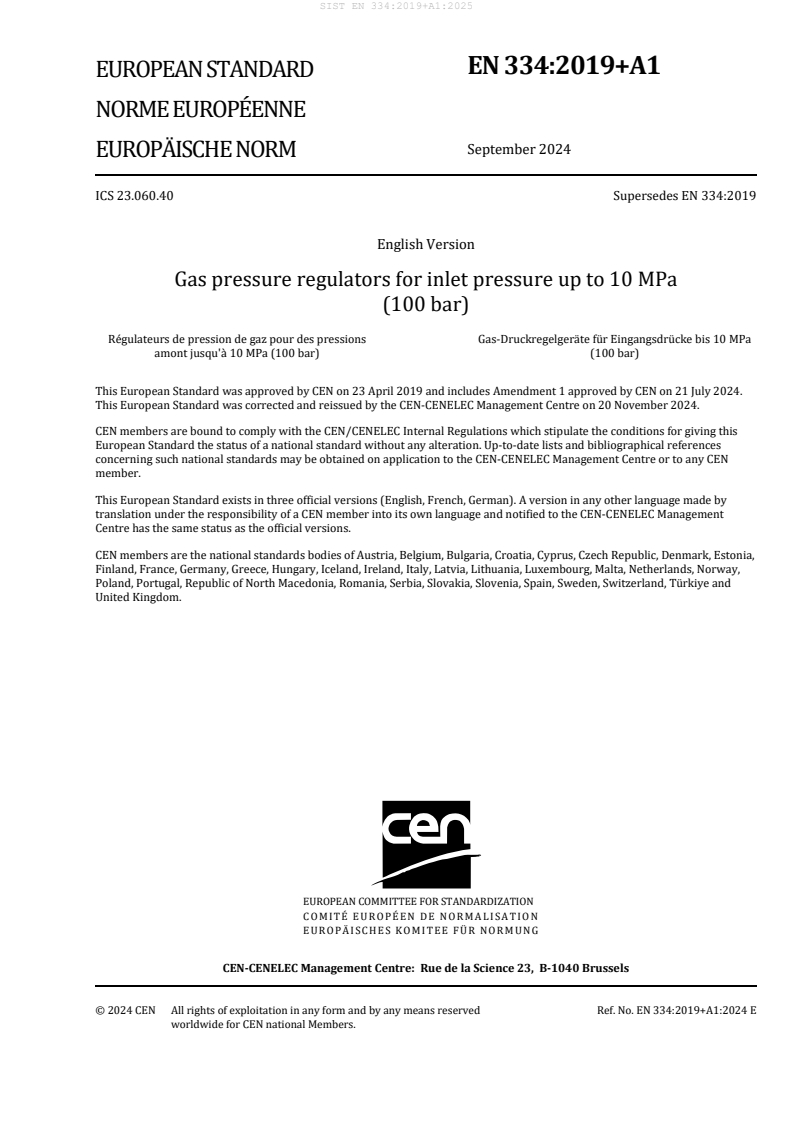
EN 334:2019+A1
EUROPEAN STANDARD
NORME EUROPÉENNE
September 2024
EUROPÄISCHE NORM
ICS 23.060.40 Supersedes EN 334:2019
English Version
Gas pressure regulators for inlet pressure up to 10 MPa
(100 bar)
Régulateurs de pression de gaz pour des pressions Gas-Druckregelgeräte für Eingangsdrücke bis 10 MPa
amont jusqu'à 10 MPa (100 bar) (100 bar)
This European Standard was approved by CEN on 23 April 2019 and includes Amendment 1 approved by CEN on 21 July 2024.
This European Standard was corrected and reissued by the CEN-CENELEC Management Centre on 20 November 2024.
CEN members are bound to comply with the CEN/CENELEC Internal Regulations which stipulate the conditions for giving this
European Standard the status of a national standard without any alteration. Up-to-date lists and bibliographical references
concerning such national standards may be obtained on application to the CEN-CENELEC Management Centre or to any CEN
member.
This European Standard exists in three official versions (English, French, German). A version in any other language made by
translation under the responsibility of a CEN member into its own language and notified to the CEN-CENELEC Management
Centre has the same status as the official versions.
CEN members are the national standards bodies of Austria, Belgium, Bulgaria, Croatia, Cyprus, Czech Republic, Denmark, Estonia,
Finland, France, Germany, Greece, Hungary, Iceland, Ireland, Italy, Latvia, Lithuania, Luxembourg, Malta, Netherlands, Norway,
Poland, Portugal, Republic of North Macedonia, Romania, Serbia, Slovakia, Slovenia, Spain, Sweden, Switzerland, Türkiye and
United Kingdom.
EUROPEAN COMMITTEE FOR STANDARDIZATION
COMITÉ EUROPÉEN DE NORMALISATIO N
EUROPÄISCHES KOMITEE FÜR NORMUN G
CEN-CENELEC Management Centre: Rue de la Science 23, B-1040 Brussels
© 2024 CEN All rights of exploitation in any form and by any means reserved Ref. No. EN 334:2019+A1:2024 E
worldwide for CEN national Members.
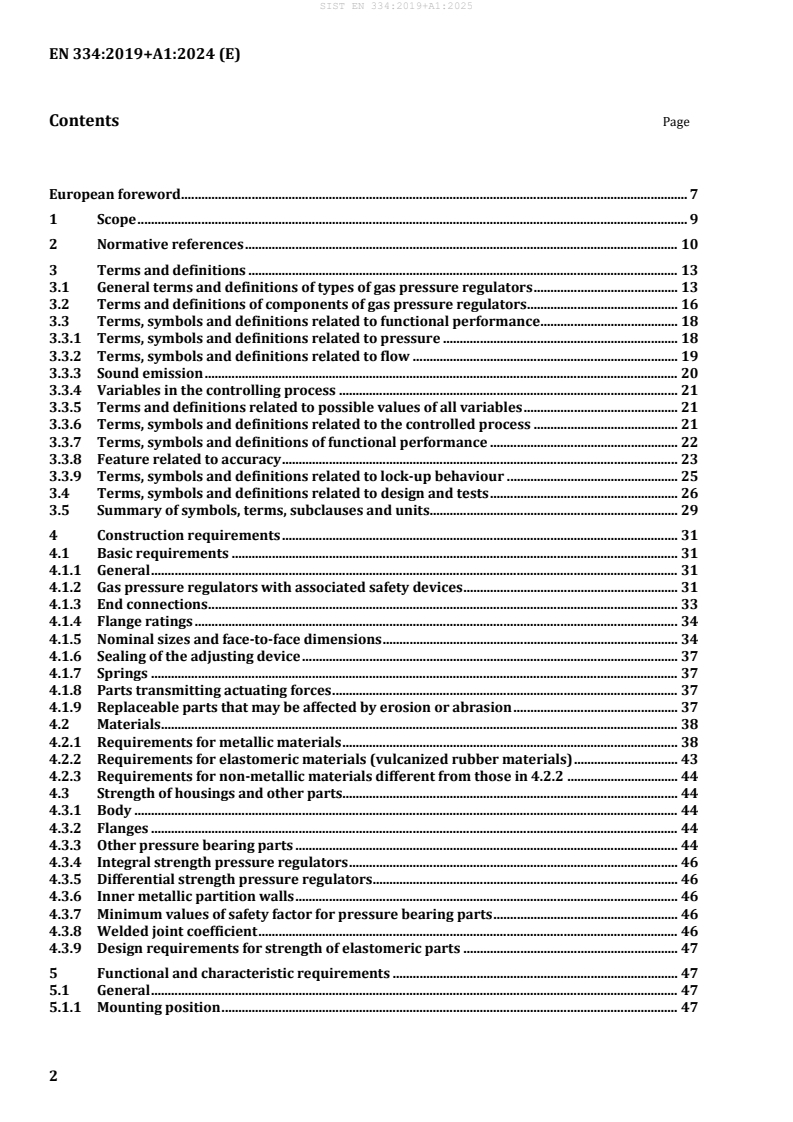
Contents Page
European foreword . 7
1 Scope . 9
2 Normative references . 10
3 Terms and definitions . 13
3.1 General terms and definitions of types of gas pressure regulators . 13
3.2 Terms and definitions of components of gas pressure regulators. 16
3.3 Terms, symbols and definitions related to functional performance . 18
3.3.1 Terms, symbols and definitions related to pressure . 18
3.3.2 Terms, symbols and definitions related to flow . 19
3.3.3 Sound emission . 20
3.3.4 Variables in the controlling process . 21
3.3.5 Terms and definitions related to possible values of all variables . 21
3.3.6 Terms, symbols and definitions related to the controlled process . 21
3.3.7 Terms, symbols and definitions of functional performance . 22
3.3.8 Feature related to accuracy . 23
3.3.9 Terms, symbols and definitions related to lock-up behaviour . 25
3.4 Terms, symbols and definitions related to design and tests . 26
3.5 Summary of symbols, terms, subclauses and units. 29
4 Construction requirements . 31
4.1 Basic requirements . 31
4.1.1 General . 31
4.1.2 Gas pressure regulators with associated safety devices . 31
4.1.3 End connections . 33
4.1.4 Flange ratings . 34
4.1.5 Nominal sizes and face-to-face dimensions . 34
4.1.6 Sealing of the adjusting device . 37
4.1.7 Springs . 37
4.1.8 Parts transmitting actuating forces . 37
4.1.9 Replaceable parts that may be affected by erosion or abrasion . 37
4.2 Materials . 38
4.2.1 Requirements for metallic materials . 38
4.2.2 Requirements for elastomeric materials (vulcanized rubber materials) . 43
4.2.3 Requirements for non-metallic materials different from those in 4.2.2 . 44
4.3 Strength of housings and other parts. 44
4.3.1 Body . 44
4.3.2 Flanges . 44
4.3.3 Other pressure bearing parts . 44
4.3.4 Integral strength pressure regulators . 46
4.3.5 Differential strength pressure regulators . 46
4.3.6 Inner metallic partition walls . 46
4.3.7 Minimum values of safety factor for pressure bearing parts . 46
4.3.8 Welded joint coefficient . 46
4.3.9 Design requirements for strength of elastomeric parts . 47
5 Functional and characteristic requirements . 47
5.1 General . 47
5.1.1 Mounting position . 47
5.2 Shell strength, external tightness and internal sealing . 47
5.2.1 Shell strength . 47
5.2.2 External tightness . 48
5.2.3 Internal sealing . 48
5.3 Control classifications . 48
5.3.1 Accuracy under stable conditions . 48
5.3.2 Lock-up behaviour . 48
5.3.3 Stable conditions. 49
5.4 Final visual inspection . 49
5.4.1 Requirements for final visual inspection after type tests . 49
5.4.2 Requirements for final visual inspection after routine tests and production
surveillance . 49
5.5 Fail close conditions . 50
5.6 Fail open conditions . 50
5.7 Closing force for monitor at full open position . 50
5.8 Antistatic characteristics . 51
6 Gas pressure regulator sizing . 51
6.1 Flow behaviour . 51
6.2 Sizing equations for the calculation of volumetric flow rates of a gas pressure
regulator with its control member in its mechanically fully open position . 52
6.2.1 Normal calculations . 52
6.2.2 Practical calculations . 52
6.2.3 Simplified calculations . 52
6.3 Calculation of the maximum accuracy flow rate . 53
6.4 Inherent flow characteristics . 53
6.5 Calculation of volumetric flow rates for partially open gas pressure regulators . 53
6.6 Flow coefficient . 53
7 Testing . 54
7.1 General . 54
7.2 Tests . 54
7.3 Type test . 55
7.4 Selection of test samples . 55
7.5 Routine tests . 56
7.6 Production surveillance . 56
7.7 Test and verification methods . 56
7.7.1 Dimensional check and visual inspection . 56
7.7.2 Materials check . 56
7.7.3 Verification of the strength of pressure bearing parts, inner metallic partition walls
and other parts . 56
7.7.4 Shell and inner metallic partition walls strength test . 58
7.7.5 Alternative shell and inner metallic partition walls strength test . 59
7.7.6 Verification of closing force for monitor in fully open position under normal
operating conditions . 59
7.7.7 External tightness test . 59
7.7.8 Test method and acceptance criteria to verify the antistatic characteristics . 61
7.7.9 Functional tests . 61
7.7.10 Final visual inspections . 74
8 Field surveillance . 74
9 Documentation . 74
9.1 Documentation related to type test . 74
9.1.1 Documentation required prior to type test. 74
9.1.2 Test report . 75
9.2 Documentation related to the routine tests . 75
9.3 Documentation related to production surveillance in accordance with 7.6 . 75
9.3.1 Documentation for production surveillance . 75
9.3.2 Production surveillance report . 75
9.4 Operating instructions . 75
10 Marking . 76
10.1 General requirements . 76
10.2 Basic requirements . 76
10.3 Other additional requirements . 77
10.4 Marking of integrated safety devices . 77
10.5 Markings for the various connections . 77
11 Packaging of finished product . 78
Annex A (informative) Alternative methods for the determination of the accuracy class, the
lock-up pressure class, the maximum accuracy flow rate, the flow coefficients and
the verification of the hysteresis band . 79
A.1 General . 79
A.2 Test methods . 79
A.2.1 Direct acting gas pressure regulator . 79
A.2.2 Pilot controlled gas pressure regulators . 80
A.3 Determination of flow coefficients for larger capacity regulators . 81
Annex B (informative) Inspection certificate . 87
Annex C (informative) Acceptance test . 89
)
Annex D (informative) Compliance evaluation . 90
D.1 General . 90
D.2 Introduction . 90
D.3 Procedure. 90
D.4 Manufacturer’s compliance evaluation . 90
D.5 Issue of the certificate of compliance . 91
Annex E (normative) Creep (venting) relief device . 92
E.1 General . 92
E.2 Terms and definitions . 92
E.3 Requirements . 92
E.3.1 Construction . 92
E.3.2 Functional requirements. 92
E.4 Testing . 92
E.5 Type test . 93
E.6 Routine tests . 93
E.7 Documentation . 93
E.8 Marking . 93
Annex F (informative) Order specification . 94
F.1 General . 94
F.2 Minimum specifications . 94
F.2.1 Details of construction . 94
F.2.2 Dimensions . 94
F.2.3 Performance . 94
F.3 Optional specifications . 95
Annex G (informative) Materials . 97
G.1 Steel materials for pressure bearing parts and inner metallic partition walls . 97
G.2 Metallic materials different from steel materials for pressure bearing parts and
inner metallic partition walls. 114
G.3 Materials for auxiliary devices, integral process and sensing lines, threaded sealing
plug, connectors and fasteners . 119
G.4 Update to year 2017 on Metallic Material Standards used in the previous editions of
this standard . 124
Annex H (informative) Dynamic force calculation method . 126
H.1 General . 126
H.2 Test method for the determination of the dynamic factor Cr . 126
H.2.1 General . 126
H.2.2 Test method for the determination of the dynamic factor Cr for a series of monitor . 127
Annex I (normative) Vent limiter . 129
I.1 General . 129
I.2 Scope . 129
I.3 Terms, symbols and definitions . 129
I.4 Requirements . 130
I.4.1 General requirements . 130
I.4.2 Materials . 130
I.4.3 Strength . 130
I.4.4 Functional requirements . 130
I.5 Testing and acceptance criteria . 131
I.5.1 General . 131
I.5.2 Type test method . 131
I.6 Documentation . 132
I.7 Specific marking on vent limiter . 132
Annex J (normative) Elastomeric material . 133
Annex K (informative) Sound emission . 135
K.1 Sound emission requirements . 135
K.2 Methods for measuring the sound pressure level . 136
Annex L (informative) Environmental Provisions . 137
Annex M (informative) Glossary . 141
Annex ZA (informative) Relationship between this European Standard and the essential
requirements of Directive 2014/68/EU aimed to be covered . 145
Bibliography . 147
European foreword
This document (EN 334:2019+A1:2024) has been prepared by Technical Committee CEN/TC 235 “Gas
pressure regulators and associated safety devices for use in gas transmission and distribution”, the
secretariat of which is held by UNI.
This European Standard shall be given the status of a national standard, either by publication of an
identical text or by endorsement, at the latest by March 2025, and conflicting national standards shall
be withdrawn at the latest by March 2025.
Attention is drawn to the possibility that some of the elements of this document may be the subject of
patent rights. CEN shall not be held responsible for identifying any or all such patent rights.
This document includes Amendment 1 approved by CEN on 21 July 2024.
This document supersedes !EN 334:2019".
The start and finish of text introduced or altered by amendment is indicated in the text by tags !".
This document has been prepared under a mandate given to CEN by the European Commission and the
European Free Trade Association, and supports essential requirements of EU Directive(s).
For relationship with EU Directive(s), see informative Annex ZA, which is an integral part of this
document.
!Deleted paragraph"
This document can be used as a guideline for gas pressure regulators outside the ranges specified in this
standard. This edition has introduced the application of statistical strength testing for series produced
pressure and safety accessories on the basis of EU Directive 2014/68/EU, Annex I, Article 3.2.2 and
Guideline H-14. Gas pressure regulators dealt with in this document are considered as standard
pressure equipment in accordance with Clause 2 a) of Art. 1 of Pressure Equipment Directive
2014/68/EU (PED).
Gas pressure regulators according to this European Standard do not have their own source of ignition.
However, the manufacturer is responsible to identify any potential ignition sources of his product
1)
which could be effective during the intended use .
Any feedback and questions on this document should be directed to the users’ national standards body.
A complete listing of these bodies can be found on the CEN website.
1) Therefore gas pressure regulators are usually not within the scope of ATEX European legislation on equipment
and protective systems intended for use in potentially explosive atmospheres. Any additional component (e.g.
proximity switch, travel transducer etc.) should be independently considered in the framework of assemblies as
per ATEX 2014/34/EU Guidelines – 2nd Edition - December2017 clauses § 44 “Combined equipment
(assemblies)”, § 46 “Components” and § 94 “Written attestation of conformity for components”.
According to the CEN-CENELEC Internal Regulations, the national standards organisations of the
following countries are bound to implement this European Standard: Austria, Belgium, Bulgaria,
Croatia, Cyprus, Czech Republic, Denmark, Estonia, Finland, France, Germany, Greece, Hungary, Iceland,
Ireland, Italy, Latvia, Lithuania, Luxembourg, Malta, Netherlands, Norway, Poland, Portugal, Republic of
North Macedonia, Romania, Serbia, Slovakia, Slovenia, Spain, Sweden, Switzerland, Turkey and the
United Kingdom.
1 Scope
This document specifies constructional, functional, testing, marking, sizing and documentation
requirements of gas pressure regulators:
— for inlet pressures up to 100 bar and nominal diameters up to DN 400;
— for an operating temperature range from – 20 °C to +60 °C,
which operate with fuel gases of the 1st and 2nd family as defined in EN 437:2018 [1], used in the
pressure control stations in accordance with EN 12186 or EN 12279, in transmission and distribution
networks and also in commercial and industrial installations.
“Gas pressure regulators” hereafter will be called “regulators” except in the titles.
For standard regulators when used in pressure control stations complying with EN 12186 or EN 12279,
the Annex ZA lists all applicable essential safety requirements of the European legislation on pressure
equipment except external and internal corrosion resistance for applications in corrosive environment.
This document considers the following temperature classes/types of regulators:
— temperature class 1: operating temperature range from −10 °C to 60 °C;
— temperature class 2: operating temperature range from −20 °C to 60 °C;
— type IS: (integral strength type);
— type DS: (differential strength type).
This document applies to regulators which use the pipeline gas as a source of control energy unassisted
by any external power source.
The regulator may incorporate a second regulator, used as monitor, complying with the requirements
in this document.
The regulator may incorporate a safety shut off device (SSD) complying with the requirements of
EN 14382.
The regulator may incorporate a creep (venting) relief device, complying with the requirements in
Annex E and/or a vent limiter, complying with the requirements in Annex I.
This document does not apply to:
— regulators upstream from/on/in domestic gas-consuming appliances which are installed
downstream of domestic gas meters;
2)
— regulators designed to be incorporated into pressure control systems used in service lines with
volumetric flow rate ≤ 200 m /h at normal conditions and inlet pressure ≤ 5 bar;
— regulators for which a specific document exists (e.g. EN 88-1 and EN 88-2, etc.);
— industrial process control valves in accordance with EN 1349.
2) The services lines are those defined in EN 12279.
The informative Annex G of this document lists some suitable materials for pressure bearing parts,
inner metallic partition walls, auxiliary devices, integral process and sensing lines, connectors and
fasteners. Other materials may be used when complying with the restrictions given in Table 5.
Continued integrity of gas pressure regulators is ensured by suitable surveillance checks and
maintenance. For periodic functional checks and maintenance it is common to refer to national
regulations/standards where existing or users/manufacturers practices.
This document has introduced the reaction of the pressure regulators to the specified reasonable
expected failures in terms of “fail close” and “fail open” pressure regulator types, but it should be
considered that there are other types of failures whose consequences can bring to the same reactions
(these risks are covered via redundancy as per EN 12186) and that residual hazards will be reduced by
a suitable surveillance in use / maintenance.
In this document, both pressure regulators that can be classified as “safety accessories” by themselves
(monitors) according to European legislation on pressure equipment as well as regulators that can be
used to provide the necessary pressure protection through redundancy (e.g. pressure regulator with
integrated safety shut-off device, pressure regulator + in-line monitor, pressure regulator + safety shut
off device) are considered.
The provisions in this document are in line with the state of art at the moment of writing.
This document does not intend to limit the improvement of actual provisions (materials, requirements,
test methods, acceptance criteria, etc.) or the developing of new provisions for gas pressure regulators
where they are suitable to ensure an equivalent level of reliability.
Some clauses of this standard should be re-considered at the time when characteristics for non-
conventional gases will be available.
2 Normative references
The following documents are referred to in the text in such a way that some or all of their content
constitutes requirements of this document. For dated references, only the edition cited applies. For
undated references, the latest edition of the referenced document (including any amendments) applies.
EN 549:1994, Rubber materials for seals and diaphragms for gas appliances and gas equipment
EN 1092-1:2018, Flanges and their joints - Circular flanges for pipes, valves, fittings and accessories, PN
designated - Part 1: Steel flanges
EN 1092-2:1997, Flanges and their joints - Circular flanges for pipes, valves, fittings and accessories, PN
designated - Part 2: Cast iron flanges
EN 1092-3:2003, Flanges and their joints - Circular flanges for pipes, valves, fittings and accessories, PN
designated - Part 3: Copper alloy flanges
EN 1092-4:2002, Flanges and their joints - Circular flanges for pipes, valves, fittings and accessories, PN
designated - Part 4: Aluminium alloy flanges
EN 1349:2009, Industrial process control valves
EN 1759-1:2004, Flanges and their joint - Circular flanges for pipes, valves, fittings and accessories, Class
designated - Part 1: Steel flanges, NPS 1/2 to 24
EN 1759-3:2003, Flanges and their joints - Circular flanges for pipes, valves, fittings and accessories, Class
designated - Part 3: Copper alloy flanges
EN 1759-4:2003, Flanges and their joint - Circular flanges for pipes, valves, fittings and accessories, class
designated - Part 4: Aluminium alloy flanges
EN 10204:2004, Metallic products - Types of inspection documents
EN 10226-1:2004, Pipe threads where pressure tight joints are made on the threads - Part 1: Taper
external threads and parallel internal threads - Dimensions, tolerances and designation
EN 10226-2:2005, Pipe threads where pressure tight joints are made on the threads - Part 2: Taper
external threads and taper internal threads - Dimensions, tolerances and designation
EN 12186:2014, Gas infrastructure - Gas pressure regulating stations for transmission and distribution -
Functional requirements
EN 12279:2000/A1:2005, Gas supply systems - Gas pressure regulating installations on service lines -
Functional requirements
EN 12516-1:2014+A1:2018, Industrial valves - Shell design strength - Part 1: Tabulation method for steel
valve shells
EN 12516-2:2014, Industrial valves - Shell design strength - Part 2: Calculation method for steel valve
shells
EN 12516-4:2014+A1:2018, Industrial valves - Shell design strength - Part 4: Calculation method for valve
shells manufactured in metallic materials other than steel
!EN 13445-4:2021+A1:2023, Unfired pressure vessels - Part 4: Fabrication"
EN 13906-1:2013, Cylindrical helical springs made from round wire and bar - Calculation and design -
Part 1 : Compression springs
EN 13906-2:2013, Cylindrical helical springs made from round wire and bar - Calculation and design -
Part 2: Extension springs
EN 13906-3:2014, Cylindrical helical springs made from round wire and bar - Calculation and design -
Part 3: Torsion springs
EN 14382:2019, Safety devices for gas pressure regulating stations and installations – Gas safety shut-off
devices for inlet pressures up to 10 MPa (100 bar)
EN 60534-2-1:2011, Industrial-process control valves - Part 2-1: Flow capacity - Sizing equations for fluid
flow under installed conditions
EN 60534-2-3:2016, Industrial-process control valves - Part 2-3: Flow capacity - Test procedures
(IEC 60534-2-3:2016)
EN 60534-3-1:2000, Industrial-process control valves - Part 3-1: Dimensions - Face-to-face dimensions for
flanged, two-way, globe-type, straight pattern and centre-to-face dimensions for flanged, two-way, globe-
type, angle pattern control valves
EN ISO 148-1:2016, Metallic materials - Charpy pendulum impact test - Part 1: Test method (ISO 148-
1:2016)
EN ISO 175:2010, Plastics - Methods of test for the determination of the effects of immersion in liquid
chemicals (ISO 175:2010)
EN ISO 9606-1:2017, Qualification testing of welders - Fusion welding - Part 1: Steels (ISO 9606-1:2012
including Cor 1:2012 and Cor 2:2013)
EN ISO 9606-2:2004, Qualification test of welders - Fusion welding - Part 2: Aluminium and aluminium
alloys (ISO 9606-2:2004)
EN ISO 9606-3:1999, Approval testing of welders - Fusion welding - Part 3: Copper and copper alloys (ISO
9606-3:1999)
EN ISO 9606-4:1999, Approval testing of welders - Fusion welding - Part 4: Nickel and nickel alloys (ISO
9606-4:1999)
!EN ISO 9712:2022, Non-destructive testing - Qualification and certification of NDT personnel (ISO
9712:2012)"
EN ISO 12156-1:2018, Diesel fuel - Assessment of lubricity using the high-frequency reciprocating rig
(HFRR) - Part 1: Test method (ISO 12156-1:2018)
EN ISO 14732:2013, Welding personnel - Qualification testing of welding operators and weld setters for
mechanized and automatic welding of metallic materials (ISO 14732:2013)
!EN ISO 15607:2019, Specification and qualification of welding procedures for metallic materials -
General rules (ISO 15607:2019)
EN ISO 15609-1:2019, Specification and qualification of welding procedures for metallic materials -
Welding procedure specification - Part 1: Arc welding (ISO 15609-1:2019)"
EN ISO 15610:2003, Specification and qualification of welding procedures for metallic materials -
Qualification based on tested welding consumables (ISO 15610:2003)
EN ISO 15611:2003, Specification and qualification of welding procedures for metallic materials -
Qualification based on previous welding experience (ISO 15611:2003)
EN ISO 15612:2018, Specification and qualification of welding procedures for metallic materials -
Qualification by adoption of a standard welding procedure (ISO 15612:2018)
EN ISO 15613:2004, Specification and qualification of welding procedures for metallic materials -
Qualification based on pre-production welding test (ISO 15613:2004)
EN ISO 15614-1:2017, Specification and qualification of welding procedures for metallic materials -
Welding procedure test - Part 1: Arc and gas welding of steels and arc welding of nickel and nickel alloys
(ISO 15614-1:2017, Corrected version 2017-10-01)
EN ISO 15614-2:2005/AC:2009, Specification and qualification of welding procedures for metallic
materials - Welding procedure test - Part 2: Arc welding of aluminium and its alloys (ISO 15614-
2:2005/Cor 2:2009)
EN ISO 17637:201
...