

SIST EN 50600-3-1:2026
(Main)Information technology - Data centre facilities and infrastructures - Part 3-1: Management and operational information
General Information
- Abstract
This document specifies processes for the management and operation of data centres. The primary focus of this document is the processes necessary to deliver the expected level of resilience, availability, risk management, risk mitigation, capacity planning, security and resource and energy efficiency.
The secondary focus is on organization and data centre management to align the actual and future demands. Only processes specific for data centres are in the scope of this document.
Business processes like people management, financial management, etc. are out of scope.
- Status
- Published
- Public Enquiry End Date
- 30-Dec-2024
- Publication Date
- 21-May-2026
- Technical Committee
- ELI - Electrical and communication installations
- Current Stage
- 6060 - National Implementation/Publication (Adopted Project)
- Start Date
- 15-May-2026
- Due Date
- 20-Jul-2026
- Completion Date
- 22-May-2026

Overview
SIST EN 50600-3-1:2026 is an international standard that defines robust processes for the management and operation of data centres. Issued by SIST and aligned with the European EN 50600 series, this document addresses essential aspects such as data centre resilience, availability, risk management, capacity planning, physical security, and energy efficiency. It provides a framework for operational information and processes specific to the unique requirements of data centre facilities and infrastructures.
Designed for data centre owners, operators, facility managers, IT managers, project managers, and contractors, this standard fosters alignment between actual capabilities and future demands. It bridges the gap between strategy, organization, and daily operations, focusing on data centre-specific management processes while explicitly excluding generic business administration topics.
Key Topics
SIST EN 50600-3-1:2026 covers a wide range of management processes critical to efficient and secure data centre operation:
- Data Centre Strategy: Procedures for assessing current capabilities, implementing key performance indicators (KPIs), reviewing strategies, and planning for future demands.
- Organizational Structure: Assigning roles, responsibilities, and managing human resources and process oversight.
- Operational Processes: Guidelines for routine data centre operations including:
- Maintenance and monitoring
- Fire compartmentalization
- Environmental and power systems control
- Security systems management
- Change, incident, and problem management
- Capacity & Availability Management: Ensuring sufficient resources, balancing load, and maintaining high uptime.
- Risk Management: Identifying, categorizing, and mitigating operational risks and documenting actions for enhanced resilience.
- Security Management: Processes to monitor and improve data centre physical and logical security, including KPI tracking for incidents.
- Resource & Energy Management: Monitoring resource consumption, applying energy-efficient practices, and using KPIs for continual improvement.
- Quality Management: Methodologies for continual process assessment and quality improvement.
- Documentation & Compliance: Establishing document management practices for operational handbooks, maintenance manuals, and compliance records.
Applications
The methodologies outlined in SIST EN 50600-3-1:2026 benefit organizations by enabling:
- Effective Data Centre Operations: Adopting standardized processes for facility maintenance, monitoring, and incident response improves service reliability and efficiency.
- Strategic Alignment: Proactive alignment of data centre capacity and organizational demands supports growth and scalability.
- Risk & Security Enhancement: Systematic risk and security management reduces vulnerability and assists compliance with regulatory frameworks.
- Performance Tracking: Use of KPIs ensures that data centre operations are measured, analyzed, and improved over time.
- Energy & Resource Efficiency: Focused benchmarks and reporting help manage costs and reduce environmental footprint.
- Smooth Transition from Build to Operation: Defined acceptance and testing processes streamline the commissioning and ongoing management of new or upgraded facilities.
This standard is essential for those responsible for the daily management, planning, and optimization of enterprise data centres, colocation sites, or cloud hosting facilities.
Related Standards
Several companion standards underpin and complement SIST EN 50600-3-1:2026:
- EN 50600-1: General concepts for data centre design and operation.
- EN 50600-2 series: Detailed requirements regarding power, environmental controls, cabling, and security infrastructures.
- EN 50600-4 series: Key Performance Indicators (KPIs) for data centres, focusing on resource usage and efficiency.
- CLC/TS 50600-5-1: Maturity model for energy management and environmental sustainability in data centres.
- EN 50174 series: Guidelines for cabling installation and quality assurance.
By referencing these related standards, organizations can develop a holistic approach to designing, managing, and optimizing data centre infrastructures in alignment with international best practices.
Adopting SIST EN 50600-3-1:2026 supports data centre operators in meeting stringent demands for resilience, availability, energy efficiency, and security, delivering greater value for organizations and their clients.
Relations
- Effective Date
- 01-Jul-2026
- Effective Date
- 18-Aug-2026
- Effective Date
- 12-May-2026
- Effective Date
- 12-May-2026
- Effective Date
- 12-May-2026
- Effective Date
- 12-May-2026
- Effective Date
- 12-May-2026
- Effective Date
- 12-May-2026
- Effective Date
- 12-May-2026
- Effective Date
- 12-May-2026
- Effective Date
- 12-May-2026
- Effective Date
- 12-May-2026
- Effective Date
- 12-May-2026
- Effective Date
- 12-May-2026
- Effective Date
- 12-May-2026
Get Certified
Connect with accredited certification bodies for this standard

BSI Group
BSI (British Standards Institution) is the business standards company that helps organizations make excellence a habit.

NYCE
Mexican standards and certification body.
Sponsored listings
Frequently Asked Questions
SIST EN 50600-3-1:2026 is a standard published by the Slovenian Institute for Standardization (SIST). Its full title is "Information technology - Data centre facilities and infrastructures - Part 3-1: Management and operational information". This standard covers: This document specifies processes for the management and operation of data centres. The primary focus of this document is the processes necessary to deliver the expected level of resilience, availability, risk management, risk mitigation, capacity planning, security and resource and energy efficiency. The secondary focus is on organization and data centre management to align the actual and future demands. Only processes specific for data centres are in the scope of this document. Business processes like people management, financial management, etc. are out of scope.
This document specifies processes for the management and operation of data centres. The primary focus of this document is the processes necessary to deliver the expected level of resilience, availability, risk management, risk mitigation, capacity planning, security and resource and energy efficiency. The secondary focus is on organization and data centre management to align the actual and future demands. Only processes specific for data centres are in the scope of this document. Business processes like people management, financial management, etc. are out of scope.
SIST EN 50600-3-1:2026 is classified under the following ICS (International Classification for Standards) categories: 35.020 - Information technology (IT) in general; 35.110 - Networking; 35.160 - Microprocessor systems. The ICS classification helps identify the subject area and facilitates finding related standards.
SIST EN 50600-3-1:2026 has the following relationships with other standards: It is inter standard links to SIST EN 50600-3-1:2016, SIST EN 50600-1:2026, SIST EN 50600-2-4:2023, SIST EN 50174-1:2018, SIST EN 50600-4-9:2023, SIST EN 50600-2-1:2021, SIST EN 50600-4-8:2023, SIST EN 50600-2-5:2016, SIST EN 50600-2-3:2019, SIST EN 50600-2-5:2021, SIST EN 50600-4-1:2017, SIST EN 50600-4-2:2017/A1:2019, SIST EN 50174-2:2018, SIST EN 50600-2-3:2014, SIST EN 50600-4-7:2020. Understanding these relationships helps ensure you are using the most current and applicable version of the standard.
SIST EN 50600-3-1:2026 is associated with the following European legislation: Standardization Mandates: M/462. When a standard is cited in the Official Journal of the European Union, products manufactured in conformity with it benefit from a presumption of conformity with the essential requirements of the corresponding EU directive or regulation.
SIST EN 50600-3-1:2026 is available in PDF format for immediate download after purchase. The document can be added to your cart and obtained through the secure checkout process. Digital delivery ensures instant access to the complete standard document.
Standards Content (Sample)
SLOVENSKI STANDARD
01-julij-2026
Nadomešča:
SIST EN 50600-3-1:2016
Informacijska tehnologija - Naprave in infrastruktura podatkovnega centra - 3-1.
del: Informacije o upravljanju in obratovanju
Information technology - Data centre facilities and infrastructures - Part 3-1:
Management and operational information
Informationstechnik - Einrichtungen und Infrastrukturen von Rechenzentren - Teil 3-1:
Informationen für das Management und den Betrieb
Technologie de l'information - Installation et infrastructures de centres de traitement de
données - Partie 3-1: Informations de gestion et de fonctionnement
Ta slovenski standard je istoveten z: EN 50600-3-1:2026
ICS:
35.110 Omreževanje Networking
2003-01.Slovenski inštitut za standardizacijo. Razmnoževanje celote ali delov tega standarda ni dovoljeno.
EUROPEAN STANDARD EN 50600-3-1
NORME EUROPÉENNE
EUROPÄISCHE NORM May 2026
ICS 35.020; 35.110; 35.160 Supersedes EN 50600-3-1:2016
English Version
Information technology - Data centre facilities and infrastructures
- Part 3-1: Management and operational information
Technologie de l'information - Installation et infrastructures Informationstechnik - Einrichtungen und Infrastrukturen von
de centres de traitement de données - Partie 3-1: Rechenzentren - Teil 3-1: Informationen für das
Informations de gestion et de fonctionnement Management und den Betrieb
This European Standard was approved by CENELEC on 2026-04-13. CENELEC members are bound to comply with the CEN/CENELEC
Internal Regulations which stipulate the conditions for giving this European Standard the status of a national standard without any alteration.
Up-to-date lists and bibliographical references concerning such national standards may be obtained on application to the CEN-CENELEC
Management Centre or to any CENELEC member.
This European Standard exists in three official versions (English, French, German). A version in any other language made by translation
under the responsibility of a CENELEC member into its own language and notified to the CEN-CENELEC Management Centre has the
same status as the official versions.
CENELEC members are the national electrotechnical committees of Austria, Belgium, Bulgaria, Croatia, Cyprus, the Czech Republic,
Denmark, Estonia, Finland, France, Germany, Greece, Hungary, Iceland, Ireland, Italy, Latvia, Lithuania, Luxembourg, Malta, the
Netherlands, Norway, Poland, Portugal, Republic of North Macedonia, Romania, Serbia, Slovakia, Slovenia, Spain, Sweden, Switzerland,
Türkiye and the United Kingdom.
European Committee for Electrotechnical Standardization
Comité Européen de Normalisation Electrotechnique
Europäisches Komitee für Elektrotechnische Normung
CEN-CENELEC Management Centre: Rue de la Science 23, B-1040 Brussels
© 2026 CENELEC All rights of exploitation in any form and by any means reserved worldwide for CENELEC Members.
Ref. No. EN 50600-3-1:2026 E
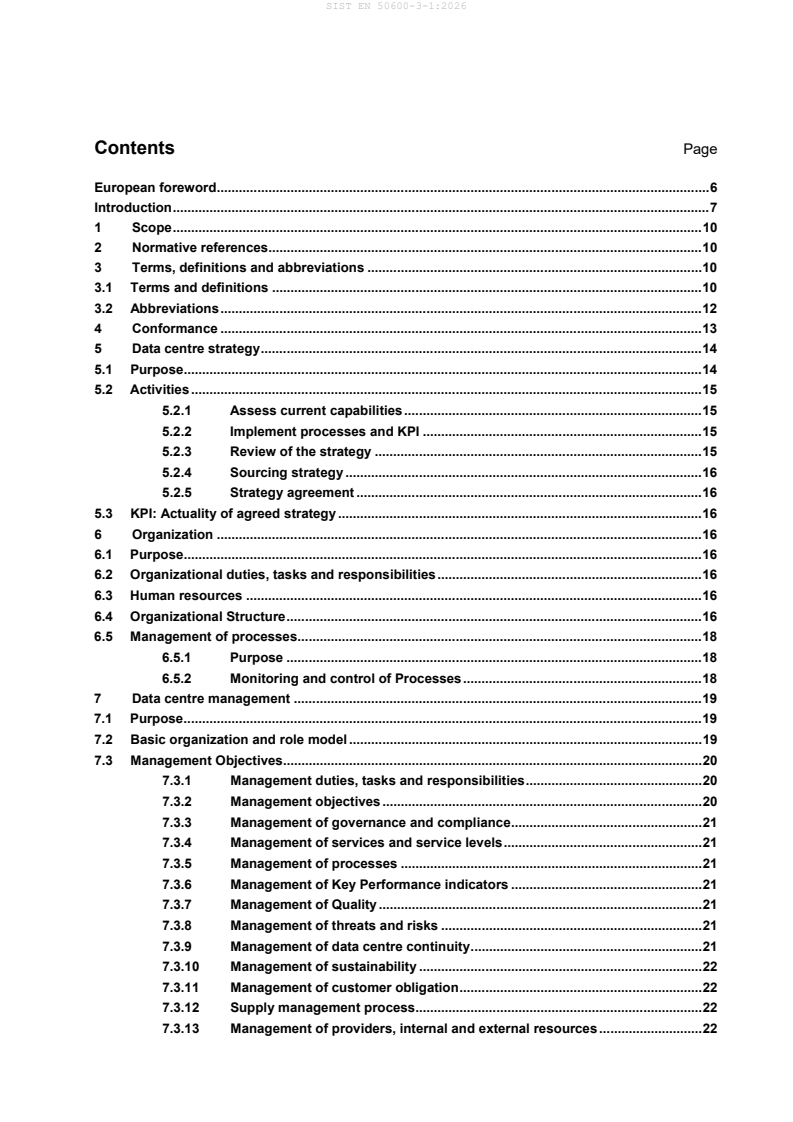
Contents Page
European foreword . 6
Introduction . 7
1 Scope . 10
2 Normative references. 10
3 Terms, definitions and abbreviations . 10
3.1 Terms and definitions . 10
3.2 Abbreviations . 12
4 Conformance . 13
5 Data centre strategy . 14
5.1 Purpose . 14
5.2 Activities . 15
5.2.1 Assess current capabilities . 15
5.2.2 Implement processes and KPI . 15
5.2.3 Review of the strategy . 15
5.2.4 Sourcing strategy . 16
5.2.5 Strategy agreement . 16
5.3 KPI: Actuality of agreed strategy . 16
6 Organization . 16
6.1 Purpose . 16
6.2 Organizational duties, tasks and responsibilities . 16
6.3 Human resources . 16
6.4 Organizational Structure . 16
6.5 Management of processes . 18
6.5.1 Purpose . 18
6.5.2 Monitoring and control of Processes . 18
7 Data centre management . 19
7.1 Purpose . 19
7.2 Basic organization and role model . 19
7.3 Management Objectives . 20
7.3.1 Management duties, tasks and responsibilities . 20
7.3.2 Management objectives . 20
7.3.3 Management of governance and compliance . 21
7.3.4 Management of services and service levels . 21
7.3.5 Management of processes . 21
7.3.6 Management of Key Performance indicators . 21
7.3.7 Management of Quality . 21
7.3.8 Management of threats and risks . 21
7.3.9 Management of data centre continuity . 21
7.3.10 Management of sustainability . 22
7.3.11 Management of customer obligation . 22
7.3.12 Supply management process. 22
7.3.13 Management of providers, internal and external resources . 22
8 Operational Processes . 23
8.1 Operational management process . 23
8.1.1 Purpose . 23
8.1.2 Activities . 23
8.1.3 Setpoint and airflow control . 27
8.1.4 Fire compartments . 28
8.1.5 Maintenance . 28
8.2 Operational information and parameters . 34
8.2.1 General . 34
8.2.2 Building construction as per EN 50600-2-1 . 34
8.2.3 Power distribution as per EN 50600-2-2 . 34
8.2.4 Environmental control as per EN 50600-2-3 . 35
8.2.5 Telecommunications cabling infrastructure as per EN 50600-2-4 . 36
8.2.6 Security systems as per EN 50600-2-5 . 36
8.3 Acceptance test . 37
8.3.1 General . 37
8.3.2 Building construction (EN 50600-2-1) tests . 38
8.3.3 Power supply and distribution (EN 50600-2-2) tests . 38
8.3.4 Environmental control (EN 50600-2-3) tests . 39
8.3.5 Telecommunications cabling infrastructure (EN 50600-2-4) tests . 39
8.3.6 Security systems (EN 50600-2-5) tests . 39
8.3.7 Energy efficiency tests . 39
8.4 Documentation . 40
8.4.1 General . 40
8.4.2 Design and construction documents . 40
8.4.3 Insurance requirement reports . 40
8.4.4 Security handbook . 40
8.4.5 Building permit . 40
8.4.6 Operational handbook . 40
8.4.7 Installation handbook . 41
8.4.8 Administration manual and software application settings . 41
8.4.9 Housekeeping manual . 41
8.4.10 Customer information portal . 41
8.5 Asset and configuration management . 41
8.5.1 Purpose . 41
8.5.2 Activities . 42
8.5.3 KPI for asset and configuration management . 42
8.6 Incident management . 42
8.6.1 Purpose . 42
8.6.2 Activities . 42
8.6.3 KPI for incident management . 43
8.7 Problem management . 43
8.7.1 Purpose . 43
8.7.2 Activities . 44
8.7.3 KPI: Ratio of solved problems . 44
8.8 Change management . 44
8.8.1 Purpose . 44
8.8.2 Activities . 44
8.8.3 KPI for change management . 45
9 Management Processes . 45
9.1 Capacity management . 45
9.1.1 Purpose . 45
9.1.2 Activities . 47
9.1.3 KPI: Balance of actual usage and capacity reserve . 48
9.2 Availability management . 48
9.2.1 Purpose . 48
9.2.2 Activities . 48
9.2.3 KPI for availability management . 49
9.3 Security management . 49
9.3.1 Purpose . 49
9.3.2 Activities . 49
9.3.3 KPI: number of security incidents . 51
9.4 Resource management . 51
9.4.1 Purpose . 51
9.4.2 Activities . 51
9.4.3 KPI for resource management . 51
9.5 Energy management . 52
9.5.1 Purpose . 52
9.5.2 Activities . 52
9.5.3 KPI for energy management . 52
9.6 Product lifecycle management . 54
9.6.1 Purpose . 54
9.6.2 Activities . 54
9.6.3 KPI: Deviation from expected product properties . 55
9.7 Cost management . 55
9.7.1 Purpose . 55
9.7.2 Activities . 55
9.7.3 KPI for cost management . 56
9.8 Service level management . 56
9.8.1 Purpose . 56
9.8.2 Activities . 56
9.8.3 KPI: Discrepancy between service quality and SLA . 57
9.9 Customer management . 57
9.9.1 General . 57
9.9.2 Purpose . 57
9.9.3 Activities . 58
9.9.4 KPI for customer management . 58
10 Risk management . 58
10.1 Purpose . 58
10.2 Activities . 59
10.2.1 General . 59
10.2.2 Risk list . 59
10.2.3 Categorization . 60
10.3 KPI for risk management . 61
10.3.1 Number of open risks . 61
10.3.2 Duration from register to completion . 61
11 Quality management . 61
11.1 Purpose . 61
11.2 Activities . 61
11.2.1 Quality methodologies . 61
11.2.2 Quality plan and objectives . 62
11.2.3 Quality assessment . 62
11.3 Quality improvement . 62
Annex A (informative) Example for process implementation . 63
A.1 Prioritization of processes . 63
A.2 Maturity . 63
Annex B (informative) Security systems . 65
B.1 Access to the data centre premises . 65
B.1.1 Manned guarding . 65
B.1.2 Employees and other authorized personnel . 65
B.1.3 Visitors . 66
B.1.4 Deliveries . 67
B.1.5 Examples for security controls . 68
B.2 Fire suppression systems . 69
B.3 Management of electrical interference. 69
Bibliography . 70
Figures
Figure 1 — Schematic relationship between the EN 50600 series of documents . 8
Figure 2 — Data centre management overview . 9
Figure 3 — Example of the elements of data centre strategy . 15
Figure 4 — Process organization . 18
Figure 5 — Examples for process modelling . 19
Figure 6 — Example for a basic model for a data centre management organization . 19
Figure 7 — Risk Management process according to ISO 31000 . 59
Tables
Table 1 — Examples of methodologies and practices . 17
Table A.1 — Prioritization of processes . 63
Table A.2 — Operational levels . 64
Table B.1 — Examples for preventive controls . 68
Table B.2 — Examples for detective controls . 68
Table B.3 — Examples for predictive controls . 68
Table B.4 — Examples for reactive and corrective controls. 69
European foreword
This document (EN 50600-3-1:2026) has been prepared by CLC/TC 215 “Electrotechnical aspects of
telecommunication equipment”.
The following dates are fixed:
• latest date by which this document has to be (dop) 2027-05-31
implemented at national level by publication of
an identical national standard or by
endorsement
• latest date by which the national standards (dow) 2027-05-31
conflicting with this document have to be
withdrawn
This document supersedes EN 50600-3-1:2016 and all of its amendments and corrigenda (if any).
a) the document has been completely revised and restructured;
b) new clauses on data centre strategy, organization, data centre management, risk management and
quality management have been added;
c) existing clauses on operational information and parameters and on acceptance test have been included
in the clause on operational processes.
Attention is drawn to the possibility that some of the elements of this document may be the subject of patent
rights. CENELEC shall not be held responsible for identifying any or all such patent rights.
This document has been prepared under a standardization request addressed to CENELEC by the
European Commission. The Standing Committee of the EFTA States subsequently approves these requests
for its Member States.
Any feedback and questions on this document should be directed to the users’ national committee. A
complete listing of these bodies can be found on the CENELEC website.
Introduction
The unrestricted access to internet-based information demanded by the information society has led to an
exponential growth of both internet traffic and the volume of stored/retrieved data. Data centres are housing
and supporting the information technology and network telecommunications equipment for data processing,
data storage and data transport. They are required both by network operators (delivering those services to
customer premises) and by enterprises within those customer premises.
Data centres need to provide modular, scalable and flexible facilities and infrastructures to easily
accommodate the rapidly changing requirements of the market. In addition, energy consumption and
water/resource usage of data centres has become critical both from an environmental point of view
(reduction of environmental footprint) and with respect to economical considerations (cost of energy) for the
data centre operator.
The implementation of data centres varies in terms of:
a) purpose (enterprise, co-location, co-hosting, or network operator facilities);
b) security level;
c) physical size;
d) accommodation (mobile, temporary and permanent constructions).
The needs of data centres also vary in terms of availability of service, the provision of security and the
objectives for energy efficiency. These needs and objectives influence the design of data centres in terms of
building construction, power distribution, environmental control, telecommunications cabling and physical
security as well as the operation of the data centre. Effective management and operational information is
required to monitor achievement of the defined needs and objectives.
Recognizing the substantial resource consumption, particularly of energy, of larger data centres, it is also
important to provide tools for the assessment of that consumption both in terms of overall value and of
source mix and to provide Key Performance Indicators (KPIs) to evaluate trends and drive performance
improvements.
At the time of publication of this document, the EN 50600 series is designed as a framework of standards,
technical specifications and technical reports covering the design, the operation and management, the key
performance indicators for energy efficient operation of the data centre as well as a maturity model for
energy management and environmental sustainability.
This series of documents specifies requirements and recommendations to support the various parties
involved in the design, planning, procurement, integration, installation, operation and maintenance of
facilities and infrastructures within data centres. These parties include:
1) owners, operators, facility managers, IT managers, project managers, main contractors;
2) consulting engineers, architects, building designers and builders, system and installation designers,
auditors, test and commissioning agents;
3) facility and infrastructure integrators, suppliers of equipment;
4) installers, maintainers.
This document is intended for use by and collaboration between facility managers, ICT managers, and main
contractors.
The inter-relationship of the documents within the EN 50600 series is shown in Figure 1.
Figure 1 — Schematic relationship between the EN 50600 series of documents
EN 50600-1 introduces the general concepts relevant for the design and operation of data centres.
EN 50600-2 documents define the requirements for the data centre design and specify requirements and
recommendations for particular facilities and infrastructures to support the relevant classification for
“availability”, “physical security” and “energy efficiency enablement” selected from EN 50600-1.
EN 50600-3-1 specifies requirements and recommendations for data centre operations, processes and
management.
EN 50600-4 documents specify requirements and recommendations for key performance indicators (KPIs)
used to assess and improve the resource usage efficiency and effectiveness, respectively, and criteria of
resilience of a data centre.
CLC/TS 50600-5-1 specifies the maturity model for energy management and environmental sustainability
and refers amongst others to EN 50600-4-X for KPIs as appropriate.
This document addresses the operational and management information (in accordance with the
requirements of EN 50600-1). A data centre’s primary function typically is to house large quantities of
computer and telecommunications hardware which affects the construction, operation, and physical security.
Most of the data centres may impose special security requirements. Therefore, it is important that the
planning of a data centre by the designer and the various engineering disciplines that will assist in the
planning and implementation of the design of the data centre i.e. electrical, mechanical, security, etc. are
carried out in cooperation with the IT and telecommunications personnel, network professionals, the facilities
manager, the IT end users, and any other personnel involved.
Figure 2 shows an overview of the document:
• The organization provides the data centre strategy and resources for data centre management and
operation.
• Data Centre management organizes all process and resources for data centre operation.
• Operational information and documentation support all data centre activities.
Figure 2 — Data centre management overview
The transition from planning and building to operation of a data centre is considered as part of the
acceptance test process in 8.3.
This series of documents does not address the selection of information technology and network
telecommunications equipment, software and associated configuration issues.
1 Scope
This document specifies processes for the management and operation of data centres. The primary focus of
this document is the processes necessary to deliver the expected level of resilience, availability, risk
management, risk mitigation, capacity planning, security and resource and energy efficiency.
The secondary focus is on organization and data centre management to align the actual and future
demands. Only processes specific for data centres are in the scope of this document.
Business processes like people management, financial management, etc. are out of scope.
2 Normative references
The following documents are referred to in the text in such a way that some or all of their content constitutes
requirements of this document. For dated references, only the edition cited applies. For undated references,
the latest edition of the referenced document (including any amendments) applies.
EN 50174-1, Information technology — Cabling installation — Part 1: Installation specification and quality
assurance
EN 50174-2, Information technology — Cabling installation — Part 2: Installation planning and practices
inside buildings
EN 50600-1, Information technology — Data centre facilities and infrastructures — Part 1: General concepts
EN 50600-2 (all parts), Information technology — Data centre facilities and infrastructures
EN 50600-2-2:2019, Information technology — Data centre facilities and infrastructures — Part 2-2: Power
supply and distribution
EN 50600-4 (all parts), Information technology — Data centre facilities and infrastructures
CLC/TS 50600-5-1, Information technology — Data centre facilities and infrastructures — Part 5-1: Maturity
Model for Energy Management and Environmental Sustainability
3 Terms, definitions and abbreviations
3.1 Terms and definitions
For the purposes of this document, the terms and definitions given in EN 50600-1, the EN 50600-2 series
and the following apply.
ISO and IEC maintain terminology databases for use in standardization at the following addresses:
— IEC Electropedia: available at https://www.electropedia.org/
— ISO Online browsing platform: available at https://www.iso.org/obp
3.1.1
availability management
process for monitoring, analysis, reporting and improvement of availability
3.1.2
capacity management
process for monitoring, analysis, reporting and improvement of capacity
3.1.3
change management
process for recording, coordination, approval and monitoring of all changes
3.1.4
configuration item
entity managed by configuration management
3.1.5
configuration management
process for logging and monitoring of configuration items
3.1.6
cost distribution model
model to distribute costs that cannot be directly related to an infrastructure item
3.1.7
cost management
process for monitoring, analysis and reporting of all infrastructure related costs
3.1.8
customer management
process for management of customers responsibilities
3.1.9
data centre strategy
process for alignment of actual data centre’s capabilities and future demands of data centre’s users and
owners
3.1.10
energy management
process for monitoring, analysis, reporting and improvement of energy efficiency
3.1.11
event
something that happens and leads to one or more failures or faults
[SOURCE: CLC/TS 50600-4-31:2024, 3.1.7]
3.1.12
incident management
process for responding to unplanned events and recovery of normal operation condition
3.1.13
incident severity
incident category, e.g. based on categories of the risk map described in EN 50600-1
3.1.14
key performance indicator
parameter used to evaluate performance
3.1.15
operations management
process for infrastructure maintenance, monitoring and event management
3.1.16
product lifecycle management
process for managing the timely renewal of infrastructure components and review of product lifecycle costs
3.1.17
provisioned capacity
capacity of the data centre’s actual installed infrastructure
3.1.18
resilience
ability to withstand and reduce the magnitude and/or duration of disruptive events, including the capability to
anticipate, absorb, adapt to, and/or rapidly recover from such an event
[SOURCE: IEEE Task Force on Definition and Quantification of Resilience, PES-TR65:2018-04]
3.1.19
resilience level
enumeration of attributes for the determination of resilience aspects of a defined service at a defined
operation point (OP)
[SOURCE: CLC/TS 50600-4-31:2024, 3.1.26]
3.1.20
security incident
unplanned event resulting in an actual or potential breach of security
3.1.21
security management
process for design and monitoring of security policies, analysis, reporting and improvement of security
3.1.22
service level management
process for monitoring, analysis and reporting of service level compliance
3.1.23
service level agreement
agreement defining the content and quality of the service to be delivered and the timescale in which it is to
be delivered
3.1.24
total capacity
maximum capacity the data centre was designed for at full use in terms of e.g. space, power and cooling
3.1.25
used capacity
data centre’s current capacity used by the IT and facility in terms of e.g. space, power and cooling
3.2 Abbreviations
For the purposes of this document, the abbreviations given in EN 50600-1 and the following apply:
AHU Air Handling Unit
BIM Building Information Modelling
BMS Building Management System
CAB Change advisory board
CBM Condition-based Maintenance
CIP Commissioning Implementation Plan
CRAC Computer Room Air Conditioning (unit)
CRAH Computer Room Air Handler units
CUE Carbon Usage Effectiveness
CER Cooling Efficiency Ratio
DCIM Data Centre Infrastructure Management
EMC Electromagnetic Compatibility
EMS Energy Management System
EOP Emergency Operating Procedure
ERF Energy Re-use Factor
HVAC Heating, Ventilation and Air Conditioning
IRL Issue Resolution Log
ISMS Information Security Management System
IST Integrated Systems Test
KPI Key Performance Indicator
LOTO Lock Out, Tag Out
MOP Method of Procedure
PDCA Plan Do Check Act
PCI-DSS Payment Card Industry Data Security Standard
PUE 1)
Power Usage Effectiveness
pPUE 1)
Partial Power Usage Effectiveness
RACI Responsible, Accountable, Consulted, Informed
RCA Root Cause Analysis
REF Renewable Energy Factor
SLA Service Level Agreement
SOC Service Organizations Controls
SOP Standard Operating Procedure
TCO Total Cost of Ownership
4 Conformance
For a data centre to conform to this European Standard it shall have at least:
a) an implemented data centre strategy defined by stated business requirements (see 5.1);
b) an implemented data centre management (see Clause 7);
c) an implemented set of management policies and procedures covering the following:
1) operations management (see 8.1);
2) incident management (see 8.6);
———————
1) It is recognized that the term “efficiency” should be employed for PUE but “effectiveness” provides continuity with earlier market
recognition of the term.
3) change management (see 8.8);
4) capacity management (see 9.1);
5) security management (see 9.3);
6) resource management (see 9.4);
7) energy management (see 9.5)
8) customer management (see 9.9);
d) an environmental control policy (see 8.2);
e) an asset management policy (see 8.4);
f) a monitored PUE KPI (see 9.5);
g) a lifecycle management policy (see 9.6).
5 Data centre strategy
5.1 Purpose
A data centre strategy shall be defined by the owner and reflect the requirements of the stakeholders. The
data centre strategy shall describe the following aspects, but not limited to:
a) availability and resilience;
b) physical security;
c) energy and resource efficiency;
d) maintainability;
e) governance.
At the beginning of the initial planning of a data centre there is a clear idea of the owner about the needs the
data centre shall serve and the identified stakeholders that are relevant to the operation. During the long
lifetime of a data centre, the needs will change and thus the strategy of operation. Power density, cooling
strategy and even the desired level of resilience can change during a data centre’s lifetime due to new
technologies in IT and facility. Also the level of desired operational maturity (see Table A.2) can change
according to the needs of users and owners.
Data centre strategy aims to align the actual capabilities and future demands of data centre’s users and
owners. Actual capabilities are reflected in data centre’s implemented processes and KPI. Future demands
can be derived from a business and IT strategy of the owners or the users. In addition, expectations for the
data centre service market can give input to a strategy alignment. It can be quite a complex process of
customer questionnaire and market observation to create a strategy based on valid assumptions.
Figure 3 shows an example of key elements of a data centre strategy.
Figure 3 — Example of the elements of data centre strategy
5.2 Activities
5.2.1 Assess current capabilities
Current activities shall be evaluated and shall be documented in a report, e.g. Business Organization Report,
Operational Management Report and Environmental Management Plan (see CLC/TS 50600-5-1 for further
details).
For every process implemented a set of KPI or an internal audit should be used to assess the quality of the
process execution. Processes with poor performance shall be inspected for lack of resources, insufficient
interaction with other processes or organizational resistance. Processes with lower management attention
will usually deliver lower results. Operational excellence should be developed by raising attention to new
processes while keeping high process quality at the existing processes.
5.2.2 Implement processes and KPI
Processes shall be implemented and documented for the operation and management of data centres in
accordance with this document. The documentation shall contain a register of all implemented processes
which contains the defined scope, objectives and responsibilities of the processes.
As operational excellence maturity and resources allow, additional processes can be implemented as a part
of the Data Centre Strategy. The organization shall be able to follow the Data Centre Strategy to accept the
value of the new processes; otherwise organizational resistance will be more likely than process quality.
For existing processes it can be useful to step forward in KPI for quality assessment. Once the process is
implemented and delivers an acceptable quality, continuous i
...