

SIST-TP CEN/TR 17512:2020
(Main)Personal protective equipment - Smart garments - Terms and Definitions
General Information
- Abstract
This document lists terms and definitions related to core terms in the field of smart garments providing protection against heat and flame (i.e. advanced garments and ensembles of garments as mentioned in the Introduction). It is intended to facilitate communications, for example, between organizations and individuals in industry and those who interact with them.
- Status
- Published
- Public Enquiry End Date
- 04-May-2020
- Publication Date
- 16-Aug-2020
- Technical Committee
- OVP - Personal protecting equipment
- Current Stage
- 6060 - National Implementation/Publication (Adopted Project)
- Start Date
- 14-Jul-2020
- Due Date
- 18-Sep-2020
- Completion Date
- 17-Aug-2020


Overview
CEN/TR 17512:2020 - Personal protective equipment - Smart garments - Terms and definitions is a CEN Technical Report (approved May 2020) that compiles standardized terminology for smart garments and ensembles that provide protection against heat and flame. Its primary purpose is to harmonize vocabulary across industries and stakeholders - manufacturers, test laboratories, regulators and researchers - to support clarity in design, testing, procurement and regulation (including implementation of EU Regulation No 1007/2011 and Regulation (EU) 2016/425).
Key topics
This document is a glossary-style Technical Report; it does not include normative test methods but organizes and defines core concepts across multiple technical domains:
- Textile and clothing: definitions of textile fibre, textile product, garment, garment ensemble, advanced garment, seams and structural seams.
- Personal Protective Equipment (PPE): terms for compatibility, ageing, cleaning, garment and material assemblies, conditioning, linings and hardware.
- Smart textiles: functional textile material, smart textile material/system, textile system, integrated elements and distinctions between textile and non-textile components.
- Electronics and e-textiles: definitions for e-textiles, textile-based electronics, sensors, measuring transducers, actuators, ICT and integration level of electronic components.
- Ergonomics and smart PPE: usability and human-system interaction terminology relevant to wearable protective systems.
- Structure: Clause 3 contains subclauses 3.1–3.6 grouped by discipline and an alphabetical Annex A for quick lookup.
Practical applications
CEN/TR 17512:2020 is intended to:
- Provide a common vocabulary for designers and manufacturers of heat- and flame-protective smart garments (e.g., firefighter ensembles with integrated sensors or heating).
- Support standards developers and test laboratories in drafting and interpreting specifications, reports and test protocols.
- Assist regulators and procurers in writing clear technical requirements and compliance documentation for PPE with integrated electronics.
- Help R&D teams and academics by standardizing terms used in research, publications and cross‑disciplinary projects.
Who should use it
- PPE manufacturers and smart textile integrators
- Certification bodies and testing laboratories
- Occupational safety managers and procurement officers
- Standards committees, product designers and researchers working on protective clothing, smart textiles, e-textiles, sensors and wearable electronics
Related standards
CEN/TR 17512:2020 draws on and aligns with existing resources such as EN ISO vocabulary for protective clothing, ISO/TR and CEN technical reports on smart textiles and IEC/ISO terminologies for electronics (see ISO and IEC online terminological platforms). It contains no normative references and functions primarily as a harmonized terminology resource.
Relations
- Effective Date
- 28-Jan-2026
- Effective Date
- 28-Jan-2026
Get Certified
Connect with accredited certification bodies for this standard

Control Union Certifications
Global certification for agriculture and sustainability.

Hohenstein Institut
Textile testing and certification.

Bureau Veritas Bangladesh
Bureau Veritas certification services in Bangladesh.
Sponsored listings
Frequently Asked Questions
SIST-TP CEN/TR 17512:2020 is a technical report published by the Slovenian Institute for Standardization (SIST). Its full title is "Personal protective equipment - Smart garments - Terms and Definitions". This standard covers: This document lists terms and definitions related to core terms in the field of smart garments providing protection against heat and flame (i.e. advanced garments and ensembles of garments as mentioned in the Introduction). It is intended to facilitate communications, for example, between organizations and individuals in industry and those who interact with them.
This document lists terms and definitions related to core terms in the field of smart garments providing protection against heat and flame (i.e. advanced garments and ensembles of garments as mentioned in the Introduction). It is intended to facilitate communications, for example, between organizations and individuals in industry and those who interact with them.
SIST-TP CEN/TR 17512:2020 is classified under the following ICS (International Classification for Standards) categories: 13.340.10 - Protective clothing; 59.080.80 - Smart textiles. The ICS classification helps identify the subject area and facilitates finding related standards.
SIST-TP CEN/TR 17512:2020 has the following relationships with other standards: It is inter standard links to SIST EN 17673:2022, SIST-TP CEN/TR 17620:2021. Understanding these relationships helps ensure you are using the most current and applicable version of the standard.
SIST-TP CEN/TR 17512:2020 is associated with the following European legislation: Standardization Mandates: M/553. When a standard is cited in the Official Journal of the European Union, products manufactured in conformity with it benefit from a presumption of conformity with the essential requirements of the corresponding EU directive or regulation.
SIST-TP CEN/TR 17512:2020 is available in PDF format for immediate download after purchase. The document can be added to your cart and obtained through the secure checkout process. Digital delivery ensures instant access to the complete standard document.
Standards Content (Sample)
SLOVENSKI STANDARD
01-september-2020
Osebna varovalna oprema - Pametna oblačila - Izrazi in definicije
Personal protective equipment - Smart garments - Terms and Definitions
Persönliche Schutzausrüstung - Smarte Bekleidung - Begriffe
Équipement de protection individuelle - Vêtements intelligents - Termes et définitions
Ta slovenski standard je istoveten z: CEN/TR 17512:2020
ICS:
13.340.10 Varovalna obleka Protective clothing
59.080.80 Inteligentne tekstilije Smart textiles
2003-01.Slovenski inštitut za standardizacijo. Razmnoževanje celote ali delov tega standarda ni dovoljeno.
CEN/TR 17512
TECHNICAL REPORT
RAPPORT TECHNIQUE
June 2020
TECHNISCHER BERICHT
ICS 01.040.59; 13.340.10; 01.040.13; 59.080.80
English Version
Personal protective equipment - Smart garments - Terms
and definitions
Équipement de protection individuelle - Vêtements Persönliche Schutzausrüstungen - Intelligente
intelligents - Termes et définitions Kleidungen - Begriffe und Definitionen
This Technical Report was approved by CEN on 24 May 2020. It has been drawn up by the Technical Committee CEN/TC 162.
CEN members are the national standards bodies of Austria, Belgium, Bulgaria, Croatia, Cyprus, Czech Republic, Denmark, Estonia,
Finland, France, Germany, Greece, Hungary, Iceland, Ireland, Italy, Latvia, Lithuania, Luxembourg, Malta, Netherlands, Norway,
Poland, Portugal, Republic of North Macedonia, Romania, Serbia, Slovakia, Slovenia, Spain, Sweden, Switzerland, Turkey and
United Kingdom.
EUROPEAN COMMITTEE FOR STANDARDIZATION
COMITÉ EUROPÉEN DE NORMALISATION
EUROPÄISCHES KOMITEE FÜR NORMUNG
CEN-CENELEC Management Centre: Rue de la Science 23, B-1040 Brussels
© 2020 CEN All rights of exploitation in any form and by any means reserved Ref. No. CEN/TR 17512:2020 E
worldwide for CEN national Members.
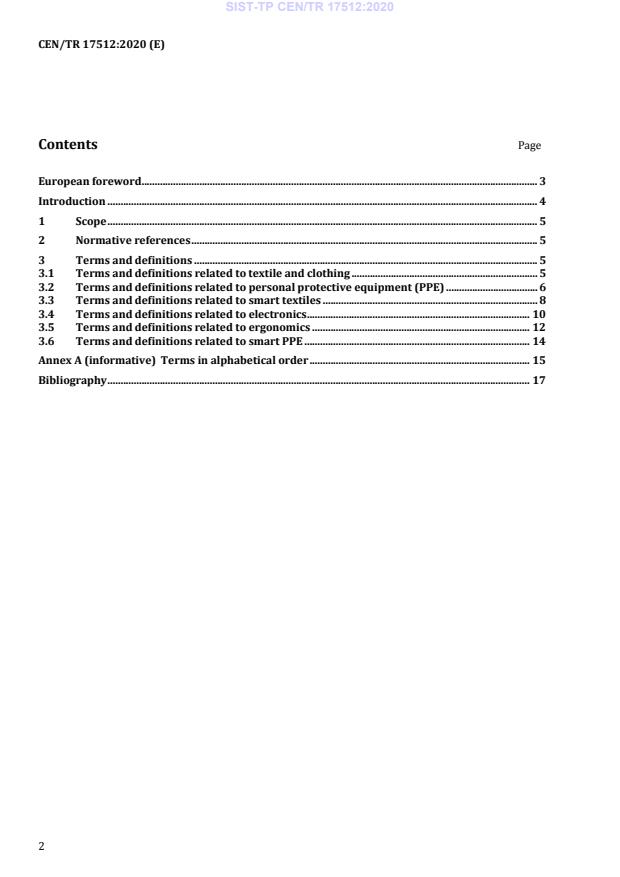
Contents Page
European foreword . 3
Introduction . 4
1 Scope . 5
2 Normative references . 5
3 Terms and definitions . 5
3.1 Terms and definitions related to textile and clothing . 5
3.2 Terms and definitions related to personal protective equipment (PPE) . 6
3.3 Terms and definitions related to smart textiles . 8
3.4 Terms and definitions related to electronics . 10
3.5 Terms and definitions related to ergonomics . 12
3.6 Terms and definitions related to smart PPE . 14
Annex A (informative) Terms in alphabetical order . 15
Bibliography . 17
European foreword
This document (CEN/TR 17512:2020) has been prepared by Technical Committee CEN/TC 162
“Protective clothing including hand and arm protection and lifejackets”, the secretariat of which is held
by DIN.
Attention is drawn to the possibility that some of the elements of this document may be the subject of
patent rights. CEN shall not be held responsible for identifying any or all such patent rights.
This document has been drafted conjunctionally according to the mode 4 cooperation between
CEN/TC162 and CEN/TC 122 (/WG 14), CEN/TC 248 (/WG 31) and CENELEC/SR 124.
This document has been prepared under a mandate given to CEN by the European Commission and the
European Free Trade Association [1].
Introduction
The purpose of this document is to support of the implementation of Regulation (EU) No 1007/2011
and of Article 5 and Annex II of Regulation (EU) 2016/425, by listing terms and defining them in
relation to the advanced garments and ensembles of garments that provide protection against heat and
flame, with integrated smart textiles and non-textile elements for enhanced health, safety and survival
capabilities.
This document is structured with subclauses related to the different (technical) facets which make up
smart garments providing protection against heat and flame.
Therefore, the listed terms and definitions took into consideration those from:
— The sector of textile and clothing (Clause 3.1);
— The sector of personal protective equipment – PPE – (Clause 3.2);
— The sector smart textiles (Clause 3.3);
— The sector of electronics (Clause 3.4);
— The sector of ergonomics (Clause 3.5);
— The sector of smart personal protective equipment – smart PPE – (Clause 3.6).
The main sources of existing terms and definitions are:
a) Regulation (EU) No 1007/2011 on textile fibre names and related labelling and marking of the fibre
composition of textile products (mainly referred to in Clause 3.1);
b) EN ISO 11610:— , Protective clothing - Vocabulary (mainly referred to in Clause 3.2);
c) ISO/TR 19591:2018, Personal protective equipment for firefighters - Standard terms and definitions
(mainly referred to in Clause 3.2);
d) ISO/TS 20141:— , Guideline on compatibility of PPE (mainly referred to in Clause 3.2);
e) CEN/TR 16298:2011 , Textile and textile products - Smart textiles - Definitions, categorization
applications and standardization needs (mainly referred to in Clause 3.3);
f) IEC 60050-151:2001, International Electrotechnical Vocabulary (IEV) - Part 151: Electrical and
magnetic devices (mainly referred to in Clause 3.4);
g) WI 00248652 , Textiles and textile products - Textiles with integrated electronics and ICT -
Definitions, categorization, applications and standardization needs (mainly referred to in
Clause 3.4);
h) ISO 9241-11:2018, Ergonomics of human-system interaction - Part 11: Usability: Definitions and
concepts (mainly referred to in Clause 3.5).
Under development since 2018-08.
Under development since 2019-04.
The technical report CEN/TR 16298:2011 has been proposed as ISO/TR 23383 (title unchanged).
Under development since 2018-04.
1 Scope
This document lists terms and definitions related to core terms in the field of smart garments providing
protection against heat and flame (i.e. advanced garments and ensembles of garments as mentioned in
the Introduction). It is intended to facilitate communications, for example, between organizations and
individuals in industry and those who interact with them.
2 Normative references
There are no normative references in this document.
3 Terms and definitions
For the purposes of this document, the following terms and definitions apply.
ISO and IEC maintain terminological databases for use in standardization at the following addresses:
— ISO Online browsing platform: available at https://www.iso.org/obp/ui
— IEC Electropedia: available at http://www.electropedia.org/
3.1 Terms and definitions related to textile and clothing
3.1.1
textile fibre
unit of matter characterized by its flexibility, fineness and high ratio of length to maximum transverse
dimension, which render it suitable for textile applications
[SOURCE: Regulation EU 1007/2011, Article 3, 1. (b), (i)]
3.1.2
textile product
any raw, semi-worked, worked, semi- manufactured, manufactured, semi-made-up or made-up product
which is exclusively composed of textile fibres, regardless of the mixing or assembly process employed
[SOURCE: Regulation EU 1007/2011, Article 3, 1. (a)]
3.1.3
textile material
material made of textile fibres and intended to be used, as such or in conjunction with other textile or
nontextile items, for the production of textile products.
Note 1 to entry: Textile material refers to linear textile materials (e.g. fibres, yarns, threads) as well as surface
textile material (e.g. knitted, woven and non-woven fabrics).
[SOURCE: CEN/TR 16298:2011, 2.1]
3.1.4
non-textile element
product which is not composed of textile fibres
Note 1 to entry: Non-textile elements may contain, for example, active medical devices, radio and electrically
operated components, slide fastener, (press) buttons, membranes, non-textile patches.
3.1.5
garment
single article of clothing
Note 1 to entry: The term “garment” is intended for referring to the product.
Note 2 to entry: The garment may consist of single or multiple layers.
Note 3 to entry: Examples of garments: trousers, jacket, gloves, socks.
[SOURCE: EN ISO 11610:—, 3.1.2]
3.1.6
garment ensemble
ensemble of garments
group of garments worn together on the body at the same time
[SOURCE: EN ISO 11610:—, 3.5.1]
3.1.7
advanced garment
garment which shows enhanced functionality(ies)
Note 1 to entry: “protection” is one of the functions that a garment can provide.
3.1.8
seam
permanent fastening between two or more pieces of material by sewing or any other method
[SOURCE: EN ISO 11610:—, 3.4.1]
3.1.9
structural seam
seam that is necessary for the integrity of the garment
[SOURCE: EN ISO 11610:—, 3.4.2]
3.2 Terms and definitions related to personal protective equipment (PPE)
3.2.1
compatibility (of PPE)
capability of two or more items or components of personal protective equipment to exist or function in
the same system without modification, adaption or mutual interference
[SOURCE: ISO/TS 20141:—, 3.1]
3.2.2
ageing
changing of the product performance over time during use or storage
EXAMPLES:
— cleaning, maintenance or disinfecting processes;
— exposure to visible and/or ultraviolet radiation;
— exposure to high or low temperatures or to changing temperatures;
— exposure to chemicals including humidity;
— exposure to biological agents such as bacteria, fungi, insects or other pests;
— exposure to mechanical action such as abrasion, flexing, pressure and strain;
— exposure to contaminants such as dirt, oil, splashes of molten metal, etc.;
— exposure to wear and tear.
[SOURCE: EN ISO 11610:—, 3.6.13]
3.2.3
cleaning
process by which a garment is made again serviceable and/or hygienically wearable by removing any
dirt or contamination
[SOURCE: EN ISO 11610:—, 3.6.16]
3.2.4
garment assembly
series of garments arranged in the order as worn.
Note 1 to entry: It may contain multilayer materials, material combinations or a series of separate garments in
single or multiple layers.
[SOURCE: EN ISO 11610:—, 3.3.28]
3.2.5
material assembly
component assembly
combination of all materials of a multi-layer garment (including hardware) presented exactly as the
finished garment construction
[SOURCE: EN ISO 11610:—, 3.3.26]
3.2.6
conditioning
one or more operations intended to bring a sample or test specimen into a state of equilibrium with
regard to temperature and humidity
[SOURCE: ISO 291:2008, definition 3.4]
3.2.7
(protective garment) hardware
non-fabric integral part, object, or the like of a garment
Note 1 to entry: (protective garment) Hardware includes those made of metal or plastic, e.g. fasteners, rank
markings.
Note 2 to entry: (protective garment) Hardware is not to be confused with (electronic) hardware.
[SOURCE: EN ISO 11610:—, 3.3.24].
3.2.8
hole
break in original structure of the test specimen’s fabric in any dimension and having a continuous
perimeter caused by melting, glowing or flaming
[SOURCE: EN ISO 11610:—, 5.5.11]
3.2.9
balaclava hood
one-piece garment designed to fit closely over the entire head and to extend downwards to cover the
neck
[SOURCE: EN ISO 11610:—, 3.5.12]
3.2.10
(innermost) lining
innermost layer of fabric or other material inserted in a garment which is intended to be nearest to the
wearer's body
Note 1 to entry: Where the lining forms part of a quilted assembly, the quilted assembly shall be regarded as the
innermost lining.
[SOURCE: EN ISO 11610:—, 3.3.6]
3.2.11
interlining
layer between the outermost layer and the innermost lining in a multilayer garment
[SOURCE: EN ISO 11610:—, 3.3.7]
3.3 Terms and definitions related to smart textiles
3.3.1
functional textile material
textile material to which a specific function is added by means of material, composition, construction
and/or finishing (applying additives, etc.)
[SOURCE: CEN/TR 16298:2011, 2.2]
3.3.2
smart textile material (intelligent textile material, interactive textile material)
functional textile material, which interacts reversible with its environment, i.e. it responds or adapts to
changes in the environment
Note 1 to entry:
...