

SIST EN 300 386 V3.2.1:2026
(Main)Telecommunication network equipment - Harmonised Standard for ElectroMagnetic Compatibility (EMC) requirements
General Information
- Abstract
The present document specifies the EMC requirements for telecommunication equipment intended to be used within a telecommunications network, which provides telecommunications between Network Termination Points (NTPs) (i.e. excluding terminal equipment beyond the NTPs). Radio functionality (e.g. Bluetooth®, Wi-Fi®, GPS) incorporated in telecommunication network equipment is also within the scope of the present document. Examples (non-exhaustive list) of such equipment are:
1) Switching equipment. Such equipment includes:
- local telephone exchanges;
- remote switching concentrators;
- international switches;
- telex switches;
- network packet switches;
- base station controllers, radio network controllers;
- network servers and gateways.
2) Non-radio transmission equipment and ancillary equipment. Such equipment includes:
- multiplexers;
- line equipment and repeaters, e.g. equipment for:
- Synchronous Digital Hierarchy (SDH);
- Plesiochronous Digital Hierarchy (PDH);
- Asynchronous Transfer Mode (ATM);
such as:
- Digital Cross Connect systems;
- network terminations;
- transmission equipment used in the access network like xDSL.
3) Power supply equipment. Such equipment includes:
- central power plant;
- end of suite power supplies;
- uninterruptible power supplies;
- stabilized AC power supplies; and
- other dedicated telecommunication network power supplies
but excludes equipment which is uniquely associated with or integrated in other equipment.
4) Supervisory equipment. Such equipment includes:
- network management equipment;
- operator access maintenance equipment;
- traffic measurement systems;
- line test units;
- functional test units.
NOTE 1: The function of supervision may either be performed by independent equipment or form part of other telecommunication network equipment. If the function of supervision forms part of a telecommunication network equipment, the performance may be evaluated simultaneously with other functions (such as switching and transmission) during EMC testing.
5) Telecommunication network equipment incorporating radio equipment.
6) Data centre equipment which is intended to be used within telecommunication network infrastructure:
- Storage.
- Processor.
- Server.
The requirements applicable to radio interfaces of Telecommunication network equipment within the scope of the present document (e.g. Bluetooth®, Wi-Fi ®, GPS) are defined in clause 7 and annex D.
The environmental classification locations used in the present document refer to ETSI TR 101 651 [i.22]. The emission requirements of the present document refer to EN 55032 [31] that have been selected to ensure an adequate level of protection to radio services. The immunity requirements of the present document have been selected to ensure an adequate level of immunity for the apparatus covered by the scope of the present document. General purpose equipment, which is used as a part of a telecommunication network, may be covered by the scope of other standards. Equipment which also fall within the scope of EN 50083-2 [3] may require additional testing on the relevant RF ports. See clause 9.2 and annex C. Equipment may provide different functions, i.e. switching equipment may also provide transmission functions and transmission equipment may provide storage capabilities, etc. All available functions of the EUT are to be tested. Technical requirements related to conducted emission EMC requirements below 9 kHz on the AC mains port of telecommunication network equipment are not included in the present document.
NOTE 2: Such technical requirements are normally found in the relevant product family standards for AC mains powered equipment (e.g. EN 61000-3-2 [i.48] and EN 61000-3-3 [i.49]).
NOTE 3: The relationship between the present document and essential requirements of annex I.1 of Directive 2014/30/EU [i.31] and/or article 3.1(b) of Directive 2014/53/EU [i.6] is given in annex A.
- Status
- Published
- Public Enquiry End Date
- 31-Oct-2025
- Publication Date
- 03-Dec-2025
- Technical Committee
- MOC - Mobile Communications
- Current Stage
- 6060 - National Implementation/Publication (Adopted Project)
- Start Date
- 01-Dec-2025
- Due Date
- 05-Feb-2026
- Completion Date
- 04-Dec-2025
Buy Documents

ETSI EN 300 386 V3.0.0 (2025-08) - Telecommunication network equipment; Harmonised Standard for ElectroMagnetic Compatibility (EMC) requirements
ETSI EN 300 386 V3.2.1 (2025-11) - Telecommunication network equipment; Harmonised Standard for ElectroMagnetic Compatibility (EMC) requirements

Overview
SIST EN 300 386 V3.2.1:2026 is the harmonised EMC (ElectroMagnetic Compatibility) standard for telecommunication network equipment used inside telecommunications networks between Network Termination Points (NTPs). It covers a wide range of equipment - switching, transmission, power supplies, supervisory systems, data‑centre servers/storage/processors and telecommunication network equipment that incorporate radio interfaces (e.g. Bluetooth®, Wi‑Fi®, GPS). Terminal equipment located beyond NTPs is excluded.
Key technical topics and requirements
- Scope and equipment types: switching equipment, non‑radio transmission and ancillary equipment (SDH/PDH/ATM, xDSL terminations), power supply systems (UPS, central plant), supervisory/test equipment, radio‑enabled network equipment and data centre components intended for telecom infrastructure.
- Emission requirements: conducted and radiated emissions testing for enclosure, AC/DC power ports, wired network ports and antenna ports. Emission references are aligned with EN 55032 to protect radio services.
- Immunity requirements and test methods: standardized test methods for Electrostatic Discharge (ESD), Electrical Fast Transients/Burst (EFT), surge, continuous conducted RF (>150 kHz), radiated RF fields, and voltage dips/interruptions on AC power ports.
- Ports and interfaces: specific provisions and test regimes for AC and DC power ports, signal line/wired network ports, antenna ports and outdoor/indoor signal lines.
- Operational and environmental conditions: installation environment classifications reference ETSI TR 101 651; all available device functions must be tested (switching, transmission, storage).
- Performance criteria: defined performance classes for continuous phenomena, transients and interruptions (notably Performance Criteria A/B/C used for switching and transmission equipment).
- Limitations and exclusions: technical requirements for conducted emissions below 9 kHz on AC mains are not included (these are typically covered by product family standards such as EN 61000‑3‑2 / EN 61000‑3‑3). Relationship to EU directives (e.g. 2014/30/EU and 2014/53/EU) is given in Annex A.
- Radio interfaces: specific requirements for embedded radio functionality are defined in Clause 7 and Annex D.
Practical applications - who uses this standard
- Manufacturers and designers of telecom network equipment to design for EMC compliance and reduce interference risk.
- EMC test laboratories and certification bodies for structured test plans and reporting.
- Network operators and integrators ensuring equipment interoperability, reliability and minimal impact on radio services.
- Compliance engineers preparing technical documentation for CE marking under relevant EU directives.
Related standards and references
- EN 55032 (emission reference)
- EN 61000‑3‑2 / EN 61000‑3‑3 (power‑quality conducted emission standards - for <9 kHz mains specifics)
- ETSI TR 101 651 (environmental classification)
- Relevant ETSI normative and informative references cited in the standard
Keywords: electromagnetic compatibility, EMC, telecommunication network equipment, harmonised standard, ETSI, EMC testing, immunity, emissions, antenna ports, power ports, network compliance.
Buy Documents
ETSI EN 300 386 V3.0.0 (2025-08) - Telecommunication network equipment; Harmonised Standard for ElectroMagnetic Compatibility (EMC) requirements
ETSI EN 300 386 V3.2.1 (2025-11) - Telecommunication network equipment; Harmonised Standard for ElectroMagnetic Compatibility (EMC) requirements
Get Certified
Connect with accredited certification bodies for this standard

ANCE
Mexican certification and testing association.

Intertek Slovenia
Intertek testing, inspection, and certification services in Slovenia.

LNE (Laboratoire National de Métrologie et d'Essais)
French national laboratory for metrology and testing.
Sponsored listings
Frequently Asked Questions
SIST EN 300 386 V3.2.1:2026 is a standard published by the Slovenian Institute for Standardization (SIST). Its full title is "Telecommunication network equipment - Harmonised Standard for ElectroMagnetic Compatibility (EMC) requirements". This standard covers: The present document specifies the EMC requirements for telecommunication equipment intended to be used within a telecommunications network, which provides telecommunications between Network Termination Points (NTPs) (i.e. excluding terminal equipment beyond the NTPs). Radio functionality (e.g. Bluetooth®, Wi-Fi®, GPS) incorporated in telecommunication network equipment is also within the scope of the present document. Examples (non-exhaustive list) of such equipment are: 1) Switching equipment. Such equipment includes: - local telephone exchanges; - remote switching concentrators; - international switches; - telex switches; - network packet switches; - base station controllers, radio network controllers; - network servers and gateways. 2) Non-radio transmission equipment and ancillary equipment. Such equipment includes: - multiplexers; - line equipment and repeaters, e.g. equipment for: - Synchronous Digital Hierarchy (SDH); - Plesiochronous Digital Hierarchy (PDH); - Asynchronous Transfer Mode (ATM); such as: - Digital Cross Connect systems; - network terminations; - transmission equipment used in the access network like xDSL. 3) Power supply equipment. Such equipment includes: - central power plant; - end of suite power supplies; - uninterruptible power supplies; - stabilized AC power supplies; and - other dedicated telecommunication network power supplies but excludes equipment which is uniquely associated with or integrated in other equipment. 4) Supervisory equipment. Such equipment includes: - network management equipment; - operator access maintenance equipment; - traffic measurement systems; - line test units; - functional test units. NOTE 1: The function of supervision may either be performed by independent equipment or form part of other telecommunication network equipment. If the function of supervision forms part of a telecommunication network equipment, the performance may be evaluated simultaneously with other functions (such as switching and transmission) during EMC testing. 5) Telecommunication network equipment incorporating radio equipment. 6) Data centre equipment which is intended to be used within telecommunication network infrastructure: - Storage. - Processor. - Server. The requirements applicable to radio interfaces of Telecommunication network equipment within the scope of the present document (e.g. Bluetooth®, Wi-Fi ®, GPS) are defined in clause 7 and annex D. The environmental classification locations used in the present document refer to ETSI TR 101 651 [i.22]. The emission requirements of the present document refer to EN 55032 [31] that have been selected to ensure an adequate level of protection to radio services. The immunity requirements of the present document have been selected to ensure an adequate level of immunity for the apparatus covered by the scope of the present document. General purpose equipment, which is used as a part of a telecommunication network, may be covered by the scope of other standards. Equipment which also fall within the scope of EN 50083-2 [3] may require additional testing on the relevant RF ports. See clause 9.2 and annex C. Equipment may provide different functions, i.e. switching equipment may also provide transmission functions and transmission equipment may provide storage capabilities, etc. All available functions of the EUT are to be tested. Technical requirements related to conducted emission EMC requirements below 9 kHz on the AC mains port of telecommunication network equipment are not included in the present document. NOTE 2: Such technical requirements are normally found in the relevant product family standards for AC mains powered equipment (e.g. EN 61000-3-2 [i.48] and EN 61000-3-3 [i.49]). NOTE 3: The relationship between the present document and essential requirements of annex I.1 of Directive 2014/30/EU [i.31] and/or article 3.1(b) of Directive 2014/53/EU [i.6] is given in annex A.
The present document specifies the EMC requirements for telecommunication equipment intended to be used within a telecommunications network, which provides telecommunications between Network Termination Points (NTPs) (i.e. excluding terminal equipment beyond the NTPs). Radio functionality (e.g. Bluetooth®, Wi-Fi®, GPS) incorporated in telecommunication network equipment is also within the scope of the present document. Examples (non-exhaustive list) of such equipment are: 1) Switching equipment. Such equipment includes: - local telephone exchanges; - remote switching concentrators; - international switches; - telex switches; - network packet switches; - base station controllers, radio network controllers; - network servers and gateways. 2) Non-radio transmission equipment and ancillary equipment. Such equipment includes: - multiplexers; - line equipment and repeaters, e.g. equipment for: - Synchronous Digital Hierarchy (SDH); - Plesiochronous Digital Hierarchy (PDH); - Asynchronous Transfer Mode (ATM); such as: - Digital Cross Connect systems; - network terminations; - transmission equipment used in the access network like xDSL. 3) Power supply equipment. Such equipment includes: - central power plant; - end of suite power supplies; - uninterruptible power supplies; - stabilized AC power supplies; and - other dedicated telecommunication network power supplies but excludes equipment which is uniquely associated with or integrated in other equipment. 4) Supervisory equipment. Such equipment includes: - network management equipment; - operator access maintenance equipment; - traffic measurement systems; - line test units; - functional test units. NOTE 1: The function of supervision may either be performed by independent equipment or form part of other telecommunication network equipment. If the function of supervision forms part of a telecommunication network equipment, the performance may be evaluated simultaneously with other functions (such as switching and transmission) during EMC testing. 5) Telecommunication network equipment incorporating radio equipment. 6) Data centre equipment which is intended to be used within telecommunication network infrastructure: - Storage. - Processor. - Server. The requirements applicable to radio interfaces of Telecommunication network equipment within the scope of the present document (e.g. Bluetooth®, Wi-Fi ®, GPS) are defined in clause 7 and annex D. The environmental classification locations used in the present document refer to ETSI TR 101 651 [i.22]. The emission requirements of the present document refer to EN 55032 [31] that have been selected to ensure an adequate level of protection to radio services. The immunity requirements of the present document have been selected to ensure an adequate level of immunity for the apparatus covered by the scope of the present document. General purpose equipment, which is used as a part of a telecommunication network, may be covered by the scope of other standards. Equipment which also fall within the scope of EN 50083-2 [3] may require additional testing on the relevant RF ports. See clause 9.2 and annex C. Equipment may provide different functions, i.e. switching equipment may also provide transmission functions and transmission equipment may provide storage capabilities, etc. All available functions of the EUT are to be tested. Technical requirements related to conducted emission EMC requirements below 9 kHz on the AC mains port of telecommunication network equipment are not included in the present document. NOTE 2: Such technical requirements are normally found in the relevant product family standards for AC mains powered equipment (e.g. EN 61000-3-2 [i.48] and EN 61000-3-3 [i.49]). NOTE 3: The relationship between the present document and essential requirements of annex I.1 of Directive 2014/30/EU [i.31] and/or article 3.1(b) of Directive 2014/53/EU [i.6] is given in annex A.
SIST EN 300 386 V3.2.1:2026 is classified under the following ICS (International Classification for Standards) categories: 33.050.01 - Telecommunication terminal equipment in general; 33.100.01 - Electromagnetic compatibility in general. The ICS classification helps identify the subject area and facilitates finding related standards.
SIST EN 300 386 V3.2.1:2026 is available in PDF format for immediate download after purchase. The document can be added to your cart and obtained through the secure checkout process. Digital delivery ensures instant access to the complete standard document.
Standards Content (Sample)
Draft ETSI EN 300 386 V.3.0.0 (2025-08)
HARMONISED EUROPEAN STANDARD
Telecommunication network equipment;
Harmonised Standard for ElectroMagnetic Compatibility (EMC)
requirements
2 Draft ETSI EN 300 386 V.3.0.0 (2025-08)
Reference
REN/ERM-EMC-422
Keywords
EMC, harmonised standard, network, testing
ETSI
650 Route des Lucioles
F-06921 Sophia Antipolis Cedex - FRANCE
Tel.: +33 4 92 94 42 00 Fax: +33 4 93 65 47 16
Siret N° 348 623 562 00017 - APE 7112B
Association à but non lucratif enregistrée à la
Sous-Préfecture de Grasse (06) N° w061004871
Important notice
The present document can be downloaded from the
ETSI Search & Browse Standards application.
The present document may be made available in electronic versions and/or in print. The content of any electronic and/or
print versions of the present document shall not be modified without the prior written authorization of ETSI. In case of any
existing or perceived difference in contents between such versions and/or in print, the prevailing version of an ETSI
deliverable is the one made publicly available in PDF format on ETSI deliver repository.
Users should be aware that the present document may be revised or have its status changed,
this information is available in the Milestones listing.
If you find errors in the present document, please send your comments to
the relevant service listed under Committee Support Staff.
If you find a security vulnerability in the present document, please report it through our
Coordinated Vulnerability Disclosure (CVD) program.
Notice of disclaimer & limitation of liability
The information provided in the present deliverable is directed solely to professionals who have the appropriate degree of
experience to understand and interpret its content in accordance with generally accepted engineering or
other professional standard and applicable regulations.
No recommendation as to products and services or vendors is made or should be implied.
In no event shall ETSI be held liable for loss of profits or any other incidental or consequential damages.
Any software contained in this deliverable is provided "AS IS" with no warranties, express or implied, including but not
limited to, the warranties of merchantability, fitness for a particular purpose and non-infringement of intellectual property
rights and ETSI shall not be held liable in any event for any damages whatsoever (including, without limitation, damages
for loss of profits, business interruption, loss of information, or any other pecuniary loss) arising out of or related to the use
of or inability to use the software.
Copyright Notification
No part may be reproduced or utilized in any form or by any means, electronic or mechanical, including photocopying and
microfilm except as authorized by written permission of ETSI.
The content of the PDF version shall not be modified without the written authorization of ETSI.
The copyright and the foregoing restriction extend to reproduction in all media.
© ETSI 2025.
All rights reserved.
ETSI
3 Draft ETSI EN 300 386 V.3.0.0 (2025-08)
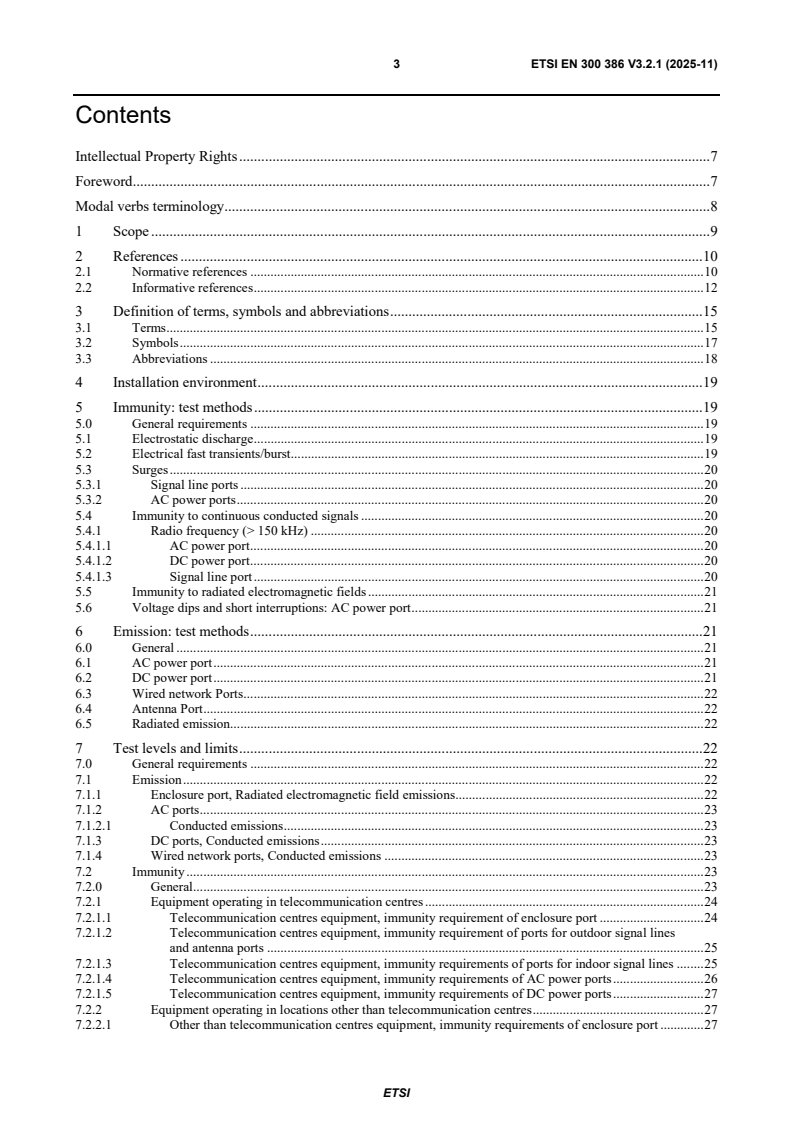
Contents
Intellectual Property Rights . 7
Foreword . 7
Modal verbs terminology . 8
1 Scope . 9
2 References . 10
2.1 Normative references . 10
2.2 Informative references . 12
3 Definition of terms, symbols and abbreviations . 15
3.1 Terms . 15
3.2 Symbols . 17
3.3 Abbreviations . 18
4 Installation environment . 19
5 Immunity: test methods . 19
5.0 General requirements . 19
5.1 Electrostatic discharge . 19
5.2 Electrical fast transients/burst . 19
5.3 Surges . 20
5.3.1 Signal line ports . 20
5.3.2 AC power ports . 20
5.4 Immunity to continuous conducted signals . 20
5.4.1 Radio frequency (> 150 kHz) . 20
5.4.1.1 AC power port . 20
5.4.1.2 DC power port . 20
5.4.1.3 Signal line port . 20
5.5 Immunity to radiated electromagnetic fields . 21
5.6 Voltage dips and short interruptions: AC power port . 21
6 Emission: test methods . 21
6.0 General . 21
6.1 AC power port . 21
6.2 DC power port . 21
6.3 Wired network Ports . 22
6.4 Antenna Port . 22
6.5 Radiated emission. 22
7 Test levels and limits . 22
7.0 General requirements . 22
7.1 Emission . 22
7.1.1 Enclosure port, Radiated electromagnetic field emissions . 22
7.1.2 AC ports . 23
7.1.2.1 Conducted emissions . 23
7.1.3 DC ports, Conducted emissions . 23
7.1.4 Wired network ports, Conducted emissions . 23
7.2 Immunity . 23
7.2.0 General . 23
7.2.1 Equipment operating in telecommunication centres . 24
7.2.1.1 Telecommunication centres equipment, immunity requirement of enclosure port . 24
7.2.1.2 Telecommunication centres equipment, immunity requirement of ports for outdoor signal lines
and antenna ports . 25
7.2.1.3 Telecommunication centres equipment, immunity requirements of ports for indoor signal lines . 25
7.2.1.4 Telecommunication centres equipment, immunity requirements of AC power ports . 26
7.2.1.5 Telecommunication centres equipment, immunity requirements of DC power ports . 27
7.2.2 Equipment operating in locations other than telecommunication centres . 27
7.2.2.1 Other than telecommunication centres equipment, immunity requirements of enclosure port . 27
ETSI
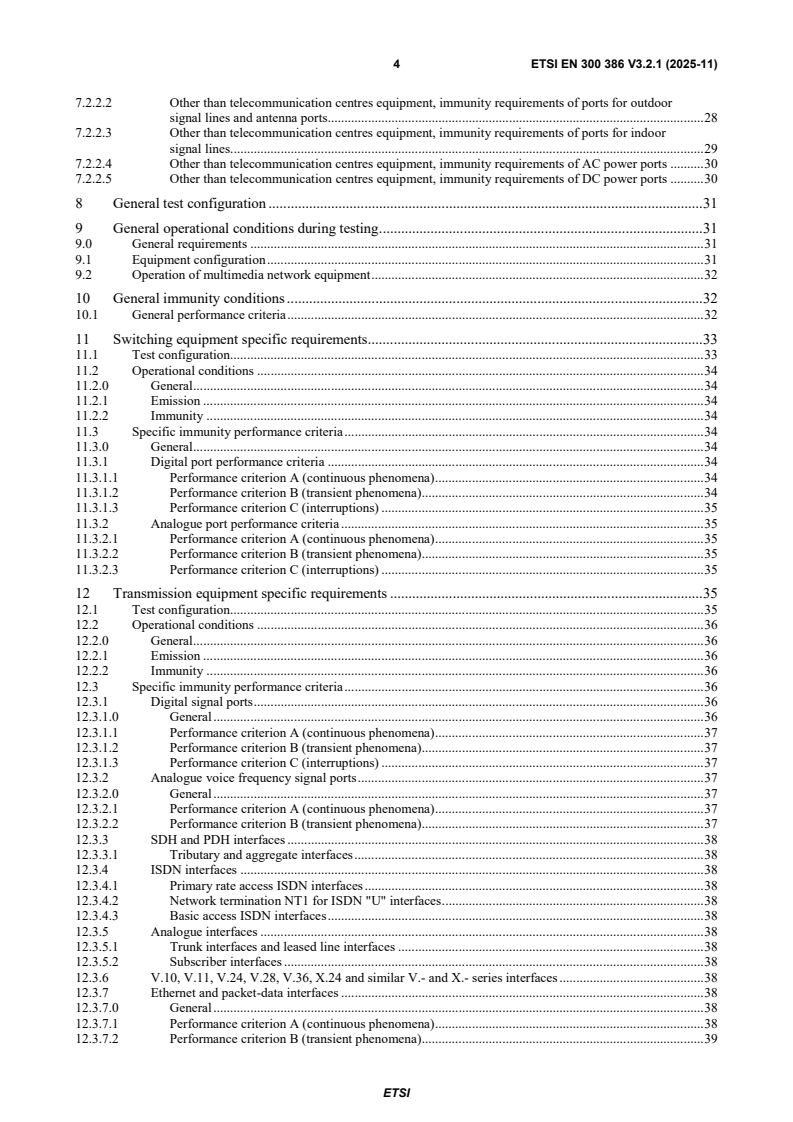
4 Draft ETSI EN 300 386 V.3.0.0 (2025-08)
7.2.2.2 Other than telecommunication centres equipment, immunity requirements of ports for outdoor
signal lines and antenna ports. 28
7.2.2.3 Other than telecommunication centres equipment, immunity requirements of ports for indoor
signal lines. 29
7.2.2.4 Other than telecommunication centres equipment, immunity requirements of AC power ports . 30
7.2.2.5 Other than telecommunication centres equipment, immunity requirements of DC power ports . 30
8 General test configuration . 31
9 General operational conditions during testing . 31
9.0 General requirements . 31
9.1 Equipment configuration . 31
9.2 Operation of multimedia network equipment . 32
10 General immunity conditions . 32
10.1 General performance criteria . 32
11 Switching equipment specific requirements . 33
11.1 Test configuration. 33
11.2 Operational conditions . 34
11.2.0 General . 34
11.2.1 Emission . 34
11.2.2 Immunity . 34
11.3 Specific immunity performance criteria . 34
11.3.0 General . 34
11.3.1 Digital port performance criteria . 34
11.3.1.1 Performance criterion A (continuous phenomena) . 34
11.3.1.2 Performance criterion B (transient phenomena). 34
11.3.1.3 Performance criterion C (interruptions) . 35
11.3.2 Analogue port performance criteria . 35
11.3.2.1 Performance criterion A (continuous phenomena) . 35
11.3.2.2 Performance criterion B (transient phenomena). 35
11.3.2.3 Performance criterion C (interruptions) . 35
12 Transmission equipment specific requirements . 35
12.1 Test configuration. 35
12.2 Operational conditions . 36
12.2.0 General . 36
12.2.1 Emission . 36
12.2.2 Immunity . 36
12.3 Specific immunity performance criteria . 36
12.3.1 Digital signal ports . 36
12.3.1.0 General . 36
12.3.1.1 Performance criterion A (continuous phenomena) . 37
12.3.1.2 Performance criterion B (transient phenomena). 37
12.3.1.3 Performance criterion C (interruptions) . 37
12.3.2 Analogue voice frequency signal ports . 37
12.3.2.0 General . 37
12.3.2.1 Performance criterion A (continuous phenomena) . 37
12.3.2.2 Performance criterion B (transient phenomena). 37
12.3.3 SDH and PDH interfaces . 38
12.3.3.1 Tributary and aggregate interfaces . 38
12.3.4 ISDN interfaces . 38
12.3.4.1 Primary rate access ISDN interfaces . 38
12.3.4.2 Network termination NT1 for ISDN "U" interfaces . 38
12.3.4.3 Basic access ISDN interfaces . 38
12.3.5 Analogue interfaces . 38
12.3.5.1 Trunk interfaces and leased line interfaces . 38
12.3.5.2 Subscriber interfaces . 38
12.3.6 V.10, V.11, V.24, V.28, V.36, X.24 and similar V.- and X.- series interfaces . 38
12.3.7 Ethernet and packet-data interfaces . 38
12.3.7.0 General . 38
12.3.7.1 Performance criterion A (continuous phenomena) . 38
12.3.7.2 Performance criterion B (transient phenomena). 39
ETSI
5 Draft ETSI EN 300 386 V.3.0.0 (2025-08)
12.3.8 Service and maintenance interfaces . 39
12.3.9 Synchronization interfaces . 39
12.3.9.0 General . 39
12.3.9.1 Performance criterion A (continuous phenomena) . 39
12.3.9.2 Performance criterion B (transient phenomena). 39
12.3.10 Remote alarm interfaces . 39
12.3.10.0 General . 39
12.3.10.1 Performance criterion A (continuous phenomena) . 39
12.3.10.2 Performance criterion B (transient phenomena). 39
12.4 Digital Subscriber Line (DSL) Access Systems . 39
12.4.1 Test configuration . 39
12.4.2 Operational conditions . 40
12.4.3 Immunity . 41
12.4.4 Specific Immunity performance criteria . 41
12.4.4.0 General . 41
12.4.4.1 Performance Criterion A (continuous phenomena) . 41
12.4.4.2 Performance Criterion B (transient phenomena) . 41
12.4.4.3 Performance Criterion C (interruptions) . 41
13 Power supply equipment specific conditions . 42
13.0 Applicability . 42
13.1 Test configuration. 42
13.2 Operational conditions . 43
13.2.1 Emission . 43
13.2.2 Immunity . 43
13.3 Specific immunity performance criteria . 43
13.3.0 General . 43
13.3.1 Alternating current secondary interface . 43
13.3.1.1 Performance criterion A (continuous phenomena) . 43
13.3.1.2 Performance criterion B (transient phenomena). 43
13.3.2 Direct current secondary interface . 44
13.3.2.1 Performance criterion A (continuous phenomena) . 44
13.3.2.2 Performance criterion B (transient phenomena). 44
13.3.3 Control/signal interface . 44
13.3.4 Tertiary supply interface . 44
14 Supervisory equipment specific conditions . 45
14.1 Test configuration. 45
14.2 Operational conditions . 45
14.3 Specific immunity performance criteria . 46
14.3.1 Performance criterion A (continuous phenomena) . 46
14.3.2 Performance criterion B (transient phenomena) . 46
Annex A (informative): Relationship between the present document and the essential
requirements of Directives 2014/30/EU and 2014/53/EU . 47
A.1 Relationship between the present document and the essential requirements of Directive
2014/30/EU . 47
A.2 Relationship between the present document and the essential requirements of Directive
2014/53/EU . 49
Annex B (informative): Evaluation of test results . 51
Annex C (informative): Guidance on EMC performance requirements and methods of
measurement for RF ports (also covered by EN 50083-2) of
multimedia network equipment . 53
Annex D (normative): Requirements of radio functions . 54
D.1 Applicability . 54
D.2 Exclusion bands . 54
D.2.1 General . 54
ETSI
6 Draft ETSI EN 300 386 V.3.0.0 (2025-08)
D.2.2 Calculation for exclusion bands . 55
D.2.2.1 Exclusion bands for receivers . 55
D.2.2.1.1 For channelized systems . 55
D.2.2.1.2 For non-channelized systems . 55
D.2.2.2 Exclusion bands for transmitters . 55
D.2.2.2.1 For channelized systems . 55
D.2.2.2.2 For Non-Channelized Equipment . 55
D.2.3 Example of exclusion Bands . 56
D.3 Mode of operation . 56
D.3.1 General . 56
D.3.2 Standby Mode . 56
D.3.3 Receivers . 56
D.3.4 Transmitters . 57
D.3.5 Performance criteria . 57
D.3.5.1 Performance criterion A . 57
D.3.5.2 Performance criterion B . 57
D.3.5.3 Performance criterion C . 57
Annex E (informative): Why testing on cables shorter than 3 m in length is not required . 58
E.1 Background . 58
E.2 Emission requirements . 58
E.3 Immunity requirements . 58
E.3.1 Common rationale . 58
E.3.2 For EN 61000-4-6 tests . 58
E.3.3 For EN 61000-4-4 tests . 59
E.4 Interactive aspects in EMC Tests . 59
E.4.1 Introduction . 59
E.4.2 For EN 61000-4-6 tests . 59
E.4.3 For EN 61000-4-4 tests . 61
E.5 Conclusion . 61
Annex F (informative): Bibliography . 62
Annex G (informative): Change history . 63
History . 64
ETSI
7 Draft ETSI EN 300 386 V.3.0.0 (2025-08)
Intellectual Property Rights
Essential patents
IPRs essential or potentially essential to normative deliverables may have been declared to ETSI. The declarations
pertaining to these essential IPRs, if any, are publicly available for ETSI members and non-members, and can be
found in ETSI SR 000 314: "Intellectual Property Rights (IPRs); Essential, or potentially Essential, IPRs notified to
ETSI in respect of ETSI standards", which is available from the ETSI Secretariat. Latest updates are available on the
ETSI IPR online database.
Pursuant to the ETSI Directives including the ETSI IPR Policy, no investigation regarding the essentiality of IPRs,
including IPR searches, has been carried out by ETSI. No guarantee can be given as to the existence of other IPRs not
referenced in ETSI SR 000 314 (or the updates on the ETSI Web server) which are, or may be, or may become,
essential to the present document.
Trademarks
The present document may include trademarks and/or tradenames which are asserted and/or registered by their owners.
ETSI claims no ownership of these except for any which are indicated as being the property of ETSI, and conveys no
right to use or reproduce any trademark and/or tradename. Mention of those trademarks in the present document does
not constitute an endorsement by ETSI of products, services or organizations associated with those trademarks.
DECT™, PLUGTESTS™, UMTS™ and the ETSI logo are trademarks of ETSI registered for the benefit of its
Members. 3GPP™, LTE™ and 5G™ logo are trademarks of ETSI registered for the benefit of its Members and of the
3GPP Organizational Partners. oneM2M™ logo is a trademark of ETSI registered for the benefit of its Members and of ®
the oneM2M Partners. GSM and the GSM logo are trademarks registered and owned by the GSM Association. ®
BLUETOOTH is a trademark registered and owned by Bluetooth SIG, Inc.
Foreword
This draft Harmonised European Standard (EN) has been produced by ETSI Technical Committee Electromagnetic
compatibility and Radio spectrum Matters (ERM), and is now submitted for the combined Public Enquiry and Vote
phase of the ETSI Standardisation Request deliverable Approval Procedure (SRdAP).
The present document has been prepared:
• under the Commission's standardisation request C(2016) 7641 final of 30.11.2016 [i.43] ('M/552'), to provide
one voluntary means of conforming to the essential requirements of Directive 2014/30/EU on the
harmonisation of the laws of the Member States relating to electromagnetic compatibility [i.31];
• under the Commission's standardisation request C(2015) 5376 final of 4.8.2015 [i.7] ('M/536'), to provide one
voluntary means of conforming to the essential requirements of Directive 2014/53/EU on the harmonisation of
the laws of the Member States relating to the making available on the market of radio equipment and repealing
Directive 1999/5/EC [i.6].
Once the present document is cited in the Official Journal of the European Union under the Directives, compliance with
the normative clauses of the present document given in tables A.1 and A.2 confers, within the limits of the scope of the
present document, a presumption of conformity with the corresponding essential requirements of the relevant Directives
and associated EFTA regulations.
Proposed national transposition dates
Date of latest announcement of this EN (doa): 3 months after ETSI publication
Date of latest publication of new National Standard
or endorsement of this EN (dop/e): 6 months after doa
Date of withdrawal of any conflicting National Standard (dow): 18 months after doa
ETSI
8 Draft ETSI EN 300 386 V.3.0.0 (2025-08)
Modal verbs terminology
In the present document "shall", "shall not", "should", "should not", "may", "need not", "will", "will not", "can" and
"cannot" are to be interpreted as described in clause 3.2 of the ETSI Drafting Rules (Verbal forms for the expression of
provisions).
"must" and "must not" are NOT allowed in ETSI deliverables except when used in direct citation.
ETSI
9 Draft ETSI EN 300 386 V.3.0.0 (2025-08)
1 Scope
The present document specifies the EMC requirements for telecommunication equipment intended to be used within a
telecommunications network, which provides telecommunications between Network Termination Points (NTPs)
® ®
(i.e. excluding terminal equipment beyond the NTPs). Radio functionality (e.g. Bluetooth , Wi-Fi , GPS) incorporated in
telecommunication network equipment is also within the scope of the present document. Examples (non-exhaustive list) of
such equipment are:
1) Switching equipment. Such equipment includes:
- local telephone exchanges;
- remote switching concentrators;
- international switches;
- telex switches;
- network packet switches;
- base station controllers, radio network controllers;
- network servers and gateways.
2) Non-radio transmission equipment and ancillary equipment. Such equipment includes:
- multiplexers;
- line equipment and repeaters, e.g. equipment for:
Synchronous Digital Hierarchy (SDH);
Plesiochronous Digital Hierarchy (PDH);
Asynchronous Transfer Mode (ATM);
such as:
Digital Cross Connect systems;
network terminations;
transmission equipment used in the access network like xDSL.
3) Power supply equipment. Such equipment includes:
- central power plant;
- end of suite power supplies;
- uninterruptible power supplies;
- stabilized AC power supplies; and
- other dedicated telecommunication network power supplies
but excludes equipment which is uniquely associated with or integrated in other equipment.
4) Supervisory equipment. Such equipment includes:
- network management equipment;
- operator access maintenance equipment;
- traffic measurement systems;
- line test units;
ETSI
10 Draft ETSI EN 300 386 V.3.0.0 (2025-08)
- functional test units.
NOTE 1: The function of supervision may either be performed by independent equipment or form part of other
telecommunication network equipment. If the function of supervision forms part of a telecommunication
network equipment, the performance may be evaluated simultaneously with other functions (such as
switching and transmission) during EMC testing.
5) Telecommunication network equipment incorporating radio equipment.
6) Data centre equipment which is intended to be used within telecommunication network infrastructure:
- Storage.
- Processor.
- Server.
The requirements applicable to radio interfaces of Telecommunication network equipment within the scope of the
® ®
present document (e.g. Bluetooth , Wi-Fi , GPS) are defined in clause 7 and annex D.
The environmental classification locations used in the present document refer to ETSI TR 101 651 [i.22].
The emission requirements of the present document refer to EN 55032 [31] that have been selected to ensure an
adequate level of protection to radio services.
The immunity requirements of the present document have been selected to ensure an adequate level of immunity for the
apparatus covered by the scope of the present document.
General purpose equipment, which is used as a part of a telecommunication network, may be covered by the scope of
other standards. Equipment which also fall within the scope of EN 50083-2 [3] may require additional testing on the
relevant RF ports. See clause 9.2 and annex C.
Equipment may provide different functions, i.e. switching equipment may also provide transmission functions and
transmission equipment may provide storage capabilities, etc. All available functions of the EUT are to be tested.
Technical requirements related to conducted emission EMC requirements below 9 kHz on the AC mains port of
telecommunication network equipment are not included in the present document.
NOTE 2: Such technical requirements are normally found in the relevant product family standards for AC mains
powered equipment (e.g. EN 61000-3-2 [i.48] and EN 61000-3-3 [i.49]).
NOTE 3: The relationship between the present document and essential requirements of annex I.1 of
Directive 2014/30/EU [i.31] and/or article 3.1(b) of Directive 2014/53/EU [i.6] is given in annex A.
2 References
2.1 Normative references
References are either specific (identified by date of publication and/or edition number or version number) or
non-specific. For specific references, only the cited version applies. For non-specific references, the latest version of the
referenced document (including any amendments) applies.
Referenced documents which are not found to be publicly available in the expected location might be found in the
ETSI docbox.
NOTE: While any hyperlinks included in this clause were valid at the time of publication, ETSI cannot guarantee
their long-term validity.
The following referenced documents are necessary for the application of the present document.
[1] EN 55016-1-2 (2014 + Amendment 1: 2018): "Specification for radio disturbance and immunity
measuring apparatus and methods - Part 1-2: Radio disturbance and immunity measuring
apparatus - Coupling devices for conducted disturbance measurements" (produced by CENELEC).
ETSI
11 Draft ETSI EN 300 386 V.3.0.0 (2025-08)
[2] Void.
[3] EN 50083-2 (2012 + Amendment 1: 2015): "Cable networks for television signals, sound signals
and interactive services - Part 2: Electromagnetic compatibility for equipment" (produced by
CENELEC).
[4] Void.
[5] Void.
[6] Void.
[7] Void.
[8] Void.
[9] EN 61000-4-2 (2009): "Electromagnetic compatibility (EMC) - Part 4-2: Testing and measurement
techniques - Electrostatic discharge immunity test", (produced by CENELEC).
[10] EN 61000-4-3 (2020): "Electromagnetic compatibility (EMC) - Part 4-3: Testing and measurement
techniques - Radiated, radio-frequency, electromagnetic field immunity test", (produced by
CENELEC).
[11] EN 61000-4-4 (2012): "Electromagnetic compatibility (EMC) - Part 4-4: Testing and measurement
techniques - Electrical fast transient/burst immunity test", (produced by CENELEC).
[12] EN 61000-4-5 (2014 + Amendment 1: 2017): "Electromagnetic compatibility (EMC) - Part 4-5:
Testing and measurement techniques - Surge immunity test", (produced by CENELEC).
[13] EN 61000-4-6 (2023): "Electromagnetic compatibility (EMC) - Part 4-6: Testing and measurement
techniques - Immunity to conducted disturbances, induced by radio-frequency fields", (produced
by CENELEC).
[14] EN 61000-4-11 (2020): "Electromagnetic compatibility (EMC) - Part 4-11: Testing and
measurement techniques - Voltage dips, short interruptions and voltage variations immunity tests
for equipment with input current up to 16 A per phase", (produced by CENELEC).
[15] ETSI EN 300 132-1 (V2.2.1) (11-2022): "Environmental Engineering (EE); Power supply
interface at the input to Information and Communication Technology (ICT) equipment;
Part 1: Alternating Current (AC)".
[16] ETSI EN 300 132-2 (V2.8.1) (10-2024): "Environmental Engineering (EE); Power supply
interface at the input of Information and
...
HARMONISED EUROPEAN STANDARD
Telecommunication network equipment;
Harmonised Standard for
ElectroMagnetic Compatibility (EMC) requirements
2 ETSI EN 300 386 V3.2.1 (2025-11)
Reference
REN/ERM-EMC-422
Keywords
EMC, harmonised standard, network, testing
ETSI
650 Route des Lucioles
F-06921 Sophia Antipolis Cedex - FRANCE
Tel.: +33 4 92 94 42 00 Fax: +33 4 93 65 47 16
Siret N° 348 623 562 00017 - APE 7112B
Association à but non lucratif enregistrée à la
Sous-Préfecture de Grasse (06) N° w061004871
Important notice
The present document can be downloaded from the
ETSI Search & Browse Standards application.
The present document may be made available in electronic versions and/or in print. The content of any electronic and/or
print versions of the present document shall not be modified without the prior written authorization of ETSI. In case of any
existing or perceived difference in contents between such versions and/or in print, the prevailing version of an ETSI
deliverable is the one made publicly available in PDF format on ETSI deliver repository.
Users should be aware that the present document may be revised or have its status changed,
this information is available in the Milestones listing.
If you find errors in the present document, please send your comments to
the relevant service listed under Committee Support Staff.
If you find a security vulnerability in the present document, please report it through our
Coordinated Vulnerability Disclosure (CVD) program.
Notice of disclaimer & limitation of liability
The information provided in the present deliverable is directed solely to professionals who have the appropriate degree of
experience to understand and interpret its content in accordance with generally accepted engineering or
other professional standard and applicable regulations.
No recommendation as to products and services or vendors is made or should be implied.
In no event shall ETSI be held liable for loss of profits or any other incidental or consequential damages.
Any software contained in this deliverable is provided "AS IS" with no warranties, express or implied, including but not
limited to, the warranties of merchantability, fitness for a particular purpose and non-infringement of intellectual property
rights and ETSI shall not be held liable in any event for any damages whatsoever (including, without limitation, damages
for loss of profits, business interruption, loss of information, or any other pecuniary loss) arising out of or related to the use
of or inability to use the software.
Copyright Notification
No part may be reproduced or utilized in any form or by any means, electronic or mechanical, including photocopying and
microfilm except as authorized by written permission of ETSI.
The content of the PDF version shall not be modified without the written authorization of ETSI.
The copyright and the foregoing restriction extend to reproduction in all media.
© ETSI 2025.
All rights reserved.
ETSI
3 ETSI EN 300 386 V3.2.1 (2025-11)
Contents
Intellectual Property Rights . 7
Foreword . 7
Modal verbs terminology . 8
1 Scope . 9
2 References . 10
2.1 Normative references . 10
2.2 Informative references . 12
3 Definition of terms, symbols and abbreviations . 15
3.1 Terms . 15
3.2 Symbols . 17
3.3 Abbreviations . 18
4 Installation environment . 19
5 Immunity: test methods . 19
5.0 General requirements . 19
5.1 Electrostatic discharge . 19
5.2 Electrical fast transients/burst . 19
5.3 Surges . 20
5.3.1 Signal line ports . 20
5.3.2 AC power ports . 20
5.4 Immunity to continuous conducted signals . 20
5.4.1 Radio frequency (> 150 kHz) . 20
5.4.1.1 AC power port . 20
5.4.1.2 DC power port . 20
5.4.1.3 Signal line port . 20
5.5 Immunity to radiated electromagnetic fields . 21
5.6 Voltage dips and short interruptions: AC power port . 21
6 Emission: test methods . 21
6.0 General . 21
6.1 AC power port . 21
6.2 DC power port . 21
6.3 Wired network Ports . 22
6.4 Antenna Port . 22
6.5 Radiated emission. 22
7 Test levels and limits . 22
7.0 General requirements . 22
7.1 Emission . 22
7.1.1 Enclosure port, Radiated electromagnetic field emissions . 22
7.1.2 AC ports . 23
7.1.2.1 Conducted emissions . 23
7.1.3 DC ports, Conducted emissions . 23
7.1.4 Wired network ports, Conducted emissions . 23
7.2 Immunity . 23
7.2.0 General . 23
7.2.1 Equipment operating in telecommunication centres . 24
7.2.1.1 Telecommunication centres equipment, immunity requirement of enclosure port . 24
7.2.1.2 Telecommunication centres equipment, immunity requirement of ports for outdoor signal lines
and antenna ports . 25
7.2.1.3 Telecommunication centres equipment, immunity requirements of ports for indoor signal lines . 25
7.2.1.4 Telecommunication centres equipment, immunity requirements of AC power ports . 26
7.2.1.5 Telecommunication centres equipment, immunity requirements of DC power ports . 27
7.2.2 Equipment operating in locations other than telecommunication centres . 27
7.2.2.1 Other than telecommunication centres equipment, immunity requirements of enclosure port . 27
ETSI
4 ETSI EN 300 386 V3.2.1 (2025-11)
7.2.2.2 Other than telecommunication centres equipment, immunity requirements of ports for outdoor
signal lines and antenna ports. 28
7.2.2.3 Other than telecommunication centres equipment, immunity requirements of ports for indoor
signal lines. 29
7.2.2.4 Other than telecommunication centres equipment, immunity requirements of AC power ports . 30
7.2.2.5 Other than telecommunication centres equipment, immunity requirements of DC power ports . 30
8 General test configuration . 31
9 General operational conditions during testing . 31
9.0 General requirements . 31
9.1 Equipment configuration . 31
9.2 Operation of multimedia network equipment . 32
10 General immunity conditions . 32
10.1 General performance criteria . 32
11 Switching equipment specific requirements . 33
11.1 Test configuration. 33
11.2 Operational conditions . 34
11.2.0 General . 34
11.2.1 Emission . 34
11.2.2 Immunity . 34
11.3 Specific immunity performance criteria . 34
11.3.0 General . 34
11.3.1 Digital port performance criteria . 34
11.3.1.1 Performance criterion A (continuous phenomena) . 34
11.3.1.2 Performance criterion B (transient phenomena). 34
11.3.1.3 Performance criterion C (interruptions) . 35
11.3.2 Analogue port performance criteria . 35
11.3.2.1 Performance criterion A (continuous phenomena) . 35
11.3.2.2 Performance criterion B (transient phenomena). 35
11.3.2.3 Performance criterion C (interruptions) . 35
12 Transmission equipment specific requirements . 35
12.1 Test configuration. 35
12.2 Operational conditions . 36
12.2.0 General . 36
12.2.1 Emission . 36
12.2.2 Immunity . 36
12.3 Specific immunity performance criteria . 36
12.3.1 Digital signal ports . 36
12.3.1.0 General . 36
12.3.1.1 Performance criterion A (continuous phenomena) . 37
12.3.1.2 Performance criterion B (transient phenomena). 37
12.3.1.3 Performance criterion C (interruptions) . 37
12.3.2 Analogue voice frequency signal ports . 37
12.3.2.0 General . 37
12.3.2.1 Performance criterion A (continuous phenomena) . 37
12.3.2.2 Performance criterion B (transient phenomena). 37
12.3.3 SDH and PDH interfaces . 38
12.3.3.1 Tributary and aggregate interfaces . 38
12.3.4 ISDN interfaces . 38
12.3.4.1 Primary rate access ISDN interfaces . 38
12.3.4.2 Network termination NT1 for ISDN "U" interfaces . 38
12.3.4.3 Basic access ISDN interfaces . 38
12.3.5 Analogue interfaces . 38
12.3.5.1 Trunk interfaces and leased line interfaces . 38
12.3.5.2 Subscriber interfaces . 38
12.3.6 V.10, V.11, V.24, V.28, V.36, X.24 and similar V.- and X.- series interfaces . 38
12.3.7 Ethernet and packet-data interfaces . 38
12.3.7.0 General . 38
12.3.7.1 Performance criterion A (continuous phenomena) . 38
12.3.7.2 Performance criterion B (transient phenomena). 39
ETSI
5 ETSI EN 300 386 V3.2.1 (2025-11)
12.3.8 Service and maintenance interfaces . 39
12.3.9 Synchronization interfaces . 39
12.3.9.0 General . 39
12.3.9.1 Performance criterion A (continuous phenomena) . 39
12.3.9.2 Performance criterion B (transient phenomena). 39
12.3.10 Remote alarm interfaces . 39
12.3.10.0 General . 39
12.3.10.1 Performance criterion A (continuous phenomena) . 39
12.3.10.2 Performance criterion B (transient phenomena). 39
12.4 Digital Subscriber Line (DSL) Access Systems . 39
12.4.1 Test configuration . 39
12.4.2 Operational conditions . 40
12.4.3 Immunity . 41
12.4.4 Specific Immunity performance criteria . 41
12.4.4.0 General . 41
12.4.4.1 Performance Criterion A (continuous phenomena) . 41
12.4.4.2 Performance Criterion B (transient phenomena) . 41
12.4.4.3 Performance Criterion C (interruptions) . 41
13 Power supply equipment specific conditions . 42
13.0 Applicability . 42
13.1 Test configuration. 42
13.2 Operational conditions . 43
13.2.1 Emission . 43
13.2.2 Immunity . 43
13.3 Specific immunity performance criteria . 43
13.3.0 General . 43
13.3.1 Alternating current secondary interface . 43
13.3.1.1 Performance criterion A (continuous phenomena) . 43
13.3.1.2 Performance criterion B (transient phenomena). 43
13.3.2 Direct current secondary interface . 44
13.3.2.1 Performance criterion A (continuous phenomena) . 44
13.3.2.2 Performance criterion B (transient phenomena). 44
13.3.3 Control/signal interface . 44
13.3.4 Tertiary supply interface . 44
14 Supervisory equipment specific conditions . 45
14.1 Test configuration. 45
14.2 Operational conditions . 45
14.3 Specific immunity performance criteria . 46
14.3.1 Performance criterion A (continuous phenomena) . 46
14.3.2 Performance criterion B (transient phenomena) . 46
Annex A (informative): Relationship between the present document and the essential
requirements of Directives 2014/30/EU and 2014/53/EU . 47
A.1 Relationship between the present document and the essential requirements of Directive
2014/30/EU . 47
A.2 Relationship between the present document and the essential requirements of Directive
2014/53/EU . 49
Annex B (informative): Evaluation of test results . 51
Annex C (informative): Guidance on EMC performance requirements and methods of
measurement for RF ports (also covered by EN 50083-2) of
multimedia network equipment . 53
Annex D (normative): Requirements of radio functions . 54
D.1 Applicability . 54
D.2 Exclusion bands . 54
D.2.1 General . 54
ETSI
6 ETSI EN 300 386 V3.2.1 (2025-11)
D.2.2 Calculation for exclusion bands . 55
D.2.2.1 Exclusion bands for receivers . 55
D.2.2.1.1 For channelized systems . 55
D.2.2.1.2 For non-channelized systems . 55
D.2.2.2 Exclusion bands for transmitters . 55
D.2.2.2.1 For channelized systems . 55
D.2.2.2.2 For Non-Channelized Equipment . 55
D.2.3 Example of exclusion Bands . 56
D.3 Mode of operation . 56
D.3.1 General . 56
D.3.2 Standby Mode . 56
D.3.3 Receivers . 56
D.3.4 Transmitters . 57
D.3.5 Performance criteria . 57
D.3.5.1 Performance criterion A . 57
D.3.5.2 Performance criterion B . 57
D.3.5.3 Performance criterion C . 57
Annex E (informative): Why testing on cables shorter than 3 m in length is not required . 58
E.1 Background . 58
E.2 Emission requirements . 58
E.3 Immunity requirements . 58
E.3.1 Common rationale . 58
E.3.2 For EN 61000-4-6 tests . 58
E.3.3 For EN 61000-4-4 tests . 59
E.4 Interactive aspects in EMC Tests . 59
E.4.1 Introduction . 59
E.4.2 For EN 61000-4-6 tests . 59
E.4.3 For EN 61000-4-4 tests . 61
E.5 Conclusion . 61
Annex F (informative): Bibliography . 62
Annex G (informative): Change history . 63
History . 64
ETSI
7 ETSI EN 300 386 V3.2.1 (2025-11)
Intellectual Property Rights
Essential patents
IPRs essential or potentially essential to normative deliverables may have been declared to ETSI. The declarations
pertaining to these essential IPRs, if any, are publicly available for ETSI members and non-members, and can be
found in ETSI SR 000 314: "Intellectual Property Rights (IPRs); Essential, or potentially Essential, IPRs notified to
ETSI in respect of ETSI standards", which is available from the ETSI Secretariat. Latest updates are available on the
ETSI IPR online database.
Pursuant to the ETSI Directives including the ETSI IPR Policy, no investigation regarding the essentiality of IPRs,
including IPR searches, has been carried out by ETSI. No guarantee can be given as to the existence of other IPRs not
referenced in ETSI SR 000 314 (or the updates on the ETSI Web server) which are, or may be, or may become,
essential to the present document.
Trademarks
The present document may include trademarks and/or tradenames which are asserted and/or registered by their owners.
ETSI claims no ownership of these except for any which are indicated as being the property of ETSI, and conveys no
right to use or reproduce any trademark and/or tradename. Mention of those trademarks in the present document does
not constitute an endorsement by ETSI of products, services or organizations associated with those trademarks.
DECT™, PLUGTESTS™, UMTS™ and the ETSI logo are trademarks of ETSI registered for the benefit of its
Members. 3GPP™, LTE™ and 5G™ logo are trademarks of ETSI registered for the benefit of its Members and of the
3GPP Organizational Partners. oneM2M™ logo is a trademark of ETSI registered for the benefit of its Members and of ®
the oneM2M Partners. GSM and the GSM logo are trademarks registered and owned by the GSM Association. ®
BLUETOOTH is a trademark registered and owned by Bluetooth SIG, Inc.
Foreword
This Harmonised European Standard (EN) has been produced by ETSI Technical Committee Electromagnetic
compatibility and Radio spectrum Matters (ERM).
The present document has been prepared:
• under the Commission's standardisation request C(2016) 7641 final of 30.11.2016 [i.43] ('M/552'), to provide
one voluntary means of conforming to the essential requirements of Directive 2014/30/EU on the
harmonisation of the laws of the Member States relating to electromagnetic compatibility [i.31];
• under the Commission's standardisation request C(2015) 5376 final of 4.8.2015 [i.7] ('M/536'), to provide one
voluntary means of conforming to the essential requirements of Directive 2014/53/EU on the harmonisation of
the laws of the Member States relating to the making available on the market of radio equipment and repealing
Directive 1999/5/EC [i.6].
Once the present document is cited in the Official Journal of the European Union under the Directives, compliance with
the normative clauses of the present document given in tables A.1 and A.2 confers, within the limits of the scope of the
present document, a presumption of conformity with the corresponding essential requirements of the relevant Directives
and associated EFTA regulations.
ETSI
8 ETSI EN 300 386 V3.2.1 (2025-11)
National transposition dates
Date of adoption of this EN: 12 November 2025
Date of latest announcement of this EN (doa): 28 February 2026
Date of latest publication of new National Standard
or endorsement of this EN (dop/e): 31 August 2026
Date of withdrawal of any conflicting National Standard (dow): 31 August 2027
Modal verbs terminology
In the present document "shall", "shall not", "should", "should not", "may", "need not", "will", "will not", "can" and
"cannot" are to be interpreted as described in clause 3.2 of the ETSI Drafting Rules (Verbal forms for the expression of
provisions).
"must" and "must not" are NOT allowed in ETSI deliverables except when used in direct citation.
ETSI
9 ETSI EN 300 386 V3.2.1 (2025-11)
1 Scope
The present document specifies the EMC requirements for telecommunication equipment intended to be used within a
telecommunications network, which provides telecommunications between Network Termination Points (NTPs)
® ®
(i.e. excluding terminal equipment beyond the NTPs). Radio functionality (e.g. Bluetooth , Wi-Fi , GPS) incorporated in
telecommunication network equipment is also within the scope of the present document. Examples (non-exhaustive list) of
such equipment are:
1) Switching equipment. Such equipment includes:
- local telephone exchanges;
- remote switching concentrators;
- international switches;
- telex switches;
- network packet switches;
- base station controllers, radio network controllers;
- network servers and gateways.
2) Non-radio transmission equipment and ancillary equipment. Such equipment includes:
- multiplexers;
- line equipment and repeaters, e.g. equipment for:
Synchronous Digital Hierarchy (SDH);
Plesiochronous Digital Hierarchy (PDH);
Asynchronous Transfer Mode (ATM);
such as:
Digital Cross Connect systems;
network terminations;
transmission equipment used in the access network like xDSL.
3) Power supply equipment. Such equipment includes:
- central power plant;
- end of suite power supplies;
- uninterruptible power supplies;
- stabilized AC power supplies; and
- other dedicated telecommunication network power supplies
but excludes equipment which is uniquely associated with or integrated in other equipment.
4) Supervisory equipment. Such equipment includes:
- network management equipment;
- operator access maintenance equipment;
- traffic measurement systems;
- line test units;
ETSI
10 ETSI EN 300 386 V3.2.1 (2025-11)
- functional test units.
NOTE 1: The function of supervision may either be performed by independent equipment or form part of other
telecommunication network equipment. If the function of supervision forms part of a telecommunication
network equipment, the performance may be evaluated simultaneously with other functions (such as
switching and transmission) during EMC testing.
5) Telecommunication network equipment incorporating radio equipment.
6) Data centre equipment which is intended to be used within telecommunication network infrastructure:
- Storage.
- Processor.
- Server.
The requirements applicable to radio interfaces of Telecommunication network equipment within the scope of the
® ®
present document (e.g. Bluetooth , Wi-Fi , GPS) are defined in clause 7 and annex D.
The environmental classification locations used in the present document refer to ETSI TR 101 651 [i.22].
The emission requirements of the present document refer to EN 55032 [31] that have been selected to ensure an
adequate level of protection to radio services.
The immunity requirements of the present document have been selected to ensure an adequate level of immunity for the
apparatus covered by the scope of the present document.
General purpose equipment, which is used as a part of a telecommunication network, may be covered by the scope of
other standards. Equipment which also fall within the scope of EN 50083-2 [3] may require additional testing on the
relevant RF ports. See clause 9.2 and annex C.
Equipment may provide different functions, i.e. switching equipment may also provide transmission functions and
transmission equipment may provide storage capabilities, etc. All available functions of the EUT are to be tested.
Technical requirements related to conducted emission EMC requirements below 9 kHz on the AC mains port of
telecommunication network equipment are not included in the present document.
NOTE 2: Such technical requirements are normally found in the relevant product family standards for AC mains
powered equipment (e.g. EN 61000-3-2 [i.48] and EN 61000-3-3 [i.49]).
NOTE 3: The relationship between the present document and essential requirements of annex I.1 of
Directive 2014/30/EU [i.31] and/or article 3.1(b) of Directive 2014/53/EU [i.6] is given in annex A.
2 References
2.1 Normative references
References are either specific (identified by date of publication and/or edition number or version number) or
non-specific. For specific references, only the cited version applies. For non-specific references, the latest version of the
referenced document (including any amendments) applies.
Referenced documents which are not found to be publicly available in the expected location might be found in the
ETSI docbox.
NOTE: While any hyperlinks included in this clause were valid at the time of publication, ETSI cannot guarantee
their long-term validity.
The following referenced documents are necessary for the application of the present document.
[1] EN 55016-1-2 (2014 + Amendment 1: 2018): "Specification for radio disturbance and immunity
measuring apparatus and methods - Part 1-2: Radio disturbance and immunity measuring
apparatus - Coupling devices for conducted disturbance measurements" (produced by CENELEC).
ETSI
11 ETSI EN 300 386 V3.2.1 (2025-11)
[2] Void.
[3] EN 50083-2 (2012 + Amendment 1: 2015): "Cable networks for television signals, sound signals
and interactive services - Part 2: Electromagnetic compatibility for equipment" (produced by
CENELEC).
[4] Void.
[5] Void.
[6] Void.
[7] Void.
[8] Void.
[9] EN 61000-4-2 (2009): "Electromagnetic compatibility (EMC) - Part 4-2: Testing and measurement
techniques - Electrostatic discharge immunity test", (produced by CENELEC).
[10] EN 61000-4-3 (2020): "Electromagnetic compatibility (EMC) - Part 4-3: Testing and measurement
techniques - Radiated, radio-frequency, electromagnetic field immunity test", (produced by
CENELEC).
[11] EN 61000-4-4 (2012): "Electromagnetic compatibility (EMC) - Part 4-4: Testing and measurement
techniques - Electrical fast transient/burst immunity test", (produced by CENELEC).
[12] EN 61000-4-5 (2014 + Amendment 1: 2017): "Electromagnetic compatibility (EMC) - Part 4-5:
Testing and measurement techniques - Surge immunity test", (produced by CENELEC).
[13] EN 61000-4-6 (2023): "Electromagnetic compatibility (EMC) - Part 4-6: Testing and measurement
techniques - Immunity to conducted disturbances, induced by radio-frequency fields", (produced
by CENELEC).
[14] EN 61000-4-11 (2020): "Electromagnetic compatibility (EMC) - Part 4-11: Testing and
measurement techniques - Voltage dips, short interruptions and voltage variations immunity tests
for equipment with input current up to 16 A per phase", (produced by CENELEC).
[15] ETSI EN 300 132-1 (V2.2.1) (11-2022): "Environmental Engineering (EE); Power supply
interface at the input to Information and Communication Technology (ICT) equipment;
Part 1: Alternating Current (AC)".
[16] ETSI EN 300 132-2 (V2.8.1) (10-2024): "Environmental Engineering (EE); Power supply
interface at the input of Information and Communication Technology (ICT) equipment;
Part 2: -48 V Direct Current (DC)".
[17] IEC 60050-161 (1990): "International Electrotechnical Vocabulary. Chapter 161: Electromagnetic
compatibility".
[18] IEC 6005
...
SLOVENSKI STANDARD
01-januar-2026
Oprema za telekomunikacijska omrežja - Harmonizirani standard za zahteve glede
elektromagnetne združljivosti (EMC)
Telecommunication network equipment - Harmonised Standard for ElectroMagnetic
Compatibility (EMC) requirements
Ta slovenski standard je istoveten z: ETSI EN 300 386 V3.2.1 (2025-11)
ICS:
33.050.01 Telekomunikacijska Telecommunication terminal
terminalska oprema na equipment in general
splošno
33.100.01 Elektromagnetna združljivost Electromagnetic compatibility
na splošno in general
2003-01.Slovenski inštitut za standardizacijo. Razmnoževanje celote ali delov tega standarda ni dovoljeno.
HARMONISED EUROPEAN STANDARD
Telecommunication network equipment;
Harmonised Standard for
ElectroMagnetic Compatibility (EMC) requirements
2 ETSI EN 300 386 V3.2.1 (2025-11)
Reference
REN/ERM-EMC-422
Keywords
EMC, harmonised standard, network, testing
ETSI
650 Route des Lucioles
F-06921 Sophia Antipolis Cedex - FRANCE
Tel.: +33 4 92 94 42 00 Fax: +33 4 93 65 47 16
Siret N° 348 623 562 00017 - APE 7112B
Association à but non lucratif enregistrée à la
Sous-Préfecture de Grasse (06) N° w061004871
Important notice
The present document can be downloaded from the
ETSI Search & Browse Standards application.
The present document may be made available in electronic versions and/or in print. The content of any electronic and/or
print versions of the present document shall not be modified without the prior written authorization of ETSI. In case of any
existing or perceived difference in contents between such versions and/or in print, the prevailing version of an ETSI
deliverable is the one made publicly available in PDF format on ETSI deliver repository.
Users should be aware that the present document may be revised or have its status changed,
this information is available in the Milestones listing.
If you find errors in the present document, please send your comments to
the relevant service listed under Committee Support Staff.
If you find a security vulnerability in the present document, please report it through our
Coordinated Vulnerability Disclosure (CVD) program.
Notice of disclaimer & limitation of liability
The information provided in the present deliverable is directed solely to professionals who have the appropriate degree of
experience to understand and interpret its content in accordance with generally accepted engineering or
other professional standard and applicable regulations.
No recommendation as to products and services or vendors is made or should be implied.
In no event shall ETSI be held liable for loss of profits or any other incidental or consequential damages.
Any software contained in this deliverable is provided "AS IS" with no warranties, express or implied, including but not
limited to, the warranties of merchantability, fitness for a particular purpose and non-infringement of intellectual property
rights and ETSI shall not be held liable in any event for any damages whatsoever (including, without limitation, damages
for loss of profits, business interruption, loss of information, or any other pecuniary loss) arising out of or related to the use
of or inability to use the software.
Copyright Notification
No part may be reproduced or utilized in any form or by any means, electronic or mechanical, including photocopying and
microfilm except as authorized by written permission of ETSI.
The content of the PDF version shall not be modified without the written authorization of ETSI.
The copyright and the foregoing restriction extend to reproduction in all media.
© ETSI 2025.
All rights reserved.
ETSI
3 ETSI EN 300 386 V3.2.1 (2025-11)
Contents
Intellectual Property Rights . 7
Foreword . 7
Modal verbs terminology . 8
1 Scope . 9
2 References . 10
2.1 Normative references . 10
2.2 Informative references . 12
3 Definition of terms, symbols and abbreviations . 15
3.1 Terms . 15
3.2 Symbols . 17
3.3 Abbreviations . 18
4 Installation environment . 19
5 Immunity: test methods . 19
5.0 General requirements . 19
5.1 Electrostatic discharge . 19
5.2 Electrical fast transients/burst . 19
5.3 Surges . 20
5.3.1 Signal line ports . 20
5.3.2 AC power ports . 20
5.4 Immunity to continuous conducted signals . 20
5.4.1 Radio frequency (> 150 kHz) . 20
5.4.1.1 AC power port . 20
5.4.1.2 DC power port . 20
5.4.1.3 Signal line port . 20
5.5 Immunity to radiated electromagnetic fields . 21
5.6 Voltage dips and short interruptions: AC power port . 21
6 Emission: test methods . 21
6.0 General . 21
6.1 AC power port . 21
6.2 DC power port . 21
6.3 Wired network Ports . 22
6.4 Antenna Port . 22
6.5 Radiated emission. 22
7 Test levels and limits . 22
7.0 General requirements . 22
7.1 Emission . 22
7.1.1 Enclosure port, Radiated electromagnetic field emissions . 22
7.1.2 AC ports . 23
7.1.2.1 Conducted emissions . 23
7.1.3 DC ports, Conducted emissions . 23
7.1.4 Wired network ports, Conducted emissions . 23
7.2 Immunity . 23
7.2.0 General . 23
7.2.1 Equipment operating in telecommunication centres . 24
7.2.1.1 Telecommunication centres equipment, immunity requirement of enclosure port . 24
7.2.1.2 Telecommunication centres equipment, immunity requirement of ports for outdoor signal lines
and antenna ports . 25
7.2.1.3 Telecommunication centres equipment, immunity requirements of ports for indoor signal lines . 25
7.2.1.4 Telecommunication centres equipment, immunity requirements of AC power ports . 26
7.2.1.5 Telecommunication centres equipment, immunity requirements of DC power ports . 27
7.2.2 Equipment operating in locations other than telecommunication centres . 27
7.2.2.1 Other than telecommunication centres equipment, immunity requirements of enclosure port . 27
ETSI
4 ETSI EN 300 386 V3.2.1 (2025-11)
7.2.2.2 Other than telecommunication centres equipment, immunity requirements of ports for outdoor
signal lines and antenna ports. 28
7.2.2.3 Other than telecommunication centres equipment, immunity requirements of ports for indoor
signal lines. 29
7.2.2.4 Other than telecommunication centres equipment, immunity requirements of AC power ports . 30
7.2.2.5 Other than telecommunication centres equipment, immunity requirements of DC power ports . 30
8 General test configuration . 31
9 General operational conditions during testing . 31
9.0 General requirements . 31
9.1 Equipment configuration . 31
9.2 Operation of multimedia network equipment . 32
10 General immunity conditions . 32
10.1 General performance criteria . 32
11 Switching equipment specific requirements . 33
11.1 Test configuration. 33
11.2 Operational conditions . 34
11.2.0 General . 34
11.2.1 Emission . 34
11.2.2 Immunity . 34
11.3 Specific immunity performance criteria . 34
11.3.0 General . 34
11.3.1 Digital port performance criteria . 34
11.3.1.1 Performance criterion A (continuous phenomena) . 34
11.3.1.2 Performance criterion B (transient phenomena). 34
11.3.1.3 Performance criterion C (interruptions) . 35
11.3.2 Analogue port performance criteria . 35
11.3.2.1 Performance criterion A (continuous phenomena) . 35
11.3.2.2 Performance criterion B (transient phenomena). 35
11.3.2.3 Performance criterion C (interruptions) . 35
12 Transmission equipment specific requirements . 35
12.1 Test configuration. 35
12.2 Operational conditions . 36
12.2.0 General . 36
12.2.1 Emission . 36
12.2.2 Immunity . 36
12.3 Specific immunity performance criteria . 36
12.3.1 Digital signal ports . 36
12.3.1.0 General . 36
12.3.1.1 Performance criterion A (continuous phenomena) . 37
12.3.1.2 Performance criterion B (transient phenomena). 37
12.3.1.3 Performance criterion C (interruptions) . 37
12.3.2 Analogue voice frequency signal ports . 37
12.3.2.0 General . 37
12.3.2.1 Performance criterion A (continuous phenomena) . 37
12.3.2.2 Performance criterion B (transient phenomena). 37
12.3.3 SDH and PDH interfaces . 38
12.3.3.1 Tributary and aggregate interfaces . 38
12.3.4 ISDN interfaces . 38
12.3.4.1 Primary rate access ISDN interfaces . 38
12.3.4.2 Network termination NT1 for ISDN "U" interfaces . 38
12.3.4.3 Basic access ISDN interfaces . 38
12.3.5 Analogue interfaces . 38
12.3.5.1 Trunk interfaces and leased line interfaces . 38
12.3.5.2 Subscriber interfaces . 38
12.3.6 V.10, V.11, V.24, V.28, V.36, X.24 and similar V.- and X.- series interfaces . 38
12.3.7 Ethernet and packet-data interfaces . 38
12.3.7.0 General . 38
12.3.7.1 Performance criterion A (continuous phenomena) . 38
12.3.7.2 Performance criterion B (transient phenomena). 39
ETSI
5 ETSI EN 300 386 V3.2.1 (2025-11)
12.3.8 Service and maintenance interfaces . 39
12.3.9 Synchronization interfaces . 39
12.3.9.0 General . 39
12.3.9.1 Performance criterion A (continuous phenomena) . 39
12.3.9.2 Performance criterion B (transient phenomena). 39
12.3.10 Remote alarm interfaces . 39
12.3.10.0 General . 39
12.3.10.1 Performance criterion A (continuous phenomena) . 39
12.3.10.2 Performance criterion B (transient phenomena). 39
12.4 Digital Subscriber Line (DSL) Access Systems . 39
12.4.1 Test configuration . 39
12.4.2 Operational conditions . 40
12.4.3 Immunity . 41
12.4.4 Specific Immunity performance criteria . 41
12.4.4.0 General . 41
12.4.4.1 Performance Criterion A (continuous phenomena) . 41
12.4.4.2 Performance Criterion B (transient phenomena) . 41
12.4.4.3 Performance Criterion C (interruptions) . 41
13 Power supply equipment specific conditions . 42
13.0 Applicability . 42
13.1 Test configuration. 42
13.2 Operational conditions . 43
13.2.1 Emission . 43
13.2.2 Immunity . 43
13.3 Specific immunity performance criteria . 43
13.3.0 General . 43
13.3.1 Alternating current secondary interface . 43
13.3.1.1 Performance criterion A (continuous phenomena) . 43
13.3.1.2 Performance criterion B (transient phenomena). 43
13.3.2 Direct current secondary interface . 44
13.3.2.1 Performance criterion A (continuous phenomena) . 44
13.3.2.2 Performance criterion B (transient phenomena). 44
13.3.3 Control/signal interface . 44
13.3.4 Tertiary supply interface . 44
14 Supervisory equipment specific conditions . 45
14.1 Test configuration. 45
14.2 Operational conditions . 45
14.3 Specific immunity performance criteria . 46
14.3.1 Performance criterion A (continuous phenomena) . 46
14.3.2 Performance criterion B (transient phenomena) . 46
Annex A (informative): Relationship between the present document and the essential
requirements of Directives 2014/30/EU and 2014/53/EU . 47
A.1 Relationship between the present document and the essential requirements of Directive
2014/30/EU . 47
A.2 Relationship between the present document and the essential requirements of Directive
2014/53/EU . 49
Annex B (informative): Evaluation of test results . 51
Annex C (informative): Guidance on EMC performance requirements and methods of
measurement for RF ports (also covered by EN 50083-2) of
multimedia network equipment . 53
Annex D (normative): Requirements of radio functions . 54
D.1 Applicability . 54
D.2 Exclusion bands . 54
D.2.1 General . 54
ETSI
6 ETSI EN 300 386 V3.2.1 (2025-11)
D.2.2 Calculation for exclusion bands . 55
D.2.2.1 Exclusion bands for receivers . 55
D.2.2.1.1 For channelized systems . 55
D.2.2.1.2 For non-channelized systems . 55
D.2.2.2 Exclusion bands for transmitters . 55
D.2.2.2.1 For channelized systems . 55
D.2.2.2.2 For Non-Channelized Equipment . 55
D.2.3 Example of exclusion Bands . 56
D.3 Mode of operation . 56
D.3.1 General . 56
D.3.2 Standby Mode . 56
D.3.3 Receivers . 56
D.3.4 Transmitters . 57
D.3.5 Performance criteria . 57
D.3.5.1 Performance criterion A . 57
D.3.5.2 Performance criterion B . 57
D.3.5.3 Performance criterion C . 57
Annex E (informative): Why testing on cables shorter than 3 m in length is not required . 58
E.1 Background . 58
E.2 Emission requirements . 58
E.3 Immunity requirements . 58
E.3.1 Common rationale . 58
E.3.2 For EN 61000-4-6 tests . 58
E.3.3 For EN 61000-4-4 tests . 59
E.4 Interactive aspects in EMC Tests . 59
E.4.1 Introduction . 59
E.4.2 For EN 61000-4-6 tests . 59
E.4.3 For EN 61000-4-4 tests . 61
E.5 Conclusion . 61
Annex F (informative): Bibliography . 62
Annex G (informative): Change history . 63
History . 64
ETSI
7 ETSI EN 300 386 V3.2.1 (2025-11)
Intellectual Property Rights
Essential patents
IPRs essential or potentially essential to normative deliverables may have been declared to ETSI. The declarations
pertaining to these essential IPRs, if any, are publicly available for ETSI members and non-members, and can be
found in ETSI SR 000 314: "Intellectual Property Rights (IPRs); Essential, or potentially Essential, IPRs notified to
ETSI in respect of ETSI standards", which is available from the ETSI Secretariat. Latest updates are available on the
ETSI IPR online database.
Pursuant to the ETSI Directives including the ETSI IPR Policy, no investigation regarding the essentiality of IPRs,
including IPR searches, has been carried out by ETSI. No guarantee can be given as to the existence of other IPRs not
referenced in ETSI SR 000 314 (or the updates on the ETSI Web server) which are, or may be, or may become,
essential to the present document.
Trademarks
The present document may include trademarks and/or tradenames which are asserted and/or registered by their owners.
ETSI claims no ownership of these except for any which are indicated as being the property of ETSI, and conveys no
right to use or reproduce any trademark and/or tradename. Mention of those trademarks in the present document does
not constitute an endorsement by ETSI of products, services or organizations associated with those trademarks.
DECT™, PLUGTESTS™, UMTS™ and the ETSI logo are trademarks of ETSI registered for the benefit of its
Members. 3GPP™, LTE™ and 5G™ logo are trademarks of ETSI registered for the benefit of its Members and of the
3GPP Organizational Partners. oneM2M™ logo is a trademark of ETSI registered for the benefit of its Members and of ®
the oneM2M Partners. GSM and the GSM logo are trademarks registered and owned by the GSM Association. ®
BLUETOOTH is a trademark registered and owned by Bluetooth SIG, Inc.
Foreword
This Harmonised European Standard (EN) has been produced by ETSI Technical Committee Electromagnetic
compatibility and Radio spectrum Matters (ERM).
The present document has been prepared:
• under the Commission's standardisation request C(2016) 7641 final of 30.11.2016 [i.43] ('M/552'), to provide
one voluntary means of conforming to the essential requirements of Directive 2014/30/EU on the
harmonisation of the laws of the Member States relating to electromagnetic compatibility [i.31];
• under the Commission's standardisation request C(2015) 5376 final of 4.8.2015 [i.7] ('M/536'), to provide one
voluntary means of conforming to the essential requirements of Directive 2014/53/EU on the harmonisation of
the laws of the Member States relating to the making available on the market of radio equipment and repealing
Directive 1999/5/EC [i.6].
Once the present document is cited in the Official Journal of the European Union under the Directives, compliance with
the normative clauses of the present document given in tables A.1 and A.2 confers, within the limits of the scope of the
present document, a presumption of conformity with the corresponding essential requirements of the relevant Directives
and associated EFTA regulations.
ETSI
8 ETSI EN 300 386 V3.2.1 (2025-11)
National transposition dates
Date of adoption of this EN: 12 November 2025
Date of latest announcement of this EN (doa): 28 February 2026
Date of latest publication of new National Standard
or endorsement of this EN (dop/e): 31 August 2026
Date of withdrawal of any conflicting National Standard (dow): 31 August 2027
Modal verbs terminology
In the present document "shall", "shall not", "should", "should not", "may", "need not", "will", "will not", "can" and
"cannot" are to be interpreted as described in clause 3.2 of the ETSI Drafting Rules (Verbal forms for the expression of
provisions).
"must" and "must not" are NOT allowed in ETSI deliverables except when used in direct citation.
ETSI
9 ETSI EN 300 386 V3.2.1 (2025-11)
1 Scope
The present document specifies the EMC requirements for telecommunication equipment intended to be used within a
telecommunications network, which provides telecommunications between Network Termination Points (NTPs)
® ®
(i.e. excluding terminal equipment beyond the NTPs). Radio functionality (e.g. Bluetooth , Wi-Fi , GPS) incorporated in
telecommunication network equipment is also within the scope of the present document. Examples (non-exhaustive list) of
such equipment are:
1) Switching equipment. Such equipment includes:
- local telephone exchanges;
- remote switching concentrators;
- international switches;
- telex switches;
- network packet switches;
- base station controllers, radio network controllers;
- network servers and gateways.
2) Non-radio transmission equipment and ancillary equipment. Such equipment includes:
- multiplexers;
- line equipment and repeaters, e.g. equipment for:
Synchronous Digital Hierarchy (SDH);
Plesiochronous Digital Hierarchy (PDH);
Asynchronous Transfer Mode (ATM);
such as:
Digital Cross Connect systems;
network terminations;
transmission equipment used in the access network like xDSL.
3) Power supply equipment. Such equipment includes:
- central power plant;
- end of suite power supplies;
- uninterruptible power supplies;
- stabilized AC power supplies; and
- other dedicated telecommunication network power supplies
but excludes equipment which is uniquely associated with or integrated in other equipment.
4) Supervisory equipment. Such equipment includes:
- network management equipment;
- operator access maintenance equipment;
- traffic measurement systems;
- line test units;
ETSI
10 ETSI EN 300 386 V3.2.1 (2025-11)
- functional test units.
NOTE 1: The function of supervision may either be performed by independent equipment or form part of other
telecommunication network equipment. If the function of supervision forms part of a telecommunication
network equipment, the performance may be evaluated simultaneously with other functions (such as
switching and transmission) during EMC testing.
5) Telecommunication network equipment incorporating radio equipment.
6) Data centre equipment which is intended to be used within telecommunication network infrastructure:
- Storage.
- Processor.
- Server.
The requirements applicable to radio interfaces of Telecommunication network equipment within the scope of the
® ®
present document (e.g. Bluetooth , Wi-Fi , GPS) are defined in clause 7 and annex D.
The environmental classification locations used in the present document refer to ETSI TR 101 651 [i.22].
The emission requirements of the present document refer to EN 55032 [31] that have been selected to ensure an
adequate level of protection to radio services.
The immunity requirements of the present document have been selected to ensure an adequate level of immunity for the
apparatus covered by the scope of the present document.
General purpose equipment, which is used as a part of a telecommunication network, may be covered by the scope of
other standards. Equipment which also fall within the scope of EN 50083-2 [3] may require additional testing on the
relevant RF ports. See clause 9.2 and annex C.
Equipment may provide different functions, i.e. switching equipment may also provide transmission functions and
transmission equipment may provide storage capabilities, etc. All available functions of the EUT are to be tested.
Technical requirements related to conducted emission EMC requirements below 9 kHz on the AC mains port of
telecommunication network equipment are not included in the present document.
NOTE 2: Such technical requirements are normally found in the relevant product family standards for AC mains
powered equipment (e.g. EN 61000-3-2 [i.48] and EN 61000-3-3 [i.49]).
NOTE 3: The relationship between the present document and essential requirements of annex I.1 of
Directive 2014/30/EU [i.31] and/or article 3.1(b) of Directive 2014/53/EU [i.6] is given in annex A.
2 References
2.1 Normative references
References are either specific (identified by date of publication and/or edition number or version number) or
non-specific. For specific references, only the cited version applies. For non-specific references, the latest version of the
referenced document (including any amendments) applies.
Referenced documents which are not found to be publicly available in the expected location might be found in the
ETSI docbox.
NOTE: While any hyperlinks included in this clause were valid at the time of publication, ETSI cannot guarantee
their long-term validity.
The following referenced documents are necessary for the application of the present document.
[1] EN 55016-1-2 (2014 + Amendment 1: 2018): "Specification for radio disturbance and immunity
measuring apparatus and methods - Part 1-2: Radio disturbance and immunity measuring
apparatus - Coupling devices for conducted disturbance measurements" (produced by CENELEC).
ETSI
11 ETSI EN 300 386 V3.2.1 (2025-11)
[2] Void.
[3] EN 50083-2 (2012 + Amendment 1: 2015): "Cable networks for television signals, sound signals
and interactive services - Part 2: Electromagnetic compatibility for equipment" (produced by
CENELEC).
[4] Void.
[5] Void.
[6] Void.
[7] Void.
[8] Void.
[9] EN 61000-4-2 (2009): "Electromagnetic compatibility (EMC) - Part 4-2: Testing and measurement
techniques - Electrostatic discharge immunity test", (produced by CENELEC).
[10] EN 61000-4-3 (2020): "Electromagnetic compatibility (EMC) - Part 4-3: Testing and measurement
techniques - Radiated, radio-frequency, electromagnetic field immunity test", (produced by
CENELEC).
[11] EN 61000-4-4 (2012): "Electromagnetic compatibility (EMC) - Part 4-4: Testing and measurement
techniques - Electrical fast transient/burst immunity test", (produced by CENELEC).
[12] EN 61000-4-5 (2014 + Amend
...