

SIST EN 300 386 V1.5.1:2010
(Main)Electromagnetic compatibility and Radio spectrum Matters (ERM) - Telecommunication network equipment - ElectroMagnetic Compatibility (EMC) requirements
- Abstract
The present document covers the EMC requirements for non-radio equipment intended to be used within a public telecommunications network, which provides telecommunications between Network Termination Points (NTPs) (i.e. excluding terminal equipment beyond the NTPs). Examples of such equipment are:
• Switching equipment. Such equipment includes:
- local telephone exchanges;
- remote switching concentrators;
- international switches;
- telex switches;
- network packet switches;
- base station controllers, radio network controllers;
- network servers and gateways.
• Non-radio transmission equipment and ancillary equipment. Such equipment includes:
- multiplexers;
- line equipment and repeaters, e.g. equipment for:
_ Synchronous Digital Hierarchy (SDH);
_ Plesiochronous Digital Hierarchy (PDH);
_ Asynchronous Transfer Mode (ATM);
such as:
_ Digital Cross Connect systems;
_ network terminations;
_ transmission equipment used in the access network like xDSL.
• Power supply equipment. Such equipment includes:
- central power plant;
- end of suite power supplies;
- uninterruptible power supplies;
- stabilized AC power supplies; and
- other dedicated telecommunication network power supplies;
but excludes equipment which is uniquely associated with or integrated in other equipment.
• Supervisory equipment. Such equipment includes:
- network management equipment;
- operator access maintenance equipment;
- traffic measurement systems;
- line test units;
- functional test units.
The function of supervision may either be performed by independent equipment or form part of other telecommunication network equipment. If the function of supervision forms part of a telecommunication network equipment, the performance may be evaluated simultaneously with other functions (such as switching and transmission) during EMC testing. The environmental classification locations used in the present document refers to TR 101 651 [i.23]. The requirements of the present document have been selected to ensure an adequate level of immunity for the apparatus covered by the scope of the present document. The levels do not, however, cover extreme cases which may occur at any location but with a low probability of occurrence. In special cases, situations may arise where the levels of disturbance may exceed the immunity test levels specified in the present document. In these instances, special mitigation measures may have to be employed. General purpose equipment, which is used as a part of a telecommunication network, may be covered by the scope of other standards. For such equipment, if those other standards fully cover the requirements of the present document, no further assessment is necessary. Equipment for cabled distribution systems intended only for television and sound signals as defined in EN 50083-2 [3] and optical amplifiers as defined in ITU-T Recommendations G.661 [i.6] and G.662 [i.7] are outside the scope of the present document. Equipment may provide different functions, i.e. switching equipment may also provide transmission functions and transmission equipment may provide storage capabilities etc. All available functions of the EUT shall be tested.
- Status
- Published
- Publication Date
- 08-Nov-2010
- Technical Committee
- MOC - Mobile Communications
- Current Stage
- 6060 - National Implementation/Publication (Adopted Project)
- Start Date
- 27-Oct-2010
- Due Date
- 01-Jan-2011
- Completion Date
- 09-Nov-2010
- Mandate
- T-353
Buy Documents
en_300386v010501p - Electromagnetic compatibility and Radio spectrum Matters (ERM); Telecommunication network equipment; ElectroMagnetic Compatibility (EMC) requirements


ETSI EN 300 386 V1.5.1 (2010-05) - Electromagnetic compatibility and Radio spectrum Matters (ERM); Telecommunication network equipment; ElectroMagnetic Compatibility (EMC) requirements



SIST EN 300 386 V1.5.1:2010 is the Slovenian adoption of ETSI EN 300 386, a harmonized European EMC standard for non-radio telecommunication network equipment used in public telecommunications networks. It specifies immunity and emission requirements for equipment between Network Termination Points (NTPs), and it is meant for manufacturers, test laboratories, network operators, quality teams and buyers who need to check EMC performance.
What does SIST EN 300 386 V1.5.1:2010 specify?
SIST EN 300 386 V1.5.1:2010 covers electromagnetic compatibility (EMC) requirements for telecommunication network equipment that is not radio equipment and is intended for use in a public telecommunications network between NTPs. The scope includes switching, non-radio transmission and ancillary equipment, power supply equipment and supervisory equipment.
The scope excludes terminal equipment beyond the NTPs, cabled distribution systems intended only for television and sound signals, and optical amplifiers. Clause 1 also notes that if another standard fully covers the same equipment, no further assessment is needed. Clause 4 organizes the document by installation environment, and clauses 5 to 14 set the test methods, limits and product-specific conditions.
| Annex | What it covers |
|---|---|
| Annex A | Surge test method for signal line ports remaining within the building |
| Annex B | Evaluation of test results and test report content |
| Annex C | Guidance for RF ports of multimedia network equipment |
| Annex D | EN title in the official languages |
| Annex E | Bibliography |
What are the key requirements of SIST EN 300 386 V1.5.1:2010?
Common EMC approach
Clause 4 splits the installation environment into telecommunication centres and locations other than telecommunication centres. If the product documentation does not restrict the installation environment, the equipment has to meet the requirements for all environments, using the more severe test level. In practice, this means a manufacturer should decide early where the equipment will be installed, because that choice affects the EMC test plan.
Clauses 5 to 7 define the basic immunity and emission framework. Immunity testing uses standard methods for electrostatic discharge, electrical fast transients, surge, conducted RF disturbances, radiated fields and power supply disturbances. Emission testing covers conducted and radiated emissions, harmonics and voltage fluctuations, so the same product can be assessed for both disturbance immunity and disturbance generation.
Test configuration and reporting
Clauses 8 to 10 require the equipment under test (EUT) to be configured as close as possible to normal use, with correct terminations, typical cabling and documented grounding. The report has to record the configuration, the selected ports and any justified omission of a test. In practice, this makes the test repeatable and shows why a result is representative.
Clause 10 sets the performance criteria. Criterion A expects the equipment to keep operating as intended during exposure, criterion B allows temporary degradation during the test but not afterwards, and criterion C allows temporary loss of function if the function self-recovers or can be restored. These criteria are the basis for judging whether a product passes an immunity test.
Equipment-specific clauses
Clauses 11 to 14 add product-specific rules for switching equipment, transmission equipment, Digital Subscriber Line (DSL) access systems, power supply equipment and supervisory equipment. For switching equipment, the standard distinguishes digital and analogue ports and sets different checks for connection control, frame alignment, synchronization and noise on analogue interfaces. For transmission equipment, the document uses representative traffic or bit sequences and checks bit errors, synchronization and interface function after exposure.
For DSL access systems, the equipment is tested at nominal transmission rate and in the operating modes it supports, with the line attenuation set to a minimum acceptable noise margin. For power supply equipment, the standard focuses on secondary AC and DC interfaces, alarm behaviour and voltage quality during and after disturbance. For supervisory equipment, the tests check that supervision links remain usable and that false alarms or incorrect indications do not appear.
What terms does SIST EN 300 386 V1.5.1:2010 define?
- Equipment Under Test (EUT) - the equipment being subjected to EMC testing.
- Network Termination Points (NTPs) - the boundary points of the public telecommunications network covered by this standard.
- enclosure port - the physical boundary of the EUT where electromagnetic fields may enter or leave.
- telecommunication network ports - ports used for voice, data and signalling connections to telecommunications or network systems.
- performance criterion - the acceptable behavior of the equipment during and after exposure to an electromagnetic phenomenon.
- AC secondary interface - the output port of an AC power supply.
- DC secondary interface - the output port of a DC power supply.
- Radio Frequencies (RF) - the frequency range above 150 kHz.
Who uses SIST EN 300 386 V1.5.1:2010?
SIST EN 300 386 V1.5.1:2010 is used by manufacturers of switching, transmission, power supply, supervisory and DSL equipment, because they need to design products that pass EMC tests for telecom-network use. Test laboratories use it to set up immunity and emission tests and to write reports. Network operators, integrators and buyers use it to check whether equipment is suitable for telecommunication centres or other installed locations and whether all available functions have been tested.
What changed in SIST EN 300 386 V1.5.1:2010 from the previous edition?
SIST EN 300 386 V1.5.1:2010 is the October 2010 publication of the EN 300 386 series. The history lists earlier editions and publications, including ETS 300 386-1, EN 300 386-2, and later EN 300 386 versions V1.3.1, V1.3.2, V1.3.3 and V1.4.1.
Which standards are used with SIST EN 300 386 V1.5.1:2010?
Clause 2 names the standards that support the test methods and product-specific assessments:
- EN 61000-4-2, -4-3, -4-4, -4-5, -4-6, -4-11 - the basic EMC immunity test methods used throughout the document.
- EN 55022 - the emission methods and limits for conducted and radiated emissions.
- EN 55016-1-2 - the artificial network and measurement arrangements for conducted disturbance testing.
- EN 61000-3-2, EN 61000-3-3, EN 61000-3-11, EN 61000-3-12 - harmonics and voltage fluctuation limits for AC supplies.
- ETS 300 132-1 and EN 300 132-2 - power supply interface conditions for AC and DC equipment.
- TR 101 651 - the environmental classification used to choose installation locations.
- EN 300 127 - radiated emission testing for physically large telecommunication systems.
- EN 50083-2 - extra EMC guidance for RF ports in multimedia network equipment.
- ITU-T G.996.1, G.992.1, G.992.3, G.992.5 and TS 101 135, TS 101 524-1, TS 101 270-1 - DSL test procedures and functional requirements.
What does the SIST EN 300 386 V1.5.1:2010 document contain?
The document contains a full EMC test framework, including general installation and operating conditions, immunity and emission methods, test levels and limits, and product-specific performance criteria. It also includes figures for switching equipment, transmission equipment, DSL access systems and power supply equipment, so laboratories can build a representative test setup. Annex A provides a dedicated surge setup for certain in-building signal ports, Annex B explains how to evaluate and report results, and Annex C adds guidance for RF ports in multimedia network equipment.
Buy Documents
en_300386v010501p - Electromagnetic compatibility and Radio spectrum Matters (ERM); Telecommunication network equipment; ElectroMagnetic Compatibility (EMC) requirements
ETSI EN 300 386 V1.5.1 (2010-05) - Electromagnetic compatibility and Radio spectrum Matters (ERM); Telecommunication network equipment; ElectroMagnetic Compatibility (EMC) requirements
Get Certified
Connect with accredited certification bodies for this standard

ANCE
Mexican certification and testing association.

Intertek Slovenia
Intertek testing, inspection, and certification services in Slovenia.

LNE (Laboratoire National de Métrologie et d'Essais)
French national laboratory for metrology and testing.
Sponsored listings
Frequently Asked Questions
SIST EN 300 386 V1.5.1:2010 is a standard published by the Slovenian Institute for Standardization (SIST). Its full title is "Electromagnetic compatibility and Radio spectrum Matters (ERM) - Telecommunication network equipment - ElectroMagnetic Compatibility (EMC) requirements". This standard covers: The present document covers the EMC requirements for non-radio equipment intended to be used within a public telecommunications network, which provides telecommunications between Network Termination Points (NTPs) (i.e. excluding terminal equipment beyond the NTPs). Examples of such equipment are: • Switching equipment. Such equipment includes: - local telephone exchanges; - remote switching concentrators; - international switches; - telex switches; - network packet switches; - base station controllers, radio network controllers; - network servers and gateways. • Non-radio transmission equipment and ancillary equipment. Such equipment includes: - multiplexers; - line equipment and repeaters, e.g. equipment for: _ Synchronous Digital Hierarchy (SDH); _ Plesiochronous Digital Hierarchy (PDH); _ Asynchronous Transfer Mode (ATM); such as: _ Digital Cross Connect systems; _ network terminations; _ transmission equipment used in the access network like xDSL. • Power supply equipment. Such equipment includes: - central power plant; - end of suite power supplies; - uninterruptible power supplies; - stabilized AC power supplies; and - other dedicated telecommunication network power supplies; but excludes equipment which is uniquely associated with or integrated in other equipment. • Supervisory equipment. Such equipment includes: - network management equipment; - operator access maintenance equipment; - traffic measurement systems; - line test units; - functional test units. The function of supervision may either be performed by independent equipment or form part of other telecommunication network equipment. If the function of supervision forms part of a telecommunication network equipment, the performance may be evaluated simultaneously with other functions (such as switching and transmission) during EMC testing. The environmental classification locations used in the present document refers to TR 101 651 [i.23]. The requirements of the present document have been selected to ensure an adequate level of immunity for the apparatus covered by the scope of the present document. The levels do not, however, cover extreme cases which may occur at any location but with a low probability of occurrence. In special cases, situations may arise where the levels of disturbance may exceed the immunity test levels specified in the present document. In these instances, special mitigation measures may have to be employed. General purpose equipment, which is used as a part of a telecommunication network, may be covered by the scope of other standards. For such equipment, if those other standards fully cover the requirements of the present document, no further assessment is necessary. Equipment for cabled distribution systems intended only for television and sound signals as defined in EN 50083-2 [3] and optical amplifiers as defined in ITU-T Recommendations G.661 [i.6] and G.662 [i.7] are outside the scope of the present document. Equipment may provide different functions, i.e. switching equipment may also provide transmission functions and transmission equipment may provide storage capabilities etc. All available functions of the EUT shall be tested.
The present document covers the EMC requirements for non-radio equipment intended to be used within a public telecommunications network, which provides telecommunications between Network Termination Points (NTPs) (i.e. excluding terminal equipment beyond the NTPs). Examples of such equipment are: • Switching equipment. Such equipment includes: - local telephone exchanges; - remote switching concentrators; - international switches; - telex switches; - network packet switches; - base station controllers, radio network controllers; - network servers and gateways. • Non-radio transmission equipment and ancillary equipment. Such equipment includes: - multiplexers; - line equipment and repeaters, e.g. equipment for: _ Synchronous Digital Hierarchy (SDH); _ Plesiochronous Digital Hierarchy (PDH); _ Asynchronous Transfer Mode (ATM); such as: _ Digital Cross Connect systems; _ network terminations; _ transmission equipment used in the access network like xDSL. • Power supply equipment. Such equipment includes: - central power plant; - end of suite power supplies; - uninterruptible power supplies; - stabilized AC power supplies; and - other dedicated telecommunication network power supplies; but excludes equipment which is uniquely associated with or integrated in other equipment. • Supervisory equipment. Such equipment includes: - network management equipment; - operator access maintenance equipment; - traffic measurement systems; - line test units; - functional test units. The function of supervision may either be performed by independent equipment or form part of other telecommunication network equipment. If the function of supervision forms part of a telecommunication network equipment, the performance may be evaluated simultaneously with other functions (such as switching and transmission) during EMC testing. The environmental classification locations used in the present document refers to TR 101 651 [i.23]. The requirements of the present document have been selected to ensure an adequate level of immunity for the apparatus covered by the scope of the present document. The levels do not, however, cover extreme cases which may occur at any location but with a low probability of occurrence. In special cases, situations may arise where the levels of disturbance may exceed the immunity test levels specified in the present document. In these instances, special mitigation measures may have to be employed. General purpose equipment, which is used as a part of a telecommunication network, may be covered by the scope of other standards. For such equipment, if those other standards fully cover the requirements of the present document, no further assessment is necessary. Equipment for cabled distribution systems intended only for television and sound signals as defined in EN 50083-2 [3] and optical amplifiers as defined in ITU-T Recommendations G.661 [i.6] and G.662 [i.7] are outside the scope of the present document. Equipment may provide different functions, i.e. switching equipment may also provide transmission functions and transmission equipment may provide storage capabilities etc. All available functions of the EUT shall be tested.
SIST EN 300 386 V1.5.1:2010 is classified under the following ICS (International Classification for Standards) categories: 33.050.01 - Telecommunication terminal equipment in general; 33.100.01 - Electromagnetic compatibility in general. The ICS classification helps identify the subject area and facilitates finding related standards.
SIST EN 300 386 V1.5.1:2010 is associated with the following European legislation: EU Directives/Regulations: 2004/108/EU; Standardization Mandates: T-353. When a standard is cited in the Official Journal of the European Union, products manufactured in conformity with it benefit from a presumption of conformity with the essential requirements of the corresponding EU directive or regulation.
SIST EN 300 386 V1.5.1:2010 is available in PDF format for immediate download after purchase. The document can be added to your cart and obtained through the secure checkout process. Digital delivery ensures instant access to the complete standard document.
Standards Content (Sample)
Harmonized European Standard (Telecommunications series)
Electromagnetic compatibility
and Radio spectrum Matters (ERM);
Telecommunication network equipment;
ElectroMagnetic Compatibility (EMC) requirements
2 ETSI EN 300 386 V1.5.1 (2010-10)
Reference
REN/ERM-EMC-271
Keywords
EMC, network, testing
ETSI
650 Route des Lucioles
F-06921 Sophia Antipolis Cedex - FRANCE
Tel.: +33 4 92 94 42 00 Fax: +33 4 93 65 47 16
Siret N° 348 623 562 00017 - NAF 742 C
Association à but non lucratif enregistrée à la
Sous-Préfecture de Grasse (06) N° 7803/88
Important notice
Individual copies of the present document can be downloaded from:
http://www.etsi.org
The present document may be made available in more than one electronic version or in print. In any case of existing or
perceived difference in contents between such versions, the reference version is the Portable Document Format (PDF).
In case of dispute, the reference shall be the printing on ETSI printers of the PDF version kept on a specific network drive
within ETSI Secretariat.
Users of the present document should be aware that the document may be subject to revision or change of status.
Information on the current status of this and other ETSI documents is available at
http://portal.etsi.org/tb/status/status.asp
If you find errors in the present document, please send your comment to one of the following services:
http://portal.etsi.org/chaircor/ETSI_support.asp
Copyright Notification
No part may be reproduced except as authorized by written permission.
The copyright and the foregoing restriction extend to reproduction in all media.
© European Telecommunications Standards Institute 2010.
All rights reserved.
TM TM TM TM
DECT , PLUGTESTS , UMTS , TIPHON , the TIPHON logo and the ETSI logo are Trade Marks of ETSI registered
for the benefit of its Members.
TM
3GPP is a Trade Mark of ETSI registered for the benefit of its Members and of the 3GPP Organizational Partners.
LTE™ is a Trade Mark of ETSI currently being registered
for the benefit of its Members and of the 3GPP Organizational Partners.
GSM® and the GSM logo are Trade Marks registered and owned by the GSM Association.
ETSI
3 ETSI EN 300 386 V1.5.1 (2010-10)
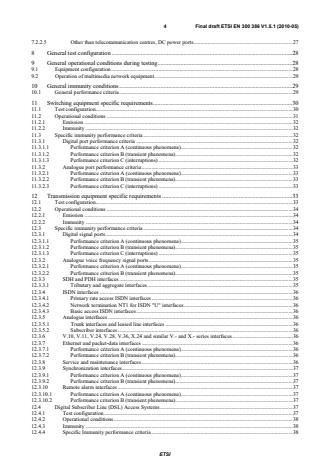
Contents
Intellectual Property Rights . 6
Foreword . 6
1 Scope . 7
2 References . 8
2.1 Normative references . 8
2.2 Informative references . 10
3 Definitions and abbreviations . 12
3.1 Definitions . 12
3.2 Abbreviations . 14
4 Installation environment . 14
5 Immunity: test methods . 15
5.1 Electrostatic discharge . 15
5.2 Electrical fast transients/burst . 15
5.3 Surges . 15
5.3.1 Signal line ports . 15
5.3.2 AC power ports . 15
5.4 Immunity to continuous conducted signals . 16
5.4.1 Low frequency (≤ 150 kHz) . 16
5.4.2 Radio frequency (> 150 kHz) . 16
5.4.2.1 AC power port . 16
5.4.2.2 DC power port . 16
5.4.2.3 Signal line port . 16
5.5 Immunity to radiated electromagnetic fields . 16
5.6 Immunity to power supply disturbances: AC and DC power ports . 16
5.6.1 Test of immunity to low frequency disturbances: AC power ports . 16
5.6.2 Test of immunity to low frequency disturbances: DC power ports . 16
6 Emission: test methods . 17
6.1 AC power port . 17
6.2 DC power port . 17
6.3 Telecommunication Port . 17
6.4 Radiated emission. 17
7 Test levels and limits . 18
7.1 Emission . 18
7.1.1 Enclosure port, Radiated electromagnetic field emissions . 18
7.1.2 AC ports . 18
7.1.2.1 Conducted emissions . 18
7.1.2.2 Current harmonics . 18
7.1.2.3 Voltage fluctuations . 18
7.1.3 DC ports, Conducted emissions . 18
7.1.4 Telecommunication ports, Conducted emissions . 18
7.2 Immunity . 19
7.2.1 Equipment operating in telecommunication centres . 19
7.2.1.1 Telecommunication centres, enclosure port . 19
7.2.1.2 Telecommunication centres, ports for outdoor signal lines . 20
7.2.1.3 Telecommunication centres, ports for indoor signal lines . 21
7.2.1.4 Telecommunication centres, AC power ports . 22
7.2.1.5 Telecommunication centres, DC power ports . 22
7.2.2 Equipment operating in locations other than telecommunication centres . 23
7.2.2.1 Other than telecommunication centres, enclosure port . 23
7.2.2.2 Other than telecommunication centres, ports for outdoor signal lines . 24
7.2.2.3 Other than telecommunication centres, ports for indoor signal lines . 25
7.2.2.4 Other than telecommunication centres, AC power ports . 26
ETSI
4 ETSI EN 300 386 V1.5.1 (2010-10)
7.2.2.5 Other than telecommunication centres, DC power ports . 27
8 General test configuration . 28
9 General operational conditions during testing . 28
9.1 Equipment configuration . 28
9.2 Operation of multimedia network equipment . 29
10 General immunity conditions . 29
10.1 General performance criteria . 29
11 Switching equipment specific requirements . 30
11.1 Test configuration. 30
11.2 Operational conditions . 31
11.2.1 Emission . 32
11.2.2 Immunity . 32
11.3 Specific immunity performance criteria . 32
11.3.1 Digital port performance criteria . 32
11.3.1.1 Performance criterion A (continuous phenomena) . 32
11.3.1.2 Performance criterion B (transient phenomena). 32
11.3.1.3 Performance criterion C (interruptions) . 32
11.3.2 Analogue port performance criteria . 33
11.3.2.1 Performance criterion A (continuous phenomena) . 33
11.3.2.2 Performance criterion B (transient phenomena). 33
11.3.2.3 Performance criterion C (interruptions) . 33
12 Transmission equipment specific requirements . 33
12.1 Test configuration. 33
12.2 Operational conditions . 34
12.2.1 Emission . 34
12.2.2 Immunity . 34
12.3 Specific immunity performance criteria . 34
12.3.1 Digital signal ports . 34
12.3.1.1 Performance criterion A (continuous phenomena) . 35
12.3.1.2 Performance criterion B (transient phenomena). 35
12.3.1.3 Performance criterion C (interruptions) . 35
12.3.2 Analogue voice frequency signal ports . 35
12.3.2.1 Performance criterion A (continuous phenomena) . 35
12.3.2.2 Performance criterion B (transient phenomena). 35
12.3.3 SDH and PDH interfaces . 35
12.3.3.1 Tributary and aggregate interfaces . 35
12.3.4 ISDN interfaces . 36
12.3.4.1 Primary rate access ISDN interfaces . 36
12.3.4.2 Network termination NT1 for ISDN "U" interfaces . 36
12.3.4.3 Basic access ISDN interfaces . 36
12.3.5 Analogue interfaces . 36
12.3.5.1 Trunk interfaces and leased line interfaces . 36
12.3.5.2 Subscriber interfaces . 36
12.3.6 V.10, V.11, V.24, V.28, V.36, X.24 and similar V.- and X.- series interfaces . 36
12.3.7 Ethernet and packet-data interfaces . 36
12.3.7.1 Performance criterion A (continuous phenomena) . 36
12.3.7.2 Performance criterion B (transient phenomena). 36
12.3.8 Service and maintenance interfaces . 36
12.3.9 Synchronization interfaces . 37
12.3.9.1 Performance criterion A (continuous phenomena) . 37
12.3.9.2 Performance criterion B (transient phenomena). 37
12.3.10 Remote alarm interfaces . 37
12.3.10.1 Performance criterion A (continuous phenomena) . 37
12.3.10.2 Performance criterion B (transient phenomena). 37
12.4 Digital Subscriber Line (DSL) Access Systems . 37
12.4.1 Test configuration . 37
12.4.2 Operational conditions . 38
12.4.3 Immunity . 38
12.4.4 Specific Immunity performance criteria . 38
ETSI
5 ETSI EN 300 386 V1.5.1 (2010-10)
12.4.4.1 Performance Criteria A (continuous phenomena) . 39
12.4.4.2 Performance Criteria B (transient phenomena) . 39
12.4.4.3 Performance Criteria C (interruptions). 39
13 Power supply equipment specific conditions . 39
13.1 Test configuration. 39
13.2 Operational conditions . 40
13.2.1 Emission . 40
13.2.2 Immunity . 40
13.3 Specific immunity performance criteria . 41
13.3.1 Alternating current secondary interface . 41
13.3.1.1 Performance criterion A (continuous phenomena) . 41
13.3.1.2 Performance criterion B (transient phenomena). 41
13.3.2 Direct current secondary interface . 42
13.3.2.1 Performance criterion A (continuous phenomena) . 42
13.3.2.2 Performance criterion B (transient phenomena). 42
13.3.3 Control/signal interface . 42
13.3.4 Tertiary supply interface . 42
14 Supervisory equipment specific conditions . 42
14.1 Test configuration. 42
14.2 Operational conditions . 43
14.3 Specific immunity performance criteria . 43
14.3.1 Performance criterion A (continuous phenomena) . 43
14.3.2 Performance criterion B (transient phenomena) . 43
Annex A (normative): Surges: test method for ports of signal lines remaining within the
building . 44
A.1 Test set-up for signal ports . 44
Annex B (informative): Evaluation of test results . 46
Annex C (informative): Guidance on EMC performance requirements and methods of
measurement for RF ports (in the sense of EN 50083 series) of
multimedia network equipment . 48
Annex D (informative): The EN title in the official languages . 49
Annex E (informative): Bibliography . 50
History . 51
ETSI
6 ETSI EN 300 386 V1.5.1 (2010-10)
Intellectual Property Rights
IPRs essential or potentially essential to the present document may have been declared to ETSI. The information
pertaining to these essential IPRs, if any, is publicly available for ETSI members and non-members, and can be found
in ETSI SR 000 314: "Intellectual Property Rights (IPRs); Essential, or potentially Essential, IPRs notified to ETSI in
respect of ETSI standards", which is available from the ETSI Secretariat. Latest updates are available on the ETSI Web
server (http://webapp.etsi.org/IPR/home.asp).
Pursuant to the ETSI IPR Policy, no investigation, including IPR searches, has been carried out by ETSI. No guarantee
can be given as to the existence of other IPRs not referenced in ETSI SR 000 314 (or the updates on the ETSI Web
server) which are, or may be, or may become, essential to the present document.
Foreword
This Harmonized European Standard (Telecommunications series) has been produced by ETSI Technical Committee
Electromagnetic compatibility and Radio spectrum Matters (ERM).
The present document has been produced by ETSI in response to a mandate from the European Commission issued
under Council Directive 98/34/EC [i.24] (as amended) laying down a procedure for the provision of information in the
field of technical standards and regulations.
The present document is intended to become a Harmonized Standard, the reference of which will be published in the
Official Journal of the European Communities referencing the Council Directive on the approximation of the laws of
the Member States relating to electromagnetic compatibility ("the EMC Directive") (89/336/EEC [i.22] as amended and
2004/108/EC [i.25]).
National transposition dates
Date of adoption of this EN: 28 September 2010
Date of latest announcement of this EN (doa): 31 December 2010
Date of latest publication of new National Standard
or endorsement of this EN (dop/e): 30 June 2011
Date of withdrawal of any conflicting National Standard (dow): 31 December 2013
ETSI
7 ETSI EN 300 386 V1.5.1 (2010-10)
1 Scope
The present document covers the EMC requirements for non-radio equipment intended to be used within a public
telecommunications network, which provides telecommunications between Network Termination Points (NTPs)
(i.e. excluding terminal equipment beyond the NTPs). Examples of such equipment are:
• Switching equipment. Such equipment includes:
- local telephone exchanges;
- remote switching concentrators;
- international switches;
- telex switches;
- network packet switches;
- base station controllers, radio network controllers;
- network servers and gateways.
• Non-radio transmission equipment and ancillary equipment. Such equipment includes:
- multiplexers;
- line equipment and repeaters, e.g. equipment for:
� Synchronous Digital Hierarchy (SDH);
� Plesiochronous Digital Hierarchy (PDH);
� Asynchronous Transfer Mode (ATM);
such as:
� Digital Cross Connect systems;
� network terminations;
� transmission equipment used in the access network like xDSL.
• Power supply equipment. Such equipment includes:
- central power plant;
- end of suite power supplies;
- uninterruptible power supplies;
- stabilized AC power supplies; and
- other dedicated telecommunication network power supplies;
but excludes equipment which is uniquely associated with or integrated in other equipment.
ETSI
8 ETSI EN 300 386 V1.5.1 (2010-10)
• Supervisory equipment. Such equipment includes:
- network management equipment;
- operator access maintenance equipment;
- traffic measurement systems;
- line test units;
- functional test units.
The function of supervision may either be performed by independent equipment or form part of other
telecommunication network equipment. If the function of supervision forms part of a telecommunication network
equipment, the performance may be evaluated simultaneously with other functions (such as switching and transmission)
during EMC testing.
The environmental classification locations used in the present document refers to TR 101 651 [i.23].
The requirements of the present document have been selected to ensure an adequate level of immunity for the apparatus
covered by the scope of the present document. The levels do not, however, cover extreme cases which may occur at any
location but with a low probability of occurrence. In special cases, situations may arise where the levels of disturbance
may exceed the immunity test levels specified in the present document. In these instances, special mitigation measures
may have to be employed.
General purpose equipment, which is used as a part of a telecommunication network, may be covered by the scope of
other standards. For such equipment, if those other standards fully cover the requirements of the present document, no
further assessment is necessary. Equipment for cabled distribution systems intended only for television and sound
signals as defined in EN 50083-2 [3] and optical amplifiers as defined in ITU-T Recommendations G.661 [i.6] and
G.662 [i.7] are outside the scope of the present document.
Equipment may provide different functions, i.e. switching equipment may also provide transmission functions and
transmission equipment may provide storage capabilities etc. All available functions of the EUT shall be tested.
2 References
References are either specific (identified by date of publication and/or edition number or version number) or
non-specific. For specific references, only the cited version applies. For non-specific references, the latest version of the
reference document (including any amendments) applies.
Referenced documents which are not found to be publicly available in the expected location might be found at
http://docbox.etsi.org/Reference.
NOTE: While any hyperlinks included in this clause were valid at the time of publication ETSI cannot guarantee
their long term validity.
2.1 Normative references
The following referenced documents are necessary for the application of the present document.
[1] CENELEC EN 55016-1-2 (Amendment - 2006): "Specification for radio disturbance and
immunity measuring apparatus and methods -- Part 1-2: Radio disturbance and immunity
measuring apparatus - Ancillary equipment - Conducted disturbances".
[2] Void.
[3] CENELEC EN 50083-2 (2006): "Cable networks for television signals, sound signals and
interactive services -- Part 2: Electromagnetic compatibility for equipment".
[4] CENELEC EN 55022 (2006) +A1 (2007): "Information technology equipment - Radio disturbance
characteristics - Limits and methods of measurement".
ETSI
9 ETSI EN 300 386 V1.5.1 (2010-10)
[5] CENELEC EN 61000-3-2 (2006): "Electromagnetic compatibility (EMC) -- Part 3-2: Limits -
Limits for harmonic current emissions (equipment input current <= 16 A per phase)".
[6] CENELEC EN 61000-3-3 (1995): "Electromagnetic compatibility (EMC) -- Part 3-3: Limits -
Limitation of voltage changes, voltage fluctuations and flicker in public low-voltage supply
systems, for equipment with rated current <= 16 A per phase and not subject to conditional
connection".
[7] CENELEC EN 61000-3-11 (2000): "Electromagnetic compatibility (EMC) -- Part 3-11: Limits -
Limitation of voltage changes, voltage fluctuations and flicker in public low-voltage supply
systems - Equipment with rated current <= 75 A and subject to conditional connection".
[8] CENELEC EN 61000-3-12 (2005): "Electromagnetic compatibility (EMC) -- Part 3-12: Limits -
Limits for harmonic currents produced by equipment connected to public low-voltage systems
with input current > 16 A and <= 75 A per phase".
[9] CENELEC EN 61000-4-2 (2009): "Electromagnetic compatibility (EMC) -- Part 4-2: Testing and
measurement techniques - Electrostatic discharge immunity test".
[10] CENELEC EN 61000-4-3 (2006): "Electromagnetic compatibility (EMC) -- Part 4-3: Testing and
measurement techniques - Radiated, radio-frequency, electromagnetic field immunity test".
[11] CENELEC EN 61000-4-4 (2004): "Electromagnetic compatibility (EMC) -- Part 4-4: Testing and
measurement techniques - Electrical fast transient/burst immunity test".
[12] CENELEC EN 61000-4-5 (2006): "Electromagnetic compatibility (EMC) -- Part 4-5: Testing and
measurement techniques - Surge immunity test".
[13] CENELEC EN 61000-4-6 (2009): "Electromagnetic compatibility (EMC) -- Part 4-6: Testing and
measurement techniques - Immunity to conducted disturbances, induced by radio-frequency
fields".
[14] CENELEC EN 61000-4-11 (2004): "Electromagnetic compatibility (EMC) -- Part 4-11: Testing
and measurement techniques - Voltage dips, short interruptions and voltage variations immunity
tests".
[15] ETSI ETS 300 132-1 (1996): "Equipment Engineering (EE); Power supply interface at the input to
telecommunications equipment; Part 1: Operated by alternating current (ac) derived from direct
current (dc) sources".
[16] ETSI EN 300 132-2 (V2.2.2): "Environmental Engineering (EE); Power supply interface at the
input to telecommunications equipment; Part 2: Operated by direct current (dc)".
[17] IEC 60050-161 (1990): "International Electrotechnical Vocabulary. Chapter 161: Electromagnetic
compatibility".
[18] IEC 60050-714 (1992): "International Electrotechnical Vocabulary - Chapter 714: Switching and
signalling in telecommunications".
[19] ETSI EN 300 127 (V1.2.1): "Electromagnetic compatibility and Radio spectrum Matters (ERM);
Radiated emission testing of physically large telecommunication systems".
[20] ITU-T Recommendation O.41 (1994): "Psophometer for use on telephone-type circuits".
[21] ITU-T Recommendation G.996.1 (2001): "Test procedures for digital subscriber line (DSL)
transceivers".
[22] ETSI TS 101 135 (V1.5.3): "Transmission and Multiplexing (TM); High bit-rate Digital
Subscriber Line (HDSL) transmission systems on metallic local lines; HDSL core specification
and applications for combined ISDN-BA and 2 048 kbit/s transmission".
[23] ETSI TS 101 524-1 (V1.1.1): "Transmission and Multiplexing (TM); Access transmission system
on metallic access cables; Symmetrical single pair high bit rate Digital Subscriber Line (SDSL);
Part 1: Functional requirements".
ETSI
10 ETSI EN 300 386 V1.5.1 (2010-10)
[24] ETSI TS 101 270-1 (V1.4.1): "Transmission and Multiplexing (TM); Access transmission systems
on metallic access cables; Very high speed Digital Subscriber Line (VDSL); Part 1: Functional
requirements".
[25] ITU-T Recommendation G.992.1 (1999) and Amendment 1 (2003): "Asymmetric digital
subscriber line (ADSL) transceivers".
[26] ITU-T Recommendation G.992.3 (2009): "Asymmetric digital subscriber line
transceivers 2 (ADSL2)".
[27] ITU-T Recommendation G.992.5 (2009): "Asymmetric digital subscriber line (ADSL)
transceivers - Extended bandwidth ADSL2 (ADSL2plus)".
2.2 Informative references
The following referenced documents are not necessary for the application of the present document but they assist the
user with regard to a particular subject area.
[i.1] ETSI EN 300 011-1 (V1.2.2): "Integrated Services Digital Network (ISDN); Primary rate User
Network Interface (UNI); Part 1: Layer 1 specification".
[i.2] ETSI ETS 300 012-1 (2000): "Integrated Services Digital Network (ISDN); Basic User-Network
Interface (UNI); Part 1: Layer 1 specification".
[i.3] ETSI EN 300 166 (V1.2.1): "Transmission and Multiplexing (TM); Physical and electrical
characteristics of hierarchical digital interfaces for equipment using the 2 048 kbit/s - based
plesiochronous or synchronous digital hierarchies".
[i.4] ETSI ETS 300 232 (1993): "Transmission and Multiplexing (TM); Optical interfaces for
equipments and systems relating to the Synchronous Digital Hierarchy [ITU-T Recommendation
G.957 (1993), modified]".
[i.5] ISO/IEC 8802-3 (2000): "Information technology - Telecommunications and information
exchange between systems - Local and metropolitan area networks - Specific requirements -
Part 3: Carrier sense multiple access with collision detection (CSMA/CD) access method and
physical layer specifications".
[i.6] ITU-T Recommendation G.661 (2006): "Definition and test methods for the relevant generic
parameters of optical amplifier devices and subsystems".
[i.7] ITU-T Recommendation G.662 (2005): "Generic characteristics of optical amplifier devices and
subsystems".
[i.8] ITU-T Recommendation G.712 (2001): "Transmission performance characteristics of pulse code
modulation channels".
[i.9] ITU-T Recommendation G.812 (2004): "Timing requirements of slave clocks suitable for use as
node clocks in synchronization networks".
[i.10] ITU-T Recommendation G.813 (2003): "Timing characteristics of SDH equipment slave clocks
(SEC)".
[i.11] Void.
[i.12] ITU-T Recommendation G.961 (1993): "Digital transmission system on metallic local lines for
ISDN basic rate access".
[i.13] ITU-T Recommendation O.150 (1996): "General requirements for instrumentation for
performance measurements on digital transmission equipment".
[i.14] ITU-T Recommendation Q.552 (2001): "Transmission characteristics at 2-wire analogue interfaces
of digital exchanges".
[i.15] ITU-T Recommendation V.10 (1993): "Electrical characteristics for unbalanced double-current
interchange circuits operating at data signalling rates nominally up to 100 kbit/s".
ETSI
11 ETSI EN 300 386 V1.5.1 (2010-10)
[i.16] ITU-T Recommendation V.11 (1996): "Electrical characteristics for balanced double-current
interchange circuits operating at data signalling rates up to 10 Mbit/s".
[i.17] ITU-T Recommendation V.24 (2000): "List of definitions for interchange circuits between Data
Terminal Equipment (DTE) and Data Circuit-terminating Equipment (DCE)".
[i.18] ITU-T Recommendation V.28 (1993): "Electrical characteristics for unbalanced double-current
interchange circuits".
[i.19] ITU-T Recommendation V.36 (1988): "Modems for synchronous data transmission using
60-108 kHz group band circuits".
[i.20] ITU-T Recommendation X.24 (1988): "List of definitions for interchange circuits between Data
Terminal Equipment (DTE) and Data Circuit-terminating Equipment (DCE) on public data
networks".
[i.21] ITU-T Recommendation X.25 (1996): "Interface between Data Terminal Equipment (DTE) and
Data Circuit-terminating Equipment (DCE) for terminals operating in the packet mode and
connected to public data networks by dedicated circuit".
[i.22] Council Directive 89/336/EEC of 3 May 1989 on the approximation of the laws of the Member
States relating to electromagnetic compatibility.
[i.23] ETSI TR 101 651 (1999): "Electromagnetic compatibility and radio spectrum matters (ERM);
Classification of the electromagnetic environment conditions for equipment in telecommunication
networks".
[i.24] Directive 98/34/EC of the European Parliament and of the Council of 22 June 1998 laying down a
procedure for the provision of information in the field of technical standards and regulations
(EMC Directive).
[i.25] Council Directive 2004/108/EC of 15 December 2004 on the approximation of the laws of the
Member States relating to electromagnetic compatibility and repealing Directive 89/336/EEC
(EMC Directive).
[i.26] ITU-T Recommendation G.783 (2006): "Characteristics of synchronous digital hierarchy (SDH)
equipment functional blocks".
[i.27] ITU-T Recommendation G.798 (2004): "Characteristics of optical transport network hierarchy
equipment functional blocks".
[i.28] Directive 1999/5/EC of the European Parliament and of the Council of 9 March 1999 on radio
equipment and telecommunications terminal equipment and the mutual recognition of their
conformity (R&TTE Directive).
[i.29] IEEE 1284 (2000): "IEEE Standard Signalling Method for a Bidirectional Parallel Peripheral
Interface for Personal Computers".
[i.30] IEEE 1394.1 (2004): "IEEE Standard for High Performance Serial Bus Bridges".
ETSI
12 ETSI EN 300 386 V1.5.1 (2010-10)
3 Definitions and abbreviations
3.1 Definitions
For the purposes of the present document, the terms and definitions given in IEC 60050-161 [17] and the following
apply:
NOTE: The definitions taken from IEC 60050-161 [17] have reference in parentheses.
AC secondary interface: output port of an AC power supply
AC secondary voltage: output of the AC power supply at the AC secondary interface
NOTE: The AC secondary voltage may be either:
- a stabilized AC supply derived from a DC primary supply (e.g. where the power supply is an
inverter); or
- derived from the AC primary supply (e.g. a stabilized power supply used where the quality of the
primary supply is not sufficient to feed telecommunication equipment).
burst (161-02-07): sequence of a limited number of distinct pulses or an oscillation of limited duration
connection: temporary association of transmission channels or telecommunication circuits, switching or other
functional units set up to provide for the transfer of information between two or more points in a telecommunication
network (IEC 60050-714 [18])
continuous disturbance (161-02-11): electromagnetic disturbance the effects of which on a particular device or
equipment cannot be resolved into a succession of distinct effects
DC secondary interface: output port of a DC power supply
DC secondary voltage: output of the DC power supply at the DC secondary interface
NOTE: The DC secondary voltage may be derived from the AC primary supply with or without a buffer battery.
duration (of a voltage change) (161-08-03): interval of time for the voltage to increase or decrease from the initial
value to the final value
duration (of a pulse): interval of time between the instants at which the instantaneous value of a pulse reaches 50 % of
the pulse magnitude for the first and last time
enclosure port: physical boundary of the Equipment Under Test (EUT) through which electromagnetic fields may
emanate or on which they may impinge
environment, environmental conditions: electromagnetic conditions external to the equipment, to which it is
subjected at a certain time
NOTE: The environmental conditions comprise a combination of single environmental parameters and their
severity.
environmental parameters: present one or more properties of the electromagnetic environment
immunity (to a disturbance) (161-01-20): ability of a device, equipment or system to perform without degradation in
the presence of an electromagnetic disturbance
impulsive disturbance (161-02-09): electromagnetic disturbance which, when incident on a particular device or
equipment, manifests itself as a succession of distinct pulses or transients
interface "A": terminals at which a power supply is connected to the telecommunications equipment
multimedia network equipment: multimedia network equipment containing broadcast and telecommunication
functions
ETSI
13 ETSI EN 300 386 V1.5.1 (2010-10)
nominal voltage: nominal value of voltage that designates the type of supply
normal service: service mode where telecommunications equipment operates within its specification
performance criterion: limits of acceptable behaviour of the equipment during and after the application of the
electromagnetic phenomenon
NOTE: Performance criteria A apply for continuous phenomena; performance criteria B and C apply for transient
phenomena; and performance criteria R apply for resistibility phenomena.
port: particular interface of the EUT with the external electromagnetic environment
power supply: power source (within the scope of the present document) to which telecommunications equipment is
intended to be connected
primary supply: public mains or a locally generated AC or DC supply
public telecommunications network: telecommunication network operated by an entity required to publish its
interface specifications under art. 4 of directive 1999/05/EC [i.28]
pulse (161-02-02): abrupt variation of short duration of a physical quantity followed by a rapid return to the initial
value
Radio Frequencies (RF): frequency range above 150 kHz
rise time (of a pulse
...
Final draft ETSI EN 300 386 V1.5.1 (2010-05)
Harmonized European Standard (Telecommunications series)
Electromagnetic compatibility
and Radio spectrum Matters (ERM);
Telecommunication network equipment;
ElectroMagnetic Compatibility (EMC) requirements
2 Final draft ETSI EN 300 386 V1.5.1 (2010-05)
Reference
REN/ERM-EMC-271
Keywords
EMC, network, testing
ETSI
650 Route des Lucioles
F-06921 Sophia Antipolis Cedex - FRANCE
Tel.: +33 4 92 94 42 00 Fax: +33 4 93 65 47 16
Siret N° 348 623 562 00017 - NAF 742 C
Association à but non lucratif enregistrée à la
Sous-Préfecture de Grasse (06) N° 7803/88
Important notice
Individual copies of the present document can be downloaded from:
http://www.etsi.org
The present document may be made available in more than one electronic version or in print. In any case of existing or
perceived difference in contents between such versions, the reference version is the Portable Document Format (PDF).
In case of dispute, the reference shall be the printing on ETSI printers of the PDF version kept on a specific network drive
within ETSI Secretariat.
Users of the present document should be aware that the document may be subject to revision or change of status.
Information on the current status of this and other ETSI documents is available at
http://portal.etsi.org/tb/status/status.asp
If you find errors in the present document, please send your comment to one of the following services:
http://portal.etsi.org/chaircor/ETSI_support.asp
Copyright Notification
No part may be reproduced except as authorized by written permission.
The copyright and the foregoing restriction extend to reproduction in all media.
© European Telecommunications Standards Institute 2010.
All rights reserved.
TM TM TM TM
DECT , PLUGTESTS , UMTS , TIPHON , the TIPHON logo and the ETSI logo are Trade Marks of ETSI registered
for the benefit of its Members.
TM
3GPP is a Trade Mark of ETSI registered for the benefit of its Members and of the 3GPP Organizational Partners.
LTE™ is a Trade Mark of ETSI currently being registered
for the benefit of its Members and of the 3GPP Organizational Partners.
GSM® and the GSM logo are Trade Marks registered and owned by the GSM Association.
ETSI
3 Final draft ETSI EN 300 386 V1.5.1 (2010-05)
Contents
Intellectual Property Rights . 6
Foreword . 6
1 Scope . 7
2 References . 8
2.1 Normative references . 8
2.2 Informative references . 10
3 Definitions and abbreviations . 12
3.1 Definitions . 12
3.2 Abbreviations . 14
4 Installation environment . 14
5 Immunity: test methods . 15
5.1 Electrostatic discharge . 15
5.2 Electrical fast transients/burst . 15
5.3 Surges . 15
5.3.1 Signal line ports . 15
5.3.2 AC power ports . 15
5.4 Immunity to continuous conducted signals . 16
5.4.1 Low frequency ( ≤ 150 kHz) . 16
5.4.2 Radio frequency (> 150 kHz) . 16
5.4.2.1 AC power port . 16
5.4.2.2 DC power port . 16
5.4.2.3 Signal line port . 16
5.5 Immunity to radiated electromagnetic fields . 16
5.6 Immunity to power supply disturbances: AC and DC power ports . 16
5.6.1 Test of immunity to low frequency disturbances: AC power ports . 16
5.6.2 Test of immunity to low frequency disturbances: DC power ports . 16
6 Emission: test methods . 17
6.1 AC power port . 17
6.2 DC power port . 17
6.3 Telecommunication Port . 17
6.4 Radiated emission. 17
7 Test levels and limits . 18
7.1 Emission . 18
7.1.1 Enclosure port, Radiated electromagnetic field emissions . 18
7.1.2 AC ports . 18
7.1.2.1 Conducted emissions . 18
7.1.2.2 Current harmonics . 18
7.1.2.3 Voltage fluctuations . 18
7.1.3 DC ports, Conducted emissions . 18
7.1.4 Telecommunication ports, Conducted emissions . 18
7.2 Immunity . 19
7.2.1 Equipment operating in telecommunication centres . 19
7.2.1.1 Telecommunication centres, enclosure port . 19
7.2.1.2 Telecommunication centres, ports for outdoor signal lines . 20
7.2.1.3 Telecommunication centres, ports for indoor signal lines . 21
7.2.1.4 Telecommunication centres, AC power ports . 22
7.2.1.5 Telecommunication centres, DC power ports . 22
7.2.2 Equipment operating in locations other than telecommunication centres . 23
7.2.2.1 Other than telecommunication centres, enclosure port . 23
7.2.2.2 Other than telecommunication centres, ports for outdoor signal lines . 24
7.2.2.3 Other than telecommunication centres, ports for indoor signal lines . 25
7.2.2.4 Other than telecommunication centres, AC power ports . 26
ETSI
4 Final draft ETSI EN 300 386 V1.5.1 (2010-05)
7.2.2.5 Other than telecommunication centres, DC power ports . 27
8 General test configuration . 28
9 General operational conditions during testing . 28
9.1 Equipment configuration . 28
9.2 Operation of multimedia network equipment . 29
10 General immunity conditions . 29
10.1 General performance criteria . 29
11 Switching equipment specific requirements . 30
11.1 Test configuration. 30
11.2 Operational conditions . 31
11.2.1 Emission . 32
11.2.2 Immunity . 32
11.3 Specific immunity performance criteria . 32
11.3.1 Digital port performance criteria . 32
11.3.1.1 Performance criterion A (continuous phenomena) . 32
11.3.1.2 Performance criterion B (transient phenomena). 32
11.3.1.3 Performance criterion C (interruptions) . 32
11.3.2 Analogue port performance criteria . 33
11.3.2.1 Performance criterion A (continuous phenomena) . 33
11.3.2.2 Performance criterion B (transient phenomena). 33
11.3.2.3 Performance criterion C (interruptions) . 33
12 Transmission equipment specific requirements . 33
12.1 Test configuration. 33
12.2 Operational conditions . 34
12.2.1 Emission . 34
12.2.2 Immunity . 34
12.3 Specific immunity performance criteria . 34
12.3.1 Digital signal ports . 34
12.3.1.1 Performance criterion A (continuous phenomena) . 35
12.3.1.2 Performance criterion B (transient phenomena). 35
12.3.1.3 Performance criterion C (interruptions) . 35
12.3.2 Analogue voice frequency signal ports . 35
12.3.2.1 Performance criterion A (continuous phenomena) . 35
12.3.2.2 Performance criterion B (transient phenomena). 35
12.3.3 SDH and PDH interfaces . 35
12.3.3.1 Tributary and aggregate interfaces . 35
12.3.4 ISDN interfaces . 36
12.3.4.1 Primary rate access ISDN interfaces . 36
12.3.4.2 Network termination NT1 for ISDN "U" interfaces . 36
12.3.4.3 Basic access ISDN interfaces . 36
12.3.5 Analogue interfaces . 36
12.3.5.1 Trunk interfaces and leased line interfaces . 36
12.3.5.2 Subscriber interfaces . 36
12.3.6 V.10, V.11, V.24, V.28, V.36, X.24 and similar V.- and X.- series interfaces . 36
12.3.7 Ethernet and packet-data interfaces . 36
12.3.7.1 Performance criterion A (continuous phenomena) . 36
12.3.7.2 Performance criterion B (transient phenomena). 36
12.3.8 Service and maintenance interfaces . 36
12.3.9 Synchronization interfaces . 37
12.3.9.1 Performance criterion A (continuous phenomena) . 37
12.3.9.2 Performance criterion B (transient phenomena). 37
12.3.10 Remote alarm interfaces . 37
12.3.10.1 Performance criterion A (continuous phenomena) . 37
12.3.10.2 Performance criterion B (transient phenomena). 37
12.4 Digital Subscriber Line (DSL) Access Systems . 37
12.4.1 Test configuration . 37
12.4.2 Operational conditions . 38
12.4.3 Immunity . 38
12.4.4 Specific Immunity performance criteria . 38
ETSI
5 Final draft ETSI EN 300 386 V1.5.1 (2010-05)
12.4.4.1 Performance Criteria A (continuous phenomena) . 39
12.4.4.2 Performance Criteria B (transient phenomena) . 39
12.4.4.3 Performance Criteria C (interruptions). 39
13 Power supply equipment specific conditions . 39
13.1 Test configuration. 39
13.2 Operational conditions . 40
13.2.1 Emission . 40
13.2.2 Immunity . 40
13.3 Specific immunity performance criteria . 41
13.3.1 Alternating current secondary interface . 41
13.3.1.1 Performance criterion A (continuous phenomena) . 41
13.3.1.2 Performance criterion B (transient phenomena). 41
13.3.2 Direct current secondary interface . 42
13.3.2.1 Performance criterion A (continuous phenomena) . 42
13.3.2.2 Performance criterion B (transient phenomena). 42
13.3.3 Control/signal interface . 42
13.3.4 Tertiary supply interface . 42
14 Supervisory equipment specific conditions . 42
14.1 Test configuration. 42
14.2 Operational conditions . 43
14.3 Specific immunity performance criteria . 43
14.3.1 Performance criterion A (continuous phenomena) . 43
14.3.2 Performance criterion B (transient phenomena) . 43
Annex A (normative): Surges: test method for ports of signal lines remaining within the
building . 44
A.1 Test set-up for signal ports . 44
Annex B (informative): Evaluation of test results . 46
Annex C (informative): Guidance on EMC performance requirements and methods of
measurement for RF ports (in the sense of EN 50083 series) of
multimedia network equipment . 48
Annex D (informative): The EN title in the official languages . 49
Annex E (informative): Bibliography . 50
History . 51
ETSI
6 Final draft ETSI EN 300 386 V1.5.1 (2010-05)
Intellectual Property Rights
IPRs essential or potentially essential to the present document may have been declared to ETSI. The information
pertaining to these essential IPRs, if any, is publicly available for ETSI members and non-members, and can be found
in ETSI SR 000 314: "Intellectual Property Rights (IPRs); Essential, or potentially Essential, IPRs notified to ETSI in
respect of ETSI standards", which is available from the ETSI Secretariat. Latest updates are available on the ETSI Web
server (http://webapp.etsi.org/IPR/home.asp).
Pursuant to the ETSI IPR Policy, no investigation, including IPR searches, has been carried out by ETSI. No guarantee
can be given as to the existence of other IPRs not referenced in ETSI SR 000 314 (or the updates on the ETSI Web
server) which are, or may be, or may become, essential to the present document.
Foreword
This Harmonized European Standard (Telecommunications series) has been produced by ETSI Technical Committee
Electromagnetic compatibility and Radio spectrum Matters (ERM), and is now submitted for the ETSI standards
One-step Approval Procedure.
The present document has been produced by ETSI in response to a mandate from the European Commission issued
under Council Directive 98/34/EC [i.24] (as amended) laying down a procedure for the provision of information in the
field of technical standards and regulations.
The present document is intended to become a Harmonized Standard, the reference of which will be published in the
Official Journal of the European Communities referencing the Council Directive on the approximation of the laws of
the Member States relating to electromagnetic compatibility ("the EMC Directive") (89/336/EEC [i.22] as amended and
2004/108/EC [i.25]).
Proposed national transposition dates
Date of latest announcement of this EN (doa): 3 months after ETSI publication
Date of latest publication of new National Standard
or endorsement of this EN (dop/e): 6 months after doa
Date of withdrawal of any conflicting National Standard (dow): 36 months after doa
ETSI
7 Final draft ETSI EN 300 386 V1.5.1 (2010-05)
1 Scope
The present document covers the EMC requirements for non-radio equipment intended to be used within a public
telecommunications network, which provides telecommunications between Network Termination Points (NTPs)
(i.e. excluding terminal equipment beyond the NTPs). Examples of such equipment are:
• Switching equipment. Such equipment includes:
- local telephone exchanges;
- remote switching concentrators;
- international switches;
- telex switches;
- network packet switches;
- base station controllers, radio network controllers;
- network servers and gateways.
• Non-radio transmission equipment and ancillary equipment. Such equipment includes:
- multiplexers;
- line equipment and repeaters, e.g. equipment for:
Synchronous Digital Hierarchy (SDH);
Plesiochronous Digital Hierarchy (PDH);
Asynchronous Transfer Mode (ATM);
such as:
Digital Cross Connect systems;
network terminations;
transmission equipment used in the access network like xDSL.
• Power supply equipment. Such equipment includes:
- central power plant;
- end of suite power supplies;
- uninterruptible power supplies;
- stabilized AC power supplies; and
- other dedicated telecommunication network power supplies;
but excludes equipment which is uniquely associated with or integrated in other equipment.
ETSI
8 Final draft ETSI EN 300 386 V1.5.1 (2010-05)
• Supervisory equipment. Such equipment includes:
- network management equipment;
- operator access maintenance equipment;
- traffic measurement systems;
- line test units;
- functional test units.
The function of supervision may either be performed by independent equipment or form part of other
telecommunication network equipment. If the function of supervision forms part of a telecommunication network
equipment, the performance may be evaluated simultaneously with other functions (such as switching and transmission)
during EMC testing.
The environmental classification locations used in the present document refers to TR 101 651 [i.23].
The requirements of the present document have been selected to ensure an adequate level of immunity for the apparatus
covered by the scope of the present document. The levels do not, however, cover extreme cases which may occur at any
location but with a low probability of occurrence. In special cases, situations may arise where the levels of disturbance
may exceed the immunity test levels specified in the present document. In these instances, special mitigation measures
may have to be employed.
General purpose equipment, which is used as a part of a telecommunication network, may be covered by the scope of
other standards. For such equipment, if those other standards fully cover the requirements of the present document, no
further assessment is necessary. Equipment for cabled distribution systems intended only for television and sound
signals as defined in EN 50083-2 [3] and optical amplifiers as defined in ITU-T Recommendations G.661 [i.6] and
G.662 [i.7] are outside the scope of the present document.
Equipment may provide different functions, i.e. switching equipment may also provide transmission functions and
transmission equipment may provide storage capabilities etc. All available functions of the EUT shall be tested.
2 References
References are either specific (identified by date of publication and/or edition number or version number) or
non-specific. For specific references, only the cited version applies. For non-specific references, the latest version of the
reference document (including any amendments) applies.
Referenced documents which are not found to be publicly available in the expected location might be found at
http://docbox.etsi.org/Reference.
NOTE: While any hyperlinks included in this clause were valid at the time of publication ETSI cannot guarantee
their long term validity.
2.1 Normative references
The following referenced documents are necessary for the application of the present document.
[1] CENELEC EN 55016-1-2 ((Amendment - 2006): "Specification for radio disturbance and
immunity measuring apparatus and methods -- Part 1-2: Radio disturbance and immunity
measuring apparatus - Ancillary equipment - Conducted disturbances".
[2] Void.
[3] CENELEC EN 50083-2 (2006): "Cable networks for television signals, sound signals and
interactive services -- Part 2: Electromagnetic compatibility for equipment".
[4] CENELEC EN 55022 (2006) +A1 (2007): "Information technology equipment - Radio disturbance
characteristics - Limits and methods of measurement".
ETSI
9 Final draft ETSI EN 300 386 V1.5.1 (2010-05)
[5] CENELEC EN 61000-3-2 (2006): "Electromagnetic compatibility (EMC) -- Part 3-2: Limits -
Limits for harmonic current emissions (equipment input current <= 16 A per phase)".
[6] CENELEC EN 61000-3-3 (1995): "Electromagnetic compatibility (EMC) -- Part 3-3: Limits -
Limitation of voltage changes, voltage fluctuations and flicker in public low-voltage supply
systems, for equipment with rated current <= 16 A per phase and not subject to conditional
connection".
[7] CENELEC EN 61000-3-11 (2000): "Electromagnetic compatibility (EMC) -- Part 3-11: Limits -
Limitation of voltage changes, voltage fluctuations and flicker in public low-voltage supply
systems - Equipment with rated current <= 75 A and subject to conditional connection".
[8] CENELEC EN 61000-3-12 (2005): "Electromagnetic compatibility (EMC) -- Part 3-12: Limits -
Limits for harmonic currents produced by equipment connected to public low-voltage systems
with input current > 16 A and <= 75 A per phase".
[9] CENELEC EN 61000-4-2 (2009): "Electromagnetic compatibility (EMC) -- Part 4-2: Testing and
measurement techniques - Electrostatic discharge immunity test".
[10] CENELEC EN 61000-4-3 (2006): "Electromagnetic compatibility (EMC) -- Part 4-3: Testing and
measurement techniques - Radiated, radio-frequency, electromagnetic field immunity test".
[11] CENELEC EN 61000-4-4 (2004): "Electromagnetic compatibility (EMC) -- Part 4-4: Testing and
measurement techniques - Electrical fast transient/burst immunity test".
[12] CENELEC EN 61000-4-5 (2006): "Electromagnetic compatibility (EMC) -- Part 4-5: Testing and
measurement techniques - Surge immunity test".
[13] CENELEC EN 61000-4-6 (2009): "Electromagnetic compatibility (EMC) -- Part 4-6: Testing and
measurement techniques - Immunity to conducted disturbances, induced by radio-frequency
fields".
[14] CENELEC EN 61000-4-11 (2004): "Electromagnetic compatibility (EMC) -- Part 4-11: Testing
and measurement techniques - Voltage dips, short interruptions and voltage variations immunity
tests".
[15] ETSI ETS 300 132-1 (1996): "Equipment Engineering (EE); Power supply interface at the input to
telecommunications equipment; Part 1: Operated by alternating current (ac) derived from direct
current (dc) sources".
[16] ETSI EN 300 132-2 (V2.2.2): "Environmental Engineering (EE); Power supply interface at the
input to telecommunications equipment; Part 2: Operated by direct current (dc)".
[17] IEC 60050-161 (1990): "International Electrotechnical Vocabulary. Chapter 161: Electromagnetic
compatibility".
[18] IEC 60050-714 (1992): "International Electrotechnical Vocabulary - Chapter 714: Switching and
signalling in telecommunications".
[19] ETSI EN 300 127 (V1.2.1): "Electromagnetic compatibility and Radio spectrum Matters (ERM);
Radiated emission testing of physically large telecommunication systems".
[20] ITU-T Recommendation O.41 (1994): "Psophometer for use on telephone-type circuits".
[21] ITU-T Recommendation G.996.1 (2001): "Test procedures for digital subscriber line (DSL)
transceivers".
[22] ETSI TS 101 135 (V1.5.3): "Transmission and Multiplexing (TM); High bit-rate Digital
Subscriber Line (HDSL) transmission systems on metallic local lines; HDSL core specification
and applications for combined ISDN-BA and 2 048 kbit/s transmission".
[23] ETSI TS 101 524-1 (V1.1.1): "Transmission and Multiplexing (TM); Access transmission system
on metallic access cables; Symmetrical single pair high bit rate Digital Subscriber Line (SDSL);
Part 1: Functional requirements".
ETSI
10 Final draft ETSI EN 300 386 V1.5.1 (2010-05)
[24] ETSI TS 101 270-1 (V1.4.1): "Transmission and Multiplexing (TM); Access transmission systems
on metallic access cables; Very high speed Digital Subscriber Line (VDSL); Part 1: Functional
requirements".
[25] ITU-T Recommendation G.992.1 (1999) and Amendment 1 (2003): "Asymmetric digital
subscriber line (ADSL) transceivers".
[26] ITU-T Recommendation G.992.3 (2009): " Asymmetric digital subscriber line
transceivers 2 (ADSL2)".
[27] ITU-T Recommendation G.992.5 (2009): "Asymmetric digital subscriber line (ADSL)
transceivers - Extended bandwidth ADSL2 (ADSL2plus)".
2.2 Informative references
The following referenced documents are not necessary for the application of the present document but they assist the
user with regard to a particular subject area.
[i.1] ETSI EN 300 011-1 (V1.2.2): "Integrated Services Digital Network (ISDN); Primary rate User
Network Interface (UNI); Part 1: Layer 1 specification".
[i.2] ETSI ETS 300 012-1 (2000): "Integrated Services Digital Network (ISDN); Basic User-Network
Interface (UNI); Part 1: Layer 1 specification".
[i.3] ETSI EN 300 166 (V1.2.1): "Transmission and Multiplexing (TM); Physical and electrical
characteristics of hierarchical digital interfaces for equipment using the 2 048 kbit/s - based
plesiochronous or synchronous digital hierarchies".
[i.4] ETSI ETS 300 232 (1993): "Transmission and Multiplexing (TM); Optical interfaces for
equipments and systems relating to the Synchronous Digital Hierarchy [ITU-T Recommendation
G.957 (1993), modified]".
[i.5] ISO/IEC 8802-3 (2000): "Information technology - Telecommunications and information
exchange between systems - Local and metropolitan area networks - Specific requirements -
Part 3: Carrier sense multiple access with collision detection (CSMA/CD) access method and
physical layer specifications".
[i.6] ITU-T Recommendation G.661 (2006): "Definition and test methods for the relevant generic
parameters of optical amplifier devices and subsystems".
[i.7] ITU-T Recommendation G.662 (2005): "Generic characteristics of optical amplifier devices and
subsystems".
[i.8] ITU-T Recommendation G.712 (2001): "Transmission performance characteristics of pulse code
modulation channels".
[i.9] ITU-T Recommendation G.812 (2004): "Timing requirements of slave clocks suitable for use as
node clocks in synchronization networks".
[i.10] ITU-T Recommendation G.813 (2003): "Timing characteristics of SDH equipment slave clocks
(SEC)".
[i.11] Void.
[i.12] ITU-T Recommendation G.961 (1993): "Digital transmission system on metallic local lines for
ISDN basic rate access".
[i.13] ITU-T Recommendation O.150 (1996): "General requirements for instrumentation for
performance measurements on digital transmission equipment".
[i.14] ITU-T Recommendation Q.552 (2001): "Transmission characteristics at 2-wire analogue interfaces
of digital exchanges".
[i.15] ITU-T Recommendation V.10 (1993): "Electrical characteristics for unbalanced double-current
interchange circuits operating at data signalling rates nominally up to 100 kbit/s".
ETSI
11 Final draft ETSI EN 300 386 V1.5.1 (2010-05)
[i.16] ITU-T Recommendation V.11 (1996): "Electrical characteristics for balanced double-current
interchange circuits operating at data signalling rates up to 10 Mbit/s".
[i.17] ITU-T Recommendation V.24 (2000): "List of definitions for interchange circuits between Data
Terminal Equipment (DTE) and Data Circuit-terminating Equipment (DCE)".
[i.18] ITU-T Recommendation V.28 (1993): "Electrical characteristics for unbalanced double-current
interchange circuits".
[i.19] ITU-T Recommendation V.36 (1988): "Modems for synchronous data transmission using
60-108 kHz group band circuits".
[i.20] ITU-T Recommendation X.24 (1988): "List of definitions for interchange circuits between Data
Terminal Equipment (DTE) and Data Circuit-terminating Equipment (DCE) on public data
networks".
[i.21] ITU-T Recommendation X.25 (1996): "Interface between Data Terminal Equipment (DTE) and
Data Circuit-terminating Equipment (DCE) for terminals operating in the packet mode and
connected to public data networks by dedicated circuit".
[i.22] Council Directive 89/336/EEC of 3 May 1989 on the approximation of the laws of the Member
States relating to electromagnetic compatibility.
[i.23] ETSI TR 101 651 (1999): "Electromagnetic compatibility and radio spectrum matters (ERM);
Classification of the electromagnetic environment conditions for equipment in telecommunication
networks".
[i.24] Directive 98/34/EC of the European Parliament and of the Council of 22 June 1998 laying down a
procedure for the provision of information in the field of technical standards and regulations
(EMC Directive).
[i.25] Council Directive 2004/108/EC of 15 December 2004 on the approximation of the laws of the
Member States relating to electromagnetic compatibility and repealing Directive 89/336/EEC
(EMC Directive).
[i.26] ITU-T Recommendation G.783 (2006): "Characteristics of synchronous digital hierarchy (SDH)
equipment functional blocks".
[i.27] ITU-T Recommendation G.798 (2004): "Characteristics of optical transport network hierarchy
equipment functional blocks".
[i.28] Directive 1999/5/EC of the European Parliament and of the Council of 9 March 1999 on radio
equipment and telecommunications terminal equipment and the mutual recognition of their
conformity (R&TTE Directive).
[i.29] IEEE 1284 (2000): "IEEE Standard Signalling Method for a Bidirectional Parallel Peripheral
Interface for Personal Computers".
[i.30] IEEE 1394.1 (2004): "IEEE Standard for High Performance Serial Bus Bridges".
ETSI
12 Final draft ETSI EN 300 386 V1.5.1 (2010-05)
3 Definitions and abbreviations
3.1 Definitions
For the purposes of the present document, the terms and definitions given in IEC 60050-161 [17] and the following
apply:
NOTE: The definitions taken from IEC 60050-161 [17] have reference in parentheses.
AC secondary interface: output port of an AC power supply
AC secondary voltage: output of the AC power supply at the AC secondary interface
NOTE: The AC secondary voltage may be either:
- a stabilized AC supply derived from a DC primary supply (e.g. where the power supply is an
inverter); or
- derived from the AC primary supply (e.g. a stabilized power supply used where the quality of the
primary supply is not sufficient to feed telecommunication equipment).
burst (161-02-07): sequence of a limited number of distinct pulses or an oscillation of limited duration
connection: temporary association of transmission channels or telecommunication circuits, switching or other
functional units set up to provide for the transfer of information between two or more points in a telecommunication
network (IEC 60050-714 [18])
continuous disturbance (161-02-11): electromagnetic disturbance the effects of which on a particular device or
equipment cannot be resolved into a succession of distinct effects
DC secondary interface: output port of a DC power supply
DC secondary voltage: output of the DC power supply at the DC secondary interface
NOTE: The DC secondary voltage may be derived from the AC primary supply with or without a buffer battery.
duration (of a voltage change) (161-08-03): interval of time for the voltage to increase or decrease from the initial
value to the final value
duration (of a pulse): interval of time between the instants at which the instantaneous value of a pulse reaches 50 % of
the pulse magnitude for the first and last time
enclosure port: physical boundary of the Equipment Under Test (EUT) through which electromagnetic fields may
emanate or on which they may impinge
environment, environmental conditions: electromagnetic conditions external to the equipment, to which it is
subjected at a certain time
NOTE: The environmental conditions comprise a combination of single environmental parameters and their
severity.
environmental parameters: present one or more properties of the electromagnetic environment
immunity (to a disturbance) (161-01-20): ability of a device, equipment or system to perform without degradation in
the presence of an electromagnetic disturbance
impulsive disturbance (161-02-09): electromagnetic disturbance which, when incident on a particular device or
equipment, manifests itself as a succession of distinct pulses or transients
interface "A": terminals at which a power supply is connected to the telecommunications equipment
multimedia network equipment: multimedia network equipment containing broadcast and telecommunication
functions
ETSI
13 Final draft ETSI EN 300 386 V1.5.1 (2010-05)
nominal voltage: nominal value of voltage that designates the type of supply
normal service: service mode where telecommunications equipment operates within its specification
performance criterion: limits of acceptable behaviour of the equipment during and after the application of the
electromagnetic phenomenon
NOTE: Performance criteria A apply for continuous phenomena; performance criteria B and C apply for transient
phenomena; and performance criteria R apply for resistibility phenomena.
port: particular interface of the EUT with the external electromagnetic environment
power supply: power source (within the scope of the present document) to which telecommunications equipment is
intended to be connected
primary supply: public mains or a locally generated AC or DC supply
public telecommunications network: telecommunication network operated by an entity required to publish its
interface specifications under art. 4 of directive 1999/05/EC [i.28]
pu
...
2003-01.Slovenski inštitut za standardizacijo. Razmnoževanje celote ali delov tega standarda ni dovoljeno.Elektromagnetna združljivost in zadeve v zvezi z radijskim spektrom (ERM) - Oprema za telekomunikacijsko omrežje - Zahteve za elektromagnetno združljivost (EMC)Electromagnetic compatibility and Radio spectrum Matters (ERM) - Telecommunication network equipment - ElectroMagnetic Compatibility (EMC) requirements33.100.01Elektromagnetna združljivost na splošnoElectromagnetic compatibility in general33.050.01Telekomunikacijska terminalska oprema na splošnoTelecommunication terminal equipment in generalICS:Ta slovenski standard je istoveten z:EN 300 386 Version 1.5.1SIST EN 300 386 V1.5.1:2010en01-december-2010SIST EN 300 386 V1.5.1:2010SLOVENSKI
STANDARD
ETSI ETSI EN 300 386 V1.5.1 (2010-10) 2
Reference REN/ERM-EMC-271 Keywords EMC, network, testing ETSI 650 Route des Lucioles F-06921 Sophia Antipolis Cedex - FRANCE
Tel.: +33 4 92 94 42 00
Fax: +33 4 93 65 47 16
Siret N° 348 623 562 00017 - NAF 742 C Association à but non lucratif enregistrée à la Sous-Préfecture de Grasse (06) N° 7803/88
Important notice Individual copies of the present document can be downloaded from: http://www.etsi.org The present document may be made available in more than one electronic version or in print. In any case of existing or perceived difference in contents between such versions, the reference version is the Portable Document Format (PDF). In case of dispute, the reference shall be the printing on ETSI printers of the PDF version kept on a specific network drive within ETSI Secretariat. Users of the present document should be aware that the document may be subject to revision or change of status. Information on the current status of this and other ETSI documents is available at http://portal.etsi.org/tb/status/status.asp If you find errors in the present document, please send your comment to one of the following services: http://portal.etsi.org/chaircor/ETSI_support.asp Copyright Notification No part may be reproduced except as authorized by written permission. The copyright and the foregoing restriction extend to reproduction in all media.
© European Telecommunications Standards Institute 2010. All rights reserved.
DECTTM, PLUGTESTSTM, UMTSTM, TIPHONTM, the TIPHON logo and the ETSI logo are Trade Marks of ETSI registered for the benefit of its Members. 3GPPTM is a Trade Mark of ETSI registered for the benefit of its Members and of the 3GPP Organizational Partners. LTE™ is a Trade Mark of ETSI currently being registered for the benefit of its Members and of the 3GPP Organizational Partners. GSM® and the GSM logo are Trade Marks registered and owned by the GSM Association. SIST EN 300 386 V1.5.1:2010
ETSI ETSI EN 300 386 V1.5.1 (2010-10) 3 Contents Intellectual Property Rights . 6 Foreword . 6 1 Scope . 7 2 References . 8 2.1 Normative references . 8 2.2 Informative references . 10 3 Definitions and abbreviations . 12 3.1 Definitions . 12 3.2 Abbreviations . 14 4 Installation environment . 14 5 Immunity: test methods . 15 5.1 Electrostatic discharge . 15 5.2 Electrical fast transients/burst . 15 5.3 Surges . 15 5.3.1 Signal line ports . 15 5.3.2 AC power ports . 15 5.4 Immunity to continuous conducted signals . 16 5.4.1 Low frequency (≤ 150 kHz) . 16 5.4.2 Radio frequency (> 150 kHz) . 16 5.4.2.1 AC power port . 16 5.4.2.2 DC power port . 16 5.4.2.3 Signal line port . 16 5.5 Immunity to radiated electromagnetic fields . 16 5.6 Immunity to power supply disturbances: AC and DC power ports . 16 5.6.1 Test of immunity to low frequency disturbances: AC power ports . 16 5.6.2 Test of immunity to low frequency disturbances: DC power ports . 16 6 Emission: test methods . 17 6.1 AC power port . 17 6.2 DC power port . 17 6.3 Telecommunication Port . 17 6.4 Radiated emission. 17 7 Test levels and limits . 18 7.1 Emission . 18 7.1.1 Enclosure port, Radiated electromagnetic field emissions . 18 7.1.2 AC ports . 18 7.1.2.1 Conducted emissions . 18 7.1.2.2 Current harmonics . 18 7.1.2.3 Voltage fluctuations . 18 7.1.3 DC ports, Conducted emissions . 18 7.1.4 Telecommunication ports, Conducted emissions . 18 7.2 Immunity . 19 7.2.1 Equipment operating in telecommunication centres . 19 7.2.1.1 Telecommunication centres, enclosure port . 19 7.2.1.2 Telecommunication centres, ports for outdoor signal lines . 20 7.2.1.3 Telecommunication centres, ports for indoor signal lines . 21 7.2.1.4 Telecommunication centres, AC power ports . 22 7.2.1.5 Telecommunication centres, DC power ports . 22 7.2.2 Equipment operating in locations other than telecommunication centres . 23 7.2.2.1 Other than telecommunication centres, enclosure port . 23 7.2.2.2 Other than telecommunication centres, ports for outdoor signal lines . 24 7.2.2.3 Other than telecommunication centres, ports for indoor signal lines . 25 7.2.2.4 Other than telecommunication centres, AC power ports . 26 SIST EN 300 386 V1.5.1:2010
ETSI ETSI EN 300 386 V1.5.1 (2010-10) 4 7.2.2.5 Other than telecommunication centres, DC power ports . 27 8 General test configuration . 28 9 General operational conditions during testing . 28 9.1 Equipment configuration . 28 9.2 Operation of multimedia network equipment . 29 10 General immunity conditions . 29 10.1 General performance criteria . 29 11 Switching equipment specific requirements . 30 11.1 Test configuration. 30 11.2 Operational conditions . 31 11.2.1 Emission . 32 11.2.2 Immunity . 32 11.3 Specific immunity performance criteria . 32 11.3.1 Digital port performance criteria . 32 11.3.1.1 Performance criterion A (continuous phenomena) . 32 11.3.1.2 Performance criterion B (transient phenomena). 32 11.3.1.3 Performance criterion C (interruptions) . 32 11.3.2 Analogue port performance criteria . 33 11.3.2.1 Performance criterion A (continuous phenomena) . 33 11.3.2.2 Performance criterion B (transient phenomena). 33 11.3.2.3 Performance criterion C (interruptions) . 33 12 Transmission equipment specific requirements . 33 12.1 Test configuration. 33 12.2 Operational conditions . 34 12.2.1 Emission . 34 12.2.2 Immunity . 34 12.3 Specific immunity performance criteria . 34 12.3.1 Digital signal ports . 34 12.3.1.1 Performance criterion A (continuous phenomena) . 35 12.3.1.2 Performance criterion B (transient phenomena). 35 12.3.1.3 Performance criterion C (interruptions) . 35 12.3.2 Analogue voice frequency signal ports . 35 12.3.2.1 Performance criterion A (continuous phenomena) . 35 12.3.2.2 Performance criterion B (transient phenomena). 35 12.3.3 SDH and PDH interfaces . 35 12.3.3.1 Tributary and aggregate interfaces . 35 12.3.4 ISDN interfaces . 36 12.3.4.1 Primary rate access ISDN interfaces . 36 12.3.4.2 Network termination NT1 for ISDN "U" interfaces . 36 12.3.4.3 Basic access ISDN interfaces . 36 12.3.5 Analogue interfaces . 36 12.3.5.1 Trunk interfaces and leased line interfaces . 36 12.3.5.2 Subscriber interfaces . 36 12.3.6 V.10, V.11, V.24, V.28, V.36, X.24 and similar V.- and X.- series interfaces . 36 12.3.7 Ethernet and packet-data interfaces . 36 12.3.7.1 Performance criterion A (continuous phenomena) . 36 12.3.7.2 Performance criterion B (transient phenomena). 36 12.3.8 Service and maintenance interfaces . 36 12.3.9 Synchronization interfaces . 37 12.3.9.1 Performance criterion A (continuous phenomena) . 37 12.3.9.2 Performance criterion B (transient phenomena). 37 12.3.10 Remote alarm interfaces . 37 12.3.10.1 Performance criterion A (continuous phenomena) . 37 12.3.10.2 Performance criterion B (transient phenomena). 37 12.4 Digital Subscriber Line (DSL) Access Systems . 37 12.4.1 Test configuration . 37 12.4.2 Operational conditions . 38 12.4.3 Immunity . 38 12.4.4 Specific Immunity performance criteria . 38 SIST EN 300 386 V1.5.1:2010
ETSI ETSI EN 300 386 V1.5.1 (2010-10) 5 12.4.4.1 Performance Criteria A (continuous phenomena) . 39 12.4.4.2 Performance Criteria B (transient phenomena) . 39 12.4.4.3 Performance Criteria C (interruptions). 39 13 Power supply equipment specific conditions . 39 13.1 Test configuration. 39 13.2 Operational conditions . 40 13.2.1 Emission . 40 13.2.2 Immunity . 40 13.3 Specific immunity performance criteria . 41 13.3.1 Alternating current secondary interface . 41 13.3.1.1 Performance criterion A (continuous phenomena) . 41 13.3.1.2 Performance criterion B (transient phenomena). 41 13.3.2 Direct current secondary interface . 42 13.3.2.1 Performance criterion A (continuous phenomena) . 42 13.3.2.2 Performance criterion B (transient phenomena). 42 13.3.3 Control/signal interface . 42 13.3.4 Tertiary supply interface . 42 14 Supervisory equipment specific conditions . 42 14.1 Test configuration. 42 14.2 Operational conditions . 43 14.3 Specific immunity performance criteria . 43 14.3.1 Performance criterion A (continuous phenomena) . 43 14.3.2 Performance criterion B (transient phenomena) . 43 Annex A (normative): Surges: test method for ports of signal lines remaining within the building . 44 A.1 Test set-up for signal ports . 44 Annex B (informative): Evaluation of test results . 46 Annex C (informative): Guidance on EMC performance requirements and methods of measurement for RF ports (in the sense of EN 50083 series) of multimedia network equipment . 48 Annex D (informative): The EN title in the official languages . 49 Annex E (informative): Bibliography . 50 History . 51
ETSI ETSI EN 300 386 V1.5.1 (2010-10) 6 Intellectual Property Rights IPRs essential or potentially essential to the present document may have been declared to ETSI. The information pertaining to these essential IPRs, if any, is publicly available for ETSI members and non-members, and can be found in ETSI SR 000 314: "Intellectual Property Rights (IPRs); Essential, or potentially Essential, IPRs notified to ETSI in respect of ETSI standards", which is available from the ETSI Secretariat. Latest updates are available on the ETSI Web server (http://webapp.etsi.org/IPR/home.asp). Pursuant to the ETSI IPR Policy, no investigation, including IPR searches, has been carried out by ETSI. No guarantee can be given as to the existence of other IPRs not referenced in ETSI SR 000 314 (or the updates on the ETSI Web server) which are, or may be, or may become, essential to the present document. Foreword This Harmonized European Standard (Telecommunications series) has been produced by ETSI Technical Committee Electromagnetic compatibility and Radio spectrum Matters (ERM). The present document has been produced by ETSI in response to a mandate from the European Commission issued under Council Directive 98/34/EC [i.24] (as amended) laying down a procedure for the provision of information in the field of technical standards and regulations. The present document is intended to become a Harmonized Standard, the reference of which will be published in the Official Journal of the European Communities referencing the Council Directive on the approximation of the laws of the Member States relating to electromagnetic compatibility ("the EMC Directive") (89/336/EEC [i.22] as amended and 2004/108/EC [i.25]).
National transposition dates Date of adoption of this EN: 28 September 2010 Date of latest announcement of this EN (doa): 31 December 2010 Date of latest publication of new National Standard or endorsement of this EN (dop/e):
30 June 2011 Date of withdrawal of any conflicting National Standard (dow): 31 December 2013
ETSI ETSI EN 300 386 V1.5.1 (2010-10) 7 1 Scope The present document covers the EMC requirements for non-radio equipment intended to be used within a public telecommunications network, which provides telecommunications between Network Termination Points (NTPs) (i.e. excluding terminal equipment beyond the NTPs). Examples of such equipment are: • Switching equipment. Such equipment includes: - local telephone exchanges; - remote switching concentrators; - international switches; - telex switches; - network packet switches; - base station controllers, radio network controllers; - network servers and gateways. • Non-radio transmission equipment and ancillary equipment. Such equipment includes: - multiplexers; - line equipment and repeaters, e.g. equipment for:
Synchronous Digital Hierarchy (SDH);
Plesiochronous Digital Hierarchy (PDH);
Asynchronous Transfer Mode (ATM); such as:
Digital Cross Connect systems;
network terminations;
transmission equipment used in the access network like xDSL. • Power supply equipment. Such equipment includes: - central power plant; - end of suite power supplies; - uninterruptible power supplies; - stabilized AC power supplies; and - other dedicated telecommunication network power supplies; but excludes equipment which is uniquely associated with or integrated in other equipment. SIST EN 300 386 V1.5.1:2010
ETSI ETSI EN 300 386 V1.5.1 (2010-10) 8 • Supervisory equipment. Such equipment includes: - network management equipment; - operator access maintenance equipment; - traffic measurement systems; - line test units; - functional test units. The function of supervision may either be performed by independent equipment or form part of other telecommunication network equipment. If the function of supervision forms part of a telecommunication network equipment, the performance may be evaluated simultaneously with other functions (such as switching and transmission) during EMC testing. The environmental classification locations used in the present document refers to TR 101 651 [i.23]. The requirements of the present document have been selected to ensure an adequate level of immunity for the apparatus covered by the scope of the present document. The levels do not, however, cover extreme cases which may occur at any location but with a low probability of occurrence. In special cases, situations may arise where the levels of disturbance may exceed the immunity test levels specified in the present document. In these instances, special mitigation measures may have to be employed. General purpose equipment, which is used as a part of a telecommunication network, may be covered by the scope of other standards. For such equipment, if those other standards fully cover the requirements of the present document, no further assessment is necessary. Equipment for cabled distribution systems intended only for television and sound signals as defined in EN 50083-2 [3] and optical amplifiers as defined in ITU-T Recommendations G.661 [i.6] and G.662 [i.7] are outside the scope of the present document. Equipment may provide different functions, i.e. switching equipment may also provide transmission functions and transmission equipment may provide storage capabilities etc. All available functions of the EUT shall be tested. 2 References References are either specific (identified by date of publication and/or edition number or version number) or non-specific. For specific references, only the cited version applies. For non-specific references, the latest version of the reference document (including any amendments) applies. Referenced documents which are not found to be publicly available in the expected location might be found at http://docbox.etsi.org/Reference. NOTE: While any hyperlinks included in this clause were valid at the time of publication ETSI cannot guarantee their long term validity. 2.1 Normative references The following referenced documents are necessary for the application of the present document. [1] CENELEC EN 55016-1-2 (Amendment - 2006): "Specification for radio disturbance and immunity measuring apparatus and methods -- Part 1-2: Radio disturbance and immunity measuring apparatus - Ancillary equipment - Conducted disturbances". [2] Void. [3] CENELEC EN 50083-2 (2006): "Cable networks for television signals, sound signals and interactive services -- Part 2: Electromagnetic compatibility for equipment". [4] CENELEC EN 55022 (2006) +A1 (2007): "Information technology equipment - Radio disturbance characteristics - Limits and methods of measurement". SIST EN 300 386 V1.5.1:2010
ETSI ETSI EN 300 386 V1.5.1 (2010-10) 9 [5] CENELEC EN 61000-3-2 (2006): "Electromagnetic compatibility (EMC) -- Part 3-2: Limits - Limits for harmonic current emissions (equipment input current <= 16 A per phase)". [6] CENELEC EN 61000-3-3 (1995): "Electromagnetic compatibility (EMC) -- Part 3-3: Limits - Limitation of voltage changes, voltage fluctuations and flicker in public low-voltage supply systems, for equipment with rated current <= 16 A per phase and not subject to conditional connection". [7] CENELEC EN 61000-3-11 (2000): "Electromagnetic compatibility (EMC) -- Part 3-11: Limits - Limitation of voltage changes, voltage fluctuations and flicker in public low-voltage supply systems - Equipment with rated current <= 75 A and subject to conditional connection". [8] CENELEC EN 61000-3-12 (2005): "Electromagnetic compatibility (EMC) -- Part 3-12: Limits - Limits for harmonic currents produced by equipment connected to public low-voltage systems with input current > 16 A and <= 75 A per phase". [9] CENELEC EN 61000-4-2 (2009): "Electromagnetic compatibility (EMC) -- Part 4-2: Testing and measurement techniques - Electrostatic discharge immunity test". [10] CENELEC EN 61000-4-3 (2006): "Electromagnetic compatibility (EMC) -- Part 4-3: Testing and measurement techniques - Radiated, radio-frequency, electromagnetic field immunity test". [11] CENELEC EN 61000-4-4 (2004): "Electromagnetic compatibility (EMC) -- Part 4-4: Testing and measurement techniques - Electrical fast transient/burst immunity test". [12] CENELEC EN 61000-4-5 (2006): "Electromagnetic compatibility (EMC) -- Part 4-5: Testing and measurement techniques - Surge immunity test". [13] CENELEC EN 61000-4-6 (2009): "Electromagnetic compatibility (EMC) -- Part 4-6: Testing and measurement techniques - Immunity to conducted disturbances, induced by radio-frequency fields". [14] CENELEC EN 61000-4-11 (2004): "Electromagnetic compatibility (EMC) -- Part 4-11: Testing and measurement techniques - Voltage dips, short interruptions and voltage variations immunity tests". [15] ETSI ETS 300 132-1 (1996): "Equipment Engineering (EE); Power supply interface at the input to telecommunications equipment; Part 1: Operated by alternating current (ac) derived from direct current (dc) sources". [16] ETSI EN 300 132-2 (V2.2.2): "Environmental Engineering (EE); Power supply interface at the input to telecommunications equipment; Part 2: Operated by direct current (dc)". [17] IEC 60050-161 (1990): "International Electrotechnical Vocabulary. Chapter 161: Electromagnetic compatibility". [18] IEC 60050-714 (1992): "International Electrotechnical Vocabulary - Chapter 714: Switching and signalling in telecommunications". [19] ETSI EN 300 127 (V1.2.1): "Electromagnetic compatibility and Radio spectrum Matters (ERM); Radiated emission testing of physically large telecommunication systems". [20] ITU-T Recommendation O.41 (1994): "Psophometer for use on telephone-type circuits". [21] ITU-T Recommendation G.996.1 (2001): "Test procedures for digital subscriber line (DSL) transceivers". [22] ETSI TS 101 135 (V1.5.3): "Transmission and Multiplexing (TM); High bit-rate Digital Subscriber Line (HDSL) transmission systems on metallic local lines; HDSL core specification and applications for combined ISDN-BA and 2 048 kbit/s transmission". [23] ETSI TS 101 524-1 (V1.1.1): "Transmission and Multiplexing (TM); Access transmission system on metallic access cables; Symmetrical single pair high bit rate Digital Subscriber Line (SDSL); Part 1: Functional requirements". SIST EN 300 386 V1.5.1:2010
ETSI ETSI EN 300 386 V1.5.1 (2010-10) 10 [24] ETSI TS 101 270-1 (V1.4.1): "Transmission and Multiplexing (TM); Access transmission systems on metallic access cables; Very high speed Digital Subscriber Line (VDSL); Part 1: Functional requirements". [25] ITU-T Recommendation G.992.1 (1999) and Amendment 1 (2003): "Asymmetric digital subscriber line (ADSL) transceivers". [26] ITU-T Recommendation G.992.3 (2009): "Asymmetric digital subscriber line transceivers 2 (ADSL2)". [27] ITU-T Recommendation G.992.5 (2009): "Asymmetric digital subscriber line (ADSL) transceivers - Extended bandwidth ADSL2 (ADSL2plus)". 2.2 Informative references The following referenced documents are not necessary for the application of the present document but they assist the user with regard to a particular subject area. [i.1] ETSI EN 300 011-1 (V1.2.2): "Integrated Services Digital Network (ISDN); Primary rate User Network Interface (UNI); Part 1: Layer 1 specification". [i.2] ETSI ETS 300 012-1 (2000): "Integrated Services Digital Network (ISDN); Basic User-Network Interface (UNI); Part 1: Layer 1 specification". [i.3] ETSI EN 300 166 (V1.2.1): "Transmission and Multiplexing (TM); Physical and electrical characteristics of hierarchical digital interfaces for equipment using the 2 048 kbit/s - based plesiochronous or synchronous digital hierarchies". [i.4] ETSI ETS 300 232 (1993): "Transmission and Multiplexing (TM); Optical interfaces for equipments and systems relating to the Synchronous Digital Hierarchy [ITU-T Recommendation G.957 (1993), modified]". [i.5] ISO/IEC 8802-3 (2000): "Information technology - Telecommunications and information exchange between systems - Local and metropolitan area networks - Specific requirements - Part 3: Carrier sense multiple access with collision detection (CSMA/CD) access method and physical layer specifications". [i.6] ITU-T Recommendation G.661 (2006): "Definition and test methods for the relevant generic parameters of optical amplifier devices and subsystems". [i.7] ITU-T Recommendation G.662 (2005): "Generic characteristics of optical amplifier devices and subsystems". [i.8] ITU-T Recommendation G.712 (2001): "Transmission performance characteristics of pulse code modulation channels". [i.9] ITU-T Recommendation G.812 (2004): "Timing requirements of slave clocks suitable for use as node clocks in synchronization networks". [i.10] ITU-T Recommendation G.813 (2003): "Timing characteristics of SDH equipment slave clocks (SEC)". [i.11] Void. [i.12] ITU-T Recommendation G.961 (1993): "Digital transmission system on metallic local lines for ISDN basic rate access". [i.13] ITU-T Recommendation O.150 (1996): "General requirements for instrumentation for performance measurements on digital transmission equipment". [i.14] ITU-T Recommendation Q.552 (2001): "Transmission characteristics at 2-wire analogue interfaces of digital exchanges". [i.15] ITU-T Recommendation V.10 (1993): "Electrical characteristics for unbalanced double-current interchange circuits operating at data signalling rates nominally up to 100 kbit/s". SIST EN 300 386 V1.5.1:2010
ETSI ETSI EN 300 386 V1.5.1 (2010-10) 11 [i.16] ITU-T Recommendation V.11 (1996): "Electrical characteristics for balanced double-current interchange circuits operating at data signalling rates up to 10 Mbit/s". [i.17] ITU-T Recommendation V.24 (2000): "List of definitions for interchange circuits between Data Terminal Equipment (DTE) and Data Circuit-terminating Equipment (DCE)". [i.18] ITU-T Recommendation V.28 (1993): "Electrical characteristics for unbalanced double-current interchange circuits". [i.19] ITU-T Recommendation V.36 (1988): "Modems for synchronous data transmission using
60-108 kHz group band circuits". [i.20] ITU-T Recommendation X.24 (1988): "List of definitions for interchange circuits between Data Terminal Equipment (DTE) and Data Circuit-terminating Equipment (DCE) on public data networks". [i.21] ITU-T Recommendation X.25 (1996): "Interface between Data Terminal Equipment (DTE) and Data Circuit-terminating Equipment (DCE) for terminals operating in the packet mode and connected to public data networks by dedicated circuit". [i.22] Council Directive 89/336/EEC of 3 May 1989 on the approximation of the laws of the Member States relating to electromagnetic compatibility. [i.23] ETSI TR 101 651 (1999): "Electromagnetic compatibility and radio spectrum matters (ERM); Classification of the electromagnetic environment conditions for equipment in telecommunication networks". [i.24] Directive 98/34/EC of the European Parliament and of the Council of 22 June 1998 laying down a procedure for the provision of information in the field of technical standards and regulations
(EMC Directive). [i.25] Council Directive 2004/108/EC of 15 December 2004 on the approximation of the laws of the Member States relating to electromagnetic compatibility and repealing Directive 89/336/EEC (EMC Directive). [i.26] ITU-T Recommendation G.783 (2006): "Characteristics of synchronous digital hierarchy (SDH) equipment functional blocks". [i.27] ITU-T Recommendation G.798 (2004): "Characteristics of optical transport network hierarchy equipment functional blocks". [i.28] Directive 1999/5/EC of the European Parliament and of the Council of 9 March 1999 on radio equipment and telecommunications terminal equipment and the mutual recognition of their conformity (R&TTE Directive). [i.29] IEEE 1284 (2000): "IEEE Standard Signalling Method for a Bidirectional Parallel Peripheral Interface for Personal Computers". [i.30] IEEE 1394.1 (2004): "IEEE Standard for High Performance Serial Bus Bridges". SIST EN 300 386 V1.5.1:2010
ETSI ETSI EN 300 386 V1.5.1 (2010-10) 12 3 Definitions and abbreviations 3.1 Definitions For the purposes of the present document, the terms and definitions given in IEC 60050-161 [17] and the following apply: NOTE: The definitions taken from IEC 60050-161 [17] have reference in parentheses. AC secondary interface: output port of an AC power supply AC secondary voltage: output of the AC power supply at the AC secondary interface NOTE: The AC secondary voltage may be either: - a stabilized AC supply derived from a DC primary supply (e.g. where the power supply is an inverter); or - derived from the AC primary supply (e.g. a stabilized power supply used where the quality of the primary supply is not sufficient to feed telecommunication equipment). burst (161-02-07): sequence of a limited number of distinct pulses or an oscillation of limited duration connection: temporary association of transmission channels or telecommunication circuits, switching or other functional units set up to provide for the transfer of information between two or more points in a telecommunication network (IEC 60050-714 [18]) continuous disturbance (161-02-11): electromagnetic disturbance the effects of which on a particular device or equipment cannot be resolved into a succession of distinct effects DC secondary interface: output port of a DC power supply DC secondary voltage: output of the DC power supply at the DC secondary interface NOTE: The DC secondary voltage may be derived from the AC primary supply with or without a buffer battery. duration (of a voltage change) (161-08-03): interval of time for the voltage to increase or decrease from the initial value to the final value duration (of a pulse): interval of time between the instants at which the instantaneous value of a pulse reaches 50 % of the pulse magnitude for the first and last time enclosure port: physical boundary of the Equipment Under Test (EUT) through which electromagnetic fields may emanate or on which they may impinge environment, environmental conditions: electromagnetic conditions external to the equipment, to which it is subjected at a certain time NOTE: The environmental conditions comprise a combination of single environmental parameters and their severity. environmental parameters: present one or more properties of the electromagnetic environment immunity (to a disturbance) (161-01-20): ability of a device, equipment or system to perform without degradation in the presence of an electromagnetic disturbance impulsive disturbance (161-02-09): electromagnetic disturbance which, when incident on a particular device or equipment, manifests itself as a succession of distinct pulses or transients interface "A": terminals at which a power supply is connected to the telecommunications equipment multimedia network equipment: multimedia network equipment containing broadcast and telecommunication functions SIST EN 300 386 V1.5.1:2010
ETSI ETSI EN 300 386 V1.5.1 (2010-10) 13 nominal voltage: nominal value of voltage that designates the type of supply normal service: service mode where telecommunications equipment operates within its specification performance criterion: limits of acceptable behaviour of the equipment during and after the application of the electromagnetic phenomenon NOTE: Performance criteria A apply for continuous phenomena; performance criteria B and C apply for transient phenomena; and performance criteria R apply for resistibility phenomena. port: particular interface of the EUT with the external electromagnetic environment power supply: power source (within the scope of the present document) to which telecommunications equipment is intended to be connected primary supply: public mains or a locally generated AC or DC supply public telecommunications network: telecommunication network operated by an entity required to publish its interface specifications under art. 4 of directive 1999/05/EC [i.28] pulse (161-02-02): abrupt variation of short duration of a physical quantity followed by a rapid return to the initial value Radio Frequencies (RF): frequency range above 150 kHz rise time (of a pulse) (161-02-05): interval of time between the ins
...