

SIST-TP IEC TR 61000-2-8:2026
(Main)Electromagnetic compatibility (EMC) - Part 2-8: Environment - Voltage dips and short interruptions on public electric power supply systems with statistical measurement results
General Information
- Abstract
IEC TR 61000-2-8:2002, which is a technical report, describes the electromagnetic disturbance phenomena of voltage dips and short interruptions in terms of their sources, effects, remedial measures, methods of measurement, and measurement results (in so far as these are available). They are discussed primarily as phenomena observed on the networks of public electricity supply systems and having an effect on electrical equipment receiving its energy supply from those systems.
“Voltage sag” is an alternative name for the phenomenon voltage dip.
- Status
- Published
- Publication Date
- 06-Jan-2026
- Technical Committee
- EMC - Electromagnetic compatibility
- Current Stage
- 6060 - National Implementation/Publication (Adopted Project)
- Start Date
- 16-Sep-2025
- Due Date
- 21-Nov-2025
- Completion Date
- 07-Jan-2026
Buy Documents


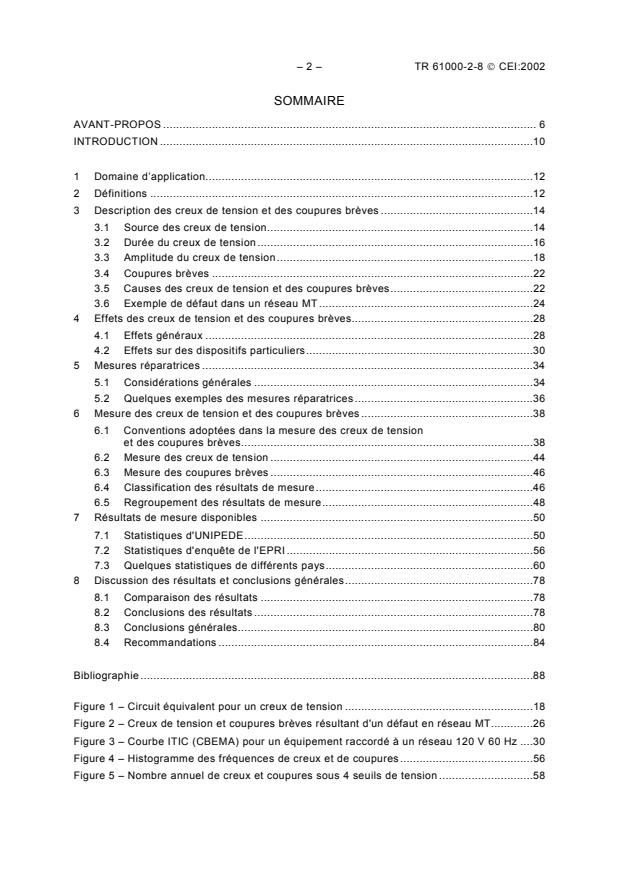
IEC TR 61000-2-8:2002 - Electromagnetic compatibility (EMC) - Part 2-8: Environment - Voltage dips and short interruptions on public electric power supply systems with statistical measurement results Released:11/22/2002
Overview
SIST-TP IEC TR 61000-2-8:2026 is a technical report published by the International Electrotechnical Commission (IEC) focusing on electromagnetic compatibility (EMC) in public electric power supply systems. It specifically addresses voltage dips and short interruptions, key electromagnetic disturbance phenomena affecting electrical equipment connected to public electricity networks. This report offers a comprehensive analysis of the sources, characteristics, effects, remedial measures, and measurement methods related to these disturbances, supported by statistical measurement results collected from various network types.
This standard is essential for professionals working in power quality, electrical engineering, and EMC fields who seek to understand and mitigate disturbances caused by voltage dips and short interruptions on public power supply systems.
Key Topics
- Voltage Dips and Short Interruptions: Definitions and detailed descriptions include their sources, duration, amplitude, and cause analysis on medium voltage (MV) and high voltage (HV) networks.
- Sources and Causes: Detailed examination of phenomena causing voltage dips and interruptions, such as faults in electrical networks, switching operations, and external factors.
- Effects on Equipment: Assessment of general impacts on electrical systems and specific vulnerable devices, highlighting the importance of EMC considerations for reliable power supply.
- Measurement Methods: Protocols and conventions for accurately measuring voltage dips and short interruptions, classification of measurement outcomes, and methods for aggregating statistical data.
- Remedial Measures: Practical approaches and examples of solutions to minimize the adverse effects of these disturbances and improve power quality.
- Statistical Results: Presentation and interpretation of real-world measurement statistics from various networks globally, including underground, overhead, mixed networks, and different voltage levels.
- Conclusions and Recommendations: Discussion on the implications of statistical findings and recommendations for utilities, manufacturers, and users to enhance electromagnetic compatibility.
Applications
SIST-TP IEC TR 61000-2-8:2026 serves numerous practical applications:
- Power Utilities can use this report to better understand the behavior of voltage dips and interruptions in public power systems and implement effective control strategies to enhance supply reliability.
- Equipment Manufacturers can improve design robustness and EMC compliance of electrical devices by understanding the disturbances they are likely to face.
- System Engineers and Consultants rely on the statistical data and measurement techniques to conduct power quality assessments and recommend remedial actions.
- Facility Managers and Industrial Installations benefit from guidelines on mitigating the effects of voltage disturbances to avoid operational disruptions and equipment damage.
- Regulatory Bodies use the findings and recommendations to set power quality standards and compliance criteria for the electric industry.
By applying the knowledge provided in this technical report, stakeholders can enhance system resilience, reduce downtime, and optimize the performance of electrical equipment under real-world power disturbance conditions.
Related Standards
SIST-TP IEC TR 61000-2-8:2026 is part of the IEC 61000 series on electromagnetic compatibility and closely relates to other standards including:
- IEC 61000-4 series – EMC testing and measurement techniques, which provide detailed test methods for electromagnetic disturbances including voltage dips.
- IEC 61000-2-x – Other parts of the environment series covering various EMC phenomena and their impact on power systems.
- IEEE 1159 – Recommended practice for monitoring electric power quality that complements IEC guidelines.
- EN 50160 – Voltage characteristics in public distribution networks, where voltage dips and interruptions are significant parameters.
These interconnected standards together provide a comprehensive framework for understanding, measuring, and managing disturbances in power quality and electromagnetic compatibility.
In summary, SIST-TP IEC TR 61000-2-8:2026 is a fundamental EMC publication offering valuable insights into voltage dips and short interruptions on public power systems. It equips professionals with practical knowledge and statistical evidence crucial for improving power system reliability and ensuring the proper operation of electrical equipment under transient power quality events.
Relations
- Effective Date
- 10-Feb-2026
- Effective Date
- 10-Feb-2026
- Effective Date
- 10-Feb-2026
- Effective Date
- 10-Feb-2026
- Effective Date
- 10-Feb-2026
Buy Documents
IEC TR 61000-2-8:2002 - Electromagnetic compatibility (EMC) - Part 2-8: Environment - Voltage dips and short interruptions on public electric power supply systems with statistical measurement results Released:11/22/2002
Get Certified
Connect with accredited certification bodies for this standard

ANCE
Mexican certification and testing association.

Intertek Slovenia
Intertek testing, inspection, and certification services in Slovenia.

LNE (Laboratoire National de Métrologie et d'Essais)
French national laboratory for metrology and testing.
Sponsored listings
Frequently Asked Questions
SIST-TP IEC TR 61000-2-8:2026 is a technical report published by the Slovenian Institute for Standardization (SIST). Its full title is "Electromagnetic compatibility (EMC) - Part 2-8: Environment - Voltage dips and short interruptions on public electric power supply systems with statistical measurement results". This standard covers: IEC TR 61000-2-8:2002, which is a technical report, describes the electromagnetic disturbance phenomena of voltage dips and short interruptions in terms of their sources, effects, remedial measures, methods of measurement, and measurement results (in so far as these are available). They are discussed primarily as phenomena observed on the networks of public electricity supply systems and having an effect on electrical equipment receiving its energy supply from those systems. “Voltage sag” is an alternative name for the phenomenon voltage dip.
IEC TR 61000-2-8:2002, which is a technical report, describes the electromagnetic disturbance phenomena of voltage dips and short interruptions in terms of their sources, effects, remedial measures, methods of measurement, and measurement results (in so far as these are available). They are discussed primarily as phenomena observed on the networks of public electricity supply systems and having an effect on electrical equipment receiving its energy supply from those systems. “Voltage sag” is an alternative name for the phenomenon voltage dip.
SIST-TP IEC TR 61000-2-8:2026 is classified under the following ICS (International Classification for Standards) categories: 01 - GENERALITIES. TERMINOLOGY. STANDARDIZATION. DOCUMENTATION; 33.100.01 - Electromagnetic compatibility in general. The ICS classification helps identify the subject area and facilitates finding related standards.
SIST-TP IEC TR 61000-2-8:2026 has the following relationships with other standards: It is inter standard links to SIST EN 62056-61:2007, SIST EN 61000-4-34:2007, SIST EN 62056-6-1:2018, SIST EN 62056-6-1:2017, SIST EN 61000-4-11:2005. Understanding these relationships helps ensure you are using the most current and applicable version of the standard.
SIST-TP IEC TR 61000-2-8:2026 is available in PDF format for immediate download after purchase. The document can be added to your cart and obtained through the secure checkout process. Digital delivery ensures instant access to the complete standard document.
Standards Content (Sample)
SLOVENSKI STANDARD
01-februar-2026
Elektromagnetna združljivost (EMC) - 2-8. del: Okolje - Upadi napetosti in
kratkotrajne prekinitve napajanja v javnih električnih napajalnih sistemih s
statističnimi merilnimi rezultati
Electromagnetic compatibility (EMC) - Part 2-8: Environment - Voltage dips and short
interruptions on public electric power supply systems with statistical measurement results
Compatibilité électromagnétique (CEM) - Partie 2-8: Environnement - Creux de tension
et coupures brèves sur les réseaux d'électricité publics incluant des résultats de
mesures statistiques
Ta slovenski standard je istoveten z: IEC TR 61000-2-8:2002
ICS:
33.100.01 Elektromagnetna združljivost Electromagnetic compatibility
na splošno in general
2003-01.Slovenski inštitut za standardizacijo. Razmnoževanje celote ali delov tega standarda ni dovoljeno.
RAPPORT CEI
TECHNIQUE IEC
61000-2-8
TECHNICAL
Première édition
REPORT
First edition
2002-11
PUBLICATION FONDAMENTALE EN CEM
BASIC EMC PUBLICATION
Compatibilité électromagnétique (CEM) –
Partie 2-8:
Environnement – Creux de tension et coupures
brèves sur les réseaux d'électricité publics
incluant des résultats de mesures statistiques
Electromagnetic compatibility (EMC) –
Part 2-8:
Environment – Voltage dips and short
interruptions on public electric power supply
systems with statistical measurement results
IEC 2002 Droits de reproduction réservés Copyright - all rights reserved
Aucune partie de cette publication ne peut être reproduite ni No part of this publication may be reproduced or utilized in any
utilisée sous quelque forme que ce soit et par aucun procédé, form or by any means, electronic or mechanical, including
électronique ou mécanique, y compris la photo-copie et les photocopying and microfilm, without permission in writing from
microfilms, sans l'accord écrit de l'éditeur. the publisher.
International Electrotechnical Commission, 3, rue de Varembé, PO Box 131, CH-1211 Geneva 20, Switzerland
Telephone: +41 22 919 02 11 Telefax: +41 22 919 03 00 E-mail: inmail@iec.ch Web: www.iec.ch
CODE PRIX
X
Commission Electrotechnique Internationale
PRICE CODE
International Electrotechnical Commission
Международная Электротехническая Комиссия
Pour prix, voir catalogue en vigueur
For price, see current catalogue
TR 61000-2-8 IEC:2002 – 3 –
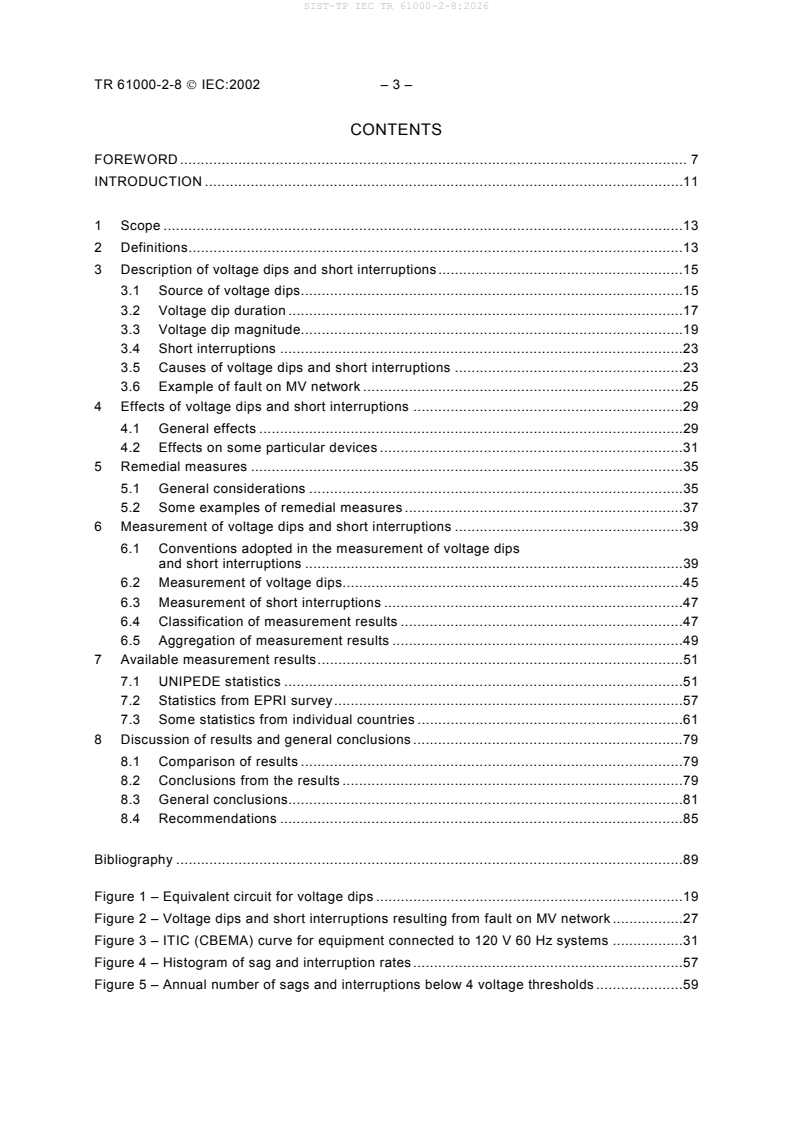
CONTENTS
FOREWORD . 7
INTRODUCTION .11
1 Scope .13
2 Definitions.13
3 Description of voltage dips and short interruptions.15
3.1 Source of voltage dips.15
3.2 Voltage dip duration .17
3.3 Voltage dip magnitude.19
3.4 Short interruptions .23
3.5 Causes of voltage dips and short interruptions .23
3.6 Example of fault on MV network .25
4 Effects of voltage dips and short interruptions .29
4.1 General effects .29
4.2 Effects on some particular devices .31
5 Remedial measures .35
5.1 General considerations .35
5.2 Some examples of remedial measures .37
6 Measurement of voltage dips and short interruptions .39
6.1 Conventions adopted in the measurement of voltage dips
and short interruptions .39
6.2 Measurement of voltage dips.45
6.3 Measurement of short interruptions .47
6.4 Classification of measurement results .47
6.5 Aggregation of measurement results .49
7 Available measurement results.51
7.1 UNIPEDE statistics .51
7.2 Statistics from EPRI survey.57
7.3 Some statistics from individual countries .61
8 Discussion of results and general conclusions .79
8.1 Comparison of results .79
8.2 Conclusions from the results .79
8.3 General conclusions.81
8.4 Recommendations .85
Bibliography .89
Figure 1 – Equivalent circuit for voltage dips .19
Figure 2 – Voltage dips and short interruptions resulting from fault on MV network .27
Figure 3 – ITIC (CBEMA) curve for equipment connected to 120 V 60 Hz systems .31
Figure 4 – Histogram of sag and interruption rates.57
Figure 5 – Annual number of sags and interruptions below 4 voltage thresholds .59
TR 61000-2-8 IEC:2002 – 5 –
Table 1 – Transformer secondary voltages with a single line-to-ground fault on the primary.21
Table 2 – Classification of measurement results .49
Table 3 – Underground networks: voltage dip incidence – maximum .53
Table 4 – Underground networks: voltage dip incidence – mean.53
th
Table 5 – Underground networks: voltage dip incidence – 95 percentile .53
Table 6 – Mixed networks: voltage dip incidence – maximum .55
Table 7 – Mixed networks: voltage dip incidence – mean .55
th
Table 8 – Mixed networks: voltage dip incidence – 95 percentile.55
Table 9 – Voltage dips and short interruptions on the HV system .61
Table 10 – Voltage dips and short interruptions on the MV system .61
Table 11 – MV overhead networks: voltage dip incidence – maximum .63
th
Table 12 – MV overhead networks: voltage dip incidence – 95 percentile.65
Table 13 – MV overhead networks: voltage dip incidence – mean .65
Table 14 – MV underground networks: voltage dip incidence – maximum .65
Table 15 – MV underground networks: voltage dip incidence – mean .67
Table 16 – HV (400 kV) networks: voltage dip incidence – maximum.67
Table 17 – HV (400 kV) networks: voltage dip incidence – mean .67
Table 18 – Voltage dip severity weighting coefficients .69
Table 19 – Underground networks: 2 measurement sites, 1996-1998 – maximum number
of dips/year .71
Table 20 – Underground networks: 2 measurement sites, 1996-1998 – mean number
of dips/year .71
Table 21 – Mixed networks: 3 measurement sites, 1996-1998 – maximum number
of dips/year .71
Table 22 – Mixed networks: 3 measurement sites, 1996-1998 – mean number
of dips/year .73
Table 23 – Mixed networks: 3 measurement sites, 1999 – maximum number of dips .73
Table 24 – Mixed networks: 3 measurement sites, 1999 – mean number of dips .75
Table 25 – Overhead networks: 3 measurement sites, 1999 – maximum number of dips .75
Table 26 – Overhead networks: 3 measurement sites, 1999 – mean number of dips.75
Table 27 – Average probability p of voltage dips and short interruptions per customer .77
Table 28 – Recommended presentation of results.87
TR 61000-2-8 IEC:2002 – 7 –
INTERNATIONAL ELECTROTECHNICAL COMMISSION
____________
ELECTROMAGNETIC COMPATIBILITY (EMC) –
Part 2-8: Environment –
Voltage dips and short interruptions on public electric power
supply systems with statistical measurement results
FOREWORD
1) The IEC (International Electrotechnical Commission) is a worldwide organization for standardization comprising
all national electrotechnical committees (IEC National Committees). The object of the IEC is to promote
international co-operation on all questions concerning standardization in the electrical and electronic fields. To
this end and in addition to other activities, the IEC publishes International Standards. Their preparation is
entrusted to technical committees; any IEC National Committee interested in the subject dealt with may
participate in this preparatory work. International, governmental and non-governmental organizations liaising
with the IEC also participate in this preparation. The IEC collaborates closely with the International Organization
for Standardization (ISO) in accordance with conditions determined by agreement between the two
organizations.
2) The formal decisions or agreements of the IEC on technical matters express, as nearly as possible, an
international consensus of opinion on the relevant subjects since each technical committee has representation
from all interested National Committees.
3) The documents produced have the form of recommendations for international use and are published in the form
of standards, technical specifications, technical reports or guides and they are accepted by the National
Committees in that sense.
4) In order to promote international unification, IEC National Committees undertake to apply IEC International
Standards transparently to the maximum extent possible in their national and regional standards. Any
divergence between the IEC Standard and the corresponding national or regional standard shall be clearly
indicated in the latter.
5) The IEC provides no marking procedure to indicate its approval and cannot be rendered responsible for any
equipment declared to be in conformity with one of its standards.
6) Attention is drawn to the possibility that some of the elements of this technical report may be the subject of
patent rights. The IEC shall not be held responsible for identifying any or all such patent rights.
The main task of IEC technical committees is to prepare International Standards. However,
a technical committee may propose the publication of a technical report when it has collected
data of a different kind from that which is normally published as an International Standard, for
example “state of the art”.
IEC 61000-2-8, which is a technical report, has been prepared by subcommittee 77A: Low
frequency phenomena, of IEC technical committee 77: Electromagnetic compatibility.
It has the status of a basic EMC publication in accordance with IEC Guide 107.
The text of this technical report is based on the following documents:
Enquiry draft Report on voting
77A/375/DTR 77A/396/RVC
Full information on the voting for the approval of this technical report can be found in the report
on voting indicated in the above table.
This publication has been drafted in accordance with the ISO/IEC Directives, Part 2.
TR 61000-2-8 IEC:2002 – 9 –
The committee has decided that the contents of this publication will remain unchanged until
2010. At this date, the publication will be
• reconfirmed;
• withdrawn;
• replaced by a revised edition, or
• amended.
TR 61000-2-8 IEC:2002 – 11 –
INTRODUCTION
IEC 61000 is published in separate parts according to the following structure:
Part 1: General
General considerations (introduction, fundamental principles)
Definitions, terminology
Part 2: Environment
Description of the environment
Classification of the environment
Compatibility levels
Part 3: Limits
Emission limits
Immunity limits (in so far as they do not fall under the responsibility of the product
committees)
Part 4: Testing and measurement techniques
Measurement techniques
Testing techniques
Part 5: Installation and mitigation guidelines
Installation guidelines
Mitigation methods and devices
Part 6: Generic standards
Part 9: Miscellaneous
Each part is further subdivided into several parts, published either as International Standards,
technical specifications or technical reports, some of which have already been published
as sections. Others will be published with the part number followed by a dash and completed
by a second number identifying the subdivision (example: 61000-6-1).
Detailed information on the various types of disturbances that can be expected on public power
supply systems can be found in IEC 61000-2-1.
TR 61000-2-8 IEC:2002 – 13 –
ELECTROMAGNETIC COMPATIBILITY (EMC) –
Part 2-8: Environment –
Voltage dips and short interruptions on public electric power
supply systems with statistical measurement results
1 Scope
This technical report describes the electromagnetic disturbance phenomena of voltage dips
and short interruptions in terms of their sources, effects, remedial measures, methods of
measurement, and measurement results (in so far as these are available). They are discussed
primarily as phenomena observed on the networks of public electricity supply systems and
having an effect on electrical equipment receiving its energy supply from those systems.
“Voltage sag” is an alternative name for the phenomenon voltage dip.
2 Definitions
2.1
voltage dip
voltage sag
sudden reduction of the voltage at a particular point on an electricity supply system below
a specified dip threshold followed by its recovery after a brief interval
NOTE 1 Typically a dip is associated with the occurrence and termination of a short circuit or other extreme
current increase on the system or installations connected to it.
NOTE 2 A voltage dip is a two-dimensional electromagnetic disturbance, the level of which is determined by both
voltage and time (duration).
2.2
short interruption
sudden reduction of the voltage on all phases at a particular point on an electricity supply
system below a specified interruption threshold followed by its restoration after a brief interval
NOTE Short interruptions are typically associated with switchgear operation related to the occurrence and
termination of short circuits on the system or installations connected to it.
2.3
(voltage dip) reference voltage
value specified as the base on which depth, thresholds and other values are expressed in
per unit or percentage terms
NOTE The nominal or declared voltage of the supply system is frequently selected as the reference voltage.
2.4
voltage dip start threshold
r.m.s. value of the voltage on an electricity supply system specified for the purpose of defining
the start of a voltage dip
NOTE Typically values between 0,85 and 0,95 of the reference voltage have been used for this threshold.
TR 61000-2-8 IEC:2002 – 15 –
2.5
voltage dip end threshold
r.m.s. value of the voltage on an electricity supply system specified for the purpose of defining
the end of a voltage dip
NOTE Typically, the value used for the end threshold has been the same as the start threshold or has exceeded it
by 0,01 of the reference voltage.
2.6
interruption threshold
r.m.s. value of the voltage on an electricity supply system specified as a boundary such that a
voltage dip in which the voltage on all phases falls below it is classified as a short interruption
2.7
residual voltage (of voltage dip)
minimum value of r.m.s. voltage recorded during a voltage dip or short interruption
NOTE The residual voltage may be expressed as a value in volts or as a percentage or per unit value relative to
the reference voltage.
2.8
depth (of voltage dip)
difference between the reference voltage and the residual voltage
NOTE 1 The depth may be expressed as a value in volts or as a percentage or per unit value relative to the
reference voltage.
NOTE 2 Frequently the word ‘depth’ is used in a descriptive, non-quantitative sense, to refer to the voltage
dimension of a voltage dip, without the intention of specifying whether that dimension is expressed as the residual
voltage or depth, as defined above. Care is needed to ensure that this meaning is clear in the context in which
it is used.
2.9
duration (of voltage dip)
time between the instant at which the voltage at a particular point on an electricity supply
system falls below the start threshold and the instant at which it rises to the end threshold.
NOTE In polyphase events, practice varies in regard to relating the start and end of the dip to the phases
concerned. Future practice is likely to be that for polyphase events a dip begins when the voltage of at least
one phase falls below the dip start threshold and ends when the voltage on all phases is equal to or above the
dip end threshold.
2.10
(voltage dip) sliding reference voltage
r.m.s. value of the voltage at a particular point on an electricity supply system continuously
calculated over a specified interval to represent the value of the voltage immediately preceding
a voltage dip for use as the reference voltage
NOTE The specified interval is much longer than the duration of a voltage dip.
3 Description of voltage dips and short interruptions
3.1 Source of voltage dips
The primary source of voltage dips observed on the public network is the electrical short circuit
occurring at any point on the electricity supply system.
TR 61000-2-8 IEC:2002 – 17 –
The short circuit causes a very large increase in current, and this, in turn, gives rise to large
voltage drops in the impedances of the supply system. Short circuit faults are an unavoidable
occurrence on electricity systems. They have many causes, but basically they involve a
breakdown in the dielectric between two structures which are intended to be insulated from
each other and which normally are maintained at different potentials.
Many short circuits are caused by overvoltages, which stress the insulation beyond its capacity.
Atmospheric lightning is a notable cause of such overvoltages. Alternatively, the insulation can
be weakened, damaged or bridged as a result of other weather effects (wind, snow, ice, salt
spray, etc.), by the impact or contact of animals, vehicles, excavating equipment, etc., and as a
result of deterioration with age.
The typical electricity supply system conveys energy from multiple sources (generating
stations) to multiple loads (motors; resistive elements for lighting, heating, etc.; the power
supply modules of electronic devices; etc.) The entire system, including generators, loads and
everything between, is a single, integrated and dynamic system – any change of voltage,
current, impedance, etc. at one point instantaneously brings about a change at every other
point on the system.
Most supply systems are three-phase systems. The short circuit can occur between phases,
phase and neutral, or phase and earth. Any number of phases can be involved.
At the point of the short circuit, the voltage effectively collapses to zero. Simultaneously, at
almost every other point on the system the voltage is reduced to the same or, more generally,
a lesser extent.
Supply systems are equipped with protective devices to disconnect the short circuit from the
source of energy. As soon as that disconnection takes place, there is an immediate recovery of
the voltage, approximately to its previous value, at every point except those disconnected.
Some faults are self-clearing: the short circuit disappears and the voltage recovers before
disconnection can take place.
The sudden reduction of voltage, followed by voltage recovery, as just described, is the
phenomenon known as voltage dip (also known as voltage sag).
The switching of large loads, energising of transformers, starting of large motors and the
fluctuations of great magnitude that are characteristic of some loads can all produce large
changes in current similar in effect to a short circuit current. Although the effect is generally
less severe at the point of occurrence, the resulting changes in voltage observed at certain
locations can be indistinguishable from those arising from short circuits. In that case they also
are categorised as voltage dips. (In the management of public networks, however, limits are
applied, as a condition of supply, to the permissible voltage fluctuations from this cause.)
3.2 Voltage dip duration
Unless a self-clearing fault is involved, the duration of voltage dips is governed by the speed of
operation of the protective devices.
In the main, the protective devices are either fuses or circuit breakers controlled by relays of
various kinds. Protection relays often are designed to have an inverse time characteristic, so
that the lower the short circuit current, the longer is the fault clearance time. Fuses have
similar characteristics. The time characteristics and settings of the fuses and relays are
carefully graduated and co-ordinated, so that a short circuit detected by several devices is
cleared at the most appropriate point.
TR 61000-2-8 IEC:2002 – 19 –
Many short circuits are cleared in the time range 100 ms – 500 ms. Faster times are often
achieved for short circuits on major transmission lines, while the clearance of short circuits on
distribution circuits can be considerably slower.
When a current fluctuation other than a short circuit is the source of the voltage dip, the
duration is governed by that of the causative event.
Some loads draw a large inrush of current as the voltage recovers at the end of a voltage dip.
This has the effect of delaying the recovery of the voltage and extending the duration of the
voltage dip. The same effect can occur when transformers go into saturation during voltage
recovery.
3.3 Voltage dip magnitude
The magnitude of the voltage dip is governed by the position of the observation point in relation
to the site of the short circuit and the source(s) of supply.
The system can be represented by a simple equivalent circuit connecting the observation point
to a single equivalent source and to the site of the fault. (see Figure 1.) The entire voltage
(100 %) is dissipated over the impedance between the source and the short circuit. The voltage
drop to the observation point depends on the relative magnitudes of the two impedances
connecting that point to the source and the short circuit. Depending on these impedances, the
depth of the voltage dip can be anywhere in the range 0 % to 100 %.
Z Z Z
1 2 3
O O
S F
1 2
Z + Z Z
2 3
U = 1 U = U =
s O U = 0
O
1 2 F
Z + Z + Z Z + Z + Z
1 2 3 1 2 3
IEC 2965/02
Voltage dips at observation points O and O for short circuit at F and single equivalent source at S (expressed in
1 2
terms of residual voltage per unit.)
Figure 1 – Equivalent circuit for voltage dips
In broad terms, the nearer the observation point is to the site of the short circuit, the closer the
voltage at that point is to the voltage at the fault site. In other words, the voltage dip
approaches the maximum possible depth (zero residual voltage) near the short circuit. On the
other hand, if an observation point is near a generation source or sources of stored energy,
such as rotating machines, the effect is to move the observation point nearer to the equivalent
single source as represented in Figure 1. This mitigates the severity of the observed voltage
dip. (However, if the dip duration is prolonged, increased current is drawn by decelerating
motors, and this can increase the severity of the dip.)
Whether a short circuit results in an observable voltage dip at a particular observation point
depends on their positions on the supply system. A short circuit on the transmission system is
likely to result in an appreciable voltage dip that is observed over a very wide area, even at a
distance of some hundreds of kilometres. On the other hand, a short circuit on a distribution
circuit has a much smaller field of observable influence. Observation points on the same circuit
are likely to experience severe dips, the dip severity will be moderated considerably on
neighbouring circuits, and at larger distances the dip is hardly discernible.
TR 61000-2-8 IEC:2002 – 21 –
Given an observation point within or near a private installation, it is, of course, possible that a
short circuit or other causative event will occur within the same installation. The observed
voltage dip that results can equal or exceed a dip caused by a short circuit on the public
transmission or distribution system.
The observed magnitude of a voltage dip depends also on the phases involved, both in the
short circuit and at the observation point, and on the winding connections (star-delta, star-star,
etc.) of any transformers between those two points.
3.3.1 Significance of transformer and load connections
The observed voltage dip magnitude arising from a particular causative event depends on
whether the observation point and the event are on the same or different sides of a network or
customer transformer. The phasing of the short circuit or other event, the phasing of the
measurement system, and the connection methods of the primary and secondary transformer
windings are all significant in this regard. For instance, considering the network or installations
on either side of a step down transformer connected Dyn or Dy, a single line to ground fault
can result, on the primary side, in a voltage dip of 0 V (residual voltage) on one phase, but, on
the secondary side, a line to neutral voltage on two phases of 58 % of the pre-existing voltage.
In practice, loads that are sensitive to voltage dips (power converters and drives, motors,
control equipment, etc.) are often connected line-to-line in industrial installations. They would
therefore be subjected to line-to-line voltage dips rather than line-to-neutral dips. This needs to
be taken into account in considering whether measurements are conducted line-to-neutral, line-
to-line, or both.
For example, Table 1 provides a summary of the voltage dips that would be observed at the
secondary sides of different step down transformers, with a single line-to-ground fault on the
primary, causing a 100 % voltage drop on phase 1 on that side. (The supply network is
assumed to be a directly grounded neutral system.)
Table 1 – Transformer secondary voltages
with a single line-to-ground fault on the primary
Line-to-neutral voltage Line-to-line voltage
Transformer
a
connection
V V V V V V
1 2 3 12 23 13
YNyn or YNy 0,0 1,0 1,0 0,58 1,0 0,58
Yy, Yyn, or Dd 0,33 0,88 0,88 0,58 1,0 0,58
YNd or Yd – – – 0,33 0,88 0,88
Dyn or Dy 0,58 1,0 0,58 0,88 0,88 0,33
a
Capital letters refer to primary winding connection (supply network side) and lower case letters
refer to secondary winding connection (load side). N and n designate a grounded primary and
secondary transformer neutral, respectively.
See [6] .
———————
Figures in square brackets refer to the bibliography.
TR 61000-2-8 IEC:2002 – 23 –
3.4 Short interruptions
The operation of a circuit breaker or fuse disconnects part of the system from the source of
energy. In the case of a radial circuit, this interrupts the supply to all downstream parts of the
system. In the case of a meshed network, disconnections at more than one point are necessary
in order to clear the fault. Electricity users within the disconnected segment of network suffer
an interruption of supply.
In the case of overhead networks, automatic reclosing sequences are often applied to the
circuit breakers that interrupt fault currents. Their purpose is to restore the circuit to normal
with the minimum of delay in the event that the fault proves to be a transient (self-clearing) one
(as in the case of a flashover, due to over-voltage, resulting in no serious or permanent
damage to the components involved). If the first reclosing attempt proves unsuccessful, there
may be subsequent attempts at pre-set intervals. If the fault remains after the pre-set
sequence of open-reclose operations is completed, the circuit breaker remains in the open
position and is not closed again until the necessary repairs have been carried out at the fault
site. (Of course, each reclosure while the fault still exists results in an additional voltage dip,
the observed depth of which depends on the position of the observation point.)
In addition to the actual isolation of the fault, further switching is often carried out, either
automatically or manually, in order to reduce the extent of network and number of users
interrupted as a result of the initial fault clearance.
Thus, a single fault can result in a complex series of switching operations, observable to users
as a series of interruptions of various durations. Depending on the structure of the network in
the particular case and on the positions of individual users relative to the sites of the fault and
the relevant switches, some users will experience very brief interruptions, while others may
even have to wait for repairs to be completed before supply can be restored.
Interruptions having a duration up to 1 min (or, in the case of some reclosing schemes,
up to 3 min) are classified conventionally as short interruptions.
3.5 Causes of voltage dips and short interruptions
As already stated, the cause of voltage dips (which sometimes extend to or are associated with
short interruptions) is the major surge of current involved in a short circuit on an electrical
system, and occasionally in large-scale load fluctuations. The flow of current through the
impedances of the network components results in voltage drops, which briefly depress the
voltage delivered to electricity users.
The dielectric breakdown involved in short circuits arises either from the stress of overvoltage
or because the insulation is weakened, damaged or bridged in some way. The causes of the
faults which have these results are many, including:
– atmospheric events: lightning and wind storms, snow, ice, deposition of salt or atmospheric
pollutants on insulators, wind-borne debris;
– mechanical interference and damage: contact by vehicles, construction equipment,
excavation equipment, animals and birds, growing trees, vandalism and malicious damage;
– breakdown of network plant: deterioration with age, corrosion, rot, latent manufacturing or
construction faults;
– accidents or errors in operation and maintenance;
– major natural events: floods, landslides, earthquakes, avalanches.
TR 61000-2-8 IEC:2002 – 25 –
A certain incidence of faults due to these causes is inevitable on all networks. Some types of
network have a greater exposure to many of these causes or to a greater range of causes. In
particular, overhead networks are exposed to most of the causes.
Voltage dips arising from load fluctuations are associated with the starting of large motors,
especially those in isolated locations served by long lines, similar motors with gross
fluctuations of load, arc furnaces, welding equipment, etc. (However, in the management of
public networks, limits are generally applied to such fluctuations as a condition of supply.)
3.6 Example of fault on MV network
Figure 2 illustrates the voltage dips and short interruptions resulting from a fault on an MV
feeder. Three cases are shown:
– a transient fault which is found to have cleared at the first reclose operation;
– a semi-permanent fault which still remains at the first reclose operation, but is found to
have cleared at the second (delayed) reclose operation;
– a permanent fault which still remains after the full reclose sequence has been completed.
In each case, the voltage dips and interruptions are shown as observed by two customers, one
on the same feeder as the fault but upstream from it, and the other on another feeder from the
same busbar. (The times shown are for illustration. Actual times depend on the settings
adopted for a particular network.)
TR 61000-2-8 IEC:2002 – 27 –
HV
MV
Fault
Feeder 2
Feeder 1
U
U
n
Customer supplied
0 200 ms
500 ms t
I
by feeder 1
I
n
t
U
U
n
Customer supplied
by feeder 2
t t t t
0 1 2
Case of a transient fault
U
U
n
Customer supplied
0 200 ms
500 ms 1 s 15 s to 30 s t
I
by feeder 1
I
n
t
U
U
n
Customer supplied
by feeder 2
t t t t t
t
0 1 2 3 4
Case of a semi-permanent fault
U
500 ms
U
n
0 200 ms
500 ms 1 s 15 s to 30 s
Customer supplied
t
I
by feeder 1
I
n
t
U
U
n
Customer supplied
by feeder 2
t t
t t t t t
0 1 2 3 4 5
200 ms 500 ms 1 s 16 s to 31 s 16,5 s to 31,5 s
Case of a permanent fault
t t t t t t
- -
0 0 1 1 2 2
Appearance Detection time Opening of the The fault has disappeared
of the fault of the fault + timing out-going feeder (case of a transient fault)
at fault
IEC 2966/02
Figure 2 – Voltage dips and short interruptions
resulting from fault on MV network
TR 61000-2-8 IEC:2002 – 29 –
4 Effects of voltage dips and short interruptions
4.1 General effects
In this document within the IEC 61000 series, the relevant effects are those relating to EMC,
i.e. the possible degradation of the performance of equipment. As EMC phenomena, voltage
dips and short interruptions can cause equipment connected to the supply network to perform
in a manner other than that which is intended.
The fundamental relationship between the supply system and the equipment connected to it is
that the system exists as an energy source from which the equipment draws whatever energy it
needs to carry out its intended function. The amount of energy drawn and the use to which it is
put is almost entirely a matter of the design and operation of the utilisation equipment
(including the switching and control features incorporated in it), limited only by the capacity of
the network to deliver energy at the point of connection of the equipment.
The energy delivery capacity of the network decreases as the voltage decreases. Voltage dips
and short interruptions, therefore, cause a temporary diminution or stoppage of the energy flow
to the equipment. This leads to a degradation of performance in a manner that varies with the
type of equipment involved, possibly extending to a complete cessation of operation.
An option that is sometimes implemented in either the design or installation of the equipment is
to incorporate a protective device for the purpose of interrupting the supply in the event of the
voltage falling below a set threshold, thereby preventing damage or other unwanted effects in
conditions of reduced voltage. Such protection can have the effect of converting a voltage dip
into a long interruption for the equipment concerned. The long interruption is not caused by the
voltage dip, but is the intended result of a protective feature that is designed to respond in that
way to reduced voltage.
As with all disturbance phenomena, the gravity of the effects of voltage dips and short
interruptions depends not only on the direct effects on the equipment concerned, but also on
how important and critical is the function carried out by that equipment. For example, modern
manufacturing methods often involve complex continuous processes utilising many devices
acting together. A failure or removal from service of any one device, in response to a voltage
dip or short interruption, can necessitate stopping the entire process, with the consequence of
loss of product and damage or serious fouling of equipment. This can be one of the most
serious and expensive consequences of voltage dips and short interruptions. Such
consequential damage or loss, however, is a function of the design of the process and is an
indirect or secondary effect of the voltage dip or short interruption.
EMC considerations are concerned with the direct effects on the performance of the actual
appliances drawing an energy supply from the electricity network. Some of the more common
effects are described more particularly for certain types of equipment in the subclauses that
follow. The list is not an exhaustive one.
NOTE A sudden phase shift can accompany the voltage dip and can have a significant effect on some equipment.
This phenomenon is not discussed further in this report.
TR 61000-2-8 IEC:2002 – 31 –
4.2 Effects on some particular devices
4.2.1 IT and process control equipment
Generally, the principal functional units of this equipment require d.c. power supplies, and
these are provided by means of power supply modules which convert the a.c. supply from the
public power supply system. Usually, it is the minimum voltage reached during a voltage dip
that is significant for the power supply modules. Figure 3 shows the well-known ITIC curve for
minimum immunity objectives concerning dips. (It includes also voltages above the normal
range.) The user of the equipment must consider whether the consequences of dips that are
more severe than shown by the curve are such that additional measures are necessary in order
to maintain satisfactory performance. Depending on the application of the equipment, failures
can have safety or other implications. Traffic signalling failure is one of many possible
examples.
1,4
1,2
1,1
0,9
0,8
0,7
1 µs 10 µs 100 µs 1 ms 10 ms 100 ms 1 s 10 s 100 s
Duration
IEC 2967/02
Figure 3 – ITIC (CBEMA) curve for equipment connected to 120 V 60 Hz systems
4.2.2 Relays and contactors
AC relays and contactors can drop out when the voltage is reduced below about 80 % of
nominal for a duration of more than one cycle. The consequences vary with the application, but
can be very severe in safety or financial terms.
4.2.3 Asynchronous motors
The point of operation of an asynchronous motor is governed by the balance between the
torque-speed characteristic of the motor, which depends on the square of the voltage, and that
of the mechanical load. During a voltage dip, the torque of the motor initially decreases,
reducing the speed, while there can be an increase in the current until a new point of operation
is reached.
Per unit of rated voltage
TR 61000-2-8 IEC:2002 – 33 –
Induction motors with a maximum torque higher than 2,2 times the rated value are very tolerant
of dips presenting a positive phase sequence residual voltage above 70 % of the rated voltage.
There is a current increase in the region of 25 % to 35 %, while the power drawn from the
network is rather constant or decreases by a small amount. (If the torque defined by the load is
rather constant, the speed decreases by only a small percentage, corresponding to the
increase of slip due to the much lower flux in the motor.) Effects are mainly thermal, with a time
constant much greater than even the longest dips. The over-current with voltage recovery is
generally limited and, for directly connected motors, does not exceed the usual starting current.
Dips of larger depth are equivalent to short interruptions in their effect on the operation of the
motor. Two different behaviours are found, according to the value of the mechanical time
constant (ratio of total inertia to the rated torque of the motor).
– Where the mechanical time constant is high compared with the duration of the dip the
speed decreases only slightly. The time constant of the flux is generally in the region of a
few hundred milliseconds, so that there is the possibility of the back electromotive force
(e.m.f) being in phase opposition to the supply voltage during recovery. The resulting
transient inrush current can be greater than the normal starting current.
– Where the mechanical time constant is low compared with the duration of the dip the speed
decrease is such that the motor virtually stops. The inrush current with voltage recovery
corresponds to the normal starting current.
NOTE The possibility of motor protection relays or contactors dropping out must be considered – see 4.2.2.
The voltage recovery following a dip can also be a critical phase if there is a large number of
motors connected to the same bus. In that case the high inrush current at the voltage recovery
can produce a secondary voltage drop, delaying voltage recovery and retarding the re-
acceleration of motors to normal speed. In some cases, it can be impossible to re-accelerate,
thus requiring disconnection of motors.
4.2.4 Synchronous motors
Operation of a synchronous motor is defined on the output side by torque and speed, and on
the input side by voltage and active power. Flux, reactive power and internal rotor angle are
variables that are linked to the voltage and torque. The voltage dip can be tolerated provided
new, stable operating conditions are established. This is generally the case for dips presenting
a residual voltage of 75 % or 80 % (positive sequence). Also, the excitation circuit may be
affected, and should be considered.
More severe conditions prevent new stable operating conditions being established, and create
a loss of
...
SLOVENSKI STANDARD
01-februar-2026
Elektromagnetna združljivost (EMC) - 2-8. del: Okolje - Udori napetosti in kratke
prekinitve v javnih električnih napajalnih sistemih s statističnimi merilnimi rezultati
Electromagnetic compatibility (EMC) - Part 2-8: Environment - Voltage dips and short
interruptions on public electric power supply systems with statistical measurement results
Compatibilité électromagnétique (CEM) - Partie 2-8: Environnement - Creux de tension
et coupures brèves sur les réseaux d'électricité publics incluant des résultats de
mesures statistiques
Ta slovenski standard je istoveten z: IEC TR 61000-2-8:2002
ICS:
33.100.01 Elektromagnetna združljivost Electromagnetic compatibility
na splošno in general
2003-01.Slovenski inštitut za standardizacijo. Razmnoževanje celote ali delov tega standarda ni dovoljeno.
RAPPORT CEI
TECHNIQUE IEC
61000-2-8
TECHNICAL
Première édition
REPORT
First edition
2002-11
PUBLICATION FONDAMENTALE EN CEM
BASIC EMC PUBLICATION
Compatibilité électromagnétique (CEM) –
Partie 2-8:
Environnement – Creux de tension et coupures
brèves sur les réseaux d'électricité publics
incluant des résultats de mesures statistiques
Electromagnetic compatibility (EMC) –
Part 2-8:
Environment – Voltage dips and short
interruptions on public electric power supply
systems with statistical measurement results
IEC 2002 Droits de reproduction réservés Copyright - all rights reserved
Aucune partie de cette publication ne peut être reproduite ni No part of this publication may be reproduced or utilized in any
utilisée sous quelque forme que ce soit et par aucun procédé, form or by any means, electronic or mechanical, including
électronique ou mécanique, y compris la photo-copie et les photocopying and microfilm, without permission in writing from
microfilms, sans l'accord écrit de l'éditeur. the publisher.
International Electrotechnical Commission, 3, rue de Varembé, PO Box 131, CH-1211 Geneva 20, Switzerland
Telephone: +41 22 919 02 11 Telefax: +41 22 919 03 00 E-mail: inmail@iec.ch Web: www.iec.ch
CODE PRIX
X
Commission Electrotechnique Internationale
PRICE CODE
International Electrotechnical Commission
Международная Электротехническая Комиссия
Pour prix, voir catalogue en vigueur
For price, see current catalogue
TR 61000-2-8 IEC:2002 – 3 –
CONTENTS
FOREWORD . 7
INTRODUCTION .11
1 Scope .13
2 Definitions.13
3 Description of voltage dips and short interruptions.15
3.1 Source of voltage dips.15
3.2 Voltage dip duration .17
3.3 Voltage dip magnitude.19
3.4 Short interruptions .23
3.5 Causes of voltage dips and short interruptions .23
3.6 Example of fault on MV network .25
4 Effects of voltage dips and short interruptions .29
4.1 General effects .29
4.2 Effects on some particular devices .31
5 Remedial measures .35
5.1 General considerations .35
5.2 Some examples of remedial measures .37
6 Measurement of voltage dips and short interruptions .39
6.1 Conventions adopted in the measurement of voltage dips
and short interruptions .39
6.2 Measurement of voltage dips.45
6.3 Measurement of short interruptions .47
6.4 Classification of measurement results .47
6.5 Aggregation of measurement results .49
7 Available measurement results.51
7.1 UNIPEDE statistics .51
7.2 Statistics from EPRI survey.57
7.3 Some statistics from individual countries .61
8 Discussion of results and general conclusions .79
8.1 Comparison of results .79
8.2 Conclusions from the results .79
8.3 General conclusions.81
8.4 Recommendations .85
Bibliography .89
Figure 1 – Equivalent circuit for voltage dips .19
Figure 2 – Voltage dips and short interruptions resulting from fault on MV network .27
Figure 3 – ITIC (CBEMA) curve for equipment connected to 120 V 60 Hz systems .31
Figure 4 – Histogram of sag and interruption rates.57
Figure 5 – Annual number of sags and interruptions below 4 voltage thresholds .59
TR 61000-2-8 IEC:2002 – 5 –
Table 1 – Transformer secondary voltages with a single line-to-ground fault on the primary.21
Table 2 – Classification of measurement results .49
Table 3 – Underground networks: voltage dip incidence – maximum .53
Table 4 – Underground networks: voltage dip incidence – mean.53
th
Table 5 – Underground networks: voltage dip incidence – 95 percentile .53
Table 6 – Mixed networks: voltage dip incidence – maximum .55
Table 7 – Mixed networks: voltage dip incidence – mean .55
th
Table 8 – Mixed networks: voltage dip incidence – 95 percentile.55
Table 9 – Voltage dips and short interruptions on the HV system .61
Table 10 – Voltage dips and short interruptions on the MV system .61
Table 11 – MV overhead networks: voltage dip incidence – maximum .63
th
Table 12 – MV overhead networks: voltage dip incidence – 95 percentile.65
Table 13 – MV overhead networks: voltage dip incidence – mean .65
Table 14 – MV underground networks: voltage dip incidence – maximum .65
Table 15 – MV underground networks: voltage dip incidence – mean .67
Table 16 – HV (400 kV) networks: voltage dip incidence – maximum.67
Table 17 – HV (400 kV) networks: voltage dip incidence – mean .67
Table 18 – Voltage dip severity weighting coefficients .69
Table 19 – Underground networks: 2 measurement sites, 1996-1998 – maximum number
of dips/year .71
Table 20 – Underground networks: 2 measurement sites, 1996-1998 – mean number
of dips/year .71
Table 21 – Mixed networks: 3 measurement sites, 1996-1998 – maximum number
of dips/year .71
Table 22 – Mixed networks: 3 measurement sites, 1996-1998 – mean number
of dips/year .73
Table 23 – Mixed networks: 3 measurement sites, 1999 – maximum number of dips .73
Table 24 – Mixed networks: 3 measurement sites, 1999 – mean number of dips .75
Table 25 – Overhead networks: 3 measurement sites, 1999 – maximum number of dips .75
Table 26 – Overhead networks: 3 measurement sites, 1999 – mean number of dips.75
Table 27 – Average probability p of voltage dips and short interruptions per customer .77
Table 28 – Recommended presentation of results.87
TR 61000-2-8 IEC:2002 – 7 –
INTERNATIONAL ELECTROTECHNICAL COMMISSION
____________
ELECTROMAGNETIC COMPATIBILITY (EMC) –
Part 2-8: Environment –
Voltage dips and short interruptions on public electric power
supply systems with statistical measurement results
FOREWORD
1) The IEC (International Electrotechnical Commission) is a worldwide organization for standardization comprising
all national electrotechnical committees (IEC National Committees). The object of the IEC is to promote
international co-operation on all questions concerning standardization in the electrical and electronic fields. To
this end and in addition to other activities, the IEC publishes International Standards. Their preparation is
entrusted to technical committees; any IEC National Committee interested in the subject dealt with may
participate in this preparatory work. International, governmental and non-governmental organizations liaising
with the IEC also participate in this preparation. The IEC collaborates closely with the International Organization
for Standardization (ISO) in accordance with conditions determined by agreement between the two
organizations.
2) The formal decisions or agreements of the IEC on technical matters express, as nearly as possible, an
international consensus of opinion on the relevant subjects since each technical committee has representation
from all interested National Committees.
3) The documents produced have the form of recommendations for international use and are published in the form
of standards, technical specifications, technical reports or guides and they are accepted by the National
Committees in that sense.
4) In order to promote international unification, IEC National Committees undertake to apply IEC International
Standards transparently to the maximum extent possible in their national and regional standards. Any
divergence between the IEC Standard and the corresponding national or regional standard shall be clearly
indicated in the latter.
5) The IEC provides no marking procedure to indicate its approval and cannot be rendered responsible for any
equipment declared to be in conformity with one of its standards.
6) Attention is drawn to the possibility that some of the elements of this technical report may be the subject of
patent rights. The IEC shall not be held responsible for identifying any or all such patent rights.
The main task of IEC technical committees is to prepare International Standards. However,
a technical committee may propose the publication of a technical report when it has collected
data of a different kind from that which is normally published as an International Standard, for
example “state of the art”.
IEC 61000-2-8, which is a technical report, has been prepared by subcommittee 77A: Low
frequency phenomena, of IEC technical committee 77: Electromagnetic compatibility.
It has the status of a basic EMC publication in accordance with IEC Guide 107.
The text of this technical report is based on the following documents:
Enquiry draft Report on voting
77A/375/DTR 77A/396/RVC
Full information on the voting for the approval of this technical report can be found in the report
on voting indicated in the above table.
This publication has been drafted in accordance with the ISO/IEC Directives, Part 2.
TR 61000-2-8 IEC:2002 – 9 –
The committee has decided that the contents of this publication will remain unchanged until
2010. At this date, the publication will be
• reconfirmed;
• withdrawn;
• replaced by a revised edition, or
• amended.
TR 61000-2-8 IEC:2002 – 11 –
INTRODUCTION
IEC 61000 is published in separate parts according to the following structure:
Part 1: General
General considerations (introduction, fundamental principles)
Definitions, terminology
Part 2: Environment
Description of the environment
Classification of the environment
Compatibility levels
Part 3: Limits
Emission limits
Immunity limits (in so far as they do not fall under the responsibility of the product
committees)
Part 4: Testing and measurement techniques
Measurement techniques
Testing techniques
Part 5: Installation and mitigation guidelines
Installation guidelines
Mitigation methods and devices
Part 6: Generic standards
Part 9: Miscellaneous
Each part is further subdivided into several parts, published either as International Standards,
technical specifications or technical reports, some of which have already been published
as sections. Others will be published with the part number followed by a dash and completed
by a second number identifying the subdivision (example: 61000-6-1).
Detailed information on the various types of disturbances that can be expected on public power
supply systems can be found in IEC 61000-2-1.
TR 61000-2-8 IEC:2002 – 13 –
ELECTROMAGNETIC COMPATIBILITY (EMC) –
Part 2-8: Environment –
Voltage dips and short interruptions on public electric power
supply systems with statistical measurement results
1 Scope
This technical report describes the electromagnetic disturbance phenomena of voltage dips
and short interruptions in terms of their sources, effects, remedial measures, methods of
measurement, and measurement results (in so far as these are available). They are discussed
primarily as phenomena observed on the networks of public electricity supply systems and
having an effect on electrical equipment receiving its energy supply from those systems.
“Voltage sag” is an alternative name for the phenomenon voltage dip.
2 Definitions
2.1
voltage dip
voltage sag
sudden reduction of the voltage at a particular point on an electricity supply system below
a specified dip threshold followed by its recovery after a brief interval
NOTE 1 Typically a dip is associated with the occurrence and termination of a short circuit or other extreme
current increase on the system or installations connected to it.
NOTE 2 A voltage dip is a two-dimensional electromagnetic disturbance, the level of which is determined by both
voltage and time (duration).
2.2
short interruption
sudden reduction of the voltage on all phases at a particular point on an electricity supply
system below a specified interruption threshold followed by its restoration after a brief interval
NOTE Short interruptions are typically associated with switchgear operation related to the occurrence and
termination of short circuits on the system or installations connected to it.
2.3
(voltage dip) reference voltage
value specified as the base on which depth, thresholds and other values are expressed in
per unit or percentage terms
NOTE The nominal or declared voltage of the supply system is frequently selected as the reference voltage.
2.4
voltage dip start threshold
r.m.s. value of the voltage on an electricity supply system specified for the purpose of defining
the start of a voltage dip
NOTE Typically values between 0,85 and 0,95 of the reference voltage have been used for this threshold.
TR 61000-2-8 IEC:2002 – 15 –
2.5
voltage dip end threshold
r.m.s. value of the voltage on an electricity supply system specified for the purpose of defining
the end of a voltage dip
NOTE Typically, the value used for the end threshold has been the same as the start threshold or has exceeded it
by 0,01 of the reference voltage.
2.6
interruption threshold
r.m.s. value of the voltage on an electricity supply system specified as a boundary such that a
voltage dip in which the voltage on all phases falls below it is classified as a short interruption
2.7
residual voltage (of voltage dip)
minimum value of r.m.s. voltage recorded during a voltage dip or short interruption
NOTE The residual voltage may be expressed as a value in volts or as a percentage or per unit value relative to
the reference voltage.
2.8
depth (of voltage dip)
difference between the reference voltage and the residual voltage
NOTE 1 The depth may be expressed as a value in volts or as a percentage or per unit value relative to the
reference voltage.
NOTE 2 Frequently the word ‘depth’ is used in a descriptive, non-quantitative sense, to refer to the voltage
dimension of a voltage dip, without the intention of specifying whether that dimension is expressed as the residual
voltage or depth, as defined above. Care is needed to ensure that this meaning is clear in the context in which
it is used.
2.9
duration (of voltage dip)
time between the instant at which the voltage at a particular point on an electricity supply
system falls below the start threshold and the instant at which it rises to the end threshold.
NOTE In polyphase events, practice varies in regard to relating the start and end of the dip to the phases
concerned. Future practice is likely to be that for polyphase events a dip begins when the voltage of at least
one phase falls below the dip start threshold and ends when the voltage on all phases is equal to or above the
dip end threshold.
2.10
(voltage dip) sliding reference voltage
r.m.s. value of the voltage at a particular point on an electricity supply system continuously
calculated over a specified interval to represent the value of the voltage immediately preceding
a voltage dip for use as the reference voltage
NOTE The specified interval is much longer than the duration of a voltage dip.
3 Description of voltage dips and short interruptions
3.1 Source of voltage dips
The primary source of voltage dips observed on the public network is the electrical short circuit
occurring at any point on the electricity supply system.
TR 61000-2-8 IEC:2002 – 17 –
The short circuit causes a very large increase in current, and this, in turn, gives rise to large
voltage drops in the impedances of the supply system. Short circuit faults are an unavoidable
occurrence on electricity systems. They have many causes, but basically they involve a
breakdown in the dielectric between two structures which are intended to be insulated from
each other and which normally are maintained at different potentials.
Many short circuits are caused by overvoltages, which stress the insulation beyond its capacity.
Atmospheric lightning is a notable cause of such overvoltages. Alternatively, the insulation can
be weakened, damaged or bridged as a result of other weather effects (wind, snow, ice, salt
spray, etc.), by the impact or contact of animals, vehicles, excavating equipment, etc., and as a
result of deterioration with age.
The typical electricity supply system conveys energy from multiple sources (generating
stations) to multiple loads (motors; resistive elements for lighting, heating, etc.; the power
supply modules of electronic devices; etc.) The entire system, including generators, loads and
everything between, is a single, integrated and dynamic system – any change of voltage,
current, impedance, etc. at one point instantaneously brings about a change at every other
point on the system.
Most supply systems are three-phase systems. The short circuit can occur between phases,
phase and neutral, or phase and earth. Any number of phases can be involved.
At the point of the short circuit, the voltage effectively collapses to zero. Simultaneously, at
almost every other point on the system the voltage is reduced to the same or, more generally,
a lesser extent.
Supply systems are equipped with protective devices to disconnect the short circuit from the
source of energy. As soon as that disconnection takes place, there is an immediate recovery of
the voltage, approximately to its previous value, at every point except those disconnected.
Some faults are self-clearing: the short circuit disappears and the voltage recovers before
disconnection can take place.
The sudden reduction of voltage, followed by voltage recovery, as just described, is the
phenomenon known as voltage dip (also known as voltage sag).
The switching of large loads, energising of transformers, starting of large motors and the
fluctuations of great magnitude that are characteristic of some loads can all produce large
changes in current similar in effect to a short circuit current. Although the effect is generally
less severe at the point of occurrence, the resulting changes in voltage observed at certain
locations can be indistinguishable from those arising from short circuits. In that case they also
are categorised as voltage dips. (In the management of public networks, however, limits are
applied, as a condition of supply, to the permissible voltage fluctuations from this cause.)
3.2 Voltage dip duration
Unless a self-clearing fault is involved, the duration of voltage dips is governed by the speed of
operation of the protective devices.
In the main, the protective devices are either fuses or circuit breakers controlled by relays of
various kinds. Protection relays often are designed to have an inverse time characteristic, so
that the lower the short circuit current, the longer is the fault clearance time. Fuses have
similar characteristics. The time characteristics and settings of the fuses and relays are
carefully graduated and co-ordinated, so that a short circuit detected by several devices is
cleared at the most appropriate point.
TR 61000-2-8 IEC:2002 – 19 –
Many short circuits are cleared in the time range 100 ms – 500 ms. Faster times are often
achieved for short circuits on major transmission lines, while the clearance of short circuits on
distribution circuits can be considerably slower.
When a current fluctuation other than a short circuit is the source of the voltage dip, the
duration is governed by that of the causative event.
Some loads draw a large inrush of current as the voltage recovers at the end of a voltage dip.
This has the effect of delaying the recovery of the voltage and extending the duration of the
voltage dip. The same effect can occur when transformers go into saturation during voltage
recovery.
3.3 Voltage dip magnitude
The magnitude of the voltage dip is governed by the position of the observation point in relation
to the site of the short circuit and the source(s) of supply.
The system can be represented by a simple equivalent circuit connecting the observation point
to a single equivalent source and to the site of the fault. (see Figure 1.) The entire voltage
(100 %) is dissipated over the impedance between the source and the short circuit. The voltage
drop to the observation point depends on the relative magnitudes of the two impedances
connecting that point to the source and the short circuit. Depending on these impedances, the
depth of the voltage dip can be anywhere in the range 0 % to 100 %.
Z Z Z
1 2 3
O O
S F
1 2
Z + Z Z
2 3
U = 1 U = U =
s O U = 0
O
1 2 F
Z + Z + Z Z + Z + Z
1 2 3 1 2 3
IEC 2965/02
Voltage dips at observation points O and O for short circuit at F and single equivalent source at S (expressed in
1 2
terms of residual voltage per unit.)
Figure 1 – Equivalent circuit for voltage dips
In broad terms, the nearer the observation point is to the site of the short circuit, the closer the
voltage at that point is to the voltage at the fault site. In other words, the voltage dip
approaches the maximum possible depth (zero residual voltage) near the short circuit. On the
other hand, if an observation point is near a generation source or sources of stored energy,
such as rotating machines, the effect is to move the observation point nearer to the equivalent
single source as represented in Figure 1. This mitigates the severity of the observed voltage
dip. (However, if the dip duration is prolonged, increased current is drawn by decelerating
motors, and this can increase the severity of the dip.)
Whether a short circuit results in an observable voltage dip at a particular observation point
depends on their positions on the supply system. A short circuit on the transmission system is
likely to result in an appreciable voltage dip that is observed over a very wide area, even at a
distance of some hundreds of kilometres. On the other hand, a short circuit on a distribution
circuit has a much smaller field of observable influence. Observation points on the same circuit
are likely to experience severe dips, the dip severity will be moderated considerably on
neighbouring circuits, and at larger distances the dip is hardly discernible.
TR 61000-2-8 IEC:2002 – 21 –
Given an observation point within or near a private installation, it is, of course, possible that a
short circuit or other causative event will occur within the same installation. The observed
voltage dip that results can equal or exceed a dip caused by a short circuit on the public
transmission or distribution system.
The observed magnitude of a voltage dip depends also on the phases involved, both in the
short circuit and at the observation point, and on the winding connections (star-delta, star-star,
etc.) of any transformers between those two points.
3.3.1 Significance of transformer and load connections
The observed voltage dip magnitude arising from a particular causative event depends on
whether the observation point and the event are on the same or different sides of a network or
customer transformer. The phasing of the short circuit or other event, the phasing of the
measurement system, and the connection methods of the primary and secondary transformer
windings are all significant in this regard. For instance, considering the network or installations
on either side of a step down transformer connected Dyn or Dy, a single line to ground fault
can result, on the primary side, in a voltage dip of 0 V (residual voltage) on one phase, but, on
the secondary side, a line to neutral voltage on two phases of 58 % of the pre-existing voltage.
In practice, loads that are sensitive to voltage dips (power converters and drives, motors,
control equipment, etc.) are often connected line-to-line in industrial installations. They would
therefore be subjected to line-to-line voltage dips rather than line-to-neutral dips. This needs to
be taken into account in considering whether measurements are conducted line-to-neutral, line-
to-line, or both.
For example, Table 1 provides a summary of the voltage dips that would be observed at the
secondary sides of different step down transformers, with a single line-to-ground fault on the
primary, causing a 100 % voltage drop on phase 1 on that side. (The supply network is
assumed to be a directly grounded neutral system.)
Table 1 – Transformer secondary voltages
with a single line-to-ground fault on the primary
Line-to-neutral voltage Line-to-line voltage
Transformer
a
connection
V V V V V V
1 2 3 12 23 13
YNyn or YNy 0,0 1,0 1,0 0,58 1,0 0,58
Yy, Yyn, or Dd 0,33 0,88 0,88 0,58 1,0 0,58
YNd or Yd – – – 0,33 0,88 0,88
Dyn or Dy 0,58 1,0 0,58 0,88 0,88 0,33
a
Capital letters refer to primary winding connection (supply network side) and lower case letters
refer to secondary winding connection (load side). N and n designate a grounded primary and
secondary transformer neutral, respectively.
See [6] .
———————
Figures in square brackets refer to the bibliography.
TR 61000-2-8 IEC:2002 – 23 –
3.4 Short interruptions
The operation of a circuit breaker or fuse disconnects part of the system from the source of
energy. In the case of a radial circuit, this interrupts the supply to all downstream parts of the
system. In the case of a meshed network, disconnections at more than one point are necessary
in order to clear the fault. Electricity users within the disconnected segment of network suffer
an interruption of supply.
In the case of overhead networks, automatic reclosing sequences are often applied to the
circuit breakers that interrupt fault currents. Their purpose is to restore the circuit to normal
with the minimum of delay in the event that the fault proves to be a transient (self-clearing) one
(as in the case of a flashover, due to over-voltage, resulting in no serious or permanent
damage to the components involved). If the first reclosing attempt proves unsuccessful, there
may be subsequent attempts at pre-set intervals. If the fault remains after the pre-set
sequence of open-reclose operations is completed, the circuit breaker remains in the open
position and is not closed again until the necessary repairs have been carried out at the fault
site. (Of course, each reclosure while the fault still exists results in an additional voltage dip,
the observed depth of which depends on the position of the observation point.)
In addition to the actual isolation of the fault, further switching is often carried out, either
automatically or manually, in order to reduce the extent of network and number of users
interrupted as a result of the initial fault clearance.
Thus, a single fault can result in a complex series of switching operations, observable to users
as a series of interruptions of various durations. Depending on the structure of the network in
the particular case and on the positions of individual users relative to the sites of the fault and
the relevant switches, some users will experience very brief interruptions, while others may
even have to wait for repairs to be completed before supply can be restored.
Interruptions having a duration up to 1 min (or, in the case of some reclosing schemes,
up to 3 min) are classified conventionally as short interruptions.
3.5 Causes of voltage dips and short interruptions
As already stated, the cause of voltage dips (which sometimes extend to or are associated with
short interruptions) is the major surge of current involved in a short circuit on an electrical
system, and occasionally in large-scale load fluctuations. The flow of current through the
impedances of the network components results in voltage drops, which briefly depress the
voltage delivered to electricity users.
The dielectric breakdown involved in short circuits arises either from the stress of overvoltage
or because the insulation is weakened, damaged or bridged in some way. The causes of the
faults which have these results are many, including:
– atmospheric events: lightning and wind storms, snow, ice, deposition of salt or atmospheric
pollutants on insulators, wind-borne debris;
– mechanical interference and damage: contact by vehicles, construction equipment,
excavation equipment, animals and birds, growing trees, vandalism and malicious damage;
– breakdown of network plant: deterioration with age, corrosion, rot, latent manufacturing or
construction faults;
– accidents or errors in operation and maintenance;
– major natural events: floods, landslides, earthquakes, avalanches.
TR 61000-2-8 IEC:2002 – 25 –
A certain incidence of faults due to these causes is inevitable on all networks. Some types of
network have a greater exposure to many of these causes or to a greater range of causes. In
particular, overhead networks are exposed to most of the causes.
Voltage dips arising from load fluctuations are associated with the starting of large motors,
especially those in isolated locations served by long lines, similar motors with gross
fluctuations of load, arc furnaces, welding equipment, etc. (However, in the management of
public networks, limits are generally applied to such fluctuations as a condition of supply.)
3.6 Example of fault on MV network
Figure 2 illustrates the voltage dips and short interruptions resulting from a fault on an MV
feeder. Three cases are shown:
– a transient fault which is found to have cleared at the first reclose operation;
– a semi-permanent fault which still remains at the first reclose operation, but is found to
have cleared at the second (delayed) reclose operation;
– a permanent fault which still remains after the full reclose sequence has been completed.
In each case, the voltage dips and interruptions are shown as observed by two customers, one
on the same feeder as the fault but upstream from it, and the other on another feeder from the
same busbar. (The times shown are for illustration. Actual times depend on the settings
adopted for a particular network.)
TR 61000-2-8 IEC:2002 – 27 –
HV
MV
Fault
Feeder 2
Feeder 1
U
U
n
Customer supplied
0 200 ms
500 ms t
I
by feeder 1
I
n
t
U
U
n
Customer supplied
by feeder 2
t t t t
0 1 2
Case of a transient fault
U
U
n
Customer supplied
0 200 ms
500 ms 1 s 15 s to 30 s t
I
by feeder 1
I
n
t
U
U
n
Customer supplied
by feeder 2
t t t t t
t
0 1 2 3 4
Case of a semi-permanent fault
U
500 ms
U
n
0 200 ms
500 ms 1 s 15 s to 30 s
Customer supplied
t
I
by feeder 1
I
n
t
U
U
n
Customer supplied
by feeder 2
t t
t t t t t
0 1 2 3 4 5
200 ms 500 ms 1 s 16 s to 31 s 16,5 s to 31,5 s
Case of a permanent fault
t t t t t t
- -
0 0 1 1 2 2
Appearance Detection time Opening of the The fault has disappeared
of the fault of the fault + timing out-going feeder (case of a transient fault)
at fault
IEC 2966/02
Figure 2 – Voltage dips and short interruptions
resulting from fault on MV network
TR 61000-2-8 IEC:2002 – 29 –
4 Effects of voltage dips and short interruptions
4.1 General effects
In this document within the IEC 61000 series, the relevant effects are those relating to EMC,
i.e. the possible degradation of the performance of equipment. As EMC phenomena, voltage
dips and short interruptions can cause equipment connected to the supply network to perform
in a manner other than that which is intended.
The fundamental relationship between the supply system and the equipment connected to it is
that the system exists as an energy source from which the equipment draws whatever energy it
needs to carry out its intended function. The amount of energy drawn and the use to which it is
put is almost entirely a matter of the design and operation of the utilisation equipment
(including the switching and control features incorporated in it), limited only by the capacity of
the network to deliver energy at the point of connection of the equipment.
The energy delivery capacity of the network decreases as the voltage decreases. Voltage dips
and short interruptions, therefore, cause a temporary diminution or stoppage of the energy flow
to the equipment. This leads to a degradation of performance in a manner that varies with the
type of equipment involved, possibly extending to a complete cessation of operation.
An option that is sometimes implemented in either the design or installation of the equipment is
to incorporate a protective device for the purpose of interrupting the supply in the event of the
voltage falling below a set threshold, thereby preventing damage or other unwanted effects in
conditions of reduced voltage. Such protection can have the effect of converting a voltage dip
into a long interruption for the equipment concerned. The long interruption is not caused by the
voltage dip, but is the intended result of a protective feature that is designed to respond in that
way to reduced voltage.
As with all disturbance phenomena, the gravity of the effects of voltage dips and short
interruptions depends not only on the direct effects on the equipment concerned, but also on
how important and critical is the function carried out by that equipment. For example, modern
manufacturing methods often involve complex continuous processes utilising many devices
acting together. A failure or removal from service of any one device, in response to a voltage
dip or short interruption, can necessitate stopping the entire process, with the consequence of
loss of product and damage or serious fouling of equipment. This can be one of the most
serious and expensive consequences of voltage dips and short interruptions. Such
consequential damage or loss, however, is a function of the design of the process and is an
indirect or secondary effect of the voltage dip or short interruption.
EMC considerations are concerned with the direct effects on the performance of the actual
appliances drawing an energy supply from the electricity network. Some of the more common
effects are described more particularly for certain types of equipment in the subclauses that
follow. The list is not an exhaustive one.
NOTE A sudden phase shift can accompany the voltage dip and can have a significant effect on some equipment.
This phenomenon is not discussed further in this report.
TR 61000-2-8 IEC:2002 – 31 –
4.2 Effects on some particular devices
4.2.1 IT and process control equipment
Generally, the principal functional units of this equipment require d.c. power supplies, and
these are provided by means of power supply modules which convert the a.c. supply from the
public power supply system. Usually, it is the minimum voltage reached during a voltage dip
that is significant for the power supply modules. Figure 3 shows the well-known ITIC curve for
minimum immunity objectives concerning dips. (It includes also voltages above the normal
range.) The user of the equipment must consider whether the consequences of dips that are
more severe than shown by the curve are such that additional measures are necessary in order
to maintain satisfactory performance. Depending on the application of the equipment, failures
can have safety or other implications. Traffic signalling failure is one of many possible
examples.
1,4
1,2
1,1
0,9
0,8
0,7
1 µs 10 µs 100 µs 1 ms 10 ms 100 ms 1 s 10 s 100 s
Duration
IEC 2967/02
Figure 3 – ITIC (CBEMA) curve for equipment connected to 120 V 60 Hz systems
4.2.2 Relays and contactors
AC relays and contactors can drop out when the voltage is reduced below about 80 % of
nominal for a duration of more than one cycle. The consequences vary with the application, but
can be very severe in safety or financial terms.
4.2.3 Asynchronous motors
The point of operation of an asynchronous motor is governed by the balance between the
torque-speed characteristic of the motor, which depends on the square of the voltage, and that
of the mechanical load. During a voltage dip, the torque of the motor initially decreases,
reducing the speed, while there can be an increase in the current until a new point of operation
is reached.
Per unit of rated voltage
TR 61000-2-8 IEC:2002 – 33 –
Induction motors with a maximum torque higher than 2,2 times the rated value are very tolerant
of dips presenting a positive phase sequence residual voltage above 70 % of the rated voltage.
There is a current increase in the region of 25 % to 35 %, while the power drawn from the
network is rather constant or decreases by a small amount. (If the torque defined by the load is
rather constant, the speed decreases by only a small percentage, corresponding to the
increase of slip due to the much lower flux in the motor.) Effects are mainly thermal, with a time
constant much greater than even the longest dips. The over-current with voltage recovery is
generally limited and, for directly connected motors, does not exceed the usual starting current.
Dips of larger depth are equivalent to short interruptions in their effect on the operation of the
motor. Two different behaviours are found, according to the value of the mechanical time
constant (ratio of total inertia to the rated torque of the motor).
– Where the mechanical time constant is high compared with the duration of the dip the
speed decreases only slightly. The time constant of the flux is generally in the region of a
few hundred milliseconds, so that there is the possibility of the back electromotive force
(e.m.f) being in phase opposition to the supply voltage during recovery. The resulting
transient inrush current can be greater than the normal starting current.
– Where the mechanical time constant is low compared with the duration of the dip the speed
decrease is such that the motor virtually stops. The inrush current with voltage recovery
corresponds to the normal starting current.
NOTE The possibility of motor protection relays or contactors dropping out must be considered – see 4.2.2.
The voltage recovery following a dip can also be a critical phase if there is a large number of
motors connected to the same bus. In that case the high inrush current at the voltage recovery
can produce a secondary voltage drop, delaying voltage recovery and retarding the re-
acceleration of motors to normal speed. In some cases, it can be impossible to re-accelerate,
thus requiring disconnection of motors.
4.2.4 Synchronous motors
Operation of a synchronous motor is defined on the output side by torque and speed, and on
the input side by voltage and active power. Flux, reactive power and internal rotor angle are
variables that are linked to the voltage and torque. The voltage dip can be tolerated provided
new, stable operating conditions are established. This is generally the case for dips presenting
a residual voltage of 75 % or 80 % (positive sequence). Also, the excitation circuit may be
affected, and should be considered.
More severe conditions prevent new stable operating conditions being established, and create
a loss of synchronism by in
...
RAPPORT CEI
TECHNIQUE IEC
61000-2-8
TECHNICAL
Première édition
REPORT
First edition
2002-11
PUBLICATION FONDAMENTALE EN CEM
BASIC EMC PUBLICATION
Compatibilité électromagnétique (CEM) –
Partie 2-8:
Environnement – Creux de tension et coupures
brèves sur les réseaux d'électricité publics
incluant des résultats de mesures statistiques
Electromagnetic compatibility (EMC) –
Part 2-8:
Environment – Voltage dips and short
interruptions on public electric power supply
systems with statistical measurement results
Numéro de référence
Reference number
CEI/IEC 61000-2-8:2002
Numérotation des publications Publication numbering
Depuis le 1er janvier 1997, les publications de la CEI As from 1 January 1997 all IEC publications are
sont numérotées à partir de 60000. Ainsi, la CEI 34-1 issued with a designation in the 60000 series. For
devient la CEI 60034-1. example, IEC 34-1 is now referred to as IEC 60034-1.
Editions consolidées Consolidated editions
Les versions consolidées de certaines publications de la The IEC is now publishing consolidated versions of its
CEI incorporant les amendements sont disponibles. Par publications. For example, edition numbers 1.0, 1.1
exemple, les numéros d’édition 1.0, 1.1 et 1.2 indiquent and 1.2 refer, respectively, to the base publication,
respectivement la publication de base, la publication de the base publication incorporating amendment 1 and
base incorporant l’amendement 1, et la publication de the base publication incorporating amendments 1
base incorporant les amendements 1 et 2. and 2.
Informations supplémentaires Further information on IEC publications
sur les publications de la CEI
Le contenu technique des publications de la CEI est The technical content of IEC publications is kept
constamment revu par la CEI afin qu'il reflète l'état under constant review by the IEC, thus ensuring that
actuel de la technique. Des renseignements relatifs à the content reflects current technology. Information
cette publication, y compris sa validité, sont dispo- relating to this publication, including its validity, is
nibles dans le Catalogue des publications de la CEI available in the IEC Catalogue of publications
(voir ci-dessous) en plus des nouvelles éditions, (see below) in addition to new editions, amendments
amendements et corrigenda. Des informations sur les and corrigenda. Information on the subjects under
sujets à l’étude et l’avancement des travaux entrepris consideration and work in progress undertaken by the
par le comité d’études qui a élaboré cette publication, technical committee which has prepared this
ainsi que la liste des publications parues, sont publication, as well as the list of publications issued,
également disponibles par l’intermédiaire de: is also available from the following:
• Site web de la CEI (www.iec.ch) • IEC Web Site (www.iec.ch)
• Catalogue des publications de la CEI • Catalogue of IEC publications
Le catalogue en ligne sur le site web de la CEI The on-line catalogue on the IEC web site
(http://www.iec.ch/searchpub/cur_fut.htm) vous permet (http://www.iec.ch/searchpub/cur_fut.htm) enables
de faire des recherches en utilisant de nombreux you to search by a variety of criteria including text
critères, comprenant des recherches textuelles, par searches, technical committees and date of
comité d’études ou date de publication. Des publication. On-line information is also available
informations en ligne sont également disponibles sur on recently issued publications, withdrawn and
les nouvelles publications, les publications rempla- replaced publications, as well as corrigenda.
cées ou retirées, ainsi que sur les corrigenda.
• IEC Just Published • IEC Just Published
Ce résumé des dernières publications parues This summary of recently issued publications
(http://www.iec.ch/online_news/justpub/jp_entry.htm) (http://www.iec.ch/online_news/justpub/jp_entry.htm)
est aussi disponible par courrier électronique. is also available by email. Please contact the
Veuillez prendre contact avec le Service client Customer Service Centre (see below) for further
(voir ci-dessous) pour plus d’informations. information.
• Service clients • Customer Service Centre
Si vous avez des questions au sujet de cette If you have any questions regarding this
publication ou avez besoin de renseignements publication or need further assistance, please
supplémentaires, prenez contact avec le Service contact the Customer Service Centre:
clients:
Email: custserv@iec.ch Email: custserv@iec.ch
Tél: +41 22 919 02 11 Tel: +41 22 919 02 11
Fax: +41 22 919 03 00 Fax: +41 22 919 03 00
.
RAPPORT CEI
TECHNIQUE IEC
61000-2-8
TECHNICAL
Première édition
REPORT
First edition
2002-11
PUBLICATION FONDAMENTALE EN CEM
BASIC EMC PUBLICATION
Compatibilité électromagnétique (CEM) –
Partie 2-8:
Environnement – Creux de tension et coupures
brèves sur les réseaux d'électricité publics
incluant des résultats de mesures statistiques
Electromagnetic compatibility (EMC) –
Part 2-8:
Environment – Voltage dips and short
interruptions on public electric power supply
systems with statistical measurement results
IEC 2002 Droits de reproduction réservés Copyright - all rights reserved
Aucune partie de cette publication ne peut être reproduite ni No part of this publication may be reproduced or utilized in any
utilisée sous quelque forme que ce soit et par aucun procédé, form or by any means, electronic or mechanical, including
électronique ou mécanique, y compris la photo-copie et les photocopying and microfilm, without permission in writing from
microfilms, sans l'accord écrit de l'éditeur. the publisher.
International Electrotechnical Commission, 3, rue de Varembé, PO Box 131, CH-1211 Geneva 20, Switzerland
Telephone: +41 22 919 02 11 Telefax: +41 22 919 03 00 E-mail: inmail@iec.ch Web: www.iec.ch
CODE PRIX
X
Commission Electrotechnique Internationale
PRICE CODE
International Electrotechnical Commission
Международная Электротехническая Комиссия
Pour prix, voir catalogue en vigueur
For price, see current catalogue
– 2 – TR 61000-2-8 CEI:2002
SOMMAIRE
AVANT-PROPOS . 6
INTRODUCTION .10
1 Domaine d’application.12
2 Définitions .12
3 Description des creux de tension et des coupures brèves .14
3.1 Source des creux de tension.14
3.2 Durée du creux de tension.16
3.3 Amplitude du creux de tension.18
3.4 Coupures brèves .22
3.5 Causes des creux de tension et des coupures brèves.22
3.6 Exemple de défaut dans un réseau MT .24
4 Effets des creux de tension et des coupures brèves.28
4.1 Effets généraux .28
4.2 Effets sur des dispositifs particuliers.30
5 Mesures réparatrices .34
5.1 Considérations générales .34
5.2 Quelques exemples des mesures réparatrices .36
6 Mesure des creux de tension et des coupures brèves .38
6.1 Conventions adoptées dans la mesure des creux de tension
et des coupures brèves.38
6.2 Mesure des creux de tension .44
6.3 Mesure des coupures brèves .46
6.4 Classification des résultats de mesure.46
6.5 Regroupement des résultats de mesure.48
7 Résultats de mesure disponibles .50
7.1 Statistiques d'UNIPEDE.50
7.2 Statistiques d'enquête de l'EPRI .56
7.3 Quelques statistiques de différents pays.60
8 Discussion des résultats et conclusions générales.78
8.1 Comparaison des résultats .78
8.2 Conclusions des résultats .78
8.3 Conclusions générales.80
8.4 Recommandations .84
Bibliographie .88
Figure 1 – Circuit équivalent pour un creux de tension .18
Figure 2 – Creux de tension et coupures brèves résultant d'un défaut en réseau MT.26
Figure 3 – Courbe ITIC (CBEMA) pour un équipement raccordé à un réseau 120 V 60 Hz .30
Figure 4 – Histogramme des fréquences de creux et de coupures.56
Figure 5 – Nombre annuel de creux et coupures sous 4 seuils de tension .58
TR 61000-2-8 IEC:2002 – 3 –
CONTENTS
FOREWORD . 7
INTRODUCTION .11
1 Scope .13
2 Definitions.13
3 Description of voltage dips and short interruptions.15
3.1 Source of voltage dips.15
3.2 Voltage dip duration .17
3.3 Voltage dip magnitude.19
3.4 Short interruptions .23
3.5 Causes of voltage dips and short interruptions .23
3.6 Example of fault on MV network .25
4 Effects of voltage dips and short interruptions .29
4.1 General effects .29
4.2 Effects on some particular devices .31
5 Remedial measures .35
5.1 General considerations .35
5.2 Some examples of remedial measures .37
6 Measurement of voltage dips and short interruptions .39
6.1 Conventions adopted in the measurement of voltage dips
and short interruptions .39
6.2 Measurement of voltage dips.45
6.3 Measurement of short interruptions .47
6.4 Classification of measurement results .47
6.5 Aggregation of measurement results .49
7 Available measurement results.51
7.1 UNIPEDE statistics .51
7.2 Statistics from EPRI survey.57
7.3 Some statistics from individual countries .61
8 Discussion of results and general conclusions .79
8.1 Comparison of results .79
8.2 Conclusions from the results .79
8.3 General conclusions.81
8.4 Recommendations .85
Bibliography .89
Figure 1 – Equivalent circuit for voltage dips .19
Figure 2 – Voltage dips and short interruptions resulting from fault on MV network .27
Figure 3 – ITIC (CBEMA) curve for equipment connected to 120 V 60 Hz systems .31
Figure 4 – Histogram of sag and interruption rates.57
Figure 5 – Annual number of sags and interruptions below 4 voltage thresholds .59
– 4 – TR 61000-2-8 CEI:2002
Tableau 1 – Tensions secondaires d'un transformateur avec un défaut d'une phase
à la terre au primaire.20
Tableau 2 – Classification des résultats de mesure .48
Tableau 3 – Réseaux souterrains: fréquence des creux de tension – maximum.52
Tableau 4 – Réseaux souterrains: fréquence des creux de tension – moyenne .52
e
Tableau 5 – Réseaux souterrains: fréquence des creux de tension – 95 percentile.52
Tableau 6 – Réseaux mixtes: fréquence des creux de tension – maximum.54
Tableau 7 – Réseaux mixtes: fréquence des creux de tension – moyenne.54
e
Tableau 8 – Réseaux mixtes: fréquence des creux de tension – 95 percentile .54
Tableau 9 – Creux de tension et coupures brèves en réseau HT .60
Tableau 10 – Creux de tension et coupures brèves en réseau MT.60
Tableau 11 – Réseaux MT aériens: fréquence des creux de tension – maximum.62
e
Tableau 12 – Réseaux MT aériens: fréquence des creux de tension – 95 percentile.64
Tableau 13 – Réseaux MT aériens: fréquence des creux de tension – moyenne .64
Tableau 14 – Réseaux MT souterrains: fréquence des creux de tension – maximum.64
Tableau 15 – Réseaux MT souterrains: fréquence des creux de tension – moyenne .66
Tableau 16 – Réseaux HT (400 kV): fréquence des creux de tension – maximum .66
Tableau 17 – Réseaux HT (400 kV): fréquence des creux de tension – moyenne .66
Tableau 18 – Coefficient de pondération de la gravité des creux de tension.68
Tableau 19 – Réseaux souterrains: 2 sites de mesures, 1996-1998 – nombre maximal
de creux/an .70
Tableau 20 – Réseaux souterrains: 2 sites de mesures, 1996-1998 – nombre moyen
de creux/an .70
Tableau 21 – Réseaux mixtes: 3 sites de mesures, 1996-1998 – nombre maximal
de creux/an .70
Tableau 22 – Réseaux mixtes: 3 sites de mesures, 1996-1998 – nombre moyen
de creux/an .72
Tableau 23 – Réseaux mixtes: 3 sites de mesures, 1999 – nombre maximal de creux.72
Tableau 24 – Réseaux mixtes: 3 sites de mesures, 1999 – nombre moyen de creux .74
Tableau 25 – Réseaux aériens: 3 sites de mesures, 1999 – nombre maximal de creux .74
Tableau 26 – Réseaux aériens: 3 sites de mesures, 1999 – nombre moyen de creux.74
Tableau 27 – Probabilité moyenne p de creux de tension et coupures brèves par client .76
Tableau 28 – Présentation recommandée des résultats.86
TR 61000-2-8 IEC:2002 – 5 –
Table 1 – Transformer secondary voltages with a single line-to-ground fault on the primary.21
Table 2 – Classification of measurement results .49
Table 3 – Underground networks: voltage dip incidence – maximum .53
Table 4 – Underground networks: voltage dip incidence – mean.53
th
Table 5 – Underground networks: voltage dip incidence – 95 percentile .53
Table 6 – Mixed networks: voltage dip incidence – maximum .55
Table 7 – Mixed networks: voltage dip incidence – mean .55
th
Table 8 – Mixed networks: voltage dip incidence – 95 percentile.55
Table 9 – Voltage dips and short interruptions on the HV system .61
Table 10 – Voltage dips and short interruptions on the MV system .61
Table 11 – MV overhead networks: voltage dip incidence – maximum .63
th
Table 12 – MV overhead networks: voltage dip incidence – 95 percentile.65
Table 13 – MV overhead networks: voltage dip incidence – mean .65
Table 14 – MV underground networks: voltage dip incidence – maximum .65
Table 15 – MV underground networks: voltage dip incidence – mean .67
Table 16 – HV (400 kV) networks: voltage dip incidence – maximum.67
Table 17 – HV (400 kV) networks: voltage dip incidence – mean .67
Table 18 – Voltage dip severity weighting coefficients .69
Table 19 – Underground networks: 2 measurement sites, 1996-1998 – maximum number
of dips/year .71
Table 20 – Underground networks: 2 measurement sites, 1996-1998 – mean number
of dips/year .71
Table 21 – Mixed networks: 3 measurement sites, 1996-1998 – maximum number
of dips/year .71
Table 22 – Mixed networks: 3 measurement sites, 1996-1998 – mean number
of dips/year .73
Table 23 – Mixed networks: 3 measurement sites, 1999 – maximum number of dips .73
Table 24 – Mixed networks: 3 measurement sites, 1999 – mean number of dips .75
Table 25 – Overhead networks: 3 measurement sites, 1999 – maximum number of dips .75
Table 26 – Overhead networks: 3 measurement sites, 1999 – mean number of dips.75
Table 27 – Average probability p of voltage dips and short interruptions per customer .77
Table 28 – Recommended presentation of results.87
– 6 – TR 61000-2-8 CEI:2002
COMMISSION ÉLECTROTECHNIQUE INTERNATIONALE
____________
COMPATIBILITÉ ÉLECTROMAGNÉTIQUE (CEM) –
Partie 2-8: Environnement –
Creux de tension et coupures brèves sur les réseaux d’électricité publics
incluant des résultats de mesures statistiques
AVANT-PROPOS
1) La CEI (Commission Electrotechnique Internationale) est une organisation mondiale de normalisation
composée de l'ensemble des comités électrotechniques nationaux (Comités nationaux de la CEI). La CEI a
pour objet de favoriser la coopération internationale pour toutes les questions de normalisation dans les
domaines de l'électricité et de l'électronique. A cet effet, la CEI, entre autres activités, publie des Normes
internationales. Leur élaboration est confiée à des comités d'études, aux travaux desquels tout Comité national
intéressé par le sujet traité peut participer. Les organisations internationales, gouvernementales et non
gouvernementales, en liaison avec la CEI, participent également aux travaux. La CEI collabore étroitement
avec l'Organisation Internationale de Normalisation (ISO), selon des conditions fixées par accord entre les
deux organisations.
2) Les décisions ou accords officiels de la CEI concernant les questions techniques représentent, dans la mesure
du possible, un accord international sur les sujets étudiés, étant donné que les Comités nationaux intéressés
sont représentés dans chaque comité d’études.
3) Les documents produits se présentent sous la forme de recommandations internationales. Ils sont publiés
comme normes, spécifications techniques, rapports techniques ou guides et agréés comme tels par les
Comités nationaux.
4) Dans le but d'encourager l'unification internationale, les Comités nationaux de la CEI s'engagent à appliquer de
façon transparente, dans toute la mesure possible, les Normes internationales de la CEI dans leurs normes
nationales et régionales. Toute divergence entre la norme de la CEI et la norme nationale ou régionale
correspondante doit être indiquée en termes clairs dans cette dernière.
5) La CEI n’a fixé aucune procédure concernant le marquage comme indication d’approbation et sa responsabilité
n’est pas engagée quand un matériel est déclaré conforme à l’une de ses normes.
6) L’attention est attirée sur le fait que certains des éléments du présent rapport technique peuvent faire l’objet de
droits de propriété intellectuelle ou de droits analogues. La CEI ne saurait être tenue pour responsable de ne
pas avoir identifié de tels droits de propriété et de ne pas avoir signalé leur existence.
La tâche principale des comités d’études de la CEI est l’élaboration des Normes
internationales. Toutefois, un comité d’études peut proposer la publication d’un rapport
technique lorsqu’il a réuni des données de nature différente de celles qui sont normalement
publiées comme Normes internationales, cela pouvant comprendre, par exemple, des
informations sur l’état de la technique.
La CEI 61000-2-8, qui est un rapport technique, a été établie par le sous-comité 77A: Phéno-
mènes basses fréquences du comité d’études 77 de la CEI: Compatibilité électromagnétique.
Elle a le statut de publication fondamentale en CEM conformément au Guide 107 de la CEI.
Le texte de ce rapport technique est issu des documents suivants:
Projet d’enquête Rapport de vote
77A/375/DTR 77A/396/RVC
Le rapport de vote indiqué dans le tableau ci-dessus donne toute information sur le vote ayant
abouti à l'approbation de ce rapport technique.
Cette publication a été rédigée selon les Directives ISO/CEI, Partie 2.
TR 61000-2-8 IEC:2002 – 7 –
INTERNATIONAL ELECTROTECHNICAL COMMISSION
____________
ELECTROMAGNETIC COMPATIBILITY (EMC) –
Part 2-8: Environment –
Voltage dips and short interruptions on public electric power
supply systems with statistical measurement results
FOREWORD
1) The IEC (International Electrotechnical Commission) is a worldwide organization for standardization comprising
all national electrotechnical committees (IEC National Committees). The object of the IEC is to promote
international co-operation on all questions concerning standardization in the electrical and electronic fields. To
this end and in addition to other activities, the IEC publishes International Standards. Their preparation is
entrusted to technical committees; any IEC National Committee interested in the subject dealt with may
participate in this preparatory work. International, governmental and non-governmental organizations liaising
with the IEC also participate in this preparation. The IEC collaborates closely with the International Organization
for Standardization (ISO) in accordance with conditions determined by agreement between the two
organizations.
2) The formal decisions or agreements of the IEC on technical matters express, as nearly as possible, an
international consensus of opinion on the relevant subjects since each technical committee has representation
from all interested National Committees.
3) The documents produced have the form of recommendations for international use and are published in the form
of standards, technical specifications, technical reports or guides and they are accepted by the National
Committees in that sense.
4) In order to promote international unification, IEC National Committees undertake to apply IEC International
Standards transparently to the maximum extent possible in their national and regional standards. Any
divergence between the IEC Standard and the corresponding national or regional standard shall be clearly
indicated in the latter.
5) The IEC provides no marking procedure to indicate its approval and cannot be rendered responsible for any
equipment declared to be in conformity with one of its standards.
6) Attention is drawn to the possibility that some of the elements of this technical report may be the subject of
patent rights. The IEC shall not be held responsible for identifying any or all such patent rights.
The main task of IEC technical committees is to prepare International Standards. However,
a technical committee may propose the publication of a technical report when it has collected
data of a different kind from that which is normally published as an International Standard, for
example “state of the art”.
IEC 61000-2-8, which is a technical report, has been prepared by subcommittee 77A: Low
frequency phenomena, of IEC technical committee 77: Electromagnetic compatibility.
It has the status of a basic EMC publication in accordance with IEC Guide 107.
The text of this technical report is based on the following documents:
Enquiry draft Report on voting
77A/375/DTR 77A/396/RVC
Full information on the voting for the approval of this technical report can be found in the report
on voting indicated in the above table.
This publication has been drafted in accordance with the ISO/IEC Directives, Part 2.
– 8 – TR 61000-2-8 CEI:2002
Le comité a décidé que le contenu de cette publication ne sera pas modifié avant 2010.
A cette date, la publication sera
• reconduite;
• supprimée
• remplacée par une édition révisée, ou
• amendée.
TR 61000-2-8 IEC:2002 – 9 –
The committee has decided that the contents of this publication will remain unchanged until
2010. At this date, the publication will be
• reconfirmed;
• withdrawn;
• replaced by a revised edition, or
• amended.
– 10 – TR 61000-2-8 CEI:2002
INTRODUCTION
La CEI 61000 est publiée sous forme de plusieurs parties conformément à la structure
suivante:
Partie 1: Généralités
Considérations générales (introduction, principes fondamentaux)
Définitions, terminologie
Partie 2: Environnement
Description de l'environnement
Classification de l'environnement
Niveaux de compatibilité
Partie 3: Limites
Limites d'émission
Limites d'immunité (dans la mesure où elles ne relèvent pas de la responsabilité des
comités de produits)
Partie 4: Techniques d'essai et de mesure
Techniques de mesure
Techniques d'essai
Partie 5: Guides d'installation et d'atténuation
Guides d'installation
Méthodes et dispositifs d'atténuation
Partie 6: Normes génériques
Partie 9: Divers
Chaque partie est à son tour subdivisée en plusieurs parties, publiées soit comme Normes
internationales, soit comme spécifications techniques ou rapports techniques, dont
certaines ont déjà été publiées en tant que sections. D’autres seront publiées sous le
numéro de la partie, suivi d'un tiret et complété d’un second chiffre identifiant la sub-
division (exemple: 61000-6-1).
Des informations détaillées sur les différents types de perturbations que l'on peut s'attendre
à trouver sur les réseaux publics d'alimentation électrique figurent dans la CEI 61000-2-1.
TR 61000-2-8 IEC:2002 – 11 –
INTRODUCTION
IEC 61000 is published in separate parts according to the following structure:
Part 1: General
General considerations (introduction, fundamental principles)
Definitions, terminology
Part 2: Environment
Description of the environment
Classification of the environment
Compatibility levels
Part 3: Limits
Emission limits
Immunity limits (in so far as they do not fall under the responsibility of the product
committees)
Part 4: Testing and measurement techniques
Measurement techniques
Testing techniques
Part 5: Installation and mitigation guidelines
Installation guidelines
Mitigation methods and devices
Part 6: Generic standards
Part 9: Miscellaneous
Each part is further subdivided into several parts, published either as International Standards,
technical specifications or technical reports, some of which have already been published
as sections. Others will be published with the part number followed by a dash and completed
by a second number identifying the subdivision (example: 61000-6-1).
Detailed information on the various types of disturbances that can be expected on public power
supply systems can be found in IEC 61000-2-1.
– 12 – TR 61000-2-8 CEI:2002
COMPATIBILITÉ ÉLECTROMAGNÉTIQUE (CEM) –
Partie 2-8: Environnement –
Creux de tension et coupures brèves sur les réseaux d’électricité publics
incluant des résultats de mesures statistiques
1 Domaine d’application
Ce rapport technique décrit les phénomènes électromagnétiques de perturbation des creux de
tension et des coupures brèves en termes de leurs origines, effets, mesures correctrices,
méthodes de mesures, et de résultats de mesures (pour autant qu’ils soient disponibles). Ils
sont discutés essentiellement comme des phénomènes observés sur les réseaux d'électricité
publics et ayant un effet sur l'appareillage électrique alimenté en énergie par ces réseaux.
Le creux de tension exprime la notion des termes anglais «voltage sag» et «voltage dip».
2 Définitions
2.1
creux de tension
réduction soudaine de la tension à un point particulier d’un circuit d'alimentation électrique en
dessous d'un seuil de creux de tension spécifié suivi de son rétablissement après un bref
intervalle
NOTE 1 Un creux de tension est généralement associé à l’apparition et à la fin d'un court-circuit ou toute autre
augmentation extrême de courant dans le réseau ou aux installations raccordées à celui-ci.
NOTE 2 Un creux de tension est une perturbation électromagnétique bidimensionnelle, dont le niveau est
déterminé par la tension et le temps (durée).
2.2
coupure brève
réduction soudaine de la tension sur toutes les phases à un point particulier d’un circuit
d'alimentation électrique en dessous d'un seuil de coupure spécifié, suivi par sa restauration
après un bref intervalle
NOTE Les coupures brèves sont généralement associées aux manœuvres des interrupteurs liées à l'apparition et
à la fin des courts-circuits dans le réseau ou dans les installations raccordées à celui-ci.
2.3
tension de référence (creux de tension)
valeur spécifiée comme base sur laquelle la profondeur, les seuils et d'autres valeurs sont
exprimés sur une base unitaire ou en termes de pourcentage
NOTE La tension nominale ou déclarée du réseau d'alimentation est fréquemment choisie comme tension de
référence.
2.4
seuil de début du creux de tension
valeur efficace de la tension dans un réseau d'alimentation électrique spécifiée afin de définir
le début d'un creux de tension
NOTE Des valeurs entre 0,85 et 0,95 de la tension de référence ont été généralement employées pour ce seuil.
TR 61000-2-8 IEC:2002 – 13 –
ELECTROMAGNETIC COMPATIBILITY (EMC) –
Part 2-8: Environment –
Voltage dips and short interruptions on public electric power
supply systems with statistical measurement results
1 Scope
This technical report describes the electromagnetic disturbance phenomena of voltage dips
and short interruptions in terms of their sources, effects, remedial measures, methods of
measurement, and measurement results (in so far as these are available). They are discussed
primarily as phenomena observed on the networks of public electricity supply systems and
having an effect on electrical equipment receiving its energy supply from those systems.
“Voltage sag” is an alternative name for the phenomenon voltage dip.
2 Definitions
2.1
voltage dip
voltage sag
sudden reduction of the voltage at a particular point on an electricity supply system below
a specified dip threshold followed by its recovery after a brief interval
NOTE 1 Typically a dip is associated with the occurrence and termination of a short circuit or other extreme
current increase on the system or installations connected to it.
NOTE 2 A voltage dip is a two-dimensional electromagnetic disturbance, the level of which is determined by both
voltage and time (duration).
2.2
short interruption
sudden reduction of the voltage on all phases at a particular point on an electricity supply
system below a specified interruption threshold followed by its restoration after a brief interval
NOTE Short interruptions are typically associated with switchgear operation related to the occurrence and
termination of short circuits on the system or installations connected to it.
2.3
(voltage dip) reference voltage
value specified as the base on which depth, thresholds and other values are expressed in
per unit or percentage terms
NOTE The nominal or declared voltage of the supply system is frequently selected as the reference voltage.
2.4
voltage dip start threshold
r.m.s. value of the voltage on an electricity supply system specified for the purpose of defining
the start of a voltage dip
NOTE Typically values between 0,85 and 0,95 of the reference voltage have been used for this threshold.
– 14 – TR 61000-2-8 CEI:2002
2.5
seuil de fin du creux de tension
valeur efficace de la tension dans un réseau d'alimentation électrique spécifiée afin de définir
la fin d'un creux de tension
NOTE La valeur utilisée pour le seuil de fin est généralement identique au seuil de départ ou la dépasse de 0,01
de la tension de référence.
2.6
seuil de coupure
valeur efficace de la tension dans un réseau d'alimentation électrique spécifiée comme
frontière telle qu'un creux de tension dans lequel la tension de toutes les phases chute en
dessous de celui ci, est classifié comme une coupure brève
2.7
tension résiduelle (d’un creux de tension)
valeur minimale de la tension efficace enregistrée pendant un creux de tension ou une
coupure brève
NOTE La tension résiduelle peut être exprimée comme une valeur en volts ou comme un pourcentage ou par une
valeur unitaire relative à la tension de référence.
2.8
profondeur (d’un creux de tension)
différence entre la tension de référence et la tension résiduelle
NOTE 1 La profondeur peut être exprimée comme une valeur en volts ou comme un pourcentage ou par une
valeur unitaire relative à la tension de référence.
NOTE 2 Le mot «profondeur» est fréquemment utilisé dans un sens descriptif et non quantitatif, se référant à
l’amplitude de tension d'un creux de tension, sans intention d'indiquer si cette amplitude est exprimée comme la
tension résiduelle ou la profondeur, comme défini ci-dessus. Il convient de veiller à s'assurer que cette signification
est claire dans le contexte dans lequel elle est employée.
2.9
durée (du creux de tension)
le temps entre l'instant où la tension à un point particulier dans un réseau d'alimentation
électrique descend en dessous du seuil de début et l'instant où il atteint le seuil de la fin
NOTE Dans les événements polyphasés, la pratique varie en ce qui concerne le lien entre le début et la fin du
creux de tension sur les phases concernées. A l’avenir la pratique consistera probablement à ce que, pour des
événements polyphasés, un creux commence lorsque la tension d’au moins une phase descend en dessous
du seuil de début de creux, et finit lorsque la tension de toutes les phases est supérieure ou égale au seuil
de fin de creux.
2.10
(creux de tension) tension de référence glissante
valeur efficace de la tension à un point particulier dans un réseau d'alimentation élec-
trique calculée continuellement sur un intervalle spécifié pour représenter la valeur de la
tension précédant immédiatement un creux de tension afin d'être utilisée comme tension
de référence
NOTE L'intervalle spécifié est beaucoup plus long que la durée du creux de tension.
3 Description des creux de tension et des coupures brèves
3.1 Source des creux de tension
La source principale des creux de tension observés sur le réseau public est le court-circuit
électrique se produisant à un point quelconque dans le réseau d'alimentation électrique.
TR 61000-2-8 IEC:2002 – 15 –
2.5
voltage dip end threshold
r.m.s. value of the voltage on an electricity supply system specified for the purpose of defining
the end of a voltage dip
NOTE Typically, the value used for the end threshold has been the same as the start threshold or has exceeded it
by 0,01 of the reference voltage.
2.6
interruption threshold
r.m.s. value of the voltage on an electricity supply system specified as a boundary such that a
voltage dip in which the voltage on all phases falls below it is classified as a short interruption
2.7
residual voltage (of voltage dip)
minimum value of r.m.s. voltage recorded during a voltage dip or short interruption
NOTE The residual voltage may be expressed as a value in volts or as a percentage or per unit value relative to
the reference voltage.
2.8
depth (of voltage dip)
difference between the reference voltage and the residual voltage
NOTE 1 The depth may be expressed as a value in volts or as a percentage or per unit value relative to the
reference voltage.
NOTE 2 Frequently the word ‘depth’ is used in a descriptive, non-quantitative sense, to refer to the voltage
dimension of a voltage dip, without the intention of specifying whether that dimension is expressed as the residual
voltage or depth, as defined above. Care is needed to ensure that this meaning is clear in the context in which
it is used.
2.9
duration (of voltage dip)
time between the instant at which the voltage at a particular point on an electricity supply
system falls below the start threshold and the instant at which it rises to the end threshold.
NOTE In polyphase events, practice varies in regard to relating the start and end of the dip to the phases
concerned. Future practice is likely to be that for polyphase events a dip begins when the voltage of at least
one phase falls below the dip start threshold and ends when the voltage on all phases is equal to or above the
dip end threshold.
2.10
(voltage dip) sliding reference voltage
r.m.s. value of the voltage at a particular point on an electricity supply system continuously
calculated over a specified interval to represent the value of the voltage immediately preceding
a voltage dip for use as the reference voltage
NOTE The specified interval is much longer than the duration of a voltage dip.
3 Description of voltage dips and short interruptions
3.1 Source of voltage dips
The primary source of voltage dips observed on the public network is the electrical short circuit
occurring at any point on the electricity supply system.
– 16 – TR 61000-2-8 CEI:2002
Le court-circuit provoque une augmentation très grande du courant, et celle-ci, à son tour,
provoque de grandes chutes de tension dans les impédances du réseau d'alimentation
électrique. L’apparition des défauts de court-circuit est inévitable dans les réseaux élec-
triques. Ils ont beaucoup de causes, mais fondamentalement ils impliquent une panne dans le
diélectrique entre deux structures qui sont prévues pour être isolées l'une de l'autre et qui
normalement sont maintenues à différents potentiels.
Beaucoup de courts-circuits sont provoqués par des surtensions, qui sollicitent l'isolation au-
delà de son aptitude. La foudre atmosphérique est une cause notable de telles surtensions.
Alternativement, l'isolation peut être affaiblie, endommagée ou détruite suite à d'autres effets
climatiques (vent, neige, glace, brouillard salin, etc.), par l'impact ou le contact des animaux,
des véhicules, des excavateurs, etc., et suite à la détérioration due au vieillissement.
Le réseau électrique typique transporte de l'énergie de multiples sources (centrales
électriques) aux multiples charges (moteurs; éléments résistifs pour l'éclairage, le chauffage,
etc.; les modules d'alimentation d'énergie des dispositifs électroniques; etc.). La totalité du
réseau, incluant générateurs, charges et ce qui les relie, est un système unique, intégré et
dynamique – n'importe quel changement de tension, de courant, d'impédance, etc. à un point
provoque instantanément un changement à chaque autre point dans le système.
La plupart des réseaux sont des systèmes triphasés. Le court-circuit peut se produire entre
les phases, phase et neutre ou phase et terre. Une, deux ou trois phases peuvent être
impliquées.
A l’endroit du co
...