

SIST EN 14677:2008
(Main)Safety of machinery - Secondary steelmaking - Machinery and equipment for treatment of liquid steel
General Information
- Abstract
This European Standard specifies the general safety requirements for secondary steelmaking machinery and equipment (SSE) as defined in 3.1 to treat liquid steel.
This European Standard covers machinery and equipment involved in the treatment process of liquid steel under vacuum or atmospheric pressure.
This European Standard deals with all significant hazards, hazardous situations and events pertinent to SSE, when used as intended and under conditions foreseen by the manufacturer, but also includes foreseeable faults and malfunctions in case of misuse.
This European Standard specifies the requirements to ensure the safety of persons which are to be met during the design, assembly, transport, commissioning, operation, maintenance and decommissioning of the equipment.
This European Standard assumes that SSE are operated and maintained by adequately trained and competent personnel. Manual intervention for setting, adjustment and maintenance is accepted as part of the normal use of the equipment.
NOTE 1 Annex B shows examples of SSE.
The following equipment is not covered by the scope of this European Standard:
cranes;
fork lift trucks or other transporting equipment;
ladles;
equipment for relining and preheating in the relining area;
burners according to EN 746-2;
dust and fume exhaust systems.
NOTE 2 Significant hazards and hazardous situations due to transporting/positioning of heavy components, e. g., by cranes (e. g., ladles, vessels, covers) are considered in this standard (see 5.2.3).
This European Standard is not applicable to SSE manufactured before the date of publication of this standard in the Official Journal.
- Status
- Published
- Publication Date
- 04-May-2008
- Technical Committee
- I13 - Imaginarni 13
- Current Stage
- 6060 - National Implementation/Publication (Adopted Project)
- Start Date
- 18-Apr-2008
- Due Date
- 23-Jun-2008
- Completion Date
- 05-May-2008
- Directive
- 2006/42/EC - Directive 2006/42/EC of the European Parliament and of the Council of 17 May 2006 on machinery, and amending Directive 95/16/EC (recast)OJ Ref: C 214, TIP C,7.9.2026 UMIK 20.1.2027 OJ Date: 08-Sep-2009 Conflicting Date: 20-Jan-2027
2014/34/EU - Directive 2014/34/EU Of The European Parliament And Of The Council of 26 February 2014 on the harmonisation of the laws of the Member States relating to equipment and protective systems intended for use in potentially explosive atmospheres (recast)OJ Ref: C 126, L 251 (bil že prej) OJ Date: 08-Apr-2016
94/9/EC - Equipment and protective systems intended for use in potentially explosive atmospheres (ATEX)OJ Ref: C 212 OJ Date: 20-Aug-2008
98/37/EC - MachineryOJ Ref: C 22 OJ Date: 28-Jan-2009



Overview
EN 14677:2008 - Safety of machinery - Secondary steelmaking - Machinery and equipment for treatment of liquid steel is a European (CEN) Type C standard that specifies general safety requirements for secondary steelmaking machinery and equipment (SSE) used to treat liquid steel under vacuum or atmospheric conditions. The standard addresses hazards, foreseeable faults and misuse, and sets out safety expectations across the entire equipment lifecycle: design, assembly, transport, commissioning, operation, maintenance and decommissioning. It assumes operation and maintenance by competent, trained personnel.
Key topics and technical requirements
EN 14677:2008 focuses on practical safety measures and verification. Major technical topics include:
- Hazard identification and risk reduction for SSE, including foreseeable malfunctions and misuse.
- Design and layout requirements: safe access, operator positions, ergonomic principles and harmful-area protection.
- Safety control systems and emergency stops, power-loss behavior and grounding requirements for electrically heated or conductive parts.
- Fluid, hydraulic and pneumatic systems safety for media supply/discharge and exchange of lances.
- Vacuum systems and vacuum vessel safety, ventilation and pump considerations for vacuum secondary steelmaking processes.
- Material addition, blowing and stirring equipment safety (positioning, exchange, and interaction with other plant).
- Media handling and deslagging safety measures.
- Temperature measurement, sampling and electrical heating safety.
- Explosion prevention and protection, fire protection and noise reduction (Annex A covers noise test code).
- Verification, marking and documentation: manufacturer’s instruction handbook, operating and maintenance manuals, transport/assembly instructions, and required training of personnel.
The standard also lists what it does not cover (e.g., cranes, fork-lift trucks, ladles, relining/preheating equipment, burners covered by EN 746-2, and dust/fume exhaust systems) while still considering hazards arising from positioning heavy components.
Applications and users
EN 14677:2008 is essential for:
- Machine and equipment designers (OEMs) developing secondary steelmaking systems
- Plant engineers and safety managers at steel mills and foundries
- Integrators and system suppliers for vacuum treatment, stirring, blowing and material-addition systems
- Maintenance teams and commissioning engineers responsible for safe operation and lifecycle compliance
- Notified bodies and conformity assessors verifying compliance with EU machinery directives
Practical benefits include clearer compliance pathways, reduced operational risk, improved operator safety and consistent documentation for commissioning and audits.
Related standards
Relevant normative references and complementary standards include (examples):
- EN ISO 12100 (general principles of risk assessment and risk reduction)
- EN 746-2 (industrial thermoprocessing burners - excluded scope overlap)
- EN 294, EN 349, EN 614‑1/2 (safety distances, ergonomic design)
Using EN 14677:2008 helps organizations align secondary steelmaking machinery with European safety expectations and facilitate regulatory compliance.
Relations
- Effective Date
- 03-Jun-2026
- Effective Date
- 09-Feb-2026
- Effective Date
- 09-Feb-2026
- Effective Date
- 09-Feb-2026
- Effective Date
- 09-Feb-2026
- Effective Date
- 09-Feb-2026
- Effective Date
- 09-Feb-2026
- Effective Date
- 09-Feb-2026
- Effective Date
- 09-Feb-2026
- Effective Date
- 28-Jan-2026
- Effective Date
- 28-Jan-2026
- Effective Date
- 28-Jan-2026
- Effective Date
- 28-Jan-2026
- Effective Date
- 28-Jan-2026
- Effective Date
- 28-Jan-2026
Get Certified
Connect with accredited certification bodies for this standard

Element Materials Technology
Materials testing and product certification.

CIS Institut d.o.o.
Personal Protective Equipment (PPE) certification body. Notified Body NB-2890 for EU Regulation 2016/425 PPE.
Inštitut za kovinske materiale in tehnologije
Institute of Metals and Technology. Materials testing, metallurgical analysis, NDT.
Sponsored listings
Frequently Asked Questions
SIST EN 14677:2008 is a standard published by the Slovenian Institute for Standardization (SIST). Its full title is "Safety of machinery - Secondary steelmaking - Machinery and equipment for treatment of liquid steel". This standard covers: This European Standard specifies the general safety requirements for secondary steelmaking machinery and equipment (SSE) as defined in 3.1 to treat liquid steel. This European Standard covers machinery and equipment involved in the treatment process of liquid steel under vacuum or atmospheric pressure. This European Standard deals with all significant hazards, hazardous situations and events pertinent to SSE, when used as intended and under conditions foreseen by the manufacturer, but also includes foreseeable faults and malfunctions in case of misuse. This European Standard specifies the requirements to ensure the safety of persons which are to be met during the design, assembly, transport, commissioning, operation, maintenance and decommissioning of the equipment. This European Standard assumes that SSE are operated and maintained by adequately trained and competent personnel. Manual intervention for setting, adjustment and maintenance is accepted as part of the normal use of the equipment. NOTE 1 Annex B shows examples of SSE. The following equipment is not covered by the scope of this European Standard: cranes; fork lift trucks or other transporting equipment; ladles; equipment for relining and preheating in the relining area; burners according to EN 746-2; dust and fume exhaust systems. NOTE 2 Significant hazards and hazardous situations due to transporting/positioning of heavy components, e. g., by cranes (e. g., ladles, vessels, covers) are considered in this standard (see 5.2.3). This European Standard is not applicable to SSE manufactured before the date of publication of this standard in the Official Journal.
This European Standard specifies the general safety requirements for secondary steelmaking machinery and equipment (SSE) as defined in 3.1 to treat liquid steel. This European Standard covers machinery and equipment involved in the treatment process of liquid steel under vacuum or atmospheric pressure. This European Standard deals with all significant hazards, hazardous situations and events pertinent to SSE, when used as intended and under conditions foreseen by the manufacturer, but also includes foreseeable faults and malfunctions in case of misuse. This European Standard specifies the requirements to ensure the safety of persons which are to be met during the design, assembly, transport, commissioning, operation, maintenance and decommissioning of the equipment. This European Standard assumes that SSE are operated and maintained by adequately trained and competent personnel. Manual intervention for setting, adjustment and maintenance is accepted as part of the normal use of the equipment. NOTE 1 Annex B shows examples of SSE. The following equipment is not covered by the scope of this European Standard: cranes; fork lift trucks or other transporting equipment; ladles; equipment for relining and preheating in the relining area; burners according to EN 746-2; dust and fume exhaust systems. NOTE 2 Significant hazards and hazardous situations due to transporting/positioning of heavy components, e. g., by cranes (e. g., ladles, vessels, covers) are considered in this standard (see 5.2.3). This European Standard is not applicable to SSE manufactured before the date of publication of this standard in the Official Journal.
SIST EN 14677:2008 is classified under the following ICS (International Classification for Standards) categories: 13.110 - Safety of machinery; 77.180 - Equipment for the metallurgical industry. The ICS classification helps identify the subject area and facilitates finding related standards.
SIST EN 14677:2008 has the following relationships with other standards: It is inter standard links to SIST ISO 7000:2004, SIST EN 60519-4:2007, SIST EN IEC 60079-10-1:2021, SIST EN 61310-2:2008, SIST EN 60079-10-2:2015, SIST EN 50171:2022, SIST EN IEC 60079-14:2025, SIST EN IEC 60079-0:2018, SIST EN 61310-1:2008, SIST EN 983:1998, SIST EN 13463-1:2002, SIST EN ISO 11064-1:2002, SIST EN ISO 7731:2008, SIST EN ISO 12100-1:2004, SIST EN 953:2000. Understanding these relationships helps ensure you are using the most current and applicable version of the standard.
SIST EN 14677:2008 is associated with the following European legislation: EU Directives/Regulations: 2006/42/EC, 2014/34/EU, 94/9/EC, 98/37/EC; Standardization Mandates: M/079, M/396, M/BC/CEN/92/46. When a standard is cited in the Official Journal of the European Union, products manufactured in conformity with it benefit from a presumption of conformity with the essential requirements of the corresponding EU directive or regulation.
SIST EN 14677:2008 is available in PDF format for immediate download after purchase. The document can be added to your cart and obtained through the secure checkout process. Digital delivery ensures instant access to the complete standard document.
Standards Content (Sample)
2003-01.Slovenski inštitut za standardizacijo. Razmnoževanje celote ali delov tega standarda ni dovoljeno.MHNODSicherheit von Maschinen - Sekundärmetallurgie - Maschinen und Anlagen zur Behandlung von FlüssigstahlSécurité des machines - Métallurgie secondaire - Machines et équipements pour traitement d'acier liquideSafety of machinery - Secondary steelmaking - Machinery and equipment for treatment of liquid steel77.180Oprema za metalurško industrijoEquipment for the metallurgical industry13.110Varnost strojevSafety of machineryICS:Ta slovenski standard je istoveten z:EN 14677:2008SIST EN 14677:2008en,fr01-julij-2008SIST EN 14677:2008SLOVENSKI
STANDARD
EUROPEAN STANDARDNORME EUROPÉENNEEUROPÄISCHE NORMEN 14677April 2008ICS 77.180 English VersionSafety of machinery - Secondary steelmaking - Machinery andequipment for treatment of liquid steelSécurité des machines - Métallurgie secondaire - Machineset équipements pour traitement d'acier liquideSicherheit von Maschinen- Sekundärmetallurgie -Maschinen und Anlagen zur Behandlung von FlüssigstahlThis European Standard was approved by CEN on 23 February 2008.CEN members are bound to comply with the CEN/CENELEC Internal Regulations which stipulate the conditions for giving this EuropeanStandard the status of a national standard without any alteration. Up-to-date lists and bibliographical references concerning such nationalstandards may be obtained on application to the CEN Management Centre or to any CEN member.This European Standard exists in three official versions (English, French, German). A version in any other language made by translationunder the responsibility of a CEN member into its own language and notified to the CEN Management Centre has the same status as theofficial versions.CEN members are the national standards bodies of Austria, Belgium, Bulgaria, Cyprus, Czech Republic, Denmark, Estonia, Finland,France, Germany, Greece, Hungary, Iceland, Ireland, Italy, Latvia, Lithuania, Luxembourg, Malta, Netherlands, Norway, Poland, Portugal,Romania, Slovakia, Slovenia, Spain, Sweden, Switzerland and United Kingdom.EUROPEAN COMMITTEE FOR STANDARDIZATIONCOMITÉ EUROPÉEN DE NORMALISATIONEUROPÄISCHES KOMITEE FÜR NORMUNGManagement Centre: rue de Stassart, 36
B-1050 Brussels© 2008 CENAll rights of exploitation in any form and by any means reservedworldwide for CEN national Members.Ref. No. EN 14677:2008: ESIST EN 14677:2008
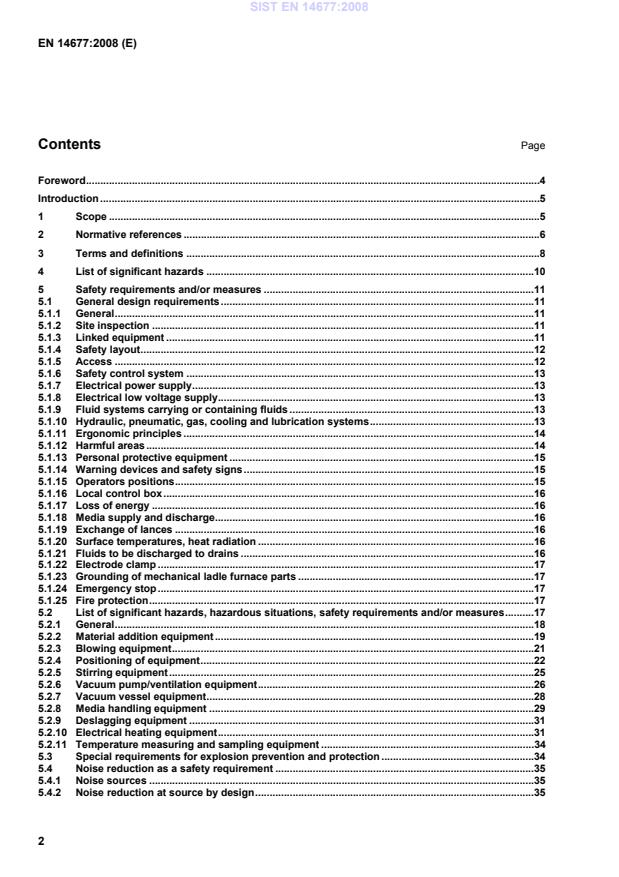
Noise test code.41 A.1 Introduction.41 A.2 Determination of A-weighted sound power level.41 A.3 Determination of A-weighted emission sound pressure levels.42 A.3.1 Determination of the emission sound pressure level at specified measuring points.42 A.3.2 Determination of the emission sound pressure level at work stations.42 A.4 Measurement uncertainty.42 A.5 Operating conditions.42 A.6 Information to be recorded and reported.43 A.7 Declaration and verification of noise emission values.43 A.8 Examples for workstations at RH-process with ladle furnace.44 Annex B (informative)
Examples for secondary steelmaking equipment.46 Annex C (informative)
Examples of secondary steelmaking processes.48 Annex ZA (informative)
Relationship between this European Standard and the Essential Requirements of EU Directive 98/37/EC.49 Annex ZB (informative)
Relationship between this European Standard and the Essential Requirements of EU Directive 2006/42/EC.50 Annex ZC (informative)
Relationship between this European Standard and the Essential Requirements of EU Directive 94/9/EC.51 Bibliography.52
Figures Figure C.1 — Examples of secondary steelmaking processes.48
Tables Table 1 — List of significant hazards, hazardous situations, safety requirements and/or measures.18 Table 2 — Examples for operating instructions.38 Table A.1 — Example of declared dual-number noise emission values for work stations
and specified measuring points.45
1) Will be replaced by prEN 60079-10-1 (2006-07). SIST EN 14677:2008
For the equipment linked to the SSE, e. g., alloying system (tanks/vessels, structures, discharge/conveyor devices, etc.), fume extraction, injection systems, SIST EN 14677:2008
...