

SIST EN 60512-12-3:2006
(Main)Connectors for electronic equipment - Tests and measurements -- Part 12-3: Soldering tests - Test 12c: Solderability, de-wetting
- Abstract
Defines a standard test method to assess the ability of the terminations of a connector to remain covered with solder when being brought into contact with molten solder under specified conditions.
- Status
- Published
- Publication Date
- 30-Jun-2006
- Current Stage
- 6060 - National Implementation/Publication (Adopted Project)
- Start Date
- 01-Jul-2006
- Due Date
- 01-Jul-2006
- Completion Date
- 01-Jul-2006



SIST EN 60512-12-3:2006 is the Slovenian adoption of EN 60512-12-3:2006, published by SIST and aligned with IEC 60512-12-3:2006. It specifies a soldering test for connectors for electronic equipment: a method for checking whether connector terminations remain covered with solder after contact with molten solder under defined conditions.
What does SIST EN 60512-12-3:2006 specify?
SIST EN 60512-12-3:2006 specifies a standard test method for assessing solderability de-wetting on connector terminations. It is used for connectors within the scope of IEC technical committee 48 and may also be applied to similar devices when a detail specification calls for it.
The document is organized into:
- Scope and object
- Normative references
- Applicability
- Preparations
- Method
- Details to be specified
The foreword also says this part is to be read with EN 60512-1 and EN 60512-1-100, which explain the structure of the EN 60512 series.
What are the key requirements of SIST EN 60512-12-3:2006?
SIST EN 60512-12-3:2006 ties the de-wetting test to a prior wetting test and uses the same preparation. In practice, the test is not set up from scratch each time: the sample is prepared as for the earlier wetting test, so the result reflects the same termination condition.
Test sequence and conditions
Clause 5 requires the procedure from IEC 60068-2-58, Test Td, Clauses 8 and 9. The de-wetting test consists of two immersions of 5 s each. Immersion depth, heat shielding and flux are the same as those used for the preceding wetting test. For a lab or supplier, that means the test conditions must be controlled and consistent with the earlier solderability step.
Inspection before and after the test
Clause 5 requires visual examination according to IEC 60512-1-1 before and after the test. The initial inspection checks that there are no defects that would affect the validity of the test. The final inspection examines the soldered surfaces at 10× magnification. This matters because the acceptance decision depends on what can be seen on the termination surface, not only on the process settings.
Acceptance criterion for de-wetting
Clause 5 states that a surface is considered not to have de-wetted if 95 % of the solder area is covered with a smooth, bright, uniform coating of adherent solder. The remaining area may show pinholes, voids, grainy surface or de-wetting areas, provided they are not concentrated in one area. In practice, the reader must judge coverage and distribution of defects, not just whether any defect exists.
What the detail specification must state
Clause 6 requires any deviation from the test method to be given in the detail specification. The document also notes that other details come from the prior solderability test. For users, this means product-specific documents control any departures from the standard method.
What terms does SIST EN 60512-12-3:2006 define?
- Termination - the connector end that is brought into contact with molten solder and is checked for solder coverage.
- De-wetting - a condition where solder does not remain uniformly on the surface after immersion, so the coating is incomplete or uneven.
- Wetting test - the prior solderability test in IEC 60512-12-1 or IEC 60512-12-2 that this de-wetting test follows when required.
- Detail specification - the product-specific document that calls up the test and states any permitted deviations.
- Test Td - the solderability-related method in IEC 60068-2-58 used for the procedure, including the immersion sequence.
- Visual examination - the inspection method from IEC 60512-1-1 used before and after the test.
- Solder area - the surface area on the termination that is assessed for coverage after testing.
Who uses SIST EN 60512-12-3:2006?
SIST EN 60512-12-3:2006 is used by connector manufacturers, test laboratories, quality engineers, and purchasers who need a repeatable way to check solderability de-wetting. It is relevant in electronics supply chains where connector terminations are soldered to equipment or assemblies.
In practice, users apply it for:
- product qualification and verification
- incoming or production testing
- comparing solderability performance between connector designs
- writing or checking detail specifications
- documenting conformance for connectors and similar devices
What changed in SIST EN 60512-12-3:2006 from the previous edition?
SIST EN 60512-12-3:2006 cancels and replaces Test 12c of IEC 60512-6, issued in 1984. The document states that this edition is a technical revision.
Which standards are used with SIST EN 60512-12-3:2006?
- IEC 60068-2-58 - provides Test Td, which supplies the procedure used for the de-wetting test.
- IEC 60512-1-1 - provides the general visual examination method used for the initial and final checks.
- IEC 60512-12-1 - provides the prior wetting test, solder bath method, when the de-wetting test follows it.
- IEC 60512-12-2 - provides the prior wetting test, soldering iron method, when the de-wetting test follows it.
- EN 60512-1 and EN 60512-1-100 - explain the structure of the EN 60512 series and are named as companion parts in the foreword.
What does the SIST EN 60512-12-3:2006 document contain?
SIST EN 60512-12-3:2006 contains a short test method rather than a long product specification. Its content centers on how to prepare the specimen, how to perform the two 5 s immersions, and how to judge the soldered surface under magnification.
It also states what the detail specification must declare when the method is used for a product. The document relies on IEC 60068-2-58 for the immersion procedure and on IEC 60512-1-1 for visual inspection.
Relations
- Effective Date
- 03-Feb-2026
- Effective Date
- 03-Feb-2026
- Effective Date
- 03-Feb-2026
- Effective Date
- 03-Feb-2026
- Effective Date
- 03-Feb-2026
Frequently Asked Questions
SIST EN 60512-12-3:2006 is a standard published by the Slovenian Institute for Standardization (SIST). Its full title is "Connectors for electronic equipment - Tests and measurements -- Part 12-3: Soldering tests - Test 12c: Solderability, de-wetting". This standard covers: Defines a standard test method to assess the ability of the terminations of a connector to remain covered with solder when being brought into contact with molten solder under specified conditions.
Defines a standard test method to assess the ability of the terminations of a connector to remain covered with solder when being brought into contact with molten solder under specified conditions.
SIST EN 60512-12-3:2006 is classified under the following ICS (International Classification for Standards) categories: 31.220.10 - Plug-and-socket devices. Connectors. The ICS classification helps identify the subject area and facilitates finding related standards.
SIST EN 60512-12-3:2006 has the following relationships with other standards: It is inter standard links to SIST EN 60512-12-2:2006, SIST EN 60068-2-58:2005, SIST EN 60512-12-1:2006, SIST EN 60512-1-1:2003, SIST EN IEC 61076-2-111:2026. Understanding these relationships helps ensure you are using the most current and applicable version of the standard.
SIST EN 60512-12-3:2006 is available in PDF format for immediate download after purchase. The document can be added to your cart and obtained through the secure checkout process. Digital delivery ensures instant access to the complete standard document.
Standards Content (Sample)
STANDARDKonektorji za elektronsko opremo – Preskusi in meritve – 12-3. del: Spajkalni preskusi – Preskus 12c: Spajkljivost, sušenje (IEC 60512-12-3:2006)Connectors for electronic equipment - Tests and measurements - Part 12-3: Soldering tests - Test 12c: Solderability, de-wetting (IEC 60512-12-3:2006)©
Standard je založil in izdal Slovenski inštitut za standardizacijo. Razmnoževanje ali kopiranje celote ali delov tega dokumenta ni dovoljenoReferenčna številkaSIST EN 60512-12-3:2006(en)ICS31.220.10
EUROPEAN STANDARD EN 60512-12-3 NORME EUROPÉENNE
EUROPÄISCHE NORM March 2006
CENELEC European Committee for Electrotechnical Standardization Comité Européen de Normalisation Electrotechnique Europäisches Komitee für Elektrotechnische Normung
Central Secretariat: rue de Stassart 35, B - 1050 Brussels
© 2006 CENELEC -
All rights of exploitation in any form and by any means reserved worldwide for CENELEC members.
Ref. No. EN 60512-12-3:2006 E
ICS 31.220.10
English version
Connectors for electronic equipment -
Tests and measurements Part 12-3: Soldering tests -
Test 12c: Solderability, de-wetting (IEC 60512-12-3:2006)
Connecteurs pour équipements électroniques -
Essais et mesures Partie 12-3: Tests de soudure -
Essai 12c: Soudabilité, démouillage (CEI 60512-12-3:2006)
Steckverbinder für elektronische Einrichtungen -
Mess- und Prüfverfahren Teil 12-3: Prüfungen der Lötbarkeit - Prüfung 12c: Lötbarkeit, Entnetzung (IEC 60512-12-3:2006)
This European Standard was approved by CENELEC on 2006-03-01. CENELEC members are bound to comply with the CEN/CENELEC Internal Regulations which stipulate the conditions for giving this European Standard the status of a national standard without any alteration.
Up-to-date lists and bibliographical references concerning such national standards may be obtained on application to the Central Secretariat or to any CENELEC member.
This European Standard exists in three official versions (English, French, German). A version in any other language made by translation under the responsibility of a CENELEC member into its own language and notified to the Central Secretariat has the same status as the official versions.
CENELEC members are the national electrotechnical committees of Austria, Belgium, Cyprus, the Czech Republic, Denmark, Estonia, Finland, France, Germany, Greece, Hungary, Iceland, Ireland, Italy, Latvia, Lithuania, Luxembourg, Malta, the Netherlands, Norway, Poland, Portugal, Romania, Slovakia, Slovenia, Spain, Sweden, Switzerland and the United Kingdom.
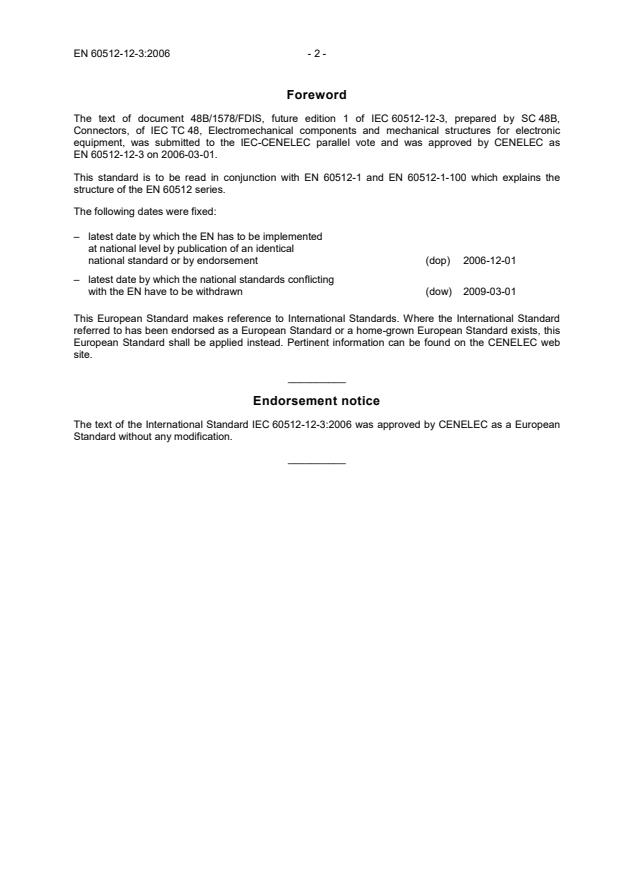
- 2 - Foreword The text of document 48B/1578/FDIS, future edition 1 of IEC 60512-12-3, prepared by SC 48B, Connectors, of IEC TC 48, Electromechanical components and mechanical structures for electronic equipment, was submitted to the IEC-CENELEC parallel vote and was approved by CENELEC as EN 60512-12-3 on 2006-03-01. This standard is to be read in conjunction with EN 60512-1 and EN 60512-1-100 which explains the structure of the EN 60512 series.
The following dates were fixed: – latest date by which the EN has to be implemented
at national level by publication of an identical
national standard or by endorsement
(dop) 2006-12-01 – latest date by which the national standards conflicting
with the EN have to be withdrawn
(dow) 2009-03-01 This European Standard makes reference to International Standards. Where the International Standard referred to has been endorsed as a European Standard or a home-grown European Standard exists, this European Standard shall be applied instead. Pertinent information can be found on the CENELEC web site. __________ Endorsement notice The text of the International Standard IEC 60512-12-3:2006 was approved by CENELEC as a European Standard without any modification. __________
NORME INTERNATIONALECEIIEC INTERNATIONAL STANDARD 60512-12-3Première éditionFirst edition2006-02 Connecteurs pour équipements électroniques – Essais et mesures – Partie 12-3: Essais de soudure – Essai 12c: Soudabilité, démouillage
Connectors for electronic equipment – Tests and measurements – Part 12-3: Soldering tests – Test 12c: Solderability, de-wetting
Pour prix, voir catalogue en vigueur For price, see current catalogue IEC 2006
Droits de reproduction réservés
Copyright - all rights reserved Aucune partie de cette publication ne peut être reproduite ni utilisée sous quelque forme que ce soit et par aucun procédé, électronique ou mécanique, y compris la photocopie et les microfilms, sans l'accord écrit de l'éditeur. No part of this publication may be reproduced or utilized in any form or by any means, electronic or mechanical, including photocopying and microfilm, without permission in writing from the publisher. International Electrotechnical Commission,
3, rue de Varembé, PO Box 131, CH-1211 Geneva 20, SwitzerlandTelephone: +41 22 919 02 11 Telefax: +41 22 919 03 00 E-mail: inmail@iec.ch
Web: www.iec.ch CODE PRIX PRICE CODE E Commission Electrotechnique InternationaleInternational Electrotechnical Commission
60512-12-3 IEC:2006 – 3 –
INTERNATIONAL ELECTROTECHNICAL COMMISSION ____________
CONNECTORS FOR ELECTRONIC EQUIPMENT – TESTS AND MEASUREMENTS –
Part 12-3: Soldering tests –
Test 12c: Solderability, de-wetting
FOREWORD 1) The International Electrotechnical Commission (IEC) is a worldwide organization for standardization comprising all national electrotechnical committees (IEC National Committees). The object of IEC is to promote international co-operation on all questions concerning standardization in the electrical and electronic fields. To this end and in addition to other activities, IEC publishes International Standards, Technical Specifications, Technical Reports, Publicly Available Specifications (PAS) and Guides (hereafter referred to as “IEC Publication(s)”). Their preparation is entrusted to technical committees; any IEC National Committee interested in the subject dealt with may participate in this preparatory work. International, governmental and non-governmental organizations liaising with the IEC also participate in this preparation. IEC collaborates closely with the International Organization for Standardization (ISO) in accordance with conditions determined by agreement between the two organizations. 2) The formal decisions or agreements of IEC on technical matters express, as nearly as possible, an international consensus of opinion on the relevant subjects since each technical committee has representation from all interested IEC National Committees.
3) IEC Publications have the form of recommendations for international use and are accepted by IEC National Committees in that sense. While all reasonable efforts are made to ensure that the technical content of IEC Publications is accurate, IEC cannot be held responsible for the way in which they are used or for any misinterpretation by any e
...