

SIST EN 1278:2011
(Main)Chemicals used for treatment of water intended for human consumption - Ozone
General Information
- Abstract
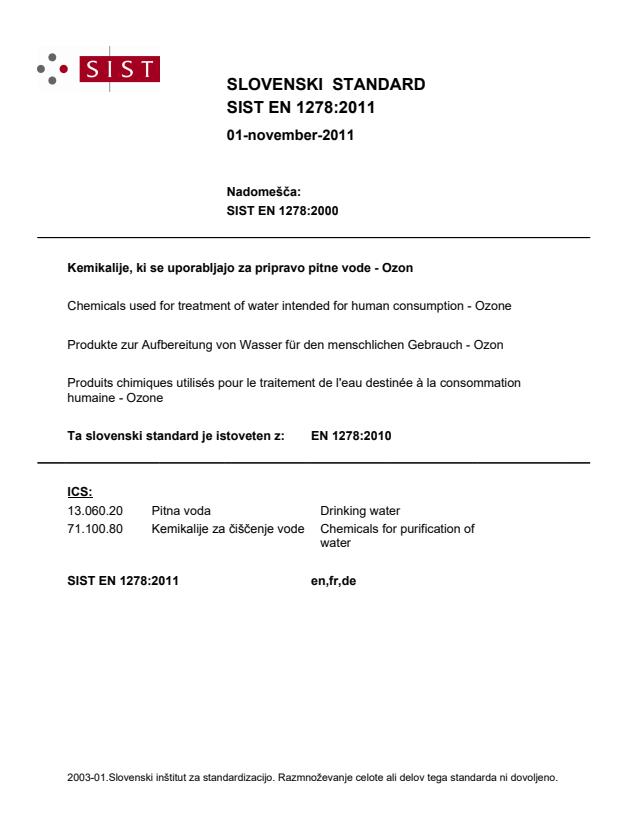
This European Standard is applicable to ozone used for treatment of water intended for human consumption.
It describes the characteristics of ozone and specifies the requirements and the corresponding test methods
for ozone. It gives information on its use in water treatment.
- Status
- Withdrawn
- Publication Date
- 03-Oct-2011
- Withdrawal Date
- 28-Sep-2026
- Technical Committee
- IOVO - Water supply and waste water engineering
- Current Stage
- 9900 - Withdrawal (Adopted Project)
- Start Date
- 29-Sep-2026
- Due Date
- 22-Oct-2026
- Completion Date
- 29-Sep-2026
- Directive
- TP262 - Uredba o pitni vodi

Overview
EN 1278:2010 (CEN) is the European standard for ozone used in the treatment of water intended for human consumption (drinking water). It describes the physical and chemical characteristics of ozone, specifies minimum purity criteria, provides sampling and test methods (including a validated iodometric titration for gas-phase ozone), and gives guidance on labelling, transportation, storage and safety for on‑site generated ozone. This edition (April 2010) supersedes EN 1278:1998.
Key Topics and Requirements
- Scope and identification
- Applies to ozone generated on or near the site of use for drinking water treatment.
- Chemical identification: O3, CAS 10028-15-6, relative molecular mass 48.
- Physical & chemical properties
- Appearance, density, vapour pressure, boiling/melting points, critical temperature/pressure.
- Ozone is a powerful oxidant; reactions and redox potentials are provided, including formation of OH• radicals in water.
- Composition and concentration
- Typical commercial concentrations: air-based ozone ~15–45 g/m3 (NTP); oxygen-based ozone ~40–200 g/m3 (NTP).
- Concentrations must be specified in tendering/operational documents.
- Purity criteria
- Minimum purity requirements and limits for common impurities and by-products are defined. Manufacturers must notify users of additional impurities arising from raw materials or processes.
- Sampling & analytical methods
- Sampling guidance: use stainless steel or ozone-resistant fluoropolymer lines; keep transfer time <1 minute; express volumes at NTP.
- Test method: direct iodometric titration for ozone in gases (applicable 1–200 g/m3 NTP). Detection limit ~0.1 g/m3; stated precision and standard deviations given.
- Labelling, transport, storage & safety
- Requirements for means of delivery, EU risk/safety labelling, transport regulations and marking are covered.
- Annexes include information on operational control and safety/emergency procedures.
Applications and Practical Use
- EN 1278:2010 supports safe, consistent use of ozone for drinking water treatment by:
- Water utilities and treatment plant operators specifying acceptable ozone concentrations and purity.
- Suppliers and manufacturers of ozone generators ensuring product compliance and correct labelling.
- Testing laboratories performing sampling and concentration analysis (iodometric titration).
- Regulators and consultants assessing compatibility with national water quality and safety requirements.
- The standard helps ensure proper handling, measurement and documentation when ozone is used as an oxidant/disinfectant in potable water applications.
Related Standards
- EN ISO 3696 - Water for analytical laboratory use (referenced for reagent water quality).
- Council Directive 98/83/EC - Quality of water intended for human consumption (chemical parameter context).
- Note: National regulations may impose additional requirements; conformity to EN 1278:2010 does not replace national approval.
Keywords: EN 1278:2010, ozone, water treatment, drinking water, CEN, ozone concentration, iodometric titration, sampling, purity criteria, safety, labelling.
Relations
- Replaces
SIST EN 1278:2000 - Chemicals used for treatment of water intended for human consumption - Ozone - Effective Date
- 01-Nov-2011
- Effective Date
- 28-Jan-2026
- Effective Date
- 28-Jan-2026
- Effective Date
- 28-Jan-2026
- Revises
SIST EN 1278:2026 - Chemicals used for treatment of water intended for human consumption - Ozone - Effective Date
- 18-Jan-2023
Get Certified
Connect with accredited certification bodies for this standard

ECOCERT
Organic and sustainability certification.

CIS Institut d.o.o.
Personal Protective Equipment (PPE) certification body. Notified Body NB-2890 for EU Regulation 2016/425 PPE.

Eurofins Food Testing Global
Global leader in food, environment, and pharmaceutical product testing.
Sponsored listings
Frequently Asked Questions
SIST EN 1278:2011 is a standard published by the Slovenian Institute for Standardization (SIST). Its full title is "Chemicals used for treatment of water intended for human consumption - Ozone". This standard covers: This European Standard is applicable to ozone used for treatment of water intended for human consumption. It describes the characteristics of ozone and specifies the requirements and the corresponding test methods for ozone. It gives information on its use in water treatment.
This European Standard is applicable to ozone used for treatment of water intended for human consumption. It describes the characteristics of ozone and specifies the requirements and the corresponding test methods for ozone. It gives information on its use in water treatment.
SIST EN 1278:2011 is classified under the following ICS (International Classification for Standards) categories: 13.060.20 - Drinking water; 71.100.80 - Chemicals for purification of water. The ICS classification helps identify the subject area and facilitates finding related standards.
SIST EN 1278:2011 has the following relationships with other standards: It is inter standard links to SIST EN 1278:2000, SIST EN ISO 3696:1998, SIST EN 17971:2024, SIST EN 15074:2006, SIST EN 1278:2026. Understanding these relationships helps ensure you are using the most current and applicable version of the standard.
SIST EN 1278:2011 is associated with the following European legislation: EU Directives/Regulations: TP262. When a standard is cited in the Official Journal of the European Union, products manufactured in conformity with it benefit from a presumption of conformity with the essential requirements of the corresponding EU directive or regulation.
SIST EN 1278:2011 is available in PDF format for immediate download after purchase. The document can be added to your cart and obtained through the secure checkout process. Digital delivery ensures instant access to the complete standard document.
Standards Content (Sample)
2003-01.Slovenski inštitut za standardizacijo. Razmnoževanje celote ali delov tega standarda ni dovoljeno.Kemikalije, ki se uporabljajo za pripravo pitne vode - OzonProdukte zur Aufbereitung von Wasser für den menschlichen Gebrauch - OzonProduits chimiques utilisés pour le traitement de l'eau destinée à la consommation humaine - OzoneChemicals used for treatment of water intended for human consumption - Ozone71.100.80Chemicals for purification of water13.060.20Pitna vodaDrinking waterICS:Ta slovenski standard je istoveten z:EN 1278:2010SIST EN 1278:2011en,fr,de01-november-2011SIST EN 1278:2011SLOVENSKI
STANDARDSIST EN 1278:20001DGRPHãþD
EUROPEAN STANDARD NORME EUROPÉENNE EUROPÄISCHE NORM
EN 1278
April 2010 ICS 71.100.80 Supersedes EN 1278:1998English Version
Chemicals used for treatment of water intended for human consumption - Ozone
Produits chimiques utilisés pour le traitement de l'eau destinée à la consommation humaine - Ozone
Produkte zur Aufbereitung von Wasser für den menschlichen Gebrauch - Ozon This European Standard was approved by CEN on 28 February 2010.
CEN members are bound to comply with the CEN/CENELEC Internal Regulations which stipulate the conditions for giving this European Standard the status of a national standard without any alteration. Up-to-date lists and bibliographical references concerning such national standards may be obtained on application to the CEN Management Centre or to any CEN member.
This European Standard exists in three official versions (English, French, German). A version in any other language made by translation under the responsibility of a CEN member into its own language and notified to the CEN Management Centre has the same status as the official versions.
CEN members are the national standards bodies of Austria, Belgium, Bulgaria, Croatia, Cyprus, Czech Republic, Denmark, Estonia, Finland, France, Germany, Greece, Hungary, Iceland, Ireland, Italy, Latvia, Lithuania, Luxembourg, Malta, Netherlands, Norway, Poland, Portugal, Romania, Slovakia, Slovenia, Spain, Sweden, Switzerland and United Kingdom.
EUROPEAN COMMITTEE FOR STANDARDIZATION
COMITÉ EUROPÉEN DE NORMALISATION EUROPÄISCHES KOMITEE FÜR NORMUNG
Management Centre:
Avenue Marnix 17,
B-1000 Brussels © 2010 CEN All rights of exploitation in any form and by any means reserved worldwide for CEN national Members. Ref. No. EN 1278:2010: ESIST EN 1278:2011
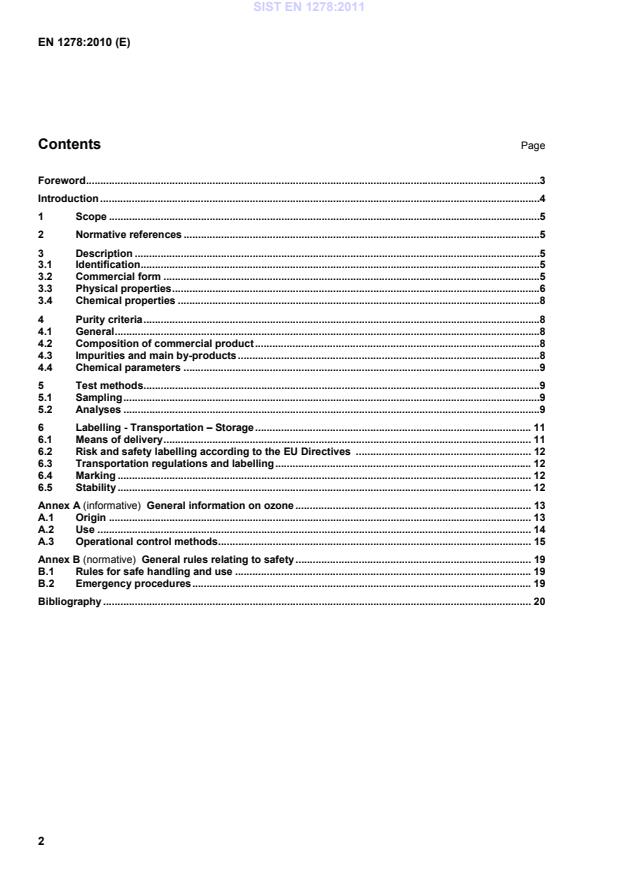
............................................................. 12 6.3 Transportation regulations and labelling ......................................................................................... 12 6.4 Marking ................................................................................................................................................ 12 6.5 Stability ................................................................................................................................................ 12 Annex A (informative)
General information on ozone . 13 A.1 Origin . 13 A.2 Use . 14 A.3 Operational control methods . 15 Annex B (normative)
General rules relating to safety . 19 B.1 Rules for safe handling and use . 19 B.2 Emergency procedures . 19 Bibliography . 20
Not applicable 3.2 Commercial form Ozone is generated on or near the site of use.
1) Chemical Abstracts Service Registry Number 2) European Inventory of Existing Commercial Chemical Substances SIST EN 1278:2011
A weak absorption in the visual range between 435 nm and 475 nm. 3.3.2 Density Gas : 2,144 kg/m3 at NTP (Normal Temperature Pressure, 273 K and 101,3 kPa); Liquid : 1,574 g/cm3 at - 183 °C; Solid : 1,728 g/cm3. 3.3.3 The gas-liquid partition coefficient In pure water, the partition coefficient values (S) expressed in grams per cubic meter water per (grams per cubic meter) gas at 101,3 kPa are given in table 1. Table 1 — The gas-liquid partition coefficient between water and gas phase Temperature
of water
°C Solubility
S, in gmHOgmgas//323
0 0,64 5 0,5 10 0,39 15 0,31 20 0,24 25 0,19 30 0,15 35 0,12 NOTE 1
Recent surveys of literature data are given in Bibliography. See [2], [3 ]and [4]. NOTE 2
S is a ratio, not an absolute concentration. 3.3.4 Vapour pressure The vapour pressure of ozone depending on temperature is given in Table 2. SIST EN 1278:2011
- 112 °C. NOTE : Vaporization heat : 681 kJ/m3at NTP. 3.3.6 Melting point - 196 °C. 3.3.7 Specific heat (liquid) Not applicable. 3.3.8 Viscosity (dynamic) 0,004 2 Pa.s at – 195 °C; 0,0015 5 Pa.s at – 183 °C. 3.3.9 Critical temperature - 12,1 °C. 3.3.10 Critical pressure 5 460 kPa. 3.3.11 Physical hardness Not applicable.
3) 100 kPa = 1 bar SIST EN 1278:2011
O2 + H2O
EoH = 2,07 V (1) O3 + H2O + 2e- →
O2 + 2OH- EoH = 1,24 V (2) OH° + H+ + e- →
H2O EoH = 2,42 V(calculated value) (3) If the pH increases by one unit, the EH -values shall decrease by 30 mV per electron transferred. At 100 kPa and 25 °C and pH = 7 the EH -values, versus the normal hydrogen electrode, become: O3 (1) = 1,66 V; O3 (2) = 0,82 V; OH° (3) = 2,21V. In water treatment most of the direct reactions of ozone are dipolar cyclo-additions and electrophilic substitution reactions. Moreover ozone, in water, can generate radicals such as OH° : (O3 + H2O → 2 OH° + O2). The OH° radical is a strong general oxidant. 4 Purity criteria 4.1 General This European Standard specifies the minimum purity requirements for Ozone used for the treatment of water intended for human consumption. Limits are given for impurities commonly present in the product. Depending on the raw material and the manufacturing process other impurities may be present and, if so, this shall be notified to the user and when necessary to relevant authorities. NOTE Users of this product should check the national regulations in order to clarify whether it is of appropriate purity for treatment of water intended for human consumption, taking into account raw water quality, required dosage, contents of other impurities and additives used in the product not stated in this product standard. Limits have been given for impurities and chemicals parameters where these are likely to be present in significant quantities from the current production process and raw materials. If the production process or raw materials lead to significant quantities of impurities, by-products or additives being present, this shall be notified to the user. 4.2 Composition of commercial product Ozone is obtainable in air, oxygen or air enriched in oxygen.
Typical concentrations obtainable in air are in the range of 15 g/m3 to 45 g/m3 (NTP) and, in oxygen 40 g/m3 to 200 g/m3(NTP). The concentration (in grams per cubic metre NTP) at the nominal operating condition of the generators shall be specified in the tendering documents. 4.3 Impurities and main by-products See A.3.2. SIST EN 1278:2011
Hydrochloric acid standard volumetric solution c(HCl) = 0,1 mol/l or sulfuric acid c(H2SO4) = 0,05 mol/l. 5.2.3.7 Zinc iodide (ZnI2)-starch indicator. Disperse 4 g starch into a small quantity of water. Add the dispersion to a solution of 20 g zinc chloride (ZnCl2) in 100 ml water. The solution is boiled until the volume has been reduced to 100 ml and finally diluted to 1 l while adding 2 g of ZnI2. 5.2.3.8 Standardization of sodium thiosulfate: 5.2.3.8.1
Reactions 5 KI + 5 H+ → 5 HI + 5 K+
(4) KIO3 + H+
→ HIO3 + K+
(5) HIO3 + 5 HI
→ 3 I2 + 3 H2O
(6) 3 I2 + 6 S2 O32-
→ 6 I- + 3 S4O62-
(7) 5.2.3.8.2
Determination Add 0,05 g of potassium iodate (5.2.3.4), 0,5 g of potassium iodide (5.2.3.5) into 50 ml water and a further 50 ml water in a conical flask. After mixing, add 10 ml standard volumetric solution acid (5.2.3.6). Titrate the liberated iodine immediately with the sodium thiosulfate solution (5.2.3.2). 5.2.3.8.3
Calculation The concentration, ct, expressed in moles per litre, of the sodium thiosulfate solution is given by: ccVVtat=× (8) where: ca is the concentration ,in moles per litre, of the acid (5.2.3.6); V is the volume, in millilitres, of the acid (5.2.3.6); Vt is the volume, in millilitres, of the sodium thiosulfate solution used. 5.2.4 Apparatus
Ordinary laboratory apparatus. 5.2.5 Procedure 5.2.5.1 Add the solution of potassium iodide (200 ml) to a standard gas washing vessel to give a depth of liquid of 10 cm to 15 cm. The use of fritted gas bubblers is not recommended. SIST EN 1278:2011
...