

SIST EN 301 908-22 V5.2.1:2011
(Main)IMT cellular networks - Harmonized EN covering the essential requirements of article 3.2 of the R&TTE Directive - Part 22: OFDMA TDD WMAN (Mobile WiMAX) FDD Base Stations (BS)
- Abstract
The present document applies to the following radio equipment type:
Mobile WiMAX FDD Base Stations for IMTOFDMA TDD WMAN This radio equipment type is capable of
operating in all or any part of the frequency bands given in table 1-1.
The present document is intended to cover the provisions of Directive 1999/5/EC [i.2] (R&TTE Directive), article 3.2, which states that "… radio equipment shall be so constructed that it effectively uses the spectrum allocated to terrestrial/space radio communications and orbital resources so as to avoid harmful interference".
In addition to the present document, other ENs that specify technical requirements in respect of essential requirements under other parts of article 3 of the R&TTE Directive [i.2] may apply to equipment within the scope of the present document.
- Status
- Published
- Public Enquiry End Date
- 31-May-2011
- Publication Date
- 16-Oct-2011
- Technical Committee
- MOC - Mobile Communications
- Current Stage
- 6060 - National Implementation/Publication (Adopted Project)
- Start Date
- 22-Sep-2011
- Due Date
- 27-Nov-2011
- Completion Date
- 17-Oct-2011
- Mandate
- M/284
Buy Documents
en_30190822v050101c - IMT cellular networks; Harmonized EN covering the essential requirements of article 3.2 of the R&TTE Directive; Part 22: OFDMA TDD WMAN (Mobile WiMAX) FDD Base Stations (BS)
en_30190822v050201p - IMT cellular networks; Harmonized EN covering the essential requirements of article 3.2 of the R&TTE Directive; Part 22: OFDMA TDD WMAN (Mobile WiMAX) FDD Base Stations (BS)
en_30190822v050201v - IMT cellular networks; Harmonized EN covering the essential requirements of article 3.2 of the R&TTE Directive; Part 22: OFDMA TDD WMAN (Mobile WiMAX) FDD Base Stations (BS)

SIST EN 301 908-22 V5.2.1:2011 is the SIST edition of the ETSI harmonized European standard for IMT cellular networks, focused on OFDMA TDD WMAN (Mobile WiMAX) FDD Base Stations (BS). It specifies the transmitter, receiver and test requirements used to show conformity with article 3.2 of the R&TTE Directive for these base stations. Manufacturers, test labs and conformity assessors use it to check that a BS uses spectrum effectively and avoids harmful interference.
What does SIST EN 301 908-22 V5.2.1:2011 specify?
SIST EN 301 908-22 V5.2.1:2011 applies to Mobile WiMAX FDD Base Stations that operate in the frequency bands identified for the two band classes in clause 1. The document is written for article 3.2 of Directive 1999/5/EC and notes that other ENs may also apply for other essential requirements under article 3.
The standard is organized into scope, references, definitions, essential requirements, and testing for compliance. It ends with four annexes that support conformity work.
| Annex | What it covers |
|---|---|
| Annex A | HS Requirements and conformance Test specifications Table (HS-RTT) |
| Annex B | Environmental profile specification |
| Annex C | The EN title in the official languages |
| Annex D | Bibliography |
What are the key requirements of SIST EN 301 908-22 V5.2.1:2011?
SIST EN 301 908-22 V5.2.1:2011 turns article 3.2 into a set of transmitter and receiver limits, then ties each limit to a test suite in clause 5.4. In practice, a base station is not assessed by one general check - it is assessed against several specific radio-performance items.
Transmitter limits
- Spectrum emission mask in clause 4.2.2 limits out-of-channel emissions for 5 MHz and 10 MHz operation. This matters because it is the main check that the BS stays inside its assigned channel and does not spill energy into neighbors.
- Adjacent Channel Leakage power Ratio (ACLR) in clause 4.2.3 compares power in the assigned channel with power in the adjacent channel using Eval_BW1. This shows how well the transmitter suppresses leakage that can disturb nearby users.
- Transmitter spurious emissions in clause 4.2.4 cover unwanted emissions from harmonics, parasitics and conversion products. Separate limits apply in different frequency regions, and extra limits protect coexistence in specific bands.
- Base station maximum output power in clause 4.2.5 checks that the actual output stays close to the declared nominal maximum output power (Pnom) under normal and extreme conditions. This is the power-control and rating check that buyers and labs use to verify declared power classes.
- Transmitter intermodulation in clause 4.2.6 checks that the transmitter still meets mask, ACLR and spurious limits when a co-channel interferer is present. This matters for real network conditions where strong nearby signals can create distortion.
Receiver limits
- Receiver spurious emissions in clause 4.2.7 limit emissions generated inside the receiver and appearing at the antenna connector. This is important for BSs with separate Tx and Rx ports because receiver-generated noise can affect other equipment.
- Receiver adjacent channel selectivity (ACS) in clause 4.2.8 checks whether the BS can keep working when a wanted signal is present together with adjacent-channel interference. The result is tied to Bit Error Ratio (BER) or equivalent Packet Error Ratio (PER), so it reflects service quality, not just RF levels.
- Receiver blocking characteristics in clause 4.2.9 check tolerance to stronger unwanted signals outside the adjacent channels. This is the practical test for resilience to wideband interference and nearby transmitters.
- Receiver intermodulation characteristics in clause 4.2.10 check receiver performance with two interfering signals that can create mixing products. This helps show whether the BS remains usable in dense RF environments.
How the compliance tests are applied
Clause 5 requires testing under the declared environmental profile and asks the manufacturer to state the operating RF range, bandwidth, modulation, Pnom, TPC range, receiver sensitivity and receiver thermal noise power. Clause 5.3 also requires measurement uncertainty to be reported, because the test result must be judged against the limit with known uncertainty. Clause 5.4 then defines the essential radio test suites, usually at the lowest, middle and highest RF channel centre frequencies, and for supported antenna configurations.
What terms does SIST EN 301 908-22 V5.2.1:2011 define?
- Burst - the period when intentional radio transmission occurs between silent periods.
- Environmental profile - the declared range of environmental conditions in which the equipment must remain compliant.
- Eval_BW1 - the test filter condition used for ACLR measurements in 5 MHz and 10 MHz equipment.
- Nominal maximum output power (Pnom) - the declared maximum mean power available at the antenna connector.
- Receiver thermal noise power (Nth) - the thermal noise power of the receiver, expressed as kTBwF.
- Receiver sensitivity level (PSENS5 / PSENS10) - the signal level needed to reach BER ≤ 10^-6, or equivalent PER, on AWGN for the most robust modulation and coding.
- Adjacent Channel Leakage power Ratio (ACLR) - the ratio of power in the assigned channel to power in the adjacent channel.
Who uses SIST EN 301 908-22 V5.2.1:2011?
SIST EN 301 908-22 V5.2.1:2011 is used by radio equipment manufacturers, RF design engineers, test laboratories, and conformity assessment teams for Mobile WiMAX BS development and type testing. Quality managers use it to prepare technical files and verify that declared power, bandwidth and environmental claims match the test evidence. Regulators and buyers can use the test structure to compare products on the same technical basis.
Which standards are used with SIST EN 301 908-22 V5.2.1:2011?
| Reference | What it contributes |
|---|---|
| ETSI EN 301 908-1 (V5.2.1) | Introduction and common requirements for the IMT cellular network series |
| CEPT/ERC Recommendation 74-01E | The baseline approach for unwanted emissions in the spurious domain |
| ETSI EN 301 908-1, Part 1 | Named in the foreword as the common-part companion to this multi-part deliverable |
| ETSI EN 301 908-19 | Mobile WiMAX TDD User Equipment (UE) companion part |
| ETSI EN 301 908-20 | Mobile WiMAX TDD Base Stations (BS) companion part |
| ETSI EN 301 908-21 | Mobile WiMAX FDD User Equipment (UE) companion part |
What does the SIST EN 301 908-22 V5.2.1:2011 document contain?
The document contains limit tables for transmitter and receiver performance, including separate requirements for 5 MHz and 10 MHz channel bandwidths. It also contains measurement methods and step-by-step test procedures for spectrum mask, ACLR, spurious emissions, output power, intermodulation, ACS, blocking and receiver intermodulation. The annexes add the HS-RTT table, the environmental profile to be declared, and supporting language and bibliography material. The procedures refer to test setups, spectrum analyzer settings, synchronization with a signaling unit, and the treatment of measurement uncertainty, so the document is directly usable for compliance testing and certification work.
Buy Documents
en_30190822v050101c - IMT cellular networks; Harmonized EN covering the essential requirements of article 3.2 of the R&TTE Directive; Part 22: OFDMA TDD WMAN (Mobile WiMAX) FDD Base Stations (BS)
en_30190822v050201p - IMT cellular networks; Harmonized EN covering the essential requirements of article 3.2 of the R&TTE Directive; Part 22: OFDMA TDD WMAN (Mobile WiMAX) FDD Base Stations (BS)
en_30190822v050201v - IMT cellular networks; Harmonized EN covering the essential requirements of article 3.2 of the R&TTE Directive; Part 22: OFDMA TDD WMAN (Mobile WiMAX) FDD Base Stations (BS)
Get Certified
Connect with accredited certification bodies for this standard

ANCE
Mexican certification and testing association.

Intertek Slovenia
Intertek testing, inspection, and certification services in Slovenia.

LNE (Laboratoire National de Métrologie et d'Essais)
French national laboratory for metrology and testing.
Sponsored listings
Frequently Asked Questions
SIST EN 301 908-22 V5.2.1:2011 is a standard published by the Slovenian Institute for Standardization (SIST). Its full title is "IMT cellular networks - Harmonized EN covering the essential requirements of article 3.2 of the R&TTE Directive - Part 22: OFDMA TDD WMAN (Mobile WiMAX) FDD Base Stations (BS)". This standard covers: The present document applies to the following radio equipment type: Mobile WiMAX FDD Base Stations for IMTOFDMA TDD WMAN This radio equipment type is capable of operating in all or any part of the frequency bands given in table 1-1. The present document is intended to cover the provisions of Directive 1999/5/EC [i.2] (R&TTE Directive), article 3.2, which states that "… radio equipment shall be so constructed that it effectively uses the spectrum allocated to terrestrial/space radio communications and orbital resources so as to avoid harmful interference". In addition to the present document, other ENs that specify technical requirements in respect of essential requirements under other parts of article 3 of the R&TTE Directive [i.2] may apply to equipment within the scope of the present document.
The present document applies to the following radio equipment type: Mobile WiMAX FDD Base Stations for IMTOFDMA TDD WMAN This radio equipment type is capable of operating in all or any part of the frequency bands given in table 1-1. The present document is intended to cover the provisions of Directive 1999/5/EC [i.2] (R&TTE Directive), article 3.2, which states that "… radio equipment shall be so constructed that it effectively uses the spectrum allocated to terrestrial/space radio communications and orbital resources so as to avoid harmful interference". In addition to the present document, other ENs that specify technical requirements in respect of essential requirements under other parts of article 3 of the R&TTE Directive [i.2] may apply to equipment within the scope of the present document.
SIST EN 301 908-22 V5.2.1:2011 is classified under the following ICS (International Classification for Standards) categories: 33.060.99 - Other equipment for radiocommunications. The ICS classification helps identify the subject area and facilitates finding related standards.
SIST EN 301 908-22 V5.2.1:2011 is associated with the following European legislation: EU Directives/Regulations: 1999/5/EC, TRRTP124; Standardization Mandates: M/284. When a standard is cited in the Official Journal of the European Union, products manufactured in conformity with it benefit from a presumption of conformity with the essential requirements of the corresponding EU directive or regulation.
SIST EN 301 908-22 V5.2.1:2011 is available in PDF format for immediate download after purchase. The document can be added to your cart and obtained through the secure checkout process. Digital delivery ensures instant access to the complete standard document.
Standards Content (Sample)
Draft ETSI EN 301 908-22 V5.1.1 (2011-02)
Harmonized European Standard
IMT cellular networks;
Harmonised EN covering the essential requirements
of article 3.2 of the R&TTE Directive;
Part 22: OFDMA TDD WMAN (Mobile WiMAX)
FDD Base Stations (BS)
2 Draft ETSI EN 301 908-22 V5.1.1 (2011-02)
Reference
DEN/MSG-TFES-009-22
Keywords
3G, cell, digital, FDD, IMT, IMT-2000, mobile,
radio, regulation, WiMAX
ETSI
650 Route des Lucioles
F-06921 Sophia Antipolis Cedex - FRANCE
Tel.: +33 4 92 94 42 00 Fax: +33 4 93 65 47 16
Siret N° 348 623 562 00017 - NAF 742 C
Association à but non lucratif enregistrée à la
Sous-Préfecture de Grasse (06) N° 7803/88
Important notice
Individual copies of the present document can be downloaded from:
http://www.etsi.org
The present document may be made available in more than one electronic version or in print. In any case of existing or
perceived difference in contents between such versions, the reference version is the Portable Document Format (PDF).
In case of dispute, the reference shall be the printing on ETSI printers of the PDF version kept on a specific network drive
within ETSI Secretariat.
Users of the present document should be aware that the document may be subject to revision or change of status.
Information on the current status of this and other ETSI documents is available at
http://portal.etsi.org/tb/status/status.asp
If you find errors in the present document, please send your comment to one of the following services:
http://portal.etsi.org/chaircor/ETSI_support.asp
Copyright Notification
No part may be reproduced except as authorized by written permission.
The copyright and the foregoing restriction extend to reproduction in all media.
© European Telecommunications Standards Institute 2011.
All rights reserved.
TM TM TM TM
DECT , PLUGTESTS , UMTS , TIPHON , the TIPHON logo and the ETSI logo are Trade Marks of ETSI registered
for the benefit of its Members.
TM
3GPP is a Trade Mark of ETSI registered for the benefit of its Members and of the 3GPP Organizational Partners.
LTE™ is a Trade Mark of ETSI currently being registered
for the benefit of its Members and of the 3GPP Organizational Partners.
GSM® and the GSM logo are Trade Marks registered and owned by the GSM Association.
ETSI
3 Draft ETSI EN 301 908-22 V5.1.1 (2011-02)
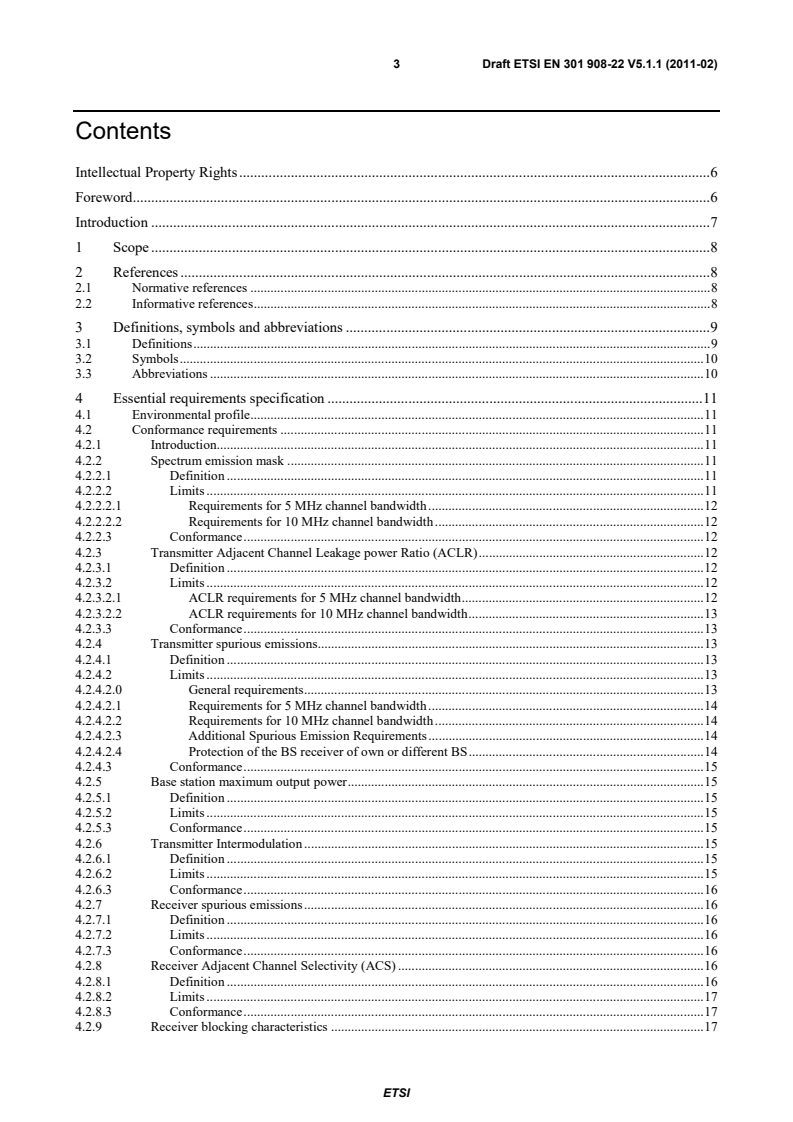
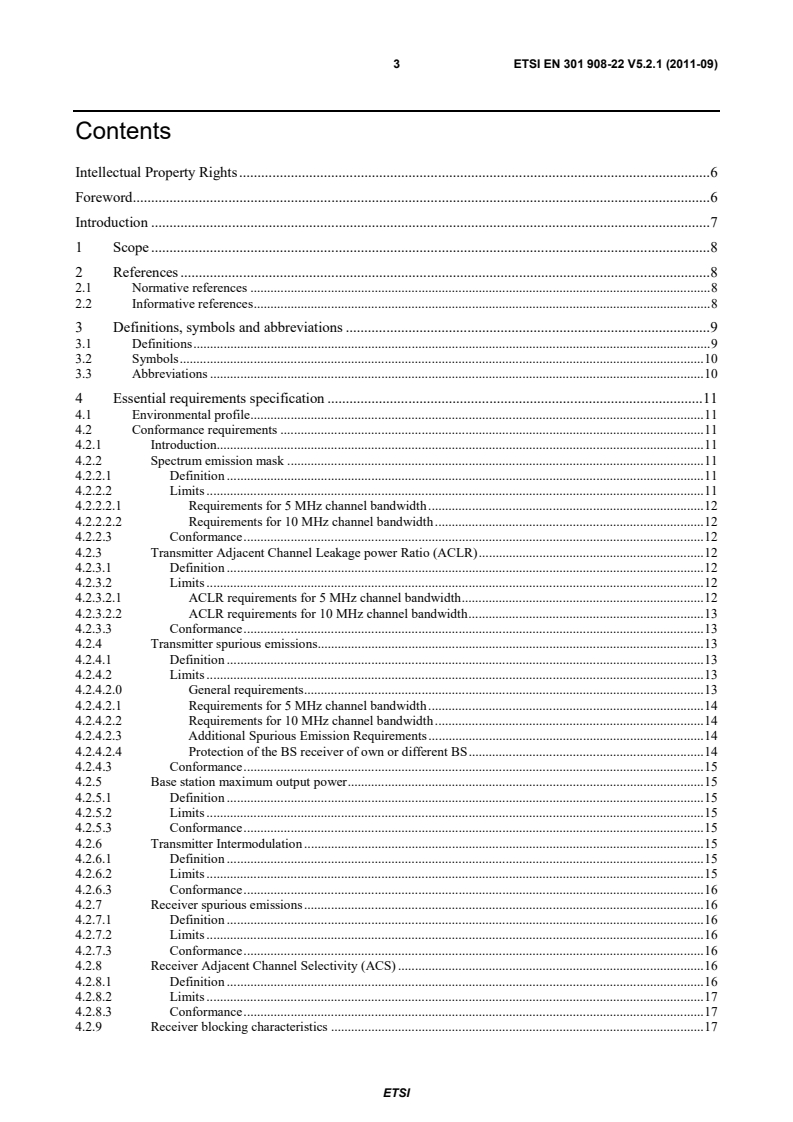
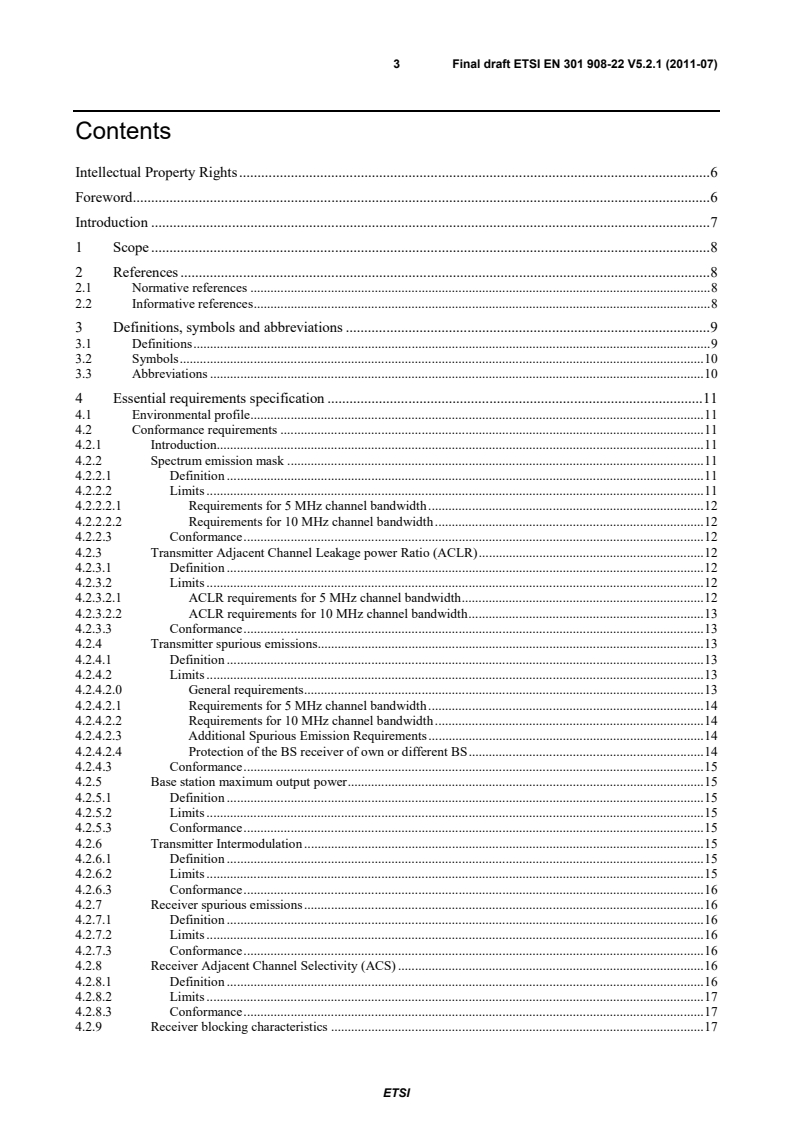
Contents
Intellectual Property Rights . 6
Foreword . 6
Introduction . 7
1 Scope . 8
2 References . 8
2.1 Normative references . 8
2.2 Informative references . 8
3 Definitions, symbols and abbreviations . 9
3.1 Definitions . 9
3.2 Symbols . 10
3.3 Abbreviations . 10
4 Essential requirements specification . 11
4.1 Environmental profile . 11
4.2 Conformance requirements . 11
4.2.1 Introduction. 11
4.2.2 Spectrum emission mask . 11
4.2.2.1 Definition . 11
4.2.2.2 Limits . 11
4.2.2.2.1 Requirements for 5 MHz channel bandwidth . 12
4.2.2.2.2 Requirements for 10 MHz channel bandwidth . 12
4.2.2.3 Conformance . 12
4.2.3 Transmitter Adjacent Channel Leakage power Ratio (ACLR) . 12
4.2.3.1 Definition . 12
4.2.3.2 Limits . 12
4.2.3.2.1 ACLR requirements for 5 MHz channel bandwidth . 12
4.2.3.2.2 ACLR requirements for 10 MHz channel bandwidth . 13
4.2.3.3 Conformance . 13
4.2.4 Transmitter spurious emis sions . 13
4.2.4.1 Definition . 13
4.2.4.2 Limits . 13
4.2.4.2.0 General requirements . 13
4.2.4.2.1 Requirements for 5 MHz channel bandwidth . 14
4.2.4.2.2 Requirements for 10 MHz channel bandwidth . 14
4.2.4.2.3 Additional Spurious Emission Requirements . 14
4.2.4.2.4 Protection of the BS receiver of own or different BS . 14
4.2.4.3 Conformance . 15
4.2.5 Base station maximum output power . 15
4.2.5.1 Definition . 15
4.2.5.2 Limits . 15
4.2.5.3 Conformance . 15
4.2.6 Transmitter Intermodulation . 15
4.2.6.1 Definition . 15
4.2.6.2 Limits . 15
4.2.6.3 Conformance . 16
4.2.7 Receiver spurious emissions . 16
4.2.7.1 Definition . 16
4.2.7.2 Limits . 16
4.2.7.3 Conformance . 16
4.2.8 Receiver Adjacent Channel Selectivity (ACS) . 16
4.2.8.1 Definition . 16
4.2.8.2 Limits . 17
4.2.8.3 Conformance . 17
4.2.9 Receiver blocking characteristics . 17
ETSI
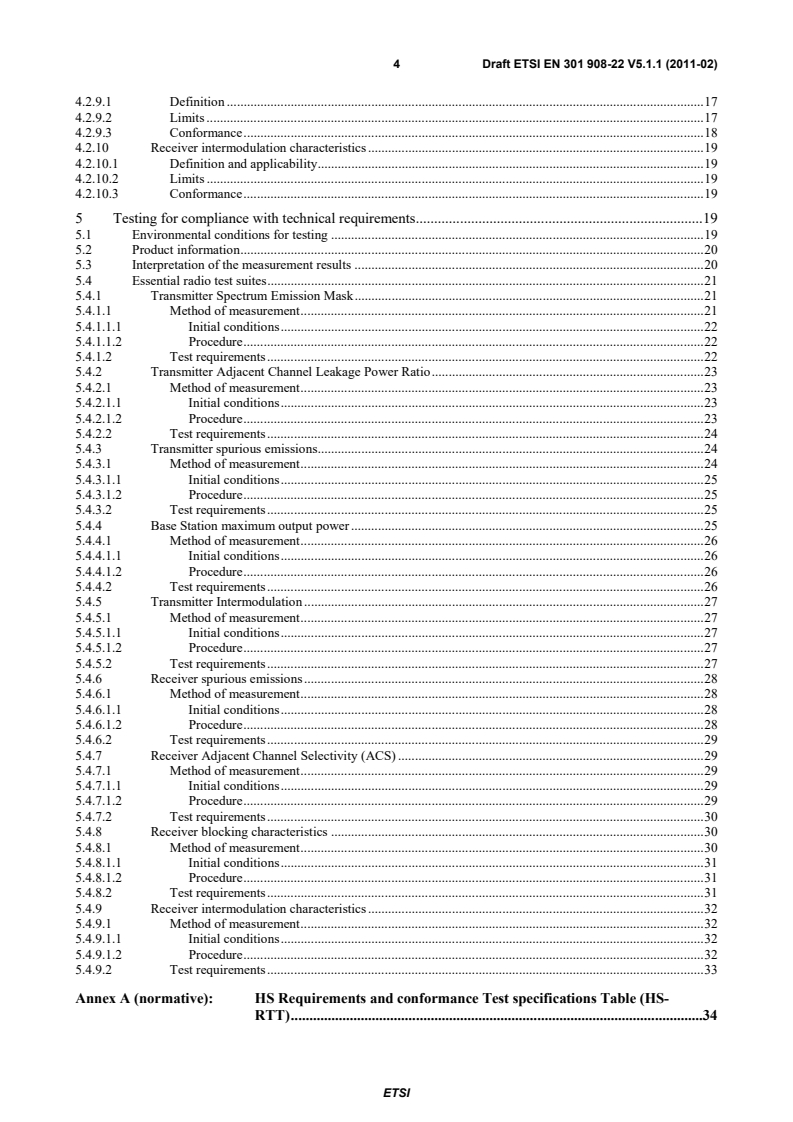
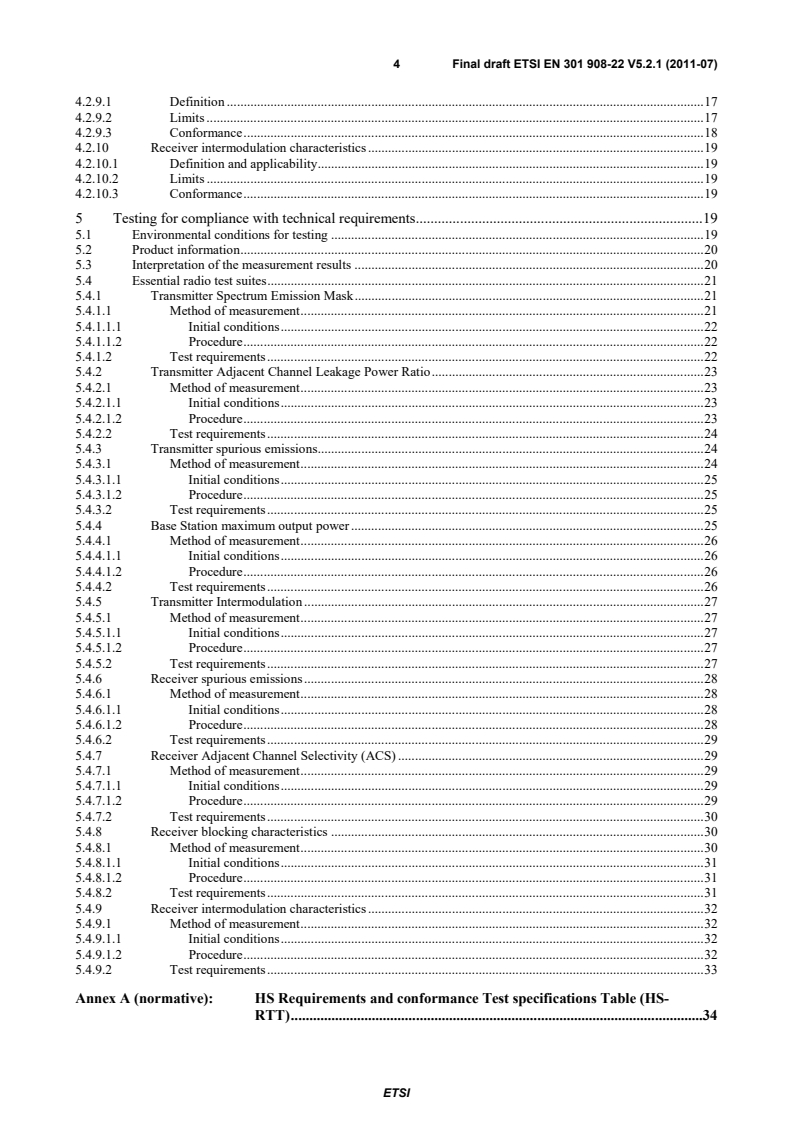
4 Draft ETSI EN 301 908-22 V5.1.1 (2011-02)
4.2.9.1 Definition . 17
4.2.9.2 Limits . 17
4.2.9.3 Conformance . 18
4.2.10 Receiver intermodulation characteristics . 19
4.2.10.1 Definition and applicability . 19
4.2.10.2 Limits . 19
4.2.10.3 Conformance . 19
5 Testing for compliance with technical requirements . 19
5.1 Environmental conditions for testing . 19
5.2 Product information . 20
5.3 Interpretation of the measurement results . 20
5.4 Essential radio test suites . 21
5.4.1 Transmitter Spectrum Emission Mask . 21
5.4.1.1 Method of measurement . 21
5.4.1.1.1 Initial conditions . 22
5.4.1.1.2 Procedure . 22
5.4.1.2 Test requirements . 22
5.4.2 Transmitter Adjacent Channel Leakage Power Ratio . 23
5.4.2.1 Method of measurement . 23
5.4.2.1.1 Initial conditions . 23
5.4.2.1.2 Procedure . 23
5.4.2.2 Test requirements . 24
5.4.3 Transmitter spurious emis sions . 24
5.4.3.1 Method of measurement . 24
5.4.3.1.1 Initial conditions . 25
5.4.3.1.2 Procedure . 25
5.4.3.2 Test requirements . 25
5.4.4 Base Station maximum output power . 25
5.4.4.1 Method of measurement . 26
5.4.4.1.1 Initial conditions . 26
5.4.4.1.2 Procedure . 26
5.4.4.2 Test requirements . 26
5.4.5 Transmitter Intermodulation . 27
5.4.5.1 Method of measurement . 27
5.4.5.1.1 Initial conditions . 27
5.4.5.1.2 Procedure . 27
5.4.5.2 Test requirements . 27
5.4.6 Receiver spurious emissions . 28
5.4.6.1 Method of measurement . 28
5.4.6.1.1 Initial conditions . 28
5.4.6.1.2 Procedure . 28
5.4.6.2 Test requirements . 29
5.4.7 Receiver Adjacent Channel Selectivity (ACS) . 29
5.4.7.1 Method of measurement . 29
5.4.7.1.1 Initial conditions . 29
5.4.7.1.2 Procedure . 29
5.4.7.2 Test requirements . 30
5.4.8 Receiver blocking characteristics . 30
5.4.8.1 Method of measurement . 30
5.4.8.1.1 Initial conditions . 31
5.4.8.1.2 Procedure . 31
5.4.8.2 Test requirements . 31
5.4.9 Receiver intermodulation characteristics . 32
5.4.9.1 Method of measurement . 32
5.4.9.1.1 Initial conditions . 32
5.4.9.1.2 Procedure . 32
5.4.9.2 Test requirements . 33
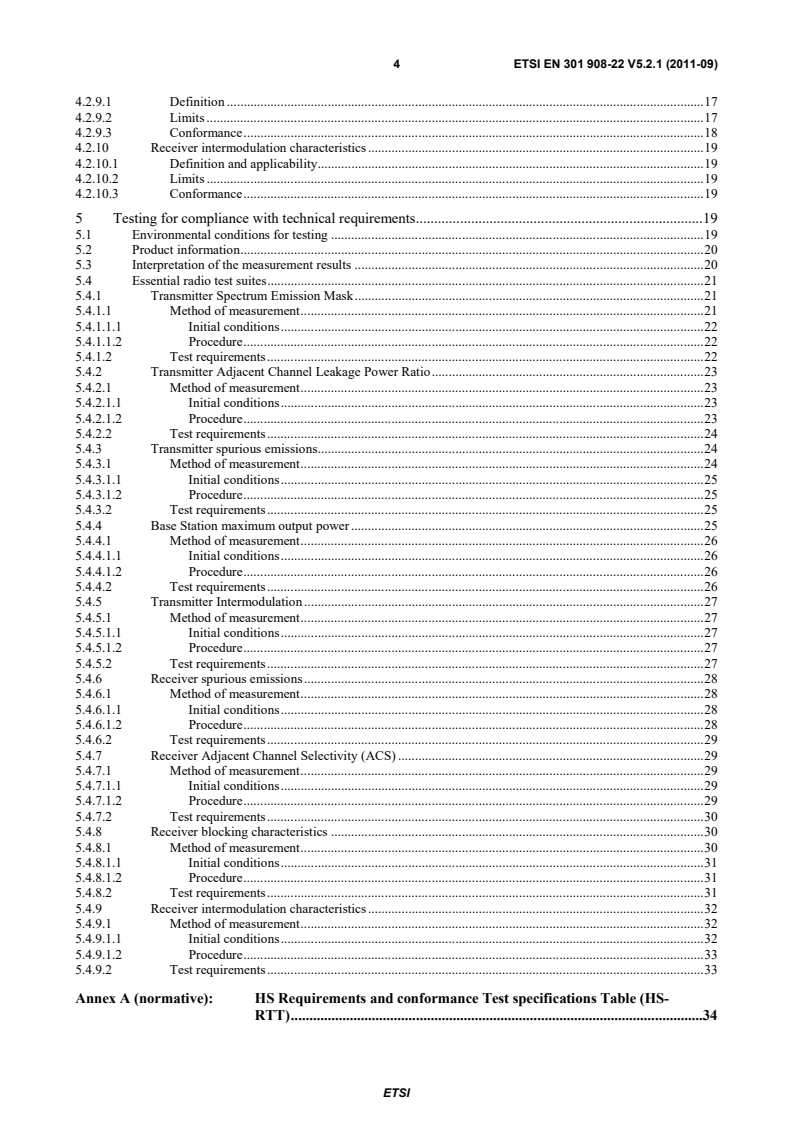
Annex A (normative): HS Requirements and conformance Test specifications Table (HS-
RTT) . 34
ETSI
5 Draft ETSI EN 301 908-22 V5.1.1 (2011-02)
Annex B (normative): Environmental profile specification . 36
Annex C (informative): The EN title in the official languages . 37
Annex D (informative): Bibliography . 38
History . 39
ETSI
6 Draft ETSI EN 301 908-22 V5.1.1 (2011-02)
Intellectual Property Rights
IPRs essential or potentially essential to the present document may have been declared to ETSI. The information
pertaining to these essential IPRs, if any, is publicly available for ETSI members and non-members, and can be found
in ETSI SR 000 314: "Intellectual Property Rights (IPRs); Essential, or potentially Essential, IPRs notified to ETSI in
respect of ETSI standards", which is available from the ETSI Secretariat. Latest updates are available on the ETSI Web
server (http://webapp.etsi.org/IPR/home.asp).
Pursuant to the ETSI IPR Policy, no investigation, including IPR searches, has been carried out by ETSI. No guarantee
can be given as to the existence of other IPRs not referenced in ETSI SR 000 314 (or the updates on the ETSI Web
server) which are, or may be, or may become, essential to the present document.
Foreword
This Harmonized European Standard (EN) has been produced by ETSI Technical Committee Mobile Standards Group
(MSG), and is now submitted for the Public Enquiry phase of the ETSI standards Two-step Approval Procedure.
The present document has been produced by ETSI in response to mandate M/284 from the European Commission
issued under Council Directive 98/34/EC [i.1] (as amended) laying down a procedure for the provision of information
in the field of technical standards and regulations.
The present document is intended to become a Harmonized Standard, the reference of which will be published in the
Official Journal of the European Union referencing the Directive 1999/5/EC [i.2] of the European Parliament and of the
Council of 9 March 1999 on radio equipment and telecommunications terminal equipment and the mutual recognition
of their conformity ("the R&TTE Directive").
The requirements relevant to Directive 1999/5/EC [i.2] are summarised in annex A.
The present document is part 22 of a multi-part deliverable covering the essential requirements under article 3.2 of
Directive 1999/5/EC [i.2] (R&TTE Directive) for Base Stations (BS), Repeaters and User Equipment (UE) for IMT
cellular networks, as identified below:
Part 1: "Introduction and common requirements";
Part 2: "CDMA Direct Spread (UTRA FDD) User Equipment (UE)";
Part 3: "CDMA Direct Spread (UTRA FDD) Base Stations (BS)";
Part 4: "CDMA Multi-Carrier (cdma2000) User Equipment (UE)";
Part 5: "CDMA Multi-Carrier (cdma2000) Base Stations (BS)";
Part 6: "CDMA TDD (UTRA TDD) User Equipment (UE)";
Part 7: "CDMA TDD (UTRA TDD) Base Stations (BS)";
Part 8: "Harmonized EN for IMT-2000, TDMA Single-Carrier (UWC 136) (UE) covering essential requirements
of article 3.2 of the R&TTE Directive";
Part 9: "Harmonized EN for IMT-2000, TDMA Single-Carrier (UWC 136) (BS) covering essential requirements
of article 3.2 of the R&TTE Directive";
Part 10: "Harmonized EN for IMT-2000, FDMA/TDMA (DECT) covering essential requirements of article 3.2 of
the R&TTE Directive";
Part 11: "CDMA Direct Spread (UTRA FDD) (Repeaters)";
Part 12: "Harmonized EN for IMT-2000, CDMA Multi-Carrier (cdma2000) (Repeaters) covering the essential
requirements of article 3.2 of the R&TTE Directive";
Part 13: "Evolved Universal Terrestrial Radio Access (E-UTRA) User Equipment (UE)";
ETSI
7 Draft ETSI EN 301 908-22 V5.1.1 (2011-02)
Part 14: "Evolved Universal Terrestrial Radio Access (E-UTRA) Base Stations (BS)";
Part 15: "Evolved Universal Terrestrial Radio Access (E-UTRA) (FDD Repeaters)";
Part 16: "Harmonized EN for IMT-2000, Evolved CDMA Multi-Carrier Ultra Mobile Broadband (UMB) (UE)
covering the essential requirements of article 3.2 of the R&TTE Directive";
Part 17: "Harmonized EN for IMT-2000, Evolved CDMA Multi-Carrier Ultra Mobile Broadband (UMB) (BS)
covering the essential requirements of article 3.2 of the R&TTE Directive";
Part 18: "E-UTRA, UTRA and GSM/EDGE Multi-Standard Radio (MSR) Base Station (BS)";
Part 19: "OFDMA TDD WMAN (Mobile WiMAX) TDD User Equipment (UE)";
Part 20: "OFDMA TDD WMAN (Mobile WiMAX) TDD Base Station (BS)";
Part 21: "OFDMA TDD WMAN (Mobile WiMAX) FDD User Equipment (UE)";
Part 22: "OFDMA TDD WMAN (Mobile WiMAX) FDD Base Stations (BS)".
Proposed national transposition dates
Date of latest announcement of this EN (doa): 3 months after ETSI publication
Date of latest publication of new National Standard
or endorsement of this EN (dop/e): 6 months after doa
Date of withdrawal of any conflicting National Standard (dow): 18 months after doa
Introduction
The present document is part of a set of standards developed by ETSI and is designed to fit in a modular structure to
cover all radio and telecommunications terminal equipment within the scope of the R&TTE Directive. The modular
structure is shown in EG 201 399 [i.3].
ETSI
8 Draft ETSI EN 301 908-22 V5.1.1 (2011-02)
1 Scope
The present document applies to the following radio equipment type:
• Mobile WiMAX FDD Base Stations for IMTOFDMA TDD WMAN This radio equipment type is capable of
operating in all or any part of the frequency bands given in table 1-1.
Table 1-1: Base Station WiMAX FDD Operating frequency bands
Mobile WiMAX Band Class Direction of transmission Mobile WiMAX FDD frequency bands
Index
Transmit 925 MHz to 960 MHz
7G
Receive 880 MHz to 915 MHz
Transmit 1 805 MHz to 1 880 MHz
6C
Receive 1 710 MHz to 1 785 MHz
The present document is intended to cover the provisions of Directive 1999/5/EC [i.2] (R&TTE Directive), article 3.2,
which states that "… radio equipment shall be so constructed that it effectively uses the spectrum allocated to
terrestrial/space radio communications and orbital resources so as to avoid harmful interference".
In addition to the present document, other ENs that specify technical requirements in respect of essential requirements
under other parts of article 3 of the R&TTE Directive [i.2] may apply to equipment within the scope of the present
document.
NOTE: A list of such ENs is included on the web site http://www.newapproach.org.
2 References
References are either specific (identified by date of publication and/or edition number or version number) or
non-specific. For specific references, only the cited version applies. For non-specific references, the latest version of the
reference document (including any amendments) applies.
Referenced documents which are not found to be publicly available in the expected location might be found at
http://docbox.etsi.org/Reference.
NOTE: While any hyperlinks included in this clause were valid at the time of publication ETSI cannot guarantee
their long term validity.
2.1 Normative references
The following referenced documents are necessary for the application of the present document.
[1] ETSI EN 301 908-1: "IMT cellular networks; Harmonized EN covering the essential requirements
of article 3.2 of the R&TTE Directive; Part 1: Introduction and common requirements".
[2] CEPT/ERC/Recommendation 74-01E (Siófok 98, Nice 99, Sesimbra 02, Hradec Kralove 05):
"Unwanted emissions in the spurious domain".
2.2 Informative references
The following referenced documents are not necessary for the application of the present document but they assist the
user with regard to a particular subject area.
[i.1] Directive 98/34/EC of the European Parliament and of the Council of 22 June 1998 laying down a
procedure for the provision of information in the field of technical standards and regulations.
ETSI
9 Draft ETSI EN 301 908-22 V5.1.1 (2011-02)
[i.2] Directive 1999/5/EC of the European Parliament and of the Council of 9 March 1999 on radio
equipment and telecommunications terminal equipment and the mutual recognition of their
conformity (R&TTE Directive).
[i.3] ETSI EG 201 399: "Electromagnetic compatibility and Radio spectrum Matters (ERM); A guide to
the production of Harmonized Standards for application under the R&TTE Directive".
[i.4] ETSI TR 102 215 (V1.3.1): "Electromagnetic compatibility and Radio spectrum Matters
(ERM);Recommended approach, and possible limits for measurement uncertainty for the
measurement of radiated electromagnetic fields above 1 GHz".
[i.5] ETSI EN 300 019-1-0: "Environmental Engineering (EE); Environmental conditions and
environmental tests for telecommunications equipment; Part 1-0: Classification of environmental
conditions; Introduction".
[i.6] ETSI TR 100 028 (V1.4.1) (all parts): "Electromagnetic compatibility and Radio spectrum Matters
(ERM); Uncertainties in the measurement of mobile radio equipment characteristics".
[i.7] ITU-R Recommendation SM.329-10 (2003): "Unwanted emissions in the spurious domain".
3 Definitions, symbols and abbreviations
3.1 Definitions
For the purposes of the present document, the terms and definitions given in the R&TTE Directive [i.2] and the
following apply:
burst: period during which radio waves are intentionally transmitted, preceded and succeeded by periods during which
no intentional transmission is made
environmental profile: declared range of environmental conditions under which equipment within the scope of the
present document is required to be compliant
Eval_BW1: test condition where the pass band of a rectangular filter with a bandwidth of 4,75 MHz for 5 MHz
equipment and 9,5 MHz for 10 MHz equipment is used for measurement centred on an operating channel or a victim
channel
integral antenna: antenna which is declared to be part of the radio equipment by the supplier
NOTE: Even when equipment with an integral antenna is concerned, it might still be possible to separate the
antenna from the equipment using a special tool. In such cases the assessment of the radio equipment and
of the antenna against requirements of this multi-part deliverable may be done separately.
maximum output power: mean power level per carrier of the base station or user equipment measured at the antenna
connector in a specified reference condition
mean power: when applied to a modulated signal, this is the power (transmitted or received) in a bandwidth
NOTE: The term "mean" here is used to exclude the amplitude fluctuation related to those theoretical variations
present in signal for example due to amplitude modulation, pulse shaping, pre-equalization, etc. Time
averaging should be applied to estimate mean power with the affect of the theoretical variations. The duty
cycle corresponding to burst activity within a frame should be also incorporated for "mean" power
estimation.
nominal maximum output power: maximum nominal mean power level measured over total allocated channel
bandwidth of the Base Station available at the antenna connector declared by the manufacturer; for equipment
implementing dynamic change of modulation format, it is intended as the maximum nominal mean power associated to
the modulation format delivering the highest power
receiver thermal noise power: equal to k×T×BW×F
WiMAX: trademarked name for the OFDMA TDD WMAN IMT technology
ETSI
10 Draft ETSI EN 301 908-22 V5.1.1 (2011-02)
3.2 Symbols
For the purposes of the present document, the following symbols apply:
A Base Station Interface A
BS
A Mobile Station Interface A
MS
A Unit Under Test Interface A
UUT
BW Assigned channel bandwidth
dB decibel
dBc decibel relative to Pnom carrier power measured in Eval_BW1
dBm decibel relative to 1 milliwatt
f Frequency of measurement
F centre frequency of the assigned channel
c
F Receiver noise figure
F The lowest frequency of the uplink operating band
UL_low
NOTE: See table 4.2.2.2.2-1.
F The highest frequency of the uplink operating band
UL_high
NOTE: See table 4.2.2.2.2-1.
k Boltzmann's constant
M Base Station Interface M
BS
M Mobile Station Interface M
MS
N Maximum number of antennas in a multiple antenna configuration
N Receiver thermal noise power expressed in dBm
th
-6
P Receiver sensitivity level at BER ≤ 10 (or equivalent PER) performance for an AWGN channel,
SENS
corresponding to the most robust modulation and coding rate supported by the technology
Pnom declared nominal maximum output Power
-6
P sensitivity levels at BER ≤ 10 , for a 5 MHz channel, corresponding to the most robust
SENS5
modulation and coding rate supported by the technology
-6
P sensitivity levels at BER ≤ 10 , for a 10 MHz channel, corresponding to the most robust
SENS10
modulation and coding rate supported by the technology
T Ambient temperature in Kelvin
3.3 Abbreviations
For the purposes of the present document, the following abbreviations apply:
ACLR Adjacent Channel Leakage power Ratio
ACS Adjacent Channel Selectivity
AWGN Additive White Gaussian Noise
BER Bit Error Ratio
BS Base Station
BW BandWidth
CW Carrier Wave
ERM Electromagnetic compatibility and Radio spectrum Matters
FDD Frequency Division Duplexing
GHz GigaHertz
MHz MegaHertz
MSG Mobile Standards Group
OFDMA Orthogonal Frequency Division Multiple Access
PER Packet Error Ratio
R&TTE Radio equipment and Telecommunications Terminal Equipment
RF Radio Frequency
TFES Task Force for European Standards for IMT
TPC Transmit Power Control
UE User Equipment
ETSI
11 Draft ETSI EN 301 908-22 V5.1.1 (2011-02)
UUT Unit Under Test
4 Essential requirements specification
With reference to article 3.2 of Directive 1999/5/EC [i.2] the phenomena in this clause have been identified as relevant
to the essential requirements.
4.1 Environmental profile
The technical requirements of the present document apply under the environmental profile for operation of the
equipment, which shall be declared by the supplier. The equipment shall comply with all the technical requirements of
the present document at all times when operating within the boundary limits of the required operational environmental
profile.
4.2 Conformance requirements
4.2.1 Introduction
To meet the essential requirement under article 3.2 of the R&TTE Directive [i.2] for IMT Base Stations (BS) six
essential parameters in addition to those in EN 301 908-1 [1] have been identified. Table 4.2.1-1 provides a cross
reference between these six essential parameters and the corresponding nine technical requirements for equipment
within the scope of the present document. To fulfil an essential parameter the compliance with all the corresponding
technical requirements in table 4.2.1-1 must be verified.
Table 4.2.1-1: Cross references
Essential parameter Corresponding technical requirements
Spectrum emission mask 4.2.2 Transmitter Spectrum emission mask
4.2.3 Transmitter adjacent channel leakage power ratio
4.2.6 Transmit Intermodulation characteristics
Conducted spurious emissions from the transmitter 4.2.4 Transmitter spurious emissions
antenna connector
Accuracy of maximum output power 4.2.5 Transmitter maximum output power
Conducted spurious emissions from the receiver 4.2.7 Receiver spurious emissions
antenna connector
Impact of interference on receiver performance 4.2.9 Receiver blocking characteristics
4.2.10 Receiver intermodulation characteristics
Receiver adjacent channel selectivity 4.2.8 Receiver adjacent channel selectivity (ACS)
4.2.2 Spectrum emission mask
4.2.2.1 Definition
Spectrum emission mask defines an out of band emission requirement for the transmitter. These out of band emissions
are unwanted emissions outside the channel bandwidth resulting from the modulation process and non-linearity in the
transmitter but excluding spurious emissions.
4.2.2.2 Limits
A Base Station device transmitting on a single RF carrier configured in accordance with the manufacturer's
specification shall meet the requirement. Emissions shall not exceed the maximum level specified in tables 4.2.2.2.1-1
and 4.2.2.2.2-1 for the appropriate BS maximum output power and nominal channel bandwidths of 5 MHz and 10 MHz.
ETSI
12 Draft ETSI EN 301 908-22 V5.1.1 (2011-02)
4.2.2.2.1 Requirements for 5 MHz channel bandwidth
The out-of-channel emission is specified as power level measured over the specified measurement bandwidth but
relative to dBc centred in the 5 MHz channel.
The power of any BS emission shall not exceed the levels specified in table 4.2.2.2.1-1.
Table 4.2.2.2.1-1: Spectrum emission mask requirement
Segment Offset Δf from channel centre Integration Allowed emission level within the
number bandwidth integration bandwidth
(MHz)
(kHz) (dBm)
1 2,5 to < 2,7 30 -14
2 2,7 to < 3,5 30 -14 - 15 (∆f - 2,715)
3 3,5 to < 4,0 30 -26
4 1 000 -13
7,5 to ≤ 12,5
4.2.2.2.2 Requirements for 10 MHz channel bandwidth
The out-of-channel emission is specified as a power level relative to dBc centred in the 10 MHz channel.
The power of any BS emission shall not exceed the levels specified in table 4.2.2.2.2-1.
Table 4.2.2.2.2-1: Spectrum emission mask requirement
Segment Integration Allowed emission level within the
Offset Δf from channel centre
number (MHz) bandwidth integration bandwidth
(kHz) (dBm)
1 5,0 to < 5,2 30 -14
2 5,2 to < 6,0 30 -14 - 15 (∆f - 2,715)
3 6,0 to < 6,5 30 -26
4 6,5 to < 15,0 1 000 -13
5 15,0 to ≤ 25,0 1 000 -15
NOTE: As an exception, in the band 925 MHz to 960 MHz, the maximum extent to which the emission mask
Segment 5 extends above the downlink band is limited to +10 MHz outside the upper downlink band
edge. Beyond this point, the spurious emission requirements of clause 4.2.4 shall be applied.
4.2.2.3 Conformance
Conformance tests described in clause 5.4.1 shall be carried out.
4.2.3 Transmitter Adjacent Channel Leakage power Ratio (ACLR)
4.2.3.1 Definition
Adjacent Channel Leakage power Ratio (ACLR) is the ratio of the mean power measured through a filter pass band
centred on the assigned channel frequency to the mean power measured through a filter pass band centred on the first
adjacent channel. The filter pass band, response and nominal bandwidth are set according to Eval_BW 1.
4.2.3.2 Limits
4.2.3.2.1 ACLR requirements for 5 MHz channel bandwidth
For 5 MHz BW the ACLR shall be equal to or greater than the limits specified in table 4.2.3.2.1-1.
ETSI
13 Draft ETSI EN 301 908-22 V5.1.1 (2011-02)
Table 4.2.3.2.1-1: Base Station ACLR limits for 5 MHz channel BW
ACLR limit relative to assigned channel
frequency (dB)
Adjacent channel
ACLR limit for Eval_BW 1
F ± 5,0 MHz
44,2
c
F ± 10,0 MHz 49,2
c
4.2.3.2.2 ACLR requirements for 10 MHz channel bandwidth
For 10 MHz BW the ACLR shall be equal to or greater than the limits specified in table 4.2.3.2.2-1.
Table 4.2.3.2.2-1: Base Station ACLR limits for 10 MHz Channel BW
ACLR limit relative to assigned channel
Adjacent channel frequency (dB)
ACLR limit for Eval_BW 1
F ± 10,0 MHz 44,2
c
F ± 20,0 MHz 49,2
c
4.2.3.3 Conformance
Conformance tests described in clause 5.4.2 shall be carried out.
4.2.4 Transmitter spurious emissions
4.2.4.1 Definition
Transmitter spurious emissions are emissions which are caused by unwanted transmitter effects such as harmonics
emission, parasitic emission, intermodulation products and frequency conversion products, but exclude out of band
emissions. This conducted measurement is measured at the RF output port. The spurious emission limits are specified in
terms of general requirements in line with ITU-R Recommendation SM.329 10 [i.7] and frequency range specific
requirements to address inter-system co-existence.
4.2.4.2 Limits
4.2.4.2.0 General requirements
The requirements shall apply to both Wide Area BS and Local Area BS.
The limits of spurious emissions (or more precisely, according latest ITU-R definitions, unwanted emissions in the
spurious domain), shall conform to CEPT/ERC Recommendation 74-01 [2].
The following requirements in tables 4.2.4.2.1-1, 4.2.4.2.2-1 and 4.2.4.2.3-1 are only applicable for frequencies, which
are greater than 250 % of the channel bandwidth (that is 12,5 MHz for the 5 MHz channel bandwidth and 25 MHz for
the 10 MHz channel bandwidth) away from the carrier centre frequency. In the following f is the centre frequency of
c
transmit signal and f is the frequency of spurious emission. BW is the channel bandwidth of choice, i.e. 5 MHz or
10 MHz.
ETSI
14 Draft ETSI EN 301 908-22 V5.1.1 (2011-02)
4.2.4.2.1 Requirements for 5 MHz channel bandwidth
Table 4.2.4.2.1-1: Spurious Emission requirement for 5 MHz channel bandwidth
Segment Frequency Range Measurement Bandwidth Maximum allowed
level (dBm)
9 kHz ≤ f < 150 kHz
1 1 kHz -36
2 150 kHz ≤ f < 30 MHz 10 kHz -36
3 30 MHz ≤ f < 1 000 MHz 100 kHz -36
4 1 GHz ≤ f < 12,75 GHz 30 kHz If 12,5 MHz ≤ |fc-f| < 50 MHz -30
300 kHz If 50 MHz ≤ |fc-f| < 60 MHz
1 MHz If 60 MHz ≤ |fc-f|
4.2.4.2.2 Requirements for 10 MHz channel bandwidth
Table 4.2.4.2.2-1: Spurious Emission requirement for 10 MHz channel bandwidth
Segment Frequency Range Measurement Bandwidth Maximum allowed
level (dBm)
1 9 kHz ≤ f < 150 kHz 1 kHz -36
2 150 kHz ≤ f < 30 MHz 10 kHz -36
3 30 MHz ≤ f < 1 000 MHz 100 kHz -36
4 1 GHz ≤ f < 12,75 GHz 30 kHz If 25 MHz ≤ |fc-f| < 100 MHz -30
300 kHz If 100 MHz ≤ |fc-f| < 120 MHz
1 MHz If 120 MHz ≤ |fc-f|
4.2.4.2.3 Additional Spurious Emission Requirements
Table 4.2.4.2.3-1: Additional spurious emissions requirements for BS (out of band)
Band Maximum Emission Level Measurement Bandwidth
(MHz) (dBm) (MHz)
-52 1
791 ≤ f < 821
832 ≤ f < 862 -49 1
876 ≤ f < 915 -51 1
-49 1
880 ≤ f < 915
-47 1
921 ≤ f < 925
925 ≤ f < 960 -52 1
1 710 ≤ f < 1 785 -49 1
-52 1
1 805 ≤ f < 1 880
-49 1
1 920 ≤ f < 1 980
2 110 ≤ f < 2 170 -52 1
1 900 ≤ f < 1 920 -49 1
2 010 ≤ f < 2 025 -52 1
-49 1
2 500 ≤ f < 2 570
-52 1
2 570 ≤ f < 2 620
2 620 ≤ f < 2 690 -52 1
4.2.4.2.4 Protection of the BS receiver of own or different BS
This requirement shall be applied in order to prevent the receivers of the BSs being desensitised by emissions from a BS
transmitter.
The power of any spurious emission shall not exceed the limit specified in table 4.2.4.2.4-1.
ETSI
15 Draft ETSI EN 301 908-22 V5.1.1 (2011-02)
Table 4.2.4.2.4-1: BS emissions limits for spurious protection of the BS receiver
Frequency Range Maximum Level Measurement Bandwidth Note
F - F
-96 dBm 100 kHz
UL_ low UL_high
NOTE: F and F are the lowest and highest frequency of the WiMAX BS uplink operating band
UL_ low UL_high
respectively.
4.2.4.3 Conformance
Conformance tests described in clause 5.4.3 shall be carried out.
4.2.5 Base station maximum output power
4.2.5.1 Definition
The nominal maximum output power (Pnom) is the nominal mean power level measured over total allocated channel
bandwidth available at the antenna connector.
The tolerance of the output power is the difference between the declared Pnom and the actual maximum output power,
with the corresponding tolerance limits.
4.2.5.2 Limits
The requirement shall apply to both Wide Area BS and Local Area BS.
In normal conditions, the measured output power, derived according to clause 5.4.4.1.2, shall remain within +2,7 dB
and -2,7 dB of the manufacturer's rated output power.
In extreme conditions, the measured output power, derived according to clause 5.4.4.1.2, shall remain within +3,2 dB
and -3,2 dB of the manufacturer's rated output power.
4.2.5.3 Conformance
Conformance tests described in clause 5.4.4 shall be carried out.
4.2.6 Transmitter Intermodulation
4.2.6.1 Definition
The transmit intermodulation requirement is a measure of the capability of the transmitter to inhibit the generation of
signals in its non
...
Harmonized European Standard
IMT cellular networks;
Harmonized EN covering the essential requirements
of article 3.2 of the R&TTE Directive;
Part 22: OFDMA TDD WMAN (Mobile WiMAX)
FDD Base Stations (BS)
2 ETSI EN 301 908-22 V5.2.1 (2011-09)
Reference
DEN/MSG-TFES-009-22
Keywords
3G, cell, digital, FDD, IMT, IMT-2000, mobile,
radio, regulation, WiMAX
ETSI
650 Route des Lucioles
F-06921 Sophia Antipolis Cedex - FRANCE
Tel.: +33 4 92 94 42 00 Fax: +33 4 93 65 47 16
Siret N° 348 623 562 00017 - NAF 742 C
Association à but non lucratif enregistrée à la
Sous-Préfecture de Grasse (06) N° 7803/88
Important notice
Individual copies of the present document can be downloaded from:
http://www.etsi.org
The present document may be made available in more than one electronic version or in print. In any case of existing or
perceived difference in contents between such versions, the reference version is the Portable Document Format (PDF).
In case of dispute, the reference shall be the printing on ETSI printers of the PDF version kept on a specific network drive
within ETSI Secretariat.
Users of the present document should be aware that the document may be subject to revision or change of status.
Information on the current status of this and other ETSI documents is available at
http://portal.etsi.org/tb/status/status.asp
If you find errors in the present document, please send your comment to one of the following services:
http://portal.etsi.org/chaircor/ETSI_support.asp
Copyright Notification
No part may be reproduced except as authorized by written permission.
The copyright and the foregoing restriction extend to reproduction in all media.
© European Telecommunications Standards Institute 2011.
All rights reserved.
TM TM TM
DECT , PLUGTESTS , UMTS and the ETSI logo are Trade Marks of ETSI registered for the benefit of its Members.
TM
3GPP and LTE™ are Trade Marks of ETSI registered for the benefit of its Members and
of the 3GPP Organizational Partners.
GSM® and the GSM logo are Trade Marks registered and owned by the GSM Association.
ETSI
3 ETSI EN 301 908-22 V5.2.1 (2011-09)
Contents
Intellectual Property Rights . 6
Foreword . 6
Introduction . 7
1 Scope . 8
2 References . 8
2.1 Normative references . 8
2.2 Informative references . 8
3 Definitions, symbols and abbreviations . 9
3.1 Definitions . 9
3.2 Symbols . 10
3.3 Abbreviations . 10
4 Essential requirements specification . 11
4.1 Environmental profile . 11
4.2 Conformance requirements . 11
4.2.1 Introduction. 11
4.2.2 Spectrum emission mask . 11
4.2.2.1 Definition . 11
4.2.2.2 Limits . 11
4.2.2.2.1 Requirements for 5 MHz channel bandwidth . 12
4.2.2.2.2 Requirements for 10 MHz channel bandwidth . 12
4.2.2.3 Conformance . 12
4.2.3 Transmitter Adjacent Channel Leakage power Ratio (ACLR) . 12
4.2.3.1 Definition . 12
4.2.3.2 Limits . 12
4.2.3.2.1 ACLR requirements for 5 MHz channel bandwidth . 12
4.2.3.2.2 ACLR requirements for 10 MHz channel bandwidth . 13
4.2.3.3 Conformance . 13
4.2.4 Transmitter spurious emis sions . 13
4.2.4.1 Definition . 13
4.2.4.2 Limits . 13
4.2.4.2.0 General requirements . 13
4.2.4.2.1 Requirements for 5 MHz channel bandwidth . 14
4.2.4.2.2 Requirements for 10 MHz channel bandwidth . 14
4.2.4.2.3 Additional Spurious Emission Requirements . 14
4.2.4.2.4 Protection of the BS receiver of own or different BS . 14
4.2.4.3 Conformance . 15
4.2.5 Base station maximum output power . 15
4.2.5.1 Definition . 15
4.2.5.2 Limits . 15
4.2.5.3 Conformance . 15
4.2.6 Transmitter Intermodulation . 15
4.2.6.1 Definition . 15
4.2.6.2 Limits . 15
4.2.6.3 Conformance . 16
4.2.7 Receiver spurious emissions . 16
4.2.7.1 Definition . 16
4.2.7.2 Limits . 16
4.2.7.3 Conformance . 16
4.2.8 Receiver Adjacent Channel Selectivity (ACS) . 16
4.2.8.1 Definition . 16
4.2.8.2 Limits . 17
4.2.8.3 Conformance . 17
4.2.9 Receiver blocking characteristics . 17
ETSI
4 ETSI EN 301 908-22 V5.2.1 (2011-09)
4.2.9.1 Definition . 17
4.2.9.2 Limits . 17
4.2.9.3 Conformance . 18
4.2.10 Receiver intermodulation characteristics . 19
4.2.10.1 Definition and applicability . 19
4.2.10.2 Limits . 19
4.2.10.3 Conformance . 19
5 Testing for compliance with technical requirements . 19
5.1 Environmental conditions for testing . 19
5.2 Product information . 20
5.3 Interpretation of the measurement results . 20
5.4 Essential radio test suites . 21
5.4.1 Transmitter Spectrum Emission Mask . 21
5.4.1.1 Method of measurement . 21
5.4.1.1.1 Initial conditions . 22
5.4.1.1.2 Procedure . 22
5.4.1.2 Test requirements . 22
5.4.2 Transmitter Adjacent Channel Leakage Power Ratio . 23
5.4.2.1 Method of measurement . 23
5.4.2.1.1 Initial conditions . 23
5.4.2.1.2 Procedure . 23
5.4.2.2 Test requirements . 24
5.4.3 Transmitter spurious emis sions . 24
5.4.3.1 Method of measurement . 24
5.4.3.1.1 Initial conditions . 25
5.4.3.1.2 Procedure . 25
5.4.3.2 Test requirements . 25
5.4.4 Base Station maximum output power . 25
5.4.4.1 Method of measurement . 26
5.4.4.1.1 Initial conditions . 26
5.4.4.1.2 Procedure . 26
5.4.4.2 Test requirements . 26
5.4.5 Transmitter Intermodulation . 27
5.4.5.1 Method of measurement . 27
5.4.5.1.1 Initial conditions . 27
5.4.5.1.2 Procedure . 27
5.4.5.2 Test requirements . 27
5.4.6 Receiver spurious emissions . 28
5.4.6.1 Method of measurement . 28
5.4.6.1.1 Initial conditions . 28
5.4.6.1.2 Procedure . 28
5.4.6.2 Test requirements . 29
5.4.7 Receiver Adjacent Channel Selectivity (ACS) . 29
5.4.7.1 Method of measurement . 29
5.4.7.1.1 Initial conditions . 29
5.4.7.1.2 Procedure . 29
5.4.7.2 Test requirements . 30
5.4.8 Receiver blocking characteristics . 30
5.4.8.1 Method of measurement . 30
5.4.8.1.1 Initial conditions . 31
5.4.8.1.2 Procedure . 31
5.4.8.2 Test requirements . 31
5.4.9 Receiver intermodulation characteristics . 32
5.4.9.1 Method of measurement . 32
5.4.9.1.1 Initial conditions . 32
5.4.9.1.2 Procedure . 33
5.4.9.2 Test requirements . 33
Annex A (normative): HS Requirements and conformance Test specifications Table (HS-
RTT) . 34
ETSI
5 ETSI EN 301 908-22 V5.2.1 (2011-09)
Annex B (normative): Environmental profile specification . 36
Annex C (informative): The EN title in the official languages . 37
Annex D (informative): Bibliography . 38
History . 39
ETSI
6 ETSI EN 301 908-22 V5.2.1 (2011-09)
Intellectual Property Rights
IPRs essential or potentially essential to the present document may have been declared to ETSI. The information
pertaining to these essential IPRs, if any, is publicly available for ETSI members and non-members, and can be found
in ETSI SR 000 314: "Intellectual Property Rights (IPRs); Essential, or potentially Essential, IPRs notified to ETSI in
respect of ETSI standards", which is available from the ETSI Secretariat. Latest updates are available on the ETSI Web
server (http://ipr.etsi.org).
Pursuant to the ETSI IPR Policy, no investigation, including IPR searches, has been carried out by ETSI. No guarantee
can be given as to the existence of other IPRs not referenced in ETSI SR 000 314 (or the updates on the ETSI Web
server) which are, or may be, or may become, essential to the present document.
Foreword
This Harmonized European Standard (EN) has been produced by ETSI Technical Committee Mobile Standards Group
(MSG).
The present document has been produced by ETSI in response to mandate M/284 from the European Commission
issued under Council Directive 98/34/EC [i.1] (as amended) laying down a procedure for the provision of information
in the field of technical standards and regulations.
The title and reference to the present document are intended to be included in the publication in the Official Journal of
the European Union of titles and references of Harmonized Standard under the Directive 1999/5/EC [i.2].
See article 5.1 of Directive 1999/5/EC [i.2] for information on presumption of conformity and Harmonised Standards or
parts thereof the references of which have been published in the Official Journal of the European Union.
The requirements relevant to Directive 1999/5/EC [i.2] are summarised in annex A.
The present document is part 22 of a multi-part deliverable covering the essential requirements under article 3.2 of
Directive 1999/5/EC [i.2] (R&TTE Directive) for Base Stations (BS), Repeaters and User Equipment (UE) for IMT
cellular networks, as identified below:
Part 1: "Introduction and common requirements";
Part 2: "CDMA Direct Spread (UTRA FDD) User Equipment (UE)";
Part 3: "CDMA Direct Spread (UTRA FDD) Base Stations (BS)";
Part 4: "CDMA Multi-Carrier (cdma2000) User Equipment (UE)";
Part 5: "CDMA Multi-Carrier (cdma2000) Base Stations (BS)";
Part 6: "CDMA TDD (UTRA TDD) User Equipment (UE)";
Part 7: "CDMA TDD (UTRA TDD) Base Stations (BS)";
Part 8: "Harmonized EN for IMT-2000, TDMA Single-Carrier (UWC 136) (UE) covering essential requirements
of article 3.2 of the R&TTE Directive";
Part 9: "Harmonized EN for IMT-2000, TDMA Single-Carrier (UWC 136) (BS) covering essential requirements
of article 3.2 of the R&TTE Directive";
Part 10: "Harmonized EN for IMT-2000, FDMA/TDMA (DECT) covering essential requirements of article 3.2 of
the R&TTE Directive";
Part 11: "CDMA Direct Spread (UTRA FDD) (Repeaters)";
Part 12: "Harmonized EN for IMT-2000, CDMA Multi-Carrier (cdma2000) (Repeaters) covering the essential
requirements of article 3.2 of the R&TTE Directive";
Part 13: "Evolved Universal Terrestrial Radio Access (E-UTRA) User Equipment (UE)";
ETSI
7 ETSI EN 301 908-22 V5.2.1 (2011-09)
Part 14: "Evolved Universal Terrestrial Radio Access (E-UTRA) Base Stations (BS)";
Part 15: "Evolved Universal Terrestrial Radio Access (E-UTRA) (FDD Repeaters)";
Part 16: "Harmonized EN for IMT-2000, Evolved CDMA Multi-Carrier Ultra Mobile Broadband (UMB) (UE)
covering the essential requirements of article 3.2 of the R&TTE Directive";
Part 17: "Harmonized EN for IMT-2000, Evolved CDMA Multi-Carrier Ultra Mobile Broadband (UMB) (BS)
covering the essential requirements of article 3.2 of the R&TTE Directive";
Part 18: "E-UTRA, UTRA and GSM/EDGE Multi-Standard Radio (MSR) Base Station (BS)";
Part 19: "OFDMA TDD WMAN (Mobile WiMAX) TDD User Equipment (UE)";
Part 20: "OFDMA TDD WMAN (Mobile WiMAX) TDD Base Stations (BS)";
Part 21: "OFDMA TDD WMAN (Mobile WiMAX) FDD User Equipment (UE)";
Part 22: "OFDMA TDD WMAN (Mobile WiMAX) FDD Base Stations (BS)".
National transposition dates
Date of adoption of this EN: 12 September 2011
Date of latest announcement of this EN (doa): 31 December 2011
Date of latest publication of new National Standard
or endorsement of this EN (dop/e): 30 June 2012
Date of withdrawal of any conflicting National Standard (dow): 30 June 2013
Introduction
The present document is part of a set of standards developed by ETSI and is designed to fit in a modular structure to
cover all radio and telecommunications terminal equipment within the scope of the R&TTE Directive [i.2]. The
modular structure is shown in EG 201 399 [i.3].
ETSI
8 ETSI EN 301 908-22 V5.2.1 (2011-09)
1 Scope
The present document applies to the following radio equipment type:
• Mobile WiMAX FDD Base Stations for IMTOFDMA TDD WMAN This radio equipment type is capable of
operating in all or any part of the frequency bands given in table 1-1.
Table 1-1: Base Station WiMAX FDD Operating frequency bands
Mobile WiMAX Band Class Direction of transmission Mobile WiMAX FDD frequency bands
Index
Transmit 925 MHz to 960 MHz
7G
Receive 880 MHz to 915 MHz
Transmit 1 805 MHz to 1 880 MHz
6C
Receive 1 710 MHz to 1 785 MHz
The present document is intended to cover the provisions of Directive 1999/5/EC [i.2] (R&TTE Directive), article 3.2,
which states that "… radio equipment shall be so constructed that it effectively uses the spectrum allocated to
terrestrial/space radio communications and orbital resources so as to avoid harmful interference".
In addition to the present document, other ENs that specify technical requirements in respect of essential requirements
under other parts of article 3 of the R&TTE Directive [i.2] may apply to equipment within the scope of the present
document.
NOTE: A list of such ENs is included on the web site http://www.newapproach.org.
2 References
References are either specific (identified by date of publication and/or edition number or version number) or
non-specific. For specific references, only the cited version applies. For non-specific references, the latest version of the
reference document (including any amendments) applies.
Referenced documents which are not found to be publicly available in the expected location might be found at
http://docbox.etsi.org/Reference.
NOTE: While any hyperlinks included in this clause were valid at the time of publication ETSI cannot guarantee
their long term validity.
2.1 Normative references
The following referenced documents are necessary for the application of the present document.
[1] ETSI EN 301 908-1 (V5.2.1): "IMT cellular networks; Harmonized EN covering the essential
requirements of article 3.2 of the R&TTE Directive; Part 1: Introduction and common
requirements".
[2] CEPT/ERC/Recommendation 74-01E (Siófok 98, Nice 99, Sesimbra 02, Hradec Kralove 05):
"Unwanted emissions in the spurious domain".
2.2 Informative references
The following referenced documents are not necessary for the application of the present document but they assist the
user with regard to a particular subject area.
[i.1] Directive 98/34/EC of the European Parliament and of the Council of 22 June 1998 laying down a
procedure for the provision of information in the field of technical standards and regulations.
ETSI
9 ETSI EN 301 908-22 V5.2.1 (2011-09)
[i.2] Directive 1999/5/EC of the European Parliament and of the Council of 9 March 1999 on radio
equipment and telecommunications terminal equipment and the mutual recognition of their
conformity (R&TTE Directive).
[i.3] ETSI EG 201 399: "Electromagnetic compatibility and Radio spectrum Matters (ERM); A guide to
the production of Harmonized Standards for application under the R&TTE Directive".
[i.4] ETSI TR 102 215 (V1.3.1): "Electromagnetic compatibility and Radio spectrum Matters
(ERM);Recommended approach, and possible limits for measurement uncertainty for the
measurement of radiated electromagnetic fields above 1 GHz".
[i.5] ETSI EN 300 019-1-0: "Environmental Engineering (EE); Environmental conditions and
environmental tests for telecommunications equipment; Part 1-0: Classification of environmental
conditions; Introduction".
[i.6] ETSI TR 100 028 (V1.4.1) (all parts): "Electromagnetic compatibility and Radio spectrum
Matters (ERM); Uncertainties in the measurement of mobile radio equipment characteristics".
[i.7] ITU-R Recommendation SM.329-10 (2003): "Unwanted emissions in the spurious domain".
3 Definitions, symbols and abbreviations
3.1 Definitions
For the purposes of the present document, the terms and definitions given in the R&TTE Directive [i.2] and the
following apply:
burst: period during which radio waves are intentionally transmitted, preceded and succeeded by periods during which
no intentional transmission is made
environmental profile: declared range of environmental conditions under which equipment within the scope of the
present document is required to be compliant
Eval_BW1: test condition where the pass band of a rectangular filter with a bandwidth of 4,75 MHz for 5 MHz
equipment and 9,5 MHz for 10 MHz equipment is used for measurement centred on an operating channel or a victim
channel
integral antenna: antenna which is declared to be part of the radio equipment by the supplier
NOTE: Even when equipment with an integral antenna is concerned, it might still be possible to separate the
antenna from the equipment using a special tool. In such cases the assessment of the radio equipment and
of the antenna against requirements of this multi-part deliverable may be done separately.
maximum output power: mean power level per carrier of the base station or user equipment measured at the antenna
connector in a specified reference condition
mean power: when applied to a modulated signal, this is the power (transmitted or received) in a bandwidth
NOTE: The term "mean" here is used to exclude the amplitude fluctuation related to those theoretical variations
present in signal for example due to amplitude modulation, pulse shaping, pre-equalization, etc. Time
averaging should be applied to estimate mean power with the affect of the theoretical variations. The duty
cycle corresponding to burst activity within a frame should be also incorporated for "mean" power
estimation.
nominal maximum output power: maximum nominal mean power level measured over total allocated channel
bandwidth of the Base Station available at the antenna connector declared by the manufacturer; for equipment
implementing dynamic change of modulation format, it is intended as the maximum nominal mean power associated to
the modulation format delivering the highest power
receiver thermal noise power: equal to k×T×BW×F
WiMAX: trademarked name for the OFDMA TDD WMAN IMT technology
ETSI
10 ETSI EN 301 908-22 V5.2.1 (2011-09)
3.2 Symbols
For the purposes of the present document, the following symbols apply:
A Base Station Interface A
BS
A Mobile Station Interface A
MS
A Unit Under Test Interface A
UUT
BW Assigned channel bandwidth
dB decibel
dBc decibel relative to Pnom carrier power measured in Eval_BW1
dBm decibel relative to 1 milliwatt
f Frequency of measurement
F centre frequency of the assigned channel
c
F Receiver noise figure
F The lowest frequency of the uplink operating band
UL_low
NOTE: See table 4.2.2.2.2-1.
F The highest frequency of the uplink operating band
UL_high
NOTE: See table 4.2.2.2.2-1.
k Boltzmann's constant
M Base Station Interface M
BS
M Mobile Station Interface M
MS
N Maximum number of antennas in a multiple antenna configuration
N Receiver thermal noise power expressed in dBm
th
-6
P Receiver sensitivity level at BER ≤ 10 (or equivalent PER) performance for an AWGN channel,
SENS
corresponding to the most robust modulation and coding rate supported by the technology
Pnom declared nominal maximum output Power
-6
P sensitivity levels at BER ≤ 10 , for a 5 MHz channel, corresponding to the most robust
SENS5
modulation and coding rate supported by the technology
-6
P sensitivity levels at BER ≤ 10 , for a 10 MHz channel, corresponding to the most robust
SENS10
modulation and coding rate supported by the technology
T Ambient temperature in Kelvin
3.3 Abbreviations
For the purposes of the present document, the following abbreviations apply:
ACLR Adjacent Channel Leakage power Ratio
ACS Adjacent Channel Selectivity
AWGN Additive White Gaussian Noise
BER Bit Error Ratio
BS Base Station
BW BandWidth
CW Continuous Wave
ERM Electromagnetic compatibility and Radio spectrum Matters
FDD Frequency Division Duplexing
GHz GigaHertz
MHz MegaHertz
MSG Mobile Standards Group
OFDMA Orthogonal Frequency Division Multiple Access
PER Packet Error Ratio
R&TTE Radio equipment and Telecommunications Terminal Equipment
RF Radio Frequency
RMS Root Mean Square
TFES Task Force for European Standards for IMT
TPC Transmit Power Control
ETSI
11 ETSI EN 301 908-22 V5.2.1 (2011-09)
UE User Equipment
UUT Unit Under Test
4 Essential requirements specification
With reference to article 3.2 of Directive 1999/5/EC [i.2] the phenomena in this clause have been identified as relevant
to the essential requirements.
4.1 Environmental profile
The technical requirements of the present document apply under the environmental profile for operation of the
equipment, which shall be declared by the supplier. The equipment shall comply with all the technical requirements of
the present document at all times when operating within the boundary limits of the required operational environmental
profile.
4.2 Conformance requirements
4.2.1 Introduction
To meet the essential requirement under article 3.2 of the R&TTE Directive [i.2] for IMT Base Stations (BS) six
essential parameters in addition to those in EN 301 908-1 [1] have been identified. Table 4.2.1-1 provides a cross
reference between these six essential parameters and the corresponding nine technical requirements for equipment
within the scope of the present document. To fulfil an essential parameter the compliance with all the corresponding
technical requirements in table 4.2.1-1 must be verified.
Table 4.2.1-1: Cross references
Essential parameter Corresponding technical requirements
Spectrum emission mask 4.2.2 Transmitter Spectrum emission mask
4.2.3 Transmitter adjacent channel leakage power ratio
4.2.6 Transmit Intermodulation characteristics
Conducted spurious emissions from the transmitter 4.2.4 Transmitter spurious emissions
antenna connector
Accuracy of maximum output power 4.2.5 Transmitter maximum output power
Conducted spurious emissions from the receiver 4.2.7 Receiver spurious emissions
antenna connector
Impact of interference on receiver performance 4.2.9 Receiver blocking characteristics
4.2.10 Receiver intermodulation characteristics
Receiver adjacent channel selectivity 4.2.8 Receiver adjacent channel selectivity (ACS)
4.2.2 Spectrum emission mask
4.2.2.1 Definition
Spectrum emission mask defines an out of band emission requirement for the transmitter. These out of band emissions
are unwanted emissions outside the channel bandwidth resulting from the modulation process and non-linearity in the
transmitter but excluding spurious emissions.
4.2.2.2 Limits
A Base Station device transmitting on a single RF carrier configured in accordance with the manufacturer's
specification shall meet the requirement. Emissions shall not exceed the maximum level specified in tables 4.2.2.2.1-1
and 4.2.2.2.2-1 for the appropriate BS maximum output power and nominal channel bandwidths of 5 MHz and 10 MHz.
ETSI
12 ETSI EN 301 908-22 V5.2.1 (2011-09)
4.2.2.2.1 Requirements for 5 MHz channel bandwidth
The out-of-channel emission is specified as power level measured over the specified measurement bandwidth but
relative to dBc centred in the 5 MHz channel.
The power of any BS emission shall not exceed the levels specified in table 4.2.2.2.1-1.
Table 4.2.2.2.1-1: Spectrum emission mask requirement
Segment Offset Δf from channel centre Integration Allowed emission level within the
number bandwidth integration bandwidth
(MHz)
(kHz) (dBm)
1 2,5 to < 2,7 30 -14
2 2,7 to < 3,5 30 -14 - 15 (∆f - 2,715)
3 3,5 to < 4,0 30 -26
4 1 000 -13
7,5 to ≤ 12,5
4.2.2.2.2 Requirements for 10 MHz channel bandwidth
The out-of-channel emission is specified as a power level relative to dBc centred in the 10 MHz channel.
The power of any BS emission shall not exceed the levels specified in table 4.2.2.2.2-1.
Table 4.2.2.2.2-1: Spectrum emission mask requirement
Segment Integration Allowed emission level within the
Offset Δf from channel centre
number (MHz) bandwidth integration bandwidth
(kHz) (dBm)
1 5,0 to < 5,2 30 -14
2 5,2 to < 6,0 30 -14 - 15 (∆f - 2,715)
3 6,0 to < 6,5 30 -26
4 6,5 to < 15,0 1 000 -13
5 15,0 to ≤ 25,0 1 000 -15
NOTE: As an exception, in the band 925 MHz to 960 MHz, the maximum extent to which the emission mask
Segment 5 extends above the downlink band is limited to +10 MHz outside the upper downlink band
edge. Beyond this point, the spurious emission requirements of clause 4.2.4 shall be applied.
4.2.2.3 Conformance
Conformance tests described in clause 5.4.1 shall be carried out.
4.2.3 Transmitter Adjacent Channel Leakage power Ratio (ACLR)
4.2.3.1 Definition
Adjacent Channel Leakage power Ratio (ACLR) is the ratio of the mean power measured through a filter pass band
centred on the assigned channel frequency to the mean power measured through a filter pass band centred on the first
adjacent channel. The filter pass band, response and nominal bandwidth are set according to Eval_BW 1.
4.2.3.2 Limits
4.2.3.2.1 ACLR requirements for 5 MHz channel bandwidth
For 5 MHz BW the ACLR shall be equal to or greater than the limits specified in table 4.2.3.2.1-1.
ETSI
13 ETSI EN 301 908-22 V5.2.1 (2011-09)
Table 4.2.3.2.1-1: Base Station ACLR limits for 5 MHz channel BW
ACLR limit relative to assigned channel
frequency (dB)
Adjacent channel
ACLR limit for Eval_BW 1
F ± 5,0 MHz
44,2
c
F ± 10,0 MHz 49,2
c
4.2.3.2.2 ACLR requirements for 10 MHz channel bandwidth
For 10 MHz BW the ACLR shall be equal to or greater than the limits specified in table 4.2.3.2.2-1.
Table 4.2.3.2.2-1: Base Station ACLR limits for 10 MHz Channel BW
ACLR limit relative to assigned channel
Adjacent channel frequency (dB)
ACLR limit for Eval_BW 1
F ± 10,0 MHz 44,2
c
F ± 20,0 MHz 49,2
c
4.2.3.3 Conformance
Conformance tests described in clause 5.4.2 shall be carried out.
4.2.4 Transmitter spurious emissions
4.2.4.1 Definition
Transmitter spurious emissions are emissions which are caused by unwanted transmitter effects such as harmonics
emission, parasitic emission, intermodulation products and frequency conversion products, but exclude out of band
emissions. This conducted measurement is measured at the RF output port. The spurious emission limits are specified in
terms of general requirements in line with ITU-R Recommendation SM.329-10 [i.7] and frequency range specific
requirements to address inter-system co-existence.
4.2.4.2 Limits
4.2.4.2.0 General requirements
The requirements shall apply to both Wide Area BS and Local Area BS.
The limits of spurious emissions (or more precisely, according latest ITU-R definitions, unwanted emissions in the
spurious domain), shall conform to CEPT/ERC Recommendation 74-01 [2].
The following requirements in tables 4.2.4.2.1-1, 4.2.4.2.2-1 and 4.2.4.2.3-1 are only applicable for frequencies, which
are greater than 250 % of the channel bandwidth (that is 12,5 MHz for the 5 MHz channel bandwidth and 25 MHz for
the 10 MHz channel bandwidth) away from the carrier centre frequency. In the following f is the centre frequency of
c
transmit signal and f is the frequency of spurious emission. BW is the channel bandwidth of choice, i.e. 5 MHz or
10 MHz.
ETSI
14 ETSI EN 301 908-22 V5.2.1 (2011-09)
4.2.4.2.1 Requirements for 5 MHz channel bandwidth
Table 4.2.4.2.1-1: Spurious Emission requirement for 5 MHz channel bandwidth
Segment Frequency Range Measurement Bandwidth Maximum allowed
level (dBm)
9 kHz ≤ f < 150 kHz
1 1 kHz -36
2 150 kHz ≤ f < 30 MHz 10 kHz -36
3 30 MHz ≤ f < 1 000 MHz 100 kHz -36
4 1 GHz ≤ f < 12,75 GHz 30 kHz If 12,5 MHz ≤ |fc-f| < 50 MHz -30
300 kHz If 50 MHz ≤ |fc-f| < 60 MHz
1 MHz If 60 MHz ≤ |fc-f|
4.2.4.2.2 Requirements for 10 MHz channel bandwidth
Table 4.2.4.2.2-1: Spurious Emission requirement for 10 MHz channel bandwidth
Segment Frequency Range Measurement Bandwidth Maximum allowed
level (dBm)
1 9 kHz ≤ f < 150 kHz 1 kHz -36
2 150 kHz ≤ f < 30 MHz 10 kHz -36
3 30 MHz ≤ f < 1 000 MHz 100 kHz -36
4 1 GHz ≤ f < 12,75 GHz 30 kHz If 25 MHz ≤ |fc-f| < 100 MHz -30
300 kHz If 100 MHz ≤ |fc-f| < 120 MHz
1 MHz If 120 MHz ≤ |fc-f|
4.2.4.2.3 Additional Spurious Emission Requirements
Table 4.2.4.2.3-1: Additional spurious emissions requirements for BS (out of band)
Band Maximum Emission Level Measurement Bandwidth
(MHz) (dBm) (MHz)
-52 1
791 ≤ f < 821
832 ≤ f < 862 -49 1
876 ≤ f < 915 -51 1
-49 1
880 ≤ f < 915
-47 1
921 ≤ f < 925
925 ≤ f < 960 -52 1
1 710 ≤ f < 1 785 -49 1
-52 1
1 805 ≤ f < 1 880
-49 1
1 920 ≤ f < 1 980
2 110 ≤ f < 2 170 -52 1
1 900 ≤ f < 1 920 -49 1
2 010 ≤ f < 2 025 -52 1
-49 1
2 500 ≤ f < 2 570
-52 1
2 570 ≤ f < 2 620
2 620 ≤ f < 2 690 -52 1
4.2.4.2.4 Protection of the BS receiver of own or different BS
This requirement shall be applied in order to prevent the receivers of the BSs being desensitised by emissions from a BS
transmitter.
The power of any spurious emission shall not exceed the limit specified in table 4.2.4.2.4-1.
ETSI
15 ETSI EN 301 908-22 V5.2.1 (2011-09)
Table 4.2.4.2.4-1: BS emissions limits for spurious protection of the BS receiver
Frequency Range Maximum Level Measurement Bandwidth Note
F - F
-96 dBm 100 kHz
UL_ low UL_high
NOTE: F and F are the lowest and highest frequency of the WiMAX BS uplink operating band
UL_ low UL_high
respectively.
4.2.4.3 Conformance
Conformance tests described in clause 5.4.3 shall be carried out.
4.2.5 Base station maximum output power
4.2.5.1 Definition
The nominal maximum output power (Pnom) is the nominal mean power level measured over total allocated channel
bandwidth available at the antenna connector.
The tolerance of the output power is the difference between the declared Pnom and the actual maximum output power,
with the corresponding tolerance limits.
4.2.5.2 Limits
The requirement shall apply to both Wide Area BS and Local Area BS.
In normal conditions, the measured output power, derived according to clause 5.4.4.1.2, shall remain within +2,7 dB
and -2,7 dB of the manufacturer's rated output power.
In extreme conditions, the measured output power, derived according to clause 5.4.4.1.2, shall remain within +3,2 dB
and -3,2 dB of the manufacturer's rated output power.
4.2.5.3 Conformance
Conformance tests described in clause 5.4.4 shall be carried out.
4.2.6 Transmitter Intermodulation
4.2.6.1 Definition
The transmit intermodulation requirement is a measure of the capability of the transmitter to inhibit the generation of
signals in its non linear elements caused by presence of the own transmit signal and an interfering signal reaching the
transmitter via the antenna.
The transmit intermodulation level is the power of the intermodulation products when a modulated interference signal
...
Final draft ETSI EN 301 908-22 V5.2.1 (2011-07)
Harmonized European Standard
IMT cellular networks;
Harmonised EN covering the essential requirements
of article 3.2 of the R&TTE Directive;
Part 22: OFDMA TDD WMAN (Mobile WiMAX)
FDD Base Stations (BS)
2 Final draft ETSI EN 301 908-22 V5.2.1 (2011-07)
Reference
DEN/MSG-TFES-009-22
Keywords
3G, cell, digital, FDD, IMT, IMT-2000, mobile,
radio, regulation, WiMAX
ETSI
650 Route des Lucioles
F-06921 Sophia Antipolis Cedex - FRANCE
Tel.: +33 4 92 94 42 00 Fax: +33 4 93 65 47 16
Siret N° 348 623 562 00017 - NAF 742 C
Association à but non lucratif enregistrée à la
Sous-Préfecture de Grasse (06) N° 7803/88
Important notice
Individual copies of the present document can be downloaded from:
http://www.etsi.org
The present document may be made available in more than one electronic version or in print. In any case of existing or
perceived difference in contents between such versions, the reference version is the Portable Document Format (PDF).
In case of dispute, the reference shall be the printing on ETSI printers of the PDF version kept on a specific network drive
within ETSI Secretariat.
Users of the present document should be aware that the document may be subject to revision or change of status.
Information on the current status of this and other ETSI documents is available at
http://portal.etsi.org/tb/status/status.asp
If you find errors in the present document, please send your comment to one of the following services:
http://portal.etsi.org/chaircor/ETSI_support.asp
Copyright Notification
No part may be reproduced except as authorized by written permission.
The copyright and the foregoing restriction extend to reproduction in all media.
© European Telecommunications Standards Institute 2011.
All rights reserved.
TM TM TM
DECT , PLUGTESTS , UMTS and the ETSI logo are Trade Marks of ETSI registered for the benefit of its Members.
TM
3GPP and LTE™ are Trade Marks of ETSI registered for the benefit of its Members and
of the 3GPP Organizational Partners.
GSM® and the GSM logo are Trade Marks registered and owned by the GSM Association.
ETSI
3 Final draft ETSI EN 301 908-22 V5.2.1 (2011-07)
Contents
Intellectual Property Rights . 6
Foreword . 6
Introduction . 7
1 Scope . 8
2 References . 8
2.1 Normative references . 8
2.2 Informative references . 8
3 Definitions, symbols and abbreviations . 9
3.1 Definitions . 9
3.2 Symbols . 10
3.3 Abbreviations . 10
4 Essential requirements specification . 11
4.1 Environmental profile . 11
4.2 Conformance requirements . 11
4.2.1 Introduction. 11
4.2.2 Spectrum emission mask . 11
4.2.2.1 Definition . 11
4.2.2.2 Limits . 11
4.2.2.2.1 Requirements for 5 MHz channel bandwidth . 12
4.2.2.2.2 Requirements for 10 MHz channel bandwidth . 12
4.2.2.3 Conformance . 12
4.2.3 Transmitter Adjacent Channel Leakage power Ratio (ACLR) . 12
4.2.3.1 Definition . 12
4.2.3.2 Limits . 12
4.2.3.2.1 ACLR requirements for 5 MHz channel bandwidth . 12
4.2.3.2.2 ACLR requirements for 10 MHz channel bandwidth . 13
4.2.3.3 Conformance . 13
4.2.4 Transmitter spurious emis sions . 13
4.2.4.1 Definition . 13
4.2.4.2 Limits . 13
4.2.4.2.0 General requirements . 13
4.2.4.2.1 Requirements for 5 MHz channel bandwidth . 14
4.2.4.2.2 Requirements for 10 MHz channel bandwidth . 14
4.2.4.2.3 Additional Spurious Emission Requirements . 14
4.2.4.2.4 Protection of the BS receiver of own or different BS . 14
4.2.4.3 Conformance . 15
4.2.5 Base station maximum output power . 15
4.2.5.1 Definition . 15
4.2.5.2 Limits . 15
4.2.5.3 Conformance . 15
4.2.6 Transmitter Intermodulation . 15
4.2.6.1 Definition . 15
4.2.6.2 Limits . 15
4.2.6.3 Conformance . 16
4.2.7 Receiver spurious emissions . 16
4.2.7.1 Definition . 16
4.2.7.2 Limits . 16
4.2.7.3 Conformance . 16
4.2.8 Receiver Adjacent Channel Selectivity (ACS) . 16
4.2.8.1 Definition . 16
4.2.8.2 Limits . 17
4.2.8.3 Conformance . 17
4.2.9 Receiver blocking characteristics . 17
ETSI
4 Final draft ETSI EN 301 908-22 V5.2.1 (2011-07)
4.2.9.1 Definition . 17
4.2.9.2 Limits . 17
4.2.9.3 Conformance . 18
4.2.10 Receiver intermodulation characteristics . 19
4.2.10.1 Definition and applicability . 19
4.2.10.2 Limits . 19
4.2.10.3 Conformance . 19
5 Testing for compliance with technical requirements . 19
5.1 Environmental conditions for testing . 19
5.2 Product information . 20
5.3 Interpretation of the measurement results . 20
5.4 Essential radio test suites . 21
5.4.1 Transmitter Spectrum Emission Mask . 21
5.4.1.1 Method of measurement . 21
5.4.1.1.1 Initial conditions . 22
5.4.1.1.2 Procedure . 22
5.4.1.2 Test requirements . 22
5.4.2 Transmitter Adjacent Channel Leakage Power Ratio . 23
5.4.2.1 Method of measurement . 23
5.4.2.1.1 Initial conditions . 23
5.4.2.1.2 Procedure . 23
5.4.2.2 Test requirements . 24
5.4.3 Transmitter spurious emis sions . 24
5.4.3.1 Method of measurement . 24
5.4.3.1.1 Initial conditions . 25
5.4.3.1.2 Procedure . 25
5.4.3.2 Test requirements . 25
5.4.4 Base Station maximum output power . 25
5.4.4.1 Method of measurement . 26
5.4.4.1.1 Initial conditions . 26
5.4.4.1.2 Procedure . 26
5.4.4.2 Test requirements . 26
5.4.5 Transmitter Intermodulation . 27
5.4.5.1 Method of measurement . 27
5.4.5.1.1 Initial conditions . 27
5.4.5.1.2 Procedure . 27
5.4.5.2 Test requirements . 27
5.4.6 Receiver spurious emissions . 28
5.4.6.1 Method of measurement . 28
5.4.6.1.1 Initial conditions . 28
5.4.6.1.2 Procedure . 28
5.4.6.2 Test requirements . 29
5.4.7 Receiver Adjacent Channel Selectivity (ACS) . 29
5.4.7.1 Method of measurement . 29
5.4.7.1.1 Initial conditions . 29
5.4.7.1.2 Procedure . 29
5.4.7.2 Test requirements . 30
5.4.8 Receiver blocking characteristics . 30
5.4.8.1 Method of measurement . 30
5.4.8.1.1 Initial conditions . 31
5.4.8.1.2 Procedure . 31
5.4.8.2 Test requirements . 31
5.4.9 Receiver intermodulation characteristics . 32
5.4.9.1 Method of measurement . 32
5.4.9.1.1 Initial conditions . 32
5.4.9.1.2 Procedure . 32
5.4.9.2 Test requirements . 33
Annex A (normative): HS Requirements and conformance Test specifications Table (HS-
RTT) . 34
ETSI
5 Final draft ETSI EN 301 908-22 V5.2.1 (2011-07)
Annex B (normative): Environmental profile specification . 36
Annex C (informative): The EN title in the official languages . 37
Annex D (informative): Bibliography . 38
History . 39
ETSI
6 Final draft ETSI EN 301 908-22 V5.2.1 (2011-07)
Intellectual Property Rights
IPRs essential or potentially essential to the present document may have been declared to ETSI. The information
pertaining to these essential IPRs, if any, is publicly available for ETSI members and non-members, and can be found
in ETSI SR 000 314: "Intellectual Property Rights (IPRs); Essential, or potentially Essential, IPRs notified to ETSI in
respect of ETSI standards", which is available from the ETSI Secretariat. Latest updates are available on the ETSI Web
server (http://ipr.etsi.org).
Pursuant to the ETSI IPR Policy, no investigation, including IPR searches, has been carried out by ETSI. No guarantee
can be given as to the existence of other IPRs not referenced in ETSI SR 000 314 (or the updates on the ETSI Web
server) which are, or may be, or may become, essential to the present document.
Foreword
This final draft Harmonized European Standard (EN) has been produced by ETSI Technical Committee Mobile
Standards Group (MSG), and is now submitted for the Vote phase of the ETSI standards Two-step Approval Procedure.
The present document has been produced by ETSI in response to mandate M/284 from the European Commission
issued under Council Directive 98/34/EC [i.1] (as amended) laying down a procedure for the provision of information
in the field of technical standards and regulations.
The title and reference to the present document are intended to be included in the publication in the Official Journal of
the European Union of titles and references of Harmonized Standard under the Directive 1999/5/EC [i.2].
See article 5.1 of Directive 1999/5/EC [i.2] for information on presumption of conformity and Harmonised Standards or
parts thereof the references of which have been published in the Official Journal of the European Union.
The requirements relevant to Directive 1999/5/EC [i.2] are summarised in annex A.
The present document is part 22 of a multi-part deliverable covering the essential requirements under article 3.2 of
Directive 1999/5/EC [i.2] (R&TTE Directive) for Base Stations (BS), Repeaters and User Equipment (UE) for IMT
cellular networks, as identified below:
Part 1: "Introduction and common requirements";
Part 2: "CDMA Direct Spread (UTRA FDD) User Equipment (UE)";
Part 3: "CDMA Direct Spread (UTRA FDD) Base Stations (BS)";
Part 4: "CDMA Multi-Carrier (cdma2000) User Equipment (UE)";
Part 5: "CDMA Multi-Carrier (cdma2000) Base Stations (BS)";
Part 6: "CDMA TDD (UTRA TDD) User Equipment (UE)";
Part 7: "CDMA TDD (UTRA TDD) Base Stations (BS)";
Part 8: "Harmonized EN for IMT-2000, TDMA Single-Carrier (UWC 136) (UE) covering essential requirements
of article 3.2 of the R&TTE Directive";
Part 9: "Harmonized EN for IMT-2000, TDMA Single-Carrier (UWC 136) (BS) covering essential requirements
of article 3.2 of the R&TTE Directive";
Part 10: "Harmonized EN for IMT-2000, FDMA/TDMA (DECT) covering essential requirements of article 3.2 of
the R&TTE Directive";
Part 11: "CDMA Direct Spread (UTRA FDD) (Repeaters)";
Part 12: "Harmonized EN for IMT-2000, CDMA Multi-Carrier (cdma2000) (Repeaters) covering the essential
requirements of article 3.2 of the R&TTE Directive";
Part 13: "Evolved Universal Terrestrial Radio Access (E-UTRA) User Equipment (UE)";
ETSI
7 Final draft ETSI EN 301 908-22 V5.2.1 (2011-07)
Part 14: "Evolved Universal Terrestrial Radio Access (E-UTRA) Base Stations (BS)";
Part 15: "Evolved Universal Terrestrial Radio Access (E-UTRA) (FDD Repeaters)";
Part 16: "Harmonized EN for IMT-2000, Evolved CDMA Multi-Carrier Ultra Mobile Broadband (UMB) (UE)
covering the essential requirements of article 3.2 of the R&TTE Directive";
Part 17: "Harmonized EN for IMT-2000, Evolved CDMA Multi-Carrier Ultra Mobile Broadband (UMB) (BS)
covering the essential requirements of article 3.2 of the R&TTE Directive";
Part 18: "E-UTRA, UTRA and GSM/EDGE Multi-Standard Radio (MSR) Base Station (BS)";
Part 19: "OFDMA TDD WMAN (Mobile WiMAX) TDD User Equipment (UE)";
Part 20: "OFDMA TDD WMAN (Mobile WiMAX) TDD Base Stations (BS)";
Part 21: "OFDMA TDD WMAN (Mobile WiMAX) FDD User Equipment (UE)";
Part 22: "OFDMA TDD WMAN (Mobile WiMAX) FDD Base Stations (BS)".
Proposed national transposition dates
Date of latest announcement of this EN (doa): 3 months after ETSI publication
Date of latest publication of new National Standard
or endorsement of this EN (dop/e): 6 months after doa
Date of withdrawal of any conflicting National Standard (dow): 18 months after doa
Introduction
The present document is part of a set of standards developed by ETSI and is designed to fit in a modular structure to
cover all radio and telecommunications terminal equipment within the scope of the R&TTE Directive [i.2]. The
modular structure is shown in EG 201 399 [i.3].
ETSI
8 Final draft ETSI EN 301 908-22 V5.2.1 (2011-07)
1 Scope
The present document applies to the following radio equipment type:
• Mobile WiMAX FDD Base Stations for IMTOFDMA TDD WMAN This radio equipment type is capable of
operating in all or any part of the frequency bands given in table 1-1.
Table 1-1: Base Station WiMAX FDD Operating frequency bands
Mobile WiMAX Band Class Direction of transmission Mobile WiMAX FDD frequency bands
Index
Transmit 925 MHz to 960 MHz
7G
Receive 880 MHz to 915 MHz
Transmit 1 805 MHz to 1 880 MHz
6C
Receive 1 710 MHz to 1 785 MHz
The present document is intended to cover the provisions of Directive 1999/5/EC [i.2] (R&TTE Directive), article 3.2,
which states that "… radio equipment shall be so constructed that it effectively uses the spectrum allocated to
terrestrial/space radio communications and orbital resources so as to avoid harmful interference".
In addition to the present document, other ENs that specify technical requirements in respect of essential requirements
under other parts of article 3 of the R&TTE Directive [i.2] may apply to equipment within the scope of the present
document.
NOTE: A list of such ENs is included on the web site http://www.newapproach.org.
2 References
References are either specific (identified by date of publication and/or edition number or version number) or
non-specific. For specific references, only the cited version applies. For non-specific references, the latest version of the
reference document (including any amendments) applies.
Referenced documents which are not found to be publicly available in the expected location might be found at
http://docbox.etsi.org/Reference.
NOTE: While any hyperlinks included in this clause were valid at the time of publication ETSI cannot guarantee
their long term validity.
2.1 Normative references
The following referenced documents are necessary for the application of the present document.
[1] ETSI EN 301 908-1 (V5.2.1): "IMT cellular networks; Harmonized EN covering the essential
requirements of article 3.2 of the R&TTE Directive; Part 1: Introduction and common
requirements".
[2] CEPT/ERC/Recommendation 74-01E (Siófok 98, Nice 99, Sesimbra 02, Hradec Kralove 05):
"Unwanted emissions in the spurious domain".
2.2 Informative references
The following referenced documents are not necessary for the application of the present document but they assist the
user with regard to a particular subject area.
[i.1] Directive 98/34/EC of the European Parliament and of the Council of 22 June 1998 laying down a
procedure for the provision of information in the field of technical standards and regulations.
ETSI
9 Final draft ETSI EN 301 908-22 V5.2.1 (2011-07)
[i.2] Directive 1999/5/EC of the European Parliament and of the Council of 9 March 1999 on radio
equipment and telecommunications terminal equipment and the mutual recognition of their
conformity (R&TTE Directive).
[i.3] ETSI EG 201 399: "Electromagnetic compatibility and Radio spectrum Matters (ERM); A guide to
the production of Harmonized Standards for application under the R&TTE Directive".
[i.4] ETSI TR 102 215 (V1.3.1): "Electromagnetic compatibility and Radio spectrum Matters
(ERM);Recommended approach, and possible limits for measurement uncertainty for the
measurement of radiated electromagnetic fields above 1 GHz".
[i.5] ETSI EN 300 019-1-0: "Environmental Engineering (EE); Environmental conditions and
environmental tests for telecommunications equipment; Part 1-0: Classification of environmental
conditions; Introduction".
[i.6] ETSI TR 100 028 (V1.4.1) (all parts): "Electromagnetic compatibility and Radio spectrum
Matters (ERM); Uncertainties in the measurement of mobile radio equipment characteristics".
[i.7] ITU-R Recommendation SM.329-10 (2003): "Unwanted emissions in the spurious domain".
3 Definitions, symbols and abbreviations
3.1 Definitions
For the purposes of the present document, the terms and definitions given in the R&TTE Directive [i.2] and the
following apply:
burst: period during which radio waves are intentionally transmitted, preceded and succeeded by periods during which
no intentional transmission is made
environmental profile: declared range of environmental conditions under which equipment within the scope of the
present document is required to be compliant
Eval_BW1: test condition where the pass band of a rectangular filter with a bandwidth of 4,75 MHz for 5 MHz
equipment and 9,5 MHz for 10 MHz equipment is used for measurement centred on an operating channel or a victim
channel
integral antenna: antenna which is declared to be part of the radio equipment by the supplier
NOTE: Even when equipment with an integral antenna is concerned, it might still be possible to separate the
antenna from the equipment using a special tool. In such cases the assessment of the radio equipment and
of the antenna against requirements of this multi-part deliverable may be done separately.
maximum output power: mean power level per carrier of the base station or user equipment measured at the antenna
connector in a specified reference condition
mean power: when applied to a modulated signal, this is the power (transmitted or received) in a bandwidth
NOTE: The term "mean" here is used to exclude the amplitude fluctuation related to those theoretical variations
present in signal for example due to amplitude modulation, pulse shaping, pre-equalization, etc. Time
averaging should be applied to estimate mean power with the affect of the theoretical variations. The duty
cycle corresponding to burst activity within a frame should be also incorporated for "mean" power
estimation.
nominal maximum output power: maximum nominal mean power level measured over total allocated channel
bandwidth of the Base Station available at the antenna connector declared by the manufacturer; for equipment
implementing dynamic change of modulation format, it is intended as the maximum nominal mean power associated to
the modulation format delivering the highest power
receiver thermal noise power: equal to k×T×BW×F
WiMAX: trademarked name for the OFDMA TDD WMAN IMT technology
ETSI
10 Final draft ETSI EN 301 908-22 V5.2.1 (2011-07)
3.2 Symbols
For the purposes of the present document, the following symbols apply:
A Base Station Interface A
BS
A Mobile Station Interface A
MS
A Unit Under Test Interface A
UUT
BW Assigned channel bandwidth
dB decibel
dBc decibel relative to Pnom carrier power measured in Eval_BW1
dBm decibel relative to 1 milliwatt
f Frequency of measurement
F centre frequency of the assigned channel
c
F Receiver noise figure
F The lowest frequency of the uplink operating band
UL_low
NOTE: See table 4.2.2.2.2-1.
F The highest frequency of the uplink operating band
UL_high
NOTE: See table 4.2.2.2.2-1.
k Boltzmann's constant
M Base Station Interface M
BS
M Mobile Station Interface M
MS
N Maximum number of antennas in a multiple antenna configuration
N Receiver thermal noise power expressed in dBm
th
-6
P Receiver sensitivity level at BER ≤ 10 (or equivalent PER) performance for an AWGN channel,
SENS
corresponding to the most robust modulation and coding rate supported by the technology
Pnom declared nominal maximum output Power
-6
P sensitivity levels at BER ≤ 10 , for a 5 MHz channel, corresponding to the most robust
SENS5
modulation and coding rate supported by the technology
-6
P sensitivity levels at BER ≤ 10 , for a 10 MHz channel, corresponding to the most robust
SENS10
modulation and coding rate supported by the technology
T Ambient temperature in Kelvin
3.3 Abbreviations
For the purposes of the present document, the following abbreviations apply:
ACLR Adjacent Channel Leakage power Ratio
ACS Adjacent Channel Selectivity
AWGN Additive White Gaussian Noise
BER Bit Error Ratio
BS Base Station
BW BandWidth
CW Carrier Wave
ERM Electromagnetic compatibility and Radio spectrum Matters
FDD Frequency Division Duplexing
GHz GigaHertz
MHz MegaHertz
MSG Mobile Standards Group
OFDMA Orthogonal Frequency Division Multiple Access
PER Packet Error Ratio
R&TTE Radio equipment and Telecommunications Terminal Equipment
RF Radio Frequency
TFES Task Force for European Standards for IMT
TPC Transmit Power Control
UE User Equipment
ETSI
11 Final draft ETSI EN 301 908-22 V5.2.1 (2011-07)
UUT Unit Under Test
4 Essential requirements specification
With reference to article 3.2 of Directive 1999/5/EC [i.2] the phenomena in this clause have been identified as relevant
to the essential requirements.
4.1 Environmental profile
The technical requirements of the present document apply under the environmental profile for operation of the
equipment, which shall be declared by the supplier. The equipment shall comply with all the technical requirements of
the present document at all times when operating within the boundary limits of the required operational environmental
profile.
4.2 Conformance requirements
4.2.1 Introduction
To meet the essential requirement under article 3.2 of the R&TTE Directive [i.2] for IMT Base Stations (BS) six
essential parameters in addition to those in EN 301 908-1 [1] have been identified. Table 4.2.1-1 provides a cross
reference between these six essential parameters and the corresponding nine technical requirements for equipment
within the scope of the present document. To fulfil an essential parameter the compliance with all the corresponding
technical requirements in table 4.2.1-1 must be verified.
Table 4.2.1-1: Cross references
Essential parameter Corresponding technical requirements
Spectrum emission mask 4.2.2 Transmitter Spectrum emission mask
4.2.3 Transmitter adjacent channel leakage power ratio
4.2.6 Transmit Intermodulation characteristics
Conducted spurious emissions from the transmitter 4.2.4 Transmitter spurious emissions
antenna connector
Accuracy of maximum output power 4.2.5 Transmitter maximum output power
Conducted spurious emissions from the receiver 4.2.7 Receiver spurious emissions
antenna connector
Impact of interference on receiver performance 4.2.9 Receiver blocking characteristics
4.2.10 Receiver intermodulation characteristics
Receiver adjacent channel selectivity 4.2.8 Receiver adjacent channel selectivity (ACS)
4.2.2 Spectrum emission mask
4.2.2.1 Definition
Spectrum emission mask defines an out of band emission requirement for the transmitter. These out of band emissions
are unwanted emissions outside the channel bandwidth resulting from the modulation process and non-linearity in the
transmitter but excluding spurious emissions.
4.2.2.2 Limits
A Base Station device transmitting on a single RF carrier configured in accordance with the manufacturer's
specification shall meet the requirement. Emissions shall not exceed the maximum level specified in tables 4.2.2.2.1-1
and 4.2.2.2.2-1 for the appropriate BS maximum output power and nominal channel bandwidths of 5 MHz and 10 MHz.
ETSI
12 Final draft ETSI EN 301 908-22 V5.2.1 (2011-07)
4.2.2.2.1 Requirements for 5 MHz channel bandwidth
The out-of-channel emission is specified as power level measured over the specified measurement bandwidth but
relative to dBc centred in the 5 MHz channel.
The power of any BS emission shall not exceed the levels specified in table 4.2.2.2.1-1.
Table 4.2.2.2.1-1: Spectrum emission mask requirement
Segment Offset Δf from channel centre Integration Allowed emission level within the
number bandwidth integration bandwidth
(MHz)
(kHz) (dBm)
1 2,5 to < 2,7 30 -14
2 2,7 to < 3,5 30 -14 - 15 (∆f - 2,715)
3 3,5 to < 4,0 30 -26
4 1 000 -13
7,5 to ≤ 12,5
4.2.2.2.2 Requirements for 10 MHz channel bandwidth
The out-of-channel emission is specified as a power level relative to dBc centred in the 10 MHz channel.
The power of any BS emission shall not exceed the levels specified in table 4.2.2.2.2-1.
Table 4.2.2.2.2-1: Spectrum emission mask requirement
Segment Integration Allowed emission level within the
Offset Δf from channel centre
number (MHz) bandwidth integration bandwidth
(kHz) (dBm)
1 5,0 to < 5,2 30 -14
2 5,2 to < 6,0 30 -14 - 15 (∆f - 2,715)
3 6,0 to < 6,5 30 -26
4 6,5 to < 15,0 1 000 -13
5 15,0 to ≤ 25,0 1 000 -15
NOTE: As an exception, in the band 925 MHz to 960 MHz, the maximum extent to which the emission mask
Segment 5 extends above the downlink band is limited to +10 MHz outside the upper downlink band
edge. Beyond this point, the spurious emission requirements of clause 4.2.4 shall be applied.
4.2.2.3 Conformance
Conformance tests described in clause 5.4.1 shall be carried out.
4.2.3 Transmitter Adjacent Channel Leakage power Ratio (ACLR)
4.2.3.1 Definition
Adjacent Channel Leakage power Ratio (ACLR) is the ratio of the mean power measured through a filter pass band
centred on the assigned channel frequency to the mean power measured through a filter pass band centred on the first
adjacent channel. The filter pass band, response and nominal bandwidth are set according to Eval_BW 1.
4.2.3.2 Limits
4.2.3.2.1 ACLR requirements for 5 MHz channel bandwidth
For 5 MHz BW the ACLR shall be equal to or greater than the limits specified in table 4.2.3.2.1-1.
ETSI
13 Final draft ETSI EN 301 908-22 V5.2.1 (2011-07)
Table 4.2.3.2.1-1: Base Station ACLR limits for 5 MHz channel BW
ACLR limit relative to assigned channel
frequency (dB)
Adjacent channel
ACLR limit for Eval_BW 1
F ± 5,0 MHz
44,2
c
F ± 10,0 MHz 49,2
c
4.2.3.2.2 ACLR requirements for 10 MHz channel bandwidth
For 10 MHz BW the ACLR shall be equal to or greater than the limits specified in table 4.2.3.2.2-1.
Table 4.2.3.2.2-1: Base Station ACLR limits for 10 MHz Channel BW
ACLR limit relative to assigned channel
Adjacent channel frequency (dB)
ACLR limit for Eval_BW 1
F ± 10,0 MHz 44,2
c
F ± 20,0 MHz 49,2
c
4.2.3.3 Conformance
Conformance tests described in clause 5.4.2 shall be carried out.
4.2.4 Transmitter spurious emissions
4.2.4.1 Definition
Transmitter spurious emissions are emissions which are caused by unwanted transmitter effects such as harmonics
emission, parasitic emission, intermodulation products and frequency conversion products, but exclude out of band
emissions. This conducted measurement is measured at the RF output port. The spurious emission limits are specified in
terms of general requirements in line with ITU-R Recommendation SM.329-10 [i.7] and frequency range specific
requirements to address inter-system co-existence.
4.2.4.2 Limits
4.2.4.2.0 General requirements
The requirements shall apply to both Wide Area BS and Local Area BS.
The limits of spurious emissions (or more precisely, according latest ITU-R definitions, unwanted emissions in the
spurious domain), shall conform to CEPT/ERC Recommendation 74-01 [2].
The following requirements in tables 4.2.4.2.1-1, 4.2.4.2.2-1 and 4.2.4.2.3-1 are only applicable for frequencies, which
are greater than 250 % of the channel bandwidth (that is 12,5 MHz for the 5 MHz channel bandwidth and 25 MHz for
the 10 MHz channel bandwidth) away from the carrier centre frequency. In the following f is the centre frequency of
c
transmit signal and f is the frequency of spurious emission. BW is the channel bandwidth of choice, i.e. 5 MHz or
10 MHz.
ETSI
14 Final draft ETSI EN 301 908-22 V5.2.1 (2011-07)
4.2.4.2.1 Requirements for 5 MHz channel bandwidth
Table 4.2.4.2.1-1: Spurious Emission requirement for 5 MHz channel bandwidth
Segment Frequency Range Measurement Bandwidth Maximum allowed
level (dBm)
9 kHz ≤ f < 150 kHz
1 1 kHz -36
2 150 kHz ≤ f < 30 MHz 10 kHz -36
3 30 MHz ≤ f < 1 000 MHz 100 kHz -36
4 1 GHz ≤ f < 12,75 GHz 30 kHz If 12,5 MHz ≤ |fc-f| < 50 MHz -30
300 kHz If 50 MHz ≤ |fc-f| < 60 MHz
1 MHz If 60 MHz ≤ |fc-f|
4.2.4.2.2 Requirements for 10 MHz channel bandwidth
Table 4.2.4.2.2-1: Spurious Emission requirement for 10 MHz channel bandwidth
Segment Frequency Range Measurement Bandwidth Maximum allowed
level (dBm)
1 9 kHz ≤ f < 150 kHz 1 kHz -36
2 150 kHz ≤ f < 30 MHz 10 kHz -36
3 30 MHz ≤ f < 1 000 MHz 100 kHz -36
4 1 GHz ≤ f < 12,75 GHz 30 kHz If 25 MHz ≤ |fc-f| < 100 MHz -30
300 kHz If 100 MHz ≤ |fc-f| < 120 MHz
1 MHz If 120 MHz ≤ |fc-f|
4.2.4.2.3 Additional Spurious Emission Requirements
Table 4.2.4.2.3-1: Additional spurious emissions requirements for BS (out of band)
Band Maximum Emission Level Measurement Bandwidth
(MHz) (dBm) (MHz)
-52 1
791 ≤ f < 821
832 ≤ f < 862 -49 1
876 ≤ f < 915 -51 1
-49 1
880 ≤ f < 915
-47 1
921 ≤ f < 925
925 ≤ f < 960 -52 1
1 710 ≤ f < 1 785 -49 1
-52 1
1 805 ≤ f < 1 880
-49 1
1 920 ≤ f < 1 980
2 110 ≤ f < 2 170 -52 1
1 900 ≤ f < 1 920 -49 1
2 010 ≤ f < 2 025 -52 1
-49 1
2 500 ≤ f < 2 570
-52 1
2 570 ≤ f < 2 620
2 620 ≤ f < 2 690 -52 1
4.2.4.2.4 Protection of the BS receiver of own or different BS
This requirement shall be applied in order to prevent the receivers of the BSs being desensitised by emissions from a BS
transmitter.
The power of any spurious emission shall not exceed the limit specified in table 4.2.4.2.4-1.
ETSI
15 Final draft ETSI EN 301 908-22 V5.2.1 (2011-07)
Table 4.2.4.2.4-1: BS emissions limits for spurious protection of the BS receiver
Frequency Range Maximum Level Measurement Bandwidth Note
F - F
-96 dBm 100 kHz
UL_ low UL_high
NOTE: F and F are the lowest and highest frequency of the WiMAX BS uplink operating band
UL_ low UL_high
respectively.
4.2.4.3 Conformance
Conformance tests described in clause 5.4.3 shall be carried out.
4.2.5 Base station maximum output power
4.2.5.1 Definition
The nominal maximum output power (Pnom) is the nominal mean power level measured over total allocated channel
bandwidth available at the antenna connector.
The tolerance of the output power is the difference between the declared Pnom and the actual maximum output power,
with the corresponding tolerance limits.
4.2.5.2 Limits
The requirement shall apply to both Wide Area BS and Local Area BS.
In normal conditions, the measured output power, derived according to clause 5.4.4.1.2, shall remain within +2,7 dB
and -2,7 dB of the manufacturer's rated output power.
In extreme conditions, the measured output power, derived according to clause 5.4.4.1.2, shall remain within +3,2 dB
and -3,2 dB of the manufacturer's rated output power.
4.2.5.3 Conformance
Conformance tests described in clause 5.4.4 shall be carried out.
4.2.6 Transmitter Intermodulation
4.2.6.1 Definition
The transmit intermodulation requirement is a measure of the capability of the transmitter to inhibit the generation of
signals in its no
...
2003-01.Slovenski inštitut za standardizacijo. Razmnoževanje celote ali delov tega standarda ni dovoljeno.IMT cellular networks - Harmonized EN covering the essential requirements of article 3.2 of the R&TTE Directive - Part 22: OFDMA TDD WMAN (Mobile WiMAX) FDD Base Stations (BS)33.060.99Druga oprema za radijske komunikacijeOther equipment for radiocommunicationsICS:Ta slovenski standard je istoveten z:EN 301 908-22 Version 5.2.1SIST EN 301 908-22 V5.2.1:2011en01-november-2011SIST EN 301 908-22 V5.2.1:2011SLOVENSKI
STANDARD
Harmonized European Standard SIST EN 301 908-22 V5.2.1:2011
ETSI ETSI EN 301 908-22 V5.2.1 (2011-09)2
Reference DEN/MSG-TFES-009-22 Keywords 3G, cell, digital, FDD, IMT, IMT-2000, mobile, radio, regulation, WiMAX ETSI 650 Route des Lucioles F-06921 Sophia Antipolis Cedex - FRANCE
Tel.: +33 4 92 94 42 00
Fax: +33 4 93 65 47 16
Siret N° 348 623 562 00017 - NAF 742 C Association à but non lucratif enregistrée à la Sous-Préfecture de Grasse (06) N° 7803/88
Important notice Individual copies of the present document can be downloaded from: http://www.etsi.org The present document may be made available in more than one electronic version or in print. In any case of existing or perceived difference in contents between such versions, the reference version is the Portable Document Format (PDF). In case of dispute, the reference shall be the printing on ETSI printers of the PDF version kept on a specific network drive within ETSI Secretariat. Users of the present document should be aware that the document may be subject to revision or change of status. Information on the current status of this and other ETSI documents is available at http://portal.etsi.org/tb/status/status.asp If you find errors in the present document, please send your comment to one of the following services: http://portal.etsi.org/chaircor/ETSI_support.asp Copyright Notification No part may be reproduced except as authorized by written permission. The copyright and the foregoing restriction extend to reproduction in all media.
© European Telecommunications Standards Institute 2011. All rights reserved.
DECTTM, PLUGTESTSTM, UMTSTM and the ETSI logo are Trade Marks of ETSI registered for the benefit of its Members. 3GPPTM and LTE™ are Trade Marks of ETSI registered for the benefit of its Members and of the 3GPP Organizational Partners. GSM® and the GSM logo are Trade Marks registered and owned by the GSM Association. SIST EN 301 908-22 V5.2.1:2011
ETSI ETSI EN 301 908-22 V5.2.1 (2011-09)3 Contents Intellectual Property Rights . 6 Foreword . 6 Introduction . 7 1 Scope . 8 2 References . 8 2.1 Normative references . 8 2.2 Informative references . 8 3 Definitions, symbols and abbreviations . 9 3.1 Definitions . 9 3.2 Symbols . 10 3.3 Abbreviations . 10 4 Essential requirements specification . 11 4.1 Environmental profile . 11 4.2 Conformance requirements . 11 4.2.1 Introduction. 11 4.2.2 Spectrum emission mask . 11 4.2.2.1 Definition . 11 4.2.2.2 Limits . 11 4.2.2.2.1 Requirements for 5 MHz channel bandwidth . 12 4.2.2.2.2 Requirements for 10 MHz channel bandwidth . 12 4.2.2.3 Conformance . 12 4.2.3 Transmitter Adjacent Channel Leakage power Ratio (ACLR) . 12 4.2.3.1 Definition . 12 4.2.3.2 Limits . 12 4.2.3.2.1 ACLR requirements for 5 MHz channel bandwidth . 12 4.2.3.2.2 ACLR requirements for 10 MHz channel bandwidth . 13 4.2.3.3 Conformance . 13 4.2.4 Transmitter spurious emissions . 13 4.2.4.1 Definition . 13 4.2.4.2 Limits . 13 4.2.4.2.0 General requirements . 13 4.2.4.2.1 Requirements for 5 MHz channel bandwidth . 14 4.2.4.2.2 Requirements for 10 MHz channel bandwidth . 14 4.2.4.2.3 Additional Spurious Emission Requirements . 14 4.2.4.2.4 Protection of the BS receiver of own or different BS . 14 4.2.4.3 Conformance . 15 4.2.5 Base station maximum output power . 15 4.2.5.1 Definition . 15 4.2.5.2 Limits . 15 4.2.5.3 Conformance . 15 4.2.6 Transmitter Intermodulation . 15 4.2.6.1 Definition . 15 4.2.6.2 Limits . 15 4.2.6.3 Conformance . 16 4.2.7 Receiver spurious emissions . 16 4.2.7.1 Definition . 16 4.2.7.2 Limits . 16 4.2.7.3 Conformance . 16 4.2.8 Receiver Adjacent Channel Selectivity (ACS) . 16 4.2.8.1 Definition . 16 4.2.8.2 Limits . 17 4.2.8.3 Conformance . 17 4.2.9 Receiver blocking characteristics . 17 SIST EN 301 908-22 V5.2.1:2011
ETSI ETSI EN 301 908-22 V5.2.1 (2011-09)4 4.2.9.1 Definition . 17 4.2.9.2 Limits . 17 4.2.9.3 Conformance . 18 4.2.10 Receiver intermodulation characteristics . 19 4.2.10.1 Definition and applicability . 19 4.2.10.2 Limits . 19 4.2.10.3 Conformance . 19 5 Testing for compliance with technical requirements . 19 5.1 Environmental conditions for testing . 19 5.2 Product information . 20 5.3 Interpretation of the measurement results . 20 5.4 Essential radio test suites . 21 5.4.1 Transmitter Spectrum Emission Mask . 21 5.4.1.1 Method of measurement . 21 5.4.1.1.1 Initial conditions . 22 5.4.1.1.2 Procedure . 22 5.4.1.2 Test requirements . 22 5.4.2 Transmitter Adjacent Channel Leakage Power Ratio . 23 5.4.2.1 Method of measurement . 23 5.4.2.1.1 Initial conditions . 23 5.4.2.1.2 Procedure . 23 5.4.2.2 Test requirements . 24 5.4.3 Transmitter spurious emissions . 24 5.4.3.1 Method of measurement . 24 5.4.3.1.1 Initial conditions . 25 5.4.3.1.2 Procedure . 25 5.4.3.2 Test requirements . 25 5.4.4 Base Station maximum output power . 25 5.4.4.1 Method of measurement . 26 5.4.4.1.1 Initial conditions . 26 5.4.4.1.2 Procedure . 26 5.4.4.2 Test requirements . 26 5.4.5 Transmitter Intermodulation . 27 5.4.5.1 Method of measurement . 27 5.4.5.1.1 Initial conditions . 27 5.4.5.1.2 Procedure . 27 5.4.5.2 Test requirements . 27 5.4.6 Receiver spurious emissions . 28 5.4.6.1 Method of measurement . 28 5.4.6.1.1 Initial conditions . 28 5.4.6.1.2 Procedure . 28 5.4.6.2 Test requirements . 29 5.4.7 Receiver Adjacent Channel Selectivity (ACS) . 29 5.4.7.1 Method of measurement . 29 5.4.7.1.1 Initial conditions . 29 5.4.7.1.2 Procedure . 29 5.4.7.2 Test requirements . 30 5.4.8 Receiver blocking characteristics . 30 5.4.8.1 Method of measurement . 30 5.4.8.1.1 Initial conditions . 31 5.4.8.1.2 Procedure . 31 5.4.8.2 Test requirements . 31 5.4.9 Receiver intermodulation characteristics . 32 5.4.9.1 Method of measurement . 32 5.4.9.1.1 Initial conditions . 32 5.4.9.1.2 Procedure . 33 5.4.9.2 Test requirements . 33 Annex A (normative): HS Requirements and conformance Test specifications Table (HS-RTT) . 34 SIST EN 301 908-22 V5.2.1:2011
ETSI ETSI EN 301 908-22 V5.2.1 (2011-09)5 Annex B (normative): Environmental profile specification . 36 Annex C (informative): The EN title in the official languages . 37 Annex D (informative): Bibliography . 38 History . 39
ETSI ETSI EN 301 908-22 V5.2.1 (2011-09)6 Intellectual Property Rights IPRs essential or potentially essential to the present document may have been declared to ETSI. The information pertaining to these essential IPRs, if any, is publicly available for ETSI members and non-members, and can be found in ETSI SR 000 314: "Intellectual Property Rights (IPRs); Essential, or potentially Essential, IPRs notified to ETSI in respect of ETSI standards", which is available from the ETSI Secretariat. Latest updates are available on the ETSI Web server (http://ipr.etsi.org). Pursuant to the ETSI IPR Policy, no investigation, including IPR searches, has been carried out by ETSI. No guarantee can be given as to the existence of other IPRs not referenced in ETSI SR 000 314 (or the updates on the ETSI Web server) which are, or may be, or may become, essential to the present document. Foreword This Harmonized European Standard (EN) has been produced by ETSI Technical Committee Mobile Standards Group (MSG). The present document has been produced by ETSI in response to mandate M/284 from the European Commission issued under Council Directive 98/34/EC [i.1] (as amended) laying down a procedure for the provision of information in the field of technical standards and regulations. The title and reference to the present document are intended to be included in the publication in the Official Journal of the European Union of titles and references of Harmonized Standard under the Directive 1999/5/EC [i.2]. See article 5.1 of Directive 1999/5/EC [i.2] for information on presumption of conformity and Harmonised Standards or parts thereof the references of which have been published in the Official Journal of the European Union. The requirements relevant to Directive 1999/5/EC [i.2] are summarised in annex A. The present document is part 22 of a multi-part deliverable covering the essential requirements under article 3.2 of Directive 1999/5/EC [i.2] (R&TTE Directive) for Base Stations (BS), Repeaters and User Equipment (UE) for IMT cellular networks, as identified below: Part 1: "Introduction and common requirements"; Part 2: "CDMA Direct Spread (UTRA FDD) User Equipment (UE)"; Part 3: "CDMA Direct Spread (UTRA FDD) Base Stations (BS)"; Part 4: "CDMA Multi-Carrier (cdma2000) User Equipment (UE)"; Part 5: "CDMA Multi-Carrier (cdma2000) Base Stations (BS)"; Part 6: "CDMA TDD (UTRA TDD) User Equipment (UE)"; Part 7: "CDMA TDD (UTRA TDD) Base Stations (BS)"; Part 8: "Harmonized EN for IMT-2000, TDMA Single-Carrier (UWC 136) (UE) covering essential requirements of article 3.2 of the R&TTE Directive"; Part 9: "Harmonized EN for IMT-2000, TDMA Single-Carrier (UWC 136) (BS) covering essential requirements of article 3.2 of the R&TTE Directive"; Part 10: "Harmonized EN for IMT-2000, FDMA/TDMA (DECT) covering essential requirements of article 3.2 of the R&TTE Directive"; Part 11: "CDMA Direct Spread (UTRA FDD) (Repeaters)"; Part 12: "Harmonized EN for IMT-2000, CDMA Multi-Carrier (cdma2000) (Repeaters) covering the essential requirements of article 3.2 of the R&TTE Directive"; Part 13: "Evolved Universal Terrestrial Radio Access (E-UTRA) User Equipment (UE)"; SIST EN 301 908-22 V5.2.1:2011
ETSI ETSI EN 301 908-22 V5.2.1 (2011-09)7 Part 14: "Evolved Universal Terrestrial Radio Access (E-UTRA) Base Stations (BS)"; Part 15: "Evolved Universal Terrestrial Radio Access (E-UTRA) (FDD Repeaters)"; Part 16: "Harmonized EN for IMT-2000, Evolved CDMA Multi-Carrier Ultra Mobile Broadband (UMB) (UE) covering the essential requirements of article 3.2 of the R&TTE Directive"; Part 17: "Harmonized EN for IMT-2000, Evolved CDMA Multi-Carrier Ultra Mobile Broadband (UMB) (BS) covering the essential requirements of article 3.2 of the R&TTE Directive"; Part 18:
"E-UTRA, UTRA and GSM/EDGE Multi-Standard Radio (MSR) Base Station (BS)"; Part 19: "OFDMA TDD WMAN (Mobile WiMAX) TDD User Equipment (UE)"; Part 20:
"OFDMA TDD WMAN (Mobile WiMAX) TDD Base Stations (BS)"; Part 21:
"OFDMA TDD WMAN (Mobile WiMAX) FDD User Equipment (UE)"; Part 22:
"OFDMA TDD WMAN (Mobile WiMAX) FDD Base Stations (BS)".
National transposition dates Date of adoption of this EN: 12 September 2011 Date of latest announcement of this EN (doa): 31 December 2011 Date of latest publication of new National Standard or endorsement of this EN (dop/e):
30 June 2012 Date of withdrawal of any conflicting National Standard (dow): 30 June 2013
Introduction The present document is part of a set of standards developed by ETSI and is designed to fit in a modular structure to cover all radio and telecommunications terminal equipment within the scope of the R&TTE Directive [i.2]. The modular structure is shown in EG 201 399 [i.3]. SIST EN 301 908-22 V5.2.1:2011
ETSI ETSI EN 301 908-22 V5.2.1 (2011-09)8 1 Scope The present document applies to the following radio equipment type: • Mobile WiMAX FDD Base Stations for IMTOFDMA TDD WMAN This radio equipment type is capable of operating in all or any part of the frequency bands given in table 1-1. Table 1-1: Base Station WiMAX FDD Operating frequency bands Mobile WiMAX Band Class Index Direction of transmission Mobile WiMAX FDD frequency bands 7G Transmit
925 MHz to 960 MHz Receive 880 MHz to 915 MHz 6C Transmit 1 805 MHz to 1 880 MHz Receive 1 710 MHz to 1 785 MHz
The present document is intended to cover the provisions of Directive 1999/5/EC [i.2] (R&TTE Directive), article 3.2, which states that "… radio equipment shall be so constructed that it effectively uses the spectrum allocated to terrestrial/space radio communications and orbital resources so as to avoid harmful interference". In addition to the present document, other ENs that specify technical requirements in respect of essential requirements under other parts of article 3 of the R&TTE Directive [i.2] may apply to equipment within the scope of the present document. NOTE: A list of such ENs is included on the web site http://www.newapproach.org. 2 References References are either specific (identified by date of publication and/or edition number or version number) or non-specific. For specific references, only the cited version applies. For non-specific references, the latest version of the reference document (including any amendments) applies. Referenced documents which are not found to be publicly available in the expected location might be found at http://docbox.etsi.org/Reference. NOTE: While any hyperlinks included in this clause were valid at the time of publication ETSI cannot guarantee their long term validity. 2.1 Normative references The following referenced documents are necessary for the application of the present document. [1] ETSI EN 301 908-1 (V5.2.1): "IMT cellular networks; Harmonized EN covering the essential requirements of article 3.2 of the R&TTE Directive; Part 1: Introduction and common requirements". [2] CEPT/ERC/Recommendation 74-01E (Siófok 98, Nice 99, Sesimbra 02, Hradec Kralove 05): "Unwanted emissions in the spurious domain". 2.2 Informative references The following referenced documents are not necessary for the application of the present document but they assist the user with regard to a particular subject area. [i.1] Directive 98/34/EC of the European Parliament and of the Council of 22 June 1998 laying down a procedure for the provision of information in the field of technical standards and regulations. SIST EN 301 908-22 V5.2.1:2011
ETSI ETSI EN 301 908-22 V5.2.1 (2011-09)9 [i.2] Directive 1999/5/EC of the European Parliament and of the Council of 9 March 1999 on radio equipment and telecommunications terminal equipment and the mutual recognition of their conformity (R&TTE Directive). [i.3] ETSI EG 201 399: "Electromagnetic compatibility and Radio spectrum Matters (ERM); A guide to the production of Harmonized Standards for application under the R&TTE Directive". [i.4] ETSI TR 102 215 (V1.3.1): "Electromagnetic compatibility and Radio spectrum Matters (ERM);Recommended approach, and possible limits for measurement uncertainty for the measurement of radiated electromagnetic fields above 1 GHz". [i.5] ETSI EN 300 019-1-0: "Environmental Engineering (EE); Environmental conditions and environmental tests for telecommunications equipment; Part 1-0: Classification of environmental conditions; Introduction". [i.6] ETSI TR 100 028 (V1.4.1) (all parts): "Electromagnetic compatibility and Radio spectrum Matters (ERM); Uncertainties in the measurement of mobile radio equipment characteristics". [i.7] ITU-R Recommendation SM.329-10 (2003): "Unwanted emissions in the spurious domain". 3 Definitions, symbols and abbreviations 3.1 Definitions For the purposes of the present document, the terms and definitions given in the R&TTE Directive [i.2] and the following apply: burst: period during which radio waves are intentionally transmitted, preceded and succeeded by periods during which no intentional transmission is made environmental profile: declared range of environmental conditions under which equipment within the scope of the present document is required to be compliant
Eval_BW1: test condition where the pass band of a rectangular filter with a bandwidth of 4,75 MHz for 5 MHz equipment and 9,5 MHz for 10 MHz equipment is used for measurement centred on an operating channel or a victim channel integral antenna: antenna which is declared to be part of the radio equipment by the supplier NOTE: Even when equipment with an integral antenna is concerned, it might still be possible to separate the antenna from the equipment using a special tool. In such cases the assessment of the radio equipment and of the antenna against requirements of this multi-part deliverable may be done separately. maximum output power: mean power level per carrier of the base station or user equipment measured at the antenna connector in a specified reference condition mean power: when applied to a modulated signal, this is the power (transmitted or received) in a bandwidth NOTE: The term "mean" here is used to exclude the amplitude fluctuation related to those theoretical variations present in signal for example due to amplitude modulation, pulse shaping, pre-equalization, etc. Time averaging should be applied to estimate mean power with the affect of the theoretical variations. The duty cycle corresponding to burst activity within a frame should be also incorporated for "mean" power estimation. nominal maximum output power: maximum nominal mean power level measured over total allocated channel bandwidth of the Base Station available at the antenna connector declared by the manufacturer; for equipment implementing dynamic change of modulation format, it is intended as the maximum nominal mean power associated to the modulation format delivering the highest power receiver thermal noise power: equal to k×T×BW×F WiMAX: trademarked name for the OFDMA TDD WMAN IMT technology SIST EN 301 908-22 V5.2.1:2011
ETSI ETSI EN 301 908-22 V5.2.1 (2011-09)10 3.2 Symbols For the purposes of the present document, the following symbols apply: ABS Base Station Interface A AMS Mobile Station Interface A AUUT Unit Under Test Interface A BW Assigned channel bandwidth dB decibel dBc decibel relative to Pnom carrier power measured in Eval_BW1 dBm decibel relative to 1 milliwatt f Frequency of measurement
Fc centre frequency of the assigned channel F Receiver noise figure FUL_low The lowest frequency of the uplink operating band
NOTE: See table 4.2.2.2.2-1. FUL_high The highest frequency of the uplink operating band
NOTE: See table 4.2.2.2.2-1. k Boltzmann's constant
MBS Base Station Interface M MMS Mobile Station Interface M N Maximum number of antennas in a multiple antenna configuration Nth Receiver thermal noise power expressed in dBm PSENS Receiver sensitivity level at BER ≤ 10-6 (or equivalent PER) performance for an AWGN channel, corresponding to the most robust modulation and coding rate supported by the technology Pnom declared nominal maximum output Power PSENS5 sensitivity levels at BER ≤ 10-6, for a 5 MHz channel, corresponding to the most robust modulation and coding rate supported by the technology PSENS10 sensitivity levels at BER ≤ 10-6, for a 10 MHz channel, corresponding to the most robust modulation and coding rate supported by the technology T Ambient temperature in Kelvin 3.3 Abbreviations For the purposes of the present document, the following abbreviations apply: ACLR Adjacent Channel Leakage power Ratio ACS Adjacent Channel Selectivity AWGN Additive White Gaussian Noise BER Bit Error Ratio BS Base Station BW BandWidth CW Continuous Wave ERM Electromagnetic compatibility and Radio spectrum Matters FDD Frequency Division Duplexing GHz GigaHertz MHz MegaHertz MSG Mobile Standards Group OFDMA Orthogonal Frequency Division Multiple Access PER Packet Error Ratio R&TTE Radio equipment and Telecommunications Terminal Equipment RF Radio Frequency RMS Root Mean Square TFES Task Force for European Standards for IMT TPC Transmit Power Control SIST EN 301 908-22 V5.2.1:2011
ETSI ETSI EN 301 908-22 V5.2.1 (2011-09)11 UE User Equipment UUT Unit Under Test 4 Essential requirements specification With reference to article 3.2 of Directive 1999/5/EC [i.2] the phenomena in this clause have been identified as relevant to the essential requirements. 4.1 Environmental profile The technical requirements of the present document apply under the environmental profile for operation of the equipment, which shall be declared by the supplier. The equipment shall comply with all the technical requirements of the present document at all times when operating within the boundary limits of the required operational environmental profile. 4.2 Conformance requirements 4.2.1 Introduction To meet the essential requirement under article 3.2 of the R&TTE Directive [i.2] for IMT Base Stations (BS) six essential parameters in addition to those in EN 301 908-1 [1] have been identified. Table 4.2.1-1 provides a cross reference between these six essential parameters and the corresponding nine technical requirements for equipment within the scope of the present document. To fulfil an essential parameter the compliance with all the corresponding technical requirements in table 4.2.1-1 must be verified. Table 4.2.1-1: Cross references Essential parameter Corresponding technical requirements Spectrum emission mask 4.2.2 Transmitter Spectrum emission mask 4.2.3 Transmitter adjacent channel leakage power ratio
4.2.6 Transmit Intermodulation characteristics Conducted spurious emissions from the transmitter antenna connector 4.2.4 Transmitter spurious emissions Accuracy of maximum output power 4.2.5 Transmitter maximum output power Conducted spurious emissions from the receiver antenna connector 4.2.7 Receiver spurious emissions Impact of interference on receiver performance 4.2.9 Receiver blocking characteristics 4.2.10 Receiver intermodulation characteristics Receiver adjacent channel selectivity 4.2.8 Receiver adjacent channel selectivity (ACS)
4.2.2 Spectrum emission mask 4.2.2.1 Definition Spectrum emission mask defines an out of band emission requirement for the transmitter. These out of band emissions are unwanted emissions outside the channel bandwidth resulting from the modulation process and non-linearity in the transmitter but excluding spurious emissions. 4.2.2.2 Limits A Base Station device transmitting on a single RF carrier configured in accordance with the manufacturer's specification shall meet the requirement. Emissions shall not exceed the maximum level specified in tables 4.2.2.2.1-1 and 4.2.2.2.2-1 for the appropriate BS maximum output power and nominal channel bandwidths of 5 MHz and 10 MHz. SIST EN 301 908-22 V5.2.1:2011
ETSI ETSI EN 301 908-22 V5.2.1 (2011-09)12 4.2.2.2.1 Requirements for 5 MHz channel bandwidth The out-of-channel emission is specified as power level measured over the specified measurement bandwidth but relative to dBc centred in the 5 MHz channel. The power of any BS emission shall not exceed the levels specified in table 4.2.2.2.1-1. Table 4.2.2.2.1-1: Spectrum emission mask requirement Segment number Offset Δf from channel centre (MHz) Integration bandwidth (kHz) Allowed emission level within the integration bandwidth (dBm) 1 2,5 to < 2,7 30 -14 2 2,7 to < 3,5 30 -14 - 15 (∆f - 2,715) 3 3,5 to < 4,0 30 -26 4 7,5 to ≤ 12,5 1 000 -13
4.2.2.2.2 Requirements for 10 MHz channel bandwidth The out-of-channel emission is specified as a power level relative to dBc centred in the 10 MHz channel. The power of any BS emission shall not exceed the levels specified in table 4.2.2.2.2-1. Table 4.2.2.2.2-1: Spectrum emission mask requirement Segment number Offset Δf from channel centre (MHz) Integration bandwidth (kHz) Allowed emission level within the integration bandwidth (dBm) 1 5,0 to < 5,2 30 -14 2 5,2 to < 6,0 30 -14 - 15 (∆f - 2,715) 3 6,0 to < 6,5 30 -26 4 6,5 to < 15,0 1 000 -13 5 15,0 to ≤ 25,0 1 000 -15 NOTE: As an exception, in the band 925 MHz to 960 MHz, the maximum extent to which the emission mask Segment 5 extends above the downlink band is limited to +10 MHz outside the upper downlink band edge. Beyond this point, the spurious emission requirements of clause 4.2.4 shall be applied.
4.2.2.3 Conformance Conformance tests described in clause 5.4.1 shall be carried out. 4.2.3 Transmitter Adjacent Channel Leakage power Ratio (ACLR) 4.2.3.1 Definition Adjacent Channel Leakage power Ratio (ACLR) is the ratio of the mean power measured through a filter pass band centred on the assigned channel frequency to the mean power measured through a filter pass band centred on the first adjacent channel. The filter pass band, response and nominal bandwidth are set according to Eval_BW 1.
4.2.3.2 Limits 4.2.3.2.1 ACLR requirements for 5 MHz channel bandwidth For 5 MHz BW the ACLR shall be equal to or greater than the limits specified in table 4.2.3.2.1-1. SIST EN 301 908-22 V5.2.1:2011
ETSI ETSI EN 301 908-22 V5.2.1 (2011-09)13 Table 4.2.3.2.1-1: Base Station ACLR limits for 5 MHz channel BW Adjacent channel ACLR limit relative to assigned channel frequency (dB) ACLR limit for Eval_BW 1 Fc ± 5,0 MHz 44,2 Fc ± 10,0 MHz 49,2
4.2.3.2.2 ACLR requirements for 10 MHz channel bandwidth For 10 MHz BW the ACLR shall be equal to or greater than the limits specified in table 4.2.3.2.2-1. Table 4.2.3.2.2-1: Base Station ACLR limits for 10 MHz Channel BW Adjacent channel ACLR limit relative to assigned channel frequency (dB) ACLR limit for Eval_BW 1 Fc ± 10,0 MHz 44,2 Fc ± 20,0 MHz 49,2
4.2.3.3 Conformance Conformance tests described in clause 5.4.2 shall be carried out. 4.2.4 Transmitter spurious emissions 4.2.4.1 Definition Transmitter spurious emissions are emissions which are caused by unwanted transmitter effects such as harmonics emission, parasitic emission, intermodulation products and frequency conversion products, but exclude out of band emissions. This conducted measurement is measured at the RF output port. The spurious emission limits are specified in terms of general requirements in line with ITU-R Recommendation SM.329-10 [i.7] and frequency range specific requirements to address inter-system co-existence. 4.2.4.2 Limits 4.2.4.2.0 General requirements The requirements shall apply to both Wide Area BS and Local Area BS.
The limits of spurious emissions (or more precisely, according latest ITU-R definitions, unwanted emissions in the spurious domain), shall conform to CEPT/ERC Recommendation 74-01 [2]. The following requirements in tables 4.2.4.2.1-1, 4.2.4.2.2-1 and 4.2.4.2.3-1 are only applicable for frequencies, which are greater than 250 % of the channel bandwidth (that is 12,5 MHz for the 5 MHz channel bandwidth and 25 MHz for the 10 MHz channel bandwidth) away from the carrier centre frequency. In the following fc is the centre frequency of transmit signal and f is the frequency of spurious emission. BW is the channel bandwidth of choice, i.e. 5 MHz or 10 MHz. SIST EN 301 908-22 V5.2.1:2011
ETSI ETSI EN 301 908-22 V5.2.1 (2011-09)14 4.2.4.2.1 Requirements for 5 MHz channel bandwidth Table 4.2.4.2.1-1: Spurious Emission requirement for 5 MHz channel bandwidth Segment Frequency Range Measurement Bandwidth Maximum allowed level (dBm) 1 9 kHz ≤ f < 150 kHz 1 kHz -36 2 150 kHz ≤ f < 30 MHz 10 kHz -36 3 30 MHz ≤ f < 1 000 MHz 100 kHz -36 4 1 GHz ≤ f < 12,75 GHz 30 kHz If 12,5 MHz ≤ |fc-f| < 50 MHz 300 kHz If 50 MHz ≤ |fc-f| < 60 MHz 1 MHz If 60 MHz ≤ |fc-f| -30
4.2.4.2.2 Requirements for 10 MHz channel bandwidth Table 4.2.4.2.2-1: Spurious Emission requirement for 10 MHz channel bandwidth Segment Frequency Range Measurement Bandwidth Maximum allowed level (dBm) 1 9 kHz ≤ f < 150 kHz 1 kHz -36 2 150 kHz ≤ f < 30 MHz 10 kHz -36 3 30 MHz ≤ f < 1 000 MHz 100 kHz -36 4 1 GHz ≤ f < 12,75 GHz 30 kHz If 25 MHz ≤ |fc-f| < 100 MHz 300 kHz If 100 MHz ≤ |fc-f| < 120 MHz 1 MHz If 120 MHz ≤ |fc-f| -30
4.2.4.2.3 Additional Spurious Emission Requirements
Table 4.2.4.2.3-1: Additional spurious emissions requirements for BS (out of band) Band
(MHz) Maximum Emission Level (dBm) Measurement Bandwidth (MHz)
791 ≤ f < 821
-52
832 ≤ f < 862
-49
876 ≤ f < 915
-51
880 ≤ f < 915
-49
921 ≤ f < 925
-47
925 ≤ f < 960
-52
1 710 ≤ f < 1 785
-49
1 805 ≤ f < 1 880
-52
1 920 ≤ f < 1 980
-49
2 110 ≤ f < 2 170
-52
1 900 ≤ f < 1 920
-49 1
2 010 ≤ f < 2 025
-52
2 500 ≤ f < 2 570
-49 1 2 570 ≤ f < 2 620
-52
2 620 ≤ f < 2 690
-52
4.2.4.2.4 Protection of the BS receiver of own or different BS This requirement shall be applied in order to prevent the receivers of the BSs being desensitised by emissions from a BS transmitter. The power of any spurious emission shall not exceed the limit specified in table 4.2.4.2.4-1. SIST EN 301 908-22 V5.2.1:2011
ETSI ETSI EN 301 908-22 V5.2.1 (2011-09)15 Table 4.2.4.2.4-1: BS emissions limits for spurious protection of the BS receiver Frequency Range Maximum Level Measurement Bandwidth Note F UL_ low - F UL_high -96 dBm 100 kHz
NOTE: F UL_ low and F UL_high are the lowest and highest frequency of the WiMAX BS uplink operating band respectively.
4.2.4.3 Conformance Conformance tests described in clause 5.4.3 shall be carried out. 4.2.5 Base station maximum output power 4.2.5.1 Definition The nominal maximum output power (Pnom) is the nominal mean power level measured over total allocated channel bandwidth available at the antenna connector. The tolerance of the output power is the difference between the declared Pnom and the actual maximum output power, with the corresponding tolerance limits. 4.2.5.2 Limits The requirement shall apply to both Wide Area BS and Local Area BS. In normal conditions, the measured output power, derived according to clause 5.4.4.1.2, shall remain within +2,7 dB and -2,7 dB of the manufacturer's rated output power. In extreme conditions, the measured output power, derived according to clause 5.4.4.1.2, shall remain within +3,2 dB and -3,2 dB of the manufacturer's rated output power. 4.2.5.3 Conformance Conformance tests described in clause 5.4.4 shall be carried out. 4.2.6 Transmitter Intermodulation 4.2.6.1 Definition The transmit intermodulation requirement is a measure of the capability of the transmitter to inhibit the generation of signals in its non linear elements caused by presence of the own transmit signal and an interfering signal reaching the transmitter via the antenna.
The transmit intermodulation level is the power of the intermodulation products when a modulated interference signal is injected into the antenna connector at a mean power level of 30 dB lower than that of the mean power of the wanted signal. The wanted signal bandwidth shall be 5 MHz and 10 MHz respectively. The interferer has the same bandwidth as the wanted signal. For 5 MHz channel BW, the centre frequency of the interference signal offset from the subject signal carrier centre frequency shall be at ±5 MHz, ±10 MHz, ±15 MHz (±10 MHz, ±20 MHz, ±30 MHz for 10 MHz channel BW) but exclude inte
...