

SIST EN 302 372 V3.1.1:2025
(Main)Short Range Devices (SRD) using Ultra Wide Band technology (UWB) - Harmonised standard for access to radio spectrum - Tank Level Probing Radar (TLPR) equipment operating in the frequency ranges 4,5 GHz to 7 GHz, 8,5 GHz to 10,6 GHz, 24,05 GHz to 27 GHz, 57 GHz to 64 GHz, 75 GHz to 85 GHz
General Information
- Abstract
The present document specifies technical requirements, limits and test methods for Tank Level Probing Radar (TLPR) equipment operating in the frequency ranges 4,5 GHz to 7 GHz, 8,5 GHz to 10,6 GHz, 24,05 GHz to 27 GHz, 57 GHz to 64 GHz and 75 GHz to 85 GHz. Tank Level Probing Radar equipment in the scope of the present document consist of a combined transmitter and receiver and are equipped with an integral or dedicated antenna provided and specified by the equipment manufacturer. Further details of the covered TLPR equipment can be found in clause 4.2 of the present document. Technical and regulatory requirements for TLPR are provided in European Commission Implementing Decision (EU) 2025/105 [i.5].
NOTE: The relationship between the present document and essential requirements of article 3.2 of Directive 2014/53/EU [i.1] is given in Annex A.
- Status
- Published
- Publication Date
- 17-Jul-2025
- Technical Committee
- MOC - Mobile Communications
- Current Stage
- 6060 - National Implementation/Publication (Adopted Project)
- Start Date
- 07-Jul-2025
- Due Date
- 11-Sep-2025
- Completion Date
- 18-Jul-2025
Buy Documents
ETSI EN 302 372 V3.0.0 (2025-03) - Short Range Devices (SRD) using Ultra Wide Band technology (UWB); Harmonised standard for access to radio spectrum; Tank Level Probing Radar (TLPR) equipment operating in the frequency ranges 4,5Â GHz to 7Â GHz, 8,5Â GHz to 10,6Â GHz, 24,05Â GHz to 27Â GHz, 57Â GHz to 64Â GHz, 75Â GHz to 85 GHz
ETSI EN 302 372 V3.1.1 (2025-07) - Short Range Devices (SRD) using Ultra Wide Band technology (UWB); Harmonised standard for access to radio spectrum; Tank Level Probing Radar (TLPR) equipment operating in the frequency ranges 4,5Â GHz to 7Â GHz, 8,5Â GHz to 10,6Â GHz, 24,05Â GHz to 27Â GHz, 57Â GHz to 64Â GHz, 75Â GHz to 85 GHz

Overview
SIST EN 302 372 V3.1.1:2025 establishes harmonized technical specifications for Tank Level Probing Radar (TLPR) equipment using Ultra Wide Band (UWB) technology. This standard applies to short range devices (SRD) operating in the designated frequency bands: 4.5 GHz to 7 GHz, 8.5 GHz to 10.6 GHz, 24.05 GHz to 27 GHz, 57 GHz to 64 GHz, and 75 GHz to 85 GHz. TLPR devices are used for precise level measurement in industrial tanks, and are designed as integrated transmitter-receiver units, equipped with specific or integral antennas defined by the manufacturer.
Produced under the requirements of the European Radio Equipment Directive 2014/53/EU and reflecting the Commission Implementing Decision (EU) 2025/105, this standard ensures compliance with essential requirements for safety, electromagnetic compatibility, and spectrum access. It provides a framework for equipment performance, installation, and testing, supporting manufacturers in achieving market access and conformity.
Key Topics
TLPR Equipment Scope:
- Covers radar devices intended for tank level measurement.
- Operates within specified UWB frequency bands for short-range applications.
- Includes both integrated and dedicated antenna configurations.
Technical and Environmental Requirements:
- Specifies performance conditions under a defined operational environmental profile.
- Outlines equipment categorization by frequency and antenna type.
- Distinguishes between devices with integrated antennas and those with connector-based antennas.
Conformance and Testing:
- Details transmitter requirements: operating frequency, e.i.r.p. spectral density, indirect and unwanted emissions, and performance under environmental extremes.
- Defines receiver requirements: baseline sensitivity and baseline resilience to interference.
- Provides guidance on applicable test methods and measurement setups for both transmitter and receiver functions.
Regulatory Alignment:
- Supports compliance with essential requirements of Directive 2014/53/EU.
- Ensures alignment with harmonized technical conditions on radio spectrum use for short-range devices.
Applications
Industrial Tank Level Measurement:
- TLPR SRD equipment is widely used for monitoring and managing liquid or bulk solid levels in tanks.
- Suitable for industries such as chemicals, oil & gas, water treatment, and food processing where precise and real-time tank level readings are critical.
Process Automation:
- Enables automated filling, emptying, and inventory monitoring of tanks through reliable radar-based measurement.
- Facilitates integration with process control and industrial IoT systems.
Compliance and Market Access:
- Helps manufacturers demonstrate regulatory conformity, ensuring access to the European market.
- Provides technical documentation and installation practices to support end users and installers.
Related Standards
- ETSI EN 303 883-1: Measurement techniques for transmitter requirements in SRD and UWB devices.
- ETSI EN 303 883-2: Measurement techniques for receiver requirements in SRD and UWB devices.
- ETSI EN 302 729-1: Harmonized standard for Level Probing Radar (LPR) equipment using UWB technology in different frequency bands.
- ETSI TS 103 789, TS 103 941: Testing setups and procedures for UWB radar equipment under various environmental conditions.
- Directive 2014/53/EU (RED): Essential requirements for radio equipment placed on the market.
- Commission Implementing Decision (EU) 2025/105: Technical spectrum conditions for short range devices.
SIST EN 302 372 V3.1.1:2025 provides the essential regulatory and technical framework for manufacturers, system integrators, and end users of UWB-based tank level probing radar equipment, enabling reliable tank monitoring, safety, and market compliance throughout the European Union.
Buy Documents
ETSI EN 302 372 V3.0.0 (2025-03) - Short Range Devices (SRD) using Ultra Wide Band technology (UWB); Harmonised standard for access to radio spectrum; Tank Level Probing Radar (TLPR) equipment operating in the frequency ranges 4,5Â GHz to 7Â GHz, 8,5Â GHz to 10,6Â GHz, 24,05Â GHz to 27Â GHz, 57Â GHz to 64Â GHz, 75Â GHz to 85 GHz
ETSI EN 302 372 V3.1.1 (2025-07) - Short Range Devices (SRD) using Ultra Wide Band technology (UWB); Harmonised standard for access to radio spectrum; Tank Level Probing Radar (TLPR) equipment operating in the frequency ranges 4,5Â GHz to 7Â GHz, 8,5Â GHz to 10,6Â GHz, 24,05Â GHz to 27Â GHz, 57Â GHz to 64Â GHz, 75Â GHz to 85 GHz
Get Certified
Connect with accredited certification bodies for this standard

ANCE
Mexican certification and testing association.

Intertek Slovenia
Intertek testing, inspection, and certification services in Slovenia.

LNE (Laboratoire National de Métrologie et d'Essais)
French national laboratory for metrology and testing.
Sponsored listings
Frequently Asked Questions
SIST EN 302 372 V3.1.1:2025 is a standard published by the Slovenian Institute for Standardization (SIST). Its full title is "Short Range Devices (SRD) using Ultra Wide Band technology (UWB) - Harmonised standard for access to radio spectrum - Tank Level Probing Radar (TLPR) equipment operating in the frequency ranges 4,5 GHz to 7 GHz, 8,5 GHz to 10,6 GHz, 24,05 GHz to 27 GHz, 57 GHz to 64 GHz, 75 GHz to 85 GHz". This standard covers: The present document specifies technical requirements, limits and test methods for Tank Level Probing Radar (TLPR) equipment operating in the frequency ranges 4,5 GHz to 7 GHz, 8,5 GHz to 10,6 GHz, 24,05 GHz to 27 GHz, 57 GHz to 64 GHz and 75 GHz to 85 GHz. Tank Level Probing Radar equipment in the scope of the present document consist of a combined transmitter and receiver and are equipped with an integral or dedicated antenna provided and specified by the equipment manufacturer. Further details of the covered TLPR equipment can be found in clause 4.2 of the present document. Technical and regulatory requirements for TLPR are provided in European Commission Implementing Decision (EU) 2025/105 [i.5]. NOTE: The relationship between the present document and essential requirements of article 3.2 of Directive 2014/53/EU [i.1] is given in Annex A.
The present document specifies technical requirements, limits and test methods for Tank Level Probing Radar (TLPR) equipment operating in the frequency ranges 4,5 GHz to 7 GHz, 8,5 GHz to 10,6 GHz, 24,05 GHz to 27 GHz, 57 GHz to 64 GHz and 75 GHz to 85 GHz. Tank Level Probing Radar equipment in the scope of the present document consist of a combined transmitter and receiver and are equipped with an integral or dedicated antenna provided and specified by the equipment manufacturer. Further details of the covered TLPR equipment can be found in clause 4.2 of the present document. Technical and regulatory requirements for TLPR are provided in European Commission Implementing Decision (EU) 2025/105 [i.5]. NOTE: The relationship between the present document and essential requirements of article 3.2 of Directive 2014/53/EU [i.1] is given in Annex A.
SIST EN 302 372 V3.1.1:2025 is classified under the following ICS (International Classification for Standards) categories: 33.060.99 - Other equipment for radiocommunications. The ICS classification helps identify the subject area and facilitates finding related standards.
SIST EN 302 372 V3.1.1:2025 is associated with the following European legislation: EU Directives/Regulations: 2014/53/EU. When a standard is cited in the Official Journal of the European Union, products manufactured in conformity with it benefit from a presumption of conformity with the essential requirements of the corresponding EU directive or regulation.
SIST EN 302 372 V3.1.1:2025 is available in PDF format for immediate download after purchase. The document can be added to your cart and obtained through the secure checkout process. Digital delivery ensures instant access to the complete standard document.
Standards Content (Sample)
Draft ETSI EN 302 372 V3.0.0 (2025-03)
HARMONISED EUROPEAN STANDARD
Short Range Devices (SRD)
using Ultra Wide Band technology (UWB);
Harmonised standard for access to radio spectrum;
Tank Level Probing Radar (TLPR) equipment operating in
the frequency ranges 4,5 GHz to 7 GHz, 8,5 GHz to 10,6 GHz,
24,05 GHz to 27 GHz, 57 GHz to 64 GHz, 75 GHz to 85 GHz
2 Draft ETSI EN 302 372 V3.0.0 (2025-03)
Reference
REN/ERM-TGUWB-151
Keywords
EHF, harmonised standard, radar, regulation, SHF,
short range, SRD, testing, UWB
ETSI
650 Route des Lucioles
F-06921 Sophia Antipolis Cedex - FRANCE
Tel.: +33 4 92 94 42 00 Fax: +33 4 93 65 47 16
Siret N° 348 623 562 00017 - APE 7112B
Association à but non lucratif enregistrée à la
Sous-Préfecture de Grasse (06) N° w061004871
Important notice
The present document can be downloaded from the
ETSI Search & Browse Standards application.
The present document may be made available in electronic versions and/or in print. The content of any electronic and/or
print versions of the present document shall not be modified without the prior written authorization of ETSI. In case of any
existing or perceived difference in contents between such versions and/or in print, the prevailing version of an ETSI
deliverable is the one made publicly available in PDF format on ETSI deliver repository.
Users should be aware that the present document may be revised or have its status changed,
this information is available in the Milestones listing.
If you find errors in the present document, please send your comments to
the relevant service listed under Committee Support Staff.
If you find a security vulnerability in the present document, please report it through our
Coordinated Vulnerability Disclosure (CVD) program.
Notice of disclaimer & limitation of liability
The information provided in the present deliverable is directed solely to professionals who have the appropriate degree of
experience to understand and interpret its content in accordance with generally accepted engineering or
other professional standard and applicable regulations.
No recommendation as to products and services or vendors is made or should be implied.
In no event shall ETSI be held liable for loss of profits or any other incidental or consequential damages.
Any software contained in this deliverable is provided "AS IS" with no warranties, express or implied, including but not
limited to, the warranties of merchantability, fitness for a particular purpose and non-infringement of intellectual property
rights and ETSI shall not be held liable in any event for any damages whatsoever (including, without limitation, damages
for loss of profits, business interruption, loss of information, or any other pecuniary loss) arising out of or related to the use
of or inability to use the software.
Copyright Notification
No part may be reproduced or utilized in any form or by any means, electronic or mechanical, including photocopying and
microfilm except as authorized by written permission of ETSI.
The content of the PDF version shall not be modified without the written authorization of ETSI.
The copyright and the foregoing restriction extend to reproduction in all media.
© ETSI 2025.
All rights reserved.
ETSI
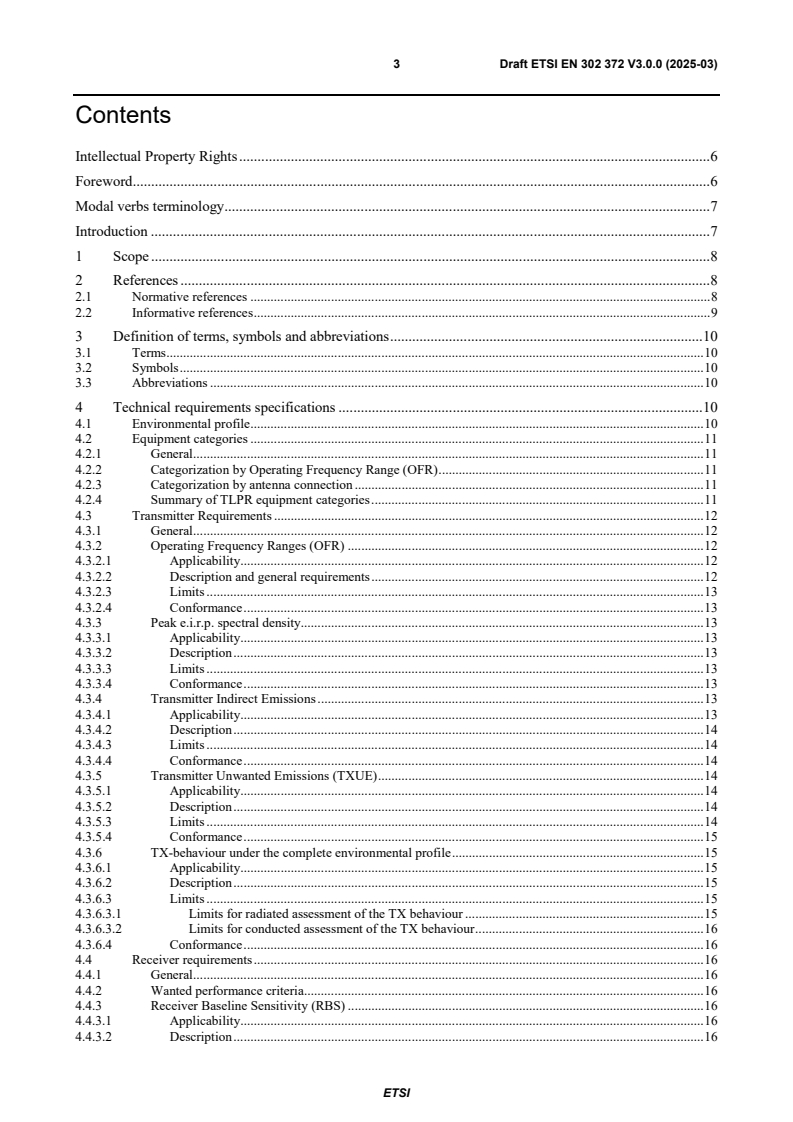
3 Draft ETSI EN 302 372 V3.0.0 (2025-03)
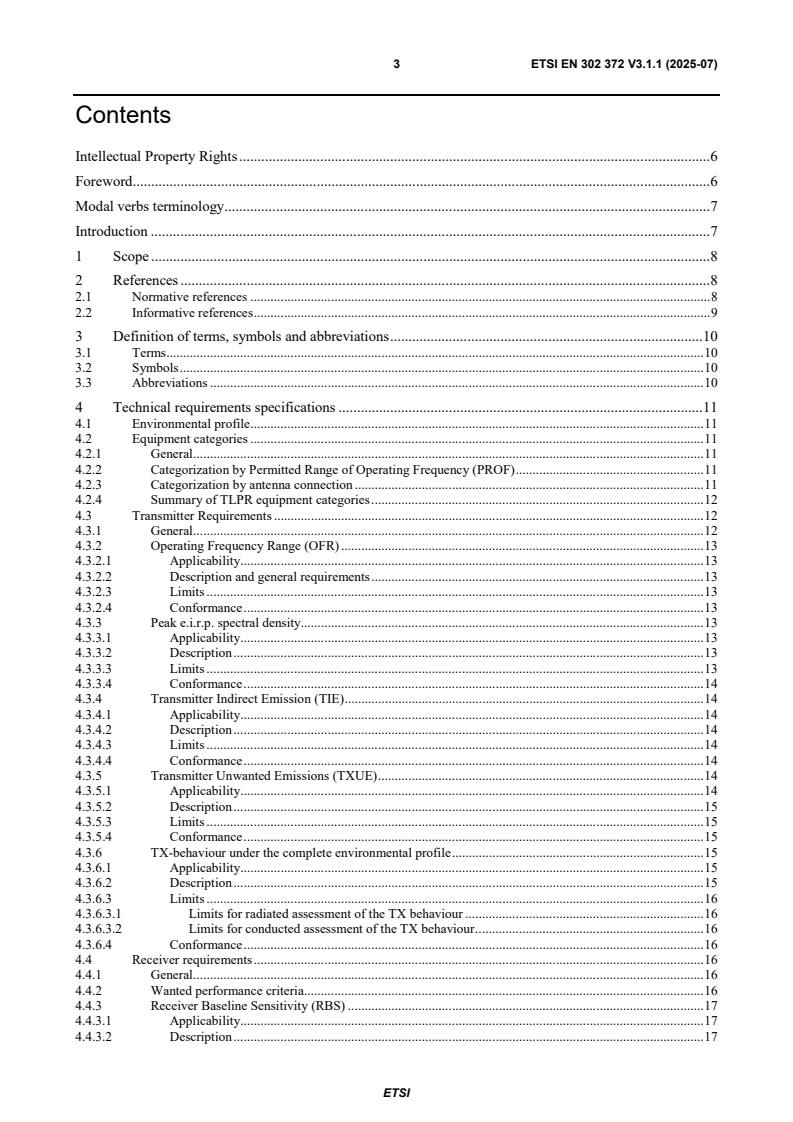
Contents
Intellectual Property Rights . 6
Foreword . 6
Modal verbs terminology . 7
Introduction . 7
1 Scope . 8
2 References . 8
2.1 Normative references . 8
2.2 Informative references . 9
3 Definition of terms, symbols and abbreviations . 10
3.1 Terms . 10
3.2 Symbols . 10
3.3 Abbreviations . 10
4 Technical requirements specifications . 10
4.1 Environmental profile . 10
4.2 Equipment categories . 11
4.2.1 General . 11
4.2.2 Categorization by Operating Frequency Range (OFR) . 11
4.2.3 Categorization by antenna connection . 11
4.2.4 Summary of TLPR equipment categories . 11
4.3 Transmitter Requirements . 12
4.3.1 General . 12
4.3.2 Operating Frequency Ranges (OFR) . 12
4.3.2.1 Applicability. 12
4.3.2.2 Description and general requirements . 12
4.3.2.3 Limits . 13
4.3.2.4 Conformance . 13
4.3.3 Peak e.i.r.p. spectral density. 13
4.3.3.1 Applicability. 13
4.3.3.2 Description . 13
4.3.3.3 Limits . 13
4.3.3.4 Conformance . 13
4.3.4 Transmitter Indirect Emissions . 13
4.3.4.1 Applicability. 13
4.3.4.2 Description . 14
4.3.4.3 Limits . 14
4.3.4.4 Conformance . 14
4.3.5 Transmitter Unwanted Emissions (TXUE) . 14
4.3.5.1 Applicability. 14
4.3.5.2 Description . 14
4.3.5.3 Limits . 14
4.3.5.4 Conformance . 15
4.3.6 TX-behaviour under the complete environmental profile . 15
4.3.6.1 Applicability. 15
4.3.6.2 Description . 15
4.3.6.3 Limits . 15
4.3.6.3.1 Limits for radiated assessment of the TX behaviour . 15
4.3.6.3.2 Limits for conducted assessment of the TX behaviour . 16
4.3.6.4 Conformance . 16
4.4 Receiver requirements . 16
4.4.1 General . 16
4.4.2 Wanted performance criteria. 16
4.4.3 Receiver Baseline Sensitivity (RBS) . 16
4.4.3.1 Applicability. 16
4.4.3.2 Description . 16
ETSI
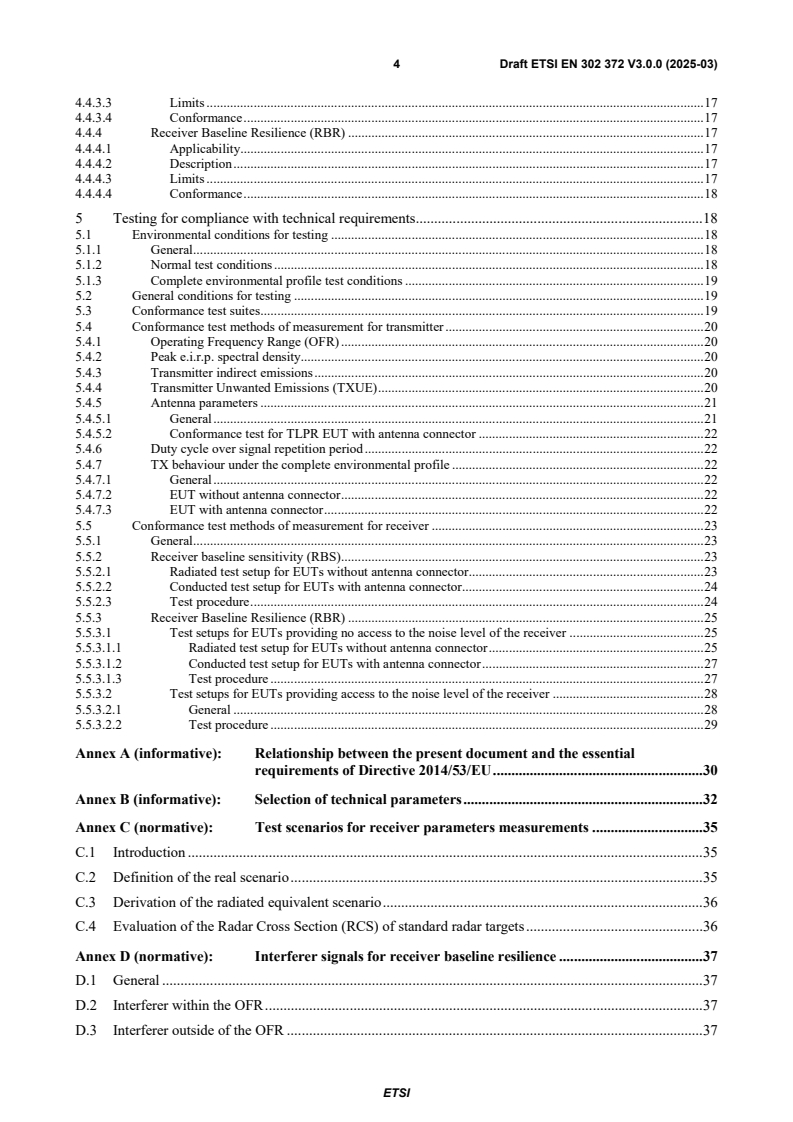
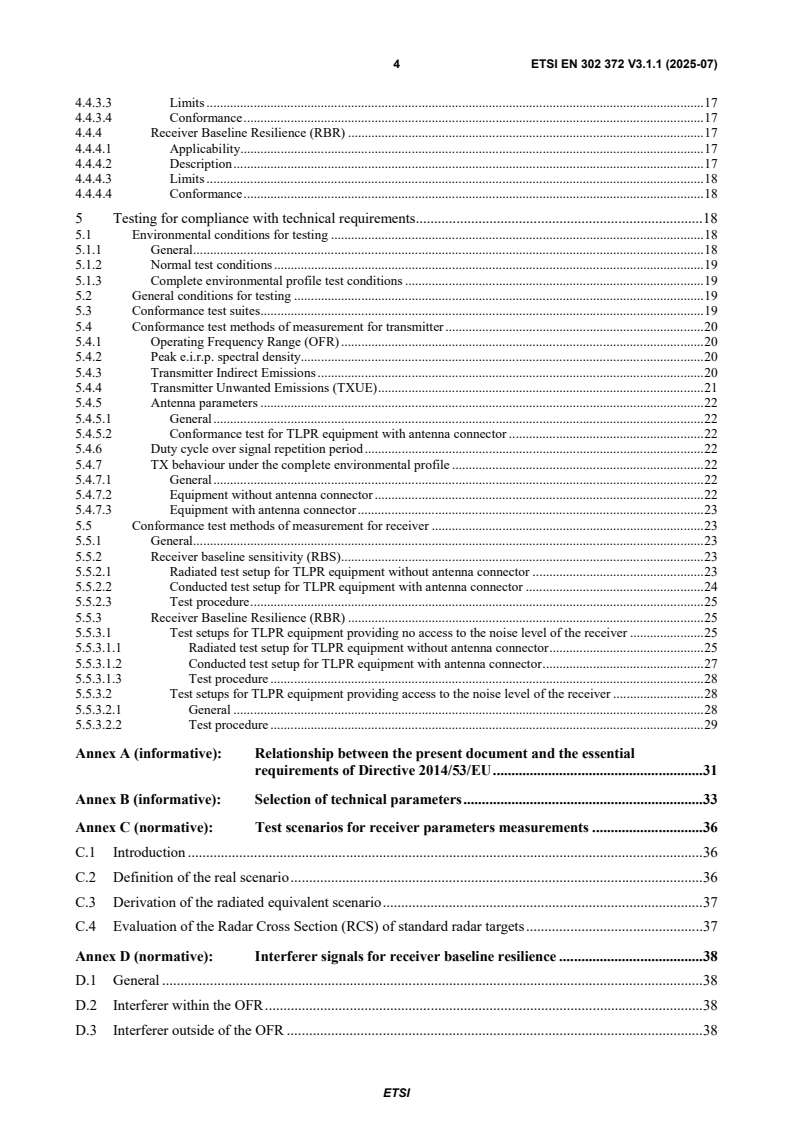
4 Draft ETSI EN 302 372 V3.0.0 (2025-03)
4.4.3.3 Limits . 17
4.4.3.4 Conformance . 17
4.4.4 Receiver Baseline Resilience (RBR) . 17
4.4.4.1 Applicability. 17
4.4.4.2 Description . 17
4.4.4.3 Limits . 17
4.4.4.4 Conformance . 18
5 Testing for compliance with technical requirements . 18
5.1 Environmental conditions for testing . 18
5.1.1 General . 18
5.1.2 Normal test conditions . 18
5.1.3 Complete environmental profile test conditions . 19
5.2 General conditions for testing . 19
5.3 Conformance test suites . 19
5.4 Conformance test methods of measurement for transmitter . 20
5.4.1 Operating Frequency Range (OFR) . 20
5.4.2 Peak e.i.r.p. spectral density. 20
5.4.3 Transmitter indirect emissions . 20
5.4.4 Transmitter Unwanted Emissions (TXUE) . 20
5.4.5 Antenna parameters . 21
5.4.5.1 General . 21
5.4.5.2 Conformance test for TLPR EUT with antenna connector . 22
5.4.6 Duty cycle over signal repetition period . 22
5.4.7 TX behaviour under the complete environmental profile . 22
5.4.7.1 General . 22
5.4.7.2 EUT without antenna connector . 22
5.4.7.3 EUT with antenna connector . 22
5.5 Conformance test methods of measurement for receiver . 23
5.5.1 General . 23
5.5.2 Receiver baseline sensitivity (RBS) . 23
5.5.2.1 Radiated test setup for EUTs without antenna connector. 23
5.5.2.2 Conducted test setup for EUTs with antenna connector. 24
5.5.2.3 Test procedure . 24
5.5.3 Receiver Baseline Resilience (RBR) . 25
5.5.3.1 Test setups for EUTs providing no access to the noise level of the receiver . 25
5.5.3.1.1 Radiated test setup for EUTs without antenna connector . 25
5.5.3.1.2 Conducted test setup for EUTs with antenna connector . 27
5.5.3.1.3 Test procedure . 27
5.5.3.2 Test setups for EUTs providing access to the noise level of the receiver . 28
5.5.3.2.1 General . 28
5.5.3.2.2 Test procedure . 29
Annex A (informative): Relationship between the present document and the essential
requirements of Directive 2014/53/EU . 30
Annex B (informative): Selection of technical parameters . 32
Annex C (normative): Test scenarios for receiver parameters measurements . 35
C.1 Introduction . 35
C.2 Definition of the real scenario . 35
C.3 Derivation of the radiated equivalent scenario . 36
C.4 Evaluation of the Radar Cross Section (RCS) of standard radar targets . 36
Annex D (normative): Interferer signals for receiver baseline resilience . 37
D.1 General . 37
D.2 Interferer within the OFR . 37
D.3 Interferer outside of the OFR . 37
ETSI
5 Draft ETSI EN 302 372 V3.0.0 (2025-03)
Annex E (informative): Range of modulation parameters . 38
E.1 Pulse modulation schemes. 38
E.2 FMCW modulation schemes . 38
Annex F (informative): Installation requirements of Tank Level Probing Radar (TLPR)
equipment . 39
Annex G (normative): Requirements on test tank . 40
Annex H (informative): Electromagnetic leakage from a EUT . 41
H.1 General . 41
H.2 Survey of sources of leakage . 41
Annex I (informative): Bibliography . 43
Annex J (informative): Change history . 44
History . 45
ETSI
6 Draft ETSI EN 302 372 V3.0.0 (2025-03)
Intellectual Property Rights
Essential patents
IPRs essential or potentially essential to normative deliverables may have been declared to ETSI. The declarations
pertaining to these essential IPRs, if any, are publicly available for ETSI members and non-members, and can be
found in ETSI SR 000 314: "Intellectual Property Rights (IPRs); Essential, or potentially Essential, IPRs notified to
ETSI in respect of ETSI standards", which is available from the ETSI Secretariat. Latest updates are available on the
ETSI IPR online database.
Pursuant to the ETSI Directives including the ETSI IPR Policy, no investigation regarding the essentiality of IPRs,
including IPR searches, has been carried out by ETSI. No guarantee can be given as to the existence of other IPRs not
referenced in ETSI SR 000 314 (or the updates on the ETSI Web server) which are, or may be, or may become,
essential to the present document.
Trademarks
The present document may include trademarks and/or tradenames which are asserted and/or registered by their owners.
ETSI claims no ownership of these except for any which are indicated as being the property of ETSI, and conveys no
right to use or reproduce any trademark and/or tradename. Mention of those trademarks in the present document does
not constitute an endorsement by ETSI of products, services or organizations associated with those trademarks.
DECT™, PLUGTESTS™, UMTS™ and the ETSI logo are trademarks of ETSI registered for the benefit of its
Members. 3GPP™, LTE™ and 5G™ logo are trademarks of ETSI registered for the benefit of its Members and of the
3GPP Organizational Partners. oneM2M™ logo is a trademark of ETSI registered for the benefit of its Members and of ®
the oneM2M Partners. GSM and the GSM logo are trademarks registered and owned by the GSM Association.
Foreword
This draft Harmonised European Standard (EN) has been produced by ETSI Technical Committee Electromagnetic
compatibility and Radio spectrum Matters (ERM), and is now submitted for the combined Public Enquiry and Vote
phase of the Standardisation Request deliverable Approval Procedure(SRdAP).
The present document has been prepared under the Commission's standardisation request C(2015) 5376 final [i.2] to
provide one voluntary means of conforming to the essential requirements of Directive 2014/53/EU on the harmonisation
of the laws of the Member States relating to the making available on the market of radio equipment and repealing
Directive 1999/5/EC [i.1].
Once the present document is cited in the Official Journal of the European Union under that Directive, compliance with
the normative clauses of the present document given in Table A.1 confers, within the limits of the scope of the present
document, a presumption of conformity with the corresponding essential requirements of that Directive and associated
EFTA regulations.
Proposed national transposition dates
Date of latest announcement of this EN (doa): 3 months after ETSI publication
Date of latest publication of new National Standard
or endorsement of this EN (dop/e): 6 months after doa
Date of withdrawal of any conflicting National Standard (dow): 18 months after doa
ETSI
7 Draft ETSI EN 302 372 V3.0.0 (2025-03)
Modal verbs terminology
In the present document "shall", "shall not", "should", "should not", "may", "need not", "will", "will not", "can" and
"cannot" are to be interpreted as described in clause 3.2 of the ETSI Drafting Rules (Verbal forms for the expression of
provisions).
"must" and "must not" are NOT allowed in ETSI deliverables except when used in direct citation.
Introduction
In order to cover the requirements concerning the receiver requirements communicated by the European Commission
the present document is a revision of ETSI EN 302 372 V2.1.1 [i.13] a harmonised standard for Tank Level Probing
Equipment within the scope of the Directive 2014/53/EU [i.1]. The standard has been published in the OJEU without
restrictions on 10 March 2017 [i.6].
Unlike LPRs [i.7] the TLPRs are always configured to pre-drilled harmonised openings and flanges of the tanks. Thus,
with very small openings of e.g. a few centimetres most of the TLPR antennae cannot fulfil the characteristics as
required by ETSI EN 302 729-1 [i.7]. Since TLPRs are always installed on metallic tanks, TLPR manufactures have
greater freedom creating a TLPR architecture in order to suit the needs of its customers.
ETSI
8 Draft ETSI EN 302 372 V3.0.0 (2025-03)
1 Scope
The present document specifies technical requirements, limits and test methods for Tank Level Probing Radar (TLPR)
equipment operating in the frequency ranges 4,5 GHz to 7 GHz, 8,5 GHz to 10,6 GHz, 24,05 GHz to 27 GHz, 57 GHz
to 64 GHz and 75 GHz to 85 GHz.
Tank Level Probing Radars in the scope of the present document consist of a combined transmitter and receiver and are
equipped with an integral or dedicated antenna provided and specified by the EUT manufacturer.
Further details of the covered TLPR EUT can be found in clause 4.2 of the present document.
Technical and regulatory requirements for TLPR are provided in European Commission Implementing Decision (EU)
2025/105 [i.5].
NOTE: The relationship between the present document and essential requirements of article 3.2 of Directive
2014/53/EU [i.1] is given in Annex A.
2 References
2.1 Normative references
References are either specific (identified by date of publication and/or edition number or version number) or non-
specific. For specific references, only the cited version applies. For non-specific references, the latest version of the
referenced document (including any amendments) applies.
Referenced documents which are not found to be publicly available in the expected location might be found in the
ETSI docbox.
NOTE: While any hyperlinks included in this clause were valid at the time of publication, ETSI cannot guarantee
their long term validity.
The following referenced documents are necessary for the application of the present document.
[1] ETSI EN 303 883-1 (V2.1.1) (2024-08): "Short Range Devices (SRD) and Ultra Wide Band
(UWB); Part 1: Measurement techniques for transmitter requirements".
[2] ETSI EN 303 883-2 (V2.1.1) (2024-08): "Short Range Devices (SRD) and Ultra Wide Band
(UWB); Part 2: Measurement techniques for receiver requirements".
[3] ETSI TS 103 789 (V1.1.1) (2023-05): "Short Range Devices (SRD) and Ultra Wide Band (UWB);
Radar related parameters and physical test setup for object detection, identification and RCS
measurement".
[4] ETSI TS 103 941 (V1.1.1) (2024-01): "Short Range Devices (SRD) and Ultra Wide Band (UWB);
Measurement setups and specifications for testing under full environmental profile (normal and
extreme environmental conditions)".
ETSI
9 Draft ETSI EN 302 372 V3.0.0 (2025-03)
2.2 Informative references
References are either specific (identified by date of publication and/or edition number or version number) or
non-specific. For specific references, only the cited version applies. For non-specific references, the latest version of the
referenced document (including any amendments) applies.
NOTE: While any hyperlinks included in this clause were valid at the time of publication, ETSI cannot guarantee
their long term validity.
The following referenced documents are not necessary for the application of the present document but they assist the
user with regard to a particular subject area.
[i.1] Directive 2014/53/EU of the European Parliament and of the Council of 16 April 2014 on the
harmonisation of the laws of the Member States relating to the making available on the market of
radio equipment and repealing Directive 1999/5/EC (RE-Directive).
[i.2] Commission implementing Decision C(2015) 5376 final of 4.8.2015 on a standardisation request
to the European Committee for Electrotechnical Standardisation and to the European
Telecommunications Standards Institute as regards radio equipment in support of Directive
2014/53/EU of the European Parliament and of the Council.
[i.3] CEPT ERC Recommendation 74-01 (May 2022): "Unwanted emissions in the spurious domain".
[i.4] Void.
[i.5] Commission Implementing Decision (EU) 2025/105 of 22 January 2025 amending Decision
2006/771/EC updating harmonised technical conditions in the area of radio spectrum use for short-
range devices and repealing Implementing Decision 2014/641/EU on harmonised technical
conditions of radio spectrum use by wireless audio programme making and special events
equipment in the Union.
[i.6] Official Journal of the European Union, 13.7.2018: "Commission communication in the
framework of the implementation of Directive 1999/5/EC of the European Parliament and of the
Council on radio equipment and telecommunications terminal equipment and the mutual
recognition of their conformity and Directive 2014/53/EU of the European Parliament and of the
Council on the harmonisation of the laws of the Member States relating to the making available on
the market of radio equipment and repealing Directive 1999/5/EC".
[i.7] ETSI EN 302 729-1 (V3.1.0) (2025-03): "Short Range Devices (SRD) using Ultra Wide Band
technology (UWB); Harmonised standard for access to radio spectrum; Part 1: Level Probing
Radar (LPR) equipment operating in the frequency ranges 6 GHz to 8,5 GHz, 24,05 GHz to
26,5 GHz, 57 GHz to 64 GHz, 75 GHz to 85 GHz for strictly vertical downward installation".
[i.8] Void.
[i.9] ETSI EG 203 336 (V1.2.1) (2020-05): "Guide for the selection of technical parameters for the
production of Harmonised Standards covering article 3.1(b) and article 3.2 of Directive
2014/53/EU".
[i.10] ETSI TS 103 567 (V1.1.1) (2019-09): "Requirements on signal interferer handling".
[i.11] CEPT ERC Recommendation 70-03 (June 2024): "Relating to the use of Short Range Devices
(SRD)".
[i.12] ETSI TS 103 361 (V1.1.1) (2016-03): "Short Range Devices (SRD) using Ultra Wide Band
technology (UWB); Receiver technical requirements, parameters and measurement procedures to
fulfil the requirements of the Directive 2014/53/EU".
[i.13] ETSI EN 302 372 (V2.1.1): "Short Range Devices (SRD); Tank Level Probing Radar (TLPR)
equipment operating in the frequency ranges 4,5 GHz to 7 GHz, 8,5 GHz to 10,6 GHz, 24,05 GHz
to 27 GHz, 57 GHz to 64 GHz, 75 GHz to 85 GHz; Harmonised Standard covering the essential
requirements of article 3.2 of the Directive 2014/53/EU".
ETSI
10 Draft ETSI EN 302 372 V3.0.0 (2025-03)
3 Definition of terms, symbols and abbreviations
3.1 Terms
For the purposes of the present document, the terms given in ETSI EN 303 883-1 [1], ETSI EN 303 883-2 [2] and the
following apply:
duty cycle over measurement period (DC_T ): ratio of the sum of all the pulse durations t to the active
on pulse
measurement period T
on
duty cycle over signal repetition period (DC_T ): ratio of the sum of all active measurement periods T (bursts,
rep on
sweeps, scans) to the signal repetition period T
rep
Equipment Under Test (EUT): TLPR under test
Frequency Modulated Continuous Wave (FMCW) radar: modulation scheme based on a periodically linear
frequency sweep of the transmit signal (see also clause E.2 and ETSI EN 303 883-1 [1], clause C.2.2)
pulsed radar (or here simply "pulsed TLPR"): modulation scheme based on a periodically transmission of short RF
pulses (see also clause E.1and ETSI EN 303 883-1 [1], clause C.2.1)
radiation: signals emitted intentionally for level measurements
step response time (of an TLPR): time span after a sudden distance change until the output value (distance value)
reaches 90 % of the final value for the first time
3.2 Symbols
For the purposes of the present document, the symbols given in ETSI EN 303 883-1 [1], ETSI EN 303 883-2 [2] and the
following apply:
t pulse duration time in pulsed modulation schemes and dwell time or sweep time for FMCW
pulse
modulation schemes
3.3 Abbreviations
For the purposes of the present document, the abbreviations given in ETSI EN 303 883-1 [1], ETSI EN 303 883-2 [2]
and the following apply:
AUT Antenna Under Test
EFTA European Free Trade Association
FMCW Frequency Modulated Continuous Wave
HPBW Half Power BeamWidth
ITU-R International Telecommunication Union - Radio sector
LPR Level Probing Radar
TLPR Tank Level Probing Radar
4 Technical requirements specifications
4.1 Environmental profile
The technical requirements of the present document apply under the environmental profile for operation of the
equipment, which shall be in accordance with its intended use, but as a minimum, shall be that specified in the test
conditions contained in the present document. The equipment shall comply with all the technical requirements of the
present document at all times when operating within the boundary limits of the operational environmental profile
defined by its intended use.
ETSI
11 Draft ETSI EN 302 372 V3.0.0 (2025-03)
4.2 Equipment categories
4.2.1 General
The present document covers Tank Level Probing Radar (TLPR) devices for operation on tanks as outlined in the scope
(clause 1) of the present document.
Receive-only devices, equipment exhibiting a receive only mode or a standby mode are not covered by the scope of the
present document.
NOTE: In addition, the manufacturer should consider further installation requirements as specified in Annex F
and should provide this information to the user/installer. These installation requirements, however, are not
subject to Annex A of the present document.
A categorization of this TLPR equipment category has been conducted based on:
• the used Operating Frequency Range (OFR), see clause 4.2.2;
• the used antenna connection, see clause 4.2.3.
4.2.2 Categorization by Operating Frequency Range (OFR)
The categorization of TLPR Equipment by the Operating Frequency Range is used as given by Table 1.
Table 1: Categorization by frequency ranges
EUT category Frequency range
OFR 1 4,5 GHz ≤ f ≤ 7 GHz
OFR 2 8,5 GHz ≤ f ≤ 10,6 GHz
OFR 3 24,05 GHz ≤ f ≤ 27 GHz
OFR 4 57 GHz ≤ f ≤ 64 GHz
OFR 5 75 GHz ≤ f ≤ 85 GHz
This categorization has been conducted, reflecting the different permitted frequency ranges which can be used for Tank
Level Probing Radars in accordance with Commission Implementing Decision (EU) 2025/105 [i.5].
4.2.3 Categorization by antenna connection
Each of the TLPR equipment may or may not be equipped with an antenna connector, therefore the second
categorization is done by the kind of antenna connection:
• ANT1: TLPR equipment features an antenna connector - the equipment is equipped with a dedicated antenna
(AUT).
• ANT2: TLPR equipment has no antenna connector-the equipment is equipped with an integral antenna.
4.2.4 Summary of TLPR equipment categories
All of the categories are subject to these clause 4 requirements. Differentiation is made by test cases under clause 5.
An overview of the applicability of transmitter requirements and receiver requirements for the different TLPR
equipment categories is shown in Table 2 and Table 3.
ETSI
12 Draft ETSI EN 302 372 V3.0.0 (2025-03)
Table 2: Applicability of transmitter requirements for the different TLPR equipment categories
Categorization
TX requirements Clause Operating Frequency Range antenna connection
OFR1 to OFR5 ANT1 and ANT2
Operating frequency range 4.3.2
Indirect emissions
measured as 4.3.4 applicable to any category applicable to any category
mean e.i.r.p. spectral density
(OFR1 to OFR5) (ANT1 and ANT2)
Peak e.i.r.p. spectral density 4.3.3
Transmitter unwanted emissions (TXUE) 4.3.5
Table 3: Applicability of receiver requirements for the different TLPR equipment categories
Categorization
RX requirements Clause Operating Frequency Range antenna connection
OFR1 to OFR5 ANT1 and ANT2
Receiver Baseline Sensitivity (RBS) 4.4.3 applicable to any category
applicable to any category
(OFR1 to OFR5)
Receiver Baseline Resilience
4.4.4 (ANT1 and ANT2)
(RBR)
The categories which are supported by the TLPR equipment shall be stated in the technical documentation of the
equipment (TLPR1 to TLPR10, see Table 4).
Table 4: TLPR equipment categories based on the categorization listed in clauses 4.2.2 and 4.2.3
TLPR Equipment category Categorization
Operating Frequency Range antenna connection
TLPR1 OFR1 ANT1
TLPR2 OFR1 ANT2
TLPR3 OFR2 ANT1
TLPR4 OFR2 ANT2
TLPR5 OFR3 ANT1
TLPR6 OFR3 ANT2
TLPR7 OFR4 ANT1
TLPR8 OFR4 ANT2
TLPR9 OFR5 ANT1
TLPR10 OFR5 ANT2
4.3 Transmitter Requirements
4.3.1 General
The transmitter requirements for TLPR equipment covered by the scope of the present document are justified in
Table B.1 in Annex B.
4.3.2 Operating Frequency Ranges (OFR)
4.3.2.1 Applicability
The Operating Frequency Range requirement applies to all TLPR equipment categories as defined in clause 4.2,
Table 4.
4.3.2.2 Description and general requirements
The Operating Frequency Range is described in clause 5.2 of ETSI EN 303 883-1 [1]. According to this description, a
value of 20 dB shall be used for the parameter X.
ETSI
13 Draft ETSI EN 302 372 V3.0.0 (2025-03)
4.3.2.3 Limits
The OFR (all frequencies between f and f ) shall be within one of the permitted frequency ranges (see Table 5).
L H
Table 5: Permitted frequency ranges for the different EUT categories
Mode of operation EUT category Frequency range
Transmit and receive TLPR1, TLPR2 4,5 GHz ≤ f ≤ 7 GHz
Transmit and receive TLPR3, TLPR4 8,5 GHz ≤ f ≤ 10,6 GHz
Transmit and receive TLPR5, TLPR6 24,05 GHz ≤ f ≤ 27 GHz
Transmit and receive TLPR7, TLPR8 57 GHz ≤ f ≤ 64 GHz
Transmit and receive TLPR9, TLPR10 75 GHz ≤ f ≤ 85 GHz
NOTE: The limits are in accordance with Commission Implementing Decision (EU) 2025/105 [i.5],
bands No. 60, 64, 68, 74b and 78b.
4.3.2.4 Conformance
The conformance test for the OFR shall is defined in clause 5.4.1.
4.3.3 Peak e.i.r.p. spectral density
4.3.3.1 Applicability
The peak e.i.r.p. spectral density requirement applies to all TLPR equipment categories as defined in clause 4.2,
Table 4.
4.3.3.2 Description
The peak e.i.r.p. spectral density is described in ETSI EN 303 883-1 [1], clause 5.3.4.
4.3.3.3 Limits
Within the OFR the peak e.i.r.p. spectral density shall not exceed the limits in Table 6.
Table 6: Peak e.i.r.p. spectral density limits
EUT category Maximum peak e.i.r.p.
(measured in 50 MHz within the antenna main beam)
TLPR1, TLPR2 +24 dBm
TLPR3, TLPR4 +30 dBm
TLPR5, TLPR6 +43 dBm
TLPR7, TLPR8 +43 dBm
TLPR9, TLPR10 +43 dBm
NOTE: The limits are in accordance with Commission Implementing Decision (EU) 2025/105 [i.5],
bands No. 60, 64, 68, 74b and 78b.
4.3.3.4 Conformance
The conformance test for peak e.i.r.p. spectral density is defined in clause 5.4.2.
4.3.4 Transmitter Indirect Emissions
4.3.4.1 Applicability
The transmitter indirect emissions requirement applies to all TLPR equipment categories as defined in clause 4.2,
Table 4.
ETSI
14 Draft ETSI EN 302 372 V3.0.0 (2025-03)
4.3.4.2 Description
The transmitter indirect emissions are leakage signals from a tank structure including an installed TLPR. Leakage
emissions from the test setup include all emissions: TX, and other spurious emissions. They are measured as maximum
mean power spectral density (specified as e.i.r.p.) of the radio device under test. Transmitter unwanted emission limits
are given in clause 4.3.5.
The transmitter indirect emissions of TLPR devices are described in ETSI EN 303 883-1 [1], clause 5.7.1, Figure 19.
The mean e.i.r.p. spectral density is described in ETSI EN 303 883-1 [1], clause 5.3.2.
4.3.4.3 Limits
The effectively radiated power within the Operating Frequency Ranges shall not exceed the values given in Table 7.
Table 7: Transmitter indirect emissions inside the assigned frequency band
Assigned frequency band (GHz) Maximum emissions outside the tank enclosure
Equipment category structure inside the assigned frequency band
TLPR1, TLPR2,
TLPR3, TLPR4,
TLPR5, TLPR6, -41,3 dBm/MHz
TLPR7, TLPR8,
TLPR9, TLPR10
NOTE: The limits are in accordance with Commission Implementing Decision (EU) 2025/105 [i.5],
bands No. 60, 64, 68, 74b and 78b.
4.3.4.4 Conformance
The conformance test for indirect emissions (mean e.i.r.p. spectral density) inside the assigned frequency band is
defined in clause 5.4.3.
4.3.5 Transmitter Unwanted Emissions (TXUE)
4.3.5.1 Applicability
The transmitter unwanted emissions requirement applies to all TLPR equipment categories as specified in clause 4.2,
Table 4.
4.3.5.2 Description
The transmitter unwanted emissions are described in clause 5.5.1 of ETSI EN 303 883-1 [1].
As requested in ETSI EN 303 883-1 [1], clause 5.5.1 the limit for the parameter X for all TLPR equipment
TXUE
categories see clause 4.2.4, Table 4) is specified to:
X: 50 %
TXUE
4.3.5.3 Limits
The Transmitter Unwanted Emissions (TXUE) for TLPR equipment shall not exceed the limits in Table 8.
ETSI
15 Draft ETSI EN 302 372 V3.0.0 (2025-03)
Table 8: Transmitter unwanted emissions limits in the spurious domain
Frequency range Limit values for TXUE
87,5 MHz ≤ f ≤ 118 MHz -54 dBm/100 kHz
174 MHz ≤ f ≤ 230 MHz -54 dBm/100 kHz
470 MHz ≤ f ≤ 694 MHz -54 dBm/100 kHz
otherwise in band 30 MHz ≤ f ≤ 1 000 MHz -36 dBm/100 kHz
1 000 MHz < f ≤ F (see Table 9) -30 dBm/1 MHz
UPPER
10,6 GHz ≤ f ≤ 10,7 GHz -60 dBm/1 MHz
(see note1)
NOTE 1: CEPT ERC Recommendation 70-03 [i.11], Table 6, line f2.
NOTE 2: The limits are in accordance with CEPT ERC Recommendation 74-01 [i.3] for all equipment
categories.
Table 9: Upper frequency boundary for the spurious domain based on
the EUT Operating Frequency Range (OFR)
EUT sub-category Frequency range which contains the OFR of the Upper frequency (F )
UPPER
EUT (defined by fL and fH) (note 1)
TLPR1, TLPR2 5,2 GHz ≤ f < 13 GHz 26 GHz
TLPR3, TLPR4
nd
TLPR5, TLPR6, TLPR7, 13 GHz ≤ f ≤ 150 GHz
2 harmonic (note)
TLPR8, TLPR9, TLPR10
NOTE 1: For F the value of f shall be used (f is the upper edge of the Operating Frequency Range (OFR),
UPPER H H
which is assessed in clause 4.3.2).
NOTE 2: The limits are in accordance with CEPT ERC Recommendation 74-01 [i.3].
4.3.5.4 Conformance
The conformance test for transmitter unwanted emissions is defined in clause 5.4.4.
4.3.6 TX-behaviour under the complete environmental profile
4.3.6.1 Applicability
This requirement shall apply to all TLPR equipment categories as specified in T
...
HARMONISED EUROPEAN STANDARD
Short Range Devices (SRD)
using Ultra Wide Band technology (UWB);
Harmonised standard for access to radio spectrum;
Tank Level Probing Radar (TLPR) equipment operating in
the frequency ranges 4,5 GHz to 7 GHz, 8,5 GHz to 10,6 GHz,
24,05 GHz to 27 GHz, 57 GHz to 64 GHz, 75 GHz to 85 GHz
2 ETSI EN 302 372 V3.1.1 (2025-07)
Reference
REN/ERM-TGUWB-151
Keywords
EHF, harmonised standard, radar, regulation, SHF,
short range, SRD, testing, UWB
ETSI
650 Route des Lucioles
F-06921 Sophia Antipolis Cedex - FRANCE
Tel.: +33 4 92 94 42 00 Fax: +33 4 93 65 47 16
Siret N° 348 623 562 00017 - APE 7112B
Association à but non lucratif enregistrée à la
Sous-Préfecture de Grasse (06) N° w061004871
Important notice
The present document can be downloaded from the
ETSI Search & Browse Standards application.
The present document may be made available in electronic versions and/or in print. The content of any electronic and/or
print versions of the present document shall not be modified without the prior written authorization of ETSI. In case of any
existing or perceived difference in contents between such versions and/or in print, the prevailing version of an ETSI
deliverable is the one made publicly available in PDF format on ETSI deliver repository.
Users should be aware that the present document may be revised or have its status changed,
this information is available in the Milestones listing.
If you find errors in the present document, please send your comments to
the relevant service listed under Committee Support Staff.
If you find a security vulnerability in the present document, please report it through our
Coordinated Vulnerability Disclosure (CVD) program.
Notice of disclaimer & limitation of liability
The information provided in the present deliverable is directed solely to professionals who have the appropriate degree of
experience to understand and interpret its content in accordance with generally accepted engineering or
other professional standard and applicable regulations.
No recommendation as to products and services or vendors is made or should be implied.
In no event shall ETSI be held liable for loss of profits or any other incidental or consequential damages.
Any software contained in this deliverable is provided "AS IS" with no warranties, express or implied, including but not
limited to, the warranties of merchantability, fitness for a particular purpose and non-infringement of intellectual property
rights and ETSI shall not be held liable in any event for any damages whatsoever (including, without limitation, damages
for loss of profits, business interruption, loss of information, or any other pecuniary loss) arising out of or related to the use
of or inability to use the software.
Copyright Notification
No part may be reproduced or utilized in any form or by any means, electronic or mechanical, including photocopying and
microfilm except as authorized by written permission of ETSI.
The content of the PDF version shall not be modified without the written authorization of ETSI.
The copyright and the foregoing restriction extend to reproduction in all media.
© ETSI 2025.
All rights reserved.
ETSI
3 ETSI EN 302 372 V3.1.1 (2025-07)
Contents
Intellectual Property Rights . 6
Foreword . 6
Modal verbs terminology . 7
Introduction . 7
1 Scope . 8
2 References . 8
2.1 Normative references . 8
2.2 Informative references . 9
3 Definition of terms, symbols and abbreviations . 10
3.1 Terms . 10
3.2 Symbols . 10
3.3 Abbreviations . 10
4 Technical requirements specifications . 11
4.1 Environmental profile . 11
4.2 Equipment categories . 11
4.2.1 General . 11
4.2.2 Categorization by Permitted Range of Operating Frequency (PROF) . 11
4.2.3 Categorization by antenna connection . 11
4.2.4 Summary of TLPR equipment categories . 12
4.3 Transmitter Requirements . 12
4.3.1 General . 12
4.3.2 Operating Frequency Range (OFR) . 13
4.3.2.1 Applicability. 13
4.3.2.2 Description and general requirements . 13
4.3.2.3 Limits . 13
4.3.2.4 Conformance . 13
4.3.3 Peak e.i.r.p. spectral density. 13
4.3.3.1 Applicability. 13
4.3.3.2 Description . 13
4.3.3.3 Limits . 13
4.3.3.4 Conformance . 14
4.3.4 Transmitter Indirect Emission (TIE) . 14
4.3.4.1 Applicability. 14
4.3.4.2 Description . 14
4.3.4.3 Limits . 14
4.3.4.4 Conformance . 14
4.3.5 Transmitter Unwanted Emissions (TXUE) . 14
4.3.5.1 Applicability. 14
4.3.5.2 Description . 15
4.3.5.3 Limits . 15
4.3.5.4 Conformance . 15
4.3.6 TX-behaviour under the complete environmental profile . 15
4.3.6.1 Applicability. 15
4.3.6.2 Description . 15
4.3.6.3 Limits . 16
4.3.6.3.1 Limits for radiated assessment of the TX behaviour . 16
4.3.6.3.2 Limits for conducted assessment of the TX behaviour . 16
4.3.6.4 Conformance . 16
4.4 Receiver requirements . 16
4.4.1 General . 16
4.4.2 Wanted performance criteria. 16
4.4.3 Receiver Baseline Sensitivity (RBS) . 17
4.4.3.1 Applicability. 17
4.4.3.2 Description . 17
ETSI
4 ETSI EN 302 372 V3.1.1 (2025-07)
4.4.3.3 Limits . 17
4.4.3.4 Conformance . 17
4.4.4 Receiver Baseline Resilience (RBR) . 17
4.4.4.1 Applicability. 17
4.4.4.2 Description . 17
4.4.4.3 Limits . 18
4.4.4.4 Conformance . 18
5 Testing for compliance with technical requirements . 18
5.1 Environmental conditions for testing . 18
5.1.1 General . 18
5.1.2 Normal test conditions . 19
5.1.3 Complete environmental profile test conditions . 19
5.2 General conditions for testing . 19
5.3 Conformance test suites . 19
5.4 Conformance test methods of measurement for transmitter . 20
5.4.1 Operating Frequency Range (OFR) . 20
5.4.2 Peak e.i.r.p. spectral density. 20
5.4.3 Transmitter Indirect Emissions . 20
5.4.4 Transmitter Unwanted Emissions (TXUE) . 21
5.4.5 Antenna parameters . 22
5.4.5.1 General . 22
5.4.5.2 Conformance test for TLPR equipment with antenna connector . 22
5.4.6 Duty cycle over signal repetition period . 22
5.4.7 TX behaviour under the complete environmental profile . 22
5.4.7.1 General . 22
5.4.7.2 Equipment without antenna connector . 22
5.4.7.3 Equipment with antenna connector . 23
5.5 Conformance test methods of measurement for receiver . 23
5.5.1 General . 23
5.5.2 Receiver baseline sensitivity (RBS) . 23
5.5.2.1 Radiated test setup for TLPR equipment without antenna connector . 23
5.5.2.2 Conducted test setup for TLPR equipment with antenna connector . 24
5.5.2.3 Test procedure . 25
5.5.3 Receiver Baseline Resilience (RBR) . 25
5.5.3.1 Test setups for TLPR equipment providing no access to the noise level of the receiver . 25
5.5.3.1.1 Radiated test setup for TLPR equipment without antenna connector . 25
5.5.3.1.2 Conducted test setup for TLPR equipment with antenna connector . 27
5.5.3.1.3 Test procedure . 28
5.5.3.2 Test setups for TLPR equipment providing access to the noise level of the receiver . 28
5.5.3.2.1 General . 28
5.5.3.2.2 Test procedure . 29
Annex A (informative): Relationship between the present document and the essential
requirements of Directive 2014/53/EU . 31
Annex B (informative): Selection of technical parameters . 33
Annex C (normative): Test scenarios for receiver parameters measurements . 36
C.1 Introduction . 36
C.2 Definition of the real scenario . 36
C.3 Derivation of the radiated equivalent scenario . 37
C.4 Evaluation of the Radar Cross Section (RCS) of standard radar targets . 37
Annex D (normative): Interferer signals for receiver baseline resilience . 38
D.1 General . 38
D.2 Interferer within the OFR . 38
D.3 Interferer outside of the OFR . 38
ETSI
5 ETSI EN 302 372 V3.1.1 (2025-07)
Annex E (informative): Range of modulation parameters . 39
E.1 Pulse modulation schemes. 39
E.2 FMCW modulation schemes . 39
Annex F (informative): Installation requirements of Tank Level Probing Radar (TLPR)
equipment . 40
Annex G (normative): Requirements on test tank . 41
Annex H (informative): Electromagnetic leakage from a EUT . 42
H.1 General . 42
H.2 Survey of sources of leakage . 42
Annex I (informative): Bibliography . 44
Annex J (informative): Change history . 45
History . 46
ETSI
6 ETSI EN 302 372 V3.1.1 (2025-07)
Intellectual Property Rights
Essential patents
IPRs essential or potentially essential to normative deliverables may have been declared to ETSI. The declarations
pertaining to these essential IPRs, if any, are publicly available for ETSI members and non-members, and can be
found in ETSI SR 000 314: "Intellectual Property Rights (IPRs); Essential, or potentially Essential, IPRs notified to
ETSI in respect of ETSI standards", which is available from the ETSI Secretariat. Latest updates are available on the
ETSI IPR online database.
Pursuant to the ETSI Directives including the ETSI IPR Policy, no investigation regarding the essentiality of IPRs,
including IPR searches, has been carried out by ETSI. No guarantee can be given as to the existence of other IPRs not
referenced in ETSI SR 000 314 (or the updates on the ETSI Web server) which are, or may be, or may become,
essential to the present document.
Trademarks
The present document may include trademarks and/or tradenames which are asserted and/or registered by their owners.
ETSI claims no ownership of these except for any which are indicated as being the property of ETSI, and conveys no
right to use or reproduce any trademark and/or tradename. Mention of those trademarks in the present document does
not constitute an endorsement by ETSI of products, services or organizations associated with those trademarks.
DECT™, PLUGTESTS™, UMTS™ and the ETSI logo are trademarks of ETSI registered for the benefit of its
Members. 3GPP™, LTE™ and 5G™ logo are trademarks of ETSI registered for the benefit of its Members and of the
3GPP Organizational Partners. oneM2M™ logo is a trademark of ETSI registered for the benefit of its Members and of ®
the oneM2M Partners. GSM and the GSM logo are trademarks registered and owned by the GSM Association.
Foreword
This Harmonised European Standard (EN) has been produced by ETSI Technical Committee Electromagnetic
compatibility and Radio spectrum Matters (ERM).
The present document has been prepared under the Commission's standardisation request C(2015) 5376 final [i.2] to
provide one voluntary means of conforming to the essential requirements of Directive 2014/53/EU on the harmonisation
of the laws of the Member States relating to the making available on the market of radio equipment and repealing
Directive 1999/5/EC [i.1].
Once the present document is cited in the Official Journal of the European Union under that Directive, compliance with
the normative clauses of the present document given in Table A.1 confers, within the limits of the scope of the present
document, a presumption of conformity with the corresponding essential requirements of that Directive and associated
EFTA regulations.
National transposition dates
Date of adoption of this EN: 12 June 2025
Date of latest announcement of this EN (doa): 30 September 2025
Date of latest publication of new National Standard
or endorsement of this EN (dop/e): 31 March 2026
Date of withdrawal of any conflicting National Standard (dow): 31 March 2027
ETSI
7 ETSI EN 302 372 V3.1.1 (2025-07)
Modal verbs terminology
In the present document "shall", "shall not", "should", "should not", "may", "need not", "will", "will not", "can" and
"cannot" are to be interpreted as described in clause 3.2 of the ETSI Drafting Rules (Verbal forms for the expression of
provisions).
"must" and "must not" are NOT allowed in ETSI deliverables except when used in direct citation.
Introduction
In order to cover the requirements concerning the receiver requirements communicated by the European Commission
the present document is a revision of ETSI EN 302 372 V2.1.1 [i.13] a harmonised standard for Tank Level Probing
Equipment within the scope of the Directive 2014/53/EU [i.1]. The standard has been published in the OJEU without
restrictions on 10 March 2017 [i.6].
Unlike LPRs [i.7] the TLPRs are always configured to pre-drilled harmonised openings and flanges of the tanks. Thus,
with very small openings of e.g. a few centimetres most of the TLPR antennae cannot fulfil the characteristics as
required by ETSI EN 302 729-1 [i.7]. Since TLPRs are always installed on metallic tanks, TLPR manufactures have
greater freedom creating a TLPR architecture in order to suit the needs of its customers.
ETSI
8 ETSI EN 302 372 V3.1.1 (2025-07)
1 Scope
The present document specifies technical requirements, limits and test methods for Tank Level Probing Radar (TLPR)
equipment operating in the frequency ranges 4,5 GHz to 7 GHz, 8,5 GHz to 10,6 GHz, 24,05 GHz to 27 GHz, 57 GHz
to 64 GHz and 75 GHz to 85 GHz.
Tank Level Probing Radar equipment in the scope of the present document consist of a combined transmitter and
receiver and are equipped with an integral or dedicated antenna provided and specified by the equipment manufacturer.
Further details of the covered TLPR equipment can be found in clause 4.2 of the present document.
Technical and regulatory requirements for TLPR are provided in European Commission Implementing Decision (EU)
2025/105 [i.5].
NOTE: The relationship between the present document and essential requirements of article 3.2 of
Directive 2014/53/EU [i.1] is given in Annex A.
2 References
2.1 Normative references
References are either specific (identified by date of publication and/or edition number or version number) or non-
specific. For specific references, only the cited version applies. For non-specific references, the latest version of the
referenced document (including any amendments) applies.
Referenced documents which are not found to be publicly available in the expected location might be found in the
ETSI docbox.
NOTE: While any hyperlinks included in this clause were valid at the time of publication, ETSI cannot guarantee
their long-term validity.
The following referenced documents are necessary for the application of the present document.
[1] ETSI EN 303 883-1 (V2.1.1) (2024-08): "Short Range Devices (SRD) and Ultra Wide Band
(UWB); Part 1: Measurement techniques for transmitter requirements".
[2] ETSI EN 303 883-2 (V2.1.1) (2024-08): "Short Range Devices (SRD) and Ultra Wide Band
(UWB); Part 2: Measurement techniques for receiver requirements".
[3] ETSI TS 103 789 (V1.1.1) (2023-05): "Short Range Devices (SRD) and Ultra Wide Band (UWB);
Radar related parameters and physical test setup for object detection, identification and RCS
measurement".
[4] ETSI TS 103 941 (V1.1.1) (2024-01): "Short Range Devices (SRD) and Ultra Wide Band (UWB);
Measurement setups and specifications for testing under full environmental profile (normal and
extreme environmental conditions)".
ETSI
9 ETSI EN 302 372 V3.1.1 (2025-07)
2.2 Informative references
References are either specific (identified by date of publication and/or edition number or version number) or
non-specific. For specific references, only the cited version applies. For non-specific references, the latest version of the
referenced document (including any amendments) applies.
NOTE: While any hyperlinks included in this clause were valid at the time of publication, ETSI cannot guarantee
their long-term validity.
The following referenced documents may be useful in implementing an ETSI deliverable or add to the reader's
understanding, but are not required for conformance to the present document.
[i.1] Directive 2014/53/EU of the European Parliament and of the Council of 16 April 2014 on the
harmonisation of the laws of the Member States relating to the making available on the market of
radio equipment and repealing Directive 1999/5/EC (RE-Directive).
[i.2] Commission implementing Decision C(2015) 5376 final of 4.8.2015 on a standardisation request
to the European Committee for Electrotechnical Standardisation and to the European
Telecommunications Standards Institute as regards radio equipment in support of Directive
2014/53/EU of the European Parliament and of the Council.
[i.3] CEPT ERC Recommendation 74-01 (May 2022): "Unwanted emissions in the spurious domain".
[i.4] Void.
[i.5] Commission Implementing Decision (EU) 2025/105 of 22 January 2025 amending Decision
2006/771/EC updating harmonised technical conditions in the area of radio spectrum use for short-
range devices and repealing Implementing Decision 2014/641/EU on harmonised technical
conditions of radio spectrum use by wireless audio programme making and special events
equipment in the Union.
[i.6] Official Journal of the European Union, 13.7.2018: "Commission communication in the
framework of the implementation of Directive 1999/5/EC of the European Parliament and of the
Council on radio equipment and telecommunications terminal equipment and the mutual
recognition of their conformity and Directive 2014/53/EU of the European Parliament and of the
Council on the harmonisation of the laws of the Member States relating to the making available on
the market of radio equipment and repealing Directive 1999/5/EC".
[i.7] ETSI EN 302 729-1 (V3.1.0) (2025-03): "Short Range Devices (SRD) using Ultra Wide Band
technology (UWB); Harmonised standard for access to radio spectrum; Part 1: Level Probing
Radar (LPR) equipment operating in the frequency ranges 6 GHz to 8,5 GHz, 24,05 GHz to
26,5 GHz, 57 GHz to 64 GHz, 75 GHz to 85 GHz for strictly vertical downward installation".
[i.8] Void.
[i.9] ETSI EG 203 336 (V1.2.1) (2020-05): "Guide for the selection of technical parameters for the
production of Harmonised Standards covering article 3.1(b) and article 3.2 of Directive
2014/53/EU".
[i.10] ETSI TS 103 567 (V1.1.1) (2019-09): "Requirements on signal interferer handling".
[i.11] CEPT ERC Recommendation 70-03 (June 2024): "Relating to the use of Short Range Devices
(SRD)".
[i.12] ETSI TS 103 361 (V1.1.1) (2016-03): "Short Range Devices (SRD) using Ultra Wide Band
technology (UWB); Receiver technical requirements, parameters and measurement procedures to
fulfil the requirements of the Directive 2014/53/EU".
[i.13] ETSI EN 302 372 (V2.1.1): "Short Range Devices (SRD); Tank Level Probing Radar (TLPR)
equipment operating in the frequency ranges 4,5 GHz to 7 GHz, 8,5 GHz to 10,6 GHz, 24,05 GHz
to 27 GHz, 57 GHz to 64 GHz, 75 GHz to 85 GHz; Harmonised Standard covering the essential
requirements of article 3.2 of the Directive 2014/53/EU".
ETSI
10 ETSI EN 302 372 V3.1.1 (2025-07)
3 Definition of terms, symbols and abbreviations
3.1 Terms
For the purposes of the present document, the terms given in ETSI EN 303 883-1 [1], ETSI EN 303 883-2 [2] and the
following apply:
duty cycle over measurement period (DC_T ): ratio of the sum of all the pulse durations t to the active
on pulse
measurement period T
on
duty cycle over signal repetition period (DC_T ): ratio of the sum of all active measurement periods T (bursts,
rep on
sweeps, scans) to the signal repetition period T
rep
Equipment Under Test (EUT): TLPR equipment under test
Frequency Modulated Continuous Wave (FMCW) radar: modulation scheme based on a periodically linear
frequency sweep of the transmit signal (see also clause E.2 and ETSI EN 303 883-1 [1], clause C.2.2)
pulsed radar (or here simply "pulsed TLPR"): modulation scheme based on a periodically transmission of short RF
pulses (see also clause E.1and ETSI EN 303 883-1 [1], clause C.2.1)
radiation: signals emitted intentionally for level measurements
step response time (of an TLPR): time span after a sudden distance change until the output value (distance value)
reaches 90 % of the final value for the first time
3.2 Symbols
For the purposes of the present document, the symbols given in ETSI EN 303 883-1 [1], ETSI EN 303 883-2 [2] and the
following apply:
t pulse duration time in pulsed modulation schemes and dwell time or sweep time for FMCW
pulse
modulation schemes
3.3 Abbreviations
For the purposes of the present document, the abbreviations given in ETSI EN 303 883-1 [1], ETSI EN 303 883-2 [2]
and the following apply:
AUT Antenna Under Test
EFTA European Free Trade Association
FMCW Frequency Modulated Continuous Wave
HPBW Half Power BeamWidth
ITU-R International Telecommunication Union - Radio sector
LPR Level Probing Radar
PROF Permitted Range of Operating Frequency
TIE Transmitter Indirect Emission
TLPR Tank Level Probing Radar
ETSI
11 ETSI EN 302 372 V3.1.1 (2025-07)
4 Technical requirements specifications
4.1 Environmental profile
The technical requirements of the present document apply under the environmental profile for operation of the
equipment, which shall be in accordance with its intended use, but as a minimum, shall be that specified in the test
conditions contained in the present document. The equipment shall comply with all the technical requirements of the
present document at all times when operating within the boundary limits of the operational environmental profile
defined by its intended use.
4.2 Equipment categories
4.2.1 General
The present document covers Tank Level Probing Radar (TLPR) equipment for operation on tanks as outlined in the
scope (clause 1) of the present document.
Receive-only equipment exhibiting a receive only mode or a standby mode are not covered by the scope of the present
document.
NOTE: In addition, the manufacturer should consider further installation requirements as specified in Annex F
and should provide this information to the user/installer. These installation requirements, however, are not
subject to Annex A of the present document.
A categorization of this TLPR equipment category has been conducted based on:
• the operation in the Permitted Range of Operating Frequency(PROF), see clause 4.2.2;
• the available antenna connection, see clause 4.2.3.
4.2.2 Categorization by Permitted Range of Operating Frequency (PROF)
The categorization of TLPR equipment by the Permitted Range of Operation is used as given by Table 1.
Table 1: Categorization by frequency ranges
EUT category Permitted Range of
Operating Frequency
PROF 1 4,5 GHz ≤ f ≤ 7 GHz
PROF 2 8,5 GHz ≤ f ≤ 10,6 GHz
PROF 3 24,05 GHz ≤ f ≤ 27 GHz
PROF 4 57 GHz ≤ f ≤ 64 GHz
PROF 5 75 GHz ≤ f ≤ 85 GHz
This categorization of Permitted Range of Operating Frequency has been conducted, reflecting the different permitted
frequency ranges which can be used for Tank Level Probing Radars in accordance with Commission Implementing
Decision (EU) 2025/105 [i.5].
4.2.3 Categorization by antenna connection
Each of the TLPR equipment may or may not be equipped with an antenna connector, therefore the second
categorization is done by the kind of antenna connection:
• ANT1: TLPR equipment features an antenna connector - the equipment is equipped with a dedicated antenna
(AUT).
• ANT2: TLPR equipment has no antenna connector-the equipment is equipped with an integral antenna.
ETSI
12 ETSI EN 302 372 V3.1.1 (2025-07)
4.2.4 Summary of TLPR equipment categories
All of the categories are subject to these clause 4 requirements. Differentiation is made by test cases under clause 5.
An overview of the applicability of transmitter requirements and receiver requirements for the different TLPR
equipment categories is shown in Table 2 and Table 3.
Table 2: Applicability of transmitter requirements for the different TLPR equipment categories
Category
TX requirements Clause Permitted Range of Operating
antenna connection
Frequency
Operating frequency range 4.3.2
Indirect emissions
measured as 4.3.4
applicable to all categories applicable to all categories
mean e.i.r.p. spectral density
(PROF1 to PROF5) (ANT1 and ANT2)
Peak e.i.r.p. spectral density 4.3.3
Transmitter Unwanted Emissions
4.3.5
(TXUE)
Table 3: Applicability of receiver requirements for the different TLPR equipment categories
Category
Permitted Range of Operating
RX requirements Clause antenna connection
Frequency
Receiver Baseline Sensitivity (RBS) 4.4.3 applicable to all categories
applicable to all categories
(PROF1 to PROF5)
Receiver Baseline Resilience
4.4.4 (ANT1 and ANT2)
(RBR)
The categories which are supported by the TLPR equipment shall be stated in the technical documentation of the
equipment (TLPR1 to TLPR10, see Table 4).
Table 4: TLPR equipment categories based on the categorization listed in clauses 4.2.2 and 4.2.3
TLPR Equipment categories Category
Permitted Range of Operating
antenna connection
Frequency
TLPR1 PROF1 ANT1
TLPR2 PROF1 ANT2
TLPR3 PROF2 ANT1
TLPR4 PROF2 ANT2
TLPR5 PROF3 ANT1
TLPR6 PROF3 ANT2
TLPR7 PROF4 ANT1
TLPR8 PROF4 ANT2
TLPR9 PROF5 ANT1
TLPR10 PROF5 ANT2
4.3 Transmitter Requirements
4.3.1 General
The transmitter requirements for TLPR equipment covered by the scope of the present document are justified in
Table B.1 in Annex B.
ETSI
13 ETSI EN 302 372 V3.1.1 (2025-07)
4.3.2 Operating Frequency Range (OFR)
4.3.2.1 Applicability
The Operating Frequency Range requirement applies to all TLPR equipment categories as defined in clause 4.2.4,
Table 4.
4.3.2.2 Description and general requirements
The Operating Frequency Range is described in clause 5.2.1 of ETSI EN 303 883-1 [1].
Following the description in ETSI EN 303 883-1 [1] clause 5.2.1, the present document specifies a value of 20 dB for
the parameter X.
4.3.2.3 Limits
The OFR (all frequencies between f and f ) shall be within the equipment category related PROF categorization (see
L H
clause 4.2.4, Table 4) of the permitted range of operation frequency. The relation is shown in Table 5.
Table 5: Permitted Ranges of Operating Frequency for the different Equipment categories
Mode of operation Equipment category Permitted Range of Operating
Frequency
Transmit and receive TLPR1, TLPR2 4,5 GHz ≤ f ≤ 7 GHz
Transmit and receive TLPR3, TLPR4 8,5 GHz ≤ f ≤ 10,6 GHz
Transmit and receive TLPR5, TLPR6 24,05 GHz ≤ f ≤ 27 GHz
Transmit and receive TLPR7, TLPR8 57 GHz ≤ f ≤ 64 GHz
Transmit and receive TLPR9, TLPR10 75 GHz ≤ f ≤ 85 GHz
NOTE: The limits for the Permitted Range of Operating Frequency are in accordance with Commission
Implementing Decision (EU) 2025/105 [i.5], bands No. 60, 64, 68, 74b and 78b.
4.3.2.4 Conformance
The conformance test for the OFR is defined in clause 5.4.1.
4.3.3 Peak e.i.r.p. spectral density
4.3.3.1 Applicability
The Peak e.i.r.p. spectral density requirement applies to all TLPR equipment categories as defined in clause 4.2.4,
Table 4.
4.3.3.2 Description
The Peak e.i.r.p. spectral density is described in ETSI EN 303 883-1 [1], clause 5.3.4.
4.3.3.3 Limits
Within the OFR the Peak e.i.r.p. spectral density shall not exceed the limits in Table 6.
ETSI
14 ETSI EN 302 372 V3.1.1 (2025-07)
Table 6: Peak e.i.r.p. spectral density limits
EUT category Peak e.i.r.p. spectral density
TLPR1, TLPR2 +24 dBm
TLPR3, TLPR4 +30 dBm
TLPR5, TLPR6 +43 dBm
TLPR7, TLPR8 +43 dBm
TLPR9, TLPR10 +43 dBm
NOTE: The limits are in accordance with Commission Implementing Decision (EU) 2025/105 [i.5],
bands No. 60, 64, 68, 74b and 78b.
4.3.3.4 Conformance
The conformance test for peak e.i.r.p. spectral density is defined in clause 5.4.2.
4.3.4 Transmitter Indirect Emission (TIE)
4.3.4.1 Applicability
The Transmitter Indirect Emission (TIE) requirement applies to all TLPR equipment categories as defined in
clause 4.2.4, Table 4.
4.3.4.2 Description
The TIE's are leakage signals from a tank structure in combination with an installed TLPR equipment. Leakage
emissions from the test setup include all emissions: TX, and other spurious emissions. They are measured as a Mean
power spectral density (specified as e.i.r.p.) outside the combination of tank structure and TLPR equipment. Transmitter
unwanted emission limits are given in clause 4.3.5.
The TIE of the TLPR equipment are described in ETSI EN 303 883-1 [1], clause 5.7.1, Figure 19.
The Mean e.i.r.p. spectral density is described in ETSI EN 303 883-1 [1], clause 5.3.2.
4.3.4.3 Limits
The TIE within the Operating Frequency Ranges of the equipment shall not exceed the limitss given in Table 7.
Table 7: TIE limit within the equipment OFR
Equipment category TIE limit within equipment OFR
TLPR1, TLPR2,
TLPR3, TLPR4,
TLPR5, TLPR6, -41,3 dBm/MHz (e.i.r.p)
TLPR7, TLPR8,
TLPR9, TLPR10
NOTE: The limits for the Transmitter Indirect Emissions are in accordance with Commission
Implementing Decision (EU) 2025/105 [i.5], bands No. 60, 64, 68, 74b and 78b.
4.3.4.4 Conformance
The conformance test for Transmitter Indirect Emission (TIE) is defined in clause 5.4.3.
4.3.5 Transmitter Unwanted Emissions (TXUE)
4.3.5.1 Applicability
The Transmitter Unwanted Emissions (TXUE) requirement applies to all TLPR equipment categories as specified in
clause 4.2.4, Table 4.
ETSI
15 ETSI EN 302 372 V3.1.1 (2025-07)
4.3.5.2 Description
The TXUE are described in clause 5.5.1 of ETSI EN 303 883-1 [1].
For the TXUE conformance assessment, the parameter X (as specified in ETSI EN 303 883-1 [1], clause 5.5.1) is
TXUE
defined as:
X: 50 %
TXUE
4.3.5.3 Limits
The Transmitter Unwanted Emissions (TXUE) for TLPR equipment shall not exceed the limits in Table 8.
Table 8: Transmitter unwanted emissions limits in the spurious domain
Frequency range Limit values for TXUE
87,5 MHz ≤ f ≤ 118 MHz -54 dBm/100 kHz
174 MHz ≤ f ≤ 230 MHz -54 dBm/100 kHz
470 MHz ≤ f ≤ 694 MHz -54 dBm/100 kHz
otherwise in band 30 MHz ≤ f ≤ 1 000 MHz -36 dBm/100 kHz
1 000 MHz < f ≤ F (see Table 9) -30 dBm/1 MHz
UPPER
10,6 GHz ≤ f ≤ 10,7 GHz -60 dBm/1 MHz
(see note1)
NOTE 1: CEPT ERC Recommendation 70-03 [i.11], Table 6, line f2.
NOTE 2: The limits are in accordance with CEPT ERC Recommendation 74-01 [i.3] for all equipment
categories.
Table 9: Upper frequency boundary for the spurious domain based on
the Equipment Operating Frequency Range (OFR)
Equipment categories Frequency range which contains the OFR of the Upper frequency (F )
UPPER
Equipment (defined by fL and fH) (note 1)
TLPR1, TLPR2 5,2 GHz ≤ f < 13 GHz 26 GHz
TLPR3, TLPR4
nd
TLPR5, TLPR6, TLPR7, 13 GHz ≤ f ≤ 150 GHz
2 harmonic (note)
TLPR8, TLPR9, TLPR10
NOTE 1: For F the value of f shall be used (f is the upper edge of the Operating Frequency Range (OFR),
UPPER H H
which is assessed in clause 4.3.2).
NOTE 2: The limits are in accordance with CEPT ERC Recommendation 74-01 [i.3].
4.3.5.4 Conformance
The conformance test for transmitter unwanted emissions is defined in clause 5.4.4.
4.3.6 TX-behaviour under the complete environmental profile
4.3.6.1 Applicability
This requirement shall apply to all TLPR equipment categories as specified
...
SLOVENSKI STANDARD
01-september-2025
Naprave kratkega dosega (SRD), ki uporabljajo ultra širokopasovno (UWB)
tehnologijo - Harmonizirani standard za dostop do radijskega spektra - Oprema
radarja za sondiranje nivoja v rezervoarjih (TLPR), ki deluje v frekvenčnih
območjih od 4,5 GHz do 7 GHz, od 8,5 GHz do 10,6 GHz, od 24,05 GHz do 27 GHz,
od 57 GHz do 64 GHz in od 75 GHz do 85 GHz
Short Range Devices (SRD) using Ultra Wide Band technology (UWB) - Harmonised
standard for access to radio spectrum - Tank Level Probing Radar (TLPR) equipment
operating in the frequency ranges 4,5 GHz to 7 GHz, 8,5 GHz to 10,6 GHz, 24,05 GHz to
27 GHz, 57 GHz to 64 GHz, 75 GHz to 85 GHz
Ta slovenski standard je istoveten z: ETSI EN 302 372 V3.1.1 (2025-07)
ICS:
33.060.99 Druga oprema za radijske Other equipment for
komunikacije radiocommunications
2003-01.Slovenski inštitut za standardizacijo. Razmnoževanje celote ali delov tega standarda ni dovoljeno.
HARMONISED EUROPEAN STANDARD
Short Range Devices (SRD)
using Ultra Wide Band technology (UWB);
Harmonised standard for access to radio spectrum;
Tank Level Probing Radar (TLPR) equipment operating in
the frequency ranges 4,5 GHz to 7 GHz, 8,5 GHz to 10,6 GHz,
24,05 GHz to 27 GHz, 57 GHz to 64 GHz, 75 GHz to 85 GHz
2 ETSI EN 302 372 V3.1.1 (2025-07)
Reference
REN/ERM-TGUWB-151
Keywords
EHF, harmonised standard, radar, regulation, SHF,
short range, SRD, testing, UWB
ETSI
650 Route des Lucioles
F-06921 Sophia Antipolis Cedex - FRANCE
Tel.: +33 4 92 94 42 00 Fax: +33 4 93 65 47 16
Siret N° 348 623 562 00017 - APE 7112B
Association à but non lucratif enregistrée à la
Sous-Préfecture de Grasse (06) N° w061004871
Important notice
The present document can be downloaded from the
ETSI Search & Browse Standards application.
The present document may be made available in electronic versions and/or in print. The content of any electronic and/or
print versions of the present document shall not be modified without the prior written authorization of ETSI. In case of any
existing or perceived difference in contents between such versions and/or in print, the prevailing version of an ETSI
deliverable is the one made publicly available in PDF format on ETSI deliver repository.
Users should be aware that the present document may be revised or have its status changed,
this information is available in the Milestones listing.
If you find errors in the present document, please send your comments to
the relevant service listed under Committee Support Staff.
If you find a security vulnerability in the present document, please report it through our
Coordinated Vulnerability Disclosure (CVD) program.
Notice of disclaimer & limitation of liability
The information provided in the present deliverable is directed solely to professionals who have the appropriate degree of
experience to understand and interpret its content in accordance with generally accepted engineering or
other professional standard and applicable regulations.
No recommendation as to products and services or vendors is made or should be implied.
In no event shall ETSI be held liable for loss of profits or any other incidental or consequential damages.
Any software contained in this deliverable is provided "AS IS" with no warranties, express or implied, including but not
limited to, the warranties of merchantability, fitness for a particular purpose and non-infringement of intellectual property
rights and ETSI shall not be held liable in any event for any damages whatsoever (including, without limitation, damages
for loss of profits, business interruption, loss of information, or any other pecuniary loss) arising out of or related to the use
of or inability to use the software.
Copyright Notification
No part may be reproduced or utilized in any form or by any means, electronic or mechanical, including photocopying and
microfilm except as authorized by written permission of ETSI.
The content of the PDF version shall not be modified without the written authorization of ETSI.
The copyright and the foregoing restriction extend to reproduction in all media.
© ETSI 2025.
All rights reserved.
ETSI
3 ETSI EN 302 372 V3.1.1 (2025-07)
Contents
Intellectual Property Rights . 6
Foreword . 6
Modal verbs terminology . 7
Introduction . 7
1 Scope . 8
2 References . 8
2.1 Normative references . 8
2.2 Informative references . 9
3 Definition of terms, symbols and abbreviations . 10
3.1 Terms . 10
3.2 Symbols . 10
3.3 Abbreviations . 10
4 Technical requirements specifications . 11
4.1 Environmental profile . 11
4.2 Equipment categories . 11
4.2.1 General . 11
4.2.2 Categorization by Permitted Range of Operating Frequency (PROF) . 11
4.2.3 Categorization by antenna connection . 11
4.2.4 Summary of TLPR equipment categories . 12
4.3 Transmitter Requirements . 12
4.3.1 General . 12
4.3.2 Operating Frequency Range (OFR) . 13
4.3.2.1 Applicability. 13
4.3.2.2 Description and general requirements . 13
4.3.2.3 Limits . 13
4.3.2.4 Conformance . 13
4.3.3 Peak e.i.r.p. spectral density. 13
4.3.3.1 Applicability. 13
4.3.3.2 Description . 13
4.3.3.3 Limits . 13
4.3.3.4 Conformance . 14
4.3.4 Transmitter Indirect Emission (TIE) . 14
4.3.4.1 Applicability. 14
4.3.4.2 Description . 14
4.3.4.3 Limits . 14
4.3.4.4 Conformance . 14
4.3.5 Transmitter Unwanted Emissions (TXUE) . 14
4.3.5.1 Applicability. 14
4.3.5.2 Description . 15
4.3.5.3 Limits . 15
4.3.5.4 Conformance . 15
4.3.6 TX-behaviour under the complete environmental profile . 15
4.3.6.1 Applicability. 15
4.3.6.2 Description . 15
4.3.6.3 Limits . 16
4.3.6.3.1 Limits for radiated assessment of the TX behaviour . 16
4.3.6.3.2 Limits for conducted assessment of the TX behaviour . 16
4.3.6.4 Conformance . 16
4.4 Receiver requirements . 16
4.4.1 General . 16
4.4.2 Wanted performance criteria. 16
4.4.3 Receiver Baseline Sensitivity (RBS) . 17
4.4.3.1 Applicability. 17
4.4.3.2 Description . 17
ETSI
4 ETSI EN 302 372 V3.1.1 (2025-07)
4.4.3.3 Limits . 17
4.4.3.4 Conformance . 17
4.4.4 Receiver Baseline Resilience (RBR) . 17
4.4.4.1 Applicability. 17
4.4.4.2 Description . 17
4.4.4.3 Limits . 18
4.4.4.4 Conformance . 18
5 Testing for compliance with technical requirements . 18
5.1 Environmental conditions for testing . 18
5.1.1 General . 18
5.1.2 Normal test conditions . 19
5.1.3 Complete environmental profile test conditions . 19
5.2 General conditions for testing . 19
5.3 Conformance test suites . 19
5.4 Conformance test methods of measurement for transmitter . 20
5.4.1 Operating Frequency Range (OFR) . 20
5.4.2 Peak e.i.r.p. spectral density. 20
5.4.3 Transmitter Indirect Emissions . 20
5.4.4 Transmitter Unwanted Emissions (TXUE) . 21
5.4.5 Antenna parameters . 22
5.4.5.1 General . 22
5.4.5.2 Conformance test for TLPR equipment with antenna connector . 22
5.4.6 Duty cycle over signal repetition period . 22
5.4.7 TX behaviour under the complete environmental profile . 22
5.4.7.1 General . 22
5.4.7.2 Equipment without antenna connector . 22
5.4.7.3 Equipment with antenna connector . 23
5.5 Conformance test methods of measurement for receiver . 23
5.5.1 General . 23
5.5.2 Receiver baseline sensitivity (RBS) . 23
5.5.2.1 Radiated test setup for TLPR equipment without antenna connector . 23
5.5.2.2 Conducted test setup for TLPR equipment with antenna connector . 24
5.5.2.3 Test procedure . 25
5.5.3 Receiver Baseline Resilience (RBR) . 25
5.5.3.1 Test setups for TLPR equipment providing no access to the noise level of the receiver . 25
5.5.3.1.1 Radiated test setup for TLPR equipment without antenna connector . 25
5.5.3.1.2 Conducted test setup for TLPR equipment with antenna connector . 27
5.5.3.1.3 Test procedure . 28
5.5.3.2 Test setups for TLPR equipment providing access to the noise level of the receiver . 28
5.5.3.2.1 General . 28
5.5.3.2.2 Test procedure . 29
Annex A (informative): Relationship between the present document and the essential
requirements of Directive 2014/53/EU . 31
Annex B (informative): Selection of technical parameters . 33
Annex C (normative): Test scenarios for receiver parameters measurements . 36
C.1 Introduction . 36
C.2 Definition of the real scenario . 36
C.3 Derivation of the radiated equivalent scenario . 37
C.4 Evaluation of the Radar Cross Section (RCS) of standard radar targets . 37
Annex D (normative): Interferer signals for receiver baseline resilience . 38
D.1 General . 38
D.2 Interferer within the OFR . 38
D.3 Interferer outside of the OFR . 38
ETSI
5 ETSI EN 302 372 V3.1.1 (2025-07)
Annex E (informative): Range of modulation parameters . 39
E.1 Pulse modulation schemes. 39
E.2 FMCW modulation schemes . 39
Annex F (informative): Installation requirements of Tank Level Probing Radar (TLPR)
equipment . 40
Annex G (normative): Requirements on test tank . 41
Annex H (informative): Electromagnetic leakage from a EUT . 42
H.1 General . 42
H.2 Survey of sources of leakage . 42
Annex I (informative): Bibliography . 44
Annex J (informative): Change history . 45
History . 46
ETSI
6 ETSI EN 302 372 V3.1.1 (2025-07)
Intellectual Property Rights
Essential patents
IPRs essential or potentially essential to normative deliverables may have been declared to ETSI. The declarations
pertaining to these essential IPRs, if any, are publicly available for ETSI members and non-members, and can be
found in ETSI SR 000 314: "Intellectual Property Rights (IPRs); Essential, or potentially Essential, IPRs notified to
ETSI in respect of ETSI standards", which is available from the ETSI Secretariat. Latest updates are available on the
ETSI IPR online database.
Pursuant to the ETSI Directives including the ETSI IPR Policy, no investigation regarding the essentiality of IPRs,
including IPR searches, has been carried out by ETSI. No guarantee can be given as to the existence of other IPRs not
referenced in ETSI SR 000 314 (or the updates on the ETSI Web server) which are, or may be, or may become,
essential to the present document.
Trademarks
The present document may include trademarks and/or tradenames which are asserted and/or registered by their owners.
ETSI claims no ownership of these except for any which are indicated as being the property of ETSI, and conveys no
right to use or reproduce any trademark and/or tradename. Mention of those trademarks in the present document does
not constitute an endorsement by ETSI of products, services or organizations associated with those trademarks.
DECT™, PLUGTESTS™, UMTS™ and the ETSI logo are trademarks of ETSI registered for the benefit of its
Members. 3GPP™, LTE™ and 5G™ logo are trademarks of ETSI registered for the benefit of its Members and of the
3GPP Organizational Partners. oneM2M™ logo is a trademark of ETSI registered for the benefit of its Members and of ®
the oneM2M Partners. GSM and the GSM logo are trademarks registered and owned by the GSM Association.
Foreword
This Harmonised European Standard (EN) has been produced by ETSI Technical Committee Electromagnetic
compatibility and Radio spectrum Matters (ERM).
The present document has been prepared under the Commission's standardisation request C(2015) 5376 final [i.2] to
provide one voluntary means of conforming to the essential requirements of Directive 2014/53/EU on the harmonisation
of the laws of the Member States relating to the making available on the market of radio equipment and repealing
Directive 1999/5/EC [i.1].
Once the present document is cited in the Official Journal of the European Union under that Directive, compliance with
the normative clauses of the present document given in Table A.1 confers, within the limits of the scope of the present
document, a presumption of conformity with the corresponding essential requirements of that Directive and associated
EFTA regulations.
National transposition dates
Date of adoption of this EN: 12 June 2025
Date of latest announcement of this EN (doa): 30 September 2025
Date of latest publication of new National Standard
or endorsement of this EN (dop/e): 31 March 2026
Date of withdrawal of any conflicting National Standard (dow): 31 March 2027
ETSI
7 ETSI EN 302 372 V3.1.1 (2025-07)
Modal verbs terminology
In the present document "shall", "shall not", "should", "should not", "may", "need not", "will", "will not", "can" and
"cannot" are to be interpreted as described in clause 3.2 of the ETSI Drafting Rules (Verbal forms for the expression of
provisions).
"must" and "must not" are NOT allowed in ETSI deliverables except when used in direct citation.
Introduction
In order to cover the requirements concerning the receiver requirements communicated by the European Commission
the present document is a revision of ETSI EN 302 372 V2.1.1 [i.13] a harmonised standard for Tank Level Probing
Equipment within the scope of the Directive 2014/53/EU [i.1]. The standard has been published in the OJEU without
restrictions on 10 March 2017 [i.6].
Unlike LPRs [i.7] the TLPRs are always configured to pre-drilled harmonised openings and flanges of the tanks. Thus,
with very small openings of e.g. a few centimetres most of the TLPR antennae cannot fulfil the characteristics as
required by ETSI EN 302 729-1 [i.7]. Since TLPRs are always installed on metallic tanks, TLPR manufactures have
greater freedom creating a TLPR architecture in order to suit the needs of its customers.
ETSI
8 ETSI EN 302 372 V3.1.1 (2025-07)
1 Scope
The present document specifies technical requirements, limits and test methods for Tank Level Probing Radar (TLPR)
equipment operating in the frequency ranges 4,5 GHz to 7 GHz, 8,5 GHz to 10,6 GHz, 24,05 GHz to 27 GHz, 57 GHz
to 64 GHz and 75 GHz to 85 GHz.
Tank Level Probing Radar equipment in the scope of the present document consist of a combined transmitter and
receiver and are equipped with an integral or dedicated antenna provided and specified by the equipment manufacturer.
Further details of the covered TLPR equipment can be found in clause 4.2 of the present document.
Technical and regulatory requirements for TLPR are provided in European Commission Implementing Decision (EU)
2025/105 [i.5].
NOTE: The relationship between the present document and essential requirements of article 3.2 of
Directive 2014/53/EU [i.1] is given in Annex A.
2 References
2.1 Normative references
References are either specific (identified by date of publication and/or edition number or version number) or non-
specific. For specific references, only the cited version applies. For non-specific references, the latest version of the
referenced document (including any amendments) applies.
Referenced documents which are not found to be publicly available in the expected location might be found in the
ETSI docbox.
NOTE: While any hyperlinks included in this clause were valid at the time of publication, ETSI cannot guarantee
their long-term validity.
The following referenced documents are necessary for the application of the present document.
[1] ETSI EN 303 883-1 (V2.1.1) (2024-08): "Short Range Devices (SRD) and Ultra Wide Band
(UWB); Part 1: Measurement techniques for transmitter requirements".
[2] ETSI EN 303 883-2 (V2.1.1) (2024-08): "Short Range Devices (SRD) and Ultra Wide Band
(UWB); Part 2: Measurement techniques for receiver requirements".
[3] ETSI TS 103 789 (V1.1.1) (2023-05): "Short Range Devices (SRD) and Ultra Wide Band (UWB);
Radar related parameters and physical test setup for object detection, identification and RCS
measurement".
[4] ETSI TS 103 941 (V1.1.1) (2024-01): "Short Range Devices (SRD) and Ultra Wide Band (UWB);
Measurement setups and specifications for testing under full environmental profile (normal and
extreme environmental conditions)".
ETSI
9 ETSI EN 302 372 V3.1.1 (2025-07)
2.2 Informative references
References are either specific (identified by date of publication and/or edition number or version number) or
non-specific. For specific references, only the cited version applies. For non-specific references, the latest version of the
referenced document (including any amendments) applies.
NOTE: While any hyperlinks included in this clause were valid at the time of publication, ETSI cannot guarantee
their long-term validity.
The following referenced documents may be useful in implementing an ETSI deliverable or add to the reader's
understanding, but are not required for conformance to the present document.
[i.1] Directive 2014/53/EU of the European Parliament and of the Council of 16 April 2014 on the
harmonisation of the laws of the Member States relating to the making available on the market of
radio equipment and repealing Directive 1999/5/EC (RE-Directive).
[i.2] Commission implementing Decision C(2015) 5376 final of 4.8.2015 on a standardisation request
to the European Committee for Electrotechnical Standardisation and to the European
Telecommunications Standards Institute as regards radio equipment in support of Directive
2014/53/EU of the European Parliament and of the Council.
[i.3] CEPT ERC Recommendation 74-01 (May 2022): "Unwanted emissions in the spurious domain".
[i.4] Void.
[i.5] Commission Implementing Decision (EU) 2025/105 of 22 January 2025 amending Decision
2006/771/EC updating harmonised technical conditions in the area of radio spectrum use for short-
range devices and repealing Implementing Decision 2014/641/EU on harmonised technical
conditions of radio spectrum use by wireless audio programme making and special events
equipment in the Union.
[i.6] Official Journal of the European Union, 13.7.2018: "Commission communication in the
framework of the implementation of Directive 1999/5/EC of the European Parliament and of the
Council on radio equipment and telecommunications terminal equipment and the mutual
recognition of their conformity and Directive 2014/53/EU of the European Parliament and of the
Council on the harmonisation of the laws of the Member States relating to the making available on
the market of radio equipment and repealing Directive 1999/5/EC".
[i.7] ETSI EN 302 729-1 (V3.1.0) (2025-03): "Short Range Devices (SRD) using Ultra Wide Band
technology (UWB); Harmonised standard for access to radio spectrum; Part 1: Level Probing
Radar (LPR) equipment operating in the frequency ranges 6 GHz to 8,5 GHz, 24,05 GHz to
26,5 GHz, 57 GHz to 64 GHz, 75 GHz to 85 GHz for strictly vertical downward installation".
[i.8] Void.
[i.9] ETSI EG 203 336 (V1.2.1) (2020-05): "Guide for the selection of technical parameters for the
production of Harmonised Standards covering article 3.1(b) and article 3.2 of Directive
2014/53/EU".
[i.10] ETSI TS 103 567 (V1.1.1) (2019-09): "Requirements on signal interferer handling".
[i.11] CEPT ERC Recommendation 70-03 (June 2024): "Relating to the use of Short Range Devices
(SRD)".
[i.12] ETSI TS 103 361 (V1.1.1) (2016-03): "Short Range Devices (SRD) using Ultra Wide Band
technology (UWB); Receiver technical requirements, parameters and measurement procedures to
fulfil the requirements of the Directive 2014/53/EU".
[i.13] ETSI EN 302 372 (V2.1.1): "Short Range Devices (SRD); Tank Level Probing Radar (TLPR)
equipment operating in the frequency ranges 4,5 GHz to 7 GHz, 8,5 GHz to 10,6 GHz, 24,05 GHz
to 27 GHz, 57 GHz to 64 GHz, 75 GHz to 85 GHz; Harmonised Standard covering the essential
requirements of article 3.2 of the Directive 2014/53/EU".
ETSI
10 ETSI EN 302 372 V3.1.1 (2025-07)
3 Definition of terms, symbols and abbreviations
3.1 Terms
For the purposes of the present document, the terms given in ETSI EN 303 883-1 [1], ETSI EN 303 883-2 [2] and the
following apply:
duty cycle over measurement period (DC_T ): ratio of the sum of all the pulse durations t to the active
on pulse
measurement period T
on
duty cycle over signal repetition period (DC_T ): ratio of the sum of all active measurement periods T (bursts,
rep on
sweeps, scans) to the signal repetition period T
rep
Equipment Under Test (EUT): TLPR equipment under test
Frequency Modulated Continuous Wave (FMCW) radar: modulation scheme based on a periodically linear
frequency sweep of the transmit signal (see also clause E.2 and ETSI EN 303 883-1 [1], clause C.2.2)
pulsed radar (or here simply "pulsed TLPR"): modulation scheme based on a periodically transmission of short RF
pulses (see also clause E.1and ETSI EN 303 883-1 [1], clause C.2.1)
radiation: signals emitted intentionally for level measurements
step response time (of an TLPR): time span after a sudden distance change until the output value (distance value)
reaches 90 % of the final value for the first time
3.2 Symbols
For the purposes of the present document, the symbols given in ETSI EN 303 883-1 [1], ETSI EN 303 883-2 [2] and the
following apply:
t pulse duration time in pulsed modulation schemes and dwell time or sweep time for FMCW
pulse
modulation schemes
3.3 Abbreviations
For the purposes of the present document, the abbreviations given in ETSI EN 303 883-1 [1], ETSI EN 303 883-2 [2]
and the following apply:
AUT Antenna Under Test
EFTA European Free Trade Association
FMCW Frequency Modulated Continuous Wave
HPBW Half Power BeamWidth
ITU-R International Telecommunication Union - Radio sector
LPR Level Probing Radar
PROF Permitted Range of Operating Frequency
TIE Transmitter Indirect Emission
TLPR Tank Level Probing Radar
ETSI
11 ETSI EN 302 372 V3.1.1 (2025-07)
4 Technical requirements specifications
4.1 Environmental profile
The technical requirements of the present document apply under the environmental profile for operation of the
equipment, which shall be in accordance with its intended use, but as a minimum, shall be that specified in the test
conditions contained in the present document. The equipment shall comply with all the technical requirements of the
present document at all times when operating within the boundary limits of the operational environmental profile
defined by its intended use.
4.2 Equipment categories
4.2.1 General
The present document covers Tank Level Probing Radar (TLPR) equipment for operation on tanks as outlined in the
scope (clause 1) of the present document.
Receive-only equipment exhibiting a receive only mode or a standby mode are not covered by the scope of the present
document.
NOTE: In addition, the manufacturer should consider further installation requirements as specified in Annex F
and should provide this information to the user/installer. These installation requirements, however, are not
subject to Annex A of the present document.
A categorization of this TLPR equipment category has been conducted based on:
• the operation in the Permitted Range of Operating Frequency(PROF), see clause 4.2.2;
• the available antenna connection, see clause 4.2.3.
4.2.2 Categorization by Permitted Range of Operating Frequency (PROF)
The categorization of TLPR equipment by the Permitted Range of Operation is used as given by Table 1.
Table 1: Categorization by frequency ranges
EUT category Permitted Range of
Operating Frequency
PROF 1 4,5 GHz ≤ f ≤ 7 GHz
PROF 2 8,5 GHz ≤ f ≤ 10,6 GHz
PROF 3 24,05 GHz ≤ f ≤ 27 GHz
PROF 4 57 GHz ≤ f ≤ 64 GHz
PROF 5 75 GHz ≤ f ≤ 85 GHz
This categorization of Permitted Range of Operating Frequency has been conducted, reflecting the different permitted
frequency ranges which can be used for Tank Level Probing Radars in accordance with Commission Implementing
Decision (EU) 2025/105 [i.5].
4.2.3 Categorization by antenna connection
Each of the TLPR equipment may or may not be equipped with an antenna connector, therefore the second
categorization is done by the kind of antenna connection:
• ANT1: TLPR equipment features an antenna connector - the equipment is equipped with a dedicated antenna
(AUT).
• ANT2: TLPR equipment has no antenna connector-the equipment is equipped with an integral antenna.
ETSI
12 ETSI EN 302 372 V3.1.1 (2025-07)
4.2.4 Summary of TLPR equipment categories
All of the categories are subject to these clause 4 requirements. Differentiation is made by test cases under clause 5.
An overview of the applicability of transmitter requirements and receiver requirements for the different TLPR
equipment categories is shown in Table 2 and Table 3.
Table 2: Applicability of transmitter requirements for the different TLPR equipment categories
Category
TX requirements Clause Permitted Range of Operating
antenna connection
Frequency
Operating frequency range 4.3.2
Indirect emissions
measured as 4.3.4
applicable to all categories applicable to all categories
mean e.i.r.p. spectral density
(PROF1 to PROF5) (ANT1 and ANT2)
Peak e.i.r.p. spectral density 4.3.3
Transmitter Unwanted Emissions
4.3.5
(TXUE)
Table 3: Applicability of receiver requirements for the different TLPR equipment categories
Category
Permitted Range of Operating
RX requirements Clause antenna connection
Frequency
Receiver Baseline Sensitivity (RBS) 4.4.3 applicable to all categories
applicable to all categories
(PROF1 to PROF5)
Receiver Baseline Resilience
4.4.4 (ANT1 and ANT2)
(RBR)
The categories which are supported by the TLPR equipment shall be stated in the technical documentation of the
equipment (TLPR1 to TLPR10, see Table 4).
Table 4: TLPR equipment categories based on the categorization listed in clauses 4.2.2 and 4.2.3
TLPR Equipment categories Category
Permitted Range of Operating
antenna connection
Frequency
TLPR1 PROF1 ANT1
TLPR2 PROF1 ANT2
TLPR3 PROF2 ANT1
TLPR4 PROF2 ANT2
TLPR5 PROF3 ANT1
TLPR6 PROF3 ANT2
TLPR7 PROF4 ANT1
TLPR8 PROF4 ANT2
TLPR9 PROF5 ANT1
TLPR10 PROF5 ANT2
4.3 Transmitter Requirements
4.3.1 General
The transmitter requirements for TLPR equipment covered by the scope of the present document are justified in
Table B.1 in Annex B.
ETSI
13 ETSI EN 302 372 V3.1.1 (2025-07)
4.3.2 Operating Frequency Range (OFR)
4.3.2.1 Applicability
The Operating Frequency Range requirement applies to all TLPR equipment categories as defined in clause 4.2.4,
Table 4.
4.3.2.2 Description and general requirements
The Operating Frequency Range is described in clause 5.2.1 of ETSI EN 303 883-1 [1].
Following the description in ETSI EN 303 883-1 [1] clause 5.2.1, the present document specifies a value of 20 dB for
the parameter X.
4.3.2.3 Limits
The OFR (all frequencies between f and f ) shall be within the equipment category related PROF categorization (see
L H
clause 4.2.4, Table 4) of the permitted range of operation frequency. The relation is shown in Table 5.
Table 5: Permitted Ranges of Operating Frequency for the different Equipment categories
Mode of operation Equipment category Permitted Range of Operating
Frequency
Transmit and receive TLPR1, TLPR2 4,5 GHz ≤ f ≤ 7 GHz
Transmit and receive TLPR3, TLPR4 8,5 GHz ≤ f ≤ 10,6 GHz
Transmit and receive TLPR5, TLPR6 24,05 GHz ≤ f ≤ 27 GHz
Transmit and receive TLPR7, TLPR8 57 GHz ≤ f ≤ 64 GHz
Transmit and receive TLPR9, TLPR10 75 GHz ≤ f ≤ 85 GHz
NOTE: The limits for the Permitted Range of Operating Frequency are in accordance with Commission
Implementing Decision (EU) 2025/105 [i.5], bands No. 60, 64, 68, 74b and 78b.
4.3.2.4 Conformance
The conformance test for the OFR is defined in clause 5.4.1.
4.3.3 Peak e.i.r.p. spectral density
4.3.3.1 Applicability
The Peak e.i.r.p. spectral density requirement applies to all TLPR equipment categories as defined in clause 4.2.4,
Table 4.
4.3.3.2 Description
The Peak e.i.r.p. spectral density is described in ETSI EN 303 883-1 [1], clause 5.3.4.
4.3.3.3 Limits
Within the OFR the Peak e.i.r.p. spectral density shall not exceed the limits in Table 6.
ETSI
14 ETSI EN 302 372 V3.1.1 (2025-07)
Table 6: Peak e.i.r.p. spectral density limits
EUT category Peak e.i.r.p. spectral density
TLPR1, TLPR2 +24 dBm
TLPR3, TLPR4 +30 dBm
TLPR5, TLPR6 +43 dBm
TLPR7, TLPR8 +43 dBm
TLPR9, TLPR10 +43 dBm
NOTE: The limits are in accordance with Commission Implementing Decision (EU) 2025/105 [i.5],
bands No. 60, 64, 68, 74b and 78b.
4.3.3.4 Conformance
The conformance test for peak e.i.r.p. spectral density is defined in clause 5.4.2.
4.3.4 Transmitter Indirect Emission (TIE)
4.3.4.1 Applicability
The Transmitter Indirect Emission (TIE) requirement applies to all TLPR equipment categories as defined in
clause 4.2.4, Table 4.
4.3.4.2 Description
The TIE's are leakage signals from a tank structure in combination with an installed TLPR equipment. Leakage
emissions from the test setup include all emissions: TX, and other spurious emissions. They are measured as a Mean
power spectral density (specified as e.i.r.p.) outside the combination of tank structure and TLPR equipment. Transmitter
unwanted emission limits are given in clause 4.3.5.
The TIE of the TLPR equipment are described in ETSI EN 303 883-1 [1], clause 5.7.1, Figure 19.
The Mean e.i.r.p. spectral density is described in ETSI EN 303 883-1 [1], clause 5.3.2.
4.3.4.3 Limits
The TIE within the Operating Frequency Ranges of the equipment shall not exceed the limitss given in Table 7.
Table 7: TIE limit within the equipment OFR
Equipment category TIE limit within equipment OFR
TLPR1, TLPR2,
TLPR3, TLPR4,
TLPR5, TLPR6, -41,3 dBm/MHz (e.i.r.p)
TLPR7, TLPR8,
TLPR9, TLPR10
NOTE: The limits for the Transmitter Indirect Emissions are in accordance with Commission
Implementing Decision (EU) 2025/105 [i.5], bands No. 60, 64, 68, 74b and 78b.
4.3.4.4 Conformance
The conformance test for Transmitter Indirect Emission (TIE) is defined in clause 5.4.3.
4.3.5 Transmitter Unwanted Emissions (TXUE)
4.3.5.1 Applicability
The Transmitter Unwanted Emissions (TXUE) requirement applies to all TLPR equipment categories as specified in
clause 4.2.4, Table 4.
ETSI
15 ETSI EN 302 372 V3.1.1 (2025-07)
4.3.5.2 Description
The TXUE are described in clause 5.5.1 of ETSI EN 303 883-1 [1].
For the TXUE conformance assessment, the parameter X (as specified in ETSI EN 303 883-1 [1], clause 5.5.1) is
TXUE
def
...