

oSIST prEN 17017-2:2026
(Main)Electronic Public Procurement - Fulfilment - Part 2: Transactions
General Information
- Abstract
This document describes the transaction information requirements of the transactions used in the basic collaborations described in EN 17017-1:2025, Electronic Public Procurement - Fulfillment - Choreographies. For each transaction there is an overview, the transaction business requirements and the transaction information requirements model containing definitions of terms, usage descriptions and cardinality of the information elements.
The document describes the following transactions:
a) Despatch Advice;
b) Receipt Advice.
The identifier of this transactions document is CEN/EN 17017 2:20xx.
How to claim compliance to a transaction is described in Clause 6.
- Status
- Not Published
- Public Enquiry End Date
- 13-Apr-2026
- Technical Committee
- ITC - Information technology
- Current Stage
- 4020 - Public enquire (PE) (Adopted Project)
- Start Date
- 04-Feb-2026
- Due Date
- 24-Jun-2026
- Completion Date
- 02-Mar-2026

Overview
oSIST prEN 17017-2:2026: Electronic Public Procurement - Fulfilment - Part 2: Transactions is a draft European Standard developed by CEN/TC 440, focusing on information requirements for transactions within electronic public procurement fulfilment. This standard describes in detail how transaction data for Despatch Advice and Receipt Advice are to be structured and exchanged, ensuring trusted and interoperable digital procurement processes across the public sector in Europe. It complements EN 17017-1, which provides the foundational fulfilment choreographies.
Key objectives:
- Enhance interoperability in electronic procurement transactions
- Standardize business requirements and data models for Despatch Advice and Receipt Advice
- Support organizations and software providers in implementing compliant, auditable, and efficient e-Procurement solutions
Key Topics
1. Transaction Types Covered:
- Despatch Advice: Notification sent when goods are shipped or services delivered, containing detailed shipment and process information.
- Receipt Advice: Confirmation from the consignee regarding the receipt, acceptance, or rejection of consignments, with supporting details.
2. Business and Transaction Information Requirements:
- A structured data model defines all required and optional information elements such as identifiers, actor roles, shipment details, and references to related orders or documents.
- Cardinality and usage descriptions clarify mandatory versus conditional data elements.
3. Compliance and Conformance:
- Clause 6 outlines how to claim compliance, ensuring all mandatory terms and business rules are fulfilled with no unapproved additions.
- Conformance allows additional (non-conflicting) business terms, enabling flexibility for custom implementations.
4. Role-Based Collaboration:
- Transaction flows are mapped to specific roles such as despatcher (sender of goods/services), consignee (recipient), buyer, and seller.
- The standard defines data exchange requirements between these roles to maintain legal and business integrity.
5. Auditability and Integrity:
- Transactions must be authenticable, with clear origin and destination, and allow for audit trails to verify integrity and trustworthiness.
Applications
oSIST prEN 17017-2:2026 is designed to provide practical value for organizations and IT vendors engaged in electronic public procurement processes:
- Public Authorities: Enables automated and standardized fulfilment documentation, improving traceability, transparency, and regulatory compliance.
- Software Vendors: Offers a clear blueprint for developing e-Procurement platforms that are interoperable and align with European best practices.
- Suppliers and Buyers: Streamlines interactions by ensuring that all parties share a common, well-defined set of data in supply chain documentation.
- Auditors and Compliance Officers: Facilitates efficient auditing and monitoring of procurement fulfilment transactions.
Typical use cases include:
- Automating the exchange of shipping notices and receipt confirmations in large-scale governmental procurement projects
- Integrating e-Procurement modules with ERP systems for seamless document and data exchange
- Supporting compliance with European digital procurement mandates
Related Standards
oSIST prEN 17017-2:2026:2026 is part of the broader CEN electronic procurement standardization framework. Related and referenced standards include:
- EN 17017-1:2025: Defines the core fulfilment choreographies.
- EN 17011, EN 17014, EN 17015: Cover architecture, pre-award, e-catalogues, and e-ordering specifications for e-Procurement.
- ISO 3166-1: Country code standard for geographic identifiers in transactions.
- ePO Ontology (EU): A shared ontology for electronic public procurement metadata and terms.
Adopting oSIST prEN 17017-2:2026 together with these related standards is key to achieving holistic, interoperable, and future-proof electronic procurement processes across borders and IT systems.
Keywords: electronic public procurement, e-Procurement, fulfilment, despatch advice, receipt advice, standardization, transaction, CEN, compliance, interoperability, public sector digitization.
Relations
- Referred By
SIST EN 17017-1:2025 - Electronic Public Procurement - Fulfilment - Part 1: Choreographies - Effective Date
- 28-Jan-2026
- Effective Date
- 28-Jan-2026
Get Certified
Connect with accredited certification bodies for this standard

BSI Group
BSI (British Standards Institution) is the business standards company that helps organizations make excellence a habit.

Bureau Veritas
Bureau Veritas is a world leader in laboratory testing, inspection and certification services.

DNV
DNV is an independent assurance and risk management provider.
Sponsored listings
Frequently Asked Questions
oSIST prEN 17017-2:2026 is a draft published by the Slovenian Institute for Standardization (SIST). Its full title is "Electronic Public Procurement - Fulfilment - Part 2: Transactions". This standard covers: This document describes the transaction information requirements of the transactions used in the basic collaborations described in EN 17017-1:2025, Electronic Public Procurement - Fulfillment - Choreographies. For each transaction there is an overview, the transaction business requirements and the transaction information requirements model containing definitions of terms, usage descriptions and cardinality of the information elements. The document describes the following transactions: a) Despatch Advice; b) Receipt Advice. The identifier of this transactions document is CEN/EN 17017 2:20xx. How to claim compliance to a transaction is described in Clause 6.
This document describes the transaction information requirements of the transactions used in the basic collaborations described in EN 17017-1:2025, Electronic Public Procurement - Fulfillment - Choreographies. For each transaction there is an overview, the transaction business requirements and the transaction information requirements model containing definitions of terms, usage descriptions and cardinality of the information elements. The document describes the following transactions: a) Despatch Advice; b) Receipt Advice. The identifier of this transactions document is CEN/EN 17017 2:20xx. How to claim compliance to a transaction is described in Clause 6.
oSIST prEN 17017-2:2026 is classified under the following ICS (International Classification for Standards) categories: 03.100.10 - Purchasing. Procurement. Logistics; 35.240.20 - IT applications in office work; 35.240.63 - IT applications in trade. The ICS classification helps identify the subject area and facilitates finding related standards.
oSIST prEN 17017-2:2026 has the following relationships with other standards: It is inter standard links to SIST EN 17017-1:2025, SIST-TS CEN/TS 17011-3:2025. Understanding these relationships helps ensure you are using the most current and applicable version of the standard.
oSIST prEN 17017-2:2026 is available in PDF format for immediate download after purchase. The document can be added to your cart and obtained through the secure checkout process. Digital delivery ensures instant access to the complete standard document.
Standards Content (Sample)
SLOVENSKI STANDARD
01-marec-2026
Elektronska javna naročila - Izpolnitev - 2. del: Transakcije
Electronic Public Procurement - Fulfilment - Part 2: Transactions
Elektronisches öffentliches Beschaffungswesen - Erfüllung - Teil 2: Transaktionen
Passation électronique des marchés publics - Exécution - Partie 2: Transactions
Ta slovenski standard je istoveten z: prEN 17017-2
ICS:
03.100.10 Nabava. Dobava. Logistika Purchasing. Procurement.
Logistics
35.240.20 Uporabniške rešitve IT pri IT applications in office work
pisarniškem delu
35.240.63 Uporabniške rešitve IT v IT applications in trade
trgovini
2003-01.Slovenski inštitut za standardizacijo. Razmnoževanje celote ali delov tega standarda ni dovoljeno.
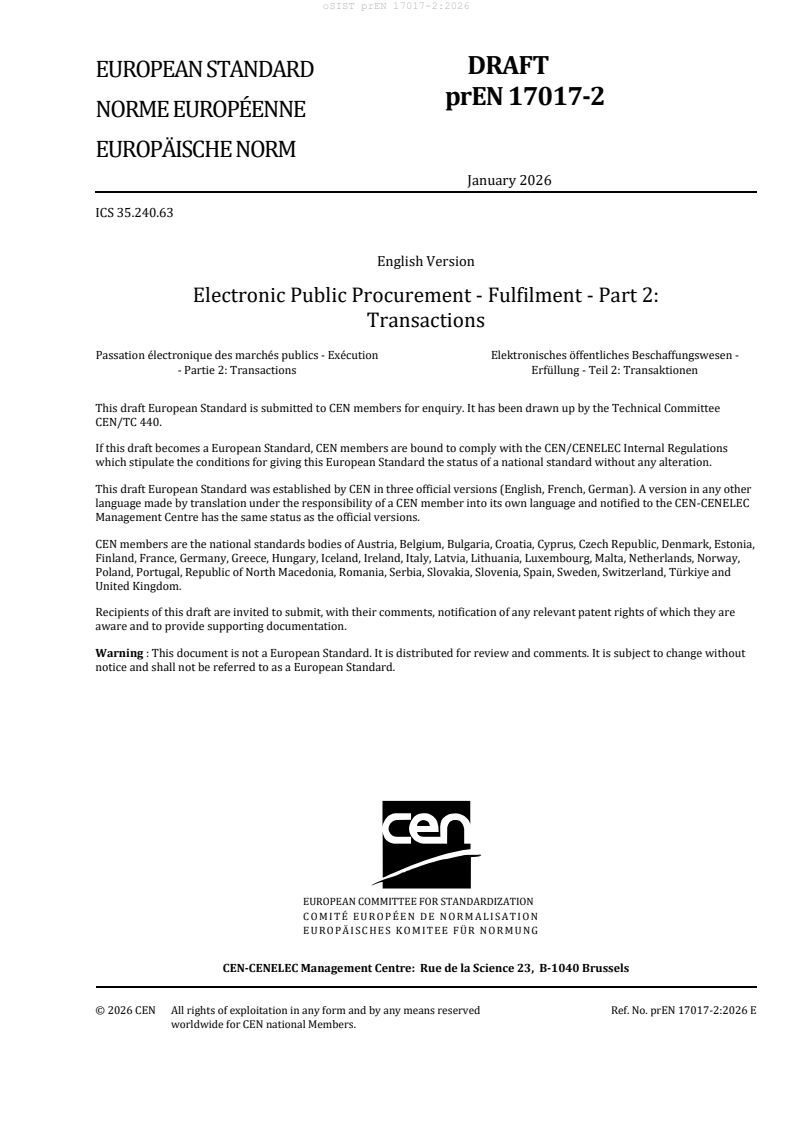
DRAFT
EUROPEAN STANDARD
NORME EUROPÉENNE
EUROPÄISCHE NORM
January 2026
ICS 35.240.63
English Version
Electronic Public Procurement - Fulfilment - Part 2:
Transactions
Passation électronique des marchés publics - Exécution Elektronisches öffentliches Beschaffungswesen -
- Partie 2: Transactions Erfüllung - Teil 2: Transaktionen
This draft European Standard is submitted to CEN members for enquiry. It has been drawn up by the Technical Committee
CEN/TC 440.
If this draft becomes a European Standard, CEN members are bound to comply with the CEN/CENELEC Internal Regulations
which stipulate the conditions for giving this European Standard the status of a national standard without any alteration.
This draft European Standard was established by CEN in three official versions (English, French, German). A version in any other
language made by translation under the responsibility of a CEN member into its own language and notified to the CEN-CENELEC
Management Centre has the same status as the official versions.
CEN members are the national standards bodies of Austria, Belgium, Bulgaria, Croatia, Cyprus, Czech Republic, Denmark, Estonia,
Finland, France, Germany, Greece, Hungary, Iceland, Ireland, Italy, Latvia, Lithuania, Luxembourg, Malta, Netherlands, Norway,
Poland, Portugal, Republic of North Macedonia, Romania, Serbia, Slovakia, Slovenia, Spain, Sweden, Switzerland, Türkiye and
United Kingdom.
Recipients of this draft are invited to submit, with their comments, notification of any relevant patent rights of which they are
aware and to provide supporting documentation.
Warning : This document is not a European Standard. It is distributed for review and comments. It is subject to change without
notice and shall not be referred to as a European Standard.
EUROPEAN COMMITTEE FOR STANDARDIZATION
COMITÉ EUROPÉEN DE NORMALISATION
EUROPÄISCHES KOMITEE FÜR NORMUNG
CEN-CENELEC Management Centre: Rue de la Science 23, B-1040 Brussels
© 2026 CEN All rights of exploitation in any form and by any means reserved Ref. No. prEN 17017-2:2026 E
worldwide for CEN national Members.
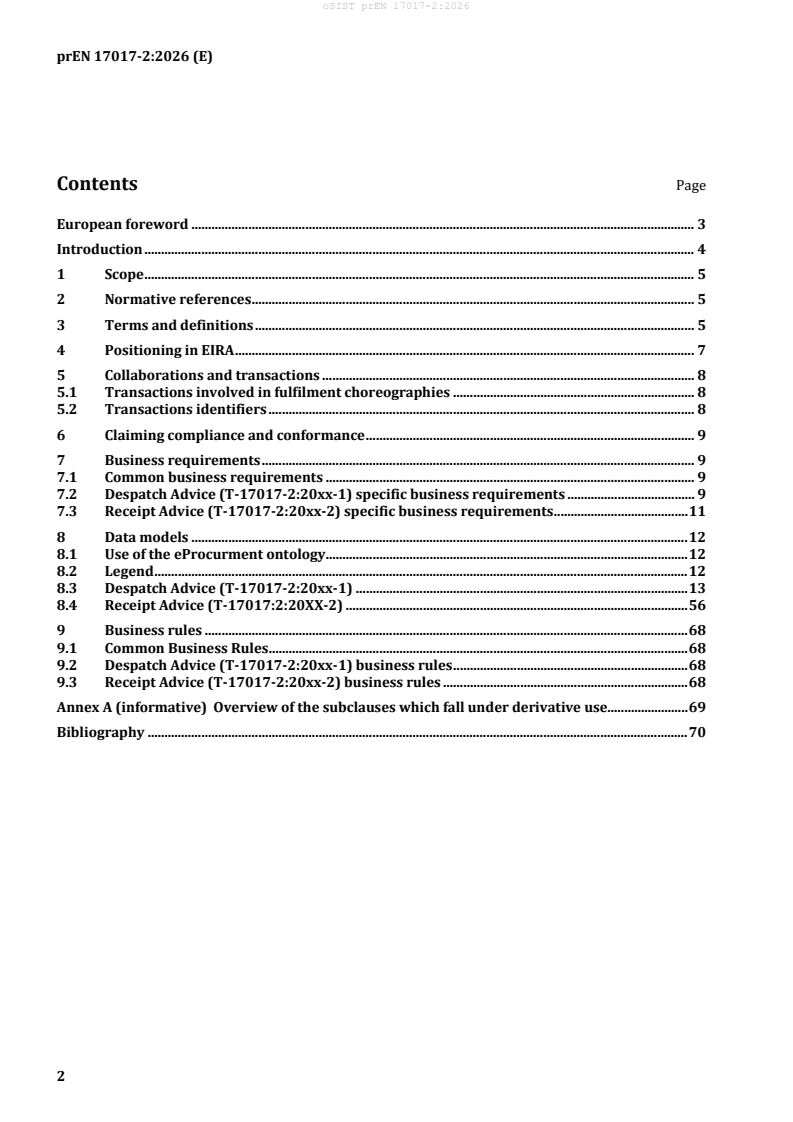
Contents Page
European foreword . 3
Introduction . 4
1 Scope . 5
2 Normative references . 5
3 Terms and definitions . 5
4 Positioning in EIRA . 7
5 Collaborations and transactions . 8
5.1 Transactions involved in fulfilment choreographies . 8
5.2 Transactions identifiers . 8
6 Claiming compliance and conformance . 9
7 Business requirements . 9
7.1 Common business requirements . 9
7.2 Despatch Advice (T-17017-2:20xx-1) specific business requirements . 9
7.3 Receipt Advice (T-17017-2:20xx-2) specific business requirements . 11
8 Data models . 12
8.1 Use of the eProcurment ontology . 12
8.2 Legend . 12
8.3 Despatch Advice (T-17017-2:20xx-1) . 13
8.4 Receipt Advice (T-17017:2:20XX-2) . 56
9 Business rules . 68
9.1 Common Business Rules . 68
9.2 Despatch Advice (T-17017-2:20xx-1) business rules . 68
9.3 Receipt Advice (T-17017-2:20xx-2) business rules . 68
Annex A (informative) Overview of the subclauses which fall under derivative use. 69
Bibliography . 70
European foreword
This document (prEN 17017-2:2026) has been prepared by Technical Committee CEN/TC 440
“Electronic Public Procurement”, the secretariat of which is held by DIN.
This document is currently submitted to the CEN Enquiry.
This document is part of a series of multi-part documents prepared, or under preparation, by
CEN/TC 440:
— 17011-series: e-Procurement Architecture, providing a set of specifications outlining different
aspects of the e-Procurement architecture for Business Interoperability Specifications.
— 17014-series: Pre-Award Business Interoperability Specifications, providing a set of specifications
outlining business choreography, transaction, syntax binding specifications and guidelines required
to support the Pre-Award phase in Public Procurement.
— 17015-series: e-Catalogue Business Interoperability Specifications, providing a set of specifications
outlining business choreography, transaction, syntax binding specifications and guidelines required
to support the e-Catalogue processes.
— 17015-series: e-Ordering Business Interoperability Specifications, providing a set of specifications
outlining business choreography, transaction, syntax binding specifications and guidelines required
to support the e-Ordering processes.
— 17017-series: e-Fulfilment Business Interoperability Specifications, providing a set of specifications
outlining business choreography, transaction, syntax binding specifications and guidelines required
to support the e-Delivery processes.
The terms “shall”, “shall not”, “should”, “should not”, “may”, “can” and “cannot” are interpreted according
to the CEN-CENELEC Internal Regulations Part 3:2022, Clause 7 .
https://boss.cen.eu/reference-material/refdocs/pages/
Introduction
Derivative use pilot
This publication falls under a CEN-CENELEC pilot on derivative use (as approved by the CEN/CA
(Administrative Board) through decision 38/2019).
CEN has the copyright to all CEN publications, including their entire content and associated metadata, as
described in CEN-CENELEC Guide 10 “Policy on dissemination, sales and copyright of CEN-CENELEC
Publications”. However, through the derivative use pilot, CEN gives permission to the copying, replication
and translation of content from a CEN/TC 440 deliverables in specific circumstances.
Under the derivative use pilot, specific sections of CEN/TC 440 publications may be copied, replicated
and translated in cases where this is a necessary condition for the meaningful implementation of the
publication. The sections which fall under derivative use will typically be elements, such as semantic
definitions and rules related to the use of information elements, and the name, definition and description
of processes and transactions, which are needed in software solutions, whether intended for sale in the
private market or for use in the public sector, and documents guiding the implementation and use in
specific countries and/or business sectors.
Under derivative use, any use of content, which has been copied, replicated, or translated from a
CEN/TC 440 publication, should comply with the intended use of the publication. Derivative use cannot
be applied in use cases other than those the publication is intended to support. The intended use of this
publication is set out below.
Intended use of this publication
This document has been developed for any organization looking for guidance on the implementation and
use of electronic procurement deliverables as well as for organizations developing or implementing
software applications related to electronic procurement, such as software providers, business entities
and national authorities. These software applications should be in conformance with this publication.
Parts of the document to which derivative use apply
Each sub-clause, which falls under derivative use, will be clearly marked with a footnote. The degree to
which the specific content can be modified, is defined in CEN/TS 17011-3:2024, Electronic Public
Procurement — Architecture — Part 3: Customization Guideline.
Annex A provides an overview of the line number references to all sub-clauses of the publication which
fall under derivative use.
Use of ePO ontology
This document uses the ePO ontology, owned by the European Union, available here
(https://github.com/OP-TED/ePO) and licensed under a CC BY 4.0 licence.
1 Scope
This document describes the transaction information requirements of the transactions used in the basic
collaborations described in EN 17017-1:2025, Electronic Public Procurement — Fulfillment —
Choreographies. For each transaction there is an overview, the transaction business requirements and
the transaction information requirements model containing definitions of terms, usage descriptions and
cardinality of the information elements.
The document describes the following transactions:
a) Despatch Advice;
b) Receipt Advice.
The identifier of this transactions document is CEN/EN 17017-2:20xx.
How to claim compliance to a transaction is described in Clause 6.
2 Normative references
The following documents are referred to in the text in such a way that some or all of their content
constitutes requirements of this document. For dated references, only the edition cited applies. For
undated references, the latest edition of the referenced document (including any amendments) applies.
ISO 3166-1, Codes for the representation of names of countries and their subdivisions — Part 1: Country
code
3 Terms and definitions
For the purposes of this document, the following terms and definitions apply.
ISO and IEC maintain terminology databases for use in standardization at the following addresses:
— ISO Online browsing platform: available at https://www.iso.org/obp/
— IEC Electropedia: available at https://www.electropedia.org/
3.1
agent
person, an organization, or a system that act in procurement or have the power to act in procurement
[SOURCE: eProcurement Ontology]
3.2
business process
sequence or network of activities and collaborations between two or more agents
3.3
business process variant
specification of a business process belonging to a choreography
Note 1 to entry: Different variants may support different electronic information exchange or collaborations. Agents
may publicly advertise their capability to support one or more variants in an automated fashion.
3.4
buyer
role of an agent that awards a contract and/or purchases items
Note 1 to entry: In pre-award, the buyer generally awards the contract, however future purchasers may be
foreseen. In post-award, the buyer generally refers to the purchaser of items.
[SOURCE: eProcurement Ontology]
3.5
choreography
set of business processes having the same goals
3.6
collaboration
interaction between two or more agents that result in the exchange of data between the agents involved
as part of a business process
3.7
consignee
group of business terms providing information on the person or organization to which the products will
be shipped and who is taking possession
3.8
consignment
batch of goods destined for or delivered to someone
3.9
despatcher
group of business terms providing information on the person or organization who provides (despatch)
the goods or services
3.10
item
single product or service
Note 1 to entry: An item can be an atomic thing or a composition of things that together are seen as a unit, e.g. a
tetrabrik of milk or an indivisible package of six tetrabriks.
3.11
role
part played by an agent in a particular business process, including its responsibilities (options and
obligations) to perform certain activities and collaborations in that business process
Note 1 to entry: The role is used to show the division of labour and responsibility amongst the agents involved in
the process or within the organization of an agent.
[SOURCE: eProcurement Ontology]
3.12
seller
role of an agent legally responsible for providing goods and services bought by a buyer
[SOURCE: eProcurement Ontology]
3.13
shipment
group of business terms providing information on the transportation of an identifiable collection of goods
items from one party (the despatch party) to another party (the consignee) via one or more modes of
transport
3.14
shipment stage
stage of movement in a transport of goods, also known as a leg
3.15
state
set of options and obligations of the participating agents at a defined step in a business process to perform
specific activities and collaborations
Note 1 to entry: An activity of an agent or a collaboration may cause the transition of one state to another in a
predefined set of next steps.
3.16
transaction
content of data exchanged or shared between the agents in a collaboration
Note 1 to entry: A transaction is the atomic unit that leads to a synchronized state in the information systems of
collaborating agents. It is the basic building block to define the choreography between agents. When an agent
recognizes an event that changes the state of a business object within a business process, it uses a transaction to
synchronize with the collaborating agent. A transaction therefore changes the state of a business process. It carries
the intention of the initiating agent and is represented by a data structure that is defined by a data model. The
exchange of a transaction may alter legal obligations between business partners.
4 Positioning in EIRA
EIRA provides a reference model that enables architects to position the IOP specifications. This document
provides a domain-specific IOP specification to which any SBB implementing the ABB should be
compliant to. The positioning of this document in the EIRA context is specified in Table 1.
IoP specifications provide a valuable source of information to formulate requirements during
architecture development and solution development. By identifying architectural building blocks
through a common terminology, it:
— helps reuse of cross domain building blocks such as, for instance, e-Signature Verification and
Validation Service, and e-Timestamp Creation Service;
— helps synchronization with European solutions such as CEF eDelivery;
— and will provide guidance in using them to provide the prescribed capability enabling, thus managing
and rationalizing IT portfolios.
Table 1 — Positioning in EIRA
EIRA ID Title Domain Interface Scope Modality
Endorsing
CEN/EN 17017-2:20xx Electronic Procurement Machine/ — e-procurement
Public Customer extension of
Procurement — ABB176
Machine/
Fulfilment — Organizational
Supplier
Part 2: Interoperability
Transactions Specification
— e-procurement
extension of
ABB12 Business
Capability
— e-procurement
extension of
ABB170
Exchange of
Business
Information
— E-procurement
extension of
ABB16 Business
Rule
5 Collaborations and transactions
5.1 Transactions involved in fulfilment choreographies
Table 2 lists the transactions and the collaborations in which they are used.
Table 2 — Roles, capabilities, basic collaborations and transactions per variant
Role Capability Collaboration Collaboration Transaction Transaction Variant
ID ID
A B C
Despatcher Send TS 17017-1:A Consignee TS 17017-1:A Despatch M M
Despatch sends Advice
Advice Despatch
Advice
Consignee Send TS 17017-1:C Consignee TS 17017-1:C Receipt M M
Receipt sends Receipt Advice
Advice Advice
5.2 Transactions identifiers
Table 3 reports the identifier of the transactions described in this document.
Table 3 — Transactions identifiers
ID Name of the transaction
T-17017-2:20xx-1 Despatch Advice
T-17017-2:20xx-2 Receipt Advice
6 Claiming compliance and conformance
A transaction instance is compliant to a specified transaction, if the following conditions are met:
— all specified business terms of that transaction are included according to their cardinalities as
well as all corresponding business rules are fulfilled,
— no additional business terms were added,
— additional business rules may have been added, which shall not conflict with the specification.
A transaction instance is conformant to a specified transaction, if the following conditions are met:
— all specified business terms of that transaction are included according to their cardinalities as
well as all corresponding business rules are fulfilled,
— additional business terms may have been added,
— additional business rules may have been added, which shall not conflict with the specification.
7 Business requirements
7.1 Common business requirements
The business requirements common to all transactions are reported in Table 4.
Table 4 — Common business requirements
ID Description
R-17017-2:20xx-1 A transaction shall provide information about its identity, type, issue date and
validity.
R-17017-2:20xx-2 All amounts in a transaction shall be stated in the same currency.
R-17017-2:20xx-3 A transaction shall contain non-negative prices and quantities.
R-17017-2:20xx-4 The transactions shall contain all information necessary for its application i.e. it
shall not rely on the availability of external references such as a centralised
repository of item information.
R-17017-2:20xx-5 It shall be possible to check the integrity and authentication of the information
content and to audit these aspects of the content. To check that the transaction is
authentic.
R-17017-2:20xx-6 A transaction shall contain information to identify the despatch party and the
consignee of the fulfilment process.
7.2 Despatch Advice (T-17017-2:20xx-1) specific business requirements
Table 5 defines the Despatch Advice business requirements.
Subclause 7.1 falls under derivative use (as set out in the Introduction). When replicating the subclause, the
content can be modified as specified in CEN/TS 17011-3.
Subclause 7.2 falls under derivative use (as set out in the Introduction). When replicating the subclause, the
content can be modified as specified in CEN/TS 17011-3.
Table 5 — Despatch Advice business requirements
ID Description
T-17017-2:20xx-1-R-1 A Despatch Advice can specify the type, which tells the context of when the
Despatch Advice is sent. This can be advice of despatch of goods (when the
despatch is about to take off), delivery note (when the delivery of goods has
taken place), a work statement (when delivery of work has taken place) or return
of goods (when goods are returned to the supplier).
T-17017-2:20xx-1-R-2 A Despatch Advice shall refer to one order on the document level.
T-17017-2:20xx-1-R-3 A Despatch Advice can refer to one or more additional documents relevant for
the delivery.
T-17017-2:20xx-1-R-4 The contact details of the consignee shall be specified in the Despatch Advice.
Information about the buyer of the goods or services can be specified on the
T-17017-2:20xx-1-R-5
Despatch Advice.
T-17017-2:20xx-1-R-6 Information about the seller of the goods or services can be specified on the
Despatch Advice
T-17017-2:20xx-1-R-7 Information about the carrier of the goods can be specified on the Despatch
Advice.
T-17017-2:20xx-1-R-8 Contact information to the receiver of the goods or services can be specified on
the Despatch Advice.
T-17017-2:20xx-1-R-9 Identification of driver who delivers the goods can be specified on the Despatch
Advice.
T-17017-2:20xx-1-R-10 It shall be possible to specify the fuel consumption used in the transport of the
goods on the Despatch Advice.
T-17017-2:20xx-1-R-11 It shall be possible to specify the environmental emission on the Despatch Advice.
T-17017-2:20xx-1-R-12 On the Despatch Advice it shall be possible to specify the details about the
transport means for the last leg in the delivery of the goods, such as the licence
plate ID and transport means code.
T-17017-2:20xx-1-R-13 It shall be possible to specify the estimated delivery period on the Despatch
Advice.
T-17017-2:20xx-1-R-14 For Despatch Advice send after delivery (for instance for services), it shall be
possible to specify the actual delivery date and time.
T-17017-2:20xx-1-R-15 The delivery location can be specified both as an ID (e.g. UN loco-code or GLN), a
name or as an address on the Despatch Advice.
T-17017-2:20xx-1-R-16 It shall be possible to specify the GPS coordinates for the delivery location.
T-17017-2:20xx-1-R-17 It shall be possible to specify when the goods are despatched on the Despatch
Advice.
T-17017-2:20xx-1-R-18 The address from where the goods are despatched can be specified on the
Despatch Advice.
T-17017-2:20xx-1-R-19 The delivery terms that state what apply to a fulfilment can be specified on the
Despatch Advice both as Inco terms and as id of other special terms.
T-17017-2:20xx-1-R-20 It shall be possible to specify how the fulfilment is packed from transport
handling units to packages to goods items on a Despatch Advice.
T-17017-2:20xx-1-R-21 It shall be possible to specify up to three levels of packages, for instance a
package that contains another package on a Despatch Advice.
ID Description
T-17017-2:20xx-1-R-22 It shall be possible to specify relevant equipment used or needed for the
fulfilment in terms of id, type, description, dimensions and special requirements,
such as power and refrigeration, on the Despatch Advice.
T-17017-2:20xx-1-R-23 It shall be possible to specify an identifier used for tracking and tracing a goods
item on the Despatch Advice.
It shall be possible to recognize a goods item from the seller’s item identification
T-17017-2:20xx-1-R-24
or a standard item identification in the Despatch Advice.
T-17017-2:20xx-1-R-25 It shall be possible to specify whether a package contains returnable material on
a Despatch Advice.
T-17017-2:20xx-1-R-26 When specifying a package, the package type shall be specified in a Despatch
Advice.
T-17017-2:20xx-1-R-27 For each goods item, it shall be possible to specify the statistics value for this
used for insurance and customs purposes on a Despatch Advice.
T-17017-2:20xx-1-R-28 It shall be possible to specify the weight, length, height, width and volume on
packages for goods items, packages and transport handling units on the Despatch
Advice.
T-17017-2:20xx-1-R-29 In a Despatch Advice, it shall be possible to refer a goods item back to a despatch
line.
T-17017-2:20xx-1-R-30 A despatch line shall specify the delivered quantity.
T-17017-2:20xx-1-R-31 In case there are outstanding quantities in a despatch line, this shall be specified
as well as the reason for outstanding.
T-17017-2:20xx-1-R-32 A despatch line shall refer to an order line.
It shall be possible to refer to or attach external documents relevant for the
T-17017-2:20xx-1-R-33
delivery on a despatch line.
T-17017-2:20xx-1-R-34 A despatch line shall include a description of the item in it as described in the
original order.
7.3 Receipt Advice (T-17017-2:20xx-2) specific business requirements
Table 6 defines the Receipt Advice business requirements.
Table 6 — Receipt Advice business requirements
ID Description
T-17017-2:20xx-2-R-1 A Receipt Advice shall contain a code specifying if the delivery has been rejected
as a whole, partly accepted or accepted.
T-17017-2:20xx-2-R-2 In case a delivery has been rejected, the Receipt Advice shall contain a reason of
why it has been rejected and what action to take.
T-17017-2:20xx-2-R-3 The Receipt Advice can have a textual note, supporting the receivers view of the
delivery.
T-17017-2:20xx-2-R-4 The Receipt Advice can have a reference to the order behind the delivery.
Subclause 7.3 falls under derivative use (as set out in the Introduction). When replicating the subclause, the
content can be modified as specified in CEN/TS 17011-3.
ID Description
T-17017-2:20xx-2-R-5 If there has been exchanged a Despatch Advice prior to the Receipt Advice, the
Receipt Advice shall have a reference to this.
T-17017-2:20xx-2-R-6 It shall be possible to refer or attach relevant documents for the delivery in the
Receipt Advice.
T-17017-2:20xx-2-R-7 The Receipt Advice shall include relevant information about the consignee (the
sender of the document).
T-17017-2:20xx-2-R-8 The Receipt Advice shall include relevant information about the despatcher (the
receiver of the document).
T-17017-2:20xx-2-R-9 The Receipt Advice can contain information about the shipment, describing it
overall in text.
T-17017-2:20xx-2-R-10 The receipt Advice can contain information about the shipment, describing
damages or other events on the transport handling units.
T-17017-2:20xx-2-R-11 The Receipt Advice can have one or more receipt lines, each corresponding to a
despatch line.
T-17017-2:20xx-2-R-12 A receipt line contains information about the state of the delivery according to
the referred despatch line. That is, the received quantity, the quantity in short, a
code for what to do with the line in short, the rejected quantity, a reason for the
rejection (if rejected) and the oversupply quantity.
T-17017-2:20xx-2-R-13 A receipt line can contain a reference to the order behind the delivery.
T-17017-2:20xx-2-R-14 A receipt line can have information about the item that was received. That is the
name and the identity of the item.
8 Data models
8.1 Use of the eProcurment ontology
The general structure of the transaction definition is shown in Table 7.
The purpose of the columns is explained in 9.2.
Table 7 — Information elements
ID Level Cardinality Business Description Usage Requirement Semantic
term note ID data type
BT-1 + 0.1 Example A short text by which
name a thing is known or
referred to
8.2 Legend
Each information element, as well as groups of information elements, that constitutes the semantic data
model is described as a row in the tables documented in 9.1, where the following information is provided.
ID: An identifier for the information element (BT – Business Term) and group of information elements
(BG – Business Term Group).
Level: Indicates on which level in the model the information element occurs:
— +: The first level of the model;
— ++: The second level of the model. The information element (or the group of information
elements) is part of a group of information elements which is specified at the first level of the
model;
— +++: The third level of the model. The information element (or the group of information elements)
is part of a group of information elements which is specified at the second level of the model;
— ++++: The fourth level of the model. The information element is part of a group of information
elements which is specified at the third level of the model.
Cardinality: Also known as multiplicity, is used to indicate if an information element (or group of
information elements) is mandatory or conditional, and if it is repeatable. The cardinality shall always be
analysed in the context of where the information element is used.
EXAMPLE The Payee Name is mandatory in the core invoice model, but only when a Payee is stated and is
relevant.
The following cardinalities exist:
— 1.1: Mandatory, minimum 1 occurrence and maximum 1 occurrence of the information element (or
group of information elements) shall be present in any conformant instance document;
— 1.n: Mandatory and repeatable, minimum 1 occurrence and unbounded upper maximum occurrence
of the information element (or group of information elements) shall be present in any conformant
instance document;
— 0.1: Conditional, minimum 0 occurrences and maximum 1 occurrence of the information element (or
group of information elements) may be present in any conformant instance document; it’s use
depends on business rules stated as well as the regulatory, commercial and contractual conditions
that applies to the business transaction;
— 0.n: Conditional and repeatable, minimum 0 occurrences and unbounded upper maximum
occurrence of the information element (or group of information elements) may be present in any
conformant instance document; it’s use depends on business rules stated as well as the
regulatory, commercial and contractual conditions that applies to the business transaction.
Business Term: The name of the information element used in the transaction data model or the name of
a coherent group of related information elements, provided to give logical meaning.
Description: A description of the semantic meaning of the information element.
Usage Note: Clarifying information on how the information element shall or may be used (such as
calculation rules).
Req. ID: The requirement identifier, provided to show the traceability of the information element with
the corresponding requirement specified in Clause 7.
Semantic Data Type: The data format that applies to the information element.
8.3 Despatch Advice (T-17017-2:20xx-1)
Table 8 defines the Despatch Advice information elements.
Subclause 8.3 falls under derivative use (as set out in the Introduction). When replicating the subclause, the
content can be modified as specified in CEN/TS 17011-3.
Table 8 — Despatch Advice information elements
ID L. C. Business term Description Usage note Requirement ID Semantic
data type
BG-DES-1 + 1.1 Despatch Advice A group of business terms providing
header information information on the Despatch Advice
BT-COM-1 ++ 1.1 Specification Identifier
identification
BT-COM-2 ++ 1.1 Business process type Identifier
identifier
BT-DES-1-1 ++ 1.1 Despatch Advice The identifier of the Despatch Identifier
identifier Advice.
BT-DES-1-2 ++ 1.1 Despatch Advice issue The date of formal issuance of the Date
date Despatch Advice.
BT-DES-1-3 ++ 0.1 Despatch Advice issue The time of formal issuance of the Time
time Despatch Advice.
BT-DES-1-4 ++ 0.1 Despatch Advice status A code signifying the status of the Default is Original (9). Code
code Despatch Advice.
BT-DES-1-5 ++ 0.1 Despatch Advice type A code signifying the type of the Default is Advice of T-17017-2:20xx-1-R-1 Code
code Despatch Advice. despatch of goods (1).
BT-DES-1-6 ++ 0.1 Despatch Advice A textual note for the dispatch as Used for Transport Text
textual note whole. Information.
BT-COM-5 ++ 0.1 Order reference An identifier of an order the T-17017-2:20xx-1-R-2 Identifier
identifier Despatch Advice refers to.
BT-COM-6 ++ 0.1 Project reference The identifier of the project the Identifier
identifier Despatch Advice refers to.
BG-COM-3 + 0.n Additional documents A group of business terms providing T-17017-2:20xx-1-R-3
reference information on one or more
referenced documents.
BT-COM-3-1 ++ 1.1 Additional document The identifier of the referenced Identifier
reference identifier document.
BT-COM-3-2 ++ 0.1 Additional document The date of formal issuance of the Date
reference issue date referenced document.
BT-COM-3-3 ++ 0.1 Additional document The time of formal issuance of the Time
reference issue time referenced document.
ID L. C. Business term Description Usage note Requirement ID Semantic
data type
BT-COM-3-4 ++ 0.1 Attached document An attached document embedded as
binary object or sent together with
the Despatch Advice.
0.1 Attached document The Mime code of the attached Code
Mime code document.
Allowed mime codes:
— application/pdf
— image/png
— image/jpeg
— text/csv
—
application/.openxmlformatsofficed
ocument.
spreadsheetml.sheet
— application/
0.1 Attached document The file name of the attached Text
filename document.
BT-COM-3-5 ++ 0.1 External document URI The URL (Uniform Resource Locator) Text
that identifies where the external
document is located.
BG-DES-2 + 1.1 Despatcher A group of business terms providing It also defines the
information information on the person or sender of the Advanced
organization who provides Despatch Advice. The
(despatches) the goods or services. role is carried out by the
supplier or on behalf of
the supplier. The real
ship-from address shall
be provided in the
Despatch Address when
the Advanced Despatch
Advice describes a
movement.
BT-DES-2-1 ++ 0.1 Despatcher electronic The identifier of the despatcher’s
address electronic address from which the
Despatch Advice is sent.
ID L. C. Business term Description Usage note Requirement ID Semantic
data type
BT-DES-26 ++ 0.1 Scheme Identifier The identification scheme identifier. Identifier
BT-DES-28 ++ 0.1 Despatcher Identifier An identifier of the despatcher. Identifier
BT-DES-29 ++ 0.1 Scheme Identifier The identification scheme identifier. Identifier
BT-DES-31 ++ 1.1 Despatcher trading The full name of the despatcher. It could be the brand Text
name name, a branch name or
the despatcher trading
name. Such alternatives
or the despatcher legal
registration name are to
be used here.
BG-DES-3 ++ 0.1 Despatcher Postal A group of business terms providing
address information about the postal address
for the despatcher.
BT-DES-33 +++ 0.1 Despatcher address The main address line in an address. Text
line 1
BT-DES-34 +++ 0.1 Despatcher address An additional address line in an Text
line 2 address that can be used to give
further details supplementing the
main line.
+++ 0.1 Despatcher address An additional address line in an Text
line 3 address that can be used to give
further details supplementing the
main line.
BT-DES-35 +++ 0.1 Despatcher city The common name of the city, town Text
or village, where the despatcher’s
address is located.
BT-DES-36 +++ 0.1 Despatcher post code The identifier for an addressable Text
group of properties according to the
relevant postal service.
BT-DES-37 +++ 0.1 Despatcher country The subdivision of a country. For Text
subdivision specifying a region, county, state,
province, etc. within a country by
using text.
ID L. C. Business term Description Usage note Requirement ID Semantic
data type
BT-DES-41 +++ 0.1 Despatcher country A code that identifies the country. Code
code
BT-DES-43 ++ 1.1 Despatcher VAT The despatcher’s VAT identifier (also Identifier
identifier known as despatcher VAT
identification number).
BT-DES-47 ++ 1.1 Despatcher name The full formal name by which the Text
despatcher is registered in the
national registry of legal entities.
BT-DES-48 ++ 0.1 Despatcher legal The identifier issued by an official Identifier
registration identifier registrar that identifies the
despatcher as a legal entity.
0.1 Scheme identifier The identification scheme identifier. Identifier
BG-DES-54 ++ 0.1 Despatcher contact A group of business terms providing
information contact information relevant for the
despatcher.
BT-DES-55 +++ 0.1 Despatcher contact A contact point for a legal entity or Identifier
point person.
BT-DES-56 +++ 0.1 Despatcher telephone A phone number for the contact Text
number point.
BT-DES-57 +++ 0.1 Despatcher email An e-mail address for the contact Text
address point.
ID L. C. Business term Description Usage note Requirement ID Semantic
data type
BG-DES-4 + 1.1 Consignee information A group of business terms providing It also defines the
information on the person or receiver of the Advanced
organization to which the products Despatch Advice. The
will be shipped and who is taking role is carried out by the
possession. customer or on behalf of
the customer. The real
ship-to address shall be
provided in the delivery
location if the Advanced
Despatch Advice
describes a movement.
If the Despatch address
describes a service
provided at a specific
location, the Delivery
Location contains this
location.
BT-DES-60 0.1 Consignee electronic The identifier of the consignee’s Identifier
address electronic address to which the
Despatch Advice is sent.
BT-DES-61 0.1 Scheme identifier The identification scheme identifier. Identifier
BT-DES-63 0.1 Consignee identifier An identifier of the consignee. Identifier
0.1 Scheme identifier The identification scheme identifier. Identifier
BT-DES-66 1.1 Consignee trading The full name of the consignee. It could be the brand Text
name name, a branch name or
the consignee trading
name. Such alternatives
or the Consignee legal
registration name are to
be used here.
BG-DES-4-1 ++ 0.1 Consignee postal A group of business terms providing
address information about the postal address
for the consignee.
BT-DES-4-1-1 +++ 0.1 Consignee address The main address line in an address. Text
line 1
ID L. C. Business term Description Usage note Requirement ID Semantic
data type
BT-DES-4-1-2 +++ 0.1 Consignee address line An additional address line in an Text
2 address that can be used to give
further details supplementing the
main line.
BT-DES-4-1-3 +++ 0.1 Consignee address line An additional address line in an Text
3 address that can be used to give
further details supplementing the
main line.
BT-DES-4-1-4 +++ 0.1 Consignee city The common name of the city, town Text
or village, where the consignee’s
address is located.
BT-DES-4-1-5 +++ 0.1 Consignee post code The identifier for an addressable Text
group of properties according to the
relevant postal service.
BT-DES-4-1-6 +++ 0.1 Consignee country The subdivision of a country. For Text
subdivision specifying a region, county, state,
province, etc. within a country by
using text.
BT-DES-4-1-7 +++ 0.1 Consignee country A code that identifies the country. Code
code
BT-DES-4-1-8 +++ 1.1 Consignee VAT The consignee’s VAT identifier (also Identifier
identifier known as consignee VAT
identification number).
BT-DES-4-1-9 +++ 1.1 Consignee name The full formal name by which the Text
consignee is registered in the
national registry of legal entities.
Consignee legal The identifier issued by an official
BT-DES-4-1-10 +++ 0.1 Identifier
registration identifier registrar that identifies the
consignee as a legal entity.
BT-DES-4-1-11 0.1 Scheme identifier The identification scheme identifier. Identifier
ID L. C. Business term Description Usage note Requirement ID Semantic
data type
BG-DES-4-2 ++ 0.1 Consignee contact A group of business terms providing T-17017-2:20xx-1-R-8 T-17017-2:20xx-1-R-4
information contact information relevant for the
consignee.
BG-DES-4-2-1 +++ 0.1 Consignee contact A contact point for a legal entity or Text
point person.
BG-DES-4-2-2 +++ 0.1 Consignee telephone A phone number for the contact Text
number point.
BG-DES-4-2-3 +++ 0.1 Consignee email An e-mail address for the contact Text
address point.
BG-COM-5 + 1.1 Buyer information A group of business terms providing T-17017-2:20xx-1-R-5
information on the agent that awards
a contract and/or purchases items.
BT-COM-5-1 ++ 0.1 Buyer trading name The full name of the buyer. Text
BT-COM-5-2 ++ 0.1 Buyer identifier An identifier of the buyer. Identifier
0.1 Scheme identifier The identification scheme identifier. Identifier
BT-COM-5-3 ++ 1.1 Buyer name The full formal name by which the Text
buyer is registered in the national
registry of legal entities.
BT-COM-5-4 ++ 0.1 Buyer legal The identifier issued by an official Identifier
registration identifier registrar that identifies the buyer as
a legal entity.
1.1 Scheme identifier The identification scheme identifier. Identifier
BT-COM-5-5 ++ 0.1 Buyer VAT identifier The buyer’s VAT identifier (also Identifier
known as buyer VAT identification
number).
BT-COM-5-6 ++ 1.1 Buyer electronic The identifier of the buyer’s Identifier
address electronic address from which the
Order is sent.
oSI
...