

SIST EN 60738-1-4:2008
(Main)Thermistors - Directly heated positive step-function temperature coefficient -- Part 1-4: Blank detail specification - Sensing application - Assessment level EZ
- Abstract
is a supplementary document to the generic specification and contains requirements for style and layout and minimum content of detail specifications. Detail specifications not complying with these requirements shall not be considered as being in accordance with IEC specifications nor shall they so be described. In the preparation of detail specifications the content of IEC 60738-1:2006, 1.4 shall be taken into account. This edition contains changes with respect to the referenced subclauses of the revised generic specification IEC 60738-1.
- Status
- Published
- Publication Date
- 11-Jun-2008
- Technical Committee
- I11 - Imaginarni 11
- Current Stage
- 6060 - National Implementation/Publication (Adopted Project)
- Start Date
- 09-May-2008
- Due Date
- 14-Jul-2008
- Completion Date
- 12-Jun-2008



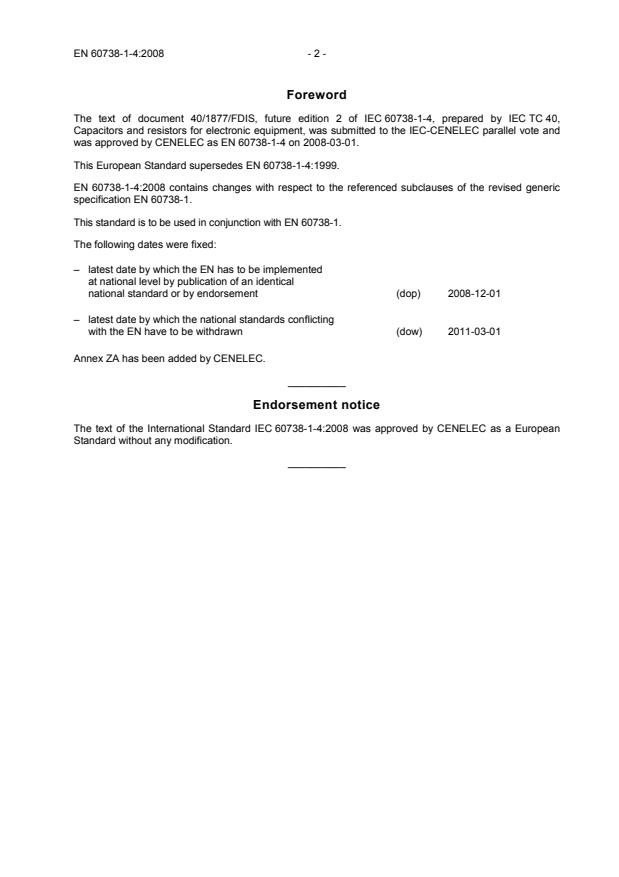
SIST EN 60738-1-4:2008 is the Slovene adoption of EN 60738-1-4:2008 from SIST, based on IEC 60738-1-4:2008. It is a blank detail specification for directly heated positive step-function temperature coefficient thermistors used in sensing applications, at assessment level EZ. In practice, it tells you how a compliant detail specification must be written and how these thermistors are to be inspected and qualified.
What does SIST EN 60738-1-4:2008 specify?
SIST EN 60738-1-4:2008 specifies the style, layout, and minimum content for detail specifications for this thermistor family. A detail specification that does not follow these rules is not treated as in accordance with IEC specifications.
SIST EN 60738-1-4:2008 is intended to be used with EN 60738-1. Its structure is simple: clause 1 covers general data for the detail specification, clause 2 covers inspection requirements, and Annex ZA lists the normative references and their European equivalents.
What are the key requirements of SIST EN 60738-1-4:2008?
SIST EN 60738-1-4:2008 mainly tells authors of detail specifications what information must be stated, and tells manufacturers and test labs how qualification and quality conformance are handled. The document is less about the internal physics of the thermistor and more about how to describe, identify, test, and order the part consistently.
For the detail specification itself
Clause 1 requires identification data such as the issuing body, the detail specification number, the generic specification reference, and the blank detail specification number. It also requires a short description of the thermistor, typical construction, an outline drawing or equivalent reference, the intended application, the assessment level, and key reference data for comparison.
Clause 1 also requires practical product data: mounting method, dimensions, coating, terminations, flammability, resistance to solvents, packaging, electrical data, marking, and ordering information. In practice, this is the information a buyer or design engineer needs to select the correct part and ensure it can be mounted, handled, and ordered correctly.
The electrical data include upper/lower category temperatures (UCT/LCT), operating temperature range at maximum voltage, maximum voltage, zero-power resistance (R_T), resistance R_NF at T_NF when applicable, isolation voltage and insulation resistance for insulated thermistors, and response time. That means the detail specification must state the operating limits and the measurements used to compare one type with another.
Clause 1 also requires the marking details and minimum ordering information, including style reference, maximum continuous a.c. voltage, detail specification reference, and minimum resistance where applicable. Additional information and any increased severities or requirements may be added, but only when needed.
For inspection and testing
Clause 2 splits inspection into qualification approval and quality conformance inspection. Qualification approval follows IEC 60738-1:2006, while quality conformance uses the test schedules in Tables 1 and 2, with sampling based on IEC 60410:1973.
The test schedules cover lot-by-lot and periodic inspection. They include visual examination, marking, dimensions, zero-power resistance, functioning resistance, residual current, voltage proof, solderability, resistance to soldering heat, robustness of terminations, rapid change of temperature, vibration, bump or shock, climatic sequence, response time, temperature coefficient of resistance, dissipation factor, and endurance tests.
The detail specification chooses the applicable limits, temperatures, voltages, and test options. For example, bump and shock are alternatives, and the endurance tests in Groups C4, C5, and D1 are selected according to the construction and application of the thermistor.
What terms does SIST EN 60738-1-4:2008 define?
- Blank detail specification - A supplementary document that sets the required structure and minimum content for a detail specification.
- Generic specification - The base document that provides the general rules the blank detail specification builds on.
- Assessment level EZ - The quality-assurance level named for this thermistor family.
- Zero-power resistance (R_T) - The resistance measured under the specified zero-power condition at the stated temperature.
- Functioning resistance (R_NF) at T_NF - The resistance measured at the specified functioning temperature T_NF.
- Upper/lower category temperatures (UCT/LCT) - The temperature limits used to define the category range for the thermistor.
- Inspection level (IL) - The sampling level used in the test schedules.
- Destructive (D) / non-destructive (ND) - Test designations showing whether a sample can be reused after the test.
Who uses SIST EN 60738-1-4:2008?
SIST EN 60738-1-4:2008 is used by manufacturers of thermistors, component engineers, quality managers, purchasers, and test laboratories. Manufacturers use it to prepare detail specifications and product markings. Quality and test teams use it for qualification approval, lot-by-lot inspection, periodic inspection, and sampling plans. Buyers use it to check whether a thermistor’s sensing application, mounting, voltage, resistance, and packaging data are described in a way they can specify and verify.
What changed in SIST EN 60738-1-4:2008 from the previous edition?
SIST EN 60738-1-4:2008 replaces SIST EN 60738-1-4:2002. The European edition supersedes EN 60738-1-4:1999 and states that this edition contains changes to the referenced subclauses of the revised generic specification EN 60738-1. It was also approved by CENELEC without modification, and Annex ZA was added by CENELEC.
Which standards are used with SIST EN 60738-1-4:2008?
- EN 60738-1 / IEC 60738-1:2006 - The generic specification that this document must be used with.
- IEC 60068-2-58 - Provides solderability and soldering-heat test methods for surface mounting devices.
- IEC 60410:1973 - Provides the sampling plans and procedures used for inspection by attributes.
- EN 60068-2-58 - The European publication corresponding to IEC 60068-2-58 in Annex ZA.
What does the SIST EN 60738-1-4:2008 document contain?
SIST EN 60738-1-4:2008 contains a template for writing detail specifications, including the positions for identification data, the thermistor description, the outline drawing, and the reference data block. It also contains the required content for general data such as coating, terminations, packaging, and electrical ratings.
The second main part is the inspection section, which points to two test schedules. Tables 1 and 2 define lot-by-lot and periodic tests, sample sizes, acceptance criteria, and whether each test is destructive or non-destructive.
The tables are used for qualification, production control, and quality conformance. They cover visual, electrical, mechanical, climatic, soldering, and endurance checks so that a detail specification can be tied to a clear test regime.
Relations
- Effective Date
- 01-Apr-2011
- Effective Date
- 09-Feb-2026
- Effective Date
- 03-Feb-2026
- Effective Date
- 03-Feb-2026
- Effective Date
- 03-Feb-2026
Frequently Asked Questions
SIST EN 60738-1-4:2008 is a standard published by the Slovenian Institute for Standardization (SIST). Its full title is "Thermistors - Directly heated positive step-function temperature coefficient -- Part 1-4: Blank detail specification - Sensing application - Assessment level EZ". This standard covers: is a supplementary document to the generic specification and contains requirements for style and layout and minimum content of detail specifications. Detail specifications not complying with these requirements shall not be considered as being in accordance with IEC specifications nor shall they so be described. In the preparation of detail specifications the content of IEC 60738-1:2006, 1.4 shall be taken into account. This edition contains changes with respect to the referenced subclauses of the revised generic specification IEC 60738-1.
is a supplementary document to the generic specification and contains requirements for style and layout and minimum content of detail specifications. Detail specifications not complying with these requirements shall not be considered as being in accordance with IEC specifications nor shall they so be described. In the preparation of detail specifications the content of IEC 60738-1:2006, 1.4 shall be taken into account. This edition contains changes with respect to the referenced subclauses of the revised generic specification IEC 60738-1.
SIST EN 60738-1-4:2008 is classified under the following ICS (International Classification for Standards) categories: 31.040.30 - Thermistors. The ICS classification helps identify the subject area and facilitates finding related standards.
SIST EN 60738-1-4:2008 has the following relationships with other standards: It is inter standard links to SIST EN 60738-1-4:2002, SIST EN ISO 14272:2002, SIST EN 60068-2-58:2005, SIST EN 60738-1:2007, SIST EN IEC 60947-8:2023. Understanding these relationships helps ensure you are using the most current and applicable version of the standard.
SIST EN 60738-1-4:2008 is available in PDF format for immediate download after purchase. The document can be added to your cart and obtained through the secure checkout process. Digital delivery ensures instant access to the complete standard document.
Standards Content (Sample)
Contents
- 1 General data
- 1.1 Method(s) of mounting (to be inserted)
- 1.2 Dimensions
- 1.3 Coating
- 1.4 Terminations
- 1.5 Flammability
- 1.6 Resistance to solvents
- 1.7 Packaging
- 1.8 Electrical data/Ratings and characteristics
- 1.9 Normative references
- 1.10 Marking
- 1.11 Ordering information
- 1.12 Additional information (not for inspection purposes)
- 1.13 Additional or increased severities or requirements to those specified in the
- 2 Inspection requirements
- 2.1 Procedures
- 7.5 Zero-power Temperature:... °C
- 7.5 Zero-power Temperature:... °C
- 7.27 Residual current res
- 7.8 Voltage proof
- 7.16 Solderabilty (see list item 6 and 7) The terminations shall be
- 7.17 Resistance to
- 7.15 Robustness of Tensile, bending and
- 7.18 Rapid change of A
- 7.19 Vibration
- 7.20 Bump (or shock, Acceleration:... m/s
- 7.21 Shock (or bump, Pulse shape: halfsine
- 7.22 Climatic
- 7.11 Response time Response time: ≤... s
- 7.12 Response time
- 7.6 Temperature
- 7.10 Dissipation fac- Dissipation factor As specified in the detail
INTRODUCTION Blank detail specification A blank detail specification is a supplementary document to the generic specification and contains requirements for style and layout and minimum content of detail specifications. Detail specifications not complying with these requirements shall not be considered as being in accordance with IEC specifications nor shall they so be described. In the preparation of detail specifications the content of IEC 60738-1:2006,1.4 shall be taken into account.
The numbers between brackets on the first page correspond to the following information which shall be inserted in the position indicated.
Identification of the detail specification [1] The "International Electrotechnical Commission" or the National Standards Organization under whose authority the detail specification is drafted.
[2] The IEC or National Standards number of the detail specification, date of issue and any further information required by the national system.
[3] The number and issue number of the IEC or national generic specification. [4] The IEC number of the blank detail specification.
Identification of the thermistor [5] A short description of the type of thermistor.
[6] Information on typical construction (if applicable).
NOTE When the thermistor is not designed for use on printed boards, this should clearly be stated in the detail specification in this position.
[7] Outline drawing with main dimensions which are of importance for interchangeability and/or reference to the national or international documents for outlines. Alternatively, this drawing may be given in an annex to the detail specification.
[8] Application or group of applications covered and/or assessment level. [9] Reference data on the most important properties, to allow comparison between the various thermistor types.
[1] IEC 60738-1-4-XXX [2] QC 440004
ELECTRONIC COMPONENTS OF ASSESSED IEC 60738-1-4 [4] QUALITY IN ACCORDANCE WITH: QC 440004
[3] DIRECTLY HEATED POSITIVE STEP-FUNCTION TEMPERATURE COEFFICIENT THERMISTORS [5] Outline drawing: [see 1.2] FOR SENSING APPLICATION [... angle projection]
MODIFIED FERRO-ELECTRIC [6] [7] CERAMIC MATERIAL [Other shapes are permitted within the dimensions given] Assessment level: EZ [8]
[9] Information on the availability of components qualified to this detail specification is given in the Register of Approvals.
THERMISTORS – DIRECTLY HEATED POSITIVE STEP-FUNCTION TEMPERATURE COEFFICIENT –
Part 1-4: Blank detail specification – Sensing application – Assessment level EZ
1 General data
1.1 Method(s) of mounting (to be inserted)
(See IEC 60738-1:2006, 7.30).
1.2 Dimensions
(All dimensions are in millimetres or inches and millimetres; it shall be stated which dimensions are suitable for gauging).
Dimensioned drawing(s) shall be given in the detail specification. If necessary, the dimensions may be listed in tabular form with reference to styles or codes.
1.3 Coating
The detail specification shall state:
a) whether the thermistor is insulated or non-insulated; b) the material; c) the colour, if applicable.
1.4 Terminations
The detail specification shall state whether the terminations are suitable for soldering. If they are not, suitable methods of connection shall be stated for example: welding, clamping or crimping.
1.5 Flammability
The detail specification shall state whether the thermistor is actively or passively flammable if applicable. The test method shall be given in the test schedule.
1.6 Resistance to solvents
The detail specification shall state whether the coating and the marking of the thermistor are solvent resistant if applicable. The test methods shall be given in the test schedule.
1.7 Packaging
The detail specification shall give the following information (if required):
a) whether bulk packed or taped and if taped, drawing or references; b) the dimensions of the immediate packaging and the number of thermistors packed;
c) the dimensions of the outer package and the number of immediate packages; d) methods of disposal of the packaging material.
1.8 Electrical data/Ratings and characteristics
The detail specification shall give units and tolerances or limiting values for the following parameters. If necessary, electrical data may be listed in tabular form, with reference to styles and codes.
Upper/Lower category temperatures (UCT/LCT); Operating temperature range at maximum voltage; Maximum voltage ( ); Umax.
Zero-power resistance (R ); T Resistance R at T (if applicable, see IEC 60738-1:2006, Figure 2); NF NF Isolation voltage (insulated thermistors only); Insulation resistance (insulated thermistors only); Response time.
1.9 Normative references
The following referenced documents are indispensable for the application of this document. For dated references, only the edition cited applies. For undated references, the latest edition of the referenced document (including any amendments) applies.
IEC 60068-2-58: Environmental testing – Part 2-58: Tests – Test Td: Test methods for solderability, resistance to dissolution of metallization and to soldering heat of surface mounting devices (SMD) IEC 60410:1973, Sampling plans and procedures for inspection by attributes IEC 60738-1:2006, Thermistors – Directly heated positive step-function temperature coefficient – Part 1: Generic specification
...