

SIST EN IEC 60539-1:2023
(Main)Directly heated negative temperature coefficient thermistors - Part 1: Generic specification (IEC 60539-1:2022)
General Information
- Abstract
IEC 60539-1:2022 is applicable to directly heated negative temperature coefficient thermistors, typically made from transition metal oxide materials with semiconducting properties.
It establishes standard terms, inspection procedures and methods of test for use in sectional and detail specifications of electronic components for quality assessment or any other purpose.
This edition includes the following significant technical changes with respect to the previous edition:- Restructured completely to comply to ISO/IEC directives; categorization and reorganization of test methods into these categories;
- Annex X added for comparison to the previous edition;
- Some wordings, figures and references have been revised.
- Status
- Published
- Public Enquiry End Date
- 17-Feb-2022
- Publication Date
- 01-Mar-2023
- Technical Committee
- I11 - Imaginarni 11
- Current Stage
- 6060 - National Implementation/Publication (Adopted Project)
- Start Date
- 13-Feb-2023
- Due Date
- 20-Apr-2023
- Completion Date
- 02-Mar-2023



Overview
EN IEC 60539-1:2023 (adoption of IEC 60539-1:2022) is the CLC/CENELEC European specification for directly heated negative temperature coefficient (NTC) thermistors. It provides a generic specification covering terminology, inspection procedures and standardized test methods used in sectional and detail specifications for electronic components. This edition is restructured to align with ISO/IEC directives, reorganizes test methods by category, and adds Annex X for comparisons with the previous edition.
Key Topics
The standard defines measurement and test procedures relevant to quality assessment and design verification of NTC thermistors. Major technical topics include:
- General provisions
- Units, symbols, preferred values, marking and coding
- Quality assessment procedures and standard atmospheric conditions
- Mounting recommendations (including surface-mount device (SMD) land patterns)
- Electrical tests and measurements
- Zero‑power resistance (R0)
- B‑value or resistance ratio (temperature sensitivity)
- Insulation resistance and voltage‑proof tests (for insulated types)
- Resistance/temperature characteristic verification
- Dissipation factor (δ)
- Thermal time constants (ambient change and self‑heating methods)
- Mechanical tests and measurements
- Visual inspection and dimensional checks
- Robustness of terminations (tensile, bending, torsion)
- Vibration, shock and free‑fall testing
- Normative references
- Related environmental and component test standards (for example, IEC 60068 series), and quality assessment standards referenced for sampling plans and measurements.
Applications
EN IEC 60539-1:2023 is intended for organizations involved in the design, manufacture, testing and procurement of NTC thermistors and related temperature-sensing components. Typical users include:
- Manufacturers of directly heated NTC thermistors and SMD thermistors
- Test laboratories and quality assurance teams performing component qualification
- Electronic designers and OEMs specifying thermistor performance in circuits
- Procurement and compliance officers ensuring products meet European and IEC-based test criteria
Applying this standard helps ensure reliable temperature sensing, consistent component labeling, repeatable test results, and smoother conformance with customer or regulatory requirements.
Related Standards
Key referenced documents include environmental and testing standards from the IEC 60068 series, IEC 60294, IEC 60717 and IEC 61193-2 among others. EN IEC 60539-1:2023 supersedes EN 60539-1:2016 and integrates updates from IEC 60539-1:2022 for harmonized international practice.
Keywords: EN IEC 60539-1:2023, IEC 60539-1:2022, directly heated negative temperature coefficient thermistors, NTC thermistors, test methods, quality assessment, CLC, CENELEC.
Relations
- Effective Date
- 01-Apr-2023
- Effective Date
- 01-Apr-2023
- Effective Date
- 03-Feb-2026
- Effective Date
- 03-Feb-2026
- Effective Date
- 03-Feb-2026
- Effective Date
- 03-Feb-2026
- Effective Date
- 03-Feb-2026
- Effective Date
- 03-Feb-2026
- Effective Date
- 03-Feb-2026
- Effective Date
- 03-Feb-2026
- Effective Date
- 03-Feb-2026
- Effective Date
- 03-Feb-2026
- Effective Date
- 03-Feb-2026
- Effective Date
- 03-Feb-2026
- Effective Date
- 03-Feb-2026
Frequently Asked Questions
SIST EN IEC 60539-1:2023 is a standard published by the Slovenian Institute for Standardization (SIST). Its full title is "Directly heated negative temperature coefficient thermistors - Part 1: Generic specification (IEC 60539-1:2022)". This standard covers: IEC 60539-1:2022 is applicable to directly heated negative temperature coefficient thermistors, typically made from transition metal oxide materials with semiconducting properties. It establishes standard terms, inspection procedures and methods of test for use in sectional and detail specifications of electronic components for quality assessment or any other purpose. This edition includes the following significant technical changes with respect to the previous edition: <ol style="list-style-type:lower-alpha"> <li style="text-align:justify">Restructured completely to comply to ISO/IEC directives; categorization and reorganization of test methods into these categories;</li> <li style="text-align:justify">Annex X added for comparison to the previous edition;</li> <li style="text-align:justify">Some wordings, figures and references have been revised.</li> </ol>
IEC 60539-1:2022 is applicable to directly heated negative temperature coefficient thermistors, typically made from transition metal oxide materials with semiconducting properties. It establishes standard terms, inspection procedures and methods of test for use in sectional and detail specifications of electronic components for quality assessment or any other purpose. This edition includes the following significant technical changes with respect to the previous edition: <ol style="list-style-type:lower-alpha"> <li style="text-align:justify">Restructured completely to comply to ISO/IEC directives; categorization and reorganization of test methods into these categories;</li> <li style="text-align:justify">Annex X added for comparison to the previous edition;</li> <li style="text-align:justify">Some wordings, figures and references have been revised.</li> </ol>
SIST EN IEC 60539-1:2023 is classified under the following ICS (International Classification for Standards) categories: 31.040.30 - Thermistors. The ICS classification helps identify the subject area and facilitates finding related standards.
SIST EN IEC 60539-1:2023 has the following relationships with other standards: It is inter standard links to SIST EN 60539-1:2016, SIST EN 60539-1:2016/AC:2017, SIST EN IEC 60068-2-17:2024, SIST EN IEC 60068-2-14:2024, SIST EN IEC 60068-2-20:2021, SIST EN IEC 60068-2-21:2021, SIST EN IEC 60068-2-1:2026, SIST EN 60068-2-31:2008, SIST EN 60068-2-45:2002, SIST EN IEC 60068-2-52:2018, SIST EN 60294:2013, SIST EN 60068-1:2014, SIST EN 60068-2-45:2001/A1:2001, SIST EN IEC 60068-2-2:2026, SIST EN 60068-2-69:2017. Understanding these relationships helps ensure you are using the most current and applicable version of the standard.
SIST EN IEC 60539-1:2023 is available in PDF format for immediate download after purchase. The document can be added to your cart and obtained through the secure checkout process. Digital delivery ensures instant access to the complete standard document.
Standards Content (Sample)
SLOVENSKI STANDARD
01-april-2023
Neposredno ogrevani termistorji z negativnim temperaturnim koeficientom - 1. del:
Splošna specifikacija (IEC 60539-1:2022)
Directly heated negative temperature coefficient thermistors - Part 1: Generic
specification (IEC 60539-1:2022)
Direkt geheizte temperaturabhängige Widerstände mit negativem
Temperaturkoeffizienten - Teil 1: Fachgrundspezifikation (IEC 60539-1:2022)
Thermistances à coefficient de température négatif à chauffage direct - Partie 1:
Spécification générique (IEC 60539-1:2022)
Ta slovenski standard je istoveten z: EN IEC 60539-1:2023
ICS:
31.040.30 Termistorji Thermistors
2003-01.Slovenski inštitut za standardizacijo. Razmnoževanje celote ali delov tega standarda ni dovoljeno.
EUROPEAN STANDARD EN IEC 60539-1
NORME EUROPÉENNE
EUROPÄISCHE NORM February 2023
ICS 31.040.30 Supersedes EN 60539-1:2016;
EN 60539-1:2016/AC:2017-09
English Version
Directly heated negative temperature coefficient thermistors -
Part 1: Generic specification
(IEC 60539-1:2022)
Thermistances à coefficient de température négatif à Direkt geheizte temperaturabhängige Widerstände mit
chauffage direct - Partie 1: Spécification générique negativem Temperaturkoeffizienten - Teil 1:
(IEC 60539-1:2022) Fachgrundspezifikation
(IEC 60539-1:2022)
This European Standard was approved by CENELEC on 2023-01-19. CENELEC members are bound to comply with the CEN/CENELEC
Internal Regulations which stipulate the conditions for giving this European Standard the status of a national standard without any alteration.
Up-to-date lists and bibliographical references concerning such national standards may be obtained on application to the CEN-CENELEC
Management Centre or to any CENELEC member.
This European Standard exists in three official versions (English, French, German). A version in any other language made by translation
under the responsibility of a CENELEC member into its own language and notified to the CEN-CENELEC Management Centre has the
same status as the official versions.
CENELEC members are the national electrotechnical committees of Austria, Belgium, Bulgaria, Croatia, Cyprus, the Czech Republic,
Denmark, Estonia, Finland, France, Germany, Greece, Hungary, Iceland, Ireland, Italy, Latvia, Lithuania, Luxembourg, Malta, the
Netherlands, Norway, Poland, Portugal, Republic of North Macedonia, Romania, Serbia, Slovakia, Slovenia, Spain, Sweden, Switzerland,
Türkiye and the United Kingdom.
European Committee for Electrotechnical Standardization
Comité Européen de Normalisation Electrotechnique
Europäisches Komitee für Elektrotechnische Normung
CEN-CENELEC Management Centre: Rue de la Science 23, B-1040 Brussels
© 2023 CENELEC All rights of exploitation in any form and by any means reserved worldwide for CENELEC Members.
Ref. No. EN IEC 60539-1:2023 E
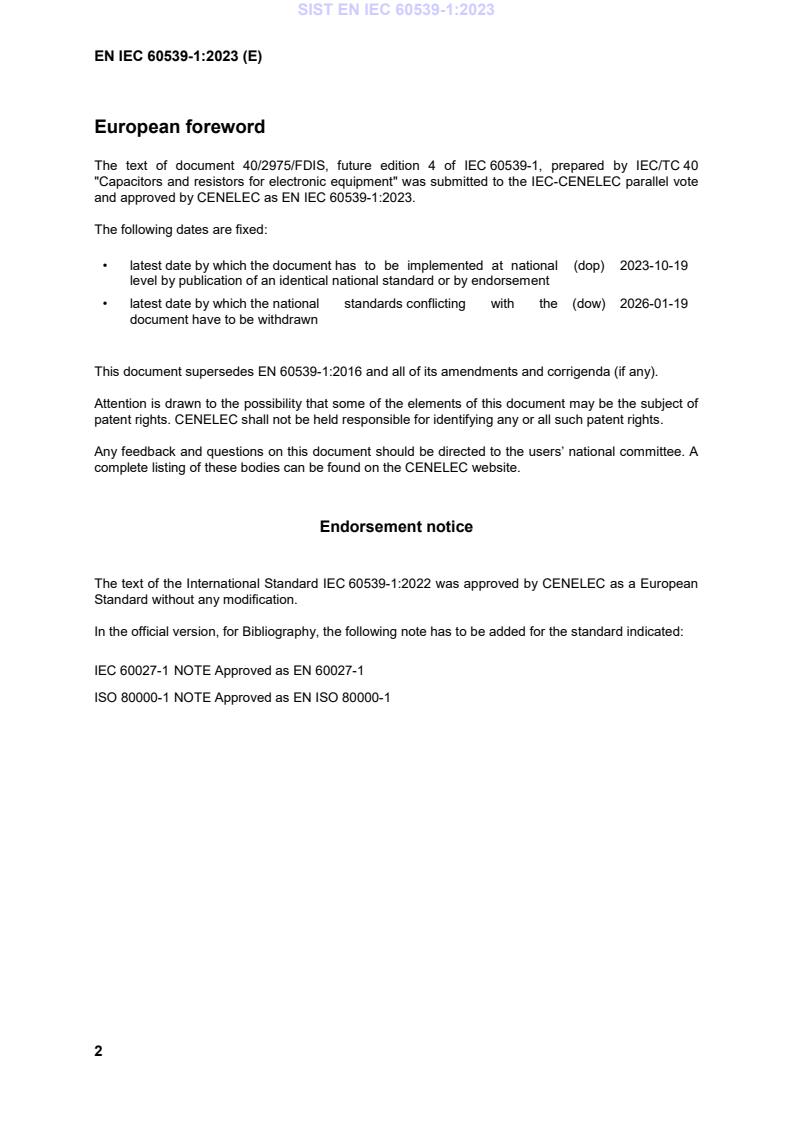
European foreword
The text of document 40/2975/FDIS, future edition 4 of IEC 60539-1, prepared by IEC/TC 40
"Capacitors and resistors for electronic equipment" was submitted to the IEC-CENELEC parallel vote
and approved by CENELEC as EN IEC 60539-1:2023.
The following dates are fixed:
• latest date by which the document has to be implemented at national (dop) 2023-10-19
level by publication of an identical national standard or by endorsement
• latest date by which the national standards conflicting with the (dow) 2026-01-19
document have to be withdrawn
This document supersedes EN 60539-1:2016 and all of its amendments and corrigenda (if any).
Attention is drawn to the possibility that some of the elements of this document may be the subject of
patent rights. CENELEC shall not be held responsible for identifying any or all such patent rights.
Any feedback and questions on this document should be directed to the users’ national committee. A
complete listing of these bodies can be found on the CENELEC website.
Endorsement notice
The text of the International Standard IEC 60539-1:2022 was approved by CENELEC as a European
Standard without any modification.
In the official version, for Bibliography, the following note has to be added for the standard indicated:
IEC 60027-1 NOTE Approved as EN 60027-1
ISO 80000-1 NOTE Approved as EN ISO 80000-1
Annex A
(normative)
Normative references to international publications
with their corresponding European publications
The following documents are referred to in the text in such a way that some or all of their content
constitutes requirements of this document. For dated references, only the edition cited applies. For
undated references, the latest edition of the referenced document (including any amendments)
applies.
NOTE 1 Where an International Publication has been modified by common modifications, indicated by (mod), the
relevant EN/HD applies.
NOTE 2 Up-to-date information on the latest versions of the European Standards listed in this annex is available
here: www.cenelec.eu.
Publication Year Title EN/HD Year
IEC 60062 - Marking codes for resistors and capacitors EN 60062 -
IEC 60068-1 2013 Environmental testing - Part 1: General EN 60068-1 2014
and guidance
IEC 60068-2-1 - Environmental testing - Part 2-1: Tests - EN 60068-2-1 -
Test A: Cold
IEC 60068-2-2 - Environmental testing - Part 2-2: Tests - EN 60068-2-2 -
Test B: Dry heat
IEC 60068-2-6 - Environmental testing - Part 2-6: Tests - EN 60068-2-6 -
Test Fc: Vibration (sinusoidal)
IEC 60068-2-11 - Environmental testing - Part 2-11: Tests - EN IEC 60068-2-11 -
Test Ka: Salt mist
IEC 60068-2-14 - Environmental testing - Part 2-14: Tests - EN 60068-2-14 -
Test N: Change of temperature
IEC 60068-2-17 - Basic environmental testing procedures - EN 60068-2-17 -
Part 2-17: Tests - Test Q: Sealing
IEC 60068-2-20 - Environmental testing - Part 2-20: Tests - EN IEC 60068-2-20 -
Test Ta and Tb: Test methods for
solderability and resistance to soldering
heat of devices with leads
IEC 60068-2-21 2021 Environmental testing - Part 2-21: Tests - EN IEC 60068-2-21 2021
Test U: Robustness of terminations and
integral mounting devices
IEC 60068-2-27 2008 Environmental testing - Part 2-27: Tests - EN 60068-2-27 2009
Test Ea and guidance: Shock
IEC 60068-2-31 - Environmental testing - Part 2-31: Tests - EN 60068-2-31 -
Test Ec: Rough handling shocks, primarily
for equipment-type specimens
IEC 60068-2-38 - Environmental testing - Part 2-38: Tests - EN IEC 60068-2-38 -
Test Z/AD: Composite
temperature/humidity cyclic test
IEC 60068-2-45 1980 Basic environmental testing procedures - EN 60068-2-45 1992
Part 2-45: Tests - Test XA and guidance:
Immersion in cleaning solvents
+ A1 1993 + A1 1993
IEC 60068-2-52 - Environmental testing - Part 2-52: Tests - EN IEC 60068-2-52 -
Test Kb: Salt mist, cyclic (sodium chloride
solution)
IEC 60068-2-58 - Environmental testing - Part 2-58: Tests - EN 60068-2-58 -
Test Td: Test methods for solderability,
resistance to dissolution of metallization
and to soldering heat of surface mounting
devices (SMD)
IEC 60068-2-69 - Environmental testing - Part 2-69: Tests - EN 60068-2-69 -
Test Te/Tc: Solderability testing of
electronic components and printed boards
by the wetting balance (force
measurement) method
IEC 60068-2-78 - Environmental testing - Part 2-78: Tests - EN 60068-2-78 -
Test Cab: Damp heat, steady state
IEC 60294 - Measurement of the dimensions of a EN 60294 -
cylindrical component with axial
terminations
IEC 60717 - Method for the determination of the space EN 60717 -
required by capacitors and resistors with
unidirectional terminations
IEC 61193-2 - Quality assessment systems - Part 2: EN 61193-2 -
Selection and use of sampling plans for
inspection of electronic components and
packages
IEC 61249-2-7 - Materials for printed boards and other EN 61249-2-7 -
interconnecting structures - Part 2-7:
Reinforced base materials clad and unclad
- Epoxide woven E-glass laminated sheet
of defined flammability (vertical burning
test), copper-clad
IEC 60539-1 ®
Edition 4.0 2022-12
INTERNATIONAL
STANDARD
NORME
INTERNATIONALE
Directly heated negative temperature coefficient thermistors –
Part 1: Generic specification
Thermistances à coefficient de température négatif à chauffage direct –
Partie 1: Spécification générique
INTERNATIONAL
ELECTROTECHNICAL
COMMISSION
COMMISSION
ELECTROTECHNIQUE
INTERNATIONALE
ICS 31.040.30 ISBN 978-2-8322-6192-7
– 2 – IEC 60539-1:2022 © IEC 2022
CONTENTS
FOREWORD . 8
1 Scope . 10
2 Normative references . 10
3 Terms and definitions . 11
4 General items . 21
4.1 Units and symbols. 21
4.2 Preferred values and appropriate category . 21
4.2.1 General . 21
4.2.2 Appropriate category . 21
4.3 Marking . 21
4.3.1 General . 21
4.3.2 Marking for small size types such as surface mount NTC thermistors . 22
4.3.3 Coding . 22
4.4 Quality assessment procedures . 22
5 General provisions for measurements and test methods . 22
5.1 General . 22
5.2 Standard atmospheric conditions for testing . 22
5.3 Drying and recovery . 23
5.3.1 Drying . 23
5.3.2 Recovery . 23
5.4 Mounting (for surface mount thermistors only) . 23
5.4.1 General . 23
5.4.2 Printed wiring board and land pattern . 23
5.4.3 Mounting on board . 23
6 Electrical tests and measurements . 25
6.1 Zero-power resistance . 25
6.1.1 General . 25
6.1.2 Measurement procedures . 25
6.1.3 Requirements . 25
6.2 B-value or resistance ratio . 25
6.2.1 General . 25
6.2.2 Requirements . 25
6.3 Insulation resistance (for insulated types only) . 26
6.3.1 General . 26
6.3.2 Test methods . 26
6.3.3 Applied voltage . 29
6.3.4 Requirements . 29
6.4 Voltage proof (for insulated types only) . 29
6.4.1 General . 29
6.4.2 Test voltage . 29
6.4.3 Requirements . 29
6.5 Resistance/temperature characteristic . 29
6.5.1 General . 29
6.5.2 Test methods . 29
6.5.3 Requirements . 29
6.6 Dissipation factor (δ) . 30
IEC 60539-1:2022 © IEC 2022 – 3 –
6.6.1 General . 30
6.6.2 Initial measurements . 30
6.6.3 Test methods . 30
6.6.4 Requirements . 31
6.7 Thermal time constant by ambient temperature change (τ ) . 31
a
6.7.1 The hot to cold thermal time constant for ambient temperature change . 31
6.7.2 The cold to hot thermal time constant for ambient temperature change . 32
6.7.3 Final measurements and requirements . 32
6.7.4 Requirements . 33
6.8 Thermal time constant by cooling after self-heating (τ ) . 33
c
6.8.1 General . 33
6.8.2 Initial measurements . 33
6.8.3 Preconditioning . 33
6.8.4 Test method . 34
6.8.5 Final measurements and requirements . 34
7 Mechanical test and measurements . 34
7.1 Visual examination and check of dimensions . 34
7.1.1 Visual examination . 34
7.1.2 Dimensions . 35
7.2 Robustness of terminations (not applicable to surface mount thermistors) . 35
7.2.1 General . 35
7.2.2 Initial measurements . 35
7.2.3 Test methods . 35
7.2.4 Test Ua – Tensile . 35
7.2.5 Test Ub – Bending (half the number of terminations) . 36
7.2.6 Test Uc – Torsion (remaining terminations). 36
7.2.7 Final measurements and requirements . 36
7.3 Vibration . 36
7.3.1 General . 36
7.3.2 Initial measurements . 36
7.3.3 Test procedures . 36
7.3.4 Final inspection, measurements and requirements. 37
7.4 Shock . 37
7.4.1 General . 37
7.4.2 Initial measurements . 37
7.4.3 Mounting . 37
7.4.4 Test procedures . 37
7.4.5 Final inspection, measurements and requirements. 37
7.5 Free fall . 37
7.5.1 General . 37
7.5.2 Initial measurements . 37
7.5.3 Test procedures . 38
7.5.4 Final inspection, measurements and requirements. 38
7.6 Shear (adhesion) test (for surface mount NTC thermistors only) . 38
7.6.1 General . 38
7.6.2 Initial measurements . 38
7.6.3 Test conditions . 38
7.6.4 Final inspection, measurements and requirements. 38
– 4 – IEC 60539-1:2022 © IEC 2022
7.7 Substrate bending test (for surface mount NTC thermistors only) . 38
7.7.1 General . 38
7.7.2 Initial measurements . 38
7.7.3 Test procedures . 38
7.7.4 Final inspection, measurements and requirements. 39
8 Environmental and climatic tests . 39
8.1 Rapid change of temperature . 39
8.1.1 General . 39
8.1.2 Initial measurements . 39
8.1.3 Test procedures . 39
8.1.4 Final inspection, measurements and requirements. 39
8.2 Thermal shock . 40
8.2.1 General . 40
8.2.2 Initial measurements . 40
8.2.3 Test procedures . 40
8.2.4 Final inspection, measurements and requirements. 40
8.3 Cold . 40
8.3.1 General . 40
8.3.2 Initial measurements . 40
8.3.3 Test procedures . 40
8.3.4 Final inspection, measurements and requirements. 41
8.4 Dry heat . 41
8.4.1 General . 41
8.4.2 Initial measurements . 41
8.4.3 Test procedures . 41
8.4.4 Final inspection, measurements and requirements. 41
8.5 Damp heat, steady state . 42
8.5.1 General . 42
8.5.2 Initial measurements . 42
8.5.3 Test procedures . 42
8.5.4 Recovery . 42
8.5.5 Final inspection, measurements and requirements. 42
8.6 Endurance . 42
8.6.1 General . 42
8.6.2 Endurance at room temperature with applied continuous maximum
current (I ) (for inrush current-limiting thermistors only) . 43
max25
8.6.3 Endurance at room temperature with applied cyclic maximum current
(I ) (for inrush current-limiting thermistors only) . 44
max25
8.6.4 Endurance at T and P (for other than inrush current-limiting
3 max
thermistors only) . 45
8.6.5 Endurance at upper category temperature . 46
8.6.6 Maximum permissible capacitance (for inrush current-limiting
thermistors only) . 47
8.7 Salt mist . 49
8.7.1 General . 49
8.7.2 Initial measurements . 49
8.7.3 Test conditions . 49
8.7.4 Final inspection, measurements and requirements. 49
8.8 Sealing . 49
IEC 60539-1:2022 © IEC 2022 – 5 –
8.9 Composite temperature/humidity cycle . 49
8.9.1 General . 49
8.9.2 Initial measurements . 49
8.9.3 Test conditions . 50
8.9.4 Final inspection, measurements and requirements. 50
9 Tests related to component assembly . 50
9.1 Resistance to soldering heat . 50
9.1.1 General . 50
9.1.2 Preconditioning . 50
9.1.3 Initial measurements . 50
9.1.4 Test procedure . 50
9.1.5 Recovery . 50
9.1.6 Final inspection, measurement and requirements . 51
9.2 Solderability . 51
9.2.1 General . 51
9.2.2 Initial measurements . 51
9.2.3 Test procedure . 51
9.2.4 Final inspection, measurements and requirements. 51
9.3 Component solvent resistance . 52
9.3.1 General . 52
9.3.2 Initial measurements . 52
9.3.3 Test conditions . 52
9.3.4 Requirements . 52
9.4 Solvent resistance of marking . 52
9.4.1 General . 52
9.4.2 Initial measurements . 52
9.4.3 Test conditions . 52
9.4.4 Requirements . 52
Annex A (normative) Rules for the preparation of detail specifications for directly
heated NTC thermistors for electronic equipment for use within quality assessment
systems . 53
A.1 Drafting . 53
A.2 Reference standard . 53
A.3 Circulation . 53
Annex B (informative) Typical examples of mountings for measurements of directly
heated thermistors . 54
Annex Q (informative) Quality assessment procedures . 56
Q.1 General . 56
Q.1.1 Scope of this annex . 56
Q.1.2 Quality assessment definitions . 57
Q.1.3 Rework . 57
Q.1.4 Alternative test methods . 57
Q.1.5 Certified test records of released lots . 58
Q.1.6 Unchecked parameters . 58
Q.1.7 Delayed delivery . 58
Q.1.8 Repair . 58
Q.1.9 Registration of approvals . 58
Q.1.10 Manufacture outside the geographical limits . 59
Q.2 Qualification approval (QA) procedures . 59
– 6 – IEC 60539-1:2022 © IEC 2022
Q.2.1 Eligibility for qualification approval . 59
Q.2.2 Application for qualification approval . 59
Q.2.3 Subcontracting . 59
Q.2.4 Test procedure for the initial product qualification approval. 59
Q.2.5 Granting of qualification approval . 59
Q.2.6 Maintenance of qualification approval . 59
Q.2.7 Quality conformance inspection . 60
Q.3 Capability approval (CA) procedures . 60
Q.3.1 General . 60
Q.3.2 Eligibility for capability approval . 60
Q.3.3 Application for capability approval . 60
Q.3.4 Subcontracting . 61
Q.3.5 Description of the capability . 61
Q.3.6 Demonstration and verification of capability . 61
Q.3.7 Granting of capability approval . 61
Q.3.8 Maintenance of capability approval . 61
Q.3.9 Quality conformance inspection . 61
Q.4 Technology approval (TA) procedure . 62
Q.4.1 General . 62
Q.4.2 Eligibility for technology approval . 62
Q.4.3 Application of technology approval . 62
Q.4.4 Subcontracting . 62
Q.4.5 Description of technology . 62
Q.4.6 Demonstration and verification of the technology . 62
Q.4.7 Granting of technology approval . 62
Q.4.8 Maintenance of technology approval . 62
Q.4.9 Quality conformance inspection . 63
Q.5 Interpretation of sampling plans and procedures as described in IEC 60410
for use within quality assessment systems . 63
Q.6 Rules for the preparation of detail specifications for NTC thermistors for
electronic equipment for use within quality assessment systems . 63
Q.6.1 Drafting . 63
Q.6.2 Reference standard . 63
Q.7 Layout of the first page of a PCP/CQC specification . 64
Q.8 Requirements for capability approval test report . 65
Q.8.1 General . 65
Q.8.2 Requirements . 65
Q.8.3 Summary of test information (for each CQC) . 65
Q.8.4 Measurement record . 65
Q.9 Guidance for the extension of endurance tests on fixed thermistor . 65
Q.9.1 Overview . 65
Q.9.2 Guidelines . 66
Annex X (informative) Cross-references to IEC 60539-1:2016 . 67
Bibliography . 69
Figure 1 – Typical resistance-temperature characteristic for NTC thermistors . 14
Figure 2 – Decreased power dissipation curve . 16
Figure 3 – Maximum current derating . 18
Figure 4 – Basic circuit for zero-power resistance measurement . 25
IEC 60539-1:2022 © IEC 2022 – 7 –
Figure 5 – Example of Method 1 for testing the insulation resistance . 26
Figure 6 – Example of Method 2 for testing the insulation resistance (1) . 27
Figure 7 – Example of Method 2 for testing the insulation resistance (2) . 27
Figure 8 – Example of Method 3 for testing the insulation resistance . 28
Figure 9 – Example of Method 4 for testing the insulation resistance . 28
Figure 10 – Example of test chamber . 30
Figure 11 – Dissipation factor measuring circuit . 31
Figure 12 – Thermal time constant measuring circuit . 34
Figure 13 – Endurance at room temperature with I evaluating circuit . 43
max25
Figure 14 – Endurance at room temperature with I evaluating circuit . 44
max25
Figure 15 – Maximum permissible capacitance test circuit (Method 1) . 48
Figure 16 – Maximum permissible capacitance test circuit (Method 2) . 48
Figure B.1 – Mounting for measurements of surface mount thermistors . 55
Table 1 – Lower and upper category temperatures and duration of the damp heat,
steady state test . 21
Table 2 – Tensile force . 36
Table B.1 – Recommended land dimensions . 54
– 8 – IEC 60539-1:2022 © IEC 2022
INTERNATIONAL ELECTROTECHNICAL COMMISSION
____________
DIRECTLY HEATED NEGATIVE TEMPERATURE
COEFFICIENT THERMISTORS –
Part 1: Generic specification
FOREWORD
1) The International Electrotechnical Commission (IEC) is a worldwide organization for standardization comprising
all national electrotechnical committees (IEC National Committees). The object of IEC is to promote international
co-operation on all questions concerning standardization in the electrical and electronic fields. To this end and
in addition to other activities, IEC publishes International Standards, Technical Specifications, Technical Reports,
Publicly Available Specifications (PAS) and Guides (hereafter referred to as "IEC Publication(s)"). Their
preparation is entrusted to technical committees; any IEC National Committee interested in the subject dealt with
may participate in this preparatory work. International, governmental and non-governmental organizations liaising
with the IEC also participate in this preparation. IEC collaborates closely with the International Organization for
Standardization (ISO) in accordance with conditions determined by agreement between the two organizations.
2) The formal decisions or agreements of IEC on technical matters express, as nearly as possible, an international
consensus of opinion on the relevant subjects since each technical committee has representation from all
interested IEC National Committees.
3) IEC Publications have the form of recommendations for international use and are accepted by IEC National
Committees in that sense. While all reasonable efforts are made to ensure that the technical content of IEC
Publications is accurate, IEC cannot be held responsible for the way in which they are used or for any
misinterpretation by any end user.
4) In order to promote international uniformity, IEC National Committees undertake to apply IEC Publications
transparently to the maximum extent possible in their national and regional publications. Any divergence between
any IEC Publication and the corresponding national or regional publication shall be clearly indicated in the latter.
5) IEC itself does not provide any attestation of conformity. Independent certification bodies provide conformity
assessment services and, in some areas, access to IEC marks of conformity. IEC is not responsible for any
services carried out by independent certification bodies.
6) All users should ensure that they have the latest edition of this publication.
7) No liability shall attach to IEC or its directors, employees, servants or agents including individual experts and
members of its technical committees and IEC National Committees for any personal injury, property damage or
other damage of any nature whatsoever, whether direct or indirect, or for costs (including legal fees) and
expenses arising out of the publication, use of, or reliance upon, this IEC Publication or any other IEC
Publications.
8) Attention is drawn to the Normative references cited in this publication. Use of the referenced publications is
indispensable for the correct application of this publication.
9) Attention is drawn to the possibility that some of the elements of this IEC Publication may be the subject of patent
rights. IEC shall not be held responsible for identifying any or all such patent rights.
IEC 60539-1 has been prepared by IEC technical committee 40: Capacitors and resistors for
electronic equipment. It is an International Standard.
This fourth edition cancels and replaces the third edition published in 2016. This edition
constitutes a technical revision.
This edition includes the following significant technical changes with respect to the previous
edition:
a) Restructured completely to comply to ISO/IEC directives; categorization and reorganization
of test methods into these categories;
b) Annex X added for comparison to the previous edition;
c) Some wordings, figures and references have been revised.
IEC 60539-1:2022 © IEC 2022 – 9 –
The text of this International Standard is based on the following documents:
Draft Report on voting
40/2975/FDIS 40/3016/RVD
Full information on the voting for its approval can be found in the report on voting indicated in
the above table.
The language used for the development of this International Standard is English.
A list of all parts in the IEC 60539-1 series, published under the general title Directly heated
negative temperature coefficient thermistors, can be found on the IEC website.
This document was drafted in accordance with ISO/IEC Directives, Part 2, and developed in
accordance with ISO/IEC Directives, Part 1 and ISO/IEC Directives, IEC Supplement, available
at www.iec.ch/members_experts/refdocs. The main document types developed by IEC are
described in greater detail at www.iec.ch/publications.
The committee has decided that the contents of this document will remain unchanged unt
...