

SIST EN 16037:2012
(Main)Chemicals used for treatment of water intended for human consumption - Sodium hydrogen sulfate
General Information
- Abstract
This European Standard is applicable to sodium hydrogen sulfate used for treatment of water intended for human consumption. It describes the characteristics of sodium hydrogen sulfate and specifies the requirements and the corresponding test methods for sodium hydrogen sulfate. It gives information on its use in water treatment.
- Status
- Published
- Public Enquiry End Date
- 19-May-2010
- Publication Date
- 07-Aug-2012
- Technical Committee
- IOVO - Water supply and waste water engineering
- Current Stage
- 6060 - National Implementation/Publication (Adopted Project)
- Start Date
- 12-Jul-2012
- Due Date
- 16-Sep-2012
- Completion Date
- 08-Aug-2012

Overview
SIST EN 16037:2012 establishes the requirements, characteristics, and testing methods for sodium hydrogen sulfate (commonly known as sodium bisulfate) when used in the treatment of water intended for human consumption. Published by the Slovenski inštitut za standardizacijo (SIST) and harmonized with the European standard EN 16037:2012, this standard ensures that sodium hydrogen sulfate meets strict purity and safety criteria before its use in drinking water processing. By providing guidelines for composition, handling, labeling, and storage, the standard supports both water treatment providers and regulators in ensuring safe drinking water.
Key Topics
Chemical Characteristics
- Identification: Sodium hydrogen sulfate (NaHSO₄), CAS number 7681-38-1
- Appearance: White to slightly yellow, free-flowing powder or beads, odourless
- Physical properties: Hygroscopic, with high solubility in water and acidic reaction in solution
Purity Requirements
- Purity: Must contain more than 95.2% sodium hydrogen sulfate by mass
- Strict limits are imposed on impurities such as sodium sulfate, water, insoluble substances, and heavy metals (iron, arsenic, cadmium, chromium, mercury, nickel, lead, antimony, selenium)
Test Methods
- Analytical procedures are defined for verifying content and impurities, including titration and atomic absorption spectrometry, ensuring consistency and safety for water treatment applications
Labelling, Transportation, and Storage
- Specific labeling requirements as per EU legislation, including hazard pictograms and safety statements
- Guidance on safe packaging, handling, and recommended storage conditions to maintain product stability
- Addresses compatibility, stressing avoidance of mixing with alkaline substances and use of suitable containers
Applications
Drinking Water Treatment
- pH Adjustment: Commonly used to lower the pH of drinking water, improving its compatibility with distribution infrastructure and ensuring compliance with regulatory standards
- Generation of Chlorine Dioxide: Applied in the acidification step for producing chlorine dioxide, a key disinfectant in water treatment
- Regeneration of Adsorbents and Ion Exchange Resins: Used in maintenance of water purification systems
- Dosing and Usage: Typically introduced as an aqueous solution, with treatment levels determined according to specific water quality objectives; dosing is controlled to ensure limits for sodium and sulfate ions are not exceeded
Operational Safety
- Emphasis on safe handling, with prescribed procedures for emergency response, first aid, and spillage control
- Not classified as a dangerous good under prevailing international transport regulations, simplifying logistics
Related Standards
For comprehensive water quality management and analytical procedures, refer also to:
- EN 1233: Water quality - Determination of chromium - Atomic absorption spectrometric methods
- EN 1483: Water quality - Determination of mercury - Method using atomic absorption spectrometry
- EN ISO 3696: Water for analytical laboratory use - Specification and test methods
- ISO 2479 / ISO 2483: Methods for determining substances insoluble in water/acid and loss of mass in sodium chloride
- ISO 3165 / ISO 6206: Guidelines for sampling and vocabulary for industrial chemical products
- ISO 6332: Water quality - Determination of iron using spectrometric methods
- ISO 8213 / ISO 8288: Sampling techniques and determination of heavy metals in water
SIST EN 16037:2012 is vital for water treatment professionals and regulatory bodies, providing a standardized approach to the use and quality control of sodium hydrogen sulfate in drinking water applications, thus ensuring consumer safety and regulatory compliance.
Relations
- Effective Date
- 25-Aug-2026
- Effective Date
- 25-Aug-2026
- Effective Date
- 25-Aug-2026
- Effective Date
- 25-Aug-2026
- Effective Date
- 09-Feb-2026
- Effective Date
- 28-Jan-2026
- Effective Date
- 28-Jan-2026
- Effective Date
- 28-Jan-2026
- Effective Date
- 28-Jan-2026
- Effective Date
- 28-Jan-2026
- Effective Date
- 28-Jan-2026
- Effective Date
- 28-Jan-2026
- Effective Date
- 28-Jan-2026
Get Certified
Connect with accredited certification bodies for this standard

ECOCERT
Organic and sustainability certification.

CIS Institut d.o.o.
Personal Protective Equipment (PPE) certification body. Notified Body NB-2890 for EU Regulation 2016/425 PPE.

Eurofins Food Testing Global
Global leader in food, environment, and pharmaceutical product testing.
Sponsored listings
Frequently Asked Questions
SIST EN 16037:2012 is a standard published by the Slovenian Institute for Standardization (SIST). Its full title is "Chemicals used for treatment of water intended for human consumption - Sodium hydrogen sulfate". This standard covers: This European Standard is applicable to sodium hydrogen sulfate used for treatment of water intended for human consumption. It describes the characteristics of sodium hydrogen sulfate and specifies the requirements and the corresponding test methods for sodium hydrogen sulfate. It gives information on its use in water treatment.
This European Standard is applicable to sodium hydrogen sulfate used for treatment of water intended for human consumption. It describes the characteristics of sodium hydrogen sulfate and specifies the requirements and the corresponding test methods for sodium hydrogen sulfate. It gives information on its use in water treatment.
SIST EN 16037:2012 is classified under the following ICS (International Classification for Standards) categories: 13.060.20 - Drinking water; 71.100.80 - Chemicals for purification of water. The ICS classification helps identify the subject area and facilitates finding related standards.
SIST EN 16037:2012 has the following relationships with other standards: It is inter standard links to SIST ISO 8288:1996, SIST ISO 3165:1995, SIST ISO 6332:1996, SIST ISO 6206:1995, SIST ISO 8213:1995, SIST EN ISO 3696:1998, SIST EN ISO 12846:2012, SIST EN 1233:1997, SIST ENV 13608-2:2003, SIST EN 1998-6:2005, SIST EN 13631-14:2003, SIST EN ISO 8751:2001, SIST EN 16038:2012. Understanding these relationships helps ensure you are using the most current and applicable version of the standard.
SIST EN 16037:2012 is available in PDF format for immediate download after purchase. The document can be added to your cart and obtained through the secure checkout process. Digital delivery ensures instant access to the complete standard document.
Standards Content (Sample)
2003-01.Slovenski inštitut za standardizacijo. Razmnoževanje celote ali delov tega standarda ni dovoljeno.Kemikalije, ki se uporabljajo za pripravo pitne vode - Natrijev hidrogen sulfatProdukte zur Aufbereitung von Wasser für den menschlichen Gebrauch - NatriumhydrogensulfatProduits chimiques uitilisés pour le traitement de l'eau destinée à la consommation humaine - Hydrogénosulfate de sodiumChemicals used for treatment of water intended for human consumption - Sodium hydrogen sulfate71.100.80Chemicals for purification of water13.060.20Pitna vodaDrinking waterICS:Ta slovenski standard je istoveten z:EN 16037:2012SIST EN 16037:2012en,fr,de01-september-2012SIST EN 16037:2012SLOVENSKI
STANDARD
EUROPEAN STANDARD NORME EUROPÉENNE EUROPÄISCHE NORM
EN 16037
July 2012 ICS 71.100.80 English Version
Chemicals used for treatment of water intended for human consumption - Sodium hydrogen sulfate
Produits chimiques uitilisés pour le traitement de l'eau destinée à la consommation humaine - Hydrogénosulfate de sodium
Produkte zur Aufbereitung von Wasser für den menschlichen Gebrauch - Natriumhydrogensulfat This European Standard was approved by CEN on 24 May 2012.
CEN members are bound to comply with the CEN/CENELEC Internal Regulations which stipulate the conditions for giving this European Standard the status of a national standard without any alteration. Up-to-date lists and bibliographical references concerning such national standards may be obtained on application to the CEN-CENELEC Management Centre or to any CEN member.
This European Standard exists in three official versions (English, French, German). A version in any other language made by translation under the responsibility of a CEN member into its own language and notified to the CEN-CENELEC Management Centre has the same status as the official versions.
CEN members are the national standards bodies of Austria, Belgium, Bulgaria, Croatia, Cyprus, Czech Republic, Denmark, Estonia, Finland, Former Yugoslav Republic of Macedonia, France, Germany, Greece, Hungary, Iceland, Ireland, Italy, Latvia, Lithuania, Luxembourg, Malta, Netherlands, Norway, Poland, Portugal, Romania, Slovakia, Slovenia, Spain, Sweden, Switzerland, Turkey and United Kingdom.
EUROPEAN COMMITTEE FOR STANDARDIZATION
COMITÉ EUROPÉEN DE NORMALISATION EUROPÄISCHES KOMITEE FÜR NORMUNG
Management Centre:
Avenue Marnix 17,
B-1000 Brussels © 2012 CEN All rights of exploitation in any form and by any means reserved worldwide for CEN national Members. Ref. No. EN 16037:2012: ESIST EN 16037:2012
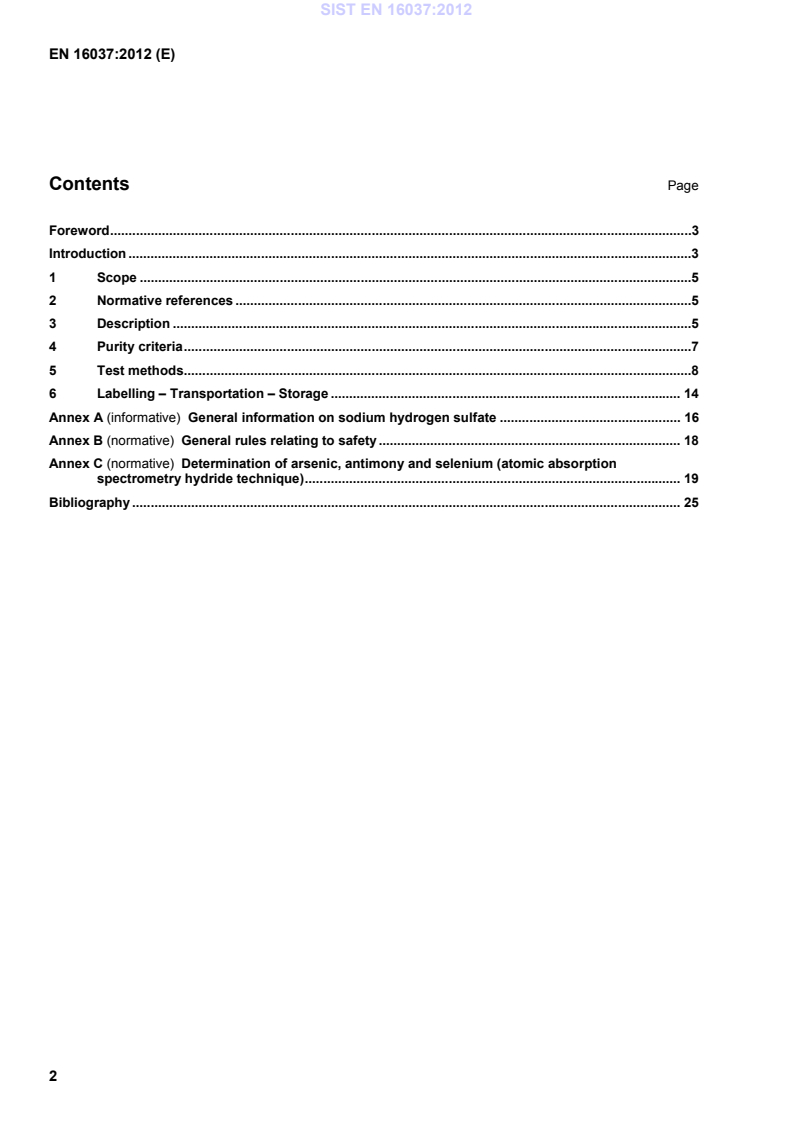
General information on sodium hydrogen sulfate . 16Annex B (normative)
General rules relating to safety . 18Annex C (normative)
Determination of arsenic, antimony and selenium (atomic absorption spectrometry hydride technique) . 19Bibliography . 25 SIST EN 16037:2012
EN 1483, Water quality — Determination of mercury — Method using atomic absorption spectrometry EN ISO 3696, Water for analytical laboratory use — Specification and test methods (ISO 3696) ISO 2479, Sodium chloride for industrial use — Determination of matter insoluble in water or in acid and preparation of principal solutions for other determinations ISO 2483, Sodium chloride for industrial use — Determination of the loss of mass at 110 degrees C ISO 3165, Sampling of chemical products for industrial use — Safety in sampling ISO 6206, Chemical products for industrial use — Sampling — Vocabulary ISO 6332, Water quality — Determination of iron — Spectrometric method using 1,10-phenanthroline ISO 8213, Chemical products for industrial use — Sampling techniques — Solid chemical products in the form of particles varying from powders to coarse lumps ISO 8288, Water quality — Determination of cobalt, nickel, copper, zinc, cadmium and lead — Flame atomic absorption spectrometric methods 3 Description 3.1 Identification 3.1.1 Chemical name Sodium hydrogen sulfate. 3.1.2 Synonym or common name Sodium bisulfate. 3.1.3 Relative molecular mass 120,06 g/mol. SIST EN 16037:2012
NaHSO4 . 3.1.5 CAS-Registry-Number1) 7681-38-1. 3.1.6 EINECS-Number2) 231-665-7. 3.2 Commercial form Powder or beads, free flowing. 3.3 Physical properties 3.3.1 Appearance and odour White to slightly yellow, odourless. 3.3.2 Density The bulk density of the product is approximately between 1 400 kg/m3 and 1 450 kg/m3. 3.3.3 Solubility in water Approximately 1 080 g/l at 25 °C. 3.3.4 Vapour pressure Not applicable. 3.3.5 Boiling point Not applicable. 3.3.6 Melting point at 100 kPa3) Approximately 180 °C. Note 1 to entry: The product decomposes at higher temperatures to sodium disulfate and water. 3.3.7 Specific heat Not applicable. 3.3.8 Viscosity (dynamic) Not applicable.
1)
Chemical Abtracts Service Registry Number. 2)
European Inventory of Existing Commercial Chemical Substances. 3)
100 kPa = 1 bar. SIST EN 16037:2012
Aqueous solutions of the product exhibit a acid reaction and are corrosive to metals: acid constant pKS = 1,99 a solution with a mass fraction of 20 % has a pH value between 1 and 1,2 at 25 °C. 4 Purity criteria 4.1 General This European Standard specifies the minimum purity requirements for sodium hydrogen sulfate used for the treatment of water intended for human consumption. Limits are given for impurities commonly present in the product. Depending on the raw material and the manufacturing process other impurities may be present and, if so, this shall be notified to the user and when necessary to the relevant authorities. NOTE Users of this product should check the national regulations in order to clarify whether it is of appropriate purity for treatment of water intended for human consumption, taking into account raw water quality, required dosage, contents of other impurities and additives used in the product not stated in the product standard. Limits have been given for impurities and chemicals parameters where these are likely to be present in significant quantities from the current production process and raw materials. If the production process or raw materials leads to significant quantities of impurities, by-products or additives being present, this shall be notified to the user. 4.2 Composition of commercial product The commercial product shall contain a mass fraction of sodium hydrogen sulfate greater than 95,2 %. 4.3 Impurities and by-products The content of impurities and by-products shall be in accordance with Table 1. SIST EN 16037:2012
4.4 Chemical Parameters The product shall conform to the requirements specified in Table 2. Table 2 — Chemical parameters Parameter Limit in mg/kg NaHSO4 Arsenic (As) max. 0,1 Cadmium (Cd) max. 0,1 Chromium (Cr) max. 1 Mercury (Hg) max. 0,1 Nickel (Ni) max. 1 Lead (Pb) max. 1 Antimony (Sb)
max. 1 Selenium (Se)
max. 1 NOTE Pesticides, polycyclic aromatic hydrocarbons and halogenated organic substances are not by-products of the manufacturing process. For parametric values on chemical parameters content in drinking water, see [1]. 5 Test methods 5.1 Sampling Prepare the laboratory sample(s) required by the relevant procedure described in ISO 8213. Observe the general recommendations of ISO 3165 and take account of ISO 6206.
5.2 Analysis 5.2.1 Determination of sodium hydrogen sulfate 5.2.1.1 Principle Alkalimetric titration with sodium hydroxide solution. 5.2.1.2 Reagents 5.2.1.2.1
All reagents shall be of a recognized analytical grade. De-ionized water (conforming to grade 3 of EN ISO 3696) is sufficient. 5.2.1.2.2
Sodium hydoxide solution, c(NaOH) = 0,1 mol/l SIST EN 16037:2012
100 - C1 – CW – Ci – C2
(2) where C1 is the content of sodium hydrogen sulfate (see 5.2.1); CW is the content of water (see 5.2.2.1); Ci is the content of insoluble substances (see 5.2.2.2); C2 is the content of iron (see 5.2.2.4). 5.2.2.4 Determination of iron (Fe) 5.2.2.4.1 Principle Iron is determined by visible absorption spectrometry of its 1,10-phenanthroline complex. 5.2.2.4.2 Reagents All reagents shall be of a recognised analytical grade and the water used shall conform to the appropriate grade specified in EN ISO 3696. 5.2.2.4.2.1 Nitric acid, solution, c(HNO3) = 2,5 mol/l. 5.2.2.4.3 Procedure 5.2.2.4.3.1 Test solution Weigh, to the nearest 0,1 mg, 1 g (m) of a test portion into a 100 ml one-mark volumetric flask. Add 0,5 ml of nitric acid (5.2.2.4.2.1), dilute with a few millilitres of water and mix. Dilute to volume with water and homogenize. 5.2.2.4.3.2 Determination The concentration of iron in the test solution (5.2.2.4.3.1) is determined according to ISO 6332. SIST EN 16037:2012
for direct determination by flame atomic absorption spectrometry; Cr: in accordance with EN 1233; As, Se and Sb: in accordance with the method given in Annex C. These methods will give an interim result (y) expressed in milligrams per litre that needs to be corrected to give the final concentration according to the formula in 5.2.3.1.4. 5.2.3.1.4 Expression of results From the interim results (y) determined (see 5.2.3.1.3.3), the content, C2, of each chemical parameter in the laboratory sample, expressed in milligrams per kilogram of sodium hydrogen sulfate is given by the following formula (4): 12100CmVyC××= (4) where Y is the interim result (5.2.3.1.3.3); V is the volume, expressed in millilitres, of the test solution (5.2.3.1.3.2) (= 100 ml); m is the mass, expressed in grams, of the test portion; C1 is the sodium hydrogen sulfate content in percentage by mass of product (see 5.2.1.5). SIST EN 16037:2012
...