

SIST-TP CEN/TR 17559:2022
(Main)Algae and algae products - Food and feed applications: General overview of limits, procedures and analytical methods
General Information
- Abstract
This document describes product specifications, product characteristics and other relevant information for algae and algae products for food, nutraceutical and animal feed applications. This document is a general overview of available limits, procedures and analytical methods applicable to algae and algae products used for food and feed applications.
This document does not apply to pharmaceutical, cosmetics, fertilizer/biostimulants, chemical and biofuel applications.
- Status
- Published
- Publication Date
- 23-Aug-2022
- Technical Committee
- I13 - Imaginarni 13
- Current Stage
- 6060 - National Implementation/Publication (Adopted Project)
- Start Date
- 10-Aug-2022
- Due Date
- 15-Oct-2022
- Completion Date
- 24-Aug-2022

Overview
CEN/TR 17559:2022 - "Algae and algae products - Food and feed applications: General overview of limits, procedures and analytical methods" is a CEN Technical Report prepared by CEN/TC 454 and approved July 2022. It provides a structured, practical overview of product specifications, product characteristics and relevant information for algae (microalgae, macroalgae, cyanobacteria, Labyrinthulomycetes) and derived products used in food, nutraceutical and animal feed applications. The report maps existing limits, sampling and analytical methods, and documentation practices to support safe, traceable and market-ready algae products. (It does not apply to pharmaceuticals, cosmetics, fertilizers/biostimulants, chemicals or biofuels.)
Key Topics
- Product specifications: recommended content for Technical Data Sheets (TDS), Certificates of Analysis (CoA), Product Data Sheets (PDS), Raw Material Specifications (RMS) and Material Safety Data Sheets (MSDS).
- Product characteristics: parameters such as energy, macronutrients (protein, lipids, carbohydrates), moisture, pigments, ash and typical compositional ranges relevant for food and feed labelling.
- Purity and contamination: identification of physical foreign matter, non-target algae/bacteria, heavy metals and chemical contaminants; overview of applicable limits and food/feed safety concerns.
- Analytical methods and procedures: mapping of available methods, references to sampling and laboratory analysis standards (including methods under development by CEN/TC 454).
- Traceability, labelling and claims: guidance on country/place of origin, shelf-life, storage conditions, allergen declaration and verification for regulatory compliance.
- Novel Food considerations: procedure overview and analytical method applicability for algae products subject to Novel Food Regulation (EU) No 2015/2283.
- Supporting annexes: examples of product specification documents, purity identification methods and a mapping of existing legislation on maximum allowed levels for elements and contaminants.
Applications and Who Uses This Standard
CEN/TR 17559:2022 is primarily intended for:
- Algae producers and processors preparing biomass, extracts or algal ingredients
- Food and feed manufacturers incorporating algae-derived ingredients
- Analytical laboratories developing or selecting methods for algae matrices
- Quality assurance, regulatory compliance teams and certification bodies
- Supply-chain managers concerned with traceability, CoA and labelling The report helps stakeholders design product specifications, implement testing programs, manage contaminant risks and support Novel Food submissions.
Related Standards
- EN 17399 (Terms and definitions)
- EN 17477 (Identification of algal biomass)
- EN 17605 (Sampling and sample treatment)
- Additional CEN/TC 454 deliverables on productivity, methods and sector-specific specifications
CEN/TR 17559:2022 is a practical reference to align algae product documentation, testing and labelling with EU food/feed safety expectations and industry best practice.
Relations
- Effective Date
- 10-Aug-2022
- Effective Date
- 28-Jan-2026
Get Certified
Connect with accredited certification bodies for this standard

BSI Group
BSI (British Standards Institution) is the business standards company that helps organizations make excellence a habit.

Bureau Veritas
Bureau Veritas is a world leader in laboratory testing, inspection and certification services.

DNV
DNV is an independent assurance and risk management provider.
Sponsored listings
Frequently Asked Questions
SIST-TP CEN/TR 17559:2022 is a technical report published by the Slovenian Institute for Standardization (SIST). Its full title is "Algae and algae products - Food and feed applications: General overview of limits, procedures and analytical methods". This standard covers: This document describes product specifications, product characteristics and other relevant information for algae and algae products for food, nutraceutical and animal feed applications. This document is a general overview of available limits, procedures and analytical methods applicable to algae and algae products used for food and feed applications. This document does not apply to pharmaceutical, cosmetics, fertilizer/biostimulants, chemical and biofuel applications.
This document describes product specifications, product characteristics and other relevant information for algae and algae products for food, nutraceutical and animal feed applications. This document is a general overview of available limits, procedures and analytical methods applicable to algae and algae products used for food and feed applications. This document does not apply to pharmaceutical, cosmetics, fertilizer/biostimulants, chemical and biofuel applications.
SIST-TP CEN/TR 17559:2022 is classified under the following ICS (International Classification for Standards) categories: 13.020.55 - Biobased products; 65.120 - Animal feeding stuffs; 67.040 - Food products in general. The ICS classification helps identify the subject area and facilitates finding related standards.
SIST-TP CEN/TR 17559:2022 has the following relationships with other standards: It is inter standard links to SIST-TP CEN/TR 17559:2021, SIST EN 17399:2024. Understanding these relationships helps ensure you are using the most current and applicable version of the standard.
SIST-TP CEN/TR 17559:2022 is associated with the following European legislation: EU Directives/Regulations: 2009/128/EC; Standardization Mandates: M/547. When a standard is cited in the Official Journal of the European Union, products manufactured in conformity with it benefit from a presumption of conformity with the essential requirements of the corresponding EU directive or regulation.
SIST-TP CEN/TR 17559:2022 is available in PDF format for immediate download after purchase. The document can be added to your cart and obtained through the secure checkout process. Digital delivery ensures instant access to the complete standard document.
Standards Content (Sample)
SLOVENSKI STANDARD
01-september-2022
Nadomešča:
SIST-TP CEN/TR 17559:2021
Alge in izdelki iz alg - Uporaba hrane in krme: Splošni pregled omejitev, postopkov
in analitskih metod
Algae and algae products - Food and feed applications: General overview of limits,
procedures and analytical methods
Algen und Algenprodukte - Nahrungs- und Futtermittelanwendungen: Überblick über
Grenzwerte, Verfahren und Analysemethoden
Algues et produits d’algues - Applications de denrées alimentaires et d’aliments pour
animaux - Vue d’ensemble des limites, modes opératoires et méthodes d’analyse
Ta slovenski standard je istoveten z: CEN/TR 17559:2022
ICS:
65.120 Krmila Animal feeding stuffs
67.040 Živilski proizvodi na splošno Food products in general
2003-01.Slovenski inštitut za standardizacijo. Razmnoževanje celote ali delov tega standarda ni dovoljeno.
CEN/TR 17559
TECHNICAL REPORT
RAPPORT TECHNIQUE
August 2022
TECHNISCHER REPORT
ICS 65.120; 67.040; 13.020.55 Supersedes CEN/TR 17559:2021
English Version
Algae and algae products - Food and feed applications:
General overview of limits, procedures and analytical
methods
Algues et produits d'algues - Applications de denrées Algen und Algenprodukte - Nahrungs- und
alimentaires et d'aliments pour animaux - Vue Futtermittelanwendungen: Überblick über Grenzwerte,
d'ensemble des limites, modes opératoires et Verfahren und Analysemethoden
méthodes d'analyse
This Technical Report was approved by CEN on 3 July 2022. It has been drawn up by the Technical Committee CEN/TC 454.
CEN members are the national standards bodies of Austria, Belgium, Bulgaria, Croatia, Cyprus, Czech Republic, Denmark, Estonia,
Finland, France, Germany, Greece, Hungary, Iceland, Ireland, Italy, Latvia, Lithuania, Luxembourg, Malta, Netherlands, Norway,
Poland, Portugal, Republic of North Macedonia, Romania, Serbia, Slovakia, Slovenia, Spain, Sweden, Switzerland, Türkiye and
United Kingdom.
EUROPEAN COMMITTEE FOR STANDARDIZATION
COMITÉ EUROPÉEN DE NORMALISATION
EUROPÄISCHES KOMITEE FÜR NORMUNG
CEN-CENELEC Management Centre: Rue de la Science 23, B-1040 Brussels
© 2022 CEN All rights of exploitation in any form and by any means reserved Ref. No. CEN/TR 17559:2022 E
worldwide for CEN national Members.
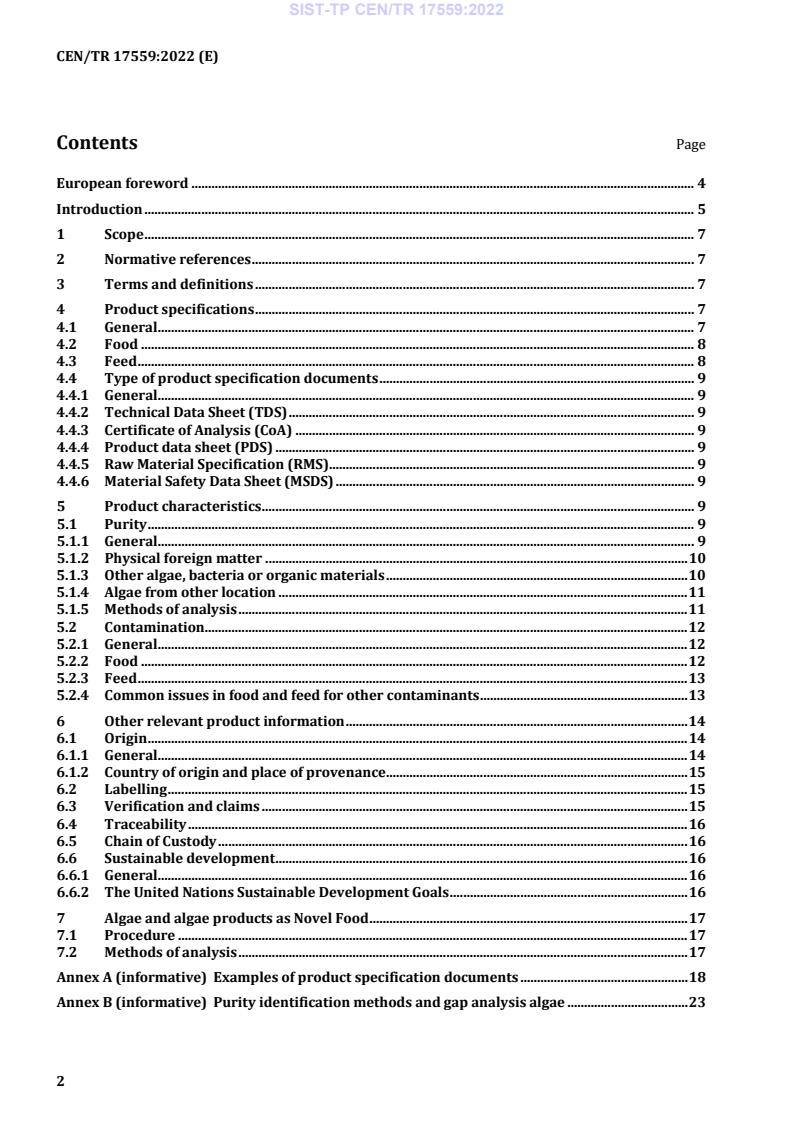
Contents Page
European foreword . 4
Introduction . 5
1 Scope . 7
2 Normative references . 7
3 Terms and definitions . 7
4 Product specifications . 7
4.1 General . 7
4.2 Food . 8
4.3 Feed . 8
4.4 Type of product specification documents . 9
4.4.1 General . 9
4.4.2 Technical Data Sheet (TDS) . 9
4.4.3 Certificate of Analysis (CoA) . 9
4.4.4 Product data sheet (PDS) . 9
4.4.5 Raw Material Specification (RMS). 9
4.4.6 Material Safety Data Sheet (MSDS) . 9
5 Product characteristics . 9
5.1 Purity . 9
5.1.1 General . 9
5.1.2 Physical foreign matter . 10
5.1.3 Other algae, bacteria or organic materials . 10
5.1.4 Algae from other location . 11
5.1.5 Methods of analysis . 11
5.2 Contamination. 12
5.2.1 General . 12
5.2.2 Food . 12
5.2.3 Feed . 13
5.2.4 Common issues in food and feed for other contaminants . 13
6 Other relevant product information . 14
6.1 Origin . 14
6.1.1 General . 14
6.1.2 Country of origin and place of provenance . 15
6.2 Labelling . 15
6.3 Verification and claims . 15
6.4 Traceability . 16
6.5 Chain of Custody . 16
6.6 Sustainable development . 16
6.6.1 General . 16
6.6.2 The United Nations Sustainable Development Goals . 16
7 Algae and algae products as Novel Food . 17
7.1 Procedure . 17
7.2 Methods of analysis . 17
Annex A (informative) Examples of product specification documents . 18
Annex B (informative) Purity identification methods and gap analysis algae . 23
Annex C (informative) Mapping of currently existing legislation on maximum allowed levels
of elements and other chemical contaminants in food and feed applications . 26
Annex D (informative) Applicability of standards to determine the safety of novel algae and
algae food products to comply with the Novel Food Regulation (EU) No 2015/2283 . 29
Bibliography . 38
European foreword
This document (CEN/TR 17559:2022) has been prepared by Technical Committee CEN/TC 454 “Algae
and algae products”, the secretariat of which is held by NEN.
Attention is drawn to the possibility that some of the elements of this document may be the subject of
patent rights. CEN shall not be held responsible for identifying any or all such patent rights.
This document supersedes CEN/TR 17559:2021.
Any feedback and questions on this document should be directed to the users’ national standards body.
A complete listing of these bodies can be found on the CEN website.
Introduction
This document has been prepared by the experts of CEN/TC 454 ‘Algae and algae products’.
The European Committee for Standardization (CEN) was requested by the European Commission (EC) to
draft European standards or European standardization deliverables to support the implementation of
Article 3 of Directive 2009/28/EC for algae and algae-based products or intermediates.
This request, presented as Mandate M/547 , also contributes to the Communication on “Innovating for
Sustainable Growth: A Bio economy for Europe”.
The former working group CEN Technical Board Working Group 218 “Algae”, was created in 2016 to
develop a work programme as part of this Mandate. The technical committee CEN/TC 454 'Algae and
algae products' was established to carry out the work programme that will prepare a series of standards.
The interest in algae and algae-based products or intermediates has increased significantly in Europe as
a valuable source including but not limited to, carbohydrates, proteins, lipids, and several pigments.
These materials are suitable for use in a wide range of applications from food and feed purposes to other
sectors, such as textile, cosmetics, biopolymers, biofuel and fertilizer/biostimulants. Standardization was
identified as having an important role in order to promote the use of algae and algae products.
The work of CEN/TC 454 should improve the reliability of the supply chain, thereby improving the
confidence of industry and consumers in algae, which include macroalgae, microalgae, cyanobacteria,
Labyrinthulomycetes, algae-based products or intermediates and will promote and support
commercialisation of the European algae industry.
This document has been prepared in close collaboration with the CEN/TC 454 working groups. The
European standards and technical reports developed in this mandate include:
CEN/TC 454/WG 1 Terminology
— CEN/TR 17559, Algae and algae products - Food and feed applications: General overview of limits,
procedures and analytical methods
CEN/TC 454/WG 2 Identification
— EN 17477, Algae and algae products - Identification of the biomass of microalgae, macroalgae,
cyanobacteria and Labyrinthulomycetes - Detection and identification with morphological and/or
molecular methods
CEN/TC 454/WG 3 Productivity
— EN 17480, Algae and algae products - Methods for the determination of productivity of algae growth
sites
CEN/TC 454/WG 5 Specifications for non-food/feed sector applications
— CEN/TR 17611, Algae and algae products - Specifications for cosmetic sector applications
— CEN/TR 17739, Algae and algae products - Specifications for chemical and biofuels sector
applications
— CEN/TR 17612, Algae and algae products - Specifications for pharmaceutical sector applications
http://ec.europa.eu/growth/tools-databases/mandates/index.cfm?fuseaction=refSearch.search
CEN/TC 454/WG 6 Product test methods
— In preparation: Algae and algae products - Methods of sampling and analysis - Determination of total
lipids using the Ryckebosch-Foubert method
— EN 17605, Algae, algae products and intermediates - Methods of sampling and analysis - Sample
treatment
— In preparation: Algae and algae products – Methods of sampling and analysis – Quantification of
chlorophyll
The available EU directives and other ISO and CEN standards which are of relevance for algae and algae
products for food and feed applications are listed in the bibliography.
1 Scope
This document describes product specifications, product characteristics and other relevant information
for algae and algae products for food, nutraceutical and animal feed applications. This document is a
general overview of available limits, procedures and analytical methods applicable to algae and algae
products used for food and feed applications.
This document does not apply to pharmaceutical, cosmetics, fertilizer/biostimulants, chemical and
biofuel applications.
2 Normative references
The following documents are referred to in the text in such a way that some or all of their content
constitutes requirements of this document. For dated references, only the edition cited applies. For
undated references, the latest edition of the referenced document (including any amendments) applies.
EN 17399, Algae and algae products - Terms and definitions
3 Terms and definitions
For the purposes of this document, the terms and definitions given in EN 17399 and the following apply:
ISO and IEC maintain terminological databases for use in standardization at the following addresses:
— IEC Electropedia: available at https://www.electropedia.org/
— ISO Online browsing platform: available at https://www.iso.org/obp
3.1
algae and algae products
functional group of organisms consisting of microalgae, macroalgae, cyanobacteria, Labyrinthulomycetes
and products derived thereof
Note 1 to entry: examples of products are biomass, extracts or derivatives from algae, including a.o. algal oil and
algal powder.
4 Product specifications
4.1 General
The interest in algae and algae products has increased significantly in Europe as a source of
carbohydrates, proteins, lipids, minerals, several pigments etc. These materials are suitable for use in a
wide range of applications for food and feed purposes and to other sectors, such as textile, cosmetics,
biopolymers, biofuel and fertilizers and biostimulants.
Depending on the application different information on product characteristics (Clause 5) are required as
product specification by the applicable regulation.
4.2 Food
All algae and algae products intended for food or food ingredients are accompanied by basic information
on the product in line with applicable EU regulation for food labelling as well as specific directives from
some EU countries. Some are mandatory and other optional and are dependent on the target market.
These product specifications for food contain information that includes but is not limited to [27]:
— energy;
— content of fat, saturates, carbohydrate, sugars, protein, and salt (sodium);
— other nutrients (e.g. vitamins, minerals, fibre, polyols) [31];
— total sulphites;
— moisture;
— ingredients and presence of allergens;
— shelf-life, including requirements for storage and shipping;
— contaminants as defined as critical in the risk assessment of the food safety management system (e.g.
heavy metals).
4.3 Feed
All algae and algae products intended for feed or feed ingredients are be accompanied by basic
information on the product. These product specification for feed contain information, where applicable,
that includes but is not limited to [45]:
— type of feed and intended use;
— energy;
— crude protein;
— crude oils and fats;
— crude fibre;
— crude ash;
— amino acids (lysine and methionine);
— minerals (calcium, sodium, phosphorus, magnesium);
— moisture;
— feed additives;
— minimum storage life;
— contaminants as defined as critical in the risk assessment of the feed safety management system (e.g.
heavy metals).
4.4 Type of product specification documents
4.4.1 General
Different product specification documents with information on algae and algae products should be used
by organisations. These documents are not mandatory and are used for information exchange.
4.4.2 Technical Data Sheet (TDS)
The technical data sheet is a technical document containing the technical parameters adopted to
characterize the product and therefore being the equivalent of the Certificate of Analysis (4.4.3). The TDS
includes the typical ranges of different parameters used to define the product characteristics or
applicable regulatory limits. Examples of a TDS for some algae are attached as Annex A.
4.4.3 Certificate of Analysis (CoA)
The certificate of analysis is a document issued by the organization based on actual laboratory results to
report test results of the sample. It includes references to the analytical method and quality standard(s)
used. It may or may not have legal value.
4.4.4 Product data sheet (PDS)
The product data sheet is a document issued by the manufacturer for marketing purposes and usually
used to provide product approval information to the customer.
4.4.5 Raw Material Specification (RMS)
The raw material specification is a technical document about the product, usually prepared by
manufacturer, directed to provide all product approval information to the customer and usually attached
to a commercial contract.
4.4.6 Material Safety Data Sheet (MSDS)
The material safety data sheet is a document issued according to EC Regulation [37] with the aim of
providing product compliance information in respect of human health and safety at the workplace and
protection of the environment.
This document is issued by the manufacturer for hazardous substances and mixtures and is not required
for all materials or products. In general, an MSDS is not necessary for food and feed applications.
NOTE Some customers ask for an MSDS even if it is not mandatory. It is the algae and algae product
manufacturer's responsibility to check the applicable regulation case by case. Algae and algae products can or can
possibly not fall under the MSDS obligation.
5 Product characteristics
5.1 Purity
5.1.1 General
The product purity is defined as the percentage of a specific component in the total amount of a product.
Any other substances are specified in the technical data sheet.
Purity is affected by the accidental presence or the fraudulent addition of any organism, part or product
of an organism, other than named in the product specification and description of the concerned algae; or
any extraneous substances with the same composition as dry algae, even in the absence of contamination.
The minimum purity required for a food product will depend on the application of the algae or algae
product and is agreed with the customer. The minimum requirement of purity for feed is regulated by
legislation and customer contracts. Purity is not related to contamination since contamination will not
affect the amount of required substance.
The following substances affecting the purity of a product can be addressed [47]:
1) Physical foreign matter (i.e. (micro) plastic fragments, wires from fishing nets and ropes, feathers
from birds, shells, etc.);
2) Other algae (including toxin‐producing cyanobacteria), bacteria or organic materials (e.g. grass,
proteins or oils from other species);
3) Algae from other origin or location than stated (e.g. from Asia instead of Europe).
NOTE 1 The percentage is specified by mass fraction (kg/kg), volume fraction (m3/m3) or cell fraction (cell
counts/all cell counts) or their corresponding concentrations if more appropriate.
NOTE 2 Foreign matter related to the use of genetically modified species or non-organic produced products are
regulated by EU Regulation.
Methods of analysis to determine the purity of algae and algae products include qualitative and
quantitative methods. If a qualitative method shows substances that affect the product purity, a
quantitative method may be necessary. Various methods are suitable for fresh materials and dry
materials or powders.
Available methods include visual inspection, microscopy, nucleic acids identification (DNA barcoding,
PCR techniques, DNA microarrays, NGS, Q-PCR), molecular and chemical fingerprinting (fatty acid profile,
pigment analysis) and isotopic analysis.
5.1.2 Physical foreign matter
Macroscopic examination is suitable for determining the presence of particles of foreign matter in whole
or cut (macro)algae. Foreign matter are all materials which are not part of the (macro)algal biomass.
Additional aids (like UV-light, sieving, centrifugation) might be helpful to find the foreign matter.
Microscopy is a suitable tool for microalgae, cyanobacteria, Labyrinthulomycetes and powdered
materials and small particles of physical foreign matter for which macroscopic examination is not
suitable. Reduction of particle size or powdering materials can hide the presence of foreign matter and
make it more difficult to detect. Also diluted samples cannot be qualified and need a quantification step.
5.1.3 Other algae, bacteria or organic materials
Visual inspection is suitable for freshly harvested macroalgae as the intact cells can be recognized as a
whole. When the holdfast is removed or when epiphytic organisms may be present on the surface and
visual inspection may or may not be sufficient to identify the species after harvesting. Macroalgae need
to be crushed and mixed and the mixture needs to be plated to identify which colonies are present in the
sample. For ground algae, cells are disrupted and the algae species can no longer be recognized nor be
quantified. Rehydration might help here. Specifically, for cyanobacteria, some guidance for the
numeration of phytoplankton can provide the degree of purity on fresh samples [1].
Macroscopical and microscopical characterization includes features, which distinguish the algae material
from potential non-specified substances. Identification tests need to be specifically validated for algae
and are usually a combination of methods depending on the algae species. Identification tests include
macroscopical characters, microscopical characters, chromatographic procedures and physicochemical
analysis. Automated tools might help like cell counters or cell flow cytometers.
The development of methods based on nucleic acids characteristics (microsatellites, NGS, barcoding,
RAPD, AFLP, etc.) to be sequenced and/or quantified (qPCR) from product samples would provide simple
and fast tools for the identification of multiple targeted species and would help to indicate the presence
of other nucleic acids than those of the algal material. Other horizontal analytical methods useful for
purity detection (molecular or chemical fingerprinting like fatty acid analysis, etc) will be developed in
CEN/TC 460 'Food and feed authenticity’. Currently, there is a lack of databases for the identification of
foreign matter.
5.1.4 Algae from other location
The most promising test to detect the presence of algae from other regions then stated, is the use of stable
isotopes. However, first databases with the characterization of isotopes from different regions needs to
be established [47]. Another method is the use of lipidomics tools, although these tools also require the
establishment of databases [60].
Currently these methods are not yet standardized and available for routine testing. In addition, essential
databases are not complete to identify all different species. Therefore, good farming practices (GFP), good
manufacturing practices (GMP), traceability and Chain of Custody systems are essential to monitor the
purity for algae and algae products.
An overview of the currently available types of foreign matter and respective detection methods
including qualitative and quantitative determination are shown in Annex B, Table B.1 [47]. The reliability
of these different methods depends on the complexity of the species and foreign matter and are not
necessarily sufficient for each case.
5.1.5 Methods of analysis
The inventory of available methods and recommendation for prioritizing future method development on
purity of algae and algae products are listed in Annex B, Table B.2.
Specific gaps to use these methods are lack of respectively [47]:
— sampling strategies for visual inspection and microscopy;
— quantification method for microscopy;
— databases, algae selective primers and protocols for nucleic acids identification; and
— databases for molecular and chemical fingerprinting and isotope analysis (see Annex B, Table B.3).
In addition to the gap per analysis methodology, methods are lacking for the quantification of the found
foreign matter. Furthermore, protocols describing what to do with the product if the presence of a foreign
matter is detected, are lacking.
It is recommended to further develop and standardize the following protocols [47]:
— sample strategies for quality control of fresh materials and of dry/powdered materials;
— quality control protocols describing which other checks have to be done when foreign matter is
found;
— visual inspection protocols for fresh materials and for dry/powdered materials;
— microscopical inspection protocols for fresh materials and for dry/powdered materials;
— protocol for molecular biological quality control taking into account the most important criteria;
— study the applicability of isotope analysis for specification of the region of origin.
5.2 Contamination
5.2.1 General
A contaminant is defined as any biological or chemical agent, foreign matter, or other substances not
intentionally added to food which may compromise food safety or suitability of algae and algae products
in the food or feed application [44]. Several types of contaminants exist including chemical,
microbiological and physical contamination. Chemical contamination of algae and algae products can
occur in the open waters (macroalgae) or in a closed or semi-closed cultivation system (micro- and
macroalgae), e.g. when water sources for algae cultivation have been in contact with human or industrial
activities or outlets. Most algae tend to accumulate minerals and other compounds if present in the
surrounding environment. Therefore, this form of contamination is important to monitor. Processes to
reduce contaminants to acceptable levels are available, like rinsing.
5.2.2 Food
The contaminants for algae that have been identified as potential hazards for food safety include: heavy
metals (including uranium), toxins, pesticides, dioxins, PAH’s, allergens, pheophorbides and
microorganisms. The potential presence of these hazards depends on the algae species and its cultivation
and processing conditions.
Several gaps in legislation for macroalgae have been identified [9], [11]. Inorganic arsenic (iAs) and other
potential toxic arsenic compounds, cadmium (Cd), lead (Pb), mercury (Hg), iodine (I), selenium (Se) and
uranium (U) are of particular concern since these can be found in algae. There is a need for a clear
overview of the regulation for algae used as food. The algae market is growing and there is a need for EU
legislation on e.g. iodine and inorganic arsenic. The specific threshold values should be set by the
European Commission and EFSA (European Food Safety Authority) taking maximum levels of daily
intake, quantity of intake and the effects of processing into consideration.
The current available EU regulation [11] is not clear in the description whether the threshold levels are
based on dry or wet material. The threshold levels being set by EFSA should be based on dry material of
the algae or algae product. Research shows that some contaminant concentrations (e.g. iodine and
inorganic arsenic) can be decreased considerably by processing, e.g. boiling, rinsing, drying, etc. [62],
[63]. Each product has to comply with the legislation, but some national food authorities demand that the
packaging should mention specific processing to be done by the consumer before consumption. This
should be harmonized in EU legislation regarding consumer processing on the packaging and if part of
the population should be warned.
Algae grown in semi-closed or open systems as well as wild-harvested macroalgae can be cross-
contaminated by allergens (such as shellfish and crustaceans). If there is a possibility that such
contaminants and/or traces/spores hereof are present in the macroalgae, this should be reported on the
product packaging [27].
Pheophorbides are breakdown compounds of chlorophyll and are not regulated. Japanese legislation sets
maximum limits. Therefore, it should be considered if these compounds are a hazard for algae and algae
products in food applications.
Although the EC Regulation sets no maximum levels for microorganisms in algae or algae products in
food, all food products have to be microbiologically safe to consume. These products have to be stable
during storage and processing, at least as long as the shelf life is indicated on the label. Specific threshold
values for microorganisms in microalgae and macroalgae and their microbial stability should be
evaluated and harmonized in the various national guidelines.
Regarding food quality management, a guidance for good hygiene practices is being validated for the
production of spirulina as food [48].
The EFSA working group for industrial contaminants is currently in the progress of updating this
legislation on contaminants, and looks at including macroalgae as food in the legislation (working
document on contaminants in macroalgae [10]). If there are not already recognized methods from EU
reference laboratories etc. in place, then standards on methods for extracting, identifying and quantifying
contaminants should be established.
Algae and algae products, elements and their chemical species to be considered in food safety control are
listed in Annex C, Table C.1, together with the different legislations that cover the microalgae and
macroalgae used for food and food applications and food supplements in the European Union.
5.2.3 Feed
The contaminants for algae and algae products that have been identified as potential hazard for feed
applications include: heavy metals (including uranium), inorganic arsenic, toxins, pesticides, dioxins,
PAH’s, fluorine, nitrate, allergens, pheophorbides and microorganisms.
Feed legislation sets different threshold levels of contaminants in different animal species. Several gaps
in legislation for algae have been identified. Inorganic arsenic (iAs) and other potential toxic arsenic
compounds, cadmium (Cd), lead (Pb), mercury (Hg), iodine (I) and uranium (U) are of particular concern
since these could be found in algae.
Within the feed legislation the threshold concentration of arsenic is regulated on the total arsenic and
inorganic arsenic content [56]. This analysis is of particular importance for the seaweed species Hizikia
fusiforme (also called Sargassum fusiforme). An update of such threshold values is necessary and the ratio
of organic and inorganic arsenic would be needed to reduce the arsenic risk. Also, more data both on the
toxic profile and the carry-over behaviour of the organic arsenic compounds is needed.
Similar limits and considerations for the iodine limits in feed are needed [33].
The legislation for elements and their chemical species of concern in feed are summarized in Annex C,
Table C.2.
Certain microbiological criteria for feed are set in the national legislation of some Member States.
However, these criteria are not harmonized in the European Union for the majority of feed (with the
exceptions of mycotoxins and animal by-products), and not specific for algae. Specific threshold values
for microorganisms in microalgae and macroalgae and their microbial stability in feed stuffs need to be
evaluated and harmonized in various national guidelines.
5.2.4 Common issues in food and feed for other contaminants
Physical contaminants
All physical contaminants which can be found in macroalgae such as parts of plastic, wires from fishing
nets and ropes, feathers from birds, shells, etc. are described by Horizonscan and RASFF (the Rapid Alert
System for Food and Feed) as foreign bodies. This terminology needs to be updated to include also other
physical contaminants such as microplastics.
Cyanotoxins and marine biotoxins
Algae and algae products can be contaminated by toxin-producing microorganisms. These toxins include
cyanotoxins like microcystins, anatoxins, cylindrospermopsin, saxitoxin group, or marine biotoxins like
palytoxins and ciguatoxins, domoic acid and lipophilic marine biotoxins as the okadaic acid group,
yessotoxin group and azaspiroacid group. Especially in some microalgae or cyanobacteria based dietary
supplements the contamination with microcystins (MC) can be a potential health risk.
The most frequently used analytical methods for microcystins determination are ELISA, Protein
Phosphatase assays and different HPLC-MS methods. The MC-levels, which can be measured in solid
samples depend extremely of the sample preparation method and is more complex than the detection of
low levels in drinking water.
https://ec.europa.eu/food/safety/rasff_en
No EU legislation for cyanotoxins for algae and algae products in food have been set yet. In the absence
of formal regulation, some countries have adopted guidelines or acceptable levels for cyanotoxins in
drinking water. The various threshold values should be harmonized in EU legislation. Guidelines or
acceptable levels for marine biotoxins in shellfish and fish are laid down in EU Regulation. Based on the
NOEAL, the WHO deduced a p-TDI and a guidance value for microcystins for drinking water [55]. In
reference to the mentioned p-TDI-value, in the USA a guidance value for “Aphanizomenon flos-aquae
(AFA) products is defined [64]. The analysis of MC in solid samples is difficult and not regulated.
Dioxins
The acceptable limit of dioxins in algae has not been established. However, the EU Commission agreed on
maximum levels (ML) and action levels for dioxins and dioxin-like PCBs in human food and feed in
December 2005. Furthermore, a new combined maximum dioxin and dioxin-like PCB levels in seafood
for human consumption set new maximum levels in EU regulation [38]. Review of the limits for the feed
sector (Specific Feed Safety Limits, 2018) describes maximum levels of dioxins, but not specifically for
algae. Algae and algae product specific threshold values should be established.
Maximum levels are set for food containing fats and oils and foods where smoking and drying processes
or environmental pollution (bivalve molluscs) might cause high levels of contamination [28]. Different
limits are specified by animal feed standards in Europe.
Uranium
The summed threshold value of all artificial radionuclides is set in legislation for food [57], [58] and feed
[59]. These threshold values should be re-evaluated. Furthermore, the uranium concentration should be
given in mg/kg rather than stating a radioactivity limit to facilitate commonly used analytical technology
like ICP-MS test methods.
Pesticides
A general default MRL applies where a pesticide is not specifically mentioned [22]. Specific MRLs for
pesticides for algae are listed in the EU Pesticides database .
6 Other relevant product information
6.1 Origin
6.1.1 General
The concept of origin of algae and algae products can be referred to as the strain origin or to the biomass
origin as industrial product for food and feed purposes.
The strain origin in case of microorganisms (microalgae, cyanobacteria and Labyrinthulomycetes) can be
traced back to a strain collection or to the wild (natural environment), and may or may not be object of
the provisions of the Nagoya protocol [41]. In macroalgae case origin of the strain, e.g. variety can be the
same of the biomass. In the latter origin is related to geographical place, and in case of products of sea-
fishing and other products taken from the sea outside a country's territorial sea, to the flag hoisted by
vessels.
The biomass origin is regulated by food law [70] and is mandatory when food labelling not including the
country of origin, (e.g. vegetables harvesting place) might mislead the consumer as to the true country of
origin or place of provenance of the food ([27], article 26).
Origin of algae and algae products can always be included in labelling on a voluntary basis. False
declarations are regulated under the general trade rules (custom seizure).
https://ec.europa.eu/food/plants/pesticides/eu-pesticides-database_en
Verification of biomass origin by test methods is very difficult in a similar way as quantifying purity
measurement. Method development in this area is highly required by the industry.
6.1.2 Country of origin and place of provenance
Macroalgae and other algae are agriculture products. As microalgae are included in “other algae” they are
also considered as agriculture products. Macroalgae can be derived from farming and from wild
harvesting.
NOTE Agriculture is defined as the cultivation and breeding of animals, plants and fungi for food, fibre, biofuel,
medicinal plants and other products used to sustain and enhance human life. To practice agriculture means to use
natural resources to “produce commodities which maintain life, including food, fibre, forest products, horticultural
crops, and their related services.” Algae farming lies in the primary sector of the economy, as the sector makes direct
use of natural resources (land and water). This includes agriculture, forestry, fishing and mining. In contrast, the
secondary sector (industry) produces manufactured goods.
As algae and algae products are considered as agricultural products the current food legislation applies
even though algae are not yet explicitly included [26]. To be able to apply for mandatory place of
provenance protection it is necessary that algae and algae products are explicitly mentioned in the Annex
1 of the food legislation [26]. Annex 1 of the EU legislation should be updated on food and feed to explicitly
include algae and algae products.
6.2 Labelling
There is EU legislation on food and feed labelling that protects consumers [31], [3], [4], [8], [65].
The label contains at least information on:
— manufacturer;
— list of ingredients (whole algae name (genus plus species) and the commercial name, or the chemical
name if only a fraction of the whole algae is used);
— production method: caught at sea or in freshwater, or farmed;
— the catch or production area;
— nutritional information, including special dietary requirements and moisture content;
— reference to potential allergens;
— storage conditions and shelf life;
— nominal content given by weight or volume;
— manufacture batch number, date of production or any reference for identifying the product;
— instructions for safe use, when appropriate (e.g. boiling, rinsing, drying).
The labelling is also related with aspects like traceability, origin and identification of species.
6.3 Verification and claims
There is EU legislation in this field that applies and shall be fulfilled. Demonstration of conformity is not
specific for algae and algae products. The requirements are described in the respective certification
scheme (e.g. organic, halal, kosher, food safety) and the EN ISO/IEC 17000 standard series provide
guidance and tools for conformity assessment.
A health claim dossier has to be submitted to prove the relation between the food and feed additive and
the health effects [36]. This also applies for algae and algae products as additive.
6.4 Traceability
The European food law requires all food and feed manufactures to have a robust traceability system in
place for all products [42] and standards are available to support companies in the implementation,
operation and monitoring of the traceability system [7]. There are no specific issues for algae different
from other food and feedstuff that need to be addressed.
6.5 Chain of Custody
Chain of custody systems have become an indispensable element of many different food and feed
applications, such as certification schemes for food safety, sustainable agriculture, forestry, aquaculture
or fisheries, social compliance and manufacturing. They enable information associated with a product
and/or production characteristics to be shared among various organizations active in the chain of
custody and safeguard product integrity.
The requirements for the implementation of a chain of custody system, which are applicable to any
organization operating at any step in the supply chain are described in ISO 22095 'Chain of Custody –
general terminology and models' and are also applicable for algae and algae products [8].
Although frequently considered as interchangeable, the concepts of traceability and chain of custody are
not identical. A chain of custody system encompasses the set of measures supporting responsibility for
the custody of materials and products a
...