


oSIST prEN 15978-1:2021
(Main)Sustainability of construction works - Methodology for the assessment of performance of buildings - Part 1: Environmental Performance
Sustainability of construction works - Methodology for the assessment of performance of buildings - Part 1: Environmental Performance
This European Standard specifies the calculation method, based on Life Cycle Assessment (LCA) and other quantified environmental information, to assess the environmental performance of a building, and gives the means for the reporting and communication of the outcome of the assessment. The standard is applicable to new and existing buildings and refurbishment projects.
The standard gives:
- the description of the object of assessment;
- the system boundary that applies at the building level;
- the procedure to be used for the inventory analysis;
- the list of indicators and procedures for the calculations of these indicators;
- the requirements for presentation of the results in reporting and communication;
- and the requirements for the data necessary for the calculation.
The approach to the assessment covers all stages of the building life cycle and is based on data obtained from Environmental Product Declarations (EPD), their "information modules" (prEN 15804) and other information necessary and relevant for carrying out the assessment. The assessment includes all building related construction products, processes and services, used over the life cycle of the building.
The interpretation and value judgments of the results of the assessment are not within the scope of this European Standard.
Nachhaltigkeit von Bauwerken - Methodik zur Bewertung der Qualität von Gebäuden - Teil 1: Umweltqualität
Dieses Dokument stellt eine auf der Ökobilanz (LCA, en: Life Cycle Assessment) und anderen quantifizierten Umweltdaten basierende Berechnungsmethode zur Bewertung der umweltbezogenen Qualität eines Gebäudes und seines Standortes sowie Hilfsmittel für das Berichtswesen und die Kommunikation des Ergebnisses dieser Bewertung zur Verfügung. Sie gilt für neue und bereits bestehende Gebäude sowie für Modernisierungen.
Dieses Dokument enthält
— die Beschreibung des Zwecks der Bewertung,
— die auf der Gebäudeebene geltende Systemgrenze,
— das bei der Bestandsanalyse anzuwendende Verfahren,
— eine Liste von Indikatoren und Verfahren zur Berechnung dieser Indikatoren,
— wahlfreie Indikatoren, die dazu verwendet werden dürfen zusätzliche Informationen zu Umweltauswirkungen und -aspekten auf lokaler Ebene, zu technischen Merkmalen und Managementprozessen, die die umweltbezogene Qualität unterstützen, bereitzustellen,
— die Anforderungen an die für die Berechnung benötigten Daten, und
— die Anforderungen an die Darstellung der Ergebnisse im Berichtswesen und bei der Kommunikation.
Dieser Bewertungsansatz deckt alle Phasen des Gebäudelebenszyklus ab und basiert auf den aus den entsprechenden Umweltproduktdeklarationen (EPD) entnommenen Daten, ihren „Informationsmodulen“ (EN 15804+A2:2019) und sonstigen Daten und Informationen, die für die Ausführung der Bewertung erforderlich und maßgebend sind. Die Bewertung schließt sämtliche im Verlauf des gesamten Lebenszyklus des betreffenden Gebäudes verwendeten gebäudebezogenen Bauprodukte, -prozesse und -dienstleistungen mit ein.
Die Auslegung und Beurteilung der Ergebnisse der Bewertung sind nicht Gegenstand dieser Europäischen Norm.
ANMERKUNG 1 Es wird im Allgemeinen davon ausgegangen, dass EPD in Übereinstimmung mit Produktkategorieregeln (d. h. PCR oder c-PCR) nach EN15804+A2:2019 die Anforderungen dieser Norm erfüllen, vorausgesetzt, sie erfüllen auch die Anforderungen nach prEN 15941.
ANMERKUNG 2 EN 15978-1 stellt Indikatoren, Berechnungsregeln und Systemgrenzen für die Bewertung der Treibhausgasemissionen, des Ressourcenverbrauchs und des Wassereinsatzes für den Gebäudebetrieb bereit, neben anderen Themen der mit dem Lebenszyklus zusammenhängenden umweltbezogenen Qualität von Gebäuden. Sie stellt ebenfalls die methodische Basis und die Bewertungsregeln bereit, um das Erreichen von umweltbezogenen Makrozielen in Europa und Instrumente wie den europäischen Berichtsrahmen Level(s) zu unterstützen.
ANMERKUNG 3 Level(s) ist ein gemeinsamer europäischer Ansatz zur Bewertung und Berichterstattung der Nachhaltigkeit von Gebäuden. Unter Anwendung bestehender Normen bietet der freiwillige Rahmen Level(s) eine gemeinsame Sprache zur Nachhaltigkeit von Gebäuden, die andere Initiativen ebenfalls nutzen können. Weiterführende Informationen können abgerufen werden unter: Level(s) (europa.eu).
Contribution des ouvrages de construction au développement durable - Méthode d’évaluation de la performance des bâtiments - Partie 1 : Performance environnementale
Le présent document fournit la méthode de calcul reposant sur l’analyse du cycle de vie (ACV) et d’autres informations environnementales quantifiées, qui permet d’évaluer la performance environnementale d’un bâtiment et de sa parcelle, et indique comment élaborer le rapport et communiquer le résultat de cette évaluation. La norme s’applique aux bâtiments neufs et aux bâtiments existants, ainsi qu’aux projets de réhabilitation.
Le présent document fournit :
- la description de l’objet de l’évaluation ;
- la frontière du système qui s’applique à l’échelle du bâtiment ;
- la procédure à suivre pour l’analyse de l’inventaire ;
- la liste des indicateurs et des procédures de calcul de ces indicateurs ;
- les indicateurs facultatifs qui peuvent être utilisés pour fournir des informations supplémentaires concernant les impacts et les aspects environnementaux à l’échelle locale, les caractéristiques techniques et les processus de management qui contribuent à la performance environnementale ;
- les exigences relatives aux données nécessaires pour réaliser le calcul ; et
- les exigences relatives à la présentation des résultats dans le cadre du reporting et de la communication.
La méthode d’évaluation couvre toutes les phases du cycle de vie d’un bâtiment et repose sur les données obtenues à partir des Déclarations Environnementales sur les Produits (DEP), de leurs « modules d’informations » (EN 15804+A2, 2019) et des autres informations nécessaires en rapport avec l’évaluation. L’évaluation comprend tous les produits de construction, les processus et les services en rapport avec le bâtiment, sur l’ensemble de son cycle de vie.
L’interprétation des résultats de l’évaluation et le jugement de valeur de ces résultats n’entrent pas dans le domaine d’application de la présente Norme européenne.
NOTE 1 Les DEP selon les règles de définition des catégories de produits de construction (c’est-à-dire RCP ou RCP-c) qui suivent l’EN 15804+A2:2019, sont généralement réputées satisfaire aux exigences de la présente norme, sous réserve qu’elles satisfassent également aux exigences du PrEN 15941.
NOTE 2 L’EN 15978-1 fournit des indicateurs, des règles de calcul et les frontières du système pour l’évaluation des émissions de gaz à effet de serre, de la consommation de ressources et du besoin en eau durant la phase d’exploitation, entre autres aspects de la performance environnementale des bâtiments liée au cycle de vie. Elle fournit également la base méthodologique et les règles d’évaluation pour soutenir la réalisation des macro objectifs liés à l’environnement en Europe et des instruments tels que le cadre européen de reporting LEVEL(s).
NOTE 3 LEVEL(s) est une approche européenne commune pour évaluer et rendre compte de la contribution des bâtiments au développement durable. En utilisant les normes existantes, le cadre volontaire Level(s) fournit un langage commun concernant la contribution des bâtiments au développement durable, que d’autres initiatives peuvent également utiliser. Des informations plus détaillées sont disponibles à l’adresse Level(s) (europa.eu).
Trajnostnost gradbenih objektov - Metodologija za ocenjevanje učinkovitosti stavb - 1. del: Okoljska učinkovitost
General Information
- Status
- Not Published
- Public Enquiry End Date
- 24-Nov-2021
- Technical Committee
- TGO - Sustainability of construction works
- Current Stage
- 98 - Abandoned project (Adopted Project)
- Start Date
- 06-May-2026
- Due Date
- 11-May-2026
Relations
- Effective Date
- 25-Apr-2018
Overview
oSIST prEN 15978-1:2021, titled Sustainability of construction works - Methodology for the assessment of performance of buildings - Part 1: Environmental Performance, is a European standard developed by CEN/TC 350. It establishes a comprehensive calculation method to assess the environmental performance of buildings through Life Cycle Assessment (LCA) and other quantified environmental data. This standard applies to new constructions, existing buildings, and refurbishment projects, providing a robust framework for assessing and communicating the sustainability credentials related to the environmental aspects of buildings.
The standard encompasses all stages of the building lifecycle-from raw material extraction through construction, use, and end-of-life-integrating data from Environmental Product Declarations (EPD) compliant with EN 15804. It promotes transparency and informed decision-making regarding the environmental impact of buildings.
Key Topics
Assessment Object Description
Defines the building or construction work scope, including boundaries for system analysis and assessment scales.System Boundaries
Specifies building-level boundaries for environmental impact calculations, ensuring comprehensive coverage of relevant construction products, processes, and services.Inventory Analysis Procedures
Details standardized steps for collecting and analyzing environmental impact data throughout the building life cycle.Environmental Indicators and Calculations
Lists mandatory and optional indicators assessing greenhouse gas emissions, resource depletion, operational water use, and other environmental impacts.Data Requirements
Stipulates the necessary data quality and sources such as EPDs and complementary product category rules (c-PCR) under EN 15804.Reporting and Communication
Outlines formats and requirements for presenting assessment results, enhancing clarity and stakeholder engagement.Life Cycle Coverage
Incorporates all stages including product manufacturing, transportation, installation, use, maintenance, refurbishment, and end-of-life scenarios.Support for Sustainability Frameworks
Aligns with EU directives and sustainability frameworks such as the Level(s) framework, facilitating assessment of contributions to Sustainable Development Goals (SDGs), especially SDG 11 on sustainable cities and communities.
Applications
Building Design and Planning
Provides architects, engineers, and sustainability consultants with a standardized environmental assessment method to inform design choices and material selection.Refurbishment and Renovation Projects
Enables evaluation of environmental benefits and impacts when upgrading existing buildings, supporting sustainability objectives.Building Certification and Verification
Supports environmental performance verification for green building certifications and compliance with regional/national sustainability requirements.Policy and Regulatory Compliance
Assists public and private sector stakeholders in demonstrating compliance with environmental regulations and EU directives related to construction sustainability.Real Estate Asset Management
Helps owners and asset managers evaluate and communicate the environmental performance of buildings to investors and occupants.Life Cycle Cost Analysis Integration
Facilitates integration with economic and social performance assessments outlined in EN 15643 for holistic sustainable building evaluation.
Related Standards
EN 15643 - Sustainability Framework
Provides the general framework for sustainability assessment covering environmental, social, and economic performance of buildings.EN 15804+A2:2019 - Environmental Product Declarations (EPDs)
Core rules establishing product-level environmental data essential for building-level LCA in oSIST prEN 15978-1:2021.prEN 15941 - Data Quality for Environmental Assessment
Guidelines on selecting and using data to ensure accuracy in environmental evaluations.ISO 52000-1 - Energy Performance of Buildings
Connects energy-related assessments with broader environmental impact evaluations.EN 16309 and EN 16627
Standards addressing social and economic performance aspects complementing the environmental scope of oSIST prEN 15978-1:2021.Level(s) Framework
A voluntary European reporting framework that uses oSIST prEN 15978-1:2021 methodologies for assessing macro-objectives in sustainable construction.
Conclusion
oSIST prEN 15978-1:2021 sets a rigorous, life cycle-based methodology for quantifying and reporting the environmental performance of buildings, contributing to the global agenda for sustainable construction. By standardizing calculations, data requirements, and communication practices, it enables consistent, transparent assessment supporting informed decision-making by architects, builders, policymakers, and investors. Implementing this European Standard aids in fulfilling environmental objectives within construction projects while advancing the transition towards sustainable built environments aligned with EU policy and United Nations Sustainable Development Goals.

Get Certified
Connect with accredited certification bodies for this standard

BSI Group
BSI (British Standards Institution) is the business standards company that helps organizations make excellence a habit.

Bureau Veritas
Bureau Veritas is a world leader in laboratory testing, inspection and certification services.

DNV
DNV is an independent assurance and risk management provider.
Sponsored listings
Frequently Asked Questions
oSIST prEN 15978-1:2021 is a draft published by the Slovenian Institute for Standardization (SIST). Its full title is "Sustainability of construction works - Methodology for the assessment of performance of buildings - Part 1: Environmental Performance". This standard covers: This European Standard specifies the calculation method, based on Life Cycle Assessment (LCA) and other quantified environmental information, to assess the environmental performance of a building, and gives the means for the reporting and communication of the outcome of the assessment. The standard is applicable to new and existing buildings and refurbishment projects. The standard gives: - the description of the object of assessment; - the system boundary that applies at the building level; - the procedure to be used for the inventory analysis; - the list of indicators and procedures for the calculations of these indicators; - the requirements for presentation of the results in reporting and communication; - and the requirements for the data necessary for the calculation. The approach to the assessment covers all stages of the building life cycle and is based on data obtained from Environmental Product Declarations (EPD), their "information modules" (prEN 15804) and other information necessary and relevant for carrying out the assessment. The assessment includes all building related construction products, processes and services, used over the life cycle of the building. The interpretation and value judgments of the results of the assessment are not within the scope of this European Standard.
This European Standard specifies the calculation method, based on Life Cycle Assessment (LCA) and other quantified environmental information, to assess the environmental performance of a building, and gives the means for the reporting and communication of the outcome of the assessment. The standard is applicable to new and existing buildings and refurbishment projects. The standard gives: - the description of the object of assessment; - the system boundary that applies at the building level; - the procedure to be used for the inventory analysis; - the list of indicators and procedures for the calculations of these indicators; - the requirements for presentation of the results in reporting and communication; - and the requirements for the data necessary for the calculation. The approach to the assessment covers all stages of the building life cycle and is based on data obtained from Environmental Product Declarations (EPD), their "information modules" (prEN 15804) and other information necessary and relevant for carrying out the assessment. The assessment includes all building related construction products, processes and services, used over the life cycle of the building. The interpretation and value judgments of the results of the assessment are not within the scope of this European Standard.
oSIST prEN 15978-1:2021 is classified under the following ICS (International Classification for Standards) categories: 13.020.20 - Environmental economics. Sustainability; 91.040.01 - Buildings in general; 91.040.99 - Other buildings. The ICS classification helps identify the subject area and facilitates finding related standards.
oSIST prEN 15978-1:2021 has the following relationships with other standards: It is inter standard links to SIST EN 15978:2011. Understanding these relationships helps ensure you are using the most current and applicable version of the standard.
oSIST prEN 15978-1:2021 is associated with the following European legislation: EU Directives/Regulations: 305/2011; Standardization Mandates: M/350, M/350 AMDT. When a standard is cited in the Official Journal of the European Union, products manufactured in conformity with it benefit from a presumption of conformity with the essential requirements of the corresponding EU directive or regulation.
oSIST prEN 15978-1:2021 is available in PDF format for immediate download after purchase. The document can be added to your cart and obtained through the secure checkout process. Digital delivery ensures instant access to the complete standard document.
Standards Content (Sample)
SLOVENSKI STANDARD
01-november-2021
Trajnostnost gradbenih objektov - Metodologija za ocenjevanje učinkovitosti stavb
- 1. del: Okoljska učinkovitost
Sustainability of construction works - Methodology for the assessment of performance of
buildings - Part 1: Environmental Performance
Nachhaltigkeit von Bauwerken - Methodik zur Bewertung der Qualität von Gebäuden -
Teil 1: Umweltqualität
Ta slovenski standard je istoveten z: prEN 15978-1
ICS:
13.020.20 Okoljska ekonomija. Environmental economics.
Trajnostnost Sustainability
91.040.01 Stavbe na splošno Buildings in general
2003-01.Slovenski inštitut za standardizacijo. Razmnoževanje celote ali delov tega standarda ni dovoljeno.
DRAFT
EUROPEAN STANDARD
NORME EUROPÉENNE
EUROPÄISCHE NORM
September 2021
ICS 91.040.99 Will supersede EN 15978:2011
English Version
Sustainability of construction works - Methodology for the
assessment of performance of buildings - Part 1:
Environmental Performance
Nachhaltigkeit von Bauwerken - Methodik zur
Bewertung der Qualität von Gebäuden - Teil 1:
Umweltqualität
This draft European Standard is submitted to CEN members for enquiry. It has been drawn up by the Technical Committee
CEN/TC 350.
If this draft becomes a European Standard, CEN members are bound to comply with the CEN/CENELEC Internal Regulations
which stipulate the conditions for giving this European Standard the status of a national standard without any alteration.
This draft European Standard was established by CEN in three official versions (English, French, German). A version in any other
language made by translation under the responsibility of a CEN member into its own language and notified to the CEN-CENELEC
Management Centre has the same status as the official versions.
CEN members are the national standards bodies of Austria, Belgium, Bulgaria, Croatia, Cyprus, Czech Republic, Denmark, Estonia,
Finland, France, Germany, Greece, Hungary, Iceland, Ireland, Italy, Latvia, Lithuania, Luxembourg, Malta, Netherlands, Norway,
Poland, Portugal, Republic of North Macedonia, Romania, Serbia, Slovakia, Slovenia, Spain, Sweden, Switzerland, Turkey and
United Kingdom.
Recipients of this draft are invited to submit, with their comments, notification of any relevant patent rights of which they are
aware and to provide supporting documentation.
Warning : This document is not a European Standard. It is distributed for review and comments. It is subject to change without
notice and shall not be referred to as a European Standard.
EUROPEAN COMMITTEE FOR STANDARDIZATION
COMITÉ EUROPÉEN DE NORMALISATION
EUROPÄISCHES KOMITEE FÜR NORMUNG
CEN-CENELEC Management Centre: Rue de la Science 23, B-1040 Brussels
© 2021 CEN All rights of exploitation in any form and by any means reserved Ref. No. prEN 15978-1:2021 E
worldwide for CEN national Members.
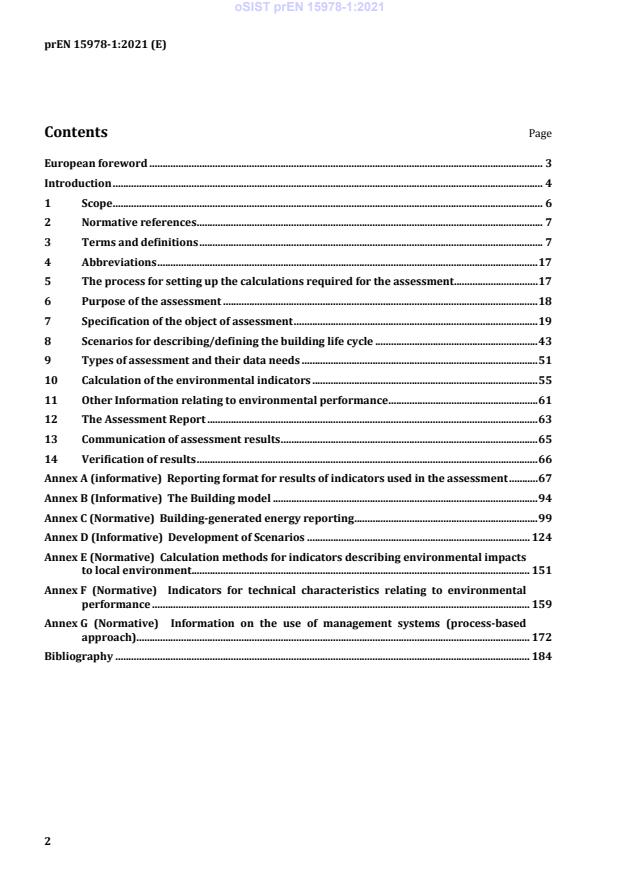
Contents Page
European foreword . 3
Introduction . 4
1 Scope . 6
2 Normative references . 7
3 Terms and definitions . 7
4 Abbreviations . 17
5 The process for setting up the calculations required for the assessment . 17
6 Purpose of the assessment . 18
7 Specification of the object of assessment . 19
8 Scenarios for describing/defining the building life cycle . 43
9 Types of assessment and their data needs . 51
10 Calculation of the environmental indicators . 55
11 Other Information relating to environmental performance . 61
12 The Assessment Report . 63
13 Communication of assessment results . 65
14 Verification of results . 66
Annex A (informative) Reporting format for results of indicators used in the assessment . 67
Annex B (Informative) The Building model . 94
Annex C (Normative) Building-generated energy reporting . 99
Annex D (Informative) Development of Scenarios . 124
Annex E (Normative) Calculation methods for indicators describing environmental impacts
to local environment . 151
Annex F (Normative) Indicators for technical characteristics relating to environmental
performance . 159
Annex G (Normative) Information on the use of management systems (process-based
approach). 172
Bibliography . 184
European foreword
This document (prEN 15978-1:2021) has been prepared by Technical Committee CEN/TC 350
“Sustainability of construction works”, the secretariat of which is held by AFNOR.
This document is currently submitted to the CEN Enquiry.
This document will supersede EN 15978:2011.
This document has been prepared under a mandate given to CEN by the European Commission and the
European Free Trade Association and supports essential requirements of EU Directive(s).
Introduction
The purpose of this document is to provide calculation rules for the assessment of the environmental
performance of new and existing buildings.
This document is part of a suite of European Standards, Technical Specifications and Technical Reports
for the assessment of the environmental performance of buildings that together support quantification
of the contribution of the assessed building to sustainable construction and sustainable development.
The environmental performance of a building is only one aspect of its sustainability. The social and
economic performance of the building are also aspects of sustainability that should be assessed as part
of a sustainability assessment. These are described in the framework standard (EN 15643).
NOTE 1 The environmental assessment at building level requires information from products and services (EN
15804).
The evaluation of technical and functional performance is beyond the scope of this document. Technical
and functional characteristics are taken into account here by reference to the functional equivalent,
which also forms a basis for comparison of the results of assessments.
This document is intended to support the decision-making process and documentation of the
assessment of the environmental performance of a building. Although the assessment results are based
on realistic scenarios, they may not fully reflect the actual and future performance of the building.
Figure 1 — Concept of sustainability assessment of buildings illustrates how the assessment of the
environmental performance takes place within the concept of the sustainability assessment of
buildings.
NOTE 2 The outer box with the red dotted line represents the area standardized by CEN/TC 350.
Figure 1 — Concept of sustainability assessment of buildings
In this document, the assessment method for the quantitative evaluation of the environmental
performance of the building is based on a life cycle approach. The general requirements for
sustainability assessment of buildings are described in EN 15643 (the general framework standard).
Other standards developed by CEN/TC 350 in this area, and how they are related to this European
Standard, are shown in Figure 2
Figure 2 — Standards of CEN/TC 350
NOTE 3 EN15978-1 supports the assessment of buildings within the Level(s) Framework (see Bibliography)
for macro objectives 1, 2, 3 and 7. Other standards from TC350 can also support Levels macro Objectives 4 and 5
(EN16309) and macro objective 6 (EN 16627)
Buildings and constructed assets have an impact on sustainable development. Therefore, the
internationally recognized Sustainable Development Goals (SDGs) formulated by the United Nations
also apply to the construction and real estate industry. As part of targets towards sustainable cities and
communities formulated in SDG 11, the construction of sustainable and resilient buildings is also
required, among other things. This goal is closely interrelated with the other SDGs. Both providers and
buyers of real estate need clear characteristics and assessment criteria in order to evaluate, assess and
communicate the contribution of buildings to sustainable development.
The use of this document can be used to show where a building (its development and use) could make a
contribution United Nations SDG Goal 11 and other SDGs such as 6, 7, 12, 13, and 15
Figure 3
NOTE 4 EN ISO 52001-1, in common with all EPB standards, provides a certain flexibility with regard to the
methods, the required input data and references to other EPB standards, For the correct use of EN5200-1,
informative default choices are provided in EN ISO 52000-1, Annex B.
NOTE 5 In the case EN ISO 52000-1 is used in the context of national or regional legal requirements, mandatory
choices can be given at national or regional level for such specific applications.
1 Scope
This document specifies the calculation method, based on Life Cycle Assessment (LCA) and other
quantified environmental information, to assess the environmental performance of a building and its
site, and gives the means for the reporting and communication of the outcome of the assessment. The
standard is applicable to new and existing buildings and refurbishment projects.
The document gives:
— the description of the object of assessment,
— the system boundary that applies at the building level,
— the procedure to be used for the inventory analysis,
— the list of indicators and procedures for the calculations of these indicators,
— optional indicators that may be used to provide additional information concerning environmental
impacts and aspects at the local level, technical characteristics and management processes that
support environmental performance,
— the requirements for the data necessary for the calculation, and
— the requirements for presentation of the results in reporting and communication.
The approach to the assessment covers all stages of the building life cycle and is based on data obtained
from Environmental Product Declarations (EPD), their "information modules" (EN 15804+A2,2019)
and other data and information necessary and relevant for carrying out the assessment. The assessment
includes all building related construction products, processes and services, used over the life cycle of
the building.
The interpretation and value judgments of the results of the assessment are not within the scope of this
European Standard.
NOTE 1 EPD according to product category rules of construction products (i.e. PCR or c-PCR) that follow
EN15804+A2:2019) are generally deemed to satisfy the requirements of this standard, subject to their also
meeting the requirements of PrEN 15941.
NOTE 2 EN 15978 -1 provides indicators, calculation rules and system boundaries for the assessment of
greenhouse gas emissions, resource consumption and operational water use among other issues of the life cycle
related environmental performance of buildings. It also provides the methodological basis and assessment rules
to support the achievement of environment related macro objectives in Europe and instruments such as the
European reporting framework LEVEL(s).
NOTE 3 LEVEL(s), is a common European approach to assess and report on the sustainability of buildings.
Using existing standards, the voluntary Level(s) framework provides a common language for building
sustainability, which other initiatives can also use. More information can be found at Level(s) (europa.eu).
2 Normative references
The following documents are referred to in the text in such a way that some or all of their content
constitutes requirements of this document. For dated references, only the edition cited applies. For
undated references, the latest edition of the referenced document (including any amendments) applies.
FprEN 15643, Sustainability of construction works — Framework for assessment of buildings and civil
engineering works
EN 15804+A2:2019, Sustainability of construction works - Environmental product declarations - Core
rules for the product category of construction products
prEN 15941, Sustainability of construction works - data quality for environmental assessment of
products and construction works - Selection and use of data
ISO 15392, Sustainability in Building Construction - General Principles
ISO 15686-1, Building and constructed assets — Service life planning — Part 1: General principles
ISO 15686-2, Building and constructed assets — Service life planning — Part 2: Service life prediction
procedures
ISO 15686-7, Building and constructed assets — Service life planning — Part 7: Performance evaluation
for feedback of service life data from practice
ISO 15686-8, Building and constructed assets — Service life planning — Part 8: Reference service life
and service-life estimation
EN ISO 52000-1 Energy performance of buildings — Overarching EPB assessment — Part 1: General
framework and procedures
3 Terms and definitions
For the purposes of this document, the following terms and definitions apply:
ISO and IEC maintain terminological databases for use in standardization at the following addresses:
• IEC Electropedia: available at http://www.electropedia.org/
• ISO Online browsing platform: available at http://www.iso.org/obp
3.1
assembled system
part of works
component or a set of components incorporated in the construction works
3.2
average data
data representative of a product, product group or construction service, provided by one or more
suppliers
Note 1 to entry: The product group or construction service can contain similar products or construction services.
[SOURCE: EN 15804:2012+A2:2019]
3.3
brief
document that states the client’s requirements for a construction project
[SOURCE: ISO 6707-2:2017, modified – “construction” has been added in the definition]
3.4
building
construction works that have the provision of shelter for its occupants or contents as one of its main
purposes and are usually enclosed and designed to stand permanently in one place
[SOURCE: ISO 6707 1:2017, modified – “partially and totally” has been removed from the definition]
3.5
building fabric
all construction products that are fixed to the building in a permanent manner, so that the dismantling of
the product changes the performance of the building and the dismantling or replacement of the product
constitute construction operations
3.6
building-integrated technical system
installed technical equipment to support the operation of a building, or installed technical equipment
that enables the core functions of the building
Note 1 to entry This includes the technical building system and other systems e.g. for sanitation, security, fire
safety, internal transport and building automation and control and IT communications, climate control systems
and installations. Building integrated technical equipment (including onsite energy generating equipment) are
construction products.
3.7
building site
specified area of land where a building is located or is defined to be located and construction work of the
building and associated external works are, or will be, undertaken
Note 1 to entry Adapted from the definition of site in ISO 6707-1.
3.8
cleaning
all operations that ensure a level of cleanliness and appearance, consisting of separating and
eliminating generally visible dirt from a surface by means of the following combined factors, in variable
proportions, such as chemical action, mechanical action, temperature, duration of application
[SOURCE: ISO 22716:2007, 2.8]
3.9
client
person or organisation that requires a building or a civil engineering works to be provided, altered or
extended and is responsible for initiating and approving the brief
[SOURCE: ISO 6707-2:2017, modified – “construction” has been replaced with “a building or a civil
engineering works” in the definition]
3.10
complementary product category rules
c-PCR
product group specific or horizontal PCR, which provide additional compliant and non-contradictory
requirements to EN 15804
Note 1 to entry: c-PCR are meant to be used together with EN 15804.
[SOURCE: CEN/TR 16970:2016]
3.11
component
construction product manufactured as a distinct unit to serve a specific function or functions
[SOURCE: ISO 6707-1:2017]
3.12
construction element
building component
building element
component or a set of assembled components incorporated in a building or construction works
[SOURCE FprEN 15643:2021]
3.13
construction product
item manufactured or processed for incorporation in construction works
3.14
construction work
activities of forming a construction works
[SOURCE: ISO 6707-1:2017]
3.15
construction works
everything that is constructed or results from construction operations
Note 1 to entry: This includes buildings, civil engineering works, structures, landscaping, external works and other
types of construction works within a built environment.
Note 2 to entry: From an economic perspective, completed construction works are typically referred to as a
constructed asset.
[SOURCE: ISO 15392: 2019]
3.16
cut-off criteria
specification of the amount of material or energy flows or the level of significance associated with unit
processes or product system to be excluded from a study
[SOURCE: EN ISO 14044:2006]
3.17
declared unit
quantity of a construction product for use as a reference unit in an EPD for an environmental
declaration based on one or more information modules
EXAMPLE Mass (kg), volume (m³).
Note 1 to entry Adapted from the definition in ISO 21930:2017.
3.18
environmental aspect
characteristic of construction works, part of works, processes or services related to their life cycle that
can cause change to the environment
[SOURCE: ISO 15392:2019]
3.19
environmental impact
result of a change to the environment, whether adverse, neutral or beneficial, wholly or partially
resulting from environmental aspects
[SOURCE: ISO 15392:2019, modified - – definition of “impact” has been integrated in the definition]
3.20
environmental performance
performance related to environmental impacts and environmental aspects
[SOURCE: ISO 15392:2019 modified - Note 1 has been removed]
3.21
Environmental Product Declaration
EPD
Type III Environmental declaration
claim which indicates the environmental impacts and aspects of a product, providing quantified
environmental data using predetermined parameters and, where relevant, additional environmental
information
Note 1 to entry: Adapted as a combination of definitions in ISO 14025:2006, (3.1) and ISO 21930:2017, (3.1.1)
Note 2 to entry: The additional environmental information can be quantitative or qualitative.
Note 3 to entry: The shorter initialism, EPD, is used as the primary preferred term in this document.
3.22
estimated service life
ESL
service life that a building or an assembled system (part of works) would be expected to have in a set of
specific in-use conditions, determined from reference service life data after taking into account any
differences from the reference in use conditions
[SOURCE: ISO 15686-1:2011]
3.23
exported energy
energy, expressed per energy carrier, supplied by the technical building systems or integrated technical
systems of works through and beyond the system boundary
Note 1 to entry: the term “exported utilities” is used in this standard to describe utilities, such as electricity, water,
heat, which may be exported.
[SOURCE: EN ISO 52000-1:2017, modified – Note to entry has been added; or integrated technical
systems of works” has been added in the definition; “and beyond” has been added in the definition;
“assessment boundary” has been replaced with “system boundary” in the definition; Note 1 to entry and
Note 2 to entry have been removed]
3.24
functional equivalent
quantified functional requirements and/or technical requirements for a building or an assembled
system (part of works) for use as a basis for comparison
Note 1 to entry: Adapted from the definition in ISO 21931-1:2010.
3.25
functional performance
performance related to the functionality of the construction works or an assembled system (part of
works), which is required by the client and/or by users and/or by regulations
Note 1 to entry: Adapted from the definition in FprEN 15643:2021.
3.26
functional requirement
type and level of functionality of a building or assembled system which is required by the client and/or
by users and/or by regulations
Note 1 to entry: Adapted from the definition in FprEN 15643:2021.
3.27
functional unit
quantified performance of a product system for use as a reference unit
[SOURCE: EN ISO 14040:2006]
3.28
functionality
suitability or usefulness for a specific purpose or activity
[SOURCE: ISO 15686 10:2010]
3.29
generic data
data that is not site or enterprise specific.
Note 1 to entry: This refers to data that is not directly collected, measured, or estimated by a company, but
sourced from a third party LCI database or other sources.
Note 2 to entry: Generic data includes industry average data (e.g., from published production data, government
statistics, and industry associations), literature studies, engineering studies and patents, and may also be based on
financial data, and contain proxy data, and other generic data.
Note 3 to entry: In this context site can mean production site and or construction site
3.30
handover
step at which possession of the construction works is surrendered to the client upon completion with or
without reservation
[SOURCE: ISO 6707-2:2017]
3.31
indicator
quantitative, qualitative or descriptive measure
SOURCE [ISO 15392:2019(en), 3.18]
3.32
life cycle
consecutive and interlinked stages in the life of the object under consideration
[SOURCE: FprEN 15643:2021]
3.33
maintenance
combination of all technical and associated administrative actions during the service life to retain a
building or an assembled system (part of works) in a state in which it can perform its required functions
Note 1 to entry: Adapted from the definition in ISO 15686-1:2011, ISO 6707-1 and in CPD Guidance Paper F.
3.34
maintenance (planned)
combination of planned technical and associated administrative actions during the service life to retain
a building, or its parts (functional units), in a state in which it can perform its required functions
Note 1 to entry: preventive (planned) maintenance covers cleaning, servicing, lubrication, changing wearing
parts, testing, inspection, condition monitoring, done on a periodic basis and done before a failure would occur.
[SOURCE: ISO 15686-1:2011, 3.13]: modified - adapted for the purposes of this standard to apply
concept of planned maintenance by replacing the term ‘all’ with ‘planned’ and adding ‘(functional units)
and the Note to entry
3.35
offsetting
mechanism for compensating for the carbon footprint of a product through the prevention of the
release of, reduction in, or removal of, an equivalent amount of GHG emissions in a process outside the
boundary of the product system
EXAMPLE: External investment in renewable energy technologies; energy efficiency measures;
afforestation/reforestation.
[SOURCE ISO 14021:2016, 3.1.12]
3.36
operational energy use
energy use during use and operation of the building
Note 1 to entry: Adapted from the definition in FprEN 15643:2021.
3.37
operational water use
water use during use and operation of the building
Note 1 to entry: Adapted from the definition in FprEN 15643:2021.
3.38
recovery
operation the principal result of which is waste serving a useful purpose by replacing other materials
which would otherwise have been used to fulfil a particular function, or waste being prepared to fulfil
that function in the plant or in the wider economy
[SOURCE: FprEN 15643:2021]
3.39
recycling
recovery operation by which waste materials are reprocessed into products, materials or substances
either for the original purpose or other purposes
Note 1 to entry: Recycling operations include:
— recycling of organic substances;
— recycling of metals;
— recycling of other inorganic materials;
as defined in Directive 2008/98 Annex II.
Note 2 to entry Recycling does not include energy recovery and the reprocessing into materials that are to be
used as fuels or for backfilling operations or other recovery operations as defined in Directive 2008/98 Annex II.
[SOURCE: FprEN 15643:2021]-Modified Note 1 to entry added and Note 2 amended to reference
Directive]
3.40
reference service life
RSL
service life of a construction product, component, assembly or system which is known to be expected
under a set of reference in-use conditions and which may form the basis of estimating the service life
under other in-use conditions
Note 1 to entry: The RSL is described as part of the functional unit and considered in the calculation of
replacements at both the construction product level and construction works level (B4) and refurbishment (B5).
[SOURCE: ISO 15686-1:2011, modified – “construction” has been added in the definition; “particular set,
i.e. a reference set of” has been replaced with “a set of reference” in the definition; Note 1 to entry has
been added]
3.41
reference study period
period over which the time-dependent characteristics of the object of assessment are analysed
Note 1 to entry: In some cases, the reference study period may differ significantly from the required service life of
the construction works
3.42
refurbishment
deep renovation
deep retrofit
planned large scale (substantial) modification and improvements to an existing construction works to
bring it up to an acceptable condition
Note 1 to entry: Refurbishment can be undertaken to facilitate continuation of the current function, including
technical modernization and a change of space plan, or a change of function to new use.
[SOURCE: ISO 6707-1:2017, modified – “planned large scale (substantial)” has been added in the
definition; “plant, building or civil engineering works” has been replaced with “construction works” in
the definition; “to bring it up an acceptable condition” has been removed from the definition; Note 1 to
entry has been added
3.43
renewable resource
resource that is grown, naturally replenished or naturally cleansed, on a human time scale
Note 1 to entry: A renewable resource is capable of being exhausted, but may last indefinitely with proper
stewardship. Examples include: biomass (used for bio-based materials) and fertile soil.
Note 2 to entry: Activities that occur in the technosphere such as recycling are not considered natural
replenishment or natural cleansing.
Note 3 to entry: In this context, human time scale refers to the typical lifetime of a human rather than the time
humans have been in existence.
[SOURCE: ISO 21930:2017, modified – “trees in forests, grasses in grassland” has been replaced with
“biomass (used for bio-based materials)” in Note 1 to entry]
3.44
repair
action outside planned maintenance to return a product/component/assembly/system to an acceptable
condition by renewal, replacement or mending of worn, damaged or degraded parts but not changing
its original parameters
Note 1 to entry: repair refers to an unplanned action because the product/assembly/system has lost its function,
this can happen because of a lack of correct planned maintenance
[SOURCE: ISO 6707-1:2017, modified - “item” has been replaced with “actions outside planned
maintenance to return component or assembled system” in the definition; “but not changing its original
parameters“ has been added in the definition; Note 1 to entry has been added]
3.45
replacement
installation of a new product, component or system, which incorporates the function of the old product,
component or system
[SOURCE: ISO 24516-3:2017, 3.21, modified - adapted by replacing term ‘asset’ with term ‘product,
component or system’]
3.46
required service life
ReqSL
service life required by the client or through regulations
[SOURCE: FprEN 15643:2021]
3.47
re-use
operation by which products or components that are not waste are used again for the same purpose for
which they were conceived or used for other equivalent purposes without reprocessing, but including
preparation for re-use
Note 1 to entry: Preparation for re-use includes checking, removal of connectors, cleaning, trimming, stripping of
coatings, packaging, repairing
[SOURCE: FprEN 15643:2021]
3.48
scenario
collection of assumptions and information concerning an expected sequence of possible future events
[SOURCE: FprEN 15643:2021]
3.49
secondary material
material recovered from a previous use or from waste which substitutes primary materials
Note 1 to entry: Secondary material is measured at the point where the secondary material enters the system
from another system.
Note 2 to entry: Materials recovered from previous use or from waste from one product system and used as an
input in another product system are secondary materials.
Note 3 to entry: Examples of secondary materials (to be measured at the system boundary) are recycled metal,
crushed concrete, glass cullet, recycled wood chips, recycled plastic.
[SOURCE: FprEN 15643:2021]
3.50
service life
working life
period of time after installation during which a building or an assembled system (part of works) meets
or exceeds the technical requirements and functional requirements
Note 1 to entry: Adapted from the definition in ISO/DIS 15686-1:2008.
[SOURCE: ISO 15686-1:2011, modified – “facility or its component parts” has been replaced with “a
building or an assembled system (part of works)” in the definition]
3.51
specific data
data representative of a product, product group or construction service, provided by one supplier
[SOURCE EN 15804+A2:2019]
3.52
system boundary
set of criteria specifying what is included and what is not included in the building assessment
Note 1 to entry: the system boundary represents the interface in the assessment between a building and its
surroundings or other product systems.
Note 2 to entry: Adapted from the definition in FprEN15643:2021
3.53
system boundary
set of criteria specifying which unit processes are part of the product system
Note 1 to entry: System boundary defines what is included and what is not included in the assessment.
[SOURCE: ISO 14040:2006, modified–NOTE has been removed; Note 1 to entry has been added]
3.54
technical building system
technical equipment for space heating, space cooling, ventilation, domestic hot water, built-in
(installed) lighting, building automation and control, on-site electricity generation, or a combination
thereof, including those systems using energy from renewable sources, of a building or building unit
[SOURCE: FprEN 15643:2021]
3.55
technical performance
performance related to the capability of construction works or part of works, which are required or are
a consequence of the requirements made either by the client, users and/or by regulations
[SOURCE: FprEN 15643:2021]
3.56
technical requirement
type and level of technical characteristics of a construction works or an assembled system (part of
works), which are required or are a consequence of the requirements made either by the client, and/or
by the users and/or by regulations
Note 1 to entry: Adapted from the definition in FprEN 15643:2021.
3.57
transparency
open, comprehensive and understandable presentation of information
[SOURCE: EN ISO 14044:2006]
3.58
user
person or organization using the building, its facilities, services and the environment it provides
[SOURCE: FprEN 15643:2021] Modified–term construction works replaced by building
3.59
waste
substance or object which the holder discards or intends to discard, or is required to discard
[SOURCE FprEN 15643:2021]
4 Abbreviations
ADP Abiotic depletion potential
AP Acidification potential of soil and water
BIPV Building integrated photovoltaic(s)
CF Characterisation Factor
EP Eutrophication potential
EPB Energy performance in buildings
EPD Environmental Product Declaration
EoL End of Life
ESL Estimated service life
GWP Global warming potential
LCA Life cycle assessment
LCI Life cycle inventory analysis
LCIA Life cycle impact assessment
ND Not declared
ODP Depletion potential of the stratospheric ozone layer
PCR Product Category Rules
c-PCR Complementary product category rules
PEF Product Environmental Footprint
POCP Formation potential of tropospheric ozone
ReqSL Required Service Life
RSL Reference Service Life
RSP Reference Study Period
5 The process for setting up the calculations required for the assessment
To carry out and complete the calculations necessary for the assessment of environmental performance
of buildings, the steps illustrated in Figure 4 should be followed. This will help ensure that the essential
information is gathered and processed according to the requirements of this European Standard. The
clauses numbered in the right column that follow the diagram explain in more detail each step specified
in the central column of the table below.
Figure 4 — Flowchart of the process for the assessment of the environmental performance
6 Purpose of the assessment
The purpose of the assessment is defined by the goal, the scope and the intended use of the assessment.
The goal of the assessment is to quantify the environmental performance of the object of assessment by
means of the compilation of environmental information.
To calculate the environmental performance of a building in terms of environmental impacts and
aspects, the scope and intended use of the assessment shall be defined, agreed and documented in
accordance with the requirements of this European Standard before an assessment is carried out.
The scope of an assessment defines what is included in the object of the assessment, in line with the
intended use of the assessment. The scope of the assessment is represented by Clauses 7 and 8.
Depending on the context, the intended use of the assessment can include the following:
a) assistance in a decision-making process from an environmental perspective, for example:
— comparison of the environmental performance between different design, engineering or
specification options for the construction, refurbishment and/or use of a building,
— comparison of the environmental performance of refurbishment of an existing building vs. its
demotion and construction of a new building,
— plan/design for deconstruction,
— identification of potential for environmental performance improvements,
— design optimisation.
b) disclosure of environmental performance to comply with legal requirements.
c) documenting and communicating the environmental performance of a building for use in, for
example:
— declaring/reporting environmental performance,
— certification and labelling,
— benchmarking,
— marketing,
— other reporting purposes.
d) support for policy development.
The scope and intended use of the assessment determine the level of detail required of the
environmental information, and of other data used in the calculations. However, the calculation method
remains the same.
7 Specification of the object of assessment
7.1 Introduction
The object of assessment is the building (or part thereof), new or existing, including its foundations and
external works within the curtilage of the building’s site, over its life cycle. The curtilage (site boundary)
used to characterise the site shall be consistent with the definition and intended use of the building.
NOTE The site is identified as the physical space of land occupied by and attached to the building
7.2 General
The object of the assessment shall be defined in line with the purpose and intended use of the
assessment.
Depending on the specific purpose of the assessment, the object of the assessment may be restricted to:
— only part of a building,
— an individual structure/component within a building,
— an assembly of building components.
If the assessment is restricted as described above, or limited to a part of the life cycle, or if any relevant
impacts or aspects are not addressed, this shall be documented, reported and reasons given.
NOTE The environmental assessment of the building excludes permanent construction works outside of the
curtilage of the site such as construction of infrastructure for communication, energy, water, waste and
transportation. A building on a site which requires such construction works will generate environmental impacts
other than those strictly related to the building. The assessment of these environmental impacts and aspects is
outside of the scope of this European Standard.
The object of assessment shall be described in terms of its physical and time-dependent characteristics.
7.3 Functional equivalent
The functional equivalent is a representation of the required technical characteristics and
functionalities of the building. It is the means by which the characteristics of the building are
rationalised into a minimum description of the object of assessment.
NOTE 1 The term functional equivalent is similar in concept to the use of the term ‘Functional Unit’ (“quantified
performance of a product system for use as a reference unit: ISO 14040:2006] -Definition 3.14”) that is used in the
application of LCA to products. However, it was decided, historically, that it would be useful to be able to
differentiate between buildings and products and the alternative term ‘Functional Equivalent’ was introduced to
allow the multiple functions that can be represented in a building to be described.
Although assessments may be carried out on an individual object, they will in most instances form part
of the process for the evaluation of decisions in relation to the object of assessment. This includes the
decision whether to build new, or refurbish/reconstruct an existing building, the evaluation of the
design options, locations, etc.
Comparisons between the results of assessments of buildings or assembled systems (part of works) - at
the design stage or whenever the results are used - shall be made only on the basis of their functional
equivalency. This requires that the major functional requirements shall be described together with
intended use and the relevant specific technical requirements. This description allows the functional
equivalency of different options and building types to be determined and forms the basis for
transparent and unbiased comparison. If the assessment results based on different functional
equivalents are used for comparisons, (for example, in a comparison of the environmental performance
two entirely different development options such as a school or hospital being considered for the same
site - See NOTE 2) then the basis for comparison shall be made clear.
NOTE 2 If appropriate, the assessment results of the buildings that have different functional equivalents (e.g.
design options for different types of buildings on the same site or the same types of buildings exposed to different
conditions) can also be compared based on a common unit of reference. The choice of the common reference unit
for all buildings being compared depends on a specific requirement of a technical, functional, environmental,
social or economic aspect, or combination thereof, which is common to all these buildings and is linked to their
corresponding functional equivalents.
NOTE 3 A common reference unit can be derived from the functional equivalent and be used to present the
result of the indicators of the environmental assessment relative to the functional equivalent. A common reference
unit may be dimensionless or qualified with a dimension (e.g. per m², per year, per employee, per room per year,
per m² per year).
When combining separate assessments of environmental, social and economic performance in a
sustainability assessment of the same object of assessment, the functional equivalent used in the
assessments of the individual dimensions of sustainability shall be the same.
The functional equivalent of a building or an assembled system (part of works) shall include, but is not
limited to, information on the following aspects:
...
Questions, Comments and Discussion
Ask us and Technical Secretary will try to provide an answer. You can facilitate discussion about the standard in here.
Loading comments...