

oSIST prEN 13160-2:2025
(Main)Leak detection systems - Part 2: Requirements and test/assessment methods for pressure and vacuum systems
General Information
- Abstract
This document gives requirements and the corresponding test/assessment methods applicable to leak detector based on the measurement of pressure change. Leak detectors are intended to be used with double skin, underground or above ground, pressurized or non-pressurized, tanks or pipe designed for water polluting liquids/fluids. The leak detectors are usually composed of:
- measuring device;
- evaluation device;
- alarm device;
- pressure generator;
- pressure relief device;
- liquid stop device;
- condensate trap.
- Status
- Not Published
- Public Enquiry End Date
- 02-Dec-2025
- Technical Committee
- TLP - Pressure vessels
- Current Stage
- 4020 - Public enquire (PE) (Adopted Project)
- Start Date
- 08-Oct-2025
- Due Date
- 25-Feb-2026
- Completion Date
- 15-Dec-2025

Overview
The standard oSIST prEN 13160-2:2025:2025, developed by CEN Technical Committee CEN/TC 393, specifies the requirements and test/assessment methods for pressure and vacuum leak detection systems. These systems are designed for double skin tanks or pipelines, whether underground or above ground, pressurized or non-pressurized, that store or transport water-polluting liquids or fluids.
Leak detection based on pressure change measurement plays a critical role in environmental safety by identifying leaks early and preventing contamination. This standard ensures uniform performance, durability, and safety levels of leak detectors used in such infrastructure.
Key Topics
Scope and Application:
Covers leak detectors intended for liquid-containing tanks and pipes, emphasizing systems built with components such as:- Measuring device
- Evaluation device
- Alarm device
- Pressure generator
- Pressure relief device
- Liquid stop device
- Condensate trap
Performance Requirements:
Defines critical functional requirements including:- Effectiveness in detecting leaks through pressure changes in interstitial spaces
- Maximum interstitial space volume (not exceeding 10 m³) compatible with system effectiveness
- Compliance with general leak detection principles outlined in EN 13160-1:2016
- Need for integrated test devices simulating leaks for system verification
Durability and Environmental Resistance:
Includes durability requirements covering:- Temperature fluctuations
- Chemical attack resistance
- Fatigue due to cyclical pressure changes
- Humidity monitoring of leak detection medium
Testing and Assessment Methods:
Provides detailed methodologies for measuring pressure changes, replenishment rates of detection media, and software functionality (if applicable). Also specifies factory production control and type testing procedures to ensure quality consistency.Marking and Documentation:
Manufacturers are required to supply comprehensive technical documentation outlining system parameters and responses to electrical supply variances. Labeling and packaging requirements are also standardized.
Applications
Leak detection systems compliant with oSIST prEN 13160-2:2025:2025 are essential for industries requiring reliable containment of hazardous liquids, especially:
- Fuel storage tanks and pipelines
- Chemical storage facilities
- Environmental protection in underground and above-ground tanks
- Service stations managing water-polluting liquids
- Infrastructure demanding rigorous leak monitoring to reduce environmental risks
By adhering to this standard, operators enhance leak detection accuracy, reduce false alarms, and ensure durability of monitoring systems under operational stresses, improving overall environmental and operational safety.
Related Standards
- EN 13160-1: General principles for leak detection systems, providing foundational concepts applicable to Part 2.
- EN 13160-7: Requirements for interstitial spaces and leak detection linings, complementary to pressure and vacuum systems.
- EN 12285-1 & EN 12285-2: Standards related to workshop fabricated steel tanks, relevant for tank structure interfaces with leak detection systems.
- EN 981: Safety standards for machinery warning signals, applicable for alarm device requirements.
- EN 14879-4: Coating and lining standards protecting components from chemical damage-important for durability of detection systems.
For accurate terminology and symbols, industry professionals also refer to ISO and IEC online resources ensuring consistency in definitions related to pressure and leak detection technologies.
Keywords: leak detection systems, pressure measurement, vacuum systems, double skin tanks, environmental safety, tank leak detector standards, CEN oSIST prEN 13160-2:2025, test methods for leak detectors, durability testing, pressure relief device, leak alarm device, underground tanks, water-polluting liquids.
Relations
- Effective Date
- 01-Nov-2025
Get Certified
Connect with accredited certification bodies for this standard

IMQ S.p.A. (Certification)
Italian electrical product certification.

SLG Prüf- und Zertifizierungs GmbH
German testing and certification body.

UL Solutions
Global safety science company with testing, inspection and certification.
Sponsored listings
Frequently Asked Questions
oSIST prEN 13160-2:2025 is a draft published by the Slovenian Institute for Standardization (SIST). Its full title is "Leak detection systems - Part 2: Requirements and test/assessment methods for pressure and vacuum systems". This standard covers: This document gives requirements and the corresponding test/assessment methods applicable to leak detector based on the measurement of pressure change. Leak detectors are intended to be used with double skin, underground or above ground, pressurized or non-pressurized, tanks or pipe designed for water polluting liquids/fluids. The leak detectors are usually composed of: - measuring device; - evaluation device; - alarm device; - pressure generator; - pressure relief device; - liquid stop device; - condensate trap.
This document gives requirements and the corresponding test/assessment methods applicable to leak detector based on the measurement of pressure change. Leak detectors are intended to be used with double skin, underground or above ground, pressurized or non-pressurized, tanks or pipe designed for water polluting liquids/fluids. The leak detectors are usually composed of: - measuring device; - evaluation device; - alarm device; - pressure generator; - pressure relief device; - liquid stop device; - condensate trap.
oSIST prEN 13160-2:2025 is classified under the following ICS (International Classification for Standards) categories: 23.020.01 - Fluid storage devices in general; 23.040.99 - Other pipeline components; 23.160 - Vacuum technology; 29.260.20 - Electrical apparatus for explosive atmospheres. The ICS classification helps identify the subject area and facilitates finding related standards.
oSIST prEN 13160-2:2025 has the following relationships with other standards: It is inter standard links to SIST EN 13160-2:2016+A1:2025. Understanding these relationships helps ensure you are using the most current and applicable version of the standard.
oSIST prEN 13160-2:2025 is available in PDF format for immediate download after purchase. The document can be added to your cart and obtained through the secure checkout process. Digital delivery ensures instant access to the complete standard document.
Standards Content (Sample)
SLOVENSKI STANDARD
01-november-2025
Sistemi za kontrolo tesnosti - 2. del: Zahteve in metode za preskušanje in
ocenjevanje tlačnih in vakuumskih sistemov
Leak detection systems - Part 2: Requirements and test/assessment methods for
pressure and vacuum systems
Leckanzeigesysteme - Teil 2: Anforderungen und Prüf /Bewertungsmethoden für Über-
und Unterdrucksysteme
Systèmes de détection de fuites - Partie 2 : Exigences et méthodes d'essai/d'évaluation
des systèmes sous pression et à dépression
Ta slovenski standard je istoveten z: prEN 13160-2
ICS:
23.020.01 Vsebniki za shranjevanje Fluid storage devices in
tekočin na splošno general
23.040.99 Drugi sestavni deli za Other pipeline components
cevovode
23.160 Vakumska tehnologija Vacuum technology
2003-01.Slovenski inštitut za standardizacijo. Razmnoževanje celote ali delov tega standarda ni dovoljeno.
DRAFT
EUROPEAN STANDARD
NORME EUROPÉENNE
EUROPÄISCHE NORM
September 2025
ICS 23.040.99 Will supersede EN 13160-2:2016+A1:2024
English Version
Leak detection systems - Part 2: Requirements and
test/assessment methods for pressure and vacuum
systems
Systèmes de détection de fuites - Partie 2 : Exigences et Leckanzeigesysteme - Teil 2: Anforderungen und Prüf
méthodes d'essai/d'évaluation des systèmes sous /Bewertungsmethoden für Über- und
pression et à dépression Unterdrucksysteme
This draft European Standard is submitted to CEN members for enquiry. It has been drawn up by the Technical Committee
CEN/TC 393.
If this draft becomes a European Standard, CEN members are bound to comply with the CEN/CENELEC Internal Regulations
which stipulate the conditions for giving this European Standard the status of a national standard without any alteration.
This draft European Standard was established by CEN in three official versions (English, French, German). A version in any other
language made by translation under the responsibility of a CEN member into its own language and notified to the CEN-CENELEC
Management Centre has the same status as the official versions.
CEN members are the national standards bodies of Austria, Belgium, Bulgaria, Croatia, Cyprus, Czech Republic, Denmark, Estonia,
Finland, France, Germany, Greece, Hungary, Iceland, Ireland, Italy, Latvia, Lithuania, Luxembourg, Malta, Netherlands, Norway,
Poland, Portugal, Republic of North Macedonia, Romania, Serbia, Slovakia, Slovenia, Spain, Sweden, Switzerland, Türkiye and
United Kingdom.
Recipients of this draft are invited to submit, with their comments, notification of any relevant patent rights of which they are
aware and to provide supporting documentation.
Warning : This document is not a European Standard. It is distributed for review and comments. It is subject to change without
notice and shall not be referred to as a European Standard.
EUROPEAN COMMITTEE FOR STANDARDIZATION
COMITÉ EUROPÉEN DE NORMALISATION
EUROPÄISCHES KOMITEE FÜR NORMUNG
CEN-CENELEC Management Centre: Rue de la Science 23, B-1040 Brussels
© 2025 CEN All rights of exploitation in any form and by any means reserved Ref. No. prEN 13160-2:2025 E
worldwide for CEN national Members.
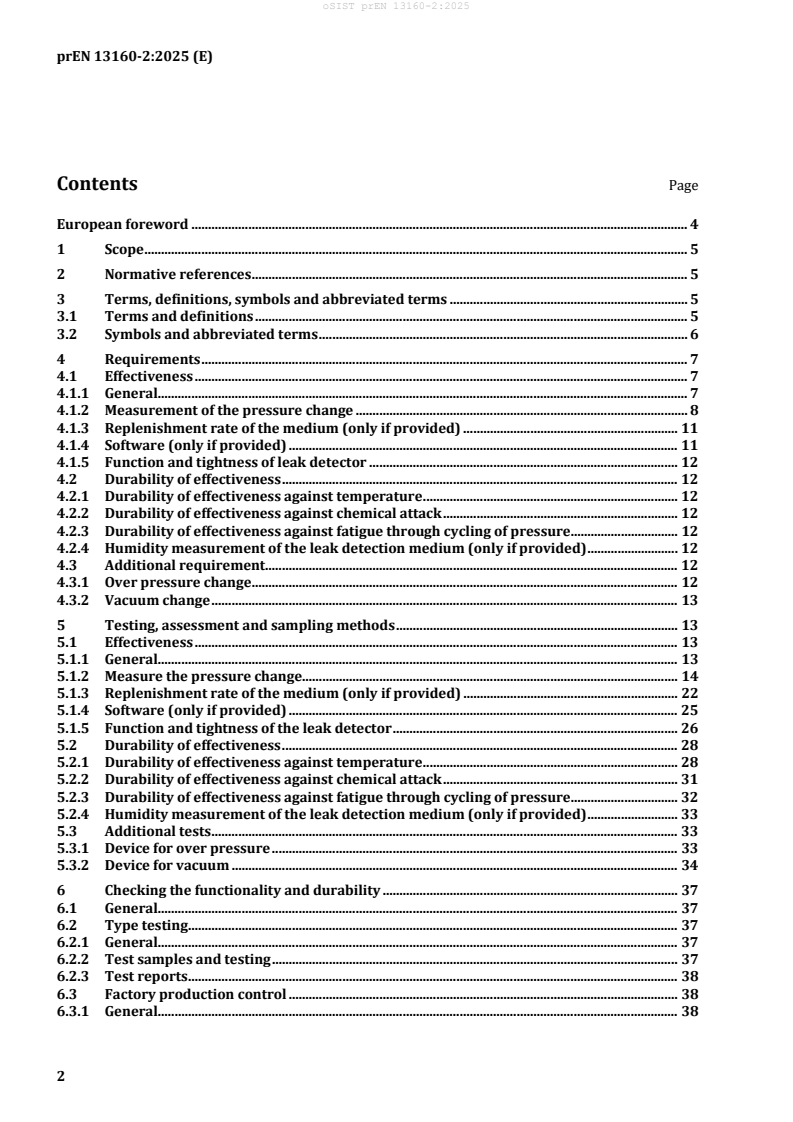
Contents Page
European foreword . 4
1 Scope . 5
2 Normative references . 5
3 Terms, definitions, symbols and abbreviated terms . 5
3.1 Terms and definitions . 5
3.2 Symbols and abbreviated terms . 6
4 Requirements . 7
4.1 Effectiveness . 7
4.1.1 General. 7
4.1.2 Measurement of the pressure change . 8
4.1.3 Replenishment rate of the medium (only if provided) . 11
4.1.4 Software (only if provided) . 11
4.1.5 Function and tightness of leak detector . 12
4.2 Durability of effectiveness . 12
4.2.1 Durability of effectiveness against temperature . 12
4.2.2 Durability of effectiveness against chemical attack . 12
4.2.3 Durability of effectiveness against fatigue through cycling of pressure . 12
4.2.4 Humidity measurement of the leak detection medium (only if provided) . 12
4.3 Additional requirement. 12
4.3.1 Over pressure change . 12
4.3.2 Vacuum change . 13
5 Testing, assessment and sampling methods . 13
5.1 Effectiveness . 13
5.1.1 General. 13
5.1.2 Measure the pressure change . 14
5.1.3 Replenishment rate of the medium (only if provided) . 22
5.1.4 Software (only if provided) . 25
5.1.5 Function and tightness of the leak detector . 26
5.2 Durability of effectiveness . 28
5.2.1 Durability of effectiveness against temperature . 28
5.2.2 Durability of effectiveness against chemical attack . 31
5.2.3 Durability of effectiveness against fatigue through cycling of pressure . 32
5.2.4 Humidity measurement of the leak detection medium (only if provided) . 33
5.3 Additional tests . 33
5.3.1 Device for over pressure . 33
5.3.2 Device for vacuum . 34
6 Checking the functionality and durability . 37
6.1 General. 37
6.2 Type testing . 37
6.2.1 General. 37
6.2.2 Test samples and testing . 37
6.2.3 Test reports . 38
6.3 Factory production control . 38
6.3.1 General. 38
6.3.2 Scope of testing . 38
6.3.3 Customised products manufactured in very small quantities . 38
7 Marking, labelling and packaging . 38
Annex A (normative) Calculation of the dry filter . 40
Annex B (normative) Test of the over pressure device. 42
Bibliography . 45
European foreword
This document (prEN 13160-2:2025) has been prepared by Technical Committee CEN/TC 393
“Equipment for storage tanks and for service stations”, the secretariat of which is held by DIN.
This document is currently submitted to the CEN Enquiry.
This document will supersede EN 13160-2:2016+A1:2024.
This document includes the following significant technical changes with respect to
EN 13160-2:2016+A1:2024:
— The term leak detection kit has been replaced by leak detector;
— Clause 6 has been revised and renamed to Checking the functionality and durability.
The EN 13160 series, under the general title Leak detection systems, is composed of the following parts:
— Part 1: General principles
— Part 2: Requirements and test/assessment methods for pressure and vacuum systems
— Part 3: Requirements and test/assessment methods for liquid systems for tanks
— Part 4: Requirements and test/assessment methods for sensor-based leak detection systems
— Part 5: Requirements and test/assessment methods for in-tank gauge systems and pressurized pipework
systems
— Part 6: Sensors in monitoring wells
— Part 7: Requirements and test/assessment methods for interstitial spaces, leak detection linings and leak
detection jackets
1 Scope
This document gives requirements and the corresponding test/assessment methods applicable to leak
detector based on the measurement of pressure change. Leak detectors are intended to be used with
double skin, underground or above ground, pressurized or non-pressurized, tanks or pipe designed for
water polluting liquids/fluids. The leak detectors are usually composed of:
— measuring device;
— evaluation device;
— alarm device;
— pressure generator;
— pressure relief device;
— liquid stop device;
— condensate trap.
2 Normative references
The following documents are referred to in the text in such a way that some or all of their content
constitutes requirements of this document. For dated references, only the edition cited applies. For
undated references, the latest edition of the referenced document (including any amendments) applies.
EN 228, Automotive fuels — Unleaded petrol — Requirements and test methods
EN 981:1996+A1:2008, Safety of machinery — System of auditory and visual danger and information
signals
EN 12285-2, Workshop fabricated steel tanks — Part 2: Horizontal cylindrical single skin and double skin
tanks for the aboveground storage of flammable and non-flammable water polluting liquids
EN 13160-1:2016, Leak detection systems — Part 1: General principles
EN 13160-7, Leak detection systems — Part 7: Requirements and test/assessment methods for interstitial
spaces, leak detection linings and leak detection jackets
EN 14879-4:2007, Organic coating systems and linings for protection of industrial apparatus and plants
against corrosion caused by aggressive media — Part 4: Linings on metallic components
EN 61672-1, Electroacoustics — Sound level meters — Part 1: Specifications
3 Terms, definitions, symbols and abbreviated terms
3.1 Terms and definitions
For the purposes of this document, the terms and definitions given in EN 13160-1:2016 and the following
apply.
ISO and IEC maintain terminology databases for use in standardization at the following addresses:
— ISO Online browsing platform: available at https://www.iso.org/obp/
— IEC Electropedia: available at https://www.electropedia.org/
3.1.1
design pressure
maximum pressure expected to be applied to a system component
3.1.2
pressure full scale
full scale pressure value of the measuring device
3.1.3
working pressure
maximum pressure which is generated by a pressure/vacuum generator in the interstitial space under
normal operating conditions
3.2 Symbols and abbreviated terms
For the purposes of this document, the following symbols and abbreviations apply:
F is the exhaust flow rate of the pressure relief valve at p , in litres per hour
e e
g is the force of gravity, in metres per second squared
h is the maximum filling height of the tank, in metres
h is the maximum height of the groundwater related to the lowest point of the tank, in metres
G
h is the filling height of the interstitial space due to alarm pressure p , in metres
1 AE
l is the length of the interconnecting line, in metres
m is the mass of air at T and p
1 1 4
m is the mass of air at T and p
2 2 4
m is the mass of the absorbed water per kg dry pearls, in kilograms per kilogram
a
msch is the bulk weight of the dry pearls, in kilograms per cubic metre
Δm is the difference between m and m
1 2
p is the set pressure of the pressure relief valve, in Pascal
a
p is the measured set pressure of the pressure relief valve, in Pascal
am
p is the relative pressure at control point “alarm off”, in Pascal
AA
p is the relative pressure at control point “alarm on”, in Pascal
AE
p is the pressure of p +5 % of the pressure relief valve, in Pascal
e am
p is the working pressure of the leak detector and corresponds to the relative pressure at
PA
control point “pump off”, in Pascal
p is the pressure of the leak detector and corresponds to the relative pressure at control point
PE
“pump on”, in Pascal
p pressure to which the interstitial space between the skins is subjected for testing, in Pascal
t2
p is the closing pressure of the pressure relief valve, in Pascal
z
p is the measured closing pressure of the pressure relief valve, in Pascal
zm
p is the operating pressure of the tanks and pipes, in Pascal
p is p + 100 000, in Pascal
1 PA
p is p + 100 000, in Pascal
2 PE
p is p + 100 000, in Pascal
3 AE
p is p + 100 000, in Pascal
4 a
Δp is the difference between p and p , in Pascal
AE PA
Q is the flow rate of air due to leaks, in cubic meters per year
L
Q is the flow rate of air due to temperature variation exceeding opening pressure of the over
S
pressure device, in cubic meters per year
Qgas is the entire flow rate of air (QS + QL), in cubic meters per year
R is the general gas constant (here for air) = 287 J/(kgK)
T is 15 °C = 288 K
T is T + ΔT
1 0 2
T is T + 7,5 K
2 1
ΔT is the temperature increase according to Formula (A.1), in Kelvins
ΔT is the temperature increase according to Formula (A.2), in Kelvins
V is the proportional reduction of the interstitial space caused by ingress of liquid for assurance
of the alarm, in per cent
V is the deflated air volume (by the pressure relief valve) in the leak detector), in cubic metres
A
Vk is the volume of interstitial space = 1 m
V is the max. volume of interstitial space, intended for this leak detector, in cubic metres
max
V is the contents (volume) of the dry filter, in litres
TF
V is the entire volume of the interstitial space, in cubic metres
V is the volume of the interstitial space at filling height h , in cubic metres
1 1
p is (p + p )/2 average working pressure (absolute), in Pascal
m 1 2
ρ is the density of the groundwater, in kilograms per cubic metre
G
ρ is the density of the stored product in the tank, in kilograms per cubic meter
P
4 Requirements
4.1 Effectiveness
4.1.1 General
This type of leak detector is classified according to EN 13160-1:2016 as class I.
The general requirements on leak detection systems according to EN 13160-1:2016 Clause 5 shall be met.
The interstitial space shall fulfil the requirements according to EN 13160-7, EN 12285-1 or EN 12285-2.
The leak detector is not effective with an interstitial space volume exceeding 10 m .
NOTE To ensure the effectiveness of the system a vacuum leak detector can only serve one tank. Whereby a
pipe might consist of several sections where the interstitial spaces are connected.
A complete documentation shall be provided by the manufacturer. The documentation shall contain the
technical values according to 4.1.2 to 4.1.5, 4.2 and 4.3 as well as a statement about the reaction of the
leak detector by over and under voltage and current.
The leak detector shall be equipped with an integrated test device for simulating a leak which shall result
in an alarm.
4.1.2 Measurement of the pressure change
4.1.2.1 Measuring device for over pressure
Leak detector comprises of measuring device for over pressure to be connected to the interstitial space.
The measuring device for over pressure shall fulfil the following requirements:
— pressure measuring range: given by the manufacturer;
— repeatability of the measurement according to manufacturer data;
— overload protection: at least 1,5 times of the working pressure (p );
PA
— overpressure protection: at least 1,5 times of the pressure full scale.
The measuring device shall be connected to the interstitial space by a measuring line of the following
minimum inside diameter:
— 6 mm for air-based systems;
— 4 mm for inert gas-based systems.
The colour of this measuring line shall be red or marked in red for indication.
4.1.2.2 Evaluation device for over pressure
The operating condition of the evaluation device shall be clearly indicated, i.e. by a “green” light.
The evaluation device shall be designed to be connected to an alarm device.
For leak detector with permanent connected pressure generator, the evaluation device shall provide a
signal to the pressure generator that the pressure in the interstitial space does not exceed more than
90 % of p and that a shut-off of the pressure generator is triggered.
t2
— For tanks
The evaluation device shall evaluate the measuring device values. In case of a pressure drop in the
interstitial space to the level before or at the value calculated in Formula (1) or Formula (2) a signal shall
be sent to the alarm device.
p = 3 000 Pa + ρ ⋅ h ⋅ g + p (1)
AE P 0
p = 3 000 Pa + ρ ⋅ h ⋅ g (2)
AE G G
— For pipes
The evaluation device shall evaluate the measuring device values. In case of a pressure drop in the
interstitial space to the level before or at the value calculated in Formula (3) a signal shall be sent to the
alarm device.
p = 0,1 MPa + p (3)
AE 0
4.1.2.3 Alarm device for over pressure
The alarm device shall generate an audible and visible alarm. The audible alarm shall have a sound level
of ≥ 70 dB (A) in a distance of minimum 1 m with a signal according to EN 981:1996+A1:2008 Table 1
which shall be maintained for a minimum period of 36 h. The audible alarm may be able to be switched
off, but the status off should be visible.
The visible alarm shall be clearly indicated i.e. by a “red” light. The visible alarm shall have no switch off
option.
The alarm device should be designed for connecting an additional alarm device, e.g. signal horn. The
output parameter shall be stated.
A test possibility shall be provided to test the functionality of the audible and visible alarm.
4.1.2.4 Measuring device for vacuum
leak detector comprises of measuring device for vacuum to be connected to the interstitial space. The
measuring device for vacuum shall fulfil the following requirements:
— vacuum measuring range: given by the manufacturer;
— repeatability of the measurement: according to manufacturer data;
— overload protection against vacuum: minimum 1,1 times of the working vacuum (p ), at least
PA
however 60 kPa (600 mbar);
— if the measuring device is designed to be used on pressurized tanks or pipes, the measuring device
shall withstand an overpressure of at least 1,1 times of the design pressure given by the
manufacturer.
A condensate trap shall be provided for all lowest points of the measuring line.
The measuring device shall be connected to the interstitial space by a measuring line of 6 mm minimum
diameter. The colour of this measuring line shall be red or marked in red.
4.1.2.5 Evaluation device for vacuum
4.1.2.5.1 General
The operating condition of the evaluation device shall be clearly indicated, i.e. by a “green” light.
The evaluation device shall be designed to be connected to an alarm device.
For assurance of the alarm the volume of the interstitial space shall be reduced by increasing liquid, see
Formula (4):
100 000 Pa− p
PA
V=1−⋅100 in % (4)
100 000 Pa− p
AE
Due to the alarm pressure p the interstitial space is filled (in the case of a leak) up to the height h
AE 1
compared with the lowest point of the tank, see Formula (5):
pp
AE AE
hhor (5)
g⋅⋅ρρg
P G
Under consideration of tank geometry or geodetic differences in the levels of the double wall pipe systems
the volume of the interstitial space V at filling height h has to be determined by calculation (or by
1 1
measurement in litres), see EN 13160-7.
==
The alarm is considered reliable, if the following condition is fulfilled, see Formula (6):
V
V< (6)
V
NOTE The calculation in 4.1.2.5.1 would be carried out for tanks with a suction line down to the lowest point
of the interstitial space. An analogue application is required for tanks without a suction line or for pipe, i.e. the line
of reference for the height h1 is the horizontal line through the lowest point, at which the suction line is connected
with or ends in the interstitial space. For tanks with a suction line down to the lowest point of the interstitial space
it is the end of the suction line on the lowest point and for tanks without a suction line down to the lowest point of
the interstitial space it is the suction nozzle at the top of the tank.
4.1.2.5.2 Without integrated vacuum generator
For the application of these systems the following conditions shall be fulfilled:
— a suction line (for the vacuum pump to be installed outside) which shall be led down to the lowest
point of the interstitial space;
or
— at above-ground tanks, as an alternative, a control nozzle may be installed at the lowest point of the
interstitial space.
The vacuum pressure (relative value) at p shall be at least 35 kPa.
AE
The vacuum pressure (relative value) of the working pressure shall be at least 70 kPa.
4.1.2.5.3 With integrated vacuum generator
The evaluation device with integrated vacuum generator for tanks and pipes shall evaluate the measuring
device values. In case of a pressure rise in the interstitial space to the level before or at the value:
a) as high as the pressure calculated according to Formula (7)
p 3 000 Pa+ρ⋅⋅gh (7)
AE
or
b) of 3 kPa, if the suction line in the interstitial space is led down to the lowest point
or
c) of 25 kPa for flat-bottom tanks with double bottom
then an appropriate signal shall be sent to the alarm device.
For leak detector with permanent connected vacuum generator, the evaluation device shall provide a
signal to the vacuum generator that the vacuum in the interstitial space does not exceed more than 90 %
of p and that a shut-off of the vacuum generator is triggered.
t2
4.1.2.6 Alarm device for vacuum
The alarm device shall generate an audible and visible alarm. The audible alarm shall have a sound level
of ≥ 70 dB (A) in a distance of minimum 1 m with a signal according to EN 981:1996+A1:2008 Table 1
which shall be maintained for a minimum period of 36 h. The audible alarm may be able to be switched
off but the status off should be visible.
The alarm device should be designed for connecting an additional alarm device, e.g. signal horn. The
output parameter shall be stated.
=
The visible alarm shall be clearly indicated i.e. by a “red” light. The visible alarm shall have no switch off
option.
A test possibility shall be provided to test the functionality of the audible and visible alarm.
4.1.3 Replenishment rate of the medium (only if provided)
4.1.3.1 Vacuum and pressure generators with regulated flow rate
The volume flow at the alarm pressure shall be (85 ± 15) l/h if a pressure/vacuum generator is used.
The pressure/vacuum generator shall be connected to the interstitial space by an interconnecting line of
the following minimum inside diameter:
— 6 mm for air-based systems;
— 4 mm for inert gas-based systems.
The colour of this interconnecting line shall be white or clear or marked in white for indication.
The pressure decrease of the interconnecting line between the pressure generator and the double skin
tank or pipe shall be less than 1 kPa (10 mbar) at (85 ± 15) l/h.
NOTE This requirement is fulfilled for air-based systems, when the length of the interconnecting line is ≤ 50 m
for an inner diameter of the interconnecting line of 6 mm.
4.1.3.2 Pressure / vacuum generator with time regulated flow
The average volume flow (measured over a refill and a control period) at the alarm pressure shall be
(85 ± 15) l/h if a pressure/vacuum generator is used.
The pressure/vacuum generator shall be connected to the interstitial space by an interconnecting line of
the following minimum inside diameter:
— 6 mm for air-based systems;
— 4 mm for inert gas-based systems.
The colour of this interconnecting line shall be white or clear or marked in white for indication.
The pressure decrease of the interconnecting line between the pressure generator and the double skin
tank or pipe shall be ≤ 1 kPa (10 mbar) at (85 ± 15) l/h.
NOTE This requirement is fulfilled for air-based systems, when the length of the interconnecting line is ≤ 50 m
for an inner diameter of the interconnecting line of 6 mm.
4.1.4 Software (only if provided)
The software, where provided, shall have a facility for self-checking by fulfilling the following
requirements:
— a self-diagnostic mode to test the integrity of the system at start up and periodically during use. A
negative result of self-diagnostic mode shall result in an alarm condition;
— a facility to check the consistency of the input and output data, malfunction shall result in an alarm
condition.
4.1.5 Function and tightness of leak detector
All leak detectors shall fulfill the following requirements:
— be equipped with a device for simulating a leak which shall result in an alarm;
— withstand the operation pressure/vacuum as well as the pressure of tanks or pipes or the hydrostatic
pressure of tanks and shall be tight under these conditions;
— have an opening and closing pressure of the pressure relief device in the range given by the
manufacturer.
The devices for simulating a leak shall have a clearly identified operating position.
4.2 Durability of effectiveness
4.2.1 Durability of effectiveness against temperature
The temperature ranges for leak detector shall be as follows:
Type 1: −20 °C to +60 °C;
Type 2: 0 °C to +40 °C;
Type 3: −40 °C to +40 °C.
4.2.2 Durability of effectiveness against chemical attack
Parts of the leak detector which might come into contact with the liquid of the stored/conveyed product
or its vapour shall be resistant to these liquids or vapours.
4.2.3 Durability of effectiveness against fatigue through cycling of pressure
Leak detector shall withstand 10 000 cycles of pressure changes.
4.2.4 Humidity measurement of the leak detection medium (only if provided)
A dry filter shall be sized so that it has not to be exchanged within one year, provided a tight system.
A device shall indicate proper function.
4.3 Additional requirement
4.3.1 Over pressure change
Each pressure relief device shall have the following parameters given by the manufacturer:
— set pressure p ;
a
— exhaust flow rate F at a pressure p ;
e e
— closing pressure p ;
z
— operational temperature range, i.e. underground, frost protected or open air.
NOTE The intention of a pressure relief device is to prevent a higher pressure in the interstitial space than p .
t2
The higher pressure results from a temperature rise or a failure of the pump control.
4.3.2 Vacuum change
4.3.2.1 Liquid stop device
The liquid stop device shall stop the flow of liquid in the suction line of the vacuum generator under
consideration of the pressures and the temperature ranges.
The liquid stop device can be:
a) a mechanical device (usually called liquid stop valve), e.g. floater moving up in case of liquid. By
floating up the suction line is closed;
b) a device combined of a sensor and a solenoid valve, e.g. the sensor detects the presence of liquid and
by this the solenoid valve is closed.
If the sensor device is additionally connected to the evaluation device and the evaluation device is sending
an alarm to the alarm device then 4.1.2.5.1 is no longer applicable.
The liquid stop device shall fulfil the following requirements:
— resist the working pressures of the evaluation device;
— resist the operating pressure of the tank or pipe;
— trigger an alarm when the sensor is wetted (only if applicable).
4.3.2.2 Condensate trap
The condensate trap shall be overpressure and vacuum tolerant.
If the condensate trap is designed to be used on pressurized tanks or pipes, the condensate trap shall
withstand an overpressure of at least 1,5 times of the design pressure given by the manufacturer.
5 Testing, assessment and sampling methods
5.1 Effectiveness
5.1.1 General
For the tests minimum one sample shall be provided by the manufacturer.
For the tests the following documentation shall be provided by the manufacturer:
— instruction(s) according to Clause 7;
— datasheet of the parts of the leak detector including type of temperature range;
— electrical diagrams of the parts of the leak detector;
— design and application drawings;
— calculation of the dry filter according to Annex A, except a dry filter is monitored with a humidity
sensor;
— parts lists of the used components including material data.
Leak detector shall be inspected visually to confirm that the sample complies with the documentation.
5.1.2 Measure the pressure change
5.1.2.1 Measuring device for over pressure
5.1.2.1.1 Test equipment
The testing shall be carried out with the following equipment:
— pressure generator for air;
— pressure regulator;
— valves;
— reference measuring device for pressure; with an accuracy of 0,6 % of the full scale range and a
division of 0,5 %;
— temperature sensor/thermometer with an accuracy of 1 K;
— test sample (measuring device for pressure combined with a pressure vessel of a volume of 1 l);
— connection lines (tubing), length of (1 ± 0,01) m.
All measuring devices shall have a full scale, sensitivity, accuracy and repeatability in accordance with
the acceptance criterion.
5.1.2.1.2 Preparation
The test set-up shall be according to Figure 1.
Key
1 test sample 5 pressure vessel 1 l
2 measure line 6 pressure regulator valve
3 pressure/suction line 7 pressure generator
4 measuring device for pressure 8 valves
Figure 1 — Measuring device for over pressure or vacuum
5.1.2.1.3 Procedure
The tests shall be carried out at a temperature of (20 ± 5) °C.
a) Visual comparison of the data of the field of application compared with the data of the measuring
device.
b) Test to check the repeatability.
— The test sample shall be connected to the reference measuring device. With the pressure generator
an overpressure shall be created until the switch value “Pump-off” is indicated. The corresponding
value on the reference measuring device shall be noted. The test set-up shall be ventilated to until the
switch value “Alarm-on” is indicated. The corresponding value on the reference measuring device
shall be noted.
— Then the test set-up shall be ventilated to atmospheric pressure.
— The test procedure as described before needs be carried out once more. The noted values (set for
pump-off and set for alarm-on) shall be compared.
c) Test to check the overload protection.
— The openings of the test sample shall be closed with plugs. The test sample shall be pressurized with
the overpressure generator to a pressure of 1,5 times of the working pressure of the measuring
device (p ).
PA
— Hold the pressure for (15 ± 1) min and then release to atmospheric condition.
— The test sample shall be connected to the reference measuring device. With the pressure generator
an overpressure shall be created until the switch value “Pump-off” is indicated. The corresponding
value on the reference measuring device shall be noted. The test set-up shall be ventilated to until the
switch value “Alarm-on” is indicated. The corresponding value on the reference measuring device
shall be noted and compared with values of b).
d) Test to check the overpressure protection.
— The test sample and the reference measuring device shall be pressurized to a pressure of 1,5 times of
full-scale. Hold the pressure for (30 ± 1) min for pressure and temperature equalization.
— Then the pressure generator is disconnected. The pressure on the reference measuring device shall
be noted. Hold the pressure for another (30 ± 1) min and then note the pressure again.
Having the pressure difference, the test time and the volume of 1 l the calculation for the tightness
requirement can be done.
5.1.2.1.4 Evaluation
The test deemed to be passed if the following are satisfied:
a) the data given by the manufacturer for the field of application of the measuring device for
overpressure correspond with data for the measuring device;
b) the noted values according to b) of 5.1.2.1.3 are within the tolerance given by the manufacturer;
c) the noted values according to c) of 5.1.2.1.3 are within the tolerance given by the manufacturer;
d) the measuring device for overpressure fulfil the tightness requirement of maximum 1 Pa l/s
according to d) of 5.1.2.1.3.
5.1.2.2 Evaluation device for over pressure
5.1.2.2.1 Test equipment
The testing shall be carried out with the following equipment:
— pressure generator and pressure reducer, if applicable;
— regulating valve;
— pressure vessel (1 l);
— reference measuring device for pressure; with an accuracy of 0,6 % of the full scale range and a
division of 0,5 %;
— test sample;
— connection lines (tubing), length of (1 ± 0,01) m;
— time measuring device with an accuracy of ± 1 s.
All measuring devices shall have a full scale, a sensitivity, an accuracy and a repeatability in accordance
with the acceptance criterion.
5.1.2.2.2 Preparation
If applicable connect the alarm device and the measuring device to the evaluation device.
The test set-up shall be according to Figure 2.
Key
1 leak detector 4 regulating valve
2 device for testing 5 test vessel 1 l for type-testing, volume for final production
test can be defined by the manufacturer
3 reference testing device 6 connection lines (pressure/suction and measuring) 1 m each
Figure 2 — Evaluation device for over pressure or vacuum
The reference testing device shall be connected to the measuring line using the device for testing the
operating condition designated by the manufacturer.
5.1.2.2.3 Procedure
a) Read the manual for the switch values p and p as well as for the intended use of tanks/pipes with
AE PA
their pressure values for p .
t2
— The following tests shall be carried out at a temperature of (20 ± 5) °C.
b) Open the regulating valve to ventilate the test vessel.
— Set the power supply on the leak detector and check whether the green lamp is visible at angle of 45°
(all sides) measured from the front plate.
c) Close the regulating valve and the pressure will build up in the test vessel. If the pressure rises too
quickly then the regulating valve can be adjusted in a way that the pressure build up is slowly enough
that the value for p and p can be clearly read on the reference testing device. Note the measured
AA PA
values.
— Open the regulating valve on the test vessel in a way that the pressure slowly drops in such a way that
the values for p and p can be clearly read on the reference testing device. Note the measured
PE AE
values.
— If a leak detector without integrated pressure generator is tested then an external pressure generator
(pump or pressure cylinder with pressure reducer) needs to be used instead of the integrated
pressure generator. The external pressure generator needs to be switched on and off manually to
realize the above described situations. In this case usually the switch values will be reduced to p
AA
and p .
AE
— Close the regulating valve again and the pressure will build up in the test vessel to the value p (or
PA
with the external pressure generator to the adequate pressure). Use the device for testing (e.g. 3-way-
valve) to ventilate the system.
5.1.2.2.4 Evaluation
The test shall be deemed to have been passed if:
a) the switch values match with the requirements for the interstitial spaces given in the manufacturer’s
manual;
b) the green light is visible from an angle of 45 ° or less measured from the front plate;
c) the evaluation device meets the optical and audible alarm settings given by the manufacturer which
shall be based on the calculation in 4.1.2.2. The evaluation device meets the pump settings given by
the manufacturer where the pump-off value is below 90 % of p ;
t2
d) the required equipment (testing device for operational function) is part of the leak detector and that
this device is working. The test is passed when the pressure drops to the alarm pressure within 10 s.
5.1.2.3 Alarm device for over pressure
5.1.2.3.1 Test equipment
The testing shall be carried out with the following equipment:
2 2
— A solid wall, having a surface area of ≥ 1 m and weighs at least 200 kg/m . The absorption coefficient
for sound shall be ≤ 0,05.
— sound level meter class 2 according to EN 61672-1;
— the continuous sound level of the surrounding shall be < 60 dB (A).
5.1.2.3.2 Preparation
For the purpose of this test the leak detector with the signal device shall be mounted with the fastening
device supplied by the manufacturer to a solid wall.
5.1.2.3.3 Procedure
The audible signal device shall be sounded continuously for at least 36 h in a fatigue test. On completion
of the fatigue test the sound level shall be measured. The arithmetic mean shall be taken from at least
3 measuring points.
These measuring points shall be located approximately equidistant on a hemisphere extending over the
leak detector front. The radius of the hemisphere shall be r = 1 m. The outer measuring points are to be
chosen such that the radius describes an angle of 45 ° referred to the leak detector or indicator front at
these points.
5.1.2.3.4 Evaluation
The test will be deemed to have been passed if the measured value for the continuous sound level
is ≥ 70 dB (A) after the fatigue test.
5.1.2.4 Measuring device for vacuum
5.1.2.4.1 Test equipment
The testing shall be carried out with the following equipment:
— generator for overpressure;
— generator for vacuum;
— pressure regulator;
— valves;
— measuring device for pressure; with an accuracy of 0,6 % of the full scale range and a division
of 0,5 %;
— temperature sensor/thermometer with an accuracy of 1 K;
— test sample (measuring device for vacuum combined with a pressure vessel of a volume of 1 l.);
— connection lines (tubing), length of (1 ± 0,01) m.
All measuring devices shall have a full scale, sensitivity, accuracy and repeatability in accordance with
the acceptance criterion.
5.1.2.4.2 Preparation
The test set-up shall be according to Figure 1.
5.1.2.4.3 Procedure
The tests shall be carried out at a temperature of (20 ± 5) °C.
a) Visual comparison of the data of the field of application compared with the data of the measuring
device.
b) Test to check the repeatability:
— The test sample shall be connected to the reference measuring device. With the vacuum generator a
vacuum shall be created until the switch value “Pump-off” is indicated. The corresponding value on
the reference measuring device shall be noted. The test set-up shall be ventilated until the switch
value “Alarm-on” is indicated. The corresponding value on the reference measuring device shall be
noted.
— Then the test set-up is ventilated to atmospheric pressure.
— The test procedure as described before needs be carried out once more.
— The noted values (set for pump-off and set for alarm-on) shall be compared.
c) Test to check the overload protection:
— The openings of the test sample shall be closed with suitable plugs. With the vacuum generator a
vac
...