

SIST EN 302 065-4-4 V1.1.1:2022
(Main)Short Range Devices (SRD) using Ultra Wide Band technology (UWB) - Harmonised Standard for access to radio spectrum - Part 4: Material Sensing devices - Sub-part 4 - Exterior material sensing applications for ground based vehicles
General Information
- Abstract
The present document specifies the requirements for technical characteristics and methods of measurements for material
sensing applications using UWB technology for external material sensing applications for ground-based vehicles.
The present document only covers non-contact based UWB material sensing devices according to ECC/DEC(07)01 [i.1]
and Commission Decision 2019/785/EU [i.2].
NOTE: The relationship between the present document and essential requirements of article 3.2 of Directive
2014/53/EU [i.3] is given in annex A.
- Status
- Published
- Public Enquiry End Date
- 30-Apr-2022
- Publication Date
- 23-Jun-2022
- Technical Committee
- MOC - Mobile Communications
- Current Stage
- 6060 - National Implementation/Publication (Adopted Project)
- Start Date
- 20-Jun-2022
- Due Date
- 25-Aug-2022
- Completion Date
- 24-Jun-2022
Buy Documents
ETSI EN 302 065-4-4 V1.1.0 (2022-02) - Short Range Devices (SRD) using Ultra Wide Band technology (UWB); Harmonised Standard for access to radio spectrum; Part 4: Material Sensing devices; Sub-part 4: Exterior material sensing applications for ground based vehicles
ETSI EN 302 065-4-4 V1.1.1 (2022-06) - Short Range Devices (SRD) using Ultra Wide Band technology (UWB); Harmonised Standard for access to radio spectrum; Part 4: Material Sensing devices; Sub-part 4: Exterior material sensing applications for ground based vehicles


Overview
SIST EN 302 065-4-4 V1.1.1:2022 is a harmonised European standard under SIST (Slovenian Institute for Standardization) that covers short range devices (SRD) using ultra wide band (UWB) technology for exterior material sensing applications in ground-based vehicles. This standard specifies the essential requirements, technical characteristics, and measurement methods for non-contact UWB sensors intended to analyze external materials around vehicles, ensuring compliance with European regulatory frameworks such as ECC/DEC(07)01 and Commission Decision 2019/785/EU.
By setting a unified approach for SRD UWB material sensors in automotive and vehicular contexts, the standard supports the safe, effective, and interference-free use of radio spectrum, while facilitating conformity with Directive 2014/53/EU (Radio Equipment Directive).
Key Topics
Scope and Applicability
- Defines requirements and test methods for UWB-based, non-contact, exterior material sensors used on ground-based vehicles.
- Only covers external material sensing (e.g., road conditions, soil, surface analysis), not internal vehicle sensors or personal devices.
- Ensures alignment with relevant spectrum and technical regulations across Europe.
Technical Requirements
- Outlines environmental and operational profiles, specifying under which conditions equipment performance is assessed.
- Provides detailed transmitter and receiver requirements, including:
- Operating frequency ranges
- Emission limits (including unwanted and indirect emissions)
- Use and testing of active mitigation techniques (e.g., Listen Before Talk)
- Duty cycle restrictions and total radiated power (TRP) limits
- Classifies devices into sub-categories based on modulation and presence of mitigation features.
Measurement and Compliance
- Specifies precise test methods for manufacturers and test labs to assess compliance.
- Includes requirements for conformance testing under various real-world and laboratory conditions.
- Measurement setups for both transmitter (TX) and receiver (RX) performance are strictly defined.
Regulatory Alignment
- Facilitates device conformity under Article 3.2 of Directive 2014/53/EU, harmonizing market access within the EU and EFTA states.
Applications
UWB-based short range exterior material sensing devices for ground vehicles have significant roles in modern mobility and transportation. Typical applications include:
- Road and Surface Condition Sensing
- Integration into maintenance vehicles or connected vehicles to detect road surface conditions, moisture, ice, or debris without direct contact.
- Vehicle Automation and Driver Assistance
- Sensor systems enabling real-time environment analysis for advanced driver assistance systems (ADAS), supporting safety and automation features.
- Construction and Mining Vehicles
- Material sensors for surface analysis and subsurface mapping during off-road or construction site operations.
- Fleet and Infrastructure Monitoring
- Monitoring public roads, parking areas, or logistics sites for improved maintenance and planning.
Related Standards
For a comprehensive approach to UWB short range devices and material sensing technologies, consider these standards:
- ETSI EN 302 065-4 (V1.1.1): Main harmonised standard for UWB material sensing devices below 10.6 GHz.
- ETSI EN 303 883-1: Measurement techniques for transmitter requirements in SRD and UWB devices.
- ETSI EN 303 883-2: Measurement techniques for receiver requirements in SRD and UWB devices.
- ETSI EN 302 066: Standard for ground- and wall-probing determination devices using SRD.
- Directive 2014/53/EU (Radio Equipment Directive): Governs placing radio equipment on the European market.
Keywords: ultra wide band, short range devices, material sensing, vehicle sensors, UWB, spectrum access, Directive 2014/53/EU, harmonised standard, ground-based vehicles, exterior material detection, non-contact sensors, regulatory compliance.
Buy Documents
ETSI EN 302 065-4-4 V1.1.0 (2022-02) - Short Range Devices (SRD) using Ultra Wide Band technology (UWB); Harmonised Standard for access to radio spectrum; Part 4: Material Sensing devices; Sub-part 4: Exterior material sensing applications for ground based vehicles
ETSI EN 302 065-4-4 V1.1.1 (2022-06) - Short Range Devices (SRD) using Ultra Wide Band technology (UWB); Harmonised Standard for access to radio spectrum; Part 4: Material Sensing devices; Sub-part 4: Exterior material sensing applications for ground based vehicles
Get Certified
Connect with accredited certification bodies for this standard

ANCE
Mexican certification and testing association.

Intertek Slovenia
Intertek testing, inspection, and certification services in Slovenia.

LNE (Laboratoire National de Métrologie et d'Essais)
French national laboratory for metrology and testing.
Sponsored listings
Frequently Asked Questions
SIST EN 302 065-4-4 V1.1.1:2022 is a standard published by the Slovenian Institute for Standardization (SIST). Its full title is "Short Range Devices (SRD) using Ultra Wide Band technology (UWB) - Harmonised Standard for access to radio spectrum - Part 4: Material Sensing devices - Sub-part 4 - Exterior material sensing applications for ground based vehicles". This standard covers: The present document specifies the requirements for technical characteristics and methods of measurements for material sensing applications using UWB technology for external material sensing applications for ground-based vehicles. The present document only covers non-contact based UWB material sensing devices according to ECC/DEC(07)01 [i.1] and Commission Decision 2019/785/EU [i.2]. NOTE: The relationship between the present document and essential requirements of article 3.2 of Directive 2014/53/EU [i.3] is given in annex A.
The present document specifies the requirements for technical characteristics and methods of measurements for material sensing applications using UWB technology for external material sensing applications for ground-based vehicles. The present document only covers non-contact based UWB material sensing devices according to ECC/DEC(07)01 [i.1] and Commission Decision 2019/785/EU [i.2]. NOTE: The relationship between the present document and essential requirements of article 3.2 of Directive 2014/53/EU [i.3] is given in annex A.
SIST EN 302 065-4-4 V1.1.1:2022 is classified under the following ICS (International Classification for Standards) categories: 33.060.99 - Other equipment for radiocommunications. The ICS classification helps identify the subject area and facilitates finding related standards.
SIST EN 302 065-4-4 V1.1.1:2022 is available in PDF format for immediate download after purchase. The document can be added to your cart and obtained through the secure checkout process. Digital delivery ensures instant access to the complete standard document.
Standards Content (Sample)
Draft ETSI EN 302 065-4-4 V1.1.0 (2022-02)
HARMONISED EUROPEAN STANDARD
Short Range Devices (SRD) using
Ultra Wide Band technology (UWB);
Harmonised Standard for access to radio spectrum;
Part 4: Material Sensing devices;
Sub-part 4: Exterior material sensing applications for
ground based vehicles
2 Draft ETSI EN 302 065-4-4 V1.1.0 (2022-02)
Reference
DEN/ERM-TGUWB-601
Keywords
harmonised standard, SRD, UWB
ETSI
650 Route des Lucioles
F-06921 Sophia Antipolis Cedex - FRANCE
Tel.: +33 4 92 94 42 00 Fax: +33 4 93 65 47 16
Siret N° 348 623 562 00017 - APE 7112B
Association à but non lucratif enregistrée à la
Sous-Préfecture de Grasse (06) N° w061004871
Important notice
The present document can be downloaded from:
http://www.etsi.org/standards-search
The present document may be made available in electronic versions and/or in print. The content of any electronic and/or
print versions of the present document shall not be modified without the prior written authorization of ETSI. In case of any
existing or perceived difference in contents between such versions and/or in print, the prevailing version of an ETSI
deliverable is the one made publicly available in PDF format at www.etsi.org/deliver.
Users of the present document should be aware that the document may be subject to revision or change of status.
Information on the current status of this and other ETSI documents is available at
https://portal.etsi.org/TB/ETSIDeliverableStatus.aspx
If you find errors in the present document, please send your comment to one of the following services:
https://portal.etsi.org/People/CommiteeSupportStaff.aspx
Notice of disclaimer & limitation of liability
The information provided in the present deliverable is directed solely to professionals who have the appropriate degree of
experience to understand and interpret its content in accordance with generally accepted engineering or
other professional standard and applicable regulations.
No recommendation as to products and services or vendors is made or should be implied.
In no event shall ETSI be held liable for loss of profits or any other incidental or consequential damages.
Any software contained in this deliverable is provided "AS IS" with no warranties, express or implied, including but not
limited to, the warranties of merchantability, fitness for a particular purpose and non-infringement of intellectual property
rights and ETSI shall not be held liable in any event for any damages whatsoever (including, without limitation, damages
for loss of profits, business interruption, loss of information, or any other pecuniary loss) arising out of or related to the use
of or inability to use the software.
Copyright Notification
No part may be reproduced or utilized in any form or by any means, electronic or mechanical, including photocopying and
microfilm except as authorized by written permission of ETSI.
The content of the PDF version shall not be modified without the written authorization of ETSI.
The copyright and the foregoing restriction extend to reproduction in all media.
© ETSI 2022.
All rights reserved.
ETSI
3 Draft ETSI EN 302 065-4-4 V1.1.0 (2022-02)
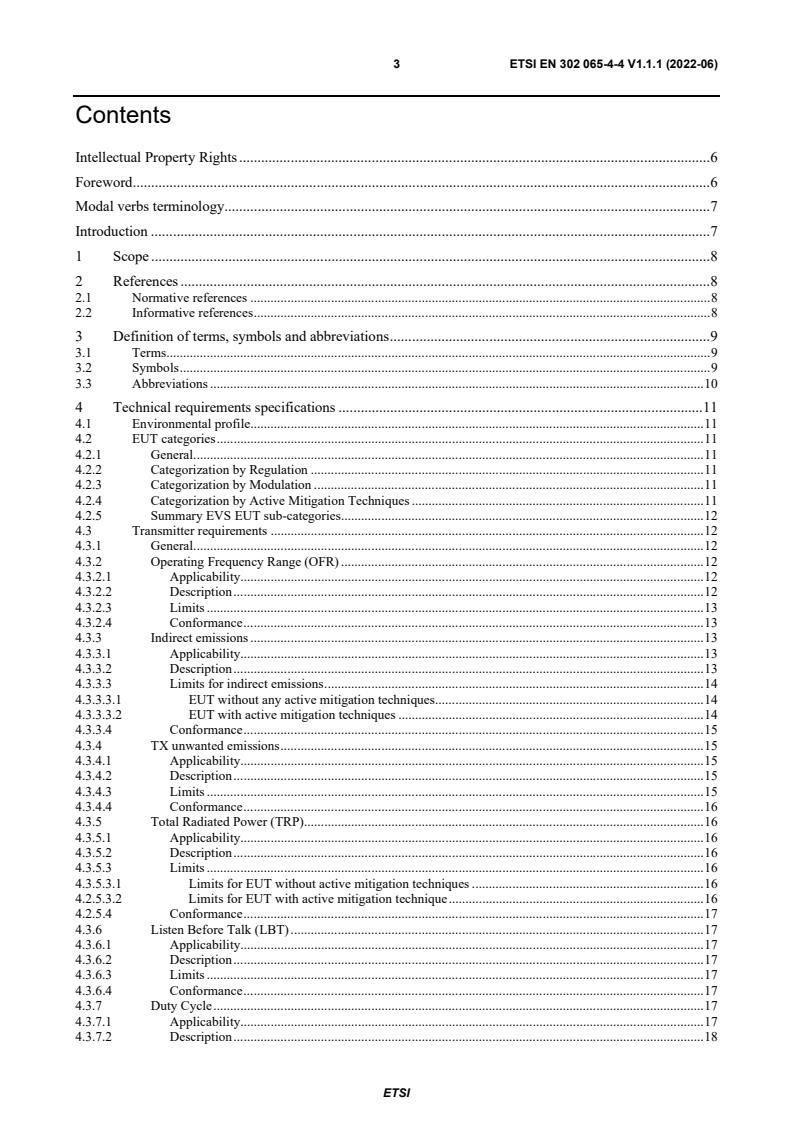
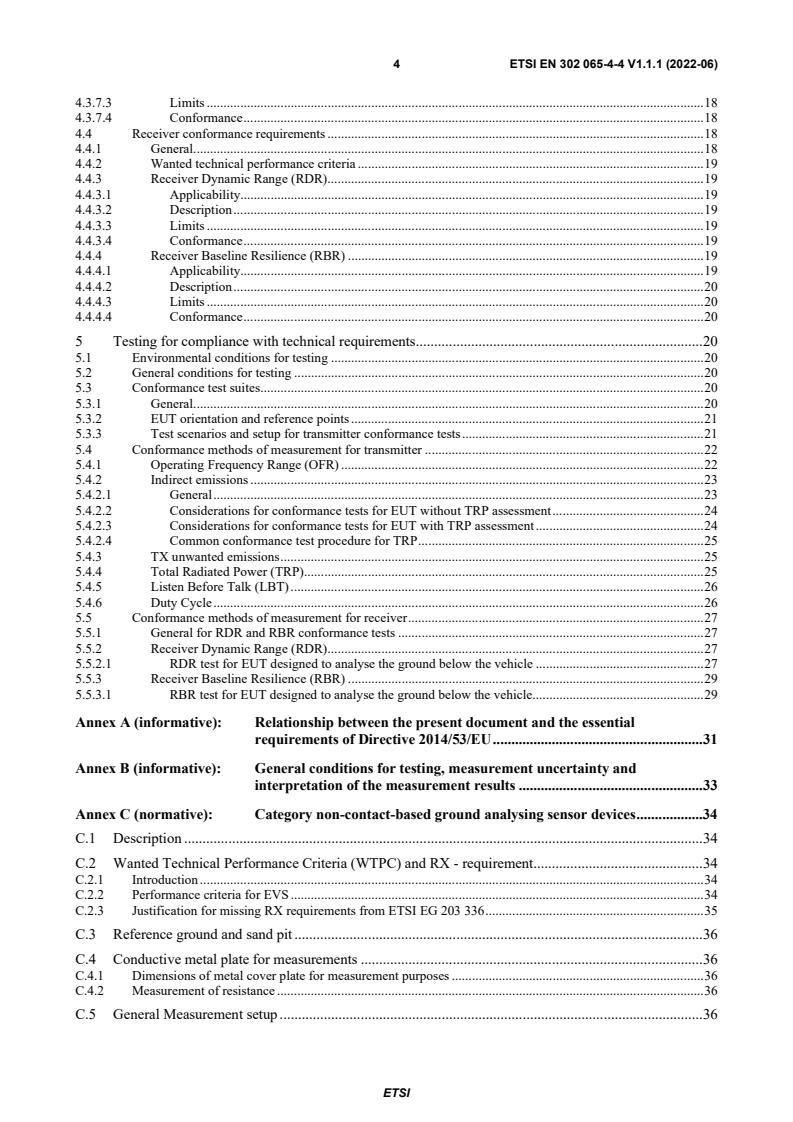
Contents
Intellectual Property Rights . 6
Foreword . 6
Modal verbs terminology . 7
Introduction . 7
1 Scope . 8
2 References . 8
2.1 Normative references . 8
2.2 Informative references . 8
3 Definition of terms, symbols and abbreviations . 9
3.1 Terms . 9
3.2 Symbols . 9
3.3 Abbreviations . 10
4 Technical requirements specifications . 10
4.1 Environmental profile . 10
4.2 EUT categories . 10
4.2.1 General . 10
4.2.2 Categorization by Regulation . 11
4.2.3 Categorization by Modulation . 11
4.2.4 Categorization by Active Mitigation Techniques . 11
4.2.5 Summary EVS EUT sub-categories . 11
4.3 Transmitter requirements . 12
4.3.1 General . 12
4.3.2 Operating Frequency Range (OFR) . 12
4.3.2.1 Applicability. 12
4.3.2.2 Description . 12
4.3.2.3 Limits . 12
4.3.2.4 Conformance . 13
4.3.3 Indirect emissions . 13
4.3.3.1 Applicability. 13
4.3.3.2 Description . 13
4.3.3.3 Limits for indirect emissions . 13
4.3.3.3.1 EUT without any active mitigation techniques . 13
4.3.3.3.2 EUT with active mitigation techniques . 14
4.3.3.4 Conformance . 15
4.3.4 TX unwanted emissions . 15
4.3.4.1 Applicability. 15
4.3.4.2 Description . 15
4.3.4.3 Limits . 15
4.3.4.4 Conformance . 15
4.3.5 Total Radiated Power (TRP) . 15
4.3.5.1 Applicability. 15
4.3.5.2 Description . 16
4.3.5.3 Limits . 16
4.3.5.3.1 Limits for EUT without active mitigation techniques. . 16
4.2.5.3.2 Limits for EUT with active mitigation technique . 16
4.2.5.4 Conformance . 16
4.3.6 Listen Before Talk (LBT) . 16
4.3.6.1 Applicability. 16
4.3.6.2 Description . 17
4.3.6.3 Limits . 17
4.3.6.4 Conformance . 17
4.3.7 Duty Cycle . 17
4.3.7.1 Applicability. 17
4.3.7.2 Description . 17
ETSI
4 Draft ETSI EN 302 065-4-4 V1.1.0 (2022-02)
4.3.7.3 Limits . 18
4.3.7.4 Conformance . 18
4.4 Receiver conformance requirements . 18
4.4.1 General . 18
4.4.2 Wanted technical performance criteria . 19
4.4.3 Receiver Dynamic Range (RDR) . 19
4.4.3.1 Applicability. 19
4.4.3.2 Description . 19
4.4.3.3 Limits . 19
4.4.3.4 Conformance . 19
4.4.4 Receiver Baseline Resilience (RBR) . 19
4.4.4.1 Applicability. 19
4.4.4.2 Description . 19
4.4.4.3 Limits . 20
4.4.4.4 Conformance . 20
5 Testing for compliance with technical requirements . 20
5.1 Environmental conditions for testing . 20
5.2 General conditions for testing . 20
5.3 Conformance test suites . 20
5.3.1 General . 20
5.3.2 EUT orientation and reference points . 20
5.3.3 Test scenarios and setup for transmitter conformance tests . 21
5.4 Conformance methods of measurement for transmitter . 22
5.4.1 Operating Frequency Range (OFR) . 22
5.4.2 Indirect emissions . 23
5.4.2.1 General . 23
5.4.2.2 Considerations for conformance tests for EUT without TRP assessment: . 24
5.4.2.3 Considerations for conformance tests for EUT with TRP assessment . 24
5.4.2.4 Common conformance test procedure for TRP . 25
5.4.3 TX unwanted emissions . 25
5.4.4 Total Radiated Power (TRP) . 25
5.4.5 Listen Before Talk (LBT) . 26
5.4.6 Duty Cycle . 26
5.5 Conformance methods of measurement for receiver . 27
5.5.1 General for RDR and RBR conformance tests . 27
5.5.2 Receiver Dynamic Range (RDR) . 27
5.5.2.1 RDR test for EUT designed to analyse the ground below the vehicle . 27
5.5.3 Receiver Baseline Resilience (RBR) . 29
5.5.3.1 RBR test for EUT designed to analyse the ground below the vehicle . 29
Annex A (informative): Relationship between the present document and the essential
requirements of Directive 2014/53/EU . 31
Annex B (informative): General conditions for testing, measurement uncertainty and
interpretation of the measurement results . 33
Annex C (normative): Category non-contact-based ground analysing sensor devices . 34
C.1 Description . 34
C.2 Wanted Technical Performance Criteria (WTPC) and RX - requirement . 34
C.2.1 Introduction . 34
C.2.2 Performance criteria for EVS . 34
C.2.3 Justification for missing RX requirements from ETSI EG 203 336 . 35
C.3 Reference ground and sand pit . 36
C.4 Conductive metal plate for measurements . 36
C.4.1 Dimensions of metal cover plate for measurement purposes . 36
C.4.2 Measurement of resistance . 36
C.5 General Measurement setup . 36
ETSI
5 Draft ETSI EN 302 065-4-4 V1.1.0 (2022-02)
Annex D (normative): Interferer for RBR test . 38
D.1 Interferer requirements for RBR tests . 38
D.1.1 General test frequencies for RBR tests . 38
D.1.2 Test frequencies for EUT with OFR < 500 MHz . 38
D.1.3 Test frequencies for EUT with OFR ≥ 500 MHz . 38
D.1.4 Interferer power levels and modulation . 39
D.2 Interferer test signals for EVS . 40
D.2.1 Interferer test signals . 40
D.2.2 Assessment if no interferer test signal provided at calculated test signals . 41
D.3 List of interferer for RBR test; assessment procedure . 42
D.3.1 General . 42
D.3.2 Assessment list of relevant interferer . 43
D.3.2.1 Considering . 43
D.3.2.2 Several interferer within the same frequency range . 43
D.3.2.3 Interferer overlapping in frequency range . 43
D.3.2.4 Status of interferer . 44
D.3.3 Kind of interferer signal . 44
Annex E (informative): Change History . 45
History . 46
ETSI
6 Draft ETSI EN 302 065-4-4 V1.1.0 (2022-02)
Intellectual Property Rights
Essential patents
IPRs essential or potentially essential to normative deliverables may have been declared to ETSI. The declarations
pertaining to these essential IPRs, if any, are publicly available for ETSI members and non-members, and can be
found in ETSI SR 000 314: "Intellectual Property Rights (IPRs); Essential, or potentially Essential, IPRs notified to
ETSI in respect of ETSI standards", which is available from the ETSI Secretariat. Latest updates are available on the
ETSI Web server (https://ipr.etsi.org/).
Pursuant to the ETSI Directives including the ETSI IPR Policy, no investigation regarding the essentiality of IPRs,
including IPR searches, has been carried out by ETSI. No guarantee can be given as to the existence of other IPRs not
referenced in ETSI SR 000 314 (or the updates on the ETSI Web server) which are, or may be, or may become,
essential to the present document.
Trademarks
The present document may include trademarks and/or tradenames which are asserted and/or registered by their owners.
ETSI claims no ownership of these except for any which are indicated as being the property of ETSI, and conveys no
right to use or reproduce any trademark and/or tradename. Mention of those trademarks in the present document does
not constitute an endorsement by ETSI of products, services or organizations associated with those trademarks.
DECT™, PLUGTESTS™, UMTS™ and the ETSI logo are trademarks of ETSI registered for the benefit of its
Members. 3GPP™ and LTE™ are trademarks of ETSI registered for the benefit of its Members and of the 3GPP
Organizational Partners. oneM2M™ logo is a trademark of ETSI registered for the benefit of its Members and of the ®
oneM2M Partners. GSM and the GSM logo are trademarks registered and owned by the GSM Association.
Foreword
This draft Harmonised European Standard (EN) has been produced by ETSI Technical Committee Electromagnetic
compatibility and Radio spectrum Matters (ERM), and is now submitted for the combined Public Enquiry and Vote
phase of the ETSI standards EN Approval Procedure.
The present document has been prepared under the Commission's standardisation request C(2015) 5376 final [i.5] to
provide one voluntary means of conforming to the essential requirements of Directive 2014/53/EU on the harmonisation
of the laws of the Member States relating to the making available on the market of radio equipment and repealing
Directive 1999/5/EC [i.3].
Once the present document is cited in the Official Journal of the European Union under that Directive, compliance with
the normative clauses of the present document given in table A.1 confers, within the limits of the scope of the present
document, a presumption of conformity with the corresponding essential requirements of that Directive and associated
EFTA regulations.
The present document is part 4, subpart 4 of a multi-part deliverable. Full details of the entire series can be found in
part 1 [i.13].
Proposed national transposition dates
Date of latest announcement of this EN (doa): 3 months after ETSI publication
Date of latest publication of new National Standard
or endorsement of this EN (dop/e): 6 months after doa
Date of withdrawal of any conflicting National Standard (dow): 18 months after doa
ETSI
7 Draft ETSI EN 302 065-4-4 V1.1.0 (2022-02)
Modal verbs terminology
In the present document "shall", "shall not", "should", "should not", "may", "need not", "will", "will not", "can" and
"cannot" are to be interpreted as described in clause 3.2 of the ETSI Drafting Rules (Verbal forms for the expression of
provisions).
"must" and "must not" are NOT allowed in ETSI deliverables except when used in direct citation.
Introduction
The present document is part of a set of standards developed by ETSI and is designed to fit in a modular structure to
cover all radio and telecommunications terminal equipment within the scope of the Directive 2014/53/EU [i.3].
For the case of the present document, the applicable harmonised standard has been ETSI EN 302 065-4 (V1.1.1) [i.8],
for Material Sensing devices using UWB technology below 10,6 GHz which was published in the OJEU without
restriction at 12 April 2017.
In order to consider the above points, ETSI ERM TGUWB decided to develop more specific standards; this means
instead of one generic ETSI EN 302 065-4 [i.8] standard for Material Sensing devices the following standard family
ETSI EN 302 065-4-x for material sensing devices:
• ETSI EN 302 065-4-1: "Material Sensing devices; Sub-part 1: Building material analysis below 10,6 GHz".
• ETSI EN 302 065-4-2: "UWB Material Sensing devices for Security Scanning UWB SSC.
• ETSI EN 302 065-4-3: "Ground humidity and condition sensor".
• ETSI EN 302 065-4-4: "Exterior material sensing applications at ground based vehicles".
• ETSI EN 302 065-4-5: "UWB surveillance devices for parking lot sensors below 10,6 GHz".
NOTE: The above list of standards represents the active work items at the time of finalizing the present document
and the final structure of the ETSI EN 302 065-4-x family may change later.
ETSI
8 Draft ETSI EN 302 065-4-4 V1.1.0 (2022-02)
1 Scope
The present document specifies the requirements for technical characteristics and methods of measurements for material
sensing applications using UWB technology for external material sensing applications for ground-based vehicles.
The present document only covers non-contact based UWB material sensing devices according to ECC/DEC(07)01 [i.1]
and Commission Decision 2019/785/EU [i.2].
NOTE: The relationship between the present document and essential requirements of article 3.2 of Directive
2014/53/EU [i.3] is given in annex A.
2 References
2.1 Normative references
References are either specific (identified by date of publication and/or edition number or version number) or
non-specific. For specific references, only the cited version applies. For non-specific references, the latest version of the
referenced document (including any amendments) applies.
Referenced documents which are not found to be publicly available in the expected location might be found at
https://docbox.etsi.org/Reference/.
NOTE: While any hyperlinks included in this clause were valid at the time of publication, ETSI cannot guarantee
their long term validity.
The following referenced documents are necessary for the application of the present document.
[1] ETSI EN 303 883-1 (V1.2.1) (02-2021): "Short Range Devices (SRD) and Ultra Wide Band
(UWB); Part 1: Measurement techniques for transmitter requirements".
[2] ETSI EN 303 883-2 (V1.2.1) (02-2021): "Short Range Devices (SRD) and Ultra Wide Band
(UWB); Part 2: Measurement techniques for receiver requirements".
[3] ETSI EN 302 066 (V2.2.1) (06-2020): "Short Range Devices (SRD); Ground- and Wall- Probing
Radio determination (GPR/WPR) devices; Harmonised Standard for access to radio spectrum".
2.2 Informative references
References are either specific (identified by date of publication and/or edition number or version number) or
non-specific. For specific references, only the cited version applies. For non-specific references, the latest version of the
referenced document (including any amendments) applies.
NOTE: While any hyperlinks included in this clause were valid at the time of publication, ETSI cannot guarantee
their long term validity.
The following referenced documents are not necessary for the application of the present document but they assist the
user with regard to a particular subject area.
[i.1] ECC/DEC/(07)01: "ECC Decision of 30 March 2007 on the harmonised use, exemption from
individual licensing and free circulation of Material Sensing Devices using Ultra-Wideband
(UWB) technology, amended on 26 June 2009, corrected on 18 November 2016 and amended on
8 March 2019.
[i.2] 2019/785/EU: "Commission Implementing Decision (EU) 2019/785 of 14 May 2019 on the
harmonisation of radio spectrum for equipment using ultra-wideband technology in the Union and
repealing Decision 2007/131/EC (notified under document C(2019) 3461)".
[i.3] Directive 2014/53/EU of the European Parliament and of the Council of 16 April 2014 on the
harmonisation of the laws of the Member States relating to the making available on the market of
radio equipment and repealing Directive 1999/5/EC.
ETSI
9 Draft ETSI EN 302 065-4-4 V1.1.0 (2022-02)
[i.4] CEPT Report 45: "Report from CEPT to the European Commission in response to the Fifth
Mandate to CEPT on ultra-wideband technology to clarify the technical parameters in view of a
potential update of Commission Decision 2007/131/EC"; Report approved on 21 June 2013 by the
ECC.
[i.5] Commission Implementing Decision C(2015) 5376 final of 4.8.2015 on a standardisation request
to the European Committee for Electrotechnical Standardisation and to the European
Telecommunications Standards Institute as regards radio equipment in support of
Directive 2014/53/EU of the European Parliament and of the Council.
[i.6] Recommendation ITU-R SM.1755: "Characteristics of ultra-wideband technology".
[i.7] ETSI EG 203 336 (V1.2.1) (05-2020): "Guide for the selection of technical parameters for the
production of Harmonised Standards covering article 3.1(b) and article 3.2 of
Directive 2014/53/EU".
[i.8] ETSI EN 302 065-4 (V1.1.1): "Short Range Devices (SRD) using Ultra Wide Band technology
(UWB); Harmonised Standard covering the essential requirements of article 3.2 of the
Directive 2014/53/EU; Part 4: Material Sensing devices using UWB technology below 10,6 GHz".
[i.9] ECC/DEC/(20)/01: "ECC Decision of 20 November 2020 on the harmonised use of the frequency
band 5945-6425 MHz for Wireless Access Systems including Radio Local Area Networks
(WAS/RLAN)".
[i.10] ETSI TS 136 101 (V16.8.0): "LTE; Evolved Universal Terrestrial Radio Access (E-UTRA); User
Equipment (UE) radio transmission and reception (3GPP TS 36.101 version 16.8.0 Release 16)".
[i.11] ETSI TS 103 361 (V1.1.1) (03-2016): "Short Range Devices (SRD) using Ultra Wide Band
technology (UWB); Receiver technical requirements, parameters and measurement procedures to
fulfil the requirements of the Directive 2014/53/EU".
[i.12] ECO Frequency Information System (cept.org).
NOTE: Available at https://efis.cept.org/.
[i.13] ETSI EN 302 065-1: "Short Range Devices (SRD) using Ultra Wide Band technology (UWB);
Harmonised Standard covering the essential requirements of article 3.2 of the Directive
2014/53/EU; Part 1: Requirements for Generic UWB applications".
3 Definition of terms, symbols and abbreviations
3.1 Terms
For the purposes of the present document, the terms and definitions given in ETSI EN 303 883-1 [1] and ETSI
EN 303 883-2 [2] and the following apply:
footsize: outside dimension of the EUT in the horizontal plane
3.2 Symbols
For the purposes of the present document, the symbols given in ETSI EN 303 883-1 [1] and ETSI EN 303 883-2 [2] and
the following apply:
c Velocity of light in a vacuum
d, d ,d Measurement distance
1 2
D Difference between M and N
Difference between M and I
D2
d Interferer distance
int
f RBR test frequency within the middle of the EUT OFR
f RBR test frequency between f and f of the EUT OFR
2 L C
ETSI
10 Draft ETSI EN 302 065-4-4 V1.1.0 (2022-02)
f RBR test frequency between f and f of the EUT OFR
3 C H
f Centre frequency of the operating frequency range
C
Highest frequency of the operating frequency range
fH
f RBR test frequency higher f of the EUT OFR
H1,2 H
fL Lowest frequency of the operating frequency range
f RBR test frequency lower f of the EUT OFR
L1,2 L
f Frequency at which the peak power emission occurs
M
G
(f)
Antenna gain over frequency
Gain of the measurement antenna
GA
I Signal recorded by the receiver in presence of the interferer
M Maximum signal for the receiver in the linear region of operation
N Receiver noise level
P Spectral power density
e.i.r.p.
R Distance
3.3 Abbreviations
For the purposes of the present document, the abbreviations given in ETSI EN 303 883-1 [1] and ETSI
EN 303 883-2 [2] and the following apply:
CW Continuous Wave
dB decibel
dBm decibel reference to 1 mW
e.i.r.p. equivalent isotropic radiated power
EC European Commission
EN European Norm
EVS External Vehicular Sensor
LBT Listen Before Talk
TH ThresHold
TRP Total Radiated Power
TS Technical Specification
WTPC Wanted Technical Performance Criteria
4 Technical requirements specifications
4.1 Environmental profile
The technical requirements of the present document apply under the environmental profile for operation of the
equipment, which shall be in accordance with its intended use. The equipment shall comply with all the technical
requirements of the present document at all times when operating within the boundary limits of the operational
environmental profile defined by its intended use.
4.2 EUT categories
4.2.1 General
The present document covers one category of EUT for exterior material sensing applications at ground based vehicle
below 10,6 GHz. This category is named as Exterior Vehicle Sensors (EVSs).
More details about the use-case, wanted technical performance criteria and the RX-test conditions of the EVS category
is provided in annex C.
The specified EVS EUT sub-categories provide a clear classification for the wanted technical performance criteria,
limits requirements and conformance test procedures.
ETSI
11 Draft ETSI EN 302 065-4-4 V1.1.0 (2022-02)
The following criteria were considered for sub-categorization of EVS category:
• Regulation: ECC and EC recommendations and decisions, see clause 4.2.2.
• Modulation: kind of modulation of the TX signal, see clause 4.2.3.
• Usage of active UWB mitigation techniques (e.g. LBT, DAA), see clause 4.2.4.
An overview of the EVS EUT sub-categories is provided in clause 4.2.5, table 1.
4.2.2 Categorization by Regulation
The following regulation was considered for sub-categorization of EVS EUT:
• UWB regulations: ECC/DEC/(07)01 [i.1] and 2019/785/EU [i.2] for EVS EUT based on UWB technology
with or without active mitigation techniques.
4.2.3 Categorization by Modulation
The following categorization of EVS EUT by modulation is used:
• TX1: for EUT with FHSS, sequential hopping/stepping or FMCW modulation.
• TX2: for any other modulation different from TX1.
4.2.4 Categorization by Active Mitigation Techniques
BMA EUT covered by ECC/DEC/(07)01 [i.1] and 2019/785/EU [i.2] can be categorized by use of active mitigation
techniques (e.g. Listen Before Transmit (LBT), Detect-and-Avoid (DAA)):
• EVS EUT based on UWB technology without active mitigation techniques.
• EVS EUT based on UWB technology with active mitigation techniques.
4.2.5 Summary EVS EUT sub-categories
4 sub-categories of the EVS EUT are identified:
• EVS1: based on UWB technology without active mitigation techniques using TX1 (UWB regulations)
• EVS2: based on UWB technology without active mitigation techniques using TX2 (UWB regulations)
• EVS3: based on UWB technology with active mitigation techniques using TX1 (UWB regulations)
• EVS4: based on UWB technology with active mitigation techniques using TX2 (UWB regulations)
An overview of requirements for each EVS EUT sub-categories is given in table 1.
ETSI
12 Draft ETSI EN 302 065-4-4 V1.1.0 (2022-02)
Table 1: EUT sub-categories covered by the present document
Category Modulation TX requirements RX-requirements
Emission requirements Additional Active
requirements mitigation
Clause Clause Clause Clause
EUT based UWB regulation; EUT without any active mitigation technique
EVS1 TX1 OFR 4.3.2 DC 4.3.7 WTPC C.2
Indirect 4.3.4 TRP 4.3.5 RBS 4.4.3
emissions
TXUE 4.3.5 RBR 4.4.4
EVS2 TX2 OFR 4.3.2 DC 4.3.7 WTPC C.2
Indirect 4.3.4 TRP 4.3.5 RBS 4.4.3
emissions
TXUE 4.3.5 RBR 4.4.4
EUT based UWB regulation; EUT implemented the active mitigation technique LBT
EVS3 TX1 OFR 4.3.2 DC 4.3.7 LBT 4.3.6 WTPC C.2
Indirect 4.3.4 TRP 4.3.5 RBS 4.4.3
emissions
TXUE 4.3.5 RBR 4.4.4
EVS4 TX2 OFR 4.3.2 DC 4.3.7 LBT 4.3.6 WTPC C.2
Indirect 4.3.4 TRP 4.3.5 RBS 4.4.3
emissions
TXUE 4.3.5 RBR 4.4.4
4.3 Transmitter requirements
4.3.1 General
Based on the different possible operational frequency ranges of the EUT categories covered in the present document
different sets of transmitter conformance requirements are applicable. The applicability is governed by the operating
frequency range as specified in clause 4.3.2.
4.3.2 Operating Frequency Range (OFR)
4.3.2.1 Applicability
This requirement shall apply to all EVS sub-categories, see clause 4.2.5, table 1.
4.3.2.2 Description
For the description of the Operating Frequency Range (OFR), see ETSI EN 303 883-1 [1], clause 5.2.1.
Requirement for test parameter X as specified in ETSI EN 303 883-1 [1], clause 5.2.1:
X: 10 dB
NOTE: The present document is in accordance with the -10 dB bandwidth for UWB EUT below 10 GHz, as
defined in annex 1 of Recommendation ITU-R SM.1755 [i.6].
4.3.2.3 Limits
The radio equipment within scope of the present document is capable of operating in all or part of the frequency bands
given in table 2.
ETSI
13 Draft ETSI EN 302 065-4-4 V1.1.0 (2022-02)
Table 2: Permitted frequency range [i.2]
Permitted frequency range
Transmit 30 MHz to 10,6 GHz
Receive 30 MHz to 10,6 GHz
The OFR shall be in the permitted frequency range of operation as given in table 2 and the OFR shall be equal or larger
than 50 MHz.
4.3.2.4 Conformance
The conformance test suite for operating bandwidth shall be as defined in clause 5.4.1.
4.3.3 Indirect emissions
4.3.3.1 Applicability
This requirement shall apply to all EVS sub-categories, see clause 4.2.5, table 1.
For some frequency ranges the EUT shall fulfil additional requirements.
The additional requirements are applicable if the OFR is partly or fully overlapping with the frequency range for which
the mitigation is requested.
An overview of the applicable additional requirements is provided in table 3.
Table 3: possible applicable requirements
OFR is partly or full Additional requirement for EUT without Additional requirements for EUT
overlapping with frequency any active mitigation technique implemented the mitigation
range [GHz] technique LBT
Sub-categories: EVS1 and EVS2 Sub-categories: EVS3 and EVS4
1,215 to 1,73 LBT, see clause 4.3.6
2,5 to 2,69 TRP, see clause 4.3.6 TRP, see clause 4.3.5
LBT, see clause 4.3.6
2,69 to 2,7 DC, see clause 4.3.7 DC, see clause 4.3.7
TRP, see clause 4.3.6 TRP, see clause 4.3.5
2,7 to 2,9 LBT, see clause 4.3.6
2,9 to 3,4 LBT, see clause 4.3.6
3,4 to 3,8 DC, see clause 4.3.7 DC, see clause 4.3.7
4,8 to 5,0 DC, see clause 4.3.7 DC, see clause 4.3.7
TRP, see clause 4.3.6 TRP, see clause 4.3.5
4.3.3.2 Description
For the description of the indirect emissions see ETSI EN 303 883-1 [1], clause 5.7.1.
For the Indirect Emission two power requirements are regulated in Commission Implementing Decision (EU)
2019/785/EU [i.2] for the emission within the OFR:
• Mean Power e.i.r.p. spectral density (defined in 1 MHz)
• Peak e.i.r.p. (defined in 50 MHz)
4.3.3.3 Limits for indirect emissions
4.3.3.3.1 EUT without any active mitigation techniques
The limits for the indirect emission requirement for the EUT without any active mitigation techniques (EVS1 and
EVS2, table 1) are listed in table 4.
ETSI
14 Draft ETSI EN 302 065-4-4 V1.1.0 (2022-02)
The exterior maximum mean power spectral density shall not exceed the limits given in table 4 measured in the
direction of the highest emission level out of the scenario.
Table 4: Emission Limit for EUT without any active mitigation technique [i.2]
Frequency Maximum mean e.i.r.p. spectral Maximum peak e.i.r.p. Remarks
range [GHz] density [dBm/MHz] [dBm defined in 50 MHz]
Below 1,73 -85 -65
1,73 to 2,2 -70 -45
2,2 to 2,5 -50 -25
2,5 to 2,69 -65 -40 Note 1
2,69 to 2,7 -70 -45 Note 1 and note 2
2,7 to 2,9 -70 -45
2,9 to 3,4 -70 -45
3,4 to 3,8 - 70 -45 Note 2
3,8 to 4,8 - 50 -25
4,8 to 5,0 -55 -30 Note 1 and note 2
5,0 to 5,25 -55 -30
5,25 to 5,35 -50 -25
5,35 to 5,6 -50 -25
5,6 to 5,65 -50 -25
5,65 to 5,725 -65 -40
5,725 to 6,0 -60 -35
6,0 to 8,5 -41,3 -0
8,5 to 9,0 -65 -25
9,0 to 10,6 -65 -25
Above 10,6 -85 -45
NOTE 1: An additional requirement on TRP applies, see clause 4.3.5.
NOTE 2: An additional requirement on DC applies, see clause 4.3.7 reduced limits for mean e.i.r.p. spectral
density do apply in case of trading DC and power according to table 14.
The measured results of the indirect emissions shall be recorded.
4.3.3.3.2 EUT with active mitigation techniques
The limits for the indirect emission requirement for the EUT (EVS3 and EVS4, table 1) with active mitigation
techniques are listed in table 5.
The exterior maximum mean power spectral density shall not exceed the limits given in table 5 measured in the
direction of the highest emission level out of the scenario.
Table 5: Emission Limit for EUT with active mitigation technique [i.2]
Frequenc
...
HARMONISED EUROPEAN STANDARD
Short Range Devices (SRD) using
Ultra Wide Band technology (UWB);
Harmonised Standard for access to radio spectrum;
Part 4: Material Sensing devices;
Sub-part 4: Exterior material sensing applications
for ground based vehicles
2 ETSI EN 302 065-4-4 V1.1.1 (2022-06)
Reference
DEN/ERM-TGUWB-601
Keywords
harmonised standard, SRD, UWB
ETSI
650 Route des Lucioles
F-06921 Sophia Antipolis Cedex - FRANCE
Tel.: +33 4 92 94 42 00 Fax: +33 4 93 65 47 16
Siret N° 348 623 562 00017 - APE 7112B
Association à but non lucratif enregistrée à la
Sous-Préfecture de Grasse (06) N° w061004871
Important notice
The present document can be downloaded from:
http://www.etsi.org/standards-search
The present document may be made available in electronic versions and/or in print. The content of any electronic and/or
print versions of the present document shall not be modified without the prior written authorization of ETSI. In case of any
existing or perceived difference in contents between such versions and/or in print, the prevailing version of an ETSI
deliverable is the one made publicly available in PDF format at www.etsi.org/deliver.
Users of the present document should be aware that the document may be subject to revision or change of status.
Information on the current status of this and other ETSI documents is available at
https://portal.etsi.org/TB/ETSIDeliverableStatus.aspx
If you find errors in the present document, please send your comment to one of the following services:
https://portal.etsi.org/People/CommiteeSupportStaff.aspx
If you find a security vulnerability in the present document, please report it through our
Coordinated Vulnerability Disclosure Program:
https://www.etsi.org/standards/coordinated-vulnerability-disclosure
Notice of disclaimer & limitation of liability
The information provided in the present deliverable is directed solely to professionals who have the appropriate degree of
experience to understand and interpret its content in accordance with generally accepted engineering or
other professional standard and applicable regulations.
No recommendation as to products and services or vendors is made or should be implied.
In no event shall ETSI be held liable for loss of profits or any other incidental or consequential damages.
Any software contained in this deliverable is provided "AS IS" with no warranties, express or implied, including but not
limited to, the warranties of merchantability, fitness for a particular purpose and non-infringement of intellectual property
rights and ETSI shall not be held liable in any event for any damages whatsoever (including, without limitation, damages
for loss of profits, business interruption, loss of information, or any other pecuniary loss) arising out of or related to the use
of or inability to use the software.
Copyright Notification
No part may be reproduced or utilized in any form or by any means, electronic or mechanical, including photocopying and
microfilm except as authorized by written permission of ETSI.
The content of the PDF version shall not be modified without the written authorization of ETSI.
The copyright and the foregoing restriction extend to reproduction in all media.
© ETSI 2022.
All rights reserved.
ETSI
3 ETSI EN 302 065-4-4 V1.1.1 (2022-06)
Contents
Intellectual Property Rights . 6
Foreword . 6
Modal verbs terminology . 7
Introduction . 7
1 Scope . 8
2 References . 8
2.1 Normative references . 8
2.2 Informative references . 8
3 Definition of terms, symbols and abbreviations . 9
3.1 Terms . 9
3.2 Symbols . 9
3.3 Abbreviations . 10
4 Technical requirements specifications . 11
4.1 Environmental profile . 11
4.2 EUT categories . 11
4.2.1 General . 11
4.2.2 Categorization by Regulation . 11
4.2.3 Categorization by Modulation . 11
4.2.4 Categorization by Active Mitigation Techniques . 11
4.2.5 Summary EVS EUT sub-categories . 12
4.3 Transmitter requirements . 12
4.3.1 General . 12
4.3.2 Operating Frequency Range (OFR) . 12
4.3.2.1 Applicability. 12
4.3.2.2 Description . 12
4.3.2.3 Limits . 13
4.3.2.4 Conformance . 13
4.3.3 Indirect emissions . 13
4.3.3.1 Applicability. 13
4.3.3.2 Description . 13
4.3.3.3 Limits for indirect emissions . 14
4.3.3.3.1 EUT without any active mitigation techniques . 14
4.3.3.3.2 EUT with active mitigation techniques . 14
4.3.3.4 Conformance . 15
4.3.4 TX unwanted emissions . 15
4.3.4.1 Applicability. 15
4.3.4.2 Description . 15
4.3.4.3 Limits . 15
4.3.4.4 Conformance . 16
4.3.5 Total Radiated Power (TRP) . 16
4.3.5.1 Applicability. 16
4.3.5.2 Description . 16
4.3.5.3 Limits . 16
4.3.5.3.1 Limits for EUT without active mitigation techniques . 16
4.2.5.3.2 Limits for EUT with active mitigation technique . 16
4.2.5.4 Conformance . 17
4.3.6 Listen Before Talk (LBT) . 17
4.3.6.1 Applicability. 17
4.3.6.2 Description . 17
4.3.6.3 Limits . 17
4.3.6.4 Conformance . 17
4.3.7 Duty Cycle . 17
4.3.7.1 Applicability. 17
4.3.7.2 Description . 18
ETSI
4 ETSI EN 302 065-4-4 V1.1.1 (2022-06)
4.3.7.3 Limits . 18
4.3.7.4 Conformance . 18
4.4 Receiver conformance requirements . 18
4.4.1 General . 18
4.4.2 Wanted technical performance criteria . 19
4.4.3 Receiver Dynamic Range (RDR) . 19
4.4.3.1 Applicability. 19
4.4.3.2 Description . 19
4.4.3.3 Limits . 19
4.4.3.4 Conformance . 19
4.4.4 Receiver Baseline Resilience (RBR) . 19
4.4.4.1 Applicability. 19
4.4.4.2 Description . 20
4.4.4.3 Limits . 20
4.4.4.4 Conformance . 20
5 Testing for compliance with technical requirements . 20
5.1 Environmental conditions for testing . 20
5.2 General conditions for testing . 20
5.3 Conformance test suites . 20
5.3.1 General . 20
5.3.2 EUT orientation and reference points . 21
5.3.3 Test scenarios and setup for transmitter conformance tests . 21
5.4 Conformance methods of measurement for transmitter . 22
5.4.1 Operating Frequency Range (OFR) . 22
5.4.2 Indirect emissions . 23
5.4.2.1 General . 23
5.4.2.2 Considerations for conformance tests for EUT without TRP assessment . 24
5.4.2.3 Considerations for conformance tests for EUT with TRP assessment . 24
5.4.2.4 Common conformance test procedure for TRP . 25
5.4.3 TX unwanted emissions . 25
5.4.4 Total Radiated Power (TRP) . 25
5.4.5 Listen Before Talk (LBT) . 26
5.4.6 Duty Cycle . 26
5.5 Conformance methods of measurement for receiver . 27
5.5.1 General for RDR and RBR conformance tests . 27
5.5.2 Receiver Dynamic Range (RDR) . 27
5.5.2.1 RDR test for EUT designed to analyse the ground below the vehicle . 27
5.5.3 Receiver Baseline Resilience (RBR) . 29
5.5.3.1 RBR test for EUT designed to analyse the ground below the vehicle . 29
Annex A (informative): Relationship between the present document and the essential
requirements of Directive 2014/53/EU . 31
Annex B (informative): General conditions for testing, measurement uncertainty and
interpretation of the measurement results . 33
Annex C (normative): Category non-contact-based ground analysing sensor devices . 34
C.1 Description . 34
C.2 Wanted Technical Performance Criteria (WTPC) and RX - requirement . 34
C.2.1 Introduction . 34
C.2.2 Performance criteria for EVS . 34
C.2.3 Justification for missing RX requirements from ETSI EG 203 336 . 35
C.3 Reference ground and sand pit . 36
C.4 Conductive metal plate for measurements . 36
C.4.1 Dimensions of metal cover plate for measurement purposes . 36
C.4.2 Measurement of resistance . 36
C.5 General Measurement setup . 36
ETSI
5 ETSI EN 302 065-4-4 V1.1.1 (2022-06)
Annex D (normative): Interferer for RBR test . 38
D.1 Interferer requirements for RBR tests . 38
D.1.1 General test frequencies for RBR tests . 38
D.1.2 Test frequencies for EUT with OFR < 500 MHz . 38
D.1.3 Test frequencies for EUT with OFR ≥ 500 MHz . 39
D.1.4 Interferer power levels and modulation . 39
D.2 Interferer test signals for EVS . 40
D.2.1 Interferer test signals . 40
D.2.2 Assessment if no interferer test signal provided at calculated test signals . 41
D.3 List of interferer for RBR test; assessment procedure . 42
D.3.1 General . 42
D.3.2 Assessment list of relevant interferer . 43
D.3.2.1 Considering . 43
D.3.2.2 Several interferer within the same frequency range . 43
D.3.2.3 Interferer overlapping in frequency range . 43
D.3.2.4 Status of interferer . 44
D.3.3 Kind of interferer signal . 44
Annex E (informative): Change History . 45
History . 46
ETSI
6 ETSI EN 302 065-4-4 V1.1.1 (2022-06)
Intellectual Property Rights
Essential patents
IPRs essential or potentially essential to normative deliverables may have been declared to ETSI. The declarations
pertaining to these essential IPRs, if any, are publicly available for ETSI members and non-members, and can be
found in ETSI SR 000 314: "Intellectual Property Rights (IPRs); Essential, or potentially Essential, IPRs notified to
ETSI in respect of ETSI standards", which is available from the ETSI Secretariat. Latest updates are available on the
ETSI Web server (https://ipr.etsi.org/).
Pursuant to the ETSI Directives including the ETSI IPR Policy, no investigation regarding the essentiality of IPRs,
including IPR searches, has been carried out by ETSI. No guarantee can be given as to the existence of other IPRs not
referenced in ETSI SR 000 314 (or the updates on the ETSI Web server) which are, or may be, or may become,
essential to the present document.
Trademarks
The present document may include trademarks and/or tradenames which are asserted and/or registered by their owners.
ETSI claims no ownership of these except for any which are indicated as being the property of ETSI, and conveys no
right to use or reproduce any trademark and/or tradename. Mention of those trademarks in the present document does
not constitute an endorsement by ETSI of products, services or organizations associated with those trademarks.
DECT™, PLUGTESTS™, UMTS™ and the ETSI logo are trademarks of ETSI registered for the benefit of its
Members. 3GPP™ and LTE™ are trademarks of ETSI registered for the benefit of its Members and of the 3GPP
Organizational Partners. oneM2M™ logo is a trademark of ETSI registered for the benefit of its Members and of the ®
oneM2M Partners. GSM and the GSM logo are trademarks registered and owned by the GSM Association.
Foreword
This Harmonised European Standard (EN) has been produced by ETSI Technical Committee Electromagnetic
compatibility and Radio spectrum Matters (ERM).
The present document has been prepared under the Commission's standardisation request C(2015) 5376 final [i.5] to
provide one voluntary means of conforming to the essential requirements of Directive 2014/53/EU on the harmonisation
of the laws of the Member States relating to the making available on the market of radio equipment and repealing
Directive 1999/5/EC [i.3].
Once the present document is cited in the Official Journal of the European Union under that Directive, compliance with
the normative clauses of the present document given in table A.1 confers, within the limits of the scope of the present
document, a presumption of conformity with the corresponding essential requirements of that Directive and associated
EFTA regulations.
The present document is part 4, sub-part 4 of a multi-part deliverable. Full details of the entire series can be found in
part 1 [i.13].
National transposition dates
Date of adoption of this EN: 24 May 2022
Date of latest announcement of this EN (doa): 31 August 2022
Date of latest publication of new National Standard
or endorsement of this EN (dop/e): 28 February 2023
Date of withdrawal of any conflicting National Standard (dow): 29 February 2024
ETSI
7 ETSI EN 302 065-4-4 V1.1.1 (2022-06)
Modal verbs terminology
In the present document "shall", "shall not", "should", "should not", "may", "need not", "will", "will not", "can" and
"cannot" are to be interpreted as described in clause 3.2 of the ETSI Drafting Rules (Verbal forms for the expression of
provisions).
"must" and "must not" are NOT allowed in ETSI deliverables except when used in direct citation.
Introduction
The present document is part of a set of standards developed by ETSI and is designed to fit in a modular structure to
cover all radio and telecommunications terminal equipment within the scope of the Directive 2014/53/EU [i.3].
For the case of the present document, the applicable harmonised standard has been ETSI EN 302 065-4 (V1.1.1) [i.8],
for Material Sensing devices using UWB technology below 10,6 GHz which was published in the OJEU without
restriction at 12 April 2017.
In order to consider the above points, ETSI ERM TGUWB decided to develop more specific standards; this means
instead of one generic ETSI EN 302 065-4 [i.8] standard for Material Sensing devices the following standard family
ETSI EN 302 065-4-x for material sensing devices:
• ETSI EN 302 065-4-1: "Material Sensing devices; Sub-part 1: Building material analysis below 10,6 GHz".
• ETSI EN 302 065-4-2: "UWB Material Sensing devices for Security Scanning".
• ETSI EN 302 065-4-3: "Ground humidity and condition sensor".
• ETSI EN 302 065-4-4: "Material Sensing devices; Sub-part 4: Exterior material sensing applications for
ground based vehicles".
• ETSI EN 302 065-4-5: "UWB surveillance devices for parking lot sensors below 10,6 GHz".
NOTE: The above list of standards represents the active work items at the time of finalizing the present document
and the final structure of the ETSI EN 302 065-4-x family may change later.
ETSI
8 ETSI EN 302 065-4-4 V1.1.1 (2022-06)
1 Scope
The present document specifies the requirements for technical characteristics and methods of measurements for material
sensing applications using UWB technology for external material sensing applications for ground-based vehicles.
The present document only covers non-contact based UWB material sensing devices according to ECC/DEC(07)01 [i.1]
and Commission Decision 2019/785/EU [i.2].
NOTE: The relationship between the present document and essential requirements of article 3.2 of Directive
2014/53/EU [i.3] is given in annex A.
2 References
2.1 Normative references
References are either specific (identified by date of publication and/or edition number or version number) or
non-specific. For specific references, only the cited version applies. For non-specific references, the latest version of the
referenced document (including any amendments) applies.
Referenced documents which are not found to be publicly available in the expected location might be found at
https://docbox.etsi.org/Reference/.
NOTE: While any hyperlinks included in this clause were valid at the time of publication, ETSI cannot guarantee
their long term validity.
The following referenced documents are necessary for the application of the present document.
[1] ETSI EN 303 883-1 (V1.2.1) (02-2021): "Short Range Devices (SRD) and Ultra Wide Band
(UWB); Part 1: Measurement techniques for transmitter requirements".
[2] ETSI EN 303 883-2 (V1.2.1) (02-2021): "Short Range Devices (SRD) and Ultra Wide Band
(UWB); Part 2: Measurement techniques for receiver requirements".
[3] ETSI EN 302 066 (V2.2.1) (06-2020): "Short Range Devices (SRD); Ground- and Wall- Probing
Radio determination (GPR/WPR) devices; Harmonised Standard for access to radio spectrum".
2.2 Informative references
References are either specific (identified by date of publication and/or edition number or version number) or
non-specific. For specific references, only the cited version applies. For non-specific references, the latest version of the
referenced document (including any amendments) applies.
NOTE: While any hyperlinks included in this clause were valid at the time of publication, ETSI cannot guarantee
their long term validity.
The following referenced documents are not necessary for the application of the present document but they assist the
user with regard to a particular subject area.
[i.1] ECC/DEC/(07)01: "ECC Decision of 30 March 2007 on the harmonised use, exemption from
individual licensing and free circulation of Material Sensing Devices using Ultra-Wideband
(UWB) technology", amended on 26 June 2009, corrected on 18 November 2016 and amended on
8 March 2019.
[i.2] 2019/785/EU: "Commission Implementing Decision (EU) 2019/785 of 14 May 2019 on the
harmonisation of radio spectrum for equipment using ultra-wideband technology in the Union and
repealing Decision 2007/131/EC (notified under document C(2019) 3461)".
[i.3] Directive 2014/53/EU of the European Parliament and of the Council of 16 April 2014 on the
harmonisation of the laws of the Member States relating to the making available on the market of
radio equipment and repealing Directive 1999/5/EC.
ETSI
9 ETSI EN 302 065-4-4 V1.1.1 (2022-06)
[i.4] CEPT Report 45: "Report from CEPT to the European Commission in response to the Fifth
Mandate to CEPT on ultra-wideband technology to clarify the technical parameters in view of a
potential update of Commission Decision 2007/131/EC"; Report approved on 21 June 2013 by the
ECC.
[i.5] Commission Implementing Decision C(2015) 5376 final of 4.8.2015 on a standardisation request
to the European Committee for Electrotechnical Standardisation and to the European
Telecommunications Standards Institute as regards radio equipment in support of
Directive 2014/53/EU of the European Parliament and of the Council.
[i.6] Recommendation ITU-R SM.1755: "Characteristics of ultra-wideband technology".
[i.7] ETSI EG 203 336 (V1.2.1) (05-2020): "Guide for the selection of technical parameters for the
production of Harmonised Standards covering article 3.1(b) and article 3.2 of Directive
2014/53/EU".
[i.8] ETSI EN 302 065-4 (V1.1.1): "Short Range Devices (SRD) using Ultra Wide Band technology
(UWB); Harmonised Standard covering the essential requirements of article 3.2 of the
Directive 2014/53/EU; Part 4: Material Sensing devices using UWB technology below 10,6 GHz".
[i.9] ECC/DEC/(20)/01: "ECC Decision of 20 November 2020 on the harmonised use of the frequency
band 5945-6425 MHz for Wireless Access Systems including Radio Local Area Networks
(WAS/RLAN)".
[i.10] ETSI TS 136 101 (V16.8.0): "LTE; Evolved Universal Terrestrial Radio Access (E-UTRA); User
Equipment (UE) radio transmission and reception (3GPP TS 36.101 version 16.8.0 Release 16)".
[i.11] ETSI TS 103 361 (V1.1.1) (03-2016): "Short Range Devices (SRD) using Ultra Wide Band
technology (UWB); Receiver technical requirements, parameters and measurement procedures to
fulfil the requirements of the Directive 2014/53/EU".
[i.12] ECO Frequency Information System (cept.org).
NOTE: Available at https://efis.cept.org/.
[i.13] ETSI EN 302 065-1: "Short Range Devices (SRD) using Ultra Wide Band technology (UWB);
Harmonised Standard covering the essential requirements of article 3.2 of the Directive
2014/53/EU; Part 1: Requirements for Generic UWB applications".
3 Definition of terms, symbols and abbreviations
3.1 Terms
For the purposes of the present document, the terms given in ETSI EN 303 883-1 [1], ETSI EN 303 883-2 [2] and the
following apply:
footsize: outside dimension of the EUT in the horizontal plane
3.2 Symbols
For the purposes of the present document, the symbols given in ETSI EN 303 883-1 [1], ETSI EN 303 883-2 [2] and the
following apply:
c Velocity of light in a vacuum
d, d ,d Measurement distance
1 2
D Difference between M and N
D Difference between M and I
d Interferer distance
int
f RBR test frequency within the middle of the EUT OFR
f RBR test frequency between f and f of the EUT OFR
2 L C
ETSI
10 ETSI EN 302 065-4-4 V1.1.1 (2022-06)
f RBR test frequency between f and f of the EUT OFR
3 C H
f Centre frequency of the operating frequency range
C
f Highest frequency of the operating frequency range
H
f RBR test frequency higher f of the EUT OFR
H1,2 H
f Lowest frequency of the operating frequency range
L
f RBR test frequency lower f of the EUT OFR
L1,2 L
f Frequency at which the peak power emission occurs
M
G
(f)
Antenna gain over frequency
G Gain of the measurement antenna
A
I Signal recorded by the receiver in presence of the interferer
M Maximum signal for the receiver in the linear region of operation
N Receiver noise level
P Spectral power density
e.i.r.p.
R Distance
3.3 Abbreviations
For the purposes of the present document, the abbreviations given in ETSI EN 303 883-1 [1], ETSI EN 303 883-2 [2]
and the following apply:
BBDR BroadBand Disaster Relief
BFWA Broadband Fixed Wireless Access
BS Base Station
CDMA Code Division Multiple Access
CW Continuous Wave
dB decibel
dBm decibel reference to 1 mW
DCS Digital Cellular System
e.i.r.p. equivalent isotropic radiated power
E-UTRA Evolved Universal Terrestrial Radio Access
EC European Commission
EN European Norm
EVS External Vehicular Sensor
FDD Frequency Division Duplex
FHSS Frequency Hopping Spread Spectrum
GSM Global System for Mobile
IMT International Mobile Telecommunications
ITS Intelligent Transport Systems
LBT Listen Before Talk
LTE Long Term Evolution
PCS Personal Communication System
PMSE Programme Making and Special Events
PPDR Public Protection and Disaster Relief
RDR Receiver Dynamic Range
RFID Radio Frequency Identification
RLAN Radio Local Area Network
T-DAB Terrestrial - Digital Audio Broadcast
TH ThresHold
TRP Total Radiated Power
TS Technical Specification
UE User Equipment
UMTS Universal Mobile Telecommunications System ®
WIMAX Worldwide Interoperability for Microwave ACCess
WTPC Wanted Technical Performance Criteria
ETSI
11 ETSI EN 302 065-4-4 V1.1.1 (2022-06)
4 Technical requirements specifications
4.1 Environmental profile
The technical requirements of the present document apply under the environmental profile for operation of the
equipment, which shall be in accordance with its intended use. The equipment shall comply with all the technical
requirements of the present document at all times when operating within the boundary limits of the operational
environmental profile defined by its intended use.
4.2 EUT categories
4.2.1 General
The present document covers one category of EUT for exterior material sensing applications at ground based vehicle
below 10,6 GHz. This category is named as Exterior Vehicle Sensors (EVSs).
More details about the use-case, wanted technical performance criteria and the RX-test conditions of the EVS category
is provided in annex C.
The specified EVS EUT sub-categories provide a clear classification for the wanted technical performance criteria,
limits requirements and conformance test procedures.
The following criteria were considered for sub-categorization of EVS category:
• Regulation: ECC and EC recommendations and decisions, see clause 4.2.2.
• Modulation: kind of modulation of the TX signal, see clause 4.2.3.
• Usage of active UWB mitigation techniques (e.g. LBT, DAA), see clause 4.2.4.
An overview of the EVS EUT sub-categories is provided in clause 4.2.5, table 1.
4.2.2 Categorization by Regulation
The following regulation was considered for sub-categorization of EVS EUT:
• UWB regulations: ECC/DEC/(07)01 [i.1] and 2019/785/EU [i.2] for EVS EUT based on UWB technology
with or without active mitigation techniques.
4.2.3 Categorization by Modulation
The following categorization of EVS EUT by modulation is used:
• TX1: for EUT with FHSS, sequential hopping/stepping or FMCW modulation.
• TX2: for any other modulation different from TX1.
4.2.4 Categorization by Active Mitigation Techniques
BMA EUT covered by ECC/DEC/(07)01 [i.1] and 2019/785/EU [i.2] can be categorized by use of active mitigation
techniques (e.g. Listen Before Transmit (LBT), Detect-and-Avoid (DAA)):
• EVS EUT based on UWB technology without active mitigation techniques.
• EVS EUT based on UWB technology with active mitigation techniques.
ETSI
12 ETSI EN 302 065-4-4 V1.1.1 (2022-06)
4.2.5 Summary EVS EUT sub-categories
4 sub-categories of the EVS EUT are identified:
• EVS1: based on UWB technology without active mitigation techniques using TX1 (UWB regulations)
• EVS2: based on UWB technology without active mitigation techniques using TX2 (UWB regulations)
• EVS3: based on UWB technology with active mitigation techniques using TX1 (UWB regulations)
• EVS4: based on UWB technology with active mitigation techniques using TX2 (UWB regulations)
An overview of requirements for each EVS EUT sub-categories is given in table 1.
Table 1: EUT sub-categories covered by the present document
Category Modulation TX requirements RX-requirements
Emission requirements Additional Active
requirements mitigation
Clause Clause Clause Clause
EUT based UWB regulation; EUT without any active mitigation technique
EVS1 TX1 OFR 4.3.2 DC 4.3.7 WTPC C.2
Indirect 4.3.4 TRP 4.3.5 RBS 4.4.3
emissions
TXUE 4.3.5 RBR 4.4.4
EVS2 TX2 OFR 4.3.2 DC 4.3.7 WTPC C.2
Indirect 4.3.4 TRP 4.3.5 RBS 4.4.3
emissions
TXUE 4.3.5 RBR 4.4.4
EUT based UWB regulation; EUT implemented the active mitigation technique LBT
EVS3 TX1 OFR 4.3.2 DC 4.3.7 LBT 4.3.6 WTPC C.2
Indirect 4.3.4 TRP 4.3.5 RBS 4.4.3
emissions
TXUE 4.3.5 RBR 4.4.4
EVS4 TX2 OFR 4.3.2 DC 4.3.7 LBT 4.3.6 WTPC C.2
Indirect 4.3.4 TRP 4.3.5 RBS 4.4.3
emissions
TXUE 4.3.5 RBR 4.4.4
4.3 Transmitter requirements
4.3.1 General
Based on the different possible operational frequency ranges of the EUT categories covered in the present document
different sets of transmitter conformance requirements are applicable. The applicability is governed by the operating
frequency range as specified in clause 4.3.2.
4.3.2 Operating Frequency Range (OFR)
4.3.2.1 Applicability
This requirement shall apply to all EVS sub-categories, see clause 4.2.5, table 1.
4.3.2.2 Description
For the description of the Operating Frequency Range (OFR), see ETSI EN 303 883-1 [1], clause 5.2.1.
Requirement for test parameter X as specified in ETSI EN 303 883-1 [1], clause 5.2.1:
X: 10 dB
ETSI
13 ETSI EN 302 065-4-4 V1.1.1 (2022-06)
NOTE: The present document is in accordance with the -10 dB bandwidth for UWB EUT below 10 GHz, as
defined in annex 1 of Recommendation ITU-R SM.1755 [i.6].
4.3.2.3 Limits
The radio equipment within scope of the present document is capable of operating in all or part of the frequency bands
given in table 2.
Table 2: Permitted frequency range in compliance with 2019/785/EU [i.2]
Permitted frequency range
Transmit 30 MHz to 10,6 GHz
Receive 30 MHz to 10,6 GHz
The OFR shall be in the permitted frequency range of operation as given in table 2 and the OFR shall be equal or larger
than 50 MHz.
4.3.2.4 Conformance
The conformance test suite for operating bandwidth shall be as defined in clause 5.4.1.
4.3.3 Indirect emissions
4.3.3.1 Applicability
This requirement shall apply to all EVS sub-categories, see clause 4.2.5, table 1.
For some frequency ranges the EUT shall fulfil additional requirements.
The additional requirements are applicable if the OFR is partly or fully overlapping with the frequency range for which
the mitigation is requested.
An overview of the applicable additional requirements is provided in table 3.
Table 3: Possible applicable requirements
OFR is partly or full Additional requirement for EUT without Additional requirements for EUT
overlapping with frequency any active mitigation technique implemented the mitigation
range [GHz] technique LBT
Sub-categories: EVS1 and EVS2 Sub-categories: EVS3 and EVS4
1,215 to 1,73 LBT, see clause 4.3.6
2,5 to 2,69 TRP, see clause 4.3.6 TRP, see clause 4.3.5
LBT, see clause 4.3.6
2,69 to 2,7 DC, see clause 4.3.7 DC, see clause 4.3.7
TRP, see clause 4.3.6 TRP, see clause 4.3.5
2,7 to 2,9 LBT, see clause 4.3.6
2,9 to 3,4 LBT, see clause 4.3.6
3,4 to 3,8 DC, see clause 4.3.7 DC, see clause 4.3.7
4,8 to 5,0 DC, see clause 4.3.7 DC, see clause 4.3.7
TRP, see clause 4.3.6 TRP, see clause 4.3.5
4.3.3.2 Description
For the description of the indirect emissions see ETSI EN 303 883-1 [1], clause 5.7.1.
For the Indirect Emission two power requirements are regulated in Commission Implementing Decision (EU)
2019/785/EU [i.2] for the emission within the OFR:
• Mean Power e.i.r.p. spectral density (defined in 1 MHz)
ETSI
14 ETSI EN 302 065-4-4 V1.1.1 (2022-06)
• Peak e.i.r.p. (defined in 50 MHz)
4.3.3.3 Limits for indirect emissions
4.3.3.3.1 EUT without any active mitigation techniques
The limits for the indirect emission requirement for the EUT without any active mitigation techniques (EVS1 and
EVS2, table 1) are listed in table 4.
The exterior maximum mean power spectral density shall not exceed the limits given in table 4 measured in the
direction of the highest emission level out of the scenario.
Table 4: Emission Limit for EUT without any active mitigation technique
in compliance with 2019/785/EU [i.2]
Frequency Maximum mean e.i.r.p. spectral Maximum peak e.i.r.p. Remarks
range [GHz] density [dBm/MHz] [dBm defined in 50 MHz]
Below 1,73 -85 -65
1,73 to 2,2 -70 -45
2,2 to 2,5 -50 -25
2,5 to 2,69 -65 -40 Note 1
2,69 to 2,7 -70 -45 Note 1 and note 2
2,7 to 2,9 -70 -45
2,9 to 3,4 -70 -45
3,4 to 3,8 - 70 -45 Note 2
3,8 to 4,8 - 50 -25
4,8 to 5,0 -55 -30 Note 1 and note 2
5,0 to 5,25 -55 -30
5,25 to 5,35 -50 -25
5,35 to 5,6 -50 -25
5,6 to 5,65 -50 -25
5,65 to 5,725 -65 -40
5,72
...
SLOVENSKI STANDARD
01-september-2022
Naprave kratkega dosega (SRD), ki uporabljajo ultra širokopasovno (UWB)
tehnologijo - Harmonizirani standard za dostop do radijskega spektra - 4. del:
Zaznavala snovi - 4. poddel: Naprave za zaznavanje zunanjih materialov za talna
vozila
Short Range Devices (SRD) using Ultra Wide Band technology (UWB) - Harmonised
Standard for access to radio spectrum - Part 4: Material Sensing devices - Sub-part 4 -
Exterior material sensing applications for ground based vehicles
Ta slovenski standard je istoveten z: ETSI EN 302 065-4-4 V1.1.1 (2022-06)
ICS:
33.060.99 Druga oprema za radijske Other equipment for
komunikacije radiocommunications
2003-01.Slovenski inštitut za standardizacijo. Razmnoževanje celote ali delov tega standarda ni dovoljeno.
HARMONISED EUROPEAN STANDARD
Short Range Devices (SRD) using
Ultra Wide Band technology (UWB);
Harmonised Standard for access to radio spectrum;
Part 4: Material Sensing devices;
Sub-part 4: Exterior material sensing applications
for ground based vehicles
2 ETSI EN 302 065-4-4 V1.1.1 (2022-06)
Reference
DEN/ERM-TGUWB-601
Keywords
harmonised standard, SRD, UWB
ETSI
650 Route des Lucioles
F-06921 Sophia Antipolis Cedex - FRANCE
Tel.: +33 4 92 94 42 00 Fax: +33 4 93 65 47 16
Siret N° 348 623 562 00017 - APE 7112B
Association à but non lucratif enregistrée à la
Sous-Préfecture de Grasse (06) N° w061004871
Important notice
The present document can be downloaded from:
http://www.etsi.org/standards-search
The present document may be made available in electronic versions and/or in print. The content of any electronic and/or
print versions of the present document shall not be modified without the prior written authorization of ETSI. In case of any
existing or perceived difference in contents between such versions and/or in print, the prevailing version of an ETSI
deliverable is the one made publicly available in PDF format at www.etsi.org/deliver.
Users of the present document should be aware that the document may be subject to revision or change of status.
Information on the current status of this and other ETSI documents is available at
https://portal.etsi.org/TB/ETSIDeliverableStatus.aspx
If you find errors in the present document, please send your comment to one of the following services:
https://portal.etsi.org/People/CommiteeSupportStaff.aspx
If you find a security vulnerability in the present document, please report it through our
Coordinated Vulnerability Disclosure Program:
https://www.etsi.org/standards/coordinated-vulnerability-disclosure
Notice of disclaimer & limitation of liability
The information provided in the present deliverable is directed solely to professionals who have the appropriate degree of
experience to understand and interpret its content in accordance with generally accepted engineering or
other professional standard and applicable regulations.
No recommendation as to products and services or vendors is made or should be implied.
In no event shall ETSI be held liable for loss of profits or any other incidental or consequential damages.
Any software contained in this deliverable is provided "AS IS" with no warranties, express or implied, including but not
limited to, the warranties of merchantability, fitness for a particular purpose and non-infringement of intellectual property
rights and ETSI shall not be held liable in any event for any damages whatsoever (including, without limitation, damages
for loss of profits, business interruption, loss of information, or any other pecuniary loss) arising out of or related to the use
of or inability to use the software.
Copyright Notification
No part may be reproduced or utilized in any form or by any means, electronic or mechanical, including photocopying and
microfilm except as authorized by written permission of ETSI.
The content of the PDF version shall not be modified without the written authorization of ETSI.
The copyright and the foregoing restriction extend to reproduction in all media.
© ETSI 2022.
All rights reserved.
ETSI
3 ETSI EN 302 065-4-4 V1.1.1 (2022-06)
Contents
Intellectual Property Rights . 6
Foreword . 6
Modal verbs terminology . 7
Introduction . 7
1 Scope . 8
2 References . 8
2.1 Normative references . 8
2.2 Informative references . 8
3 Definition of terms, symbols and abbreviations . 9
3.1 Terms . 9
3.2 Symbols . 9
3.3 Abbreviations . 10
4 Technical requirements specifications . 11
4.1 Environmental profile . 11
4.2 EUT categories . 11
4.2.1 General . 11
4.2.2 Categorization by Regulation . 11
4.2.3 Categorization by Modulation . 11
4.2.4 Categorization by Active Mitigation Techniques . 11
4.2.5 Summary EVS EUT sub-categories . 12
4.3 Transmitter requirements . 12
4.3.1 General . 12
4.3.2 Operating Frequency Range (OFR) . 12
4.3.2.1 Applicability. 12
4.3.2.2 Description . 12
4.3.2.3 Limits . 13
4.3.2.4 Conformance . 13
4.3.3 Indirect emissions . 13
4.3.3.1 Applicability. 13
4.3.3.2 Description . 13
4.3.3.3 Limits for indirect emissions . 14
4.3.3.3.1 EUT without any active mitigation techniques . 14
4.3.3.3.2 EUT with active mitigation techniques . 14
4.3.3.4 Conformance . 15
4.3.4 TX unwanted emissions . 15
4.3.4.1 Applicability. 15
4.3.4.2 Description . 15
4.3.4.3 Limits . 15
4.3.4.4 Conformance . 16
4.3.5 Total Radiated Power (TRP) . 16
4.3.5.1 Applicability. 16
4.3.5.2 Description . 16
4.3.5.3 Limits . 16
4.3.5.3.1 Limits for EUT without active mitigation techniques . 16
4.2.5.3.2 Limits for EUT with active mitigation technique . 16
4.2.5.4 Conformance . 17
4.3.6 Listen Before Talk (LBT) . 17
4.3.6.1 Applicability. 17
4.3.6.2 Description . 17
4.3.6.3 Limits . 17
4.3.6.4 Conformance . 17
4.3.7 Duty Cycle . 17
4.3.7.1 Applicability. 17
4.3.7.2 Description . 18
ETSI
4 ETSI EN 302 065-4-4 V1.1.1 (2022-06)
4.3.7.3 Limits . 18
4.3.7.4 Conformance . 18
4.4 Receiver conformance requirements . 18
4.4.1 General . 18
4.4.2 Wanted technical performance criteria . 19
4.4.3 Receiver Dynamic Range (RDR) . 19
4.4.3.1 Applicability. 19
4.4.3.2 Description . 19
4.4.3.3 Limits . 19
4.4.3.4 Conformance . 19
4.4.4 Receiver Baseline Resilience (RBR) . 19
4.4.4.1 Applicability. 19
4.4.4.2 Description . 20
4.4.4.3 Limits . 20
4.4.4.4 Conformance . 20
5 Testing for compliance with technical requirements . 20
5.1 Environmental conditions for testing . 20
5.2 General conditions for testing . 20
5.3 Conformance test suites . 20
5.3.1 General . 20
5.3.2 EUT orientation and reference points . 21
5.3.3 Test scenarios and setup for transmitter conformance tests . 21
5.4 Conformance methods of measurement for transmitter . 22
5.4.1 Operating Frequency Range (OFR) . 22
5.4.2 Indirect emissions . 23
5.4.2.1 General . 23
5.4.2.2 Considerations for conformance tests for EUT without TRP assessment . 24
5.4.2.3 Considerations for conformance tests for EUT with TRP assessment . 24
5.4.2.4 Common conformance test procedure for TRP . 25
5.4.3 TX unwanted emissions . 25
5.4.4 Total Radiated Power (TRP) . 25
5.4.5 Listen Before Talk (LBT) . 26
5.4.6 Duty Cycle . 26
5.5 Conformance methods of measurement for receiver . 27
5.5.1 General for RDR and RBR conformance tests . 27
5.5.2 Receiver Dynamic Range (RDR) . 27
5.5.2.1 RDR test for EUT designed to analyse the ground below the vehicle . 27
5.5.3 Receiver Baseline Resilience (RBR) . 29
5.5.3.1 RBR test for EUT designed to analyse the ground below the vehicle . 29
Annex A (informative): Relationship between the present document and the essential
requirements of Directive 2014/53/EU . 31
Annex B (informative): General conditions for testing, measurement uncertainty and
interpretation of the measurement results . 33
Annex C (normative): Category non-contact-based ground analysing sensor devices . 34
C.1 Description . 34
C.2 Wanted Technical Performance Criteria (WTPC) and RX - requirement . 34
C.2.1 Introduction . 34
C.2.2 Performance criteria for EVS . 34
C.2.3 Justification for missing RX requirements from ETSI EG 203 336 . 35
C.3 Reference ground and sand pit . 36
C.4 Conductive metal plate for measurements . 36
C.4.1 Dimensions of metal cover plate for measurement purposes . 36
C.4.2 Measurement of resistance . 36
C.5 General Measurement setup . 36
ETSI
5 ETSI EN 302 065-4-4 V1.1.1 (2022-06)
Annex D (normative): Interferer for RBR test . 38
D.1 Interferer requirements for RBR tests . 38
D.1.1 General test frequencies for RBR tests . 38
D.1.2 Test frequencies for EUT with OFR < 500 MHz . 38
D.1.3 Test frequencies for EUT with OFR ≥ 500 MHz . 39
D.1.4 Interferer power levels and modulation . 39
D.2 Interferer test signals for EVS . 40
D.2.1 Interferer test signals . 40
D.2.2 Assessment if no interferer test signal provided at calculated test signals . 41
D.3 List of interferer for RBR test; assessment procedure . 42
D.3.1 General . 42
D.3.2 Assessment list of relevant interferer . 43
D.3.2.1 Considering . 43
D.3.2.2 Several interferer within the same frequency range . 43
D.3.2.3 Interferer overlapping in frequency range . 43
D.3.2.4 Status of interferer . 44
D.3.3 Kind of interferer signal . 44
Annex E (informative): Change History . 45
History . 46
ETSI
6 ETSI EN 302 065-4-4 V1.1.1 (2022-06)
Intellectual Property Rights
Essential patents
IPRs essential or potentially essential to normative deliverables may have been declared to ETSI. The declarations
pertaining to these essential IPRs, if any, are publicly available for ETSI members and non-members, and can be
found in ETSI SR 000 314: "Intellectual Property Rights (IPRs); Essential, or potentially Essential, IPRs notified to
ETSI in respect of ETSI standards", which is available from the ETSI Secretariat. Latest updates are available on the
ETSI Web server (https://ipr.etsi.org/).
Pursuant to the ETSI Directives including the ETSI IPR Policy, no investigation regarding the essentiality of IPRs,
including IPR searches, has been carried out by ETSI. No guarantee can be given as to the existence of other IPRs not
referenced in ETSI SR 000 314 (or the updates on the ETSI Web server) which are, or may be, or may become,
essential to the present document.
Trademarks
The present document may include trademarks and/or tradenames which are asserted and/or registered by their owners.
ETSI claims no ownership of these except for any which are indicated as being the property of ETSI, and conveys no
right to use or reproduce any trademark and/or tradename. Mention of those trademarks in the present document does
not constitute an endorsement by ETSI of products, services or organizations associated with those trademarks.
DECT™, PLUGTESTS™, UMTS™ and the ETSI logo are trademarks of ETSI registered for the benefit of its
Members. 3GPP™ and LTE™ are trademarks of ETSI registered for the benefit of its Members and of the 3GPP
Organizational Partners. oneM2M™ logo is a trademark of ETSI registered for the benefit of its Members and of the ®
oneM2M Partners. GSM and the GSM logo are trademarks registered and owned by the GSM Association.
Foreword
This Harmonised European Standard (EN) has been produced by ETSI Technical Committee Electromagnetic
compatibility and Radio spectrum Matters (ERM).
The present document has been prepared under the Commission's standardisation request C(2015) 5376 final [i.5] to
provide one voluntary means of conforming to the essential requirements of Directive 2014/53/EU on the harmonisation
of the laws of the Member States relating to the making available on the market of radio equipment and repealing
Directive 1999/5/EC [i.3].
Once the present document is cited in the Official Journal of the European Union under that Directive, compliance with
the normative clauses of the present document given in table A.1 confers, within the limits of the scope of the present
document, a presumption of conformity with the corresponding essential requirements of that Directive and associated
EFTA regulations.
The present document is part 4, sub-part 4 of a multi-part deliverable. Full details of the entire series can be found in
part 1 [i.13].
National transposition dates
Date of adoption of this EN: 24 May 2022
Date of latest announcement of this EN (doa): 31 August 2022
Date of latest publication of new National Standard
or endorsement of this EN (dop/e): 28 February 2023
Date of withdrawal of any conflicting National Standard (dow): 29 February 2024
ETSI
7 ETSI EN 302 065-4-4 V1.1.1 (2022-06)
Modal verbs terminology
In the present document "shall", "shall not", "should", "should not", "may", "need not", "will", "will not", "can" and
"cannot" are to be interpreted as described in clause 3.2 of the ETSI Drafting Rules (Verbal forms for the expression of
provisions).
"must" and "must not" are NOT allowed in ETSI deliverables except when used in direct citation.
Introduction
The present document is part of a set of standards developed by ETSI and is designed to fit in a modular structure to
cover all radio and telecommunications terminal equipment within the scope of the Directive 2014/53/EU [i.3].
For the case of the present document, the applicable harmonised standard has been ETSI EN 302 065-4 (V1.1.1) [i.8],
for Material Sensing devices using UWB technology below 10,6 GHz which was published in the OJEU without
restriction at 12 April 2017.
In order to consider the above points, ETSI ERM TGUWB decided to develop more specific standards; this means
instead of one generic ETSI EN 302 065-4 [i.8] standard for Material Sensing devices the following standard family
ETSI EN 302 065-4-x for material sensing devices:
• ETSI EN 302 065-4-1: "Material Sensing devices; Sub-part 1: Building material analysis below 10,6 GHz".
• ETSI EN 302 065-4-2: "UWB Material Sensing devices for Security Scanning".
• ETSI EN 302 065-4-3: "Ground humidity and condition sensor".
• ETSI EN 302 065-4-4: "Material Sensing devices; Sub-part 4: Exterior material sensing applications for
ground based vehicles".
• ETSI EN 302 065-4-5: "UWB surveillance devices for parking lot sensors below 10,6 GHz".
NOTE: The above list of standards represents the active work items at the time of finalizing the present document
and the final structure of the ETSI EN 302 065-4-x family may change later.
ETSI
8 ETSI EN 302 065-4-4 V1.1.1 (2022-06)
1 Scope
The present document specifies the requirements for technical characteristics and methods of measurements for material
sensing applications using UWB technology for external material sensing applications for ground-based vehicles.
The present document only covers non-contact based UWB material sensing devices according to ECC/DEC(07)01 [i.1]
and Commission Decision 2019/785/EU [i.2].
NOTE: The relationship between the present document and essential requirements of article 3.2 of Directive
2014/53/EU [i.3] is given in annex A.
2 References
2.1 Normative references
References are either specific (identified by date of publication and/or edition number or version number) or
non-specific. For specific references, only the cited version applies. For non-specific references, the latest version of the
referenced document (including any amendments) applies.
Referenced documents which are not found to be publicly available in the expected location might be found at
https://docbox.etsi.org/Reference/.
NOTE: While any hyperlinks included in this clause were valid at the time of publication, ETSI cannot guarantee
their long term validity.
The following referenced documents are necessary for the application of the present document.
[1] ETSI EN 303 883-1 (V1.2.1) (02-2021): "Short Range Devices (SRD) and Ultra Wide Band
(UWB); Part 1: Measurement techniques for transmitter requirements".
[2] ETSI EN 303 883-2 (V1.2.1) (02-2021): "Short Range Devices (SRD) and Ultra Wide Band
(UWB); Part 2: Measurement techniques for receiver requirements".
[3] ETSI EN 302 066 (V2.2.1) (06-2020): "Short Range Devices (SRD); Ground- and Wall- Probing
Radio determination (GPR/WPR) devices; Harmonised Standard for access to radio spectrum".
2.2 Informative references
References are either specific (identified by date of publication and/or edition number or version number) or
non-specific. For specific references, only the cited version applies. For non-specific references, the latest version of the
referenced document (including any amendments) applies.
NOTE: While any hyperlinks included in this clause were valid at the time of publication, ETSI cannot guarantee
their long term validity.
The following referenced documents are not necessary for the application of the present document but they assist the
user with regard to a particular subject area.
[i.1] ECC/DEC/(07)01: "ECC Decision of 30 March 2007 on the harmonised use, exemption from
individual licensing and free circulation of Material Sensing Devices using Ultra-Wideband
(UWB) technology", amended on 26 June 2009, corrected on 18 November 2016 and amended on
8 March 2019.
[i.2] 2019/785/EU: "Commission Implementing Decision (EU) 2019/785 of 14 May 2019 on the
harmonisation of radio spectrum for equipment using ultra-wideband technology in the Union and
repealing Decision 2007/131/EC (notified under document C(2019) 3461)".
[i.3] Directive 2014/53/EU of the European Parliament and of the Council of 16 April 2014 on the
harmonisation of the laws of the Member States relating to the making available on the market of
radio equipment and repealing Directive 1999/5/EC.
ETSI
9 ETSI EN 302 065-4-4 V1.1.1 (2022-06)
[i.4] CEPT Report 45: "Report from CEPT to the European Commission in response to the Fifth
Mandate to CEPT on ultra-wideband technology to clarify the technical parameters in view of a
potential update of Commission Decision 2007/131/EC"; Report approved on 21 June 2013 by the
ECC.
[i.5] Commission Implementing Decision C(2015) 5376 final of 4.8.2015 on a standardisation request
to the European Committee for Electrotechnical Standardisation and to the European
Telecommunications Standards Institute as regards radio equipment in support of
Directive 2014/53/EU of the European Parliament and of the Council.
[i.6] Recommendation ITU-R SM.1755: "Characteristics of ultra-wideband technology".
[i.7] ETSI EG 203 336 (V1.2.1) (05-2020): "Guide for the selection of technical parameters for the
production of Harmonised Standards covering article 3.1(b) and article 3.2 of Directive
2014/53/EU".
[i.8] ETSI EN 302 065-4 (V1.1.1): "Short Range Devices (SRD) using Ultra Wide Band technology
(UWB); Harmonised Standard covering the essential requirements of article 3.2 of the
Directive 2014/53/EU; Part 4: Material Sensing devices using UWB technology below 10,6 GHz".
[i.9] ECC/DEC/(20)/01: "ECC Decision of 20 November 2020 on the harmonised use of the frequency
band 5945-6425 MHz for Wireless Access Systems including Radio Local Area Networks
(WAS/RLAN)".
[i.10] ETSI TS 136 101 (V16.8.0): "LTE; Evolved Universal Terrestrial Radio Access (E-UTRA); User
Equipment (UE) radio transmission and reception (3GPP TS 36.101 version 16.8.0 Release 16)".
[i.11] ETSI TS 103 361 (V1.1.1) (03-2016): "Short Range Devices (SRD) using Ultra Wide Band
technology (UWB); Receiver technical requirements, parameters and measurement procedures to
fulfil the requirements of the Directive 2014/53/EU".
[i.12] ECO Frequency Information System (cept.org).
NOTE: Available at https://efis.cept.org/.
[i.13] ETSI EN 302 065-1: "Short Range Devices (SRD) using Ultra Wide Band technology (UWB);
Harmonised Standard covering the essential requirements of article 3.2 of the Directive
2014/53/EU; Part 1: Requirements for Generic UWB applications".
3 Definition of terms, symbols and abbreviations
3.1 Terms
For the purposes of the present document, the terms given in ETSI EN 303 883-1 [1], ETSI EN 303 883-2 [2] and the
following apply:
footsize: outside dimension of the EUT in the horizontal plane
3.2 Symbols
For the purposes of the present document, the symbols given in ETSI EN 303 883-1 [1], ETSI EN 303 883-2 [2] and the
following apply:
c Velocity of light in a vacuum
d, d ,d Measurement distance
1 2
D Difference between M and N
D Difference between M and I
d Interferer distance
int
f RBR test frequency within the middle of the EUT OFR
f RBR test frequency between f and f of the EUT OFR
2 L C
ETSI
10 ETSI EN 302 065-4-4 V1.1.1 (2022-06)
f RBR test frequency between f and f of the EUT OFR
3 C H
f Centre frequency of the operating frequency range
C
f Highest frequency of the operating frequency range
H
f RBR test frequency higher f of the EUT OFR
H1,2 H
f Lowest frequency of the operating frequency range
L
f RBR test frequency lower f of the EUT OFR
L1,2 L
f Frequency at which the peak power emission occurs
M
G
(f)
Antenna gain over frequency
G Gain of the measurement antenna
A
I Signal recorded by the receiver in presence of the interferer
M Maximum signal for the receiver in the linear region of operation
N Receiver noise level
P Spectral power density
e.i.r.p.
R Distance
3.3 Abbreviations
For the purposes of the present document, the abbreviations given in ETSI EN 303 883-1 [1], ETSI EN 303 883-2 [2]
and the following apply:
BBDR BroadBand Disaster Relief
BFWA Broadband Fixed Wireless Access
BS Base Station
CDMA Code Division Multiple Access
CW Continuous Wave
dB decibel
dBm decibel reference to 1 mW
DCS Digital Cellular System
e.i.r.p. equivalent isotropic radiated power
E-UTRA Evolved Universal Terrestrial Radio Access
EC European Commission
EN European Norm
EVS External Vehicular Sensor
FDD Frequency Division Duplex
FHSS Frequency Hopping Spread Spectrum
GSM Global System for Mobile
IMT International Mobile Telecommunications
ITS Intelligent Transport Systems
LBT Listen Before Talk
LTE Long Term Evolution
PCS Personal Communication System
PMSE Programme Making and Special Events
PPDR Public Protection and Disaster Relief
RDR Receiver Dynamic Range
RFID Radio Frequency Identification
RLAN Radio Local Area Network
T-DAB Terrestrial - Digital Audio Broadcast
TH ThresHold
TRP Total Radiated Power
TS Technical Specification
UE User Equipment
UMTS Universal Mobile Telecommunications System ®
WIMAX Worldwide Interoperability for Microwave ACCess
WTPC Wanted Technical Performance Criteria
ETSI
11 ETSI EN 302 065-4-4 V1.1.1 (2022-06)
4 Technical requirements specifications
4.1 Environmental profile
The technical requirements of the present document apply under the environmental profile for operation of the
equipment, which shall be in accordance with its intended use. The equipment shall comply with all the technical
requirements of the present document at all times when operating within the boundary limits of the operational
environmental profile defined by its intended use.
4.2 EUT categories
4.2.1 General
The present document covers one category of EUT for exterior material sensing applications at ground based vehicle
below 10,6 GHz. This category is named as Exterior Vehicle Sensors (EVSs).
More details about the use-case, wanted technical performance criteria and the RX-test conditions of the EVS category
is provided in annex C.
The specified EVS EUT sub-categories provide a clear classification for the wanted technical performance criteria,
limits requirements and conformance test procedures.
The following criteria were considered for sub-categorization of EVS category:
• Regulation: ECC and EC recommendations and decisions, see clause 4.2.2.
• Modulation: kind of modulation of the TX signal, see clause 4.2.3.
• Usage of active UWB mitigation techniques (e.g. LBT, DAA), see clause 4.2.4.
An overview of the EVS EUT sub-categories is provided in clause 4.2.5, table 1.
4.2.2 Categorization by Regulation
The following regulation was considered for sub-categorization of EVS EUT:
• UWB regulations: ECC/DEC/(07)01 [i.1] and 2019/785/EU [i.2] for EVS EUT based on UWB technology
with or without active mitigation techniques.
4.2.3 Categorization by Modulation
The following categorization of EVS EUT by modulation is used:
• TX1: for EUT with FHSS, sequential hopping/stepping or FMCW modulation.
• TX2: for any other modulation different from TX1.
4.2.4 Categorization by Active Mitigation Techniques
BMA EUT covered by ECC/DEC/(07)01 [i.1] and 2019/785/EU [i.2] can be categorized by use of active mitigation
techniques (e.g. Listen Before Transmit (LBT), Detect-and-Avoid (DAA)):
• EVS EUT based on UWB technology without active mitigation techniques.
• EVS EUT based on UWB technology with active mitigation techniques.
ETSI
12 ETSI EN 302 065-4-4 V1.1.1 (2022-06)
4.2.5 Summary EVS EUT sub-categories
4 sub-categories of the EVS EUT are identified:
• EVS1: based on UWB technology without active mitigation techniques using TX1 (UWB regulations)
• EVS2: based on UWB technology without active mitigation techniques using TX2 (UWB regulations)
• EVS3: based on UWB technology with active mitigation techniques using TX1 (UWB regulations)
• EVS4: based on UWB technology with active mitigation techniques using TX2 (UWB regulations)
An overview of requirements for each EVS EUT sub-categories is given in table 1.
Table 1: EUT sub-categories covered by the present document
Category Modulation TX requirements RX-requirements
Emission requirements Additional Active
requirements mitigation
Clause Clause Clause Clause
EUT based UWB regulation; EUT without any active mitigation technique
EVS1 TX1 OFR 4.3.2 DC 4.3.7 WTPC C.2
Indirect 4.3.4 TRP 4.3.5 RBS 4.4.3
emissions
TXUE 4.3.5 RBR 4.4.4
EVS2 TX2 OFR 4.3.2 DC 4.3.7 WTPC C.2
Indirect 4.3.4 TRP 4.3.5 RBS 4.4.3
emissions
TXUE 4.3.5 RBR 4.4.4
EUT based UWB regulation; EUT implemented the active mitigation technique LBT
EVS3 TX1 OFR 4.3.2 DC 4.3.7 LBT 4.3.6 WTPC C.2
Indirect 4.3.4 TRP 4.3.5 RBS 4.4.3
emissions
TXUE 4.3.5 RBR 4.4.4
EVS4 TX2 OFR 4.3.2 DC 4.3.7 LBT 4.3.6 WTPC C.2
Indirect 4.3.4 TRP 4.3.5 RBS 4.4.3
emissions
TXUE 4.3.5 RBR 4.4.4
4.3 Transmitter requirements
4.3.1 General
Based on the different possible operational frequency ranges of the EUT categories covered in the present document
different sets of transmitter conformance requirements are applicable. The applicability is governed by the operating
frequency range as specified in clause 4.3.2.
4.3.2 Operating Frequency Range (OFR)
4.3.2.1 Applicability
This requirement shall apply to all EVS sub-categories, see clause 4.2.5, table 1.
4.3.2.2 Description
For the description of the Operating Frequency Range (OFR), see ETSI EN 303 883-1 [1], clause 5.2.1.
Requirement for test parameter X as specified in ETSI EN 303 883-1 [1], clause 5.2.1:
X: 10 dB
ETSI
13 ETSI EN 302 065-4-4 V1.1.1 (2022-06)
NOTE: The present document is in accordance with the -10 dB bandwidth for UWB EUT below 10 GHz, as
defined in annex 1 of Recommendation ITU-R SM.1755 [i.6].
4.3.2.3 Limits
The radio equipment within scope of the present document is capable of operating in all or part of the frequency bands
given in table 2.
Table 2: Permitted frequency range in compliance with 2019/785/EU [i.2]
Permitted frequency range
Transmit 30 MHz to 10,6 GHz
Receive 30 MHz to 10,6 GHz
The OFR shall be in the permitted frequency range of operation as given in table 2 and the OFR shall be equal or larger
than 50 MHz.
4.3.2.4 Conformance
The conformance test suite for operating bandwidth shall be as defined in clause 5.4.1.
4.3.3 Indirect emissions
4.3.3.1 Applicability
This requirement shall apply to all EVS sub-categories, see clause 4.2.5, table 1.
For some frequency ranges the EUT shall fulfil additional requirements.
The additional requirements are applicable if the OFR is partly or fully overlapping with the frequency range for which
the mitigation is requested.
An overview of the applicable additional requirements is provided in table 3.
Table 3: Possible applicable requirements
OFR is partly or full Additional requirement for EUT without Additional requirements for EUT
overlapping with frequency any active mitigation technique implemented the mitigation
range [GHz] technique LBT
Sub-categories: EVS1 and EVS2 Sub-categories: EVS3 and EVS4
1,215 to 1,73 LBT, see clause 4.3.6
2,5 to 2,69 TRP, see clause 4.3.6 TRP, see clause 4.3.5
LBT, see clause 4.3.6
2,69 to 2,7 DC, see clause 4.3.7 DC, see clause 4.3.7
TRP, see clause 4.3.6 TRP, see clause 4.3.5
2,7 to 2,9 LBT, see clause 4.3.6
2,9 to 3,4 LBT, see clause 4.3.6
3,4 to 3,8 DC, see clause 4.3.7 DC, see clause 4.3.7
4,8 to 5,0 DC, see clause 4.3.7 DC, see clause 4.3.7
TRP, see clause 4.3.6 TRP, see clause 4.3.5
4.3.3.2 Description
For the description of
...