


SIST EN 1996-2:2006
(Main)Eurocode 6 - Design of masonry structures - Part 2: Design considerations, selection of materials and execution of masonry
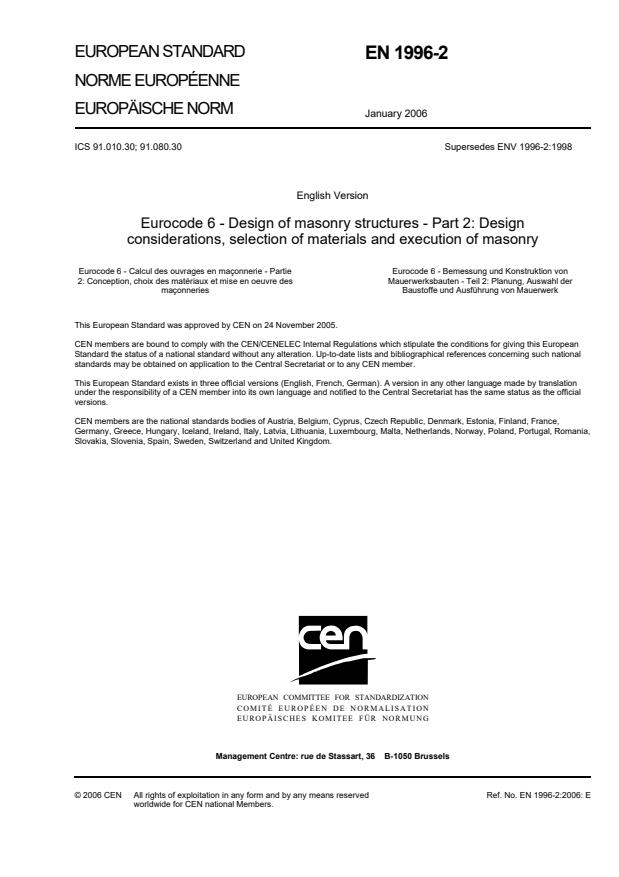
Eurocode 6 - Design of masonry structures - Part 2: Design considerations, selection of materials and execution of masonry
(1)P The scope of Eurocode 6 for Masonry Structures as given in 1.1.1 of EN 1996-1-1 applies also to this Part 2.
(2)P Part 2 of Eurocode 6 gives basic rules for the selection of materials and execution of masonry to enable it to comply with the design assumptions of the other parts of Eurocode 6. With the exception of the items given in 1.1(3)P, the scope of Part 2 deals with ordinary aspects of masonry design and execution including:
the selection of masonry materials;
factors affecting the performance and durability of masonry;
resistance of buildings to moisture penetration;
storage, preparation and use of materials on site;
the execution of masonry;
masonry protection during execution;
NOTE 1. Where general guidance only is given, additional guidance based on local conditions and practice may be made available in non contradictory complementary documents which may be referred to in the National Annex.
NOTE 2. The scope of Eurocode 6 excludes seismic, thermal and acoustic functional performance of masonry structures;
(3)P Part 2 of Eurocode 6 does not cover the following items:
those aspects of masonry covered in other parts of Eurocode 6;
aesthetic aspects;
applied finishes;
health & safety of persons engaged in the design or execution of masonry;
the environmental effects of masonry buildings, civil engineering works and structures on their surroundings.
Eurocode 6 - Bemessung und Konstruktion von Mauerwerksbauten - Teil 2: Planung, Auswahl der Baustoffe und Ausführung von Mauerwerk
(1)P Der in EN 1996 1 1, 1.1.1, beschriebene Anwendungsbereich des Eurocodes 6 für Mauerwerksbauten gilt auch für den vorliegenden Teil 2.
(2)P Teil 2 des Eurocodes 6 enthält Grundregeln für die Auswahl von Baustoffen und Ausführung von Mauerwerk mit dem Ziel, den der Bemessung und Konstruktion zugrunde zu legenden Annahmen der anderen Teile des Eurocodes 6 zu entsprechen. Mit Ausnahme der in 1.1(3)P angegebenen Aufzählungen gilt der Anwendungsbereich von Teil 2 für die üblichen Aspekte der Planung sowie der Ausführung von Mauerwerk; dazu gehören:
die Auswahl der Baustoffe;
Faktoren, die die Eigenschaften und Dauerhaftigkeit des Mauerwerks beeinflussen;
der Widerstand der Bauwerke gegen das Eindringen von Feuchte;
die Lagerung, Vorbereitung und Verwendung von Baustoffen auf der Baustelle;
die Ausführung des Mauerwerks;
der Schutz des Mauerwerks während der Ausführung.
ANMERKUNG 1 Wenn nur allgemeine Leitlinien angegeben sind, darf im Nationalen Anhang auf zusätzliche Leitlinien, die auf der Grundlage der örtlichen Bedingungen und Verfahrensweisen erstellt wurden und in nicht entgegenstehenden, ergänzenden Dokumenten enthalten sind, verwiesen werden.
ANMERKUNG 2 Der Anwendungsbereich des Eurocodes 6 schließt das Leistungsvermögen des Mauerwerks in Bezug auf Erdbebensicherheit, Wärme- und Schalldämmung aus.
(3)P Teil 2 des Eurocodes 6 gilt nicht für:
die in anderen Teilen des Eurocodes 6 behandelten Mauerwerksaspekte;
ästhetische Aspekte;
Oberflächenbehandlungen;
die Gesundheit und Sicherheit der mit der Planung oder der Ausführung von Mauerwerk beschäftigten Personen;
die Umwelteinflüsse von Mauerwerksbauten, Ingenieurbauten und Tragwerken auf ihre Umgebung.
Eurocode 6 - Calcul des ouvrages en maçonnerie - Partie 2: Conception, choix des matériaux et mise en oeuvre des maçonneries
(1)P Le domaine d'application de l'Eurocode 6 pour les ouvrages en maçonnerie tel qu'il est donné au paragraphe 1.1.1 de l'EN 1996 1 1 s'applique également à cette partie.
(2)P La partie 2 de l'Eurocode 6 énonce les règles fondamentales pour le choix des matériaux et la mise en �uvre des maçonneries, afin que ces dernières soient conformes aux hypothèses de conception des autres parties de l'Eurocode 6. Excepté pour les points indiqués au paragraphe 1.1(3)P, cette partie traite des aspects ordinaires de la conception et de la construction de maçonneries, y compris :
le choix des matériaux de maçonnerie ;
les facteurs influençant les performances et la durabilité de la maçonnerie ;
la résistance des ouvrages à la pénétration de l'humidité ;
le stockage, la préparation et l'utilisation des matériaux sur site ;
la mise en �uvre des maçonneries ;
la protection des maçonneries au cours de la construction.
NOTE 1 Lorsque seules des indications générales sont fournies, des informations sur les conditions et pratiques locales peuvent être rendues disponibles dans des documents complémentaires non contradictoires à référencer dans une Annexe Nationale.
NOTE 2 Le domaine d'application de l'Eurocode 6 exclut les performances fonctionnelles sismiques, thermiques et acoustiques des ouvrages en maçonnerie.
(3)P La partie 2 de l'Eurocode 6 ne couvre pas les points suivants :
les aspects de la maçonnerie couverts dans d'autres parties de l'Eurocode 6 ;
les aspects esthétiques ;
les finitions appliquées ;
l'hygiène et la sécurité des personnes engagées dans la conception ou la mise en �uvre des maçonneries ;
les effets sur l'environnement des ouvrages de maçonnerie, des constructions et des ouvrages de génie civil sur leur milieu.
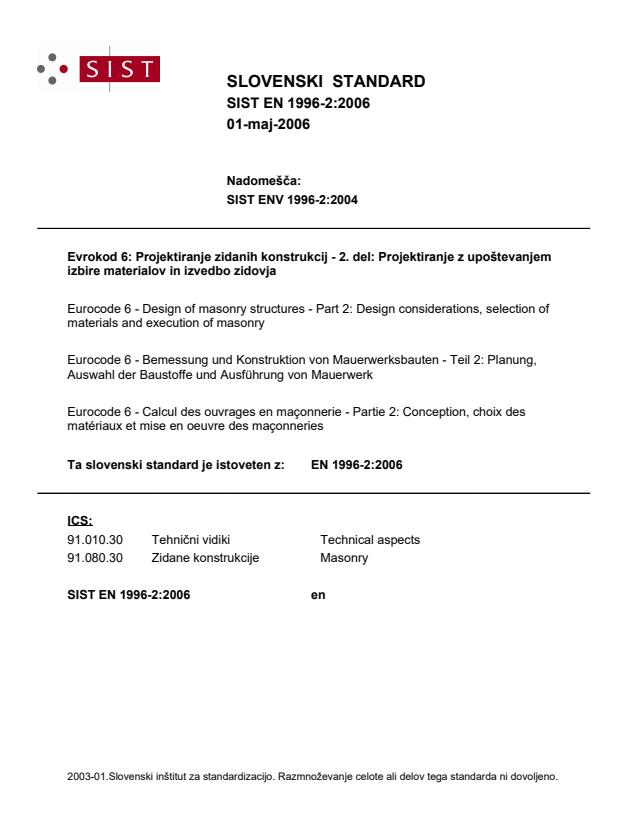
Evrokod 6: Projektiranje zidanih konstrukcij - 2. del: Projektiranje z upoštevanjem izbire materialov in izvedbo zidovja
General Information
Relations
Standards Content (Sample)
2003-01.Slovenski inštitut za standardizacijo. Razmnoževanje celote ali delov tega standarda ni dovoljeno.Eurocode 6 - Design of masonry structures - Part 2: Design considerations, selection of materials and execution of masonryEvrokod 6: Projektiranje zidanih konstrukcij - 2. del: Projektiranje z upoštevanjem izbire materialov in izvedbo zidovjaEurocode 6 - Calcul des ouvrages en maçonnerie - Partie 2: Conception, choix des matériaux et mise en oeuvre des maçonneriesEurocode 6 - Bemessung und Konstruktion von Mauerwerksbauten - Teil 2: Planung, Auswahl der Baustoffe und Ausführung von MauerwerkTa slovenski standard je istoveten z:EN 1996-2:2006SIST EN 1996-2:2006en91.080.30Zidane konstrukcijeMasonry91.010.30Technical aspectsICS:SIST ENV 1996-2:20041DGRPHãþDSLOVENSKI
STANDARDSIST EN 1996-2:200601-maj-2006
EUROPEAN STANDARDNORME EUROPÉENNEEUROPÄISCHE NORMEN 1996-2January 2006ICS 91.010.30; 91.080.30Supersedes ENV 1996-2:1998
English VersionEurocode 6 - Design of masonry structures - Part 2: Designconsiderations, selection of materials and execution of masonryEurocode 6 - Calcul des ouvrages en maçonnerie - Partie2: Conception, choix des matériaux et mise en oeuvre desmaçonneriesEurocode 6 - Bemessung und Konstruktion vonMauerwerksbauten - Teil 2: Planung, Auswahl derBaustoffe und Ausführung von MauerwerkThis European Standard was approved by CEN on 24 November 2005.CEN members are bound to comply with the CEN/CENELEC Internal Regulations which stipulate the conditions for giving this EuropeanStandard the status of a national standard without any alteration. Up-to-date lists and bibliographical references concerning such nationalstandards may be obtained on application to the Central Secretariat or to any CEN member.This European Standard exists in three official versions (English, French, German). A version in any other language made by translationunder the responsibility of a CEN member into its own language and notified to the Central Secretariat has the same status as the officialversions.CEN members are the national standards bodies of Austria, Belgium, Cyprus, Czech Republic, Denmark, Estonia, Finland, France,Germany, Greece, Hungary, Iceland, Ireland, Italy, Latvia, Lithuania, Luxembourg, Malta, Netherlands, Norway, Poland, Portugal, Romania,Slovakia, Slovenia, Spain, Sweden, Switzerland and United Kingdom.EUROPEAN COMMITTEE FOR STANDARDIZATIONCOMITÉ EUROPÉEN DE NORMALISATIONEUROPÄISCHES KOMITEE FÜR NORMUNGManagement Centre: rue de Stassart, 36
B-1050 Brussels© 2006 CENAll rights of exploitation in any form and by any means reservedworldwide for CEN national Members.Ref. No. EN 1996-2:2006: E
3 2.3.4.1 General.16 2.3.4.2 Spacing of movement joints.17 2.3.5 Permissible deviations.17 2.3.6 Resistance to moisture penetration through external walls.18 3 Execution.18 3.1 General.18 3.2 Acceptance, handling and storage of materials.18 3.2.1 General.18 3.2.2 Reinforcement and prestressing materials.18 3.3 Preparation of materials.19 3.3.1 Site-made mortars and concrete infill.19 3.3.1.1 General.19 3.3.1.2 Chloride content.19 3.3.1.3 Strength of mortar and concrete infill.19 3.3.1.4 Admixtures and additions.19 3.3.1.5 Gauging.19 3.3.1.6 Mixing method and mixing time.20 3.3.1.7 Workable life of mortars and concrete infill containing cement.20 3.3.1.8 Mixing in cold weather.20 3.3.2 Factory made mortars, pre-batched mortars, pre-mixed lime sand mortars and ready mixed concrete infill.20 3.4 Permissible deviations.21 3.5 Execution of masonry.23 3.5.1 General.23 3.5.2 Laying masonry units.23 3.5.3 Pointing and jointing for masonry other than thin layer masonry.24 3.5.3.1 Pointing.24 3.5.3.2 Jointing.24 3.5.4 Incorporation of damp proof course membranes.24 3.5.5 Movement joints.24 3.5.6 Incorporation of thermal insulation materials.24 3.5.7 Cleaning facing masonry.24 3.6 Curing and protective procedures during execution.24 3.6.1 General.24 3.6.2 Protection against rain.25 3.6.3 Protection against freeze/thaw cycling.25 3.6.4 Protection against effects of low humidity.25 3.6.5 Protection against mechanical damage.25 3.6.6 Construction height of masonry.25 A.1 Classification.26 A.2 Exposure to wetting.27 B.1 Selection of masonry units and mortar.29 C.1 Exposure classes.31 C.2 Selection of materials.31
This European Standard shall be given the status of a national standard, either by publication of an identical text or by endorsement, at the latest by July 2006, and conflicting national standards shall be withdrawn at the latest by March 2010. CEN/TC 250 is responsible for all Structural Eurocodes. This document supersedes ENV 1996-2:1998 According to the CEN/CENELEC Internal Regulations, the national standards organizations of the following countries are bound to implement this European Standard: Austria, Belgium, Cyprus, Czech Republic, Denmark, Estonia, Finland, France, Germany, Greece, Hungary, Iceland, Ireland, Italy, Latvia, Lithuania, Luxembourg, Malta, Netherlands, Norway, Poland, Portugal, Romania, Slovakia, Slovenia, Spain, Sweden, Switzerland and United Kingdom.
Background of the Eurocode programme In 1975, the Commission of the European Community decided on an action programme in the field of construction, based on Article 95 of the Treaty. The objective of the programme was the elimination of technical obstacles to trade and the harmonisation of technical specifications. Within this action programme, the Commission took the initiative to establish a set of harmonised technical rules for the design of construction works which, in a first stage, would serve as an alternative to the national rules in force in the Member States and, ultimately, would replace them.
For fifteen years, the Commission, with the help of a Steering Committee with Representatives of Member States, conducted the development of the Eurocodes programme, which led to the first generation of European codes in the 1980s.
In 1989, the Commission and the Member States of the EU and EFTA decided, on the basis of an agreement1) between the Commission and CEN, to transfer the preparation and the publication of the Eurocodes to the CEN through a series of Mandates, in order to provide them with a future status of European Standard (EN). This links de facto the Eurocodes with the provisions of all the Council’s Directives and/or Commission’s Decisions dealing with European standards (eg. the Council Directive 89/106/EEC on construction products - CPD - and Council Directives 93/37/EEC,
1) Agreement between the Commission of the European Communities and the European Committee for Standardisation (CEN) concerning the work on EUROCODES for the design of building and civil engineering works (BC/CEN/03/89).
5 92/50/EEC and 89/440/EEC on public works and services and equivalent EFTA Directives initiated in pursuit of setting up the internal market). The Structural Eurocode programme comprises the following standards generally consisting of a number of parts: EN 1990, Eurocode: Basis of structural design EN 1991, Eurocode 1: Actions on structures. EN 1992, Eurocode 2: Design of concrete structures. EN 1993, Eurocode 3: Design of steel structures. EN 1994, Eurocode 4: Design of composite steel and concrete structures. EN 1995, Eurocode 5: Design of timber structures. EN 1996, Eurocode 6: Design of masonry structures. EN 1997, Eurocode 7: Geotechnical design. EN 1998, Eurocode 8: Design of structures for earthquake resistance. EN 1999, Eurocode 9: Design of aluminium structures. Eurocode standards recognise the responsibility of regulatory authorities in each Member State and have safeguarded their right to determine values related to regulatory safety matters at national level where these continue to vary from State to State. Status and field of application of Eurocodes The Member States of the EU and EFTA recognise that Eurocodes serve as reference documents for the following purposes: as a means to prove compliance of building and civil engineering works with the essential requirements of Council Directive 89/106/EEC, particularly Essential Requirement N°1 Mechanical resistance and stability and Essential Requirement N°2 Safety in case of fire; as a basis for specifying contracts for construction works and related engineering services; as a framework for drawing up harmonised technical specifications for construction products (ENs and ETAs). The Eurocodes, as far as they concern the construction works themselves, have a direct relationship with the Interpretative Documents2) referred to in Article 12 of the CPD, although they are of a
2) According to Article 3.3 of the CPD, the essential requirements (ERs) shall be given concrete form in interpretative documents for the creation of the necessary links between the essential requirements and the mandates for harmonised ENs and ETAGs/ETAs.
3) According to Article 12 of the CPD the interpretative documents shall: a) give concrete form to the essential requirements by harmonising the terminology and the technical bases and indicating classes or levels for each requirement where necessary; b) indicate methods of correlating these classes or levels of requirement with the technical specifications, e. g. methods of calculation and of proof, technical rules for project design, etc.; c) serve as a reference for the establishment of harmonised standards and guidelines for European technical approvals. The Eurocodes, de facto, play a similar role in the field of ER 1 and a part of ER 2.
7 Links between Eurocodes and harmonised technical specifications (ENs and ETAs) for products There is a need for consistency between the harmonised technical specifications for construction products and the technical rules for works4) Furthermore, all the information accompanying the CE Marking of the construction products which refer to Eurocodes shall clearly mention which Nationally Determined Parameters have been taken into account. This European Standard is part of EN 1996 which comprises the following Parts: Part 1-1: General - Rules for reinforced and unreinforced masonry Part 1-2: General rules - Structural fire design. Part 2: Design considerations, selection of materials and execution of masonry. Part 3: Simplified calculation methods for unreinforced masonry structures EN 1996-2 describes the principles and requirements for design considerations, selection of materials and execution of masonry structures. For the design of new structures, EN 1996-1-1 is intended to be used, for direct application, together with ENs 1990, 1991, 1992, 1993, 1994, 1995, 1997, 1998 and 1999. EN 1996-2 is intended to be used together with EN 1990, EN 1991-1-2, EN 1996-1-1, EN 1996-1-2 and EN 1996-3. Additional information specific to EN 1996-2 The scope of Eurocode 6 is defined in EN 1996-1-1, and this includes information on the other parts of Eurocode 6. National Annex for EN 1996-2 This standard gives alternative procedures, values and recommendations for classes with notes indicating where national choices may have to be made. Therefore the National Standard implementing EN 1996-2 should have a National Annex containing all Nationally Determined Parameters to be used for the design of buildings and civil engineering works to be constructed in the relevant country.
National choice is allowed in EN 1996-2 through clauses:
2.3.4.2(2) 3.5.3.1(1)
4) see Article 3.3 and Article 12 of the CPD, as well as clauses 4.2, 4.3.1, 4.3.2 and 5.2 of ID 1.
EN 1996-2 does not cover the following items:
those aspects of masonry covered in other parts of Eurocode 6; aesthetic aspects; applied finishes; health
and safety of persons engaged in the design or execution of masonry; the environmental effects of masonry buildings, civil engineering works and structures on their surroundings.
9 1.2 Normative references (1)P This European Standard incorporates, by dated or undated reference, provisions from other publications. These normative references are cited at the appropriate places in the text and the publications are listed hereafter. For dated references, subsequent amendments to or revisions of any of these publications apply to this European Standard only when incorporated in it by amendment or revision. For undated references the latest edition of the publication applies (including amendments). EN 206-1, Concrete -Part 1: Specification, performance, production and conformity
EN 771 (all parts), Specification for masonry units EN 998-2, Specification for mortar for masonry – Part 2: Masonry mortar EN 845 (all parts), Specification for ancillary components for masonry EN 1015-11, Methods of test for mortar for masonry - Part 11: Determination of flexural and compressive strength of hardened mortar EN 1015-17, Methods of test for mortar for masonry – Part 17: Determination of water-soluble chloride content of fresh mortars EN 1052 (all parts), Methods of test for masonry EN 1990, Eurocode: Basis of structural design
EN 1996-1-1, Eurocode 6: Design of masonry structures - Part 1: General rules for reinforced and unreinforced masonry structures EN 13914-1, The design, preparation and application of external rendering and internal plastering - Part 1: External rendering 1.3 Assumptions (1)P In addition to the assumptions given in 1.3 of EN 1990:2002 the following assumptions apply in this EN 1996-2: Design shall be in accordance with Section 2 taking into account Section 3. Execution shall be in accordance with Section 3 taking into account Section 2. (2) The design Principles are valid only when the Principles for execution in Section 3 are complied with. 1.4 Distinction between Principles and Application Rules (1)P The rules in 1.4 of EN 1990:2002 apply to this EN 1996-2.
EN 1996-1-1 apply to this EN 1996-2. (3) Additional terms and definitions used in this EN 1996-2 are given the meanings contained in 1.5.2 to 1.5.5, inclusive. 1.5.2 Terms and definitions relating to communication of design 1.5.2.1 design specification documents describing the designer's requirements for the construction, including drawings, schedules, test reports, references to parts of other documents and written instructions 1.5.3 Terms relating to climatic factors and exposure conditions 1.5.3.1
macro conditions climatic factors depending on the general climate of the region in which a structure is built, modified by the effects of local topography and/or other aspects of the site
1.5.3.2 micro conditions localised climatic and environmental factors depending on the position of a masonry element within the overall structure and taking into account the effect of protection, or lack of protection, by constructional details or finishes 1.5.4 Term relating to masonry units 1.5.4.1 accessory masonry unit a masonry unit which is shaped to provide a particular function, e.g. to complete the geometry of the masonry
11 1.5.5 Other terms 1.5.5.1 applied finish a covering of material bonded to the surface of the masonry 1.5.5.2 cavity width the distance perpendicular to the plane of the wall between the cavity faces of the masonry leaves of a cavity wall or that between the cavity face of a veneer wall and the masonry backing structure 1.5.5.3 cladding a covering of material(s) fastened or anchored in front of the masonry and not in general bonded to it 1.6 Symbols (1)P For the purpose of this standard the symbols in accordance with 1.6 of EN 1996-1-1:2005 apply. (2)P Other symbols used in this EN 1996-2 are: dp minimum depth for pointing lm maximum horizontal distance between vertical movement joints in external non-loadbearing walls; 2 Design considerations 2.1 Factors affecting the durability of masonry 2.1.1 General (1)P Masonry shall be designed to have the performance required for its intended use. 2.1.2 Classification of environmental conditions
2.1.2.1 Micro conditions of exposure (1)P The micro conditions to which the masonry is expected to be exposed shall be taken into account in the design. (2) When deciding the micro conditions of exposure of the masonry, the effect of applied finishes, protective claddings and details should be taken into account.
MX1 - In a dry environment;
MX2 - Exposed to moisture or wetting;
MX3 - Exposed to moisture or wetting plus freeze/thaw cycling;
MX4 - Exposed to saturated salt air or seawater;
MX5 - In an aggressive chemical environment. NOTE When necessary, more closely defined conditions within these classes may be specified using the sub-classes in Annex A (e.g. MX2.1 or MX2.2 and M X 3.1 or M X 3.2). (4) To produce masonry that meets specified performance criteria and withstands the environmental conditions to which it is exposed, the determination of the exposure class should take into account: climatic factors; severity of exposure to moisture or wetting; exposure to freeze/thaw cycling; presence of chemical materials that may lead to damaging reactions. 2.1.2.2 Climatic factors (macro conditions of exposure) (1)P The effect of the macro conditions on the micro conditions shall be taken into account when determining the wetting of masonry and its exposure to freeze/thaw cycling. (2) Concerning the macro conditions the following should be taken into account: F rain and snow; F the combination of wind and rain; F temperature variation; F relative humidity variation. NOTE It is acknowledged that climates (macro conditions) vary considerably throughout Europe and that certain aspects of climate can influence the risk of exposure of masonry to wetting and/or freeze/thaw cycling. However, it is the classification of the micro conditions that is relevant for determining the durability of masonry rather than the ranking of the macro conditions. Examples of relative exposure to wetting of masonry elements in a typical building are shown in Annex A. 2.1.3 Aggressive chemical environments (1) In coastal areas the exposure of masonry to airborne chlorides or seawater should be taken into account.
13 (2) Possible sources of sulfates include the following: natural soils; groundwater; waste deposits and filled ground; construction materials; airborne pollutants. (3) Where the presence of aggressive chemicals in the environment, other than airborne chlorides or seawater, can affect masonry, class MX5 should be assumed. Where salts can be transported by water moving through the masonry, the potential for increased concentrations and quantities of available chemicals should be taken into account. 2.2 Selection of materials 2.2.1 General (1)P Materials, where incorporated in the works, shall be able to resist the actions to which they are expected to be exposed, including environmental actions. (2)P Only materials, products, and systems with established suitability shall be used. (3) Where the selection of materials for masonry is not otherwise covered in Part 2, it should be done in accordance with local practice and experience. NOTE 1 Established suitability may result from conformity to a European Standard that is either referred to by this standard or that specifically refers to uses within the scope of this standard. Alternatively, where either there is no appropriate European Standard, or the material or product deviates from the requirements of an appropriate European Standard, established suitability may result from conformity to either: - a Technical Approval, or - a national standard, or - other provisions, any of which refer specifically to uses within the scope of this standard and are accepted in the place of use of the material or product.
NOTE 2 Acceptable masonry unit specifications and mortar may be selected from Annex B, Table B.1 and B.2, in relation to durability. 2.2.2 Masonry units (1) The requirements for masonry units should be specified in accordance with the following parts of EN 771 relating to the type of material: EN 771-1 for clay masonry units; EN 771-2 for calcium silicate masonry units; EN 771-3 for aggregate concrete masonry units;
15 that will fulfil the performance requirements, or alternatively, it can be done as an execution task in accordance with 3.3.1.1(2). For general applications mortar durability designations may be selected from table B.2. (4) When site-made masonry mortar or concrete infill is to be specified for use in exposure classes MX4 or MX5, the mix proportions to provide adequate durability for the particular conditions should be selected on the basis of authoritative publicly available references acceptable in the place of use. (5) Where adhesion between masonry units and mortar (bond strength) is a particular design requirement, the mix proportions should take this into account. NOTE The manufacturer of masonry units may give advice on the type of masonry mortar to be used or tests may be carried out in accordance with relevant parts of EN 1052. 2.2.4 Ancillary components and reinforcement (1)P Ancillary components and their fixings shall be corrosion resistant in the environment in which they are used. NOTE 1 Annex C gives guidance on materials and corrosion protection systems for ancillary components in relation to exposure classes. NOTE 2 Reinforcing steel should be selected following the recommendations given in 4.3.3 of EN 1996-1-1:2005 2.3 Masonry 2.3.1 Detailing (1) Where the detailing of masonry is not otherwise covered in this EN 1996-2, it should be done in accordance with local practice and experience.
NOTE The local practice and experience may be given in non-contradictory complementary information and referenced in the National Annex 2.3.2 Joint finishes (1) Pointing mortar should be compatible with the jointing mortar. 2.3.3 Masonry movement (1)P The possibility of masonry movement shall be allowed for in the design such that the performance of the masonry in use is not adversely affected by such movement. (2) Where intersecting walls do not all have effectively similar deformation behaviour, the connection between such walls should be able to accommodate any resulting differential movement. (3) Movement tolerant ties should be provided where required to accommodate relative in-plane movements between masonry leaves or between masonry and other structures to which the masonry is attached.
(4) Where cavity wall ties that are not movement tolerant are used, the uninterrupted height between horizontal movement joints in the outer leaf of external cavity walls should be limited to avoid the loosening of the wall ties.
17 2.3.4.2 Spacing of movement joints (1) The horizontal spacing of vertical movement joints in masonry walls should take into account the type of wall, masonry units, mortar and the specific construction details.
(2) The horizontal distance between vertical movement joints in external non-loadbearing unreinforced masonry walls should not exceed lm. NOTE 1 The value for lm to be used in a Country may be found in its National Annex. Recommended values for lm for unreinforced non-loadbearing walls are given in the table: Maximum recommended horizontal distance, lm,, between vertical movement joints for unreinforced, non-loadbearing walls Type of masonry lm ( m ) Clay masonry 12 Calcium silicate masonry 8 Aggregate concrete and manufactured stone masonry 6 Autoclaved aerated concrete masonry 6 Natural stone masonry 12 NOTE 2 The maximum horizontal spacing of vertical movement joints may be increased for walls containing bed joint reinforcement conforming to EN 845-3. Guidance may be obtained from the manufacturers of bed joint reinforcement
(3) The distance of the first vertical joint from a restrained vertical edge of a wall should not exceed half the value of lm. (4)
The need for vertical movement joints in unreinforced loadbearing walls should be considered.
NOTE
No recommended values for the spacing are given as they depend on local building traditions, type of floors used and other construction details. (5) The positioning of movement joints should take into account the need to maintain structural integrity of load bearing internal walls. (6) Where horizontal joints are required to accommodate vertical movement in an unreinforced veneer wall or in an unreinforced non-loadbearing outer leaf of a cavity wall, the spacing of horizontal movement joints should take into account the type and positioning of the support system. 2.3.5 Permissible deviations (1) Permissible deviations of the constructed masonry from its intended position should be specified.
(2) The permissible deviations should be specifically stated as values in the design specification or in accordance with locally accepted standards. NOTE Compliance with tolerances is necessary in order to ensure that, despite the inevitable inaccuracies at each stage in the building process, the functional requirements are satisfied and the correct assembly of structures and components takes place without the need for adjustment or reworking. The permissible tolerances for dimensions of masonry units are specified in EN 771. (3) Unless otherwise allowed for in the structural design, the permissible deviations should not be greater than the values given in
Table 3.1. Where the design allows for deviations in excess of the
(3) During storage and handling of prestressing steel, welding in the vicinity of tendons without the provision of special protection (from welding splatter) should be prevented. (4) For sheaths, the following should be taken into account:
EN 1996
...
Questions, Comments and Discussion
Ask us and Technical Secretary will try to provide an answer. You can facilitate discussion about the standard in here.
Loading comments...