

SIST EN 1838:2025
(Main)Lighting applications - Emergency lighting
General Information
- Abstract
This document specifies the luminous requirements for emergency lighting systems, including adaptive emergency escape lighting systems, electric emergency lighting, installed in premises or locations where such systems are required or needed and which are principally applicable to locations where the public or workers have access.
- Status
- Published
- Public Enquiry End Date
- 30-Jul-2022
- Publication Date
- 04-Feb-2025
- Technical Committee
- STV - Steklo, svetloba in razsvetljava v gradbeništvu
- Current Stage
- 6060 - National Implementation/Publication (Adopted Project)
- Start Date
- 30-Dec-2024
- Due Date
- 06-Mar-2025
- Completion Date
- 05-Feb-2025

Overview
EN 1838:2024 - Lighting applications - Emergency lighting for buildings (CEN) defines the luminous requirements and guidance for emergency lighting systems installed where the public or workers have access. Approved May 2024, this European Standard supersedes EN 1838:2013 and covers electric emergency lighting, including adaptive emergency escape lighting (AEEL), to ensure safe evacuation, visibility of safety signs and safe shutdown of hazardous processes when normal lighting fails.
Key topics and technical requirements
- Scope and terminology: Clear definitions for emergency lighting, escape route lighting, open area (anti-panic) lighting, high‑risk task area lighting, local area lighting and standby lighting.
- Luminous requirements: Performance and illumination objectives for different emergency lighting types (escape routes, open areas, high‑risk tasks, local/standby lighting). EN 1838 specifies how lighting should enable safe movement and task completion during power loss.
- Escape route coverage: Requirements updated to address the width of escape routes, ensuring adequate lateral coverage as well as lengthwise illumination.
- Points of emphasis & specific areas: More detailed provisions for lighting of points of emphasis (e.g., stairs, junctions) and specific locations such as toilets, changing rooms, public indoor swimming pools, and plant rooms.
- Safety signs: Illumination, mounting height, viewing distance and conformity requirements for internally and externally illuminated safety signs.
- System performance: Annex A covers system durations and activation times; Annex B provides on-site measurement methods (Methods A–D) for illuminance and luminance, verification intervals and conformity assessment.
- Special considerations: Annex C contains guidance for emergency lighting during/after premises lockdown or prolonged disconnection of power.
- Normative references: Works together with EN 50172 and EN 12665 and refers to luminaire and safety-sign standards (EN IEC 60598‑1, EN 60598‑2‑22, ISO 7010, ISO 3864 series).
Applications and who should use it
EN 1838 is essential for:
- Lighting designers and electrical engineers specifying emergency lighting systems
- Architects and building services consultants integrating evacuation strategies
- Facility managers, safety officers and building owners ensuring compliance
- Manufacturers of emergency luminaires and safety signs, and installation/commissioning contractors
- Inspectors and certifiers performing on-site verification and maintenance checks
Typical uses include design and verification of emergency escape lighting in public buildings, workplaces, swimming pools, industrial sites, and control/plant rooms, and for retrofits to meet updated safety and regulatory requirements.
Related standards
- EN 50172:2024 - Emergency escape lighting systems
- EN 12665:2024 - Light and lighting - Basic terms and criteria
- EN IEC 60598‑1 / EN 60598‑2‑22 - Luminaires and emergency luminaire requirements
- ISO 7010, ISO 3864 series - Safety signs and colours
- CEN/TS 17951 - Adaptive emergency escape lighting techniques
Keywords: EN 1838, emergency lighting, emergency escape lighting, adaptive emergency escape lighting, safety signs, escape route lighting, standby lighting, CEN, EN 50172.
Relations
- Effective Date
- 09-Feb-2026
- Effective Date
- 09-Feb-2026
- Effective Date
- 09-Feb-2026
- Effective Date
- 09-Feb-2026
- Effective Date
- 09-Feb-2026
- Refers
SIST EN IEC 60598-1:2025 - Luminaires - Part 1: General requirements and tests (IEC 60598-1:2024) - Effective Date
- 09-Feb-2026
- Effective Date
- 28-Jan-2026
- Effective Date
- 28-Jan-2026
- Effective Date
- 09-Feb-2026
- Effective Date
- 28-Jan-2026
- Effective Date
- 28-Jan-2026
- Effective Date
- 28-Jan-2026
- Effective Date
- 28-Jan-2026
- Effective Date
- 28-Jan-2026
- Effective Date
- 28-Jan-2026
Get Certified
Connect with accredited certification bodies for this standard

DIBt (Deutsches Institut für Bautechnik)
German Institute for Building Technology.
DIN CERTCO
DIN Group product certification.

Aboma Certification B.V.
Specialized in construction, metal, and transport sectors.
Sponsored listings
Frequently Asked Questions
SIST EN 1838:2025 is a standard published by the Slovenian Institute for Standardization (SIST). Its full title is "Lighting applications - Emergency lighting". This standard covers: This document specifies the luminous requirements for emergency lighting systems, including adaptive emergency escape lighting systems, electric emergency lighting, installed in premises or locations where such systems are required or needed and which are principally applicable to locations where the public or workers have access.
This document specifies the luminous requirements for emergency lighting systems, including adaptive emergency escape lighting systems, electric emergency lighting, installed in premises or locations where such systems are required or needed and which are principally applicable to locations where the public or workers have access.
SIST EN 1838:2025 is classified under the following ICS (International Classification for Standards) categories: 91.160.10 - Interior lighting. The ICS classification helps identify the subject area and facilitates finding related standards.
SIST EN 1838:2025 has the following relationships with other standards: It is inter standard links to SIST EN IEC 60598-2-22:2022, SIST ISO 3864-1:2012, SIST ISO 3864-4:2012, SIST EN 50172:2024, SIST ISO 3864-3:2024, SIST EN IEC 60598-1:2025, SIST EN 12665:2024, SIST EN ISO 7010:2020, SIST EN 50171:2022, SIST EN 15193:2007, SIST EN 15288-1:2008+A1:2010, SIST EN 16584-3:2025, SIST EN 16584-3:2017, SIST EN 15193-1:2017, SIST EN 12193:2019. Understanding these relationships helps ensure you are using the most current and applicable version of the standard.
SIST EN 1838:2025 is available in PDF format for immediate download after purchase. The document can be added to your cart and obtained through the secure checkout process. Digital delivery ensures instant access to the complete standard document.
Standards Content (Sample)
SLOVENSKI STANDARD
01-marec-2025
Razsvetljava - Zasilna razsvetljava
Lighting applications - Emergency lighting
Angewandte Lichttechnik - Notbeleuchtung
Éclairagisme - Éclairage de secours
Ta slovenski standard je istoveten z: EN 1838:2024
ICS:
91.160.10 Notranja razsvetljava Interior lighting
2003-01.Slovenski inštitut za standardizacijo. Razmnoževanje celote ali delov tega standarda ni dovoljeno.
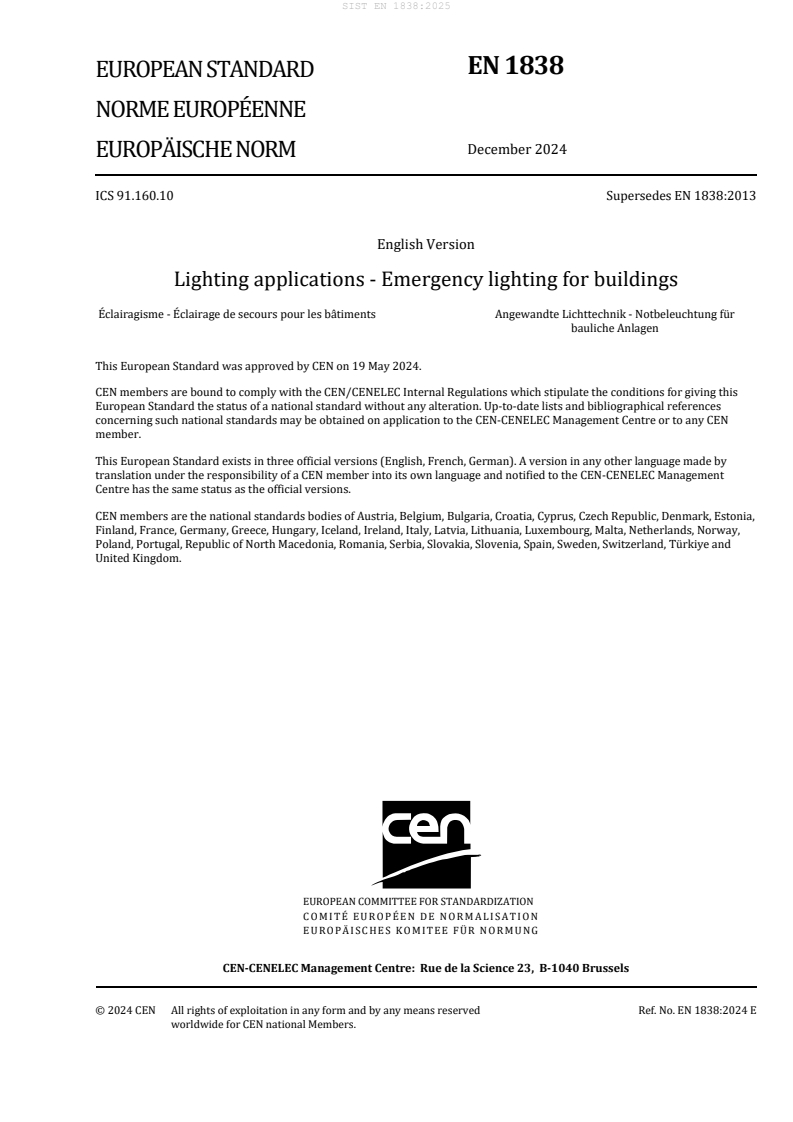
EN 1838
EUROPEAN STANDARD
NORME EUROPÉENNE
December 2024
EUROPÄISCHE NORM
ICS 91.160.10 Supersedes EN 1838:2013
English Version
Lighting applications - Emergency lighting for buildings
Éclairagisme - Éclairage de secours pour les bâtiments Angewandte Lichttechnik - Notbeleuchtung für
bauliche Anlagen
This European Standard was approved by CEN on 19 May 2024.
CEN members are bound to comply with the CEN/CENELEC Internal Regulations which stipulate the conditions for giving this
European Standard the status of a national standard without any alteration. Up-to-date lists and bibliographical references
concerning such national standards may be obtained on application to the CEN-CENELEC Management Centre or to any CEN
member.
This European Standard exists in three official versions (English, French, German). A version in any other language made by
translation under the responsibility of a CEN member into its own language and notified to the CEN-CENELEC Management
Centre has the same status as the official versions.
CEN members are the national standards bodies of Austria, Belgium, Bulgaria, Croatia, Cyprus, Czech Republic, Denmark, Estonia,
Finland, France, Germany, Greece, Hungary, Iceland, Ireland, Italy, Latvia, Lithuania, Luxembourg, Malta, Netherlands, Norway,
Poland, Portugal, Republic of North Macedonia, Romania, Serbia, Slovakia, Slovenia, Spain, Sweden, Switzerland, Türkiye and
United Kingdom.
EUROPEAN COMMITTEE FOR STANDARDIZATION
COMITÉ EUROPÉEN DE NORMALISATION
EUROPÄISCHES KOMITEE FÜR NORMUNG
CEN-CENELEC Management Centre: Rue de la Science 23, B-1040 Brussels
© 2024 CEN All rights of exploitation in any form and by any means reserved Ref. No. EN 1838:2024 E
worldwide for CEN national Members.
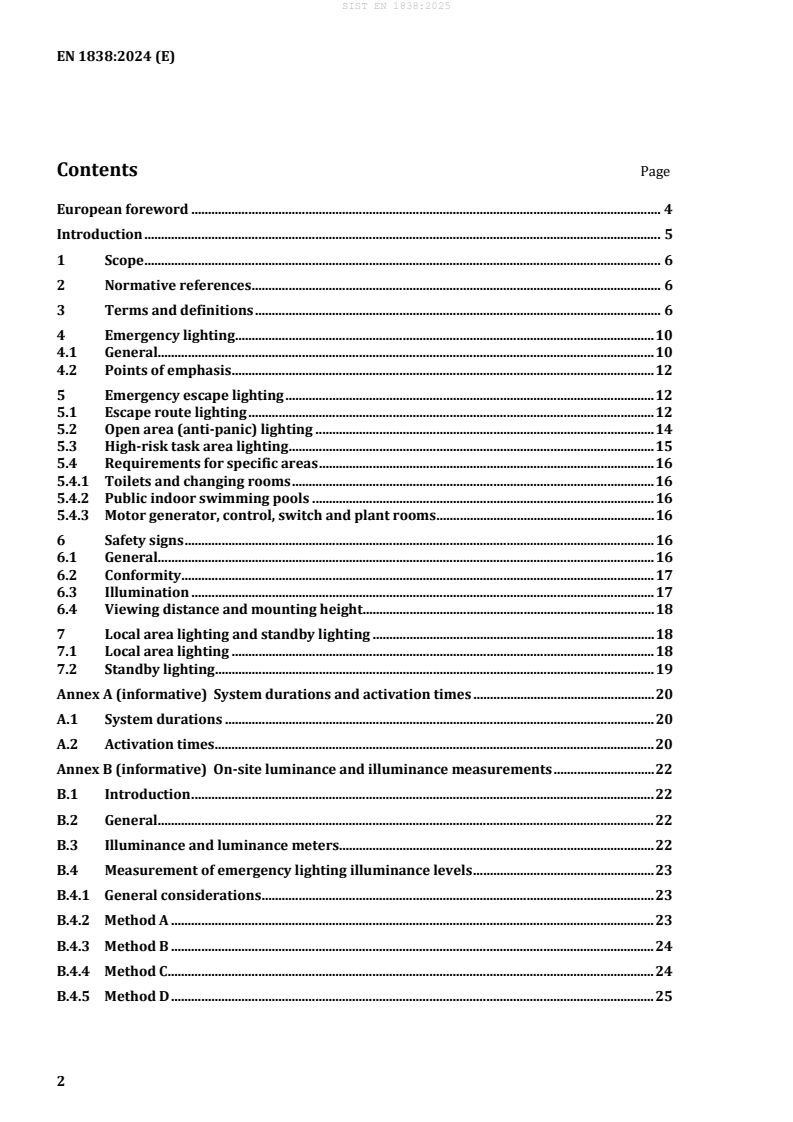
Contents Page
European foreword . 4
Introduction . 5
1 Scope . 6
2 Normative references . 6
3 Terms and definitions . 6
4 Emergency lighting . 10
4.1 General. 10
4.2 Points of emphasis . 12
5 Emergency escape lighting . 12
5.1 Escape route lighting . 12
5.2 Open area (anti-panic) lighting . 14
5.3 High-risk task area lighting . 15
5.4 Requirements for specific areas . 16
5.4.1 Toilets and changing rooms . 16
5.4.2 Public indoor swimming pools . 16
5.4.3 Motor generator, control, switch and plant rooms . 16
6 Safety signs . 16
6.1 General. 16
6.2 Conformity . 17
6.3 Illumination . 17
6.4 Viewing distance and mounting height. 18
7 Local area lighting and standby lighting . 18
7.1 Local area lighting . 18
7.2 Standby lighting . 19
Annex A (informative) System durations and activation times . 20
A.1 System durations . 20
A.2 Activation times . 20
Annex B (informative) On-site luminance and illuminance measurements . 22
B.1 Introduction . 22
B.2 General. 22
B.3 Illuminance and luminance meters. 22
B.4 Measurement of emergency lighting illuminance levels . 23
B.4.1 General considerations . 23
B.4.2 Method A . 23
B.4.3 Method B . 24
B.4.4 Method C . 24
B.4.5 Method D . 25
B.5 Illuminance measurements on site . 26
B.5.1 General . 26
B.5.2 Illuminance measurements of open area (anti panic) lighting, local area lighting and
high-risk task area lighting . 27
B.5.2.1 Initial verification . 27
B.5.2.2 Five-year verification . 27
B.5.3 Illuminance measurement of escape route lighting . 27
B.5.3.1 General . 27
B.5.3.2 Measurements . 28
B.5.3.3 Uniformity . 28
B.6 Safety signs . 28
B.6.1 Internally illuminated safety signs . 28
B.6.1.1 Initial verification . 28
B.6.1.2 Five-year verification . 28
B.6.2 Externally illuminated safety signs . 28
B.6.2.1 Initial verification . 28
B.6.2.2 Five-year verification . 29
B.7 Conformity assessment . 29
Annex C (informative) Local area lighting . 30
Annex D (informative) A-deviations . 31
Bibliography . 33
European foreword
This document (EN 1838:2024) has been prepared by Technical Committee CEN/TC 169 “Light and
lighting”, the secretariat of which is held by DIN.
This European Standard shall be given the status of a national standard, either by publication of an
identical text or by endorsement, at the latest by June 2025, and conflicting national standards shall be
withdrawn at the latest by June 2027.
Attention is drawn to the possibility that some of the elements of this document may be the subject of
patent rights. CEN shall not be held responsible for identifying any or all such patent rights.
This document supersedes EN 1838:2013.
— Requirements for emergency escape route lighting have been amended to cover the width of the
escape route;
— Greater detail has been included for the requirements for emergency lighting of points of emphasis
and specific areas of hazard;
— Considerations for emergency lighting systems during and after a premises lockdown or prolonged
periods where power is disconnected have been added as Annex C.
This document is read in conjunction with EN 50172.
Any feedback and questions on this document should be directed to the users’ national standards body.
A complete listing of these bodies can be found on the CEN website.
According to the CEN-CENELEC Internal Regulations, the national standards organisations of the
following countries are bound to implement this European Standard: Austria, Belgium, Bulgaria, Croatia,
Cyprus, Czech Republic, Denmark, Estonia, Finland, France, Germany, Greece, Hungary, Iceland, Ireland,
Italy, Latvia, Lithuania, Luxembourg, Malta, Netherlands, Norway, Poland, Portugal, Republic of North
Macedonia, Romania, Serbia, Slovakia, Slovenia, Spain, Sweden, Switzerland, Türkiye and the United
Kingdom.
Introduction
Emergency lighting for buildings is provided for use when the supply to the normal lighting fails and is
therefore powered from a source independent of that supplying the normal lighting. It may provide
lighting for both safety and operational tasks.
For the purposes of this document emergency lighting is regarded as a generic term of which there are a
number of specific forms, as shown in Table 1.
Table 1 — Specific forms of emergency lighting
Emergency lighting see Clauses 4, 5, 6 and 7
Emergency escape lighting, see Clause 4 and 5
Escape route Open area (anti- High-risk task area Local area Standby
lighting panic) lighting lighting lighting lighting
see 5.1 see 5.2 see 5.3 see 7.1 see 7.2
Safety signs including adaptive safety signs
see Clause 6
Emergency lighting can be provided by maintained luminaires and maintained safety signs when the
normal lighting is available. Maintained luminaires and maintained exit and safety signs shall operate
when the normal lighting is required but fails. (Refer to EN 50172 for further details on normal lighting
failures.)
Adaptive emergency escape lighting (AEEL) is a technique that can be used as a supplement to
emergency escape lighting and, when applied to escape routes in addition to emergency escape lighting,
can enhance their effectiveness in an emergency. These techniques are included in CEN/TS 17951.
1 Scope
This document specifies the luminous requirements for emergency lighting systems, including adaptive
emergency escape lighting systems, electric emergency lighting, installed in premises or locations where
such systems are required or needed and which are principally applicable to locations where the public
or workers have access.
2 Normative references
The following documents are referred to in the text in such a way that some or all of their content
constitutes requirements of this document. For dated references, only the edition cited applies. For
undated references, the latest edition of the referenced document (including any amendments) applies.
EN 12665:2024, Light and lighting - Basic terms and criteria for specifying lighting requirements
EN 50172:2024, Emergency escape lighting systems
EN IEC 60598-1, Luminaires - Part 1: General requirements and tests (IEC 60598-1)
EN 60598-2-22, Luminaires - Part 2-22: Particular requirements - Luminaires for emergency lighting
EN ISO 7010, Graphical symbols - Safety colours and safety signs - Registered safety signs (ISO 7010)
ISO 3864-1, Graphical symbols — Safety colours and safety signs — Part 1: Design principles for safety signs
and safety markings
ISO 3864-3, Graphical symbols — Safety colours and safety signs — Part 3: Design principles for graphical
symbols for use in safety signs
ISO 3864-4, Graphical symbols — Safety colours and safety signs — Part 4: Colorimetric and photometric
properties of safety sign materials
3 Terms and definitions
For the purposes of this document, the terms and definitions given in EN 12665:2024 and the following
apply.
ISO and IEC maintain terminology databases for use in standardization at the following addresses:
— IEC Electropedia: available at http://www.electropedia.org/
— ISO Online browsing platform: available at http://www.iso.org/obp
3.1
emergency lighting
lighting provided for use when the power supply to the normal electric lighting fails
[SOURCE: EN 12665:2024, 3.5.6]
3.2
place of safety
designated place normally outside the building where escaping people can assemble safely and are not
at risk of the emergency status
[SOURCE: EN 12665:2024, 3.5.100]
3.3
escape route
designated route, used to evacuate in case of an emergency, to a place of safety
[SOURCE: EN 12665:2024, 3.5.43]
3.4
escape route lighting
part of emergency escape lighting provided to ensure that the escape route can be effectively identified
and safely used when the location is occupied
[SOURCE: EN 12665:2024, 3.5.44]
3.5
emergency escape lighting
part of emergency lighting that provides illumination for visibility of the escape route and of safety
signage for fire-fighting and safety equipment and for the guidance and the safety of people leaving a
location to a place of safety or attempting to terminate a potentially hazardous process or situation before
doing so
[SOURCE: EN 12665:2024, 3.5.36]
3.6
open area (anti-panic) lighting
part of emergency escape lighting provided to avoid panic and provide illumination allowing people to
reach a place where an escape route can be identified
[SOURCE: EN 12665:2024, 3.5.64]
3.7
local area lighting
part of emergency lighting that provides illumination for people allowed to remain temporarily in a
premise during a mains supply failure if it is risk assessed for the activities that are allowed to be
performed
[SOURCE: EN 12665:2024, 3.5.101]
3.8
high-risk task area lighting
part of emergency lighting that provides illumination for the safety of people involved in a potentially
dangerous process or situation and to enable proper shut down procedures for the safety of the operator
and other occupants of the building
[SOURCE: EN 12665:2024, 3.5.50]
3.9
standby lighting
part of emergency lighting provided to enable normal activities to continue substantially unchanged
[SOURCE: EN 12665:2024, 3.5.74, modified – spelling standby lighting is used]
3.10
safety sign
sign that gives a general safety message, obtained by a combination of colour and geometric shape and
which, by the addition of a graphical symbol, gives a particular safety message
[SOURCE: ISO 3864-1:2011, 3.12]
3.11
maintained safety sign
sign in which the integral lamps are energized at all times when normal or emergency mode of operation
is required
[SOURCE: ISO 3864-4:2011, 3.8]
3.12
non-maintained safety sign
sign in which the integral lamps are in operation only when the power supply to the normal lighting fails
[SOURCE: ISO 3864-4:2011, 3.9]
3.13
internally illuminated safety sign
safety sign that is illuminated, when it is required, by an internal light source
[SOURCE: EN 12665:2024, 3.5.54]
3.14
externally illuminated safety sign
safety sign that is illuminated, when it is required, by an external emergency luminaire
[SOURCE: EN 12665:2024, 3.5.48]
3.15
emergency exit
way out marked with a safety sign that is intended to be used during an emergency leading to a defined
place of safety
[SOURCE: EN 12665:2024, 3.5.37]
3.16
final emergency exit
termination of an escape route from a building or premises giving direct access to a street, passageway,
walkway or open space, and sited to ensure the rapid dispersal of persons from the vicinity of a building
or premises
3.17
adaptive emergency escape lighting system
AEELS
electrically operated escape lighting system which provides directional guidance and adequate
illuminance by means of a set of emergency lighting luminaires and directional indication that can
manually or automatically change the escape route direction and improve the conspicuity of the
emergency signage and optionally adapt the lighting level on escape routes
[SOURCE: EN 12665:2024, 3.5.103]
3.18
adaptive safety sign
internally illuminated escape route safety sign that interacts together with luminaires to change the
information it displays to indicate an alternative escape route or to indicate that the route is closed or not
available for use
[SOURCE: EN 12665:2024, 3.5.104]
3.19
system duration
minimum period of time for which the luminous requirements of the
emergency lighting system are met
Note 1 to entry: A system can consist of a single luminaire.
3.20
activation time
time between failure of the supply to the normal lighting and
emergency lighting reaching the required level of illuminance
3.21
identifiability
property of a graphical symbol which enables its elements to be perceived as the objects or shapes
depicted
[SOURCE: ISO 9186-2:2008, 3.1]
3.22
maintenance factor
MF
DEPRECATED: light loss factor
DEPRECATED: depreciation factor
f
m
quotient of illuminance produced by the lighting installation after a certain
time interval and the illuminance produced by the installation when new
Note 1 to entry: The English term “light loss factor” and the French term “facteur de perte de lumière” are no longer
used.
Note 2 to entry: The English term “depreciation factor” and the French term “facteur de dépréciation” were formerly
used to designate the reciprocal of the above quotient.
Note 3 to entry: The maintenance factor takes into account light losses caused by dirt accumulation on luminaires
and room surfaces (in interiors) or other relevant surfaces (in exteriors, where appropriate), and the decrease in
the luminous flux of lamps.
Note 4 to entry: The maintenance factor has unit one.
[SOURCE: EN 12665:2024, 3.5.18]
4 Emergency lighting
4.1 General
To ensure that emergency escape lighting operates when it is required, it shall be installed, tested and
maintained in accordance with EN 50172 and if automatic test facilities are installed, they shall be in
accordance with EN 62034.
The requirements given in this document shall be maintained for the full rated duration to the end of the
design life of the emergency lighting system.
The emergency escape lighting design shall be based on worst conditions (e.g. minimum light output,
maximum glare limits and including an appropriate maintenance factor) of the luminaires during
operating life and shall be based only on direct light from luminaires. Lighting calculations shall be based
on the rated emergency intensities data related to the practical emergency light source flux according to
EN 60598-2-22.
The contributions by room surface inter-reflections shall not be considered except, in lighting systems
such as indirect luminaires or up lights (used as an emergency luminaire in maintained mode) where the
luminaire works in conjunction with a reflecting surface. When using indirect lighting for emergency
escape lighting, the following three points shall be taken into account.
— The first reflection may be included in the calculation of the emergency escape lighting.
— The reflective surface shall be considered in the maintenance of the emergency escape lighting as if
it was part of the emergency light.
— The distance between the light source and the reflecting surface shall not be obstructed by any object.
Luminaires should be mounted at least 2 m above the floor level unless a mounting height of luminaires
for lighting of 2 m is not suitable for special reasons (e.g. in outdoor areas, assembly points, places of
safety, stairways, historic buildings etc.), provided that they are sufficiently protected from possible
damage and that the luminous requirements of this standard are met.
Emergency luminaires shall provide the required illuminance levels, and safety signs shall achieve the
required luminance values. A maintenance factor shall be applied, determined according to
ISO/CIE TS 22012 and EN 12665.
To provide visibility for evacuation purposes lighting is required in the volume of the space of the escape
routes. Signs that are provided at all exits intended to be used in an emergency and along escape routes
shall be externally or internally illuminated to indicate unambiguously the escape route to a place of
safety. Sign requirements are detailed in Clause 6.
Where direct sight of an emergency exit is not possible, an externally or internally illuminated directional
sign (or series of signs) shall be provided to assist progression towards the emergency exit.
An emergency luminaire shall comply with EN 60598-2-22 and shall be sited in such a way that it
provides appropriate illuminance in particular near each emergency exit and at positions where it is
necessary to emphasize potential danger or safety equipment. The positions to be emphasized shall
include those given in 4.2.
If the premises operator needs to be able to redirect occupants away from specific emergency escape
routes an adaptive emergency escape lighting system (AEELS) in compliance with CEN/TS 17951 should
be used.
Table 2 gives an overview of requirements for the specific forms of emergency lighting. Requirements
for specific forms are given in the subclauses shown in the table.
Table 2 — Overview of requirements for the specific forms of emergency lighting
Emergency lighting
Emergency escape lighting
Application Local area Standby
lighting lighting
Uses the Does not
Open area High-risk
Escape route
emergency provide
(anti-panic) task area
lighting,
escape system emergency
lighting, lighting,
during failures of escape
c
the normal lighting
d
supply
EN 1838 5.1 5.2 5.3 7.1 7.2
subclause
Minimum 1 lx (see 5.1.1) 0,5 lx 10 % of Minimum light As required
Illuminance normal level based on a for the task
(in empty
level lighting at risk assessment
core area)
the hazard but not less than
with a for escape routes
minimum of
15 lx
a a
Maximum see 5.1.6 see 5.2.6 0,5 s, see see 7.1
activation 5.3.7
time
b b
Minimum 1 h As required 1 h According to
rated to complete the visual
duration the task task
Points of Specific hazard points and safety equipment have particular
emphasis requirements – see 4.2
Luminaire Emergency luminaire in accordance with EN 60598-2-22. Applicable
subpart of
EN 60598-2
Safety signs Exit signs may either be internally illuminated and compliant with
EN 60598-2-22 or they may be externally illuminated by an external
luminaire for emergency lighting according to EN 60598-2-22, so that a
minimum of 5 lx vertical illuminance shall be provided at the sign under
all conditions, see 6.3.
a
Developments in the light sources such as Light Emitting Diodes can now provide faster activation time.
Their use is recommended as they provide safety advantages by reducing the time between mains supply
failure and provision of the emergency escape lighting in most luminaires.
b
For minimum rated durations as defined in Annex A, by the risk assessment or national requirements.
c
If emergency escape lighting is required it shall be in accordance with the columns under ‘escape lighting’
see 5.1.
d
Risk assessment is done accordingly to national requirements.
NOTE For national deviations see Annex D.
4.2 Points of emphasis
The following points of emphasis shall be illuminated and any appropriate signage should be provided:
a) near each emergency exit;
b) near stairs so that each flight of stairs receives direct light;
c) near any other change in level;
d) at change of direction if the direction of the escape route is unclear;
e) at intersections of corridors;
f) outside the building near each final emergency exit and to a place of safety;
g) near each first aid post so that at least 5 lx vertical illuminance shall be provided at the first aid box;
h) near each piece of firefighting equipment and call point so that at least 5 lx vertical illuminance shall
be provided at the fire alarm call points, firefighting equipment, panel, also escape route and rescue
plans as defined in ISO 23601;
i) near safety equipment provided for people with disabilities so at least 5 lx vertical illuminance shall
be provided at the safety equipment;
j) near the point where an alarm call is received from a passenger lift car and the associated lift escape
winding facilities;
k) corridors from all passenger lift doors to the nearest escape route;
l) near manual release controls to release electronically locked doors so that at least 5 lx vertical
illuminance shall be provided
NOTE For the purpose of this clause ‘near’ is considered to be within 2 m measured horizontally.
5 Emergency escape lighting
5.1 Escape route lighting
5.1.1 The objective of escape route lighting is to provide appropriate visual conditions on escape routes.
The horizontal illuminance on the escape route floor level shall not be less than 1 lx. For escape routes
wider than 2 m, borders of 0,5 m of the perimeter of the escape route area are excluded. For escape routes
of 2 m and narrower, borders of 1/4 of the escape route width are excluded.
NOTE Countries requiring different lighting levels are given in Annex D.
5.1.2 The diversity U (ratio of the minimum to the maximum illuminance in accordance with
d
EN 12665) shall not be less than 1:40.
5.1.3 Disability glare shall be kept low by limiting the luminous intensity of the luminaires within the
field of view.
NOTE 1 Specific requirements for disability glare limits from LED luminaires are under consideration.
For horizontal escape routes, the luminous intensity of the luminaires shall not exceed the values in
Table 3 within the zone 60° to 90° from the downward vertical at all angles of azimuth (see Figure 1).
For all other escape routes and areas, the limiting values shall not be exceeded at all angles (see Figure 2).
Key
1 area where the maximum luminous intensity shall not exceed the values of Table 3
Figure 1 — Horizontal level escape routes
Key
1 area where the maximum luminous intensity shall not exceed the values of Table 3
Figure 2 — Other escape routes and areas
NOTE 2 High contrast between a luminaire and its background can produce glare. In escape route lighting the
main problem will be disability glare, in which the brightness of the luminaires can dazzle and prevent obstructions
or signs being seen.
Table 3 — Disability glare limits
Escape route and open Local area lighting and high-
Mounting height above floor area (anti-panic) lighting risk task area lighting
level maximum luminous maximum luminous
intensity intensity
h (m) I (cd) I (cd)
max max
h < 2,5 500 1 000
2,5 ≤ h < 3,0 900 1 800
3,0 ≤ h < 3,5 1 600 3 200
3,5 ≤ h < 4,0 2 500 5 000
4,0 ≤ h < 4,5 3 500 7 000
h > 4,5 5 000 10 000
5.1.4 In order to identify safety colours the minimum value for the colour rendering index R from a
a
light source shall be 40. The luminaire shall not substantially subtract from this.
5.1.5 The minimum duration of the illumination of the emergency escape lighting allowed for escape
purposes shall be 1 h.
5.1.6 After failure of the normal mains lighting the emergency escape route lighting shall reach 50 %
of the required illuminance within an activation time of 5 s and full required illuminance within 60 s-
5.1.7 Because of the effect of aging of light sources and batteries, and the effects of pollution, periodic
maintenance and measurements shall be carried out to ensure the system remains compliant with 5.1.1.
and 5.1.2. Maintenance and measurement shall be in accordance with EN 50172. Recommendation for
on-site luminance and illuminance measurements are provided in Annex B
5.1.8 The illumination by the emergency escape lighting system of any area of the escape route shall be
from two or more luminaires so that the failure of one luminaire does not suddenly make the route
completely dark or render the directional finding effect of the system ineffective. A multi-purpose
luminaire that provides direction finding and escape route lighting may be used.
For areas with a floor area not greater than 8 m , if a single luminaire provides the required illumination,
then an internally illuminated exit sign can meet the system integrity requirements of 5.1.8 for a second
luminaire. The requirements for points of emphasis in 4.2 shall be provided.
5.1.9 When emergency escape lighting is required in a room, but the room does not have direct access to
an escape route, the route from the room to the escape route shall be provided with emergency escape
lighting that meets the requirements of 5.1.
5.2 Open area (anti-panic) lighting
5.2.1 The objective of open area (anti-panic) lighting is to enable safe exit for occupants by providing
appropriate visual conditions and direction to escape routes and to ensure that firefighting and safety
equipment can be readily located and used.
Open areas should be risk assessed to determine if they require open area lighting. Factors which require
open area lighting to be provided include but are not limited to:
— if the area is larger than 60 m ;
— if the area is subject to risks such as large number of occupants, tripping hazards, etc.
Where open area lighting is to be provided, the horizontal illuminance shall be not less than 0,5 lx at the
floor level of the empty core area which excludes a border of 0,5 m of the perimeter of the area.
Where an escape route passes through an open area, but is not clearly defined, emergency escape lighting
shall be provided on the shortest obvious route through this area. The horizontal illuminance shall be not
less than 1 lx at the floor level of this shortest route with a minimum width of 2 m, excluding a border of
0,5 m at the start and end of this route inside the open area.
If permanently installed architectural room dividers are present the emergency lighting shall meet the
requirements both in open and closed positions.
5.2.2 The diversity Ud (ratio of the minimum to the maximum illuminance in accordance with
EN 12665) shall not be less than 1:40.
5.2.3 Disability glare shall be kept low by limiting the luminous intensity of the luminaires within the
field of view. These shall not exceed the values in Table 3 within the zone 60° to 90° from the downward
vertical at all angles of azimuth (see Figure 1 and Figure 2).
NOTE Specific requirements for disability glare limits from LED luminaires are under consideration.
5.2.4 In order to identify safety colours the minimum value for the colour rendering index R from a
a
light source shall be 40. The luminaire shall not substantially subtract from this.
5.2.5 The minimum duration allowed for escape purposes shall be 1 h.
5.2.6 After failure of the normal mains lighting the open area lighting shall reach 50 % of the required
illuminance within an activation time of 5 s and full required illuminance within 60 s.
5.2.7 Because of the effect of aging of light sources and batteries, and the effects of pollution, periodic
maintenance and measurements shall be carried out to ensure the system remains compliant with 5.2.1
and 5.2.2. Maintenance and measurement shall be in accordance with EN 50172. Recommendation for
on-site luminance and illuminance measurements are provided in Annex B.
5.3 High-risk task area lighting
5.3.1 The objective of high-risk task area lighting is to ensure the safety of people involved in a potentially
dangerous process or situation and to enable proper shut down procedures for the safety of other
occupants of the premises.
5.3.2 In areas of high risk the maintained illuminance on the task area plane shall be not less than 10 %
of the required maintained illuminance for that task and shall be not less than 15 lx. It shall be free of
harmful stroboscopic effects, for example if illuminating rotating machinery.
5.3.3 The diversity U (ratio of the minimum to the maximum illuminance of the high-risk task area
d
safety lighting in accordance with EN 12665) shall not be less than 1:10.
5.3.4 Disability glare shall be kept low by limiting luminous intensity of the luminaires within the field
of view. These shall not exceed the values in Table 3 within the zone 60° to 90° from the downward
vertical at all angles of azimuth.
5.3.5 In order to identify safety colours, the minimum value for the colour rendering index R from a
a
light source shall be 40. The luminaire shall not substantially subtract from this.
5.3.6 The minimum duration shall be the period for which the risk exists to people. This should be
identified by the employer.
5.3.7 High-risk task area lighting shall provide the full required illuminance permanently or within an
activation time of 0,5 s, depending on application.
5.3.8 Because of the effect of aging of light sources and batteries, and the effects of pollution, periodic
maintenance and measurements shall be carried out to ensure the system remains compliant with 5.3.2
and 5.3.3. Maintenance and measurement shall be in accordance with EN 50172. Recommendation for
on-site luminance and illuminance measurements are provided in Annex B.
5.4 Requirements for specific areas
5.4.1 Toilets and changing rooms
Toilet facilities and changing rooms exceeding 8 m gross floor area, shall be provided with open area
(anti-panic) lighting.
Toilet lobbies shall be provided with emergency escape lighting to the levels required for escape routes.
In accessible toilets, shower cubicles within toilet facilities or changing rooms and single occupancy
toilets with baby changing facilities a minimum horizontal illuminance of 1 lx on the floor shall be
provided from one or more luminaires. For single occupancy toilets with baby changing facilities,
however, a minimum horizontal illuminance of 1 lx is required on the changing table. For illuminated
toilet alarms a minimum of 5 lx vertical illuminance is required, (see 4.2, i))
For toilet lobbies less than 8 m floor area, light from an internally illuminated emergency exit sign may
contribute to meeting the system integrity requirements (see 5.1.8).
NOTE This clause does not necessitate the provision of emergency escape lighting in a single occupancy toilet
for use by an able-bodied person.
5.4.2 Public indoor swimming pools
For increased safety in swimming pools, it is recommended to increase the emergency lighting level to
5 lx horizontal illuminance on the water surface and at floor level on circulation routes of the pool
surrounds and the access routes to diving boards or flumes.
NOTE Higher illuminance levels during the first period after power failure on the water are required in
EN 12193:2018, 6.7.
5.4.3 Motor generator, control, switch and plant rooms
Emergency escape lighting shall be provided in all motor generator rooms, control rooms, switch rooms,
plant rooms and adjacent to main control equipment associated with the provision of normal and
emergency escape lighting to the building. The horizontal illuminance shall be not less than 0,5 lx on the
floor. The illuminance on main control equipment and switchboards associated with the provision of
normal and emergency escape lighting to the building shall not be less than 5 lx in the plane of the visual
task.
6 Safety signs
6.1 General
A safety sign giving the location of an emergency exit or of an escape route shall be in view at all points
along the escape route placed such that a person moving towards it will be directed towards an
emergency exit.
In buildings or areas with occupants who are not familiar with the location, escape route safety signs shall
be operated in maintained mode.
All safety signs and supplementary arrow signs required during emergency evacuation shall meet the
requirements of ISO 3864-4 (photometric) and EN ISO 7010 (design).
All signs within the scope of this document and escape plans require illumination (internal or external)
to ensure they are conspicuous and identifiable.
NOTE Escape plans are described in ISO 23601.
Under both emergency lighting conditions and under mains healthy conditions, the sign shall be
sufficiently externally or internally illuminated under all conditions, and the safety colour green stays
green and the contrast colour white stays white within the colour boundaries specified in ISO 3864-4.
Adaptive safety signs in compliance with CEN/TS 17951 may be used.
6.2 Conformity
Emergency escape route safety signs shall meet the requirements specified in ISO 3864-1 and ISO 3864-4
under all conditions (e.g. when normal power is operational and when normal power has failed or is
absent).
Design principles and colorimetric properties of escape route safety signs shall be in accordance with
ISO 3864-1, ISO 3864-3, ISO 3864-4 (photometric).
6.3 Illumination
6.3.1 Safety signs may either be internally illuminated in accordance with EN 60598-2-22 or externally
illuminated by a luminaire for emergency lighting in accordance with EN 60598-2-22.
6.3.2 In emergency mode, an internally illuminated safety sign shall provide a luminance of at least
2cd/m and an externally illuminated safety sign shall be illuminated by a vertical illuminance of at least
5 lx.
6.3.3 For illuminated escape route safety signs the ratio of the maximum to the minimum luminance
within either white or the safety colour shall not be greater than 10:1. High variation of adjacent points
should be avoided.
6.3.4 For illuminated escape route safety signs the ratio of the luminance contrast colour to the
luminance safety colour shall not be less than 5:1 and not greater than 15:1.
6.3.5 The safety colour and contrast colour shall conform to the requirements of ISO 3864-1 and
ISO 3864-4.
6.3.6 The minimum duration of illumination of the escape route safety signs shall be 1 h.
6.3.7 All escape route safety signs shall be externally or internally illuminated to at least 50 % of the
required luminance within 5 s and full required luminance within 60 s.
6.3.8 Because of the effect of aging of light sources and batteries, and the effects of pollution, periodic
measurements in accordance with EN 50172:2024, 7.4 shall be carried out to ensure the system remains
compliant with 6.3.2.
6.3.9 To aid visibility under high ambient lighting conditions when normal power is operational,
increased illumination of the escape route safety signs should be considered.
6.4 Viewing distance and mounting height
As an internally illuminated sign is identifiable at greater distance than an externally illuminated sign of
the same size the maximum viewing distance (see Figure 3) shall be determined by use of the following
formula:
l = z × h
where:
l is the distance of observation;
h is the height of the sign
z is the factor of distance (z is a constant: 100 for externally illuminated signs; 200 for
internally illuminated signs).
The dimensional units of h and l shall be the same.
Figure 3 — Maximum viewing distance
Where practicable, escape route safety signs should be positioned
...