

oSIST prEN 81-76:2022
(Main)Safety rules for the construction and installation of lifts - Particular applications for passenger and goods passenger lifts - Part 76: Evacuation of persons with disabilities using lifts
General Information
- Abstract
This document specifies the additional requirements to EN 81-20:2020 for passenger and goods passenger lifts, which can be used to support faster evacuation of persons with disabilities and persons with walking difficulties, including in case of fire alarm.
This document does not apply to:
- lifts installed into buildings which are not in accordance with Annex C;
- lifts for evacuation due to circumstances which introduce other hazards such as explosion threat, chemical or biological attack, flooding, storm damage, or earthquake. In these cases, this document can be used as a basis with further measures as required from risk assessment.
The following significant hazards are out of the scope of this document (see Table 2):
- fire or smoke in the evacuation lift well, safe areas or machinery spaces;
- ingress of water to the lift well during evacuation process;
- insufficient or incorrectly located evacuation lifts;
- insufficient evacuation capacity;
- entrapment in waiting area (safe area) due to absence of lift service or adjacent stairs;
- structural collapse or failure of building services (including public supply network, lighting, ventilation) before the evacuation using lifts has been completed;
- presence of harmful gases, potentially explosive atmosphere, extreme climate conditions, transport of dangerous goods.
- Status
- Not Published
- Public Enquiry End Date
- 11-Sep-2022
- Technical Committee
- DTN - Lift and transport appliances
- Current Stage
- 4020 - Public enquire (PE) (Adopted Project)
- Start Date
- 15-Jun-2022
- Due Date
- 02-Nov-2022
- Completion Date
- 21-Sep-2022

Overview
oSIST prEN 81-76:2022 is a draft European standard developed by SIST addressing the safety rules for the construction and installation of lifts, specifically focusing on the evacuation of persons with disabilities using passenger and goods passenger lifts. Created as an extension to EN 81-20:2020, this standard provides additional safety and functional requirements enabling lifts to be utilized as an effective means for faster and safer evacuation of people with mobility challenges, especially during emergencies such as a fire alarm. The standard aims to facilitate inclusive building design by ensuring people with disabilities or walking difficulties are not left behind during evacuations.
Key Topics
- Scope and Limitations: Specifies safety and operational requirements for lifts supporting the evacuation of persons with disabilities. Applies to lifts in compliant buildings (see Annex C) and excludes scenarios involving explosions, chemical or biological threats, flooding, storm damage, or earthquakes, although it may serve as a basis for further risk assessment in these cases.
- Evacuation Modes: Defines different operating modes for evacuation lifts, including automatic, remote-assisted, and driver-assisted operations, each with distinct control and communication requirements.
- Critical Safety Features:
- Enhanced door controls and emergency trap doors for accessible exits.
- Visual and audible indicators for lift status during emergencies.
- Control hierarchies ensuring safety device priorities during evacuation.
- Accessibility: Prescribes minimum lift car sizes and interface specifications to ensure accessibility compliant with EN 81-70:2003.
- Environmental Considerations: Addresses requirements related to fire protection, smoke control, water ingress prevention, and power backup for lifts designated as evacuation devices.
Applications
- Emergency Evacuation Planning: Assists architects, building managers, lift manufacturers, and safety professionals in implementing lifts as a reliable evacuation option for persons with disabilities.
- Inclusive Building Design: Supports compliance with regulations and directives requiring equal access and safety during emergency evacuations, improving the overall accessibility and usability of modern buildings.
- Facility Management: Informs the setup of building management systems (BMS) for controlling and coordinating evacuation lifts, including integration with alarm and communication systems.
- Fire Safety Strategy: Enables evacuation lifts to operate safely in fire scenarios (where the lift shaft and refuge areas remain protected), broadening evacuation options beyond traditional stairways.
Related Standards
Implementation and conformity with oSIST prEN 81-76:2022 are closely aligned with several related standards:
- EN 81-20:2020: General safety rules for constructing and installing lifts - forms the base requirements.
- EN 81-70:2003: Accessibility requirements for lifts, including persons with disabilities.
- EN 81-72:2020 & EN 81-73:2020: Firefighter lifts and lift behavior in fire events.
- EN 81-28:2003: Remote alarm functionality for lifts.
- EN 81-77:2018: Requirements for lifts in seismic conditions.
Practical Value
Adopting oSIST prEN 81-76:2022 enhances both the safety and inclusivity of buildings. It enables stakeholders to meet European accessibility directives and provides a structured approach to extending evacuation strategies to all building occupants, including those who cannot use stairs. The standard helps address practical design, installation, and operational management challenges, ensuring lifts can be used as dependable evacuation tools for people with chronic or temporary mobility impairments during emergencies.
Keywords: evacuation lifts, safety standards, accessibility, persons with disabilities, lift installation, emergency evacuation, inclusive design, building safety regulation
Relations
- Effective Date
- 18-Jan-2023
- Effective Date
- 30-Jun-2021
Get Certified
Connect with accredited certification bodies for this standard

DIBt (Deutsches Institut für Bautechnik)
German Institute for Building Technology.
DIN CERTCO
DIN Group product certification.

Aboma Certification B.V.
Specialized in construction, metal, and transport sectors.
Sponsored listings
Frequently Asked Questions
oSIST prEN 81-76:2022 is a draft published by the Slovenian Institute for Standardization (SIST). Its full title is "Safety rules for the construction and installation of lifts - Particular applications for passenger and goods passenger lifts - Part 76: Evacuation of persons with disabilities using lifts". This standard covers: This document specifies the additional requirements to EN 81-20:2020 for passenger and goods passenger lifts, which can be used to support faster evacuation of persons with disabilities and persons with walking difficulties, including in case of fire alarm. This document does not apply to: - lifts installed into buildings which are not in accordance with Annex C; - lifts for evacuation due to circumstances which introduce other hazards such as explosion threat, chemical or biological attack, flooding, storm damage, or earthquake. In these cases, this document can be used as a basis with further measures as required from risk assessment. The following significant hazards are out of the scope of this document (see Table 2): - fire or smoke in the evacuation lift well, safe areas or machinery spaces; - ingress of water to the lift well during evacuation process; - insufficient or incorrectly located evacuation lifts; - insufficient evacuation capacity; - entrapment in waiting area (safe area) due to absence of lift service or adjacent stairs; - structural collapse or failure of building services (including public supply network, lighting, ventilation) before the evacuation using lifts has been completed; - presence of harmful gases, potentially explosive atmosphere, extreme climate conditions, transport of dangerous goods.
This document specifies the additional requirements to EN 81-20:2020 for passenger and goods passenger lifts, which can be used to support faster evacuation of persons with disabilities and persons with walking difficulties, including in case of fire alarm. This document does not apply to: - lifts installed into buildings which are not in accordance with Annex C; - lifts for evacuation due to circumstances which introduce other hazards such as explosion threat, chemical or biological attack, flooding, storm damage, or earthquake. In these cases, this document can be used as a basis with further measures as required from risk assessment. The following significant hazards are out of the scope of this document (see Table 2): - fire or smoke in the evacuation lift well, safe areas or machinery spaces; - ingress of water to the lift well during evacuation process; - insufficient or incorrectly located evacuation lifts; - insufficient evacuation capacity; - entrapment in waiting area (safe area) due to absence of lift service or adjacent stairs; - structural collapse or failure of building services (including public supply network, lighting, ventilation) before the evacuation using lifts has been completed; - presence of harmful gases, potentially explosive atmosphere, extreme climate conditions, transport of dangerous goods.
oSIST prEN 81-76:2022 is classified under the following ICS (International Classification for Standards) categories: 91.140.90 - Lifts. Escalators. The ICS classification helps identify the subject area and facilitates finding related standards.
oSIST prEN 81-76:2022 has the following relationships with other standards: It is inter standard links to SIST-TS CEN/TS 81-76:2012, SIST-TS CEN/TS 81-76:2012. Understanding these relationships helps ensure you are using the most current and applicable version of the standard.
oSIST prEN 81-76:2022 is associated with the following European legislation: EU Directives/Regulations: 2014/33/EU; Standardization Mandates: M/549. When a standard is cited in the Official Journal of the European Union, products manufactured in conformity with it benefit from a presumption of conformity with the essential requirements of the corresponding EU directive or regulation.
oSIST prEN 81-76:2022 is available in PDF format for immediate download after purchase. The document can be added to your cart and obtained through the secure checkout process. Digital delivery ensures instant access to the complete standard document.
Standards Content (Sample)
SLOVENSKI STANDARD
01-september-2022
Varnostna pravila za konstruiranje in vgradnjo dvigal (liftov) - Posebne izvedbe
osebnih in osebno-tovornih dvigal - 76. del: Uporaba osebnih dvigal za evakuacijo
invalidnih oseb
Safety rules for the construction and installation of lifts - Particular applications for
passenger and goods passenger lifts - Part 76: Evacuation of persons with disabilities
using lifts
Sicherheitsregeln für Konstruktion und Einbau von Aufzügen - Besondere Anwendungen
für Personen- und Lastenaufzüge - Teil 76: Personenaufzüge für die Evakuierung von
Personen mit Behinderungen
Règles de sécurité pour la construction et l'installation des élévateurs - Applications
particulières pour les ascenseurs et les ascenseurs de charge - Partie 76 : Évacuation
des personnes en situation de handicap au moyen d'ascenseurs
Ta slovenski standard je istoveten z: prEN 81-76
ICS:
91.140.90 Dvigala. Tekoče stopnice Lifts. Escalators
2003-01.Slovenski inštitut za standardizacijo. Razmnoževanje celote ali delov tega standarda ni dovoljeno.
DRAFT
EUROPEAN STANDARD
NORME EUROPÉENNE
EUROPÄISCHE NORM
June 2022
ICS 91.140.90 Will supersede CEN/TS 81-76:2011
English Version
Safety rules for the construction and installation of lifts -
Particular applications for passenger and goods passenger
lifts - Part 76: Evacuation of persons with disabilities using
lifts
Règles de sécurité pour la construction et l'installation Sicherheitsregeln für Konstruktion und Einbau von
des élévateurs - Applications particulières pour les Aufzügen - Besondere Anwendungen für Personen-
ascenseurs et les ascenseurs de charge - Partie 76 : und Lastenaufzüge - Teil 76: Personenaufzüge für die
Évacuation des personnes en situation de handicap au Evakuierung von Personen mit Behinderungen
moyen d'ascenseurs
This draft European Standard is submitted to CEN members for enquiry. It has been drawn up by the Technical Committee
CEN/TC 10.
If this draft becomes a European Standard, CEN members are bound to comply with the CEN/CENELEC Internal Regulations
which stipulate the conditions for giving this European Standard the status of a national standard without any alteration.
This draft European Standard was established by CEN in three official versions (English, French, German). A version in any other
language made by translation under the responsibility of a CEN member into its own language and notified to the CEN-CENELEC
Management Centre has the same status as the official versions.
CEN members are the national standards bodies of Austria, Belgium, Bulgaria, Croatia, Cyprus, Czech Republic, Denmark, Estonia,
Finland, France, Germany, Greece, Hungary, Iceland, Ireland, Italy, Latvia, Lithuania, Luxembourg, Malta, Netherlands, Norway,
Poland, Portugal, Republic of North Macedonia, Romania, Serbia, Slovakia, Slovenia, Spain, Sweden, Switzerland, Turkey and
United Kingdom.
Recipients of this draft are invited to submit, with their comments, notification of any relevant patent rights of which they are
aware and to provide supporting documentation.
Warning : This document is not a European Standard. It is distributed for review and comments. It is subject to change without
notice and shall not be referred to as a European Standard.
EUROPEAN COMMITTEE FOR STANDARDIZATION
COMITÉ EUROPÉEN DE NORMALISATION
EUROPÄISCHES KOMITEE FÜR NORMUNG
CEN-CENELEC Management Centre: Rue de la Science 23, B-1040 Brussels
© 2022 CEN All rights of exploitation in any form and by any means reserved Ref. No. prEN 81-76:2022 E
worldwide for CEN national Members.
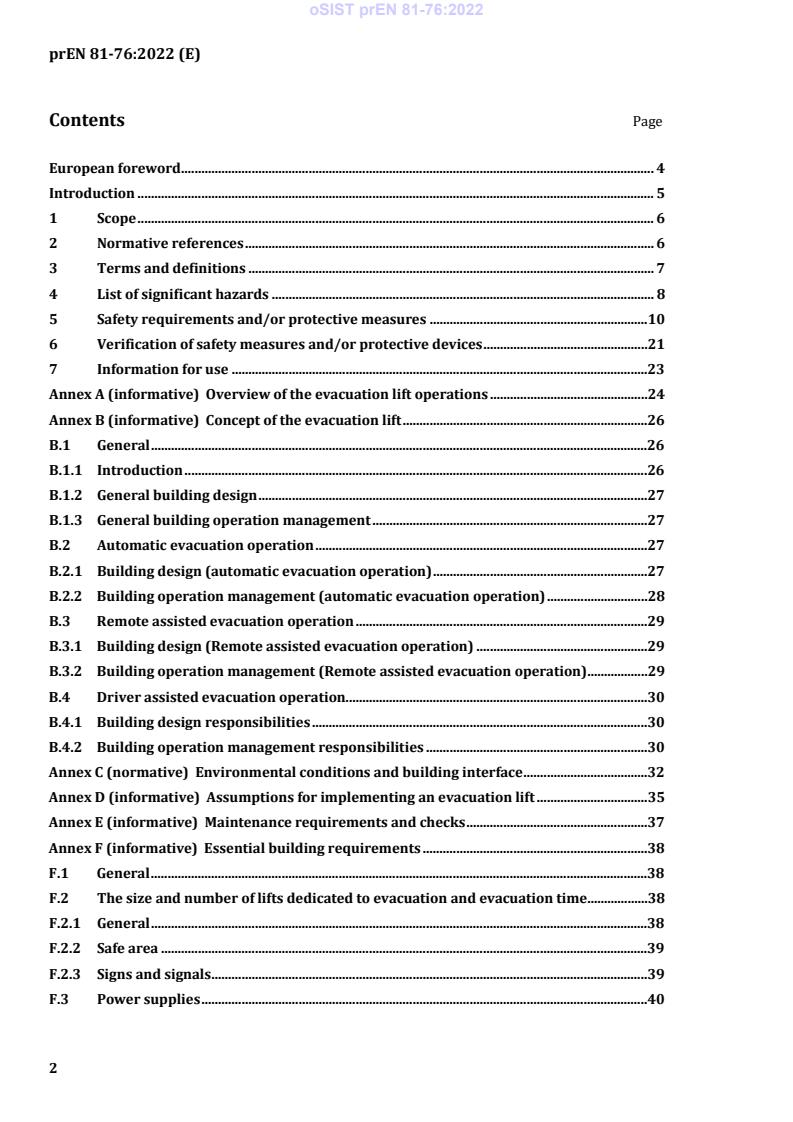
Contents Page
European foreword . 4
Introduction . 5
1 Scope . 6
2 Normative references . 6
3 Terms and definitions . 7
4 List of significant hazards . 8
5 Safety requirements and/or protective measures .10
6 Verification of safety measures and/or protective devices .21
7 Information for use .23
Annex A (informative) Overview of the evacuation lift operations .24
Annex B (informative) Concept of the evacuation lift .26
B.1 General .26
B.1.1 Introduction .26
B.1.2 General building design .27
B.1.3 General building operation management .27
B.2 Automatic evacuation operation .27
B.2.1 Building design (automatic evacuation operation) .27
B.2.2 Building operation management (automatic evacuation operation) .28
B.3 Remote assisted evacuation operation .29
B.3.1 Building design (Remote assisted evacuation operation) .29
B.3.2 Building operation management (Remote assisted evacuation operation) .29
B.4 Driver assisted evacuation operation.30
B.4.1 Building design responsibilities .30
B.4.2 Building operation management responsibilities .30
Annex C (normative) Environmental conditions and building interface .32
Annex D (informative) Assumptions for implementing an evacuation lift .35
Annex E (informative) Maintenance requirements and checks .37
Annex F (informative) Essential building requirements .38
F.1 General .38
F.2 The size and number of lifts dedicated to evacuation and evacuation time .38
F.2.1 General .38
F.2.2 Safe area .39
F.2.3 Signs and signals .39
F.3 Power supplies .40
F.4 Water management . 40
F.5 Measures to address the accumulation of water in the lift pit . 40
F.6 Smoke management . 41
Annex ZA (informative) Relationship between this European Standard and the essential
requirements of Directive 2014/33/EU aimed to be covered . 42
Bibliography . 44
European foreword
This document (prEN 81-76:2022) has been prepared by Technical Committee CEN/TC 10 “Lifts,
escalators and moving walks”, the secretariat of which is held by AFNOR.
This document is currently submitted to the CEN Enquiry.
This document will supersede CEN/TS 81-76:2011.
This document is intended to be used in conjunction with other parts of EN 81 series of standards. The
structure of the EN 81 series of standards is described in CEN/TR 81-10:2008.
This document has been prepared under a Standardization Request given to CEN by the European
Commission and the European Free Trade Association, and supports essential requirements of EU
Directive(s) / Regulation(s).
For relationship with EU Directive(s) / Regulation(s), see informative Annex ZA, which is an integral part
of this document.
Introduction
This document is a type-C standard as stated in EN ISO 12100.
This document is of relevance, in particular, for the following stakeholder groups representing the market
players with regard to machinery safety:
— machine manufacturers (small, medium and large enterprises);
— health and safety bodies (regulators, accident prevention organizations, market surveillance, etc.).
Others can be affected by the level of machinery safety achieved with the means of the document by the
above-mentioned stakeholder groups:
— machine users/employers (small, medium and large enterprises);
— machine users/employees (e.g. trade unions, organizations for people with special needs);
— service providers, e.g. for maintenance (small, medium and large enterprises);
— consumers (in case of machinery intended for use by consumers).
The above-mentioned stakeholder groups have been given the possibility to participate in the drafting
process of this document.
The lifts concerned and the extent to which hazards, hazardous situations or hazardous events are
covered are indicated in the Scope of this document.
When requirements of this type-C standard are different from those which are stated in type-A or type-B
standards, the requirements of this type-C standard take precedence over the requirements of the other
standards for machines that have been designed and built according to the requirements of this type-C
standard.
This document specifies a lift to be used for the evacuation of persons with disabilities and persons with
disabled mobility automatically or under driver control. Annex B provides a concept for the use of an
evacuation lift.
1 Scope
This document specifies the additional requirements to EN 81-20:2020 for passenger and goods
passenger lifts, which can be used to support faster evacuation of persons with disabilities and persons
with walking difficulties, including in case of fire alarm.
This document does not apply to:
— lifts installed into buildings which are not in accordance with Annex C;
— lifts for evacuation due to circumstances which introduce other hazards such as explosion threat,
chemical or biological attack, flooding, storm damage, or earthquake. In these cases, this document
can be used as a basis with further measures as required from risk assessment.
The following significant hazards are out of the scope of this document (see Table 2):
— fire or smoke in the evacuation lift well, safe areas or machinery spaces;
— ingress of water to the lift well during evacuation process;
— insufficient or incorrectly located evacuation lifts;
— insufficient evacuation capacity;
— entrapment in waiting area (safe area) due to absence of lift service or adjacent stairs;
— structural collapse or failure of building services (including public supply network, lighting,
ventilation) before the evacuation using lifts has been completed;
— presence of harmful gases, potentially explosive atmosphere, extreme climate conditions, transport
of dangerous goods.
2 Normative references
The following documents are referred to in the text in such a way that some or all of their content
constitutes requirements of this document. For dated references, only the edition cited applies. For
undated references, the latest edition of the referenced document (including any amendments) applies.
EN 81-20:2020, Safety rules for the construction and installation of lifts — Lifts for the transport of persons
and goods — Part 20: Passenger and goods passenger lifts
EN 81-28:2003, Safety rules for the construction and installation of lifts — Lifts for the transport of persons
and goods — Part 28: Remote alarm on passenger and goods passenger lifts
EN 81-70:2003, Safety rules for the construction and installation of lifts — Particular applications for
passenger and goods passenger lift — Part 70: Accessibility to lifts for persons including persons with
disability
EN 81-71:2005+A1:2006, Safety rules for the construction and installation of lifts — Particular
applications to passenger lifts and goods passenger lifts — Part 71: Vandal resistant lifts
As impacted by EN 81 70:2003/A1:2004.
EN 81-72:2020, Safety rules for the construction and installation of lifts — Particular applications for
passenger and goods passenger lifts — Part 72: Firefighters lifts
EN 81-73:2020, Safety rules for the construction and installation of lifts — Particular applications for
passenger and goods passenger lifts — Part 73: Behaviour of lifts in the event of fire
EN 81-77:2018, Safety rules for the construction and installations of lifts — Particular applications for
passenger and goods passenger lifts — Part 77: Lifts subject to seismic conditions
EN 131-1:2015+A1:2019, Ladders — Part 1: Terms, types, functional sizes
EN ISO 12100:2010, Safety of machinery — General principles for design — Risk assessment and risk
reduction (ISO 12100:2010)
IEC 60417:2002, Graphical symbols for use on equipment (available at: https://www.graphical-
symbols.info/equipment)
3 Terms and definitions
For the purposes of this document, the terms and definitions given in EN ISO 12100:2010 and
EN 81-20:2020 and the following apply.
ISO and IEC maintain terminological databases for use in standardization at the following addresses:
— ISO Online browsing platform: available at https://www.iso.org/obp
— IEC Electropedia: available at https://www.electropedia.org/
3.1
evacuation lift
lift designed to be used for the evacuation of persons with disabilities, in automatic mode or under the
direction of building management, trained evacuation assistant or rescue services
3.2
person with disabilities
person who, due to any temporary or permanent disability, impaired mobility or walking difficulty, is
unable to use stairs safely
3.3
evacuation assistant
person appointed to assist in the evacuation process
3.4
driver
evacuation assistant (3.3) appointed to operate the evacuation lift from inside the car
3.5
evacuation lift switch
manual device to activate the evacuation operation(s)
3.6
evacuation exit floor
EEF
destination floor(s) for evacuating the building using lift(s) determined by the evacuation plan and which
has a safe area(s)
Note 1 to entry: It is assumed that the evacuation exit floors have safe and accessible routes out of the building.
3.7
safe area
refuge, refuge area, lobby or fire protected lobby, provided with a safe route to the lift and a safe exit, that
will remain safe for persons for the duration of evacuation operations and is both separated from a fire
by suitable fire resisting construction and kept free from dangerous temperatures and the effects of
smoke
Note 1 to entry: The term “place of relative safety” defined in EN 17210:2021, 3.36, has the similar meaning as safe
area.
3.8
building management system
BMS
system capable of making decisions based on information sent to it
[SOURCE: EN 81-73:2020, 3.2]
3.9
suspend service signal
signal to suspend the evacuation operation
3.10
evacuation recall signal
signal to switch the lift to phase 1 evacuation operation (including the recall to active EEF)
4 List of significant hazards
4.1 Significant hazards related to the evacuation lift
This clause contains all the significant hazards, hazardous situations and events, as far as they are dealt
with in this standard, identified by risk assessment as significant for this type of machinery and which
require action to eliminate or reduce the risk (see Table 1).
Table 1 — List of significant hazards and hazardous situations – Evacuation lift
No. Hazards Requirements and clauses in
this document
as listed in EN ISO 12100:2010, Annex B
1 General hazards for lifts 5.3.1
2 Trapping hazard, entrapment 5.3.1, 5.3.4, 5.3.5, 5.5.2 i), 5.10,
5.11
3 Lift is not used correctly for evacuation 5.4, 5.5, 7.1, 7.2
4 Lift is not accessible to persons with disabilities 5.3.1, 5.3.2, 5.5.3, 5.6.3.1,
5.6.3.3, 5.7.3.1
5 Lift not available when needed 5.3.2, 5.3.3, 5.3.4, 5.3.7, 5.4.3
6 Hazards to maintenance personnel 5.3.1, 5.4.1, 7.1, 7.2
7 Inadequate design, location or identification of manual controls 5.3.1, 5.6, 5.7.3.1
8 Inadequate communications during evacuation 5.5.3.3.1, 5.6.2, 5.7, 5.10
9 Inadequate marking, difficulty in recognizing the evacuation lift 5.5.2, 5.5.3.1, 5.5.3.2.1, 5.6.3.3,
5.6.4
4.2 Significant hazards related to environment and conditions
Table 2 shows significant hazards related to environment and conditions of the evacuation lift, which are
outside the scope but dealt with by this document.
Table 2 — List of significant hazards and hazardous situations – Environment and conditions
No. Significant Hazards and Hazardous situations - Environment Information in this
document
1 Fire/heat/smoke into a lift well/machinery space/safe area 5.3.6, 5.5.4, Annex C, Annex D,
F.2.2, F.6
2 Lift not useable long enough for evacuation of persons with 5.3.3, 5.10, 5.11, C.9, F.3
disabilities
3 Flow of water into the lift well C.12, F.4, F.5
4 Not having enough or correctly located evacuation lifts to 5.3.2, F.2
evacuate all persons with disabilities requiring evacuation
within adequate time
5 Failure of the power supply 5.10, 5.11, F.3, C.5, C.7, C.9,
C.10
6 Inadequate lighting 5.10, C.5, C.9
7 Interruption of a connection between the lift and the building 5.4.3, 5.5.3.3.3, 5.5.4
management system (BMS) or fire detection system
5 Safety requirements and/or protective measures
5.1 General
Passenger and goods passenger lifts shall comply with the safety requirements and/or protective/risk
reduction measures of this clause. In addition, the passenger and goods passenger lifts shall be designed
according to the principles of EN ISO 12100:2010 for relevant but not significant hazards which are not
dealt with by this document.
5.2 Environmental conditions, building interface and assumptions for implementing an
evacuation lift
Annex C, Annex D and Annex F give requirements and guidance on environmental conditions, building
interface and assumptions for implementing an evacuation lift, which are essential for the
implementation and safe use of an evacuation lift.
5.3 Fundamental evacuation lift requirements
5.3.1 The evacuation lift shall be designed in conformity with EN 81-20:2020 and provided with
additional protection, controls and signals.
5.3.2 The minimum evacuation lift car size shall be of a type 2 according to EN 81-70:2003, Table 3. See
also F.2.1.
5.3.3 The lift shall be designed to operate during whole evacuation operation period (see C.9 and F.2).
5.3.4 Any ambient temperature sensor shall not stop, or prevent the start, of the evacuation operation.
5.3.5 The evacuation lift shall have an emergency trap door according to EN 81-20:2020, 5.4.6 except
for its size, which shall be according to EN 81-72:2020, 5.4.1.1. When the distance between consecutive
landing doorsills exceeds 7 m, intermediate emergency doors shall be provided, such that the distance
between sills is not more than 7 m.
Portable/movable 6 m long ladders according to EN 131-1:2015+A1:2019 without stabilizer shall be
provided and stored in the vicinity of the evacuation lift. The use and storing of the ladders shall be
described in the instructions.
NOTE The trap door is intended to provide a way to give support into the car.
5.3.6 An evacuation lift shall be provided with a means to suspend evacuation operation, see 5.5.4.
NOTE The suspend service signal allows a building management system (BMS) to suspend evacuation
operation, e.g. if smoke or fire is detected in the lift spaces, safe areas.
5.3.7 No electrical fault on any other lift located in the same lift group as the evacuation lift shall affect
the operation of the evacuation lift.
5.3.8 When on evacuation operation, the evacuation lift door shall open only where there is a safe area
in front of the landing door.
5.3.9 In the case of lifts with more than one car door, no more than one car door shall open at a time
during evacuation operation.
5.3.10 All EEFs shall have the required equipment for the selected lift configuration and the selected
operation modes according this document.
5.3.11 The landing and car doors shall be automatic power operated horizontally sliding doors.
5.4 Control system requirements
5.4.1 General
Evacuation operations shall not override any of the following:
— any electric safety devices;
— the suspend service signal (see 5.5.4);
— the inspection operation (see EN 81-20:2020, 5.12.1.5);
— the emergency electrical operation (see EN 81-20:2020, 5.12.1.6);
— the firefighters lift switch (see EN 81-72:2020, 5.8), if applicable;
— the behaviour of the lift in seismic mode (EN 81-77:2018, 5.10.4), if applicable;
— the remote alarm system (EN 81-28:2003, 4.1);
— any maintenance control.
NOTE Maintenance controls include, but are not limited to, the following functions:
— prevention of movement of lift after the opening of any door providing access to the pit
(EN 81-20:2020, 5.2.6.4.4.1 d));
— prevention of movement of lift after return to normal operation of the lift from pit inspection station
(EN 81-20:2020, 5.12.1.5.2.2);
— protection for maintenance operations (EN 81-20:2020, 5.12.1.7); or
— landing and car door bypass device(s) (EN 81-20:2020, 5.12.1.8).
5.4.2 Evacuation control signals, functions and signal priorities
Evacuation control signals, functions and priorities of signals shall be provided according to Table 3. At
least one of the optional evacuation operations (5.5.3.2, 5.5.3.3, 5.5.3.4) shall be provided.
Evacuation control signals shall be provided either by an evacuation lift switch, if provided, or provided
automatically.
NOTE Selection of appropriate evacuation operation(s) is based on evacuation strategy.
Table 3 — Summary of evacuation controls, functions and priorities
a
Control name Function name Clause Requirement
Signal priority
The suspend service Suspend service 1 (Highest) 5.5.4 Mandatory
signal
The driver assisted Driver assisted 2 5.5.3.4 Optional
evacuation signal evacuation operation
The remote assisted Remote assisted 3 5.5.3.3 Optional
evacuation signal evacuation operation
The automatic Automatic evacuation 4 5.5.3.2 Optional
evacuation signal operation
The evacuation recall Evacuation recall 5 (Lowest) 5.5.2 Mandatory
signal (Phase 1)
a
The priority of a control signal does not confer any preference for the use of the relative evacuation operation.
For changing the evacuation operation from one to another, see 5.5.2, 5.5.3.2.2, 5.5.3.3.3 and 5.5.3.4.3.
See Annex A for the evacuation control functionalities and priorities.
5.4.3 Availability and diagnostics
Interruption of a connection to the lift control system shall be treated as in Table 4.
Table 4 — Signal connection interruption reaction
Connection interruption of: The lift control system shall
consider the signal as:
the suspend service signal active (see 5.5.4)
the driver assisted evacuation signal active (see 5.5.3.4.2)
the remote assisted evacuation signal inactive (see 5.5.3.3.3)
the remote assisted evacuation control panel communication panel inactive (see 5.5.3.3.3)
(including audio and/or video communication connection) for
more than 30 s
the automatic evacuation signal inactive (see 5.5.3.2.2)
the evacuation recall signal active
NOTE In case of any evacuation operation signal comes to inactive state due to failure, the lift is prevented from
unintentionally returning to normal operation by keeping the evacuation recall signal active during the evacuation
operation. See also C.4.
5.5 Evacuation operation
5.5.1 General
An evacuation recall signal shall be provided either by an evacuation lift switch, if provided, or provided
automatically. See C.4.
5.5.2 Evacuation recall (Phase 1)
On activation of the evacuation recall signal or on deactivation of any evacuation operation (Phase 2) (see
also Table 3 and Table 4), the lift shall behave as described as follows:
a) all registered car and landing calls shall be cancelled and no new calls shall be registered;
b) visual indication that the lift has been switched to evacuation operation shall be given in the car
operating panel;
c) door re-open button (EN 81-20:2020, 5.3.6.3), door close button (where provided), door protective
device (EN 81-20:2020, 5.3.6.2.2.1 b)), door reopening device (EN 81-20:2020, 5.3.6.2.2.1 d)) and
remote alarm system shall remain operative;
d) a car parked at a landing, shall close the doors and travel nonstop to the active EEF. When the door
is not closed after 20 s, the protective device according to EN 81-20:2020 5.3.6.2.2.1 b) shall be made
inactive and the doors shall attempt to close as defined in EN 81-20:2020, 5.3.6.2.2.1 b) 4). An audible
signal shall sound in the car until the doors are closed.
e) a car travelling away from the active EEF shall make a normal stop latest at the nearest possible
landing without opening the doors, make an audible speech message such as “evacuation” and
reverse its direction and return to the active EEF;
f) a car travelling towards the active EEF shall continue its travel nonstop to the active EEF. If the lift
has already started stopping at a level, it is acceptable to make a normal stop and without opening
doors, make an audible speech message such as “evacuation”, and to continue to the active EEF;
g) on arriving at the active EEF, the car shall open its door and shall make audible speech message and
a visual indication informing the user(s) to leave the evacuation lift. The audible signal shall be
according to EN 81-70:2003, 5.1.3. The visual indication shall be located within or above the car
operating panel or above the car door/s;
h) when the door is not closed at the active EEF after 20 s, the protective device according to
EN 81-20:2020 5.3.6.2.2.1 b) shall be made inactive, the doors shall attempt to close as defined in
EN 81-20:2020, 5.3.6.2.2.1 b) 4) and an audible signal shall sound in the car until the doors are closed.
i) to enable the fire and rescue service to check whether the car is present and persons are not trapped
at the active EEF, any landing call at the active EEF shall initiate opening of the doors;
j) when any evacuation operation is not active, after deactivation of the evacuation recall signal and
when the lift is at the active EEF, the car shall return to normal operation and visual indication (see
5.5.2 b)) shall be deactivated.
5.5.3 Evacuation operation (Phase 2)
5.5.3.1 General
5.5.3.1.1 After the evacuation recall (5.5.2) is completed and any evacuation operation is activated (see
Table 3), the lift shall operate as follows:
a) registration of landing calls shall be reactivated on those landings intended to be served according
to the evacuation strategy (see Annex D, i) 3));
b) when the lift is capable of serving landing calls, information about this service capability and the
active EEF location of the lift shall be available for external systems;
NOTE This information is used e.g. for controlling evacuation route indicators.
c) at a given landing, activation of any landing control device or any accessibility button shall register a
landing call;
d) at a given landing, the call registration feedback shall be according to EN 81-70:2003, Table 4,
item g);
e) if evacuation operation is not available due to interrupted connection or lift malfunction, all existing
landing calls shall be cancelled and call registration feedback shall not be given.
Service capability and the active EEF location (see 5.5.3.1.1 b)) shall be visually indicated at active EEF.
5.5.3.1.2 If a lift is on its way to the active EEF during a change of the active EEF it shall behave as
following:
a) a lift travelling towards the new EEF shall continue its travel non-stop to the new EEF;
b) if the lift has already started stopping at the previous EEF, it is acceptable to make a normal stop and
without opening doors to continue to the new EEF;
c) a lift travelling away from the new EEF shall make a normal stop latest at the nearest possible landing
without opening the doors and return to the new EEF.
During remote assisted evacuation operation or driver assisted evacuation operation any new travel after
a change of the active EEF shall start only under manual control (remote or driver).
5.5.3.2 Automatic evacuation operation
5.5.3.2.1 General
After procedure described in 5.5.3.1 and when automatic evacuation signal is active and when no higher
priority signal is active (see Table 3), the lift shall operate as described as follows.
a) In automatic evacuation operation, the lift shall serve registered landing calls;
b) The priority of the landing calls shall be based on distance from the active EEF with the furthest
landing call getting highest priority, if not otherwise specified by the evacuation strategy. See B.2.1;
NOTE Lift control system needs appropriate information for evacuation priorities before automatic
evacuation operation.
c) If the lift has started deceleration to respond a landing call, this landing call shall be served before
any other landing calls;
d) On arrival at a landing other than the active EEF, the car shall open the doors and give a voice
announcement to inform persons to enter the car (message such as “Evacuation. Enter the car”). A
car call or destination indication to the active EEF shall automatically be indicated;
e) The door dwell time shall comply with EN 81-70:2003, 5.2.2. At the latest when the actual door dwell
time exceeds 20 s, all door protective devices shall be made inactive and the doors shall attempt to
close as defined in EN 81-20:2020, 5.3.6.2.2.1 b) 4);
f) Once the doors are closed, the car shall proceed towards the active EEF. If the car is empty, it may
respond the next landing call without visiting the active EEF;
g) The car may serve other landing calls on the way to the active EEF. If the car makes stops on the way
to the active EEF, the following shall be provided:
1) an audible and visual indication to inform persons not to leave the car (message such as “No
exit”). The audible signal shall be according to EN 81-70:2003, 5.1.3;
2) means to prevent stops without sufficient capacity of the lift;
h) Actuation of the landing call device shall not prevent a loaded car from closing its doors and leaving
the floor;
i) On arriving at the active EEF, the evacuation lift car shall open its door and shall make an audible and
visual indication such as “Exit now”. The audible signal shall be according to EN 81-70:2003, 5.1.3.
5.5.3.2.2 Deactivation of automatic evacuation operation
Automatic evacuation operation shall be ceased when
— the automatic evacuation signal is deactivated; or
— the remote assisted evacuation signal is activated; or
— the driver assisted evacuation signal is activated; or
— the suspend service signal is activated.
In these cases the car shall return to the active EEF according to 5.5.2.
5.5.3.3 Remote assisted evacuation
5.5.3.3.1 General
Remote assisted evacuation is evacuation under the control of an authorized person (“remote evacuation
assistant”, see B.3.2), who controls the lift from remote evacuation control panel. When the remote
evacuation control panel is located in the same building, see C.5.
NOTE Remote assisted evacuation is subjected to cybersecurity. Cybersecurity of industrial control systems
are specified in the IEC 62443 series. A lift application specific cybersecurity standard ISO 8102-20 is under
development (currently at DIS stage).
In remote assisted evacuation operation control from outside the lift car or from a remote location is
permitted provided there are communication means between the remote location control and the lift car
(see 5.7.3). The use of remote assisted evacuation and the communication means shall be selected based
on building evacuation strategy. See guidance from B.3.
Activation of the remote assisted evacuation operation shall override the automatic evacuation signal
(5.5.3.2).
5.5.3.3.2 Remote assisted evacuation operation
After the procedure described in 5.5.3.1, and when the remote assisted evacuation signal is active, and
when no higher priority signal is active (see Table 3), communication between the lift and the remote
evacuation control panel shall be opened by the lift control. After communication is established and the
remote evacuation control panel is activated, the lift shall operate as described as follows.
Control of lift is solely from remote evacuation control panel except alarm and door open buttons of in-
car operating panel shall continue operation.
a) Registered landing calls, car position, direction of travel and car door status shall be indicated at
remote evacuation control panel;
b) A call registered on the remote evacuation control panel shall cause the car door to close and the car
to travel to the required landing;
c) If car door closing is prevented by door protective device, a separate door close command from
remote evacuation control panel shall bypass the protective device and the car doors shall attempt
to close as defined in EN 81-20:2020, 5.3.6.2.2.1 b) 4);
d) At any time it shall be possible to register a new call from the remote evacuation control panel. The
previous call shall be cancelled. The car shall travel in the shortest time to the newly registered
landing;
e) On arrival at the destination, the car shall automatically open its selected door (see 5.3.9) and remain
at landing until a new destination call is registered;
f) On arrival at a landing, the car shall open the doors and give a voice announcement to inform persons
to enter the car (message such as “Evacuation. Enter the car”). The audible signal shall be according
to EN 81-70:2003, 5.1.3;
g) When arriving at the active EEF, the evacuation lift shall make audible and visual indication such as
“Exit now”. The audible signal shall be according to EN 81-70:2003, 5.1.3.
5.5.3.3.3 Deactivation of remote assisted evacuation
Remote assisted evacuation operation shall be ceased when
— the remote assisted evacuation signal is deactivated; or
— the remote evacuation control panel becomes inactive; or
— the connection between the remote evacuation control panel and the lift is interrupted for more than
30 s (see also Table 3 and Table 4); or
— the audible or video communication system is interrupted for more than 30 s (see also Table 4); or
— the driver assisted evacuation signal is activated; or
— the suspend service signal is activated.
In these cases the car shall return to the active EEF according to 5.5.2.
5.5.3.4 Driver assisted evacuation
5.5.3.4.1 General
Driver assisted evacuation operation shall override the automatic evacuation operation (5.5.3.2) and
remote assisted evacuation operation (5.5.3.3).
Driver assisted evacuation is evacuation under the control of an authorized person (“evacuation
assistant”, see B.4.2), who controls the lift from car operating panel.
5.5.3.4.2 Driver assisted evacuation operation
After the procedure described in 5.5.3.1 and when the driver assisted evacuation signal is active (see
5.6.5.2), the lift shall operate as described below.
a) Registered landing calls shall be indicated in the car by blinking car call acceptance light of the given
landings or by a blinking floor identification on a display;
b) Where multiple lifts in a group are in evacuation operation, all registered landing calls shall be
indicated in each car in the driver assisted evacuation operation. If one of the cars serves the landing
call, the landing call shall be cancelled from the other car(s);
c) The active EEF location shall be indicated in the car;
d) All heat and smoke sensitive door protection devices shall be made inactive;
e) Constant pressure on any car call button or on the door close button shall cause the car door to close.
Closing shall start only after 1 to 2 s delay. If the button is released before the car door is fully closed,
the car doors shall automatically reopen. When the car door is fully closed, the car call can be
registered and the car shall start to travel to the destination landing (see 5.3.11);
f) If car doors are closed by the door close button and car call is not registered within 15 s, the car shall
travel to the active EEF and open its doors;
g) At any time, it shall be possible to register a new call from within the car. The previous car call shall
be cancelled. The car shall travel in the shortest time to the newly registered landing;
h) On arrival at any destination, the car shall automatically open its selected door (see 5.3.9) and remain
at the landing until the car door is closed and a new car call is registered as described in e), or until
timeout expires as described in f).
5.5.3.4.3 Deactivation of driver assisted evacuation operation
Driver assisted evacuation operation shall cease when the driver assisted evacuation signal is no longer
active or when the suspend service signal is active. The car shall return to the active EEF according to
5.5.2.
5.5.4 Suspension of evacuation operation
Upon receiving the suspend service signal (see also C.4), the lift shall operate as defined in
EN 81-73:2020, 5.3, where the designated landing is to be understood as active EEF.
NOTE Suspend service signal can be used also when the evacuation operation is completed.
5.6 Car and landing control equipment
5.6.1 Car controls for driver assisted evacuation operation
Whilst on driver assisted evacuation operation, control of the evacuation lift shall be by means of buttons
or similar devices in the car. These may be buttons for the normal use of the lift. In the case of destination
controls, the car controls and car signals for the evacuation operation is permitted to be arranged behind
a cover which is locked in normal operation.
5.6.2 Remote evacuation control panel
The remote evacuation control panel(s) shall have at least the following controls and indications as
required in various clauses of this document:
— registered landing calls (5.5.3.3.2 a));
— car position and direction of travel (5.5.3.3.2 a));
— door status (5.5.3.3.2 a));
— registered call (5.5.3.3.2 b));
— evacuation lift operation mode and service availability;
— active EEF;
— the remote connection communication status;
— lift identification.
NOTE Audio and video communication system is specified in 5.7.3.
5.6.3 Landing controls and signals
5.6.3.1 Landing controls
Landing controls shall comply with EN 81-70:2003, 5.4.2.2.
5.6.3.2 Landing signals at the EEF
The EEFs shall have a car position indicator.
The EEFs shall have a visual indication showing the selected evacuation operation (see 5.5.3.1.1) and an
active communication system.
5.6.3.3 Landing signals at the landings intended to be served
Indication of available evacuation service shall be given by the landing call registration feedback
according to EN 81-70:2003, Table 4, item g) or 5.4.3.1.2 in case of destination control. No feedback shall
be given, if the evacuation service is not available.
The illuminated signals specified in EN 81-20:2020, 5.12.4.3, shall be arrows and shall be placed above
or adjacent to the landing doors. On arrival the lift shall give an audible signal according to
EN 81-70:2003, 5.4.2.4.2.
5.6.4 Evacuation lift sign
The evacuation lift sign shall be according to Figure 1. The evacuation lift sign can be amended with route
indications as shown in F.2.3 and Figure F.1.
Figure 1 — Safety sign “Evacuation lift for persons with disabilities”, ISO 7010-E070
Illustration in the safety sign shall be in white with green background.
The evacuation lift shall be indicated with the safety sign on every landing intended to be served during
the evacuation operation. The location and the height of the sign shall be according to EN 81-70:2003,
5.4.3.3 c).
5.6.5 Evacuation lift switch for driver assisted evacuation operation
5.6.5.1 General
An evacuation lift switch shall be provided for driver assisted evacuation operation.
Evacuation lift switches shall be located in the safe areas at the EEFs within 2 m horizontally from the
evacuation lift, at a height between 1,4 m and 2,0 m above floor level. The switches shall be marked with
the safety sign shown in Figure 1 and it shall be indicated to which lift the switch is associated, in
accordance with EN 81-70:2003, 5.4.3.3 c). The size of the safety sign shall be at least 100 mm × 100 mm.
5.6.5.2 Operation of the evacuation lift switch
Operation of the evacuation lift switch shall be by means of a key. Where no other key has been agreed
(see Annex D, i) 8)), the key shall be the unlocking triangle as defined in EN 81-20:2020, 5.
...