

SIST EN ISO 13408-1:2024
(Main)Aseptic processing of health care products - Part 1: General requirements (ISO 13408-1:2023)
General Information
- Abstract
This document specifies the general requirements for, and offers guidance on, processes, programs and procedures for development, validation and routine control of aseptic processing of health care products.
This document includes requirements and guidance relative to the overall topic of aseptic processing.
Specific requirements and guidance on various specialized processes and methods related to sterilizing filtration, lyophilization, clean-in place (CIP) technologies, sterilization in place (SIP) and isolator systems are given in the other parts of the ISO 13408 series.
- Status
- Published
- Public Enquiry End Date
- 27-Feb-2022
- Publication Date
- 13-May-2024
- Technical Committee
- VAZ - Healthcare
- Current Stage
- 6060 - National Implementation/Publication (Adopted Project)
- Start Date
- 09-May-2024
- Due Date
- 14-Jul-2024
- Completion Date
- 14-May-2024
- Directive
- 2017/745 - Regulation (EU) 2017/745 of the European Parliament and of the Council of 5 April 2017 on medical devices, amending Directive 2001/83/EC, Regulation (EC) No 178/2002 and Regulation (EC) No 1223/2009 and repealing Council Directives 90/385/EEC and 93/42/EECOJ Ref: 2024, 2024/2631, OJ L OJ Date: 09-Oct-2024

Overview
EN ISO 13408-1:2024 (ISO 13408-1:2023) specifies the general requirements and guidance for the development, validation and routine control of aseptic processing of health care products. Published by CEN as the European adoption of ISO 13408-1, this standard sets out high‑level expectations for processes, programs and procedures used to maintain aseptic conditions during manufacture of sterile medicines, medical devices and other health care products.
Key topics and requirements
- Scope and intent: General requirements and guidance for aseptic processing; not a replacement for product‑specific manufacturing controls.
- Process development: Framework for planning aseptic processes, including risk‑based approaches and procedural controls.
- Validation: Guidance on establishing and documenting validated aseptic processes prior to routine production.
- Routine control and monitoring: Expectations for ongoing environmental, personnel and process monitoring to maintain sterility assurance.
- Programs and procedures: Organization of standard operating procedures (SOPs), training, change control and quality oversight for aseptic operations.
- Interface to specialist methods: Identifies that sterilizing filtration, lyophilization, clean‑in‑place (CIP), sterilization‑in‑place (SIP) and isolator systems are covered in other parts of the ISO 13408 series (e.g., Part 2, Part 6).
- Regulatory linkage: Assists conformity with EU Regulations (e.g., Regulation (EU) 2017/745 and 2017/746) for applicable General Safety and Performance Requirements where aseptic processing is relevant.
Applications and who should use it
This standard is essential for:
- Pharmaceutical and biotech manufacturers implementing or improving aseptic filling and sterile product assembly.
- Medical device manufacturers producing devices requiring aseptic handling or sterile assembly.
- Quality assurance, validation and regulatory teams developing validation protocols, routine monitoring plans and compliance documentation.
- Facility design and operations teams aligning cleanroom practice, personnel flows and environmental control with aseptic requirements.
Use cases include process design, validation planning, writing SOPs for aseptic operations, and establishing monitoring programs to sustain sterility assurance during production.
Related standards
- ISO 13408-2 (Sterilizing filtration)
- ISO 13408-6 (Isolator systems)
- ISO 14644 series (Cleanrooms and associated controlled environments - notably Parts 1, 2, 4 and 7)
These referenced standards provide the detailed technical requirements for specific methods, cleanroom classification and separative devices that complement the general guidance in EN ISO 13408-1.
Keywords: aseptic processing, health care products, ISO 13408-1, EN ISO 13408-1:2024, validation, sterilizing filtration, lyophilization, CIP, SIP, isolator systems, cleanrooms, regulatory compliance.
Relations
- Effective Date
- 28-Jan-2026
- Effective Date
- 28-Jan-2026
- Effective Date
- 21-Nov-2018
Get Certified
Connect with accredited certification bodies for this standard

BSI Group
BSI (British Standards Institution) is the business standards company that helps organizations make excellence a habit.

TÜV Rheinland
TÜV Rheinland is a leading international provider of technical services.

TÜV SÜD
TÜV SÜD is a trusted partner of choice for safety, security and sustainability solutions.
Sponsored listings
Frequently Asked Questions
SIST EN ISO 13408-1:2024 is a standard published by the Slovenian Institute for Standardization (SIST). Its full title is "Aseptic processing of health care products - Part 1: General requirements (ISO 13408-1:2023)". This standard covers: This document specifies the general requirements for, and offers guidance on, processes, programs and procedures for development, validation and routine control of aseptic processing of health care products. This document includes requirements and guidance relative to the overall topic of aseptic processing. Specific requirements and guidance on various specialized processes and methods related to sterilizing filtration, lyophilization, clean-in place (CIP) technologies, sterilization in place (SIP) and isolator systems are given in the other parts of the ISO 13408 series.
This document specifies the general requirements for, and offers guidance on, processes, programs and procedures for development, validation and routine control of aseptic processing of health care products. This document includes requirements and guidance relative to the overall topic of aseptic processing. Specific requirements and guidance on various specialized processes and methods related to sterilizing filtration, lyophilization, clean-in place (CIP) technologies, sterilization in place (SIP) and isolator systems are given in the other parts of the ISO 13408 series.
SIST EN ISO 13408-1:2024 is classified under the following ICS (International Classification for Standards) categories: 11.080.01 - Sterilization and disinfection in general. The ICS classification helps identify the subject area and facilitates finding related standards.
SIST EN ISO 13408-1:2024 has the following relationships with other standards: It is inter standard links to SIST EN ISO 16396-1:2022, SIST EN 14885:2015, SIST EN ISO 13408-1:2015. Understanding these relationships helps ensure you are using the most current and applicable version of the standard.
SIST EN ISO 13408-1:2024 is associated with the following European legislation: EU Directives/Regulations: 2017/745, 2017/746; Standardization Mandates: M/575, M/575 Amd 2. When a standard is cited in the Official Journal of the European Union, products manufactured in conformity with it benefit from a presumption of conformity with the essential requirements of the corresponding EU directive or regulation.
SIST EN ISO 13408-1:2024 is available in PDF format for immediate download after purchase. The document can be added to your cart and obtained through the secure checkout process. Digital delivery ensures instant access to the complete standard document.
Standards Content (Sample)
SLOVENSKI STANDARD
01-julij-2024
Aseptična proizvodnja izdelkov za zdravstveno nego - 1. del: Splošne zahteve (ISO
13408-1:2023)
Aseptic processing of health care products - Part 1: General requirements (ISO 13408-
1:2023)
Aseptische Herstellung von Produkten für die Gesundheitsfürsorge - Teil 1: Allgemeine
Anforderungen (ISO 13408-1:2023)
Traitement aseptique des produits de santé - Partie 1 : Exigences générales (ISO 13408
-1:2023)
Ta slovenski standard je istoveten z: EN ISO 13408-1:2024
ICS:
11.080.01 Sterilizacija in dezinfekcija na Sterilization and disinfection
splošno in general
2003-01.Slovenski inštitut za standardizacijo. Razmnoževanje celote ali delov tega standarda ni dovoljeno.
EN ISO 13408-1
EUROPEAN STANDARD
NORME EUROPÉENNE
April 2024
EUROPÄISCHE NORM
ICS 11.080.01 Supersedes EN ISO 13408-1:2015
English Version
Aseptic processing of health care products - Part 1:
General requirements (ISO 13408-1:2023)
Traitement aseptique des produits de santé - Partie 1: Aseptische Herstellung von Produkten für die
Exigences générales (ISO 13408-1:2023) Gesundheitsfürsorge - Teil 1: Allgemeine
Anforderungen (ISO 13408-1:2023)
This European Standard was approved by CEN on 2 July 2023.
CEN members are bound to comply with the CEN/CENELEC Internal Regulations which stipulate the conditions for giving this
European Standard the status of a national standard without any alteration. Up-to-date lists and bibliographical references
concerning such national standards may be obtained on application to the CEN-CENELEC Management Centre or to any CEN
member.
This European Standard exists in three official versions (English, French, German). A version in any other language made by
translation under the responsibility of a CEN member into its own language and notified to the CEN-CENELEC Management
Centre has the same status as the official versions.
CEN members are the national standards bodies of Austria, Belgium, Bulgaria, Croatia, Cyprus, Czech Republic, Denmark, Estonia,
Finland, France, Germany, Greece, Hungary, Iceland, Ireland, Italy, Latvia, Lithuania, Luxembourg, Malta, Netherlands, Norway,
Poland, Portugal, Republic of North Macedonia, Romania, Serbia, Slovakia, Slovenia, Spain, Sweden, Switzerland, Türkiye and
United Kingdom.
EUROPEAN COMMITTEE FOR STANDARDIZATION
COMITÉ EUROPÉEN DE NORMALISATION
EUROPÄISCHES KOMITEE FÜR NORMUNG
CEN-CENELEC Management Centre: Rue de la Science 23, B-1040 Brussels
© 2024 CEN All rights of exploitation in any form and by any means reserved Ref. No. EN ISO 13408-1:2024 E
worldwide for CEN national Members.
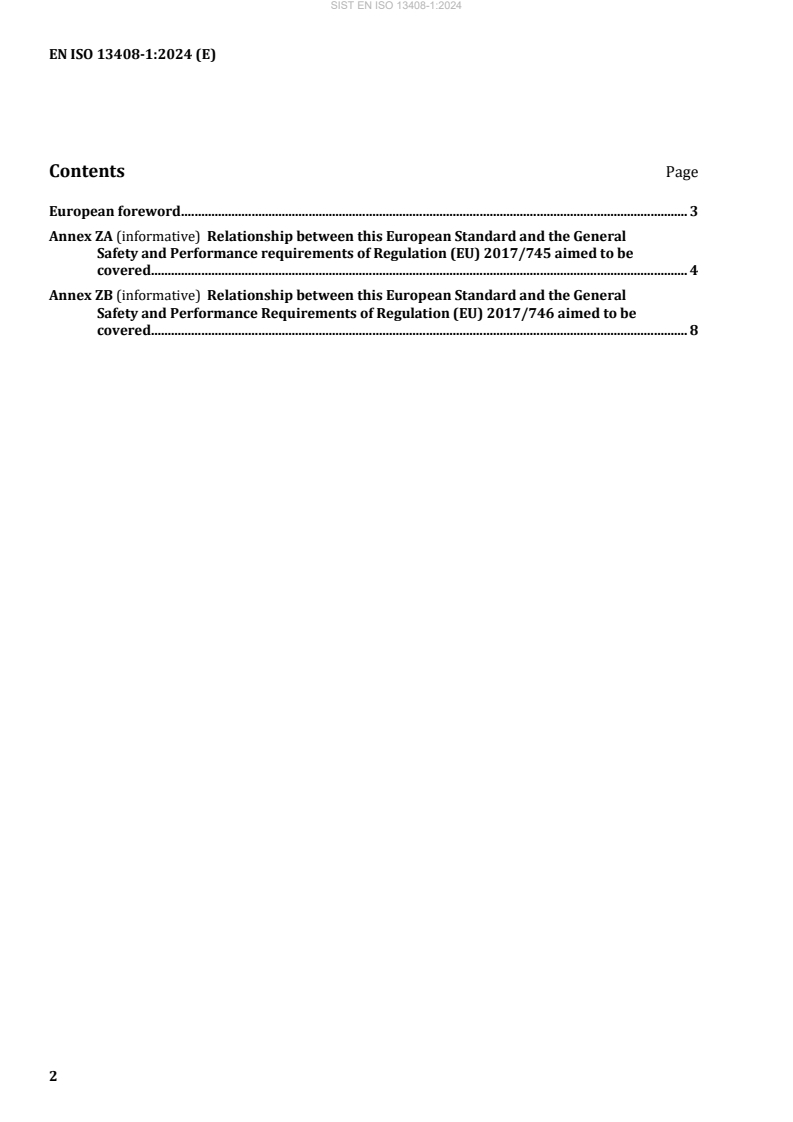
Contents Page
European foreword . 3
Annex ZA (informative) Relationship between this European Standard and the General
Safety and Performance requirements of Regulation (EU) 2017/745 aimed to be
covered. 4
Annex ZB (informative) Relationship between this European Standard and the General
Safety and Performance Requirements of Regulation (EU) 2017/746 aimed to be
covered. 8
European foreword
This document (EN ISO 13408-1:2024) has been prepared by Technical Committee ISO/TC 198
"Sterilization of health care products" in collaboration with Technical Committee CEN/TC 204
“Sterilization of medical devices” the secretariat of which is held by BSI.
This European Standard shall be given the status of a national standard, either by publication of an
identical text or by endorsement, at the latest by October 2024, and conflicting national standards shall
be withdrawn at the latest by October 2024.
Attention is drawn to the possibility that some of the elements of this document may be the subject of
patent rights. CEN shall not be held responsible for identifying any or all such patent rights.
This document supersedes EN ISO 13408-1:2015.
This document has been prepared under a standardization request addressed to CEN by the European
Commission. The Standing Committee of the EFTA States subsequently approves these requests for its
Member States.
For the relationship with EU Legislation, see informative Annex ZA and ZB, which is an integral part of
this document.
Any feedback and questions on this document should be directed to the users’ national standards
body/national committee. A complete listing of these bodies can be found on the CEN website.
According to the CEN-CENELEC Internal Regulations, the national standards organizations of the
following countries are bound to implement this European Standard: Austria, Belgium, Bulgaria,
Croatia, Cyprus, Czech Republic, Denmark, Estonia, Finland, France, Germany, Greece, Hungary, Iceland,
Ireland, Italy, Latvia, Lithuania, Luxembourg, Malta, Netherlands, Norway, Poland, Portugal, Republic of
North Macedonia, Romania, Serbia, Slovakia, Slovenia, Spain, Sweden, Switzerland, Türkiye and the
United Kingdom.
Endorsement notice
The text of ISO 13408-1:2023 has been approved by CEN as EN ISO 13408-1:2024 without any
modification.
Annex ZA
(informative)
Relationship between this European Standard and the General Safety and
Performance requirements of Regulation (EU) 2017/745 aimed to be
covered
This European standard has been prepared under M/575 to provide one voluntary means of
conforming to the General Safety and Performance Requirements of Regulation (EU) 2017/745 of 5
April 2017 concerning medical devices [OJ L 117] and to system or process requirements including
those relating to quality management systems, risk management, post-market surveillance systems,
clinical investigations, clinical evaluation or post-market clinical follow-up.
Once this standard is cited in the Official Journal of the European Union under that Regulation,
compliance with the normative clauses of this standard given in Table ZA.1 and application of the
edition of the normatively referenced standards as given in Table ZA.2 confers, within the limits of the
scope of this standard, a presumption of conformity with the corresponding General Safety and
Performance Requirements of that Regulation, and associated EFTA Regulations.
Where a definition in this standard differs from a definition of the same term set out in Regulation (EU)
2017/745, the differences shall be indicated in this Annex Z. For the purpose of using this standard in
support of the requirements set out in Regulation (EU) 2017/745, the definitions set out in this
Regulation prevail.
Where the European standard is an adoption of an International Standard, the scope of this standard
can differ from the scope of the European Regulation that it supports. As the scope of the applicable
regulatory requirements differ from nation to nation and region to region, the standard can only
support European regulatory requirements to the extent of the scope of the European regulation for
medical devices (EU) 2017/745).
NOTE 1 Where a reference from a clause of this standard to the risk management process is made, the risk
management process needs to be in compliance with Regulation (EU) 2017/745. This means that risks have to be
‘reduced as far as possible’, ‘reduced to the lowest possible level’, ‘reduced as far as possible and appropriate’,
‘removed or reduced as far as possible’, ‘eliminated or reduced as far as possible’, ’removed or minimized as far as
possible’, or ‘minimized’, according to the wording of the corresponding General Safety and Performance
Requirement.
NOTE 2 The manufacturer’s policy for determining acceptable risk must be in compliance with General Safety
and Performance Requirements 1, 2, 3, 4, 5, 8, 9, 10, 11, 14, 16, 17, 18, 19, 20, 21 and 22 of the Regulation.
NOTE 3 When a General Safety and Performance Requirement does not appear in Table ZA.1, it means that it is
not addressed by this European Standard.
Table ZA.1 — Correspondence between this European Standard and Annex I of
Regulation (EU) 2017/745 [OJ L 117] and to system or process requirements including those
relating to quality management systems, risk management, post-market surveillance systems,
clinical investigations, clinical evaluation or post-market clinical follow-up
General Safety and
Performance Requirements Clause(s)/sub-clause(s) of
Remarks/Notes
of Regulation (EU) this EN
2017/745
11.3 4,5,6,7,8,9 This standard provides general
requirements for processes, programs and
procedures for development, validation
and routine control of aseptic processing.
This General Safety and Performance
Requirement is addressed only with regard
to devices for which use of aseptic
processing is appropriate.
This General Safety and Performance
Requirement is only partly addressed in
this European Standard. Design and
packaging for maintenance of sterility are
not covered. Aspects of manufacture other
than those related to maintenance of a
specific microbial state by aseptic
processing are not covered.
11.4 first sentence only 4,5,6,7,8,9 This standard provides general
requirements for processes, programs and
procedures for development, validation
and routine control of aseptic processing.
This General Safety and Performance
Requirement is addressed only with regard
to devices for which use of aseptic
processing is appropriate.
This General Safety and Performance
Requirement is only partly addressed in
this European Standard. Design and
packaging for maintenance of sterility are
not covered. Evidence that the integrity of
the packaging is maintained to the point of
use is not covered. Aspects of manufacture
other than those related to maintenance of
sterility during aseptic processing are not
covered. Transport and storage conditions
are not covered.
11.5 4,5,6,7,8,9 This standard provides general
requirements for processes, programs and
procedures for development, validation
and routine control of aseptic processing.
This General Safety and Performance
Requirement is addressed only with regard
General Safety and
Performance Requirements Clause(s)/sub-clause(s) of
Remarks/Notes
of Regulation (EU) this EN
2017/745
to devices for which use of aseptic
processing is appropriate.
This General Safety and Performance
Requirement is only partly addressed in
this European Standard. Design and
packaging for maintenance of sterility are
not covered. Aspects of manufacture other
than those related to maintenance of
sterility during aseptic processing are not
covered.
Table ZA.2 — Applicable Standards to confer presumption of conformity as described in this
Annex ZA
Column 1 Column 2 Column 3 Column 4
Reference in International Title Corresponding European
Clause 2 Standard Edition Standard Edition
ISO 13408-2 ISO 13408-2:2018 Aseptic processing of health care EN ISO 13408-2:2018
products — Part 2: Sterilizing
filtration
ISO 13408-6 ISO 13408-6:2021 Aseptic processing of health care EN ISO 13408-6:2021
products — Part 6: Isolator
systems
ISO 14644- ISO 14644-1:2015 Cleanrooms and associated EN ISO 14644-1:2015
1:2015 controlled environments —
Part 1: Classification of air
cleanliness by particle
concentration
ISO 14644-2 ISO 14644-2:2015 Cleanrooms and associated EN ISO 14644-2:2015
controlled environments —
Part 2: Monitoring to provide
evidence of cleanroom
performance related to air
cleanliness by particle
concentration
ISO 14664-4 ISO 14664-4:2001 Cleanrooms and associated EN ISO 14664-4:2001
controlled environments —
Part 4: Design, construction and
start-up
ISO 14644-7 ISO 14644-7:2004 Cleanrooms and associated EN ISO 14644-7:2004
controlled environments —
Part 7: Separative devices (clean
air hoods, gloveboxes, isolators
and mini-environments)
The documents listed in the Column 1 of Table ZA.2, in whole or in part, are normatively referenced in
this document and are indispensable for its application. The achievement of the presumption of
conformity is subject to the application of the edition of Standards as listed in Column 4 or, if no
European Standard Edition exists, the International Standard Edition given in Column 2 of Table ZA.2.
WARNING 1 Presumption of conformity stays valid only as long as a reference to this European
Standard is maintained in the list published in the Official Journal of the European Union. Users of this
standard should consult frequently the latest list published in the Official Journal of the European
Union.
WARNING 2 Other Union legislation may be applicable to the product(s) falling within the scope of this
standard.
Annex ZB
(informative)
Relationship between this European Standard and the General Safety and
Performance Requirements of Regulation (EU) 2017/746 aimed to be
covered
This European standard has been prepared under M/575 to provide one voluntary means of
conforming to the General Safety and Performance Requirements of Regulation (EU) 2017/746 of 5
April 2017 concerning in vitro diagnostic medical devices [OJ L 117] and to system or process
requirements including those relating to quality management systems, risk management, post-market
surveillance systems, performance studies, clinical evidence or post-market performance follow-up.
Once this standard is cited in the Official Journal of the European Union under that Regulation,
compliance with the normative clauses of this standard given in Table ZB.1 and application of the
edition of the normatively referenced standards as given in Table ZA.2 confers, within the limits of the
scope of this standard, a presumption of conformity with the corresponding General Safety and
Performance Requirements of that Regulation, and associated EFTA Regulations.
Where a definition in this standard differs from a definition of the same term set out in Regulation (EU)
2017/746, the differences shall be indicated in the Annex Z. For the purpose of using this standard in
support of the requirements set out in Regulation (EU) 2017/746, the definitions set out in this
Regulation prevail.
Where the European standard is an adoption of an International Standard, the scope of this standard
can differ from the scope of the European Regulation that it supports. As the scope of the applicable
regulatory requirements differ from nation to nation and region to region, the standard can only
support European regulatory requirements to the extent of the scope of the In vitro Diagnostic
Regulation (EU) 2017/746).
NOTE 1 Where a reference from a clause of this standard to the risk management process is made, the risk
management process needs to be in compliance with Regulation (EU) 2017/746. This means that risks have to be
‘reduced as far as possible’, ‘reduced to a level as low as reasonably practicable’, ‘reduced to the lowest possible
level’, ‘reduced as far as possible and appropriate’, ‘removed or reduced as far as possible’, ‘eliminated or reduced
as far as possible’, ‘prevented’ or ‘minimized’, according to the wording of the corresponding General Safety and
Performance Requirement.
NOTE 2 The manufacturer’s policy for determining acceptable risk must be in compliance with General Safety
and Performance Requirements 1, 2, 3, 4, 5, 8, 10, 11, 13, 15, 16, 17, 18 and 19 of the Regulation.
NOTE 3 When a General Safety and Performance Requirement does not appear in Table ZB.1, it means that it is
not addressed by this European Standard.
Table ZB.1 — Correspondence between this European standard and Annex I of
Regulation (EU) 2017/746 [OJ L 117] and to system or process requirements including those
relating to quality management systems, risk management, post-market surveillance systems,
performance studies, clinical evidence or post-market performance follow-up
General Safety and Clause(s)/sub-clause(s)
Performance Requirements of of Remarks/Notes
Regulation (EU) 2017/746 this EN
11.2 4,5,6,7,8,9 This standard provides general
requirements for processes, programs and
procedures for development, validation
and routine control of aseptic processing.
This General Safety and Performance
Requirement is addressed only with regard
to devices for which use of aseptic
processing is appropriate.
This General Safety and Performance
Requirement is only partly addressed in
this European Standard. Design and
packaging for maintenance of sterility are
not covered. Aspects of manufacture other
than those related to maintenance of a
specific microbial state by aseptic
processing are not covered. Transport and
storage conditions are not covered.
11.3 4,5,6,7,8,9 This standard provides general
requirements for processes, programs and
procedures for development, validation
and routine control of aseptic processing.
This General Safety and Performance
Requirement is addressed only with regard
to devices for which use of aseptic
processing is appropriate.
This General Safety and Performance
Requirement is only partly addressed in
this European Standard. Design and
packaging for maintenance of sterility are
not covered. Aspects of manufacture other
than those related to maintenance of
sterility during aseptic processing are not
covered.
WARNING 1 Presumption of conformity stays valid only as long as a reference to this European
Standard is maintained in the list published in the Official Journal of the European Union. Users of this
standard should consult frequently the latest list published in the Official Journal of the European
Union.
WARNING 2 Other Union legislation may be applicable to the product(s) falling within the scope of this
standard.
INTERNATIONAL ISO
STANDARD 13408-1
Third edition
2023-08
Aseptic processing of health care
products —
Part 1:
General requirements
Traitement aseptique des produits de santé —
Partie 1: Exigences générales
Reference number
ISO 13408-1:2023(E)
ISO 13408-1:2023(E)
© ISO 2023
All rights reserved. Unless otherwise specified, or required in the context of its implementation, no part of this publication may
be reproduced or utilized otherwise in any form or by any means, electronic or mechanical, including photocopying, or posting on
the internet or an intranet, without prior written permission. Permission can be requested from either ISO at the address below
or ISO’s member body in the country of the requester.
ISO copyright office
CP 401 • Ch. de Blandonnet 8
CH-1214 Vernier, Geneva
Phone: +41 22 749 01 11
Email: copyright@iso.org
Website: www.iso.org
Published in Switzerland
ii
ISO 13408-1:2023(E)
Contents Page
Foreword . vi
Introduction .viii
1 Scope . 1
2 Normative references . 1
3 Terms and definitions . 1
4 General . 8
5 Principles of aseptic processing .9
5.1 General . 9
5.2 Use of an aseptic process . 9
5.3 Core elements . 10
5.4 Aseptic processing zones . 11
5.4.1 General . 11
5.4.2 Critical processing zone . 11
5.4.3 Direct support zones . 11
5.4.4 Indirect support zones .12
6 Process design, development and risk management .12
6.1 General .12
6.2 Process design . 13
6.3 Risk assessment . 14
6.4 Identification of critical control points and process parameters . 14
6.5 Handling and processing . 15
6.6 Environment and air handling . 15
6.7 Materials . 16
6.8 Personnel . 16
6.8.1 General . 16
6.8.2 Training . 16
6.8.3 Health . 17
6.8.4 Interventions . 17
6.8.5 Service personnel . 17
6.8.6 Cleanroom clothing systems . 17
6.9 Aseptic processing equipment. 18
6.9.1 General . 18
6.9.2 Automated processes and robotics . 19
6.9.3 Single use systems and connecting devices . 19
6.9.4 Auxiliary equipment and utilities . 19
6.10 Components . 20
6.11 Product related safety requirements . 20
6.12 Aseptic final packaging process . 20
6.13 Flow management . 20
6.13.1 Containment .20
6.13.2 Cross contamination . 21
6.13.3 Item introduction . 21
6.13.4 Egress . 21
6.13.5 Waste management . . 21
6.14 Manufacturing process duration . . 22
7 Contamination control strategy (CCS) .22
7.1 General .22
7.2 Cleaning and disinfection programs . 22
7.2.1 General .22
7.2.2 Cleaning . 23
7.2.3 Disinfection . 23
7.2.4 Equipment used for cleaning and disinfection in APA . 24
iii
ISO 13408-1:2023(E)
7.2.5 Cleaning process validation . 24
7.2.6 Disinfection process validation . . 25
7.2.7 Cleaning and disinfection of equipment . 25
7.2.8 Cleaning and disinfection procedures . 25
7.3 Sterilization . 26
7.3.1 General . 26
7.3.2 Sterilization processes . 26
7.3.3 Sterilization equipment . 26
7.3.4 Sterilization procedures . 26
7.3.5 Post aseptic lethal treatments . 27
7.3.6 Endotoxin control . 27
7.3.7 Depyrogenation process . 27
7.4 Maintenance of sterility .28
7.5 Maintenance and calibration programs .30
7.5.1 Service personnel . 30
7.5.2 Planned maintenance activities .30
7.5.3 Unplanned maintenance . 31
7.5.4 Calibration of equipment . 31
7.6 Environmental monitoring . 31
7.6.1 General . 31
7.6.2 Sampling for non-viable particulate monitoring . 32
7.6.3 Sampling for microbiological environmental monitoring . 32
7.7 Containment of highly potent or toxic substances . 33
8 Demonstration of the effectiveness .33
8.1 Equipment qualification and validation. 33
8.1.1 General . 33
8.1.2 User requirements specification . 33
8.1.3 Design qualification .34
8.1.4 Installation qualification (IQ).34
8.1.5 Operational qualification (OQ) .34
8.1.6 Performance qualification (PQ) .34
8.1.7 Requalification .34
8.2 Aseptic process validation . 35
8.2.1 General . 35
8.2.2 Establishment and management of interventions. 35
8.2.3 Process simulation. 35
8.2.4 Initial aseptic qualification .38
8.2.5 Periodic performance requalification .38
8.2.6 Repeat of initial aseptic qualification .39
8.2.7 Documentation of process simulations .39
8.2.8 Disposition of filled product .40
8.2.9 Aseptic process lifecycle considerations .40
8.3 Maintenance of process . 41
8.3.1 General . 41
8.3.2 Review of the manufacturing process . 41
8.3.3 Changes or developments to the manufacturing process . 41
9 Product release .42
9.1 General . 42
9.2 Testing for sterility . 42
9.3 Testing for bacterial endotoxins . 42
9.4 Testing for mycoplasma . . 43
9.5 Rapid and alternative microbiological methods . 43
Annex A (informative) Aseptic processing — Typical elements . 44
Annex B (informative) Risk management .45
Annex C (informative) Typical processing zones .52
iv
ISO 13408-1:2023(E)
Annex D (informative) Comparison of classification of cleanrooms and filters .57
Annex E (informative) Example of an aseptic process flow chart .60
Annex F (informative) Closed systems and robotics .61
Annex G (informative) Sterile cleanroom clothing system qualification .64
Annex H (informative) Rapid and alternative microbiological methods .68
Bibliography .70
v
ISO 13408-1:2023(E)
Foreword
ISO (the International Organization for Standardization) is a worldwide federation of national standards
bodies (ISO member bodies). The work of preparing International Standards is normally carried out
through ISO technical committees. Each member body interested in a subject for which a technical
committee has been established has the right to be represented on that committee. International
organizations, governmental and non-governmental, in liaison with ISO, also take part in the work.
ISO collaborates closely with the International Electrotechnical Commission (IEC) on all matters of
electrotechnical standardization.
The procedures used to develop this document and those intended for its further maintenance are
described in the ISO/IEC Directives, Part 1. In particular, the different approval criteria needed for the
different types of ISO documents should be noted. This document was drafted in accordance with the
editorial rules of the ISO/IEC Directives, Part 2 (see www.iso.org/directives).
ISO draws attention to the possibility that the implementation of this document may involve the use
of (a) patent(s). ISO takes no position concerning the evidence, validity or applicability of any claimed
patent rights in respect thereof. As of the date of publication of this document, ISO had not received
notice of (a) patent(s) which may be required to implement this document. However, implementers are
cautioned that this may not represent the latest information, which may be obtained from the patent
database available at www.iso.org/patents. ISO shall not be held responsible for identifying any or all
such patent rights.
Any trade name used in this document is information given for the convenience of users and does not
constitute an endorsement.
For an explanation of the voluntary nature of standards, the meaning of ISO specific terms and
expressions related to conformity assessment, as well as information about ISO's adherence to
the World Trade Organization (WTO) principles in the Technical Barriers to Trade (TBT), see
www.iso.org/iso/foreword.html.
This document was prepared by Technical Committee ISO/TC 198, Sterilization of health care products,
in collaboration with the European Committee for Standardization (CEN) Technical Committee CEN/
TC 204, Sterilization of medical devices, in accordance with the Agreement on technical cooperation
between ISO and CEN (Vienna Agreement).
This third edition cancels and replaces the second edition (ISO 13408-1:2008) which has been
technically revised. It also incorporates ISO 13408-1:2008/Amd 1: 2013.
The main changes are as follows:
— a complete restructuring of the document;
— inclusion of a diagram to explain the relationship between the ISO 13408 series and ISO 18362;
— revision of the normative references;
— alignment of definitions with ISO 11139:2018;
— positioning of the document to recognize current and future advances in sterile manufacturing
technology, acknowledging that new approaches to aseptic processing are transforming classical
aseptic processing;
— promotion of aseptic processing principles and the systematic implementation of quality risk
management (QRM), including for aseptic process design, and microbiological contamination and
particulate contamination control;
— provision of guidance for different types of aseptic processing, for example, manual processing
systems to automated robotic processing systems;
vi
ISO 13408-1:2023(E)
— deletion of tables from the previous edition of this document referring to acceptance criteria for
process simulation (media fill) qualification and requalification;
— encouraging adoption
...