


SIST EN 15502-1:2012+A1:2015
(Main)Gas-fired heating boilers - Part 1: General requirements and tests
Gas-fired heating boilers - Part 1: General requirements and tests
This European Standard specifies the common requirements and test methods concerning, in particular the construction, safety, fitness for purpose, and rational use of energy, as well as the classification, marking and energy labelling of gas-fired central heating boilers that are fitted with atmospheric burners, fan assisted atmospheric burners or fully premixed burners, and are hereafter referred to as boilers.
This European Standard is to be used in conjunction with the specific Parts 2 (Part 2-1 and following ones).
This European Standard applies to boilers of types B and C, according to CEN/TR 1749:2014
a) that use one or more combustible gases of the three gas families at the pressures stated in EN 437 ;
b) where the temperature of the heat transfer fluid does not exceed 105 °C during normal operation;
c) where the maximum operating pressure in the water circuit does not exceed 6 bar;
d) which can give rise to condensation under certain circumstances;
e) !which are declared in the installation instructions to be either a "condensing" boiler or a "low temperature boiler" or a "standard boiler" or an "other boiler". If no declaration is given the boiler is to be considered both a "standard boiler" and an "other boiler";
NOTE The Ecodesign Directive defines "other boilers", "low temperature boilers" and "condensing boilers". The Boiler Efficiency Directive defines "standard boilers", "low temperature boilers" and "condensing boilers". Depending on the legislation applied, a boiler can be both "a standard boiler" and an "other boiler"."
f) which are intended to be installed inside a building or in a partially protected place;
g) which are intended to produce hot water either by the instantaneous or storage principle, the whole being marketed as a single unit.
This European Standard applies to boilers designed for sealed water systems or for open water systems.
This general standard and the specific standards (see Part 2) provide requirements for boilers with known constructions. For boilers with any alternative constructions, which might not fully be covered by this standard or a specific standard, the risk associated with this alternative construction will need to be assessed.
An example of an assessment methodology, based upon risk assessment, is given in Clause 11.
This European Standard is not intended to cover appliances intended for connection to gas grids where the quality of the distributed gas is likely to vary to a large extent over the lifetime of the appliance.
Heizkessel fur gasförmige Brennstoffe - Teil 1: Allgemeine Anforderungen und Prüfungen
Diese Europäische Norm legt die allgemeinen Anforderungen und Prüfmethoden insbesondere für den Bau, die Sicherheit, die Gebrauchstauglichkeit und den Energieeinsatz sowie die Klassifizierung und Kennzeich-nung von Heizkesseln fest, die mit atmosphärischen Brennern mit oder ohne Ventilator oder mit Vormisch-brenner ausgerüstet sind und nachfolgend kurz „Kessel" “ genannt werden.
Die vorliegende Europäische Norm ist in Verbindung mit den Teilen 2 (Teil 2-1 und folgende) anzuwenden.
Die vorliegende Europäische Norm wird für Kessel des Typs B und C nach CEN/TR 1749:2009 angewandt:
a) die mit einem oder mehreren brennbaren Gasen der drei Gasfamilien mit den in EN 437 genannten Drücken betrieben werden;
b) bei denen die Temperatur der Wärme leitenden Flüssigkeit unter normalen Betriebsbedingungen 105 °C nicht überschreitet;
c) deren maximaler wasserseitiger Betriebsdruck 6 bar nicht überschreitet;
d) bei denen sich unter bestimmten Bedingungen Kondenswasser bildet;
e) die vom Hersteller als Brennwertgeräte, als Niedertemperaturkessel oder als Standardkessel bezeichnet werden. Wenn keine Angabe gemacht wird, wird der Kessel als Standardkessel betrachtet;
f) die dafür vorgesehen sind, im Gebäude oder an einer teilweise geschützten Stelle aufgestellt zu werden;
g) die dafür vorgesehen sind, nach dem Durchlaufprinzip oder nach dem Speicherprinzip Warmwasser herzustellen, wobei das Ganze als eine Einheit vertrieben wird.
Diese Europäische Norm ist für Kessel anwendbar, die für geschlossene oder offene Wassersysteme ausgelegt sind.
Diese allgemeine Norm und die speziellen Normen (siehe Teil 2) beschreiben die Anforderungen für Kessel mit bekannter Bauweise. Für Kessel mit alternativer Bauweise, die eventuell nicht vollständig durch diese oder eine spezielle Norm abgedeckt werden, bedarf das Risiko, das mit dieser alternativen Bauweise verbunden ist, einer Abschätzung.
Ein Beispiel für eine auf einer Risikoanalyse beruhenden Bewertungsmethode wird in Abschnitt 11 beschrieben.
Diese Europäische Norm ist nicht für Geräte zum Anschluss an Gasversorgungsnetze bestimmt, bei denen sich die Qualität des verteilten Gases wahrscheinlich über die Lebensdauer des Geräts stark erweitert.
Chaudières de chauffage central utilisant les combustibles gazeux - Partie 1: Exigences générales et essais
La présente Norme européenne spécifie les exigences et les méthodes d’essai communes, en particulier la conception, la sécurité, l’aptitude à la fonction, l’utilisation rationnelle de l’énergie, ainsi que la classification et le marquage concernant les chaudières de chauffage central utilisant les combustibles gazeux et dotées de brûleurs atmosphériques, de brûleurs atmosphériques assistés d’un ventilateur ou de brûleurs à pré-mélange total, ci-après dénommées « chaudières ».
La présente Norme européenne est à utiliser conjointement avec les Parties 2 spécifiques (Partie 2-1 et les suivantes).
La présente Norme européenne s’applique aux chaudières de types B et C, conformément au CEN/TR 1749 : 2009 :
a) utilisant un ou plusieurs combustibles gazeux appartenant aux trois familles de gaz et aux pressions indiquées dans l'EN 437 ;
b) dont la température du fluide caloporteur ne dépasse pas 105 °C en fonctionnement normal ;
c) dont la pression maximale de service dans le circuit d’eau ne dépasse pas 6 bar ;
d) pouvant condenser dans certaines circonstances ;
e) déclarées comme étant « chaudière à condensation » ou « chaudière à basse température » ou « chaudière standard » par le fabricant. En l’absence d’information la chaudière est considérée comme « chaudière standard » ;
f) destinées à être installées dans un bâtiment ou à un emplacement partiellement protégé ;
g) destinées à produire instantanément de l'eau chaude ou capables de la stocker, l'ensemble étant commercialisé sous forme monobloc.
La présente Norme européenne s’applique aux chaudières à circuit d’eau fermé ou ouvert.
La présente norme et les normes spécifiques (voir les Parties 2) fournissent des exigences pour les chaudières dont la construction est connue. Pour les chaudières de construction différente susceptibles de ne pas être couvertes par la présente norme ou une norme spécifique, le risque associé à cette construction différente doit être évalué.
L’Article 11 donne un exemple de méthodologie d’évaluation basée sur l’évaluation des risques.
La présente Norme européenne ne s’applique pas aux appareils destinés à être raccordés au réseau de gaz lorsque la qualité du gaz distribué peut varier de façon importante pendant la durée de vie de l’appareil.
Plinski kotli za gretje - 1. del: Splošne zahteve in preskusi
Ta evropski standard določa splošne zahteve in preskusne metode, povezane predvsem s konstrukcijo, varnostjo, ustreznostjo namenu in racionalno porabo energije ter klasifikacijo, označevanje in energetsko označevanje plinskih kotlov za centralno gretje z nameščenimi atmosferskimi gorilniki, atmosferskimi gorilniki z ventilatorjem ali gorilniki s popolnim vnaprejšnjim mešanjem, v nadaljevanju: »kotli«.
Ta evropski standard je treba uporabljati v povezavi s posebnimi 2. deli (del 2-1 in naslednji deli).
Ta evropski standard velja za kotle tipov B in C v skladu s standardom CEN/TR 1749:2014:
a) ki uporabljajo enega ali več gorljivih plinov iz treh družin plinov pri tlakih, navedenih v standardu EN 437;
b) kadar temperatura tekočine za prenos toplote ne presega 105 °C med običajnim delovanjem;
c) kadar najvišji obratovalni tlak v vodnem omrežju ne presega 6 barov;
d) ki lahko pod določenimi pogoji povzročijo kondenzacijo;
e) ki so v navodilih za namestitev deklarirani kot »kondenzacijski kotli« ali »nizkotemperaturni kotli« ali »standardni kotli« ali »drugi kotli«; Če ni navedene deklaracije, se kotel šteje za »standardni kotel« in »drug kotel«.
OPOMBA Direktiva o okoljsko primerni zasnovi opredeljuje »druge kotle«, »nizkotemperaturne kotle« in »kondenzacijske kotle«. OPOMBA Direktiva o učinkovitosti kotlov opredeljuje »standardne kotle«, »nizkotemperaturne kotle« in »kondenzacijske kotle«. Glede na uporabljeno zakonodajo je kotel lahko »standardni kotel« in »drug kotel«.
f) ki so namenjeni vgradnji v zgradbi ali delno zaščitenem prostoru;
g) ki so namenjeni ogrevanju vode po pretočnem principu ali principu shranjevanja, pri čemer se trži kot ena enota.
Ta evropski standard se uporablja za kotle za zaprte ali odprte vodne sisteme.
Ta splošni standard in posebni standardi (glejte 2. del) določajo zahteve za kotle z znanimi konstrukcijami. V zvezi s kotli z drugačnimi konstrukcijami, ki morda niso v celoti zajeti v tem standardu ali posebnem standardu, je treba oceniti tveganje, povezano z drugačno konstrukcijo.
Primer metodologije ocenjevanja, ki temelji na oceni tveganja, je naveden v točki 11.
Ta evropski standard ni namenjen obravnavi aparatov za povezavo s plinskimi omrežji, v katerih bo kakovost distribuiranega plina med življenjsko dobo aparata verjetno znatno nihala.
General Information
- Status
- Withdrawn
- Publication Date
- 10-Aug-2015
- Withdrawal Date
- 13-Mar-2022
- Technical Committee
- PLN - Gas appliances for domestic use
- Current Stage
- 9900 - Withdrawal (Adopted Project)
- Start Date
- 11-Mar-2022
- Due Date
- 03-Apr-2022
- Completion Date
- 14-Mar-2022
Relations
- Effective Date
- 01-Sep-2015
- Replaced By
SIST EN 15502-1:2022 - Gas-fired heating boilers - Part 1: General requirements and tests - Effective Date
- 01-Apr-2022
- Consolidates
SIST EN 15502-1:2012/kFprA1:2015 - Gas-fired heating boilers - Part 1: General requirements and tests - Effective Date
- 01-Sep-2015


Frequently Asked Questions
SIST EN 15502-1:2012+A1:2015 is a standard published by the Slovenian Institute for Standardization (SIST). Its full title is "Gas-fired heating boilers - Part 1: General requirements and tests". This standard covers: This European Standard specifies the common requirements and test methods concerning, in particular the construction, safety, fitness for purpose, and rational use of energy, as well as the classification, marking and energy labelling of gas-fired central heating boilers that are fitted with atmospheric burners, fan assisted atmospheric burners or fully premixed burners, and are hereafter referred to as boilers. This European Standard is to be used in conjunction with the specific Parts 2 (Part 2-1 and following ones). This European Standard applies to boilers of types B and C, according to CEN/TR 1749:2014 a) that use one or more combustible gases of the three gas families at the pressures stated in EN 437 ; b) where the temperature of the heat transfer fluid does not exceed 105 °C during normal operation; c) where the maximum operating pressure in the water circuit does not exceed 6 bar; d) which can give rise to condensation under certain circumstances; e) !which are declared in the installation instructions to be either a "condensing" boiler or a "low temperature boiler" or a "standard boiler" or an "other boiler". If no declaration is given the boiler is to be considered both a "standard boiler" and an "other boiler"; NOTE The Ecodesign Directive defines "other boilers", "low temperature boilers" and "condensing boilers". The Boiler Efficiency Directive defines "standard boilers", "low temperature boilers" and "condensing boilers". Depending on the legislation applied, a boiler can be both "a standard boiler" and an "other boiler"." f) which are intended to be installed inside a building or in a partially protected place; g) which are intended to produce hot water either by the instantaneous or storage principle, the whole being marketed as a single unit. This European Standard applies to boilers designed for sealed water systems or for open water systems. This general standard and the specific standards (see Part 2) provide requirements for boilers with known constructions. For boilers with any alternative constructions, which might not fully be covered by this standard or a specific standard, the risk associated with this alternative construction will need to be assessed. An example of an assessment methodology, based upon risk assessment, is given in Clause 11. This European Standard is not intended to cover appliances intended for connection to gas grids where the quality of the distributed gas is likely to vary to a large extent over the lifetime of the appliance.
This European Standard specifies the common requirements and test methods concerning, in particular the construction, safety, fitness for purpose, and rational use of energy, as well as the classification, marking and energy labelling of gas-fired central heating boilers that are fitted with atmospheric burners, fan assisted atmospheric burners or fully premixed burners, and are hereafter referred to as boilers. This European Standard is to be used in conjunction with the specific Parts 2 (Part 2-1 and following ones). This European Standard applies to boilers of types B and C, according to CEN/TR 1749:2014 a) that use one or more combustible gases of the three gas families at the pressures stated in EN 437 ; b) where the temperature of the heat transfer fluid does not exceed 105 °C during normal operation; c) where the maximum operating pressure in the water circuit does not exceed 6 bar; d) which can give rise to condensation under certain circumstances; e) !which are declared in the installation instructions to be either a "condensing" boiler or a "low temperature boiler" or a "standard boiler" or an "other boiler". If no declaration is given the boiler is to be considered both a "standard boiler" and an "other boiler"; NOTE The Ecodesign Directive defines "other boilers", "low temperature boilers" and "condensing boilers". The Boiler Efficiency Directive defines "standard boilers", "low temperature boilers" and "condensing boilers". Depending on the legislation applied, a boiler can be both "a standard boiler" and an "other boiler"." f) which are intended to be installed inside a building or in a partially protected place; g) which are intended to produce hot water either by the instantaneous or storage principle, the whole being marketed as a single unit. This European Standard applies to boilers designed for sealed water systems or for open water systems. This general standard and the specific standards (see Part 2) provide requirements for boilers with known constructions. For boilers with any alternative constructions, which might not fully be covered by this standard or a specific standard, the risk associated with this alternative construction will need to be assessed. An example of an assessment methodology, based upon risk assessment, is given in Clause 11. This European Standard is not intended to cover appliances intended for connection to gas grids where the quality of the distributed gas is likely to vary to a large extent over the lifetime of the appliance.
SIST EN 15502-1:2012+A1:2015 is classified under the following ICS (International Classification for Standards) categories: 91.140.10 - Central heating systems; 97.100.20 - Gas heaters. The ICS classification helps identify the subject area and facilitates finding related standards.
SIST EN 15502-1:2012+A1:2015 has the following relationships with other standards: It is inter standard links to SIST EN 15502-1:2012, SIST EN 15502-1:2022, SIST EN 15502-1:2012/kFprA1:2015. Understanding these relationships helps ensure you are using the most current and applicable version of the standard.
SIST EN 15502-1:2012+A1:2015 is associated with the following European legislation: EU Directives/Regulations: 2009/125/EC, 2009/142/EC, 2010/30/EU, 811/2013, 813/2013, 92/13/EEC; Standardization Mandates: M/066, M/495, M/535, M/BC/CEN/89/2. When a standard is cited in the Official Journal of the European Union, products manufactured in conformity with it benefit from a presumption of conformity with the essential requirements of the corresponding EU directive or regulation.
SIST EN 15502-1:2012+A1:2015 is available in PDF format for immediate download after purchase. The document can be added to your cart and obtained through the secure checkout process. Digital delivery ensures instant access to the complete standard document.
Standards Content (Sample)
SLOVENSKI STANDARD
01-september-2015
Plinski kotli za gretje - 1. del: Splošne zahteve in preskusi
Gas-fired heating boilers - Part 1: General requirements and tests
Heizkessel fur gasförmige Brennstoffe - Teil 1: Allgemeine Anforderungen und
Prüfungen
Chaudières de chauffage central utilisant les combustibles gazeux - Partie 1: Exigences
générales et essais
Ta slovenski standard je istoveten z: EN 15502-1:2012+A1:2015
ICS:
91.140.10 Sistemi centralnega Central heating systems
ogrevanja
97.100.20 Plinski grelniki Gas heaters
2003-01.Slovenski inštitut za standardizacijo. Razmnoževanje celote ali delov tega standarda ni dovoljeno.
EUROPEAN STANDARD
EN 15502-1:2012+A1
NORME EUROPÉENNE
EUROPÄISCHE NORM
June 2015
ICS 27.060.30; 91.140.10 Supersedes EN 15502-1:2012
English Version
Gas-fired heating boilers - Part 1: General requirements and
tests
Chaudières de chauffage central utilisant les combustibles Heizkessel fur gasförmige Brennstoffe - Teil 1: Allgemeine
gazeux - Partie 1: Exigences générales et essais Anforderungen und Prüfungen
This European Standard was approved by CEN on 25 May 2012 and includes Amendment 1 approved by CEN on 24 April 2015.
CEN members are bound to comply with the CEN/CENELEC Internal Regulations which stipulate the conditions for giving this European
Standard the status of a national standard without any alteration. Up-to-date lists and bibliographical references concerning such national
standards may be obtained on application to the CEN-CENELEC Management Centre or to any CEN member.
This European Standard exists in three official versions (English, French, German). A version in any other language made by translation
under the responsibility of a CEN member into its own language and notified to the CEN-CENELEC Management Centre has the same
status as the official versions.
CEN members are the national standards bodies of Austria, Belgium, Bulgaria, Croatia, Cyprus, Czech Republic, Denmark, Estonia,
Finland, Former Yugoslav Republic of Macedonia, France, Germany, Greece, Hungary, Iceland, Ireland, Italy, Latvia, Lithuania,
Luxembourg, Malta, Netherlands, Norway, Poland, Portugal, Romania, Slovakia, Slovenia, Spain, Sweden, Switzerland, Turkey and United
Kingdom.
EUROPEAN COMMITTEE FOR STANDARDIZATION
COMITÉ EUROPÉEN DE NORMALISATION
EUROPÄISCHES KOMITEE FÜR NORMUNG
CEN-CENELEC Management Centre: Avenue Marnix 17, B-1000 Brussels
© 2015 CEN All rights of exploitation in any form and by any means reserved Ref. No. EN 15502-1:2012+A1:2015 E
worldwide for CEN national Members.
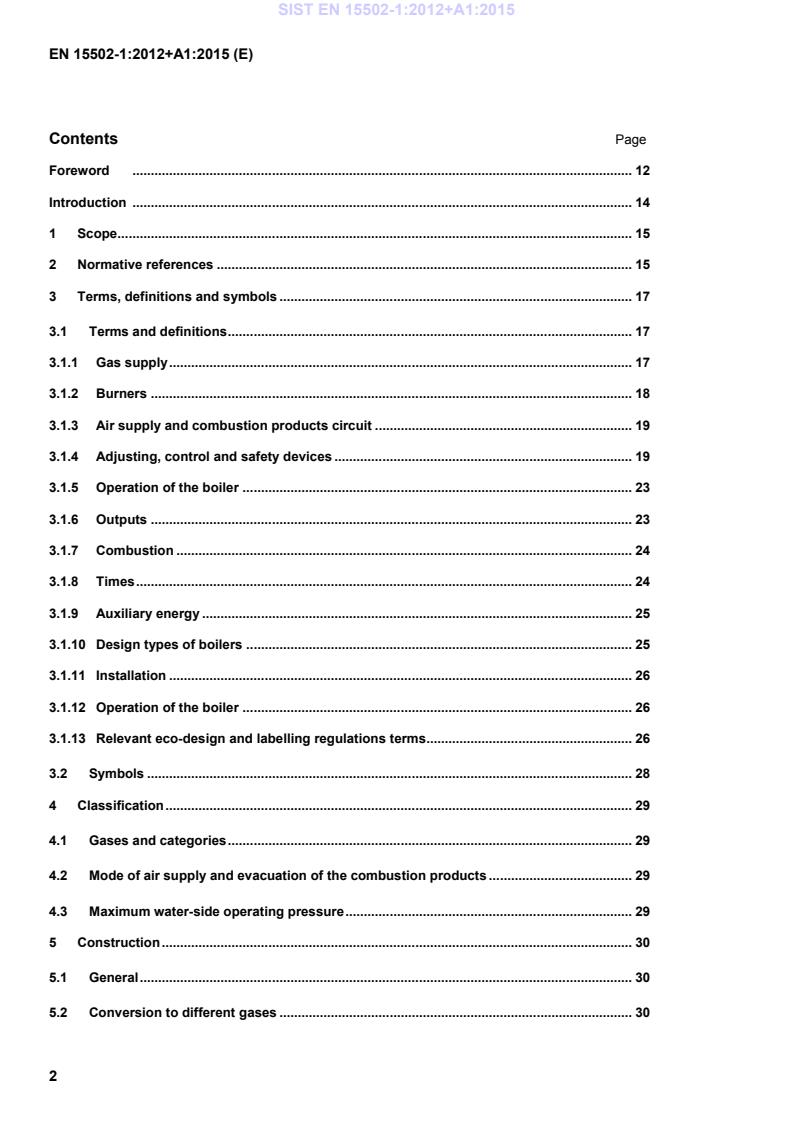
Contents Page
Foreword . 12
Introduction . 14
1 Scope . 15
2 Normative references . 15
3 Terms, definitions and symbols . 17
3.1 Terms and definitions . 17
3.1.1 Gas supply . 17
3.1.2 Burners . 18
3.1.3 Air supply and combustion products circuit . 19
3.1.4 Adjusting, control and safety devices . 19
3.1.5 Operation of the boiler . 23
3.1.6 Outputs . 23
3.1.7 Combustion . 24
3.1.8 Times . 24
3.1.9 Auxiliary energy . 25
3.1.10 Design types of boilers . 25
3.1.11 Installation . 26
3.1.12 Operation of the boiler . 26
3.1.13 Relevant eco-design and labelling regulations terms . 26
3.2 Symbols . 28
4 Classification . 29
4.1 Gases and categories . 29
4.2 Mode of air supply and evacuation of the combustion products . 29
4.3 Maximum water-side operating pressure . 29
5 Construction . 30
5.1 General . 30
5.2 Conversion to different gases . 30
5.3 Materials . 30
5.3.1 General. 30
5.3.2 Materials and thicknesses of walls or tubes with water side operating pressure for
boilers of pressure class-3 . 31
5.3.3 Domestic water connections . 32
5.3.4 Thermal Insulation . 32
5.4 Method of construction . 32
5.4.1 Design . 32
5.4.2 Checking the state of operation . 33
5.4.3 Use and servicing . 33
5.4.4 Connections to the gas and water pipes. 34
5.4.5 Soundness . 34
5.4.6 Supply of combustion air and evacuation of the combustion products . 35
5.4.7 Dampers . 35
5.4.8 Air proving . 35
5.4.9 Gas/air ratio controls . 36
5.4.10 Fan . 36
5.4.11 Drainage . 36
5.4.12 Operational safety in the event of failure of the auxiliary energy . 36
5.4.13 Special provision for Low Temperature Boilers and Condensing Boilers . 36
5.5 Burners . 37
5.6 Pressure test points . 38
5.7 Requirements for the application of control and safety devices . 38
5.7.1 General. 38
5.7.2 djusters and range-rating devices . 38
5.7.3 Gas circuit . 39
5.7.4 Gas pressure regulator . 40
5.7.5 Ignition devices . 40
5.7.6 Flame supervision devices . 41
5.7.7 Gas/air ratio control tubes . 42
5.7.8 Thermostats and water temperature limiting devices. 42
5.7.9 Remote control . 43
5.7.10 Expansion vessel and pressure gauge. 44
5.7.11 Protection against frost for boilers intended to be installed in a partially protected
place . 44
5.7.12 Adjusting, control and safety devices for the domestic hot water circuit . 44
6 Electrical safety . 45
7 Controls. 45
7.1 General . 45
7.2 Detailed specifications . 45
7.3 Thermostats and water temperature limiting devices . 46
7.3.1 General . 46
7.3.2 Construction requirements . 47
7.3.3 Performance . 48
8 Operational requirements . 50
8.1 General . 50
8.1.1 Characteristics of the reference and limit gases . 50
8.1.2 General test conditions . 51
8.2 Soundness . 55
8.2.1 Soundness of the gas circuit . 55
8.2.2 Soundness of the combustion circuit. 55
8.2.3 Soundness of the water circuit . 55
8.2.4 Soundness of the domestic water circuit . 57
8.3 Hydraulic resistance . 57
8.4 Heat inputs and heat output . 57
8.4.1 Determination of the nominal heat input or the maximum and minimum heat input . 57
8.4.2 Adjustment of the heat input by the downstream gas pressure . 59
8.4.3 Ignition rate . 59
8.4.4 Nominal output . 59
8.4.5 Verification of the nominal condensing output . 60
8.4.6 Nominal domestic hot water heat input . 60
8.4.7 Water pressure to obtain the nominal heat input for instantaneous combination
boilers . 60
8.4.8 Obtaining the domestic hot water temperature for instantaneous combination boilers 60
8.4.9 Heating-up time of the domestic hot water . 61
8.5 Limiting temperatures . 61
8.5.1 General. 61
8.5.2 Limiting temperatures of the adjusting, control and safety devices . 62
8.5.3 Limiting temperatures of the side walls, the front and the top . 62
8.5.4 Limiting temperature of the test panels and the floor . 62
8.6 Ignition, cross lighting, flame stability . 63
8.6.1 General. 63
8.6.2 Limit conditions . 63
8.6.3 Special flue conditions. 65
8.6.4 Reduction of the gas rate of the ignition burner . 65
8.7 Reduction of the gas pressure . 66
8.8 Defective closure of the gas valve immediately upstream of the main burner . 66
8.9 Pre-purge . 66
8.10 Functioning of a permanent ignition burner when the fan stops during the standby
time . 66
8.11 Adjustment, control and safety devices . 67
8.11.1 General. 67
8.11.2 Boilers intended to be installed in a partially protected place . 67
8.11.3 Combination Boilers . 67
8.11.4 Control devices . 70
8.11.5 Ignition devices . 70
8.11.6 Flame supervision device . 72
8.11.7 Gas pressure regulator . 75
8.11.8 Thermostats and water temperature limiting devices. 76
8.12 Carbon monoxide. 78
8.12.1 General . 78
8.12.2 Limit conditions . 80
8.12.3 Special conditions . 80
8.12.4 Sooting . 81
8.12.5 Supplementary test for low temperature boilers and condensing boilers . 82
8.13 NO . 82
x
8.13.1 Requirement . 82
8.13.2 Test methods . 83
8.13.3 NO requirement for Eco-design regulation . 85
x
8.14 Special provisions for boilers intended to be installed in a partially protected place . 86
8.14.1 Frost protection system for boilers intended to be installed in a partially protected
place . 86
8.14.2 Protection against the ingress of rain . 86
8.15 Formation of condensate . 86
8.16 Temperature of combustion products . 87
8.17 Sound power level . 87
9 Useful efficiencies . 88
9.1 General . 88
9.1.1 Use of correction formulae . 88
9.1.2 Use of the general test conditions . 88
9.2 Useful efficiency at the nominal heat input . 88
9.2.1 Requirements . 88
9.2.2 Tests . 89
9.3 Useful efficiency at part load . 90
9.3.1 Requirements . 90
9.3.2 Tests . 90
9.4 Losses of combination boilers . 96
9.4.1 Requirements for losses of combination boilers . 96
9.4.2 Test of losses of combination boilers . 96
9.5 Compliance with the eco-design regulation for efficiency. 98
9.5.1 Requirements for seasonal space heating energy efficiency . 98
9.5.2 Calculations for seasonal space heating energy efficiency . 99
9.5.3 Useful efficiency for nominal heat output > 70kW and ≤ 400kW . 100
9.5.4 Water heating energy efficiency for combined heaters . 101
9.6 Compliance with the Labelling delegated regulation for efficiency . 101
9.6.1 Seasonal space heating energy efficiency classes . 101
9.6.2 Annual energy consumption of space heating . 102
9.6.3 Water heating energy efficiency classes . 102
9.6.4 Annual Fuel consumption of water heating . 103
9.6.5 Annual electricity consumption . 103
10 Electric auxiliary energy . 103
10.1 General . 103
10.2 System boundaries. 103
10.3 Auxiliary energy at nominal heat input . 104
10.4 Auxiliary energy at part load . 105
10.5 Auxiliary energy at stand-by . 105
10.6 Auxiliary electricity consumption measurements required for eco-design and
labelling regulations . 105
10.6.1 General. 105
10.6.2 System boundaries . 105
10.6.3 Auxiliary electricity consumption [kW] at nominal heat input . 106
10.6.4 Auxiliary electricity consumption at part load [kW] . 106
10.6.5 Auxiliary electricity consumption at stand by [kW] . 106
11 Risk assessment . 106
12 Marking and instructions . 107
12.1 Boiler marking . 107
12.1.1 Data plate . 107
12.1.2 Supplementary markings . 108
12.1.3 Packaging . 108
12.1.4 Warnings on the boiler and the packaging . 108
12.1.5 Other information . 108
12.2 Instructions . 108
12.2.1 Technical instructions . 108
12.2.2 User’s instructions. 111
12.2.3 Conversion instructions . 111
12.3 Presentation . 112
12.4 Supplementary marking and instructions in the case of boilers to be installed in
partially protected places . 112
12.4.1 General information . 112
12.4.2 Warning on the boilers and the packaging . 112
12.4.3 Technical instructions . 112
13 Requirements for Eco-design Regulation (No 813/2013) and Energy Labelling
Regulation (No 811/2013) . 119
13.1 Requirements for product information for the Eco-design Regulation (Annex II,
Regulation No 813/2013) . 119
13.2 Energy label for Energy Labelling Regulation No 811/2013 Energy Label . 119
13.2.1 Boiler energy label . 119
13.2.2 Additional energy label for boilers intended to be used in a package . 119
13.2.3 Energy label for a package of space heater and temperature control and/or solar
device . 119
13.3 Product fiche for Energy Labelling Regulation 811/2013 . 119
13.3.1 General . 119
13.3.2 Boilers . 120
13.3.3 Combination boilers . 120
13.3.4 Packages of space heater and temperature control and/or solar device . 121
13.3.5 Packages of combination heater and temperature control and/or solar device . 121
13.3.6 Technical documentation for Energy Labelling Regulation No 811/2013 . 122
Annex A (informative) Properties of carbon and stainless steels . 123
Annex B (normative) Minimum requirements for cast iron . 124
Annex C (normative) Parts in aluminium and aluminium alloys . 125
Annex D (normative) Parts in copper or copper alloys . 126
Annex E (normative) Minimum thicknesses for rolled parts . 127
Annex F (normative) Nominal minimum thicknesses of boiler sections of cast materials
under water pressure . 128
Annex G (normative) Parameters for welded joints and welding processes . 129
Annex H (informative) Composition of the gas circuit . 134
H.1 General . 134
H.2 Boilers with permanent ignition burner or alternating ignition burner or leakage control
device or with pre-purge . 134
H.2.1 Heat inputs not exceeding 70 kW . 134
H.2.2 Heat inputs exceeding 70 kW but not exceeding 150 kW . 135
H.2.3 Heat inputs exceeding 150 kW but not exceeding 300 kW . 136
H.2.4 Heat Inputs exceeding 300 kW but not exceeding 1 000 kW . 137
H.3 Boilers without permanent ignition burner or alternating ignition burner, without
leakage control device and without pre-purge . 138
H.3.1 Heat inputs up to 70 kW . 138
H.3.2 Heat inputs exceeding 70 kW but not exceeding 150 kW . 139
H.3.3 Heat inputs exceeding 150 kW but not exceeding 300 kW . 140
H.3.4 Heat inputs exceeding 300 kW but not exceeding 1000 kW . 141
Annex I (informative) Compilation of the test conditions for the various gas families . 142
Annex J (informative) Calculation of conversions of NOx . 144
Annex K (informative) Example of calculation of the weighting factors NOx . 145
Annex L (informative) Practical method of calibrating the test rig to enable the heat loss
Dp to be determined . 147
Annex M (informative) Means of determining the ignition time at full rate . 148
Annex N (informative) Determination of the heat losses from the test rig of the indirect
method and the contributions of the circulating pump of the test rig . 149
Annex O (informative) Example of a risk assessment method . 150
Annex P (informative) Examples of risk assessment with a method described in Annex O . 153
P.1 Introduction . 153
P.2 Risks . 153
P.3 Risk assessment . 153
Annex Q (informative) Realisation of a protective measure . 158
Annex R (informative) Overall classification of a basic risk . 160
Annex S (informative) Not exhaustive list of classification examples . 163
Annex T (normative) Correction for the determined efficiency in the low water temperature
test of low temperature boilers (LTB) and condensing boilers (CB) . 165
Annex U (informative) Use of test gases . 166
U.1 Boilers within a range . 166
U.2 Guidance on the use of test gases . 166
Annex V (informative) Standards intended to be replaced by this standard in combination
with the relevant part 2 . 167
Annex W (informative) Alternative Method for the determination of the nominal heat
input or the maximum and minimum heat input (according to 8.4.1) for appliances using
a pneumatic gas/air ratio control system . 169
Annex AA (normative) Product Information related to Eco-design Regulation and Labelling
Regulation . 170
AA.1 Product information – technical parameters required by the ErP Regulation
(813/2013) . 170
AA.2 Product information – technical parameters required by the Labelling Regulation
(811/2013) . 171
Annex BB (normative) Product label for boilers required by the Labelling Regulation
811/2013 . 172
BB.1 Boiler space heaters in seasonal space heating efficiency classes A++ to G . 172
BB.2 Boiler combination space heaters in seasonal space heating efficiency classes
A++ to G and in water heating energy efficiency classes A to G . 172
BB.3 Boiler space heaters in seasonal space heating efficiency classes A+++ to D
(from 26-9-2019) . 173
BB.4 Boiler combination space heaters in seasonal space heating efficiency classes
A+++ to D and in water heating energy efficiency classes A+ to F (from 26-9-2019) . 173
BB.5 The design of the label for boiler space heaters. 174
BB.6 The design of the label for combination boilers . 174
BB.7 Water heating load profiles of combination heaters . 175
Annex CC (normative) Product label for packages required by the Labelling Regulation
811/2013 . 176
CC.1 PACKAGES OF SPACE HEATER, TEMPERATURE CONTROL AND SOLAR DEVICE . 176
CC.2 PACKAGES OF COMBINATION HEATER, TEMPERATURE CONTROL AND
SOLAR DEVICE . 176
CC.3 Design of the label for packages of space heater, temperature control and solar
device 177
CC.4 Design of the label for packages of combination heater, temperature control and
solar device . 177
Annex DD (normative) Calculation of the seasonal space heating energy efficiency of a
package of space heater, temperature control and solar . 179
DD.1 Calculation of the seasonal space heating energy efficiency of a package . 179
DD.2 Classes of the temperature controls . 179
DD.3 Weighting of the preferential boiler or preferential combination boiler and
supplementary heater . 180
DD.4 Calculation of the water heating efficiency of a package . 180
Annex ZA (informative) Clauses of this European Standard addressing essential
requirements or provisions of EU Directive 2009/142/EC, "Directive relating to appliances
burning gaseous fuels (codified version)" (GAD) . 181
Annex ZB (informative) Clauses of this European Standard addressing the methods for the
verification of the efficiency of the EU Directive 92/42/EEC, relating to the efficiency of new
hot boilers with an output of 4 – 400 kW . 184
Annex ZC (informative) Relationship between this European Standard and the
Requirements of COMMISSION REGULATION (EU) No 813/2013 of 2 August 2013
implementing Directive 2009/125/EC of the European Parliament and of the Council
with regard to ecodesign requirements for space heaters and combination heaters . 185
Annex ZD (informative) Relationship between this European Standard and the
Requirements of COMMISSION DELEGATED REGULATION (EU) No 811/2013 of 18
February 2013 supplementing Directive 2010/30/EU of the European Parliament and of
the Council with regard to the energy labelling of space heaters, combination heaters,
packages of space heater, temperature control and solar device and packages of
combination heater, temperature control and solar device . 186
Bibliography . 188
Foreword
This document (EN 15502-1:2012+A1:2015) has been prepared by Technical Committee CEN/TC 109
“Central heating boilers using gaseous fuels”, the secretariat of which is held by NEN.
This European Standard shall be given the status of a national standard, either by publication of an identical
text or by endorsement, at the latest by December 2015, and conflicting national standards shall be withdrawn
at the latest by December 2015.
Attention is drawn to the possibility that some of the elements of this document may be the subject of patent
rights. CEN [and/or CENELEC] shall not be held responsible for identifying any or all such patent rights.
This document includes Amendment 1, approved by CEN on 2015-04-24.
The start and finish of text introduced or altered by amendment is indicated in the text by tags ! ".
This document supersedes EN 15502-1:2012.
!The main technical changes compared to EN 15502-1:2012 are the following:
— Technical changes related to ecodesign and energy labelling:in:
— Clause 8, Operational requirements;
— Clause 9, Useful efficiencies;
— Clause 10, Electric auxiliary energy.
— Additions related to ecodesign and energy labelling:
— Clause 13, Requirements for Eco-design Regulation (No 813/2013) and Energy Labelling Regulation
(No 811/2013);
— AnnexAA;
— Annex BB;
— Annex CC;
— Annex DD;
— Annex ZC;
— Annex ZD.
— Changes to solve the inconsistencies identified in the letter 13-215 'GAD 2009 142 EC issues of 7 Nov
2013 by Mr Gwenole Cozogou of the commission to CEN:
— Annex ZA."
This document has been prepared under mandates M89/6 and M066, given to CEN by the European
Commission and the European Free Trade Association, and supports essential requirements as meant in
article 3 of EU Directive 2009/142/EC, relating to appliances burning gaseous fuels and the verification
methods valid for production and measurements, as meant in article 5.2 of EU Directive 92/42/EEC, relating to
the efficiency requirements for new hot water boilers fired with liquid or gaseous fuels, with an output of 4 –
400 kW.
!This document has been prepared under mandate M/495, given to CEN by the European Commission and
the European Free Trade Association to provide a means of conforming to:
- requirements of Commission Regula
...
Questions, Comments and Discussion
Ask us and Technical Secretary will try to provide an answer. You can facilitate discussion about the standard in here.
Loading comments...