

SIST EN 301 178-1 V1.4.1:2012
(Main)Electromagnetic compatibility and Radio spectrum Matters (ERM) - Portable Very High Frequency (VHF) radiotelephone equipment for the maritime mobile service operating in the VHF bands (for non-GMDSS applications only) - Part 1: Technical characteristics and methods of measurement
- Abstract
To implement transmit timeout timer and amend high temperature test procedure as a result
- Status
- Published
- Publication Date
- 12-Jan-2012
- Technical Committee
- MOC - Mobile Communications
- Current Stage
- 6060 - National Implementation/Publication (Adopted Project)
- Start Date
- 10-Jan-2012
- Due Date
- 16-Mar-2012
- Completion Date
- 13-Jan-2012
Buy Documents
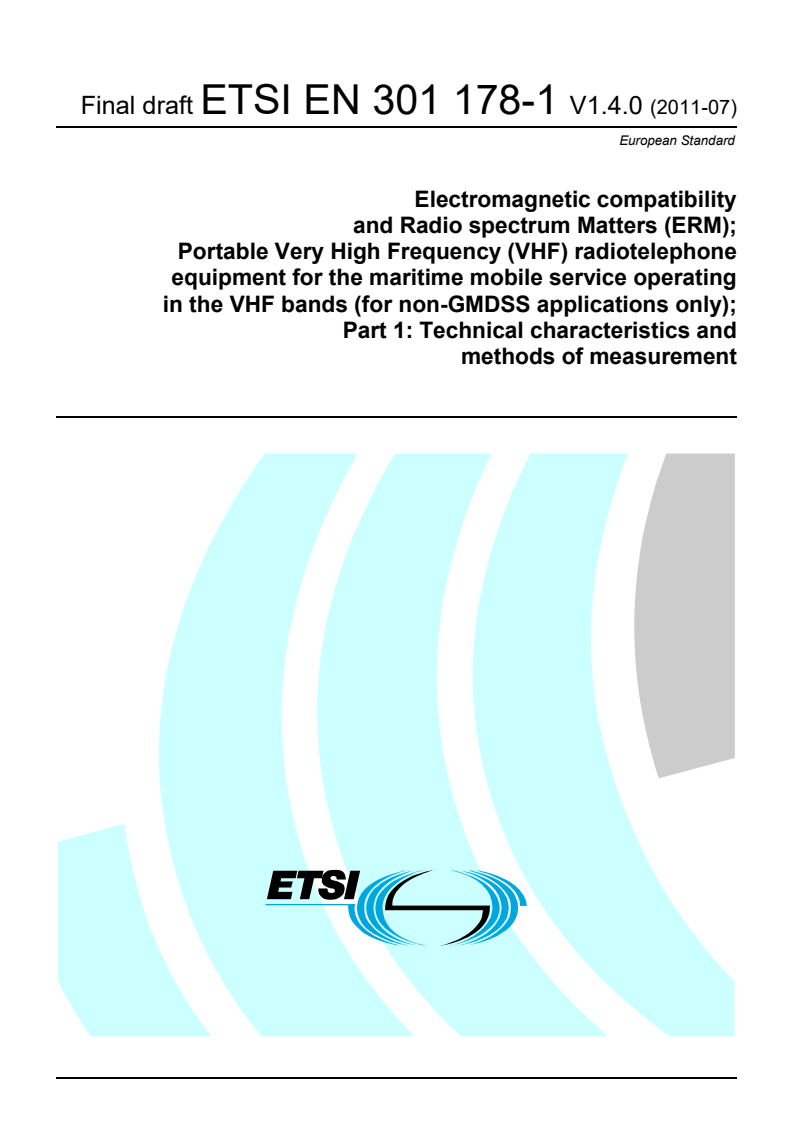
en_30117801v010400o - Electromagnetic compatibility and Radio spectrum Matters (ERM); Portable Very High Frequency (VHF) radiotelephone equipment for the maritime mobile service operating in the VHF bands (for non-GMDSS applications only); Part 1: Technical characteristics and methods of measurement
en_30117801v010401p - Electromagnetic compatibility and Radio spectrum Matters (ERM); Portable Very High Frequency (VHF) radiotelephone equipment for the maritime mobile service operating in the VHF bands (for non-GMDSS applications only); Part 1: Technical characteristics and methods of measurement


SIST EN 301 178-1 V1.4.1:2012 is the Slovenian adoption of ETSI EN 301 178-1 for portable Very High Frequency (VHF) radiotelephone equipment used in the maritime mobile service, for non-Global Maritime Distress and Safety System (GMDSS) applications only. It specifies the technical characteristics and methods of measurement for equipment operating in the VHF bands, so designers, test labs, and buyers can check whether a portable set is built and performs as required.
This part focuses on the equipment itself and on how to test it. It covers both 25 kHz channels and equipment that also uses 12.5 kHz channels.
What does SIST EN 301 178-1 V1.4.1:2012 specify?
SIST EN 301 178-1 V1.4.1:2012 sets minimum technical characteristics, operational features, and measurement methods for portable maritime VHF radiotelephones that do not provide distress and safety functions. The document is organized into clauses 1 to 9, with normative Annexes A and B.
| Annex | What it covers |
|---|---|
| Annex A | Measuring receiver requirements for adjacent channel power measurement |
| Annex B | Radiated measurement sites and arrangements |
The scope is limited to equipment operating on maritime mobile service bands using 25 kHz channels, or both 25 kHz and 12.5 kHz channels. The foreword also places it in a two-part series, with Part 2 covering the harmonized essential requirements of article 3.2 of the R&TTE Directive.
What are the key requirements of SIST EN 301 178-1 V1.4.1:2012?
Clause 4 sets the main construction and operating rules. The equipment must be suitable for shipboard use, have clear controls and labelling, and provide technical documentation. This matters because the standard is not only about RF performance - it also checks whether the handset can be used safely and consistently on board.
Clause 4 also sets channel and function restrictions. The equipment must work on the channels defined in Radio Regulations appendix 18, prevent non-DSC use of channel 70, prevent non-AIS use of channels AIS1 and AIS2, and block unauthorized additional channels when required. In practice, this means the user cannot accidentally enable functions or channels that are reserved for other maritime uses.
Clause 4.2 and 5.1 require practical user controls and timing behavior. The set must indicate the selected channel, mark channel 16 distinctly, provide a push-to-talk control with a transmission time limit of 5 min, and switch channels within 5 s. Transmission must also stop if the synthesizer is out of lock or while channel switching is in progress.
Clause 6 defines how measurements are made. It fixes the normal test modulation, test channels, RF connections, artificial antenna, and measurement uncertainty handling. For testers, this is important because results are only comparable when the same test conditions are used.
Clause 6.12 and 7.4 include the environmental sequence and the high-temperature procedure. The equipment is tested at -15 °C and +55 °C, and the upper-temperature procedure explicitly uses the transmit timeout timer before the equipment returns to standby. This links the environmental test to the operating controls the user actually has.
Clauses 8 and 9 set the transmitter and receiver limits. The transmitter is checked for frequency error, carrier power, frequency deviation, audio response, harmonic distortion, adjacent channel power, spurious emissions, residual modulation, and transient frequency behavior. The receiver is checked for audio output, sensitivity, selectivity, rejection of unwanted signals, spurious emissions, noise and hum, squelch operation, and squelch hysteresis. These are the core performance checks that tell a buyer or lab whether the radio will stay on frequency, stay intelligible, and resist interference.
What terms does SIST EN 301 178-1 V1.4.1:2012 define?
- Block - to inhibit a function so the user cannot access it from the interface.
- Detachable antenna - an antenna fixed with a connector and removable by the user.
- Integral antenna - an antenna permanently fixed to the equipment and not removable by the user.
- G3E - phase modulation, described here as frequency modulation with 6 dB/octave pre-emphasis for speech.
- Performance check - a check of transmitter carrier power, transmitter frequency, and receiver sensitivity.
- SINAD - Signal + Noise + Distortion divided by Noise + Distortion; used to judge receiver performance.
- OATS - Open Area Test Site, one of the approved radiated-measurement sites.
Who uses SIST EN 301 178-1 V1.4.1:2012?
This standard is used by manufacturers of portable maritime VHF radiotelephones, test laboratories, certification teams, and technical buyers. It is also relevant to quality managers who need a test plan for RF performance, environmental robustness, and user controls.
It matters to ship operators and marine equipment specifiers because the document separates non-GMDSS portable radios from distress and safety equipment, and it checks channel access, output power, squelch behavior, and resistance to misuse.
What changed in SIST EN 301 178-1 V1.4.1:2012 from the previous edition?
This version implements a transmit timeout timer and amends the high-temperature test procedure accordingly.
Which standards are used with SIST EN 301 178-1 V1.4.1:2012?
The normative references provide the channel plan, operating rules, test methods, and measurement support used by this standard:
- ITU Radio Regulations, appendix 18 - VHF maritime channel table and channel assignments.
- ITU-T Recommendation E.161 - keypad digit and symbol arrangement.
- ITU-R Recommendation M.493-13 - Digital Selective Calling (DSC) system.
- ITU-R Recommendation M.541-9 - operational procedures for DSC equipment.
- ETSI EN 300 225 - related portable VHF radiotelephone requirements for survival craft.
- ITU-T Recommendation O.41 - psophometric telephone filtering network for SINAD-related measurements.
- ETSI TR 100 028-1 - measurement uncertainty method.
- ITU-R Recommendation M.1084-4 - guidance for 12.5 kHz channel operation.
- ANSI C63.5 - antenna calibration for radiated measurements.
- ETSI TR 102 273 series - radiated measurement site methods and uncertainty evaluation.
What does the SIST EN 301 178-1 V1.4.1:2012 document contain?
The document contains detailed test clauses for construction, controls, environmental endurance, transmitter performance, and receiver performance. It also includes measurement conditions, uncertainty limits, and the test channels to be used.
Annex A specifies the measuring receiver needed for adjacent channel power, including filter shape and attenuation behavior. Annex B describes anechoic chambers, chambers with ground planes, and OATS setups, plus how to place the equipment, antenna, and substitution antenna during radiated tests.
Several figures and tables support the methods, including the frequency-deviation and audio-response plots, the transient-frequency measurement arrangement, and the timing template for transmitter switching behavior. In practice, these parts are used for design verification, type testing, and laboratory conformance testing.
Buy Documents
en_30117801v010400o - Electromagnetic compatibility and Radio spectrum Matters (ERM); Portable Very High Frequency (VHF) radiotelephone equipment for the maritime mobile service operating in the VHF bands (for non-GMDSS applications only); Part 1: Technical characteristics and methods of measurement
en_30117801v010401p - Electromagnetic compatibility and Radio spectrum Matters (ERM); Portable Very High Frequency (VHF) radiotelephone equipment for the maritime mobile service operating in the VHF bands (for non-GMDSS applications only); Part 1: Technical characteristics and methods of measurement
Get Certified
Connect with accredited certification bodies for this standard

DNV
DNV is an independent assurance and risk management provider.

Lloyd's Register
Lloyd's Register is a global professional services organisation specialising in engineering and technology.

FSC International
Forest Stewardship Council certification.
Sponsored listings
Frequently Asked Questions
SIST EN 301 178-1 V1.4.1:2012 is a standard published by the Slovenian Institute for Standardization (SIST). Its full title is "Electromagnetic compatibility and Radio spectrum Matters (ERM) - Portable Very High Frequency (VHF) radiotelephone equipment for the maritime mobile service operating in the VHF bands (for non-GMDSS applications only) - Part 1: Technical characteristics and methods of measurement". This standard covers: To implement transmit timeout timer and amend high temperature test procedure as a result
To implement transmit timeout timer and amend high temperature test procedure as a result
SIST EN 301 178-1 V1.4.1:2012 is classified under the following ICS (International Classification for Standards) categories: 33.060.99 - Other equipment for radiocommunications; 33.100.01 - Electromagnetic compatibility in general; 47.020.70 - Navigation and control equipment. The ICS classification helps identify the subject area and facilitates finding related standards.
SIST EN 301 178-1 V1.4.1:2012 is available in PDF format for immediate download after purchase. The document can be added to your cart and obtained through the secure checkout process. Digital delivery ensures instant access to the complete standard document.
Standards Content (Sample)
Final draft ETSI EN 301 178-1 V1.4.0 (2011-07)
European Standard
Electromagnetic compatibility
and Radio spectrum Matters (ERM);
Portable Very High Frequency (VHF) radiotelephone
equipment for the maritime mobile service operating
in the VHF bands (for non-GMDSS applications only);
Part 1: Technical characteristics and
methods of measurement
2 Final draft ETSI EN 301 178-1 V1.4.0 (2011-07)
Reference
REN/ERM-TG26-095-1
Keywords
maritime, radio, VHF
ETSI
650 Route des Lucioles
F-06921 Sophia Antipolis Cedex - FRANCE
Tel.: +33 4 92 94 42 00 Fax: +33 4 93 65 47 16
Siret N° 348 623 562 00017 - NAF 742 C
Association à but non lucratif enregistrée à la
Sous-Préfecture de Grasse (06) N° 7803/88
Important notice
Individual copies of the present document can be downloaded from:
http://www.etsi.org
The present document may be made available in more than one electronic version or in print. In any case of existing or
perceived difference in contents between such versions, the reference version is the Portable Document Format (PDF).
In case of dispute, the reference shall be the printing on ETSI printers of the PDF version kept on a specific network drive
within ETSI Secretariat.
Users of the present document should be aware that the document may be subject to revision or change of status.
Information on the current status of this and other ETSI documents is available at
http://portal.etsi.org/tb/status/status.asp
If you find errors in the present document, please send your comment to one of the following services:
http://portal.etsi.org/chaircor/ETSI_support.asp
Copyright Notification
No part may be reproduced except as authorized by written permission.
The copyright and the foregoing restriction extend to reproduction in all media.
© European Telecommunications Standards Institute 2011.
All rights reserved.
TM TM TM
DECT , PLUGTESTS , UMTS and the ETSI logo are Trade Marks of ETSI registered for the benefit of its Members.
TM
3GPP and LTE™ are Trade Marks of ETSI registered for the benefit of its Members and
of the 3GPP Organizational Partners.
GSM® and the GSM logo are Trade Marks registered and owned by the GSM Association.
ETSI
3 Final draft ETSI EN 301 178-1 V1.4.0 (2011-07)
Contents
Intellectual Property Rights . 7
Foreword . 7
1 Scope . 8
2 References . 8
2.1 Normative references . 8
2.2 Informative references . 9
3 Definitions, symbols and abbreviations . 9
3.1 Definitions . 9
3.2 Symbols . 9
3.3 Abbreviations . 9
4 General and operational requirements . 10
4.1 Construction . 10
4.2 Controls and indicators . 10
4.3 Microphone and loudspeaker . 11
4.4 Safety precautions . 11
4.5 Labelling. 11
5 Technical requirements . 12
5.1 Switching time . 12
5.2 Class of emission and modulation characteristics . 12
6 General conditions of measurement . 12
6.1 Arrangements for RF connections to the equipment . 12
6.1.1 RF connections to integral antenna equipment . 12
6.1.2 RF connection to equipment with a detachable antenna . 12
6.2 Arrangements for test signals applied to the receiver input . 12
6.3 Squelch . 12
6.4 Normal test modulation . 12
6.5 Artificial antenna . 13
6.6 Arrangements for test signals applied to the transmitter input . 13
6.7 Test channels . 13
6.8 Measurement uncertainty and interpretation of the measured results . 13
6.8.1 Measurement uncertainty . 13
6.8.2 Interpretation of the measurement results . 13
6.9 Test conditions, power sources and ambient te mperat ures . 14
6.9.1 Normal and extreme test conditions. 14
6.9.2 Test power source . 14
6.10 Normal test conditions . 14
6.10.1 Normal temperature and humidity . 14
6.10.2 Normal power sources . 14
6.10.2.1 Battery power source. 14
6.10.2.2 Other power sources . 14
6.11 Extreme test conditions . 14
6.11.1 Extreme temperatures . 15
6.11.2 Extreme values of test power sources . 15
6.11.2.1 Battery power source. 15
6.11.2.2 Other power sources . 15
6.12 Procedure for tests at extreme temperatures . 15
7 Environmental tests . 15
7.1 Procedure . 15
7.2 Performance check . 15
7.3 Drop test . 16
7.3.1 Definition . 16
7.3.2 Method of measurement . 16
ETSI
4 Final draft ETSI EN 301 178-1 V1.4.0 (2011-07)
7.3.3 Requirement . 16
7.4 Temperature tests . 16
7.4.1 Definition . 16
7.4.2 Dry heat . 16
7.4.2.1 Definition . 16
7.4.2.2 Method of measurement . 16
7.4.2.3 Requirement . 16
7.4.3 Damp heat . 17
7.4.3.1 Definition . 17
7.4.3.2 Method of measurement . 17
7.4.3.3 Requirement . 17
7.4.4 Low temperature cycle . 17
7.4.4.1 Definition . 17
7.4.4.2 Method of measurement . 17
7.4.4.3 Requirement . 17
8 Transmitter . 17
8.1 Frequency error . 17
8.1.1 Definition . 17
8.1.2 Method of measurement . 18
8.1.3 Limits . 18
8.2 Carrier power . 18
8.2.1 Definitions . 18
8.2.2 Method of measurement . 18
8.2.3 Limits, Normal and extreme test conditions . 18
8.3 Frequency deviation . 18
8.3.1 Definition . 18
8.3.2 Maximum permissible frequency deviation . 18
8.3.2.1 Method of measurement . 18
8.3.2.2 Limits . 19
8.3.3 Reduction of frequency deviation at modulation frequencies above 3 kHz . 19
8.3.3.1 Method of measurement . 19
8.3.3.2 Limits . 19
8.4 Sensitivity of the modulator, including microphone . 20
8.4.1 Definition . 20
8.4.2 Method of measurement . 20
8.4.3 Limits . 20
8.5 Audio frequency response . 20
8.5.1 Definition . 20
8.5.2 Method of measurement . 21
8.5.3 Limit . 21
8.6 Audio frequency harmonic distortion of the emission. 22
8.6.1 Definition . 22
8.6.2 Method of measurement . 22
8.6.2.1 Normal test conditions . 22
8.6.2.2 Extreme test conditions . 22
8.6.3 Limits . 22
8.7 Adjacent channel power . 22
8.7.1 Definition . 22
8.7.2 Method of measurement . 22
8.7.3 Limits . 23
8.8 Conducted spurious emissions conveyed to the antenna . 23
8.8.1 Definition . 23
8.8.2 Method of measurement . 23
8.8.3 Limit . 23
8.9 Cabinet radiation and conducted spurious emissions other than those conveyed to the antenna . 23
8.9.1 Definitions . 23
8.9.2 Method of measurement . 24
8.9.3 Limits . 25
8.10 Residual modulation of the transmitter . 25
8.10.1 Definition . 25
8.10.2 Method of measurement . 25
ETSI
5 Final draft ETSI EN 301 178-1 V1.4.0 (2011-07)
8.10.3 Limit . 25
8.11 Transient frequency behaviour of the transmitter . 25
8.11.1 Definitions . 25
8.11.2 Method of measurement . 26
8.11.3 Limits . 27
9 Receiver . . 29
9.1 Harmonic distortion and rated audio frequency output power . 29
9.1.1 Definition . 29
9.1.2 Methods of measurement . 29
9.1.3 Limits . 29
9.2 Audio frequency response . 29
9.2.1 Definition . 29
9.2.2 Method of measurement . 29
9.2.3 Limits . 30
9.3 Maximum usable sensitivity . 30
9.3.1 Definition . 30
9.3.2 Method of measurement . 31
9.3.3 Limits . 31
9.4 Co-channel rejection. 31
9.4.1 Definition . 31
9.4.2 Method of measurement . 31
9.4.3 Limit . 31
9.5 Adjacent channel selectivity . 32
9.5.1 Definition . 32
9.5.2 Method of measurement . 32
9.5.3 Limits . 32
9.6 Spurious response rejection . 32
9.6.1 Definition . 32
9.6.2 Method of measurement . 32
9.6.3 Limit . 33
9.7 Intermodulation response . 33
9.7.1 Definition . 33
9.7.2 Method of measurement . 33
9.7.3 Limit . 33
9.8 Blocking or desensitization . 33
9.8.1 Definition . 33
9.8.2 Method of measurement . 33
9.8.3 Limit . 34
9.9 Conducted spurious emissions . 34
9.9.1 Definition . 34
9.9.2 Method of measurement . 34
9.9.3 Limit . 34
9.10 Radiated spurious emissions. 34
9.10.1 Definition . 34
9.10.2 Method of measurements . 34
9.10.3 Limit . 35
9.11 Receiver noise and hum level . 35
9.11.1 Definition . 35
9.11.2 Method of measurement . 35
9.11.3 Limit . 36
9.12 Squelch operation . 36
9.12.1 Definition . 36
9.12.2 Method of measurement . 36
9.12.3 Limits . 36
9.13 Squelch hysteresis . 37
9.13.1 Definition . 37
9.13.2 Method of measurement . 37
9.13.3 Limit . 37
Annex A (normative): Measuring receiver for adjacent channel power measurement . 38
A.1 Power measuring receiver specification . 38
ETSI
6 Final draft ETSI EN 301 178-1 V1.4.0 (2011-07)
A.1.1 IF filter . 38
A.1.2 Attenuation indicator . 39
A.1.3 Rms value indicator . 39
A.1.4 Oscillator and amplifier . 39
Annex B (normative): Radiated measurement . 40
B.1 Test sites and general arrangements for measurements involving the use of radiated fields . 40
B.1.1 Anechoic chamber . 40
B.1.2 Anechoic chamber with a ground plane . 41
B.1.3 OATS . 42
B.1.4 Test antenna . 43
B.1.5 Substitution antenna . 43
B.1.6 Measuring antenna . 44
B.2 Guidance on the use of radiation test sites . 44
B.2.1 Verification of the test site . 44
B.2.2 Preparation of the EUT . 44
B.2.3 Power supplies to the EUT . 44
B.2.4 Volume control setting for analogue speech tests . 44
B.2.5 Range length . 45
B.2.6 Site preparation . 45
B.3 Coupling of signals . 46
B.3.1 General . 46
B.3.2 Data signals . 46
B.3.3 Speech and analogue signals . 46
B.3.3.1 Acoustic coupler description. 46
B.3.3.2 Calibration . 47
History . 48
ETSI
7 Final draft ETSI EN 301 178-1 V1.4.0 (2011-07)
Intellectual Property Rights
IPRs essential or potentially essential to the present document may have been declared to ETSI. The information
pertaining to these essential IPRs, if any, is publicly available for ETSI members and non-members, and can be found
in ETSI SR 000 314: "Intellectual Property Rights (IPRs); Essential, or potentially Essential, IPRs notified to ETSI in
respect of ETSI standards", which is available from the ETSI Secretariat. Latest updates are available on the ETSI Web
server (http://ipr.etsi.org).
Pursuant to the ETSI IPR Policy, no investigation, including IPR searches, has been carried out by ETSI. No guarantee
can be given as to the existence of other IPRs not referenced in ETSI SR 000 314 (or the updates on the ETSI Web
server) which are, or may be, or may become, essential to the present document.
Foreword
This final draft European Standard (EN) has been produced by ETSI Technical Committee Electromagnetic
compatibility and Radio spectrum Matters (ERM), and is now submitted for the ETSI standards One-step Approval
Procedure.
The present document is part 1 of a multi-part deliverable covering the Electromagnetic compatibility and Radio
spectrum Matters (ERM); Portable Very High Frequency (VHF) radiotelephone equipment for the maritime mobile
service operating in the VHF bands (for non-GMDSS applications only), as identified below:
Part 1: "Technical characteristics and methods of measurement";
Part 2: "Harmonized EN covering essential requirements of article 3.2 of the R&TTE Directive".
Proposed national transposition dates
Date of latest announcement of this EN (doa): 3 months after ETSI publication
Date of latest publication of new National Standard
or endorsement of this EN (dop/e): 6 months after doa
Date of withdrawal of any conflicting National Standard (dow): 6 months after doa
ETSI
8 Final draft ETSI EN 301 178-1 V1.4.0 (2011-07)
1 Scope
The present document states the minimum technical characteristics and methods of measurement required for portable
Very High Frequency (VHF) radiotelephones not providing maritime distress and safety communications functions
(i.e. not forming part of the Global Maritime Distress and Safety System (GMDSS)) operating in certain frequency
bands allocated to the maritime mobile service using either 25 kHz or 25 kHz and 12,5 kHz channels.
The present document also specifies technical characteristics, methods of measurement and required test results.
2 References
References are either specific (identified by date of publication and/or edition number or version number) or
non-specific. For specific references, only the cited version applies. For non-specific references, the latest version of the
reference document (including any amendments) applies.
Referenced documents which are not found to be publicly available in the expected location might be found at
http://docbox.etsi.org/Reference.
NOTE: While any hyperlinks included in this clause were valid at the time of publication, ETSI cannot guarantee
their long term validity.
2.1 Normative references
The following referenced documents are necessary for the application of the present document.
[1] ITU Radio Regulations (2008), appendix 18: "Table of transmitting frequencies in the VHF
maritime mobile band".
[2] ITU-T Recommendation E.161 (2001): "Arrangement of digits, letters and symbols on telephones
and other devices that can be used for gaining access to a telephone network".
[3] ITU-R Recommendation M.493-13 (2009): "Digital selective-calling system for use in the
maritime mobile service".
[4] ITU-R Recommendation M.541-9 (2004): "Operational procedures for the use of digital selective-
calling equipment in the maritime mobile service".
[5] ETSI EN 300 225: "Electromagnetic compatibility and Radio spectrum Matters (ERM); Technical
characteristics and methods of measurement for survival craft portable VHF radiotelephone
apparatus".
[6] ITU-T Recommendation O.41 (1994): "Psophometer for use on telephone-type circuits".
[7] Void.
[8] ETSI TR 100 028-1 (V1.4.1): "Electromagnetic compatibility and Radio spectrum Matters (ERM);
Uncertainties in the measurement of mobile radio equipment characteristics; Part 1".
[9] ITU-R Recommendation M.1084-4 (2001): "Interim solutions for improved efficiency in the use
of the band 156-174 MHz by stations in the maritime mobile service".
[10] ANSI C63.5 (2006): "American National Standard for Calibration of Antennas Used for Radiated
Emission Measurements in Electro Magnetic Interference".
[11] Void.
[12] ETSI TR 102 273 series (V1.2.1): "Electromagnetic compatibility and Radio spectrum Matters
(ERM); Improvement on Radiated Methods of Measurement (using test site) and evaluation of the
corresponding measurement uncertainties".
ETSI
9 Final draft ETSI EN 301 178-1 V1.4.0 (2011-07)
2.2 Informative references
The following referenced documents are not necessary for the application of the present document but they assist the
user with regard to a particular subject area.
[i.1] IEC 60489-3 Second edition (1988) appendix F: "Methods of measurement for radio equipment
used in the mobile services; Part 3: Receivers for A3E or F3E emissions".
[i.2] ITU-R Recommendation SM.332-4: "Selectivity of receivers".
3 Definitions, symbols and abbreviations
3.1 Definitions
For the purposes of the present document, the following terms and definitions apply:
block: to inhibit a function by making it inaccessible from the user interface
detachable antenna: antenna fixed to the equipment by means of an antenna connector and detachable by the user
G3E: phase-modulation (frequency modulation with a pre-emphasis of 6 dB/octave) for speech
integral antenna: antenna that is permanently fixed to the equipment and not detachable by the user
modulation index: ratio between the frequency deviation and the modulation frequency
performance check: check of:
- the transmitter carrier power and frequency
- receiver sensitivity
3.2 Symbols
For the purposes of the present document, the following symbols apply:
-5
dBA Relative to 2 × 10 Pa
3.3 Abbreviations
For the purposes of the present document, the following abbreviations apply:
ad amplitude difference
DSC Digital Selective Calling
emf electromotive force
EUT Equipment Under Test
fd frequency difference
GMDSS Global Maritime Distress and Safety System
IF Intermediate Frequency
MPFD Maximum Permissible Frequency Deviation
OATS Open Area Test Site
rms root mean square
SINAD (Signal + Noise + Distortion)/(Noise + Distortion)
VHF Very High Frequency
VSWR Voltage Standing Wave Radio
ETSI
10 Final draft ETSI EN 301 178-1 V1.4.0 (2011-07)
4 General and operational requirements
4.1 Construction
The manufacturer shall declare that compliance to the requirements of clause 4 is achieved and shall provide relevant
documentation.
The mechanical and electrical construction and finish of the equipment shall conform in all respects to good engineering
practice, and the equipment shall be suitable for use on board ships.
All controls shall be of sufficient size to enable the usual control functions to be easily performed and the number of
controls should be the minimum necessary for simple and satisfactory operation.
All parts of the equipment to be checked during inspection or maintenance operations shall be readily accessible. The
components shall be readily identifiable.
Technical documentation shall be supplied with the equipment.
The VHF maritime mobile service uses both single-frequency and two-frequency channels. For two-frequency channels
there shall be a separation of 4,6 MHz between the transmitting frequency and the receiving frequency
(see Radio Regulations appendix 18 [1]).
The equipment, which can consist of more than one unit, shall be capable of operating on single frequency and
two-frequency channels with manual control (simplex).
The equipment shall be of a colour which distinguishes it from the portable VHF equipment specified in
EN 300 225 [5].
The equipment shall be able to operate on all channels defined in Radio Regulations, appendix 18 [1], noting in
particular footnotes m) and e).
Additional VHF channels for maritime use outside those defined by appendix 18 to the Radio Regulations may also be
provided where permitted by relevant administrations. These channels shall be clearly identified for use as relating to the
relevant administration(s) and accessed through a positive action(s) for enabling use of these channel(s) but means shall be
provided to block any or all of these additional channels if required by the relevant administration(s).
If 12,5 kHz channels are implemented in the equipment it shall be in accordance with ITU-R Recommendation
M.1084-4 [9].
The equipment shall be so designed that use of channel 70 for purposes other than DSC is prevented
(see ITU-R Recommendations M.493-13 [3] and M.541-9 [4]), and that use of channels AIS1 and AIS2 for purposes other
than AIS is prevented.
Scan or multiple watch may be provided but means shall be provided to block or unblock these functions.
If the equipment is fitted with an auxiliary antenna connector, simultaneous connection of both the auxiliary antenna
and the normal antenna shall be prevented.
It shall not be possible to transmit while any frequency synthesizer used within the transmitter is out of lock.
It shall not be possible to transmit during channel switching operations.
4.2 Controls and indicators
The equipment shall have a channel selector and shall indicate the designator, as shown in Radio Regulations,
appendix 18 [1], of th
...
European Standard
Electromagnetic compatibility
and Radio spectrum Matters (ERM);
Portable Very High Frequency (VHF) radiotelephone
equipment for the maritime mobile service operating
in the VHF bands (for non-GMDSS applications only);
Part 1: Technical characteristics and
methods of measurement
2 ETSI EN 301 178-1 V1.4.1 (2011-11)
Reference
REN/ERM-TG26-095-1
Keywords
maritime, radio, VHF
ETSI
650 Route des Lucioles
F-06921 Sophia Antipolis Cedex - FRANCE
Tel.: +33 4 92 94 42 00 Fax: +33 4 93 65 47 16
Siret N° 348 623 562 00017 - NAF 742 C
Association à but non lucratif enregistrée à la
Sous-Préfecture de Grasse (06) N° 7803/88
Important notice
Individual copies of the present document can be downloaded from:
http://www.etsi.org
The present document may be made available in more than one electronic version or in print. In any case of existing or
perceived difference in contents between such versions, the reference version is the Portable Document Format (PDF).
In case of dispute, the reference shall be the printing on ETSI printers of the PDF version kept on a specific network drive
within ETSI Secretariat.
Users of the present document should be aware that the document may be subject to revision or change of status.
Information on the current status of this and other ETSI documents is available at
http://portal.etsi.org/tb/status/status.asp
If you find errors in the present document, please send your comment to one of the following services:
http://portal.etsi.org/chaircor/ETSI_support.asp
Copyright Notification
No part may be reproduced except as authorized by written permission.
The copyright and the foregoing restriction extend to reproduction in all media.
© European Telecommunications Standards Institute 2011.
All rights reserved.
TM TM TM
DECT , PLUGTESTS , UMTS and the ETSI logo are Trade Marks of ETSI registered for the benefit of its Members.
TM
3GPP and LTE™ are Trade Marks of ETSI registered for the benefit of its Members and
of the 3GPP Organizational Partners.
GSM® and the GSM logo are Trade Marks registered and owned by the GSM Association.
ETSI
3 ETSI EN 301 178-1 V1.4.1 (2011-11)
Contents
Intellectual Property Rights . 7
Foreword . 7
1 Scope . 8
2 References . 8
2.1 Normative references . 8
2.2 Informative references . 9
3 Definitions, symbols and abbreviations . 9
3.1 Definitions . 9
3.2 Symbols . 9
3.3 Abbreviations . 9
4 General and operational requirements . 10
4.1 Construction . 10
4.2 Controls and indicators . 10
4.3 Microphone and loudspeaker . 11
4.4 Safety precautions . 11
4.5 Labelling. 11
5 Technical requirements . 12
5.1 Switching time . 12
5.2 Class of emission and modulation characteristics . 12
6 General conditions of measurement . 12
6.1 Arrangements for RF connections to the equipment . 12
6.1.1 RF connections to integral antenna equipment . 12
6.1.2 RF connection to equipment with a detachable antenna . 12
6.2 Arrangements for test signals applied to the receiver input . 12
6.3 Squelch . 12
6.4 Normal test modulation . 12
6.5 Artificial antenna . 13
6.6 Arrangements for test signals applied to the transmitter input . 13
6.7 Test channels . 13
6.8 Measurement uncertainty and interpretation of the measured results . 13
6.8.1 Measurement uncertainty . 13
6.8.2 Interpretation of the measurement results . 13
6.9 Test conditions, power sources and ambient te mperat ures . 14
6.9.1 Normal and extreme test conditions. 14
6.9.2 Test power source . 14
6.10 Normal test conditions . 14
6.10.1 Normal temperature and humidity . 14
6.10.2 Normal power sources . 14
6.10.2.1 Battery power source. 14
6.10.2.2 Other power sources . 14
6.11 Extreme test conditions . 14
6.11.1 Extreme temperatures . 15
6.11.2 Extreme values of test power sources . 15
6.11.2.1 Battery power source. 15
6.11.2.2 Other power sources . 15
6.12 Procedure for tests at extreme temperatures . 15
7 Environmental tests . 15
7.1 Procedure . 15
7.2 Performance check . 15
7.3 Drop test . 16
7.3.1 Definition . 16
7.3.2 Method of measurement . 16
ETSI
4 ETSI EN 301 178-1 V1.4.1 (2011-11)
7.3.3 Requirement . 16
7.4 Temperature tests . 16
7.4.1 Definition . 16
7.4.2 Dry heat . 16
7.4.2.1 Definition . 16
7.4.2.2 Method of measurement . 16
7.4.2.3 Requirement . 16
7.4.3 Damp heat . 17
7.4.3.1 Definition . 17
7.4.3.2 Method of measurement . 17
7.4.3.3 Requirement . 17
7.4.4 Low temperature cycle . 17
7.4.4.1 Definition . 17
7.4.4.2 Method of measurement . 17
7.4.4.3 Requirement . 17
8 Transmitter . 17
8.1 Frequency error . 17
8.1.1 Definition . 17
8.1.2 Method of measurement . 18
8.1.3 Limits . 18
8.2 Carrier power . 18
8.2.1 Definitions . 18
8.2.2 Method of measurement . 18
8.2.3 Limits, Normal and extreme test conditions . 18
8.3 Frequency deviation . 18
8.3.1 Definition . 18
8.3.2 Maximum permissible frequency deviation . 18
8.3.2.1 Method of measurement . 18
8.3.2.2 Limits . 19
8.3.3 Reduction of frequency deviation at modulation frequencies above 3 kHz . 19
8.3.3.1 Method of measurement . 19
8.3.3.2 Limits . 19
8.4 Sensitivity of the modulator, including microphone . 20
8.4.1 Definition . 20
8.4.2 Method of measurement . 20
8.4.3 Limits . 20
8.5 Audio frequency response . 20
8.5.1 Definition . 20
8.5.2 Method of measurement . 21
8.5.3 Limit . 21
8.6 Audio frequency harmonic distortion of the emission. 22
8.6.1 Definition . 22
8.6.2 Method of measurement . 22
8.6.2.1 Normal test conditions . 22
8.6.2.2 Extreme test conditions . 22
8.6.3 Limits . 22
8.7 Adjacent channel power . 22
8.7.1 Definition . 22
8.7.2 Method of measurement . 22
8.7.3 Limits . 23
8.8 Conducted spurious emissions conveyed to the antenna . 23
8.8.1 Definition . 23
8.8.2 Method of measurement . 23
8.8.3 Limit . 23
8.9 Cabinet radiation and conducted spurious emissions other than those conveyed to the antenna . 23
8.9.1 Definitions . 23
8.9.2 Method of measurement . 24
8.9.3 Limits . 25
8.10 Residual modulation of the transmitter . 25
8.10.1 Definition . 25
8.10.2 Method of measurement . 25
ETSI
5 ETSI EN 301 178-1 V1.4.1 (2011-11)
8.10.3 Limit . 25
8.11 Transient frequency behaviour of the transmitter . 25
8.11.1 Definitions . 25
8.11.2 Method of measurement . 26
8.11.3 Limits . 27
9 Receiver . . 29
9.1 Harmonic distortion and rated audio frequency output power . 29
9.1.1 Definition . 29
9.1.2 Methods of measurement . 29
9.1.3 Limits . 29
9.2 Audio frequency response . 29
9.2.1 Definition . 29
9.2.2 Method of measurement . 29
9.2.3 Limits . 30
9.3 Maximum usable sensitivity . 30
9.3.1 Definition . 30
9.3.2 Method of measurement . 31
9.3.3 Limits . 31
9.4 Co-channel rejection. 31
9.4.1 Definition . 31
9.4.2 Method of measurement . 31
9.4.3 Limit . 31
9.5 Adjacent channel selectivity . 32
9.5.1 Definition . 32
9.5.2 Method of measurement . 32
9.5.3 Limits . 32
9.6 Spurious response rejection . 32
9.6.1 Definition . 32
9.6.2 Method of measurement . 32
9.6.3 Limit . 33
9.7 Intermodulation response . 33
9.7.1 Definition . 33
9.7.2 Method of measurement . 33
9.7.3 Limit . 33
9.8 Blocking or desensitization . 33
9.8.1 Definition . 33
9.8.2 Method of measurement . 33
9.8.3 Limit . 34
9.9 Conducted spurious emissions . 34
9.9.1 Definition . 34
9.9.2 Method of measurement . 34
9.9.3 Limit . 34
9.10 Radiated spurious emissions. 34
9.10.1 Definition . 34
9.10.2 Method of measurements . 34
9.10.3 Limit . 35
9.11 Receiver noise and hum level . 35
9.11.1 Definition . 35
9.11.2 Method of measurement . 35
9.11.3 Limit . 36
9.12 Squelch operation . 36
9.12.1 Definition . 36
9.12.2 Method of measurement . 36
9.12.3 Limits . 36
9.13 Squelch hysteresis . 37
9.13.1 Definition . 37
9.13.2 Method of measurement . 37
9.13.3 Limit . 37
Annex A (normative): Measuring receiver for adjacent channel power measurement . 38
A.1 Power measuring receiver specification . 38
ETSI
6 ETSI EN 301 178-1 V1.4.1 (2011-11)
A.1.1 IF filter . 38
A.1.2 Attenuation indicator . 39
A.1.3 Rms value indicator . 39
A.1.4 Oscillator and amplifier . 39
Annex B (normative): Radiated measurement . 40
B.1 Test sites and general arrangements for measurements involving the use of radiated fields . 40
B.1.1 Anechoic chamber . 40
B.1.2 Anechoic chamber with a ground plane . 41
B.1.3 OATS . 42
B.1.4 Test antenna . 43
B.1.5 Substitution antenna . 43
B.1.6 Measuring antenna . 44
B.2 Guidance on the use of radiation test sites . 44
B.2.1 Verification of the test site . 44
B.2.2 Preparation of the EUT . 44
B.2.3 Power supplies to the EUT . 44
B.2.4 Volume control setting for analogue speech tests . 44
B.2.5 Range length . 45
B.2.6 Site preparation . 45
B.3 Coupling of signals . 46
B.3.1 General . 46
B.3.2 Data signals . 46
B.3.3 Speech and analogue signals . 46
B.3.3.1 Acoustic coupler description. 46
B.3.3.2 Calibration . 47
History . 48
ETSI
7 ETSI EN 301 178-1 V1.4.1 (2011-11)
Intellectual Property Rights
IPRs essential or potentially essential to the present document may have been declared to ETSI. The information
pertaining to these essential IPRs, if any, is publicly available for ETSI members and non-members, and can be found
in ETSI SR 000 314: "Intellectual Property Rights (IPRs); Essential, or potentially Essential, IPRs notified to ETSI in
respect of ETSI standards", which is available from the ETSI Secretariat. Latest updates are available on the ETSI Web
server (http://ipr.etsi.org).
Pursuant to the ETSI IPR Policy, no investigation, including IPR searches, has been carried out by ETSI. No guarantee
can be given as to the existence of other IPRs not referenced in ETSI SR 000 314 (or the updates on the ETSI Web
server) which are, or may be, or may become, essential to the present document.
Foreword
This European Standard (EN) has been produced by ETSI Technical Committee Electromagnetic compatibility and
Radio spectrum Matters (ERM).
The present document is part 1 of a multi-part deliverable covering the Electromagnetic compatibility and Radio
spectrum Matters (ERM); Portable Very High Frequency (VHF) radiotelephone equipment for the maritime mobile
service operating in the VHF bands (for non-GMDSS applications only), as identified below:
Part 1: "Technical characteristics and methods of measurement";
Part 2: "Harmonized EN covering essential requirements of article 3.2 of the R&TTE Directive".
National transposition dates
Date of adoption of this EN: 21 November 2011
Date of latest announcement of this EN (doa): 29 February 2012
Date of latest publication of new National Standard
or endorsement of this EN (dop/e): 31 August 2012
Date of withdrawal of any conflicting National Standard (dow): 31 August 2012
ETSI
8 ETSI EN 301 178-1 V1.4.1 (2011-11)
1 Scope
The present document states the minimum technical characteristics and methods of measurement required for portable
Very High Frequency (VHF) radiotelephones not providing maritime distress and safety communications functions
(i.e. not forming part of the Global Maritime Distress and Safety System (GMDSS)) operating in certain frequency
bands allocated to the maritime mobile service using either 25 kHz or 25 kHz and 12,5 kHz channels.
The present document also specifies technical characteristics, methods of measurement and required test results.
2 References
References are either specific (identified by date of publication and/or edition number or version number) or
non-specific. For specific references, only the cited version applies. For non-specific references, the latest version of the
reference document (including any amendments) applies.
Referenced documents which are not found to be publicly available in the expected location might be found at
http://docbox.etsi.org/Reference.
NOTE: While any hyperlinks included in this clause were valid at the time of publication, ETSI cannot guarantee
their long term validity.
2.1 Normative references
The following referenced documents are necessary for the application of the present document.
[1] ITU Radio Regulations (2008), appendix 18: "Table of transmitting frequencies in the VHF
maritime mobile band".
[2] ITU-T Recommendation E.161 (2001): "Arrangement of digits, letters and symbols on telephones
and other devices that can be used for gaining access to a telephone network".
[3] ITU-R Recommendation M.493-13 (2009): "Digital selective-calling system for use in the
maritime mobile service".
[4] ITU-R Recommendation M.541-9 (2004): "Operational procedures for the use of digital selective-
calling equipment in the maritime mobile service".
[5] ETSI EN 300 225: "Electromagnetic compatibility and Radio spectrum Matters (ERM); Technical
characteristics and methods of measurement for survival craft portable VHF radiotelephone
apparatus".
[6] ITU-T Recommendation O.41 (1994): "Psophometer for use on telephone-type circuits".
[7] Void.
[8] ETSI TR 100 028-1 (V1.4.1): "Electromagnetic compatibility and Radio spectrum Matters (ERM);
Uncertainties in the measurement of mobile radio equipment characteristics; Part 1".
[9] ITU-R Recommendation M.1084-4 (2001): "Interim solutions for improved efficiency in the use
of the band 156-174 MHz by stations in the maritime mobile service".
[10] ANSI C63.5 (2006): "American National Standard for Calibration of Antennas Used for Radiated
Emission Measurements in Electro Magnetic Interference".
[11] Void.
[12] ETSI TR 102 273 series (V1.2.1): "Electromagnetic compatibility and Radio spectrum Matters
(ERM); Improvement on Radiated Methods of Measurement (using test site) and evaluation of the
corresponding measurement uncertainties".
ETSI
9 ETSI EN 301 178-1 V1.4.1 (2011-11)
2.2 Informative references
The following referenced documents are not necessary for the application of the present document but they assist the
user with regard to a particular subject area.
[i.1] IEC 60489-3 Second edition (1988) appendix F: "Methods of measurement for radio equipment
used in the mobile services; Part 3: Receivers for A3E or F3E emissions".
[i.2] ITU-R Recommendation SM.332-4: "Selectivity of receivers".
3 Definitions, symbols and abbreviations
3.1 Definitions
For the purposes of the present document, the following terms and definitions apply:
block: to inhibit a function by making it inaccessible from the user interface
detachable antenna: antenna fixed to the equipment by means of an antenna connector and detachable by the user
G3E: phase-modulation (frequency modulation with a pre-emphasis of 6 dB/octave) for speech
integral antenna: antenna that is permanently fixed to the equipment and not detachable by the user
modulation index: ratio between the frequency deviation and the modulation frequency
performance check: check of:
- the transmitter carrier power and frequency
- receiver sensitivity
3.2 Symbols
For the purposes of the present document, the following symbols apply:
-5
dBA Relative to 2 × 10 Pa
3.3 Abbreviations
For the purposes of the present document, the following abbreviations apply:
ad amplitude difference
DSC Digital Selective Calling
emf electromotive force
EUT Equipment Under Test
fd frequency difference
GMDSS Global Maritime Distress and Safety System
IF Intermediate Frequency
MPFD Maximum Permissible Frequency Deviation
OATS Open Area Test Site
rms root mean square
SINAD (Signal + Noise + Distortion)/(Noise + Distortion)
VHF Very High Frequency
VSWR Voltage Standing Wave Radio
ETSI
10 ETSI EN 301 178-1 V1.4.1 (2011-11)
4 General and operational requirements
4.1 Construction
The manufacturer shall declare that compliance to the requirements of clause 4 is achieved and shall provide relevant
documentation.
The mechanical and electrical construction and finish of the equipment shall conform in all respects to good engineering
practice, and the equipment shall be suitable for use on board ships.
All controls shall be of sufficient size to enable the usual control functions to be easily performed and the number of
controls should be the minimum necessary for simple and satisfactory operation.
All parts of the equipment to be checked during inspection or maintenance operations shall be readily accessible. The
components shall be readily identifiable.
Technical documentation shall be supplied with the equipment.
The VHF maritime mobile service uses both single-frequency and two-frequency channels. For two-frequency channels
there shall be a separation of 4,6 MHz between the transmitting frequency and the receiving frequency
(see Radio Regulations appendix 18 [1]).
The equipment, which can consist of more than one unit, shall be capable of operating on single frequency and
two-frequency channels with manual control (simplex).
The equipment shall be of a colour which distinguishes it from the portable VHF equipment specified in
EN 300 225 [5].
The equipment shall be able to operate on all channels defined in Radio Regulations, appendix 18 [1], noting in
particular footnotes m) and e).
Additional VHF channels for maritime use outside those defined by appendix 18 to the Radio Regulations may also be
provided where permitted by relevant administrations. These channels shall be clearly identified for use as relating to the
relevant administration(s) and accessed through a positive action(s) for enabling use of these channel(s) but means shall be
provided to block any or all of these additional channels if required by the relevant administration(s).
If 12,5 kHz channels are implemented in the equipment it shall be in accordance with ITU-R Recommendation
M.1084-4 [9].
The equipment shall be so designed that use of channel 70 for purposes other than DSC is prevented
(see ITU-R Recommendations M.493-13 [3] and M.541-9 [4]), and that use of channels AIS1 and AIS2 for purposes other
than AIS is prevented.
Scan or multiple watch may be provided but means shall be provided to block or unblock these functions.
If the equipment is fitted with an auxiliary antenna connector, simultaneous connection of both the auxiliary antenna
and the normal antenna shall be prevented.
It shall not be possible to transmit while any frequency synthesizer used within the transmitter is out of lock.
It shall not be possible to transmit during channel switching operations.
4.2 Controls and indicators
The equipment shall have a channel selector and shall indicate the designator, as shown in Radio Regulations,
appendix 18 [1], of the channel at which the equipment is set. The channel designator shall be legible irrespective of the
external lighting conditions.
Channel 16 shall be distinctively marked
...
2003-01.Slovenski inštitut za standardizacijo. Razmnoževanje celote ali delov tega standarda ni dovoljeno.Electromagnetic compatibility and Radio spectrum Matters (ERM) - Portable Very High Frequency (VHF) radiotelephone equipment for the maritime mobile service operating in the VHF bands (for non-GMDSS applications only) - Part 1: Technical characteristics and methods of measurement47.020.70Navigacijska in krmilna opremaNavigation and control equipment33.100.01Elektromagnetna združljivost na splošnoElectromagnetic compatibility in general33.060.99Druga oprema za radijske komunikacijeOther equipment for radiocommunicationsICS:Ta slovenski standard je istoveten z:EN 301 178-1 Version 1.4.1SIST EN 301 178-1 V1.4.1:2012en01-februar-2012SIST EN 301 178-1 V1.4.1:2012SLOVENSKI
STANDARD
European Standard SIST EN 301 178-1 V1.4.1:2012
ETSI ETSI EN 301 178-1 V1.4.1 (2011-11) 2
Reference REN/ERM-TG26-095-1 Keywords maritime, radio, VHF ETSI 650 Route des Lucioles F-06921 Sophia Antipolis Cedex - FRANCE
Tel.: +33 4 92 94 42 00
Fax: +33 4 93 65 47 16
Siret N° 348 623 562 00017 - NAF 742 C Association à but non lucratif enregistrée à la Sous-Préfecture de Grasse (06) N° 7803/88
Important notice Individual copies of the present document can be downloaded from: http://www.etsi.org The present document may be made available in more than one electronic version or in print. In any case of existing or perceived difference in contents between such versions, the reference version is the Portable Document Format (PDF). In case of dispute, the reference shall be the printing on ETSI printers of the PDF version kept on a specific network drive within ETSI Secretariat. Users of the present document should be aware that the document may be subject to revision or change of status. Information on the current status of this and other ETSI documents is available at http://portal.etsi.org/tb/status/status.asp If you find errors in the present document, please send your comment to one of the following services: http://portal.etsi.org/chaircor/ETSI_support.asp Copyright Notification No part may be reproduced except as authorized by written permission. The copyright and the foregoing restriction extend to reproduction in all media.
© European Telecommunications Standards Institute 2011. All rights reserved.
DECTTM, PLUGTESTSTM, UMTSTM and the ETSI logo are Trade Marks of ETSI registered for the benefit of its Members. 3GPPTM and LTE™ are Trade Marks of ETSI registered for the benefit of its Members and of the 3GPP Organizational Partners. GSM® and the GSM logo are Trade Marks registered and owned by the GSM Association. SIST EN 301 178-1 V1.4.1:2012
ETSI ETSI EN 301 178-1 V1.4.1 (2011-11) 3 Contents Intellectual Property Rights . 7 Foreword . 7 1 Scope . 8 2 References . 8 2.1 Normative references . 8 2.2 Informative references . 9 3 Definitions, symbols and abbreviations . 9 3.1 Definitions . 9 3.2 Symbols . 9 3.3 Abbreviations . 9 4 General and operational requirements . 10 4.1 Construction . 10 4.2 Controls and indicators . 10 4.3 Microphone and loudspeaker . 11 4.4 Safety precautions . 11 4.5 Labelling. 11 5 Technical requirements . 12 5.1 Switching time . 12 5.2 Class of emission and modulation characteristics . 12 6 General conditions of measurement . 12 6.1 Arrangements for RF connections to the equipment . 12 6.1.1 RF connections to integral antenna equipment . 12 6.1.2 RF connection to equipment with a detachable antenna . 12 6.2 Arrangements for test signals applied to the receiver input . 12 6.3 Squelch . 12 6.4 Normal test modulation . 12 6.5 Artificial antenna . 13 6.6 Arrangements for test signals applied to the transmitter input . 13 6.7 Test channels . 13 6.8 Measurement uncertainty and interpretation of the measured results . 13 6.8.1 Measurement uncertainty . 13 6.8.2 Interpretation of the measurement results . 13 6.9 Test conditions, power sources and ambient temperatures . 14 6.9.1 Normal and extreme test conditions. 14 6.9.2 Test power source . 14 6.10 Normal test conditions . 14 6.10.1 Normal temperature and humidity . 14 6.10.2 Normal power sources . 14 6.10.2.1 Battery power source. 14 6.10.2.2 Other power sources . 14 6.11 Extreme test conditions . 14 6.11.1 Extreme temperatures . 15 6.11.2 Extreme values of test power sources . 15 6.11.2.1 Battery power source. 15 6.11.2.2 Other power sources . 15 6.12 Procedure for tests at extreme temperatures . 15 7 Environmental tests . 15 7.1 Procedure . 15 7.2 Performance check . 15 7.3 Drop test . 16 7.3.1 Definition . 16 7.3.2 Method of measurement . 16 SIST EN 301 178-1 V1.4.1:2012
ETSI ETSI EN 301 178-1 V1.4.1 (2011-11) 4 7.3.3 Requirement . 16 7.4 Temperature tests . 16 7.4.1 Definition . 16 7.4.2 Dry heat . 16 7.4.2.1 Definition . 16 7.4.2.2 Method of measurement . 16 7.4.2.3 Requirement . 16 7.4.3 Damp heat . 17 7.4.3.1 Definition . 17 7.4.3.2 Method of measurement . 17 7.4.3.3 Requirement . 17 7.4.4 Low temperature cycle . 17 7.4.4.1 Definition . 17 7.4.4.2 Method of measurement . 17 7.4.4.3 Requirement . 17 8 Transmitter . 17 8.1 Frequency error . 17 8.1.1 Definition . 17 8.1.2 Method of measurement . 18 8.1.3 Limits . 18 8.2 Carrier power . 18 8.2.1 Definitions . 18 8.2.2 Method of measurement . 18 8.2.3 Limits, Normal and extreme test conditions . 18 8.3 Frequency deviation . 18 8.3.1 Definition . 18 8.3.2 Maximum permissible frequency deviation . 18 8.3.2.1 Method of measurement . 18 8.3.2.2 Limits . 19 8.3.3 Reduction of frequency deviation at modulation frequencies above 3 kHz . 19 8.3.3.1 Method of measurement . 19 8.3.3.2 Limits . 19 8.4 Sensitivity of the modulator, including microphone . 20 8.4.1 Definition . 20 8.4.2 Method of measurement . 20 8.4.3 Limits . 20 8.5 Audio frequency response . 20 8.5.1 Definition . 20 8.5.2 Method of measurement . 21 8.5.3 Limit . 21 8.6 Audio frequency harmonic distortion of the emission. 22 8.6.1 Definition . 22 8.6.2 Method of measurement . 22 8.6.2.1 Normal test conditions . 22 8.6.2.2 Extreme test conditions . 22 8.6.3 Limits . 22 8.7 Adjacent channel power . 22 8.7.1 Definition . 22 8.7.2 Method of measurement . 22 8.7.3 Limits . 23 8.8 Conducted spurious emissions conveyed to the antenna . 23 8.8.1 Definition . 23 8.8.2 Method of measurement . 23 8.8.3 Limit . 23 8.9 Cabinet radiation and conducted spurious emissions other than those conveyed to the antenna . 23 8.9.1 Definitions . 23 8.9.2 Method of measurement . 24 8.9.3 Limits . 25 8.10 Residual modulation of the transmitter . 25 8.10.1 Definition . 25 8.10.2 Method of measurement . 25 SIST EN 301 178-1 V1.4.1:2012
ETSI ETSI EN 301 178-1 V1.4.1 (2011-11) 5 8.10.3 Limit . 25 8.11 Transient frequency behaviour of the transmitter . 25 8.11.1 Definitions . 25 8.11.2 Method of measurement . 26 8.11.3 Limits . 27 9 Receiver . 29 9.1 Harmonic distortion and rated audio frequency output power . 29 9.1.1 Definition . 29 9.1.2 Methods of measurement . 29 9.1.3 Limits . 29 9.2 Audio frequency response . 29 9.2.1 Definition . 29 9.2.2 Method of measurement . 29 9.2.3 Limits . 30 9.3 Maximum usable sensitivity . 30 9.3.1 Definition . 30 9.3.2 Method of measurement . 31 9.3.3 Limits . 31 9.4 Co-channel rejection. 31 9.4.1 Definition . 31 9.4.2 Method of measurement . 31 9.4.3 Limit . 31 9.5 Adjacent channel selectivity . 32 9.5.1 Definition . 32 9.5.2 Method of measurement . 32 9.5.3 Limits . 32 9.6 Spurious response rejection . 32 9.6.1 Definition . 32 9.6.2 Method of measurement . 32 9.6.3 Limit . 33 9.7 Intermodulation response . 33 9.7.1 Definition . 33 9.7.2 Method of measurement . 33 9.7.3 Limit . 33 9.8 Blocking or desensitization . 33 9.8.1 Definition . 33 9.8.2 Method of measurement . 33 9.8.3 Limit . 34 9.9 Conducted spurious emissions . 34 9.9.1 Definition . 34 9.9.2 Method of measurement . 34 9.9.3 Limit . 34 9.10 Radiated spurious emissions. 34 9.10.1 Definition . 34 9.10.2 Method of measurements . 34 9.10.3 Limit . 35 9.11 Receiver noise and hum level . 35 9.11.1 Definition . 35 9.11.2 Method of measurement . 35 9.11.3 Limit . 36 9.12 Squelch operation . 36 9.12.1 Definition . 36 9.12.2 Method of measurement . 36 9.12.3 Limits . 36 9.13 Squelch hysteresis . 37 9.13.1 Definition . 37 9.13.2 Method of measurement . 37 9.13.3 Limit . 37 Annex A (normative): Measuring receiver for adjacent channel power measurement . 38 A.1 Power measuring receiver specification . 38 SIST EN 301 178-1 V1.4.1:2012
ETSI ETSI EN 301 178-1 V1.4.1 (2011-11) 6 A.1.1 IF filter . 38 A.1.2 Attenuation indicator . 39 A.1.3 Rms value indicator . 39 A.1.4 Oscillator and amplifier . 39 Annex B (normative): Radiated measurement . 40 B.1 Test sites and general arrangements for measurements involving the use of radiated fields . 40 B.1.1 Anechoic chamber . 40 B.1.2 Anechoic chamber with a ground plane . 41 B.1.3 OATS . 42 B.1.4 Test antenna . 43 B.1.5 Substitution antenna . 43 B.1.6 Measuring antenna . 44 B.2 Guidance on the use of radiation test sites . 44 B.2.1 Verification of the test site . 44 B.2.2 Preparation of the EUT . 44 B.2.3 Power supplies to the EUT . 44 B.2.4 Volume control setting for analogue speech tests . 44 B.2.5 Range length . 45 B.2.6 Site preparation . 45 B.3 Coupling of signals . 46 B.3.1 General . 46 B.3.2 Data signals . 46 B.3.3 Speech and analogue signals . 46 B.3.3.1 Acoustic coupler description. 46 B.3.3.2 Calibration . 47 History . 48
ETSI ETSI EN 301 178-1 V1.4.1 (2011-11) 7 Intellectual Property Rights IPRs essential or potentially essential to the present document may have been declared to ETSI. The information pertaining to these essential IPRs, if any, is publicly available for ETSI members and non-members, and can be found in ETSI SR 000 314: "Intellectual Property Rights (IPRs); Essential, or potentially Essential, IPRs notified to ETSI in respect of ETSI standards", which is available from the ETSI Secretariat. Latest updates are available on the ETSI Web server (http://ipr.etsi.org). Pursuant to the ETSI IPR Policy, no investigation, including IPR searches, has been carried out by ETSI. No guarantee can be given as to the existence of other IPRs not referenced in ETSI SR 000 314 (or the updates on the ETSI Web server) which are, or may be, or may become, essential to the present document. Foreword This European Standard (EN) has been produced by ETSI Technical Committee Electromagnetic compatibility and Radio spectrum Matters (ERM). The present document is part 1 of a multi-part deliverable covering the Electromagnetic compatibility and Radio spectrum Matters (ERM); Portable Very High Frequency (VHF) radiotelephone equipment for the maritime mobile service operating in the VHF bands (for non-GMDSS applications only), as identified below: Part 1: "Technical characteristics and methods of measurement"; Part 2: "Harmonized EN covering essential requirements of article 3.2 of the R&TTE Directive".
National transposition dates Date of adoption of this EN: 21 November 2011 Date of latest announcement of this EN (doa): 29 February 2012 Date of latest publication of new National Standard or endorsement of this EN (dop/e):
31 August 2012 Date of withdrawal of any conflicting National Standard (dow): 31 August 2012
ETSI ETSI EN 301 178-1 V1.4.1 (2011-11) 8 1 Scope The present document states the minimum technical characteristics and methods of measurement required for portable Very High Frequency (VHF) radiotelephones not providing maritime distress and safety communications functions (i.e. not forming part of the Global Maritime Distress and Safety System (GMDSS)) operating in certain frequency bands allocated to the maritime mobile service using either 25 kHz or 25 kHz and 12,5 kHz channels. The present document also specifies technical characteristics, methods of measurement and required test results. 2 References References are either specific (identified by date of publication and/or edition number or version number) or non-specific. For specific references, only the cited version applies. For non-specific references, the latest version of the reference document (including any amendments) applies. Referenced documents which are not found to be publicly available in the expected location might be found at http://docbox.etsi.org/Reference. NOTE: While any hyperlinks included in this clause were valid at the time of publication, ETSI cannot guarantee their long term validity. 2.1 Normative references The following referenced documents are necessary for the application of the present document. [1] ITU Radio Regulations (2008), appendix 18: "Table of transmitting frequencies in the VHF maritime mobile band". [2] ITU-T Recommendation E.161 (2001): "Arrangement of digits, letters and symbols on telephones and other devices that can be used for gaining access to a telephone network". [3] ITU-R Recommendation M.493-13 (2009): "Digital selective-calling system for use in the maritime mobile service". [4] ITU-R Recommendation M.541-9 (2004): "Operational procedures for the use of digital selective-calling equipment in the maritime mobile service". [5] ETSI EN 300 225: "Electromagnetic compatibility and Radio spectrum Matters (ERM); Technical characteristics and methods of measurement for survival craft portable VHF radiotelephone apparatus". [6] ITU-T Recommendation O.41 (1994): "Psophometer for use on telephone-type circuits". [7] Void. [8] ETSI TR 100 028-1 (V1.4.1): "Electromagnetic compatibility and Radio spectrum Matters (ERM); Uncertainties in the measurement of mobile radio equipment characteristics; Part 1". [9] ITU-R Recommendation M.1084-4 (2001): "Interim solutions for improved efficiency in the use of the band 156-174 MHz by stations in the maritime mobile service". [10] ANSI C63.5 (2006): "American National Standard for Calibration of Antennas Used for Radiated Emission Measurements in Electro Magnetic Interference". [11] Void. [12] ETSI TR 102 273 series (V1.2.1): "Electromagnetic compatibility and Radio spectrum Matters (ERM); Improvement on Radiated Methods of Measurement (using test site) and evaluation of the corresponding measurement uncertainties". SIST EN 301 178-1 V1.4.1:2012
ETSI ETSI EN 301 178-1 V1.4.1 (2011-11) 9 2.2 Informative references The following referenced documents are not necessary for the application of the present document but they assist the user with regard to a particular subject area. [i.1] IEC 60489-3 Second edition (1988) appendix F: "Methods of measurement for radio equipment used in the mobile services; Part 3: Receivers for A3E or F3E emissions". [i.2] ITU-R Recommendation SM.332-4: "Selectivity of receivers". 3 Definitions, symbols and abbreviations 3.1 Definitions For the purposes of the present document, the following terms and definitions apply: block: to inhibit a function by making it inaccessible from the user interface detachable antenna: antenna fixed to the equipment by means of an antenna connector and detachable by the user G3E: phase-modulation (frequency modulation with a pre-emphasis of 6 dB/octave) for speech integral antenna: antenna that is permanently fixed to the equipment and not detachable by the user modulation index: ratio between the frequency deviation and the modulation frequency performance check: check of: - the transmitter carrier power and frequency - receiver sensitivity 3.2 Symbols For the purposes of the present document, the following symbols apply: dBA Relative to 2 × 10⁻⁵ Pa 3.3 Abbreviations For the purposes of the present document, the following abbreviations apply: ad amplitude difference DSC Digital Selective Calling emf electromotive force EUT Equipment Under Test fd frequency difference GMDSS Global Maritime Distress and Safety System IF Intermediate Frequency MPFD Maximum Permissible Frequency Deviation OATS Open Area Test Site rms root mean square SINAD (Signal + Noise + Distortion)/(Noise + Distortion) VHF Very High Frequency VSWR Voltage Standing Wave Radio SIST EN 301 178-1 V1.4.1:2012
ETSI ETSI EN 301 178-1 V1.4.1 (2011-11) 10 4 General and operational requirements 4.1 Construction The manufacturer shall declare that compliance to the requirements of clause 4 is achieved and shall provide relevant documentation. The mechanical and electrical construction and finish of the equipment shall conform in all respects to good engineering practice, and the equipment shall be suitable for use on board ships. All controls shall be of sufficient size to enable the usual control functions to be easily performed and the number of controls should be the minimum necessary for simple and satisfactory operation. All parts of the equipment to be checked during inspection or maintenance operations shall be readily accessible. The components shall be readily identifiable. Technical documentation shall be supplied with the equipment. The VHF maritime mobile service uses both single-frequency and two-frequency channels. For two-frequency channels there shall be a separation of 4,6 MHz between the transmitting frequency and the receiving frequency (see Radio Regulations appendix 18 [1]). The equipment, which can consist of more than one unit, shall be capable of operating on single frequency and two-frequency channels with manual control (simplex). The equipment shall be of a colour which distinguishes it from the portable VHF equipment specified in EN 300 225 [5]. The equipment shall be able to operate on all channels defined in Radio Regulations, appendix 18 [1], noting in particular footnotes m) and e). Additional VHF channels for maritime use outside those defined by appendix 18 to the Radio Regulations may also be provided where permitted by relevant administrations. These channels shall be clearly identified for use as relating to the relevant administration(s) and accessed through a positive action(s) for enabling use of these channel(s) but means shall be provided to block any or all of these additional channels if required by the relevant administration(s). If 12,5 kHz channels are implemented in the equipment it shall be in accordance with ITU-R Recommendation
M.1084-4 [9]. The equipment shall be so designed that use of channel 70 for purposes other than DSC is prevented (see ITU-R Recommendations M.493-13 [3] and M.541-9 [4]), and that use of channels AIS1 and AIS2 for purposes other than AIS is prevented. Scan or multiple watch may be provided but means shall be provided to block or unblock these functions. If the equipment is fitted with an auxiliary antenna connector, simultaneous connection of both the auxiliary antenna and the normal antenna shall be prevented. It shall not be possible to transmit while any frequency synthesizer used within the transmitter is out of lock. It shall not be possible to transmit during channel switching operations. 4.2 Controls and indicators The equipment shall have a channel selector and shall indicate the designator, as shown in Radio Regulations, appendix 18 [1], of
...