


SIST EN 16901:2017
(Main)Ice-cream freezers - Classification, requirements and test conditions
Ice-cream freezers - Classification, requirements and test conditions
The scope of this European Standard is to define the classification for horizontal closed ice-cream freezers and to specify their requirements and test methods. These appliances are different to supermarket segment freezers, as they work with static air cooling, with a skin evaporator (no evaporator fan) and are used specifically for the storage and display of pre-packed ice-cream. This standard is only applicable to integral type refrigeration systems. This standard is not applicable to remote and secondary system type cabinets. Ice-cream freezers within this standard should have a net volume ≤ 600 l and only for transparent lid ice cream freezers they should have a Net Volume/TDA ≥ 0,35 m.
Speiseeis-Gefriermaschinen - Klassifikation, Anforderungen und Prüfbedingungen
Diese Norm definiert die Klassifizierung von geschlossenen horizontalen Speiseeis Gefriermaschinen und legt die Anforderungen und Prüfverfahren für Speiseeis Gefriermaschinen fest. Diese Geräte unterscheiden sich von Gefriermaschinen für den Supermarktbereich, da sie mit statischer Luftkühlung mit Außenwandverdampfer (ohne Verdampferventilator) betrieben, und eigens für die Lagerung und die Ausstellung von vorverpacktem Speiseeis verwendet werden. Diese Norm gilt ausschließlich für eingebaute Kälteanlagen. Diese Norm gilt nicht für Kühlmöbel mit getrennt aufgestellter und indirekter Kälteanlage. Speiseeis Gefriermaschinen, die von dieser Norm abgedeckt werden, sollten über einen Nettoinhalt 600 l verfügen, mit Ausnahme von Speiseeis-Gefriermaschinen mit Glasdeckel, bei denen das Verhältnis Nettoinhalt/TDA 0,35 m betragen sollte.
Congélateurs pour crèmes glacées - Classification, exigences et conditions d'essai
Le but de la présente Norme européenne est de définir la classification des congélateurs pour crèmes glacées horizontaux fermés et de spécifier les exigences et méthodes d'essai. Ces appareils sont différents des congélateurs disponibles dans les supermarchés, parce qu'ils fonctionnent par refroidissement d'air statique, avec un évaporateur à surface (pas de ventilateur d'évaporateur) et qu'ils sont spécifiquement utilisés pour l'entreposage et l'exposition de crèmes glacées préemballées. La présente Norme européenne est applicable uniquement aux systèmes de réfrigération intégrés. La présente Norme européenne n'est pas applicable aux armoires à système de fluide frigorigène incorporé ou à distance. Il convient que les congélateurs pour crèmes glacées relevant du domaine d'application de la présente norme aient un volume utile inférieur ou égal à 600 l ; il convient également que les congélateurs pour crèmes glacées munis de couvercles transparents aient un rapport volume utile/surface totale d'exposition (TDA) supérieur ou égal à 0,35 m.
Zamrzovalniki za sladoled - Razvrstitev, zahteve in preskusni pogoji
Namen tega evropskega standarda je opredeliti razvrstitev za vodoravno zaprte zamrzovalnike za sladoled ter določiti njihove zahteve in preskusne metode. Te naprave so drugačne od zamrzovalnikov v supermarketih, ker delujejo na statično hlajenje s površinskim izparilnikom (brez izparilnega ventilatorja) in se uporabljajo izrecno za shranjevanje in razstavljanje pakiranega sladoleda. Ta standard se uporablja samo za vgrajeni tip hladilnih sistemov. Ta standard se ne uporablja za oddaljene in sekundarne tipe sistemov omar. Zamrzovalniki za sladoled v okviru tega standarda naj bi imeli neto prostornino ≤ 600 l in samo zamrzovalniki za sladoled s prosojnim pokrovom naj bi imeli neto prostornino/TDA ≥ 0,35 m.
General Information
- Status
- Withdrawn
- Public Enquiry End Date
- 29-Oct-2015
- Publication Date
- 10-Jan-2017
- Withdrawal Date
- 09-Dec-2020
- Technical Committee
- I13 - Imaginarni 13
- Current Stage
- 9900 - Withdrawal (Adopted Project)
- Start Date
- 10-Dec-2020
- Due Date
- 02-Jan-2021
- Completion Date
- 10-Dec-2020
Relations
- Effective Date
- 09-Dec-2020
- Effective Date
- 19-Apr-2017

Frequently Asked Questions
SIST EN 16901:2017 is a standard published by the Slovenian Institute for Standardization (SIST). Its full title is "Ice-cream freezers - Classification, requirements and test conditions". This standard covers: The scope of this European Standard is to define the classification for horizontal closed ice-cream freezers and to specify their requirements and test methods. These appliances are different to supermarket segment freezers, as they work with static air cooling, with a skin evaporator (no evaporator fan) and are used specifically for the storage and display of pre-packed ice-cream. This standard is only applicable to integral type refrigeration systems. This standard is not applicable to remote and secondary system type cabinets. Ice-cream freezers within this standard should have a net volume ≤ 600 l and only for transparent lid ice cream freezers they should have a Net Volume/TDA ≥ 0,35 m.
The scope of this European Standard is to define the classification for horizontal closed ice-cream freezers and to specify their requirements and test methods. These appliances are different to supermarket segment freezers, as they work with static air cooling, with a skin evaporator (no evaporator fan) and are used specifically for the storage and display of pre-packed ice-cream. This standard is only applicable to integral type refrigeration systems. This standard is not applicable to remote and secondary system type cabinets. Ice-cream freezers within this standard should have a net volume ≤ 600 l and only for transparent lid ice cream freezers they should have a Net Volume/TDA ≥ 0,35 m.
SIST EN 16901:2017 is classified under the following ICS (International Classification for Standards) categories: 97.040.30 - Domestic refrigerating appliances. The ICS classification helps identify the subject area and facilitates finding related standards.
SIST EN 16901:2017 has the following relationships with other standards: It is inter standard links to SIST EN ISO 22043:2021, SIST EN ISO 22043:2021. Understanding these relationships helps ensure you are using the most current and applicable version of the standard.
SIST EN 16901:2017 is associated with the following European legislation: EU Directives/Regulations: 2009/125/EC; Standardization Mandates: M/495. When a standard is cited in the Official Journal of the European Union, products manufactured in conformity with it benefit from a presumption of conformity with the essential requirements of the corresponding EU directive or regulation.
SIST EN 16901:2017 is available in PDF format for immediate download after purchase. The document can be added to your cart and obtained through the secure checkout process. Digital delivery ensures instant access to the complete standard document.
Standards Content (Sample)
SLOVENSKI STANDARD
01-marec-2017
Zamrzovalniki za sladoled - Razvrstitev, zahteve in preskusni pogoji
Ice-cream freezers - Classification, requirements and test conditions
Speiseeis-Gefriermaschinen - Klassifikation, Anforderungen und Prüfbedingungen
Congélateurs pour crèmes glacées - Classification, exigences et conditions d'essai
Ta slovenski standard je istoveten z: EN 16901:2016
ICS:
97.040.30 Hladilni aparati za dom Domestic refrigerating
appliances
2003-01.Slovenski inštitut za standardizacijo. Razmnoževanje celote ali delov tega standarda ni dovoljeno.
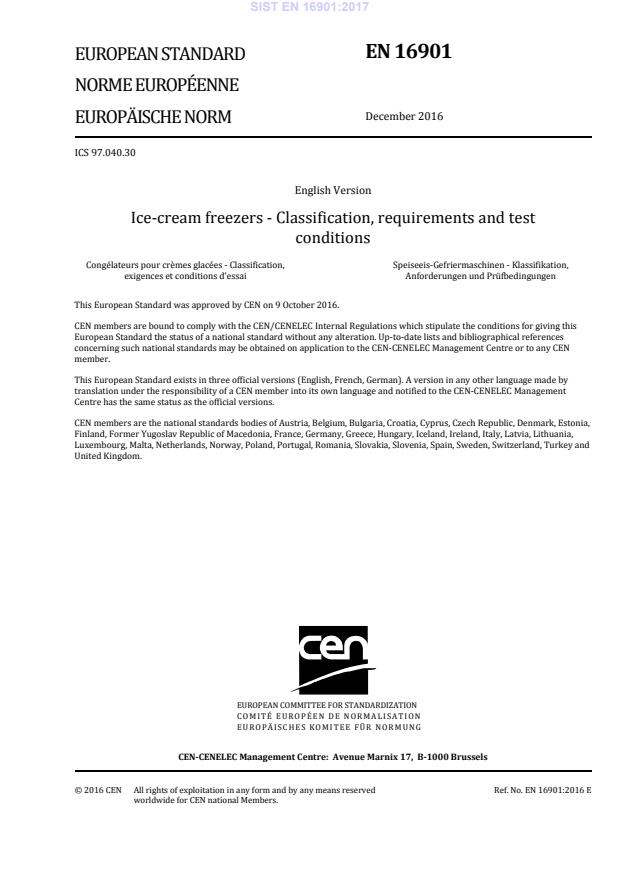
EN 16901
EUROPEAN STANDARD
NORME EUROPÉENNE
December 2016
EUROPÄISCHE NORM
ICS 97.040.30
English Version
Ice-cream freezers - Classification, requirements and test
conditions
Congélateurs pour crèmes glacées - Classification, Speiseeis-Gefriermaschinen - Klassifikation,
exigences et conditions d'essai Anforderungen und Prüfbedingungen
This European Standard was approved by CEN on 9 October 2016.
CEN members are bound to comply with the CEN/CENELEC Internal Regulations which stipulate the conditions for giving this
European Standard the status of a national standard without any alteration. Up-to-date lists and bibliographical references
concerning such national standards may be obtained on application to the CEN-CENELEC Management Centre or to any CEN
member.
This European Standard exists in three official versions (English, French, German). A version in any other language made by
translation under the responsibility of a CEN member into its own language and notified to the CEN-CENELEC Management
Centre has the same status as the official versions.
CEN members are the national standards bodies of Austria, Belgium, Bulgaria, Croatia, Cyprus, Czech Republic, Denmark, Estonia,
Finland, Former Yugoslav Republic of Macedonia, France, Germany, Greece, Hungary, Iceland, Ireland, Italy, Latvia, Lithuania,
Luxembourg, Malta, Netherlands, Norway, Poland, Portugal, Romania, Slovakia, Slovenia, Spain, Sweden, Switzerland, Turkey and
United Kingdom.
EUROPEAN COMMITTEE FOR STANDARDIZATION
COMITÉ EUROPÉEN DE NORMALISATION
EUROPÄISCHES KOMITEE FÜR NORMUNG
CEN-CENELEC Management Centre: Avenue Marnix 17, B-1000 Brussels
© 2016 CEN All rights of exploitation in any form and by any means reserved Ref. No. EN 16901:2016 E
worldwide for CEN national Members.
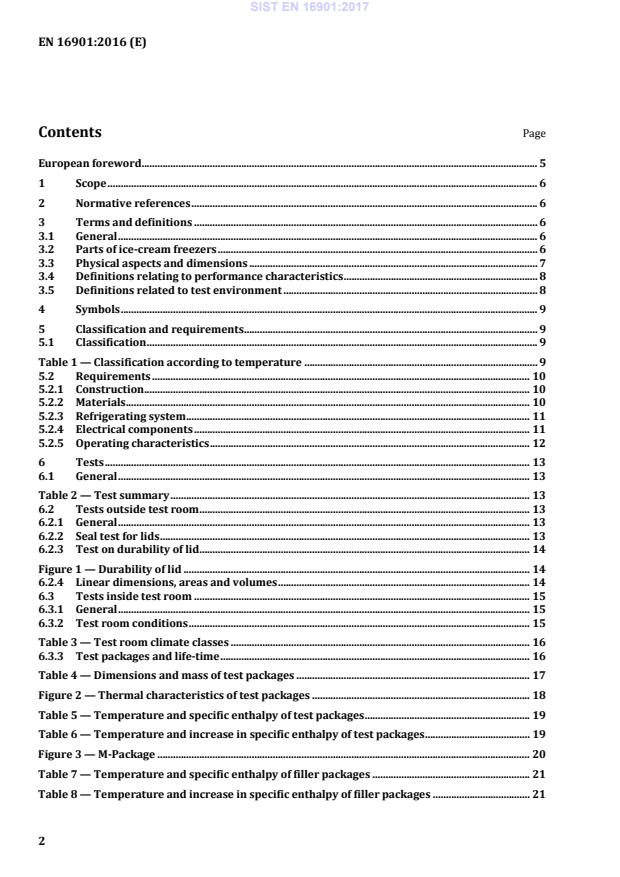
Contents Page
European foreword . 5
1 Scope . 6
2 Normative references . 6
3 Terms and definitions . 6
3.1 General . 6
3.2 Parts of ice-cream freezers . 6
3.3 Physical aspects and dimensions . 7
3.4 Definitions relating to performance characteristics . 8
3.5 Definitions related to test environment . 8
4 Symbols . 9
5 Classification and requirements . 9
5.1 Classification . 9
Table 1 — Classification according to temperature . 9
5.2 Requirements . 10
5.2.1 Construction . 10
5.2.2 Materials . 10
5.2.3 Refrigerating system . 11
5.2.4 Electrical components . 11
5.2.5 Operating characteristics . 12
6 Tests . 13
6.1 General . 13
Table 2 — Test summary . 13
6.2 Tests outside test room . 13
6.2.1 General . 13
6.2.2 Seal test for lids . 13
6.2.3 Test on durability of lid . 14
Figure 1 — Durability of lid . 14
6.2.4 Linear dimensions, areas and volumes . 14
6.3 Tests inside test room . 15
6.3.1 General . 15
6.3.2 Test room conditions . 15
Table 3 — Test room climate classes . 16
6.3.3 Test packages and life-time . 16
Table 4 — Dimensions and mass of test packages . 17
Figure 2 — Thermal characteristics of test packages . 18
Table 5 — Temperature and specific enthalpy of test packages . 19
Table 6 — Temperature and increase in specific enthalpy of test packages . 19
Figure 3 — M-Package . 20
Table 7 — Temperature and specific enthalpy of filler packages . 21
Table 8 — Temperature and increase in specific enthalpy of filler packages . 21
Figure 4 — Thermal characteristics of filler packages. 22
6.3.4 Instruments, measuring equipment and measuring expanded measurement
uncertainty . 22
6.3.5 Preparation of test ice cream freezer . 22
Figure 5 — Ice cream location within the test room . 23
Figure 6 — Condensing air with test room air flow, or across, but not opposed the test room
air flow . 24
Figure 7 — Air movement . 25
Figure 8 — Climate measuring point for ice cream freezer . 25
Figure 9 — Glass lid ice cream freezer with flat base deck with and without tubes laid at the
base . 27
Figure 10 — Glass lid ice cream freezer with stepped base deck with and without tubes laid
at the base. 28
Figure 11 — Tests on ice cream freezers with lights or without lights . 29
6.3.6 Test on ice cream freezers . 30
Figure 12 — Relevant temperature curve of M-packages . 31
Figure 13 — Arithmetic mean temperature of M-packages . 32
Figure 14 — Condensation code . 33
Table 9 — Temperature rise time conditions for C1 . 34
7 Test report . 34
7.1 Tests outside test room . 34
Table 10 — Linear dimensions, areas and volumes . 35
7.2 Tests inside test room . 35
Table 11 — Conditions for tests inside test room . 35
Table 12 — Ice cream freezer preparation for tests inside test room. 35
Table 13 — Temperature test for tests inside test room . 36
Table 14 — Water vapour condensation test . 36
Table 15 — Electrical energy consumption test . 36
Table 16 — Specific energy consumption . 37
8 Marking . 37
8.1 Load limit . 37
Figure 15 — Load limit markings . 37
Figure 16 — Dimensions of load limit line . 37
Figure 17 — Different positions for the load limit . 38
8.2 Marking plate . 38
8.3 Information to be supplied by the manufacturer . 38
Annex A (informative) Ice-cream freezer families . 40
Table A.1 — Ice cream freezer families . 40
Annex B (normative) Net volume calculation . 41
Annex C (normative) Equivalent volume calculation . 42
Annex D (normative) TDA calculation . 43
D.1 General . 43
D.2 Calculation of TDA . 43
Figure D.1 — Horizontal, open, wall-site and island cabinets . 44
Figure D.2 — Horizontal, open, island cabinets . 45
Annex E (informative) Test for absence of odour and taste . 46
E.1 Preparation and testing . 46
E.1.1 Ambient temperature . 46
E.1.2 Cleaning . 46
E.1.3 Thermostat setting . 46
E.1.4 Samples . 46
E.1.5 Test period . 46
E.2 Examination of samples . 47
E.2.1 Conditions . 47
E.2.2 Evaluation . 47
Annex F (normative) Performance and energy rating of ice cream freezers . 48
F.1 Scope . 48
F.2 Standard rating conditions for ice cream freezers . 48
F.3 Specific energy consumption (SEC) for ice cream freezers . 48
Annex ZA (informative) Relationship between this European Standard and the ecodesign
requirements of Commission Draft Ecodesign Regulation DG ENER LOT12 aimed to
be covered . 49
Table ZA.1 — Correspondence between this European Standard and Commission Draft
Ecodesign Regulation DG ENER LOT12 implementing Directive 2009/125/EC of the
European Parliament and of the Council with regard to ecodesign requirements for
refrigerated commercial display cabinets and Commission’s standardization
request ‘M/495’. 49
Bibliography . 50
European foreword
This document (EN 16901:2016) has been prepared by Technical Committee CEN/TC 44 “Commercial
and Professional Refrigerating Appliances and Systems, Performance and Energy Consumption”, the
secretariat of which is held by UNI.
This European Standard shall be given the status of a national standard, either by publication of an
identical text or by endorsement, at the latest by June 2017, and conflicting national standards shall be
withdrawn at the latest by June 2017.
Attention is drawn to the possibility that some of the elements of this document may be the subject of
patent rights. CEN shall not be held responsible for identifying any or all such patent rights.
This document has been prepared under a mandate given to CEN by the European Commission and the
European Free Trade Association, and supports essential requirements of EU Directive 2009/125/EC.
For relationship with EU Directive, see informative Annex ZA, which is an integral part of this
document.
According to the CEN-CENELEC Internal Regulations, the national standards organisations of the
following countries are bound to implement this European Standard: Austria, Belgium, Bulgaria,
Croatia, Cyprus, Czech Republic, Denmark, Estonia, Finland, Former Yugoslav Republic of Macedonia,
France, Germany, Greece, Hungary, Iceland, Ireland, Italy, Latvia, Lithuania, Luxembourg, Malta,
Netherlands, Norway, Poland, Portugal, Romania, Slovakia, Slovenia, Spain, Sweden, Switzerland,
Turkey and the United Kingdom.
1 Scope
The scope of this European Standard is to define the classification for horizontal closed ice-cream
freezer with access of the product from the top and to specify their requirements and test methods.
These appliances are different to supermarket segment freezers, as they work with static air cooling,
with a skin evaporator (no evaporator fan) and are used specifically for the storage and display of pre-
packed ice-cream. This standard is only applicable to integral type refrigeration systems. This standard
is not applicable to remote and secondary system type cabinets. Ice-cream freezers within this standard
should have a net volume ≤ 600 l and only for transparent lid ice cream freezers they should have a net
volume/TDA ≥ 0,35 m.
2 Normative references
The following documents, in whole or in part, are normatively referenced in this document and are
indispensable for its application. For dated references, only the edition cited applies. For undated
references, the latest edition of the referenced document (including any amendments) applies.
EN 60335-1, Household and similar electrical appliances — Safety — Part 1: General requirements (IEC
60335-1)
EN 60335-2-89, Household and similar electrical appliances - Safety - Part 2-89: Particular requirements
for commercial refrigerating appliances with an incorporated or remote refrigerant condensing unit or
compressor (IEC 60335-2-89)
ISO 817, Refrigerants — Designation and safety classification
ISO 5149-2, Refrigerating systems and heat pumps — Safety and environmental requirements — Part 2:
Design, construction, testing, marking and documentation
3 Terms and definitions
For the purposes of this document, the following terms and definitions apply.
3.1 General
3.1.1
ice cream freezer
horizontal closed refrigerated cabinets intended to store and/or display and sell pre-packed ice cream
where access by the consumer to the pre-packed ice cream is gained by opening a lid (solid or
transparent) from the top
Note 1 to entry: See Annex A for the designation of the ice cream freezer family.
3.2 Parts of ice-cream freezers
3.2.1
condensing unit
combination of one or more compressors, condensers and liquid receivers (when required) and the
regularly furnished accessories
3.2.2
night cover
top cover permanently integrated into the ice-cream freezer used to reduce the heat ingress (e.g. by
infrared radiation or convection) during the period when there are no sales
3.3 Physical aspects and dimensions
3.3.1
depth
horizontal distance between the front and the rear of the ice cream freezer
3.3.2
width
horizontal distance between the two external sides of the ice cream freezer
3.3.3
height
vertical distance from the bottom to the top of the ice cream freezer
3.3.4
load limit
boundary surface consisting of a plane or several planes within which all M-packages can be maintained
within the limits for the M- packages temperature class declared
3.3.5
load limit line
permanently marked boundary line denoting the edge of the load limit surface
3.3.6
net volume
storage volume inside the appliance which can be used for storage of products
Note 1 to entry: For the calculation method see Annex B.
3.3.7
gross volume
volume within the inside walls of the ice-cream freezer or compartment, excluding internal fittings and
the lid when closed
3.3.8
equivalent volume
reference volume corrected for compartment temperature classification
3.3.9
total display area
TDA
total visible foodstuffs area, including visible area through the glazing, defined by the sum of horizontal
and vertical projected surface areas of the net volume
Note 1 to entry: For the calculation method see Annex D.
3.3.10
shelf area
area defined by the external dimensions of the shelf or internal dimensions of the base of the cabinet or
basket
3.3.11
footprint
surface occupied by the ice-cream freezer
3.4 Definitions relating to performance characteristics
3.4.1
normal conditions of use
operating conditions which exist when the ice cream freezer, including all permanently located
accessories, has been set up and situated in accordance with the recommendations of the manufacturer
and is in service
Note 1 to entry: The effects of actions by non-technical personnel for the purposes of loading, unloading,
cleaning, defrosting, the manipulation of accessible controls and of any removable accessories etc., according to
the manufacturer's instructions are within this definition. The effects of actions resulting from interventions by
technical personnel for the purposes of maintenance or repair are outside this definition.
3.4.2
defrost
removal of frost, snow and ice from an ice-cream freezer
3.4.3
total energy consumption
TEC
total amount of energy used by an ice cream freezer
3.4.4
specific energy consumption for ice cream freezers
SEC
index of the efficiency of the ice cream freezer, expressed as the ratio of TEC divided by equivalent
volume (TEC/Equivalent volume);
3.4.5
product temperature
one of the classifications defined in Table 1 of this standard, establishing the performance level of the
ice cream freezer
3.5 Definitions related to test environment
3.5.1
M-package
test package fitted with a temperature measuring device
3.5.2
climate class
classification of the test room climate according to the dry bulb temperature and relative humidity
3.5.3
M-package temperature class
M-package temperature class classification of M-package temperature according to the temperatures of
the warmest M-packages during the temperature test
3.5.4
ice cream freezers classification
designation given by the combination of climate class and M-package temperature class
4 Symbols
t running time — time during which the compressor is running within the 24 h test period
run
t stopping time — time during which the compressor is not running within the 24 h test period
stop
and excluding defrost time
Δt time between two consecutive measurement samples
N number of measuring samples in the 24 h test period
max
TEC total energy consumption in kilowatt hours per 24 h period
SEC specific energy consumption for ice cream freezers expressed in kilowatt hours per 24 h per m
(TEC/ Equivalent volume);
t relative or percentage running time:
rr
t
run
t = (1)
rr
t
run+t
stop
where
t +t = 24 h
run stop
t time in which 90 % of a sudden temperature change of 20 °C is indicated, the measurement
medium being moderately agitated air (velocity 1 m/s)
5 Classification and requirements
5.1 Classification
The classification of the ice cream freezers is done according to temperature. The performance of ice
cream freezers shall comply with one of the classifications defined in Table 1. The performance shall be
verified in accordance with the conditions and test methods specified in Annex F.
Table 1 — Classification according to temperature
Class Warmest M-package Warmest M-package
temperature colder or equal maximum temperature rise
to in all tests except lid allowed
opening test
[K]
[°C]
C1 −18,0 2,0
C2 −7,0 2,0
S Special classification 2,0
5.2 Requirements
5.2.1 Construction
5.2.1.1 Strength and rigidity
The ice-cream freezer and its parts shall be constructed with adequate strength and rigidity for normal
conditions of handling, transport and use and attention shall be given to the following:
a) interior fittings shall be sufficiently strong for the duty required;
b) where sliding shelves, baskets or trays are fitted they shall retain their shape and ease of movement
when fully loaded;
c) any fitments which are provided with stops to prevent accidental removal shall be self-supporting
when fully loaded and withdrawn to the limit of the stops.
5.2.1.2 Pipes and connections
Pipes and connections to moving or resiliently mounted parts shall be arranged so as not to foul or
transmit harmful vibrations to other parts. All other pipes and connections shall be securely anchored
and have sufficient free length and/or vibration eliminators to prevent failure due to fatigue. Where
necessary, pipes and valves shall be adequately thermally insulated.
5.2.1.3 Lids
Lids shall be condensate-free at the climate class specified by the manufacturer.
When any lids provided to ensure an air seal to the refrigerated space are closed, there shall be no
undue leakage of ambient air into the interior (see 6.2.1). The lids shall not open of their own accord.
The gasket shall be made from a material whose characteristics are compatible with the operating
conditions (especially temperatures). If the fastening device is mechanical, a stop or other means shall
be provided to prevent the gasket from being excessively deformed.
5.2.1.4 Joints and seams
All construction joints and seams within the net volume shall prevent the accumulation of potentially
contaminating substances. All construction joints and seams within the net volume shall permit the
easy removal of any deposits of potentially contaminating substances.
5.2.2 Materials
5.2.2.1 General
The materials shall be durable and shall not favour the development of mould or emit odours. Under
normal conditions of use, materials in contact with foodstuffs shall be resistant to moisture and shall
neither be toxic nor contaminate them.
5.2.2.2 Corrosion resistance
Metal parts, used in the construction of cabinets, shall have resistance to corrosion appropriate to their
location and function.
5.2.2.3 Thermal insulation
The thermal insulation shall be efficient and permanently fixed. In particular, the insulating material
shall not be subject to shrinkage and shall not allow under normal working conditions an accumulation
of moisture.
Suitable means shall be used to prevent deterioration of the thermal insulation by the ingress of
moisture.
Where the insulation space is vented to the inside, it shall be ensured that particles of the insulation
material cannot escape into the foodstuff display compartment.
For fibrous insulation materials, it shall not be possible to insert a rigid probe of 1 mm diameter
through any aperture which allows access to the insulating material, the probe being applied with
negligible force.
5.2.3 Refrigerating system
5.2.3.1 Design and construction
The design and construction of all parts of the refrigerating system subject to internal pressure shall
take into account the maximum working pressure to which they are subjected when the ice cream
freezer is in operation or at rest. The maximum ambient temperature during transit shall be taken into
account. All refrigerant containing components shall be in accordance with ISO 5149-2.
5.2.3.2 Condensation
There shall be suitable means to prevent water condensing on cold surfaces of the ice cream freezer and
its parts and from harmfully affecting the operation of the refrigerating system or its controls.
5.2.3.3 System protection
For ice-cream freezers, the refrigerating system shall suffer no damage if any lid in the cooler is left
open while the ice cream freezer is operating in an ambient temperature corresponding to the climate
class (see Table 1) for which the cooler is intended. When the lid is kept open under normal operating
conditions (for example, during product loading) or is left open accidentally, any automatic motor
overload protective device may come into operation.
5.2.3.4 Refrigerant
When deciding on the refrigerant for the system, attention shall be given to the possible hazards
associated with the use of certain refrigerants and heat-transfer media due to their toxicity,
flammability etc. Guidance on this point is available in ISO 5149-2.
5.2.4 Electrical components
5.2.4.1 General
Electrical components shall be in accordance with EN 60335-2-89 and EN 60335-1.
5.2.4.2 Temperature display
The ice-cream freezer shall incorporate a temperature display instrument showing the air temperature
in the refrigerated display ice cream freezer, at the load line, to provide an indication of the operation
and functioning of the refrigerating equipment and information on its operating state.
NOTE As a rule, measured air temperature is not identical with pre packed ice cream temperature in an ice
cream freezer.
5.2.4.3 Temperature-measuring instrument
Suitable temperature-measuring instruments shall be used, i.e. those that fulfill the following
requirements:
— the unit symbol (°C) shall be inscribed or displayed on the temperature-measuring instrument;
— the range of measurement shall be at least from −40 °C to +40 °C;
— the scale division or smallest numerical increment shall be less than or equal to 1 °C;
— the maximum errors shall be 2 K over the total measuring range;
— the time constant t of the sensor shall be equal to or less than 20 min.
When temperature-measuring instruments are employed in ice-cream freezers:
one temperature-measuring instrument shall be employed for each ice-cream freezer with its own
refrigerating circuit.
5.2.4.4 Temperature sensor location
The temperature sensor location shall be readily accessible to enable on site testing for the correct
indication of temperature and replacement of the temperature measuring instrument on site in service.
NOTE 1 The temperature sensor of a thermometer is considered to be “readily accessible” if it is reached
directly for examination. It is necessary to remove access panel(s) to carry out replacement.
NOTE 2 The positioning of the temperature sensor in a guide tube is also considered to be “readily accessible”
if the sensor is introduced into and removed from the guide tube without a tool.
Wherever possible, the mounting method shall not supply heat to, or withdraw heat from the
temperature sensor. The temperature sensor shall be protected against heat radiation from the external
ambient.
NOTE 3 For electronic controllers, it is possible to display a calculated temperature.
NOTE 4 For recording and display of temperatures, one or two temperature sensors are used. The temperature
sensor is the same as those used for controlling the refrigeration. An alarm is activated in case of error. This
option is not in accordance with the requirements of EN 12830.
NOTE 5 It is the responsibility of the supplier and user to ensure that the location of the temperature sensor
complies with national regulation on temperature control of foodstuffs.
5.2.5 Operating characteristics
5.2.5.1 Water vapour condensation
The performance of ice-cream freezer shall not be impaired by water vapour condensation. The amount
of water vapour condensation shall be verified according to the conditions and test methods specified in
6.3.6.4.
5.2.5.2 Energy consumption
The energy consumption shall be stated by the manufacturer. The total energy consumption (TEC) shall
be measured and calculated according to the conditions and the test methods specified in 6.3.6.6.3.
5.2.5.3 Specific energy consumption
The ice cream freezer specific energy consumption (SEC) as ratio between TEC and equivalent volume
(TEC/Veq) shall be stated by the manufacturer. This value shall be used to compare the energy
efficiency between different ice cream freezers.
6 Tests
6.1 General
When the characteristics of an ice-cream freezer are to be verified, all the tests and inspections shall be
applied to one and the same ice-cream freezer. These tests and inspections may also be made
individually for the study of a particular characteristic.
Table 2 lists the tests and inspections that shall be carried out. Ice-cream freezers shall comply with the
requirements specified in this part of the standard using the appropriate test method.
Table 2 — Test summary
Tests and inspections Requirement clause Test method Test room
Seal test 5.2.1.3 6.2.1 Outside test
room
Absence of odour and taste — Annex E
(see 6.2)
(not compulsory)
Durability of lid 5.2.1.3 6.2.2
Temperature 5.1 6.3.6.1 Inside test
room
Water vapour condensation 5.2.3.2 6.3.6.4
(see 6.3)
Temperature rise time - 6.3.6.5
Energy consumption 5.2.5.2 6.3.6.6
6.2 Tests outside test room
6.2.1 General
The tests which may be carried out outside the test room deal with the inspection of construction
characteristics, physical dimensions and the absence of odour and taste.
6.2.2 Seal test for lids
The effectiveness of lids provided to ensure a seal shall be tested as follows (with the ice-cream freezer
not running). Insert a strip of paper 50 mm wide, 0,08 mm thick and of a suitable length at any point of
the seal. With the lid closed normally on it the strip of paper shall not slide freely.
NOTE 1 Attention is drawn to the fact that some ice cream freezers having lids are fitted with decompression
valves which allow air to penetrate for a short period of time so that any drop in pressure created inside the ice
cream freezer is compensated. No test is required for such valves.
NOTE 2 The most unfavourable points can be found by inspecting the contact of the seal with the ice cream
freezer closed and lighted from the inside.
6.2.3 Test on durability of lid
6.2.3.1 General
The purpose of these tests, carried out using the following procedures, is to check the durability of the
lids. The ambient temperature shall be between +16 °C and +32 °C. The refrigerating appliance shall be
switched off.
6.2.3.2 Opening sequence
The lids shall be pulled out to within 15 mm to 20 mm of their fully open position (Figure 1).
6.2.3.3 Closing sequence
The lids shall be closed as in normal use from within 15 mm to 20 mm of their fully closed position
(Figure 1).
Key
A opening course
1 pull out
2 push
Figure 1 — Durability of lid
The number of cycles per minute shall be between 5 and 10. Each lid shall withstand 30 000 opening
and closing operations without deterioration which could be prejudicial to the air-tightness of the lid
sealing. All the lids shall be present on the cabinet when tested.
6.2.4 Linear dimensions, areas and volumes
Measurements shall be made with the ice-cream freezer not in operation but situated in a place where
the temperature is maintained between 16 °C and 30 °C. If the ice cream freezer includes jacks or other
components for adjustment of height (i.e. castor or wheel), the height defined shall be the minimum
height necessary at installation of the ice cream freezer.
When measuring the net volume parts necessary for the proper functioning of the ice cream freezer
shall be fitted as intended and the volume representing the space occupied by these parts deducted (see
Annex B).
6.3 Tests inside test room
6.3.1 General
The tests which are carried out inside the test room deal with the measurement of the following
characteristics:
— temperature;
— water vapour condensation;
— electrical energy consumption.
General test conditions are defined, which are common for all tests carried out inside the test room.
These conditions concern the test room, the test and M-packages, and the measuring instruments.
6.3.2 Test room conditions
6.3.2.1 Design, walls, floor and radiant heat
The test room shall be a parallelepiped space in which two of the opposite side walls, referred to as the
discharge technical side wall and the return technical side wall, are designed to create an even,
horizontal air flow within the test room. By convention, the distance separating these two technical side
walls is referred to as the “length” of the test room.
The minimum useful dimensions (length, width, height) of the test room shall be dependent on the
overall dimensions (length, depth, height) of the ice cream freezer to be tested.
The ceiling and the two non-technical side walls of the room shall be thermally insulated and shall be
equipped with an inner metal skin.
A minimum insulation level equivalent to 60 mm of rigid polyurethane foam (λ = 0,03 W/m °C) should
be used for the building of a new test room.
The floor shall be made of concrete or of thermally equivalent material and/or shall be sufficiently
insulated to ensure that external climatic conditions do not affect the floor temperature.
Lighting shall be installed to maintain 600 ± 100 lx measured at a height of 1 m above the floor level and
shall be lit continuously during the test period. The emission spectrum of that lighting device within the
infrared field shall not include peaks of a value of more than 500 W/5 nm/lm.
The walls, ceilings and any partitions of rooms intended for the testing of ice cream freezer shall be
painted in light grey (for example, NCS 2706-G90Y or RAL 7032) with an emissivity between 0,9 and 1
at 25 °C.
6.3.2.2 Thermal and air flow characteristics
An experimental evaluation of the test-room performances shall be carried out at a minimum of once
per year
— with test room empty and with lighting switched on,
— in a test room at ambient temperature of 25 °C and 60 % relative humidity,
— measuring the velocity, temperature and relative humidity of the air at different points within two
vertical planes parallel to the technical side walls and 600 mm away from the technical side walls,
and
— with the climate measuring point located at the geometrical centre of the test room during the
evaluation.
These measuring points shall form a two-dimensional grid in which the step is a maximum of 500 mm
in the horizontal and vertical directions. The peripheral line of points shall be located at a maximum of
500 mm from the other two side walls, floor and ceiling.
A three-dimensional grid inside the test room shall be investigated when obstacles/irregularities
projected into the room of more than 1 m surface area facing the discharge technical side wall exist
along the walls.
The mean horizontal air velocity measured during 1 min with a maximal interval of 5 s at each of the
points defined above shall lie between 0,1 m/s and 0,2 m/s.
Air temperature measured at each of the points defined above shall not deviate from the rated
temperature of the test-room climate class by more than 2 °C.
The test room shall be capable of maintaining values of humidity within ± 5 units of the relative
humidity percentage figures of the rated humidity of the test room temperature class at the specified
measuring points.
Surface temperature of walls, ceiling and floor shall be measured in proximity to the points which
constitute the peripheral line of the grid defined above. These surface temperatures shall remain within
a tolerance of ± 2 °C in relation to the air temperature measured at the nearest point of the grid.
6.3.2.3 Climate classes
Tests shall be carried out in one of the climate classes according to Table 3.
During the test, the test room shall be capable of maintaining values of temperature and humidity
within ± 1 °C of the temperature and ± 5 units of the relative humidity percentage figures at the
specified climate measuring point(s) (see 6.3.5.3).
Table 3 — Test room climate classes
Test room climate Minimum temperature and relative Maximum temperature and relative
class range humidity humidity
A +16 °C, 80 % 30 °C, 55 %
B +16 °C, 80 % 35 °C, 75 %
C +16 °C, 80 % 40 °C, 40 %
6.3.3 Test packages and life-time
6.3.3.1 General
When tests are carried o
...
Questions, Comments and Discussion
Ask us and Technical Secretary will try to provide an answer. You can facilitate discussion about the standard in here.
Loading comments...