

SIST IEC 60050-741:2024
(Main)International Electrotechnical Vocabulary (IEV) – Part 741: Internet of Things (IoT)
General Information
- Abstract
IEC 60050-741:2020 provides a definition of Internet of Things along with related terms and definitions. It has the status of a horizontal standard in accordance with IEC Guide 108:2006. This terminology is consistent with the terminology developed in the other specialized parts of the IEV.
- Status
- Published
- Publication Date
- 04-Mar-2024
- Technical Committee
- TRM - Terminology
- Current Stage
- 6100 - Translation of adopted SIST standards (Adopted Project)
- Start Date
- 06-Nov-2024
- Due Date
- 05-Nov-2025
- Completion Date
- 06-May-2026

Overview
SIST IEC 60050-741:2024 is a part of the International Electrotechnical Vocabulary (IEV) series developed by the International Electrotechnical Commission (IEC). This standard specifically defines terms and concepts related to the Internet of Things (IoT). It serves as a horizontal standard in electrotechnology, ensuring consistent and harmonized terminology across various fields involving IoT technologies. By integrating terminology from ISO/IEC 20924:2018 and other related sources, IEC 60050-741 provides a comprehensive vocabulary essential for global interoperability and communication in the rapidly evolving IoT sector.
Key Topics
SIST IEC 60050-741:2024 covers a broad spectrum of terms relevant to the Internet of Things, structured under two main sections:
- General terms related to IoT concepts, infrastructure, and communication protocols.
- Internet of Things-specific terms, detailing technologies, architectures, device types, and functional elements unique to IoT systems.
The document systematically organizes terminological entries using a hierarchical numbering scheme (part-section-entry), providing:
- Preferred terms with clear, authoritative definitions.
- Synonyms, abbreviations, and language-specific variants facilitating multilingual understanding.
- Supplementary notes, examples, and references to related standards enhancing practical application.
- Harmonization with related IEC and ISO/IEC standards to maintain consistency in terminology across electrotechnology and information technology domains.
Applications
SIST IEC 60050-741:2024 is invaluable for a wide range of stakeholders engaged with IoT technologies, including:
- Standardization bodies developing new technical standards related to IoT.
- Manufacturers and developers designing IoT devices or systems requiring precise communication and documentation.
- Industry professionals and engineers seeking to apply standardized terminology in technical specifications, product documentation, and interoperability frameworks.
- Researchers and educators defining and teaching IoT concepts consistently.
- Regulatory agencies and certification bodies referencing unified terminology to create clear policies and conformity assessments.
By adopting this standard, organizations can:
- Enhance global interoperability of IoT products and solutions.
- Reduce misunderstandings caused by inconsistent or ambiguous terminology.
- Support clear communication in multilingual and multinational environments.
- Facilitate regulatory compliance and market acceptance through adherence to internationally recognized vocabulary.
Related Standards
SIST IEC 60050-741:2024 aligns closely with other parts of the IEC 60050 series and various ISO/IEC standards, including:
- IEC 60050 (International Electrotechnical Vocabulary) series – provides foundational electrotechnical terms beyond IoT.
- ISO/IEC 20924:2018 – IoT vocabulary standard that served as a primary source for this part.
- IEC Guide 108:2006 – defines the status and usage guidance for horizontal standards like IEC 60050.
- Other IEC technical committees outputs on electrotechnical and information technologies, ensuring interoperability across related fields.
- ISO/IEC JTC 1 Subcommittee 41: Internet of Things and related technologies – collaborating in terminology development for unified IoT concepts.
For easy access to all terminology parts, users can visit the official IEC Electropedia website at www.electropedia.org, which hosts up-to-date definitions and multilingual entries.
Keywords: SIST IEC 60050-741:2024, Internet of Things standard, IoT vocabulary, electrotechnical vocabulary, IoT terminology, international standard IoT, IEC IoT definitions, IoT interoperability, IoT technical terms, IEC electrotechnical commission, horizontal standard, IoT applications, multilingual IoT terminology.
Get Certified
Connect with accredited certification bodies for this standard

BSI Group
BSI (British Standards Institution) is the business standards company that helps organizations make excellence a habit.

NYCE
Mexican standards and certification body.
Sponsored listings
Frequently Asked Questions
SIST IEC 60050-741:2024 is a standard published by the Slovenian Institute for Standardization (SIST). Its full title is "International Electrotechnical Vocabulary (IEV) – Part 741: Internet of Things (IoT)". This standard covers: IEC 60050-741:2020 provides a definition of Internet of Things along with related terms and definitions. It has the status of a horizontal standard in accordance with IEC Guide 108:2006. This terminology is consistent with the terminology developed in the other specialized parts of the IEV.
IEC 60050-741:2020 provides a definition of Internet of Things along with related terms and definitions. It has the status of a horizontal standard in accordance with IEC Guide 108:2006. This terminology is consistent with the terminology developed in the other specialized parts of the IEV.
SIST IEC 60050-741:2024 is classified under the following ICS (International Classification for Standards) categories: 01 - GENERALITIES. TERMINOLOGY. STANDARDIZATION. DOCUMENTATION; 01.040.35 - Information technology (Vocabularies); 35.240.95 - Internet applications. The ICS classification helps identify the subject area and facilitates finding related standards.
SIST IEC 60050-741:2024 is available in PDF format for immediate download after purchase. The document can be added to your cart and obtained through the secure checkout process. Digital delivery ensures instant access to the complete standard document.
Standards Content (Sample)
SLOVENSKI STANDARD
01-april-2024
Mednarodni elektrotehniški slovar - 741. del: Internet stvari
International Electrotechnical Vocabulary (IEV) – Part 741: Internet of Things (IoT)
Vocabulaire Electrotechnique International (IEV) - Partie 741: Internet des Objets (IdO)
Ta slovenski standard je istoveten z: IEC 60050-741:2020
ICS:
01.040.35 Informacijska tehnologija. Information technology
(Slovarji) (Vocabularies)
35.240.95 Spletne uporabniške rešitve Internet applications
2003-01.Slovenski inštitut za standardizacijo. Razmnoževanje celote ali delov tega standarda ni dovoljeno.
IEC 60050-741 ®
Edition 1.0 2020-04
INTERNATIONAL
STANDARD
NORME
INTERNATIONALE
HORIZONTAL STANDARD
NORME HORIZONTALE
International Electrotechnical Vocabulary (IEV) – Part 741: Internet of Things
(IoT)
Vocabulaire Electrotechnique International (IEV) – Partie 741: Internet des Objets
(IdO)
INTERNATIONAL
ELECTROTECHNICAL
COMMISSION
COMMISSION
ELECTROTECHNIQUE
INTERNATIONALE
ICS 01.040.35; 35.240.95 ISBN 978-2-8322-8106-2
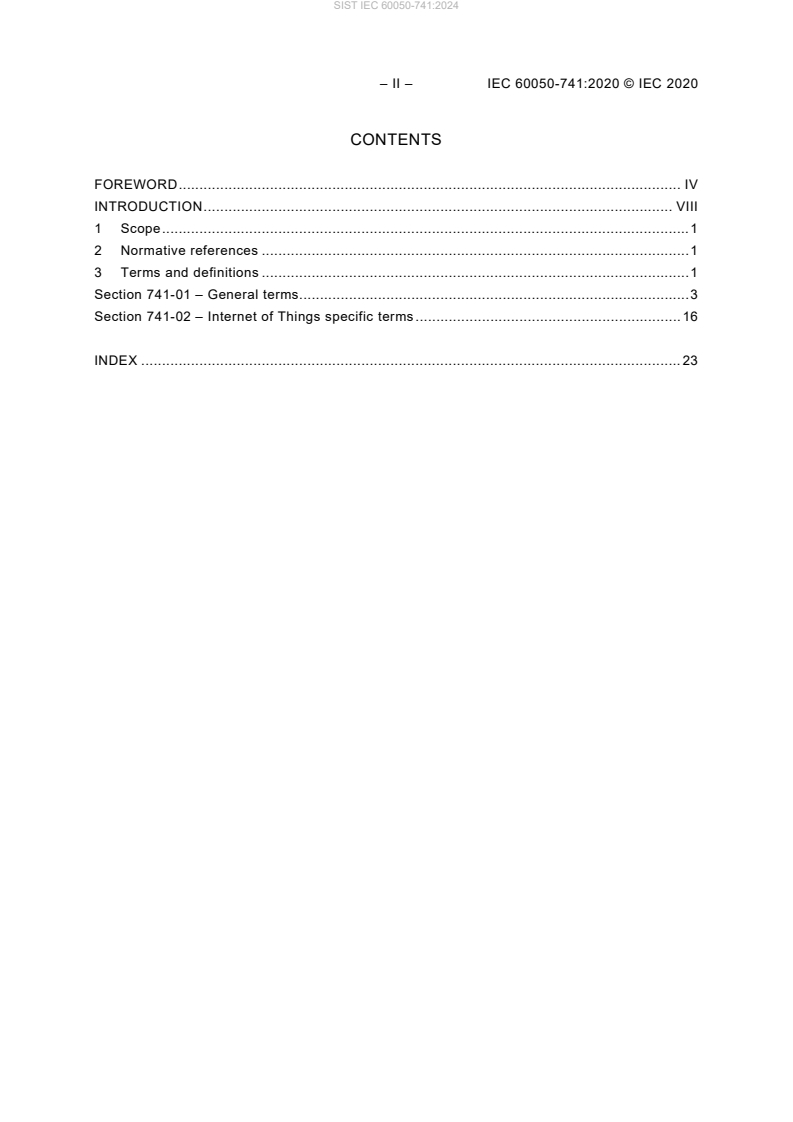
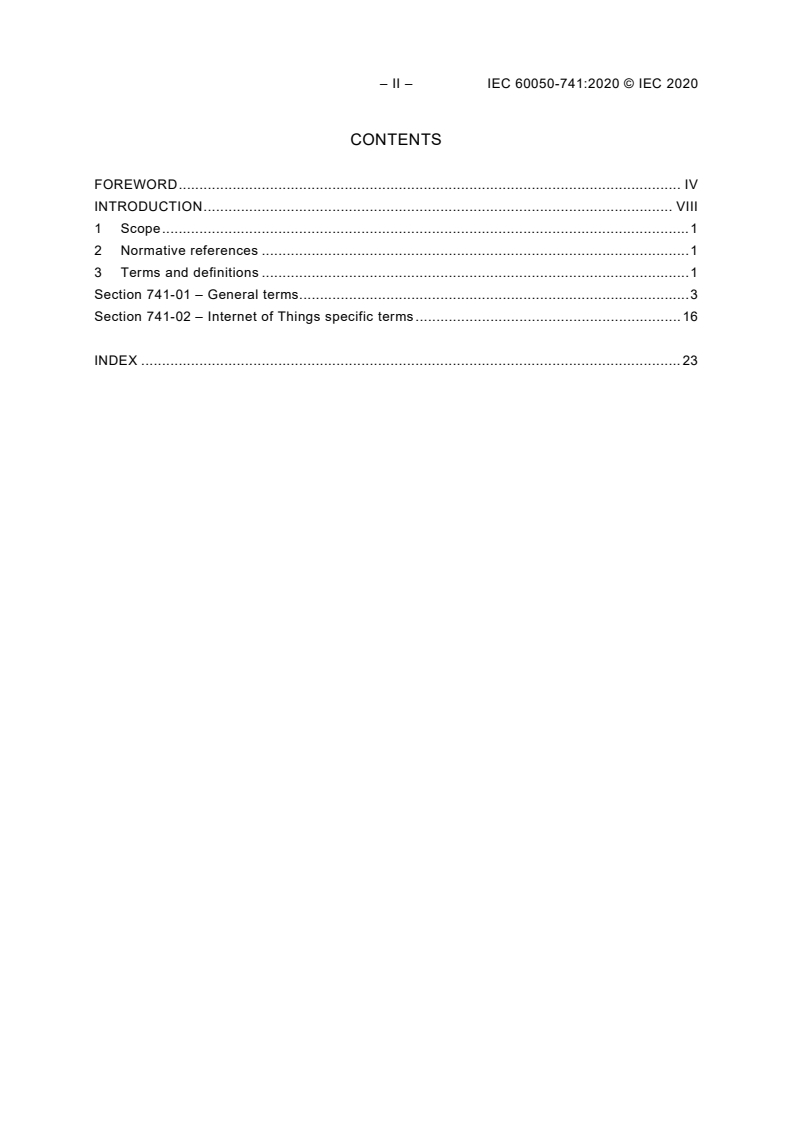
– II – IEC 60050-741:2020 © IEC 2020
CONTENTS
FOREWORD . IV
INTRODUCTION . VIII
1 Scope . 1
2 Normative references . 1
3 Terms and definitions . 1
Section 741-01 – General terms. 3
Section 741-02 – Internet of Things specific terms . 16
INDEX . 23
SOMMAIRE
AVANT-PROPOS . VI
INTRODUCTION . XI
1 Domaine d'application . 2
2 Références normatives . 2
3 Termes et définitions . 2
Section 741-01 – Termes généraux . 3
Section 741-02 – Termes particuliers à l'Internet des Objets . 16
INDEX . 23
– IV – IEC 60050-741:2020 © IEC 2020
INTERNATIONAL ELECTROTECHNICAL COMMISSION
_______________
INTERNATIONAL ELECTROTECHNICAL VOCABULARY (IEV) –
Part 741: Internet of Things (IoT)
FOREWORD
1) The International Electrotechnical Commission (IEC) is a worldwide organization for standardization comprising
all national electrotechnical committees (IEC National Committees). The object of IEC is to promote
international co-operation on all questions concerning standardization in the electrical and electronic fields. To
this end and in addition to other activities, IEC publishes International Standards, Technical Specifications,
Technical Reports, Publicly Available Specifications (PAS) and Guides (hereafter referred to as "IEC
Publication(s)"). Their preparation is entrusted to technical committees; any IEC National Committee interested
in the subject dealt with may participate in this preparatory work. International, governmental and non-
governmental organizations liaising with the IEC also participate in this preparation. IEC collaborates closely
with the International Organization for Standardization (ISO) in accordance with conditions determined by
agreement between the two organizations.
2) The formal decisions or agreements of IEC on technical matters express, as nearly as possible, an international
consensus of opinion on the relevant subjects since each technical committee has representation from all
interested IEC National Committees.
3) IEC Publications have the form of recommendations for international use and are accepted by IEC National
Committees in that sense. While all reasonable efforts are made to ensure that the technical content of IEC
Publications is accurate, IEC cannot be held responsible for the way in which they are used or for any
misinterpretation by any end user.
4) In order to promote international uniformity, IEC National Committees undertake to apply IEC Publications
transparently to the maximum extent possible in their national and regional publications. Any divergence
between any IEC Publication and the corresponding national or regional publication shall be clearly indicated in
the latter.
5) IEC itself does not provide any attestation of conformity. Independent certification bodies provide conformity
assessment services and, in some areas, access to IEC marks of conformity. IEC is not responsible for any
services carried out by independent certification bodies.
6) All users should ensure that they have the latest edition of this publication.
7) No liability shall attach to IEC or its directors, employees, servants or agents including individual experts and
members of its technical committees and IEC National Committees for any personal injury, property damage or
other damage of any nature whatsoever, whether direct or indirect, or for costs (including legal fees) and
expenses arising out of the publication, use of, or reliance upon, this IEC Publication or any other IEC
Publications.
8) Attention is drawn to the Normative references cited in this publication. Use of the referenced publications is
indispensable for the correct application of this publication.
9) Attention is drawn to the possibility that some of the elements of this IEC Publication may be the subject of
patent rights. IEC shall not be held responsible for identifying any or all such patent rights.
International Standard IEC 60050-741 was prepared by IEC technical committee 1:
Terminology.
This first edition comprises terminology formerly published in ISO/IEC 20924:2018 (together
with a few entries from other sources that define certain technical terms appearing in
definitions), and reviewed by subcommittee 41: Internet of things and related technologies, of
ISO/IEC joint technical committee 1: Information technology, and IEC technical committee 1:
Terminology, as change request C00055 for inclusion in the International Electrotechnical
Vocabulary (IEV).
This publication was developed in accordance with the ISO/IEC Directives, Part 1, IEC
Supplement, Annexes SK and SL, and was approved by the validation team of IEC technical
committee 1: Terminology, under the normal database procedure.
A list of all parts of the IEC 60050 series, published under the general title International
Electrotechnical Vocabulary can be found on the IEC website and is available at
www.electropedia.org.
All parts of the IEC 60050 series have the status of a horizontal standard in accordance with
IEC Guide 108.
– VI – IEC 60050-741:2020 © IEC 2020
COMMISSION ÉLECTROTECHNIQUE INTERNATIONALE
________________
VOCABULAIRE ÉLECTROTECHNIQUE INTERNATIONAL (IEV) –
Partie 741: Internet des Objets (IdO)
AVANT-PROPOS
1) La Commission Electrotechnique Internationale (IEC) est une organisation mondiale de normalisation
composée de l'ensemble des comités électrotechniques nationaux (Comités nationaux de l'IEC). L'IEC a pour
objet de favoriser la coopération internationale pour toutes les questions de normalisation dans les domaines
de l'électricité et de l'électronique. A cet effet, l'IEC – entre autres activités – publie des Normes
internationales, des Spécifications techniques, des Rapports techniques, des Spécifications accessibles au
public (PAS) et des Guides (ci-après dénommés "Publication(s) de l'IEC"). Leur élaboration est confiée à des
comités d'études, aux travaux desquels tout Comité national intéressé par le sujet traité peut participer. Les
organisations internationales, gouvernementales et non gouvernementales, en liaison avec l'IEC, participent
également aux travaux. L'IEC collabore étroitement avec l'Organisation Internationale de Normalisation (ISO),
selon des conditions fixées par accord entre les deux organisations.
2) Les décisions ou accords officiels de l'IEC concernant les questions techniques représentent, dans la mesure
du possible, un accord international sur les sujets étudiés, étant donné que les Comités nationaux de l'IEC
intéressés sont représentés dans chaque comité d'études.
3) Les Publications de l'IEC se présentent sous la forme de recommandations internationales et sont agréées
comme telles par les Comités nationaux de l'IEC. Tous les efforts raisonnables sont entrepris afin que l'IEC
s'assure de l'exactitude du contenu technique de ses publications; l'IEC ne peut pas être tenue responsable de
l'éventuelle mauvaise utilisation ou interprétation qui en est faite par un quelconque utilisateur final.
4) Dans le but d'encourager l'uniformité internationale, les Comités nationaux de l'IEC s'engagent, dans toute la
mesure possible, à appliquer de façon transparente les Publications de l'IEC dans leurs publications nationales
et régionales. Toutes divergences entre toutes Publications de l'IEC et toutes publications nationales ou
régionales correspondantes doivent être indiquées en termes clairs dans ces dernières.
5) L'IEC elle-même ne fournit aucune attestation de conformité. Des organismes de certification indépendants
fournissent des services d'évaluation de conformité et, dans certains secteurs, accèdent aux marques de
conformité de l'IEC. L'IEC n'est responsable d'aucun des services effectués par les organismes de certification
indépendants.
6) Tous les utilisateurs doivent s'assurer qu'ils sont en possession de la dernière édition de cette publication.
7) Aucune responsabilité ne doit être imputée à l'IEC, à ses administrateurs, employés, auxiliaires ou
mandataires, y compris ses experts particuliers et les membres de ses comités d'études et des Comités
nationaux de l'IEC, pour tout préjudice causé en cas de dommages corporels et matériels, ou de tout autre
dommage de quelque nature que ce soit, directe ou indirecte, ou pour supporter les coûts (y compris les frais
de justice) et les dépenses découlant de la publication ou de l'utilisation de cette Publication de l'IEC ou de
toute autre Publication de l'IEC, ou au crédit qui lui est accordé.
8) L'attention est attirée sur les références normatives citées dans cette publication. L'utilisation de publications
référencées est obligatoire pour une application correcte de la présente publication.
9) L'attention est attirée sur le fait que certains des éléments de la présente Publication de l'IEC peuvent faire
l'objet de droits de propriété intellectuelle ou de droits analogues. L'IEC ne saurait être tenue pour responsable
de ne pas avoir identifié de tels droits de propriété et de ne pas avoir signalé leur existence.
La Norme internationale IEC 60050-741 a été établie par le comité d'études 1 de l'IEC:
Terminologie.
Cette première édition comprend la terminologie publiée auparavant dans
ISO/IEC 20924:2018 (ainsi que quelques articles, provenant de sources annexes, qui
définissent certains termes techniques présents dans les définitions), et a été passée en
revue par le sous-comité d'études 41: Internet des objets et technologies connexes, du comité
technique conjoint 1 de l'ISO/IEC: Technologies de l'information, et le comité d'études 1 de
l'IEC: Terminologie, en tant que "change request" C00055 pour inclusion dans le Vocabulaire
Electrotechnique International (IEV).
Cette publication a été développée en conformité avec les Annexes SK et SL du Supplément
IEC aux Directives ISO/IEC, Partie 1, et a été approuvée par l'équipe de validation du comité
d'études 1 de l'IEC: Terminologie, selon la procédure base de données "normale".
Une liste de toutes les parties de la série IEC 60050, publiée sous le titre général Vocabulaire
Electrotechnique International, peut être consultée sur le site web de l'IEC et est disponible à
l'adresse www.electropedia.org.
Toutes les parties de la série IEC 60050 ont le statut d'une norme horizontale conformément
au Guide IEC 108.
– VIII – IEC 60050-741:2020 © IEC 2020
INTRODUCTION
Principles and rules followed
General
The IEV (IEC 60050, International Electrotechnical Vocabulary) is a general purpose
multilingual vocabulary covering the field of electrotechnology, electronics and
telecommunication (available at www.electropedia.org). It comprises about 22 000
terminological entries, each corresponding to a concept. These terminological entries are
distributed among about 90 parts, each part corresponding to a given field.
EXAMPLE
Part 161 (IEC 60050-161): Electromagnetic compatibility
Part 411 (IEC 60050-411): Rotating machines
The terminological entries follow a hierarchical classification scheme part/section/concept;
within the sections, the terminological entries are organized in a systematic order.
The terms and definitions (and possibly non-verbal representations, examples, notes to entry
and sources) in the entries are given in two or more of the three IEC languages, that is to say
French, English and Russian (principal IEV languages).
In each terminological entry, the terms alone are also given in several of the additional IEV
languages [Arabic (ar), Czech (cs), German (de), Spanish (es), Finnish (fi), Italian (it),
Japanese (ja), Korean (ko), Norwegian [Bokmål (nb) and Nynorsk (nn)], Polish (pl),
Portuguese (pt), Slovenian (sl), Serbian (sr), Swedish (sv) and Chinese (zh)].
Information regarding the IEV and the drafting and presentation of the terminological entries
is provided in the IEC Supplement to the ISO/IEC Directives, Annex SK. The following
constitutes a summary of these rules.
Organization of a terminological entry
Each of the terminological entries corresponds to a concept, and comprises:
- an IEV number,
- possibly a letter symbol for the quantity or unit,
then, for the principal IEV languages present in the part:
- the term designating the concept, called "preferred term", possibly accompanied by
synonyms and abbreviations,
- the definition of the concept,
- possibly non-verbal representations, examples and notes to entry,
- possibly the source,
and finally, for the additional IEV languages, the terms alone.
IEV number
The IEV number is comprised of three elements, separated by hyphens:
part number: 3 digits,
section number: 2 digits,
entry number: sequence of decimal digits in which leading zeroes are permissible but
redundant (e.g. 1 to 113, 01 to 99, 001 to 127).
EXAMPLE 845-27-003
Letter symbols for quantities and units
These symbols, which are language independent, are given on a separate line following the
IEV number.
EXAMPLE
131-12-04
R
resistance
Preferred term and synonyms
The preferred term is the term that heads a terminological entry in a given language; it can be
followed by synonyms. It is printed in boldface.
Synonyms:
The synonyms are printed on separate lines under the preferred term: preferred synonyms are
printed in boldface, admitted and and deprecated synonyms are printed in lightface.
Deprecated synonyms are prefixed by the text "DEPRECATED:".
Absence of an appropriate term:
When no appropriate term exists in a given language, the preferred term is replaced by five
dots, as follows:
.....
" " (and there are of course no synonyms).
Attributes
Each term (and synonym) can be followed by attributes giving additional information, and
printed in lightface on the same line as the corresponding term, following this term.
EXAMPLE
specific use of the term:
transmission line,
– X – IEC 60050-741:2020 © IEC 2020
national variant:
lift, GB
grammatical information:
quantize, verb
transient, noun
AC, adj
Source
In some cases, it has been necessary to include in an IEV part a concept taken from another
IEV part, or from another authoritative terminology document (ISO/IEC Guide 99,
ISO/IEC 2382, etc.), either with or without modification to the definition (and possibly to the
term).
This is indicated by the mention of this source, printed in lightface, and placed at the end of
the terminological entry in each of the principal IEV languages present.
EXAMPLE SOURCE: IEC 60050-131:2002, 131-03-13, modified
Terms in additional IEV languages
These terms are placed following the terminological entries in the principal IEV languages, on
separate lines (a single line for each language), preceded by the alpha-2 code for the
language defined in ISO 639-1, and in the alphabetic order of this code.
INTRODUCTION
Principes d'établissement et règles suivies
Généralités
L'IEV (IEC 60050 – Vocabulaire Electrotechnique International) est un vocabulaire multilingue
à usage général couvrant le champ de l'électrotechnique, de l'électronique et des
télécommunications (disponible à l'adresse www.electropedia.org). Il comprend environ
22 000 articles terminologiques correspondant chacun à un concept (une notion). Ces articles
terminologiques sont répartis dans environ 90 parties, chacune correspondant à un domaine
donné.
EXEMPLE
Partie 161 (IEC 60050-161): Compatibilité électromagnétique
Partie 411 (IEC 60050-411): Machines tournantes
Les articles terminologiques suivent un schéma de classification hiérarchique
partie/section/concept, les articles terminologiques étant, au sein des sections, classés dans
un ordre systématique.
Les termes et définitions (et éventuellement les représentations non verbales, exemples,
notes à l'article et sources) sont donnés dans deux des trois langues de l'IEC ou dans les
trois, c'est-à-dire en français, en anglais et en russe (langues principales de l'IEV).
Dans chaque article terminologique, les termes seuls sont également donnés dans plusieurs
des langues additionnelles de l'IEV [arabe (ar), tchèque (cs), allemand (de), espagnol (es),
finnois (fi), italien (it), japonais (ja), coréen (ko), norvégien [bokmål (nb) et nynorsk (nn)],
polonais (pl), portugais (pt), slovène (sl), serbe (sr), suédois (sv) et chinois (zh)].
Des informations concernant l'IEV, la rédaction ainsi que la présentation des articles
terminologiques sont fournies dans le Supplément de l'IEC aux Directives ISO/IEC, à
l'Annexe SK. Un résumé de ces règles est donné ci-dessous.
Constitution d'un article terminologique
Chacun des articles terminologique correspond à un concept, et comprend:
- un numéro IEV,
- éventuellement un symbole littéral de grandeur ou d'unité,
puis, pour chaque langue principale de l'IEV présente dans la partie:
- le terme désignant le concept, appelé "terme privilégié", éventuellement accompagné
de synonymes et d'abréviations,
- la définition du concept,
– XII – IEC 60050-741:2020 © IEC 2020
- éventuellement des représentations non verbales, des exemples et des notes à
l'article,
- éventuellement la source,
et enfin, pour les langues additionnelles de l'IEV, les termes seuls.
Numéro IEV
Le numéro IEV comprend trois éléments, séparés par des traits d'union:
numéro de partie: 3 chiffres,
numéro de section: 2 chiffres,
numéro d'article: série de chiffres décimaux dans laquelle les zéro initiaux sont permis
mais superflus (par exemple 1 à 113, 01 à 99, 001 à 127).
EXEMPLE 845-27-003
Symboles littéraux de grandeurs et d'unités
Ces symboles, indépendants de la langue, sont donnés sur une ligne séparée à la suite du
numéro IEV.
EXEMPLE
131-12-04
R
résistance, f
Terme privilégié et synonymes
Le terme privilégié est le terme qui figure en tête d'un article dans une langue donnée; il peut
être suivi par des synonymes. Il est imprimé en caractères gras.
Synonymes:
Les synonymes sont imprimés sur des lignes séparées sous le terme privilégié: les
synonymes privilégiés sont imprimés en caractères gras, et les synonymes admis et
déconseillés sont imprimés en caractères maigres. Les synonymes déconseillés sont
précédés par le texte "DÉCONSEILLÉ:".
Absence de terme approprié:
Lorsqu'il n'existe pas de terme approprié dans une langue, le terme privilégié est remplacé
par cinq points, comme ceci:
.....
" " (et il n'y a alors bien entendu pas de synonymes).
Attributs
Chaque terme (et synonyme) peut être suivi d'attributs donnant des informations
supplémentaires; ces attributs sont imprimés en caractères maigres, à la suite de ce terme, et
sur la même ligne.
EXEMPLE
spécificité d'utilisation du terme:
rang,
variante nationale:
unité de traitement, CA
catégorie grammaticale:
quantifier, verbe
électronique, f
électronique, adj
Source
Dans certains cas, il a été nécessaire d'inclure dans une partie de l'IEV un concept pris dans
une autre partie de l'IEV, ou dans un autre document de terminologie faisant autorité
(Guide ISO/IEC 99, ISO/IEC 2382, etc.), avec ou sans modification de la définition (ou
éventuellement du terme).
Ceci est indiqué par la mention de cette source, imprimée en caractères maigres et placée à
la fin de l'article terminologique dans chacune des langues principales de l'IEV présentes.
EXEMPLE SOURCE: IEC 60050-131:2002, 131-03-13, modifié
Termes dans les langues additionnelles de l'IEV
Ces termes sont placés à la fin des articles terminologiques dans les langues principales de
l'IEV, sur des lignes séparées (une ligne par langue), précédés par le code alpha-2 de la
langue, défini dans l'ISO 639-1, et dans l'ordre alphabétique de ce code.
– 1 – IEC 60050-741:2020 © IEC 2020
INTERNATIONAL ELECTROTECHNICAL VOCABULARY (IEV) –
Part 741: Internet of Things (IoT)
1 Scope
This part of IEC 60050 provides a definition of Internet of Things along with related terms and
definitions. It has the status of a horizontal standard in accordance with IEC Guide 108,
Guidelines for ensuring the coherency of IEC publications – Application of horizontal
standards.
This terminology is consistent with the terminology developed in the other specialized parts of
the IEV.
This horizontal standard is primarily intended for use by technical committees in the
preparation of standards in accordance with the principles laid down in IEC Guide 108.
One of the responsibilities of a technical committee is, wherever applicable, to make use of
horizontal standards in the preparation of its publications.
2 Normative references
There are no normative references in this document.
3 Terms and definitions
The terms and definitions contained in this part of IEC 60050 were extracted from the
Electropedia (www.electropedia.org) (also known as the "IEV Online") – the world's most
comprehensive online terminology database covering the field of electrotechnology,
electronics and telecommunication.
VOCABULAIRE ÉLECTROTECHNIQUE INTERNATIONAL (IEV) –
Partie 741: Internet des Objets (IdO)
1 Domaine d'application
La présente partie de l'IEC 60050 donne une définition de l'Internet des objets ainsi que des
termes et définitions associées. Elle a le statut de norme horizontale conformément au
Guide IEC 108, Lignes directrices pour assurer la cohérence des publications de l'IEC –
Application des normes horizontales.
Cette terminologie est en accord avec la terminologie figurant dans les autres parties
spécialisées de l'IEV.
La présente norme horizontale est essentiellement destinée à l'usage des comités d'études
dans la préparation des normes, conformément aux principes établis dans le Guide IEC 108.
L'une des responsabilités d'un comité d'études est d'utiliser, autant que possible, les normes
horizontales lors de la préparation de ses publications.
2 Références normatives
Le présent document ne contient aucune référence normative.
3 Termes et définitions
Les termes et définitions contenus dans la présente partie de l'IEC 60050 ont été extraits de
l'Electropedia (www.electropedia.org) (également connue sous le nom "IEV Online") – la base
de données terminologique en ligne la plus complète couvrant le champ de l'électrotechnique,
de l'électronique et des télécommunications.
– 3 – IEC 60050-741:2020 © IEC 2020
741-01 General terms
741-01 Termes généraux
741-01-01
address,
value that can be used to identify an endpoint, which can designate the originating source or
destination of data [ISO 14641:2018, 3.10] being transmitted
SOURCE: ISO/IEC 20924:2018, 3.1.1
adresse, f
valeur qui peut être utilisée pour identifier un interfaceur, qui peut désigner la source ou la destination
de données [ISO 14641:2018, 3.10] transmises
SOURCE: ISO/IEC 20924:2018, 3.1.1
741-01-02
application
software designed to fulfil a particular purpose
SOURCE: ISO/IEC 20924:2018, 3.1.2
application, f
logiciel conçu pour répondre à un objectif spécifique
SOURCE: ISO/IEC 20924:2018, 3.1.2
741-01-03
architecture,
set of fundamental concepts or properties of a system in its environment embodied in its elements,
relationships, and in the principles of its design and evolution
SOURCE: ISO/IEC 20924:2018, 3.1.3
architecture, f
ensemble des concepts fondamentaux ou des propriétés d'un système dans son environnement qui sont
mis en œuvre dans ses éléments, ses relations et dans les principes utilisés pour sa conception et à son
évolution
SOURCE: ISO/IEC 20924:2018, 3.1.3
741-01-04
asset
physical entity or digital entity that has value to an individual, an organization or a government
SOURCE: ISO/IEC 20924:2018, 3.1.4
actif, m
entité physique ou entité numérique qui a une valeur pour un particulier, une organisation ou un
gouvernement
SOURCE: ISO/IEC 20924:2018, 3.1.4
741-01-05
availability,
property of being accessible and usable upon demand by an authorized entity
Note 1 to entry: IoT systems can include both human users and service components as "authorized
entities".
SOURCE: ISO/IEC 20924:2018, 3.1.5
disponibilité, f
propriété qui rend accessible et utilisable à la demande par une entité autorisée
Note 1 à l'article: Les systèmes IdO peuvent intégrer à la fois des utilisateurs humains et des
composants de service en tant qu'"entités autorisées".
SOURCE: ISO/IEC 20924:2018, 3.1.5
– 5 – IEC 60050-741:2020 © IEC 2020
741-01-06
characteristic
abstraction of a property of an entity or of a set of entities
SOURCE: ISO/IEC 20924:2018, 3.1.6
caractéristique, f
abstraction d'une propriété d'une entité ou d'un ensemble d'entités
SOURCE: ISO/IEC 20924:2018, 3.1.6
741-01-07
cloud computing
paradigm for enabling network access to a scalable and elastic pool of shareable physical or virtual
resources with self-service provisioning and administration on-demand
SOURCE: ISO/IEC 20924:2018, 3.1.7
informatique en nuage, f
concept qui permet l'accès en réseau à un ensemble modulable et variable de ressources physiques ou
virtuelles partageables avec autoapprovisionnement et administration à la demande
SOURCE: ISO/IEC 20924:2018, 3.1.7
741-01-08
cloud service
one or more capabilities offered via cloud computing invoked using a defined interface
SOURCE: ISO/IEC 20924:2018, 3.1.8
service informatique en nuage, m
ensemble de fonctionnalités offertes par l'intermédiaire de l'informatique en nuage, auquel il est fait
appel au moyen d'une interface définie
SOURCE: ISO/IEC 20924:2018, 3.1.8
741-01-09
cloud service provider
party which makes cloud services available
SOURCE: ISO/IEC 20924:2018, 3.1.9
fournisseur de service informatique en nuage, m
partie qui met à disposition des services informatiques en nuage
SOURCE: ISO/IEC 20924:2018, 3.1.9
741-01-10
compliance
characteristic of conformance to rules, such as those defined by a law, a regulation, a standard, or a
policy
SOURCE: ISO/IEC 20924:2018, 3.1.10
conformité, f
caractéristique établissant la conformité à des règles, telles que celles définies par une loi, un
règlement, une norme, ou une politique
SOURCE: ISO/IEC 20924:2018, 3.1.10
741-01-11
component,
modular, deployable, and replaceable part of a system that encapsulates implementation and exposes a
set of interfaces
SOURCE: ISO/IEC 20924:2018, 3.1.11
composant, m
élément modulaire, pouvant être déployé et remplaçable d'un système qui intègre une prise en charge
et qui propose un ensemble d'interfaces
SOURCE: ISO/IEC 20924:2018, 3.1.11
– 7 – IEC 60050-741:2020 © IEC 2020
741-01-12
confidentiality
property that information is not made available or disclosed to unauthorized individuals, entities, or
processes
SOURCE: ISO/IEC 20924:2018, 3.1.12
confidentialité, f
propriété qui assure qu'une information n'est pas mise à la disposition ou portée à la connaissance des
particuliers, des entités ou des processus qui ne disposent pas d'une autorisation appropriée
SOURCE: ISO/IEC 20924:2018, 3.1.12
741-01-13
data store
persistent repository for digital information
Note 1 to entry: A data store can be accessed by a single entity or shared by multiple entities via a
network or other connection.
SOURCE: ISO/IEC 20924:2018, 3.1.13
dépôt de données, m
stockage permanent d'informations numériques
Note 1 à l'article: L'accès à un dépôt de données peut être réservé à une entité unique ou être partagé
par plusieurs entités par l'intermédiaire d'un réseau ou d'une autre connexion.
SOURCE: ISO/IEC 20924:2018, 3.1.13
741-01-14
digital entity
computational element and/or data element
Note 1 to entry: A digital entity can exist as a cloud service or as a service in a data centre, or as a
network element or as an IoT gateway.
SOURCE: ISO/IEC 20924:2018, 3.1.14
entité numérique, f
élément de calcul ou élément de données
Note 1 à l'article: Une entité numérique peut exister en tant que service informatique en nuage ou en
tant que service dans un centre de données, ou en tant qu'élément d'un réseau ou encore en tant que
passerelle IdO.
SOURCE: ISO/IEC 20924:2018, 3.1.14
741-01-15
digital user
digital entity that uses an IoT system
Note 1 to entry: Digital user includes automation services that act on behalf of human users.
SOURCE: ISO/IEC 20924:2018, 3.1.15
utilisateur numérique, m
entité numérique qui utilise un système IdO
Note 1 à l'article: L'utilisateur numérique inclut les services d'automatisation qui agissent pour le
compte d'utilisateurs humains.
SOURCE: ISO/IEC 20924:2018, 3.1.15
741-01-16
discovery service
service to find unknown resources, entities or services based on a specification of the desired target
Note 1 to entry: A discovery service can be used by a human user or a digital user.
SOURCE: ISO/IEC 20924:2018, 3.1.16
service d'investigation informatique, m
service mis en œuvre pour trouver des ressources, des entités ou des services à partir de la
spécification d'une cible choisie
Note 1 à l'article: Un service d'investigation informatique peut être utilisé par un utilisateur humain ou
un utilisateur numérique.
SOURCE: ISO/IEC 20924:2018, 3.1.16
– 9 – IEC 60050-741:2020 © IEC 2020
741-01-17
endpoint
component that exposes or uses one or more network interfaces
SOURCE: ISO/IEC 20924:2018, 3.1.17
interfaceur, m
composant qui expose ou utilise des interfaces réseau
SOURCE: ISO/IEC 20924:2018, 3.1.17
741-01-18
entity
thing (physical or non-physical) having a distinct existence
SOURCE: ISO/IEC 20924:2018, 3.1.18
entité, f
objet (physique ou non physique) qui a une existence autonome
SOURCE: ISO/IEC 20924:2018, 3.1.18
741-01-19
functional component
functional building block needed to engage in an activity, backed by an implementation
Note 1 to entry: See also “component”, which is a superset containing all functional components and
other types of component that are deployable.
SOURCE: ISO/IEC 20924:2018, 3.1.19
composant fonctionnel, m
bloc de construction fonctionnel qui est nécessaire pour lancer une activité, avec le soutien d'une mise
en œuvre
Note 1 à l'article: Voir aussi “composant”, qui est un surensemble qui contient tous les composants
fonctionnels et les autres types de composants qui peuvent être déployés.
SOURCE: ISO/IEC 20924:2018, 3.1.19
741-01-20
human user
natural person who uses a system
SOURCE: ISO/IEC 20924:2018, 3.1.20
utilisateur humain, m
personne physique qui utilise un système
SOURCE: ISO/IEC 20924:2018, 3.1.20
741-01-21
identifier,
information that unambiguously distinguishes one entity from other entities in a given identity context
SOURCE: ISO/IEC 20924:2018, 3.1.21
identificateur, m
information qui distingue sans aucune ambiguïté une entité d'autres entités dans un contexte d'identité
donné
SOURCE: ISO/IEC 20924:2018, 3.1.21
741-01-22
identity context
environment where an entity can use a set of attributes for identification
SOURCE: ISO/IEC 20924:2018, 3.1.22
contexte d'identité, m
environnement dans lequel une entité peut utiliser un ensemble d'attributs pour identification
SOURCE: ISO/IEC 20924:2018, 3.1.22
– 11 – IEC 60050-741:2020 © IEC 2020
741-01-23
interface,
shared boundary between two functional components, defined by various characteristics pertaining to
the functions, physical interconnections, digital signal exchanges, and other characteristics, as
appropriate
SOURCE: ISO/IEC 20924:2018, 3.1.23, modified – For consistency with the terminology in the IEV,
"signal" replaced by "digital signal"
interface, f
limite partagée par deux composants fonctionnels, définie par différentes caractéristiques relevant des
fonctions, des interconnexions physiques, des échanges de signaux numériques, et par d'autres
caractéristiques, en tant que de besoin
SOURCE: ISO/IEC 20924:2018, 3.1.23, modifié – Dans un souci de cohérence avec la terminologie
utilisée dans l'IEV, "signal" remplacé par "signal numérique"
741-01-24
interoperability
See IEV 871-05-06
interopérabilité, f
Voir IEV 871-05-06
741-01-25
network,
infrastructure that connects a set of endpoints, enabling communication of data [ISO 14641:2018,
3.10] between the digital entities reachable through them
SOURCE: ISO/IEC 20924:2018, 3.1.25
réseau, m
infrastructure qui relie un ensemble d'interfaceurs, ce qui permet la communication de données [ISO
14641:2018, 3.10] entre les entités numériques qui peuvent être atteintes par leur intermédiaire
SOURCE: ISO/IEC 20924:2018, 3.1.25
741-01-26
physical entity
entity that has material existence in the physical world
Note 1 to entry: In the Internet of Things reference architecture, the physical entity is the thing to be
sensed and/or actuated by IoT devices or IoT systems.
SOURCE: ISO/IEC 20924:2018, 3.1.26
entité physique, f
entité qui a une existence matérielle dans le monde physique
Note 1 à l'article: Dans l'architecture de référence de l'Internet des Objets, l'entité physique est l'objet
qui doit être détecté et/ou actionné par les dispositifs IdO ou les systèmes IdO.
SOURCE: ISO/IEC 20924:2018, 3.1.26
741-01-27
reference architecture
architecture description that provides a proven template solution when developing or validating an
architecture for a particular solution
SOURCE: ISO/IEC 20924:2018, 3.1.27
architecture de référence, f
description d'architecture qui fournit une solution de modèle éprouvée lors du développement ou de la
validation d'une architecture pour une solution spécifique
SOURCE: ISO/IEC 20924:2018, 3.1.27
741-01-28
service
distinct part of the functionality that is provided by an entity through interfaces
SOURCE: ISO/IEC 20924:2018, 3.1.28
service, m
partie spécifique de la fonctionnalité qui est fournie par une entité par l'intermédiaire d'interfaces
SOURCE: ISO/IEC 20924:2018, 3.1.28
– 13 – IEC 60050-741:2020 © IEC 2020
741-01-29
service provider
See IEV 732-01-26
fournisseur de service, m
Voir IEV 732-01-26
741-01-30
stakeholder
individual, team, organization, or classes thereof, having an interest in a system
Note 1 to entry: In the definition "organization" means "person or group of people that has its own
functions with responsibilities, authorities and relationships to achieve its objectives" (source of
definition: ISO 9000:2015, 3.2.1).
SOURCE: ISO/IEC 20924:2018, 3.1.30, modified – Note 1 to entry has been added.
partie prenante, f
personne, groupe de personnes, organisme ou classes de ceux-ci, qui sont intéressés par un système
Note 1 à l'article: Dans la définition "organisme" signifie "personne ou groupe de personnes ayant un
rôle avec les responsabilités, l’autorité et les relations lui permettant d’atteindre ses objectifs" (source
de définition: ISO 9000:2015, 3.2.1).
SOURCE: ISO/IEC 20924:2018, 3.1.30, modifié – La note 1 à l'article a été ajoutée.
741-01-31
tag
human- or machine-readable mark, or digital identity used to communicate information about an
entity
Note 1 to entry: A tag can contain information that can be read by sensors to aid in identification of
the physical entity.
SOURCE: ISO/IEC 20924:2018, 3.1.31
balise, f
marque lisible par l'homme ou une machine ou identité numérique utilisée pour communiquer des
informations concernant une entité
Note 1 à l'article: Une balise peut contenir des informations qui peuvent être lues par des capteurs afin
d'aider à l'identification de l'entité physique.
SOURCE: ISO/IEC 20924:2018, 3.1.31
741-01-32
trustworthiness
property of deserving of trust or confidence
SOURCE: ISO/IEC 20924:2018, 3.1.32
gage de confiance, m
propriété de ce qui mérite la confiance
SOURCE: ISO/IEC 20924:2018, 3.1.32
741-01-33
virtual entity
digital entity that represents a physical entity
SOURCE: ISO/IEC 20924:2018, 3.1.33
entité virtuelle, f
entité numérique qui représente une entité physique
SOURCE: ISO/IEC 20924:2018, 3.1.33
741-01-500
information,
structured data that are endowed with meaning and purpose
Note 1 to entry: Information is data that have been shaped into a form that is meaningful and useful to
human beings.
– 15 – IEC 60050-741:2020 © IEC 2020
information, f
donnée structurée porteuse d'un sens et d'un objectif
Note 1 à l'article: Les informations sont des données qui ont été mises sous une forme qui présente un
sens et une utilité pour les êtres humains.
741-01-501
data centre
structure, or group of structures, dedicated to the centralized accommodation, interconnection and
operation of information technology and network telecommunications equipment providing data
storage, processing and transport services together with all the facilities and infrastructures for power
distribution and environmental control together with the necessary levels of resilience and security
required to provide the desired service availability
Note 1 to entry: A structure can consist of multiple buildings and/or spaces with specific functions to
support the primary function.
Note 2 to entry: The boundaries of the structure or space considered the data centre, which includes
the information and communication technology equipment and supporting environmental controls,
can be defined within a larger structure or building.
SOURCE: ISO/IEC 30134-1:2016, 3.1.4
centre de données, m
structure dédiée ou groupe de structures dédiées destinées à l'hébergement, à l'interconnexion et à
l'exploitation centralisés des équipements de technologies de l'information et de télécommunication
qui assurent des services de stockage, de traitement et de transport des données ainsi que toutes les
installations et infrastructures de distribution d'énergie et de contrôle environnemental avec les
niveaux nécessaires de résistance aux pannes et de sécurité requis pour offrir la disponibilité de
service désirée
Note 1 à l'article: Une structure peut être constituée de plusieurs bâtiments et/ou espaces avec des
fonctions spécifiques pour la prise en charge de la fonction principale.
Note 2 à l'article: Les limites de la structure ou de l'espace considéré du centre de données, qui
contient les équipements de technologies de l'information et de communication et les dispositifs de
contrôle environnemental, peuvent être définies à l'intérieur d'une structure ou d'un bâtiment de
grande dimension.
SOURCE: ISO/IEC 30134-1:2016, 3.1.4
741-02 Internet of Things specific terms
741-02 Termes particuliers à l'Internet des Objets
741-02-01
Internet of Things
IoT
infrastructure of interconnected entities, people, systems and information resources together with
services which processes and reacts to information from the physical world and virtual world
SOURCE: ISO/IEC 20924:2018, 3.2.1
Internet des Objets, m
IdO, m
infrastructure d'entités interconnectées, de personnes, de systèmes et de ressources d'information avec
des services qui traite des informations qui proviennent du monde physique et du monde virtuel et qui
réagit auxdites informations
SOURCE: ISO/IE
...
IEC 60050-741 ®
Edition 1.0 2020-04
INTERNATIONAL
STANDARD
NORME
INTERNATIONALE
HORIZONTAL STANDARD
NORME HORIZONTALE
International Electrotechnical Vocabulary (IEV) – Part 741: Internet of Things
(IoT)
Vocabulaire Electrotechnique International (IEV) – Partie 741: Internet des Objets
(IdO)
All rights reserved. Unless otherwise specified, no part of this publication may be reproduced or utilized in any form
or by any means, electronic or mechanical, including photocopying and microfilm, without permission in writing from
either IEC or IEC's member National Committee in the country of the requester. If you have any questions about IEC
copyright or have an enquiry about obtaining additional rights to this publication, please contact the address below or
your local IEC member National Committee for further information.
Droits de reproduction réservés. Sauf indication contraire, aucune partie de cette publication ne peut être reproduite
ni utilisée sous quelque forme que ce soit et par aucun procédé, électronique ou mécanique, y compris la photocopie
et les microfilms, sans l'accord écrit de l'IEC ou du Comité national de l'IEC du pays du demandeur. Si vous avez des
questions sur le copyright de l'IEC ou si vous désirez obtenir des droits supplémentaires sur cette publication, utilisez
les coordonnées ci-après ou contactez le Comité national de l'IEC de votre pays de résidence.
IEC Central Office Tel.: +41 22 919 02 11
3, rue de Varembé info@iec.ch
CH-1211 Geneva 20 www.iec.ch
Switzerland
About the IEC
The International Electrotechnical Commission (IEC) is the leading global organization that prepares and publishes
International Standards for all electrical, electronic and related technologies.
About IEC publications
The technical content of IEC publications is kept under constant review by the IEC. Please make sure that you have the
latest edition, a corrigendum or an amendment might have been published.
IEC publications search - webstore.iec.ch/advsearchform Electropedia - www.electropedia.org
The advanced search enables to find IEC publications by a The world's leading online dictionary on electrotechnology,
variety of criteria (reference number, text, technical containing more than 22 000 terminological entries in English
committee,…). It also gives information on projects, replaced and French, with equivalent terms in 16 additional languages.
and withdrawn publications. Also known as the International Electrotechnical Vocabulary
(IEV) online.
IEC Just Published - webstore.iec.ch/justpublished
Stay up to date on all new IEC publications. Just Published IEC Glossary - std.iec.ch/glossary
details all new publications released. Available online and 67 000 electrotechnical terminology entries in English and
once a month by email. French extracted from the Terms and definitions clause of
IEC publications issued between 2002 and 2015. Some
IEC Customer Service Centre - webstore.iec.ch/csc entries have been collected from earlier publications of IEC
If you wish to give us your feedback on this publication or TC 37, 77, 86 and CISPR.
need further assistance, please contact the Customer Service
Centre: sales@iec.ch.
A propos de l'IEC
La Commission Electrotechnique Internationale (IEC) est la première organisation mondiale qui élabore et publie des
Normes internationales pour tout ce qui a trait à l'électricité, à l'électronique et aux technologies apparentées.
A propos des publications IEC
Le contenu technique des publications IEC est constamment revu. Veuillez vous assurer que vous possédez l’édition la
plus récente, un corrigendum ou amendement peut avoir été publié.
Recherche de publications IEC - Electropedia - www.electropedia.org
webstore.iec.ch/advsearchform Le premier dictionnaire d'électrotechnologie en ligne au
La recherche avancée permet de trouver des publications IEC monde, avec plus de 22 000 articles terminologiques en
en utilisant différents critères (numéro de référence, texte, anglais et en français, ainsi que les termes équivalents dans
comité d’études,…). Elle donne aussi des informations sur les 16 langues additionnelles. Egalement appelé Vocabulaire
projets et les publications remplacées ou retirées. Electrotechnique International (IEV) en ligne.
IEC Just Published - webstore.iec.ch/justpublished Glossaire IEC - std.iec.ch/glossary
Restez informé sur les nouvelles publications IEC. Just 67 000 entrées terminologiques électrotechniques, en anglais
Published détaille les nouvelles publications parues. et en français, extraites des articles Termes et définitions des
Disponible en ligne et une fois par mois par email. publications IEC parues entre 2002 et 2015. Plus certaines
entrées antérieures extraites des publications des CE 37, 77,
Service Clients - webstore.iec.ch/csc 86 et CISPR de l'IEC.
Si vous désirez nous donner des commentaires sur cette
publication ou si vous avez des questions contactez-nous:
sales@iec.ch.
IEC 60050-741 ®
Edition 1.0 2020-04
INTERNATIONAL
STANDARD
NORME
INTERNATIONALE
HORIZONTAL STANDARD
NORME HORIZONTALE
International Electrotechnical Vocabulary (IEV) – Part 741: Internet of Things
(IoT)
Vocabulaire Electrotechnique International (IEV) – Partie 741: Internet des Objets
(IdO)
INTERNATIONAL
ELECTROTECHNICAL
COMMISSION
COMMISSION
ELECTROTECHNIQUE
INTERNATIONALE
ICS 01.040.35; 35.240.95 ISBN 978-2-8322-8106-2
– II – IEC 60050-741:2020 © IEC 2020
CONTENTS
FOREWORD . IV
INTRODUCTION . VIII
1 Scope . 1
2 Normative references . 1
3 Terms and definitions . 1
Section 741-01 – General terms. 3
Section 741-02 – Internet of Things specific terms . 16
INDEX . 23
SOMMAIRE
AVANT-PROPOS . VI
INTRODUCTION . XI
1 Domaine d'application . 2
2 Références normatives . 2
3 Termes et définitions . 2
Section 741-01 – Termes généraux . 3
Section 741-02 – Termes particuliers à l'Internet des Objets . 16
INDEX . 23
– IV – IEC 60050-741:2020 © IEC 2020
INTERNATIONAL ELECTROTECHNICAL COMMISSION
_______________
INTERNATIONAL ELECTROTECHNICAL VOCABULARY (IEV) –
Part 741: Internet of Things (IoT)
FOREWORD
1) The International Electrotechnical Commission (IEC) is a worldwide organization for standardization comprising
all national electrotechnical committees (IEC National Committees). The object of IEC is to promote
international co-operation on all questions concerning standardization in the electrical and electronic fields. To
this end and in addition to other activities, IEC publishes International Standards, Technical Specifications,
Technical Reports, Publicly Available Specifications (PAS) and Guides (hereafter referred to as "IEC
Publication(s)"). Their preparation is entrusted to technical committees; any IEC National Committee interested
in the subject dealt with may participate in this preparatory work. International, governmental and non-
governmental organizations liaising with the IEC also participate in this preparation. IEC collaborates closely
with the International Organization for Standardization (ISO) in accordance with conditions determined by
agreement between the two organizations.
2) The formal decisions or agreements of IEC on technical matters express, as nearly as possible, an international
consensus of opinion on the relevant subjects since each technical committee has representation from all
interested IEC National Committees.
3) IEC Publications have the form of recommendations for international use and are accepted by IEC National
Committees in that sense. While all reasonable efforts are made to ensure that the technical content of IEC
Publications is accurate, IEC cannot be held responsible for the way in which they are used or for any
misinterpretation by any end user.
4) In order to promote international uniformity, IEC National Committees undertake to apply IEC Publications
transparently to the maximum extent possible in their national and regional publications. Any divergence
between any IEC Publication and the corresponding national or regional publication shall be clearly indicated in
the latter.
5) IEC itself does not provide any attestation of conformity. Independent certification bodies provide conformity
assessment services and, in some areas, access to IEC marks of conformity. IEC is not responsible for any
services carried out by independent certification bodies.
6) All users should ensure that they have the latest edition of this publication.
7) No liability shall attach to IEC or its directors, employees, servants or agents including individual experts and
members of its technical committees and IEC National Committees for any personal injury, property damage or
other damage of any nature whatsoever, whether direct or indirect, or for costs (including legal fees) and
expenses arising out of the publication, use of, or reliance upon, this IEC Publication or any other IEC
Publications.
8) Attention is drawn to the Normative references cited in this publication. Use of the referenced publications is
indispensable for the correct application of this publication.
9) Attention is drawn to the possibility that some of the elements of this IEC Publication may be the subject of
patent rights. IEC shall not be held responsible for identifying any or all such patent rights.
International Standard IEC 60050-741 was prepared by IEC technical committee 1:
Terminology.
This first edition comprises terminology formerly published in ISO/IEC 20924:2018 (together
with a few entries from other sources that define certain technical terms appearing in
definitions), and reviewed by subcommittee 41: Internet of things and related technologies, of
ISO/IEC joint technical committee 1: Information technology, and IEC technical committee 1:
Terminology, as change request C00055 for inclusion in the International Electrotechnical
Vocabulary (IEV).
This publication was developed in accordance with the ISO/IEC Directives, Part 1, IEC
Supplement, Annexes SK and SL, and was approved by the validation team of IEC technical
committee 1: Terminology, under the normal database procedure.
A list of all parts of the IEC 60050 series, published under the general title International
Electrotechnical Vocabulary can be found on the IEC website and is available at
www.electropedia.org.
All parts of the IEC 60050 series have the status of a horizontal standard in accordance with
IEC Guide 108.
– VI – IEC 60050-741:2020 © IEC 2020
COMMISSION ÉLECTROTECHNIQUE INTERNATIONALE
________________
VOCABULAIRE ÉLECTROTECHNIQUE INTERNATIONAL (IEV) –
Partie 741: Internet des Objets (IdO)
AVANT-PROPOS
1) La Commission Electrotechnique Internationale (IEC) est une organisation mondiale de normalisation
composée de l'ensemble des comités électrotechniques nationaux (Comités nationaux de l'IEC). L'IEC a pour
objet de favoriser la coopération internationale pour toutes les questions de normalisation dans les domaines
de l'électricité et de l'électronique. A cet effet, l'IEC – entre autres activités – publie des Normes
internationales, des Spécifications techniques, des Rapports techniques, des Spécifications accessibles au
public (PAS) et des Guides (ci-après dénommés "Publication(s) de l'IEC"). Leur élaboration est confiée à des
comités d'études, aux travaux desquels tout Comité national intéressé par le sujet traité peut participer. Les
organisations internationales, gouvernementales et non gouvernementales, en liaison avec l'IEC, participent
également aux travaux. L'IEC collabore étroitement avec l'Organisation Internationale de Normalisation (ISO),
selon des conditions fixées par accord entre les deux organisations.
2) Les décisions ou accords officiels de l'IEC concernant les questions techniques représentent, dans la mesure
du possible, un accord international sur les sujets étudiés, étant donné que les Comités nationaux de l'IEC
intéressés sont représentés dans chaque comité d'études.
3) Les Publications de l'IEC se présentent sous la forme de recommandations internationales et sont agréées
comme telles par les Comités nationaux de l'IEC. Tous les efforts raisonnables sont entrepris afin que l'IEC
s'assure de l'exactitude du contenu technique de ses publications; l'IEC ne peut pas être tenue responsable de
l'éventuelle mauvaise utilisation ou interprétation qui en est faite par un quelconque utilisateur final.
4) Dans le but d'encourager l'uniformité internationale, les Comités nationaux de l'IEC s'engagent, dans toute la
mesure possible, à appliquer de façon transparente les Publications de l'IEC dans leurs publications nationales
et régionales. Toutes divergences entre toutes Publications de l'IEC et toutes publications nationales ou
régionales correspondantes doivent être indiquées en termes clairs dans ces dernières.
5) L'IEC elle-même ne fournit aucune attestation de conformité. Des organismes de certification indépendants
fournissent des services d'évaluation de conformité et, dans certains secteurs, accèdent aux marques de
conformité de l'IEC. L'IEC n'est responsable d'aucun des services effectués par les organismes de certification
indépendants.
6) Tous les utilisateurs doivent s'assurer qu'ils sont en possession de la dernière édition de cette publication.
7) Aucune responsabilité ne doit être imputée à l'IEC, à ses administrateurs, employés, auxiliaires ou
mandataires, y compris ses experts particuliers et les membres de ses comités d'études et des Comités
nationaux de l'IEC, pour tout préjudice causé en cas de dommages corporels et matériels, ou de tout autre
dommage de quelque nature que ce soit, directe ou indirecte, ou pour supporter les coûts (y compris les frais
de justice) et les dépenses découlant de la publication ou de l'utilisation de cette Publication de l'IEC ou de
toute autre Publication de l'IEC, ou au crédit qui lui est accordé.
8) L'attention est attirée sur les références normatives citées dans cette publication. L'utilisation de publications
référencées est obligatoire pour une application correcte de la présente publication.
9) L'attention est attirée sur le fait que certains des éléments de la présente Publication de l'IEC peuvent faire
l'objet de droits de propriété intellectuelle ou de droits analogues. L'IEC ne saurait être tenue pour responsable
de ne pas avoir identifié de tels droits de propriété et de ne pas avoir signalé leur existence.
La Norme internationale IEC 60050-741 a été établie par le comité d'études 1 de l'IEC:
Terminologie.
Cette première édition comprend la terminologie publiée auparavant dans
ISO/IEC 20924:2018 (ainsi que quelques articles, provenant de sources annexes, qui
définissent certains termes techniques présents dans les définitions), et a été passée en
revue par le sous-comité d'études 41: Internet des objets et technologies connexes, du comité
technique conjoint 1 de l'ISO/IEC: Technologies de l'information, et le comité d'études 1 de
l'IEC: Terminologie, en tant que "change request" C00055 pour inclusion dans le Vocabulaire
Electrotechnique International (IEV).
Cette publication a été développée en conformité avec les Annexes SK et SL du Supplément
IEC aux Directives ISO/IEC, Partie 1, et a été approuvée par l'équipe de validation du comité
d'études 1 de l'IEC: Terminologie, selon la procédure base de données "normale".
Une liste de toutes les parties de la série IEC 60050, publiée sous le titre général Vocabulaire
Electrotechnique International, peut être consultée sur le site web de l'IEC et est disponible à
l'adresse www.electropedia.org.
Toutes les parties de la série IEC 60050 ont le statut d'une norme horizontale conformément
au Guide IEC 108.
– VIII – IEC 60050-741:2020 © IEC 2020
INTRODUCTION
Principles and rules followed
General
The IEV (IEC 60050, International Electrotechnical Vocabulary) is a general purpose
multilingual vocabulary covering the field of electrotechnology, electronics and
telecommunication (available at www.electropedia.org). It comprises about 22 000
terminological entries, each corresponding to a concept. These terminological entries are
distributed among about 90 parts, each part corresponding to a given field.
EXAMPLE
Part 161 (IEC 60050-161): Electromagnetic compatibility
Part 411 (IEC 60050-411): Rotating machines
The terminological entries follow a hierarchical classification scheme part/section/concept;
within the sections, the terminological entries are organized in a systematic order.
The terms and definitions (and possibly non-verbal representations, examples, notes to entry
and sources) in the entries are given in two or more of the three IEC languages, that is to say
French, English and Russian (principal IEV languages).
In each terminological entry, the terms alone are also given in several of the additional IEV
languages [Arabic (ar), Czech (cs), German (de), Spanish (es), Finnish (fi), Italian (it),
Japanese (ja), Korean (ko), Norwegian [Bokmål (nb) and Nynorsk (nn)], Polish (pl),
Portuguese (pt), Slovenian (sl), Serbian (sr), Swedish (sv) and Chinese (zh)].
Information regarding the IEV and the drafting and presentation of the terminological entries
is provided in the IEC Supplement to the ISO/IEC Directives, Annex SK. The following
constitutes a summary of these rules.
Organization of a terminological entry
Each of the terminological entries corresponds to a concept, and comprises:
- an IEV number,
- possibly a letter symbol for the quantity or unit,
then, for the principal IEV languages present in the part:
- the term designating the concept, called "preferred term", possibly accompanied by
synonyms and abbreviations,
- the definition of the concept,
- possibly non-verbal representations, examples and notes to entry,
- possibly the source,
and finally, for the additional IEV languages, the terms alone.
IEV number
The IEV number is comprised of three elements, separated by hyphens:
part number: 3 digits,
section number: 2 digits,
entry number: sequence of decimal digits in which leading zeroes are permissible but
redundant (e.g. 1 to 113, 01 to 99, 001 to 127).
EXAMPLE 845-27-003
Letter symbols for quantities and units
These symbols, which are language independent, are given on a separate line following the
IEV number.
EXAMPLE
131-12-04
R
resistance
Preferred term and synonyms
The preferred term is the term that heads a terminological entry in a given language; it can be
followed by synonyms. It is printed in boldface.
Synonyms:
The synonyms are printed on separate lines under the preferred term: preferred synonyms are
printed in boldface, admitted and and deprecated synonyms are printed in lightface.
Deprecated synonyms are prefixed by the text "DEPRECATED:".
Absence of an appropriate term:
When no appropriate term exists in a given language, the preferred term is replaced by five
dots, as follows:
.....
" " (and there are of course no synonyms).
Attributes
Each term (and synonym) can be followed by attributes giving additional information, and
printed in lightface on the same line as the corresponding term, following this term.
EXAMPLE
specific use of the term:
transmission line,
– X – IEC 60050-741:2020 © IEC 2020
national variant:
lift, GB
grammatical information:
quantize, verb
transient, noun
AC, adj
Source
In some cases, it has been necessary to include in an IEV part a concept taken from another
IEV part, or from another authoritative terminology document (ISO/IEC Guide 99,
ISO/IEC 2382, etc.), either with or without modification to the definition (and possibly to the
term).
This is indicated by the mention of this source, printed in lightface, and placed at the end of
the terminological entry in each of the principal IEV languages present.
EXAMPLE SOURCE: IEC 60050-131:2002, 131-03-13, modified
Terms in additional IEV languages
These terms are placed following the terminological entries in the principal IEV languages, on
separate lines (a single line for each language), preceded by the alpha-2 code for the
language defined in ISO 639-1, and in the alphabetic order of this code.
INTRODUCTION
Principes d'établissement et règles suivies
Généralités
L'IEV (IEC 60050 – Vocabulaire Electrotechnique International) est un vocabulaire multilingue
à usage général couvrant le champ de l'électrotechnique, de l'électronique et des
télécommunications (disponible à l'adresse www.electropedia.org). Il comprend environ
22 000 articles terminologiques correspondant chacun à un concept (une notion). Ces articles
terminologiques sont répartis dans environ 90 parties, chacune correspondant à un domaine
donné.
EXEMPLE
Partie 161 (IEC 60050-161): Compatibilité électromagnétique
Partie 411 (IEC 60050-411): Machines tournantes
Les articles terminologiques suivent un schéma de classification hiérarchique
partie/section/concept, les articles terminologiques étant, au sein des sections, classés dans
un ordre systématique.
Les termes et définitions (et éventuellement les représentations non verbales, exemples,
notes à l'article et sources) sont donnés dans deux des trois langues de l'IEC ou dans les
trois, c'est-à-dire en français, en anglais et en russe (langues principales de l'IEV).
Dans chaque article terminologique, les termes seuls sont également donnés dans plusieurs
des langues additionnelles de l'IEV [arabe (ar), tchèque (cs), allemand (de), espagnol (es),
finnois (fi), italien (it), japonais (ja), coréen (ko), norvégien [bokmål (nb) et nynorsk (nn)],
polonais (pl), portugais (pt), slovène (sl), serbe (sr), suédois (sv) et chinois (zh)].
Des informations concernant l'IEV, la rédaction ainsi que la présentation des articles
terminologiques sont fournies dans le Supplément de l'IEC aux Directives ISO/IEC, à
l'Annexe SK. Un résumé de ces règles est donné ci-dessous.
Constitution d'un article terminologique
Chacun des articles terminologique correspond à un concept, et comprend:
- un numéro IEV,
- éventuellement un symbole littéral de grandeur ou d'unité,
puis, pour chaque langue principale de l'IEV présente dans la partie:
- le terme désignant le concept, appelé "terme privilégié", éventuellement accompagné
de synonymes et d'abréviations,
- la définition du concept,
– XII – IEC 60050-741:2020 © IEC 2020
- éventuellement des représentations non verbales, des exemples et des notes à
l'article,
- éventuellement la source,
et enfin, pour les langues additionnelles de l'IEV, les termes seuls.
Numéro IEV
Le numéro IEV comprend trois éléments, séparés par des traits d'union:
numéro de partie: 3 chiffres,
numéro de section: 2 chiffres,
numéro d'article: série de chiffres décimaux dans laquelle les zéro initiaux sont permis
mais superflus (par exemple 1 à 113, 01 à 99, 001 à 127).
EXEMPLE 845-27-003
Symboles littéraux de grandeurs et d'unités
Ces symboles, indépendants de la langue, sont donnés sur une ligne séparée à la suite du
numéro IEV.
EXEMPLE
131-12-04
R
résistance, f
Terme privilégié et synonymes
Le terme privilégié est le terme qui figure en tête d'un article dans une langue donnée; il peut
être suivi par des synonymes. Il est imprimé en caractères gras.
Synonymes:
Les synonymes sont imprimés sur des lignes séparées sous le terme privilégié: les
synonymes privilégiés sont imprimés en caractères gras, et les synonymes admis et
déconseillés sont imprimés en caractères maigres. Les synonymes déconseillés sont
précédés par le texte "DÉCONSEILLÉ:".
Absence de terme approprié:
Lorsqu'il n'existe pas de terme approprié dans une langue, le terme privilégié est remplacé
par cinq points, comme ceci:
.....
" " (et il n'y a alors bien entendu pas de synonymes).
Attributs
Chaque terme (et synonyme) peut être suivi d'attributs donnant des informations
supplémentaires; ces attributs sont imprimés en caractères maigres, à la suite de ce terme, et
sur la même ligne.
EXEMPLE
spécificité d'utilisation du terme:
rang,
variante nationale:
unité de traitement, CA
catégorie grammaticale:
quantifier, verbe
électronique, f
électronique, adj
Source
Dans certains cas, il a été nécessaire d'inclure dans une partie de l'IEV un concept pris dans
une autre partie de l'IEV, ou dans un autre document de terminologie faisant autorité
(Guide ISO/IEC 99, ISO/IEC 2382, etc.), avec ou sans modification de la définition (ou
éventuellement du terme).
Ceci est indiqué par la mention de cette source, imprimée en caractères maigres et placée à
la fin de l'article terminologique dans chacune des langues principales de l'IEV présentes.
EXEMPLE SOURCE: IEC 60050-131:2002, 131-03-13, modifié
Termes dans les langues additionnelles de l'IEV
Ces termes sont placés à la fin des articles terminologiques dans les langues principales de
l'IEV, sur des lignes séparées (une ligne par langue), précédés par le code alpha-2 de la
langue, défini dans l'ISO 639-1, et dans l'ordre alphabétique de ce code.
– 1 – IEC 60050-741:2020 © IEC 2020
INTERNATIONAL ELECTROTECHNICAL VOCABULARY (IEV) –
Part 741: Internet of Things (IoT)
1 Scope
This part of IEC 60050 provides a definition of Internet of Things along with related terms and
definitions. It has the status of a horizontal standard in accordance with IEC Guide 108,
Guidelines for ensuring the coherency of IEC publications – Application of horizontal
standards.
This terminology is consistent with the terminology developed in the other specialized parts of
the IEV.
This horizontal standard is primarily intended for use by technical committees in the
preparation of standards in accordance with the principles laid down in IEC Guide 108.
One of the responsibilities of a technical committee is, wherever applicable, to make use of
horizontal standards in the preparation of its publications.
2 Normative references
There are no normative references in this document.
3 Terms and definitions
The terms and definitions contained in this part of IEC 60050 were extracted from the
Electropedia (www.electropedia.org) (also known as the "IEV Online") – the world's most
comprehensive online terminology database covering the field of electrotechnology,
electronics and telecommunication.
VOCABULAIRE ÉLECTROTECHNIQUE INTERNATIONAL (IEV) –
Partie 741: Internet des Objets (IdO)
1 Domaine d'application
La présente partie de l'IEC 60050 donne une définition de l'Internet des objets ainsi que des
termes et définitions associées. Elle a le statut de norme horizontale conformément au
Guide IEC 108, Lignes directrices pour assurer la cohérence des publications de l'IEC –
Application des normes horizontales.
Cette terminologie est en accord avec la terminologie figurant dans les autres parties
spécialisées de l'IEV.
La présente norme horizontale est essentiellement destinée à l'usage des comités d'études
dans la préparation des normes, conformément aux principes établis dans le Guide IEC 108.
L'une des responsabilités d'un comité d'études est d'utiliser, autant que possible, les normes
horizontales lors de la préparation de ses publications.
2 Références normatives
Le présent document ne contient aucune référence normative.
3 Termes et définitions
Les termes et définitions contenus dans la présente partie de l'IEC 60050 ont été extraits de
l'Electropedia (www.electropedia.org) (également connue sous le nom "IEV Online") – la base
de données terminologique en ligne la plus complète couvrant le champ de l'électrotechnique,
de l'électronique et des télécommunications.
– 3 – IEC 60050-741:2020 © IEC 2020
741-01 General terms
741-01 Termes généraux
741-01-01
address,
value that can be used to identify an endpoint, which can designate the originating source or
destination of data [ISO 14641:2018, 3.10] being transmitted
SOURCE: ISO/IEC 20924:2018, 3.1.1
adresse, f
valeur qui peut être utilisée pour identifier un interfaceur, qui peut désigner la source ou la destination
de données [ISO 14641:2018, 3.10] transmises
SOURCE: ISO/IEC 20924:2018, 3.1.1
741-01-02
application
software designed to fulfil a particular purpose
SOURCE: ISO/IEC 20924:2018, 3.1.2
application, f
logiciel conçu pour répondre à un objectif spécifique
SOURCE: ISO/IEC 20924:2018, 3.1.2
741-01-03
architecture,
set of fundamental concepts or properties of a system in its environment embodied in its elements,
relationships, and in the principles of its design and evolution
SOURCE: ISO/IEC 20924:2018, 3.1.3
architecture, f
ensemble des concepts fondamentaux ou des propriétés d'un système dans son environnement qui sont
mis en œuvre dans ses éléments, ses relations et dans les principes utilisés pour sa conception et à son
évolution
SOURCE: ISO/IEC 20924:2018, 3.1.3
741-01-04
asset
physical entity or digital entity that has value to an individual, an organization or a government
SOURCE: ISO/IEC 20924:2018, 3.1.4
actif, m
entité physique ou entité numérique qui a une valeur pour un particulier, une organisation ou un
gouvernement
SOURCE: ISO/IEC 20924:2018, 3.1.4
741-01-05
availability,
property of being accessible and usable upon demand by an authorized entity
Note 1 to entry: IoT systems can include both human users and service components as "authorized
entities".
SOURCE: ISO/IEC 20924:2018, 3.1.5
disponibilité, f
propriété qui rend accessible et utilisable à la demande par une entité autorisée
Note 1 à l'article: Les systèmes IdO peuvent intégrer à la fois des utilisateurs humains et des
composants de service en tant qu'"entités autorisées".
SOURCE: ISO/IEC 20924:2018, 3.1.5
– 5 – IEC 60050-741:2020 © IEC 2020
741-01-06
characteristic
abstraction of a property of an entity or of a set of entities
SOURCE: ISO/IEC 20924:2018, 3.1.6
caractéristique, f
abstraction d'une propriété d'une entité ou d'un ensemble d'entités
SOURCE: ISO/IEC 20924:2018, 3.1.6
741-01-07
cloud computing
paradigm for enabling network access to a scalable and elastic pool of shareable physical or virtual
resources with self-service provisioning and administration on-demand
SOURCE: ISO/IEC 20924:2018, 3.1.7
informatique en nuage, f
concept qui permet l'accès en réseau à un ensemble modulable et variable de ressources physiques ou
virtuelles partageables avec autoapprovisionnement et administration à la demande
SOURCE: ISO/IEC 20924:2018, 3.1.7
741-01-08
cloud service
one or more capabilities offered via cloud computing invoked using a defined interface
SOURCE: ISO/IEC 20924:2018, 3.1.8
service informatique en nuage, m
ensemble de fonctionnalités offertes par l'intermédiaire de l'informatique en nuage, auquel il est fait
appel au moyen d'une interface définie
SOURCE: ISO/IEC 20924:2018, 3.1.8
741-01-09
cloud service provider
party which makes cloud services available
SOURCE: ISO/IEC 20924:2018, 3.1.9
fournisseur de service informatique en nuage, m
partie qui met à disposition des services informatiques en nuage
SOURCE: ISO/IEC 20924:2018, 3.1.9
741-01-10
compliance
characteristic of conformance to rules, such as those defined by a law, a regulation, a standard, or a
policy
SOURCE: ISO/IEC 20924:2018, 3.1.10
conformité, f
caractéristique établissant la conformité à des règles, telles que celles définies par une loi, un
règlement, une norme, ou une politique
SOURCE: ISO/IEC 20924:2018, 3.1.10
741-01-11
component,
modular, deployable, and replaceable part of a system that encapsulates implementation and exposes a
set of interfaces
SOURCE: ISO/IEC 20924:2018, 3.1.11
composant, m
élément modulaire, pouvant être déployé et remplaçable d'un système qui intègre une prise en charge
et qui propose un ensemble d'interfaces
SOURCE: ISO/IEC 20924:2018, 3.1.11
– 7 – IEC 60050-741:2020 © IEC 2020
741-01-12
confidentiality
property that information is not made available or disclosed to unauthorized individuals, entities, or
processes
SOURCE: ISO/IEC 20924:2018, 3.1.12
confidentialité, f
propriété qui assure qu'une information n'est pas mise à la disposition ou portée à la connaissance des
particuliers, des entités ou des processus qui ne disposent pas d'une autorisation appropriée
SOURCE: ISO/IEC 20924:2018, 3.1.12
741-01-13
data store
persistent repository for digital information
Note 1 to entry: A data store can be accessed by a single entity or shared by multiple entities via a
network or other connection.
SOURCE: ISO/IEC 20924:2018, 3.1.13
dépôt de données, m
stockage permanent d'informations numériques
Note 1 à l'article: L'accès à un dépôt de données peut être réservé à une entité unique ou être partagé
par plusieurs entités par l'intermédiaire d'un réseau ou d'une autre connexion.
SOURCE: ISO/IEC 20924:2018, 3.1.13
741-01-14
digital entity
computational element and/or data element
Note 1 to entry: A digital entity can exist as a cloud service or as a service in a data centre, or as a
network element or as an IoT gateway.
SOURCE: ISO/IEC 20924:2018, 3.1.14
entité numérique, f
élément de calcul ou élément de données
Note 1 à l'article: Une entité numérique peut exister en tant que service informatique en nuage ou en
tant que service dans un centre de données, ou en tant qu'élément d'un réseau ou encore en tant que
passerelle IdO.
SOURCE: ISO/IEC 20924:2018, 3.1.14
741-01-15
digital user
digital entity that uses an IoT system
Note 1 to entry: Digital user includes automation services that act on behalf of human users.
SOURCE: ISO/IEC 20924:2018, 3.1.15
utilisateur numérique, m
entité numérique qui utilise un système IdO
Note 1 à l'article: L'utilisateur numérique inclut les services d'automatisation qui agissent pour le
compte d'utilisateurs humains.
SOURCE: ISO/IEC 20924:2018, 3.1.15
741-01-16
discovery service
service to find unknown resources, entities or services based on a specification of the desired target
Note 1 to entry: A discovery service can be used by a human user or a digital user.
SOURCE: ISO/IEC 20924:2018, 3.1.16
service d'investigation informatique, m
service mis en œuvre pour trouver des ressources, des entités ou des services à partir de la
spécification d'une cible choisie
Note 1 à l'article: Un service d'investigation informatique peut être utilisé par un utilisateur humain ou
un utilisateur numérique.
SOURCE: ISO/IEC 20924:2018, 3.1.16
– 9 – IEC 60050-741:2020 © IEC 2020
741-01-17
endpoint
component that exposes or uses one or more network interfaces
SOURCE: ISO/IEC 20924:2018, 3.1.17
interfaceur, m
composant qui expose ou utilise des interfaces réseau
SOURCE: ISO/IEC 20924:2018, 3.1.17
741-01-18
entity
thing (physical or non-physical) having a distinct existence
SOURCE: ISO/IEC 20924:2018, 3.1.18
entité, f
objet (physique ou non physique) qui a une existence autonome
SOURCE: ISO/IEC 20924:2018, 3.1.18
741-01-19
functional component
functional building block needed to engage in an activity, backed by an implementation
Note 1 to entry: See also “component”, which is a superset containing all functional components and
other types of component that are deployable.
SOURCE: ISO/IEC 20924:2018, 3.1.19
composant fonctionnel, m
bloc de construction fonctionnel qui est nécessaire pour lancer une activité, avec le soutien d'une mise
en œuvre
Note 1 à l'article: Voir aussi “composant”, qui est un surensemble qui contient tous les composants
fonctionnels et les autres types de composants qui peuvent être déployés.
SOURCE: ISO/IEC 20924:2018, 3.1.19
741-01-20
human user
natural person who uses a system
SOURCE: ISO/IEC 20924:2018, 3.1.20
utilisateur humain, m
personne physique qui utilise un système
SOURCE: ISO/IEC 20924:2018, 3.1.20
741-01-21
identifier,
information that unambiguously distinguishes one entity from other entities in a given identity context
SOURCE: ISO/IEC 20924:2018, 3.1.21
identificateur, m
information qui distingue sans aucune ambiguïté une entité d'autres entités dans un contexte d'identité
donné
SOURCE: ISO/IEC 20924:2018, 3.1.21
741-01-22
identity context
environment where an entity can use a set of attributes for identification
SOURCE: ISO/IEC 20924:2018, 3.1.22
contexte d'identité, m
environnement dans lequel une entité peut utiliser un ensemble d'attributs pour identification
SOURCE: ISO/IEC 20924:2018, 3.1.22
– 11 – IEC 60050-741:2020 © IEC 2020
741-01-23
interface,
shared boundary between two functional components, defined by various characteristics pertaining to
the functions, physical interconnections, digital signal exchanges, and other characteristics, as
appropriate
SOURCE: ISO/IEC 20924:2018, 3.1.23, modified – For consistency with the terminology in the IEV,
"signal" replaced by "digital signal"
interface, f
limite partagée par deux composants fonctionnels, définie par différentes caractéristiques relevant des
fonctions, des interconnexions physiques, des échanges de signaux numériques, et par d'autres
caractéristiques, en tant que de besoin
SOURCE: ISO/IEC 20924:2018, 3.1.23, modifié – Dans un souci de cohérence avec la terminologie
utilisée dans l'IEV, "signal" remplacé par "signal numérique"
741-01-24
interoperability
See IEV 871-05-06
interopérabilité, f
Voir IEV 871-05-06
741-01-25
network,
infrastructure that connects a set of endpoints, enabling communication of data [ISO 14641:2018,
3.10] between the digital entities reachable through them
SOURCE: ISO/IEC 20924:2018, 3.1.25
réseau, m
infrastructure qui relie un ensemble d'interfaceurs, ce qui permet la communication de données [ISO
14641:2018, 3.10] entre les entités numériques qui peuvent être atteintes par leur intermédiaire
SOURCE: ISO/IEC 20924:2018, 3.1.25
741-01-26
physical entity
entity that has material existence in the physical world
Note 1 to entry: In the Internet of Things reference architecture, the physical entity is the thing to be
sensed and/or actuated by IoT devices or IoT systems.
SOURCE: ISO/IEC 20924:2018, 3.1.26
entité physique, f
entité qui a une existence matérielle dans le monde physique
Note 1 à l'article: Dans l'architecture de référence de l'Internet des Objets, l'entité physique est l'objet
qui doit être détecté et/ou actionné par les dispositifs IdO ou les systèmes IdO.
SOURCE: ISO/IEC 20924:2018, 3.1.26
741-01-27
reference architecture
architecture description that provides a proven template solution when developing or validating an
architecture for a particular solution
SOURCE: ISO/IEC 20924:2018, 3.1.27
architecture de référence, f
description d'architecture qui fournit une solution de modèle éprouvée lors du développement ou de la
validation d'une architecture pour une solution spécifique
SOURCE: ISO/IEC 20924:2018, 3.1.27
741-01-28
service
distinct part of the functionality that is provided by an entity through interfaces
SOURCE: ISO/IEC 20924:2018, 3.1.28
service, m
partie spécifique de la fonctionnalité qui est fournie par une entité par l'intermédiaire d'interfaces
SOURCE: ISO/IEC 20924:2018, 3.1.28
– 13 – IEC 60050-741:2020 © IEC 2020
741-01-29
service provider
See IEV 732-01-26
fournisseur de service, m
Voir IEV 732-01-26
741-01-30
stakeholder
individual, team, organization, or classes thereof, having an interest in a system
Note 1 to entry: In the definition "organization" means "person or group of people that has its own
functions with responsibilities, authorities and relationships to achieve its objectives" (source of
definition: ISO 9000:2015, 3.2.1).
SOURCE: ISO/IEC 20924:2018, 3.1.30, modified – Note 1 to entry has been added.
partie prenante, f
personne, groupe de personnes, organisme ou classes de ceux-ci, qui sont intéressés par un système
Note 1 à l'article: Dans la définition "organisme" signifie "personne ou groupe de personnes ayant un
rôle avec les responsabilités, l’autorité et les relations lui permettant d’atteindre ses objectifs" (source
de définition: ISO 9000:2015, 3.2.1).
SOURCE: ISO/IEC 20924:2018, 3.1.30, modifié – La note 1 à l'article a été ajoutée.
741-01-31
tag
human- or machine-readable mark, or digital identity used to communicate information about an
entity
Note 1 to entry: A tag can contain information that can be read by sensors to aid in identification of
the physical entity.
SOURCE: ISO/IEC 20924:2018, 3.1.31
balise, f
marque lisible par l'homme ou une machine ou identité numérique utilisée pour communiquer des
informations concernant une entité
Note 1 à l'article: Une balise peut contenir des informations qui peuven
...
SL O V EN S K I SIST IEC 60050-741
S T ANDAR D
april 2024
Mednarodni elektrotehniški slovar – 741. del: Internet stvari (IoT)
International Electrotechnical Vocabulary (IEV) – Part 741: Internet of Things
(IoT)
Vocabulaire Electrotechnique International (IEV) – Partie 741: Internet des Objets
(IdO)
Referenčna oznaka
ICS 01.040.35; 35.240.95 SIST IEC 60050-741:2024 (sl)
Nadaljevanje na straneh od 2 do 22
© 2026-06. Slovenski inštitut za standardizacijo. Razmnoževanje celote ali delov tega standarda ni dovoljeno.
SIST IEC 60050-741 : 2024
NACIONALNI UVOD
Standard SIST IEC 60050-741, Mednarodni elektrotehniški slovar – 741. del: Internet stvari (IoT), 2024,
ima status slovenskega standarda in je istoveten z mednarodnim standardom IEC 60050-741 (en, fr),
International Electrotechnical Vocabulary (IEV) – Part 741: Internet of Things (IoT), 2020.
NACIONALNI PREDGOVOR
Mednarodni standard IEC 60050-741:2020 je pripravil tehnični odbor Mednarodne elektrotehniške
komisije IEC/TC 1 Terminologija.
Slovenski standard SIST IEC 60050-741:2024 je prevod mednarodnega standarda IEC 60050-
741:2020. V primeru spora glede besedila slovenskega prevoda v tem standardu je odločilen izvirni
mednarodni standard. Slovensko izdajo standarda je pripravil tehnični odbor SIST/TC Terminologija.
Odločitev za privzem tega standarda po metodi prevoda je 20. 4. 2026 sprejel tehnični odbor SIST/TC
Terminologija.
ZVEZE Z NACIONALNIMI STANDARDI
V tem dokumentu ni sklicevanja na druge standarde.
OSNOVA ZA IZDAJO STANDARDA
̶ Prevod standarda SIST IEC 60050-741:2024
OPOMBE
Nacionalni uvod in nacionalni predgovor nista sestavni del standarda.
SIST IEC 60050-741 : 2024
VSEBINA Stran
PREDGOVOR . 4
UVOD . 6
1 Področje uporabe . 9
2 Zveze s standardi . 9
3 Izrazi in definicije . 9
Razdelek 741-01: Splošni izrazi .10
Razdelek 471-02: Specifični izrazi za internet stvari .15
ABECEDNI SEZNAM .18
SIST IEC 60050-741 : 2024
MEDNARODNA ELEKTROTEHNIŠKA KOMISIJA
Mednarodni elektrotehniški slovar –
741. del: Internet stvari (IoT)
PREDGOVOR
1) Mednarodna elektrotehniška komisija (IEC) je svetovna organizacija za standardizacijo, ki združuje
vse nacionalne elektrotehniške komiteje (nacionalni komiteji IEC). Cilj IEC je pospeševati
mednarodno sodelovanje v vseh vprašanjih standardizacije s področja elektrotehnike in
elektronike. V ta namen poleg drugih dejavnosti izdaja mednarodne standarde, tehnične
specifikacije, tehnična poročila, javno dostopne specifikacije (PAS) in vodila (v nadaljevanju:
publikacije IEC). Za njihovo pripravo so odgovorni tehnični odbori; vsak nacionalni komite IEC, ki
ga zanima obravnavana tema, lahko sodeluje v tem pripravljalnem delu. Prav tako lahko v pripravi
sodelujejo mednarodne, vladne in nevladne organizacije, ki so povezane z IEC. IEC deluje v tesni
povezavi z Mednarodno organizacijo za standardizacijo (ISO) skladno s pogoji, določenimi v
sporazumu med obema organizacijama.
2) Uradne odločitve ali sporazumi IEC o tehničnih vprašanjih, pripravljeni v tehničnih odborih, kjer so
prisotni vsi nacionalni komiteji, ki jih tema zanima, izražajo, kolikor je mogoče, mednarodno
soglasje o obravnavani temi.
3) Publikacije IEC imajo obliko priporočil za njihovo rabo na mednarodni ravni in jih kot takšne
sprejmejo nacionalni komiteji IEC. Čeprav IEC skuša po najboljših močeh zagotavljati točnost
tehničnih vsebin v publikacijah IEC, IEC ne more biti odgovoren za način njihove uporabe ali za
kakršnokoli napačno razlago katerihkoli končnih uporabnikov.
4) Za pospeševanje mednarodnega poenotenja so se nacionalni komiteji IEC zavezali, da bodo v
svojih nacionalnih in regionalnih publikacijah čim pregledneje uporabljati publikacije IEC. Vsako
odstopanje med katerokoli publikacijo IEC in ustrezno nacionalno ali regionalno publikacijo je treba
to v slednji jasno označiti.
5) IEC sam ne izvaja potrjevanja skladnosti. Storitve ugotavljanja skladnosti in na nekaterih področjih
dostop do oznak skladnosti IEC zagotavljajo neodvisni certifikacijski organi. IEC ne prevzema
odgovornosti za nobeno od storitev, ki jih izvajajo neodvisni certifikacijski organi.
6) Vsi uporabniki naj si zagotovijo zadnjo izdajo te publikacije.
7) IEC ali njegovi direktorji, zaposleni, uslužbenci ali agenti, vključno s posameznimi izvedenci ter
člani tehničnih odborov in nacionalnih komitejev IEC, ne prevzemajo nobene odgovornosti za
kakršnokoli osebno poškodbo, premoženjsko škodo ali katerokoli drugo škodo kakršnekoli vrste,
bodisi posredne ali neposredne, ali za stroške (vključno z odvetniškimi stroški) in izdatke, nastale
zaradi te publikacije, njene uporabe ali zanašanja na to publikacijo IEC ali katerokoli drugo
publikacijo IEC.
8) Opozoriti je treba na zveze s standardi, navedene v tej publikaciji. Uporaba navedenih publikacij je
nujna za pravilno uporabo te publikacije.
9) Opozoriti je treba na možnost, da bi lahko bil kateri od elementov te publikacije predmet patentnih
pravic. IEC ni odgovoren za identificiranje katerekoli ali vseh takih patentnih pravic.
Mednarodni standard 60050-741 je pripravil tehnični odbor IEC 1 Terminologija.
Ta prva izdaja vsebuje terminologijo, ki je bila pred tem objavljena v ISO/IEC 20924:2018 (skupaj z
SIST IEC 60050-741 : 2024
nekaterimi izrazi iz drugih virov, ki definirajo določene tehniške termine v definicijah) ter sta jo pregledala
pododbor 41 Internet stvari in povezane tehnologije skupnega tehniškega odbora ISO/IEC 1:
Informacijska tehnologija in tehniški komite IEC 1: Terminologija, kot spreminjevalna zahteva C00055
za vključitev v Mednarodni elektrotehniški slovar (IEV).
Ta publikacija je bila razvita v skladu s 1. delom Direktiv ISO/IEC, dopolnilom IEC, dodatkoma SK in SL,
in jo je po običajnem postopku za podatkovne zbirke odobrila potrjevalna skupina tehniškega odbora
IEC 1 Terminologija.
Seznam vseh delov skupine IEC 60050, izdanih s splošnim naslovom Mednarodni elektrotehniški slovar,
je na voljo na spletni strani IEC in na naslovu www.electropedia.org.
Vsi deli skupine IEC 60050 imajo status horizontalnega standarda v skladu z vodilom IEC Vodilo 108.
SIST IEC 60050-741 : 2024
UVOD
Načela in upoštevana pravila
Splošno
IEV (IEC 60050, Mednarodni elektrotehniški slovar) je splošni večjezični slovar za področja
elektrotehnike, elektronike in telekomunikacij (na voljo na www.electropedia.org). Obsega okoli 22.000
terminoloških gesel, od katerih vsako ustreza določenemu pojmu. Ta terminološka gesla so razdeljena
na 90 delov, od katerih vsak ustreza danemu področju.
PRIMER
161. del (IEC 60050-161): Elektromagnetna združljivost
411. del (IEC 60050-411): Rotacijski stroji
Terminološka gesla sledijo hierarhični klasifikacijski shemi del/razdelek/geslo; terminološka gesla so
znotraj razdelka urejena sistematično.
Izrazi in definicije (in lahko tudi neverbalne predstavitve, primeri, opombe in viri) v geslih so navedeni v
dveh ali treh jezikih IEC, to je v v francoščini, angleščini in ruščini (glavni jeziki IEV).
V vsakem terminološkem geslu so izrazi sami navedeni v več dodatnih jezikih IEV (arabščini (ar), češčini
(cs), nemščini (de), španščini (es), finščini (fi), italijanščini (it), japonščini (ja), korejščini (ko), norveščini
(no) (Bokmål (nb) in Nynorsk (nn)), poljščini (pl), portugalščini (pt), slovenščini (sl), srbščini (sr),
švedščini (sv) in kitajščini (zh)).
Informacije v zvezi z IEV in pripravo ter predstavitev terminoloških gesel so na voljo v dodatku k
direktivam ISO/IEC (IEC Supplement to the ISO/IEC Directives), dodatek SK. Povzetek the pravil sledi
v nadaljevanju.
Organizacija terminološkega gesla
Vsako terminološko geslo ustreza pojmu in obsega:
‒ številko gesla IEV,
‒ lahko tudi črkovni simbol za veličino ali enoto,
nato, za glavne jezike IEV, ki so prisotni v delu:
‒ izraz, ki označuje pojem, imenovan "prednostni izraz", ki mu lahko sledijo sinonimi in okrajšave,
‒ definicijo pojma,
‒ lahko še neverbalne predstavitve, primere in opombe,
‒ lahko tudi vir,
in na koncu, za dodatne jezike IEV, same izraze.
Številka gesla IEV
Številka gesla IEV je sestavljena iz treh elementov, ločenih z vezaji:
Številka dela: 3 števke,
Številka razdelka: 2 števki,
Številka gesla: zaporedje digitalnih števk, v katerih so vodilne ničle dovoljene, a zanemarljive (npr.
1 do 113, 01 do 99, 001 do 127).
SIST IEC 60050-741 : 2024
PRIMER 845-27-003
Črkovni simboli za veličine in enote
Ti simboli, ki so jezikovno neodvisni, so navedeni v ločeni vrstici za številko gesla IEV.
PRIMER
131-12-04
R
upornost
Prednostni izraz in sinonimi
Prednostni izraz je izraz, ki je v danem jeziku vodilni; lahko mu sledijo sinonimi. Zapisan je s krepkimi
črkami.
Sinonimi:
Sinonimi so zapisani v ločenih vrsticah pod prednostnim izrazom; prednostni sinonimi so zapisani
krepko, dovoljeni in neprimerni sinonimi pa nekrepko. Pred neprimernimi sinonimi je predpona
"NEPRIMEREN".
Odsotnost ustreznega izraza:
Če v določenem jeziku ne obstaja ustrezni izraz, se na njegovo mesto zapiše pet pik, takole:
“ . ” (in tukaj seveda ni sinonimov)
Pridevki
Vsakemu izrazu (ali sinonimu) lahko sledijo pridevki z dodatnimi informacijami, zapisani nekrepko v isti
vrstici za ustreznim izrazom.
PRIMER
specifična uporaba izraza:
prenosni vod
nacionalna različica:
lift, GB
slovnična informacija:
kvantificirati, glagol
prehod, samostalnik
AC, pridevnik
Vir
V nekaterih primerih je bilo nujno v del IEV vključiti pojem iz drugega dela IEV ali drugega veljavnega
terminološkega dokumenta (ISO/IEC Vodilo 99, ISO/IEC 2382 itd.), katerega definicija je lahko
spremenjena ali nespremenjena (in lahko tudi izraz).
To je označeno z omembo tega vira, zapisano nekrepko in je na koncu terminološkega gesla v vsakem
SIST IEC 60050-741 : 2024
od uporabljenih glavnih jezikov IEV.
PRIMER VIR: IEC 60050-131:2002, 131-03-13, spremenjen
Izrazi v dodatnih jezikih IEV
Ti izrazi so navedeni za terminološkimi gesli v glavnih jezikih IEV v ločenih vrsticah (ena vrstica za vsak
jezik), pred katerimi je dvočrkovna koda (alpha-2) jezika v skladu z ISO 639-1, in po abecednem redu
teh kod.
SIST IEC 60050-741 : 2024
MEDNARODNI ELEKTROTEHNIŠKI SLOVAR
741. del: Internet stvari (IoT)
1 Področje uporabe
Ta del standarda IEC 60050 podaja definicijo interneta stvari, skupaj s povezanimi izrazi in definicijami.
Ima status horizontalnega standarda v skladu z vodilom IEC Vodilo 108, Smernice za zagotavljanje
usklajenosti publikacij IEC – Uporaba horizontalnih standardov.
Ta terminologija je skladna s terminologijo, razvito v drugih specializiranih delih IEV.
Ta horizontalni standard je namenjen predvsem tehničnim odborom za uporabo pri pripravi standardov
v skladu z načeli, predpisanimi v vodilu IEC Vodilo 108.
Ena od odgovornosti tehničnega odbora je uporaba, kjer je le mogoče, horizontalnega standarda pri
pripravi svojih publikacij.
2 Zveze s standardi
V tem dokumentu ni sklicevanj na standarde.
3 Izrazi in definicije
Izrazi in definicije, vključeni v ta del IEC 60050, so bili vzeti iz spletnega glosarja Electropedia
(www.electropedia.org) (poznanega tudi kot "IEV Online") – najbolj izčrpne svetovne spletne
terminološke podatkovne zbirke, ki pokriva področja elektrotehnologije, elektronike in telekomunikacij.
SIST IEC 60050-741 : 2024
Razdelek 741-01: Splošni izrazi
Izraz v slovenščini Definicija
Zap. št. Izraz v angleščini
Izraz v francoščini
Izraz v nemščini
741-01-01 – naslov Vrednost, ki se lahko uporabi za prepoznavo končne točke, ki
lahko označuje vir ali usmerišče prenašanih podatkov iz ISO
– address,
14641:2018, 3.10.
– adresse,
– Adresse,
[VIR: ISO/IEC 20924:2018, 3.1.1]
741-01-02 – aplikacija
Programska oprema, zasnovana za izpolnjevanje določenega
namena.
– application
– application
[VIR: ISO/IEC 20924:2018, 3.1.2]
– Applikation, Anwendung
741-01-03 – arhitektura Nabor temeljnih konceptov ali lastnosti sistema v njegovem
okolju, vgrajen v njegove elemente, medsebojne odnose in
– architecture,
načela njegove zasnove in razvoja.
– architecture,
– Architektur,
[VIR: ISO/IEC 20924:2018, 3.1.3]
741-01-04 – sredstvo Fizična ali digitalna entiteta, ki ima vrednost za posameznika,
organizacijo ali vlado.
– asset
– actif
[VIR: ISO/IEC 20924:2018, 3.1.4]
– Asset
741-01-05 – razpoložljivost
stvari>
dostopnost in uporabnost.
– availability,
Things>
OPOMBA: Sistemi IoT lahko kot "pooblaščene entitete" vključujejo
– disponibilité,
des Objets>
– Verfügbarkeit,
[VIR: ISO/IEC 20924:2018, 3.1.5]
der Dinge>
741-01-06 – karakteristika Izvleček lastnosti entitete ali nabora entitet.
– characteristic
– caractéristique
– Merkmal [VIR: ISO/IEC 20924:2018, 3.1.6]
741-01-07 – računanje v oblaku Primer za dostopanje omrežja do stopenjsko nastavljivega in
elastičnega bazena deljivih fizičnih ali navideznih virov z
– cloud computing
možnostjo samopostrežbe in administracije na zahtevo.
– informatique en nuage
– Cloud-Computing
[VIR: ISO/IEC 20924:2018, 3.1.7]
741-01-08 – storitev v oblaku, Ena ali več zmogljivosti, ki jo ponuja računanje v oblaku,
oblakovna storitev
priklicana z uporabo določenega vmesnika.
– cloud service
– service informatique en
nuage
[VIR: ISO/IEC 20924:2018, 3.1.8]
– Cloud-Dienst
741-01-09 – ponudnik storitve v Oseba ali organizacija, ki zagotovi razpoložljivost (dostop do)
oblaku, ponudnik storitev v oblaku.
oblakovne storitve
SIST IEC 60050-741 : 2024
– cloud service provider
– fournisseur de service
informatique en nuage
VIR: ISO/IEC 20924:2018, 3.1.9
– Cloud-Dienstanbieter
741-01-10 – skladnost Karakteristika skladnosti s pravili, določenimi z zakonom,
predpisom, standardom ali politiko.
– compliance
– conformité
VIR: ISO/IEC 20924:2018, 3.1.10
– Compliance
741-01-11 – komponenta, sestavni
Modularni, premestljivi in zamenljivi del sistema, ki pokriva
del
uporabo in razkrije nabor vmesnikov.
– component,
Things>
– composant,
Objets>
– Komponente,
VIR: ISO/IEC 20924:2018, 3.1.11
der Dinge>
741-01-12 – zaupnost Lastnost, ki zagotavlja, da informacija ni razpoložljiva ali razkrita
nepooblaščenim posameznikom, entitetam ali procesom.
– confidentiality
– confidentialité
VIR: ISO/IEC 20924:2018, 3.1.12
– Vertraulichkeit
741-01-13 – shramba podatkov,
Trajna shramba za digitalne informacije.
podatkovna shramba
– data store
OPOMBA: Do shrambe podatkov lahko dostopa posamezna
– dépôt de données
entiteta ali pa jo lahko souporablja več entitet po
omrežju ali drugih povezavah.
– Datenspeicher
VIR: ISO/IEC 20924:2018, 3.1.13
741-01-14 – digitalna entiteta
Računski in/ali podatkovni element.
– digital entity
– entité numérique
OPOMBA: Digitalna entiteta lahko obstaja kot storitev v
oblaku ali storitev v podatkovnem centru ali
– digitale Entität
omrežni element ali prehod IoT.
VIR: ISO/IEC 20924:2018, 3.1.14
741-01-15 – digitalni uporabnik Digitalna entiteta, ki uporablja sistem IoT.
– digital user
– utilisateur numérique OPOMBA: Digitalni uporabnik vključuje samodejne storitve,
ki delujejo v imenu človeških uporabnikov.
– digitaler Benutzer
VIR: ISO/IEC 20924:2018, 3.1.15
741-01-16 – storitev iskanja Storitev iskanja neznanih virov, entitet ali storitev, ki temeljijo na
specifikacijah želenega cilja.
– discovery service
– service d'investigation
informatique OPOMBA: Storitev iskanja lahko uporablja človeški ali
digitalni uporabnik.
– Suchdienst
VIR: ISO/IEC 20924
...