

SIST EN 12697-5:2019
(Main)Bituminous mixtures - Test methods - Part 5: Determination of the maximum density
General Information
- Abstract
This document specifies test methods for determining the maximum density of a bituminous mixture (voidless mass). It specifies a volumetric procedure, a hydrostatic procedure and a mathematical procedure.
The test methods described are intended for use with loose bituminous materials containing paving grade bitumens, modified binders or other bituminous binders used for bituminous mixes. The tests are suitable for both fresh or aged bituminous materials.
Samples may be supplied as loose material or as compacted material; it is advised to separate the latter first.
NOTE General guidance on selection of a test procedure to determine the maximum density of a bituminous mixture is given in Annex A.
- Status
- Published
- Public Enquiry End Date
- 19-Nov-2017
- Publication Date
- 30-Jan-2019
- Technical Committee
- CES - Roads
- Current Stage
- 6060 - National Implementation/Publication (Adopted Project)
- Start Date
- 10-Jan-2019
- Due Date
- 17-Mar-2019
- Completion Date
- 31-Jan-2019

Overview
EN 12697-5:2018 (CEN) specifies test methods for determining the maximum density (voidless mass) of bituminous mixtures used in road construction. The standard describes three accepted procedures - volumetric, hydrostatic and mathematical - to determine maximum density for loose or compacted samples containing paving-grade bitumens, modified binders or other bituminous binders. Tests are suitable for both fresh and aged materials. Annex A gives guidance on selecting the appropriate procedure.
Key topics and technical requirements
- Test procedures
- Volumetric procedure (pyknometer): measures sample volume by displacement of water or suitable solvent; requires a pyknometer calibrated per Annex C and a vacuum system to evacuate air (residual pressure ≤ 4 kPa).
- Hydrostatic procedure: determines volume from dry mass and mass in water; uses a container suspended in a temperature-controlled water bath.
- Mathematical procedure: calculates maximum density from component proportions (binder content, aggregates, additives) and constituent densities.
- Sampling and sample preparation
- Sampling per EN 12697-27; bulk sample splitting using EN 12697-28 methods.
- Dry samples to constant mass in a ventilated oven at (110 ± 5) °C; constant mass defined by <0.1% change between two determinations at least 30 min apart.
- Minimum sample sizes and core thickness requirements are specified.
- Apparatus and accuracy
- Balance accuracy: at least 0.1 g for masses up to 5 kg, 1 g for larger masses.
- Water-bath temperature control within ±0.2 °C and circulation requirements.
- Pyknometer volume such that sample occupies up to 2/3 of its capacity; plastic recommended for operator safety.
- Safety and limitations
- Use of solvents (e.g., dichloromethane) may be required - hazardous and subject to occupational limits. Solvents are not suitable for mixtures with water‑absorbing additives (e.g., zeolites) or additives soluble in the solvent.
Applications and who uses this standard
- Quality control laboratories performing volumetric analysis of asphalt and bituminous mixes.
- Road authorities and pavement engineers calculating air voids, compaction levels and volumetric properties for acceptance testing and design verification.
- Contractors and material suppliers validating mix designs and verifying binder content/density relationships.
- Research institutions studying binder–aggregate interactions, binder absorption (see Annex B) and aging effects.
Related standards
- EN 12697-1 (soluble binder content)
- EN 12697-27 (sampling)
- EN 12697-28 (sample preparation)
- EN 1097 (aggregate tests)
- EN ISO 3838 (pyknometer methods)
EN 12697-5:2018 is part of the EN 12697 series for bituminous mixtures and is intended to harmonize maximum density determination for pavement material testing and design.
Relations
- Effective Date
- 01-Mar-2019
- Effective Date
- 01-Mar-2019
- Effective Date
- 28-Jan-2026
- Effective Date
- 28-Jan-2026
- Effective Date
- 28-Jan-2026
- Effective Date
- 28-Jan-2026
- Effective Date
- 28-Jan-2026
- Effective Date
- 28-Jan-2026
- Effective Date
- 28-Jan-2026
- Effective Date
- 28-Jan-2026
- Effective Date
- 28-Jan-2026
- Effective Date
- 28-Jan-2026
- Effective Date
- 28-Jan-2026
- Effective Date
- 28-Jan-2026
- Effective Date
- 28-Jan-2026
Get Certified
Connect with accredited certification bodies for this standard

Zavod za gradbeništvo Slovenije (ZAG) - Inšpekcija
ZAG inspection body for construction products, structures, and materials.
Sponsored listings
Frequently Asked Questions
SIST EN 12697-5:2019 is a standard published by the Slovenian Institute for Standardization (SIST). Its full title is "Bituminous mixtures - Test methods - Part 5: Determination of the maximum density". This standard covers: This document specifies test methods for determining the maximum density of a bituminous mixture (voidless mass). It specifies a volumetric procedure, a hydrostatic procedure and a mathematical procedure. The test methods described are intended for use with loose bituminous materials containing paving grade bitumens, modified binders or other bituminous binders used for bituminous mixes. The tests are suitable for both fresh or aged bituminous materials. Samples may be supplied as loose material or as compacted material; it is advised to separate the latter first. NOTE General guidance on selection of a test procedure to determine the maximum density of a bituminous mixture is given in Annex A.
This document specifies test methods for determining the maximum density of a bituminous mixture (voidless mass). It specifies a volumetric procedure, a hydrostatic procedure and a mathematical procedure. The test methods described are intended for use with loose bituminous materials containing paving grade bitumens, modified binders or other bituminous binders used for bituminous mixes. The tests are suitable for both fresh or aged bituminous materials. Samples may be supplied as loose material or as compacted material; it is advised to separate the latter first. NOTE General guidance on selection of a test procedure to determine the maximum density of a bituminous mixture is given in Annex A.
SIST EN 12697-5:2019 is classified under the following ICS (International Classification for Standards) categories: 93.080.20 - Road construction materials. The ICS classification helps identify the subject area and facilitates finding related standards.
SIST EN 12697-5:2019 has the following relationships with other standards: It is inter standard links to SIST EN 12697-5:2010, SIST EN 12697-5:2010/AC:2012, SIST EN 1097-4:2008, SIST EN 1097-3:1999, SIST EN 1097-8:2020, SIST EN 12697-27:2017, SIST EN 1097-7:2023, SIST EN 1097-2:2020, SIST EN 1097-5:2008, SIST EN 12697-1:2020, SIST EN 12697-28:2020, SIST EN 1097-6:2022, SIST EN 1097-10:2014, SIST EN 1097-9:2014, SIST EN 1097-1:2024. Understanding these relationships helps ensure you are using the most current and applicable version of the standard.
SIST EN 12697-5:2019 is available in PDF format for immediate download after purchase. The document can be added to your cart and obtained through the secure checkout process. Digital delivery ensures instant access to the complete standard document.
Standards Content (Sample)
2003-01.Slovenski inštitut za standardizacijo. Razmnoževanje celote ali delov tega standarda ni dovoljeno.Asphalt - Prüfverfahren - Teil 5: Bestimmung der RohdichteMélanges bitumineux - Méthodes d'essai - Partie 5: Masse volumique réelle (MVR)Bituminous mixtures - Test methods - Part 5: Determination of the maximum density93.080.20Materiali za gradnjo cestRoad construction materialsICS:Ta slovenski standard je istoveten z:EN 12697-5:2018SIST EN 12697-5:2019en,fr,de01-marec-2019SIST EN 12697-5:2019SLOVENSKI
STANDARDSIST EN 12697-5:2010/AC:2012SIST EN 12697-5:20101DGRPHãþD
EUROPEAN STANDARD NORME EUROPÉENNE EUROPÄISCHE NORM
EN 12697-5
December
t r s z ICS
{ uä r z rä t r Supersedes EN
s t x { yæ wã t r r {English Version
Bituminous mixtures æ Test methods æ Part
wã Determination of the maximum density Mélanges bitumineux æ Méthodes d 5essai æ Partie
wã
Asphalt æ Prüfverfahren æ Teil
wã Bestimmung der Rohdichte This European Standard was approved by CEN on
{ November
t r s zä
egulations which stipulate the conditions for giving this European Standard the status of a national standard without any alterationä Upætoædate lists and bibliographical references concerning such national standards may be obtained on application to the CENæCENELEC Management Centre or to any CEN memberä
translation under the responsibility of a CEN member into its own language and notified to the CENæCENELEC Management Centre has the same status as the official versionsä
CEN members are the national standards bodies of Austriaá Belgiumá Bulgariaá Croatiaá Cyprusá Czech Republicá Denmarká Estoniaá Finlandá Former Yugoslav Republic of Macedoniaá Franceá Germanyá Greeceá Hungaryá Icelandá Irelandá Italyá Latviaá Lithuaniaá Luxembourgá Maltaá Netherlandsá Norwayá Polandá Portugalá Romaniaá Serbiaá Slovakiaá Sloveniaá Spainá Swedená Switzerlandá Turkey and United Kingdomä
EUROPEAN COMMITTEE FOR STANDARDIZATION COMITÉ EUROPÉEN DE NORMALISATION EUROPÄISCHES KOMITEE FÜR NORMUNG
CEN-CENELEC Management Centre:
Rue de la Science 23,
B-1040 Brussels
t r s z CEN All rights of exploitation in any form and by any means reserved worldwide for CEN national Membersä Refä Noä EN
s t x { yæ wã t r s z ESIST EN 12697-5:2019
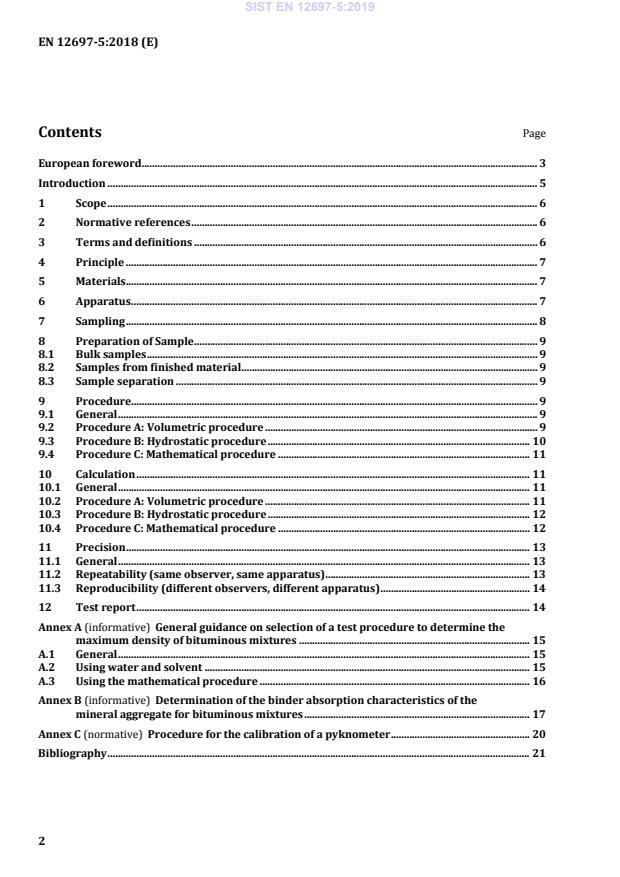
General guidance on selection of a test procedure to determine the maximum density of bituminous mixtures . 15 A.1 General . 15 A.2 Using water and solvent . 15 A.3 Using the mathematical procedure . 16 Annex B (informative)
Determination of the binder absorption characteristics of the mineral aggregate for bituminous mixtures . 17 Annex C (normative)
Procedure for the calibration of a pyknometer . 20 Bibliography . 21
[5.1] Demineralized water added as an option, including [9.2.3], [9.2.5], [9.3.3]; — [6.4] Amended description of accuracy for balance; — [6.8] The NOTE has been converted to regular text; — [7.2] Added description of loose samples and minimum thickness for cored samples for consistency with EN 12697-6; — [7.3] New subclause and NOTE introduced, describing recording of thickness before cutting and cutting of cored samples; — [7.4] New subclause describing recording of thickness after cutting and description on when a cut sample shall be regarded as representative with respect to the original thickness; — [8.2] NOTE 2 added, explaining extended drying time to constant weight when waterabsorbing additives are used; previous NOTE renumbered to "NOTE 1"; — [9.2.3] New NOTE explaining when use of solvent is not suitable; — [9.4.1] Subclause amended to include also the proportion of additives in total mass; — [10.1.2] Formula (1) amended according to corrigendum EN 12697-5:2009/AC:2012; — [10.3] Density of water amended to the nearest “0,0001” Mg/m3 in accordance with [10.1.2]. Change includes also [10.2], [B.5.5] and [C.7]; — [10.4] Symbols for binder density and binder content changed to harmonise with other standards SIST EN 12697-5:2019
General guidance on selection of a test procedure to determine the maximum density of a bituminous mixture is given in Annex A. 2 Normative references The following documents are referred to in the text in such a way that some or all of their content constitutes requirements of this document. For dated references, only the edition cited applies. For undated references, the latest edition of the referenced document (including any amendments) applies. EN 1097 (all parts), Tests for mechanical and physical properties of aggregates EN 12697-1, Bituminous mixtures — Test methods for hot mix asphalt — Part 1: Soluble binder content EN 12697-27, Bituminous mixtures — Test methods — Part 27: Sampling EN 12697-28, Bituminous mixtures — Test methods for hot mix asphalt — Part 28: Preparation of samples for determining binder content, water content and grading EN ISO 3838, Crude petroleum and liquid or solid petroleum products — Determination of density or relative density — Capillary-stoppered pyknometer and graduated bicapillary pyknometer methods (ISO 3838) 3 Terms and definitions For the purposes of this document, the following terms and definitions apply. ISO and IEC maintain terminological databases for use in standardization at the following addresses: — Electropedia I.E.C. available at http://www.electropedia.org/ — ISO Online browsing platform: available at http://www.iso.org/obp 3.1 maximum density mass per unit volume without air voids of the bituminous mixture 3.2 bulk density mass per unit volume including the air voids of a specimen SIST EN 12697-5:2019
...