

SIST EN 302 537 V2.1.1:2016
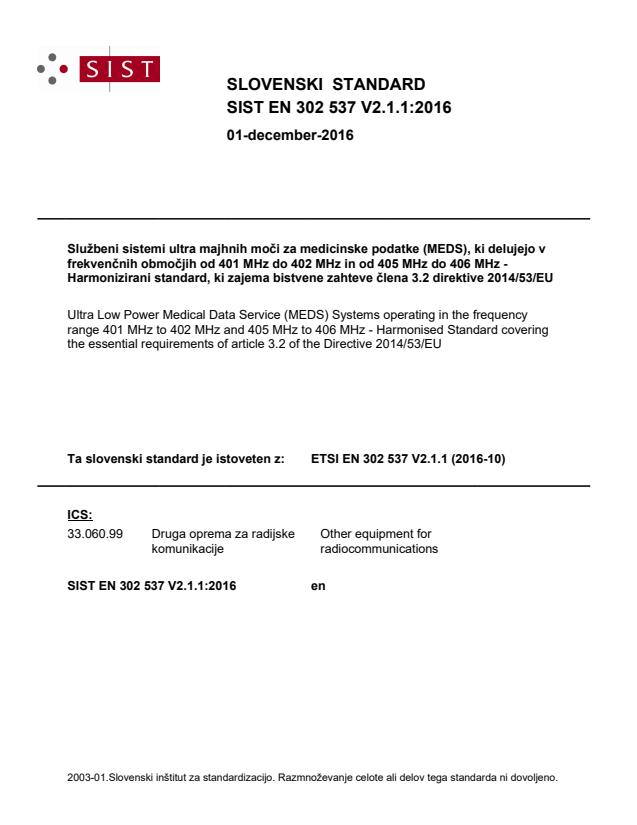
(Main)Ultra Low Power Medical Data Service (MEDS) Systems operating in the frequency range 401 MHz to 402 MHz and 405 MHz to 406 MHz - Harmonised Standard covering the essential requirements of article 3.2 of the Directive 2014/53/EU
General Information
- Abstract
The present document applies to ultra low power systems and accessories operating in spectrum within the bands
401 MHz to 402 MHz and 405 MHz to 406 MHz that operate in a MEDS service for telecommand and telemetry
between devices that are part of a MEDS (see definition of MEDS);
Only two types of MEDS system devices are permitted under the present document:
1) Frequency agile devices designed to access a minimum of 18 channels evenly distributed across the 401 MHz
to 402 MHz and 405 MHz to 406 MHz bands with a minimum of 9 channels for each 1 MHz segment (i.e.
401 MHz to 402 MHz and 405 MHz to 406 MHz).
2) Devices capable of operation only on a single channel using low duty cycle and low power for spectrum access
in the 401 MHz to 402 MHz or 405 MHz to 406 MHz bands, see clause 4.2.3.1.2 and the following clauses.
The frequency usage conditions for the bands 401 MHz to 402 MHz and 405 MHz to 406 MHz are European wide
harmonised for "active medical implant devices" according to Commission Implementing Decision 2013/752/EU [i.12]
and ERC Decision (01)17 [i.1] with the following usage restrictions:
• "This set of usage conditions is only available for systems specifically designed for the purpose of providing
non-voice digital communications between active implantable medical devices and/or body-worn devices and
other devices external to the human body used for transferring non-time critical individual patient-related
physiological information."
The present document covers devices utilizing ultra low power radio devices in combination with medical devices, the
medical portion of which is regulated by the Medical Device Directive [i.8] (MDD) or the Active Implantable Medical
Device Directive (AIMD [i.9]). The radio part of medical devices regulated by the MDD is hereafter referred to as
ULP-AMD, ULP-AMD-P for peripheral devices, and ULP-BWD for body worn devices. ULP-BWD are devices, such
as a physiological parameter sensor or handheld devices that are intended to operate in very close proximity to the
human body, including touching the body, whose radio antenna is external to the body and is used to communicate with
a device that is part of a MEDS system. The radio part of medical devices regulated under the AIMD is hereafter
referred to as Ultra Low Power-Active Medical Implants (ULP-AMI) and peripherals (ULP-AMI-P) used in a Medical
Data Service (MEDS).
Devices covered by the present document are an evolving new technology to be made available worldwide by the
medical equipment industry that will provide high speed communications capability between devices associated with an
individual patient that are part of a complete MEDS system as defined in clause 3.1. Examples of MEDS devices falling
under the scope of the present document are portable body worn physiological sensors that allow ambulatory
monitoring, implanted devices and external system devices used to transfer data collected by a MEDS system to
medical practitioners that will use the data to diagnose and treat a patient.
The present document contains requirements to demonstrate that Ultra Low Power Medical Data Service (MEDS)
Systems operating in the frequency range 401 MHz to 402 MHz and 405 MHz to 406 MHz "… shall be so constructed
that they both effectively use and support the efficient use of radio spectrum in order to avoid harmful interference"
(article 3.2 of the Directive 2014/53/EU [i.2]). It does not necessarily include all the characteristics, which may be
required by a user, nor does it necessarily represent the optimum performance achievable.
- Status
- Published
- Public Enquiry End Date
- 11-Sep-2016
- Publication Date
- 19-Oct-2016
- Technical Committee
- MOC - Mobile Communications
- Current Stage
- 6060 - National Implementation/Publication (Adopted Project)
- Start Date
- 10-Oct-2016
- Due Date
- 15-Dec-2016
- Completion Date
- 20-Oct-2016
Buy Documents
ETSI EN 302 537 V2.0.1 (2016-06) - Ultra Low Power Medical Data Service (MEDS) Systems operating in the frequency range 401 MHz to 402 MHz and 405 MHz to 406 MHz; Harmonised Standard covering the essential requirements of article 3.2 of the Directive 2014/53/EU
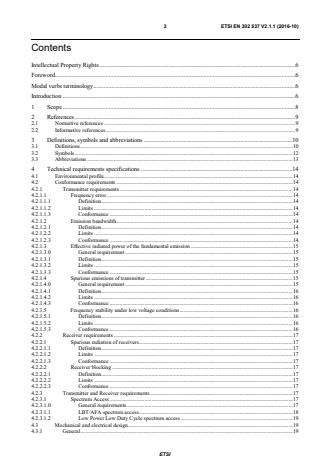
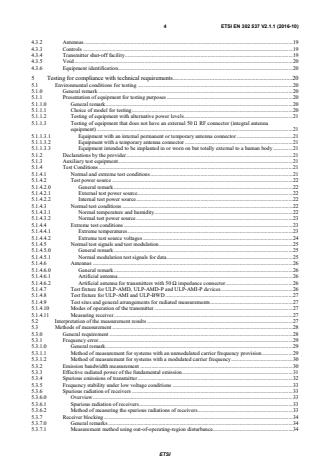
ETSI EN 302 537 V2.1.1 (2016-10) - Ultra Low Power Medical Data Service (MEDS) Systems operating in the frequency range 401 MHz to 402 MHz and 405 MHz to 406 MHz; Harmonised Standard covering the essential requirements of article 3.2 of the Directive 2014/53/EU

Overview
SIST EN 302 537 V2.1.1:2016 is a harmonised European standard that specifies essential requirements for Ultra Low Power Medical Data Service (MEDS) Systems operating within the 401 MHz to 402 MHz and 405 MHz to 406 MHz frequency bands. Developed by the Slovenski inštitut za standardizacijo (SIST) and aligned with ETSI EN 302 537, this standard ensures that medical data telemetry and telecommand systems function efficiently and safely, in compliance with article 3.2 of Directive 2014/53/EU – the Radio Equipment Directive (RED).
The standard applies to active medical implant devices and body-worn or external accessories designed for non-voice digital communications involving patient-related physiological information. Devices under this standard operate at ultra low power to minimize radio spectrum interference and meet stringent technical and regulatory requirements across Europe.
Key Topics
- Frequency Range and Usage: The standard covers systems operating in the 401–402 MHz and 405–406 MHz bands. These frequency bands are harmonized Europe-wide for active medical implants and associated devices, ensuring consistent regulatory compliance.
- Device Categories: Only two device types are permitted:
- Frequency agile devices accessing a minimum of 18 channels evenly split across the specified bands.
- Single channel low duty cycle devices using ultra low power for spectrum access.
- System Components: MEDS systems consist of:
- Active medical implants (ULP-AMI)
- Peripherals and body-worn devices (ULP-BWD, ULP-AMI-P, ULP-AMD, ULP-AMD-P)
- External communication devices for transferring patient data
- Application Requirements: Devices must support efficient spectrum use and avoid harmful interference, in line with RED article 3.2.
- Conformance and Testing: The standard specifies testing methods, environmental profiles, measurement conditions, and interpretations needed to demonstrate regulatory compliance.
- Usage Restrictions: Access is limited to systems specifically intended for non-voice digital communication, transferring non-time critical patient data.
Applications
Ultra Low Power MEDS systems compliant with SIST EN 302 537 V2.1.1:2016 are essential for modern medical telemetry and patient monitoring. Practical applications include:
- Implantable Medical Devices: Such as pacemakers, neurostimulators, and implantable sensors communicating physiological data to monitoring equipment or healthcare practitioners.
- Body-Worn Sensors: Like portable ECG monitors, glucose sensors, or wearable health trackers that transmit data for ambulatory monitoring without tethering the patient.
- External Medical Equipment: Devices outside the body that receive and process information from implants or body-worn sensors for remote monitoring or adjusting therapeutic treatments.
- Telemedicine Solutions: Supporting patient diagnosis and treatment by securely relaying critical but non-time-sensitive physiological information between patient-associated devices and healthcare providers.
By adhering to this standard, manufacturers ensure their ultra low power medical radio devices are legally marketable throughout Europe and offer reliable performance within constrained spectrum allocations.
Related Standards
Compliance with SIST EN 302 537 V2.1.1:2016 is often linked to other key standards and regulations, including:
- Directive 2014/53/EU (Radio Equipment Directive - RED): The principal legal framework governing radio equipment in Europe.
- Commission Implementing Decision 2013/752/EU: On harmonised frequency use for active medical implant devices.
- ERC Decision (01)17: Defines frequency characteristics and licensing exemptions for ultra low power medical implant communication.
- Medical Device Directive (MDD, 93/42/EEC): Regulates aspects of medical device safety and efficacy.
- Active Implantable Medical Device Directive (AIMD, 90/385/EEC): Covers additional requirements for active implantable devices.
Manufacturers and integrators should consider these related standards to ensure comprehensive compliance for their ultra low power medical data service systems.
Buy Documents
ETSI EN 302 537 V2.0.1 (2016-06) - Ultra Low Power Medical Data Service (MEDS) Systems operating in the frequency range 401 MHz to 402 MHz and 405 MHz to 406 MHz; Harmonised Standard covering the essential requirements of article 3.2 of the Directive 2014/53/EU
ETSI EN 302 537 V2.1.1 (2016-10) - Ultra Low Power Medical Data Service (MEDS) Systems operating in the frequency range 401 MHz to 402 MHz and 405 MHz to 406 MHz; Harmonised Standard covering the essential requirements of article 3.2 of the Directive 2014/53/EU
Get Certified
Connect with accredited certification bodies for this standard

ANCE
Mexican certification and testing association.

Intertek Slovenia
Intertek testing, inspection, and certification services in Slovenia.

LNE (Laboratoire National de Métrologie et d'Essais)
French national laboratory for metrology and testing.
Sponsored listings
Frequently Asked Questions
SIST EN 302 537 V2.1.1:2016 is a standard published by the Slovenian Institute for Standardization (SIST). Its full title is "Ultra Low Power Medical Data Service (MEDS) Systems operating in the frequency range 401 MHz to 402 MHz and 405 MHz to 406 MHz - Harmonised Standard covering the essential requirements of article 3.2 of the Directive 2014/53/EU". This standard covers: The present document applies to ultra low power systems and accessories operating in spectrum within the bands 401 MHz to 402 MHz and 405 MHz to 406 MHz that operate in a MEDS service for telecommand and telemetry between devices that are part of a MEDS (see definition of MEDS); Only two types of MEDS system devices are permitted under the present document: 1) Frequency agile devices designed to access a minimum of 18 channels evenly distributed across the 401 MHz to 402 MHz and 405 MHz to 406 MHz bands with a minimum of 9 channels for each 1 MHz segment (i.e. 401 MHz to 402 MHz and 405 MHz to 406 MHz). 2) Devices capable of operation only on a single channel using low duty cycle and low power for spectrum access in the 401 MHz to 402 MHz or 405 MHz to 406 MHz bands, see clause 4.2.3.1.2 and the following clauses. The frequency usage conditions for the bands 401 MHz to 402 MHz and 405 MHz to 406 MHz are European wide harmonised for "active medical implant devices" according to Commission Implementing Decision 2013/752/EU [i.12] and ERC Decision (01)17 [i.1] with the following usage restrictions: • "This set of usage conditions is only available for systems specifically designed for the purpose of providing non-voice digital communications between active implantable medical devices and/or body-worn devices and other devices external to the human body used for transferring non-time critical individual patient-related physiological information." The present document covers devices utilizing ultra low power radio devices in combination with medical devices, the medical portion of which is regulated by the Medical Device Directive [i.8] (MDD) or the Active Implantable Medical Device Directive (AIMD [i.9]). The radio part of medical devices regulated by the MDD is hereafter referred to as ULP-AMD, ULP-AMD-P for peripheral devices, and ULP-BWD for body worn devices. ULP-BWD are devices, such as a physiological parameter sensor or handheld devices that are intended to operate in very close proximity to the human body, including touching the body, whose radio antenna is external to the body and is used to communicate with a device that is part of a MEDS system. The radio part of medical devices regulated under the AIMD is hereafter referred to as Ultra Low Power-Active Medical Implants (ULP-AMI) and peripherals (ULP-AMI-P) used in a Medical Data Service (MEDS). Devices covered by the present document are an evolving new technology to be made available worldwide by the medical equipment industry that will provide high speed communications capability between devices associated with an individual patient that are part of a complete MEDS system as defined in clause 3.1. Examples of MEDS devices falling under the scope of the present document are portable body worn physiological sensors that allow ambulatory monitoring, implanted devices and external system devices used to transfer data collected by a MEDS system to medical practitioners that will use the data to diagnose and treat a patient. The present document contains requirements to demonstrate that Ultra Low Power Medical Data Service (MEDS) Systems operating in the frequency range 401 MHz to 402 MHz and 405 MHz to 406 MHz "… shall be so constructed that they both effectively use and support the efficient use of radio spectrum in order to avoid harmful interference" (article 3.2 of the Directive 2014/53/EU [i.2]). It does not necessarily include all the characteristics, which may be required by a user, nor does it necessarily represent the optimum performance achievable.
The present document applies to ultra low power systems and accessories operating in spectrum within the bands 401 MHz to 402 MHz and 405 MHz to 406 MHz that operate in a MEDS service for telecommand and telemetry between devices that are part of a MEDS (see definition of MEDS); Only two types of MEDS system devices are permitted under the present document: 1) Frequency agile devices designed to access a minimum of 18 channels evenly distributed across the 401 MHz to 402 MHz and 405 MHz to 406 MHz bands with a minimum of 9 channels for each 1 MHz segment (i.e. 401 MHz to 402 MHz and 405 MHz to 406 MHz). 2) Devices capable of operation only on a single channel using low duty cycle and low power for spectrum access in the 401 MHz to 402 MHz or 405 MHz to 406 MHz bands, see clause 4.2.3.1.2 and the following clauses. The frequency usage conditions for the bands 401 MHz to 402 MHz and 405 MHz to 406 MHz are European wide harmonised for "active medical implant devices" according to Commission Implementing Decision 2013/752/EU [i.12] and ERC Decision (01)17 [i.1] with the following usage restrictions: • "This set of usage conditions is only available for systems specifically designed for the purpose of providing non-voice digital communications between active implantable medical devices and/or body-worn devices and other devices external to the human body used for transferring non-time critical individual patient-related physiological information." The present document covers devices utilizing ultra low power radio devices in combination with medical devices, the medical portion of which is regulated by the Medical Device Directive [i.8] (MDD) or the Active Implantable Medical Device Directive (AIMD [i.9]). The radio part of medical devices regulated by the MDD is hereafter referred to as ULP-AMD, ULP-AMD-P for peripheral devices, and ULP-BWD for body worn devices. ULP-BWD are devices, such as a physiological parameter sensor or handheld devices that are intended to operate in very close proximity to the human body, including touching the body, whose radio antenna is external to the body and is used to communicate with a device that is part of a MEDS system. The radio part of medical devices regulated under the AIMD is hereafter referred to as Ultra Low Power-Active Medical Implants (ULP-AMI) and peripherals (ULP-AMI-P) used in a Medical Data Service (MEDS). Devices covered by the present document are an evolving new technology to be made available worldwide by the medical equipment industry that will provide high speed communications capability between devices associated with an individual patient that are part of a complete MEDS system as defined in clause 3.1. Examples of MEDS devices falling under the scope of the present document are portable body worn physiological sensors that allow ambulatory monitoring, implanted devices and external system devices used to transfer data collected by a MEDS system to medical practitioners that will use the data to diagnose and treat a patient. The present document contains requirements to demonstrate that Ultra Low Power Medical Data Service (MEDS) Systems operating in the frequency range 401 MHz to 402 MHz and 405 MHz to 406 MHz "… shall be so constructed that they both effectively use and support the efficient use of radio spectrum in order to avoid harmful interference" (article 3.2 of the Directive 2014/53/EU [i.2]). It does not necessarily include all the characteristics, which may be required by a user, nor does it necessarily represent the optimum performance achievable.
SIST EN 302 537 V2.1.1:2016 is classified under the following ICS (International Classification for Standards) categories: 33.060.99 - Other equipment for radiocommunications. The ICS classification helps identify the subject area and facilitates finding related standards.
SIST EN 302 537 V2.1.1:2016 is associated with the following European legislation: EU Directives/Regulations: 1999/5/EC, 2005-01-1864, 2014/53/EU. When a standard is cited in the Official Journal of the European Union, products manufactured in conformity with it benefit from a presumption of conformity with the essential requirements of the corresponding EU directive or regulation.
SIST EN 302 537 V2.1.1:2016 is available in PDF format for immediate download after purchase. The document can be added to your cart and obtained through the secure checkout process. Digital delivery ensures instant access to the complete standard document.
Standards Content (Sample)
Draft ETSI EN 302 537 V2.0.1 (2016-06)
HARMONISED EUROPEAN STANDARD
Ultra Low Power Medical Data Service (MEDS)
Systems operating in the frequency range
401 MHz to 402 MHz and 405 MHz to 406 MHz;
Harmonised Standard covering the essential requirements
of article 3.2 of the Directive 2014/53/EU
2 Draft ETSI EN 302 537 V2.0.1 (2016-06)
Reference
REN/ERM-TG30-307
Keywords
harmonised standard, radio, regulation, testing
ETSI
650 Route des Lucioles
F-06921 Sophia Antipolis Cedex - FRANCE
Tel.: +33 4 92 94 42 00 Fax: +33 4 93 65 47 16
Siret N° 348 623 562 00017 - NAF 742 C
Association à but non lucratif enregistrée à la
Sous-Préfecture de Grasse (06) N° 7803/88
Important notice
The present document can be downloaded from:
http://www.etsi.org/standards-search
The present document may be made available in electronic versions and/or in print. The content of any electronic and/or
print versions of the present document shall not be modified without the prior written authorization of ETSI. In case of any
existing or perceived difference in contents between such versions and/or in print, the only prevailing document is the
print of the Portable Document Format (PDF) version kept on a specific network drive within ETSI Secretariat.
Users of the present document should be aware that the document may be subject to revision or change of status.
Information on the current status of this and other ETSI documents is available at
https://portal.etsi.org/TB/ETSIDeliverableStatus.aspx
If you find errors in the present document, please send your comment to one of the following services:
https://portal.etsi.org/People/CommiteeSupportStaff.aspx
Copyright Notification
No part may be reproduced or utilized in any form or by any means, electronic or mechanical, including photocopying
and microfilm except as authorized by written permission of ETSI.
The content of the PDF version shall not be modified without the written authorization of ETSI.
The copyright and the foregoing restriction extend to reproduction in all media.
© European Telecommunications Standards Institute 2016.
All rights reserved.
TM TM TM
DECT , PLUGTESTS , UMTS and the ETSI logo are Trade Marks of ETSI registered for the benefit of its Members.
TM
3GPP and LTE™ are Trade Marks of ETSI registered for the benefit of its Members and
of the 3GPP Organizational Partners.
GSM® and the GSM logo are Trade Marks registered and owned by the GSM Association.
ETSI
3 Draft ETSI EN 302 537 V2.0.1 (2016-06)
Contents
Intellectual Property Rights . 6
Foreword . 6
Modal verbs terminology . 6
Introduction . 6
1 Scope . 8
2 References . 8
2.1 Normative references . 8
2.2 Informative references . 9
3 Definitions, symbols and abbreviations . 10
3.1 Definitions . 10
3.2 Symbols . 12
3.3 Abbreviations . 13
4 Technical requirements specifications . 13
4.1 Environmental profile . 13
4.2 Conformance requirements . 14
4.2.1 Transmitter requirements . 14
4.2.1.1 Frequency error . 14
4.2.1.1.1 Definition. 14
4.2.1.1.2 Limits . 14
4.2.1.1.3 Conformance . 14
4.2.1.2 Emission bandwidth . 14
4.2.1.2.1 Definition. 14
4.2.1.2.2 Limits . 14
4.2.1.2.3 Conformance . 14
4.2.1.3 Effective radiated power of the fundamental emission . 14
4.2.1.3.0 General requirement . 14
4.2.1.3.1 Definition. 15
4.2.1.3.2 Limits . 15
4.2.1.3.3 Conformance . 15
4.2.1.4 Spurious emissions of transmitter . 15
4.2.1.4.0 General requirement . 15
4.2.1.4.1 Definition. 15
4.2.1.4.2 Limits . 16
4.2.1.4.3 Conformance . 16
4.2.1.5 Frequency stability under low voltage conditions . 16
4.2.1.5.1 Definition. 16
4.2.1.5.2 Limits . 16
4.2.1.5.3 Conformance . 16
4.2.2 Receiver requirements . 16
4.2.2.1 Spurious radiation of receivers . 16
4.2.2.1.1 Definition. 16
4.2.2.1.2 Limits . 17
4.2.2.1.3 Conformance . 17
4.2.2.2 Receiver blocking . 17
4.2.2.2.1 Definition. 17
4.2.2.2.2 Limits . 17
4.2.2.2.3 Conformance . 17
4.2.3 Transmitter and Receiver requirements . 17
4.2.3.1 Spectrum Access . 17
4.2.3.1.0 General requirements . 17
4.2.3.1.1 LBT/AFA spectrum access . 18
4.2.3.1.2 Low Power Low Duty Cycle spectrum access . 18
4.3 Mechanical and electrical design . 19
4.3.1 General . 19
ETSI
4 Draft ETSI EN 302 537 V2.0.1 (2016-06)
4.3.2 Antennas . 19
4.3.3 Controls . 19
4.3.4 Transmitter shut-off facility . 19
4.3.5 Marking . 19
4.3.6 Equipment identification . 19
5 Testing for compliance with technical requirements . 20
5.1 Environmental conditions for testing . 20
5.1.0 General remark . 20
5.1.1 Presentation of equipment for testing purposes . 20
5.1.1.0 General remark . 20
5.1.1.1 Choice of model for testing . 20
5.1.1.2 Testing of equipment with alternative power levels . 20
5.1.1.3 Testing of equipment that does not have an external 50 Ω RF connector (integral antenna
equipment) . 21
5.1.1.3.1 Equipment with an internal permanent or temporary antenna connector . 21
5.1.1.3.2 Equipment with a temporary antenna connector . 21
5.1.1.3.3 Equipment intended to be implanted in or worn on but totally external to a human body . 21
5.1.2 Declarations by the provider . 21
5.1.3 Auxiliary test equipment . 21
5.1.4 Test Conditions . 21
5.1.4.1 Normal and extreme test conditions . 21
5.1.4.2 Test power source . 22
5.1.4.2.0 General remark . 22
5.1.4.2.1 External test power source . 22
5.1.4.2.2 Internal test power source . 22
5.1.4.3 Normal test conditions . 22
5.1.4.3.1 Normal temperature and humidity . 22
5.1.4.3.2 Normal test power source . 23
5.1.4.4 Extreme test conditions . 23
5.1.4.4.1 Extreme temperatures . 23
5.1.4.4.2 Extreme test source voltages . 24
5.1.4.5 Normal test signals and test modulation. 25
5.1.4.5.0 General remark . 25
5.1.4.5.1 Normal modulation test signals for data . 25
5.1.4.6 Antennas . 26
5.1.4.6.0 General remark . 26
5.1.4.6.1 Artificial antenna . 26
5.1.4.6.2 Artificial antenna for transmitters with 50 Ω impedance connector . 26
5.1.4.7 Test fixture for ULP-AMD, ULP-AMD-P and ULP-AMI-P devices . 26
5.1.4.8 Test fixture for ULP-AMI and ULP-BWD . 27
5.1.4.9 Test sites and general arrangements for radiated measurements . 27
5.1.4.10 Modes of operation of the transmitter . 27
5.1.4.11 Measuring receiver . 27
5.2 Interpretation of the measurement results . 27
5.3 Methods of measurement . 28
5.3.0 General requirement . 28
5.3.1 Frequency error . 29
5.3.1.0 General remark . 29
5.3.1.1 Method of measurement for systems with an unmodulated carrier frequency provision . 29
5.3.1.2 Method of measurement for systems with a modulated carrier frequency . 30
5.3.2 Emission bandwidth measurement . 30
5.3.3 Effective radiated power of the fundamental emission . 31
5.3.4 Spurious emissions of transmitter . 32
5.3.5 Frequency stability under low voltage conditions . 33
5.3.6 Spurious radiation of receivers . 33
5.3.6.0 Overview . 33
5.3.6.1 Spurious radiation of receivers . 33
5.3.6.2 Method of measuring the spurious radiations of receivers . 33
5.3.7 Receiver blocking . 34
5.3.7.0 General remarks . 34
5.3.7.1 Measurement method using out-of-operating-region disturbance . 34
ETSI
5 Draft ETSI EN 302 537 V2.0.1 (2016-06)
5.3.7.2 Measurement method using frequency administration commands . 35
5.3.7.3 Results based on the above test method . 35
5.3.8 Spectrum Access . 35
5.3.8.1 LBT/AFA spectrum access . 35
5.3.8.1.0 General provisions . 35
5.3.8.1.1 LBT threshold power level . 36
5.3.8.1.2 Monitoring system bandwidth . 38
5.3.8.1.3 Monitoring system scan cycle time and minimum channel monitoring period . 39
5.3.8.1.4 Channel access based on ambient levels relative to the calculated access LBT threshold level,
P . 40
Th
5.3.8.1.5 Discontinuation of MEDS session if a silent period greater than or equal to 5 s occurs . 41
5.3.8.1.6 Use of pre-scanned alternate channel . 42
5.3.8.2 Spectrum access based on low power and low duty cycle . 44
5.3.8.2.0 Overview . 44
5.3.8.2.1 Methods of measurement. 44
Annex A (normative): Relationship between the present document and the essential
requirements of Directive 2014/53/EU . 46
Annex B (normative): Radiated measurements . 47
B.1 Test sites and general arrangements for measurements involving the use of radiated fields . 47
B.1.1 Outdoor test site . 47
B.1.1.0 Introduction. 47
B.1.1.1 Standard position . 48
B.1.1.2 Equipment in close proximity to the human body but external to it . 48
B.1.1.3 Human torso simulator for ULP-BWD and ULP-AMI . 48
B.1.2 Test antenna . 49
B.1.3 Substitution antenna . 49
B.1.4 Optional additional indoor site . 50
B.2 Guidance on the use of radiation test sites . 51
B.2.0 Introduction . 51
B.2.1 Measuring distance . 51
B.2.2 Test antenna . 51
B.2.3 Substitution antenna . 51
B.2.4 Artificial antenna . 51
B.2.5 Auxiliary cables . 51
B.3 Further optional alternative indoor test site using a fully anechoic chamber . 52
B.3.0 Introduction . 52
B.3.1 Example of the construction of a fully anechoic chamber . 52
B.3.2 Influence of parasitic reflections in fully anechoic chambers . 52
B.3.3 Calibration of the fully anechoic chamber . 53
Annex C (normative): Technical performance of the spectrum analyser . 55
Annex D (informative): Bibliography . 56
History . 57
ETSI
6 Draft ETSI EN 302 537 V2.0.1 (2016-06)
Intellectual Property Rights
IPRs essential or potentially essential to the present document may have been declared to ETSI. The information
pertaining to these essential IPRs, if any, is publicly available for ETSI members and non-members, and can be found
in ETSI SR 000 314: "Intellectual Property Rights (IPRs); Essential, or potentially Essential, IPRs notified to ETSI in
respect of ETSI standards", which is available from the ETSI Secretariat. Latest updates are available on the ETSI Web
server (https://ipr.etsi.org/).
Pursuant to the ETSI IPR Policy, no investigation, including IPR searches, has been carried out by ETSI. No guarantee
can be given as to the existence of other IPRs not referenced in ETSI SR 000 314 (or the updates on the ETSI Web
server) which are, or may be, or may become, essential to the present document.
Foreword
This draft Harmonised European Standard (EN) has been produced by ETSI Technical Committee Electromagnetic
compatibility and Radio spectrum Matters (ERM), and is now submitted for the combined Public Enquiry and Vote
phase of the ETSI standards EN Approval Procedure.
The present document has been prepared under the Commission's standardisation request C(2015) 5376 final [i.11] to
provide one voluntary means of conforming to the essential requirements of Directive 2014/53/EU on the harmonisation
of the laws of the Member States relating to the making available on the market of radio equipment and repealing
Directive 1999/5/EC [i.2].
Once the present document is cited in the Official Journal of the European Union under that Directive, compliance with
the normative clauses of the present document given in table A.1 confers, within the limits of the scope of the present
document, a presumption of conformity with the corresponding essential requirements of that Directive, and associated
EFTA regulations.
Proposed national transposition dates
Date of latest announcement of this EN (doa): 3 months after ETSI publication
Date of latest publication of new National Standard
or endorsement of this EN (dop/e): 6 months after doa
Date of withdrawal of any conflicting National Standard (dow): 18 months after doa
Modal verbs terminology
In the present document "shall", "shall not", "should", "should not", "may", "need not", "will", "will not", "can" and
"cannot" are to be interpreted as described in clause 3.2 of the ETSI Drafting Rules (Verbal forms for the expression of
provisions).
"must" and "must not" are NOT allowed in ETSI deliverables except when used in direct citation.
Introduction
The present document covers the ultra low power radio devices used in a Medical Data Service and the various types of
devices that form part of the system providing the service. It includes methods of measurement and requirements for
radio systems used in the service that are fitted with an antenna connector and/or having an integral antenna. If a device
which is operating in the MEDS and is available on the market is required to be checked, it should be tested in
accordance with the methods of measurement specified in the present document.
ETSI
7 Draft ETSI EN 302 537 V2.0.1 (2016-06)
The present document covers various individual devices which when operating together form a system operating as a
Medical Data Service (MEDS) that provides medical practitioners with therapeutic and/or diagnostic information used
to provide improved medical treatment of a patient and/or to provide an interactive system for patient control of
therapeutic devices. MEDS is intended only for transmission of non-time critical data, the loss of which will not
compromise the health and/or safety of the patient.
The present document contains required characteristics considered necessary for the radio sections to meet in order to
efficiently use the available spectrum for the purpose of transferring data that is used in diagnosing and delivering
therapies to individuals with various illnesses. Of particular importance is the inclusion of spectrum monitoring and
access requirements (listen before talk protocol) designed to significantly reduce any interference potential between
MEDS systems operating in the band or between a MEDS system and primary users of the band.
The present document is a specific product standard applicable to ultra low power devices that are part of a MEDS
system operating in spectrum within the frequency bands 401 MHz to 402 MHz and 405 MHz to 406 MHz.
The frequency usage conditions for the bands 401 MHz to 402 MHz and 405 MHz to 406 MHz are European wide
harmonised for "active medical implant devices" according to Commission Implementing Decision 2013/752/EU [i.12]
and ERC Decision (01)17 [i.1].
The present document contains the technical characteristics for ultra low power radio equipment and is structured in the
following way:
• Clauses 1 through 3 provide a general description on the types of equipment covered by the present document
and the definitions, symbols and abbreviations used.
• Clause 4 provides the technical requirements, specifications, limits and conformance relative to transmitter,
receiver, and spectrum access.
• Clauses 5.1 and 5.2 specify the conditions for testing of the equipment and interpretation of the measurement
results with the maximum measurement uncertainty values.
• Clause 5.3 specifies the required measurement methods. In particular clause 5.3.8 describes the monitoring
system performance specifications that have been chosen to minimize harmful interference to other equipment
or services and minimize the potential for disturbance to this equipment from ambient sources or other medical
device users in the band.
• Annex A (normative) provides the relationship between the present document and the essential requirements
of Directive 2014/53/EU.
• Annex B (normative) provides specifications concerning radiated measurements.
• Annex C (normative) provides Technical performance of the spectrum analyser.
• Annex D (informative) bibliography provides additional information.
ETSI
8 Draft ETSI EN 302 537 V2.0.1 (2016-06)
1 Scope
The present document applies to ultra low power systems and accessories operating in spectrum within the bands
401 MHz to 402 MHz and 405 MHz to 406 MHz that operate in a MEDS service for telecommand and telemetry
between devices that are part of a MEDS (see definition of MEDS);
Only two types of MEDS system devices are permitted under the present document:
1) Frequency agile devices designed to access a minimum of 18 channels evenly distributed across the 401 MHz
to 402 MHz and 405 MHz to 406 MHz bands with a minimum of 9 channels for each 1 MHz segment (i.e.
401 MHz to 402 MHz and 405 MHz to 406 MHz).
2) Devices capable of operation only on a single channel using low duty cycle and low power for spectrum access
in the 401 MHz to 402 MHz or 405 MHz to 406 MHz bands, see clause 4.2.3.1.2 and the following clauses.
The frequency usage conditions for the bands 401 MHz to 402 MHz and 405 MHz to 406 MHz are European wide
harmonised for "active medical implant devices" according to Commission Implementing Decision 2013/752/EU [i.12]
and ERC Decision (01)17 [i.1] with the following usage restrictions:
• "This set of usage conditions is only available for systems specifically designed for the purpose of providing
non-voice digital communications between active implantable medical devices and/or body-worn devices and
other devices external to the human body used for transferring non-time critical individual patient-related
physiological information."
The present document covers devices utilizing ultra low power radio devices in combination with medical devices, the
medical portion of which is regulated by the Medical Device Directive [i.8] (MDD) or the Active Implantable Medical
Device Directive (AIMD [i.9]). The radio part of medical devices regulated by the MDD is hereafter referred to as
ULP-AMD, ULP-AMD-P for peripheral devices, and ULP-BWD for body worn devices. ULP-BWD are devices, such
as a physiological parameter sensor or handheld devices that are intended to operate in very close proximity to the
human body, including touching the body, whose radio antenna is external to the body and is used to communicate with
a device that is part of a MEDS system. The radio part of medical devices regulated under the AIMD is hereafter
referred to as Ultra Low Power-Active Medical Implants (ULP-AMI) and peripherals (ULP-AMI-P) used in a Medical
Data Service (MEDS).
Devices covered by the present document are an evolving new technology to be made available worldwide by the
medical equipment industry that will provide high speed communications capability between devices associated with an
individual patient that are part of a complete MEDS system as defined in clause 3.1. Examples of MEDS devices falling
under the scope of the present document are portable body worn physiological sensors that allow ambulatory
monitoring, implanted devices and external system devices used to transfer data collected by a MEDS system to
medical practitioners that will use the data to diagnose and treat a patient.
The present document contains requirements to demonstrate that Ultra Low Power Medical Data Service (MEDS)
Systems operating in the frequency range 401 MHz to 402 MHz and 405 MHz to 406 MHz "… shall be so constructed
that they both effectively use and support the efficient use of radio spectrum in order to avoid harmful interference"
(article 3.2 of the Directive 2014/53/EU [i.2]). It does not necessarily include all the characteristics, which may be
required by a user, nor does it necessarily represent the optimum performance achievable.
2 References
2.1 Normative references
References are either specific (identified by date of publication and/or edition number or version number) or
non-specific. For specific references, only the cited version applies. For non-specific references, the latest version of the
referenced document (including any amendments) applies.
Referenced documents which are not found to be publicly available in the expected location might be found at
https://docbox.etsi.org/Reference/.
NOTE: While any hyperlinks included in this clause were valid at the time of publication, ETSI cannot guarantee
their long term validity.
ETSI
9 Draft ETSI EN 302 537 V2.0.1 (2016-06)
The following referenced documents are necessary for the application of the present document.
[1] CISPR 16-2-3:2010+AMD1:2010+AMD2:2014: "Specification for radio disturbance and
immunity measuring apparatus and methods. Part 2-3: Methods of measurement of disturbances
and immunity - Radiated disturbance measurements".
2.2 Informative references
References are either specific (identified by date of publication and/or edition number or version number) or
non-specific. For specific references, only the cited version applies. For non-specific references, the latest version of the
referenced document (including any amendments) applies.
NOTE: While any hyperlinks included in this clause were valid at the time of publication, ETSI cannot guarantee
their long term validity.
The following referenced documents are not necessary for the application of the present document but they assist the
user with regard to a particular subject area.
[i.1] ERC Decision (01)17 (2011 amendment): "Harmonised frequencies, technical characteristics and
exemption from individual licensing of Ultra Low Power Active Medical Implant (ULP-AMI)
communication systems operating in the frequency band 401 - 406 MHz on a secondary basis".
[i.2] Directive 2014/53/EU of the European Parliament and of the Council of 16 April 2014 on the
harmonisation of the laws of the Member States relating to the making available on the market of
radio equipment and repealing Directive 1999/5/EC.
[i.3] ETSI TR 100 028 (all parts) (V1.4.1): "Electromagnetic compatibility and Radio spectrum Matters
(ERM); Uncertainties in the measurement of mobile radio equipment characteristics".
[i.4] Recommendation ITU-T O.153: "Basic parameters for the measurement of error performance at
bit rates below the primary rate".
[i.5] "Radiofrequency Radiation Dosimetry Handbook" (October 1986), USAF School of Aerospace
Medicine, Aerospace Medical Division (AFSC), Brooks Air Force Base, TX 78235-5301.
[i.6] ANSI C63.17 (1998): "American National Standard for Methods of Measurement of the
Electromagnetic and Operational Compatibility of Unlicensed Personal Communications Services
(UPCS) Devices".
[i.7] "Simulated Biological Materials for Electromagnetic Radiation Absorption Studies", by
G. Hartsgrove, A. Kraszewski, and A. Surowiec as published in Bioelectromagnetics 8:29-36
(1987).
[i.8] Council Directive 93/42/EEC of 14 June 1993 concerning medical devices (MD Directive).
[i.9] Council Directive 90/385/EEC of 20 June 1990 on the approximation of the laws of the Member
States relating to active implantable medical devices (AIMD Directive).
[i.10] Recommendation ITU-R RS.1346: "Sharing between the meteorological aids service and medical
implant communication systems (MICS) operating in the mobile service in the frequency band
401-406 MHz".
[i.11] Commission Implementing Decision C(2015) 5376 final of 4.8.2015 on a standardisation request
to the European Committee for Electrotechnical Standardisation and to the European
Telecommunications Standards Institute as regards radio equipment in support of Directive
2014/53/EU of the European Parliament and of the Council.
[i.12] Commission Implementing Decision 2013/752/EU of 11 December 2013 amending Decision
2006/771/EC on harmonisation of the radio spectrum for use by short-range devices and repealing
Decision 2005/928/EC.
ETSI
10 Draft ETSI EN 302 537 V2.0.1 (2016-06)
3 Definitions, symbols and abbreviations
3.1 Definitions
For the purposes of the present document, the following terms and definitions apply:
access protocol: specification for measuring natural and man-made ambient background levels for the purpose of
providing a technique for spectrum access that reduces the potential for harmful interference to/from other users of the
spectrum
Active Medical Device (AMD): any medical device relying for its functioning on a source of electrical energy or any
source of power other than that directly generated by the human body or gravity
Active Implantable Medical Device (AIMD): any active medical device (AMD) which is intended to be totally or
partially introduced, surgically or medically, into the human body or by medical intervention into a natural orifice, and
which is intended to remain after the procedure
Adaptive Frequency Agility (AFA): ability to determine an unoccupied sub-band or channel of operation in order to
minimize interference with other users of the same band
artificial antenna: reduced-radiating dummy load equal to the nominal impedance specified by the provider
Body Worn Device (BWD): medical sensor, handheld device, or other medical device intended to be operated in close
proximity to the human body, and is used to sense and/or transfer, via means of radio frequency transmission, human
physiological parameters or system programming information
conducted measurements: measurements that are made using a direct 50 Ω connection to the equipment under test
dedicated antenna: removable antenna supplied and tested with the radio equipment, designed as an indispensable part
of the equipment
effective radiated power: maximum power radiated during the interval of continuous transmission within the emission
bandwidth of the EUT with the highest radiated power in the direction of the maximum level under specified conditions of
measurements in the presence of modulation or without modulation as appropriate
NOTE: See clause 4.2.1.3.1.
emission bandwidth: measured as the width of the signal between the points on either side of carrier centre frequency
that are 20 dB down relative to the maximum level of the modulated carrier
NOTE: Compliance is determined using instrumentation employing a peak detector function and a resolution
bandwidth approximately equal to 1 % of the emission bandwidth of the device under test.
integral antenna: permanent fixed antenna, which may be built-in, designed as an indispensable part of the equipment
LBT threshold power level: ambient signal power level above which the monitoring system selects spectrum for use in
a communication session according to the next available channel with the lowest level of ambient signal power or least
interfered channel (LIC)
Least Interfered Channel (LIC): channel, among the available channels, that has the lowest potential for causing
interference to or receiving interference from other users of the band
Listen Before Talk (LBT): combination of the listen mode followed by the talk mode
listen mode: action taken by an interrogator to detect an unoccupied sub-band or channel
Medical Data Service (MEDS): service that uses a system specifically for the purpose of providing non-voice digital
communications between active medical implants and/or body worn devices and other devices external to the human
body engaged in transferring non-time critical individual patient related physiological information
Medical Data Service (MEDS) communication session: collection of transmissions that may or may not be
continuous, between co-operating ULP-AMI, ULP-AMI-P, ULP-BWD, ULP-AMD and ULP-AMD-P
ETSI
11 Draft ETSI EN 302 537 V2.0.1 (2016-06)
Medical Data Service (MEDS) system: collection of medical devices having short range RF
...
HARMONISED EUROPEAN STANDARD
Ultra Low Power Medical Data Service (MEDS)
Systems operating in the frequency range
401 MHz to 402 MHz and 405 MHz to 406 MHz;
Harmonised Standard covering the essential requirements
of article 3.2 of the Directive 2014/53/EU
2 ETSI EN 302 537 V2.1.1 (2016-10)
Reference
REN/ERM-TG30-307
Keywords
harmonised standard, radio, regulation, testing
ETSI
650 Route des Lucioles
F-06921 Sophia Antipolis Cedex - FRANCE
Tel.: +33 4 92 94 42 00 Fax: +33 4 93 65 47 16
Siret N° 348 623 562 00017 - NAF 742 C
Association à but non lucratif enregistrée à la
Sous-Préfecture de Grasse (06) N° 7803/88
Important notice
The present document can be downloaded from:
http://www.etsi.org/standards-search
The present document may be made available in electronic versions and/or in print. The content of any electronic and/or
print versions of the present document shall not be modified without the prior written authorization of ETSI. In case of any
existing or perceived difference in contents between such versions and/or in print, the only prevailing document is the
print of the Portable Document Format (PDF) version kept on a specific network drive within ETSI Secretariat.
Users of the present document should be aware that the document may be subject to revision or change of status.
Information on the current status of this and other ETSI documents is available at
https://portal.etsi.org/TB/ETSIDeliverableStatus.aspx
If you find errors in the present document, please send your comment to one of the following services:
https://portal.etsi.org/People/CommiteeSupportStaff.aspx
Copyright Notification
No part may be reproduced or utilized in any form or by any means, electronic or mechanical, including photocopying
and microfilm except as authorized by written permission of ETSI.
The content of the PDF version shall not be modified without the written authorization of ETSI.
The copyright and the foregoing restriction extend to reproduction in all media.
© European Telecommunications Standards Institute 2016.
All rights reserved.
TM TM TM
DECT , PLUGTESTS , UMTS and the ETSI logo are Trade Marks of ETSI registered for the benefit of its Members.
TM
3GPP and LTE™ are Trade Marks of ETSI registered for the benefit of its Members and
of the 3GPP Organizational Partners.
GSM® and the GSM logo are Trade Marks registered and owned by the GSM Association.
ETSI
3 ETSI EN 302 537 V2.1.1 (2016-10)
Contents
Intellectual Property Rights . 6
Foreword . 6
Modal verbs terminology . 6
Introduction . 6
1 Scope . 8
2 References . 9
2.1 Normative references . 9
2.2 Informative references . 9
3 Definitions, symbols and abbreviations . 10
3.1 Definitions . 10
3.2 Symbols . 12
3.3 Abbreviations . 13
4 Technical requirements specifications . 14
4.1 Environmental profile . 14
4.2 Conformance requirements . 14
4.2.1 Transmitter requirements . 14
4.2.1.1 Frequency error . 14
4.2.1.1.1 Definition. 14
4.2.1.1.2 Limits . 14
4.2.1.1.3 Conformance . 14
4.2.1.2 Emission bandwidth . 14
4.2.1.2.1 Definition. 14
4.2.1.2.2 Limits . 14
4.2.1.2.3 Conformance . 14
4.2.1.3 Effective radiated power of the fundamental emission . 15
4.2.1.3.0 General requirement . 15
4.2.1.3.1 Definition. 15
4.2.1.3.2 Limits . 15
4.2.1.3.3 Conformance . 15
4.2.1.4 Spurious emissions of transmitter . 15
4.2.1.4.0 General requirement . 15
4.2.1.4.1 Definition. 16
4.2.1.4.2 Limits . 16
4.2.1.4.3 Conformance . 16
4.2.1.5 Frequency stability under low voltage conditions . 16
4.2.1.5.1 Definition. 16
4.2.1.5.2 Limits . 16
4.2.1.5.3 Conformance . 16
4.2.2 Receiver requirements . 17
4.2.2.1 Spurious radiation of receivers . 17
4.2.2.1.1 Definition. 17
4.2.2.1.2 Limits . 17
4.2.2.1.3 Conformance . 17
4.2.2.2 Receiver blocking . 17
4.2.2.2.1 Definition. 17
4.2.2.2.2 Limits . 17
4.2.2.2.3 Conformance . 17
4.2.3 Transmitter and Receiver requirements . 17
4.2.3.1 Spectrum Access . 17
4.2.3.1.0 General requirements . 17
4.2.3.1.1 LBT/AFA spectrum access . 18
4.2.3.1.2 Low Power Low Duty Cycle spectrum access . 19
4.3 Mechanical and electrical design . 19
4.3.1 General . 19
ETSI
4 ETSI EN 302 537 V2.1.1 (2016-10)
4.3.2 Antennas . 19
4.3.3 Controls . 19
4.3.4 Transmitter shut-off facility . 19
4.3.5 Void . 20
4.3.6 Equipment identification . 20
5 Testing for compliance with technical requirements . 20
5.1 Environmental conditions for testing . 20
5.1.0 General remark . 20
5.1.1 Presentation of equipment for testing purposes . 20
5.1.1.0 General remark . 20
5.1.1.1 Choice of model for testing . 20
5.1.1.2 Testing of equipment with alternative power levels . 21
5.1.1.3 Testing of equipment that does not have an external 50 Ω RF connector (integral antenna
equipment) . 21
5.1.1.3.1 Equipment with an internal permanent or temporary antenna connector . 21
5.1.1.3.2 Equipment with a temporary antenna connector . 21
5.1.1.3.3 Equipment intended to be implanted in or worn on but totally external to a human body . 21
5.1.2 Declarations by the provider . 21
5.1.3 Auxiliary test equipment . 21
5.1.4 Test Conditions . 21
5.1.4.1 Normal and extreme test conditions . 21
5.1.4.2 Test power source . 22
5.1.4.2.0 General remark . 22
5.1.4.2.1 External test power source . 22
5.1.4.2.2 Internal test power source . 22
5.1.4.3 Normal test conditions . 22
5.1.4.3.1 Normal temperature and humidity . 22
5.1.4.3.2 Normal test power source . 23
5.1.4.4 Extreme test conditions . 23
5.1.4.4.1 Extreme temperatures . 23
5.1.4.4.2 Extreme test source voltages . 24
5.1.4.5 Normal test signals and test modulation. 25
5.1.4.5.0 General remark . 25
5.1.4.5.1 Normal modulation test signals for data . 25
5.1.4.6 Antennas . 26
5.1.4.6.0 General remark . 26
5.1.4.6.1 Artificial antenna . 26
5.1.4.6.2 Artificial antenna for transmitters with 50 Ω impedance connector . 26
5.1.4.7 Test fixture for ULP-AMD, ULP-AMD-P and ULP-AMI-P devices . 26
5.1.4.8 Test fixture for ULP-AMI and ULP-BWD . 27
5.1.4.9 Test sites and general arrangements for radiated measurements . 27
5.1.4.10 Modes of operation of the transmitter . 27
5.1.4.11 Measuring receiver . 27
5.2 Interpretation of the measurement results . 27
5.3 Methods of measurement . 28
5.3.0 General requirement . 28
5.3.1 Frequency error . 29
5.3.1.0 General remark . 29
5.3.1.1 Method of measurement for systems with an unmodulated carrier frequency provision . 29
5.3.1.2 Method of measurement for systems with a modulated carrier frequency . 30
5.3.2 Emission bandwidth measurement . 30
5.3.3 Effective radiated power of the fundamental emission . 31
5.3.4 Spurious emissions of transmitter . 32
5.3.5 Frequency stability under low voltage conditions . 33
5.3.6 Spurious radiation of receivers . 33
5.3.6.0 Overview . 33
5.3.6.1 Spurious radiation of receivers . 33
5.3.6.2 Method of measuring the spurious radiations of receivers . 33
5.3.7 Receiver blocking . 34
5.3.7.0 General remarks . 34
5.3.7.1 Measurement method using out-of-operating-region disturbance . 34
ETSI
5 ETSI EN 302 537 V2.1.1 (2016-10)
5.3.7.2 Measurement method using frequency administration commands . 35
5.3.7.3 Results based on the above test method . 35
5.3.8 Spectrum Access . 35
5.3.8.1 LBT/AFA spectrum access . 35
5.3.8.1.0 General provisions . 35
5.3.8.1.1 LBT threshold power level . 36
5.3.8.1.2 Monitoring system bandwidth . 38
5.3.8.1.3 Monitoring system scan cycle time and minimum channel monitoring period . 39
5.3.8.1.4 Channel access based on ambient levels relative to the calculated access LBT threshold level,
P . 40
Th
5.3.8.1.5 Discontinuation of MEDS session if a silent period greater than or equal to 5 s occurs . 41
5.3.8.1.6 Use of pre-scanned alternate channel . 42
5.3.8.2 Spectrum access based on low power and low duty cycle . 44
5.3.8.2.0 Overview . 44
5.3.8.2.1 Methods of measurement. 44
Annex A (normative): Relationship between the present document and the essential
requirements of Directive 2014/53/EU . 46
Annex B (normative): Radiated measurements . 47
B.1 Test sites and general arrangements for measurements involving the use of radiated fields . 47
B.1.1 Outdoor test site . 47
B.1.1.0 Introduction. 47
B.1.1.1 Standard position . 48
B.1.1.2 Equipment in close proximity to the human body but external to it . 48
B.1.1.3 Human torso simulator for ULP-BWD and ULP-AMI . 48
B.1.2 Test antenna . 49
B.1.3 Substitution antenna . 49
B.1.4 Optional additional indoor site . 50
B.2 Guidance on the use of radiation test sites . 51
B.2.0 Introduction . 51
B.2.1 Measuring distance . 51
B.2.2 Test antenna . 51
B.2.3 Substitution antenna . 51
B.2.4 Artificial antenna . 51
B.2.5 Auxiliary cables . 51
B.3 Further optional alternative indoor test site using a fully anechoic chamber . 52
B.3.0 Introduction . 52
B.3.1 Example of the construction of a fully anechoic chamber . 52
B.3.2 Influence of parasitic reflections in fully anechoic chambers . 52
B.3.3 Calibration of the fully anechoic chamber . 53
Annex C (normative): Technical performance of the spectrum analyser . 55
Annex D (informative): Bibliography . 56
History . 57
ETSI
6 ETSI EN 302 537 V2.1.1 (2016-10)
Intellectual Property Rights
IPRs essential or potentially essential to the present document may have been declared to ETSI. The information
pertaining to these essential IPRs, if any, is publicly available for ETSI members and non-members, and can be found
in ETSI SR 000 314: "Intellectual Property Rights (IPRs); Essential, or potentially Essential, IPRs notified to ETSI in
respect of ETSI standards", which is available from the ETSI Secretariat. Latest updates are available on the ETSI Web
server (https://ipr.etsi.org/).
Pursuant to the ETSI IPR Policy, no investigation, including IPR searches, has been carried out by ETSI. No guarantee
can be given as to the existence of other IPRs not referenced in ETSI SR 000 314 (or the updates on the ETSI Web
server) which are, or may be, or may become, essential to the present document.
Foreword
This Harmonised European Standard (EN) has been produced by ETSI Technical Committee Electromagnetic
compatibility and Radio spectrum Matters (ERM).
The present document has been prepared under the Commission's standardisation request C(2015) 5376 final [i.11] to
provide one voluntary means of conforming to the essential requirements of Directive 2014/53/EU on the harmonisation
of the laws of the Member States relating to the making available on the market of radio equipment and repealing
Directive 1999/5/EC [i.2].
Once the present document is cited in the Official Journal of the European Union under that Directive, compliance with
the normative clauses of the present document given in table A.1 confers, within the limits of the scope of the present
document, a presumption of conformity with the corresponding essential requirements of that Directive, and associated
EFTA regulations.
National transposition dates
Date of adoption of this EN: 12 September 2016
Date of latest announcement of this EN (doa): 31 December 2016
Date of latest publication of new National Standard
or endorsement of this EN (dop/e): 30 June 2017
Date of withdrawal of any conflicting National Standard (dow): 30 June 2018
Modal verbs terminology
In the present document "shall", "shall not", "should", "should not", "may", "need not", "will", "will not", "can" and
"cannot" are to be interpreted as described in clause 3.2 of the ETSI Drafting Rules (Verbal forms for the expression of
provisions).
"must" and "must not" are NOT allowed in ETSI deliverables except when used in direct citation.
Introduction
The present document covers the ultra low power radio devices used in a Medical Data Service and the various types of
devices that form part of the system providing the service. It includes methods of measurement and requirements for
radio systems used in the service that are fitted with an antenna connector and/or having an integral antenna. If a device
which is operating in the MEDS and is available on the market is required to be checked, it should be tested in
accordance with the methods of measurement specified in the present document.
ETSI
7 ETSI EN 302 537 V2.1.1 (2016-10)
The present document covers various individual devices which when operating together form a system operating as a
Medical Data Service (MEDS) that provides medical practitioners with therapeutic and/or diagnostic information used
to provide improved medical treatment of a patient and/or to provide an interactive system for patient control of
therapeutic devices. MEDS is intended only for transmission of non-time critical data, the loss of which will not
compromise the health and/or safety of the patient.
The present document contains required characteristics considered necessary for the radio sections to meet in order to
efficiently use the available spectrum for the purpose of transferring data that is used in diagnosing and delivering
therapies to individuals with various illnesses. Of particular importance is the inclusion of spectrum monitoring and
access requirements (listen before talk protocol) designed to significantly reduce any interference potential between
MEDS systems operating in the band or between a MEDS system and primary users of the band.
The present document is a specific product standard applicable to ultra low power devices that are part of a MEDS
system operating in spectrum within the frequency bands 401 MHz to 402 MHz and 405 MHz to 406 MHz.
The frequency usage conditions for the bands 401 MHz to 402 MHz and 405 MHz to 406 MHz are European wide
harmonised for "active medical implant devices" according to Commission Implementing Decision 2013/752/EU [i.12]
and ERC Decision (01)17 [i.1].
The present document contains the technical characteristics for ultra low power radio equipment and is structured in the
following way:
• Clauses 1 through 3 provide a general description on the types of equipment covered by the present document
and the definitions, symbols and abbreviations used.
• Clause 4 provides the technical requirements, specifications, limits and conformance relative to transmitter,
receiver, and spectrum access.
• Clauses 5.1 and 5.2 specify the conditions for testing of the equipment and interpretation of the measurement
results with the maximum measurement uncertainty values.
• Clause 5.3 specifies the required measurement methods. In particular clause 5.3.8 describes the monitoring
system performance specifications that have been chosen to minimize harmful interference to other equipment
or services and minimize the potential for disturbance to this equipment from ambient sources or other medical
device users in the band.
• Annex A (normative) provides the relationship between the present document and the essential requirements
of Directive 2014/53/EU.
• Annex B (normative) provides specifications concerning radiated measurements.
• Annex C (normative) provides Technical performance of the spectrum analyser.
• Annex D (informative) bibliography provides additional information.
ETSI
8 ETSI EN 302 537 V2.1.1 (2016-10)
1 Scope
The present document applies to ultra low power systems and accessories operating in spectrum within the bands
401 MHz to 402 MHz and 405 MHz to 406 MHz that operate in a MEDS service for telecommand and telemetry
between devices that are part of a MEDS (see definition of MEDS);
Only two types of MEDS system devices are permitted under the present document:
1) Frequency agile devices designed to access a minimum of 18 channels evenly distributed across the 401 MHz
to 402 MHz and 405 MHz to 406 MHz bands with a minimum of 9 channels for each 1 MHz segment (i.e.
401 MHz to 402 MHz and 405 MHz to 406 MHz).
2) Devices capable of operation only on a single channel using low duty cycle and low power for spectrum access
in the 401 MHz to 402 MHz or 405 MHz to 406 MHz bands, see clause 4.2.3.1.2 and the following clauses.
The frequency usage conditions for the bands 401 MHz to 402 MHz and 405 MHz to 406 MHz are European wide
harmonised for "active medical implant devices" according to Commission Implementing Decision 2013/752/EU [i.12]
and ERC Decision (01)17 [i.1] with the following usage restrictions:
• "This set of usage conditions is only available for systems specifically designed for the purpose of providing
non-voice digital communications between active implantable medical devices and/or body-worn devices and
other devices external to the human body used for transferring non-time critical individual patient-related
physiological information."
The present document covers devices utilizing ultra low power radio devices in combination with medical devices, the
medical portion of which is regulated by the Medical Device Directive [i.8] (MDD) or the Active Implantable Medical
Device Directive (AIMD [i.9]). The radio part of medical devices regulated by the MDD is hereafter referred to as
ULP-AMD, ULP-AMD-P for peripheral devices, and ULP-BWD for body worn devices. ULP-BWD are devices, such
as a physiological parameter sensor or handheld devices that are intended to operate in very close proximity to the
human body, including touching the body, whose radio antenna is external to the body and is used to communicate with
a device that is part of a MEDS system. The radio part of medical devices regulated under the AIMD is hereafter
referred to as Ultra Low Power-Active Medical Implants (ULP-AMI) and peripherals (ULP-AMI-P) used in a Medical
Data Service (MEDS).
Devices covered by the present document are an evolving new technology to be made available worldwide by the
medical equipment industry that will provide high speed communications capability between devices associated with an
individual patient that are part of a complete MEDS system as defined in clause 3.1. Examples of MEDS devices falling
under the scope of the present document are portable body worn physiological sensors that allow ambulatory
monitoring, implanted devices and external system devices used to transfer data collected by a MEDS system to
medical practitioners that will use the data to diagnose and treat a patient.
The present document contains requirements to demonstrate that Ultra Low Power Medical Data Service (MEDS)
Systems operating in the frequency range 401 MHz to 402 MHz and 405 MHz to 406 MHz "… shall be so constructed
that they both effectively use and support the efficient use of radio spectrum in order to avoid harmful interference"
(article 3.2 of the Directive 2014/53/EU [i.2]). It does not necessarily include all the characteristics, which may be
required by a user, nor does it necessarily represent the optimum performance achievable.
ETSI
9 ETSI EN 302 537 V2.1.1 (2016-10)
2 References
2.1 Normative references
References are either specific (identified by date of publication and/or edition number or version number) or
non-specific. For specific references, only the cited version applies. For non-specific references, the latest version of the
referenced document (including any amendments) applies.
Referenced documents which are not found to be publicly available in the expected location might be found at
https://docbox.etsi.org/Reference/.
NOTE: While any hyperlinks included in this clause were valid at the time of publication, ETSI cannot guarantee
their long term validity.
The following referenced documents are necessary for the application of the present document.
[1] CISPR 16-2-3:2010+AMD1:2010+AMD2:2014: "Specification for radio disturbance and
immunity measuring apparatus and methods. Part 2-3: Methods of measurement of disturbances
and immunity - Radiated disturbance measurements".
2.2 Informative references
References are either specific (identified by date of publication and/or edition number or version number) or
non-specific. For specific references, only the cited version applies. For non-specific references, the latest version of the
referenced document (including any amendments) applies.
NOTE: While any hyperlinks included in this clause were valid at the time of publication, ETSI cannot guarantee
their long term validity.
The following referenced documents are not necessary for the application of the present document but they assist the
user with regard to a particular subject area.
[i.1] ERC Decision (01)17 (2011 amendment): "Harmonised frequencies, technical characteristics and
exemption from individual licensing of Ultra Low Power Active Medical Implant (ULP-AMI)
communication systems operating in the frequency band 401 - 406 MHz on a secondary basis".
[i.2] Directive 2014/53/EU of the European Parliament and of the Council of 16 April 2014 on the
harmonisation of the laws of the Member States relating to the making available on the market of
radio equipment and repealing Directive 1999/5/EC.
[i.3] ETSI TR 100 028 (all parts) (V1.4.1): "Electromagnetic compatibility and Radio spectrum Matters
(ERM); Uncertainties in the measurement of mobile radio equipment characteristics".
[i.4] Recommendation ITU-T O.153: "Basic parameters for the measurement of error performance at
bit rates below the primary rate".
[i.5] "Radiofrequency Radiation Dosimetry Handbook" (October 1986), USAF School of Aerospace
Medicine, Aerospace Medical Division (AFSC), Brooks Air Force Base, TX 78235-5301.
[i.6] ANSI C63.17 (1998): "American National Standard for Methods of Measurement of the
Electromagnetic and Operational Compatibility of Unlicensed Personal Communications Services
(UPCS) Devices".
[i.7] "Simulated Biological Materials for Electromagnetic Radiation Absorption Studies", by
G. Hartsgrove, A. Kraszewski, and A. Surowiec as published in Bioelectromagnetics 8:29-36
(1987).
[i.8] Council Directive 93/42/EEC of 14 June 1993 concerning medical devices (MD Directive).
[i.9] Council Directive 90/385/EEC of 20 June 1990 on the approximation of the laws of the Member
States relating to active implantable medical devices (AIMD Directive).
ETSI
10 ETSI EN 302 537 V2.1.1 (2016-10)
[i.10] Recommendation ITU-R RS.1346: "Sharing between the meteorological aids service and medical
implant communication systems (MICS) operating in the mobile service in the frequency band
401-406 MHz".
[i.11] Commission Implementing Decision C(2015) 5376 final of 4.8.2015 on a standardisation request
to the European Committee for Electrotechnical Standardisation and to the European
Telecommunications Standards Institute as regards radio equipment in support of Directive
2014/53/EU of the European Parliament and of the Council.
[i.12] Commission Implementing Decision 2013/752/EU of 11 December 2013 amending Decision
2006/771/EC on harmonisation of the radio spectrum for use by short-range devices and repealing
Decision 2005/928/EC.
3 Definitions, symbols and abbreviations
3.1 Definitions
For the purposes of the present document, the following terms and definitions apply:
access protocol: specification for measuring natural and man-made ambient background levels for the purpose of
providing a technique for spectrum access that reduces the potential for harmful interference to/from other users of the
spectrum
Active Medical Device (AMD): any medical device relying for its functioning on a source of electrical energy or any
source of power other than that directly generated by the human body or gravity
Active Implantable Medical Device (AIMD): any active medical device (AMD) which is intended to be totally or
partially introduced, surgically or medically, into the human body or by medical intervention into a natural orifice, and
which is intended to remain after the procedure
Adaptive Frequency Agility (AFA): ability to determine an unoccupied sub-band or channel of operation in order to
minimize interference with other users of the same band
artificial antenna: reduced-radiating dummy load equal to the nominal impedance specified by the provider
Body Worn Device (BWD): medical sensor, handheld device, or other medical device intended to be operated in close
proximity to the human body, and is used to sense and/or transfer, via means of radio frequency transmission, human
physiological parameters or system programming information
conducted measurements: measurements that are made using a direct 50 Ω connection to the equipment under test
dedicated antenna: removable antenna supplied and tested with the radio equipment, designed as an indispensable part
of the equipment
effective radiated power: maximum power radiated during the interval of continuous transmission within the emission
bandwidth of the EUT with the highest radiated power in the direction of the maximum level under specified conditions of
measurements in the presence of modulation or without modulation as appropriate
NOTE: See clause 4.2.1.3.1.
emission bandwidth: measured as the width of the signal between the points on either side of carrier centre frequency
that are 20 dB down relative to the maximum level of the modulated carrier
NOTE: Compliance is determined using instrumentation employing a peak detector function and a resolution
bandwidth approximately equal to 1 % of the emission bandwidth of the device under test.
integral antenna: permanent fixed antenna, which may be built-in, designed as an indispensable part of the equipment
LBT threshold power level: ambient signal power level above which the monitoring system selects spectrum for use in
a communication session according to the next available channel with the lowest level of ambient signal power or least
interfered channel (LIC)
ETSI
11 ETSI EN 302 537 V2.1.1 (2016-10)
Least Interfered Channel (LIC): channel, among the available channels, that has the lowest potential for causing
interference to or receiving interference from other users of the band
Listen Before Talk (LBT): combination of the listen mode followed by the talk mode
listen mode: action taken by an interrogator to detect an unoccupied sub-band or channel
Medical Data Service (MEDS): service that uses a system specifically for the purpose of providing non-voice digital
communications between active medical implants and/or body worn devices and other devices external to the human
body engaged in transferring non-time critical individual patient related physiological information
Medical Data Service (MEDS) communication session: collection of transmissions that may or may not be
continuous, between co-operating ULP-AMI, ULP-AMI-P, ULP-BWD, ULP-AMD and ULP-AMD-P
Medical Data Service (MEDS) system: collection of medical devices having short range RF communication
capability, that are associated with a specific patient, consisting of at least one active medical implant or body worn
device together with other devices
...
2003-01.Slovenski inštitut za standardizacijo. Razmnoževanje celote ali delov tega standarda ni dovoljeno.Ultra Low Power Medical Data Service (MEDS) Systems operating in the frequency range 401 MHz to 402 MHz and 405 MHz to 406 MHz - Harmonised Standard covering the essential requirements of article 3.2 of the Directive 2014/53/EU33.060.99Druga oprema za radijske komunikacijeOther equipment for radiocommunicationsICS:Ta slovenski standard je istoveten z:ETSI EN 302 537 V2.1.1 (2016-10)SIST EN 302 537 V2.1.1:2016en01-december-2016SIST EN 302 537 V2.1.1:2016SLOVENSKI
STANDARD
HARMONISED EUROPEAN STANDARD SIST EN 302 537 V2.1.1:2016
ETSI ETSI EN 302 537 V2.1.1 (2016-10) 2
Reference REN/ERM-TG30-307 Keywords harmonised standard, radio, regulation, testing ETSI 650 Route des Lucioles F-06921 Sophia Antipolis Cedex - FRANCE
Tel.: +33 4 92 94 42 00
Fax: +33 4 93 65 47 16
Siret N° 348 623 562 00017 - NAF 742 C Association à but non lucratif enregistrée à la Sous-Préfecture de Grasse (06) N° 7803/88
Important notice The present document can be downloaded from: http://www.etsi.org/standards-search The present document may be made available in electronic versions and/or in print. The content of any electronic and/or print versions of the present document shall not be modified without the prior written authorization of ETSI. In case of any existing or perceived difference in contents between such versions and/or in print, the only prevailing document is the print of the Portable Document Format (PDF) version kept on a specific network drive within ETSI Secretariat. Users of the present document should be aware that the document may be subject to revision or change of status. Information on the current status of this and other ETSI documents is available at https://portal.etsi.org/TB/ETSIDeliverableStatus.aspx If you find errors in the present document, please send your comment to one of the following services: https://portal.etsi.org/People/CommiteeSupportStaff.aspx Copyright Notification No part may be reproduced or utilized in any form or by any means, electronic or mechanical, including photocopying and microfilm except as authorized by written permission of ETSI. The content of the PDF version shall not be modified without the written authorization of ETSI. The copyright and the foregoing restriction extend to reproduction in all media.
© European Telecommunications Standards Institute 2016. All rights reserved.
DECTTM, PLUGTESTSTM, UMTSTM and the ETSI logo are Trade Marks of ETSI registered for the benefit of its Members. 3GPPTM and LTE™ are Trade Marks of ETSI registered for the benefit of its Members and of the 3GPP Organizational Partners. GSM® and the GSM logo are Trade Marks registered and owned by the GSM Association. SIST EN 302 537 V2.1.1:2016
ETSI ETSI EN 302 537 V2.1.1 (2016-10) 3 Contents Intellectual Property Rights . 6 Foreword . 6 Modal verbs terminology . 6 Introduction . 6 1 Scope . 8 2 References . 9 2.1 Normative references . 9 2.2 Informative references . 9 3 Definitions, symbols and abbreviations . 10 3.1 Definitions . 10 3.2 Symbols . 12 3.3 Abbreviations . 13 4 Technical requirements specifications . 14 4.1 Environmental profile . 14 4.2 Conformance requirements . 14 4.2.1 Transmitter requirements . 14 4.2.1.1 Frequency error . 14 4.2.1.1.1 Definition. 14 4.2.1.1.2 Limits . 14 4.2.1.1.3 Conformance . 14 4.2.1.2 Emission bandwidth . 14 4.2.1.2.1 Definition. 14 4.2.1.2.2 Limits . 14 4.2.1.2.3 Conformance . 14 4.2.1.3 Effective radiated power of the fundamental emission . 15 4.2.1.3.0 General requirement . 15 4.2.1.3.1 Definition. 15 4.2.1.3.2 Limits . 15 4.2.1.3.3 Conformance . 15 4.2.1.4 Spurious emissions of transmitter . 15 4.2.1.4.0 General requirement . 15 4.2.1.4.1 Definition. 16 4.2.1.4.2 Limits . 16 4.2.1.4.3 Conformance . 16 4.2.1.5 Frequency stability under low voltage conditions . 16 4.2.1.5.1 Definition. 16 4.2.1.5.2 Limits . 16 4.2.1.5.3 Conformance . 16 4.2.2 Receiver requirements . 17 4.2.2.1 Spurious radiation of receivers . 17 4.2.2.1.1 Definition. 17 4.2.2.1.2 Limits . 17 4.2.2.1.3 Conformance . 17 4.2.2.2 Receiver blocking . 17 4.2.2.2.1 Definition. 17 4.2.2.2.2 Limits . 17 4.2.2.2.3 Conformance . 17 4.2.3 Transmitter and Receiver requirements . 17 4.2.3.1 Spectrum Access . 17 4.2.3.1.0 General requirements . 17 4.2.3.1.1 LBT/AFA spectrum access . 18 4.2.3.1.2 Low Power Low Duty Cycle spectrum access . 19 4.3 Mechanical and electrical design . 19 4.3.1 General . 19 SIST EN 302 537 V2.1.1:2016
ETSI ETSI EN 302 537 V2.1.1 (2016-10) 4 4.3.2 Antennas . 19 4.3.3 Controls . 19 4.3.4 Transmitter shut-off facility . 19 4.3.5 Void . 20 4.3.6 Equipment identification . 20 5 Testing for compliance with technical requirements . 20 5.1 Environmental conditions for testing . 20 5.1.0 General remark . 20 5.1.1 Presentation of equipment for testing purposes . 20 5.1.1.0 General remark . 20 5.1.1.1 Choice of model for testing . 20 5.1.1.2 Testing of equipment with alternative power levels . 21 5.1.1.3 Testing of equipment that does not have an external 50 Ω RF connector (integral antenna equipment) . 21 5.1.1.3.1 Equipment with an internal permanent or temporary antenna connector . 21 5.1.1.3.2 Equipment with a temporary antenna connector . 21 5.1.1.3.3 Equipment intended to be implanted in or worn on but totally external to a human body . 21 5.1.2 Declarations by the provider . 21 5.1.3 Auxiliary test equipment . 21 5.1.4 Test Conditions . 21 5.1.4.1 Normal and extreme test conditions . 21 5.1.4.2 Test power source . 22 5.1.4.2.0 General remark . 22 5.1.4.2.1 External test power source . 22 5.1.4.2.2 Internal test power source . 22 5.1.4.3 Normal test conditions . 22 5.1.4.3.1 Normal temperature and humidity . 22 5.1.4.3.2 Normal test power source . 23 5.1.4.4 Extreme test conditions . 23 5.1.4.4.1 Extreme temperatures . 23 5.1.4.4.2 Extreme test source voltages . 24 5.1.4.5 Normal test signals and test modulation. 25 5.1.4.5.0 General remark . 25 5.1.4.5.1 Normal modulation test signals for data . 25 5.1.4.6 Antennas . 26 5.1.4.6.0 General remark . 26 5.1.4.6.1 Artificial antenna . 26 5.1.4.6.2 Artificial antenna for transmitters with 50 Ω impedance connector . 26 5.1.4.7 Test fixture for ULP-AMD, ULP-AMD-P and ULP-AMI-P devices . 26 5.1.4.8 Test fixture for ULP-AMI and ULP-BWD . 27 5.1.4.9 Test sites and general arrangements for radiated measurements . 27 5.1.4.10 Modes of operation of the transmitter . 27 5.1.4.11 Measuring receiver . 27 5.2 Interpretation of the measurement results . 27 5.3 Methods of measurement . 28 5.3.0 General requirement . 28 5.3.1 Frequency error . 29 5.3.1.0 General remark . 29 5.3.1.1 Method of measurement for systems with an unmodulated carrier frequency provision . 29 5.3.1.2 Method of measurement for systems with a modulated carrier frequency . 30 5.3.2 Emission bandwidth measurement . 30 5.3.3 Effective radiated power of the fundamental emission . 31 5.3.4 Spurious emissions of transmitter . 32 5.3.5 Frequency stability under low voltage conditions . 33 5.3.6 Spurious radiation of receivers . 33 5.3.6.0 Overview . 33 5.3.6.1 Spurious radiation of receivers . 33 5.3.6.2 Method of measuring the spurious radiations of receivers . 33 5.3.7 Receiver blocking . 34 5.3.7.0 General remarks . 34 5.3.7.1 Measurement method using out-of-operating-region disturbance . 34 SIST EN 302 537 V2.1.1:2016
ETSI ETSI EN 302 537 V2.1.1 (2016-10) 5 5.3.7.2 Measurement method using frequency administration commands . 35 5.3.7.3 Results based on the above test method . 35 5.3.8 Spectrum Access . 35 5.3.8.1 LBT/AFA spectrum access . 35 5.3.8.1.0 General provisions . 35 5.3.8.1.1 LBT threshold power level . 36 5.3.8.1.2 Monitoring system bandwidth . 38 5.3.8.1.3 Monitoring system scan cycle time and minimum channel monitoring period . 39 5.3.8.1.4 Channel access based on ambient levels relative to the calculated access LBT threshold level, PTh . 40 5.3.8.1.5 Discontinuation of MEDS session if a silent period greater than or equal to 5 s occurs . 41 5.3.8.1.6 Use of pre-scanned alternate channel . 42 5.3.8.2 Spectrum access based on low power and low duty cycle . 44 5.3.8.2.0 Overview . 44 5.3.8.2.1 Methods of measurement. 44 Annex A (normative): Relationship between the present document and the essential requirements of Directive 2014/53/EU . 46 Annex B (normative): Radiated measurements . 47 B.1 Test sites and general arrangements for measurements involving the use of radiated fields . 47 B.1.1 Outdoor test site . 47 B.1.1.0 Introduction. 47 B.1.1.1 Standard position . 48 B.1.1.2 Equipment in close proximity to the human body but external to it . 48 B.1.1.3 Human torso simulator for ULP-BWD and ULP-AMI . 48 B.1.2 Test antenna . 49 B.1.3 Substitution antenna . 49 B.1.4 Optional additional indoor site . 50 B.2 Guidance on the use of radiation test sites . 51 B.2.0 Introduction . 51 B.2.1 Measuring distance . 51 B.2.2 Test antenna . 51 B.2.3 Substitution antenna . 51 B.2.4 Artificial antenna . 51 B.2.5 Auxiliary cables . 51 B.3 Further optional alternative indoor test site using a fully anechoic chamber . 52 B.3.0 Introduction . 52 B.3.1 Example of the construction of a fully anechoic chamber . 52 B.3.2 Influence of parasitic reflections in fully anechoic chambers . 52 B.3.3 Calibration of the fully anechoic chamber . 53 Annex C (normative): Technical performance of the spectrum analyser . 55 Annex D (informative): Bibliography . 56 History . 57
ETSI ETSI EN 302 537 V2.1.1 (2016-10) 6 Intellectual Property Rights IPRs essential or potentially essential to the present document may have been declared to ETSI. The information pertaining to these essential IPRs, if any, is publicly available for ETSI members and non-members, and can be found in ETSI SR 000 314: "Intellectual Property Rights (IPRs); Essential, or potentially Essential, IPRs notified to ETSI in respect of ETSI standards", which is available from the ETSI Secretariat. Latest updates are available on the ETSI Web server (https://ipr.etsi.org/). Pursuant to the ETSI IPR Policy, no investigation, including IPR searches, has been carried out by ETSI. No guarantee can be given as to the existence of other IPRs not referenced in ETSI SR 000 314 (or the updates on the ETSI Web server) which are, or may be, or may become, essential to the present document. Foreword This Harmonised European Standard (EN) has been produced by ETSI Technical Committee Electromagnetic compatibility and Radio spectrum Matters (ERM). The present document has been prepared under the Commission's standardisation request C(2015) 5376 final [i.11] to provide one voluntary means of conforming to the essential requirements of Directive 2014/53/EU on the harmonisation of the laws of the Member States relating to the making available on the market of radio equipment and repealing Directive 1999/5/EC [i.2]. Once the present document is cited in the Official Journal of the European Union under that Directive, compliance with the normative clauses of the present document given in table A.1 confers, within the limits of the scope of the present document, a presumption of conformity with the corresponding essential requirements of that Directive, and associated EFTA regulations.
National transposition dates Date of adoption of this EN: 12 September 2016 Date of latest announcement of this EN (doa): 31 December 2016 Date of latest publication of new National Standard or endorsement of this EN (dop/e):
30 June 2017 Date of withdrawal of any conflicting National Standard (dow): 30 June 2018
Modal verbs terminology In the present document "shall", "shall not", "should", "should not", "may", "need not", "will", "will not", "can" and "cannot" are to be interpreted as described in clause 3.2 of the ETSI Drafting Rules (Verbal forms for the expression of provisions). "must" and "must not" are NOT allowed in ETSI deliverables except when used in direct citation. Introduction The present document covers the ultra low power radio devices used in a Medical Data Service and the various types of devices that form part of the system providing the service. It includes methods of measurement and requirements for radio systems used in the service that are fitted with an antenna connector and/or having an integral antenna. If a device which is operating in the MEDS and is available on the market is required to be checked, it should be tested in accordance with the methods of measurement specified in the present document. SIST EN 302 537 V2.1.1:2016
ETSI ETSI EN 302 537 V2.1.1 (2016-10) 7 The present document covers various individual devices which when operating together form a system operating as a Medical Data Service (MEDS) that provides medical practitioners with therapeutic and/or diagnostic information used to provide improved medical treatment of a patient and/or to provide an interactive system for patient control of therapeutic devices. MEDS is intended only for transmission of non-time critical data, the loss of which will not compromise the health and/or safety of the patient.
The present document contains required characteristics considered necessary for the radio sections to meet in order to efficiently use the available spectrum for the purpose of transferring data that is used in diagnosing and delivering therapies to individuals with various illnesses. Of particular importance is the inclusion of spectrum monitoring and access requirements (listen before talk protocol) designed to significantly reduce any interference potential between MEDS systems operating in the band or between a MEDS system and primary users of the band.
The present document is a specific product standard applicable to ultra low power devices that are part of a MEDS system operating in spectrum within the frequency bands 401 MHz to 402 MHz and 405 MHz to 406 MHz.
The frequency usage conditions for the bands 401 MHz to 402 MHz and 405 MHz to 406 MHz are European wide harmonised for "active medical implant devices" according to Commission Implementing Decision 2013/752/EU [i.12] and ERC Decision (01)17 [i.1]. The present document contains the technical characteristics for ultra low power radio equipment and is structured in the following way: • Clauses 1 through 3 provide a general description on the types of equipment covered by the present document and the definitions, symbols and abbreviations used. • Clause 4 provides the technical requirements, specifications, limits and conformance relative to transmitter, receiver, and spectrum access. • Clauses 5.1 and 5.2 specify the conditions for testing of the equipment and interpretation of the measurement results with the maximum measurement uncertainty values. • Clause 5.3 specifies the required measurement methods. In particular clause 5.3.8 describes the monitoring system performance specifications that have been chosen to minimize harmful interference to other equipment or services and minimize the potential for disturbance to this equipment from ambient sources or other medical device users in the band. • Annex A (normative) provides the relationship between the present document and the essential requirements of Directive 2014/53/EU. • Annex B (normative) provides specifications concerning radiated measurements. • Annex C (normative) provides Technical performance of the spectrum analyser. • Annex D (informative) bibliography provides additional information.
ETSI ETSI EN 302 537 V2.1.1 (2016-10) 8 1 Scope The present document applies to ultra low power systems and accessories operating in spectrum within the bands 401 MHz to 402 MHz and 405 MHz to 406 MHz that operate in a MEDS service for telecommand and telemetry between devices that are part of a MEDS (see definition of MEDS); Only two types of MEDS system devices are permitted under the present document: 1) Frequency agile devices designed to access a minimum of 18 channels evenly distributed across the 401 MHz to 402 MHz and 405 MHz to 406 MHz bands with a minimum of 9 channels for each 1 MHz segment (i.e. 401 MHz to 402 MHz and 405 MHz to 406 MHz). 2) Devices capable of operation only on a single channel using low duty cycle and low power for spectrum access in the 401 MHz to 402 MHz or 405 MHz to 406 MHz bands, see clause 4.2.3.1.2 and the following clauses. The frequency usage conditions for the bands 401 MHz to 402 MHz and 405 MHz to 406 MHz are European wide harmonised for "active medical implant devices" according to Commission Implementing Decision 2013/752/EU [i.12] and ERC Decision (01)17 [i.1] with the following usage restrictions: • "This set of usage conditions is only available for systems specifically designed for the purpose of providing non-voice digital communications between active implantable medical devices and/or body-worn devices and other devices external to the human body used for transferring non-time critical individual patient-related physiological information." The present document covers devices utilizing ultra low power radio devices in combination with medical devices, the medical portion of which is regulated by the Medical Device Directive [i.8] (MDD) or the Active Implantable Medical Device Directive (AIMD [i.9]). The radio part of medical devices regulated by the MDD is hereafter referred to as ULP-AMD, ULP-AMD-P for peripheral devices, and ULP-BWD for body worn devices. ULP-BWD are devices, such as a physiological parameter sensor or handheld devices that are intended to operate in very close proximity to the human body, including touching the body, whose radio antenna is external to the body and is used to communicate with a device that is part of a MEDS system. The radio part of medical devices regulated under the AIMD is hereafter referred to as Ultra Low Power-Active Medical Implants (ULP-AMI) and peripherals (ULP-AMI-P) used in a Medical Data Service (MEDS). Devices covered by the present document are an evolving new technology to be made available worldwide by the medical equipment industry that will provide high speed communications capability between devices associated with an individual patient that are part of a complete MEDS system as defined in clause 3.1. Examples of MEDS devices falling under the scope of the present document are portable body worn physiological sensors that allow ambulatory monitoring, implanted devices and external system devices used to transfer data collected by a MEDS system to medical practitioners that will use the data to diagnose and treat a patient. The present document contains requirements to demonstrate that Ultra Low Power Medical Data Service (MEDS) Systems operating in the frequency range 401 MHz to 402 MHz and 405 MHz to 406 MHz "… shall be so constructed that they both effectively use and support the efficient use of radio spectrum in order to avoid harmful interference" (article 3.2 of the Directive 2014/53/EU [i.2]). It does not necessarily include all the characteristics, which may be required by a user, nor does it necessarily represent the optimum performance achievable. SIST EN 302 537 V2.1.1:2016
ETSI ETSI EN 302 537 V2.1.1 (2016-10) 9 2 References 2.1 Normative references References are either specific (identified by date of publication and/or edition number or version number) or non-specific. For specific references, only the cited version applies. For non-specific references, the latest version of the referenced document (including any amendments) applies. Referenced documents which are not found to be publicly available in the expected location might be found at https://docbox.etsi.org/Reference/. NOTE: While any hyperlinks included in this clause were valid at the time of publication, ETSI cannot guarantee their long term validity. The following referenced documents are necessary for the application of the present document. [1] CISPR 16-2-3:2010+AMD1:2010+AMD2:2014: "Specification for radio disturbance and immunity measuring apparatus and methods. Part 2-3: Methods of measurement of disturbances and immunity - Radiated disturbance measurements". 2.2 Informative references References are either specific (identified by date of publication and/or edition number or version number) or non-specific. For specific references, only the cited version applies. For non-specific references, the latest version of the referenced document (including any amendments) applies. NOTE: While any hyperlinks included in this clause were valid at the time of publication, ETSI cannot guarantee their long term validity. The following referenced documents are not necessary for the application of the present document but they assist the user with regard to a particular subject area. [i.1] ERC Decision (01)17 (2011 amendment): "Harmonised frequencies, technical characteristics and exemption from individual licensing of Ultra Low Power Active Medical Implant (ULP-AMI) communication systems operating in the frequency band 401 - 406 MHz on a secondary basis". [i.2] Directive 2014/53/EU of the European Parliament and of the Council of 16 April 2014 on the harmonisation of the laws of the Member States relating to the making available on the market of radio equipment and repealing Directive 1999/5/EC. [i.3] ETSI TR 100 028 (all parts) (V1.4.1): "Electromagnetic compatibility and Radio spectrum Matters (ERM); Uncertainties in the measurement of mobile radio equipment characteristics". [i.4] Recommendation ITU-T O.153: "Basic parameters for the measurement of error performance at bit rates below the primary rate". [i.5] "Radiofrequency Radiation Dosimetry Handbook" (October 1986), USAF School of Aerospace Medicine, Aerospace Medical Division (AFSC), Brooks Air Force Base, TX 78235-5301. [i.6] ANSI C63.17 (1998): "American National Standard for Methods of Measurement of the Electromagnetic and Operational Compatibility of Unlicensed Personal Communications Services (UPCS) Devices". [i.7] "Simulated Biological Materials for Electromagnetic Radiation Absorption Studies", by G. Hartsgrove, A. Kraszewski, and A. Surowiec as published in Bioelectromagnetics 8:29-36 (1987). [i.8] Council Directive 93/42/EEC of 14 June 1993 concerning medical devices (MD Directive). [i.9] Council Directive 90/385/EEC of 20 June 1990 on the approximation of the laws of the Member States relating to active implantable medical devices (AIMD Directive). SIST EN 302 537 V2.1.1:2016
ETSI ETSI EN 302 537 V2.1.1 (2016-10) 10 [i.10] Recommendation ITU-R RS.1346: "Sharing between the meteorological aids service and medical implant communication systems (MICS) operating in the mobile service in the frequency band 401-406 MHz". [i.11] Commission Implementing Decision C(2015) 5376 final of 4.8.2015 on a standardisation request to the European Committee for Electrotechnical Standardisation and to the European Telecommunications Standards Institute as regards radio equipment in support of Directive 2014/53/EU of the European Parliament and of the Council. [i.12] Commission Implementing Decision 2013/752/EU of 11 December 2013 amending Decision 2006/771/EC on harmonisation of the radio spectrum for use by short-range devices and repealing Decision 2005/928/EC. 3 Definitions, symbols and abbreviations 3.1 Definitions For the purposes of the present document, the following terms and definitions apply: access protocol: specification for measuring natural and man-made ambient background levels for the purpose of providing a technique for spectrum access that reduces the potential for harmful interference to/from other users of the spectrum Active Medical Device (AMD): any medical device relying for its functioning on a source of electrical energy or any source of power other than that directly generated by the human body or gravity Active Implantable Medical Device (AIMD): any active medical device (AMD) which is intended to be totally or partially introduced, surgically or medically, into the human body or by medical intervention into a natural orifice, and which is intended to remain after the procedure Adaptive Frequency Agility (AFA): ability to determine an unoccupied sub-band or channel of operation in order to minimize interference with other users of the same band artificial antenna: reduced-radiating dummy load equal to the nominal impedance specified by the provider Body Worn Device (BWD): medical sensor, handheld device, or other medical device intended to be operated in close proximity to the human body, and is used to sense and/or transfer, via means of radio frequency transmission, human physiological parameters or system programming information conducted measurements: measurements that are made using a direct 50 Ω connection to the equipment under test dedicated antenna: removable antenna supplied and tested with the radio equipment, designed as an indispensable part of the equipment effective radiated power: maximum power radiated during the interval of continuous transmission within the emission bandwidth of the EUT with the highest radiated power in the direction of the maximum level under specified conditions of measurements in the presence of modulation or without modulation as appropriate NOTE: See clause 4.2.1.3.1. emission bandwidth: measured as the width of the signal between the points on either side of carrier centre frequency that are 20 dB down relative to the maximum level of the modulated carrier NOTE: Compliance is determined using instrumentation employing a peak detector function and a resolution bandwidth approximately equal to 1 % of the emission bandwidth of the device under test. integral antenna: permanent fixed antenna, which may be built-in, designed as an indispensable part of the equipment LBT threshold power level: ambient signal power level above which the monitoring system selects spectrum for use in a communication session according to the next available channel with the lowest level of ambient signal power or least interfered channel (LIC) SIST EN 302 537 V2.1.1:2016
ETSI ETSI EN 302 537 V2.1.1 (2016-10) 11 Least Interfered Channel (LIC): channel, among the available channels, that has the lowest potential for causing interference to or receiving interference from other users of the band Listen Before Talk (LBT): combination of the listen mode followed by the talk mode listen mode: action taken by an interrogator to detect an unoccupied sub-band or channel Medical Data Service (MEDS): service that uses a system specifically for the purpose of providing non-voice digital communications between active medical implants and/or body worn devices and other devices external to the human body engaged in transferring non-time critical individual patient related physiological information Medical Data Service (MEDS) communication session: collection of transmissions that may or may not be continuous, between co-operating ULP-AMI, ULP-AMI-P, ULP-BWD, ULP-AMD and ULP-AMD-P Medical Data Service (MEDS) system: collection of medical devices having short range RF communication capability, that are associated with a specific patient, consisting of at least one active medical implant or body worn device together with other devices external to the body, that have the ability to communicate with each other using frequencies in the 401 MHz to 402
...