


SIST EN IEC 61000-4-30:2026
(Main)Electromagnetic compatibility (EMC) - Part 4-30: Testing and measurement techniques - Power quality measurement methods
Electromagnetic compatibility (EMC) - Part 4-30: Testing and measurement techniques - Power quality measurement methods
IEC 61000-4-30:2025 defines the methods for measurement and interpretation of results for power quality parameters in AC power supply systems with a declared fundamental frequency of 50 Hz or 60 Hz. Measurement methods are described for each relevant parameter in terms that give reliable and repeatable results, regardless of the method’s implementation. This document addresses measurement methods for in-situ measurements. This document covers two classes of measurement methods (Class A and Class S). The classes of measurement are specified in Clause 4.
NOTE 1 In this document, “A” stands for “advanced” and “S” stands for “surveys”.
Measurement of parameters covered by this document is limited to conducted phenomena in power systems. The power quality parameters considered in this document are power frequency, magnitude of the supply voltage, flicker, supply voltage dips and swells, voltage interruptions, transient voltages, supply voltage unbalance, voltage harmonics and interharmonics, rapid voltage changes, mains communicating system (MCS) voltages, magnitude of current, harmonic currents, interharmonic currents and current unbalance. Emissions in the 2 kHz to 150 kHz range are considered in Annex C and Annex D. Depending on the purpose of the measurement, all or a subset of the phenomena on this list can be measured.
NOTE 2 Test methods for verifying compliance with this document can be found in IEC 62586-2.
NOTE 3 The effects of transducers inserted between the power system and the instrument are acknowledged but not addressed in detail in this document. Guidance about effects of transducers can be found IEC TR 61869-103.
This fourth edition cancels and replaces the third edition published in 2015. This edition constitutes a technical revision.This edition includes the following significant technical changes with respect to the previous edition:
a) IEC 61000-4-30:2015/AMD1:2021 and IEC 61000-4-30:2015/COR1:2016 were included.
b) The measurement method for rapid voltage changes (RVC) has been corrected and extended.
c) The measurement method for voltage events has been updated and extended.
d) Annex C was divided into 2 parts:
1) Annex C: The measurement method from IEC 61000-4-7:2002 and IEC 61000‑4‑7:2002/AMD1:2008, Annex B for conducted emissions in the 2 kHz to 9 kHz range has been separate
2) Annex D: A new measurement method for conducted emissions in the 9 kHz to 150 kHz range has been added.
e) Annex D (underdeviation and overdeviation parameters) was removed.
f) Annex E (Class B) was removed.
Elektromagnetische Verträglichkeit (EMV) - Teil 4-30: Prüf- und Messverfahren - Verfahren zur Messung der Spannungsqualität
Compatibilité électromagnétique (CEM) - Partie 4-30: Techniques d'essai et de mesure - Méthodes de mesure de la qualité de l'alimentation
IEC 61000-4-30:2025 définit les méthodes de mesure des paramètres de qualité de l'alimentation des réseaux d'énergie électrique en courant alternatif à une fréquence fondamentale déclarée de 50 Hz ou 60 Hz et la façon d'interpréter les résultats. Les méthodes de mesure sont décrites pour chaque paramètre applicable en des termes qui fournissent des résultats fiables et répétables, indépendamment de la mise en œuvre de la méthode. Le présent document porte sur les méthodes de mesure destinées aux mesurages in situ. Le présent document couvre deux classes de méthodes de mesure (classe A et classe S). Les classes de mesure sont spécifiées à l'Article 4.
NOTE 1 Dans le présent document, "A" signifie "advanced" et "S" signifie "surveys".
Le mesurage des paramètres couverts par le présent document se limite aux phénomènes conduits sur les réseaux d'énergie électrique. Les paramètres de qualité de l'alimentation pris en compte dans le présent document sont la fréquence industrielle, l'amplitude de la tension d'alimentation, le papillotement, les creux de la tension d'alimentation et les surtensions temporaires à fréquence industrielle, les coupures de tension, les tensions transitoires, le déséquilibre de tension d'alimentation, les harmoniques et interharmoniques de tension, les variations rapides de tension, les tensions des systèmes de communication par le réseau d'alimentation (MCS), l'amplitude du courant, les courants harmoniques, les courants interharmoniques et le déséquilibre de courant. Les émissions dans la plage comprise entre 2 kHz et 150 kHz sont prises en compte à l'Annexe C et à l'Annexe D. En fonction de l'objet du mesurage, celui-ci peut porter soit sur une partie des phénomènes de cette liste soit sur l'ensemble.
NOTE 2 Les méthodes d'essai concernant la vérification de la conformité au présent document peuvent être consultées dans l'IEC 62586-2.
NOTE 3 Les effets des transducteurs lorsqu'ils sont placés entre le réseau et l'appareil de mesure sont pris en compte, mais non traités en détail dans le présent document. Des recommandations concernant les effets des transducteurs peuvent être consultées dans l'IEC TR 61869-103.
Cette quatrième édition annule et remplace la troisième édition parue en 2015. Cette édition constitue une révision technique. Cette édition inclut les modifications techniques majeures suivantes par rapport à l'édition précédente:
a) l'IEC 61000-4-30:2015/AMD1:2021 et l'IEC 61000-4-30:2015/COR1:2016 ont été prises en compte;
b) la méthode de mesure des variations rapides de tension (RVC) a été corrigée et étendue;
c) la méthode de mesure des événements de tension a été mise à jour et étendue;
d) l'Annexe C a été divisée en 2 parties:
1) Annexe C: la méthode de mesure de l'IEC 61000-4-7:2002 et de l'IEC 61000‑4‑7:2002/AMD1:2008, Annexe B pour les émissions conduites dans la plage de 2 kHz à 9 kHz
a été séparée;
2) Annexe D: une nouvelle méthode de mesure des émissions conduites dans la plage de 9 kHz à 150 kHz a été ajoutée;
e) l'Annexe D (paramètres de valeur basse et valeur haute) a été supprimée;
f) l'Annexe E (classe B) a été supprimée.
Elektromagnetna združljivost (EMC) - 4-30. del: Preskusne in merilne tehnike - Metode merjenja kakovosti napetosti
General Information
Relations
Overview
EN IEC 61000-4-30:2025 (Electromagnetic compatibility - Part 4-30) specifies standardized power quality measurement methods for in‑situ (on‑site) measurement and interpretation of power quality parameters in AC power supply systems with a declared fundamental frequency of 50 Hz or 60 Hz. The fourth edition (technical revision) defines reliable, repeatable measurement procedures independent of implementation and distinguishes two measurement classes: Class A (advanced) and Class S (surveys). It covers conducted power quality phenomena and includes new/updated guidance for rapid voltage changes, voltage events, and conducted emissions up to 150 kHz.
Keywords: EN IEC 61000-4-30:2025, EMC, power quality measurement, Class A, Class S, in-situ measurements
Key topics and technical requirements
- Scope and classes: Defines measurement objectives and the two classes of measurement (A = advanced, S = surveys).
- Parameters covered: Power frequency; supply voltage magnitude; flicker; voltage dips, swells, interruptions; transient voltages; voltage unbalance; voltage and current harmonics and interharmonics; rapid voltage changes (RVC); mains communicating system (MCS) voltages; current magnitude and unbalance.
- Conducted emissions: Annex C and D treat emissions in 2 kHz–150 kHz (Annex C covers earlier 2–9 kHz guidance; Annex D adds the 9–150 kHz measurement method).
- Measurement aggregation & timing: Specifies aggregation algorithms and periods (e.g., 150/180-cycle, 10‑minute, 2‑hour) to ensure consistent reporting.
- Performance and accuracy: Maximum permissible measurement errors, time‑clock error limits, and flagging/reporting rules for data quality.
- Event detection and evaluation: Detailed methods for detecting and evaluating dips, swells, interruptions, RVC events and transients.
- Implementation notes: Focus on in-situ monitoring; transducer effects are acknowledged (detailed transducer guidance referenced to IEC TR 61869-103).
- Standards linkage: Test verification methods are referenced in IEC 62586-2; some measurement methods draw on IEC 61000-4-7 material.
Keywords: flicker, harmonics, interharmonics, RVC, conducted emissions, aggregation
Practical applications and users
- Utilities and distribution network operators for network quality assessment and compliance monitoring.
- Power quality engineers and consultants performing contractual surveys, statistical studies, or diagnostics.
- Test laboratories and manufacturers of power quality analyzers to validate performance to Class A / Class S criteria.
- Industrial and commercial facility managers addressing equipment immunity, disturbance attribution, or SLA disputes.
- Regulators and standards bodies developing power quality limits and enforcement procedures.
Keywords: power quality analyzers, utilities, network monitoring, SLA, disturbance diagnosis
Related standards
- IEC 62586-2 - test methods for verifying compliance with EN IEC 61000-4-30.
- IEC TR 61869-103 - guidance on effects of transducers between system and instrument.
- IEC 61000-4-7 - referenced measurement methods for harmonic/interharmonic analysis (informative in Annex C).
EN IEC 61000-4-30:2025 is essential for consistent, repeatable on‑site power quality measurement and reporting aligned with international EMC best practice.
Frequently Asked Questions
SIST EN IEC 61000-4-30:2026 is a draft published by the Slovenian Institute for Standardization (SIST). Its full title is "Electromagnetic compatibility (EMC) - Part 4-30: Testing and measurement techniques - Power quality measurement methods". This standard covers: IEC 61000-4-30:2025 defines the methods for measurement and interpretation of results for power quality parameters in AC power supply systems with a declared fundamental frequency of 50 Hz or 60 Hz. Measurement methods are described for each relevant parameter in terms that give reliable and repeatable results, regardless of the method’s implementation. This document addresses measurement methods for in-situ measurements. This document covers two classes of measurement methods (Class A and Class S). The classes of measurement are specified in Clause 4. NOTE 1 In this document, “A” stands for “advanced” and “S” stands for “surveys”. Measurement of parameters covered by this document is limited to conducted phenomena in power systems. The power quality parameters considered in this document are power frequency, magnitude of the supply voltage, flicker, supply voltage dips and swells, voltage interruptions, transient voltages, supply voltage unbalance, voltage harmonics and interharmonics, rapid voltage changes, mains communicating system (MCS) voltages, magnitude of current, harmonic currents, interharmonic currents and current unbalance. Emissions in the 2 kHz to 150 kHz range are considered in Annex C and Annex D. Depending on the purpose of the measurement, all or a subset of the phenomena on this list can be measured. NOTE 2 Test methods for verifying compliance with this document can be found in IEC 62586-2. NOTE 3 The effects of transducers inserted between the power system and the instrument are acknowledged but not addressed in detail in this document. Guidance about effects of transducers can be found IEC TR 61869-103. This fourth edition cancels and replaces the third edition published in 2015. This edition constitutes a technical revision.This edition includes the following significant technical changes with respect to the previous edition: a) IEC 61000-4-30:2015/AMD1:2021 and IEC 61000-4-30:2015/COR1:2016 were included. b) The measurement method for rapid voltage changes (RVC) has been corrected and extended. c) The measurement method for voltage events has been updated and extended. d) Annex C was divided into 2 parts: 1) Annex C: The measurement method from IEC 61000-4-7:2002 and IEC 61000‑4‑7:2002/AMD1:2008, Annex B for conducted emissions in the 2 kHz to 9 kHz range has been separate 2) Annex D: A new measurement method for conducted emissions in the 9 kHz to 150 kHz range has been added. e) Annex D (underdeviation and overdeviation parameters) was removed. f) Annex E (Class B) was removed.
IEC 61000-4-30:2025 defines the methods for measurement and interpretation of results for power quality parameters in AC power supply systems with a declared fundamental frequency of 50 Hz or 60 Hz. Measurement methods are described for each relevant parameter in terms that give reliable and repeatable results, regardless of the method’s implementation. This document addresses measurement methods for in-situ measurements. This document covers two classes of measurement methods (Class A and Class S). The classes of measurement are specified in Clause 4. NOTE 1 In this document, “A” stands for “advanced” and “S” stands for “surveys”. Measurement of parameters covered by this document is limited to conducted phenomena in power systems. The power quality parameters considered in this document are power frequency, magnitude of the supply voltage, flicker, supply voltage dips and swells, voltage interruptions, transient voltages, supply voltage unbalance, voltage harmonics and interharmonics, rapid voltage changes, mains communicating system (MCS) voltages, magnitude of current, harmonic currents, interharmonic currents and current unbalance. Emissions in the 2 kHz to 150 kHz range are considered in Annex C and Annex D. Depending on the purpose of the measurement, all or a subset of the phenomena on this list can be measured. NOTE 2 Test methods for verifying compliance with this document can be found in IEC 62586-2. NOTE 3 The effects of transducers inserted between the power system and the instrument are acknowledged but not addressed in detail in this document. Guidance about effects of transducers can be found IEC TR 61869-103. This fourth edition cancels and replaces the third edition published in 2015. This edition constitutes a technical revision.This edition includes the following significant technical changes with respect to the previous edition: a) IEC 61000-4-30:2015/AMD1:2021 and IEC 61000-4-30:2015/COR1:2016 were included. b) The measurement method for rapid voltage changes (RVC) has been corrected and extended. c) The measurement method for voltage events has been updated and extended. d) Annex C was divided into 2 parts: 1) Annex C: The measurement method from IEC 61000-4-7:2002 and IEC 61000‑4‑7:2002/AMD1:2008, Annex B for conducted emissions in the 2 kHz to 9 kHz range has been separate 2) Annex D: A new measurement method for conducted emissions in the 9 kHz to 150 kHz range has been added. e) Annex D (underdeviation and overdeviation parameters) was removed. f) Annex E (Class B) was removed.
SIST EN IEC 61000-4-30:2026 is classified under the following ICS (International Classification for Standards) categories: 33.100.01 - Electromagnetic compatibility in general; 33.100.99 - Other aspects related to EMC. The ICS classification helps identify the subject area and facilitates finding related standards.
SIST EN IEC 61000-4-30:2026 has the following relationships with other standards: It is inter standard links to SIST EN 61000-4-30:2015/A1:2021, SIST EN 61000-4-30:2015, SIST EN 61000-4-30:2015/AC:2017. Understanding these relationships helps ensure you are using the most current and applicable version of the standard.
SIST EN IEC 61000-4-30:2026 is associated with the following European legislation: EU Directives/Regulations: 2014/30/EU. When a standard is cited in the Official Journal of the European Union, products manufactured in conformity with it benefit from a presumption of conformity with the essential requirements of the corresponding EU directive or regulation.
You can purchase SIST EN IEC 61000-4-30:2026 directly from iTeh Standards. The document is available in PDF format and is delivered instantly after payment. Add the standard to your cart and complete the secure checkout process. iTeh Standards is an authorized distributor of SIST standards.
Standards Content (Sample)
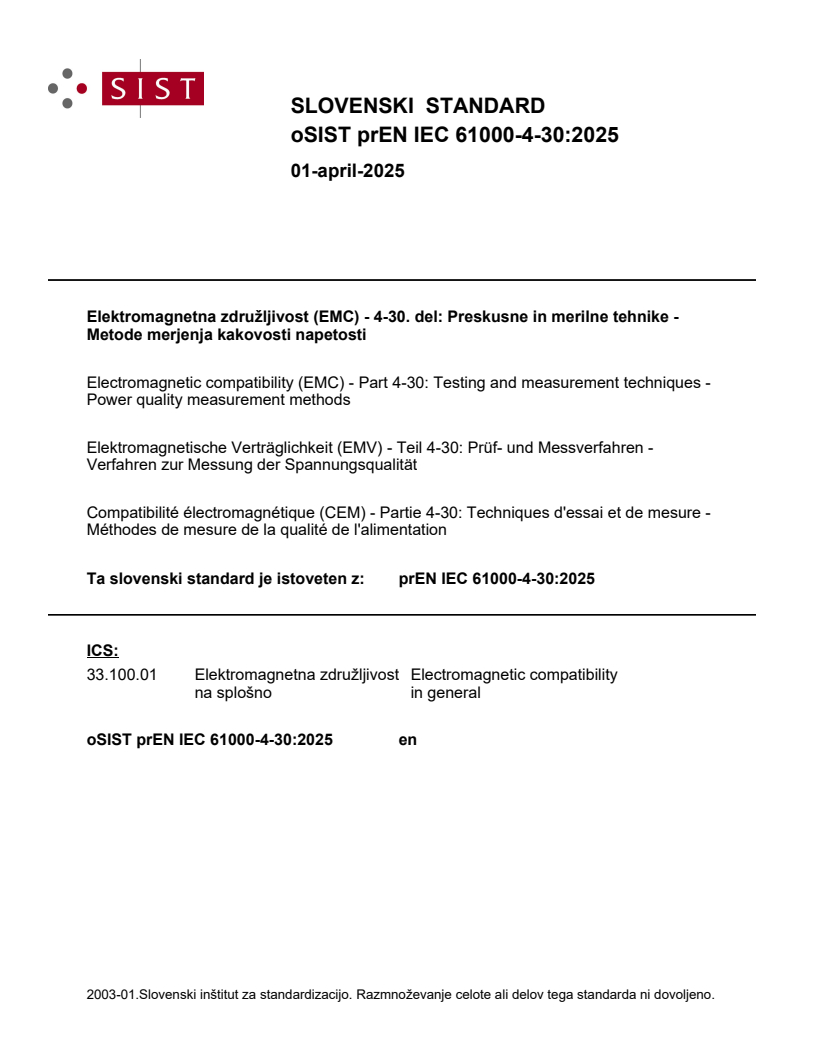
SLOVENSKI STANDARD
oSIST prEN IEC 61000-4-30:2025
01-april-2025
Elektromagnetna združljivost (EMC) - 4-30. del: Preskusne in merilne tehnike -
Metode merjenja kakovosti napetosti
Electromagnetic compatibility (EMC) - Part 4-30: Testing and measurement techniques -
Power quality measurement methods
Elektromagnetische Verträglichkeit (EMV) - Teil 4-30: Prüf- und Messverfahren -
Verfahren zur Messung der Spannungsqualität
Compatibilité électromagnétique (CEM) - Partie 4-30: Techniques d'essai et de mesure -
Méthodes de mesure de la qualité de l'alimentation
Ta slovenski standard je istoveten z: prEN IEC 61000-4-30:2025
ICS:
33.100.01 Elektromagnetna združljivost Electromagnetic compatibility
na splošno in general
oSIST prEN IEC 61000-4-30:2025 en
2003-01.Slovenski inštitut za standardizacijo. Razmnoževanje celote ali delov tega standarda ni dovoljeno.
oSIST prEN IEC 61000-4-30:2025
oSIST prEN IEC 61000-4-30:2025
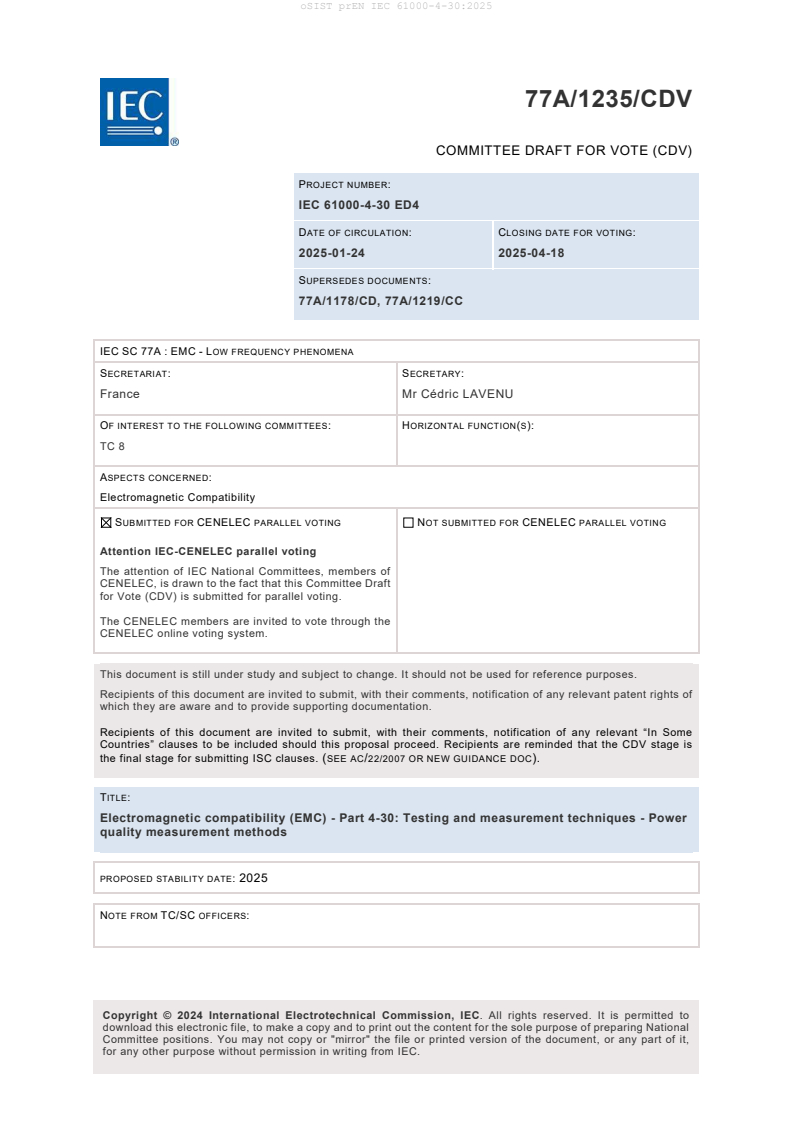
77A/1235/CDV
COMMITTEE DRAFT FOR VOTE (CDV)
PROJECT NUMBER:
IEC 61000-4-30 ED4
DATE OF CIRCULATION: CLOSING DATE FOR VOTING:
2025-01-24 2025-04-18
SUPERSEDES DOCUMENTS:
77A/1178/CD, 77A/1219/CC
IEC SC 77A : EMC - LOW FREQUENCY PHENOMENA
SECRETARIAT: SECRETARY:
France Mr Cédric LAVENU
OF INTEREST TO THE FOLLOWING COMMITTEES: HORIZONTAL FUNCTION(S):
TC 8
ASPECTS CONCERNED:
Electromagnetic Compatibility
SUBMITTED FOR CENELEC PARALLEL VOTING NOT SUBMITTED FOR CENELEC PARALLEL VOTING
Attention IEC-CENELEC parallel voting
The attention of IEC National Committees, members of
CENELEC, is drawn to the fact that this Committee Draft
for Vote (CDV) is submitted for parallel voting.
The CENELEC members are invited to vote through the
CENELEC online voting system.
This document is still under study and subject to change. It should not be used for reference purposes.
Recipients of this document are invited to submit, with their comments, notification of any relevant patent rights of
which they are aware and to provide supporting documentation.
Recipients of this document are invited to submit, with their comments, notification of any relevant “In Some
Countries” clauses to be included should this proposal proceed. Recipients are reminded that the CDV stage is
the final stage for submitting ISC clauses. (SEE AC/22/2007 OR NEW GUIDANCE DOC).
TITLE:
Electromagnetic compatibility (EMC) - Part 4-30: Testing and measurement techniques - Power
quality measurement methods
PROPOSED STABILITY DATE: 2025
NOTE FROM TC/SC OFFICERS:
download this electronic file, to make a copy and to print out the content for the sole purpose of preparing National
Committee positions. You may not copy or "mirror" the file or printed version of the document, or any part of it,
for any other purpose without permission in writing from IEC.
oSIST prEN IEC 61000-4-30:2025
IEC CDV 61000-4-30 ED4 © IEC 2025 2 77A/1235/CDV
1 CONTENTS
3 FOREWORD . 7
4 INTRODUCTION . 9
5 Part 1: General . 9
6 Part 2: Environment . 9
7 Part 3: Limits . 9
8 Part 4: Testing and measurement techniques . 9
9 Part 5: Installation and mitigation guidelines. 9
10 Part 6: Generic standards. 9
11 Part 9: Miscellaneous . 9
12 1 Scope . 10
13 2 Normative References and Bibliography . 10
14 2.1 Normative References . 10
15 3 Terms and definitions . 11
16 4 General . 16
17 4.1 Classes of measurement . 16
18 4.2 Organization of the measurements . 17
19 4.3 Electrical values to be measured . 17
20 4.4 Measurement aggregation over time intervals . 17
21 4.5 Measurement aggregation algorithm . 18
22 4.5.1 Requirements . 18
23 4.5.2 150/180-cycle aggregation . 18
24 4.5.3 10-minute aggregation . 18
25 4.5.4 2-hour aggregation . 20
26 4.6 Maximum permissible error of the time clock . 20
27 4.7 Maximum permissible errors of power quality parameters . 21
28 4.8 Flagging concept . 21
29 5 Power quality parameters . 21
30 5.1 General . 21
31 5.2 Power frequency . 21
32 5.2.1 Measurement method . 21
33 5.2.2 Maximum permissible measurement error and measuring range . 22
34 5.2.3 Measurement evaluation . 22
35 5.2.4 Aggregation . 22
36 5.3 Magnitude of the supply voltage . 22
37 5.3.1 Measurement method . 22
38 5.3.2 Maximum permissible measurement error and measuring range . 23
39 5.3.3 Measurement evaluation . 23
40 5.3.4 Aggregation . 23
41 5.4 Flicker. 23
42 5.4.1 Measurement method . 23
43 5.4.2 Maximum permissible measurement error and measuring range . 23
44 5.4.3 Measurement evaluation . 23
45 5.4.4 Aggregation . 23
46 5.5 Supply voltage dip and swell events . 23
47 5.5.1 Measurement method . 23
48 5.5.2 Voltage dips on single-phase systems . 24
oSIST prEN IEC 61000-4-30:2025
IEC CDV 61000-4-30 ED4 © IEC 2025 3 77A/1235/CDV
49 5.5.3 Voltage swells on single-phase systems . 25
50 5.5.4 Voltage dip and swell events on polyphase systems . 25
51 5.5.5 Maximum permissible measurement error . 28
52 5.5.6 Aggregation . 28
53 5.6 Supply voltage interruptions . 28
54 5.6.1 Measurement method . 28
55 5.6.2 Detection and evaluation . 28
56 5.6.3 Maximum permissible measurement error . 29
57 5.6.4 Aggregation . 29
58 5.7 Transient voltages . 29
59 5.8 Supply voltage unbalance . 29
60 5.8.1 Measurement method . 29
61 5.8.2 Maximum permissible measurement error and measuring range . 30
62 5.8.3 Measurement evaluation . 30
63 5.8.4 Aggregation . 30
64 5.9 Voltage harmonics . 30
65 5.9.1 Measurement method . 30
66 5.9.2 Maximum permissible measurement error and measuring range . 31
67 5.9.3 Measurement evaluation . 31
68 5.9.4 Aggregation . 31
69 5.10 Voltage interharmonics . 31
70 5.10.1 Measurement method . 31
71 5.10.2 Maximum permissible measurement error and measuring range . 32
72 5.10.3 Evaluation . 32
73 5.10.4 Aggregation . 32
74 5.11 MCS voltage on the supply voltage . 32
75 5.11.1 General . 32
76 5.11.2 Measurement method . 32
77 5.11.3 Maximum permissible measurement error and measuring range . 33
78 5.11.4 Aggregation . 33
79 5.12 Rapid voltage changes (RVC) . 33
80 5.12.1 General . 33
81 5.12.2 RVC event detection . 33
82 5.12.3 RVC event evaluation . 35
83 5.12.4 Examples of RVC event evaluation . 36
84 5.12.5 Maximum permissible measurement error . 37
85 5.13 Current . 37
86 5.13.1 General . 37
87 5.13.2 Magnitude of current . 38
88 5.13.3 Current recording . 38
89 5.13.4 Harmonic currents . 38
90 5.13.5 Interharmonic currents . 39
91 5.13.6 Current unbalance . 39
92 6 Performance verification . 39
93 Annex A (informative) Power quality measurements – Issues and guidelines . 42
94 A.1 General . 42
95 A.2 Installation precautions . 42
96 A.2.1 General . 42
97 A.2.2 Test leads. 42
oSIST prEN IEC 61000-4-30:2025
IEC CDV 61000-4-30 ED4 © IEC 2025 4 77A/1235/CDV
98 A.2.3 Guarding of live parts . 43
99 A.2.4 Monitor placement . 43
100 A.2.5 Earthing . 43
101 A.2.6 Interference . 44
102 A.3 Transducers . 44
103 A.3.1 General . 44
104 A.3.2 Signal levels . 44
105 A.3.3 Frequency response of transducers . 45
106 A.3.4 Transducers for measuring transients . 46
107 A.4 Transient voltages and currents . 46
108 A.4.1 General . 46
109 A.4.2 Frequency and amplitude characteristics of AC mains transients . 47
110 A.4.3 Transient voltage detection . 47
111 A.4.4 Transient voltage evaluation . 48
112 A.4.5 Effect of surge protective devices on transient measurements . 48
113 A.5 Voltage dip characteristics . 48
114 A.5.1 General . 48
115 A.5.2 Rapidly updated r.m.s. values . 49
116 A.5.3 Phase angle/point-on-wave. 49
117 A.5.4 Voltage dip unbalance . 49
118 A.5.5 Phase shift during voltage dip . 49
119 A.5.6 Missing voltage . 50
120 A.5.7 Distortion during voltage dip . 50
121 A.5.8 Other characteristics and references . 50
122 Annex B (informative) Power Quality measurement – Guidance for applications . 51
123 B.1 Contractual applications of power quality measurements . 51
124 B.1.1 General . 51
125 B.1.2 General considerations . 51
126 B.1.3 Specific considerations . 52
127 B.2 Statistical survey applications . 54
128 B.2.1 General . 54
129 B.2.2 Considerations . 55
130 B.2.3 Power quality indices . 55
131 B.2.4 Monitoring objectives . 55
132 B.2.5 Economic aspects of power quality surveys . 56
133 B.3 Locations and types of surveys . 57
134 B.3.1 Monitoring locations. 57
135 B.3.2 Pre-monitoring site surveys . 57
136 B.3.3 Customer side site survey. 57
137 B.3.4 Network side survey . 57
138 B.4 Connections and quantities to measure . 58
139 B.4.1 Equipment connection options . 58
140 B.4.2 Priorities: Quantities to measure . 58
141 B.4.3 Current monitoring . 59
142 B.5 Selecting the monitoring thresholds and monitoring period . 59
143 B.5.1 Monitoring thresholds . 59
144 B.5.2 Monitoring period . 59
145 B.6 Statistical analysis of the measured data . 60
146 B.6.1 General . 60
oSIST prEN IEC 61000-4-30:2025
IEC CDV 61000-4-30 ED4 © IEC 2025 5 77A/1235/CDV
147 B.6.2 Indices . 60
148 B.7 Trouble-shooting applications . 60
149 B.7.1 General . 60
150 B.7.2 Power quality signatures . 60
151 B.7.3 Waveform data format . 61
152 Annex C (informative) Functional design and specification for measurements in the 2
153 kHz to 9 kHz range for Class A and S equipment . 62
154 C.1 General . 62
155 C.2 Voltage disturbances in the 2 kHz to 9 kHz range . 62
156 C.2.1 Measurement method . 62
157 C.2.2 Maximum permissible measurement error . 62
158 C.2.3 Aggregation . 62
159 Annex D (informative) Functional design and specifications for measurements in the
160 9 kHz to 150 kHz range . 64
161 D.1 General . 64
162 D.2 Background . 64
163 D.3 Comparability requirements . 65
164 D.4 Method overview . 65
165 D.5 Signal input stage . 67
166 D.5.1 Input filtering . 67
167 D.5.2 Frequency response . 67
168 D.5.3 Transducer compensation . 67
169 D.5.4 Measuring range . 67
170 D.5.5 Overload detection . 68
171 D.6 Fourier transform stage . 68
172 D.6.1 DFT window design . 69
173 D.6.2 Application of the DFT . 70
174 D.6.3 Selectivity and power bandwidth . 71
175 D.7 CISPR detector stage . 71
176 D.7.1 RMS detector . 72
177 D.7.2 Peak detector . 72
178 D.7.3 Quasi-Peak detector . 72
179 D.7.4 Average detector . 74
180 D.7.5 RMS-Average detector . 74
181 D.8 CISPR indicator stage . 74
182 D.9 Adjustment of time constants . 76
183 D.10 Accuracy requirements . 76
184 D.10.1 General . 76
185 D.10.2 Accuracy requirements for measuring steady-state sinusoidal signals . 77
186 D.10.3 Accuracy requirements for measuring impulsive signals . 77
187 D.11 Aggregation . 79
188 D.11.1 General . 79
189 D.11.2 Aggregation time intervals . 80
190 D.11.3 Aggregation methods . 80
191 D.12 Integration of signal levels over frequency . 80
192 Bibliography . 82
194 Figure 1 – Measurement chain . 17
195 Figure 2 – Synchronization of aggregation intervals for Class A . 19
oSIST prEN IEC 61000-4-30:2025
IEC CDV 61000-4-30 ED4 © IEC 2025 6 77A/1235/CDV
196 Figure 3 – Synchronization of aggregation intervals for Class S: parameters for which
197 gaps are not permitted . 20
198 Figure 4 – Synchronization of aggregation intervals for Class S: parameters for which
199 gaps are permitted (see 4.5.2) . 20
200 Figure 5 – Example of the MPE of a supply voltage unbalance measurement . 30
201 Figure 6 – RVC event: example of a change in r.m.s. voltage that results in an RVC
202 event . 36
203 Figure 7 – Not an RVC event: example of a change in r.m.s. voltage that does not
204 result in an RVC event because the dip threshold is exceeded . 37
205 Figure A.1 – Frequency spectrum of typical representative transient test waveforms . 47
206 Figure D.1 – Block diagram of the 9 – 150 kHz measurement method . 66
207 Figure D.2 – CISPR 16-1-1 quasi-peak detector equivalent circuit . 72
208 Figure D.3 – Indicator response to a 160 ms impulse pulse width when represented by
209 a 2nd order Linkwitz-Riley low-pass filter tuned to the frequency Fc = 0.9947 Hz . 76
210 Figure D.4 – Impulses with an amplitude of 5.51 V and a width of 2.45 µs to assess
211 instrument compliance at 100 Hz . 79
213 Table 1 – Summary of requirements (see subclauses for actual requirements) . 40
214 Table D.1 – CISPR Band A filter impulse response zero-crossing times . 70
215 Table D.2 – Adjusted time constants for the Quasi-Peak detector . 76
216 Table D.3 – Sinusoidal signal accuracy requirements from 9 kHz to 150 kHz . 77
217 Table D.4 – Impulsive signal accuracy requirements from 9 kHz to 150 kHz . 77
218 Table D.5 – Reference quasi-peak response to spectrally flat impulses . 78
oSIST prEN IEC 61000-4-30:2025
IEC CDV 61000-4-30 ED4 © IEC 2025 7 77A/1235/CDV
221 INTERNATIONAL ELECTROTECHNICAL COMMISSION
222 ____________
224 ELECTROMAGNETIC COMPATIBILITY (EMC) –
226 Part 4-30: Testing and measurement techniques –
227 Power quality measurement methods
229 FOREWORD
230 1) The International Electrotechnical Commission (IEC) is a worldwide organization for standardization comprising
231 all national electrotechnical committees (IEC National Committees). The object of IEC is to promote international
232 co-operation on all questions concerning standardization in the electrical and electronic fields. To this end and
233 in addition to other activities, IEC publishes International Standards, Technical Specifications, Technical Reports,
234 Publicly Available Specifications (PAS) and Guides (hereafter referred to as “IEC Publication(s)”). Their
235 preparation is entrusted to technical committees; any IEC National Committee interested in the subject dealt with
236 may participate in this preparatory work. International, governmental and non-governmental organizations liaising
237 with the IEC also participate in this preparation. IEC collaborates closely with the International Organization for
238 Standardization (ISO) in accordance with conditions determined by agreement between the two organizations.
239 2) The formal decisions or agreements of IEC on technical matters express, as nearly as possible, an international
240 consensus of opinion on the relevant subjects since each technical committee has representation from all
241 interested IEC National Committees.
242 3) IEC Publications have the form of recommendations for international use and are accepted by IEC National
243 Committees in that sense. While all reasonable efforts are made to ensure that the technical content of IEC
244 Publications is accurate, IEC cannot be held responsible for the way in which they are used or for any
245 misinterpretation by any end user.
246 4) In order to promote international uniformity, IEC National Committees undertake to apply IEC Publications
247 transparently to the maximum extent possible in their national and regional publications. Any divergence between
248 any IEC Publication and the corresponding national or regional publication shall be clearly indicated in the latter.
249 5) IEC itself does not provide any attestation of conformity. Independent certification bodies provide conformity
250 assessment services and, in some areas, access to IEC marks of conformity. IEC is not responsible for any
251 services carried out by independent certification bodies.
252 6) All users should ensure that they have the latest edition of this publication.
253 7) No liability shall attach to IEC or its directors, employees, servants or agents including individual experts and
254 members of its technical committees and IEC National Committees for any personal injury, property damage or
255 other damage of any nature whatsoever, whether direct or indirect, or for costs (including legal fees) and
256 expenses arising out of the publication, use of, or reliance upon, this IEC Publication or any other IEC
257 Publications.
258 8) Attention is drawn to the Normative references cited in this publication. Use of the referenced publications is
259 indispensable for the correct application of this publication.
260 9) Attention is drawn to the possibility that some of the elements of this IEC Publication may be the subject of patent
261 rights. IEC shall not be held responsible for identifying any or all such patent rights.
262 International Standard IEC 61000-4-30 has been prepared by subcommittee 77A: EMC – Low-
263 frequency phenomena, of IEC technical committee 77: Electromagnetic compatibility.
264 This standard forms part 4-30 of IEC 61000. It has the status of a basic EMC publication in
265 accordance with IEC Guide 107.
266 This fourth edition cancels and replaces the third edition published in 2015. This edition
267 constitutes a technical revision.
268 This edition includes the following significant technical changes with respect to the previous
269 edition:
270 a) Corrigendum 1 and Amendment 1 of IEC 61000-4-30 Ed. 3 were included.
271 b) The measurement method for rapid voltage changes (RVC) has been corrected and
272 extended.
273 c) The measurement method for voltage events has been updated and extended.
oSIST prEN IEC 61000-4-30:2025
IEC CDV 61000-4-30 ED4 © IEC 2025 8 77A/1235/CDV
274 d) Annex C from Ed. 3 was divided into 2 parts:
275 • Annex C: The measurement method from IEC 61000-4-7 Annex B for conducted
276 emissions in the 2 kHz to 9 kHz range has been separated.
277 • Annex D: A new measurement method for conducted emissions in the 9 kHz to 150 kHz
278 range has been added.
279 e) Informative Annex D (underdeviation and overdeviation parameters) was removed.
280 f) Informative Annex E (Class B) was removed.
281 The text of this standard is based on the following documents:
FDIS Report on voting
77A/XX/FDIS 77A/XX/RVD
283 Full information on the voting for the approval of this standard can be found in the report on
284 voting indicated in the above table.
285 This publication has been drafted in accordance with the ISO/IEC Directives, Part 2.
286 A list of all parts in the IEC 61000 series, published under the general title Electromagnetic
287 compatibility (EMC), can be found on the IEC website.
288 The committee has decided that the contents of this publication will remain unchanged until the
289 stability date indicated on the IEC web site under "http://webstore.iec.ch" in the data related to
290 the specific publication. At this date, the publication will be
291 • reconfirmed,
292 • withdrawn,
293 • replaced by a revised edition, or
294 • amended.
IMPORTANT – The 'colour inside' logo on the cover page of this publication indicates that it
contains colours which are considered to be useful for the correct understanding of its
contents. Users should therefore print this document using a colour printer.
oSIST prEN IEC 61000-4-30:2025
IEC CDV 61000-4-30 ED4 © IEC 2025 9 77A/1235/CDV
298 INTRODUCTION
299 IEC 61000 is published in separate parts according to the following structure:
300 Part 1: General
301 General considerations (introduction, fundamental principles)
302 Definitions, terminology
303 Part 2: Environment
304 Description of the environment
305 Classification of the environment
306 Compatibility levels
307 Part 3: Limits
308 Emission limits
309 Immunity limits (in so far as they do not fall under the responsibility of the product
310 committees)
311 Part 4: Testing and measurement techniques
312 Measurement techniques
313 Testing techniques
314 Part 5: Installation and mitigation guidelines
315 Installation guidelines
316 Mitigation methods and devices
317 Part 6: Generic standards
318 Part 9: Miscellaneous
319 Each part is further subdivided into several parts, published either as International Standards
320 or as Technical Specifications or Technical Reports, some of which have already been
321 published as sections. Others will be published with the part number followed by a dash and
322 completed by a second number identifying the subdivision (example: 61000-6-1).
oSIST prEN IEC 61000-4-30:2025
IEC CDV 61000-4-30 ED4 © IEC 2025 10 77A/1235/CDV
324 ELECTROMAGNETIC COMPATIBILITY (EMC) –
326 Part 4-30: Testing and measurement techniques –
327 Power quality measurement methods
331 1 Scope
332 This part of IEC 61000-4 defines the methods for measurement and interpretation of results for
333 power quality parameters in AC power supply systems with a declared fundamental frequency
334 of 50 Hz or 60 Hz.
335 Measurement methods are described for each relevant parameter in terms that give reliable
336 and repeatable results, regardless of the method’s implementation. This standard addresses
337 measurement methods for in-situ measurements.
338 This standard covers two classes of measurement methods (Class A and Class S). The classes
339 of measurement are specified in Clause 4.
340 NOTE 1 In this standard, “A” stands for “Advanced” and “S” stands for “Surveys”.
341 Measurement of parameters covered by this standard is limited to conducted phenomena in
342 power systems. The power quality parameters considered in this standard are power frequency,
343 magnitude of the supply voltage, flicker, supply voltage dips and swells, voltage interruptions,
344 transient voltages, supply voltage unbalance, voltage harmonics and interharmonics, rapid
345 voltage changes, mains communicating system voltages and current measurements.
346 Emissions in the 2 kHz to 150 kHz range are considered in Annex C and Annex D (informative).
347 Depending on the purpose of the measurement all or a subset of the phenomena on this list
348 may be measured.
349 NOTE 2 Test methods for verifying compliance with this standard can be found in IEC 62586-2.
350 NOTE 3 The effects of transducers inserted between the power system and the instrument are acknowledged but
351 not addressed in detail in this standard. Guidance about effects of transducers can be found IEC TR 61869-103.
352 NOTE 4 Measurements of voltage signals associated with MCS are also in the scope of this standard.
353 2 Normative References and Bibliography
354 2.1 Normative References
355 The following documents, in whole or in part, are normatively referenced in this document and
356 are indispensable for its application. For dated references, only the edition cited applies. For
357 undated references, the latest edition of the referenced document (including any amendments)
358 applies.
359 IEC 61000-2-4, Electromagnetic compatibility (EMC) – Part 2-4: Environment – Compatibility
360 levels in industrial plants for low-frequency conducted disturbances
361 IEC 61000-3-8, Electromagnetic compatibility (EMC) – Part 3: Limits – Section 8: Signalling on
362 low-voltage electrical installations – Emission levels, frequency bands and electromagnetic
363 disturbance levels
364 IEC 61000-4-7:2002, Electromagnetic compatibility (EMC) – Part 4-7: Testing and measurement
365 techniques – General guide on harmonics and interharmonics measurements and instrumentation, for
366 power supply systems and equipment connected thereto
367 IEC 61000-4-7:2002/AMD1:2008
368 IEC 61000-4-15:2010, Electromagnetic compatibility (EMC) – Part 4-15: Testing and
369 measurement techniques – Flickermeter – Functional and design specifications
oSIST prEN IEC 61000-4-30:2025
IEC CDV 61000-4-30 ED4 © IEC 2025 11 77A/1235/CDV
370 IEC 62586-1, Power quality measurement in power supply systems – Part 1: Power quality
371 instruments (PQI)
372 IEC 62586-2, Power quality measurement in power supply systems – Part 2: Functional tests
373 and uncertainty requirements
374 IEC 62428:2008, Electric power engineering – Modal components in three-phase a.c. systems
375 – Quantities and transformations
376 ISO/IEC Guide 99:2007
377 For the purposes of this document, the terms and definitions given in IEC 60050-161 and the
378 following apply.
379 ISO and IEC maintain terminological databases for use in standardization at the following
380 addresses:
381 • ISO Online browsing platform: available at https://www.iso.org/obp
382 • IEC Electropedia: available at http://www.electropedia.org/
383 3 Terms and definitions
384 For the purposes of this document, the terms and definitions given in IEC 60050-161, as well
385 as the following apply.
386 3.1
387 channel
388 individual measurement path through an instrument
389 Note 1 to entry: “Channel” and “phase” are not the same. A voltage channel is by definition the difference in potential
390 between 2 conductors. Phase refers to a single conductor. On polyphase systems, a channel may be between any
391 two phases, or between any phase and neutral, or between any phase and earth, or between neutral and earth.
392 3.2
393 declared input voltage
394 U
din
395 value obtained from the declared supply voltage by a transducer ratio
396 Note 1 to entry: This quantity can be expressed as a phase-to-phase or as a phase-to-neutral value.
397 3.3
398 declared supply voltage
399 U
c
400 normally the nominal voltage U of the system
n
401 Note 1 to entry: If by agreement between the supplier and the customer a voltage different from the nominal voltage
402 is applied to the terminals, then this voltage is the declared supply voltage U
c.
403 3.4
404 dip threshold
405 voltage magnitude specified for the purpose of detecting the start and the end of a voltage dip
406 3.5
407 flagged data
408 for any measurement time interval in which interruptions, dips or swells occur, the marked
409 measurement results of all other parameters made during this time interval
410 Note 1 to entry: For some applications, this ‘marked’ or ‘flagged’ data may be excluded from further analysis, for
411 example. See 4.8 for further explanation.
oSIST prEN IEC 61000-4-30:2025
IEC CDV 61000-4-30 ED4 © IEC 2025 12 77A/1235/CDV
412 3.6
413 flicker
414 impression of unsteadiness of visual sensation induced by a light stimulus whose luminance or
415 spectral distribution fluctuates with time
416 [SOURCE: IEC 60050-161:1990, IEV 161-08-13]
417 3.6.1
418 P
st
419 short-term flicker evaluation based on an observation period of 10 minutes
420 [SOURCE: IEC 61000-4-15:2010, 3.2]
421 3.6.2
422 P
lt
423 long-term flicker evaluation
424 [SOURCE: IEC 61000-4-15:2010, 3.2]
425 3.7
426 fundamental component
427 component whose frequency is the fundamental frequency
428 3.8
429 fundamental frequency
430 frequency in the spectrum obtained from a Fourier transform of a time function, to which all the
431 frequencies of the spectrum are referred
432 Note 1 to entry: In case of any remaining risk of ambiguity, the fundamental frequency may be derived from the
433 number of poles and speed of rotation of the synchronous generator(s) feeding the system.
434 3.9
435 harmonic component
436 any of the components having a harmonic frequency
437 Note 1 to entry: Its value is normally expressed as an r.m.s. value. For brevity, such component may be referred to
438 simply as a harmonic.
439 [SOURCE: IEC 61000-2-2:2002, 3.2.4]
440 3.10
441 harmonic frequency
442 frequency which is an integer multiple of the fundamental frequency
443 Note 1 to entry: The ratio of the harmonic frequency to the fundamental frequency is the harmonic order
444 (recommended notation: h).
445 [SOURCE: IEC 61000-2-2:2002, 3.2.3]
446 3.11
447 hysteresis
448 difference in magnitude between the start and end thresholds
449 Note 1 to entry: This definition of hysteresis is relevant to PQ measurement parameters and is different from the
450 IEC 60050 definition which is relevant to iron core saturation.
451 Note 2 to entry: The purpose of hysteresis in the context of PQ measurements is to avoid counting multiple events
452 when the magnitude of the parameter oscillates about the threshold level.
453 3.12
454 influence quantity
455 quantity which is not the subject of the measurement and whose change affects the relationship
456 between the ind
...
Questions, Comments and Discussion
Ask us and Technical Secretary will try to provide an answer. You can facilitate discussion about the standard in here.
Loading comments...