

SIST EN 1077:2007
(Main)Helmets for alpine skiers and snowboarders
General Information
- Abstract
This European Standard is applicable to performance requirements and tests for two classes of helmets for alpine skiers, snowboarders and for similar groups, including children and participants in competitions. The standard comprises two different classes of protection, class A and class B.
Requirements and the corresponding methods of test, where appropriate, are given for the following:
- construction including field of vision;
- shock absorbing properties;
- resistance to penetration;
- retention system properties;
- marking and information.
- Status
- Published
- Publication Date
- 10-Sep-2007
- Technical Committee
- OVP - Personal protecting equipment
- Current Stage
- 6060 - National Implementation/Publication (Adopted Project)
- Start Date
- 05-Sep-2007
- Due Date
- 10-Nov-2007
- Completion Date
- 11-Sep-2007
- Directive
- 2016/425 - Regulation (EU) 2016/425 of the European Parliament and of the Council of 9 March 2016 on personal protective equipment and repealing Council Directive 89/686/EECOJ Ref: C 113 OJ Date: 27-Mar-2018
89/686/EEC - Personal protective equipment (PPE)OJ Ref: C 205 OJ Date: 09-Jul-2011 Conflicting Date: 08-Mar-2008


Overview
EN 1077:2007 is the CEN European standard for helmets for alpine skiers and snowboarders. It defines performance requirements and test methods for two protection classes (Class A and Class B) covering adults and children, including participants in competitions. The standard sets mandatory criteria for construction, field of vision, shock absorption, resistance to penetration, retention system performance, marking and user information. EN 1077:2007 supersedes EN 1077:1996 and supports the essential requirements of EU Directive 89/686/EEC.
Key topics and technical requirements
- Two protection classes
- Class A - larger extent of coverage, higher protection (includes areas above a defined headform line); non-detachable coverage parts; abrasion protection below the reference plane.
- Class B - reduced coverage to allow more ventilation and hearing; parts below a defined plane may be detachable or removable.
- Field of vision
- No occultation within a field bounded by: horizontal 105°, upward 25°, downward 45° (tested per EN 13087-6).
- Shock absorbing properties
- Performance and test methods defined to limit transmitted forces (see EN 13087-2).
- Resistance to penetration
- Tests and limits specified to reduce risk from sharp impacts (see EN 13087-3).
- Retention system
- Requirements for strength and effectiveness (EN 13087-5 and EN 13087-4).
- Chin strap width ≥ 15 mm; no chin cups; secure attachments; recommended marking of opening mechanisms (red/orange) and avoidance of green color on retention parts.
- Materials & skin safety
- Materials in contact with skin must resist sweat, not cause adverse health effects; metallic parts should be checked (e.g., EN 1811 for nickel emission).
- Durability, marking and information
- Requirements for product marking, user instructions and replacement advice after impact.
Applications and who uses this standard
- Helmet manufacturers and designers - to design and certify ski/snowboard helmets to market in Europe.
- Test laboratories and certification bodies - to perform standardized tests and type approvals.
- Retailers, procurement specialists and sports equipment specifiers - to select compliant helmets for consumers and events.
- Competition organizers and safety officers - to define acceptable head protection for events.
- Regulators and conformity assessment entities - for enforcement against PPE directives.
Related standards
- EN 960 (headforms for testing)
- EN 13087 series (test methods: shock absorption, penetration, retention system tests, field of vision)
- EN 1811 (nickel emission testing)
- Annex ZA of EN 1077 (relationship with EU Directive 89/686/EEC)
Keywords: EN 1077, helmets for alpine skiers and snowboarders, ski helmet standard, snowboard helmet, helmet testing, Class A helmet, Class B helmet, shock absorption, penetration resistance, retention system.
Relations
- Effective Date
- 01-Oct-2007
- Effective Date
- 22-Jul-2026
- Effective Date
- 22-Jul-2026
- Effective Date
- 28-Jan-2026
- Refers
SIST EN 13087-4:2001 - Protective helmets - Test methods - Part 4: Retention system effectiveness - Effective Date
- 28-Jan-2026
- Effective Date
- 28-Jan-2026
- Effective Date
- 28-Jan-2026
Get Certified
Connect with accredited certification bodies for this standard

CIS Institut d.o.o.
Personal Protective Equipment (PPE) certification body. Notified Body NB-2890 for EU Regulation 2016/425 PPE.

Kiwa BDA Testing
Building and construction product certification.
Kmetijski inštitut Slovenije
Agricultural Institute of Slovenia. Soil testing, plant health, agricultural product analysis.
Sponsored listings
Frequently Asked Questions
SIST EN 1077:2007 is a standard published by the Slovenian Institute for Standardization (SIST). Its full title is "Helmets for alpine skiers and snowboarders". This standard covers: This European Standard is applicable to performance requirements and tests for two classes of helmets for alpine skiers, snowboarders and for similar groups, including children and participants in competitions. The standard comprises two different classes of protection, class A and class B. Requirements and the corresponding methods of test, where appropriate, are given for the following: - construction including field of vision; - shock absorbing properties; - resistance to penetration; - retention system properties; - marking and information.
This European Standard is applicable to performance requirements and tests for two classes of helmets for alpine skiers, snowboarders and for similar groups, including children and participants in competitions. The standard comprises two different classes of protection, class A and class B. Requirements and the corresponding methods of test, where appropriate, are given for the following: - construction including field of vision; - shock absorbing properties; - resistance to penetration; - retention system properties; - marking and information.
SIST EN 1077:2007 is classified under the following ICS (International Classification for Standards) categories: 13.340.20 - Head protective equipment; 97.220.20 - Winter sports equipment. The ICS classification helps identify the subject area and facilitates finding related standards.
SIST EN 1077:2007 has the following relationships with other standards: It is inter standard links to SIST EN 1077:1996, SIST EN 960:2006, SIST EN 13087-3:2000, SIST EN 13087-6:2012, SIST EN 13087-4:2001, SIST EN 13087-2:2000, SIST EN 13087-5:2001. Understanding these relationships helps ensure you are using the most current and applicable version of the standard.
SIST EN 1077:2007 is associated with the following European legislation: EU Directives/Regulations: 2016/425, 89/686/EEC, 93/68/EEC, 93/95/EEC, 96/58/EC; Standardization Mandates: M/BC/CEN/90/2. When a standard is cited in the Official Journal of the European Union, products manufactured in conformity with it benefit from a presumption of conformity with the essential requirements of the corresponding EU directive or regulation.
SIST EN 1077:2007 is available in PDF format for immediate download after purchase. The document can be added to your cart and obtained through the secure checkout process. Digital delivery ensures instant access to the complete standard document.
Standards Content (Sample)
2003-01.Slovenski inštitut za standardizacijo. Razmnoževanje celote ali delov tega standarda ni dovoljeno.Helmets for alpine skiers and snowboardersCasques pour skieurs de ski alpin et de surf nes neigesHelme für alpine Skiläufer und für SnowboarderTa slovenski standard je istoveten z:EN 1077:2007SIST EN 1077:2007en,fr,de97.220.20Oprema za zimske športeWinter sports equipment13.340.20Varovalna oprema za glavoHead protective equipmentICS:SIST EN 1077:19961DGRPHãþDSLOVENSKI
STANDARDSIST EN 1077:200701-oktober-2007
EUROPEAN STANDARDNORME EUROPÉENNEEUROPÄISCHE NORMEN 1077August 2007ICS 13.340.20Supersedes EN 1077:1996
English VersionHelmets for alpine skiers and snowboardersCasques pour skieurs de ski alpin et de surf nes neigesHelme für alpine Skiläufer und für SnowboarderThis European Standard was approved by CEN on 17 February 2007.CEN members are bound to comply with the CEN/CENELEC Internal Regulations which stipulate the conditions for giving this EuropeanStandard the status of a national standard without any alteration. Up-to-date lists and bibliographical references concerning such nationalstandards may be obtained on application to the CEN Management Centre or to any CEN member.This European Standard exists in three official versions (English, French, German). A version in any other language made by translationunder the responsibility of a CEN member into its own language and notified to the CEN Management Centre has the same status as theofficial versions.CEN members are the national standards bodies of Austria, Belgium, Bulgaria, Cyprus, Czech Republic, Denmark, Estonia, Finland,France, Germany, Greece, Hungary, Iceland, Ireland, Italy, Latvia, Lithuania, Luxembourg, Malta, Netherlands, Norway, Poland, Portugal,Romania, Slovakia, Slovenia, Spain, Sweden, Switzerland and United Kingdom.EUROPEAN COMMITTEE FOR STANDARDIZATIONCOMITÉ EUROPÉEN DE NORMALISATIONEUROPÄISCHES KOMITEE FÜR NORMUNGManagement Centre: rue de Stassart, 36
B-1050 Brussels© 2007 CENAll rights of exploitation in any form and by any means reservedworldwide for CEN national Members.Ref. No. EN 1077:2007: E
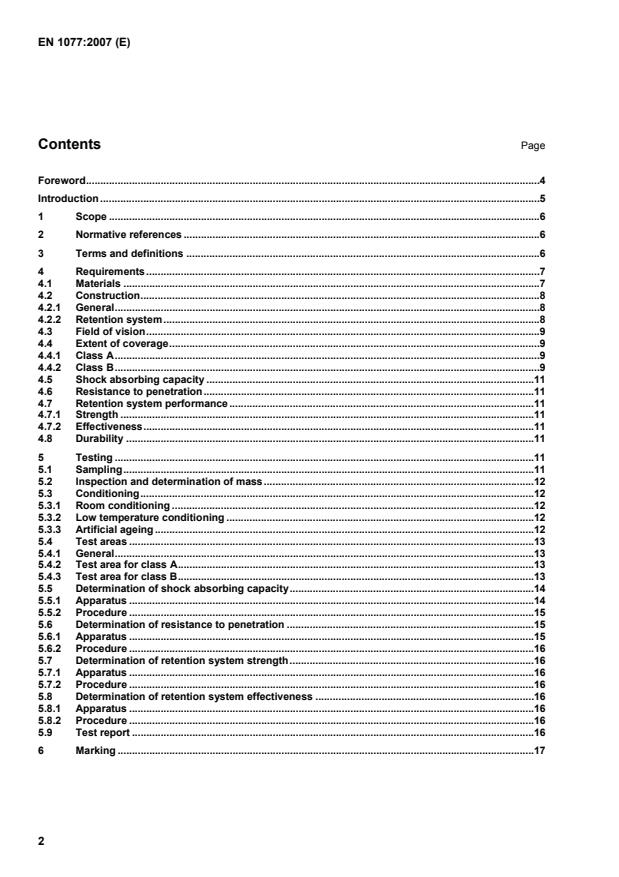
Relationship between this European Standard and the Essential Requirements of EU Directive 89/686/EEC.18 Bibliography.19
Examples for documents which can be presented as evidence of chemical innocuousness are given in the NOTE. NOTE The following list of documents is given for information and as examples of documents to
...