

SIST EN ISO 18527-1:2022
(Main)Eye and face protection for sports use - Part 1: Requirements for downhill skiing and snowboarding goggles (ISO 18527-1:2021)
General Information
- Abstract
This document applies to all goggles with plano lenses, intended for eye protection against hazards including ultraviolet and visible solar radiation, rain, snow and wind, during downhill skiing, snowboarding and other similar activities.
This document applies to downhill skiing and snowboarding goggles fitted with an insert to carry prescription lenses.
It specifies requirements and testing for materials, performance, marking of goggles and information to be supplied by the manufacturer.
Information on the selection and use of downhill skiing and snowboarding goggles is given in Annex A.
This document does not apply to
a) eye protectors for protection when operating or travelling on a motorized vehicle,
b) eye protectors for protection against optical radiation from artificial sources, such as those used in solaria,
c) eye protectors for direct observation of the sun, and
d) eye protectors intended for sports with unrelated hazards and risks.
- Status
- Published
- Public Enquiry End Date
- 19-Jul-2018
- Publication Date
- 21-Aug-2022
- Technical Committee
- OVP - Personal protecting equipment
- Current Stage
- 6060 - National Implementation/Publication (Adopted Project)
- Start Date
- 28-Jul-2022
- Due Date
- 02-Oct-2022
- Completion Date
- 22-Aug-2022



Overview
EN ISO 18527-1:2022 - Eye and face protection for sports use: Part 1 - specifies requirements and test methods for downhill skiing and snowboarding goggles. Adopted by CEN from ISO 18527-1:2021, this standard covers plano-lens goggles (including models fitted with inserts for prescription lenses) intended to protect against hazards such as ultraviolet (UV) and visible solar radiation, wind, rain, snow and related environmental effects. It replaces EN 174:2001 and includes manufacturer marking and information requirements plus Annex A guidance on selection and use.
Key topics and technical requirements
- Scope and exclusions: Applies to downhill skiing and snowboarding goggles; excludes eye protection for motorized vehicles, artificial optical radiation sources, direct solar observation and unrelated sports hazards.
- Materials and construction: Requirements for physiological compatibility, surface condition of parts in contact with the user, headform fit, retention systems (headband/harness) and adjustability.
- Optical performance: Tests and specifications for lens transmittance (visible and solar UV), transmittance categories, uniformity, scattered light, refractive power, spatial deviation and prism imbalance. Special provisions for photochromic, polarizing and gradient-tinted lenses are included.
- Mechanical and environmental testing: Mechanical strength, impact resistance (including criteria for goggles with prescription inserts), temperature range performance and resistance to solar UV degradation.
- Safety-related properties: Resistance to ignition and protection against water/snow ingress are addressed.
- Marking and information: Mandatory marking, performance class labelling and manufacturer information to support correct selection and safe use.
Practical applications
- Designers and manufacturers of ski and snowboard goggles use the standard to design compliant products, define optical classes and validate performance through standardized tests.
- Test laboratories and certification bodies apply the specification to assess conformity and prepare test reports.
- Retailers, procurement teams and safety officers rely on the standard’s marking and information requirements to select appropriate goggles for different light and risk conditions.
- Regulatory and conformity-assessment stakeholders use Annex ZA to relate the standard to EU Regulation 2016/425 for PPE compliance.
Who should use this standard
- Ski/snowboard goggle manufacturers and product designers
- Optical labs and third‑party testing/certification bodies
- Retail buyers, sports equipment distributors and safety managers
- Regulators reviewing PPE conformity and market surveillance
Related standards
- ISO standards referenced for lens measurement, headforms and test methods (e.g., transmittance and optical property standards) and EN/ISO documents cited in the standard’s normative references. EN ISO 18527-1:2022 supports conformity with EU Regulation 2016/425 where applicable.
Keywords: EN ISO 18527-1:2022, ski goggles standard, snowboard goggles requirements, goggle testing, UV protection, goggle marking, PPE for winter sports.
Relations
- Effective Date
- 28-Jan-2026
- Effective Date
- 28-Jan-2026
- Effective Date
- 28-Jan-2026
- Effective Date
- 28-Jan-2026
- Effective Date
- 01-Sep-2022
Get Certified
Connect with accredited certification bodies for this standard

CIS Institut d.o.o.
Personal Protective Equipment (PPE) certification body. Notified Body NB-2890 for EU Regulation 2016/425 PPE.

Kiwa BDA Testing
Building and construction product certification.
Kmetijski inštitut Slovenije
Agricultural Institute of Slovenia. Soil testing, plant health, agricultural product analysis.
Sponsored listings
Frequently Asked Questions
SIST EN ISO 18527-1:2022 is a standard published by the Slovenian Institute for Standardization (SIST). Its full title is "Eye and face protection for sports use - Part 1: Requirements for downhill skiing and snowboarding goggles (ISO 18527-1:2021)". This standard covers: This document applies to all goggles with plano lenses, intended for eye protection against hazards including ultraviolet and visible solar radiation, rain, snow and wind, during downhill skiing, snowboarding and other similar activities. This document applies to downhill skiing and snowboarding goggles fitted with an insert to carry prescription lenses. It specifies requirements and testing for materials, performance, marking of goggles and information to be supplied by the manufacturer. Information on the selection and use of downhill skiing and snowboarding goggles is given in Annex A. This document does not apply to a) eye protectors for protection when operating or travelling on a motorized vehicle, b) eye protectors for protection against optical radiation from artificial sources, such as those used in solaria, c) eye protectors for direct observation of the sun, and d) eye protectors intended for sports with unrelated hazards and risks.
This document applies to all goggles with plano lenses, intended for eye protection against hazards including ultraviolet and visible solar radiation, rain, snow and wind, during downhill skiing, snowboarding and other similar activities. This document applies to downhill skiing and snowboarding goggles fitted with an insert to carry prescription lenses. It specifies requirements and testing for materials, performance, marking of goggles and information to be supplied by the manufacturer. Information on the selection and use of downhill skiing and snowboarding goggles is given in Annex A. This document does not apply to a) eye protectors for protection when operating or travelling on a motorized vehicle, b) eye protectors for protection against optical radiation from artificial sources, such as those used in solaria, c) eye protectors for direct observation of the sun, and d) eye protectors intended for sports with unrelated hazards and risks.
SIST EN ISO 18527-1:2022 is classified under the following ICS (International Classification for Standards) categories: 13.340.20 - Head protective equipment; 97.220.20 - Winter sports equipment. The ICS classification helps identify the subject area and facilitates finding related standards.
SIST EN ISO 18527-1:2022 has the following relationships with other standards: It is inter standard links to SIST EN 1501-3:2021, SIST EN 9300-012:2014, SIST EN 2583:2019, SIST EN 3645-006:2015, SIST EN 174:2001. Understanding these relationships helps ensure you are using the most current and applicable version of the standard.
SIST EN ISO 18527-1:2022 is associated with the following European legislation: EU Directives/Regulations: 2016/425; Standardization Mandates: M/571, M/571 Amd 1. When a standard is cited in the Official Journal of the European Union, products manufactured in conformity with it benefit from a presumption of conformity with the essential requirements of the corresponding EU directive or regulation.
SIST EN ISO 18527-1:2022 is available in PDF format for immediate download after purchase. The document can be added to your cart and obtained through the secure checkout process. Digital delivery ensures instant access to the complete standard document.
Standards Content (Sample)
SLOVENSKI STANDARD
01-september-2022
Ščitniki za oči in obraz za uporabo pri športu - 1. del: Zahteve za očala za
smučanje in deskanje na snegu (ISO 18527-1:2021)
Eye and face protection for sports use - Part 1: Requirements for downhill skiing and
snowboarding goggles (ISO 18527-1:2021)
Augen- und Gesichtsschutz für sportliche Anwendungen - Teil 1: Anforderungen an
Abfahrtski- und Snowboardbrillen (ISO 18527-1:2021)
Protection des yeux et du visage à usage sportif - Partie 1: Exigences relatives aux
lunettes de ski alpin et de surf des neiges (ISO 18527-1:2021)
Ta slovenski standard je istoveten z: EN ISO 18527-1:2022
ICS:
13.340.20 Varovalna oprema za glavo Head protective equipment
97.220.20 Oprema za zimske športe Winter sports equipment
2003-01.Slovenski inštitut za standardizacijo. Razmnoževanje celote ali delov tega standarda ni dovoljeno.
EN ISO 18527-1
EUROPEAN STANDARD
NORME EUROPÉENNE
May 2022
EUROPÄISCHE NORM
ICS 13.340.20; 97.220.20 Supersedes EN 174:2001
English Version
Eye and face protection for sports use - Part 1:
Requirements for downhill skiing and snowboarding
goggles (ISO 18527-1:2021)
Protection des yeux et du visage à usage sportif - Partie Augen- und Gesichtsschutz für sportliche
1: Exigences relatives aux lunettes de ski alpin et de Anwendungen - Teil 1: Anforderungen an Abfahrtski-
surf des neiges (ISO 18527-1:2021) und Snowboardbrillen (ISO 18527-1:2021)
This European Standard was approved by CEN on 29 February 2020.
CEN members are bound to comply with the CEN/CENELEC Internal Regulations which stipulate the conditions for giving this
European Standard the status of a national standard without any alteration. Up-to-date lists and bibliographical references
concerning such national standards may be obtained on application to the CEN-CENELEC Management Centre or to any CEN
member.
This European Standard exists in three official versions (English, French, German). A version in any other language made by
translation under the responsibility of a CEN member into its own language and notified to the CEN-CENELEC Management
Centre has the same status as the official versions.
CEN members are the national standards bodies of Austria, Belgium, Bulgaria, Croatia, Cyprus, Czech Republic, Denmark, Estonia,
Finland, France, Germany, Greece, Hungary, Iceland, Ireland, Italy, Latvia, Lithuania, Luxembourg, Malta, Netherlands, Norway,
Poland, Portugal, Republic of North Macedonia, Romania, Serbia, Slovakia, Slovenia, Spain, Sweden, Switzerland, Turkey and
United Kingdom.
EUROPEAN COMMITTEE FOR STANDARDIZATION
COMITÉ EUROPÉEN DE NORMALISATION
EUROPÄISCHES KOMITEE FÜR NORMUNG
CEN-CENELEC Management Centre: Rue de la Science 23, B-1040 Brussels
© 2022 CEN All rights of exploitation in any form and by any means reserved Ref. No. EN ISO 18527-1:2022 E
worldwide for CEN national Members.
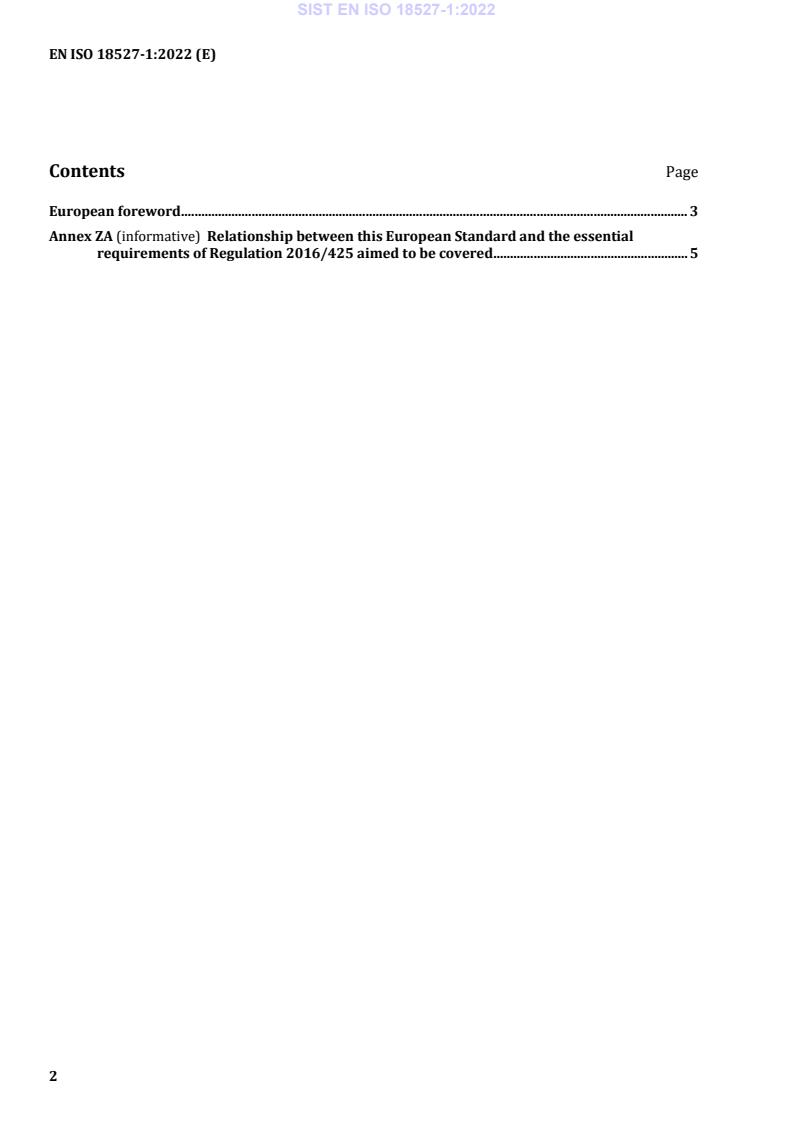
Contents Page
European foreword . 3
Annex ZA (informative) Relationship between this European Standard and the essential
requirements of Regulation 2016/425 aimed to be covered . 5
European foreword
This document (EN ISO 18527-1:2022) has been prepared by Technical Committee ISO/TC 94
"Personal safety -- Personal protective equipment" in collaboration with Technical Committee CEN/TC
85 “Eye protective equipment” the secretariat of which is held by AFNOR.
This European Standard shall be given the status of a national standard, either by publication of an
identical text or by endorsement, at the latest by November 2022, and conflicting national standards
shall be withdrawn at the latest by May 2025.
Attention is drawn to the possibility that some of the elements of this document may be the subject of
patent rights. CEN shall not be held responsible for identifying any or all such patent rights.
This document supersedes EN 174:2001.
This document has been prepared under a mandate given to CEN by the European Commission and the
European Free Trade Association, and supports essential requirements of EU Directive(s) /
Regulation(s).
For the relationship with EU Directive(s) / Regulation(s) 2016/425 see informative Annex ZA, which is
an integral part of this document.
Any feedback and questions on this document should be directed to the users’ national standards
body/national committee. A complete listing of these bodies can be found on the CEN website.
The following referenced documents are indispensable for the application of this document. For
undated references, the latest edition of the referenced document (including any amendments) applies.
For dated references, only the edition cited applies. However, for any use of this document ‘within the
meaning of Annex ZA, the user should always check that any referenced document has not been
superseded and that its relevant contents can still be considered the generally acknowledged state-of-
art.
When an IEC or ISO standard is referred to in the ISO standard text, this shall be understood as a
normative reference to the corresponding EN standard, if available, and otherwise to the dated version
of the ISO or IEC standard, as listed below.
NOTE The way in which these referenced documents are cited in normative requirements determines the
extent (in whole or in part) to which they apply.
Undated normative Clause(s) of the ISO Equivalent dated standard
references in the ISO standard
EN ISO or IEC
standard
ISO 4007 Clause 2 & 3 EN ISO 4007:2018 ISO 4007:2018
ISO 8980-5 Clause 2 & 14.3 EN ISO 8980-5:2005 ISO 8980-5:2005
Clause 2, 5.1, 5.6.4 &
ISO 11664-2 EN ISO 11664-2:2011 ISO 11664-2:2007
5.6.5
ISO 18526-1 Clause 2 EN ISO 18526-1:2020 ISO 18526-1:2020
ISO 18526-2 Clause 2 EN ISO 18526-2:2020 ISO 18526-2:2020
ISO 18526-3 Clause 2 EN ISO 18526-3 :2020 ISO 18526-3:2020
ISO 18526-4 Clause 2, 4.5 & 15.3 EN ISO 18526-4:2020 ISO 18526-4:2020
ISO 21987 Clause 2 & 7.5 EN ISO 21987:2017 ISO 21987:2017
According to the CEN-CENELEC Internal Regulations, the national standards organizations of the
following countries are bound to implement this European Standard: Austria, Belgium, Bulgaria,
Croatia, Cyprus, Czech Republic, Denmark, Estonia, Finland, France, Germany, Greece, Hungary, Iceland,
Ireland, Italy, Latvia, Lithuania, Luxembourg, Malta, Netherlands, Norway, Poland, Portugal, Republic of
North Macedonia, Romania, Serbia, Slovakia, Slovenia, Spain, Sweden, Switzerland, Turkey and the
United Kingdom.
Endorsement notice
The text of ISO 18527-1:2021 has been approved by CEN as EN ISO 18527-1:2022 without any
modification.
Annex ZA
(informative)
Relationship between this European Standard and the essential
requirements of Regulation 2016/425 aimed to be covered
This European Standard has been prepared under a Commission’s standardization request M/571 to
provide one voluntary means of conforming to requirements of Regulation 2016/425.
Once this standard is cited in the Official Journal of the European Union under that Regulation
2016/425 compliance with the normative clauses of this standard given in Table ZA.1 confers, within
the limits of the scope of this standard, a presumption of conformity with the corresponding [essential]
requirements of that Regulation 2016/425 and associated EFTA regulations
Table ZA.1 — Correspondence between this European Standard and Annex II of Regulation
2016/425 OJEU reference
Essential Requirements of Clause(s)/subclause(s) Remarks/Notes
Regulation of this EN
1.1.1 Ergonomics 4.1; 12
1.1.2.1 Optimum level of 7; 9; 10 ; 11; 12; 13; 14
protection
1.1.2.2 Classes of protection 5.2; 5.3
appropriate to different levels
of risk
1.2.1 Absence of risks and other 4.2; 4.4
'inherent' nuisance factors
1.2.1.1 Suitable constituent 4.1
materials
1.2.1.2 Satisfactory surface 4.2; 4.5
condition of all PPE parts in
contact with the user.
1.2.1.3 Maximum permissible 6; 7; 12
user impediment
1.3.1 Adaptation of PPE to user 4.6
morphology
1.3.2 Lightness and design 8; 9; 10
strength
1.3.3 Compatibility of different 4.6
classes or types of PPE
designed
for simultaneous use
1.4 Manufacturer's instructions 15
and information
2.1 PPE incorporating 4.5
adjustment systems
2.3 PPE for the face, eyes and 5.5; 6; 7; 14.2; 15.2
respiratory system
2.9 PPE incorporating 4.2
components which can be
adjusted or removed by the use
2.12 PPE bearing one or more 15.2
identification markings or
indicators directly or indirectly
relating to health and safety
2.14 "Multi risk" PPE 5; 8; 9; 10; 11; 14.1
3.7.1 PPE constituent materials 14.1
and other components
3.9.1 Non-ionising radiation 5.2, 5.3, 5.4; 15.2
WARNING 1 — Presumption of conformity stays valid only as long as a reference to this European
Standard is maintained in the list published in the Official Journal of the European Union. Users of this
standard should consult frequently the latest list published in the Official Journal of the European
Union.
WARNING 2 — Other Union legislation may be applicable to the product(s) falling within the scope of
this standard.
INTERNATIONAL ISO
STANDARD 18527-1
First edition
2021-03
Eye and face protection for sports
use —
Part 1:
Requirements for downhill skiing and
snowboarding goggles
Protection des yeux et du visage à usage sportif —
Partie 1: Exigences relatives aux lunettes de ski alpin et de surf des
neiges
Reference number
ISO 18527-1:2021(E)
©
ISO 2021
ISO 18527-1:2021(E)
© ISO 2021
All rights reserved. Unless otherwise specified, or required in the context of its implementation, no part of this publication may
be reproduced or utilized otherwise in any form or by any means, electronic or mechanical, including photocopying, or posting
on the internet or an intranet, without prior written permission. Permission can be requested from either ISO at the address
below or ISO’s member body in the country of the requester.
ISO copyright office
CP 401 • Ch. de Blandonnet 8
CH-1214 Vernier, Geneva
Phone: +41 22 749 01 11
Email: copyright@iso.org
Website: www.iso.org
Published in Switzerland
ii © ISO 2021 – All rights reserved
ISO 18527-1:2021(E)
Contents Page
Foreword .v
Introduction .vi
1 Scope . 1
2 Normative references . 1
3 Terms and definitions . 2
4 General requirements for goggles . 2
4.1 Physiological compatibility . 2
4.2 Construction and adjustment . 2
4.3 Cleaning and/or disinfection . 3
4.4 Lens material and surface quality . 3
4.5 Headform(s) . 3
4.6 Retention by headband and harnesses (sit and fit) . 3
4.7 Mandatory and optional requirements . 3
5 Transmittance of the lenses . 3
5.1 General . 3
5.2 Transmittance categories . 3
5.3 Solar ultraviolet transmittance . 4
5.4 General transmittance requirements . 4
5.4.1 Uniformity of luminous transmittance and transmittance matching . 4
5.4.2 Ultraviolet transmittance of the frame or housing . 5
5.5 Special transmittance requirements . 5
5.5.1 Photochromic lenses . 5
5.5.2 Polarizing lenses . 5
5.5.3 Gradient-tinted lenses . 6
5.6 Claimed transmittance and reflectance properties (optional requirements) . 6
5.6.1 General. 6
5.6.2 Solar blue-light absorption/transmittance . . 6
5.6.3 Solar UV absorption/transmittance . 6
5.6.4 Anti-reflective coated lenses. 7
5.6.5 Reduced reflection coated lenses . 7
5.6.6 Enhanced infrared absorption . 7
6 Scattered light . 7
7 Refractive power . 7
7.1 General . 7
7.2 Spherical and cylindrical power . 8
7.3 Spatial deviation . 8
7.4 Prism imbalance . 8
7.5 Goggles with inserts to carry prescription lenses . 8
8 Mechanical testing . 8
8.1 Temperature range . 8
8.2 Mechanical strength level 2 . 8
8.2.1 Complete goggles . 8
8.2.2 Goggles with inserts to carry prescription lenses . 9
8.2.3 Failure criteria after impact . 9
9 Resistance to solar ultraviolet radiation . 9
10 Resistance to ignition .10
11 Protection against water and snow .10
12 Field of view.10
13 Minimum area to be protected .10
ISO 18527-1:2021(E)
13.1 Assessment of frontal protection .10
13.2 Assessment of lateral protection .11
14 Optional requirements .12
14.1 Extended low temperature range .12
14.2 Resistance to fogging .12
14.3 Resistance to abrasion .12
15 Marking and information to be supplied by the manufacturer .13
15.1 Assessment .13
15.2 Mandatory markings on goggles .13
15.3 Information to be supplied with goggles by the manufacturer .13
15.4 Additional information to be available from the manufacturer .15
16 Selection of test samples .15
16.1 General .15
16.2 Preparation and conditioning of test samples .16
Annex A (informative) Selection and use of downhill skiing and snowboarding goggles .19
Bibliography .22
iv © ISO 2021 – All rights reserved
ISO 18527-1:2021(E)
Foreword
ISO (the International Organization for Standardization) is a worldwide federation of national standards
bodies (ISO member bodies). The work of preparing International Standards is normally carried out
through ISO technical committees. Each member body interested in a subject for which a technical
committee has been established has the right to be represented on that committee. International
organizations, governmental and non-governmental, in liaison with ISO, also take part in the work.
ISO collaborates closely with the International Electrotechnical Commission (IEC) on all matters of
electrotechnical standardization.
The procedures used to develop this document and those intended for its further maintenance are
described in the ISO/IEC Directives, Part 1. In particular the different approval criteria needed for the
different types of ISO documents should be noted. This document was drafted in accordance with the
editorial rules of the ISO/IEC Directives, Part 2 (see www .iso .org/ directives).
Attention is drawn to the possibility that some of the elements of this document may be the subject of
patent rights. ISO shall not be held responsible for identifying any or all such patent rights. Details of
any patent rights identified during the development of the document will be in the Introduction and/or
on the ISO list of patent declarations received (see www .iso .org/ patents).
Any trade name used in this document is information given for the convenience of users and does not
constitute an endorsement.
For an explanation of the voluntary nature of standards, the meaning of ISO specific terms and
expressions related to conformity assessment, as well as information about ISO's adherence to the
World Trade Organization (WTO) principles in the Technical Barriers to Trade (TBT) see the following
URL: www .iso .org/ iso/ foreword .html.
This document was prepared by Technical Committee ISO/TC 94, Personal safety — Personal protective
equipment, Subcommittee SC 6, Eye and face protection, in collaboration with the European Committee
for Standardization (CEN) Technical Committee CEN/TC 85, Eye protective equipment, in accordance
with the Agreement on technical cooperation between ISO and CEN (Vienna Agreement).
A list of all parts in the ISO 18527 series can be found on the ISO website.
Any feedback or questions on this document should be directed to the user’s national standards body. A
complete listing of these bodies can be found at www .iso .org/ members .html.
ISO 18527-1:2021(E)
Introduction
This family of documents comprised of the ISO 16321 series, the ISO 18526 series and the ISO 18527 series
was developed in response to the worldwide stakeholders’ demand for minimum requirements and test
methods for eye and face protectors traded internationally. ISO 4007 gives the terms and definitions
for all the various product types. The test methods are given in the ISO 18526 series, while the
requirements for occupational eye and face protectors are given in the ISO 16321 series. Eye protectors
for specific sports are mostly dealt with by the ISO 18527 series. A guidance document, ISO 19734, for
the selection, use and maintenance of eye and face protectors is under preparation.
vi © ISO 2021 – All rights reserved
INTERNATIONAL STANDARD ISO 18527-1:2021(E)
Eye and face protection for sports use —
Part 1:
Requirements for downhill skiing and snowboarding
goggles
1 Scope
This document applies to all goggles with plano lenses, intended for eye protection against hazards
including ultraviolet and visible solar radiation, rain, snow and wind, during downhill skiing,
snowboarding and other similar activities.
This document applies to downhill skiing and snowboarding goggles fitted with an insert to carry
prescription lenses.
It specifies requirements and testing for materials, performance, marking of goggles and information
to be supplied by the manufacturer.
Information on the selection and use of downhill skiing and snowboarding goggles is given in Annex A.
This document does not apply to
a) eye protectors for protection when operating or travelling on a motorized vehicle,
b) eye protectors for protection against optical radiation from artificial sources, such as those used in
solaria,
c) eye protectors for direct observation of the sun, and
d) eye protectors intended for sports with unrelated hazards and risks.
2 Normative references
The following documents are referred to in the text in such a way that some or all of their content
constitutes requirements of this document. For dated references, only the edition cited applies. For
undated references, the latest edition of the referenced document (including any amendments) applies.
ISO 4007, Personal protective equipment — Eye and face protection — Vocabulary
ISO 8980-5, Ophthalmic optics — Uncut finished spectacle lenses — Part 5: Minimum requirements for
spectacle lens surfaces claimed to be abrasion-resistant
ISO 11664-2, Colorimetry — Part 2: CIE standard illuminants
ISO 18526-1:2020, Eye and face protection — Test methods — Part 1: Geometrical optical properties
ISO 18526-2:2020, Eye and face protection — Test methods — Part 2: Physical optical properties
ISO 18526-3:2020, Eye and face protection — Test methods — Part 3: Physical and mechanical properties
ISO 18526-4, Eye and face protection — Test methods — Part 4: Headforms
ISO 21987, Ophthalmic optics — Mounted spectacle lenses
ISO 18527-1:2021(E)
3 Terms and definitions
For the purposes of this document, the terms and the definitions given in ISO 4007 apply.
ISO and IEC maintain terminological databases for use in standardization at the following addresses:
— ISO Online browsing platform: available at https:// www .iso .org/ obp
— IEC Electropedia: available at http:// www .electropedia .org/
4 General requirements for goggles
4.1 Physiological compatibility
Goggles shall be designed and manufactured in such a way that, when used under the conditions and
for the purposes intended, they will not compromise the health or safety of the wearer. The risks
posed by substances leaking or evaporating from the goggles that can come into prolonged contact
with the wearer shall be reduced by the manufacturer to within the limits of any applicable regulatory
requirement.
Special attention shall be given to substances that are allergenic, carcinogenic, mutagenic or toxic to
reproduction.
NOTE 1 Excessive pressure due to a poor fit on the head, chemical irritation or allergy are known to produce
reactions. Rare or idiosyncratic reactions to any material are known to occur and the individual wearer is well
advised to avoid those types of frame materials.
Substances recommended for cleaning, maintenance or disinfection shall be known to be unlikely to
have any adverse effect upon the wearer, when applied in accordance with the instructions given in the
information to be supplied by the manufacturer.
Manufacturers/suppliers shall perform an appropriate risk analysis on potentially harmful substances
contained in the goggles such that, when the goggles are used under the conditions and for the purposes
intended, the health (and safety) of the wearer shall not be compromised.
The following are examples of documents that represent the appropriate information:
a) specification of the material(s);
b) safety data sheets relating to the materials;
c) information relating to the suitability of the materials for use with food, in medical devices, or
other relevant applications;
d) information relating to toxicological, allergenic, carcinogenic, toxic to reproduction, or mutagenic
investigations on the materials.
NOTE 2 Specific national regulations with regard to the restriction of certain chemical substances need to be
observed, for example release of nickel.
4.2 Construction and adjustment
Areas of the goggles that may, during intended use, come into contact with the wearer shall be free
from projections, sharp edges or other features likely to cause discomfort or injury to the wearer.
Any part of the goggles that can be adjusted or removed by the wearer for the purpose of replacement
(in accordance with the instructions given in the information to be supplied by the manufacturer) shall
facilitate adjustment, removal and attachment without the use of tools.
Any adjustment system incorporated in the goggles shall maintain the intended fit for the foreseeable
conditions of use.
2 © ISO 2021 – All rights reserved
ISO 18527-1:2021(E)
The test shall be carried out by physical inspection according to ISO 18526-3:2020, 6.1.
4.3 Cleaning and/or disinfection
The goggles shall be cleaned only once according to the cleaning and/or disinfection procedures in the
information to be supplied by the manufacturer before being subjected to testing.
4.4 Lens material and surface quality
+05,
In a circular area 30 mm diameter centred on the reference point(s) but excluding a marginal area
−0
+0
5 mm wide around the edge of the lens if this overlaps with the circular area, lenses shall be free
−05,
from defects likely to impair vision in use (such as bubbles, scratches, inclusions, dull spots, pitting,
mould marks, scouring, grains, pocking, scaling and undulation) when examined according to
ISO 18526-3:2020, 6.6.
4.5 Headform(s)
Unless the manufacturer specifies the headform(s) according to ISO 18526-4 that is/are compatible
with the goggles, the test methods where (a) headform(s) is/are required shall use the headform 1-M
according to ISO 18526-4 as the default.
4.6 Retention by headband and harnesses (sit and fit)
Goggles shall sit in the intended position during normal use and shall adapt to the contours of the face.
The headband shall be designed to be flexible or adjustable and sit securely on the back of the head or a
helmet. The headband assembly shall not cause any discomfort nor exhibit any insecurity when tested
in accordance with ISO 18526-3:2020, 6.5.
4.7 Mandatory and optional requirements
In this document both optional and mandatory requirements are described. Depending on the intended
use and/or the manufacturer's claimed specification, some requirements marked as optional become
mandatory.
5 Transmittance of the lenses
5.1 General
Transmittance values shall be determined in accordance with ISO 18526-2:2020, Clauses 6 to 11,
as appropriate. Luminous transmittance shall be calculated using CIE standard illuminant D65 in
accordance with ISO 11664-2 (see also ISO 4007:2018, 3.10.1.32).
5.2 Transmittance categories
Depending upon the mean luminous transmittance, τ , at their reference points, lenses for downhill
v,D65
skiing and snowboarding use shall be attributed to one of the five tint categories in Table 1.
The ranges of the luminous transmittance, τ , of these five categories are given by the values in
v,D65
Table 1. There are only three descriptive groups for use by consumers as shown in Table 7. An overlap
of the transmittance values shall be not more than ±2 % (absolute) between the categories 0, 1, 2 and 3.
There is no overlap in transmittance values between categories 3 and 4.
If the manufacturer and/or supplier declares a luminous transmittance value, the maximum deviation
for this value shall be ±3 % absolute for transmittance values falling in categories 0 to 3 and ±30 %
relative to the stated value for transmittance values falling in tint category 4.
ISO 18527-1:2021(E)
When describing the transmittance properties of a lens with changeable tint, e.g. photochromic, two
categories for the luminous transmittance values are generally used. These two values correspond to
the highest and lowest transmittance states of the lens. Lenses or filters with temperature sensitive
transmittance shall also be tested at (+5 ± 2) °C. If the performance at (+5 ± 2) °C results in a category
change, then this category shall also be attributed.
In the case of a gradient-tinted lens, the mean luminous transmittance τ at the reference points
v,D65
shall be used to characterize the luminous transmittance and the tint category.
For a gradient-tinted lens, the overlap in luminous transmittance allowed between categories shall be
double that for uniformly tinted lenses.
5.3 Solar ultraviolet transmittance
When tested within a 10 mm radius circle centred on the reference point according to ISO 18526-2:2020,
Clause 8, the solar UV-A, τ , solar UV-B, τ , and mean spectral (380 to 400) nm, τ ,
SUVA SUVB m380–400
transmittances shall conform with the requirements in Table 1, based on the mean luminous
transmittance, τ , at the reference points of the lens(es).
v,D65
Table 1 — Transmittance requirements for downhill skiing and snowboarding lenses
Optional
Visible spectral
Wavelength range from 280 nm to 400 nm infrared spectral
range
range
Maximum Maximum Maximum mean Luminous Maximum solar IR
solar UV-B solar UV-A 380 nm to 400 nm transmittance transmittance
Tint
transmittance transmittance spectral
category
transmittance
τ τ τ τ τ
SUVB SUVA,380 m380-400 v,D65 SIR
280 nm ≤ λ ≤ 315 nm ≤ λ ≤ 380 nm ≤ λ ≤ 400 nm 380 nm ≤ λ ≤ 780 nm ≤ λ ≤
315 nm 380 nm 780 nm 2 000 nm
(%)
(%) (%) (%) (%)
S0 τ > 80 τ
v,D65 v,D65
0,75 τ
v,D65
S1 0,30 τ 43 < τ ≤ 80 τ
v,D65 v,D65 v,D65
S2 18 < τ ≤ 43 τ
v,D65 v,D65
0,5 τ
0,03 τ v,D65
v,D65
S3 8 < τ ≤ 18 τ
v,D65 v,D65
0,5 % absolute or
0,15 τ
v,D65
S4 0,15 τ 3 < τ ≤ 8 τ
v,D65 v,D65 v,D65
whichever is greater
NOTE Some national requirements can stipulate a different requirement for the long wavelength limit of UV-A.
5.4 General transmittance requirements
5.4.1 Uniformity of luminous transmittance and transmittance matching
5.4.1.1 Uniformly tinted lenses
Lenses that are intended to be uniformly tinted shall appear to be visually uniform within circles
+05,
30 mm diameter centred on the reference points or to the edge of the lens less the marginal zone
−0
+0
5 mm wide (whichever is greater), and appear to have the same transmittance at the two reference
−05,
points when inspected against a white background in accordance with ISO 18526-3:2020, 6.6. Where
there is visible non-uniformity, then, when tested according to ISO 18526-2:2020, 7.4, the relative
difference in the luminous transmittance values between any two points of the lens within these areas
shall not be greater than 15 % (relative to the higher value), except for tint category S4 where it shall
not be greater than 20 %.
4 © ISO 2021 – All rights reserved
ISO 18527-1:2021(E)
Where there are visibly mismatched transmittances at the reference points, when measured in
accordance with ISO 18526-2:2020, 7.5, the difference in luminous transmittance values at the reference
points for the right and left eyes shall not exceed 15 % (relative to the higher transmittance).
5.4.1.2 Linear gradient-tinted lenses
In the case of mounted linear gradient-tinted lenses, when inspected against a white background in
accordance with ISO 18526-3:2020, 6.6, the luminous transmittances shall appear constant in the
horizontal direction and having equal transmittance at the reference points. Where there is visible
rotation of the gradient or visibly mismatched transmittances at the reference points, when measured
in accordance with ISO 18526-2:2020, 7.5, the difference in the luminous transmittances at the reference
+05,
points and between pairs of points on the lens at 15 mm to the left, to the right, above and below the
−0
reference points shall not exceed 15 % (relative to the higher value in each direction).
5.4.1.3 Radial gradient-tinted lenses
When measured in accordance with ISO 18526-2:2020, 7.5, the difference in the luminous transmittances
+05,
at the reference points and between pairs of points on the lens 15 mm to the left, to the right, above
−0
and below the reference points shall not exceed 15 % (relative to the higher value).
5.4.1.4 Variations due to thickness variations
Changes of luminous transmittance that are caused by thickness variations due to the design of the lens
are permitted. For verification, the test method in ISO 18526-2:2020, 7.4.1.4 shall be used.
5.4.2 Ultraviolet transmittance of the frame or housing
When tested in accordance with ISO 18526-2:2020, Clause 6, non-lens areas of goggles shall provide at
least the same level of protection against ultraviolet radiation, for the area to be protected according
Clause 12, as given by a lens of any tint category declared usable with the goggles by the manufacturer
or supplier.
5.5 Special transmittance requirements
5.5.1 Photochromic lenses
The tint categories of photochromic lenses shall be determined by the luminous transmittance in the
faded state, τ , and the luminous transmittance in the darkened state, τ , measured according to
v,0 v,1
ISO 18526-2:2020, Clause 16, at a temperature of (5 ± 2) °C. In both states, the requirements specified in
5.2 and 5.3 shall be met. The photochromic response PR = τ /τ shall be ≥1,25.
v,0 v,1
5.5.2 Polarizing lenses
5.5.2.1 Plane of transmission
If the lenses in the goggles are claimed to be polarizing, the lenses shall be fitted in the frame so that
their planes of transmission, when tested according to ISO 18526-2:2020, 15.1, shall not deviate from
the vertical by more than ±5°. When the goggles are fitted with two separate lenses, any misalignment
between the planes of transmission of the left and right lenses shall not be greater than 6°.
ISO 18527-1:2021(E)
5.5.2.2 Polarizing efficiency
When tested according to ISO 18526-2:2020, 15.2, the polarizing efficiency, P, shall be ≥78 % for tint
categories 2, 3, 4 and ≥60 % for tint category 1.
NOTE 1 These values are equivalent to ratios of the luminous transmittance values parallel and perpendicular
to the plane of transmission of approximately 8:1 and 4:1 respectively.
NOTE 2 Lenses of tint category 0 do not have any useful polarizing effect.
5.5.3 Gradient-tinted lenses
5.5.3.1 General
Uniformity of transmission is subject to the requirements of 5.4.1.2 and 5.4.1.3.
5.5.3.2 Determination of the tint category
The tint category of gradient-tinted lenses shall be determined by the luminous transmittance at the
reference point.
5.6 Claimed transmittance and reflectance properties (optional requirements)
5.6.1 General
In the case where specific transmittance values are claimed, these claims shall be according to 5.6.2
and 5.6.3. These requirements shall apply within a 10 mm radius circle centred on the reference point.
5.6.2 Solar blue-light absorption/transmittance
a) Solar blue-light absorption – In the case where it is claimed that a lens has x % solar blue-
light absorption, the solar blue-light transmittance, τ , of the lens, measured according to
SB
ISO 18526-2:2020, 9.1, shall not exceed (100,5 − x) %.
b) Solar blue-light transmittance – In the case where it is claimed that a lens has less than x % solar
blue-light transmittance, the solar blue-light transmittance, τ , of the lens, measured according to
SB
ISO 18526-2:2020, 9.1, shall not exceed (x + 0,5) %.
For the calculation of the blue-light transmittance, the values of ISO 18526-2:2020, Table D.1 shall be used.
5.6.3 Solar UV absorption/transmittance
Requirements for the maximum transmittance of lenses in the UV-A and the UV-B shall be as given
in Table 1 as appropriate. In cases where it is claimed that a lens provides a certain percentage UV
absorption or UV transmittance that is better than the requirement in Table 1, corresponding
requirements shall apply.
For the calculation of the values of UV absorption/transmittance the values of ISO 18526-2:2020,
Table D.1 shall be used.
a) Solar UV absorption – In the case where it is claimed that a lens has x % UV absorption, the solar
UV transmittance of the lens, τ , measured according to ISO 18526-2:2020, 8.3, shall not
SUV,380
exceed (100,5 − x) %.
b) Solar UV transmittance – In the case where it is claimed that a lens has less than x %
UV transmittance, the solar UV transmittance of the lens, τ , measured according to
SUV,380
ISO 18526-2:2020, 8.3, shall not exceed (x + 0,5) %.
6 © ISO 2021 – All rights reserved
ISO 18527-1:2021(E)
c) Solar UV-A absorption – In the case where it is claimed that a lens has x % UV-A absorption, the
solar UV-A transmittance of the lens, τ , measured according to ISO 18526-2:2020, 8.4, shall
SUVA 380
not exceed (100,5 − x) %.
d) Solar UV-A transmittance – In the case where it is claimed that a lens has less than x % UV-A
...