

SIST EN 688:2026
(Main)Resilient floor coverings - Specification for corklinoleum
General Information
- Abstract
This document specifies the characteristics of corklinoleum, supplied in roll form.
To encourage the consumer to make an informed choice, this document includes a classification system based on intensity of use, which shows where resilient floor coverings should give satisfactory service (see EN ISO 10874). It also includes requirements for marking.
The term 'linoleum' is frequently incorrectly applied to a range of floor coverings, often to those based on polyvinyl chloride or rubber. This document does not apply to such.
- Status
- Published
- Public Enquiry End Date
- 30-Jul-2025
- Publication Date
- 18-Jun-2026
- Technical Committee
- ITEK - Textile and textile products
- Current Stage
- 6060 - National Implementation/Publication (Adopted Project)
- Start Date
- 10-Jun-2026
- Due Date
- 15-Aug-2026
- Completion Date
- 19-Jun-2026

Overview
SIST EN 688:2026 - Resilient Floor Coverings: Specification for Corklinoleum sets out standardized requirements for the characteristics and performance of corklinoleum floors supplied in roll form. This standard, developed by the Slovenian Institute for Standardization (SIST), ensures that corklinoleum products meet criteria for durability, safety, and quality, supporting both manufacturers and consumers in making informed choices. Corklinoleum, a distinctive resilient floor covering, consists of a blend of linoleum cement and granulated cork, offering underfoot comfort and sound reduction.
Notably, SIST EN 688:2026 clarifies the difference between genuine linoleum and other materials, excluding products based on PVC or rubber. This document incorporates a robust classification system based on the intensity of use, referencing EN ISO 10874, to guide users in selecting the appropriate flooring for domestic, commercial, and specialized environments.
Key Topics
- Product Composition: Corklinoleum is defined by a homogeneous mixture of linoleum cement and cork granules, with additional pigments and fillers, calendared onto a carrier or fibrous backing, then oxidatively cured.
- Performance Requirements: The standard specifies criteria such as:
- Thickness and Density: Defined tolerances for nominal values.
- Mass per Unit Area: Strict allowances to ensure consistency.
- Flexibility: Resistance to cracking when bent to specified radii.
- Residual Indentation: Limits for deformation under static load.
- Colour Fastness to Light: Minimum levels to ensure lasting appearance.
- Classification System: Floors are classified by intensity of use (e.g., domestic moderate, domestic general, commercial moderate) according to EN ISO 10874, helping users select coverings offering the necessary service life and performance.
- Marking Requirements: Products and packaging must be clearly labelled with standard reference, manufacturer, product details, batch numbers, and class symbols, supporting traceability and informed purchase decisions.
- Optional Properties: Guidance on optional tests for electrical resistance, electrostatic propensity, stain resistance, and impact sound reduction, addressing specialized application needs.
Applications
Corklinoleum floor coverings are widely specified for environments where durability, comfort, and sustainable materials matter. Typical applications include:
- Residential Spaces: Living areas, kitchens, and bedrooms benefit from the underfoot comfort and acoustic dampening that corklinoleum provides.
- Commercial Areas: Offices, classrooms, corridors, and retail environments utilize corklinoleum's resilience and ease of maintenance.
- Healthcare and Institutional Settings: Thanks to its hygienic surfaces and comfort, corklinoleum is suitable for clinics, schools, and public buildings.
- Eco-Friendly Projects: Corklinoleum is a natural material, making it an attractive option for sustainable building initiatives.
The use of the classification system ensures that users can select floor coverings rated for the intensity of expected foot traffic, optimizing service life and reducing maintenance costs.
Related Standards
SIST EN 688:2026 references several important international and European standards for testing and classification, including:
- EN ISO 10874: Classification for resilient, textile, and laminate floor coverings by use intensity.
- EN ISO 24346 / 24340 / 24341: Methods for determining thickness, width, length, straightness, and flatness of flooring materials.
- EN ISO 23996 / 23997: Determination of density and mass per unit area.
- EN ISO 24344: Flexibility assessment.
- EN ISO 24343-1: Residual indentation testing.
- EN ISO 26985: Identification of linoleum and analysis of fillers.
- EN 1081 / EN 1815: Electrical resistance and electrostatic propensity tests.
- EN ISO 26987: Stain and chemical resistance.
- EN ISO 105-B02: Colour fastness to artificial light.
Choosing corklinoleum flooring conforming to SIST EN 688:2026 assures compliance with essential quality, safety, and performance criteria, underpinned by robust, internationally harmonized testing methods and clear guidelines for buyers and specifiers.
Relations
- Effective Date
- 23-Sep-2026
- Effective Date
- 01-Nov-2023
Get Certified
Connect with accredited certification bodies for this standard

Gozdarski inštitut Slovenije
Slovenian Forestry Institute. Forest management certification support, timber testing.
Sponsored listings
Frequently Asked Questions
SIST EN 688:2026 is a standard published by the Slovenian Institute for Standardization (SIST). Its full title is "Resilient floor coverings - Specification for corklinoleum". This standard covers: This document specifies the characteristics of corklinoleum, supplied in roll form. To encourage the consumer to make an informed choice, this document includes a classification system based on intensity of use, which shows where resilient floor coverings should give satisfactory service (see EN ISO 10874). It also includes requirements for marking. The term 'linoleum' is frequently incorrectly applied to a range of floor coverings, often to those based on polyvinyl chloride or rubber. This document does not apply to such.
This document specifies the characteristics of corklinoleum, supplied in roll form. To encourage the consumer to make an informed choice, this document includes a classification system based on intensity of use, which shows where resilient floor coverings should give satisfactory service (see EN ISO 10874). It also includes requirements for marking. The term 'linoleum' is frequently incorrectly applied to a range of floor coverings, often to those based on polyvinyl chloride or rubber. This document does not apply to such.
SIST EN 688:2026 is classified under the following ICS (International Classification for Standards) categories: 79.100 - Cork and cork products; 97.150 - Floor coverings. The ICS classification helps identify the subject area and facilitates finding related standards.
SIST EN 688:2026 has the following relationships with other standards: It is inter standard links to SIST EN ISO 105-B02:2014, SIST EN 688:2011. Understanding these relationships helps ensure you are using the most current and applicable version of the standard.
SIST EN 688:2026 is available in PDF format for immediate download after purchase. The document can be added to your cart and obtained through the secure checkout process. Digital delivery ensures instant access to the complete standard document.
Standards Content (Sample)
SLOVENSKI STANDARD
01-julij-2026
Netekstilne talne obloge - Specifikacija plutovinastih linolejev
Resilient floor coverings - Specification for corklinoleum
Elastische Bodenbeläge - Spezifikation für Korklinoleum
Revêtements de sol résilients - Spécifications pour le linoléum sur liège
Ta slovenski standard je istoveten z: EN 688:2026
ICS:
79.100 Pluta in izdelki iz plute Cork and cork products
97.150 Talne obloge Floor coverings
2003-01.Slovenski inštitut za standardizacijo. Razmnoževanje celote ali delov tega standarda ni dovoljeno.
EN 688
EUROPEAN STANDARD
NORME EUROPÉENNE
May 2026
EUROPÄISCHE NORM
ICS 97.150 Supersedes EN 688:2011
English Version
Resilient floor coverings - Specification for corklinoleum
Revêtements de sol résilients - Spécifications pour le Elastische Bodenbeläge - Spezifikation für
linoléum sur liège Korklinoleum
This European Standard was approved by CEN on 27 April 2026.
CEN members are bound to comply with the CEN/CENELEC Internal Regulations which stipulate the conditions for giving this
European Standard the status of a national standard without any alteration. Up-to-date lists and bibliographical references
concerning such national standards may be obtained on application to the CEN-CENELEC Management Centre or to any CEN
member.
This European Standard exists in three official versions (English, French, German). A version in any other language made by
translation under the responsibility of a CEN member into its own language and notified to the CEN-CENELEC Management
Centre has the same status as the official versions.
CEN members are the national standards bodies of Austria, Belgium, Bulgaria, Croatia, Cyprus, Czech Republic, Denmark, Estonia,
Finland, France, Germany, Greece, Hungary, Iceland, Ireland, Italy, Latvia, Lithuania, Luxembourg, Malta, Netherlands, Norway,
Poland, Portugal, Republic of North Macedonia, Romania, Serbia, Slovakia, Slovenia, Spain, Sweden, Switzerland, Türkiye and
United Kingdom.
EUROPEAN COMMITTEE FOR STANDARDIZATION
COMITÉ EUROPÉEN DE NORMALISATION
EUROPÄISCHES KOMITEE FÜR NORMUNG
CEN-CENELEC Management Centre: Rue de la Science 23, B-1040 Brussels
© 2026 CEN All rights of exploitation in any form and by any means reserved Ref. No. EN 688:2026 E
worldwide for CEN national Members.
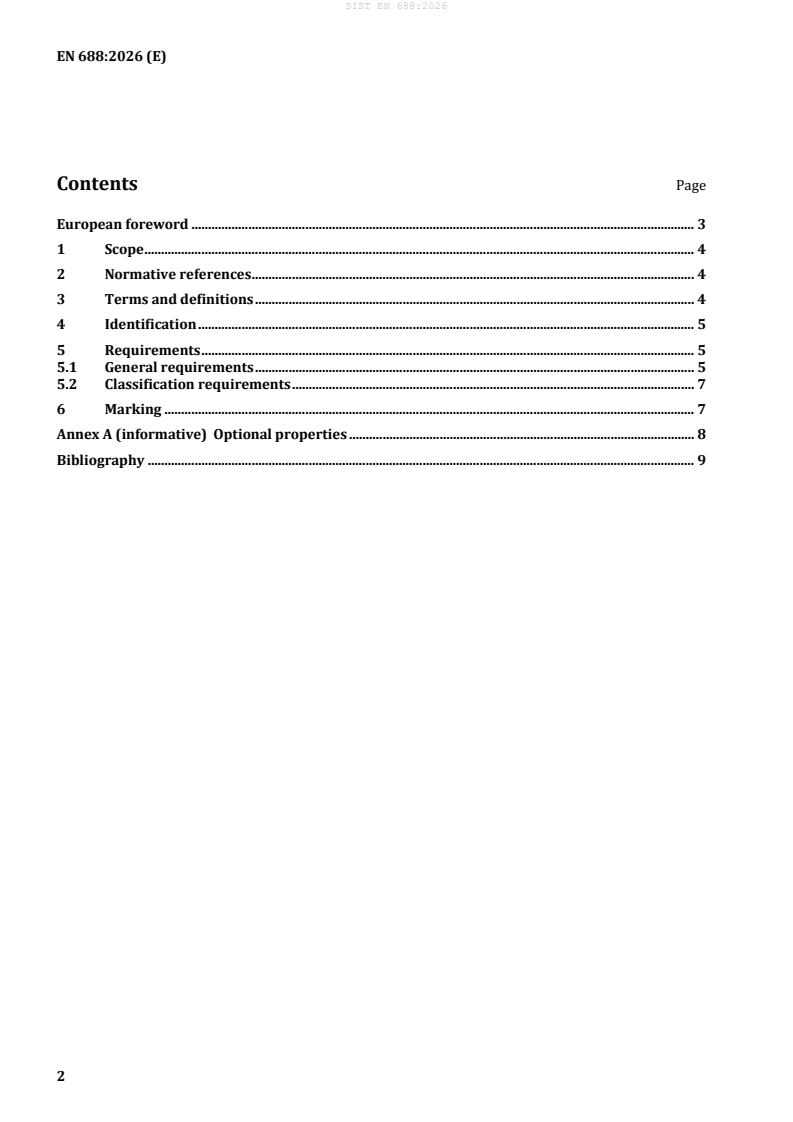
Contents Page
European foreword . 3
1 Scope . 4
2 Normative references . 4
3 Terms and definitions . 4
4 Identification . 5
5 Requirements . 5
5.1 General requirements . 5
5.2 Classification requirements . 7
6 Marking . 7
Annex A (informative) Optional properties . 8
Bibliography . 9
European foreword
This document (EN 688:2026) has been prepared by Technical Committee CEN/TC 134 “Resilient, textile,
laminate and modular mechanical locked floor coverings”, the secretariat of which is held by NBN.
This European Standard shall be given the status of a national standard, either by publication of an
identical text or by endorsement, at the latest by November 2026 and conflicting national standards shall
be withdrawn at the latest by November 2026.
Attention is drawn to the possibility that some of the elements of this document may be the subject of
patent rights. CEN shall not be held responsible for identifying any or all such patent rights.
This document supersedes EN 688:2011.
— adjusted classification table and requirements;
— product with a nominal thickness of 2,5 mm (see Table 1) added;
— update of the normative references;
— requirement for thickness adjusted;
— requirement for density adjusted;
— impact sound reduction changed from requirement to optional property.
Any feedback and questions on this document should be directed to the users’ national standards body.
A complete listing of these bodies can be found on the CEN website.
According to the CEN-CENELEC Internal Regulations, the national standards organizations of the
following countries are bound to implement this European Standard: Austria, Belgium, Bulgaria, Croatia,
Cyprus, Czech Republic, Denmark, Estonia, Finland, France, Germany, Greece, Hungary, Iceland, Ireland,
Italy, Latvia, Lithuania, Luxembourg, Malta, Netherlands, Norway, Poland, Portugal, Republic of North
Macedonia, Romania, Serbia, Slovakia, Slovenia, Spain, Sweden, Switzerland, Türkiye and the United
Kingdom.
1 Scope
This document specifies the characteristics of corklinoleum, supplied in roll form.
To encourage the consumer to make an informed choice, this document includes a classification system
based on intensity of use, which shows where resilient floor coverings should give satisfactory service
(see EN ISO 10874). It also includes requirements for marking.
The term 'linoleum' is frequently incorrectly applied to a range of floor coverings, often to those based
on polyvinyl chloride or rubber. This document does not apply to such.
2 Normati
...