


kSIST FprEN IEC 63497:2026
(Main)Shunt-connected active correction devices (ACD)
Shunt-connected active correction devices (ACD)
IEC 63497:2026, which is a product standard, is intended to specify the EMC, performance and safety requirements of shunt-connected active correction devices (ACD) with rated system voltages not exceeding 1 000 V AC or 1 500 V DC.
These devices can be either cord or permanently connected. They can be movable, stationary, or fixed devices.
An ACD includes both a static VAR generator (SVG) and an active harmonic filter (AHF).
The primary function of a shunt connected ACD is to do one or more of the following:
- active harmonic filtering;
- reactive power compensation;
- unbalanced load compensation.
Additional functions of a shunt-connected ACD, not addressed by this document, can be the following:
- flicker compensation;
- interharmonic component filtering.
In case of hybrid devices, combining a passive harmonic filter and an ACD, this document covers only the active part.
This document does not cover
- active mitigation functions part of another device (variable speed drive, uninterruptible power supply, dynamic voltage restorer, etc.),
- switched power capacitors,
- switched inductors,
- passive harmonic filters,
- energy storage converters, and
- series-connected active correction devices.
Parallele aktive Korrekturgeräte (ACD)
Dispositifs de correction active (ACD) à connexion shunt
L'IEC 63497:2026, qui est une norme de produit destinée à spécifier les exigences de compatibilité électromagnétique (CEM), de performance et de sécurité relatives aux dispositifs de correction active (ACD) à connexion shunt dont les tensions système assignées ne dépassent pas 1 000 V en courant alternatif ou 1 500 V en courant continu.
Ces dispositifs peuvent être des dispositifs à cordon amovible, ou être raccordés de manière permanente. Ils peuvent être des dispositifs mobiles, stationnaires ou fixes.
Les ACD englobent les générateurs de puissance réactive statiques (SVG) et les filtres d’harmoniques actifs (AHF).
La fonction principale d’un ACD à connexion shunt est de réaliser une ou plusieurs des tâches suivantes:
- filtrage actif des harmoniques;
- compensation de puissance réactive;
- compensation des charges non équilibrées.
Les fonctions supplémentaires d’un ACD à connexion shunt, non abordées dans le présent document, peuvent être les suivantes:
- compensation du papillotement ("flicker");
- filtrage des composantes interharmoniques.
Dans le cas de dispositifs hybrides, qui combinent un filtre d’harmoniques passif et un ACD, le présent document couvre uniquement la partie active.
Le présent document ne couvre pas
- les fonctions d’atténuation active d’un autre dispositif (variateur, alimentation sans interruption, correcteur dynamique de tension, etc.),
- les condensateurs de puissance commutés,
- les inductances commutées,
- les filtres d’harmoniques passifs,
- les convertisseurs de stockage d’énergie, et
- les dispositifs de correction active à connexion série.
Naprave za aktivno korekcijo, povezane s preklopno povezavo (ADC)
General Information
- Status
- Not Published
- Public Enquiry End Date
- 30-Jul-2025
- Technical Committee
- MOV - Measuring equipment for electromagnetic quantities
- Current Stage
- 5020 - Formal vote (FV) (Adopted Project)
- Start Date
- 05-Jan-2026
- Due Date
- 23-Feb-2026
- Completion Date
- 16-Mar-2026
Relations
- Effective Date
- 07-Apr-2026
- Effective Date
- 07-Apr-2026
- Effective Date
- 07-Apr-2026
- Effective Date
- 07-Apr-2026
- Effective Date
- 07-Apr-2026
Overview - IEC 63497:2025 Shunt‑connected Active Correction Devices (ACD)
prEN IEC 63497:2025 defines requirements, tests and documentation for shunt‑connected active correction devices (ACD) used in low‑voltage and medium‑voltage power systems to improve power quality. Prepared by IEC SC 22E (Stabilized power supplies) and submitted as a Committee Draft for Vote, the standard covers terminology, ratings, design and construction, safety, electromagnetic compatibility (EMC), environmental and mechanical conditions, earthing, markings and technical documentation. Annexes specify a response time test and a non‑linear reference load for harmonic tests; an informative annex addresses self‑resonance testing.
Key topics and technical requirements
The standard focuses on practical and verifiable requirements for ACDs, including:
- Terms and definitions: device, electrical parameters and phenomena relevant to ACDs (harmonics, sequence components, etc.).
- Ratings and connection types: rated frequency, rated voltage and wiring arrangements.
- Design and construction: architecture of ACDs, functional classification, component and subassembly requirements.
- Safety requirements: protection against electric shock, mechanical hazards, fire, temperature, fluids, radiation and foreseeable misuse.
- EMC requirements: immunity and emissions testing, including voltage harmonic immunity.
- Climatic and mechanical requirements: temperature/humidity, altitude, vibration, shock, enclosure IK/IP ratings.
- Earthing and installation: supply system earthing schemes and specific earthing requirements.
- Testing:
- Type tests (safety, EMC, climatic, mechanical, functional)
- Functional test areas such as harmonic global compensation, harmonic attenuation, reactive power output and accuracy, source current balancing, minimum fault level, response times and losses
- Routine and limited thermal tests
- Performance criteria: defined acceptance criteria for ACD performance during tests.
Practical applications and who uses IEC 63497
This standard is applicable to organizations and professionals involved in the design, manufacture, testing, specification and installation of active power quality equipment:
- Manufacturers of ACDs and power electronics (shunt active filters, active front‑ends)
- System integrators and installers specifying ACD performance for industrial and commercial sites
- Laboratories and test houses performing type and routine tests to verify compliance
- Utilities and facility managers procuring equipment to mitigate harmonics, imbalance and reactive power issues
- Compliance and safety engineers preparing documentation and markings required for market entry
Practical benefits include reliable harmonic attenuation, improved power factor, reduced neutral currents and compliance with EMC and safety requirements.
Related standards and committees
IEC 63497 is prepared by IEC SC 22E and is of interest to TC 22, SC 22H, TC 33 and TC 77. It complements other IEC EMC and electrical safety standards used for power quality equipment and installations.

Get Certified
Connect with accredited certification bodies for this standard

IMQ S.p.A. (Certification)
Italian electrical product certification.

SLG Prüf- und Zertifizierungs GmbH
German testing and certification body.

UL Solutions
Global safety science company with testing, inspection and certification.
Sponsored listings
Frequently Asked Questions
kSIST FprEN IEC 63497:2026 is a draft published by the Slovenian Institute for Standardization (SIST). Its full title is "Shunt-connected active correction devices (ACD)". This standard covers: IEC 63497:2026, which is a product standard, is intended to specify the EMC, performance and safety requirements of shunt-connected active correction devices (ACD) with rated system voltages not exceeding 1 000 V AC or 1 500 V DC. These devices can be either cord or permanently connected. They can be movable, stationary, or fixed devices. An ACD includes both a static VAR generator (SVG) and an active harmonic filter (AHF). The primary function of a shunt connected ACD is to do one or more of the following: - active harmonic filtering; - reactive power compensation; - unbalanced load compensation. Additional functions of a shunt-connected ACD, not addressed by this document, can be the following: - flicker compensation; - interharmonic component filtering. In case of hybrid devices, combining a passive harmonic filter and an ACD, this document covers only the active part. This document does not cover - active mitigation functions part of another device (variable speed drive, uninterruptible power supply, dynamic voltage restorer, etc.), - switched power capacitors, - switched inductors, - passive harmonic filters, - energy storage converters, and - series-connected active correction devices.
IEC 63497:2026, which is a product standard, is intended to specify the EMC, performance and safety requirements of shunt-connected active correction devices (ACD) with rated system voltages not exceeding 1 000 V AC or 1 500 V DC. These devices can be either cord or permanently connected. They can be movable, stationary, or fixed devices. An ACD includes both a static VAR generator (SVG) and an active harmonic filter (AHF). The primary function of a shunt connected ACD is to do one or more of the following: - active harmonic filtering; - reactive power compensation; - unbalanced load compensation. Additional functions of a shunt-connected ACD, not addressed by this document, can be the following: - flicker compensation; - interharmonic component filtering. In case of hybrid devices, combining a passive harmonic filter and an ACD, this document covers only the active part. This document does not cover - active mitigation functions part of another device (variable speed drive, uninterruptible power supply, dynamic voltage restorer, etc.), - switched power capacitors, - switched inductors, - passive harmonic filters, - energy storage converters, and - series-connected active correction devices.
kSIST FprEN IEC 63497:2026 is classified under the following ICS (International Classification for Standards) categories: 29.200 - Rectifiers. Convertors. Stabilized power supply; 29.240.01 - Power transmission and distribution networks in general. The ICS classification helps identify the subject area and facilitates finding related standards.
kSIST FprEN IEC 63497:2026 has the following relationships with other standards: It is inter standard links to kSIST FprHD 60364-1:2025, SIST EN IEC 61000-6-4:2019, SIST EN IEC 60664-1:2020, SIST EN IEC 62477-1:2024, SIST EN IEC 61000-6-2:2019. Understanding these relationships helps ensure you are using the most current and applicable version of the standard.
kSIST FprEN IEC 63497:2026 is associated with the following European legislation: EU Directives/Regulations: 2014/35/EU; Standardization Mandates: M/511. When a standard is cited in the Official Journal of the European Union, products manufactured in conformity with it benefit from a presumption of conformity with the essential requirements of the corresponding EU directive or regulation.
kSIST FprEN IEC 63497:2026 is available in PDF format for immediate download after purchase. The document can be added to your cart and obtained through the secure checkout process. Digital delivery ensures instant access to the complete standard document.
Standards Content (Sample)
SLOVENSKI STANDARD
oSIST prEN IEC 63497:2025
01-julij-2025
Naprave za aktivno korekcijo, povezane s preklopno povezavo (ADC)
Shunt-connected active correction devices (ACD)
Dispositifs de correction active (ACD) à connexion shunt
Ta slovenski standard je istoveten z: prEN IEC 63497:2025
ICS:
29.200 Usmerniki. Pretvorniki. Rectifiers. Convertors.
Stabilizirano električno Stabilized power supply
napajanje
oSIST prEN IEC 63497:2025 en,fr,de
2003-01.Slovenski inštitut za standardizacijo. Razmnoževanje celote ali delov tega standarda ni dovoljeno.
oSIST prEN IEC 63497:2025
oSIST prEN IEC 63497:2025
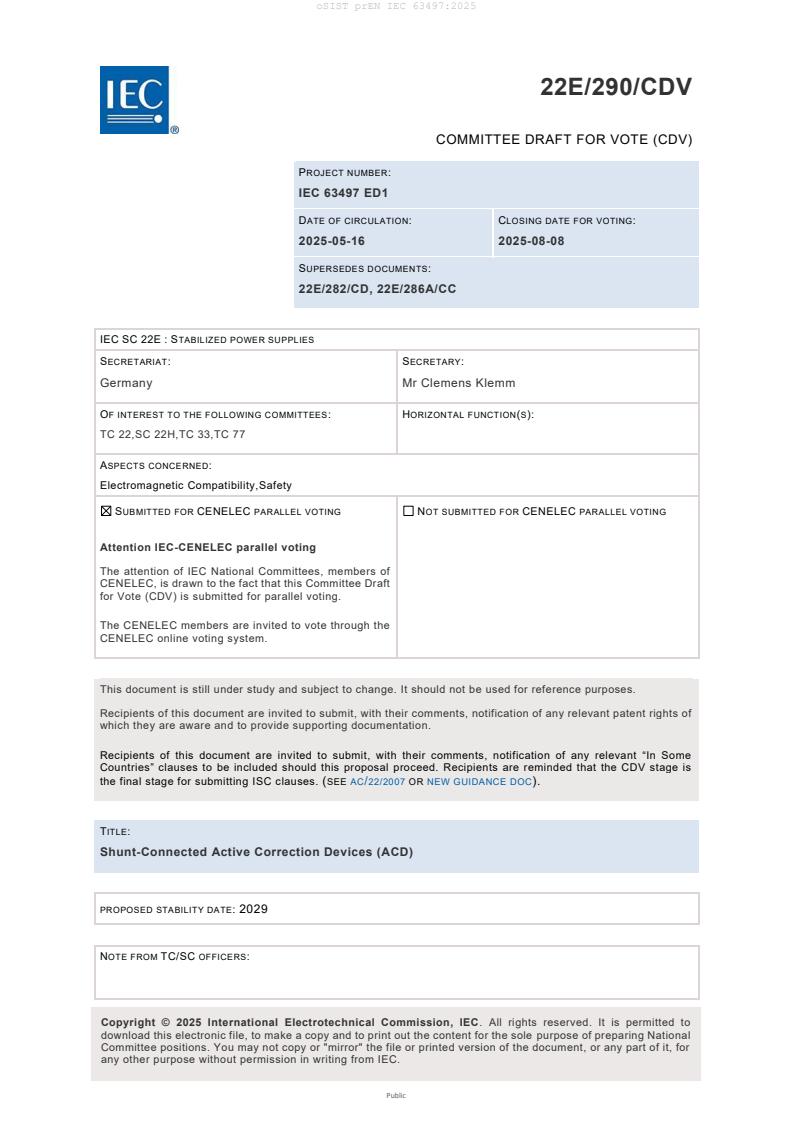
22E/290/CDV
COMMITTEE DRAFT FOR VOTE (CDV)
PROJECT NUMBER:
IEC 63497 ED1
DATE OF CIRCULATION: CLOSING DATE FOR VOTING:
2025-05-16 2025-08-08
SUPERSEDES DOCUMENTS:
22E/282/CD, 22E/286A/CC
IEC SC 22E : STABILIZED POWER SUPPLIES
SECRETARIAT: SECRETARY:
Germany Mr Clemens Klemm
OF INTEREST TO THE FOLLOWING COMMITTEES: HORIZONTAL FUNCTION(S):
TC 22,SC 22H,TC 33,TC 77
ASPECTS CONCERNED:
Electromagnetic Compatibility,Safety
SUBMITTED FOR CENELEC PARALLEL VOTING NOT SUBMITTED FOR CENELEC PARALLEL VOTING
Attention IEC-CENELEC parallel voting
The attention of IEC National Committees, members of
CENELEC, is drawn to the fact that this Committee Draft
for Vote (CDV) is submitted for parallel voting.
The CENELEC members are invited to vote through the
CENELEC online voting system.
This document is still under study and subject to change. It should not be used for reference purposes.
Recipients of this document are invited to submit, with their comments, notification of any relevant patent rights of
which they are aware and to provide supporting documentation.
Recipients of this document are invited to submit, with their comments, notification of any relevant “In Some
Countries” clauses to be included should this proposal proceed. Recipients are reminded that the CDV stage is
the final stage for submitting ISC clauses. (SEE AC/22/2007 OR NEW GUIDANCE DOC).
TITLE:
Shunt-Connected Active Correction Devices (ACD)
PROPOSED STABILITY DATE: 2029
NOTE FROM TC/SC OFFICERS:
download this electronic file, to make a copy and to print out the content for the sole purpose of preparing National
Committee positions. You may not copy or "mirror" the file or printed version of the document, or any part of it, for
any other purpose without permission in writing from IEC.
Public
oSIST prEN IEC 63497:2025
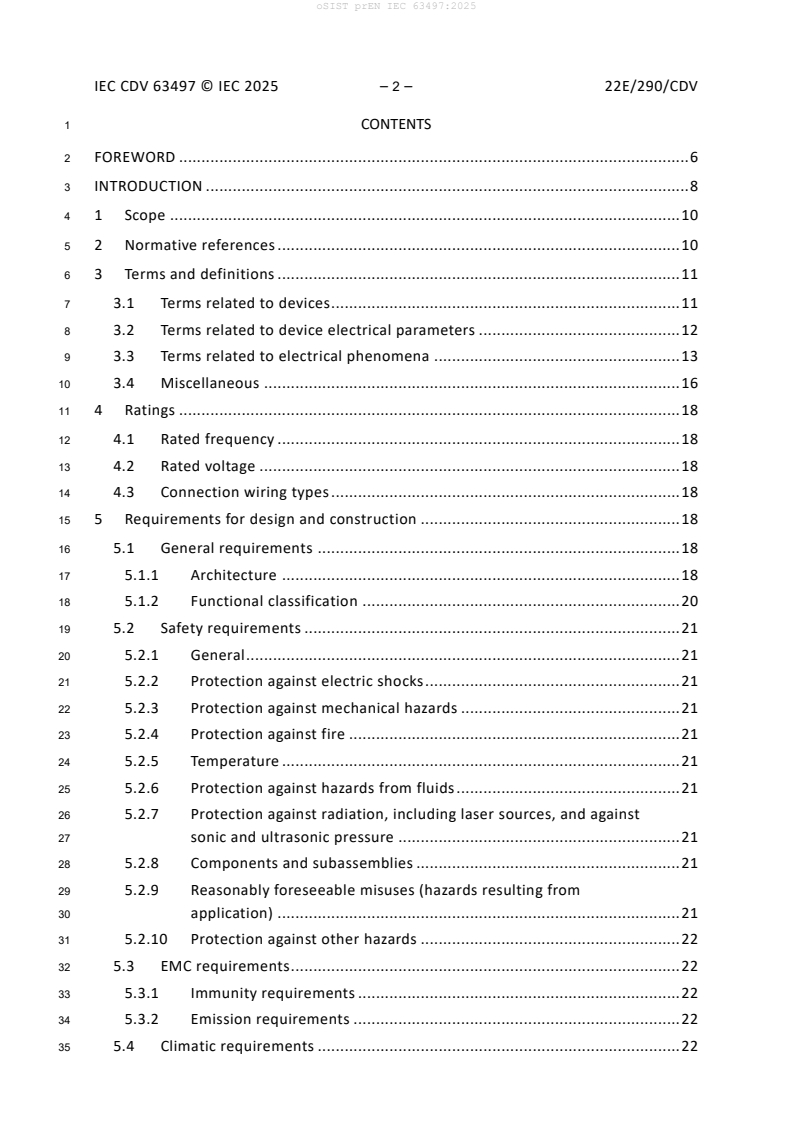
IEC CDV 63497 © IEC 2025 – 2 – 22E/290/CDV
1 CONTENTS
2 FOREWORD . 6
3 INTRODUCTION . 8
4 1 Scope . 10
5 2 Normative references . 10
6 3 Terms and definitions . 11
7 3.1 Terms related to devices . 11
8 3.2 Terms related to device electrical parameters . 12
9 3.3 Terms related to electrical phenomena . 13
10 3.4 Miscellaneous . 16
11 4 Ratings . 18
12 4.1 Rated frequency . 18
13 4.2 Rated voltage . 18
14 4.3 Connection wiring types . 18
15 5 Requirements for design and construction . 18
16 5.1 General requirements . 18
17 5.1.1 Architecture . 18
18 5.1.2 Functional classification . 20
19 5.2 Safety requirements . 21
20 5.2.1 General . 21
21 5.2.2 Protection against electric shocks . 21
22 5.2.3 Protection against mechanical hazards . 21
23 5.2.4 Protection against fire . 21
24 5.2.5 Temperature . 21
25 5.2.6 Protection against hazards from fluids . 21
26 5.2.7 Protection against radiation, including laser sources, and against
27 sonic and ultrasonic pressure . 21
28 5.2.8 Components and subassemblies . 21
29 5.2.9 Reasonably foreseeable misuses (hazards resulting from
30 application) . 21
31 5.2.10 Protection against other hazards . 22
32 5.3 EMC requirements . 22
33 5.3.1 Immunity requirements . 22
34 5.3.2 Emission requirements . 22
35 5.4 Climatic requirements . 22
oSIST prEN IEC 63497:2025
IEC CDV 63497 © IEC 2025 – 3 – 22E/290/CDV
36 5.4.1 Temperature and humidity . 22
37 5.4.2 Altitude . 22
38 5.5 Mechanical requirements . 23
39 5.5.1 Vibrations . 23
40 5.5.2 Shocks . 23
41 5.5.3 Enclosure robustness (IK code) . 23
42 5.5.4 Degree of protection by enclosures (IP code) . 23
43 5.6 Earthing scheme . 23
44 5.6.1 Supply system earthing . 23
45 5.6.2 Requirements . 23
46 5.7 Markings and technical documentation . 23
47 5.7.1 General . 23
48 5.7.2 Product specific markings . 24
49 5.7.3 Product specific items in technical documentation . 24
50 6 Type tests . 26
51 6.1 Reference conditions for testing . 26
52 6.2 Safety tests . 26
53 6.3 EMC tests . 26
54 6.3.1 EMC immunity and emission . 26
55 6.3.2 Voltage harmonic immunity . 27
56 6.4 Climatic tests . 27
57 6.5 Mechanical tests . 28
58 6.5.1 Vibrations . 28
59 6.5.2 Shocks . 28
60 6.6 Functional tests . 28
61 6.6.1 Reference conditions for testing . 28
62 6.6.2 Harmonic global compensation . 28
63 6.6.3 Harmonic attenuation capability . 29
64 6.6.4 Reactive power compensation output current . 29
65 6.6.5 Reactive power compensation accuracy . 30
66 6.6.6 Source current balancing . 31
67 6.6.7 Minimum fault level test . 32
68 6.6.8 Harmonic response time . 33
69 6.6.9 Reactive power compensation response time . 34
70 6.6.10 Losses . 34
oSIST prEN IEC 63497:2025
IEC CDV 63497 © IEC 2025 – 4 – 22E/290/CDV
71 6.7 Performance criteria . 35
72 7 Routine tests . 36
73 7.1 Safety tests . 36
74 7.2 Functional tests . 36
75 7.3 Limited thermal tests . 36
76 7.3.1 Scope . 36
77 7.3.2 Procedure . 36
78 7.3.3 Acceptance criteria . 37
79 Annex A (normative) Response time test specification . 38
80 A.1 Assumption . 38
81 A.2 Specification . 38
82 Annex B (normative) Non-linear reference load for harmonic test . 40
83 B.1 Introduction . 40
84 B.2 Mathematical representation . 40
85 B.3 General principle . 40
86 B.4 Load specification for 3W system . 41
87 B.5 Load specification for 4W system . 43
88 Annex C (Informative) Self-resonance tests . 46
89 C.1 Introduction . 46
90 C.2 Proposed method . 46
91 C.2.1 Test setup . 46
92 C.2.2 Test method . 46
93 C.3 Evaluation . 47
94 Bibliography . 48
96 Figure 1 – Typical current waveforms for single-phase non-linear loads (for a
97 single-phase power supply and a phase controlled rectifier) . 9
98 Figure 2 – Typical current waveforms for three-phase non-linear loads (for a
99 VSD) . 9
100 Figure 3 – Internal architecture of an ACD . 19
101 Figure 4 – Principle of operation of an ACD (for AHF function) . 20
102 Figure 5 – Negative sequence current creation . 31
103 Figure 6 – Zero sequence current creation . 32
104 Figure 7 – Response time illustration . 33
105 Figure B.1 – Load waveform for 3W system . 41
oSIST prEN IEC 63497:2025
IEC CDV 63497 © IEC 2025 – 5 – 22E/290/CDV
106 Figure B.2 – ACD waveform for 3W system . 42
107 Figure B.3 – Load waveform for 4W system . 44
108 Figure B.4 – ACD waveform for 4W system . 45
110 Table 1 –Temperature classes . 22
111 Table 2 – Items to document in technical documentation . 24
112 Table 3 – Additional reference conditions for testing . 26
113 Table 4 – Individual voltage harmonic limits for odd non-multiple 3 harmonics . 27
114 Table 5 – Negative sequence component specification . 31
115 Table 6 – Zero-sequence component specification . 31
116 Table 7 – Test specification . 32
117 Table 8 – Definition of response time parameters . 33
118 Table 9 – Performance criterion for ACD . 35
oSIST prEN IEC 63497:2025
IEC CDV 63497 © IEC 2025 – 6 – 22E/290/CDV
120 INTERNATIONAL ELECTROTECHNICAL COMMISSION
122 SHUNT-CONNECTED ACTIVE CORRECTION DEVICES (ACD)
124 FOREWORD
125 1) The International Electrotechnical Commission (IEC) is a worldwide organization for standardization comprising all national
126 electrotechnical committees (IEC National Committees). The object of IEC is to promote international co -operation on all
127 questions concerning standardization in the electrical and electronic fields. To this end and in addition to other activities ,
128 IEC publishes International Standards, Technical Specifications, Technical Reports, Publicly Available Specifications (PAS)
129 and Guides (hereafter referred to as “IEC Publication(s)”). Their preparation is entrusted to technical committees; any IEC
130 National Committee interested in the subject dealt with may participate in this preparatory work. International,
131 governmental and non-governmental organizations liaising with the IEC also participate in this preparation. IEC
132 collaborates closely with the International Organization for Standardization (ISO) in accordance with conditions
133 determined by agreement between the two organizations.
134 2) The formal decisions or agreements of IEC on technical matters express, as nearly as possible, an international consensus
135 of opinion on the relevant subjects since each technical committee has representation from all interested IEC National
136 Committees.
137 3) IEC Publications have the form of recommendations for international use and are accepted by IEC National Committees in
138 that sense. While all reasonable efforts are made to ensure that the technical content of IEC Publications is accurate, IEC
139 cannot be held responsible for the way in which they are used or for any misinterpretation by any end user.
140 4) In order to promote international uniformity, IEC National Committees undertake to apply IEC Publications transparently
141 to the maximum extent possible in their national and regional publications. Any divergence between any IEC Publication
142 and the corresponding national or regional publication shall be clearly indicated in the latter.
143 5) IEC itself does not provide any attestation of conformity. Independent certification bodies provide conformity assessment
144 services and, in some areas, access to IEC marks of conformity. IEC is not responsible for any services carried out by
145 independent certification bodies.
146 6) All users should ensure that they have the latest edition of this publication.
147 7) No liability shall attach to IEC or its directors, employees, servants or agents including individual experts and members of
148 its technical committees and IEC National Committees for any personal injury, property damage or other damage of any
149 nature whatsoever, whether direct or indirect, or for costs (including legal fees) and expenses arising out of the
150 publication, use of, or reliance upon, this IEC Publication or any other IEC Publications.
151 8) Attention is drawn to the Normative references cited in this publication. Use of the referenced publications is
152 indispensable for the correct application of this publication.
153 9) Attention is drawn to the possibility that some of the elements of this IEC Publication may be the subject of patent rights.
154 IEC shall not be held responsible for identifying any or all such patent rights.
155 IEC 63497 has been prepared by IEC technical committee 22E: Stabilized power supplies
157 The text is based on the following documents:
Draft Report on voting
XX/XX/FDIS XX/XX/RVD
159 Full information on the voting for its approval can be found in the report on voting indicated in
160 the above table.
161 The language used for the development of this Technical Report is English.
162 This document was drafted in accordance with ISO/IEC Directives, Part 2, and developed in
163 accordance with ISO/IEC Directives, Part 1 and ISO/IEC Directives, IEC Supplement, available
oSIST prEN IEC 63497:2025
IEC CDV 63497 © IEC 2025 – 7 – 22E/290/CDV
164 at www.iec.ch/members_experts/refdocs. The main document types developed by IEC are
165 described in greater detail at http://www.iec.ch/standardsdev/publications.
166 The committee has decided that the contents of this document will remain unchanged until the
167 stability date indicated on the IEC website under webstore.iec.ch in the data related to the
168 specific document. At this date, the document will be
169 • reconfirmed,
170 • withdrawn,
171 • replaced by a revised edition, or
172 • amended.
oSIST prEN IEC 63497:2025
IEC CDV 63497 © IEC 2025 – 8 – 22E/290/CDV
174 INTRODUCTION
175 Loads with non-linear behaviour, causing power quality issues, are increasingly frequent in all
176 industrial, commercial and residential installations and their percentage in overall electrical
177 consumption is growing steadily.
179 Examples include:
180 – Industrial equipment (welding machines, arc and induction furnaces, battery
181 chargers, rectifiers like electrolysers, etc.),
182 – Variable Speed Drives (VSD) for AC or DC motors,
183 – Uninterruptible Power Supplies,
184 – Electric Vehicle charging system.
185 –
186 In power systems, where non-linear loads are permanently connected, they continuously
187 generate harmonics, whose effects are described in IEC TS 63191. The major consequences
188 of harmonics are the increase of the RMS current in the different circuits and the deterioration
189 of the supply voltage quality. The negative impact may remain un-noticed, but economical
190 results may be compromised:
191 – increased overloading on the electrical system, thereby limiting usable capacity,
192 – increased energy losses,
193 – increased risks of outage,
194 – Overheating of equipment and cables in installation leading to reduction of
195 equipment lifetime,
196 – Perturbation of some electronic systems.
197 –
198 The following pictures present typical current waveforms for single-phase (Figure 1) and three-
199 phase non-linear loads (Figure 2), measured by devices such as Power Metering and Monitoring
200 Devices (PMD) compliant to IEC 61557-12 or Power Quality Instruments (PQI) compliant to IEC
201 62586-1.
oSIST prEN IEC 63497:2025
IEC CDV 63497 © IEC 2025 – 9 – 22E/290/CDV
204 Figure 1 – Typical current waveforms for single-phase non-linear loads
205 (for a single-phase power supply and a phase controlled rectifier)
207 Figure 2 – Typical current waveforms for three-phase non-linear loads (for
208 a VSD)
209 A shunt-connected active correction device is used in parallel with the load to minimize these
210 distortions, in order to obtain an approximately sinusoidal waveform.
oSIST prEN IEC 63497:2025
IEC CDV 63497 © IEC 2025 – 10 – 22E/290/CDV
212 INTERNATIONAL ELECTROTECHNICAL COMMISSION
214 SHUNT-CONNECTED ACTIVE CORRECTION DEVICES (ACD)
216 1 Scope
217 This document is a product standard intended to specify the EMC, performance and safety
218 requirements of shunt-connected Active Correction Devices (ACD) with rated system voltages
219 not exceeding 1 000 V AC or 1 500 V DC.
220 These devices can be either cord or permanently connected. They can be movable, stationary,
221 or fixed devices.
222 ACD includes both Static VAR Generator (SVG) and Active Harmonic Filter (AHF).
223 The primary function of a shunt connected ACD is to do one or more of the following:
224 - Active harmonic filtering;
225 - Reactive power compensation;
226 - Unbalanced load compensation;
227 Additional functions of a shunt connected ACD can be:
228 - Flicker compensation;
229 - Interharmonic component filtering.
230 In case of hybrid devices, combining a passive harmonic filter and an ACD, the standard covers
231 only the active part.
232 This document does not cover:
233 - Active mitigation functions part of another device (Variable Speed Drive, Uninterruptible
234 Power Supply, Dynamic Voltage Restorer, etc.);
235 - Switched power capacitors;
236 - Switched inductors;
237 - Passive harmonic filters;
238 - Energy storage converters;
239 - Series-connected active correction devices.
240 2 Normative references
241 The following documents are referred to in the text in such a way that some or all of their content
242 constitutes requirements of this document. For dated references, only the edition cited applies.
oSIST prEN IEC 63497:2025
IEC CDV 63497 © IEC 2025 – 11 – 22E/290/CDV
243 For undated references, the latest edition of the referenced document (including any
244 amendments) applies.
245 IEC 60364-1, Low-voltage electrical installations - Part 1: Fundamental principles, assessment
246 of general characteristics, definitions
247 IEC 60529, Degrees of protection provided by enclosures (IP Code)
248 IEC 60664-1:2020, Insulation coordination for equipment within low-voltage supply systems -
249 Part 1: Principles, requirements and tests
250 IEC 61000-4-13, Electromagnetic compatibility (EMC) - Part 4-13: Testing and measurement
251 techniques - Harmonics and interharmonics including mains signalling at a.c. power port, low
252 frequency immunity tests
253 IEC 61000-4-30, Electromagnetic compatibility (EMC) – Part 4-30: Testing and measurement
254 techniques - Power quality measurement methods
255 IEC 61000-6-2:2016, Electromagnetic compatibility (EMC) – Part 6-2: Generic standards -
256 Immunity for industrial environments
257 IEC 61000-6-4:2018, Electromagnetic compatibility (EMC) – Part 6-4: Generic standards -
258 Emission standard for industrial environments
259 IEC 61800-3, Adjustable speed electrical power drive systems - Part 3: EMC requirements and
260 specific test methods for PDS and machine tools
261 IEC 62477-1:2022, Safety requirements for power electronic converter systems and equipment
262 – Part 1: General
263 3 Terms and definitions
264 For the purposes of this document, the definitions of IEC 62477-1 and the following terms and
265 definitions apply.
266 ISO and IEC maintain terminological databases for use in standardization at the following
267 addresses:
268 • IEC Electropedia: available at http://www.electropedia.org/
269 • ISO Online browsing platform: available at https://www.iso.org/obp/ui/
270 3.1 Terms related to devices
271 3.1.1
272 static var generator
273 SVG
274 active device mainly used for stepless reactive power compensation and/or load
275 balancing
oSIST prEN IEC 63497:2025
IEC CDV 63497 © IEC 2025 – 12 – 22E/290/CDV
276 3.1.2 Note to entry - SVG can be called EVC (Electronic VAR Compensator) or
277 STATCOM (Static Synchronous Compensator).
278 active harmonics filter
279 AHF
280 active device used for harmonic filtering and possibly stepless reactive power
281 compensation and/or load balancing
282 Note to entry - AHF can be called APF (Active Power Filter).
283 3.1.3
284 dynamic voltage restorer
285 DVR
286 a system to mitigate the sags and swells in supply voltage
287 3.2 Terms related to device electrical parameters
288 3.2.1
289 rated voltage
290 rated value of the voltage assigned by the manufacturer to a component, device or
291 equipment and to which operation and performance characteristics are referred
292 Note 1 to entry: Equipment may have more than one rated voltage value or may have a rated voltage range.
293 Note 2 to entry: For three-phase power supply, the line-to-line voltage applies.
294 [SOURCE: IEV 442-09-10]
295 3.2.2
296 rated current
297 the RMS current assigned by the manufacturer for a specified operating condition of a
298 device
299 [SOURCE: IEV 442-01-02 modified, accessory replaced by device]
300 3.2.3
301 rated frequency
302 the frequency at which the device is designed to operate
303 3.2.4
304 operating range
305 environmental conditions (temperature range, EMC environment, .) and use
306 conditions (voltage range, current range, .) for which a device is able to perform its
307 intended function(s)
oSIST prEN IEC 63497:2025
IEC CDV 63497 © IEC 2025 – 13 – 22E/290/CDV
308 3.3 Terms related to electrical phenomena
309 3.3.1
310 total harmonic ratio
311 total harmonic distortion
312 THD (abbreviation)
313 ratio of the RMS value of the harmonic content to the r.m.s. value of the fundamental
314 component or the reference fundamental component of an alternating quantity
315 Note 1 to entry – The total harmonic ratio depends on the choice of the fundamental component. If it is not clear from the
316 context which one is used an indication should be given.
317 Note 2 to entry – The total harmonic ratio may be restricted to a certain harmonic order. This is to be stated.
318 [SOURCE: IEV 551-20-13]
319 3.3.2
320 commutation notch
321 a periodic voltage transient that may appear in the AC side voltage of a line or machine
322 commutated converter due to the commutation
323 [SOURCE: IEV 551-16-06]
324 3.3.3
325 fundamental frequency
326 frequency of the fundamental component
327 [SOURCE: IEV 551-20-03]
328 3.3.4
329 fundamental component (of a Fourier series)
330 fundamental
331 sinusoidal component of the Fourrier series of a periodic quantity having the frequency of
332 the quantity itself
333 Note to entry – For practical analysis, an approximation of the periodicity may be necessary
334 [SOURCE: IEV 551-20-01]
335 3.3.5
336 harmonic frequency
337 frequency which is an integer multiple of the fundamental frequency. The ratio of the
338 harmonic frequency to the fundamental frequency is named harmonic order.
339 (Recommended notation "h")
340 [SOURCE: IEC 61000-2-4:2002]
oSIST prEN IEC 63497:2025
IEC CDV 63497 © IEC 2025 – 14 – 22E/290/CDV
341 3.3.6
342 harmonic component
343 any of the components having a harmonic frequency. Its value is normally expressed as
344 an r.m.s. value
345 Note to entry - For brevity, such a component may be referred to simply as a harmonic
346 [SOURCE: IEC 61000-2-4:2002, modified, note to entry added]
347 3.3.7
348 interharmonic frequency
349 any frequency which is not an integer multiple of the fundamental frequency
350 Note 1 to entry – By extension from harmonic order, the interharmonic order is the ratio of interharmonic frequency to the
351 fundamental frequency. This ratio is not an integer. (Recommended notation "m")
352 Note 2 to entry – In the case where m < 1, the term sub-harmonic frequency may also be used.
353 [SOURCE: IEC 61000-2-4:2002]
354 3.3.8
355 interharmonic component
356 component having an interharmonic frequency. Its value is normally expressed as an
357 r.m.s. value.
358 Note 1 to entry – For the purpose of this standard, and as stated in IEC 61000 -4-7, the time window has a width of 10
359 fundamental periods (for 50 Hz systems) or 12 fundamental periods (for 60 Hz systems), i.e. approximately 200 ms. The
360 difference in frequency between two consecutive interharmonic components is, therefore, approximately 5 Hz.
361 Note 2 to entry - For brevity, such a component may be referred to simply as an interharmonic
362 [SOURCE: IEC 61000-2-4:2002, modified, note to entry added]
363 3.3.9
364 power factor
365 under periodic conditions, ratio of the absolute value of the active power P to the
366 apparent power S:
367 λ=|P| / S
369 Note 1 to Entry – Under sinusoidal conditions, the power factor is the fundamental power factor.
370 [SOURCE: IEV 131-11-46, modified, Note 1 modified]
371 3.3.10
372 fundamental power factor
373 ratio of the absolute value of the fundamental active power P1 to the fundamental
374 apparent power S1
375 λ1 = |P1| / S1
376 Note 1 to entry: The fundamental power factor is also given by:
oSIST prEN IEC 63497:2025
IEC CDV 63497 © IEC 2025 – 15 – 22E/290/CDV
377 λ1 = |cos φ1|
378 Note 2 to entry: The fundamental power factor only refers to fundamental quantities.
379 Note 3 to entry: The fundamental power factor is sometimes called displacement factor or displacement power factor.
380 [SOURCE: IEV 845-27-127]
381 3.3.11
382 load balancing
383 improvement of the unbalance factor
384 Note to entry – This term refers to the balancing of the source current.
386 3.3.12
387 negative (sequence) component (of a three-phase system)
388 one of the three symmetrical sequence components which exists only in an
389 unsymmetrical three-phase system of sinusoidal quantities and which is defined by the
390 following complex mathematical expression:
391 X = 1/3(X + a X + a X )
2 L1 L2 L3
392 where a is the 120 degree operator, and X , X and X are the complex expressions of
L1 L2 L3
393 the phase quantities concerned, and where X denotes the system current or voltage
394 phasors
395 [SOURCE IEV 448 448-11-28]
396 3.3.13
397 zero (sequence) component (of a three-phase system)
398 one of the three symmetrical sequence components which exists only in an
399 unsymmetrical three-phase system of sinusoidal quantities and which is defined by the
400 following complex mathematical expression:
401 X0 = 1/3 (X + X + X )
L1 L2 L3
402 where X , X and X are the complex expressions of the phase quantities concerned,
L1 L2 L3
403 and where X denotes the system current or voltage phasors
404 [SOURCE IEV 448-11-29]
405 3.3.14
406 positive (sequence) component (of a three-phase system)
407 one of the three symmetrical sequence components which exists in symmetrical and
408 unsymmetrical three-phase system(s) of sinusoidal quantities and which is defined by
409 the following complex mathematical expression:
410 X1 = 1/3(X + a X + a X )
L1 L2 L3
oSIST prEN IEC 63497:2025
IEC CDV 63497 © IEC 2025 – 16 – 22E/290/CDV
411 where a is the 120 degree operator, and X , X and X are the complex expressions of
L1 L2 L3
412 the phase quantities concerned, and where X denotes the system current or voltage
413 phasors
414 [SOURCE IEV 448-11-27]
415 3.3.15
416 unbalance factor
417 in a three-phase system, degree of unbalance expressed by the ratio (in per cent) of
418 the RMS values of the negative sequence component (or the zero sequence component)
419 to the positive sequence component of the fundamental component of the voltage or
420 the electric current
421 [SOURCE IEV 614-01-33]
422 3.3.16
423 attenuation factor
424 AF
h
425 ratio of the load-side current to the grid-side (filtered) current, measured at the same
426 time, for a specific harmonic rank h
427 3.3.17
428 filtering efficiency
429
h
430 ratio of the ACD current to the load-side current for a specific harmonic rank h, usually
431 expressed in percent
1 𝐴𝐹 − 1
ℎ
432 𝜂 = 1 − =
ℎ
𝐴𝐹 𝐴𝐹
ℎ ℎ
433 3.3.18
434 crest factor
435 ratio between the maximum instantaneous value and the RMS value
436 3.3.19
437 rate of change of frequency
438 ROCOF
439 amount of frequency change per unit of time
440 [SOURCE IEC TS 62786-1, 3.26]
441 3.4 Miscellaneous
442 3.4.1
443 reasonably foreseeable misuse
444 use of a product, process or service in a way not intended by the supplier, but which
445 may result from readily predictable human behaviour
oSIST prEN IEC 63497:2025
IEC CDV 63497 © IEC 2025 – 17 – 22E/290/CDV
446 [SOURCE IEV 903-01-14]
447 3.4.2
448 EUT
449 equipment under test
oSIST prEN IEC 63497:2025
IEC CDV 63497 © IEC 2025 – 18 – 22E/290/CDV
450 4 Ratings
451 4.1 Rated frequency
452 For AC applications covered by this document, the standard values of the rated frequency are:
453 50 Hz and 60 Hz.
454 4.2 Rated voltage
455 The rated input voltage or rated input voltage range, shall be specified by the manufacturer,
456 taking into account Annex B of IEC 60664-1:2020, and in particular the "nominal voltages
457 presently used in the world" as specified in table B.2.
458 4.3 Connection wiring types
459 For three-phase networks, the type of wiring shall be specified by the manufacturer:
460 - 3-wire (3W) connection, when the ACD is connected to the mains with three phases
461 without neutral.
462 - 4-wire (4W) connection, when the ACD is connected to the mains with three phases
463 and neutral.
464 5 Requirements for design and construction
465 5.1 General requirements
466 5.1.1 Architecture
467 The high-level block diagram representing the internal architecture of an ACD is shown in Figure
468 3.
469 It consists of:
470 - a power converter
471 - a set of sensors
472 - a controller
473 The operation principle of an ACD is described in Figure 4 is based on controlling the converter
474 such that power quality metrics like fundamental power factor or THD are improved.
475 As an example for AHF, a typical way is to operate it as a current source , opposite in phase
476 to the current that is produced by non-linear loads, so that the grid current presents a
477 pure sinusoidal waveform. The concept is shown on Figure 4.
478 Figure 4 is a pictorial representation of the ACD filtering function on display. ACD could be
479 configured for power factor correction or unbalance correction as well.
oSIST prEN IEC 63497:2025
IEC CDV 63497 © IEC 2025 – 19 – 22E/290/CDV
481 Figure 3 – Internal architecture of an ACD
oSIST prEN IEC 63497:2025
IEC CDV 63497 © IEC 2025 – 20 – 22E/290/CDV
483 Figure 4 – Principle of operation of an ACD (for AHF function)
484 5.1.2 Functional classification
485 The below segmentation intends to help users in selecting the relevant device to mitigate their
486 grid.
487 ACD can be called SVG (Static Var Generator) if it covers the below compensation
488 functionalities:
489 - fundamental reactive power compensation, load balancing or both, and
490 - optional limited harmonic filtering (limited harmonic orders and/or lower current
491 ratings).
492 ACD can be called AHF (Active Harmonic Filter) if it covers the below compensation
493 functionalities:
494 - fundamental reactive power compensation or load balancing or both, and
th
495 - active and parameterizable harmonic filtering for all harmonics up to 49 order or higher.
th
496 Note – Devices that are capable of filtering below the 49 order can be called SVG.
oSIST prEN IEC 63497:2025
IEC CDV 63497 © IEC 2025 – 21 – 22E/290/CDV
498 5.2 Safety requirements
499 5.2.1 General
500 ACD shall comply with all the requirements of IEC 62477-1:2022.
501 ACD are intended to be operated and maintained by a skilled person.
502 5.2.2 Protection against electric shocks
503 ACD shall comply with IEC 62477-1:2022, clauses 4.1, 4.3, 4.5, 4.8, 4.11 and 4.13.
504 5.2.3 Protection against mechanical hazards
505 ACD shall comply with IEC 62477-1:2022, clauses 4.4, 4.7, 4.9 and 4.12.
506 5.2.4 Protection against fire
507 ACD shall comply with IEC 62477-1:2022, clauses 4.2, 4.3, 4.5.1.2 and 4.6.
508 5.2.5 Temperature
509 ACD shall comply with IEC 62477-1:2022, clauses 4.2, 4.6.4 and 4.9.
510 5.2.6 Protection against hazards from fluids
511 ACD shall comply with IEC 62477-1:2022, clauses 4.7.2.
512 5.2.7 Protection against radiation, including laser sources, and against sonic and
513 ultrasonic pressure
514 ACD shall comply with IEC 62477-1:2022, clauses 4.10.
515 5.2.8 Components and subassemblies
516 ACD shall comply with IEC 62477-1:2022, clauses 4.11.2.
517 5.2.9 Reasonably foreseeable misuses (hazards resulting from application)
518 5.2.9.1 Device requirements
519 The following common foreseeable misuses of the device shall not lead to hazardous situations
520 for the user:
521 - Incorrect phase order of power cables resulting in negative phase sequence system.
522 - Insufficient cooling, e.g. due to blocked air flow.
523 5.2.9.2 Technical documentation requirements
524 The following foreseeable misuses of the device shall be addressed with relevant information
525 provided in the technical documentation:
526 - Incorrect current transformer connection: incorrect phase order, missing signals,
527 inverted signals, signals from different LV system than the one the ACD is connected
528 to.
529 - Incorrect sizing of power cables. For 4W systems: Incorrect sizing of neutral conductor.
oSIST prEN IEC 63497:2025
IEC CDV 63497 © IEC 2025 – 22 – 22E/290/CDV
530 - Operation in parallel to a switched, non-detuned capacitor bank.
531 Note – Some information is provided in informative Annex C.
532 5.2.10 Protection against other hazards
533 ACD shall comply with IEC 62477-1:2022, clauses 4.14.
534 5.3 EMC requirements
535 5.3.1 Immunity requirements
536 ACD shall comply with IEC 61000-6-2:2016 taking into account the specific performance criteria
537 specified in Table 9.
538 5.3.2 Emission requirements
539 ACD shall comply with IEC 61000-6-4:2018.
540 5.4 Climatic requirements
541 5.4.1 Temperature and humidity
542 ACD shall comply with the requirements of one of the temperature classes of Table 1, where
543 K30 is the minimum requirement.
544 Table 1 –Temperature classes
d
Ranges K30 temperature K40 temperature Kx temperature
c c
class class class
a b
15 °C to +30 °C 5 °C to +40 °C According to
Rated operating range
manufacturer's
(without derating)
10 to 75% RH, non- 5 to 85% RH, non-
a b
specification
condensing condensing
Limit range of operation 10°C to +40 °C 0°C to +50 °C According to
e
(with a derating on maximum admissible manufacturer's
90% RH, non- 90% RH, non-
f d
current up to this temperature, and a thermal
specification
condensing condensing
protection above this temperature)
g g
Limit range for storage and shipping –20 °C to +70 °C –20 °C to +70 °C According to
manufacturer's
90% RH, non- 90% RH, non-
a b
specification
condensing condensing
a
The operating temperature is the highest temperature of the air at the inlet of the ACD.
b
Rated operating range K30 aligns with IEC 62477-1 indoor conditioned, and K40 aligns with IEC 62477-1 indoor
unconditioned.
c
K30 and K40 classes imply that all requirements on ranges are met.
d
Kx stands for extended conditions (exceeding K30 specification).
e
The derating shall be specified by the manufacturer.
f
Limits shall be defined by the manufacturer according to the application.
g
Except for LCD that usually limits temperature to 60°C for storage.
545 5.4.2 Altitude
546 ACD shall comply with the below requirements:
547 - maximum operating altitude without derating shall be at least 1000 m.
oSIST prEN IEC 63497:2025
IEC CDV 63497 © IEC 2025 – 23 – 22E/290/CDV
548 - maximum operating altitude with derating shall be at least 2000 m, the derating being
549 specified by the manufacturer.
550 In case the device has better altitude capabilities, these capabilities shall be specified in the
551 technical documentation.
552 5.5 Mechanical requirements
553 5.5.1 Vibrations
554 ACD devices shall pass the test specified in 6.5.1.
555 5.5.2 Shocks
556 ACD devices shall pass the test specified in 6.5.2.
557 5.5.3 Enclosure robustness (IK code)
558 No requirements.
559 5.5.4 Degree of protection by enclosures (IP code)
560 The manufacturer shall document equipment Ingress Protection (IP) according to IEC 60529.
561 The minimum IP requirements of the ACD shall be IP2X, except ACD intended to be used for
562 OEM (Original Equipment Manufacturer) where no IP requirement applies.
563 5.6 Earthing scheme
564 5.6.1 Supply system earthing
565 The following three basic types of system earthing are described in IEC 60364-1.
566 – TN system: has one point directly earthed, the accessible conductive parts of
567 the installation being connected to that point by protective conductors. Three
568 types of
...
Questions, Comments and Discussion
Ask us and Technical Secretary will try to provide an answer. You can facilitate discussion about the standard in here.
Loading comments...