

oSIST prEN 18388:2026
(Main)Inhibitors - Determination of the chloride content by ion chromatography and conductivity detection (IC-CD)
- Abstract
This document specifies a method for the determination of the chloride content in inhibitors by ion chromatography.
This document is applicable to inhibitors and inhibiting compounds including mixtures of inhibitors and inhibiting compounds.
- Status
- Not Published
- Public Enquiry End Date
- 01-Oct-2026
- Technical Committee
- KAT - Soil quality
- Current Stage
- 4020 - Public enquire (PE) (Adopted Project)
- Start Date
- 22-Jul-2026
- Due Date
- 09-Dec-2026

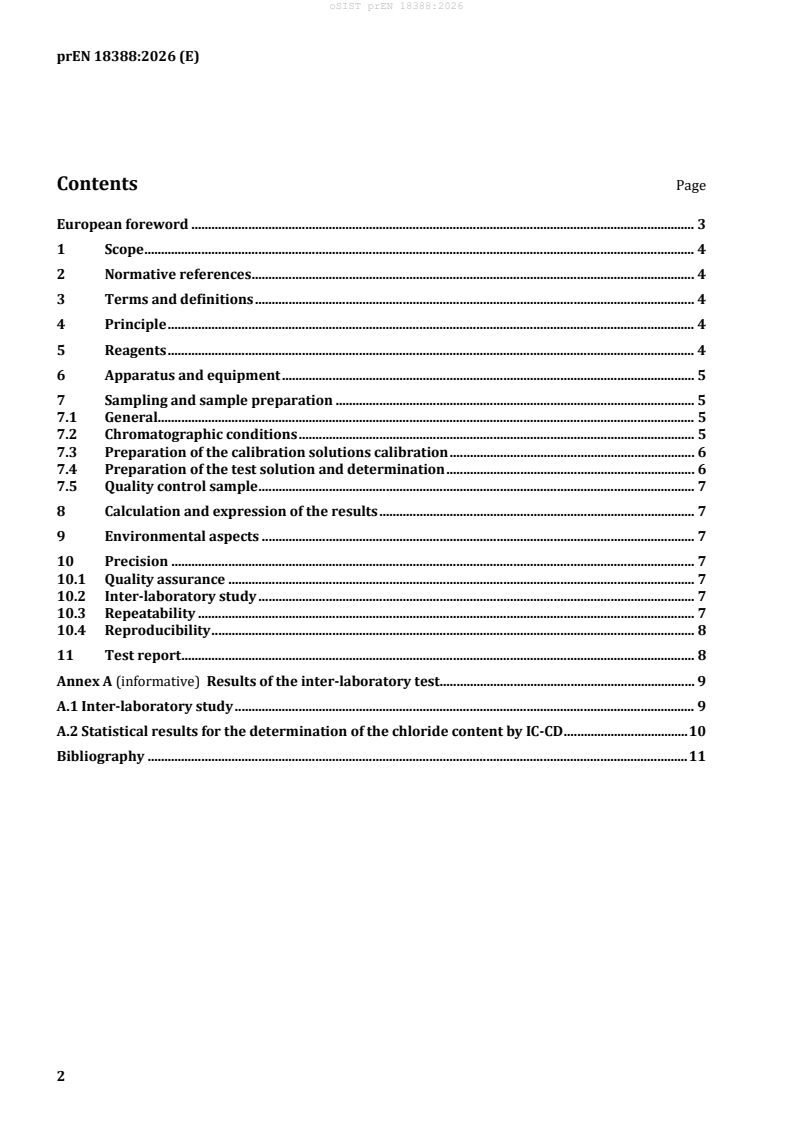
oSIST prEN 18388:2026 is the Slovenian version of prEN 18388, a draft European Standard from CEN/TC 260. It specifies a method for determining chloride content in inhibitors by ion chromatography with conductivity detection (IC-CD). Laboratories and product-control teams use it for inhibitors and inhibiting compounds, including mixtures of those materials.
What does oSIST prEN 18388:2026 specify?
oSIST prEN 18388:2026 specifies how to determine chloride in inhibitors using ion chromatography. The method applies to inhibitors and inhibiting compounds, including mixtures of inhibitors and inhibiting compounds.
The document is organized into scope, normative references, terms and definitions, principle, reagents, apparatus and equipment, sampling and sample preparation, chromatographic conditions, calibration, test solution preparation, quality control, calculation, environmental aspects, precision, and test report. Annex A gives the results of the inter-laboratory test used to assess precision.
Sampling itself is outside the method. The standard points users to EN 1482-1 for a recommended sampling approach and requires sample preparation to follow EN 1482-2.
What are the key requirements of oSIST prEN 18388:2026?
Measurement principle and reagents
oSIST prEN 18388:2026 measures chloride after the inhibitor sample is diluted in water, then analyzed by IC-CD. In practice, the analyst works with an aqueous test solution rather than the original material.
Clause 5 requires analytical-grade reagents with negligible chloride compared with the sample level. Water must be distilled or demineralized, chloride standard solution is used for calibration, and a chloride quality control sample is required. The eluent is chosen according to the instrument manufacturer, so the chromatographic system is set up to match the column and detector used in the laboratory.
Apparatus and chromatographic setup
The standard calls for an ion chromatography device with a conductivity detector, with an autosampler and column oven as optional equipment. A suppressed conductivity detector may be used to reduce noise and background. The supporting equipment includes a balance readable to 0.1 mg, a 0.45 µm syringe filter, a 100 ml graduated flask, pipettes, and a shaker.
Clause 7.2 gives recommended chromatographic conditions: a quaternary ammonium stationary phase, carbonate/bicarbonate mobile phase, manufacturer-guided flow and temperature, chemical or electrochemical suppression, and an injection volume of 5 µl to 100 µl. This means laboratories must document their chosen column and operating conditions so the method remains consistent and repeatable.
Calibration, sample preparation, and determination
Clause 7.3 requires a calibration series prepared from the chloride standard solution at several levels between 0.10 and 10.0 mg/ml. Clause 7.4 then sets the sample preparation: weigh 1 000 mg ± 100 mg of sample into a 100 ml flask, add water, shake for 5 to 10 minutes, fill to volume, and filter through the syringe filter.
The determination is performed twice, and the injected results must fall within the calibration range. If the sample is outside that range, an extra dilution step is recommended. In practice, this helps avoid reporting a result from an overloaded or under-range chromatogram.
Quality control, calculation, and precision
Clause 7.5 requires a quality control sample in each sample series, also determined twice. Clause 8 states that evaluation is based on the calibration curve over peak areas, and the curve may be used if the correlation coefficient is at least 0.999. The result is reported as chloride mass fraction in g/kg.
Clause 10 requires the quality control sample recovery to be between 95 % and 105 %; if not, recalibration is needed. Repeatability and reproducibility are checked against limits given in Table 3, with the supporting inter-laboratory study summarized in Annex A. Clause 11 then defines what must be included in the test report, including sample identification, the method reference, results, sampling information if known, finish date, repeatability-limit compliance, and any optional settings or incidents that could have affected the result.
What terms does oSIST prEN 18388:2026 define?
- IC-CD means ion chromatography with conductivity detection, the measurement technique used for chloride.
- Conductivity detector is the detector that measures the ionic signal after chromatographic separation.
- Quality control sample is the chloride check sample used to verify that a run is performing correctly.
- Repeatability is the closeness of results obtained in the same laboratory under the same conditions.
- Reproducibility is the closeness of results obtained in different laboratories under different conditions.
- HorRat is the study index reported in Annex A for comparing collaborative-study precision.
Who uses oSIST prEN 18388:2026?
oSIST prEN 18388:2026 is used by laboratories that test inhibitors and inhibiting compounds for chloride content. It is also relevant to manufacturers, quality managers, and buyers involved in fertilizer-related products, because the standard sits in ICS 65.080 and is tied to sample preparation, routine analysis, and test reporting.
It is especially useful for analysts who need a consistent IC-CD method, for QA teams checking batch consistency, and for organizations that need a documented test method for internal control or supplier verification.
Which standards are used with oSIST prEN 18388:2026?
- EN 1482-2 - gives the general sample preparation provisions required before analysis.
- EN 12944-1 - provides general vocabulary for fertilizers and liming materials.
- EN 12944-2 - provides vocabulary for terms relating to fertilizers.
- EN 1482-1 - is cited as the recommended sampling method for obtaining a representative sample.
- ISO 5725-3 - is used for the calculation approach behind repeatability and reproducibility in the precision study.
What does the oSIST prEN 18388:2026 document contain?
The document contains the method principle, reagent requirements, apparatus list, chromatographic conditions, calibration preparation, sample preparation steps, calculation guidance, environmental handling notes, precision requirements, and a test report checklist. Tables 1 to 3 cover the recommended IC conditions, calibration dilution steps, and precision limits.
Formula (1) gives the calculation for chloride mass fraction, and Annex A presents the inter-laboratory study used to support the precision statement. Annex A also includes statistical results for different inhibitor samples and the study terms used to summarize the data.
Get Certified
Connect with accredited certification bodies for this standard

Control Union Certifications
Global certification for agriculture and sustainability.

ECOCERT
Organic and sustainability certification.

FSC International
Forest Stewardship Council certification.
Sponsored listings
Frequently Asked Questions
oSIST prEN 18388:2026 is a draft published by the Slovenian Institute for Standardization (SIST). Its full title is "Inhibitors - Determination of the chloride content by ion chromatography and conductivity detection (IC-CD)". This standard covers: This document specifies a method for the determination of the chloride content in inhibitors by ion chromatography. This document is applicable to inhibitors and inhibiting compounds including mixtures of inhibitors and inhibiting compounds.
This document specifies a method for the determination of the chloride content in inhibitors by ion chromatography. This document is applicable to inhibitors and inhibiting compounds including mixtures of inhibitors and inhibiting compounds.
oSIST prEN 18388:2026 is classified under the following ICS (International Classification for Standards) categories: 65.080 - Fertilizers. The ICS classification helps identify the subject area and facilitates finding related standards.
oSIST prEN 18388:2026 is associated with the following European legislation: EU Directives/Regulations: 2019/1009; Standardization Mandates: M/564, M/564 AMD 1, M/564 AMD 2. When a standard is cited in the Official Journal of the European Union, products manufactured in conformity with it benefit from a presumption of conformity with the essential requirements of the corresponding EU directive or regulation.
oSIST prEN 18388:2026 is available in PDF format for immediate download after purchase. The document can be added to your cart and obtained through the secure checkout process. Digital delivery ensures instant access to the complete standard document.
Standards Content (Sample)
SLOVENSKI STANDARD
01-september-2026
Inhibitorji - Določanje klorida z ionsko kromatografijo in detekcijo na osnovi
prevodnosti (IC-CD)
Inhibitors - Determination of the chloride content by ion chromatography and conductivity
detection (IC-CD)
Hemmstoffe - Bestimmung des Chloridgehalts mittels Ionenchromatographie und
Leitfähigkeitsnachweis (IC-CD)
Ta slovenski standard je istoveten z: prEN 18388
ICS:
65.080 Gnojila Fertilizers
2003-01.Slovenski inštitut za standardizacijo. Razmnoževanje celote ali delov tega standarda ni dovoljeno.
DRAFT
EUROPEAN STANDARD
NORME EUROPÉENNE
EUROPÄISCHE NORM
August 2026
ICS
English Version
Inhibitors - Determination of the chloride content by ion
chromatography and conductivity detection (IC-CD)
Hemmstoffe - Bestimmung des Chloridgehalts mittels
Ionenchromatographie und Leitfähigkeitsnachweis (IC-
CD)
This draft European Standard is submitted to CEN members for enquiry. It has been drawn up by the Technical Committee
CEN/TC 260.
If this draft becomes a European Standard, CEN members are bound to comply with the CEN/CENELEC Internal Regulations
which stipulate the conditions for giving this European Standard the status of a national standard without any alteration.
This draft European Standard was established by CEN in three official versions (English, French, German). A version in any other
language made by translation under the responsibility of a CEN member into its own language and notified to the CEN-CENELEC
Management Centre has the same status as the official versions.
CEN members are the national standards bodies of Austria, Belgium, Bulgaria, Croatia, Cyprus, Czech Republic, Denmark, Estonia,
Finland, France, Germany, Greece, Hungary, Iceland, Ireland, Italy, Latvia, Lithuania, Luxembourg, Malta, Netherlands, Norway,
Poland, Portugal, Republic of North Macedonia, Romania, Serbia, Slovakia, Slovenia, Spain, Sweden, Switzerland, Türkiye and
United Kingdom.
Recipients of this draft are invited to submit, with their comments, notification of any relevant patent rights of which they are
aware and to provide supporting documentation.
Warning : This document is not a European Standard. It is distributed for review and comments. It is subject to change without
notice and shall not be referred to as a European Standard.
EUROPEAN COMMITTEE FOR STANDARDIZATION
COMITÉ EUROPÉEN DE NORMALISATION
EUROPÄISCHES KOMITEE FÜR NORMUNG
CEN-CENELEC Management Centre: Rue de la Science 23, B-1040 Brussels
© 2026 CEN All rights of exploitation in any form and by any means reserved Ref. No. prEN 18388:2026 E
worldwide for CEN national Members.
Contents Page
European foreword . 3
1 Scope . 4
2 Normative references . 4
3 Terms and definitions . 4
4 Principle . 4
5 Reagents . 4
6 Apparatus and equipment . 5
7 Sampling and sample preparation . 5
7.1 General. 5
7.2 Chromatographic conditions . 5
7.3 Preparation of the calibration solutions calibration . 6
7.4 Preparation of the test solution and determination . 6
7.5 Quality control sample . 7
8 Calculation and expression of the results . 7
9 Environmental aspects . 7
10 Precision . 7
10.1 Quality assurance . 7
10.2 Inter-laboratory study . 7
10.3 Repeatability . 7
10.4 Reproducibility . 8
11 Test report . 8
Annex A (informative) Results of the inter-laboratory test. 9
A.1 Inter-laboratory study . 9
A.2 Statistical results for the determination of the chloride content by IC-CD . 10
Bibliography . 11
European foreword
This document (prEN 18388:2026) has been prepared by Technical Committee CEN/TC 260 “Fertilizers
and liming materials”, the secretariat of which is held by DIN.
This document is currently submitted to the CEN Enquiry.
This document has been prepared under a standardization request addressed to CEN by the European
Commission. The Standing Committee of the EFTA States subsequently approves these requests for its
Member States.
1 Scope
This document specifies a method for the determination of the chloride content in inhibitors by ion
chromatography.
This document is applicable to inhibitors and inhibiting compounds including mixtures of inhibitors and
inhibiting compounds.
2 Normative references
The following documents are referred to in the text in such a way that some or all of their content
constitutes requirements of this document. For dated references, only the edition cited applies. For
undated references, the latest edition of the referenced document (including any amendments) applies.
EN 1482-2, Fertilizers, liming materials and inhibitors - Sampling and sample preparation - Part 2: General
sample preparation provisions
EN 12944-1, Fertilizers and liming materials - Vocabulary - Part 1: General terms
EN 12944-2, Fertilizers and liming materials - Vocabulary - Part 2: Terms relating to fertilizers
3 Terms and definitions
For the purposes of this document, the terms and definitions given in EN 12944-1 and EN 12944-2 apply.
ISO and IEC maintain terminology databases for use in standardization at the following addresses:
— ISO Online browsing platform: available at https://www.iso.org/obp/
— IEC Electropedia: available at https://www.electropedia.org/
4 Principle
The inhibitor sample is diluted in water. The content of chloride is determined in diluted aqueous solution
by ion chromatography using a conductivity detector (IC-CD).
5 Reagents
All reagents shall be of recognized analytical grade and shall have negligible concentration of the element
to be determined if compared to the lowest concentration of that element in the sample solution.
5.1 Water, distilled or demineralized.
The electrical conductivity shall be < 0,2 mS/m (at 25 °C).
−
) = 1 000 mg/l.
5.2 Chloride standard solution, mass concentration γ(Cl
−
5.3 Quality control sample chloride, γ(Cl ) = 1,0 mg/l prepared from a certified solution or a certified
solid standard substance.
5.4 Eluent for IC-CD, as advised by the manufacturer to be used for determining chloride.
The eluent advised by the manufacturer of the instrument depends on the instrument
...