

SIST ISO 28560-1:2024
(Main)Information and documentation - RFID in libraries - Part 1: Data elements and general guidelines for implementation
General Information
- Abstract
This document specifies a model for the use of radio frequency identification (RFID) tags for items appropriate for the needs of all types of libraries, including national, academic, public, corporate, special, and school.
It provides the framework to ensure interoperability between libraries that exchange library items with RFID tags, the freedom of the library to acquire or renew equipment or library items from different vendors, and interoperability of a single RFID application from the vendor's perspective.
This document specifies a set of data elements and general guidelines for implementation, to meet the needs for:
- circulation of library items;
- acquisition of library items;
- interlibrary loan processes;
- data requirements of publishers, printers, and other suppliers of library items;
- inventory and stock checking of items.
This document gives guidelines for item security, profiles, privacy, implementation, migration, label design, and location of the RFID label. It specifies the data model, system data elements, and user data elements to be used in conjunction with ISO 28560-2, ISO 28560-3, and any future parts of the ISO 28560 series.
A source of additional information about implementation issues is provided in Annex A.
- Status
- Published
- Publication Date
- 06-Oct-2024
- Technical Committee
- IDT - Information, documentation, language and terminology
- Current Stage
- 6060 - National Implementation/Publication (Adopted Project)
- Start Date
- 17-Sep-2024
- Due Date
- 22-Nov-2024
- Completion Date
- 07-Oct-2024


Overview
SIST ISO 28560-1:2024 is an international standard developed by the International Organization for Standardization (ISO) that defines the framework for using radio frequency identification (RFID) in libraries. Specifically, it addresses the data elements and general implementation guidelines needed to ensure effective, interoperable RFID applications across all types of libraries, including national, academic, public, corporate, special, and school libraries.
RFID technology in libraries enables improved tracking, management, and circulation of library items. The standard provides a data model compatible with various hardware and software, supporting a broad range of library activities such as acquisitions, lending, interlibrary loans, and inventory control. It also covers essential aspects like item security, data privacy, migration between legacy systems, and label design.
By adopting SIST ISO 28560-1:2024, libraries and their suppliers are able to ensure consistent, interoperable, and future-proof RFID implementations that meet evolving industry needs.
Key Topics
Data Elements for Library Items: The standard specifies required and optional data elements to encode on RFID tags, such as primary item identifiers, owner institution information, shelf locations, supplier codes, interlibrary loan data, and more.
Interoperability: Ensures that libraries exchanging items can seamlessly communicate using RFID, regardless of RFID hardware, software, or supplier, by following standard data elements and encoding rules.
Implementation Guidelines: Offers practical advice on implementing RFID, including data security tools, privacy considerations, and migration strategies for updating from older RFID systems.
Profiles and Customization: Supports regional and business profiles, allowing libraries to customize data element sets to meet local or institutional needs without sacrificing interoperability.
Item Security and Privacy: Provides recommendations for label design and location, and outlines data elements related to security, such as electronic article surveillance (EAS), application family identifier (AFI), and data storage format identifier (DSFID), along with privacy guidelines.
Applications
Implementing SIST ISO 28560-1:2024 in library environments delivers a wide range of operational and strategic benefits:
Streamlined Circulation and Returns: Automates the check-in and check-out process, reducing manual handling and improving user service efficiency.
Inventory and Stock Management: Facilitates rapid stock checks and inventory control by enabling bulk scanning and real-time database updates.
Interlibrary Loan Support: Standardizes item data to make lending and borrowing items between libraries frictionless, helping resource sharing networks.
Efficient Acquisitions and Supply Chain: Improves tracking and management of library acquisitions and supplier interactions through standardized identifiers and order numbers.
Enhanced Security: Integrates item security features at the tag level, aiding in theft prevention and better management of library assets.
Vendor Neutrality: Provides libraries with the freedom to procure RFID tags, readers, and software from various suppliers by adhering to a common data standard.
Related Standards
SIST ISO 28560-1:2024 is part of a series of standards addressing RFID in libraries. The following related standards are crucial for full implementation and interoperability:
- ISO 28560-2: Defines rules for encoding RFID data elements based on ISO/IEC 15962.
- ISO 28560-3: Specifies fixed length encoding for RFID in libraries.
- ISO 15511: International standard identifier for libraries and related organizations (ISIL).
- ISO/IEC 15961-3: Information technology - RFID for item management - Part 3: RFID data constructs.
Implementing SIST ISO 28560-1:2024 in conjunction with these related standards ensures complete, interoperable, and future-ready RFID solutions in the library sector.
Conclusion
SIST ISO 28560-1:2024 is an essential standard for libraries planning to adopt or update RFID-based systems. It enhances interoperability, security, and efficiency across the industry, positioning libraries for sustainable, scalable resource management and improved service delivery through standardized RFID data practices.
Relations
- Effective Date
- 01-Nov-2024
Get Certified
Connect with accredited certification bodies for this standard

BSI Group
BSI (British Standards Institution) is the business standards company that helps organizations make excellence a habit.

NYCE
Mexican standards and certification body.
Sponsored listings
Frequently Asked Questions
SIST ISO 28560-1:2024 is a standard published by the Slovenian Institute for Standardization (SIST). Its full title is "Information and documentation - RFID in libraries - Part 1: Data elements and general guidelines for implementation". This standard covers: This document specifies a model for the use of radio frequency identification (RFID) tags for items appropriate for the needs of all types of libraries, including national, academic, public, corporate, special, and school. It provides the framework to ensure interoperability between libraries that exchange library items with RFID tags, the freedom of the library to acquire or renew equipment or library items from different vendors, and interoperability of a single RFID application from the vendor's perspective. This document specifies a set of data elements and general guidelines for implementation, to meet the needs for: - circulation of library items; - acquisition of library items; - interlibrary loan processes; - data requirements of publishers, printers, and other suppliers of library items; - inventory and stock checking of items. This document gives guidelines for item security, profiles, privacy, implementation, migration, label design, and location of the RFID label. It specifies the data model, system data elements, and user data elements to be used in conjunction with ISO 28560-2, ISO 28560-3, and any future parts of the ISO 28560 series. A source of additional information about implementation issues is provided in Annex A.
This document specifies a model for the use of radio frequency identification (RFID) tags for items appropriate for the needs of all types of libraries, including national, academic, public, corporate, special, and school. It provides the framework to ensure interoperability between libraries that exchange library items with RFID tags, the freedom of the library to acquire or renew equipment or library items from different vendors, and interoperability of a single RFID application from the vendor's perspective. This document specifies a set of data elements and general guidelines for implementation, to meet the needs for: - circulation of library items; - acquisition of library items; - interlibrary loan processes; - data requirements of publishers, printers, and other suppliers of library items; - inventory and stock checking of items. This document gives guidelines for item security, profiles, privacy, implementation, migration, label design, and location of the RFID label. It specifies the data model, system data elements, and user data elements to be used in conjunction with ISO 28560-2, ISO 28560-3, and any future parts of the ISO 28560 series. A source of additional information about implementation issues is provided in Annex A.
SIST ISO 28560-1:2024 is classified under the following ICS (International Classification for Standards) categories: 35.040.50 - Automatic identification and data capture techniques; 35.240.30 - IT applications in information, documentation and publishing. The ICS classification helps identify the subject area and facilitates finding related standards.
SIST ISO 28560-1:2024 has the following relationships with other standards: It is inter standard links to SIST ISO 28560-1:2014. Understanding these relationships helps ensure you are using the most current and applicable version of the standard.
SIST ISO 28560-1:2024 is available in PDF format for immediate download after purchase. The document can be added to your cart and obtained through the secure checkout process. Digital delivery ensures instant access to the complete standard document.
Standards Content (Sample)
SLOVENSKI STANDARD
01-november-2024
Nadomešča:
SIST ISO 28560-1:2014
Informatika in dokumentacija - RFID v knjižnicah - 1. del: Podatkovni elementi in
splošne smernice za izvedbo
Information and documentation — RFID in libraries — Part 1: Data elements and general
guidelines for implementation
Information et documentation — RFID dans les bibliothèques — Partie 1: Éléments de
données et lignes directrices générales pour la mise en oeuvre
Ta slovenski standard je istoveten z: ISO 28560-1:2023
ICS:
35.040.50 Tehnike za samodejno Automatic identification and
razpoznavanje in zajem data capture techniques
podatkov
35.240.30 Uporabniške rešitve IT v IT applications in information,
informatiki, dokumentiranju in documentation and
založništvu publishing
2003-01.Slovenski inštitut za standardizacijo. Razmnoževanje celote ali delov tega standarda ni dovoljeno.
INTERNATIONAL ISO
STANDARD 28560-1
Third edition
2023-06
Information and documentation —
RFID in libraries —
Part 1:
Data elements and general guidelines
for implementation
Information et documentation — RFID dans les bibliothèques —
Partie 1: Éléments de données et lignes directrices générales pour la
mise en oeuvre
Reference number
© ISO 2023
All rights reserved. Unless otherwise specified, or required in the context of its implementation, no part of this publication may
be reproduced or utilized otherwise in any form or by any means, electronic or mechanical, including photocopying, or posting on
the internet or an intranet, without prior written permission. Permission can be requested from either ISO at the address below
or ISO’s member body in the country of the requester.
ISO copyright office
CP 401 • Ch. de Blandonnet 8
CH-1214 Vernier, Geneva
Phone: +41 22 749 01 11
Email: copyright@iso.org
Website: www.iso.org
Published in Switzerland
ii
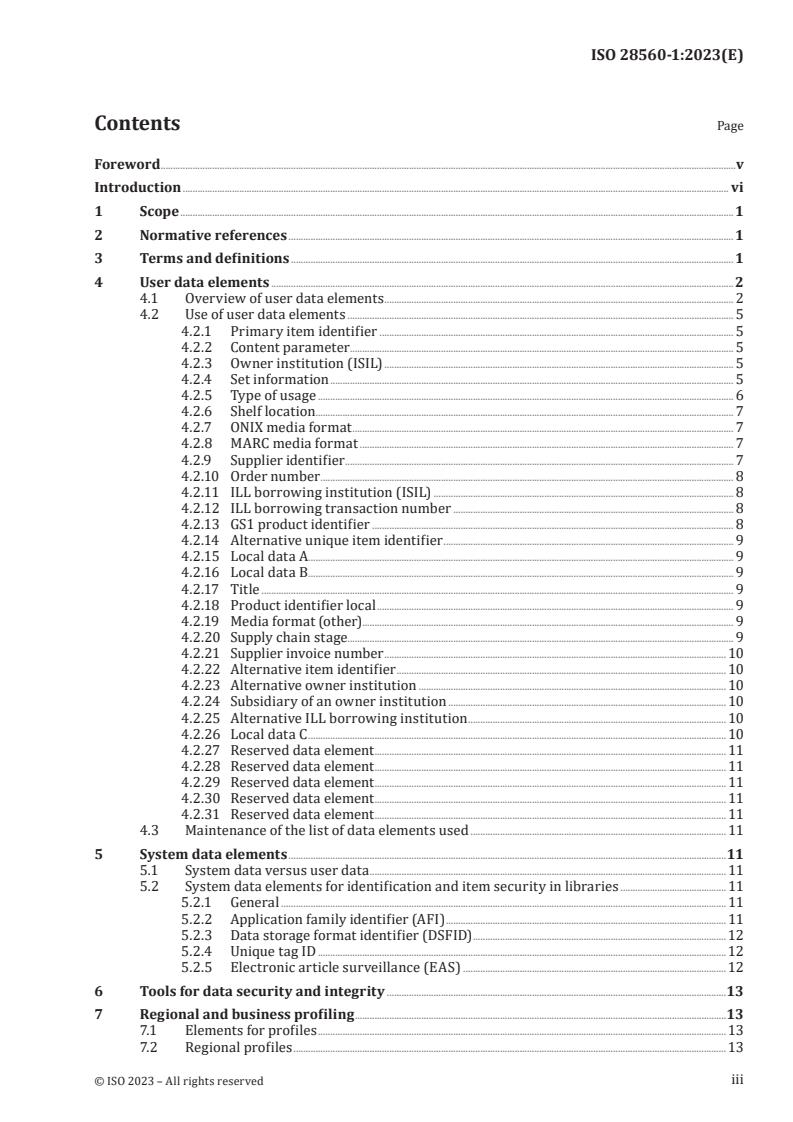
Contents Page
Foreword .v
Introduction . vi
1 Scope . 1
2 Normative references . 1
3 Terms and definitions . 1
4 User data elements .2
4.1 Overview of user data elements . 2
4.2 Use of user data elements . 5
4.2.1 Primary item identifier . 5
4.2.2 Content parameter . . 5
4.2.3 Owner institution (ISIL) . 5
4.2.4 Set information . 5
4.2.5 Type of usage . 6
4.2.6 Shelf location . . 7
4.2.7 ONIX media format . 7
4.2.8 MARC media format . 7
4.2.9 Supplier identifier . 7
4.2.10 Order number . 8
4.2.11 ILL borrowing institution (ISIL) . 8
4.2.12 ILL borrowing transaction number . 8
4.2.13 GS1 product identifier . 8
4.2.14 Alternative unique item identifier . 9
4.2.15 Local data A . . 9
4.2.16 Local data B . 9
4.2.17 Title . 9
4.2.18 Product identifier local . 9
4.2.19 Media format (other). 9
4.2.20 Supply chain stage. 9
4.2.21 Supplier invoice number . 10
4.2.22 Alternative item identifier . 10
4.2.23 Alternative owner institution . 10
4.2.24 Subsidiary of an owner institution . 10
4.2.25 Alternative ILL borrowing institution . 10
4.2.26 Local data C . 10
4.2.27 Reserved data element . 11
4.2.28 Reserved data element . 11
4.2.29 Reserved data element . 11
4.2.30 Reserved data element . 11
4.2.31 Reserved data element . 11
4.3 Maintenance of the list of data elements used . 11
5 System data elements .11
5.1 System data versus user data . 11
5.2 System data elements for identification and item security in libraries . 11
5.2.1 General . 11
5.2.2 Application family identifier (AFI) . 11
5.2.3 Data storage format identifier (DSFID) .12
5.2.4 Unique tag ID .12
5.2.5 Electronic article surveillance (EAS) .12
6 Tools for data security and integrity .13
7 Regional and business profiling .13
7.1 Elements for profiles . 13
7.2 Regional profiles . 13
iii
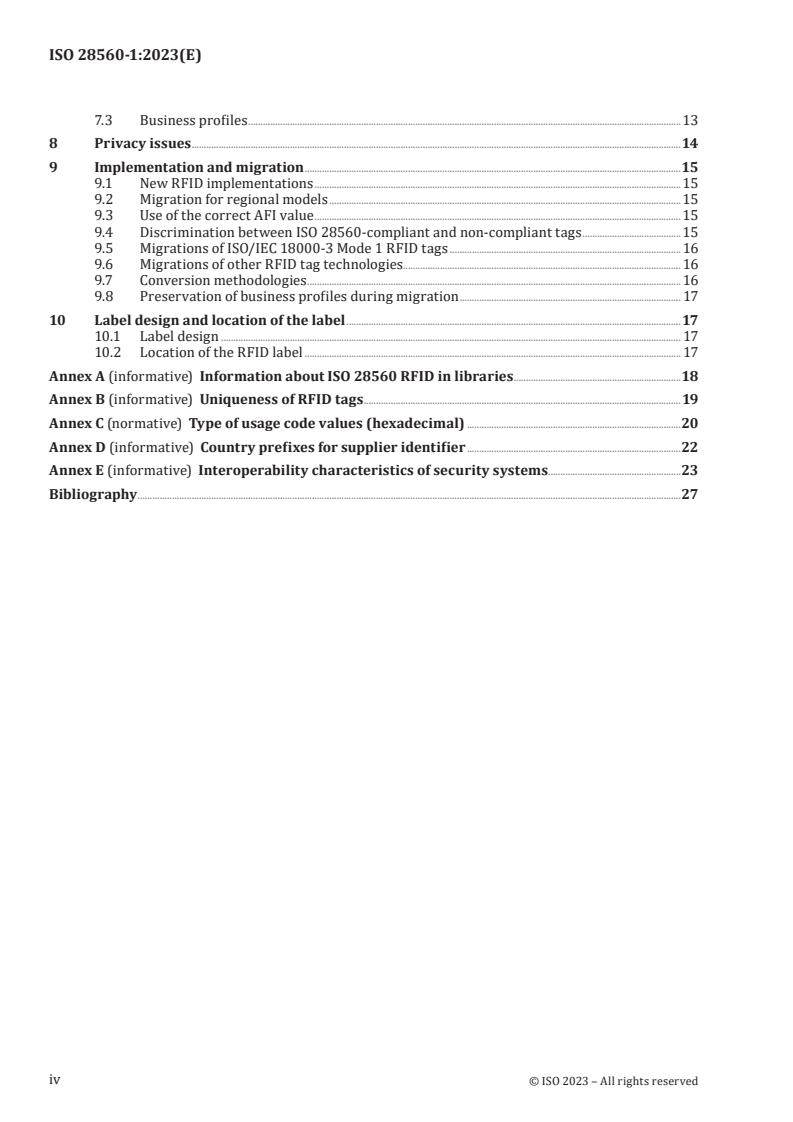
7.3 Business profiles .13
8 Privacy issues .14
9 Implementation and migration .15
9.1 New RFID implementations .15
9.2 Migration for regional models .15
9.3 Use of the correct AFI value . 15
9.4 Discrimination between ISO 28560-compliant and non-compliant tags .15
9.5 Migrations of ISO/IEC 18000-3 Mode 1 RFID tags . 16
9.6 Migrations of other RFID tag technologies. 16
9.7 Conversion methodologies . 16
9.8 Preservation of business profiles during migration . 17
10 Label design and location of the label .17
10.1 Label design . 17
10.2 Location of the RFID label . 17
Annex A (informative) Information about ISO 28560 RFID in libraries .18
Annex B (informative) Uniqueness of RFID tags .19
Annex C (normative) Type of usage code values (hexadecimal) .20
Annex D (informative) Country prefixes for supplier identifier .22
Annex E (informative) Interoperability characteristics of security systems .23
Bibliography .27
iv
Foreword
ISO (the International Organization for Standardization) is a worldwide federation of national standards
bodies (ISO member bodies). The work of preparing International Standards is normally carried out
through ISO technical committees. Each member body interested in a subject for which a technical
committee has been established has the right to be represented on that committee. International
organizations, governmental and non-governmental, in liaison with ISO, also take part in the work.
ISO collaborates closely with the International Electrotechnical Commission (IEC) on all matters of
electrotechnical standardization.
The procedures used to develop this document and those intended for its further maintenance are
described in the ISO/IEC Directives, Part 1. In particular, the different approval criteria needed for the
different types of ISO document should be noted. This document was drafted in accordance with the
editorial rules of the ISO/IEC Directives, Part 2 (see www.iso.org/directives).
ISO draws attention to the possibility that the implementation of this document may involve the use
of (a) patent(s). ISO takes no position concerning the evidence, validity or applicability of any claimed
patent rights in respect thereof. As of the date of publication of this document, ISO had not received
notice of (a) patent(s) which may be required to implement this document. However, implementers are
cautioned that this may not represent the latest information, which may be obtained from the patent
database available at www.iso.org/patents. ISO shall not be held responsible for identifying any or all
such patent rights.
Any trade name used in this document is information given for the convenience of users and does not
constitute an endorsement.
For an explanation of the voluntary nature of standards, the meaning of ISO specific terms and
expressions related to conformity assessment, as well as information about ISO's adherence to
the World Trade Organization (WTO) principles in the Technical Barriers to Trade (TBT), see
www.iso.org/iso/foreword.html.
This document was prepared by Technical Committee ISO/TC 46, Information and documentation,
Subcommittee SC 4, Technical interoperability.
This third edition cancels and replaces the second edition (ISO 28560-1:2014), of which it constitutes a
minor revision.
The changes are as follows:
— a few updates have been applied and definitions of DSFID values have been entrusted to the other
parts of the ISO 28560 series.
A list of all parts in the ISO 28560 series can be found on the ISO web site.
Any feedback or questions on this document should be directed to the user’s national standards body. A
complete listing of these bodies can be found at www.iso.org/members.html.
v
Introduction
Libraries are implementing radio frequency identification (RFID) as item identification to replace
bar codes. RFID streamlines applications like user self-service, security, and materials handling. This
standard data model for encoding information on RFID tags increases the cost-effectiveness of the
technology within libraries, particularly through greater interoperability of RFID tags and equipment,
and enhance support for resource sharing between libraries.
This document deals with data elements and provides general guidelines for implementation. Other
parts of the ISO 28560 series describe encodings and choice of frequency.
Communication between the RFID reader and the library system (or other applications) is handled by,
[12] [13]
for example, SIP-2 and NCIP .
This document provides essential standards-based information about RFID in libraries. Ongoing advice
needs to be provided because of the evolving nature of RFID technology and the opportunities to
migrate between different types of legacy system and encoding rules of this document.
vi
INTERNATIONAL STANDARD ISO 28560-1:2023(E)
Information and documentation — RFID in libraries —
Part 1:
Data elements and general guidelines for implementation
1 Scope
This document specifies a model for the use of radio frequency identification (RFID) tags for items
appropriate for the needs of all types of libraries, including national, academic, public, corporate,
special, and school.
It provides the framework to ensure interoperability between libraries that exchange library items with
RFID tags, the freedom of the library to acquire or renew equipment or library items from different
vendors, and interoperability of a single RFID application from the vendor's perspective.
This document specifies a set of data elements and general guidelines for implementation, to meet the
needs for:
— circulation of library items;
— acquisition of library items;
— interlibrary loan processes;
— data requirements of publishers, printers, and other suppliers of library items;
— inventory and stock checking of items.
This document gives guidelines for item security, profiles, privacy, implementation, migration, label
design, and location of the RFID label. It specifies the data model, system data elements, and user
data elements to be used in conjunction with ISO 28560-2, ISO 28560-3, and any future parts of the
ISO 28560 series.
A source of additional information about implementation issues is provided in Annex A.
2 Normative references
The following documents are referred to in the text in such a way that some or all of their content
constitutes requirements of this document. For dated references, only the edition cited applies. For
undated references, the latest edition of the referenced document (including any amendments) applies.
ISO 15511, Information and documentation — International standard identifier for libraries and related
organizations (ISIL)
ISO/IEC 15961-3, Information technology —Radio frequency identification (RFID) for item management —
Part 3: RFID data constructs
ISO 28560-2, Information and documentation — RFID in libraries — Part 2: Encoding of RFID data
elements based on rules from ISO/IEC 15962
ISO 28560-3, Information and documentation — RFID in libraries — Part 3: Fixed length encoding
3 Terms and definitions
For the purposes of this document, the following terms and definitions apply.
ISO and IEC maintain terminology databases for use in standardization at the following addresses:
— ISO Online browsing platform: available at https:// www .iso .org/ obp
— IEC Electropedia: available at https:// www .electropedia .org/
3.1
distributor
wholesaler that purchases products from manufacturers and sells them to retailers or other wholesalers
Note 1 to entry: In the context of this document, a distributor is a wholesaler that purchases library materials
such as books or audiovisual materials from publishers and sells them to libraries or retailers.
3.2
interlibrary loan
ILL
service where a library borrows an item (3.3) from another library
3.3
item
unit tracked in a library system
Note 1 to entry: An item, which can be a set (3.7), can be loanable or non-circulating, but is always loaned in its
entirety.
3.4
jobber
specialized distributor (3.1) of library items (3.3) that provides services such as the attachment of
labelling and electronic information to items to make them ready for immediate shelving upon arrival
at the destination library
3.5
library management system
enterprise resource planning system for a library, used to track items owned, items loaned, orders
made, bills paid, and patrons
Note 1 to entry: In some countries, this is known as an integrated library system.
3.6
part
individual physical entity included in an item (3.3)
Note 1 to entry: A part can be a library material or a container for the library materials in a set (3.7).
3.7
set
item (3.3) consisting of a number of parts, all identified by the same item identifier and loaned in one
transaction as a unit
3.8
supply chain
series of entities, typically beginning with a publisher and ending with a library, through which library
materials flow as they are acquired by that library
4 User data elements
4.1 Overview of user data elements
Libraries can choose which data elements they want to store on the tag. It is unlikely that a library
places all the listed data elements on the tag. A number of data elements are reserved for local use. They
should be ignored where the processing institution is not the owner of the item (as in ILL).
Table 1 lists the user data elements that are defined in this document.
Table 1 — User data elements
Name of the ISO 8459
a c d f g
N Description Ref Status Relationship
b e
data element mapping
1 Primary item iden- Unique identification 4.2.1 Piece identifier Mandatory for cir- None
tifier of an item at least culated items
inside the library
2 Content parameter Specifies the struc- 4.2.2 None Can be mandatory None
ture of the tag data as specified in other
parts of ISO 28560
3 Owner institution The ISIL code for the 4.2.3 Party identifier; Strongly recom- Elements 3 and
(ISIL) institution that owns Participant's func- mended to create 23 are mutually
the item tion interoperability exclusive
4 Set information Number of parts in 4.2.4 Number of volumes; Optional None
item and ordinal part Component
number
5 Type of usage Additional qualifying 4.2.5 None Optional None
information about
the item or part of
a set
6 Shelf location Code for location of 4.2.6 Copy shelf locator Optional None
the item
7 ONIX media format ONIX media descrip- 4.2.7 Record content type Optional Data elements 7, 8,
tor and 19 should be
consistent
8 MARC media format MARC 21 category of 4.2.8 Record content type Optional Data elements 7, 8,
material descriptor and 19 should be
consistent
9 Supplier identifier Code for identifica- 4.2.9 Party identifier; Optional None
tion of supplier of the Participant's func-
item tion
10 Order number Number meaningful 4.2.10 Request identifier Optional None
to the library and to
the supplier of the
item
11 ILL borrowing insti- ISIL code for the in- 4.2.11 Party identifier; Optional Data elements 11
tution (ISIL) stitution borrowing Participant's func- and 25 are mutually
the item tion exclusive
12 ILL borrowing Number identifying 4.2.12 None Optional None
transaction number an interlibrary loan
transaction
13 GS1 product iden- GTIN-13 code of GS1 4.2.13 Resource identifier Optional Data elements 13
tifier code and 18 should be
consistent
14 Alternative unique Possibly encoding 4.2.14 None Reserved for future
item identifier in new tag architec- use
tures
15 Local data A Any locally defined 4.2.15 None Optional None
purpose
a
This column specifies the data element number (N), i.e. the number identifying the data element.
b
This column specifies the data element name (name of data element), i.e. the name identifying the data element.
c
This column specifies the data element description, i.e. a brief description about the purpose of the data element.
d
This column contains a reference to the subclause where the data element is described.
e
This column contains the mapping to the corresponding data elements in ISO 8459. The mapping is for information.
f
This column classifies the data elements into categories (status).
g
This column specifies possible relationships to other data elements (relationship).
TTabablele 1 1 ((ccoonnttiinnueuedd))
Name of the ISO 8459
a c d f g
N Description Ref Status Relationship
b e
data element mapping
16 Local data B Any locally defined 4.2.16 None Optional None
purpose
17 Title The title/titles of the 4.2.17 Title Optional None
library item
18 Product identifier Product identifier not 4.2.18 Resource identifier Optional Data elements 13
local based on GTIN-13 code and 18 should be
consistent
19 Media format Media descriptor 4.2.19 Record content type Optional Data elements 7, 8,
(other) other than ONIX or and 19 should be
MARC consistent
20 Supply chain stage The stage of the 4.2.20 None Optional None
supply chain in which
the item currently
resides
21 Supplier invoice Invoice number 4.2.21 Invoice identifier Optional None
number meaningful to the
library and to the
supplier of the item
22 Alternative item Optional identifier 4.2.22 Piece identifier Optional None
identifier for an item
23 Alternative owner Code for the library 4.2.23 Party identifier; Optional Data elements 3
institution institution other than Participant's func- and 23 are mutually
ISIL tion exclusive
24 Subsidiary of an Internal code defined 4.2.24 Party identifier; Optional None
owner institution within a library insti- Participant's func-
tution tion
25 Alternative ILL bor- Code for the ILL bor- 4.2.25 Party identifier; Optional Data elements 11
rowing institution rowing institution Participant's func- and 25 are mutually
other than ISIL tion exclusive
26 Local data C Any locally defined 4.2.26 None Optional None
purpose
27 Not defined 4.2.27 Reserved for future
use
28 Not defined 4.2.28 Reserved for future
use
29 Not defined 4.2.29 Reserved for future
use
30 Not defined 4.2.30 Reserved for future
use
31 Not defined 4.2.31 Reserved for future
use
a
This column specifies the data element number (N), i.e. the number identifying the data element.
b
This column specifies the data element name (name of data element), i.e. the name identifying the data element.
c
This column specifies the data element description, i.e. a brief description about the purpose of the data element.
d
This column contains a reference to the subclause where the data element is described.
e
This column contains the mapping to the corresponding data elements in ISO 8459. The mapping is for information.
f
This column classifies the data elements into categories (status).
g
This column specifies possible relationships to other data elements (relationship).
4.2 Use of user data elements
4.2.1 Primary item identifier
The library's unique identification of an item shall be used as the primary item identifier. This data
element is required for circulation. It can be absent in the acquisition process.
The primary item identifier can be, but need not be, equivalent to the (former) bar code. It can be
decided at a local or national level if the identifier should be unique outside the library and how this is
to be achieved.
Annex B illustrates how the primary item identifier can be combined with other data to achieve
increasing levels of uniqueness, ultimately global uniqueness.
4.2.2 Content parameter
The content parameter data element specifies the structure of the tag data. The parameter can
have different forms for the various possible encoding methodologies specified in other parts of the
ISO 28560 series.
4.2.3 Owner institution (ISIL)
The owner institution (ISIL) data element is used for the ISIL code for the institution that owns the item.
The ISIL code shall be as defined in ISO 15511.
The list of ISIL agencies that are responsible for the issuing process of ISIL codes can be found at http://
biblstandard .dk/ isil/ .
In exceptional cases, the ISIL code, or parts of the ISIL code, can be stored in data element 23 (alternative
owner institution).
4.2.4 Set information
4.2.4.1 General
If the set information data element is encoded, it shall consist of two components, which are
a) the “number of parts in item”, followed by
b) the “ordinal part number”,
as specified in 4.2.4.2 and 4.2.4.3. These two component parameters are used to identify various
permutations relating to sets.
A single part item is the default case. A system reading a tag that does not contain the set information
data element can assume that the item has only a single part.
4.2.4.2 Numbers of parts in item
For sets with only a single part, the “numbers of parts in item” component shall take the value “1”.
For sets with more than a single part, the “numbers of parts in item” component shall take a value in the
range 0 to 255, where a positive number indicates the total number of parts in the set, and 0 that the
total number is not known.
4.2.4.3 Ordinal part number
For sets with only a single part, the “ordinal part number” component shall take the value “1”.
For sets with more than a single part, the “ordinal part number” component shall take a value in the
range 0 to 255, under one of the following two conditions.
— If all parts in the set carry an RFID tag, a positive ordinal part number corresponding to the
placement of the part in the set shall be assigned to each part.
— If only some of the parts in the set carry an RFID tag, the first part shall be assigned the ordinal part
number 0, and the following parts an ordinal part number corresponding to the placement of the
part in the set. As a consequence, no part shall be assigned the ordinal part number 1.
4.2.4.4 Examples
EXAMPLE 1 A set with three parts, all with their own RFID tags:
— Number of this part = 1 (first RFID tag): code = 31
— Number of this part = 2 (second RFID tag): code = 32
— Number of this part = 3 (third RFID tag): code = 33
EXAMPLE 2 A set consisting of a single part with one RFID tag:
— Number of this part = 1: code = 11 (if present)
EXAMPLE 3 A set consists of 12 parts, and this is the fourth part:
— Number of this part = 4 (fourth RFID tag): code = 1204
EXAMPLE 4 A set having four parts but one part does not carry an RFID tag:
— Number of this part = 1 (first RFID tag): code = 40
— Number of this part = 2 (second RFID tag): code = 42
— Number of this part = 3 (third RFID tag): code = 43
— Number of this part = 4 (no RFID tag)
NOTE 1 The “0” of the first part serves two functions:
a) it indicates that not all parts have an RFID tag;
b) it indicates that this is the first part.
EXAMPLE 5 A set having an unknown number of parts or increasing in number of parts over time.
— Number of this part = 1 (first RFID tag): code = 01
— Number of this part = 2 (second RFID tag): code = 02
— Number of this part = 3 (third RFID tag): code = 03
— Number of this part = 4 (fourth RFID tag): code = 04
NOTE 2 The initial “0” indicates that the number of parts is not fixed.
4.2.5 Type of usage
4.2.5.1 General
The type of usage data element provides additional qualifying information about the item or part of a
set, for example, the type of material and its use within the library. As synergies between RFID-enabled
devices become more common, this data element can be set dynamically by one RFID device for the
benefit of another. Individual parts of a set can have different values for the type of usage data element.
If this data element is encoded, it shall use the values specified in Annex C.
4.2.5.2 Examples
EXAMPLE 1 An acquisition item that arrives at a library can be processed automatically if it has the following
type of usage parameters:
— Main qualifier = 0 (Class = acquisition item)
— Sub-qualifier = 1 (Sub-class = for automated processes)
EXAMPLE 2 If a similar acquisition item is only parameterized by a main qualifier, it can have the following
type of usage parameters:
— Main qualifier = 0 (Class = acquisition item)
— Sub-qualifier is absent means that the sub-class is unspecified (identical to sub-qualifier value zero)
EXAMPLE 3 An item for circulation that has to be handled with care and is not suited for automatic sorting
has the following type of usage parameters:
— Main qualifier = 1 (Class = item for circulation)
— Sub-qualifier = 2 (Sub-class = not for automatic sorting)
EXAMPLE 4 A discarded item that is offered for sale has the following type of usage parameters:
— Main qualifier = 7 (Class = discarded item)
— Sub-qualifier = 1 (Sub-class = for sale)
4.2.6 Shelf location
The shelf location data element holds the location of the item.
The data element can take any value the library decides to use. The values reflect the library's shelf
location system and are only intended for use in the library owning the item.
Automatic sorting systems can use this data element for sorting purposes.
4.2.7 ONIX media format
The ONIX media format data element shall, if encoded, represent an ONIX media descriptor of two
alphabetic characters.
These media descriptors are based on the ONIX Books Product Form Code List, published and
maintained by EDItEUR. Use the latest product form code from the ONIX Books Code Lists (see https://
www .editeur .org).
NOTE EDItEUR is the international group coordinating development of the standards infrastructure for
electronic commerce in the book and serials industries.
4.2.8 MARC media format
The MARC media format data element shall, if encoded, represent a MARC 21 category of material
descriptor.
This media descriptor is a compound of two letters defined by positions 6 and 7 in the leader of a
MARC 21 record. See https:// www .loc .gov/ marc/ bibliographic.
4.2.9 Supplier identifier
The supplier identifier data element is used for identification of the supplier of the item.
If a supplier code is determined by the purchasing library or its owner body (e.g. university, city,
government) there might be structure rules already in place. If not, it is recommended to define a
unique list on a national level. Annex D indicates a method using a country prefix.
4.2.10 Order number
The order number data element is used for an order number meaningful to the library and to the
supplier of the item.
4.2.11 ILL borrowing institution (ISIL)
The ILL borrowing institution (ISIL) data element is used for identification of an institution borrowing
the item.
When using this data element, the borrowing institution shall be represented by the ISIL code
according to ISO 15511. The data element is formatted according to similar rules as defined for the
owner institution (ISIL) data element (see 4.2.3). The ILL borrowing institution (ISIL) data element and
the alternative ILL borrowing institution data element (see 4.2.25) are mutually exclusive.
4.2.12 ILL borrowing transaction number
The ILL borrowing transaction number data element is used to identify an ILL transaction.
The ILL borrowing transaction number is assigned by the ILL transaction processing system and
encoded by the lending institution to identify an interlibrary loan transaction. The structure of the
number is locally defined.
4.2.13 GS1 product identifier
The GS1 product identifier data element shall, if encoded, be used to store the GTIN-13 code of GS1.
NOTE 1 GS1 is a global organization for standards and solutions to supply and demand chains globally and
across sectors.
The Global Trade Item Number (GTIN) is a code that identifies the product and not the individual item.
The GTIN-13 has 13 digits and is commonly seen on retail products in a bar code format and is (without
the check digit) also an element of tags used in retail that follow the electronic product code scheme of
GS1/EPC Global. The GTIN-13 code is commonly called the UPC code in the United States, and in other
parts of the world, it is known as the EAN-13 code.
NOTE 2 The Universal Product Code (UPC) is a specific type of bar code used for tracking trade items.
NOTE 3 The EAN-13 code is the European Article Number (EAN) 13 digit code.
The GTIN-13 code includes the encoding of:
— the ISBN, with the prefixes “978” and “979”;
— the ISSN with the prefix “977”;
— the ISMN with the prefix “979”.
The code structure for CDs, DVDs, and other products without formal registration codes follows
conventional GS1 rules. This means that for many products that originate in the United States, the code
shall be expanded with leading zeros to conform to the 13-digit structure. Codes on products from most
other countries use the full 13-digit structure. Encoding everything in a 13-digit structure is important
because the final digit is a check digit that can be used for validation processes in some systems.
4.2.14 Alternative unique item identifier
This data element is reserved for possibly encoding in new tag architectures.
4.2.15 Local data A
The local data A data element is used for any locally defined purpose. The structure and formatting is
locally defined.
4.2.16 Local data B
The local data B data element is used for any locally defined purpose. The structure and formatting is
locally defined.
4.2.17 Title
The title data element holds the title or titles of the library item.
4.2.18 Product identifier local
The product identifier local data element is used for a product code not based on the GTIN-13 codes.
This data element can be used for items that do not have a GTIN-13 code, or for which the GTIN-13 code
is not known or not adequate. This enables information systems linked to various code structures to be
supported by the RFID system.
4.2.19 Media format (other)
The media format (other) data element represents any media descriptor other than ONIX or MARC. See
Table 2.
Table 2 — Media format (other)
Code Value Code Value (Hexa-
Description
(Decimal) decimal)
0 00 Undefined
1 01 Book
2 02 CD/DVD
3 03 Magnetic tape
4 04 Other
5 05 Other, careful handling is required
6 06 Very small item, special handling is required
7 to 127 07 to 7F Reserved for ISO TC 46 SC4
128 to 255 80 to FF Free use by the library
4.2.20 Supply chain stage
The supply chain stage data element is used to identify the stage of the supply chain in which the item
currently resides. While current practice is for individual library institutions to add RFID tags to
their own material, this data element might become significant if tagging becomes more common at
“upstream” stages of the library material supply chain.
Table 3 lists the supply chain stage code decimal values that shall be used if this data element is encoded.
Table 3 — Supply chain stage code
Supply chain stage code
Supply chain stage
Decimal (as in ISO 28560-1) Hexadecimal (as input)
0 00 Used as null value
16 10 Manufacturer
24 18 Publisher
32 20 Distributor
48 30 Jobber
64 40 Library
Other values for supply chain stage are reserved for future use and can only be encoded once they have
been defined in future editions of this document. For this specific data element, the value “0” indicates
“undefined”.
4.2.21 Supplier invoice number
The supplier invoice number data element is used for a locally designated invoice number meaningful
to the library and to the supplier of the library material.
This data element can be left permanently written to the tag or it can be used only temporarily during
an acquisitions process.
4.2.22 Alternative item identifier
The alternative item identifier data element is used for a locally designated optional identifier.
This data element can be temporary and have only local meaning as during an acquisitions process or it
can contain other identifiers as deemed necessary.
4.2.23 Alternative owner institution
The alternative owner institution data element is used for an alternative identification of the library
institution (i.e. not ISIL).
The data element can be used, for example, where a library identifier scheme pre-dates the ISIL and
cannot easily be converted into an ISIL-compliant scheme. This data element can be used in exceptional
cases for the ISIL code, or parts of the ISIL code (see 4.2.3).
4.2.24 Subsidiary of an owner institution
The subsidiary of an owner institution data element is used to refine the identity to a level lower than
the ISIL, e.g. a branch or collection. As such it is an internal code defined within a library institution.
4.2.25 Alternative ILL borrowing institution
The alternative ILL borrowing institution data element is used for an alternative code for the ILL
borrowing institution (i.e. not ISIL).
This data element and the ILL borrowing institution (ISIL) data element (4.2.11) are mutually exclusive
and only one of them shall be encoded on the tag.
4.2.26 Local data C
The local data C data element is used for any locally defined purpose. The structure and formatting is
locally defined.
--------
...
INTERNATIONAL ISO
STANDARD 28560-1
Third edition
2023-06
Information and documentation —
RFID in libraries —
Part 1:
Data elements and general guidelines
for implementation
Information et documentation — RFID dans les bibliothèques —
Partie 1: Éléments de données et lignes directrices générales pour la
mise en oeuvre
Reference number
© ISO 2023
All rights reserved. Unless otherwise specified, or required in the context of its implementation, no part of this publication may
be reproduced or utilized otherwise in any form or by any means, electronic or mechanical, including photocopying, or posting on
the internet or an intranet, without prior written permission. Permission can be requested from either ISO at the address below
or ISO’s member body in the country of the requester.
ISO copyright office
CP 401 • Ch. de Blandonnet 8
CH-1214 Vernier, Geneva
Phone: +41 22 749 01 11
Email: copyright@iso.org
Website: www.iso.org
Published in Switzerland
ii
Contents Page
Foreword .v
Introduction . vi
1 Scope . 1
2 Normative references . 1
3 Terms and definitions . 1
4 User data elements .2
4.1 Overview of user data elements . 2
4.2 Use of user data elements . 5
4.2.1 Primary item identifier . 5
4.2.2 Content parameter . . 5
4.2.3 Owner institution (ISIL) . 5
4.2.4 Set information . 5
4.2.5 Type of usage . 6
4.2.6 Shelf location . . 7
4.2.7 ONIX media format . 7
4.2.8 MARC media format . 7
4.2.9 Supplier identifier . 7
4.2.10 Order number . 8
4.2.11 ILL borrowing institution (ISIL) . 8
4.2.12 ILL borrowing transaction number . 8
4.2.13 GS1 product identifier . 8
4.2.14 Alternative unique item identifier . 9
4.2.15 Local data A . . 9
4.2.16 Local data B . 9
4.2.17 Title . 9
4.2.18 Product identifier local . 9
4.2.19 Media format (other). 9
4.2.20 Supply chain stage. 9
4.2.21 Supplier invoice number . 10
4.2.22 Alternative item identifier . 10
4.2.23 Alternative owner institution . 10
4.2.24 Subsidiary of an owner institution . 10
4.2.25 Alternative ILL borrowing institution . 10
4.2.26 Local data C . 10
4.2.27 Reserved data element . 11
4.2.28 Reserved data element . 11
4.2.29 Reserved data element . 11
4.2.30 Reserved data element . 11
4.2.31 Reserved data element . 11
4.3 Maintenance of the list of data elements used . 11
5 System data elements .11
5.1 System data versus user data . 11
5.2 System data elements for identification and item security in libraries . 11
5.2.1 General . 11
5.2.2 Application family identifier (AFI) . 11
5.2.3 Data storage format identifier (DSFID) .12
5.2.4 Unique tag ID .12
5.2.5 Electronic article surveillance (EAS) .12
6 Tools for data security and integrity .13
7 Regional and business profiling .13
7.1 Elements for profiles . 13
7.2 Regional profiles . 13
iii
7.3 Business profiles .13
8 Privacy issues .14
9 Implementation and migration .15
9.1 New RFID implementations .15
9.2 Migration for regional models .15
9.3 Use of the correct AFI value . 15
9.4 Discrimination between ISO 28560-compliant and non-compliant tags .15
9.5 Migrations of ISO/IEC 18000-3 Mode 1 RFID tags . 16
9.6 Migrations of other RFID tag technologies. 16
9.7 Conversion methodologies . 16
9.8 Preservation of business profiles during migration . 17
10 Label design and location of the label .17
10.1 Label design . 17
10.2 Location of the RFID label . 17
Annex A (informative) Information about ISO 28560 RFID in libraries .18
Annex B (informative) Uniqueness of RFID tags .19
Annex C (normative) Type of usage code values (hexadecimal) .20
Annex D (informative) Country prefixes for supplier identifier .22
Annex E (informative) Interoperability characteristics of security systems .23
Bibliography .27
iv
Foreword
ISO (the International Organization for Standardization) is a worldwide federation of national standards
bodies (ISO member bodies). The work of preparing International Standards is normally carried out
through ISO technical committees. Each member body interested in a subject for which a technical
committee has been established has the right to be represented on that committee. International
organizations, governmental and non-governmental, in liaison with ISO, also take part in the work.
ISO collaborates closely with the International Electrotechnical Commission (IEC) on all matters of
electrotechnical standardization.
The procedures used to develop this document and those intended for its further maintenance are
described in the ISO/IEC Directives, Part 1. In particular, the different approval criteria needed for the
different types of ISO document should be noted. This document was drafted in accordance with the
editorial rules of the ISO/IEC Directives, Part 2 (see www.iso.org/directives).
ISO draws attention to the possibility that the implementation of this document may involve the use
of (a) patent(s). ISO takes no position concerning the evidence, validity or applicability of any claimed
patent rights in respect thereof. As of the date of publication of this document, ISO had not received
notice of (a) patent(s) which may be required to implement this document. However, implementers are
cautioned that this may not represent the latest information, which may be obtained from the patent
database available at www.iso.org/patents. ISO shall not be held responsible for identifying any or all
such patent rights.
Any trade name used in this document is information given for the convenience of users and does not
constitute an endorsement.
For an explanation of the voluntary nature of standards, the meaning of ISO specific terms and
expressions related to conformity assessment, as well as information about ISO's adherence to
the World Trade Organization (WTO) principles in the Technical Barriers to Trade (TBT), see
www.iso.org/iso/foreword.html.
This document was prepared by Technical Committee ISO/TC 46, Information and documentation,
Subcommittee SC 4, Technical interoperability.
This third edition cancels and replaces the second edition (ISO 28560-1:2014), of which it constitutes a
minor revision.
The changes are as follows:
— a few updates have been applied and definitions of DSFID values have been entrusted to the other
parts of the ISO 28560 series.
A list of all parts in the ISO 28560 series can be found on the ISO web site.
Any feedback or questions on this document should be directed to the user’s national standards body. A
complete listing of these bodies can be found at www.iso.org/members.html.
v
Introduction
Libraries are implementing radio frequency identification (RFID) as item identification to replace
bar codes. RFID streamlines applications like user self-service, security, and materials handling. This
standard data model for encoding information on RFID tags increases the cost-effectiveness of the
technology within libraries, particularly through greater interoperability of RFID tags and equipment,
and enhance support for resource sharing between libraries.
This document deals with data elements and provides general guidelines for implementation. Other
parts of the ISO 28560 series describe encodings and choice of frequency.
Communication between the RFID reader and the library system (or other applications) is handled by,
[12] [13]
for example, SIP-2 and NCIP .
This document provides essential standards-based information about RFID in libraries. Ongoing advice
needs to be provided because of the evolving nature of RFID technology and the opportunities to
migrate between different types of legacy system and encoding rules of this document.
vi
INTERNATIONAL STANDARD ISO 28560-1:2023(E)
Information and documentation — RFID in libraries —
Part 1:
Data elements and general guidelines for implementation
1 Scope
This document specifies a model for the use of radio frequency identification (RFID) tags for items
appropriate for the needs of all types of libraries, including national, academic, public, corporate,
special, and school.
It provides the framework to ensure interoperability between libraries that exchange library items with
RFID tags, the freedom of the library to acquire or renew equipment or library items from different
vendors, and interoperability of a single RFID application from the vendor's perspective.
This document specifies a set of data elements and general guidelines for implementation, to meet the
needs for:
— circulation of library items;
— acquisition of library items;
— interlibrary loan processes;
— data requirements of publishers, printers, and other suppliers of library items;
— inventory and stock checking of items.
This document gives guidelines for item security, profiles, privacy, implementation, migration, label
design, and location of the RFID label. It specifies the data model, system data elements, and user
data elements to be used in conjunction with ISO 28560-2, ISO 28560-3, and any future parts of the
ISO 28560 series.
A source of additional information about implementation issues is provided in Annex A.
2 Normative references
The following documents are referred to in the text in such a way that some or all of their content
constitutes requirements of this document. For dated references, only the edition cited applies. For
undated references, the latest edition of the referenced document (including any amendments) applies.
ISO 15511, Information and documentation — International standard identifier for libraries and related
organizations (ISIL)
ISO/IEC 15961-3, Information technology —Radio frequency identification (RFID) for item management —
Part 3: RFID data constructs
ISO 28560-2, Information and documentation — RFID in libraries — Part 2: Encoding of RFID data
elements based on rules from ISO/IEC 15962
ISO 28560-3, Information and documentation — RFID in libraries — Part 3: Fixed length encoding
3 Terms and definitions
For the purposes of this document, the following terms and definitions apply.
ISO and IEC maintain terminology databases for use in standardization at the following addresses:
— ISO Online browsing platform: available at https:// www .iso .org/ obp
— IEC Electropedia: available at https:// www .electropedia .org/
3.1
distributor
wholesaler that purchases products from manufacturers and sells them to retailers or other wholesalers
Note 1 to entry: In the context of this document, a distributor is a wholesaler that purchases library materials
such as books or audiovisual materials from publishers and sells them to libraries or retailers.
3.2
interlibrary loan
ILL
service where a library borrows an item (3.3) from another library
3.3
item
unit tracked in a library system
Note 1 to entry: An item, which can be a set (3.7), can be loanable or non-circulating, but is always loaned in its
entirety.
3.4
jobber
specialized distributor (3.1) of library items (3.3) that provides services such as the attachment of
labelling and electronic information to items to make them ready for immediate shelving upon arrival
at the destination library
3.5
library management system
enterprise resource planning system for a library, used to track items owned, items loaned, orders
made, bills paid, and patrons
Note 1 to entry: In some countries, this is known as an integrated library system.
3.6
part
individual physical entity included in an item (3.3)
Note 1 to entry: A part can be a library material or a container for the library materials in a set (3.7).
3.7
set
item (3.3) consisting of a number of parts, all identified by the same item identifier and loaned in one
transaction as a unit
3.8
supply chain
series of entities, typically beginning with a publisher and ending with a library, through which library
materials flow as they are acquired by that library
4 User data elements
4.1 Overview of user data elements
Libraries can choose which data elements they want to store on the tag. It is unlikely that a library
places all the listed data elements on the tag. A number of data elements are reserved for local use. They
should be ignored where the processing institution is not the owner of the item (as in ILL).
Table 1 lists the user data elements that are defined in this document.
Table 1 — User data elements
Name of the ISO 8459
a c d f g
N Description Ref Status Relationship
b e
data element mapping
1 Primary item iden- Unique identification 4.2.1 Piece identifier Mandatory for cir- None
tifier of an item at least culated items
inside the library
2 Content parameter Specifies the struc- 4.2.2 None Can be mandatory None
ture of the tag data as specified in other
parts of ISO 28560
3 Owner institution The ISIL code for the 4.2.3 Party identifier; Strongly recom- Elements 3 and
(ISIL) institution that owns Participant's func- mended to create 23 are mutually
the item tion interoperability exclusive
4 Set information Number of parts in 4.2.4 Number of volumes; Optional None
item and ordinal part Component
number
5 Type of usage Additional qualifying 4.2.5 None Optional None
information about
the item or part of
a set
6 Shelf location Code for location of 4.2.6 Copy shelf locator Optional None
the item
7 ONIX media format ONIX media descrip- 4.2.7 Record content type Optional Data elements 7, 8,
tor and 19 should be
consistent
8 MARC media format MARC 21 category of 4.2.8 Record content type Optional Data elements 7, 8,
material descriptor and 19 should be
consistent
9 Supplier identifier Code for identifica- 4.2.9 Party identifier; Optional None
tion of supplier of the Participant's func-
item tion
10 Order number Number meaningful 4.2.10 Request identifier Optional None
to the library and to
the supplier of the
item
11 ILL borrowing insti- ISIL code for the in- 4.2.11 Party identifier; Optional Data elements 11
tution (ISIL) stitution borrowing Participant's func- and 25 are mutually
the item tion exclusive
12 ILL borrowing Number identifying 4.2.12 None Optional None
transaction number an interlibrary loan
transaction
13 GS1 product iden- GTIN-13 code of GS1 4.2.13 Resource identifier Optional Data elements 13
tifier code and 18 should be
consistent
14 Alternative unique Possibly encoding 4.2.14 None Reserved for future
item identifier in new tag architec- use
tures
15 Local data A Any locally defined 4.2.15 None Optional None
purpose
a
This column specifies the data element number (N), i.e. the number identifying the data element.
b
This column specifies the data element name (name of data element), i.e. the name identifying the data element.
c
This column specifies the data element description, i.e. a brief description about the purpose of the data element.
d
This column contains a reference to the subclause where the data element is described.
e
This column contains the mapping to the corresponding data elements in ISO 8459. The mapping is for information.
f
This column classifies the data elements into categories (status).
g
This column specifies possible relationships to other data elements (relationship).
TTabablele 1 1 ((ccoonnttiinnueuedd))
Name of the ISO 8459
a c d f g
N Description Ref Status Relationship
b e
data element mapping
16 Local data B Any locally defined 4.2.16 None Optional None
purpose
17 Title The title/titles of the 4.2.17 Title Optional None
library item
18 Product identifier Product identifier not 4.2.18 Resource identifier Optional Data elements 13
local based on GTIN-13 code and 18 should be
consistent
19 Media format Media descriptor 4.2.19 Record content type Optional Data elements 7, 8,
(other) other than ONIX or and 19 should be
MARC consistent
20 Supply chain stage The stage of the 4.2.20 None Optional None
supply chain in which
the item currently
resides
21 Supplier invoice Invoice number 4.2.21 Invoice identifier Optional None
number meaningful to the
library and to the
supplier of the item
22 Alternative item Optional identifier 4.2.22 Piece identifier Optional None
identifier for an item
23 Alternative owner Code for the library 4.2.23 Party identifier; Optional Data elements 3
institution institution other than Participant's func- and 23 are mutually
ISIL tion exclusive
24 Subsidiary of an Internal code defined 4.2.24 Party identifier; Optional None
owner institution within a library insti- Participant's func-
tution tion
25 Alternative ILL bor- Code for the ILL bor- 4.2.25 Party identifier; Optional Data elements 11
rowing institution rowing institution Participant's func- and 25 are mutually
other than ISIL tion exclusive
26 Local data C Any locally defined 4.2.26 None Optional None
purpose
27 Not defined 4.2.27 Reserved for future
use
28 Not defined 4.2.28 Reserved for future
use
29 Not defined 4.2.29 Reserved for future
use
30 Not defined 4.2.30 Reserved for future
use
31 Not defined 4.2.31 Reserved for future
use
a
This column specifies the data element number (N), i.e. the number identifying the data element.
b
This column specifies the data element name (name of data element), i.e. the name identifying the data element.
c
This column specifies the data element description, i.e. a brief description about the purpose of the data element.
d
This column contains a reference to the subclause where the data element is described.
e
This column contains the mapping to the corresponding data elements in ISO 8459. The mapping is for information.
f
This column classifies the data elements into categories (status).
g
This column specifies possible relationships to other data elements (relationship).
4.2 Use of user data elements
4.2.1 Primary item identifier
The library's unique identification of an item shall be used as the primary item identifier. This data
element is required for circulation. It can be absent in the acquisition process.
The primary item identifier can be, but need not be, equivalent to the (former) bar code. It can be
decided at a local or national level if the identifier should be unique outside the library and how this is
to be achieved.
Annex B illustrates how the primary item identifier can be combined with other data to achieve
increasing levels of uniqueness, ultimately global uniqueness.
4.2.2 Content parameter
The content parameter data element specifies the structure of the tag data. The parameter can
have different forms for the various possible encoding methodologies specified in other parts of the
ISO 28560 series.
4.2.3 Owner institution (ISIL)
The owner institution (ISIL) data element is used for the ISIL code for the institution that owns the item.
The ISIL code shall be as defined in ISO 15511.
The list of ISIL agencies that are responsible for the issuing process of ISIL codes can be found at http://
biblstandard .dk/ isil/ .
In exceptional cases, the ISIL code, or parts of the ISIL code, can be stored in data element 23 (alternative
owner institution).
4.2.4 Set information
4.2.4.1 General
If the set information data element is encoded, it shall consist of two components, which are
a) the “number of parts in item”, followed by
b) the “ordinal part number”,
as specified in 4.2.4.2 and 4.2.4.3. These two component parameters are used to identify various
permutations relating to sets.
A single part item is the default case. A system reading a tag that does not contain the set information
data element can assume that the item has only a single part.
4.2.4.2 Numbers of parts in item
For sets with only a single part, the “numbers of parts in item” component shall take the value “1”.
For sets with more than a single part, the “numbers of parts in item” component shall take a value in the
range 0 to 255, where a positive number indicates the total number of parts in the set, and 0 that the
total number is not known.
4.2.4.3 Ordinal part number
For sets with only a single part, the “ordinal part number” component shall take the value “1”.
For sets with more than a single part, the “ordinal part number” component shall take a value in the
range 0 to 255, under one of the following two conditions.
— If all parts in the set carry an RFID tag, a positive ordinal part number corresponding to the
placement of the part in the set shall be assigned to each part.
— If only some of the parts in the set carry an RFID tag, the first part shall be assigned the ordinal part
number 0, and the following parts an ordinal part number corresponding to the placement of the
part in the set. As a consequence, no part shall be assigned the ordinal part number 1.
4.2.4.4 Examples
EXAMPLE 1 A set with three parts, all with their own RFID tags:
— Number of this part = 1 (first RFID tag): code = 31
— Number of this part = 2 (second RFID tag): code = 32
— Number of this part = 3 (third RFID tag): code = 33
EXAMPLE 2 A set consisting of a single part with one RFID tag:
— Number of this part = 1: code = 11 (if present)
EXAMPLE 3 A set consists of 12 parts, and this is the fourth part:
— Number of this part = 4 (fourth RFID tag): code = 1204
EXAMPLE 4 A set having four parts but one part does not carry an RFID tag:
— Number of this part = 1 (first RFID tag): code = 40
— Number of this part = 2 (second RFID tag): code = 42
— Number of this part = 3 (third RFID tag): code = 43
— Number of this part = 4 (no RFID tag)
NOTE 1 The “0” of the first part serves two functions:
a) it indicates that not all parts have an RFID tag;
b) it indicates that this is the first part.
EXAMPLE 5 A set having an unknown number of parts or increasing in number of parts over time.
— Number of this part = 1 (first RFID tag): code = 01
— Number of this part = 2 (second RFID tag): code = 02
— Number of this part = 3 (third RFID tag): code = 03
— Number of this part = 4 (fourth RFID tag): code = 04
NOTE 2 The initial “0” indicates that the number of parts is not fixed.
4.2.5 Type of usage
4.2.5.1 General
The type of usage data element provides additional qualifying information about the item or part of a
set, for example, the type of material and its use within the library. As synergies between RFID-enabled
devices become more common, this data element can be set dynamically by one RFID device for the
benefit of another. Individual parts of a set can have different values for the type of usage data element.
If this data element is encoded, it shall use the values specified in Annex C.
4.2.5.2 Examples
EXAMPLE 1 An acquisition item that arrives at a library can be processed automatically if it has the following
type of usage parameters:
— Main qualifier = 0 (Class = acquisition item)
— Sub-qualifier = 1 (Sub-class = for automated processes)
EXAMPLE 2 If a similar acquisition item is only parameterized by a main qualifier, it can have the following
type of usage parameters:
— Main qualifier = 0 (Class = acquisition item)
— Sub-qualifier is absent means that the sub-class is unspecified (identical to sub-qualifier value zero)
EXAMPLE 3 An item for circulation that has to be handled with care and is not suited for automatic sorting
has the following type of usage parameters:
— Main qualifier = 1 (Class = item for circulation)
— Sub-qualifier = 2 (Sub-class = not for automatic sorting)
EXAMPLE 4 A discarded item that is offered for sale has the following type of usage parameters:
— Main qualifier = 7 (Class = discarded item)
— Sub-qualifier = 1 (Sub-class = for sale)
4.2.6 Shelf location
The shelf location data element holds the location of the item.
The data element can take any value the library decides to use. The values reflect the library's shelf
location system and are only intended for use in the library owning the item.
Automatic sorting systems can use this data element for sorting purposes.
4.2.7 ONIX media format
The ONIX media format data element shall, if encoded, represent an ONIX media descriptor of two
alphabetic characters.
These media descriptors are based on the ONIX Books Product Form Code List, published and
maintained by EDItEUR. Use the latest product form code from the ONIX Books Code Lists (see https://
www .editeur .org).
NOTE EDItEUR is the international group coordinating development of the standards infrastructure for
electronic commerce in the book and serials industries.
4.2.8 MARC media format
The MARC media format data element shall, if encoded, represent a MARC 21 category of material
descriptor.
This media descriptor is a compound of two letters defined by positions 6 and 7 in the leader of a
MARC 21 record. See https:// www .loc .gov/ marc/ bibliographic.
4.2.9 Supplier identifier
The supplier identifier data element is used for identification of the supplier of the item.
If a supplier code is determined by the purchasing library or its owner body (e.g. university, city,
government) there might be structure rules already in place. If not, it is recommended to define a
unique list on a national level. Annex D indicates a method using a country prefix.
4.2.10 Order number
The order number data element is used for an order number meaningful to the library and to the
supplier of the item.
4.2.11 ILL borrowing institution (ISIL)
The ILL borrowing institution (ISIL) data element is used for identification of an institution borrowing
the item.
When using this data element, the borrowing institution shall be represented by the ISIL code
according to ISO 15511. The data element is formatted according to similar rules as defined for the
owner institution (ISIL) data element (see 4.2.3). The ILL borrowing institution (ISIL) data element and
the alternative ILL borrowing institution data element (see 4.2.25) are mutually exclusive.
4.2.12 ILL borrowing transaction number
The ILL borrowing transaction number data element is used to identify an ILL transaction.
The ILL borrowing transaction number is assigned by the ILL transaction processing system and
encoded by the lending institution to identify an interlibrary loan transaction. The structure of the
number is locally defined.
4.2.13 GS1 product identifier
The GS1 product identifier data element shall, if encoded, be used to store the GTIN-13 code of GS1.
NOTE 1 GS1 is a global organization for standards and solutions to supply and demand chains globally and
across sectors.
The Global Trade Item Number (GTIN) is a code that identifies the product and not the individual item.
The GTIN-13 has 13 digits and is commonly seen on retail products in a bar code format and is (without
the check digit) also an element of tags used in retail that follow the electronic product code scheme of
GS1/EPC Global. The GTIN-13 code is commonly called the UPC code in the United States, and in other
parts of the world, it is known as the EAN-13 code.
NOTE 2 The Universal Product Code (UPC) is a specific type of bar code used for tracking trade items.
NOTE 3 The EAN-13 code is the European Article Number (EAN) 13 digit code.
The GTIN-13 code includes the encoding of:
— the ISBN, with the prefixes “978” and “979”;
— the ISSN with the prefix “977”;
— the ISMN with the prefix “979”.
The code structure for CDs, DVDs, and other products without formal registration codes follows
conventional GS1 rules. This means that for many products that originate in the United States, the code
shall be expanded with leading zeros to conform to the 13-digit structure. Codes on products from most
other countries use the full 13-digit structure. Encoding everything in a 13-digit structure is important
because the final digit is a check digit that can be used for validation processes in some systems.
4.2.14 Alternative unique item identifier
This data element is reserved for possibly encoding in new tag architectures.
4.2.15 Local data A
The local data A data element is used for any locally defined purpose. The structure and formatting is
locally defined.
4.2.16 Local data B
The local data B data element is used for any locally defined purpose. The structure and formatting is
locally defined.
4.2.17 Title
The title data element holds the title or titles of the library item.
4.2.18 Product identifier local
The product identifier local data element is used for a product code not based on the GTIN-13 codes.
This data element can be used for items that do not have a GTIN-13 code, or for which the GTIN-13 code
is not known or not adequate. This enables information systems linked to various code structures to be
supported by the RFID system.
4.2.19 Media format (other)
The media format (other) data element represents any media descriptor other than ONIX or MARC. See
Table 2.
Table 2 — Media format (other)
Code Value Code Value (Hexa-
Description
(Decimal) decimal)
0 00 Undefined
1 01 Book
2 02 CD/DVD
3 03 Magnetic tape
4 04 Other
5 05 Other, careful handling is required
6 06 Very small item, special handling is required
7 to 127 07 to 7F Reserved for ISO TC 46 SC4
128 to 255 80 to FF Free use by the library
4.2.20 Supply chain stage
The supply chain stage data element is used to identify the stage of the supply chain in which the item
currently resides. While current practice is for individual library institutions to add RFID tags to
their own material, this data element might become significant if tagging becomes more common at
“upstream” stages of the library material supply chain.
Table 3 lists the supply chain stage code decimal values that shall be used if this data element is encoded.
Table 3 — Supply chain stage code
Supply chain stage code
Supply chain stage
Decimal (as in ISO 28560-1) Hexadecimal (as input)
0 00 Used as null value
16 10 Manufacturer
24 18 Publisher
32 20 Distributor
48 30 Jobber
64 40 Library
Other values for supply chain stage are reserved for future use and can only be encoded once they have
been defined in future editions of this document. For this specific data element, the value “0” indicates
“undefined”.
4.2.21 Supplier invoice number
The supplier invoice number data element is used for a locally designated invoice number meaningful
to the library and to the supplier of the library material.
This data element can be left permanently written to the tag or it can be used only temporarily during
an acquisitions process.
4.2.22 Alternative item identifier
The alternative item identifier data element is used for a locally designated optional identifier.
This data element can be temporary and have only local meaning as during an acquisitions process or it
can contain other identifiers as deemed necessary.
4.2.23 Alternative owner institution
The alternative owner institution data element is used for an alternative identification of the library
institution (i.e. not ISIL).
The data element can be used, for example, where a library identifier scheme pre-dates the ISIL and
cannot easily be converted into an ISIL-compliant scheme. This data element can be used in exceptional
cases for the ISIL code, or parts of the ISIL code (see 4.2.3).
4.2.24 Subsidiary of an owner institution
The subsidiary of an owner institution data element is used to refine the identity to a level lower than
the ISIL, e.g. a branch or collection. As such it is an internal code defined within a library institution.
4.2.25 Alternative ILL borrowing institution
The alternative ILL borrowing institution data element is used for an alternative code for the ILL
borrowing institution (i.e. not ISIL).
This data element and the ILL borrowing institution (ISIL) data element (4.2.11) are mutually exclusive
and only one of them shall be encoded on the tag.
4.2.26 Local data C
The local data C data element is used for any locally defined purpose. The structure and formatting is
locally defined.
4.2.27 Reserved data element
Data element reserved for future use.
4.2.28 Reserved data element
Data element reserved for future use.
4.2.29 Reserved data element
Data element reserved for future use.
4.2.30 Reserved data element
Data element reserved for future use.
4.2.31 Reserved data element
Data element reserved for future use.
4.3 Maintenance of the list of data elements used
Pending proposals for additional data elements and planned allocations for reserved data elements
should be published on the website given in Annex A.
5 System data elements
5.1 System data versus user data
Many tags have organized their memory in such a way that the user and the system data are stored
in different memory compartments. Other parts of the ISO 28560 series provide the details of all
the system data that play a crucial role in the system architecture. Subclause 5.2 describes the most
important system data.
5.2 System data elements for identification and item security in libraries
5.2.1 General
ISO/IEC 15961-3 defines the rules for the application family identifier (AFI), the data format and the
object identifiers for RFID for item management.
The AFI, the data format and the object identifiers for RFID for item management shall be in accordance
with ISO/IEC 15961-3.
5.2.2 Application family identifier (AFI)
The AFI is a s
...