

SIST-TS CEN/TS 17883:2024
(Main)Environmental characterization of eluates from leachates from waste and soil using reproductive and toxicological gene expression in Daphnia magna
General Information
- Abstract
This document specifies the crucial steps of a quantitative real-time polymerase chain reaction (qPCR) method to quantify the abundance of specific mRNA molecules extracted from Daphnia magna.
The method allows the identification of molecular responses to exposures for potentially toxic substances through the analysis of the abundance of specific mRNA molecules. In this document, the central genes involved in reproductive and toxic responses are included.
NOTE The selection of genes can be adapted to specific exposure conditions, for example, exposure to known toxic substances, by adding genes known to respond to a specific insult.
The present method allows for rapid, robust and sensitive detection of molecular responses and can be used to analyse the toxic effects of water leachates from soil and waste. The method gives information of the concentration of a substance or test-liquid at which toxic effects begin to occur prior to observations of reproductive or toxic effects at higher levels of organization, which reduces the need for the use of safety factors in toxicity assessment.
The method is useful in several types of risk assessment. In this document, the genes studied are appropriate for the assessment of the risks when recycling materials and for the classification of waste, but the method can be adapted to other types of risk assessment by including other genes.
- Status
- Published
- Public Enquiry End Date
- 14-May-2024
- Publication Date
- 12-Nov-2024
- Technical Committee
- KAT - Soil quality
- Current Stage
- 6060 - National Implementation/Publication (Adopted Project)
- Start Date
- 07-Nov-2024
- Due Date
- 12-Jan-2025
- Completion Date
- 13-Nov-2024

Overview
CEN/TS 17883:2024 - Environmental characterization of eluates from leaching of waste and soil using reproductive and toxicological gene expression in Daphnia magna defines a toxicogenomic qPCR method to quantify specific mRNA markers in Daphnia magna. The Technical Specification specifies the critical steps for sampling, exposure, RNA extraction, DNA synthesis and quantitative real‑time PCR to detect molecular responses to water eluates from waste and soil. The method targets central genes linked to reproduction and toxicological pathways and can be adapted by adding genes relevant to specific contaminants or exposure scenarios.
Key topics and technical requirements
- Test principle: Quantitative real‑time PCR to measure gene‑specific mRNA abundance as an early biomarker of exposure and mode of action.
- Biological model: Use of Daphnia magna (neonates and older daphnids) to assess developmental, reproductive and toxic responses.
- Exposure design: Short exposures (24–96 h) with consideration of life stage to capture developmental versus reproductive gene responses.
- Sample workflow: Sections cover leaching procedures, exposure protocols (including acute immobilization), sampling for gene expression, RNA extraction, cDNA synthesis and qPCR protocols.
- Data handling: Guidance on analysis and interpretation - up/down regulation, number of genes affected, response level and statistical significance. Annex material presents toxicogenomic data presentation.
- Adaptability: Gene panels may be expanded to target known molecular initiating events (MIEs) or adverse outcome pathways (AOPs) for specific contaminants.
- Quality considerations: Emphasis on RNA quality/quantity checks, appropriate controls and standardized procedures for robust, sensitive results.
Applications and users
- Environmental laboratories performing ecotoxicity testing, toxicogenomic screening or monitoring of leachates and receiving waters.
- Regulators and risk assessors using molecular endpoints to inform risk assessment, waste classification and decisions about recycling materials.
- Waste managers and remediation practitioners who need early indicators of toxic effects from soil or waste eluates.
- Researchers developing targeted gene panels for specific chemicals or mechanisms (metal toxicity, oxidative stress, xenobiotic metabolism, reproduction).
Practical benefits include rapid, sensitive detection of effects before organism‑level outcomes, mechanistic insight into causative agents, and potential reduction of conservative safety factors in toxicity assessment.
Related standards
CEN/TS 17883:2024 complements other CEN/ISO methods for leaching tests, soil and waste characterization, and ecotoxicity assays. Users should consult applicable national and international standards on leachate preparation, aquatic toxicity testing and molecular laboratory best practices when implementing this TS.
Relations
- Effective Date
- 01-Dec-2024
- Effective Date
- 28-Jan-2026
- Effective Date
- 28-Jan-2026
- Refers
SIST EN 14735:2022 - Characterization of waste - Preparation of waste samples for ecotoxicity tests - Effective Date
- 28-Jan-2026
Get Certified
Connect with accredited certification bodies for this standard

CIS Institut d.o.o.
Personal Protective Equipment (PPE) certification body. Notified Body NB-2890 for EU Regulation 2016/425 PPE.

Kiwa BDA Testing
Building and construction product certification.
Kmetijski inštitut Slovenije
Agricultural Institute of Slovenia. Soil testing, plant health, agricultural product analysis.
Sponsored listings
Frequently Asked Questions
SIST-TS CEN/TS 17883:2024 is a technical specification published by the Slovenian Institute for Standardization (SIST). Its full title is "Environmental characterization of eluates from leachates from waste and soil using reproductive and toxicological gene expression in Daphnia magna". This standard covers: This document specifies the crucial steps of a quantitative real-time polymerase chain reaction (qPCR) method to quantify the abundance of specific mRNA molecules extracted from Daphnia magna. The method allows the identification of molecular responses to exposures for potentially toxic substances through the analysis of the abundance of specific mRNA molecules. In this document, the central genes involved in reproductive and toxic responses are included. NOTE The selection of genes can be adapted to specific exposure conditions, for example, exposure to known toxic substances, by adding genes known to respond to a specific insult. The present method allows for rapid, robust and sensitive detection of molecular responses and can be used to analyse the toxic effects of water leachates from soil and waste. The method gives information of the concentration of a substance or test-liquid at which toxic effects begin to occur prior to observations of reproductive or toxic effects at higher levels of organization, which reduces the need for the use of safety factors in toxicity assessment. The method is useful in several types of risk assessment. In this document, the genes studied are appropriate for the assessment of the risks when recycling materials and for the classification of waste, but the method can be adapted to other types of risk assessment by including other genes.
This document specifies the crucial steps of a quantitative real-time polymerase chain reaction (qPCR) method to quantify the abundance of specific mRNA molecules extracted from Daphnia magna. The method allows the identification of molecular responses to exposures for potentially toxic substances through the analysis of the abundance of specific mRNA molecules. In this document, the central genes involved in reproductive and toxic responses are included. NOTE The selection of genes can be adapted to specific exposure conditions, for example, exposure to known toxic substances, by adding genes known to respond to a specific insult. The present method allows for rapid, robust and sensitive detection of molecular responses and can be used to analyse the toxic effects of water leachates from soil and waste. The method gives information of the concentration of a substance or test-liquid at which toxic effects begin to occur prior to observations of reproductive or toxic effects at higher levels of organization, which reduces the need for the use of safety factors in toxicity assessment. The method is useful in several types of risk assessment. In this document, the genes studied are appropriate for the assessment of the risks when recycling materials and for the classification of waste, but the method can be adapted to other types of risk assessment by including other genes.
SIST-TS CEN/TS 17883:2024 is classified under the following ICS (International Classification for Standards) categories: 13.030.01 - Wastes in general; 13.060.70 - Examination of biological properties of water; 13.080.99 - Other standards related to soil quality. The ICS classification helps identify the subject area and facilitates finding related standards.
SIST-TS CEN/TS 17883:2024 has the following relationships with other standards: It is inter standard links to SIST-TS CEN/TS 17883:2023, SIST EN ISO 21268-2:2020, SIST EN 12457-2:2004, SIST EN 14735:2022. Understanding these relationships helps ensure you are using the most current and applicable version of the standard.
SIST-TS CEN/TS 17883:2024 is available in PDF format for immediate download after purchase. The document can be added to your cart and obtained through the secure checkout process. Digital delivery ensures instant access to the complete standard document.
Standards Content (Sample)
SLOVENSKI STANDARD
01-december-2024
Nadomešča:
SIST-TS CEN/TS 17883:2023
Karakterizacija izlužkov odpadkov in tal z reproduktivno in toksikološko
ekspresijo genov pri Daphnia magna
Environmental characterization of eluates from leachates from waste and soil using
reproductive and toxicological gene expression in Daphnia magna
Umwelttechnische Charakterisierung von Sickerwässern aus Abfall und Boden mittels
reproduktiver und toxikologischer Genexpression in Daphnia magna
Caractérisation environnementale des éluats de lixiviats de déchets et de sols à l’aide de
l’expression génétique reproductive et toxicologique chez Daphnia magna
Ta slovenski standard je istoveten z: CEN/TS 17883:2024
ICS:
13.030.01 Odpadki na splošno Wastes in general
13.060.70 Preiskava bioloških lastnosti Examination of biological
vode properties of water
13.080.99 Drugi standardi v zvezi s Other standards related to
kakovostjo tal soil quality
2003-01.Slovenski inštitut za standardizacijo. Razmnoževanje celote ali delov tega standarda ni dovoljeno.
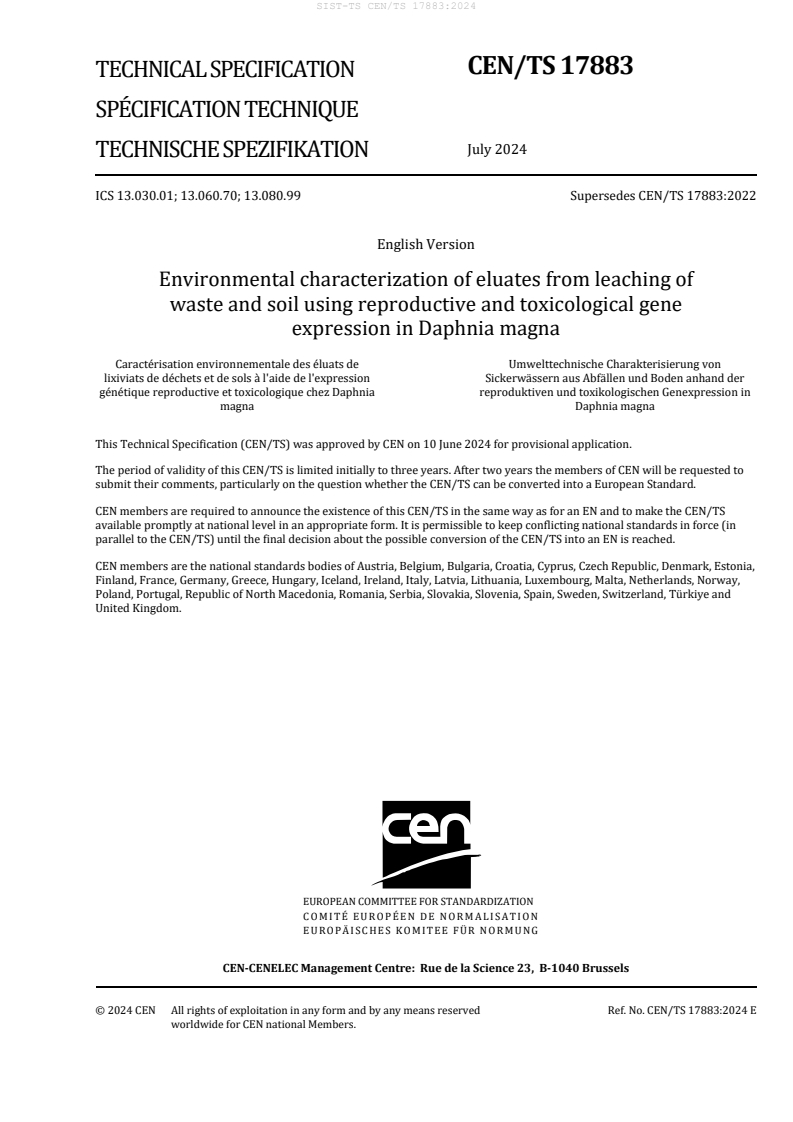
CEN/TS 17883
TECHNICAL SPECIFICATION
SPÉCIFICATION TECHNIQUE
July 2024
TECHNISCHE SPEZIFIKATION
ICS 13.030.01; 13.060.70; 13.080.99 Supersedes CEN/TS 17883:2022
English Version
Environmental characterization of eluates from leaching of
waste and soil using reproductive and toxicological gene
expression in Daphnia magna
Caractérisation environnementale des éluats de Umwelttechnische Charakterisierung von
lixiviats de déchets et de sols à l'aide de l'expression Sickerwässern aus Abfällen und Boden anhand der
génétique reproductive et toxicologique chez Daphnia reproduktiven und toxikologischen Genexpression in
magna Daphnia magna
This Technical Specification (CEN/TS) was approved by CEN on 10 June 2024 for provisional application.
The period of validity of this CEN/TS is limited initially to three years. After two years the members of CEN will be requested to
submit their comments, particularly on the question whether the CEN/TS can be converted into a European Standard.
CEN members are required to announce the existence of this CEN/TS in the same way as for an EN and to make the CEN/TS
available promptly at national level in an appropriate form. It is permissible to keep conflicting national standards in force (in
parallel to the CEN/TS) until the final decision about the possible conversion of the CEN/TS into an EN is reached.
CEN members are the national standards bodies of Austria, Belgium, Bulgaria, Croatia, Cyprus, Czech Republic, Denmark, Estonia,
Finland, France, Germany, Greece, Hungary, Iceland, Ireland, Italy, Latvia, Lithuania, Luxembourg, Malta, Netherlands, Norway,
Poland, Portugal, Republic of North Macedonia, Romania, Serbia, Slovakia, Slovenia, Spain, Sweden, Switzerland, Türkiye and
United Kingdom.
EUROPEAN COMMITTEE FOR STANDARDIZATION
COMITÉ EUROPÉEN DE NORMALISATION
EUROPÄISCHES KOMITEE FÜR NORMUNG
CEN-CENELEC Management Centre: Rue de la Science 23, B-1040 Brussels
© 2024 CEN All rights of exploitation in any form and by any means reserved Ref. No. CEN/TS 17883:2024 E
worldwide for CEN national Members.
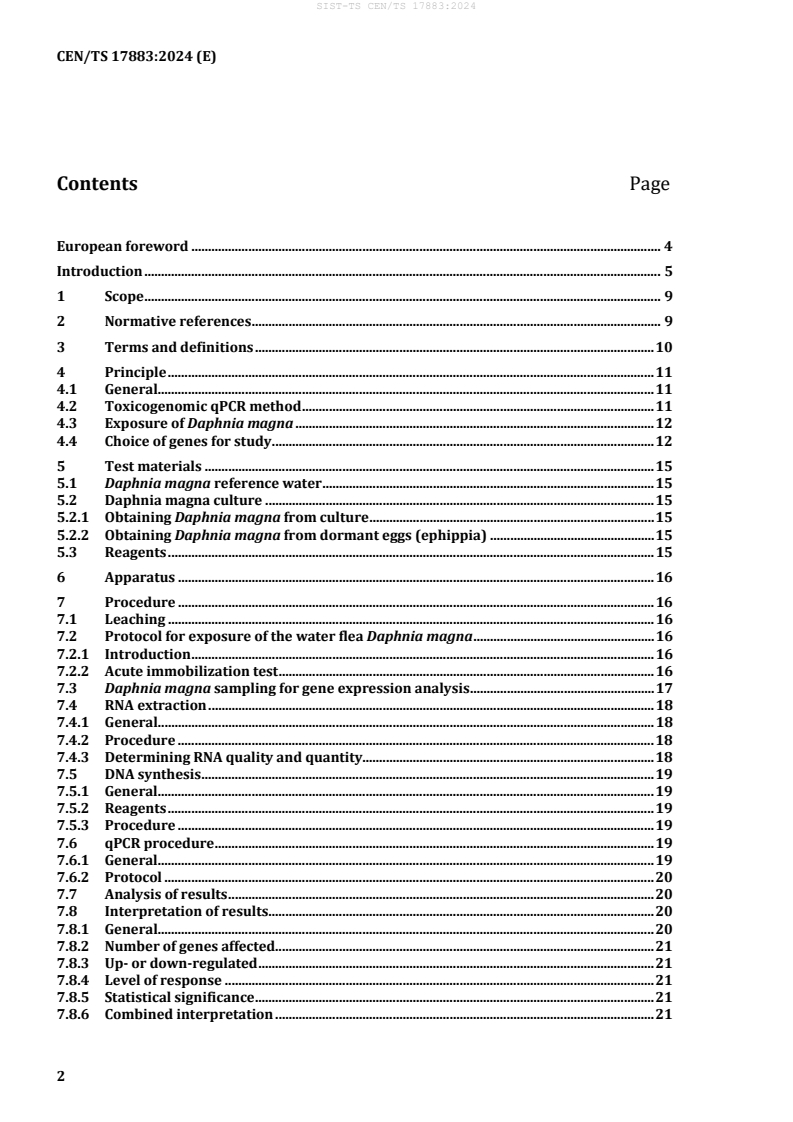
Contents Page
European foreword . 4
Introduction . 5
1 Scope . 9
2 Normative references . 9
3 Terms and definitions . 10
4 Principle . 11
4.1 General. 11
4.2 Toxicogenomic qPCR method . 11
4.3 Exposure of Daphnia magna . 12
4.4 Choice of genes for study . 12
5 Test materials . 15
5.1 Daphnia magna reference water . 15
5.2 Daphnia magna culture . 15
5.2.1 Obtaining Daphnia magna from culture . 15
5.2.2 Obtaining Daphnia magna from dormant eggs (ephippia) . 15
5.3 Reagents . 15
6 Apparatus . 16
7 Procedure . 16
7.1 Leaching . 16
7.2 Protocol for exposure of the water flea Daphnia magna . 16
7.2.1 Introduction . 16
7.2.2 Acute immobilization test . 16
7.3 Daphnia magna sampling for gene expression analysis . 17
7.4 RNA extraction . 18
7.4.1 General. 18
7.4.2 Procedure . 18
7.4.3 Determining RNA quality and quantity. 18
7.5 DNA synthesis . 19
7.5.1 General. 19
7.5.2 Reagents . 19
7.5.3 Procedure . 19
7.6 qPCR procedure . 19
7.6.1 General. 19
7.6.2 Protocol . 20
7.7 Analysis of results . 20
7.8 Interpretation of results . 20
7.8.1 General. 20
7.8.2 Number of genes affected . 21
7.8.3 Up- or down-regulated . 21
7.8.4 Level of response . 21
7.8.5 Statistical significance . 21
7.8.6 Combined interpretation . 21
7.8.7 Result assessment . 21
Annex A (informative) Presentation and interpretation of toxicogenomic data . 22
Bibliography . 25
European foreword
This document (CEN/TS 17883:2024) has been prepared by Technical Committee CEN/TC 444
“Environmental characterization of solid matrices”, the secretariat of which is held by NEN.
Attention is drawn to the possibility that some of the elements of this document may be the subject of
patent rights. CEN shall not be held responsible for identifying any or all such patent rights.
This document supersedes CEN/TS 17883:2022.
Any feedback and questions on this document should be directed to the users’ national standards body.
A complete listing of these bodies can be found on the CEN website. According to the CEN/CENELEC
Internal Regulations, the national standards organisations of the following countries are bound to
announce this Technical Specification: Austria, Belgium, Bulgaria, Croatia, Cyprus, Czech Republic,
Denmark, Estonia, Finland, France, Germany, Greece, Hungary, Iceland, Ireland, Italy, Latvia, Lithuania,
Luxembourg, Malta, Netherlands, Norway, Poland, Portugal, Republic of North Macedonia, Romania,
Serbia, Slovakia, Slovenia, Spain, Sweden, Switzerland, Türkiye and the United Kingdom.
Introduction
The aim of this document is to describe the procedure used to set up and perform quantitative PCR to
quantify effects of eluates from waste and soil on reproductive and toxicological end points in Daphnia
magna. The presented method allows for rapid, robust and sensitive detection of molecular responses
and can be used to analyse the toxic effects of water eluates from soil and waste as well as the recipient
waters.
The study of messenger RNA (mRNA) from different living organisms, using different molecular
approaches, can be used to identify the responses of organisms to exposure to toxic substances.
Messenger RNA (mRNA) transfers information from the DNA, which stores all the necessary information
needed for life, to the cellular machinery that synthesizes proteins. Proteins are the working units in the
cell and their abundance is highly dependent on the RNA levels in the cell as all proteins are translation
products of mRNA. As mRNA is the first step in the response to toxic substances it is also a quick, precise
and sensitive biomarker of exposure that gives information on the mechanisms responsible for the
responses. The relationship between physiological impact and mechanistic resolution is shown in
Figure 1.
Figure 1 — Differences in physiological impact and mechanistic resolution at different
organizational levels
There is an important difference between determining an effect of a toxic substance and understanding
what it is that cause the effect. Effects that cause harm to entire ecosystems are usually identified by
changes in populations. Effects at the organism/individual level are easiest observed by changes in the
physiology, morphology or behaviour of an organism. However, as the environment is highly complex
and highly variable, the measurement of changes in ecosystems, population or individuals has very low
resolution when it comes to identifying the cause of any observed effect. To avoid “guilt by association”
it is important to identify the connection between an exposure and the observed effect. The most sensitive
methods for this are at the level of RNA and protein regulation at the cellular level. RNA forms the link
between proteins and chromosomal DNA (genes). The chromosomally located genes can be regulated in
several different ways, but independent of the regulatory mechanism, exposure to toxic substances will
result in a change in active RNA and thereby in the corresponding protein.
A toxic response is initiated by a molecular initiating event (MIE). This can be the exposure to an inorganic
or organic compound as well as to radioactivity. The MIE is followed by the molecular interaction
between the compound initiating the MIE and a molecule (receptor activation, protein binding, DNA
binding) that results in alterations in a set of key events (KE) starting with changes in gene expression
leading to changes in protein production. This in turn leads to an altered signal cascade that can, if it
overrides homoeostatic control, result in altered functions of cells, tissues and organs. These alterations
in function can then lead to adverse outcomes (AO) such as a malformation, organ dysfunction and
eventually lethality. This results in an AO of regulatory relevance for risk assessment that represents
overt adversity at either organism or population level (Figure 2).
Figure 2 — The Adverse Outcome Pathway
An AOP (Adverse Outcome Pathway), starts with a molecular interaction between a chemical and a
molecule. This step is called the Molecular Initiating Event (MIE). This is followed by a set of Key Events
(KE) propagating the signal to higher levels of organization. This leads to an outcome on the physiology
of an organism and if this outcome is deleterious it is called and Adverse Outcome (AO). The complete
chain of events is therefore called AO Pathway (AOP) and connects the initial exposure, through a
molecular interaction to a physiological change in the organism. At sufficient concentrations of the
chemical and durations of exposure, a KE can increase to a level where it will trigger another KE to shut
down, overcoming cell defence mechanisms and adaptation processes.
Thus, in order for an AO to occur, there has to be an initial molecular interaction leading to alterations in
gene activity. While the AO is the measure of the damage/toxicity of the exposure, the initial changes in
gene activity is the direct response to the exposure.
With the toxicogenomic qPCR method it is possible to directly measure the first KE in the cascade leading
from MIE to AO. This can be done by analysis of genes belonging to selected AOP such as metal toxicity,
xenobiotic toxicity, stress response, reproduction, metabolism, respiration, cell cycle (cancer and
apoptosis). By determining the correlation between significant changes in gene expression and specific
AOPs it is thereby possible to identify the causative factor. Lack of correlation between an AOP and its
MIE indicates that there is no effect caused by the exposure on that AOP. An advantage with this method
is that it allows for identification of the cause of the AO as each gene is regulated by a specific set of
receptors and transcription factors.
Analysis of RNA levels is therefore the most robust and sensitive way to determine the mechanism
leading to the effects observed following an exposure. For comparison, reproduction in Daphnia magna
can be analysed by measuring the number of offspring in a 21-day assay. If there is a reduction, or
increase, in offspring this indicates that the exposure affects reproduction. At the same time, a short
exposure (24 h to 96 h) followed by analysis of RNA levels will be able to show if there is a change in the
machinery necessary for reproduction.
One advantage of analysing the regulation of genes is that the induction or reduction in RNA is directly
correlated to specific compounds that can regulate the gene expression. Thus, by combining the analysis
of reproductive RNA with the analysis of RNA measuring toxicity it is possible to determine what type of
toxic effect is caused by the compounds that the organism is exposed to. By analysing the RNA regulation,
it is therefore possible to determine effects related to HP14 (Ecotoxic, i.e. causing toxicity to organisms
in the environment).
While young daphnids (24 h to 48 h old) can be used to investigate the expression of genes related to
biological pathways activated during early development of the animal (i.e.; metal response, oxidative
stress), older daphnids (>72 h old) are required to analyse effects of the tested compound on genes
related to pathways that are functional in later life stages, such as reproduction. To cover genes involved
in both development, toxicity, and reproduction it is therefore important to expose the animals from
hatching/birth to 96 h.
The analyses can be designed based on previous chemical data indicating what type of exposure that the
Daphnia magna will be experiencing. The resolution of the assay can be increased by selecting specific
genes that are known to respond to specific insults. In addition, by using controlled exposures to specific
compounds it is possible to identify if these are contributing to a measured biological effect see Figure 3.
Thus, it is possible to determine if the effect is caused by a compound of concern or by normally occurring
abiotic properties of the exposure solution.
Figure 3 — Testing the effect of eluates from leachates from waste and soil using reproductive
and toxicological gene expression in Daphnia magna
The rational for choosing Daphnia magna for toxicological analyses is that it is a sensitive organism.
Daphnia magna is considered a keystone species for the analysis of effects caused by complex
environmental exposure [1]. It has successfully been applied as a sensitive model system for studies of
effects caused by building material and bottom-ash [2,3].
The advantages of the method can be summarized as:
1. Robust: Analysis at the RNA level using qPCR is a robust method. An exposure that affects an animal
has to involve bioavailable compounds that can activate or inhibit the conversion of DNA information
into RNA. This gives information on the responses to the exposure.
2. Quantitative: Analysis at the RNA level is quantifiable. As the amount of RNA is directly proportional
to the activation of genes and occurs rapidly following an exposure this is an easily quantifiable
method.
3. Mechanistic: The resolution of qPCR arrays (including many genes) allows for identification of the
cause leading to the effect. This cannot be achieved by traditional methods at the individual or higher
organizational level.
4. Sensitive: Alterations at the RNA level is more sensitive than analysis of physiological, morphological
or behavioural effects at the level of individual organisms or higher. This is due to alterations in RNA
being the first step in the organismal responses to exposure.
5. Complex mixtures: Using the biological qPCR approach allows for the detection of effects, even if they
are caused by complex mixtures, where several compounds in low doses are functioning in an
additive, synergistic or antagonistic manner.
6. Other advantages: The method is less prone to false positives (or negatives). The method is fast. The
method is relatively cheaper than corresponding physiological assays that require longer time and
thus more man hours to perform.
1 Scope
This document specifies the crucial steps of a quantitative real-time polymerase chain reaction (qPCR)
method to quantify the abundance of specific mRNA molecules extracted from Daphnia magna.
The method allows the identification of molecular responses to exposures for potentially toxic substances
through the analysis of the abundance of specific mRNA molecules. In this document, the central genes
involved in reproductive and toxic responses are included.
NOTE The selection of genes can be adapted to specific exposure conditions, for example, exposure to known
toxic substances, by adding genes known to respond to a specific insult.
The present method allows for rapid, robust, and sensitive detection of molecular responses and can be
used to analyse the toxic effects of water eluates from soil and waste. The method gives information of
the concentration of a substance or dilution of a test-liquid at which toxic effects begin to occur prior to
observations of reproductive or toxic effects at higher levels of organization, which reduces the need for
the use of safety factors in toxicity assessment.
The method is useful in several types of hazard assessment. In this document, the genes studied are
appropriate for the assessment of the risks when recycling materials and for the classification of waste,
but the method can be adapted to other types of risk assessment by including other genes.
2 Normative references
The following documents are referred to in the text in such a way that some or all of their content
constitutes requirements of this document. For dated references, only the edition cited applies. For
undated references, the latest edition of the referenced document (including any amendments) applies.
EN 12457-2, Characterisation of waste - Leaching - Compliance test for leaching of granular waste
materials and sludges - Part 2: One stage batch test at a liquid to solid ratio of 10 l/kg for materials with
particle size below 4 mm (without or with size reduction)
EN 14735, Characterization of waste - Preparation of waste samples for ecotoxicity tests
EN ISO 21268-2, Soil quality - Leaching procedures for subsequent chemical and ecotoxicological testing of
soil and soil-like material - Part 2: Batch test using a liquid to solid ratio of 10 l/kg dry matter (ISO 21268-
2)
ISO 20395, Biotechnology — Requirements for evaluating the performance of quantification methods for
nucleic acid target sequences — qPCR and dPCR
3 Terms and definitions
For the purposes of this document, the following terms and definitions apply.
ISO and IEC maintain terminology databases for use in standardization at the following addresses:
— ISO Online browsing platform: available at https://www.iso.org/obp
— IEC Electropedia: available at https://www.electropedia.org
3.1
cDNA
conversion product from mRNA
3.2
cycle threshold
Ct
number of cycles required for the signal to cross the threshold above the base line
3.3
dsDNA
double stranded DNA
3.4
mRNA
messenger ribonucleic acid
3.5
NOAEL
No Observed Adverse Effect Level
3.6
polymerase chain reaction
method allowing the amplification of a specific DNA sequence using a specific pair of oligonucleotide
primers
3.7
primer
short single stranded DNA sequence used to amplify cDNA or genes in a PCR reaction
3.8
quantitative polymerase chain reaction
qPCR
method allowing quantification of a DNA template (3.12) of the number of a specific cDNA sequence using
a specific pair of oligonucleotide primers
3.9
reverse transcriptase
enzyme that catalyses the formation of DNA from an RNA template
3.10
RNase
enzyme which promotes the breakdown of RNA into oligonucleotides and smaller molecules
3.11
SYBR green
nucleic acid stain used in molecular biology
3.12
template
cDNA sample used to perform PCR (3.6) to amplify a specific DNA sequence
3.13
toxicogenomic
application of omics technology to study toxicity
4 Principle
4.1 General
This document describes a toxicogenomic qPCR method using quantification of specific genes from a gene
panel consisting of genes involved in reproduction and in toxic responses of Daphnia magna.
4.2 Toxicogenomic qPCR method
The toxicogenomic qPCR method fills the gap that exists between chemical and biological methods of risk
assessment. The method that is based on proven PCR technology for the analysis of effects on gene
expression by different treatments. An increased gene expression leads to increased protein production,
often to restore the balance in the system.
The main tasks to isolate and determine the abundance of specific RNA, following conversion of mRNA to
cDNA, by qPCR are shown in Figure 4.
Figure 4 — Main tasks to determine the abundance of specific RNA by qPCR. A) Exposure of the
Daphnia magna to the test solution B) Extraction of mRNA, cDNA synthesis and qPCR
4.3 Exposure of Daphnia magna
Prior to PCR an acute immobilization curve needs to be established and the qPCR should be performed
at the dilution where no more immobilization is registered (NOAEL). In order to include reproductive
genes in the panel it is important that the Daphnia magna are exposed following the activation of
reproductive processes that occur 3 days after birth. Therefore, exposure shall be initiated 3 days after
hatching/bi
...