


kSIST FprEN IEC 61995-1:2025
(Main)Devices for the connection of luminaires for household and similar purposes - Part 1: General requirements
Devices for the connection of luminaires for household and similar purposes - Part 1: General requirements
IEC 61995-1:2025 applies to devices for the connection of luminaires (DCL) intended for household and similar purposes, for the electrical connection of fixed luminaires of class I or class II to final circuits rated at not more than 16 A without mechanical support for the luminaires incorporated in the plug/outlet interface. The DCL retention mechanisms are not intended to support the weight of the luminaires.
This second edition cancels and replaces the first edition published in 2005 and Amendment 1:2016. This edition constitutes a technical revision.
This edition includes the following significant technical changes with respect to the previous edition:
a) additional requirements and tests for additional suspension means;
b) additional requirements and tests for additional functions;
c) additional requirements and tests for floating type DCLs;
d) introduction of insulation piercing terminals (IPT);
e) additional classification according to the connection capacities of the DCL outlet terminals;
f) modification of maximum withdrawal force for plugs with enabled locking means;
g) improvements of temperature rise tests.
Betriebsmittel für den Anschluss von Leuchten für Haushalt und ähnliche Zwecke - Teil 1: Allgemeine Anforderungen
Dispositifs de connexion pour luminaires pour usage domestique et analogue - Partie 1: Exigences générales
L'IEC 61995-1:2025 s'applique aux dispositifs de connexion pour luminaires (DCL) prévus pour un usage domestique et analogue, destinés au raccordement de luminaires fixes de classe I ou de classe II à des circuits finaux de courant assigné inférieur ou égal à 16 A sans support mécanique aux luminaires incorporés dans l'interface de la fiche/du socle. Les mécanismes de retenue de DCL ne sont pas destinés à supporter le poids des luminaires.
Cette deuxième édition annule et remplace la première édition parue en 2005 et son Amendement 1:2016. Cette édition constitue une révision technique.
Cette édition inclut les modifications techniques majeures suivantes par rapport à l'édition précédente:
a) exigences et essais complémentaires pour les moyens de suspension supplémentaires;
b) exigences et essais complémentaires pour les fonctions supplémentaires;
c) exigences et essais complémentaires pour les DCL flottants non démontables;
d) introduction des bornes à perçage d'isolant (BPI);
e) classification supplémentaire selon les capacités de connexion des bornes de socles DCL;
f) modification de la force de retrait maximale pour les fiches avec dispositif de verrouillage activé;
g) amélioration des essais d'échauffement.
Elementi za priključitev svetilk za gospodinjstva in podobne namene - 1. del: Splošne zahteve
General Information
- Status
- Not Published
- Public Enquiry End Date
- 30-Dec-2023
- Technical Committee
- EPR - Electrical accessories
- Current Stage
- 6060 - National Implementation/Publication (Adopted Project)
- Start Date
- 30-Jun-2026
- Due Date
- 04-Sep-2026

Relations
- Effective Date
- 03-Feb-2026
- Refers
SIST EN 61032:2001 - Protection of persons and equipment by enclosures - Probes for verification - Effective Date
- 03-Feb-2026
- Effective Date
- 03-Feb-2026
- Effective Date
- 03-Feb-2026
- Effective Date
- 03-Feb-2026
- Effective Date
- 03-Feb-2026
- Effective Date
- 03-Feb-2026
- Effective Date
- 03-Feb-2026
- Effective Date
- 03-Feb-2026
- Effective Date
- 03-Feb-2026
- Effective Date
- 03-Feb-2026
- Effective Date
- 30-Jun-2026
- Effective Date
- 08-Aug-2023
- Effective Date
- 23-Jan-2023
- Effective Date
- 01-Mar-2022
Overview
kSIST FprEN IEC 61995-1:2025 sets out the general requirements for devices used for the connection of luminaires for household and similar purposes. These devices, known as DCL (Device for Connection of Luminaires), ensure safe and reliable electrical connection of fixed class I or class II luminaires to circuits rated up to 16A. Importantly, the retention mechanisms of DCLs are not designed to physically support the weight of the luminaires. This international standard, developed by CLC and aligned with the latest IEC updates, addresses classification, performance, marking, and safety requirements. It serves as a key reference for manufacturers, installation professionals, and standards organizations focused on electrical accessories and lighting systems for domestic and similar environments.
Key Topics
- Scope: kSIST FprEN IEC 61995-1:2025 applies to DCL outlets and plugs for connecting fixed luminaires (class I or II) to final circuits up to 16 A and voltages of 125 V or 250 V (50/60 Hz), under ambient conditions typically up to +40°C.
- Classification: DCL devices are classified by interface design, terminal type (screw-type, screwless-type, insulation-piercing terminals), conductor compatibility, installation method (fixed or floating), and additional suspension means.
- Technical Changes: The latest edition introduces new requirements and tests for additional suspension means, floating type DCLs, insulation-piercing terminals (IPT), and updated tests for temperature rise and mechanical strength.
- Marking and Identification: Detailed marking requirements for current, voltage, manufacturer identification, terminal markings, and special indications for application with luminaires.
- Constructional and Safety Aspects: Addresses protection against electric shock, earthing, protection levels (IP ratings), resistance to heat, ageing, humidity, marking clarity, and EMC/EMF requirements.
- Testing and Compliance: Outlines type testing procedures, specimen preparation and environmental conditions for robust assessment of compliance.
Applications
kSIST FprEN IEC 61995-1:2025 is widely applicable across the lighting and electrical installation sectors. Its primary uses include:
- Residential Lighting Installations: Ensures compatibility and safety in modern domestic electrical systems, facilitating the straightforward and secure connection of pendant and fixed luminaires using standardized DCL outlets and plugs.
- Commercial and Similar Purposes: Suitable for offices, hospitality, and other indoor spaces with requirements similar to those in residential settings.
- Product Design and Manufacturing: Provides manufacturers with requirements for DCL device design, focusing on ease of installation, safety, and reliability for end users.
- Regulatory and Conformity Assessment: Used by testing bodies, certification organizations, and regulatory authorities as a benchmark for conformity of luminaires connection devices within the European marketplace.
Related Standards
For comprehensive compliance and interoperability, consider these related international standards:
- EN IEC 61995-2: Standard sheets defining dimensions and configurations for DCL interfaces.
- IEC 60529: Degrees of protection provided by enclosures (IP code), referenced for DCL protection requirements.
- IEC 61140: Protection against electric shock - Common aspects for installation and equipment.
- IEC 60068 Series: Environmental testing protocols relevant for DCL devices.
- ISO/IEC Guide 51: Guidance on the integration of safety aspects within standards.
Summary
kSIST FprEN IEC 61995-1:2025 delivers a trusted, harmonized framework for the safe and effective connection of luminaires in household and similar environments. With robust coverage of classification, marking, performance, and testing requirements, it underpins quality and safety in lighting installations and supports stakeholders in achieving compliance and best practices in electrical accessories. For manufacturers, installers, and regulatory bodies, adherence to this standard streamlines product development, enhances market access, and assures end-user safety in line with evolving electrical and lighting technologies.
Get Certified
Connect with accredited certification bodies for this standard

IMQ S.p.A. (Certification)
Italian electrical product certification.

SLG Prüf- und Zertifizierungs GmbH
German testing and certification body.

UL Solutions
Global safety science company with testing, inspection and certification.
Sponsored listings
Frequently Asked Questions
kSIST FprEN IEC 61995-1:2025 is a draft published by the Slovenian Institute for Standardization (SIST). Its full title is "Devices for the connection of luminaires for household and similar purposes - Part 1: General requirements". This standard covers: IEC 61995-1:2025 applies to devices for the connection of luminaires (DCL) intended for household and similar purposes, for the electrical connection of fixed luminaires of class I or class II to final circuits rated at not more than 16 A without mechanical support for the luminaires incorporated in the plug/outlet interface. The DCL retention mechanisms are not intended to support the weight of the luminaires. This second edition cancels and replaces the first edition published in 2005 and Amendment 1:2016. This edition constitutes a technical revision. This edition includes the following significant technical changes with respect to the previous edition: a) additional requirements and tests for additional suspension means; b) additional requirements and tests for additional functions; c) additional requirements and tests for floating type DCLs; d) introduction of insulation piercing terminals (IPT); e) additional classification according to the connection capacities of the DCL outlet terminals; f) modification of maximum withdrawal force for plugs with enabled locking means; g) improvements of temperature rise tests.
IEC 61995-1:2025 applies to devices for the connection of luminaires (DCL) intended for household and similar purposes, for the electrical connection of fixed luminaires of class I or class II to final circuits rated at not more than 16 A without mechanical support for the luminaires incorporated in the plug/outlet interface. The DCL retention mechanisms are not intended to support the weight of the luminaires. This second edition cancels and replaces the first edition published in 2005 and Amendment 1:2016. This edition constitutes a technical revision. This edition includes the following significant technical changes with respect to the previous edition: a) additional requirements and tests for additional suspension means; b) additional requirements and tests for additional functions; c) additional requirements and tests for floating type DCLs; d) introduction of insulation piercing terminals (IPT); e) additional classification according to the connection capacities of the DCL outlet terminals; f) modification of maximum withdrawal force for plugs with enabled locking means; g) improvements of temperature rise tests.
kSIST FprEN IEC 61995-1:2025 is classified under the following ICS (International Classification for Standards) categories: 29.120.20 - Connecting devices; 29.140.40 - Luminaires. The ICS classification helps identify the subject area and facilitates finding related standards.
kSIST FprEN IEC 61995-1:2025 has the following relationships with other standards: It is inter standard links to SIST EN 60529:1997, SIST EN 61032:2001, SIST EN 60417-2:2002, SIST EN 60529:1997/A1:2000, SIST EN IEC 60112:2021, SIST EN 60529:1997/A2:2014, SIST EN 60068-2-31:2008, SIST EN 60068-2-75:2014, SIST EN IEC 60695-2-11:2022, SIST EN 60269-4:1998, kSIST FprEN IEC 61995-2:2025, SIST HD 60364-5-537:2017, kSIST prEN IEC 61995-1:2025/kFprAA:2025, SIST EN 61995-1:2008, SIST EN 61995-1:2008/A11:2021. Understanding these relationships helps ensure you are using the most current and applicable version of the standard.
kSIST FprEN IEC 61995-1:2025 is associated with the following European legislation: EU Directives/Regulations: 2014/35/EU; Standardization Mandates: M/511. When a standard is cited in the Official Journal of the European Union, products manufactured in conformity with it benefit from a presumption of conformity with the essential requirements of the corresponding EU directive or regulation.
kSIST FprEN IEC 61995-1:2025 is available in PDF format for immediate download after purchase. The document can be added to your cart and obtained through the secure checkout process. Digital delivery ensures instant access to the complete standard document.
Standards Content (Sample)
SLOVENSKI STANDARD
oSIST prEN IEC 61995-1:2023
01-december-2023
Elementi za priključitev svetilk za gospodinjstva in podobne namene - 1. del:
Splošne zahteve
Devices for the connection of luminaires for household and similar purposes - Part 1:
General requirements
Betriebsmittel für den Anschluss von Leuchten für Haushalt und ähnliche Zwecke - Teil
1: Allgemeine Anforderungen
Dispositifs de connexion pour luminaires pour usage domestique et analogue - Partie 1:
Exigences générales
Ta slovenski standard je istoveten z: prEN IEC 61995-1:2023
ICS:
29.120.20 Spojni elementi Connecting devices
29.140.40 Svetila Luminaires
oSIST prEN IEC 61995-1:2023 en,fr,de
2003-01.Slovenski inštitut za standardizacijo. Razmnoževanje celote ali delov tega standarda ni dovoljeno.
oSIST prEN IEC 61995-1:2023
oSIST prEN IEC 61995-1:2023
23B/1477/CDV
COMMITTEE DRAFT FOR VOTE (CDV)
PROJECT NUMBER:
IEC 61995-1 ED2
DATE OF CIRCULATION: CLOSING DATE FOR VOTING:
2023-10-27 2024-01-19
SUPERSEDES DOCUMENTS:
23B/1451/CD, 23B/1457/CC
IEC SC 23B : PLUGS, SOCKET-OUTLETS AND SWITCHES
SECRETARIAT: SECRETARY:
Italy Mr Cristiano Masini
OF INTEREST TO THE FOLLOWING COMMITTEES: PROPOSED HORIZONTAL STANDARD:
SC 34D,TC 64
Other TC/SCs are requested to indicate their interest, if
any, in this CDV to the secretary.
FUNCTIONS CONCERNED:
EMC ENVIRONMENT QUALITY ASSURANCE SAFETY
SUBMITTED FOR CENELEC PARALLEL VOTING NOT SUBMITTED FOR CENELEC PARALLEL VOTING
Attention IEC-CENELEC parallel voting
The attention of IEC National Committees, members of
CENELEC, is drawn to the fact that this Committee Draft
for Vote (CDV) is submitted for parallel voting.
The CENELEC members are invited to vote through the
CENELEC online voting system.
This document is still under study and subject to change. It should not be used for reference purposes.
Recipients of this document are invited to submit, with their comments, notification of any relevant patent rights of
which they are aware and to provide supporting documentation.
Recipients of this document are invited to submit, with their comments, notification of any relevant “In Some
Countries” clauses to be included should this proposal proceed. Recipients are reminded that the CDV stage is the
final stage for submitting ISC clauses. (SEE AC/22/2007 OR NEW GUIDANCE DOC).
TITLE:
Devices for the connection of luminaires for household and similar purposes - Part 1: General
requirements
PROPOSED STABILITY DATE: 2030
NOTE FROM TC/SC OFFICERS:
Revision of IEC 61995-1 - Proposal to include requirements for additional suspension means, to allow
different wiring capacities and to add the option of floating type DCL outlets. In addition, it was agreed
to align if needed to IEC60884-1 for relevant clauses.
download this electronic file, to make a copy and to print out the content for the sole purpose of preparing
National Committee positions. You may not copy or "mirror" the file or printed version of the document, or any
part of it, for any other purpose without permission in writing from IEC.
oSIST prEN IEC 61995-1:2023
IEC CDV 61995-1 © IEC 2023 2 23B/1477/CDV
1 INTRODUCTION
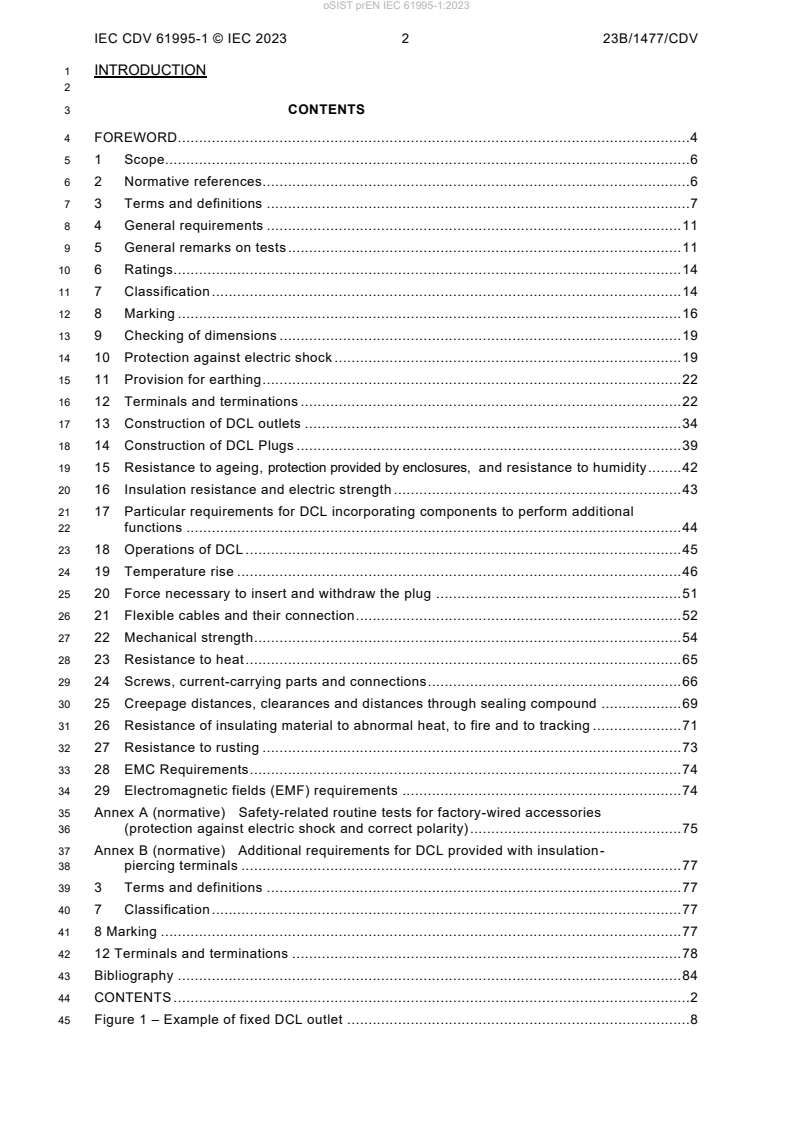
3 CONTENTS
4 FOREWORD . 4
5 1 Scope . 6
6 2 Normative references. 6
7 3 Terms and definitions . 7
8 4 General requirements . 11
9 5 General remarks on tests . 11
10 6 Ratings . 14
11 7 Classification . 14
12 8 Marking . 16
13 9 Checking of dimensions . 19
14 10 Protection against electric shock . 19
15 11 Provision for earthing . 22
16 12 Terminals and terminations . 22
17 13 Construction of DCL outlets . 34
18 14 Construction of DCL Plugs . 39
19 15 Resistance to ageing, protection provided by enclosures, and resistance to humidity . 42
20 16 Insulation resistance and electric strength . 43
21 17 Particular requirements for DCL incorporating components to perform additional
22 functions . 44
23 18 Operations of DCL . 45
24 19 Temperature rise . 46
25 20 Force necessary to insert and withdraw the plug . 51
26 21 Flexible cables and their connection . 52
27 22 Mechanical strength . 54
28 23 Resistance to heat . 65
29 24 Screws, current-carrying parts and connections . 66
30 25 Creepage distances, clearances and distances through sealing compound . 69
31 26 Resistance of insulating material to abnormal heat, to fire and to tracking . 71
32 27 Resistance to rusting . 73
33 28 EMC Requirements . 74
34 29 Electromagnetic fields (EMF) requirements . 74
35 Annex A (normative) Safety-related routine tests for factory-wired accessories
36 (protection against electric shock and correct polarity) . 75
37 Annex B (normative) Additional requirements for DCL provided with insulation-
38 piercing terminals . 77
39 3 Terms and definitions . 77
40 7 Classification . 77
41 8 Marking . 77
42 12 Terminals and terminations . 78
43 Bibliography . 84
44 CONTENTS . 2
45 Figure 1 – Example of fixed DCL outlet . 8
oSIST prEN IEC 61995-1:2023
IEC CDV 61995-1 © IEC 2023 3 23B/1477/CDV
46 Figure 2 – Example of thread-forming screw . 9
47 Figure 3 – Example of thread-cutting screw . 9
48 Figure 4 – Example of additional suspension means . 10
49 Figure 5 – Example of floating type DCL outlet . 11
50 Figure 6 – Test piston dimensions . 19
51 Figure 7 – Arrangement for checking damage to conductors . 25
52 Figure 8 – Information for deflection test . 33
53 Figure 9 – Circuit diagram for temperature rise test . 47
54 Figure 10 – Apparatus for testing the cord retention . 52
55 Figure 11 – Sequence of blows for parts A, B, C and D . 56
56 Figure 12 – Arrangement for test on covers or cover-plates . 58
57 Figure 13 – Gauge (thickness: about 2 mm) for the verification of the outline of covers
58 or cover-plates . 60
59 Figure 14 – Examples of application of the gauge of Figure 13 on covers fixed without
60 screws on a mounting surface or supporting surface . 61
61 Figure 15 – Examples of application of the gauge of Figure 13 in accordance with the
62 requirements of 22.6 . 62
63 Figure 16 – Gauge for verification of grooves, holes and reverse tapers . 63
64 Figure 17 – Sketch showing the direction of application of the gauge of Figure 16 . 64
65 Figure 18– Ball pressure test apparatus . 66
66 Figure 19 –Diagrammatic representation of 26.1 . 72
67 Figure A.1 – Example of IPTs . 83
68 Figure A.2 – Example of test-points . 83
69 Figure A.3 – Example of test results . 83
71 Table 1– Number of specimens needed for the tests . 13
72 Table 2 – Connection of copper conductors . 23
73 Table 3– Values for checking damage to conductors. 26
74 Table 4 – Values for pull forces . 26
75 Table 5 – Core composition of conductors . 27
76 Table 6 – Screw torque values . 28
77 Table 7 – Test current for checking screwless-type terminals . 31
78 Table 8 – Conductors for deflection test . 34
79 Table 9 – Force for deflection test . 34
80 Table 10 – Forces to be applied to covers, cover-plates whose fixing is not dependent
81 on screws . 36
82 Table 11 – Test currents for temperature rise test . 47
83 Table 12 – Permissible temperature rise values . 50
84 Table 13 – Cable dimensions for the cord anchorage test . 53
85 Table 14 – Height of fall for impact test . 54
86 Table 15 – Creepage distances and clearances . 70
oSIST prEN IEC 61995-1:2023
IEC CDV 61995-1 © IEC 2023 4 23B/1477/CDV
88 INTERNATIONAL ELECTROTECHNICAL COMMISSION
89 ____________
91 DEVICES FOR THE CONNECTION OF LUMINAIRES
92 FOR HOUSEHOLD AND SIMILAR PURPOSES –
94 Part 1: General requirements
97 FOREWORD
98 1) The International Electrotechnical Commission (IEC) is a worldwide organization for standardization comprising
99 all national electrotechnical committees (IEC National Committees). The object of IEC is to promote
100 international co-operation on all questions concerning standardization in the electrical and electronic fields. To
101 this end and in addition to other activities, IEC publishes International Standards, Technical Specifications,
102 Technical Reports, Publicly Available Specifications (PAS) and Guides (hereafter referred to as “IEC
103 Publication(s)”). Their preparation is entrusted to technical committees; any IEC National Committee interested
104 in the subject dealt with may participate in this preparatory work. International, governmental and non -
105 governmental organizations liaising with the IEC also participate in this preparation. IEC collaborates closely
106 with the International Organization for Standardization (ISO) in accordance with conditions determined by
107 agreement between the two organizations.
108 2) The formal decisions or agreements of IEC on technical matters express, as nearly as possible, an international
109 consensus of opinion on the relevant subjects since each technical committee has representation from all
110 interested IEC National Committees.
111 3) IEC Publications have the form of recommendations for international use and are accepted by IEC National
112 Committees in that sense. While all reasonable efforts are made to ensure that the technical content of IEC
113 Publications is accurate, IEC cannot be held responsible for the way in which they are used or for any
114 misinterpretation by any end user.
115 4) In order to promote international uniformity, IEC National Committees undertake to apply IEC Publications
116 transparently to the maximum extent possible in their national and regional publications. Any divergence
117 between any IEC Publication and the corresponding national or regional publication shall be clearly indicated in
118 the latter.
119 5) IEC itself does not provide any attestation of conformity. Independent certification bodies provide conformity
120 assessment services and, in some areas, access to IEC marks of conformity. IEC is not responsible for any
121 services carried out by independent certification bodies.
122 6) All users should ensure that they have the latest edition of this publication.
123 7) No liability shall attach to IEC or its directors, employees, servants or agents including individual experts and
124 members of its technical committees and IEC National Committees for any personal injury, property damage or
125 other damage of any nature whatsoever, whether direct or indirect, or for costs (including legal fees) and
126 expenses arising out of the publication, use of, or reliance upon, this IEC Publication or any other IEC
127 Publications.
128 8) Attention is drawn to the Normative references cited in this publication. Use of the referenced publications is
129 indispensable for the correct application of this publication.
130 9) Attention is drawn to the possibility that some of the elements of this IEC Publication may be the subject of
131 patent rights. IEC shall not be held responsible for identifying any or all such patent rights.
oSIST prEN IEC 61995-1:2023
IEC CDV 61995-1 © IEC 2023 5 23B/1477/CDV
133 International Standard IEC 61995-1 has been prepared by subcommittee 23B: Plugs, socket-
134 outlets and switches, of IEC technical committee 23: Electrical accessories.
135 This publication has been drafted in accordance with the ISO/IEC Directives, Part 2.
136 IEC 61995 consists of the following parts, under the general title Devices for the connection of
137 luminaires for household and similar purposes:
138 Part 1: General requirements
139 Part 2: Standard sheets
140 The committee has decided that the contents of the base publication and its amendment will
141 remain unchanged until the stability date indicated on the IEC web site under
142 "http://webstore.iec.ch" in the data related to the specific publication. At this date, the
143 publication will be
144 • reconfirmed,
145 • withdrawn,
146 • replaced by a revised edition, or
147 • amended.
oSIST prEN IEC 61995-1:2023
IEC CDV 61995-1 © IEC 2023 6 23B/1477/CDV
150 DEVICES FOR THE CONNECTION OF LUMINAIRES
151 FOR HOUSEHOLD AND SIMILAR PURPOSES –
153 Part 1: General requirements
155 1 Scope
156 This document applies to devices for the connection of luminaires (DCL) intended for household and
157 similar purposes, for the electrical connection of fixed luminaires of class I or class II to final circuits
158 rated at not more than 16 A without mechanical support for the luminaires incorporated in the
159 plug/outlet interface. The DCL retention mechanisms are not intended to support the weight of the
160 luminaires.
161 DCL plugs and outlets have a rated current of 6 A.
162 DCL outlets have an earthing contact.
163 The rated voltage is 125 V or 250 V at 50/60 Hz.
164 DCL with additional suspension means are limited to a maximum mass of 5 kg.
165 DCL plugs and DCL outlets complying with this document are suitable for use at ambient
166 temperatures not normally exceeding +40 °C, but their average over a period of 24 h does not
167 exceed +35 °C, with a lower limit of the ambient air temperature of –5 °C.
168 DCLs are intended for use according to their IP rating as specified in IEC 60529.
169 This document gives additional requirements for DCL accessories provided with insulation-piercing
170 terminals, see Annex B (normative).
171 2 Normative references
172 The following referenced documents are indispensable for the application of this document.
173 For dated references, only the edition cited applies. For undated references, the latest edition
174 of the referenced document (including any amendments) applies.
175 IEC 60068-2-31:2008, Environmental testing – Part 2-31: Tests – Test Ec: Rough handling
176 shocks, primarily for equipment-type specimens
177 IEC 60068-2-75:2014, Environmental testing – Part 2-75: Tests – Test Eh: Hammer test
178 IEC 60112:2020, Method for the determination of the proof and the comparative tracking indices of
179 solid insulating materials
180 IEC 60227-5:2011, Polyvinyl chloride insulated cables of rated voltages up to and including
181 450/750V – Part 5: Flexible cables (cords)
1)
182 IEC 60417-DB: , Graphical symbols for use on equipment
183 IEC 60529:1989/AMD1:1999/AMD2:2013, Degrees of protection provided by enclosures (IP Code)
184 IEC 60695-2-11:2021, Fire hazard testing – Part 2-11: Glowing/hot-wire based test methods –
185 Glow-wire flammability test method for end-products
186 IEC 61032:1997, Protection of persons and equipment by enclosures – Probes for verification
———————
1)
“DB” refers to the IEC on-line database.
oSIST prEN IEC 61995-1:2023
IEC CDV 61995-1 © IEC 2023 7 23B/1477/CDV
187 IEC 61995-2:202X - Devices for the connection of luminaires for household and similar
188 purposes - Part 2: Standard sheets for DCL
189 ISO/IEC Guide 51:2014, Safety aspects – Guidelines for their inclusion in standards
190 3 Terms and definitions
191 For the purposes of this document, the following terms and definitions apply.
192 ISO and IEC maintain terminological databases for use in standardization at the following
193 addresses:
194 • IEC Electropedia: available at http://www.electropedia.org/
195 • ISO Online browsing platform: available at http://www.iso.org/obp
196 Note 1 to entry Where the terms voltage and current are used, they imply RMS values, unless otherwise specified.
197 Note 2 to entry Throughout this document the word "earthing" is used for "protective earthing".
198 Note 3 to entry The term "accessory" is used as a general term covering DCL plugs and DCL outlets.
199 3.1
200 device for connecting a luminaire DCL
201 system comprising a DCL outlet and a DCL plug providing a fixed luminaire with electrical
202 connection to and disconnection from a fixed installation
203 Note to entry The designations DCL, DCL outlet or DCL plug, are used when it is necessary to specify particular
204 requirements and test specifications.
205 3.2
206 DCL outlet
207 device for connecting a luminaire having socket-contacts designed to engage with the pins of
208 a DCL plug and having terminals for the connection of cable
209 3.3
210 DCL plug
211 device for connecting a luminaire having pins designed to engage with the contacts of a DCL
212 outlet
213 3.4
214 rewirable DCL plug
215 DCL plug so constructed that the flexible cable can be replaced
216 3.5
217 non-rewirable DCL plug
218 DCL plug so constructed that it forms a complete unit with the flexible cable after connection
219 and assembly by the manufacturer of the plug (see also 14.1)
220 3.6
221 moulded-on DCL plug
222 non-rewirable DCL plug, the manufacture of which is completed by insulating material
223 moulded around pre-assembled component parts and the terminations of the flexible cable
224 3.7
225 rated voltage
226 the voltage assigned by the manufacturer for a specified operating condition of an accessory
227 [SOURCE: IEV 442-01-03]
oSIST prEN IEC 61995-1:2023
IEC CDV 61995-1 © IEC 2023 8 23B/1477/CDV
228 3.8
229 rated current
230 the current assigned by the manufacturer for specified operating condition of an accessory
231 [SOURCE: IEV 442-01-02]
232 3.9
233 fixed DCL outlet
234 DCL outlet intended to be installed at a fixed location and be connected to fixed wiring
236 Figure 1 Example of fixed DCL outlet and plug
237 3.10
238 mounting box
239 box in or on a wall or ceiling, etc., for flush or surface application, intended to house a DCL
240 outlet
241 3.11
242 terminal
243 insulated or non-insulated connecting device intended for reusable electrical connection of the
244 external conductors
245 3.12
246 termination
247 insulated or non-insulated connecting device intended for non-reusable electrical connection
248 of the external conductors
249 3.13
250 clamping unit
251 part(s) of the terminal necessary for the mechanical clamping and the electrical connection of the
252 conductor(s), including the parts which are necessary to ensure correct contact pressure
253 [SOURCE: IEV 442-06-12]
254 3.14
255 screw-type terminal
256 terminal for the connection and subsequent disconnection of one conductor or the
257 interconnection and subsequent disconnection of two or more conductors, the connection
258 being made, directly or indirectly, by means of screws or nuts of any kind
259 Note to entry The terms of definitions 3.14 to 3.17 are examples of screw-type terminals.
260 3.15
261 pillar terminal
262 screw-type terminal in which the conductor is inserted into a hole or cavity, where it is clamped under
263 the end of the screw or screws
264 Note to entry The clamping pressure may be applied directly by the end of the screw or through an intermediate
265 clamping member to which pressure is applied by the end of the screw
oSIST prEN IEC 61995-1:2023
IEC CDV 61995-1 © IEC 2023 9 23B/1477/CDV
266 3.16
267 stirrup terminal
268 pillar terminal where the clamping pressure is applied indirectly by an intermediate clamping
269 member when the screw is tightened
270 3.17
271 stud terminal
272 screw-type terminal in which the conductor is clamped under a nut
273 Note to entry The clamping pressure may be applied directly by a suitably shaped nut or through an intermediate
274 part, such as a washer, clamping plate or anti-spread device
275 3.18
276 screw-head terminal
277 screw-type terminal in which the conductor is clamped under the head of the screw
278 Note to entry The clamping pressure may be applied directly by a suitably shaped nut or through an intermediate
279 part, such as a washer, clamping plate or anti-spread device
280 3.19
281 screwless-type terminal
282 connecting device for the connection and subsequent disconnection of a rigid (solid or
283 stranded) or flexible conductor or the interconnection of two or more conductors capable of
284 being dismantled, the connection being made, directly or indirectly, by means of springs, parts
285 of angled, eccentric or conical form, etc., without special preparation of the conductor
286 concerned, other than removal of insulation
287 3.20
288 thread-forming screw
289 screw having an uninterrupted thread, which by screwing in, forms a thread by displacing material
290 Note to entry An example of a thread-forming screw is shown in Figure 2.
292 Figure 2 – Example of thread-forming screw
293 3.21
294 thread-cutting screw
295 screw having an uninterrupted thread, which by screwing in, forms a thread by removing material
296 Note to entry An example of a thread-cutting screw is shown in Figure 3.
299 Figure 3 – Example of thread-cutting screw
300 3.22
301 loop terminal
302 supply terminal intended for the interconnection of live conductors
oSIST prEN IEC 61995-1:2023
IEC CDV 61995-1 © IEC 2023 10 23B/1477/CDV
303 3.23
304 DCL temporary lampholder
305 independent lampholder integral with a DCL plug, designed in order to be temporarily connected to a
306 DCL outlet
307 3.24
308 additional suspension means
309 means comprising any necessary component (hooks, brackets, etc) which is a part of the DCL, used
310 to fix the luminaire
312 Key
313 1 Mounting box (flush-type or surface-type)
314 2 Fixed DCL outlet
315 3 Additional suspension means
316 4 Cover-plate
317 Figure 4 – Example of additional suspension means
319 3.25
320 base
321 part of the DCL outlet supporting the outlet contacts
322 3.26
323 live parts
324 conductor or conductive part intended to be energized in normal use, including a neutral conductor,
325 but by convention, not a PEN conductor
326 [SOURCE: IEV 826-12-08]
327 3.27
328 cord anchorage
329 part of an accessory which has the ability to limit the displacement of a fitted flexible cable against pull,
330 push and turning forces
331 3.28
332 main part
333 assembly consisting of the base and other parts
334 Note to entry This assembly is not intended to be dismantled at any time after manufacture
oSIST prEN IEC 61995-1:2023
IEC CDV 61995-1 © IEC 2023 11 23B/1477/CDV
335 3.29
336 protective earthing
337 protective grounding (US)
338 earthing a point or points in a system or in an installation or in equipment, for purposes of electrical
339 safety
340 [SOURCE: IEV 195-01-11]
341 3.30
342 type test
343 test of one or more devices made to a certain design to show that the design meets certain
344 specifications
345 3.31
346 floating type DCL outlet
347 DCL outlet not intended to be fixed to a mounting box
349 Figure 5 Example of floating type DCL outlet
351 3.32
352 stroke
353 insertion or withdrawal of the DCL plug
354 4 General requirements
355 DCL systems shall be so designed and constructed that in normal use their performance is reliable,
356 and safety is achieved by reducing risk to a tolerable level, as defined in ISO/IEC Guide 51.
357 Compliance is checked by meeting all the relevant requirements and tests specified.
358 5 General remarks on tests
359 5.1 General
360 Tests shall be made to prove compliance with the requirements laid down in this standard, where
361 applicable.
362 Tests according to this standard are type tests.
oSIST prEN IEC 61995-1:2023
IEC CDV 61995-1 © IEC 2023 12 23B/1477/CDV
363 5.2 Products arrangement during test
364 Unless otherwise specified, the specimens are tested as delivered and under normal
365 conditions of use.
366 Non-rewirable DCL plugs and non-rewireable DCL outlets are tested with the type and size of
367 flexible cable as delivered.
368 DCL plugs and DCL outlets are tested separately, unless otherwise specified.
369 The neutral is treated as a pole.
370 Flush and semi-flush type DCL-outlets shall be tested, if appropriate, when installed in a box
371 complying with the applicable standard sheet(s), if any. In case the DCL-outlet is manufactured for a
372 specific box, the tests shall be conducted when the DCL-outlet is installed in the corresponding box as
373 specified by the manufacturer.
374 5.3 Ambient test condition
375 Unless otherwise specified, the tests are carried out in the order of the clauses, at an ambient
376 temperature between 15 °C and 35 °C.
377 It is recommended that the tests are made at an ambient temperature of (20 ± 5) °C.
378 5.4 Specimens needed for the tests
379 Unless otherwise specified, three specimens are subjected to all the relevant tests.
380 The number of specimens required for the tests shall be as specified in Table 1.
oSIST prEN IEC 61995-1:2023
IEC CDV 61995-1 © IEC 2023 13 23B/1477/CDV
382 Table 1– Number of specimens needed for the tests
Number of specimens
Clauses and subclauses
DCL outlet DCL plug
6 Ratings A A
7 Classification A A
8 Marking A A
9 Checking of dimensions ABC ABC
10 Protection against electric shock ABC ABC
11 Provision for earthing ABC ABC
a b a
12 Terminals and terminations ABC ABC
13 Construction of DCL outlets ABC ABC
14 Construction of DCL Plugs ABC ABC
15 Resistance to ageing, to harmful ingres of water and to humidity ABC ABC
16 Insulation resistance and electric strength ABC ABC
Particular requirements for DCL incorporating components to perform
17 ABC ABC
additional functions
18 Making and breaking capacity ABC ABC
19 Temperature rise ABC ABC
c c
20 Force necessary to insert and withdraw the plug A A
d
21 Flexible cables and their connection – ABC
e
22 Mechanical strength ABC ABC
f f
23 Resistance to heat ABC ABC
24 Screws, current-carrying parts and connections ABC ABC
25 Creepage distances, clearances and distances through sealing ABC ABC
compound
g g
26 Resistance of insulating material to abnormal heat, to fire and to DEF DEF
tracking
27 Resistance to rusting DEF DEF
a
Five extra screwless-type terminals are used for the test of 12.3.10.
b
Three extra specimens of DCL outlets are used for the test of 12.3.11.
c
One extra specimen of DCL plug and DCL outlet are used for the test of 20.
d
Three extra specimens of non-rewirable DCL plugs are used for the test of 21.2.
e
Three extra specimens of DCL outlets are used for the tests of 22.3.1 and 22.3.2.
f
Three extra specimens of DCL may be used for the tests of 23.2 and 23.3.
g
Three extra specimens of DCL may be used for the tests of 26.2.
384 5.5 Compliance general requirement
385 The specimens are submitted to all the relevant tests and the requirements are satisfied if all
386 these tests are met.
387 If one specimen does not satisfy a test due to an assembly or manufacturing fault, that test
388 and any preceding one which may have influenced the results of the test shall be repeated
389 and also the tests which follow shall be made in the required sequence on another full set of
390 specimens, all of which shall comply with the requirements.
391 Note The applicant may submit, together with the number of specimens specified in 5.4, an additional set of
392 specimens which may be required, should one specimen fail. The testing station will then, without further request,
393 test the additional specimens and will only reject them if a further failure occurs. If the additional set of specimens
394 is not submitted at the same time, the failure of one specimen will entail rejection.
oSIST prEN IEC 61995-1:2023
IEC CDV 61995-1 © IEC 2023 14 23B/1477/CDV
395 In this document the term “instructions” is understood to mean manufacturer’s instructions
396 6 Ratings
397 DCL plugs and DCL outlets shall have a rated voltage of 125 V AC or 250 V AC and a rated
398 current of 6 A.
399 The rated voltage of the components incorporated in the DCL are selected by the manufacturer
400 according to the nominal voltage of the fixed electrical installation where the accessory is intended to
401 be installed or used.
402 Note The nominal voltages are defined in IEC 60038.
403 Compliance is checked by inspection of the marking and by the tests described in this
404 document.
405 7 Classification
406 7.1 DCL accessories classification
407 7.1.1 according to their interface design:
408 7.1.1.1 complying with IEC 61995-2;
409 7.1.1.2 other types (not complying with IEC 61995-2).
410 7.1.2 according to the type of terminals:
411 7.1.2.1 with screw-type terminals
412 7.1.2.2 with screwless-type terminals
413 7.1.2.3 with Insulation Piercing Terminals (IPT)
414 7.1.3 according to the type of conductors to be connected:
415 7.1.3.1 rigid (both solid and stranded) conductors only
416 7.1.3.2 rigid (both solid and stranded) and flexible conductors.
417 Note In the following country, only DCL plugs for connection of flexible cables are allowed: DK.
oSIST prEN IEC 61995-1:2023
IEC CDV 61995-1 © IEC 2023 15 23B/1477/CDV
418 7.2 DCL outlets classification
419 7.2.1 according to the method of application:
420 7.2.1.1 fixed type;
421 7.2.1.2 floating type;
422 7.2.2 according to the connection capacities of the DCL outlet terminals:
423 7.2.2.1 with a connection capacity up and including 1,5 mm²;
424 7.2.2.2 with a connection capacity up and including 2,5 mm²;
425 7.2.3 according to the provision of a loop terminal:
426 7.2.3.1 with a loop terminal
427 7.2.3.2 without a loop terminal
428 7.2.4 according to the method of mounting as a consequence of design:
429 7.2.4.1 design A – where the cover or cover-plate or parts of them can be removed without
430 displacement of the conductors
431 7.2.4.2 design B – where the cover or cover-plate or parts of them cannot be removed
432 without displacement of the conductors.
433 Note If a DCL outlet has a base (main part) which cannot be separated from the cover or cover -plate and requires
434 a supplementary plate which can be removed for redecorating the wall or ceiling without displacement of the
435 conductors, it is considered to be of design A, provided the supplementary plate meets the requirements specified
436 for covers and cover-plates.
437 7.2.5 according to the provisions for suspension means:
438 7.2.5.1 without additional suspension means for supporting the luminaires;
439 7.2.5.2 with additional suspension means for supporting the luminaires, fixed to a
440 mounting box
441 7.2.5.3 with additional suspension means for supporting the luminaires, fixed to the
442 building construction.
443 7.3 DCL plugs classification
444 7.3.1 according to the method of connecting the cable:
445 7.3.1.1 rewirable;
446 7.3.1.2 non-rewirable;
447 7.3.2 according to the class of luminaire to which they are intended to be connected:
448 7.3.2.1 for fixed luminaires of Class I;
449 7.3.2.2 for fixed luminaires of Class II;
450 Note For the description of the classes of equipment, see IEC 61140 (Protection against Electric Shock – Common
451 aspects for installation and equipment).
oSIST prEN IEC 61995-1:2023
IEC CDV 61995-1 © IEC 2023 16 23B/1477/CDV
452 7.4 according to the IP degree of protection per IEC 60529:
453 7.4.1 with declared IP rating;
454 7.4.2 without declared IP rating.
455 8 Marking
456 8.1 General
457 8.1.1 DCL Outlet markings
458 DCL outlets shall be marked as follows:
459 – rated current;
460 – rated voltage;
461 – symbol for alternating current;
462 – name or trademark of the manufacturer or responsible vendor;
463 – terminal identification (see 8.3);
464 – symbol indicating that the outlet is only to be used with luminaires, that shall be visible
465 after installation but not necessarily after insertion of the DCL plug.
466 - for DCL outlets classified according to 7.2.5.2 or 7.2.5.3: The maximum mass to be
467 suspended to the suspension mean in kg, that shall be visible after installation as for
468 normal use but not necessarily after mounting the luminaires.
469 In addition DCL outlets with screwless-type terminals shall be marked with:
470 – an appropriate marking indicating the length of insulation to be removed before the
471 insertion of the conductor in the screwless-type terminal;
472 – an indication of the suitability to accept rigid conductors only (“r“) for those DCL outlets
473 having this restriction. (see also 12.3.1).
474 DCL outlets having terminals with a connection capacity of less than 2,5 mm² shall be marked with:
475 - 1,5 mm² Max
476 The additional markings shall be put on the DCL outlet. In addition, they can be given on the
477 packaging unit and/or in an instruction sheet which accompanies the DCL outlet.
478 8.1.2 DCL Plugs marking
479 DCL plugs shall be marked as follows:
480 – rated current;
481 – rated voltage;
482 – symbol for alternating current;
483 – name or trademark of the manufacturer or responsible vendor;
484 – terminal identification (see 8.3);
485 – symbol indicating the plug is only for use with luminaires, that shall be visible after fitting
486 the flexible cable but not necessarily after insertion into the DCL outlet.
487 In addition, DCL plugs with screwless-type terminals shall be marked with:
488 – an appropriate marking indicating the length of insulation to be removed before the
489 insertion of the conductor in the screwless-type terminal.
490 The additional markings shall be put either on the DCL plug or on the packaging unit, and/or
491 given in an instruction sheet which accompanies the DCL plug.
oSIST prEN IEC 61995-1:2023
IEC CDV 61995-1 © IEC 2023 17 23B/1477/CDV
492 8.2 Symbols
493 Where symbols are used, they shall be as follows:
494 – amperes A
495 – volts V
496 – nature of supply (symbol IEC 60417- 5032) ~
497 – line L
498 – neutral N
499 – mass kg
500 – Terminal capacity mm
503 – protective earth (symbol IEC60417- 5019)
505 – symbol for use with luminaires only (symbol IEC60417-5974)
507 For the marking with rated current and rated voltage the figures may be used alone. These figures
508 shall be placed on one line separated by an oblique line or the figure for rated current shall be placed
509 above the figure for rated voltage, separated by a horizontal line. The marking for the nature of supply
510 shall be placed next to the marking for rated current and rated voltage.
512 Note 1 Lines formed by the construction of the tool are not considered as part of the marking.
513 Note 2 Details of construction of symbols are given in IEC 60417.
514 Note 3 The marking for current, voltage and nature of supply may be, for example, as follows:
515 6 A 250 V~ or 6/250~ or ~
516 8.3 Particular requirements for markings on terminals other than phase terminals
517 Terminals intended exclusively for the neutral conductor shall be indicated by the letter N.
518 Earthing terminals shall be indicated by the symbol for protective earth.
519 These markings shall not be placed on screws, or any other easily removable parts.
520 Note "Easily removable parts" are those parts which can be removed during the normal installation of the DCL
521 outlet or the assembly of the DCL plug.
522 Terminations of non-rewirable DCL plugs need not be marked.
523 8.4 User information
524 8.4.1 General
525 DCL outlets and DCL plugs shall be provided with information warning the user that these
526 products are intended only for the connection of fixed luminaires.
527 Where it is necessary for safe operation that the user be aware of any particular
528 characteristics of the DCL plug or DCL outlet, the necessary information shall be given.
oSIST prEN IEC 61995-1:2023
IEC CDV 61995-1 © IEC 2023 18 23B/1477/CDV
529 The instructions and information referred to in this subclause shall be given by marking the DCL
530 plug or DCL outlet itself, or where this is not practicable, in an instruction sheet accompanying
531 the DCL.
532 8.4.2 Information to be given by the manufacturer instructions
533 Manufacturer shall provide instructions for the proper fixing, installation and intended use of
534 the additional suspension means classified according to 7.2.5.2 or 7.2.5.3, in particular the
535 maximum mass to be suspended, the type of mounting box to be used and the type of surface
536 and material on which it is intended to be used.
537 Note General requirements for boxes and enclosures can be found in IEC 60670-1 and particular requirements for
538 boxes and enclosures with provision for suspension means in IEC 60670-21.
539 8.5 Durability
540 Markings shall be durable and easily legible.
541 Laser marking directly on the product and marking made by moulding, pressing or engraving
542 are not subjected to this test.
543 Compliance is checked by inspection, using normal or corrected vision, without additional
544 magnification and, if necessary, by the following test.
545 The test is made by rubbing the marking for 15 s with a piece of cotton cloth soaked with
546 water and again for 15 s with a piece of cotton cloth soaked with n-hexane 95 % (Chemical
547 Abstracts Service Registry Number, CAS RN, 110-54-3).
548 Note n-hexane 95 % (Chemical Abstracts Service Registry Number, CAS RN, 110-54-3) is available from a variety
549 of chemical suppliers as a high pressure liquid chromatography (HPLC) solvent.
550 When using the liquid specified for the test, precautions as stated in the relative material
551 safety datasheet provided by the chemical supplier shall be taken to safeguard the laboratory
552 technicians.
553 The marking surface to be tested shall be dried after the test with water.
554 Rubbing shall commence immediately after soaking the piece of cotton, applying a
555 compression force of (5 ± 1) N at a rate of about one cycle per second (a cycle comprising a
556 forward and backward movement along the length of the marking). For markings longer than
...