

SIST EN ISO 3964-1:2026
(Main)Dentistry - Coupling dimensions for handpiece connectors - Part 1: Mechanical properties (ISO 3964-1:2026)
- Abstract
This document specifies coupling between handpieces and motors that are connected to dental units. For the purposes of this document, the couplings described in this document are not equipped with electronic terminal(s).
This document specifies the nominal dimensions, tolerances and extraction force of coupling systems for use between handpieces and motor which supply the handpiece with water, air and light and rotation energy.
- Status
- Published
- Public Enquiry End Date
- 29-Jun-2025
- Publication Date
- 29-Jun-2026
- Technical Committee
- VAZ - Healthcare
- Current Stage
- 6060 - National Implementation/Publication (Adopted Project)
- Start Date
- 19-Jun-2026
- Due Date
- 24-Aug-2026
- Completion Date
- 30-Jun-2026

SIST EN ISO 3964-1:2026 is the Slovenian adoption of EN ISO 3964-1:2026, published by SIST and aligned with ISO 3964-1:2026. It specifies the mechanical coupling dimensions for connectors between dental handpieces and motors used on dental units, including nominal dimensions, tolerances and extraction force. The document is aimed at manufacturers, testers, quality teams and buyers who need compatible handpiece-motor interfaces for water, air, light and rotation supply.
What does SIST EN ISO 3964-1:2026 specify?
SIST EN ISO 3964-1:2026 specifies coupling systems between handpieces and motors connected to dental units, with the couplings described here not equipped with electronic terminal(s). It focuses on the mechanical interface that lets the motor and handpiece fit together and transmit the functions needed in use.
The document is organized into seven clauses:
- Clause 1 - Scope
- Clause 2 - Normative references
- Clause 3 - Terms and definitions
- Clause 4 - Classification according to the supply of water, air and light
- Clause 5 - Requirements
- Clause 6 - Sampling
- Clause 7 - Test methods
Clause 4 divides coupling systems into four types, based on whether internal spray supply and light supply are present.
| Type | What it covers |
|---|---|
| Type 1 | Straight and angled handpieces and motors without internal spray supply and without light supply |
| Type 2 | Straight and angled handpieces and motors with internal spray supply and without light supply |
| Type 3 | Straight and angled handpieces and motors with internal spray supply and with light supply |
| Type 4 | Straight and angled handpieces and motors without internal spray supply and with light supply |
This classification matters because the connector geometry depends on the functions the handpiece must carry, so a manufacturer can choose the right interface for the intended dental unit.
What are the key requirements of SIST EN ISO 3964-1:2026?
SIST EN ISO 3964-1:2026 defines the geometry, fit and retention of handpiece connectors so that handpieces and motors can connect consistently in dental use. The most important requirements are in Clause 4 and Clause 5, with the test methods in Clause 7 showing how to check them.
Classification of coupling systems in Clause 4 - The standard separates coupling systems into four types according to internal spray supply and light supply. In practice, this tells the designer or purchaser which connector family matches the intended water, air and light functions.
General relationship to dental handpieces in Clause 5.1 - The document treats the coupling as a specific part of the dental handpiece system and points to ISO 14457 for requirements on the handpieces themselves. In practice, the connector cannot be selected in isolation; it has to fit the handpiece requirements used in the wider device design.
Dimensional control in Clause 5.2 - The handpiece-side and motor-side dimensions and configurations are given in Figures 1 to 8, with key coupling dimensions listed in the tables. In practice, manufacturers use these drawings to design mating parts that physically fit and align.
Tolerance rules in Clause 5.2 - Dimensions without individual tolerances must comply with ISO 2768-1 and ISO 22081. In practice, this gives a default tolerance framework for dimensions that are not separately specified, which is important for consistent manufacturing and inspection.
Coupling length categories in Clause 5.2 - The document distinguishes long, middle, short and extra short coupling dimensions. In practice, this helps suppliers match connector size to the intended handpiece length and packaging space on the dental unit.
Interchangeability and design flexibility in Clause 5.2 - Alternative designs of the coupling lock system are permitted, and the handpiece length type must be stated in the manufacturer’s instructions for use. In practice, this allows design variation while still making the handpiece choice clear to the user.
Extraction force in Clause 5.3 - The connected handpiece must require at least 30 N to extract, or the motor must be designed to release cooling air pressure appropriately. In practice, this is a retention and safety check so the coupling stays secure during use and disconnects in a controlled way.
Sampling and verification in Clauses 6 and 7 - One representative sample of each coupling type is selected for testing, dimensions are checked with measuring accuracy of ±0,01 mm or ±1° for angles, and coupling force is measured with a device accurate to ±0,5 N. In practice, this gives a clear acceptance check for production and conformity assessment.
Clause 7.2 also requires the handpiece and motor to be installed according to the manufacturer’s instructions, including sterilization procedures, before measuring extraction force. That matters because the test has to reflect the way the connector is actually used and handled.
What terms does SIST EN ISO 3964-1:2026 define?
SIST EN ISO 3964-1:2026 uses the general dental vocabulary in ISO 1942 and the handpiece and motor terms in ISO 14457, and it adds two defined terms of its own.
- Coupling dimension - The dimensions of the connector between air and electrical motors and straight or angled handpieces, used to connect and supply the handpiece system.
- Coupling system - The set of connector parts between air and electrical motors and straight or angled handpieces that connect and supply the handpiece system.
- Type 1 - A coupling system for straight and angled handpieces and motors without internal spray supply and without light supply.
- Type 2 - A coupling system for straight and angled handpieces and motors with internal spray supply and without light supply.
- Type 3 - A coupling system for straight and angled handpieces and motors with internal spray supply and with light supply.
- Type 4 - A coupling system for straight and angled handpieces and motors without internal spray supply and with light supply.
These terms matter because they define the exact connector variant to be specified, manufactured, tested and recorded.
Who uses SIST EN ISO 3964-1:2026?
SIST EN ISO 3964-1:2026 is used by manufacturers of dental handpieces, motors and dental units, along with their design, production and quality teams. It is also relevant to test laboratories, procurement teams and technical buyers who need to confirm connector compatibility before purchase or release.
In practice, users apply the document when:
- designing the handpiece-motor interface
- checking dimensional conformity of connector parts
- verifying extraction force on assembled systems
- documenting the intended coupling type in instructions for use
- comparing supplier parts against a common mechanical interface
Because the standard covers both dimensions and retention force, it helps teams judge whether a connector will fit and stay connected in the intended dental application.
What changed in SIST EN ISO 3964-1:2026 from the previous edition?
SIST EN ISO 3964-1:2026 replaces SIST EN ISO 3964:2017 and SIST EN ISO 3964:2017/A1:2019. The document states that it is technically revised.
The main changes identified for this edition are:
- improved technical drawings
- new dimensions
- optional figures added
For users, that means connector design and checking should be based on the updated drawings and dimensional content rather than the older edition.
Which standards are used with SIST EN ISO 3964-1:2026?
SIST EN ISO 3964-1:2026 relies on four normative references that support vocabulary, tolerances and the wider dental handpiece context.
- ISO 1942, Dentistry - Vocabulary - provides the dental terms and definitions used as the basis for the document’s terminology.
- ISO 2768-1, General tolerances - Part 1 - supplies default linear and angular tolerance rules for dimensions without individual tolerance indications.
- ISO 22081, Geometrical product specifications (GPS) - supports general geometrical tolerancing and general size specifications for the connector geometry.
- ISO 14457, Dentistry - Handpieces and motors - gives the requirements for dental handpieces and motors that the coupling system has to fit.
These references matter because they connect the coupling requirements to the broader dental vocabulary, tolerance system and handpiece/motor requirements.
What does the SIST EN ISO 3964-1:2026 document contain?
SIST EN ISO 3964-1:2026 contains detailed engineering drawings for four coupling types, with separate handpiece-side and motor-side figures. The document uses tables to set out key dimensions for the interfaces and to distinguish the long, middle, short and extra short coupling dimensions.
It also contains the classification scheme for water, air and light supply, plus the requirement that dimensions without individual tolerances follow ISO 2768-1 and ISO 22081. The test section gives measurement methods for dimensions and extraction force, including the accuracy needed for gauges and force measurement devices.
For practical use, this means the document is mainly a design-and-verification standard: it tells manufacturers what to build, test labs what to measure, and buyers what to ask for when specifying compatible dental handpiece connectors.
Relations
- Replaces
SIST EN ISO 3964:2017 - Dentistry - Coupling dimensions for handpiece connectors (ISO 3964:2016) - Effective Date
- 01-Sep-2026
- Effective Date
- 01-Sep-2026
- Effective Date
- 16-Sep-2026
Get Certified
Connect with accredited certification bodies for this standard

BSI Group
BSI (British Standards Institution) is the business standards company that helps organizations make excellence a habit.

TÜV Rheinland
TÜV Rheinland is a leading international provider of technical services.

TÜV SÜD
TÜV SÜD is a trusted partner of choice for safety, security and sustainability solutions.
Sponsored listings
Frequently Asked Questions
SIST EN ISO 3964-1:2026 is a standard published by the Slovenian Institute for Standardization (SIST). Its full title is "Dentistry - Coupling dimensions for handpiece connectors - Part 1: Mechanical properties (ISO 3964-1:2026)". This standard covers: This document specifies coupling between handpieces and motors that are connected to dental units. For the purposes of this document, the couplings described in this document are not equipped with electronic terminal(s). This document specifies the nominal dimensions, tolerances and extraction force of coupling systems for use between handpieces and motor which supply the handpiece with water, air and light and rotation energy.
This document specifies coupling between handpieces and motors that are connected to dental units. For the purposes of this document, the couplings described in this document are not equipped with electronic terminal(s). This document specifies the nominal dimensions, tolerances and extraction force of coupling systems for use between handpieces and motor which supply the handpiece with water, air and light and rotation energy.
SIST EN ISO 3964-1:2026 is classified under the following ICS (International Classification for Standards) categories: 11.060.20 - Dental equipment; 11.060.25 - Dental instruments. The ICS classification helps identify the subject area and facilitates finding related standards.
SIST EN ISO 3964-1:2026 has the following relationships with other standards: It is inter standard links to SIST EN ISO 3964:2017, SIST EN ISO 3964:2017/A1:2019, SIST ISO 2768-1:1999. Understanding these relationships helps ensure you are using the most current and applicable version of the standard.
SIST EN ISO 3964-1:2026 is available in PDF format for immediate download after purchase. The document can be added to your cart and obtained through the secure checkout process. Digital delivery ensures instant access to the complete standard document.
Standards Content (Sample)
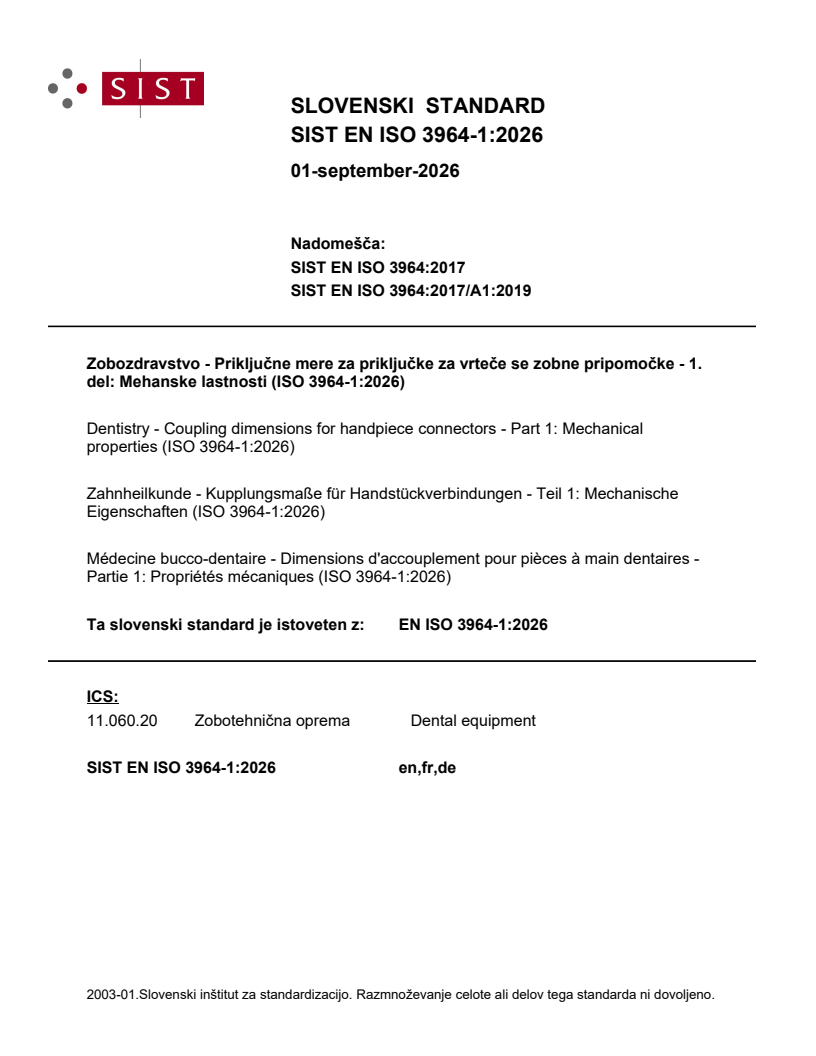
SLOVENSKI STANDARD
01-september-2026
Nadomešča:
SIST EN ISO 3964:2017
SIST EN ISO 3964:2017/A1:2019
Zobozdravstvo - Priključne mere za priključke za vrteče se zobne pripomočke - 1.
del: Mehanske lastnosti (ISO 3964-1:2026)
Dentistry - Coupling dimensions for handpiece connectors - Part 1: Mechanical
properties (ISO 3964-1:2026)
Zahnheilkunde - Kupplungsmaße für Handstückverbindungen - Teil 1: Mechanische
Eigenschaften (ISO 3964-1:2026)
Médecine bucco-dentaire - Dimensions d'accouplement pour pièces à main dentaires -
Partie 1: Propriétés mécaniques (ISO 3964-1:2026)
Ta slovenski standard je istoveten z: EN ISO 3964-1:2026
ICS:
11.060.20 Zobotehnična oprema Dental equipment
2003-01.Slovenski inštitut za standardizacijo. Razmnoževanje celote ali delov tega standarda ni dovoljeno.
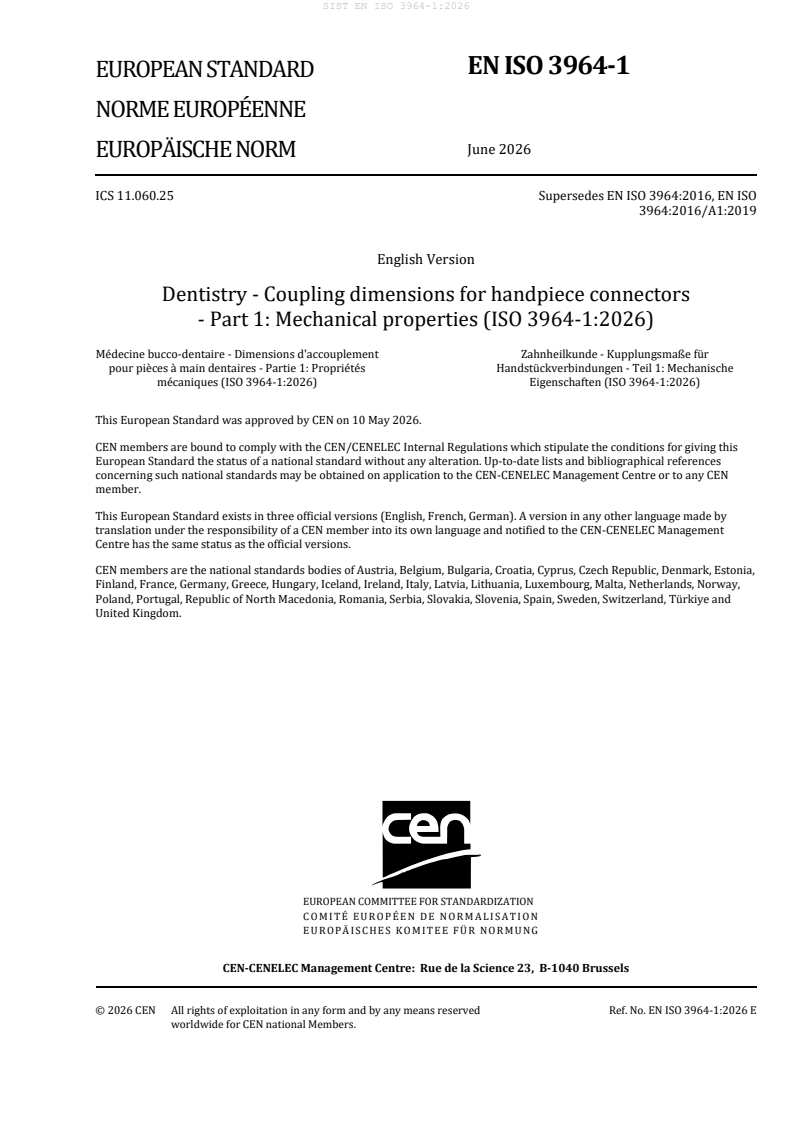
EN ISO 3964-1
EUROPEAN STANDARD
NORME EUROPÉENNE
June 2026
EUROPÄISCHE NORM
ICS 11.060.25 Supersedes EN ISO 3964:2016, EN ISO
3964:2016/A1:2019
English Version
Dentistry - Coupling dimensions for handpiece connectors
- Part 1: Mechanical properties (ISO 3964-1:2026)
Médecine bucco-dentaire - Dimensions d'accouplement Zahnheilkunde - Kupplungsmaße für
pour pièces à main dentaires - Partie 1: Propriétés Handstückverbindungen - Teil 1: Mechanische
mécaniques (ISO 3964-1:2026) Eigenschaften (ISO 3964-1:2026)
This European Standard was approved by CEN on 10 May 2026.
CEN members are bound to comply with the CEN/CENELEC Internal Regulations which stipulate the conditions for giving this
European Standard the status of a national standard without any alteration. Up-to-date lists and bibliographical references
concerning such national standards may be obtained on application to the CEN-CENELEC Management Centre or to any CEN
member.
This European Standard exists in three official versions (English, French, German). A version in any other language made by
translation under the responsibility of a CEN member into its own language and notified to the CEN-CENELEC Management
Centre has the same status as the official versions.
CEN members are the national standards bodies of Austria, Belgium, Bulgaria, Croatia, Cyprus, Czech Republic, Denmark, Estonia,
Finland, France, Germany, Greece, Hungary, Iceland, Ireland, Italy, Latvia, Lithuania, Luxembourg, Malta, Netherlands, Norway,
Poland, Portugal, Republic of North Macedonia, Romania, Serbia, Slovakia, Slovenia, Spain, Sweden, Switzerland, Türkiye and
United Kingdom.
EUROPEAN COMMITTEE FOR STANDARDIZATION
COMITÉ EUROPÉEN DE NORMALISATION
EUROPÄISCHES KOMITEE FÜR NORMUNG
CEN-CENELEC Management Centre: Rue de la Science 23, B-1040 Brussels
© 2026 CEN All rights of exploitation in any form and by any means reserved Ref. No. EN ISO 3964-1:2026 E
worldwide for CEN national Members.
Contents Page
European foreword . 3
European foreword
This document (EN ISO 3964-1:2026) has been prepared by Technical Committee ISO/TC 106
"Dentistry" in collaboration with Technical Committee CEN/TC 55 “Dentistry” the secretariat of which
is held by DIN.
This European Standard shall be given the status of a national standard, either by publication of an
identical text or by endorsement, at the latest by December 2026, and conflicting national standards
shall be withdrawn at the latest by December 2026.
Attention is drawn to the possibility that some of the elements of this document may be the subject of
patent rights. CEN shall not be held responsible for identifying any or all such patent rights.
This document supersedes EN ISO 3964:2016.
Any feedback and questions on this document should be directed to the users’ national standards
body/national committee. A complete listing of these bodies can be found on the CEN website.
According to the CEN-CENELEC Internal Regulations, the national standards organizations of the
following countries are bound to implement this European Standard: Austria, Belgium, Bulgaria,
Croatia, Cyprus, Czech Republic, Denmark, Estonia, Finland, France, Germany, Greece, Hungary, Iceland,
Ireland, Italy, Latvia, Lithuania, Luxembourg, Malta, Netherlands, Norway, Poland, Portugal, Republic of
North Macedonia, Romania, Serbia, Slovakia, Slovenia, Spain, Sweden, Switzerland, Türkiye and the
United Kingdom.
Endorsement notice
The text of ISO 3964-1:2026 has been approved by CEN as EN ISO 3964-1:2026 without any
modification.
International
Standard
ISO 3964-1
First edition
Dentistry — Coupling dimensions
2026-06
for handpiece connectors —
Part 1:
Mechanical properties
Médecine bucco-dentaire — Dimensions d'accouplement pour
pièces à main dentaires —
Partie 1: Propriétés mécaniques
Reference number
ISO 3964-1:2026(en) © ISO 2026
ISO 3964-1:2026(en)
© ISO 2026
All rights reserved. Unless otherwise specified, or required in the context of its implementation, no part of this publication may
be reproduced or utilized otherwise in any form or by any means, electronic or mechanical, including photocopying, or posting on
the internet or an intranet, without prior written permission. Permission can be requested from either ISO at the address below
or ISO’s member body in the country of the requester.
ISO copyright office
CP 401 • Ch. de Blandonnet 8
CH-1214 Vernier, Geneva
Phone: +41 22 749 01 11
Email: copyright@iso.org
Website: www.iso.org
Published in Switzerland
ii
ISO 3964-1:2026(en)
Contents Page
Foreword .iv
1 Scope . 1
2 Normative references . 1
3 Terms and definitions . 1
4 Classification according to the supply of water, air and light . 2
5 Requirements . 2
5.1 General .2
5.2 Dimensions .2
5.3 Coupling force . .16
6 Sampling . 16
7 Test methods .16
7.1 Dimensions .16
7.2 Coupling force .16
iii
ISO 3964-1:2026(en)
Foreword
ISO (the International Organization for Standardization) is a worldwide federation of national standards
bodies (ISO member bodies). The work of preparing International Standards is normally carried out through
ISO technical committees. Each member body interested in a subject for which a technical committee
has been established has the right to be represented on that committee. International organizations,
governmental and non-governmental, in liaison with ISO, also take part in the work. ISO collaborates closely
with the International Electrotechnical Commission (IEC) on all matters of electrotechnical standardization.
The procedures used to develop this document and those intended for its further maintenance are described
in the ISO/IEC Directives, Part 1. In particular, the different approval criteria needed for the different types
of ISO document should be noted. This document was drafted in accordance with the editorial rules of the
ISO/IEC Directives, Part 2 (see www.iso.org/directives).
ISO draws attention to the possibility that the implementation of this document may involve the use of (a)
patent(s). ISO takes no position concerning the evidence, validity or applicability of any claimed patent
rights in respect thereof. As of the date of publication of this document, ISO had not received notice of (a)
patent(s) which may be required to implement this document. However, implementers are cautioned that
this may not represent the latest information, which may be obtained from the patent database available at
www.iso.org/patents. ISO shall not be held responsible for identifying any or all such patent rights.
Any trade name used in this document is information given for the convenience of users and does not
constitute an endorsement.
For an explanation of the voluntary nature of standards, the meaning of ISO specific terms and expressions
related to conformity assessment, as well as information about ISO's adherence to the World Trade
Organization (WTO) principles in the Technical Barriers to Trade (TBT), see www.iso.org/iso/foreword.html.
This document was prepared by Technical Committee ISO/TC 106, Dentistry, Subcommittee SC 4, Dental
instruments, in collaboration with the European Committee for Standardization (CEN) Technical Committee
CEN/TC 55, Dentistry, in accordance with the Agreement on technical cooperation between ISO and CEN
(Vienna Agreement).
This first edition cancels and replaces ISO 3964:2016, which has been technically revised. It also incorporates
the Amendment ISO 3964:2016/Amd 1:2018.
The main changes are as follows:
— the technical drawings have been improved;
— new dimensions and optional figures have been added.
A list of all parts in the ISO 3964 series can be found on the ISO website.
Any feedback or questions on this document should be directed to the user’s national standards body. A
complete listing of these bodies can be found at www.iso.org/members.html.
iv
International Standard ISO 3964-1:2026(en)
Dentistry — Coupling dimensions for handpiece
connectors —
Part 1:
Mechanical properties
1 Scope
This document specifies coupling between handpieces and motors that are connected to dental units. For
the purposes of this document, the couplings described in this document are not equipped with electronic
terminal(s).
This document specifies the nominal dimensions, tolerances and extraction force of coupling systems for use
between handpieces and motor which supply the handpiece with water, air and light and rotation energy.
2 Normative references
The following documents, in whole or in part, are normatively referenced in this document and are
indispensable for its application. For dated references, only the edition cite
...