


SIST EN ISO 20430:2021
(Main)Plastics and rubber machines - Injection moulding machines - Safety requirements (ISO 20430:2020)
Plastics and rubber machines - Injection moulding machines - Safety requirements (ISO 20430:2020)
This document specifies the essential safety requirements for the design and construction of injection moulding machines for the processing of plastics and/or rubber and provides information for their safe use.
This document is applicable only to injection moulding machines with hydraulic and/or electrical drives for platen movement.
This document deals with all significant hazards, hazardous situations and events relevant to injection moulding machines, when they are used as intended and under conditions of misuse which are reasonably foreseeable by the manufacturer (see Annex A) during the life cycle of the machinery (see ISO 12100:2010, 5.4).
The following are not covered:
— machines on which the clamping unit can only be operated by the physical force of the operator;
— machines for which the hydraulic jack can only be manually operated;
— injection blow moulding machines;
— machines for reaction injection moulding;
— compression moulding machines and transfer moulding machines;
— direct-on sole moulding machines, unit sole and footwear component moulding machines, full shoe and boot moulding machines;
— design of an exhaust system;
— design and construction of the mould.
NOTE Moulds and exhaust systems are not part of the machinery.
This document is not applicable to injection moulding machines which are manufactured before the date of its publication.
Kunststoff- und Gummimaschinen - Spritzgießmaschinen - Sicherheitsanforderungen (ISO 20430:2020)
Dieses Dokument legt die wesentlichen Sicherheitsanforderungen für die Konstruktion und den Bau von Spritzgießmaschinen für die Verarbeitung von Kunststoff und/oder Gummi fest und enthält Informationen für deren sichere Verwendung.
Dieses Dokument gilt nur für Spritzgießmaschinen mit hydraulischen und/oder elektrischen Antrieben für die Bewegung der Aufspannplatte.
Dieses Dokument behandelt alle signifikanten Gefährdungen, Gefährdungssituationen oder Gefährdungsereignisse, die auf Spritzgießmaschinen zutreffen, wenn sie bestimmungsgemäß und unter Bedingungen der missbräuchlichen Verwendung, die vom Hersteller während des Lebenszyklus der Maschine (siehe ISO 12100:2010, 5.4) vernünftigerweise vorhersehbar sind, verwendet werden (siehe Anhang A).
Folgende sind nicht erfasst:
— Maschinen, bei denen die Schließeinheit nur durch die körperliche Kraft der Bedienperson betrieben werden kann;
— Maschinen, bei denen die hydraulische Hubeinrichtung nur manuell bedient werden kann;
— Spritzblasformmaschinen;
— Maschinen für das Reaktionsgießen;
— Formpressen und Spritzpressen;
— Direktansohlmaschinen, Sohlen- und Schuhteileformmaschinen, Schuh- und Stiefelformmaschinen;
— Konstruktion eines Absaugsystems;
— Konstruktion und Bau des Werkzeugs.
ANMERKUNG Werkzeuge und Absaugsysteme sind nicht Teil der Maschine.
Dieses Dokument gilt nicht für Spritzgießmaschinen, die vor dem Datum ihrer Veröffentlichung hergestellt wurden.
Machines pour les matières plastiques et le caoutchouc - Machines de moulage par injection - Prescription de sécurité (ISO 20430:2020)
Le présent document spécifie les exigences essentielles de sécurité applicables à la conception et à la construction des machines de moulage par injection qui sont utilisées pour le moulage des matières plastiques et/ou du caoutchouc et fournit des informations pour leur utilisation en toute sécurité.
Le présent document s'applique uniquement aux machines de moulage par injection à actionneurs hydrauliques et/ou électriques pour les mouvements du plateau.
Le présent document traite de tous les phénomènes dangereux, situations dangereuses et événements dangereux significatifs applicables aux machines de moulage par injection, dans le cadre d'une utilisation normale ou d'un mauvais usage raisonnablement prévisible par le fabricant (voir Annexe A) pendant leur cycle de vie (voir ISO 12100:2010, 5.4).
Les machines et éléments suivants sont exclus:
— machines dont l'unité de fermeture ne peut être actionnée que par la force de l'opérateur;
— machines dont le vérin hydraulique ne peut être actionné que manuellement;
— machines de moulage par injection-soufflage;
— machines de moulage par injection et réaction;
— machines de moulage par compression et machines de moulage par transfert;
— machines de moulage direct de semelles, machines de moulage de semelles et de composants d'articles chaussants, machines de moulage de chaussures et bottes complètes;
— conception d'un système d'aspiration;
— conception et construction du moule.
NOTE Les moules et systèmes d'évacuation ne font pas partie des machines.
Le présent document ne s'applique pas aux machines de moulage par injection fabriquées avant sa date de publication.
Stroji za predelavo gume in plastike - Stroji za brizgalno vlivanje - Varnostne zahteve (ISO 20430:2020)
General Information
- Status
- Published
- Public Enquiry End Date
- 04-Apr-2017
- Publication Date
- 14-Jan-2021
- Technical Committee
- VSN - Safety of machinery
- Current Stage
- 6060 - National Implementation/Publication (Adopted Project)
- Start Date
- 09-Jul-2020
- Due Date
- 13-Sep-2020
- Completion Date
- 15-Jan-2021
Relations
- Replaces
SIST EN 201:2009 - Plastics and rubber machines - Injection moulding machines - Safety requirements - Effective Date
- 08-Jul-2020
Overview
EN ISO 20430:2020 - "Plastics and rubber machines - Injection moulding machines - Safety requirements" specifies essential safety requirements for the design, construction and safe use of injection moulding machines used for processing plastics and/or rubber. It applies to machines with hydraulic and/or electrical drives for platen movement and addresses significant hazards, foreseeable misuse and lifecycle considerations in line with ISO 12100:2010. The standard excludes manually‑operated clamping or hydraulic jacks, injection blow moulding, reaction injection, compression/transfer moulding, mould design and exhaust systems.
Key Topics
The standard covers practical safety measures and risk-reduction requirements, including:
- Basic machine controls: start, stop, restart and emergency stop design and behaviour.
- Physical guards and protective devices: fixed guards, interlocks and electro‑sensitive protective equipment (ESPE) such as light curtains.
- Control interfaces: requirements for two‑hand controls, pressure‑sensitive mats/floors and control guards.
- Automatic monitoring: safety monitoring of cycles, position and interlocks to prevent hazardous movements.
- Mould area hazards: protections against platen closing forces, access control where whole‑body entry is possible, and specific measures for downstroking/upstroking platens or toggle systems.
- Thermal and mechanical hazards: nozzle, injection unit and mould‑related hot surfaces and moving parts.
- Maintenance and servicing: safe procedures, isolation of energy sources and hazards during adjustment and repair.
- Other risks: hydraulic/pneumatic system failures, release of fluids under pressure, electrical hazards and electromagnetic interference, noise, fumes/gases/dust, and slip/trip/fall issues.
- Documentation and lifecycle: instructions for safe use, foreseeable misuse, and informative annexes listing significant hazards and conformity guidance.
Applications and Who Uses It
EN ISO 20430:2020 is intended for:
- Machine manufacturers and designers to integrate compliant safety features during design and production.
- Safety engineers and compliance officers for risk assessment, CE marking and demonstrating conformity with Directive 2006/42/EC (see Annex ZA).
- Plant engineers, maintenance teams and machine operators to understand required protective measures and safe operating/maintenance practices.
- System integrators and purchasers specifying safe injection moulding equipment for plastics and rubber production.
Using this standard helps reduce workplace injuries, ensures consistent machine safety across installations, and supports regulatory compliance for injection moulding machines.
Related standards
- ISO 12100:2010 (machine risk assessment and design principles)
- EN ISO 20430:2020 replaces EN 201:2009 and references relevant type‑A and type‑B machine safety standards for specific measures.



Frequently Asked Questions
SIST EN ISO 20430:2021 is a standard published by the Slovenian Institute for Standardization (SIST). Its full title is "Plastics and rubber machines - Injection moulding machines - Safety requirements (ISO 20430:2020)". This standard covers: This document specifies the essential safety requirements for the design and construction of injection moulding machines for the processing of plastics and/or rubber and provides information for their safe use. This document is applicable only to injection moulding machines with hydraulic and/or electrical drives for platen movement. This document deals with all significant hazards, hazardous situations and events relevant to injection moulding machines, when they are used as intended and under conditions of misuse which are reasonably foreseeable by the manufacturer (see Annex A) during the life cycle of the machinery (see ISO 12100:2010, 5.4). The following are not covered: — machines on which the clamping unit can only be operated by the physical force of the operator; — machines for which the hydraulic jack can only be manually operated; — injection blow moulding machines; — machines for reaction injection moulding; — compression moulding machines and transfer moulding machines; — direct-on sole moulding machines, unit sole and footwear component moulding machines, full shoe and boot moulding machines; — design of an exhaust system; — design and construction of the mould. NOTE Moulds and exhaust systems are not part of the machinery. This document is not applicable to injection moulding machines which are manufactured before the date of its publication.
This document specifies the essential safety requirements for the design and construction of injection moulding machines for the processing of plastics and/or rubber and provides information for their safe use. This document is applicable only to injection moulding machines with hydraulic and/or electrical drives for platen movement. This document deals with all significant hazards, hazardous situations and events relevant to injection moulding machines, when they are used as intended and under conditions of misuse which are reasonably foreseeable by the manufacturer (see Annex A) during the life cycle of the machinery (see ISO 12100:2010, 5.4). The following are not covered: — machines on which the clamping unit can only be operated by the physical force of the operator; — machines for which the hydraulic jack can only be manually operated; — injection blow moulding machines; — machines for reaction injection moulding; — compression moulding machines and transfer moulding machines; — direct-on sole moulding machines, unit sole and footwear component moulding machines, full shoe and boot moulding machines; — design of an exhaust system; — design and construction of the mould. NOTE Moulds and exhaust systems are not part of the machinery. This document is not applicable to injection moulding machines which are manufactured before the date of its publication.
SIST EN ISO 20430:2021 is classified under the following ICS (International Classification for Standards) categories: 83.200 - Equipment for the rubber and plastics industries. The ICS classification helps identify the subject area and facilitates finding related standards.
SIST EN ISO 20430:2021 has the following relationships with other standards: It is inter standard links to SIST EN 201:2009. Understanding these relationships helps ensure you are using the most current and applicable version of the standard.
SIST EN ISO 20430:2021 is associated with the following European legislation: EU Directives/Regulations: 2006/42/EC; Standardization Mandates: M/396, M/BC/CEN/88/13. When a standard is cited in the Official Journal of the European Union, products manufactured in conformity with it benefit from a presumption of conformity with the essential requirements of the corresponding EU directive or regulation.
SIST EN ISO 20430:2021 is available in PDF format for immediate download after purchase. The document can be added to your cart and obtained through the secure checkout process. Digital delivery ensures instant access to the complete standard document.
Standards Content (Sample)
SLOVENSKI STANDARD
01-februar-2021
Nadomešča:
SIST EN 201:2009
Stroji za predelavo gume in plastike - Stroji za brizgalno vlivanje - Varnostne
zahteve (ISO 20430:2020)
Plastics and rubber machines - Injection moulding machines - Safety requirements (ISO
20430:2020)
Kunststoff- und Gummimaschinen - Spritzgießmaschinen - Sicherheitsanforderungen
(ISO 20430:2020)
Machines pour les matières plastiques et le caoutchouc - Machines de moulage par
injection - Prescription de sécurité (ISO 20430:2020)
Ta slovenski standard je istoveten z: EN ISO 20430:2020
ICS:
83.200 Oprema za gumarsko Equipment for the rubber and
industrijo in industrijo plastics industries
polimernih materialov
2003-01.Slovenski inštitut za standardizacijo. Razmnoževanje celote ali delov tega standarda ni dovoljeno.
EN ISO 20430
EUROPEAN STANDARD
NORME EUROPÉENNE
July 2020
EUROPÄISCHE NORM
ICS 83.200 Supersedes EN 201:2009
English Version
Plastics and rubber machines - Injection moulding
machines - Safety requirements (ISO 20430:2020)
Machines pour les matières plastiques et le caoutchouc Kunststoff- und Gummimaschinen -
- Machines de moulage par injection - Prescription de Spritzgießmaschinen - Sicherheitsanforderungen (ISO
sécurité (ISO 20430:2020) 20430:2020)
This European Standard was approved by CEN on 26 April 2020.
CEN members are bound to comply with the CEN/CENELEC Internal Regulations which stipulate the conditions for giving this
European Standard the status of a national standard without any alteration. Up-to-date lists and bibliographical references
concerning such national standards may be obtained on application to the CEN-CENELEC Management Centre or to any CEN
member.
This European Standard exists in three official versions (English, French, German). A version in any other language made by
translation under the responsibility of a CEN member into its own language and notified to the CEN-CENELEC Management
Centre has the same status as the official versions.
CEN members are the national standards bodies of Austria, Belgium, Bulgaria, Croatia, Cyprus, Czech Republic, Denmark, Estonia,
Finland, France, Germany, Greece, Hungary, Iceland, Ireland, Italy, Latvia, Lithuania, Luxembourg, Malta, Netherlands, Norway,
Poland, Portugal, Republic of North Macedonia, Romania, Serbia, Slovakia, Slovenia, Spain, Sweden, Switzerland, Turkey and
United Kingdom.
EUROPEAN COMMITTEE FOR STANDARDIZATION
COMITÉ EUROPÉEN DE NORMALISATION
EUROPÄISCHES KOMITEE FÜR NORMUNG
CEN-CENELEC Management Centre: Rue de la Science 23, B-1040 Brussels
© 2020 CEN All rights of exploitation in any form and by any means reserved Ref. No. EN ISO 20430:2020 E
worldwide for CEN national Members.
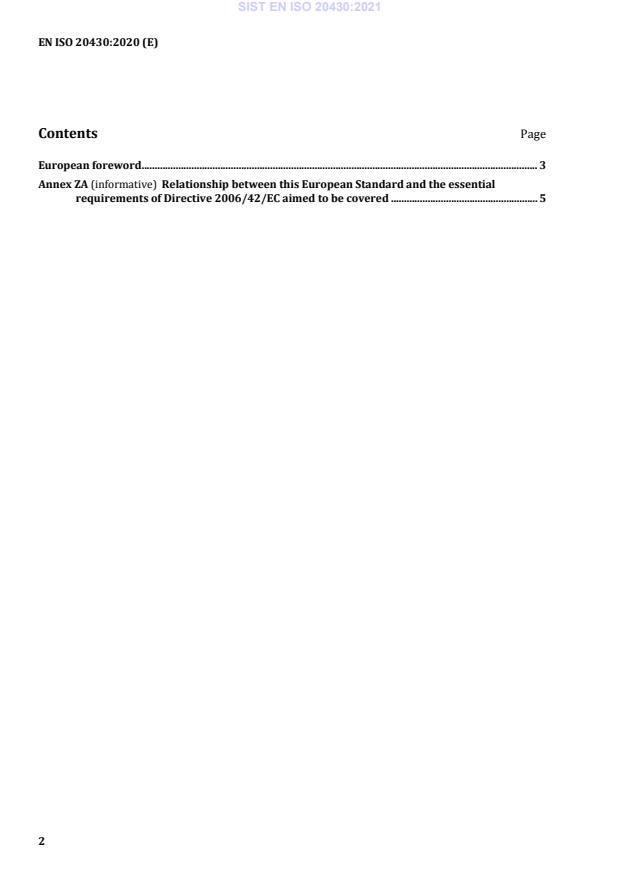
Contents Page
European foreword . 3
Annex ZA (informative) Relationship between this European Standard and the essential
requirements of Directive 2006/42/EC aimed to be covered . 5
European foreword
This document (EN ISO 20430:2020) has been prepared by Technical Committee ISO/TC 270 "Plastics
and rubber machines" in collaboration with Technical Committee CEN/TC 145 “Plastics and rubber
machines” the secretariat of which is held by UNI.
This European Standard shall be given the status of a national standard, either by publication of an
identical text or by endorsement, at the latest by January 2021, and conflicting national standards shall
be withdrawn at the latest by July 2022.
Attention is drawn to the possibility that some of the elements of this document may be the subject of
patent rights. CEN shall not be held responsible for identifying any or all such patent rights.
This document supersedes EN 201:2009.
Compared with EN 201:2009, the following significant technical changes have been made:
modification of the scope;
cancellation of the safety requirements for magnetic clamping systems;
cancellation of the safety requirements for other ancillary requirements;
adaption of the normative references and referring to ISO standards;
consideration of revised type-A and type-B standards;
moving of the list of significant hazards to an informative annex;
modification of the safety requirements and protective measures by taking into consideration the
technological progress in the plastics and rubber industry and the continuous development of the
safety technology;
modification of all annexes;
fundamental modification of the annexes specifying the protective types and addition of further
examples of application;
moving of the annex indicating the relationship between this European Standard and the Essential
Requirements of EU Directive 2006/42/EC to informative Annex ZA;
cancellation of the annex indicating the relationship between this European Standard and the
Essential Requirements of EU Directive 98/37/EC.
This document has been prepared under a mandate given to CEN by the European Commission and the
European Free Trade Association, and supports essential requirements of EU Directive(s).
For the relationship with EU Directive(s) see informative Annex ZA, which is an integral part of this
document.
According to the CEN-CENELEC Internal Regulations, the national standards organizations of the
following countries are bound to implement this European Standard: Austria, Belgium, Bulgaria,
Croatia, Cyprus, Czech Republic, Denmark, Estonia, Finland, France, Germany, Greece, Hungary, Iceland,
Ireland, Italy, Latvia, Lithuania, Luxembourg, Malta, Netherlands, Norway, Poland, Portugal, Republic of
North Macedonia, Romania, Serbia, Slovakia, Slovenia, Spain, Sweden, Switzerland, Turkey and the
United Kingdom.
Endorsement notice
The text of ISO 20430:2020 has been approved by CEN as EN ISO 20430:2020 without any modification.
Annex ZA
(informative)
Relationship between this European Standard and the essential
requirements of Directive 2006/42/EC aimed to be covered
This European Standard has been prepared under a Commission’s standardization request "M/396
Mandate to CEN and CENELEC for Standardisation in the field of Machinery" to provide one voluntary
means of conforming to essential requirements of Directive 2006/42/EC of the European Parliament
and the Council of 17 May 2006 on machinery, and amending Directive 95/16/EC (recast).
Once this standard is cited in the Official Journal of the European Union under that Directive,
compliance with the normative clauses of this standard given in Table ZA.1 confers, within the limits of
the scope of this standard, a presumption of conformity with the corresponding essential requirements
of that Directive and associated EFTA regulations.
Table ZA.1 — Correspondence between this European Standard and
Annex I of Directive 2006/42/EC
The relevant Essential
Clause(s)/subclause(s)
Requirements of Directive Remarks/Notes
of this EN
2006/42/EC (MD)
1.1.2 4, 5, 6
1.1.3 4.1, 4.8.2, 6.2.23
1.2.1 4.1.1
1.2.2 4.1.5, 4.2.1.3, 4.2.3.2, 4.2.7, 4.2.8,
4.8.10, Annex E, Annex F
1.2.3 4.1.2, 4.2.4
1.2.4.1 4.1.2.2
1.2.4.2 4.1.2.2
1.2.4.3 4.1.3
1.2.5 4.2.3.2, 4.5.1, 4.6.1
1.2.6 4.1.2.3, 4.8.10
1.3.2 4.8.1, 4.8.2, 4.9.4
1.3.3 4.5, 4.9.4, Annex H
1.3.7 4.1.4, 4.1.5, 4.1.6, 4.1.7, 4.2, 4.3,
4.4, 4.5, 4.6, 4.7, 4.8.10, 4.9,
Annex B, Annex C, Annex D,
Annex E, Annex F
1.3.8 4.1.4, 4.1.5, 4.1.6, 4.1.7, 4.2, 4.3,
4.4, 4.5, 4.6, 4.7, 4.8.10, 4.9,
Annex B, Annex C, Annex D,
Annex E, Annex F
The relevant Essential
Clause(s)/subclause(s)
Requirements of Directive Remarks/Notes
of this EN
2006/42/EC (MD)
1.3.9 4.1.8, 4.2.6, 4.3.2, 4.3.3, Annex B,
Annex C, Annex D, Annex E
1.4 4.1.4, 4.1.5, 4.1.6, 4.1.7, 4.2, 4.3,
4.4, 4.5, 4.6, 4.7, 4.8.10, 4.9
1.5.1 4.8.4
1.5.3 4.8.9
1.5.4 4.8.3
1.5.5 4.2.5, 4.5, 4.6.2, 4.6.3, 4.8.5
1.5.8 4.8.6, Annex I
1.5.10 4.8.4
1.5.11 4.8.4
1.5.13 4.8.1, 4.8.2, 4.8.7
1.5.14 4.2.7, 4.2.8
1.5.15 4.8.8
1.6.1 4.2.6, 4.3.2, 4.8.3, 4.8.8
1.6.2 4.8.8
1.6.3 4.1.1
1.7.1 4.8.8, 6.1, 6.4, 6.5
1.7.1.2 4.2.3.2, 4.8.11, 4.9.3, 4.9.4.3,
4.9.4.4, 6.5, Annex F, F.2
1.7.2 4.2.3.2, 4.8.11, 6.4
1.7.3 6.2.21, 6.3, Annex H
1.7.4.1 6.1
1.7.4.2 6.2, Annex I
1.7.4.3 6.2.24, Annex I
WARNING 1 — Presumption of conformity stays valid only as long as a reference to this European
Standard is maintained in the list published in the Official Journal of the European Union. Users of this
standard should consult frequently the latest list published in the Official Journal of the European
Union.
WARNING 2 — Other Union legislation may be applicable to the product(s) falling within the scope of
this standard.
INTERNATIONAL ISO
STANDARD 20430
First edition
2020-04
Plastics and rubber machines —
Injection moulding machines — Safety
requirements
Machines pour les matières plastiques et le caoutchouc — Machines
de moulage par injection — Prescription de sécurité
Reference number
ISO 20430:2020(E)
©
ISO 2020
ISO 20430:2020(E)
© ISO 2020
All rights reserved. Unless otherwise specified, or required in the context of its implementation, no part of this publication may
be reproduced or utilized otherwise in any form or by any means, electronic or mechanical, including photocopying, or posting
on the internet or an intranet, without prior written permission. Permission can be requested from either ISO at the address
below or ISO’s member body in the country of the requester.
ISO copyright office
CP 401 • Ch. de Blandonnet 8
CH-1214 Vernier, Geneva
Phone: +41 22 749 01 11
Fax: +41 22 749 09 47
Email: copyright@iso.org
Website: www.iso.org
Published in Switzerland
ii © ISO 2020 – All rights reserved
ISO 20430:2020(E)
Contents Page
Foreword .vi
Introduction .vii
1 Scope . 1
2 Normative references . 1
3 Terms, definitions and abbreviated terms . 3
3.1 Terms and definitions . 3
3.2 Abbreviated terms .11
4 Safety requirements and/or protective/risk reduction measures .11
4.1 Basic requirements .11
4.1.1 General.11
4.1.2 Start, stop and restart functions .11
4.1.3 Emergency stop .12
4.1.4 Guards .12
4.1.5 ESPE in the form of light curtains .15
4.1.6 Two-hand control devices .15
4.1.7 Pressure-sensitive mats, floors and edges .16
4.1.8 Requirements for automatic monitoring .16
4.1.9 Movements caused by gravity during production .17
4.2 Mould area .17
4.2.1 Hazards due to the closing movement of the platen during production .17
4.2.2 Hazards due to the closing movement of the platen on sides of the
machine where a cycle cannot be initiated .19
4.2.3 Hazards due to movements other than the closing movement of the platen
during production .20
4.2.4 Use of control guards .21
4.2.5 Thermal hazards .24
4.2.6 Additional safety requirements for machines with a downstroking platen .24
4.2.7 Additional requirements for machines where whole-body access is
possible between the interlocking guard or light curtain for the mould
area and the mould area itself .25
4.2.8 Additional requirements for machines where whole-body access to the
mould area is possible . . .26
4.3 Clamping mechanism area or area behind the movable platen .28
4.3.1 Basic safety requirements .28
4.3.2 Additional safety requirements for machines with an upstroking platen .28
4.3.3 Additional requirements for machines with toggle systems .29
4.4 Area of movement of cores and ejectors and their drive mechanisms outside the
mould and/or clamping mechanism areas .29
4.5 Nozzle area .29
4.5.1 Mechanical hazards .29
4.5.2 Thermal hazards .30
4.6 Injection unit area .30
4.6.1 Mechanical hazards .30
4.6.2 Thermal hazards .31
4.6.3 Mechanical and/or thermal hazards .32
4.7 Discharge area .32
4.8 Safety requirements and/or protective measures against hazards not associated
with a particular area of the machine .33
4.8.1 Hazards due to flexible hoses .33
4.8.2 Release of fluids under pressure .33
4.8.3 Hazards during adjustment and maintenance .33
4.8.4 Electrical hazards and hazards due to electromagnetic interference .33
4.8.5 Thermal hazards .34
ISO 20430:2020(E)
4.8.6 Hazards generated by noise .34
4.8.7 Hazards generated by gases, fumes and dusts .34
4.8.8 Slip, trip and fall hazards .35
4.8.9 Hydraulic and pneumatic systems.35
4.8.10 Power-operated guards .35
4.8.11 Hazards due to unintentionally interrupted forward movement of the
screw/piston .35
4.9 Additional safety requirements and/or protective measures associated with
specific machine design.36
4.9.1 Shuttle-table machines/machines with sliding table/platen and turn-
table machines and carousel machines .36
4.9.2 Multi-station machines with mobile injection unit .36
4.9.3 Cellular foam injection moulding machines .36
4.9.4 Additional requirements for machines where the injection unit discharges
towards the operating position .37
5 Verification of the safety requirements and/or protective measures .39
6 Information for use .41
6.1 General .41
6.2 Instruction handbook .42
6.2.1 General.42
6.2.2 Emergency stop .42
6.2.3 Overall system stopping performance .42
6.2.4 Stopping time .42
6.2.5 Light curtains .42
6.2.6 Moulds and extensions .42
6.2.7 Movements of cores and ejectors .42
6.2.8 Machines with toggle systems .43
6.2.9 Machines with a downstroking or upstroking platen .43
6.2.10 Thermal hazards in the mould area .43
6.2.11 Maintenance operations on machines with vertical clamping unit .43
6.2.12 Machines where whole-body access is possible .43
6.2.13 Presence detecting devices in the mould area .43
6.2.14 Injection unit .43
6.2.15 Machines where the injection unit discharges towards the operating position .44
6.2.16 Interrupted forward movement of the screw/piston .44
6.2.17 Flexible hose assemblies .44
6.2.18 Adjustment and maintenance .44
6.2.19 Exhaust system .44
6.2.20 Non-permanent safe means of access .44
6.2.21 Designated access and working positions .45
6.2.22 Cellular foam injection moulding .45
6.2.23 Cleaning of hydraulic system .45
6.2.24 Noise emission .45
6.2.25 Splashing hazards where two-hand control devices are used .45
6.3 Marking .45
6.4 Warning signs .46
6.5 Warning devices .46
Annex A (informative) List of significant hazards.47
Annex B (normative) Protective Type I .55
Annex C (normative) Protective Type II .67
Annex D (normative) Protective Type III .81
Annex E (normative) Two-hand control device for the mould area.125
Annex F (normative) Acknowledgement system .136
Annex G (normative) Use of proportional valves for the platen movement .137
iv © ISO 2020 – All rights reserved
ISO 20430:2020(E)
Annex H (informative) Warning signs, prohibition signs and mandatory action signs .138
Annex I (normative) Noise test code .142
Bibliography .148
ISO 20430:2020(E)
Foreword
ISO (the International Organization for Standardization) is a worldwide federation of national standards
bodies (ISO member bodies). The work of preparing International Standards is normally carried out
through ISO technical committees. Each member body interested in a subject for which a technical
committee has been established has the right to be represented on that committee. International
organizations, governmental and non-governmental, in liaison with ISO, also take part in the work.
ISO collaborates closely with the International Electrotechnical Commission (IEC) on all matters of
electrotechnical standardization.
The procedures used to develop this document and those intended for its further maintenance are
described in the ISO/IEC Directives, Part 1. In particular, the different approval criteria needed for the
different types of ISO documents should be noted. This document was drafted in accordance with the
editorial rules of the ISO/IEC Directives, Part 2 (see www .iso .org/ directives).
Attention is drawn to the possibility that some of the elements of this document may be the subject of
patent rights. ISO shall not be held responsible for identifying any or all such patent rights. Details of
any patent rights identified during the development of the document will be in the Introduction and/or
on the ISO list of patent declarations received (see www .iso .org/ patents).
Any trade name used in this document is information given for the convenience of users and does not
constitute an endorsement.
For an explanation of the voluntary nature of standards, the meaning of ISO specific terms and
expressions related to conformity assessment, as well as information about ISO's adherence to the
World Trade Organization (WTO) principles in the Technical Barriers to Trade (TBT) see www .iso .org/
iso/ foreword .html.
This document was prepared by Technical Committee ISO/TC 270, Plastics and rubber machines, in
collaboration with the European Committee for Standardization (CEN) Technical Committee CEN/TC
145, Plastics and rubber machines, in accordance with the Agreement on technical cooperation between
ISO and CEN (Vienna Agreement).
Any feedback or questions on this document should be directed to the user’s national standards body. A
complete listing of these bodies can be found at www .iso .org/ members .html.
vi © ISO 2020 – All rights reserved
ISO 20430:2020(E)
Introduction
This document is a type-C standard as stated in ISO 12100:2010.
This document is of relevance, in particular, for the following stakeholder groups representing the
market players with regard to machinery safety:
— machine manufacturers (small, medium and large enterprises);
— health and safety bodies (regulators, accident prevention organizations, market surveillance, etc.).
Others can be affected by the level of machinery safety achieved with the means of the document by the
above-mentioned stakeholder groups:
— machine distributors, resellers, rebuilders and integrators;
— machine users/employers (small, medium and large enterprises);
— machine operators/employees (e.g. trade unions, organizations for people with special needs);
— service providers, e.g. for maintenance (small, medium and large enterprises).
The above-mentioned stakeholder groups have been given the possibility to participate in the drafting
process of this document.
The machinery concerned and the extent to which hazards, hazardous situations or hazardous events
are covered are indicated in the Scope of this document.
When requirements of this type-C standard are different from those which are stated in type-A or
type-B standards, the requirements of this type-C standard take precedence over the requirements of
the other standards for machines that have been designed and built according to the requirements of
this type-C standard.
INTERNATIONAL STANDARD ISO 20430:2020(E)
Plastics and rubber machines — Injection moulding
machines — Safety requirements
1 Scope
This document specifies the essential safety requirements for the design and construction of injection
moulding machines for the processing of plastics and/or rubber and provides information for their
safe use.
This document is applicable only to injection moulding machines with hydraulic and/or electrical drives
for platen movement.
This document deals with all significant hazards, hazardous situations and events relevant to injection
moulding machines, when they are used as intended and under conditions of misuse which are
reasonably foreseeable by the manufacturer (see Annex A) during the life cycle of the machinery (see
ISO 12100:2010, 5.4).
The following are not covered:
— machines on which the clamping unit can only be operated by the physical force of the operator;
— machines for which the hydraulic jack can only be manually operated;
— injection blow moulding machines;
— machines for reaction injection moulding;
— compression moulding machines and transfer moulding machines;
— direct-on sole moulding machines, unit sole and footwear component moulding machines, full shoe
and boot moulding machines;
— design of an exhaust system;
— design and construction of the mould.
NOTE Moulds and exhaust systems are not part of the machinery.
This document is not applicable to injection moulding machines which are manufactured before the
date of its publication.
2 Normative references
The following documents are referred to in the text in such a way that some or all of their content
constitutes requirements of this document. For dated references, only the edition cited applies. For
undated references, the latest edition of the referenced document (including any amendments) applies.
ISO 1402:2009, Rubber and plastics hoses and hose assemblies — Hydrostatic testing
ISO 3744:2010, Acoustics — Determination of sound power levels and sound energy levels of noise sources
using sound pressure — Engineering methods for an essentially free field over a reflecting plane
ISO 3746:2010, Acoustics — Determination of sound power levels and sound energy levels of noise sources
using sound pressure — Survey method using an enveloping measurement surface over a reflecting plane
ISO 3747:2010, Acoustics — Determination of sound power levels and sound energy levels of noise sources
using sound pressure — Engineering/survey methods for use in situ in a reverberant environment
ISO 20430:2020(E)
ISO 4413:2010, Hydraulic fluid power — General rules and safety requirements for systems and their
components
ISO 4414:2010, Pneumatic fluid power — General rules and safety requirements for systems and their
components
ISO 4871:1996, Acoustics — Declaration and verification of noise emission values of machinery and
equipment
ISO 7751:2016, Rubber and plastics hoses and hose assemblies — Ratios of proof and burst pressure to
maximum working pressure
ISO 11201:2010, Acoustics — Noise emitted by machinery and equipment — Determination of emission
sound pressure levels at a work station and at other specified positions in an essentially free field over a
reflecting plane with negligible environmental corrections
ISO 11202:2010, Acoustics — Noise emitted by machinery and equipment — Determination of emission
sound pressure levels at a work station and at other specified positions applying approximate environmental
corrections
ISO 11204:2010, Acoustics — Noise emitted by machinery and equipment — Determination of emission
sound pressure levels at a work station and at other specified positions applying accurate environmental
corrections
ISO 12100:2010, Safety of machinery — General principles for design — Risk assessment and risk reduction
ISO 13732-1:2006, Ergonomics of the thermal environment — Methods for the assessment of human
responses to contact with surfaces — Part 1: Hot surfaces
ISO 13849-1:2015, Safety of machinery — Safety-related parts of control systems — Part 1: General
principles for design
ISO 13849-2:2012, Safety of machinery — Safety-related parts of control systems — Part 2: Validation
ISO 13850:2015, Safety of machinery — Emergency stop function — Principles for design
ISO 13851:2002, Safety of machinery — Two-hand control devices — Functional aspects and design
principles
ISO 13855:2010, Safety of machinery — Positioning of safeguards with respect to the approach speeds of
parts of the human body
ISO 13856-1:2013, Safety of machinery — Pressure-sensitive protective devices — Part 1: General principles
for design and testing of pressure-sensitive mats and pressure-sensitive floors
ISO 13856-2:2013, Safety of machinery — Pressure-sensitive protective devices — Part 2: General
principles for design and testing of pressure-sensitive edges and pressure-sensitive bars
ISO 13857:2008, Safety of machinery — Safety distances to prevent hazard zones being reached by upper
and lower limbs
ISO 14118:2017, Safety of machinery — Prevention of unexpected start-up
ISO 14119:2013, Safety of machinery — Interlocking devices associated with guards — Principles for
design and selection
ISO 14120:2015, Safety of machinery — Guards — General requirements for the design and construction of
fixed and movable guards
ISO 14122-1:2016, Safety of machinery — Permanent means of access to machinery — Part 1: Choice of
fixed means and general requirements of access
2 © ISO 2020 – All rights reserved
ISO 20430:2020(E)
ISO 14122-2:2016, Safety of machinery — Permanent means of access to machinery — Part 2: Working
platforms and walkways
ISO 14122-3:2016, Safety of machinery — Permanent means of access to machinery — Part 3: Stairs,
stepladders and guard-rails
ISO 14122-4:2016, Safety of machinery — Permanent means of access to machinery — Part 4: Fixed ladders
IEC 60204-1:2016, Safety of machinery — Electrical equipment of machines — Part 1: General requirements
IEC 60947-5-3:2013, Low-voltage switchgear and controlgear — Part 5-3: Control circuit devices
and switching elements — Requirements for proximity devices with defined behaviour under fault
conditions (PDDB)
IEC 61496-1:2012, Safety of machinery — Electro-sensitive protective equipment — Part 1: General
requirements and tests
IEC 61496-2:2013, Safety of machinery — Electro-sensitive protective equipment — Part 2: Particular
requirements for equipment using active opto-electronic protective devices (AOPDs)
IEC 61496-3:2008, Safety of machinery — Electro-sensitive protective equipment — Part 3: Particular
requirements for active opto-electronic protective devices responsive to diffuse Reflection (AOPDDR)
IEC 61800-5-1:2007, Adjustable speed electrical power drive systems — Part 5-1: Safety requirements —
Electrical, thermal and energy
IEC 61800-5-2:2016, Adjustable speed electrical power drive systems — Part 5-2: Safety Requirements —
Functional
3 Terms, definitions and abbreviated terms
3.1 Terms and definitions
For the purposes of this document, the following terms and definitions given in ISO 12100:2010 and the
following apply.
ISO and IEC maintain terminological databases for use in standardization at the following addresses:
— ISO Online browsing platform: available at https:// www .iso .org/ obp
— IEC Electropedia: available at http:// www .electropedia .org/
3.1.1
injection moulding machine
machine for the cyclic production of moulded parts from plastics and/or rubber
Note 1 to entry: The material is injected through a nozzle into a mould (3.1.2) containing one or more cavities in
which the article is formed.
Note 2 to entry: An injection moulding machine essentially consists of one or more clamping units (3.1.6), one or
more injection units (3.1.8), drive and control systems.
Note 3 to entry: Examples of horizontal and vertical injection moulding machine are shown in Annex A.
3.1.2
mould
exchangeable part consisting of two or more halves clamped on the platens of the machine in which the
material is injected
ISO 20430:2020(E)
3.1.3
ejector
driven component (e.g. pin with linear movement) inside a mould (3.1.2) used for the ejection of the
moulded part(s) out of the opened mould
3.1.4
core
driven component inside a mould (3.1.2) for carrying out mould functions, e.g. enabling undercuts in
the moulded part
3.1.5
mould area
area between the platens where the mould (3.1.2) is fixed
3.1.6
clamping unit
part of the machine that holds, opens and closes the mould (3.1.2)
3.1.7
clamping mechanism area
area which comprises mechanisms for the movement of the movable platen and/or the application of
the clamping force
3.1.8
injection unit
unit for processing (plasticizing and/or homogenizing) and delivering material through a nozzle
3.1.9
carousel machine
machine consisting of two or more clamping units (3.1.6) mounted on a carousel in either a vertical or
horizontal configuration to index on one or more fixed injection units (3.1.8)
Note 1 to entry: See Figure 1.
4 © ISO 2020 – All rights reserved
ISO 20430:2020(E)
Figure 1 — Example of a carousel machine, shown without guards
3.1.10
shuttle-table machine
machine with a sliding table/platen
machine designed to contain one or more parts of moulds (3.1.2) attached to a sliding table/platen
Note 1 to entry: The table/platen indexes the parts of the mould by a sliding movement between the loading/
unloading station and the injection position.
Note 2 to entry: See Figure 2.
ISO 20430:2020(E)
Figure 2 — Examples of shuttle-table machines (two stations left; single station right), shown
without guards for the movements of the table
3.1.11
turn-table machine
machine designed to contain one or more parts of moulds (3.1.2) attached to a rotating table
Note 1 to entry: The table indexes the parts of the mould by a rotary movement between the loading/unloading
station and the injection position.
Note 2 to entry: See Figure 3.
6 © ISO 2020 – All rights reserved
ISO 20430:2020(E)
Figure 3 — Example of a turn-table machine, shown without guards for the movements of
the table
3.1.12
multi-station machine with mobile injection unit
machine consisting of a mobile injection unit (3.1.8) which indexes between two or more stationary
clamping units (3.1.6)
Note 1 to entry: See Figures 4 and 5.
ISO 20430:2020(E)
Figure 4 — Example of multi-station machine with mobile injection unit, shown without guards
for the clamping units
Figure 5 — Example of multi-station machine with mobile injection unit, shown with guards for
the clamping units
8 © ISO 2020 – All rights reserved
ISO 20430:2020(E)
3.1.13
ancillary equipment
equipment which interacts with the injection moulding machine (3.1.1)
Note 1 to entry: Examples are pick and place device, robot, mould changing equipment, mould clamping system
or conveyor.
3.1.14
cellular foam injection moulding
injection moulding which involves either an entrained gas mixed into the melt or a granulate containing
a foaming agent to achieve a cellular-structured product
3.1.15
electrical axis
axis where the primary movement of the axis is initiated by electrical energy
3.1.16
hydraulic axis
axis where the primary movement of the axis is initiated by hydraulic energy
3.1.17
standstill
condition under which there is no movement of a machine part
Note 1 to entry: See Figure 6 for
...
Questions, Comments and Discussion
Ask us and Technical Secretary will try to provide an answer. You can facilitate discussion about the standard in here.
Loading comments...