

SIST-TS CEN/TS 16157-15:2026
(Main)Intelligent transport systems — DATEX II data exchange specifications for traffic management and information — Part 15: JSON Schema mapping
- Abstract
The CEN 16157 multipart standard specifies and defines component aspects supporting the shared use of data and information in the field of traffic and travel. The component aspects include the modelling approach, the data content, the data structure and relationships and the communications specification.
This document defines a mapping from UML models, compliant with EN 16157-1, into JavaScript Object Notation (JSON) using JSON Schema as specified in draft 2020-12 and subsequent versions.
The schema mapping conforms to the JSON format defined by the Internet Engineering Task Force (IETF) in RFC 8259.
In the context of describing generation of schema, this refers to the webtool made available as part of the CEN 16157 multipart standard, which can generate the JSON schema mapping specified in this document.
- Status
- Published
- Public Enquiry End Date
- 05-Aug-2026
- Publication Date
- 29-Oct-2026
- Technical Committee
- ITC - Information technology
- Current Stage
- 6060 - National Implementation/Publication (Adopted Project)
- Start Date
- 28-Oct-2026
- Due Date
- 02-Jan-2027
- Completion Date
- 30-Oct-2026

SIST-TS CEN/TS 16157-15:2026 is the Slovenian technical specification published by SIST for DATEX II traffic management and information. It specifies how UML models from EN 16157-1 are mapped into JSON Schema and JSON so systems can exchange DATEX II data in a consistent machine-readable form.
What does SIST-TS CEN/TS 16157-15:2026 specify?
SIST-TS CEN/TS 16157-15:2026 defines a schema mapping from UML models compliant with EN 16157-1 into JavaScript Object Notation (JSON) using JSON Schema draft 2020-12 and subsequent versions. The mapping follows the JSON format defined in RFC 8259, so the result is meant for JSON-based exchange and validation.
The document is organized into clauses on scope, normative references, symbols and abbreviations, document structure and namespaces, datatype mapping, enumeration mapping, class mapping, identifiable and versioned identifiable objects, model roots, and Level B extensions. In practice, that structure tells implementers how to generate schema files, how to name them, how to link them, and how to represent DATEX II model elements in JSON Schema.
What are the key requirements of SIST-TS CEN/TS 16157-15:2026?
File structure and namespaces
SIST-TS CEN/TS 16157-15:2026 requires each «D2Namespace» to be mapped to its own JSON Schema definition file. The file name pattern is DATEXII_<ModelBaseVersion>_<Namespace>.json, and cross-file references use $ref to point to definitions in the relevant namespace file.
This matters because DATEX II models are split across namespaces. A producer or tool chain has to generate one schema file per namespace and resolve links between them instead of putting everything into one file.
The schema skeleton uses $schema for the JSON Schema version and $defs for the generated definitions. title is optional, while description is for documentation purposes and is only generated when documentation is being produced.
Datatypes and special included types
SIST-TS CEN/TS 16157-15:2026 maps «D2Datatype» elements to JSON Schema definitions with the same name unless a special rule applies. The datatype table maps UML schemaType values to JSON types, formats, patterns, and limits, so implementers can carry over datatype constraints into the schema.
The practical effect is that datatype constraints from the UML model remain visible in JSON validation. For example, the mapping covers values such as base64Binary, date, dateTime, decimal, integer, string, time, and url, and it uses JSON Schema features such as format, pattern, contentEncoding, minimum, and exclusiveMinimum where appropriate.
The document also maps schemaTypeInclude for compound or reused structures such as MultiLingualString, VersionedReference, and Reference. That means multilingual content, references, and versioned references are not treated as plain strings - they are expanded into structured JSON Schema types with the expected member fields.
Enumerations, literals and backward-compatible extension
SIST-TS CEN/TS 16157-15:2026 maps each «D2Enumeration» and its «D2Literal» values to a JSON Schema enum in the order defined by the UML order property. The reserved literal extendedG is appended automatically to support backward-compatible extension.
That matters when a receiver may encounter values added later. The schema can still validate the known literals while reserving a slot for an extended value.
When an enumeration is used as the type of a «D2Attribute», the document uses a G-suffixed wrapper object. That wrapper allows the attribute to carry either one of the defined literals or extendedG, and it also provides extendedValueG when an extended value is needed.
Classes, attributes, relations and multiplicity
SIST-TS CEN/TS 16157-15:2026 maps «D2Class» elements to JSON Schema objects and adds an ExtensionTypeG pattern so classes can be extended. The properties are generated in a defined order: attributes first, then compositions, then the extension element.
This ordering matters for schema generation and for readable data models. Attributes are mapped according to their UML order, and compositions are also ordered by the association order values.
Single-valued attributes and relations map to a single $ref. Multi-valued ones map to arrays with minItems and maxItems when bounds are given. If a lower bound is not specified, the schema uses zero; if an upper bound is not specified, the array is unbounded in the schema.
The naming rules are also important. A «D2Attribute» name comes from schemaName if it is present, otherwise from the UML attribute name. A «D2Relation» name comes from the opposite association end name, or from the opposite class name in lower camel case.
For qualifying compositions, the document applies a special mapping: the lower bound is fixed to zero and the upper bound becomes unbounded. This is how the schema represents qualified associations that behave more like keyed collections than fixed-size links.
Identifiers, versions and references
SIST-TS CEN/TS 16157-15:2026 treats «D2Identifiable» and «D2VersionedIdentifiable» classes as class mappings with required identification properties. D2Identifiable requires idG, while D2VersionedIdentifiable requires both idG and versionG.
This matters for interoperability because reference targets must be uniquely identifiable. When a schema references one of these classes, the document uses Reference for D2Identifiable targets and VersionedReference for D2VersionedIdentifiable targets.
The targetClass tagged property controls the reference wrapper name. If no targetClass is present, the schema falls back to the ordinary reference structure. The document also notes name collisions that can arise from the fixed G suffix, which is useful when choosing UML names for implementation.
Root elements and Level B extensions
SIST-TS CEN/TS 16157-15:2026 generates a top-level element for each «D2ModelRoot» using the rootElement value. If the root class is a superclass, the wrapper type ending in G is referenced instead of the base class directly.
That is the entry point for documents or payloads built from the model. It gives implementers a defined starting point for serialization and validation.
For Level B extensions, the schema does not just reuse the generic extension placeholder. Instead, it introduces a specific extension type that collects the classes or literals added across the extension boundary, so the extended model remains explicit in the generated schema.
What terms does SIST-TS CEN/TS 16157-15:2026 define?
- UML (Unified Modeling Language) - the model language used as the source for the JSON Schema mapping.
- JSON (JavaScript Object Notation) - the data interchange format used for the generated schemas.
- LCC (lower camel case) - a naming style where the first letter is lower case, used in generated names.
- UCC (upper camel case) - a naming style where names start with a capital letter, used for wrapper names.
- URI (Uniform Resource Identifier) - an identifier form listed among the abbreviations.
- URL (Uniform Resource Locator) - a locator form listed among the abbreviations.
Who uses SIST-TS CEN/TS 16157-15:2026?
SIST-TS CEN/TS 16157-15:2026 is used by organisations and developers working with road traffic and travel information, especially traffic management organisations, infrastructure providers, service providers, and road administrations. It also matters to software teams that generate JSON Schema from UML or validate DATEX II messages.
In practice, users apply it when they need interoperable data exchange between traffic systems, message producers, and service platforms. It is relevant for schema generation, implementation of DATEX II interfaces, data validation, and integration of road traffic information services.
What changed in SIST-TS CEN/TS 16157-15:2026 from the previous edition?
SIST-TS CEN/TS 16157-15:2026 supersedes CEN/TS 17466.
Which standards are used with SIST-TS CEN/TS 16157-15:2026?
- EN 16157-1:2018, Part 1: Context and framework - this provides the overall DATEX II context and the UML model basis that Part 15 maps into JSON Schema.
- RFC 8259 - this defines the JSON format that the schema mapping follows.
- JSON Schema draft 2020-12 and subsequent versions - this is the schema language used for the mapping and the generated definition files.
What does the SIST-TS CEN/TS 16157-15:2026 document contain?
The document contains mapping rules for turning DATEX II UML models into JSON Schema files, including file naming, $ref linking, and namespace separation. It also includes tables for datatype mappings and included datatype structures, together with rules for enumeration wrappers and extension values.
Clause 8 covers class mapping, including standalone classes, classes with superclasses, superclass wrappers, attributes, relations, and qualifiers. Clause 9 covers identifiers and versioned references, clause 10 defines the model-root entry point, and clause 11 explains how Level B extensions are represented in the generated schema.
The text includes schema-pattern examples and wrapper structures to show how the generated JSON Schema should be organized. Those examples are there to support implementation, schema generation, and validation, rather than to define message content directly.
Relations
- Effective Date
- 07-Oct-2026
Get Certified
Connect with accredited certification bodies for this standard

BSI Group
BSI (British Standards Institution) is the business standards company that helps organizations make excellence a habit.

Great Wall Tianjin Quality Assurance Center
Established 1993, first batch to receive national accreditation with IAF recognition.
Hong Kong Quality Assurance Agency (HKQAA)
Hong Kong's leading certification body.
Sponsored listings
Frequently Asked Questions
SIST-TS CEN/TS 16157-15:2026 is a technical specification published by the Slovenian Institute for Standardization (SIST). Its full title is "Intelligent transport systems — DATEX II data exchange specifications for traffic management and information — Part 15: JSON Schema mapping". This standard covers: The CEN 16157 multipart standard specifies and defines component aspects supporting the shared use of data and information in the field of traffic and travel. The component aspects include the modelling approach, the data content, the data structure and relationships and the communications specification. This document defines a mapping from UML models, compliant with EN 16157-1, into JavaScript Object Notation (JSON) using JSON Schema as specified in draft 2020-12 and subsequent versions. The schema mapping conforms to the JSON format defined by the Internet Engineering Task Force (IETF) in RFC 8259. In the context of describing generation of schema, this refers to the webtool made available as part of the CEN 16157 multipart standard, which can generate the JSON schema mapping specified in this document.
The CEN 16157 multipart standard specifies and defines component aspects supporting the shared use of data and information in the field of traffic and travel. The component aspects include the modelling approach, the data content, the data structure and relationships and the communications specification. This document defines a mapping from UML models, compliant with EN 16157-1, into JavaScript Object Notation (JSON) using JSON Schema as specified in draft 2020-12 and subsequent versions. The schema mapping conforms to the JSON format defined by the Internet Engineering Task Force (IETF) in RFC 8259. In the context of describing generation of schema, this refers to the webtool made available as part of the CEN 16157 multipart standard, which can generate the JSON schema mapping specified in this document.
SIST-TS CEN/TS 16157-15:2026 is classified under the following ICS (International Classification for Standards) categories: 03.220.20 - Road transport; 35.240.60 - IT applications in transport. The ICS classification helps identify the subject area and facilitates finding related standards.
SIST-TS CEN/TS 16157-15:2026 has the following relationships with other standards: It is inter standard links to SIST-TS CEN/TS 17402:2020. Understanding these relationships helps ensure you are using the most current and applicable version of the standard.
SIST-TS CEN/TS 16157-15:2026 is available in PDF format for immediate download after purchase. The document can be added to your cart and obtained through the secure checkout process. Digital delivery ensures instant access to the complete standard document.
Standards Content (Sample)
SLOVENSKI STANDARD
01-december-2026
Inteligentni transportni sistemi - Specifikacije za izmenjavo podatkov DATEX II pri
upravljanju prometa in informiranju - 15. del: Povezovanje s shemo JSON
Intelligent transport systems — DATEX II data exchange specifications for traffic
management and information — Part 15: JSON Schema mapping
Intelligente Verkehrssysteme - DATEX II Datenaustauschspezifikation für
Verkehrsmanagement und Verkehrsinformation - Teil 15: Abbildung des JSON-Schema
Systèmes de transport intelligents — Spécifications Datex II d'échange de données pour
la gestion du trafic et l'information routière — Partie 15 : Mappage de Schéma JSON
Ta slovenski standard je istoveten z: CEN/TS 16157-15:2026
ICS:
03.220.20 Cestni transport Road transport
35.240.60 Uporabniške rešitve IT v IT applications in transport
prometu
2003-01.Slovenski inštitut za standardizacijo. Razmnoževanje celote ali delov tega standarda ni dovoljeno.
CEN/TS 16157-15
TECHNICAL SPECIFICATION
SPÉCIFICATION TECHNIQUE
September 2026
TECHNISCHE SPEZIFIKATION
ICS 35.240.60
English Version
Intelligent transport systems - DATEX II data exchange
specifications for traffic management and information -
Part 15: JSON Schema mapping
Systèmes de transport intelligents - Spécifications Intelligente Verkehrssysteme - DATEX II
Datex II d'échange de données pour la gestion du trafic Datenaustauschspezifikation für Verkehrsmanagement
et l'information routière - Partie 15 : Mappage de und Verkehrsinformation - Teil 15: Abbildung des
Schéma JSON JSON-Schema
This Technical Specification (CEN/TS) was approved by CEN on 21 September 2026 for provisional application.
The period of validity of this CEN/TS is limited initially to three years. After two years the members of CEN will be requested to
submit their comments, particularly on the question whether the CEN/TS can be converted into a European Standard.
CEN members are required to announce the existence of this CEN/TS in the same way as for an EN and to make the CEN/TS
available promptly at national level in an appropriate form. It is permissible to keep conflicting national standards in force (in
parallel to the CEN/TS) until the final decision about the possible conversion of the CEN/TS into an EN is reached.
CEN members are the national standards bodies of Austria, Belgium, Bulgaria, Croatia, Cyprus, Czech Republic, Denmark, Estonia,
Finland, France, Germany, Greece, Hungary, Iceland, Ireland, Italy, Latvia, Lithuania, Luxembourg, Malta, Netherlands, Norway,
Poland, Portugal, Republic of North Macedonia, Romania, Serbia, Slovakia, Slovenia, Spain, Sweden, Switzerland, Türkiye and
United Kingdom.
EUROPEAN COMMITTEE FOR STANDARDIZATION
COMITÉ EUROPÉEN DE NORM A L I S A T IO N
EUROPÄISCHES KOMITEE FÜR NORMUN G
CEN-CENELEC Management Centre: Rue de la Science 23, B-1040 Brussels
© 2026 CEN All rights of exploitation in any form and by any means reserved Ref. No. CEN/TS 16157-15:2026 E
worldwide for CEN national Members.
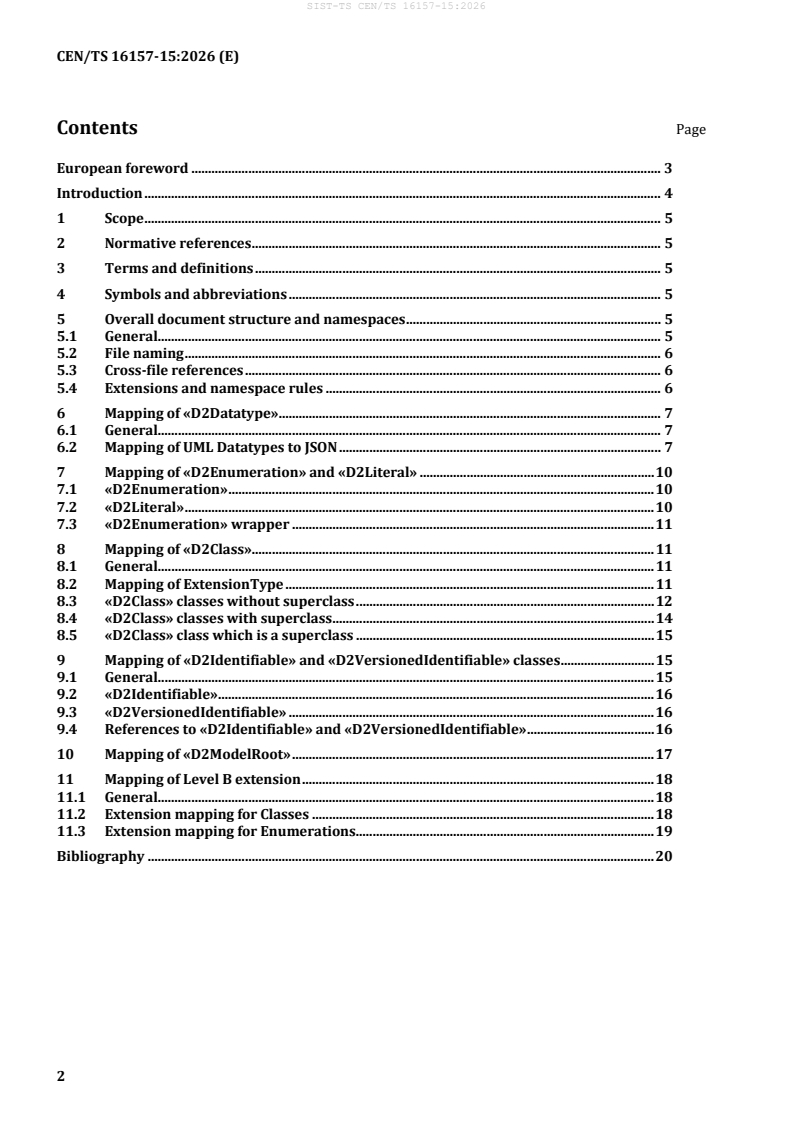
Contents Page
European foreword . 3
Introduction . 4
1 Scope . 5
2 Normative references . 5
3 Terms and definitions . 5
4 Symbols and abbreviations . 5
5 Overall document structure and namespaces . 5
5.1 General. 5
5.2 File naming . 6
5.3 Cross-file references . 6
5.4 Extensions and namespace rules . 6
6 Mapping of «D2Datatype» . 7
6.1 General. 7
6.2 Mapping of UML Datatypes to JSON . 7
7 Mapping of «D2Enumeration» and «D2Literal» . 10
7.1 «D2Enumeration» . 10
7.2 «D2Literal» . 10
7.3 «D2Enumeration» wrapper . 11
8 Mapping of «D2Class» . 11
8.1 General. 11
8.2 Mapping of ExtensionType . 11
8.3 «D2Class» classes without superclass . 12
8.4 «D2Class» classes with superclass . 14
8.5 «D2Class» class which is a superclass . 15
9 Mapping of «D2Identifiable» and «D2VersionedIdentifiable» classes . 15
9.1 General. 15
9.2 «D2Identifiable» . 16
9.3 «D2VersionedIdentifiable» . 16
9.4 References to «D2Identifiable» and «D2VersionedIdentifiable» . 16
10 Mapping of «D2ModelRoot» . 17
11 Mapping of Level B extension . 18
11.1 General. 18
11.2 Extension mapping for Classes . 18
11.3 Extension mapping for Enumerations. 19
Bibliography . 20
European foreword
This document (CEN/TS 16157-15:2026) has been prepared by Technical Committee CEN/TC 278
“Intelligent transport systems”, the secretariat of which is held by NEN.
Attention is drawn to the possibility that some of the elements of this document may be the subject of
patent rights. CEN shall not be held responsible for identifying any or all such patent rights.
This document supersedes CEN/TS 17466.
The CEN 16157 series consist of several parts under the general title “Intelligent transport systems —
DATEX II data exchange specifications for traffic management and information”. Other parts may be
developed in the future.
A list of all parts in a series can be found on the CEN website: www.cencenelec.eu.
For users of this document, attention is drawn to the resources of www.datex2.eu. This web site contains
related software tools and software resources that aid the implementation of EN 16157 DATEX II.
Any feedback and questions on this document should be directed to the users’ national standards body.
A complete listing of these bodies can be found on the CEN website.
According to the CEN/CENELEC Internal Regulations, the national standards organisations of the
following countries are bound to announce this Technical Specification: Austria, Belgium, Bulgaria,
Croatia, Cyprus, Czech Republic, Denmark, Estonia, Finland, France, Germany, Greece, Hungary, Iceland,
Ireland, Italy, Latvia, Lithuania, Luxembourg, Malta, Netherlands, Norway, Poland, Portugal, Republic of
North Macedonia, Romania, Serbia, Slovakia, Slovenia, Spain, Sweden, Switzerland, Türkiye and the
United Kingdom.
Introduction
This document defines a common set of data exchange specifications to support the vision of a seamless
interoperable exchange of road traffic and travel information across boundaries, including national,
urban, interurban, road administrations, infrastructure providers and service providers. Standardization
in this context is a vital constituent to ensure interoperability, reduction of risk, reduction of the cost
base, promotion of open marketplaces and many social, economic and community benefits to be gained
from more informed travellers, network managers and transport operators.
Deploying intelligent transport systems in line with European Sustainable and Smart Mobility Strategy
as issued by the European Commission requires co-ordination of traffic management operation and
development of seamless pan-European information services. These jointly aim at contributing to the
transformation of the European transport system for the objectives of efficient, safe, sustainable, smart
and resilient mobility.
In this context the European Commission has been supporting the development of information exchange
between the actors of road traffic management and related services for several years. In the road sector,
DATEX II has been long in fruition, with the European Commission being fundamental to its development
through an initial contract and subsequent co-funding of the further evolution of the standard and user
support ecosystem. With this standardization of DATEX II, there is a real basis for common exchange
between the actors of the traffic and travel information sector both in the collaboration between traffic
management organisations and their systems, as well as in coherent information provision to service
providers. DATEX II supports the requirements of the stakeholder organisations involved in the road
traffic and travel domain in compliance with the EU policy and legal frameworks aimed at the sector.
Attention is drawn to the possibility that some of the elements of this document may be the subject of
patent rights. CEN shall not be held responsible for identifying any or all such patent rights.
This European Standard includes the framework and context for exchanges, the modelling approach, data
content, data structure and relationships.
This European Standard supports a methodology that is extensible.
Part 15 of the CEN/TS 16157 series (this Technical Specification) specifies the mapping from UML models
into a JSON Schema representation, in compliance with CEN/EN 16157-1, which defines the overall
context and framework for such mappings, including the corresponding XML Schema representation.
1 Scope
The CEN 16157 multipart standard specifies and defines component aspects supporting the shared use
of data and information in the field of traffic and travel. The component aspects include the modelling
approach, the data content, the data structure and relationships and the communications specification.
This document defines a mapping from UML models, compliant with EN 16157-1, into JavaScript Object
Notation (JSON) using JSON Schema as specified in draft 2020-12 and subsequent versions.
The schema mapping conforms to the JSON format defined by the Internet Engineering Task Force (IETF)
in RFC 8259.
In the context of describing generation of schema, this refers to the webtool made available as part of the
CEN 16157 multipart standard, which can generate the JSON schema mapping specified in this document.
2 Normative references
The following documents are referred to in the text in such a way that some or all of their content
constitutes requirements of this document. For dated references, only the edition cited applies. For
undated references, the latest edition of the referenced document (including any amendments) applies.
EN 16157-1:2018, Intelligent transport systems - DATEX II data exchange specifications for traffic
management and information - Part 1: Context and framework
3 Terms and definitions
There are no terms and definitions listed in this document.
ISO and IEC maintain terminology databases for use in standardization at the following addresses:
— ISO Online browsing platform: available at https://www.iso.org/obp/
— IEC Electropedia: available at https://www.electropedia.org/
4 Symbols and abbreviations
UML Unified Modeling Language
JSON JavaScript Object Notation
LCC lower camel case
UCC upper camel case
URI Uniform Resource Identifier
URL Uniform Resource Locator
5 Overall document structure and namespaces
5.1 General
The mapping rules described in this document define the structure of types, properties, and elements
derived from the UML model. In order to provide a usable implementation format these types, properties
and elements are organised into JSON Schema definition files. Each file corresponds to one
«D2Namespace» and contains the complete set of class, enumeration, and reference definitions belonging
to that package.
The "title" properties are optional. The "description" properties are intended solely for documentation
purposes and shall only be included if a schema that includes definitions and descriptions is being
generated, with exception on necessary information to the programmer, where description will be
generated.
The whole set of type and element definitions provided in the following sections are wrapped into
multiple JSON schema definition files, each with the following JSON structure:
{
"$schema": "https://json-schema.org/draft/2020-12/schema",
"$defs": {
Definitions of classes, enumerations, wrappers and references are
inserted here
}
…other top-level members if applicable
}
5.2 File naming
Each «D2Namespace» in the source model shall be mapped to its own JSON Schema definition file using:
DATEXII__.json
where:
• is taken from the corresponding attribute on the class stereotyped as
«D2ModelRoot».
• is the name of the package stereotyped as «D2Namespace».
5.3 Cross-file references
Where one «D2Namespace»uses constructs from another «D2Namespace»then the schema within the
using namespace shall use a JSON Schema $ref construct referencing a schema in the schema file for the
used namespace, in the following pattern:
"": {
"$ref":
".json#/$defs/"
}
5.4 Extensions and namespace rules
• Level B (backward-compatible) extensions. If a model contains Level B extension classes, the
JSON Schema constructs for those extension classes shall be placed in the JSON Schema for the
concepts they extend.
• Level C (non-backward-compatible) extensions. If an extended model is not backward
compatible, a distinct schema filename shall be used to clearly distinguish the Level C schema from
the Level A schema. The schema filename shall be used to reference other schema using the keyword
$ref.
NOTE The tool provided to generate schemas will prefix the schema filenames, and subsequently use this
prefixed filename for reference other schemas using the keyword $ref.
6 Mapping of «D2Datatype»
6.1 General
In this document UML datatypes classified as «D2Datatype» are, in principle, mapped to JSON Schema
definitions bearing the same name as the UML datatype.
Exceptions to this mapping — that is, instances where a «D2Datatype» is mapped differently — are
documented in the following sections.
Additionally, the value of the "definition" tagged value in UML is mapped to the description property in
JSON Schema. The general structure is as follows:
: {
"title": "",
"description": "",
"type": "RestrictionBase"
}
The value of "type" (referred to as "RestrictionBase" in pseudocode) is determined by the following
algorithm:
1. If the assigned «D2Datatype» stereotype has a non-empty schemaType property (see EN 16157-
1:2018, Part 1: Context and framework, Section 6.2.4), then this value is mapped according to the
Mapping of Datatypes table (see below).
2. If both schemaType and schemaTypeInclude properties of the «D2Datatype» stereotype are empty,
then the value of "type" is replaced with a $ref pointing to the supertype definition:
"$ref": "#/$defs/"
6.2 Mapping of UML Datatypes to JSON
6.2.1 schemaType attribute
The ollowing table shows mapping of schemaType attribute in UML to JSON type. If no mapping is found,
string shall be used as default mapping. Where a phrase in angle brackets ends with
“FromFacetsInUMLModel”, the part before that suffix is the name from tag in the UML ‘facets’ tagged
value.
NOTE Derived types of types defined in Table 1 can also contain definition of facets.
Table 1 — Mapping table datatypes, schemaType
schemaType JSON
base64Binary “type:”:”string”
“contentEncoding”:”base64”
“pattern”:”^[A-Za-z0-9+/]+={0,2}$”
boolean "type": "boolean"
date "type": "string"
“format”: “date”
dateTime "type": "string"
"format": "date-time"
decimal "type": "number"
(Optional facets)
“minimum”:
“maximum”:
double "type": "number"
(Optional facets)
“minimum”:
“maximum”:
float "type": "number"
(Optional facets)
“minimum”:
“maximum”:
int "type": "integer"
(Optional facets)
“minimum”:
“maximum”:
integer "type": "integer"
(Optional facets) minInclusive and maxInclusive
“minimum”:
“maximum”:
language “type:”:”string”
“pattern”: "^[a-z]{2}$"
negativeInteger "type": "integer", " exclusiveMaximum": 0
positiveInteger "type": "integer", "exclusiveMinimum ": 0
nonNegativeInteger "type": "integer", "minimum": 0
string "type": "string"
(Optional facets)
“maximumLength”:
“pattern”:”
time "type": "string"
“format”: “time”
url "type": "string"
6.2.2 schemaTypeInclude attribute
The following table shows mapping of schemaTypeInclude attribute in UML to JSON type.
Table 2 — Mapping table datatypes, schemaTypeInclude
schemaTypeInclu JSON
de
{
MultiLingualStrin
MultilingualString: {
g
"title": "MultilingualString",
"description":
"",
"type": "object",
"additionalProperties": false,
"properties": {
"values": {
"type": "array",
"items": {
...