

SIST EN 1595:2000
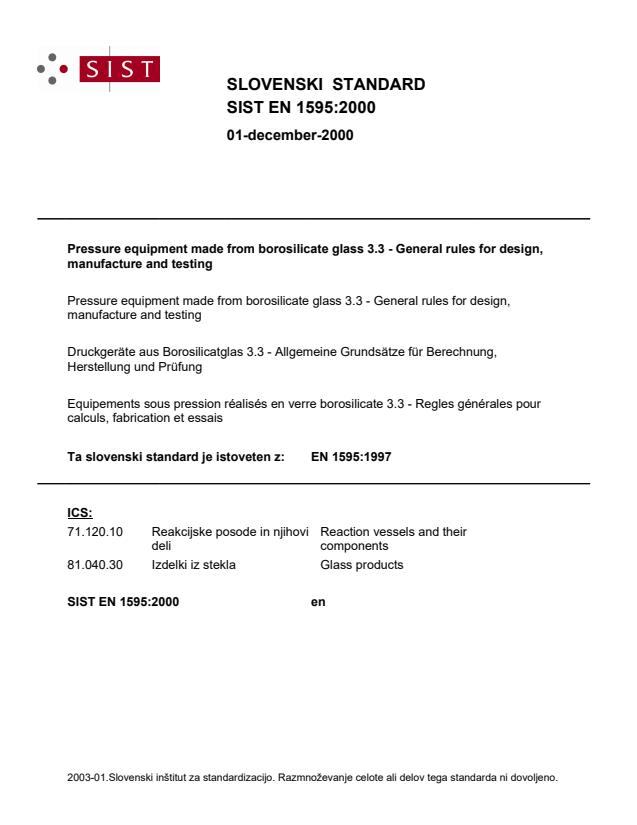
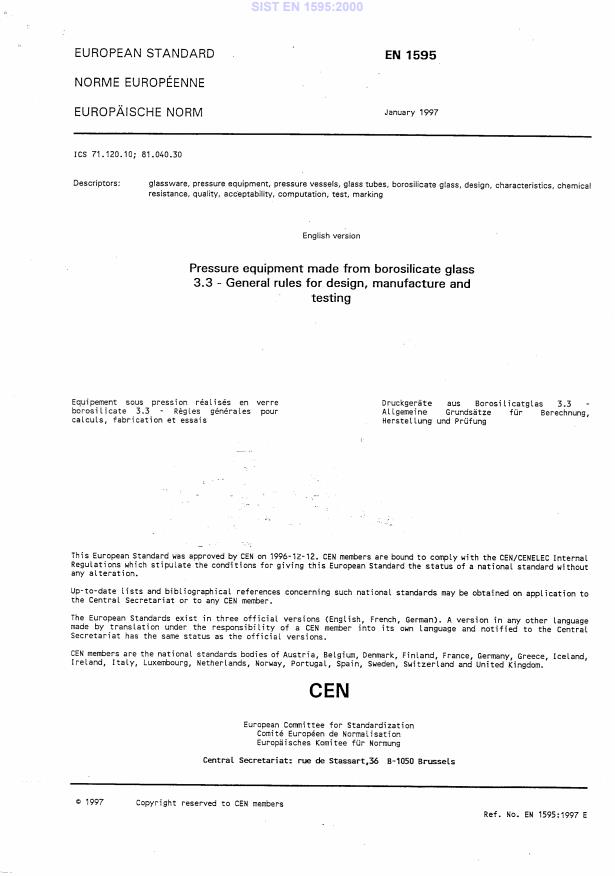
(Main)Pressure equipment made from borosilicate glass 3.3 - General rules for design, manufacture and testing
General Information
- Abstract
This European Standard specifies material, design, inspection, testing and marking requirements of pressure equipment (e.g. vessels, pipes, valves) made from borosilicate glass 3.3 with a coefficient of mean linear thermal expansion of (3,3 +/- 0,1) x 10-6 K-1. The following are excluded: - circular, flat and tubular sight glasses, - equipment made from borosilicate glass with another coefficient of thermal expansion.
- Status
- Published
- Publication Date
- 30-Nov-2000
- Technical Committee
- SS SPL - Technical Board for the general field
- Current Stage
- 6060 - National Implementation/Publication (Adopted Project)
- Start Date
- 01-Dec-2000
- Due Date
- 01-Dec-2000
- Completion Date
- 01-Dec-2000

Overview
SIST EN 1595:2000 is a European standard developed by CEN that establishes general rules for the design, manufacture, and testing of pressure equipment made from borosilicate glass 3.3. This standard specifically addresses equipment such as vessels, pipes, and valves that utilize borosilicate glass with a mean linear thermal expansion coefficient of (3.3 ± 0.1) x 10⁻⁶ K⁻¹. It defines comprehensive requirements for materials, inspection processes, testing protocols, and marking to ensure safety and reliability in industrial applications. Notably, this standard excludes certain glass products like circular, flat, and tubular sight glasses and equipment made from borosilicate glass with different thermal expansion coefficients.
Key Topics
Material Specifications
Defines the precise characteristics of borosilicate glass 3.3, including thermal expansion properties crucial for pressure resistance under varying temperature conditions.Design Principles
Provides general rules for the safe and effective design of pressure vessels and associated components, emphasizing dimensional stability and structural integrity when subjected to pressure and thermal stresses.Manufacturing Guidelines
Outlines recommended manufacturing procedures to maintain the mechanical and chemical properties of borosilicate glass during fabrication of pressure equipment.Inspection and Testing
Details required inspection methods and testing techniques to verify compliance with mechanical strength and safety criteria, including pressure testing and defect identification.Marking Requirements
Specifies marking protocols to ensure traceability and identification of compliant pressure equipment throughout its lifecycle.
Applications
SIST EN 1595:2000 is essential for industries where pressure vessels made from borosilicate glass 3.3 are used, including:
Chemical and Pharmaceutical Manufacturing
Reaction vessels and pipelines requiring resistance to thermal shock and chemical corrosion.Food and Beverage Processing
Transparent pressure equipment allowing visual monitoring while maintaining high safety standards.Laboratory Equipment Production
Fabrication of specialized containers and apparatus designed to withstand internal pressure and variable temperatures.Industrial Process Engineering
Installation of borosilicate glass components in chemical reactors, distillation columns, and storage vessels where durability and visibility are critical.
Related Standards
- EN 13445 – Unfired Pressure Vessels: Provides design and manufacturing rules for metal pressure vessels, complementary to glass equipment standards.
- EN 1092 – Flanges and Their Joints: Details standards on flanges often used alongside borosilicate glass pressure components.
- ISO 9001 – Quality Management Systems: Relevant for manufacturers implementing consistent quality control processes for compliance.
- EN 10204 – Metallic Products Inspection Documents: Related to inspection documentation which may guide marking and certification practices.
By adhering to SIST EN 1595:2000, manufacturers and users of borosilicate glass pressure equipment can ensure optimal safety, quality, and performance in a variety of demanding industrial environments. This standard plays a critical role in improving product reliability while facilitating regulatory compliance across European markets.
Relations
- Effective Date
- 28-Jan-2026
Get Certified
Connect with accredited certification bodies for this standard

ECOCERT
Organic and sustainability certification.

Eurofins Food Testing Global
Global leader in food, environment, and pharmaceutical product testing.

Intertek Bangladesh
Intertek certification and testing services in Bangladesh.
Sponsored listings
Frequently Asked Questions
SIST EN 1595:2000 is a standard published by the Slovenian Institute for Standardization (SIST). Its full title is "Pressure equipment made from borosilicate glass 3.3 - General rules for design, manufacture and testing". This standard covers: This European Standard specifies material, design, inspection, testing and marking requirements of pressure equipment (e.g. vessels, pipes, valves) made from borosilicate glass 3.3 with a coefficient of mean linear thermal expansion of (3,3 +/- 0,1) x 10-6 K-1. The following are excluded: - circular, flat and tubular sight glasses, - equipment made from borosilicate glass with another coefficient of thermal expansion.
This European Standard specifies material, design, inspection, testing and marking requirements of pressure equipment (e.g. vessels, pipes, valves) made from borosilicate glass 3.3 with a coefficient of mean linear thermal expansion of (3,3 +/- 0,1) x 10-6 K-1. The following are excluded: - circular, flat and tubular sight glasses, - equipment made from borosilicate glass with another coefficient of thermal expansion.
SIST EN 1595:2000 is classified under the following ICS (International Classification for Standards) categories: 71.120.10 - Reaction vessels and their components; 81.040.30 - Glass products. The ICS classification helps identify the subject area and facilitates finding related standards.
SIST EN 1595:2000 has the following relationships with other standards: It is inter standard links to SIST EN 12585:2000. Understanding these relationships helps ensure you are using the most current and applicable version of the standard.
SIST EN 1595:2000 is available in PDF format for immediate download after purchase. The document can be added to your cart and obtained through the secure checkout process. Digital delivery ensures instant access to the complete standard document.
Standards Content (Sample)
2003-01.Slovenski inštitut za standardizacijo. Razmnoževanje celote ali delov tega standarda ni dovoljeno.Pressure equipment made from borosilicate glass 3.3 - General rules for design, manufacture and testingDruckgeräte aus Borosilicatglas 3.3 - Allgemeine Grundsätze für Berechnung, Herstellung und PrüfungEquipements sous pression réalisés en verre borosilicate 3.3 - Regles générales pour calculs, fabrication et essaisPressure equipment made from borosilicate glass 3.3 - General rul
...