

SIST EN 16603-33-01:2019
(Main)Space engineering - Mechanisms
General Information
- Abstract
This Standard specifies the requirements applicable to the concept definition, design, analysis, development, production, test verification and inorbit operation of space mechanisms on spacecraft and payloads in order to meet the mission performance requirements.
This version of the standard has not been produced with the objective to cover also the requirements for mechanisms on launchers. Applicability of the requirements contained in this current version of the standard to launcher mechanisms is a decision left to the individual launcher project.
Requirements in this Standard are defined in terms of what shall be accomplished, rather than in terms of how to organise and perform the necessary work. This allows existing organizational structures and methods to be applied where they are effective, and for the structures and methods to evolve as necessary without rewriting the standards. Complementary non-ECSS handbooks and guidelines exist to support mechanism design.
This standard may be tailored for the specific characteristic and constrains of a space project in conformance with ECSS-S-ST-00.
- Status
- Published
- Public Enquiry End Date
- 05-Sep-2018
- Publication Date
- 13-May-2019
- Technical Committee
- I13 - Imaginarni 13
- Current Stage
- 6060 - National Implementation/Publication (Adopted Project)
- Start Date
- 25-Apr-2019
- Due Date
- 30-Jun-2019
- Completion Date
- 14-May-2019


Overview
SIST EN 16603-33-01:2019 - Space engineering: Mechanisms is a European (CEN/CENELEC) adaptation of the ECSS mechanism requirements. It specifies the requirements for the concept definition, design, analysis, development, production, verification and in‑orbit operation of mechanisms used on spacecraft and payloads to meet mission performance. The standard defines what shall be accomplished (requirements), not the detailed organizational methods, and can be tailored per ECSS‑S‑ST‑00. Note: this edition is not intended to cover launcher mechanisms - applicability to launchers is project‑specific.
Key topics and technical requirements
The standard covers the full lifecycle of spacecraft mechanisms with emphasis on reliability and mission safety. Major technical topics include:
- Scope and terminology: standardized definitions for actuators, latches, control systems, deliverable output torque/force, and more.
- Mission & environmental requirements: consideration of space environments and mission‑specific constraints.
- Functional performance: system performance, elementary functions (degrees of freedom, torque/force, sensing) and related uncertainty factors.
- Design requirements:
- Materials and tribology (lubrication, contact design, wear control).
- Thermal control and thermo‑mechanical interfaces.
- Mechanical design and sizing, including fasteners and structural factors.
- Pyrotechnics and explosive device considerations where applicable.
- Electrical/electronic interfaces and actuation systems.
- Open‑loop and closed‑loop control systems for mechanism motion.
- Verification: analysis and test verification methods, life testing, uncertainty factors and documentation of verification results.
- Production and manufacturing: machining, assembly, drawings and cleanliness requirements.
- Deliverables and documentation: normative annexes provide templates and DRDs for Specific Mechanism Specification (SMS), Mechanism Design Description (MDD), Mechanism Analytical Verification (MAV), Mechanism User Manual (MUM), and safety‑critical verification plans/reports (MSVP/MSVR).
Practical applications - who uses this standard
- Spacecraft and payload mechanism designers and systems engineers.
- Integration, test and verification teams (environmental, life‑test, functional test).
- Project managers, quality assurance and safety engineers to define requirements and acceptance criteria.
- Contractors and suppliers manufacturing actuation systems, latches, deployment mechanisms, robotic arms, heaters and thermal interfaces.
- Useful for procurement specifications, design reviews and compliance demonstrations in satellite and payload projects.
Related standards (selected)
This standard references and aligns with other ECSS/EN documents, for example:
- EN 16603-10-02 (Verification)
- EN 16603-31 (Thermal control)
- EN 16603-32 (Structural)
- ECSS‑Q‑ST‑70 series (materials, processes)
Keywords: space mechanisms, spacecraft mechanisms, mechanism design, verification, in‑orbit operation, SIST EN 16603-33-01:2019, space engineering, ECSS.
Relations
- Effective Date
- 25-Aug-2026
- Effective Date
- 25-Aug-2026
- Effective Date
- 25-Aug-2026
- Effective Date
- 25-Aug-2026
- Effective Date
- 25-Aug-2026
- Refers
SIST ISO 677:1998 - Straight bevel gears for general engineering and heavy engineering -- Basic rack - Effective Date
- 25-Aug-2026
- Effective Date
- 25-Aug-2026
- Effective Date
- 28-Jan-2026
- Effective Date
- 28-Jan-2026
- Effective Date
- 28-Jan-2026
- Effective Date
- 28-Jan-2026
- Effective Date
- 28-Jan-2026
- Effective Date
- 28-Jan-2026
- Effective Date
- 28-Jan-2026
- Effective Date
- 28-Jan-2026
Get Certified
Connect with accredited certification bodies for this standard

BUREAU VERITAS Certification Germany
Bureau Veritas certification in Germany.

Element Materials Technology
Materials testing and product certification.

AQMS Ltd.
AQMS provides ISO certification to SMEs across the UK.
Sponsored listings
Frequently Asked Questions
SIST EN 16603-33-01:2019 is a standard published by the Slovenian Institute for Standardization (SIST). Its full title is "Space engineering - Mechanisms". This standard covers: This Standard specifies the requirements applicable to the concept definition, design, analysis, development, production, test verification and inorbit operation of space mechanisms on spacecraft and payloads in order to meet the mission performance requirements. This version of the standard has not been produced with the objective to cover also the requirements for mechanisms on launchers. Applicability of the requirements contained in this current version of the standard to launcher mechanisms is a decision left to the individual launcher project. Requirements in this Standard are defined in terms of what shall be accomplished, rather than in terms of how to organise and perform the necessary work. This allows existing organizational structures and methods to be applied where they are effective, and for the structures and methods to evolve as necessary without rewriting the standards. Complementary non-ECSS handbooks and guidelines exist to support mechanism design. This standard may be tailored for the specific characteristic and constrains of a space project in conformance with ECSS-S-ST-00.
This Standard specifies the requirements applicable to the concept definition, design, analysis, development, production, test verification and inorbit operation of space mechanisms on spacecraft and payloads in order to meet the mission performance requirements. This version of the standard has not been produced with the objective to cover also the requirements for mechanisms on launchers. Applicability of the requirements contained in this current version of the standard to launcher mechanisms is a decision left to the individual launcher project. Requirements in this Standard are defined in terms of what shall be accomplished, rather than in terms of how to organise and perform the necessary work. This allows existing organizational structures and methods to be applied where they are effective, and for the structures and methods to evolve as necessary without rewriting the standards. Complementary non-ECSS handbooks and guidelines exist to support mechanism design. This standard may be tailored for the specific characteristic and constrains of a space project in conformance with ECSS-S-ST-00.
SIST EN 16603-33-01:2019 is classified under the following ICS (International Classification for Standards) categories: 49.140 - Space systems and operations. The ICS classification helps identify the subject area and facilitates finding related standards.
SIST EN 16603-33-01:2019 has the following relationships with other standards: It is inter standard links to SIST ISO 678:1998, SIST ISO 76:2006, SIST ISO 128-43:2016, SIST ISO 6336-1:2008, SIST ISO 6336-3:2008, SIST ISO 677:1998, SIST ISO 6336-2:2008, SIST EN ISO 20848-2:2008, SIST EN 13834:2007, SIST EN 16437:2014/kFprA1:2019, SIST EN 54-25:2008/AC:2012, SIST CEN/TR 14748:2005, SIST EN ISO 11806-2:2012, SIST EN 4700-005:2011, SIST EN 4700-003:2011. Understanding these relationships helps ensure you are using the most current and applicable version of the standard.
SIST EN 16603-33-01:2019 is associated with the following European legislation: Standardization Mandates: M/496. When a standard is cited in the Official Journal of the European Union, products manufactured in conformity with it benefit from a presumption of conformity with the essential requirements of the corresponding EU directive or regulation.
SIST EN 16603-33-01:2019 is available in PDF format for immediate download after purchase. The document can be added to your cart and obtained through the secure checkout process. Digital delivery ensures instant access to the complete standard document.
Standards Content (Sample)
SLOVENSKI STANDARD
01-julij-2019
Vesoljska tehnika - Mehanizmi
Space engineering - Mechanisms
Raumfahrttechnik - Mechanik/Mechanismen
Ingénierie spatiale - Mécanismes
Ta slovenski standard je istoveten z: EN 16603-33-01:2019
ICS:
49.140 Vesoljski sistemi in operacije Space systems and
operations
2003-01.Slovenski inštitut za standardizacijo. Razmnoževanje celote ali delov tega standarda ni dovoljeno.
EUROPEAN STANDARD EN 16603-33-01
NORME EUROPÉENNE
EUROPÄISCHE NORM
April 2019
ICS 49.140
English version
Space engineering - Mechanisms
Ingénierie spatiale - Mécanismes Raumfahrttechnik - Mechanik/Mechanismen
This European Standard was approved by CEN on 7 October 2018.
CEN and CENELEC members are bound to comply with the CEN/CENELEC Internal Regulations which stipulate the conditions for
giving this European Standard the status of a national standard without any alteration. Up-to-date lists and bibliographical
references concerning such national standards may be obtained on application to the CEN-CENELEC Management Centre or to
any CEN and CENELEC member.
This European Standard exists in three official versions (English, French, German). A version in any other language made by
translation under the responsibility of a CEN and CENELEC member into its own language and notified to the CEN-CENELEC
Management Centre has the same status as the official versions.
CEN and CENELEC members are the national standards bodies and national electrotechnical committees of Austria, Belgium,
Bulgaria, Croatia, Cyprus, Czech Republic, Denmark, Estonia, Finland, Former Yugoslav Republic of Macedonia, France, Germany,
Greece, Hungary, Iceland, Ireland, Italy, Latvia, Lithuania, Luxembourg, Malta, Netherlands, Norway, Poland, Portugal, Romania,
Serbia, Slovakia, Slovenia, Spain, Sweden, Switzerland, Turkey and United Kingdom.
CEN-CENELEC Management Centre:
Rue de la Science 23, B-1040 Brussels
© 2019 CEN/CENELEC All rights of exploitation in any form and by any means Ref. No. EN 16603-33-01:2019 E
reserved worldwide for CEN national Members and for
CENELEC Members.
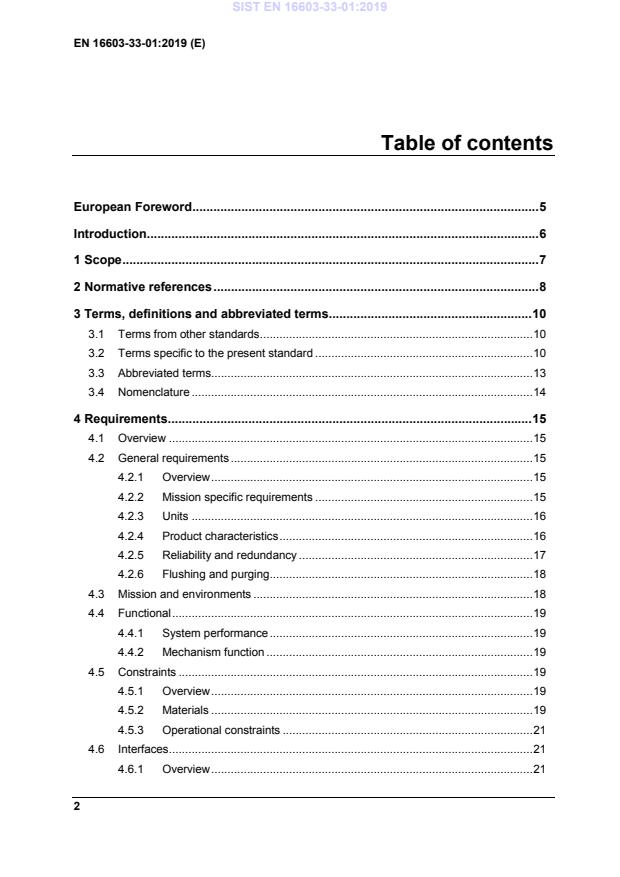
Table of contents
European Foreword . 5
Introduction . 6
1 Scope . 7
2 Normative references . 8
3 Terms, definitions and abbreviated terms . 10
3.1 Terms from other standards . 10
3.2 Terms specific to the present standard . 10
3.3 Abbreviated terms. 13
3.4 Nomenclature . 14
4 Requirements . 15
4.1 Overview . 15
4.2 General requirements . 15
4.2.1 Overview . 15
4.2.2 Mission specific requirements . 15
4.2.3 Units . 16
4.2.4 Product characteristics . 16
4.2.5 Reliability and redundancy . 17
4.2.6 Flushing and purging . 18
4.3 Mission and environments . 18
4.4 Functional . 19
4.4.1 System performance . 19
4.4.2 Mechanism function . 19
4.5 Constraints . 19
4.5.1 Overview . 19
4.5.2 Materials . 19
4.5.3 Operational constraints . 21
4.6 Interfaces . 21
4.6.1 Overview . 21
4.6.2 Thermo-mechanical interfaces . 21
4.7 Design requirements . 21
4.7.1 Overview . 21
4.7.2 General design . 22
4.7.3 Tribology . 22
4.7.4 Thermal control . 25
4.7.5 Mechanical design and sizing . 26
4.7.6 Pyrotechnics . 37
4.7.7 Electrical and electronic . 37
4.7.8 Open-loop and closed-loop control system for mechanisms . 39
4.8 Verification . 41
4.8.1 General . 41
4.8.2 Verification by analysis . 41
4.8.3 Verification by test . 46
4.9 Production and manufacturing . 54
4.9.1 Manufacturing process . 54
4.9.2 Manufacturing drawings . 54
4.9.3 Assembly . 55
4.10 Deliverables . 55
Annex A (normative) Specific mechanism specification (SMS) - DRD . 56
Annex B (normative) Mechanism design description (MDD) - DRD . 60
Annex C (normative) Mechanism analytical verification (MAV) - DRD . 62
Annex D (normative) Mechanism user manual (MUM) - DRD . 64
Annex E (informative) Documentation technical items . 68
Annex F (normative) Safety critical mechanisms verification plan (MSVP) -
DRD . 69
Annex G (normative) Safety critical mechanisms verification report (MSVR)
- DRD . 72
Bibliography . 74
Tables
Table 4-1:<> . 24
Table 4-2: Minimum uncertainty factors for actuation function . 29
Table 4-3:Minimum uncertainty factors for holding function . 32
Table 4-4: Life test duration factors . 50
Table 4-5: Examples of lifetime to be demonstrated by test . 51
Table 4-6: Example of lifetime to be demonstrated by test for safety critical mechanisms
having critical hazard potential . 52
Table 4-7: Example of lifetime to be demonstrated by test for safety critical mechanisms
having catastrophic hazard potential . 52
Table E-1 : Documentation technical items . 68
European Foreword
This document (EN 16603-33-01:2019) has been prepared by Technical Committee
CEN-CENELEC/TC 5 “Space”, the secretariat of which is held by DIN.
This standard (EN 16603-33-01:2019) originates from ECSS-E-ST-33-01C Rev.1.
This European Standard shall be given the status of a national standard, either by
publication of an identical text or by endorsement, at the latest by October 2019,
and conflicting national standards shall be withdrawn at the latest by October
2019.
Attention is drawn to the possibility that some of the elements of this document
may be the subject of patent rights. CEN [and/or CENELEC] shall not be held
responsible for identifying any or all such patent rights.
This document has been prepared under a standardization request given to CEN
by the European Commission and the European Free Trade Association.
This document has been developed to cover specifically space systems and has
therefore precedence over any EN covering the same scope but with a wider
domain of applicability (e.g. : aerospace).
According to the CEN-CENELEC Internal Regulations, the national standards
organizations of the following countries are bound to implement this European
Standard: Austria, Belgium, Bulgaria, Croatia, Cyprus, Czech Republic,
Denmark, Estonia, Finland, Former Yugoslav Republic of Macedonia, France,
Germany, Greece, Hungary, Iceland, Ireland, Italy, Latvia, Lithuania,
Luxembourg, Malta, Netherlands, Norway, Poland, Portugal, Romania, Serbia,
Slovakia, Slovenia, Spain, Sweden, Switzerland, Turkey and the United
Kingdom.
Introduction
This document has been established to provide mechanism engineering teams
with a set of requirements, design rules and guidelines based on the state of the
art knowledge and experience in the field of space mechanisms.
The use of this document helps mechanisms developers to establish generic
mechanisms designs and to derive application specific requirements.
The main objectives are to achieve reliable operation of space mechanisms in
orbit and to prevent anomalies during the development phase influencing
schedule and cost efficiency of space programmes.
Scope
This Standard specifies the requirements applicable to the concept definition,
design, analysis, development, production, test verification and inorbit
operation of space mechanisms on spacecraft and payloads in order to meet the
mission performance requirements.
This version of the standard has not been produced with the objective to cover
also the requirements for mechanisms on launchers. Applicability of the
requirements contained in this current version of the standard to launcher
mechanisms is a decision left to the individual launcher project.
Requirements in this Standard are defined in terms of what shall be
accomplished, rather than in terms of how to organise and perform the necessary
work. This allows existing organizational structures and methods to be applied
where they are effective, and for the structures and methods to evolve as
necessary without rewriting the standards. Complementary non-ECSS
handbooks and guidelines exist to support mechanism design.
This standard may be tailored for the specific characteristic and constrains of a
space project in conformance with ECSS-S-ST-00.
Normative references
The following normative documents contain provisions which, through reference
in this text, constitute provisions of this ECSS standard. For dated references,
subsequent amendments to or revisions of any of these publications do not apply.
However, parties to agreements based on this ECSS Standard are encouraged to
investigate the possibility of applying the most recent editions of the normative
documents indicated below. For undated references the latest edition of the
publication referred to applies.
EN reference Reference in text Title
EN 16601-00-01 ECSS-S-ST-00-01 ECSS system — Glossary of terms
EN 16603-10-02 ECSS-E-ST-10-02 Space engineering – Verification
EN 16603-20 ECSS-E-ST-20 Space engineering – Electrical and electronic
EN 16603-06 ECSS-E-ST-20-06 Space engineering – Spacecraft charging
EN 16603-07 ECSS-E-ST-20-07 Space engineering – Electromagnetic compatibility
EN 16603-31 ECSS-E-ST-31 Space engineering – Thermal control general
requirements
EN 16603-32 ECSS-E-ST-32 Space engineering – Structural
EN 16603-32-01 ECSS-E-ST-32-01 Space engineering – Fracture control
EN 16603-32-10 ECSS-E-ST-32-10 Space engineering – Structural factors of safety for
spaceflight hardware
EN 16603-33-11 ECSS-E-ST-33-11 Space engineering – Explosive systems and devices
EN 16602-30 ECSS-Q-ST-30 Space product assurance - Dependability
EN 16602-40 ECSS-Q-ST-40 Space product assurance – Safety
EN 16602-70 ECSS-Q-ST-70 Space product assurance – material, mechanical part
and process
EN 16602-70-36 ECSS-Q-ST-70-36 Space product assurance – Material selection for
controlling stress corrosion cracking
EN 16602-70-37 ECSS-Q-ST-70-37 Space product assurance – Determination of the
susceptibility of metals to stress corrosion cracking
EN 16602-70-71 ECSS-Q-ST-70-71 Space product assurance – Data for selection of space
materials and processes
ISO 76 (2006) Rolling bearings – Static load rating
ISO 128 (1996) Technical drawings
EN reference Reference in text Title
ISO 677 (1976) Straight bevel gears for general engineering and for
heavy engineering – Basic rack
ISO 678 (1976) Straight bevel gears for general engineering and for
heavy engineering – Modules and diametral pitches
ISO 6336-1 (2006) Calculation of the load capacity of spur and helical
gears — Part 1: Basic principles, introduction and
general influence factors
ISO 6336-2 (2006) Calculation of the load capacity of spur and helical
gears — Part 2: Calculation of surface durability
(pitting)
ISO 6336-3 (2006) Calculation of the load capacity of spur and helical
gears — Part 3: Calculation of tooth bending strength
Terms, definitions and abbreviated terms
3.1 Terms from other standards
a. For the purpose of this Standard, the term and definition from ECSS-S-ST-
00-01 apply, and in particular the following:
1. cleanliness
2. component
3. interface
4. product
b. For the purpose of this Standard, the term and definition from ECSS-S-ST-
32-10 apply, and in particular the following:
1. fail-safe
2. model factor (KM)
3. project factor (KP)
3.2 Terms specific to the present standard
3.2.1 actuator
component that performs the moving function of a mechanism
NOTE 1 An actuator can be either an electric motor, or
any other mechanical (e.g. spring) or electric
component or part providing the torque or force
for the motion of the mechanism.
NOTE 2 This term is defined in the present standard with
a different meaning than in ECSS-S-ST-00-01. The
term with the meaning defined herein is
applicable only to the present standard.
3.2.2 control system
system (open or closed loop) which controls the relative motion of the
mechanism
3.2.3 deliverable output torque (T )
L
torque at the mechanism or actuator output
NOTE 1 The deliverable output torque or force can be
specified by the customer for an undefined
purpose and not affect the actual performance of
the mechanism.
NOTE 2 For example: A theoretical torque or force of a
robotic mechanism (service tool) for which no
specific function except torque or force provision
can be specified at an early stage in the project
development.
3.2.4 deliverable output force (F )
L
force at the mechanism or actuator output
3.2.5 elementary function
lowest level function
NOTE For example: One degree of freedom (rotation
and translation), torque or force generation,
sensing.
3.2.6 inertial resistance force (F )
D
force to accelerate the mass
3.2.7 inertial resistance torque(T )
D
torque to accelerate the inertia
3.2.8 fastener
item used to provide attachment of two or more separate parts, components or
assemblies
NOTE For example: Fasteners have the function of
locking the parts together and providing the
structural load path between the parts or, if used
as a securing part, to ensure proper locating of
the parts to be secured.
3.2.9 flushing or purging
control of the mechanism environment by enclosing the mechanism in specific
gaseous or fluid media which are surrounding, passing over or through the
mechanism
3.2.10 latching or locking
intentional constraining of one or more previously unconstrained degrees of
freedom which cannot be released without specific action
3.2.11 lubrication
use of specific material surface properties or an applied material between two
contacting or moving surfaces in order to reduce friction, wear or adhesion
3.2.12 mechanism
assembly of parts that are linked together to enable a relative motion
3.2.13 off-loading
complete or partial unloading of a part or assembly from an initial pre-load
NOTE Off-loading is usually employed so as not to
expose a mechanisms part or assembly to launch
loads or other induced loads.
3.2.14 phase margin
indicator for the stability of dynamic control systems
3.2.15 positively locked
form-locked into a defined position from which release can only be obtained by
application of a specific actuation force
3.2.16 positive indication of status
direct monitoring of the state of the primary function at the output level of the
mechanism
3.2.17 primary function
high level function
NOTE For example: To hold, to release, to deploy, to
track, and to point.
3.2.18 safety critical mechanism
mechanical product having a critical or catastrophic hazard potential
3.2.19 threaded fastener
fastener with a threaded portion
NOTE For example: Screws, bolts and studs.
3.2.20 tribology
discipline that deals with the design, friction, wear and lubrication of interacting
surfaces in relative motion to each other
3.2.21 venting
compensation of the internal mechanism pressure environment with its
surrounding pressure environment
NOTE For example: Use of dedicated venting holes or
passages
3.3 Abbreviated terms
For the purpose of this Standard, the abbreviated terms from ECSS-S-ST-00-01
and the following apply:
Abbreviation Meaning
analogue to digital
A/D
alternating current
AC
centre of gravity
COG
collected volatile condensable material
CVCM
digital to analogue
D/A
direct current
DC
design for minimum risk
DFMR
design limits loads
DLL
electromagnetic compatibility
EMC
electrostatic discharge
ESD
actuation force
F
F inertial resistance force
D
F deliverable output force
L
failure mode effects and criticality analysis
FMECA
F
min minimum actuator force required
factor of safety
FOS
F friction torque or force
R
ground support equipment
GSE
H
A harness and other torque or force resistances
H adhesion torque or force
D
hardness Vickers
HV
H hysteresis torque or force
Y
inertia resistance (linear or angular)
I
Interface
I/F
low Earth orbit
LEO
mass
M
mechanism analytical verification
MAV
mechanism design description
MDD
mechanism user manual
MUM
multilayer insulation
MLI
moment of inertia
MOI
margin of safety
MOS
Abbreviation Meaning
strength safety margin
MS
safety critical mechanisms verification plan
MSVP
safety critical mechanisms verification report
MSVR
not applicable
n.a.
specific mechanism specification
SMS
recovered mass loss
RML
spring force
S
international system of units
SI
spacecraft
S/C
specific mechanism specification
SMS
actuation torque
T
T inertial resistance torque
D
T
L deliverable output torque
T minimum actuator torque required
min
total mass loss
TML
ultraviolet
UV
verification control document
VCD
3.4 Nomenclature
The following nomenclature applies throughout this document:
a. The word “shall” is used in this Standard to express requirements. All the
requirements are expressed with the word “shall”.
b. The word “should” is used in this Standard to express recommendations.
All the recommendations are expressed with the word “should”.
NOTE It is expected that, during tailoring,
recommendations in this document are either
converted into requirements or tailored out.
c. The words “may” and “need not” are used in this Standard to express
positive and negative permissions, respectively. All the positive
permissions are expressed with the word “may”. All the negative
permissions are expressed with the words “need not”.
d. The word “can” is used in this Standard to express capabilities or
possibilities, and therefore, if not accompanied by one of the previous
words, it implies descriptive text.
NOTE In ECSS “may” and “can” have completely
different meanings: “may” is normative
(permission), and “can” is descriptive.
e. The present and past tenses are used in this Standard to express statements
of fact, and therefore they imply descriptive text.
Requirements
4.1 Overview
This Standard addresses the requirements related to the generic aspects of the
engineering steps for the various engineering disciplines involved in the
achievement of the specified space mechanism performance.
The following requirements are identified considering interfaces and interactions
of mechanisms with those disciplines: thermal control, structures, functional
operations, materials and parts, pyrotechnics, propulsion, electrical and
electronics, and servocontrol interactions. Where interactions with other
European space regulation are identified, reference is made to the related
regulation.
4.2 General requirements
4.2.1 Overview
Requirements of clause 4.2 cover the interaction of mechanisms engineering with
project management, processes, parts and components, product assurance, and
the related requirements affecting the conceptual definition, design, sizing,
analysis, development, and hardware production of mechanisms.
In view of the criticality of space mechanisms, which are often potential mission
critical single point failures, particular attention is placed upon the reliability and
redundancy of space mechanisms (see clause 4.2.5).
4.2.2 Mission specific requirements
a. A dedicated specific mechanism specification (SMS) shall be established in
conformance with Annex A for each individual mechanism in a project,
and agreed by the customer.
NOTE The SMS specification identifies all specific
requirements for a specific mechanism in a
project, that are not covered by the present
standard.
4.2.3 Units
a. SI-units and associated symbols system shall be used.
4.2.4 Product characteristics
4.2.4.1 Marking and labelling
4.2.4.1.1 Specific identification
a. The identification of delivered pieces of hardware, parts, components,
subassemblies and assemblies shall carry at least the equipment title.
NOTE 1 For the identification of pieces of hardware,
parts, components, subassemblies, and
assemblies of the mechanism, see clause 5.3.1.5 of
ECSS-M-ST-40.
NOTE 2 The identification can be removable.
NOTE 3 The identification number and the equipment
title can be defined by the contracting authority.
4.2.4.1.2 Marking
a. Marking shall be applied on non-functional surfaces.
b. Bearings shall not be marked by the use of vibroetch marks on the lateral
faces of the bearing races.
NOTE Etched marks on the lateral faces of the bearing
races affect the mounting tolerances of the
bearing in the housing and the bearing’s
tribological performance characteristics.
4.2.4.2 Parts and components
a. Existing parts and components used in mechanisms shall have been
previously qualified for the intended application according to a
qualification procedure approved by the customer.
NOTE Existing parts and components relate to parts
and components that were not specifically
developed for this specific application and cover
commercially available and off-the-shelf
hardware.
b. Existing parts and components used in mechanisms should have been
previously qualified at part or component level.
c. Flight proven parts and components should be used.
NOTE For the selection of not-flight proven parts and
components, see ECSS-Q-ST-60 for EEE
components and ECSS-Q-ST-70 for materials and
parts.
4.2.4.3 Interchangeability
a. All items having the same identification number shall be functionally and
dimensionally interchangeable.
4.2.4.4 Maintainability
a. The mechanism should be designed to be maintenance free during storage
and ground life.
b. If the design is not maintenance free, the maintenance requirements shall
be documented in the SMS, justified, agreed by the customer.
c. If ground maintenance during storage or ground operation is not avoided,
the maintenance procedures shall be provided.
4.2.5 Reliability and redundancy
4.2.5.1 Reliability
a. For all mechanisms, which are critical to mission success, conformance to
the specified reliability figure shall be demonstrated according to the
following methods:
1. electronic components: by parts count as a minimum or other
methods approved by the customer;
2. mechanical parts: by stress analysis or other methods approved by
the customer;
3. mechanical limitedlife: by life test approved by the customer.
b. For noncritical mechanisms, conformance to the reliability figure shall be
demonstrated by simplified methods or other methods accepted by the
customer.
NOTE 1 The methods to achieve by design, derive by
analysis, and demonstrate by test the specified
reliability figures are presented in ECSS-Q-ST-30.
NOTE 2 An example of a simplified method is parts
count.
c. Failure of one part or element shall not result in consequential damage to
the equipment or other spacecraft components.
d. For structural reliability aspects ECSS-E-ST-32 shall apply.
e. For safety critical mechanisms in a crewed space mission where structural
failure can cause a catastrophic hazardous event, fasteners and load
carrying paths within mechanisms shall be designed in conformance with
fracture control requirements from ECSS-E-ST-32-01.
NOTE Definitions of catastrophic and critical hazardous
events are provided in ECSS-Q-ST-40. Fracture
control requirements are provided in ECSS-E-ST-
32-01.
4.2.5.2 Redundancy
a. During the design of the mechanism, all single point failure modes shall be
identified.
b. All single points of failure should be eliminated by redundant components.
c. If single points of failure cannot be avoided, they shall be justified by the
supplier and approved by the customer.
d. Redundancy concepts shall be agreed by the customer.
NOTE Redundancy concepts are selected to minimize
the number of single points of failure and to
conform to the reliability requirements.
e. Where a single point failure mode is identified and redundancy is not
provided, compliance with the reliability, availability and maintainability
requirements specified in ECSS-Q-ST-30 shall be demonstrated.
f. Unless redundancy is achieved by the provision of a complete redundant
mechanism, active parts of mechanisms, such as sensors, motor windings,
brushes, actuators, switches and electronics, shall be redundant.
g. Failure of one element or part shall not prevent the other redundant
element or part from performing its intended function, nor the mechanism
from meeting its performance requirements specified in the specific
mechanism specification.
NOTE High-reliability of a mechanism can be
incorporated in a design by including component
redundancy or high design margins. The aim is
to deliver a design which is single failure
tolerant.
4.2.6 Flushing and purging
a. If operating the mechanism in air is detrimental to the performance of the
mechanism over its complete mission, means for flushing the critical parts
with an inert clean dry gas shall be provided.
NOTE Example of detrimental cause to operate the
mechanism in air is the presence of moisture or
other deleterious contamination.
b. Only lubricants qualified in respect to the residual humidity of the dry gas
shall be used.
4.3 Mission and environments
a. The mechanism engineering shall consider every mission phase identified
for the specific space programme and conform to the related mission
requirements and environmental constraints.
NOTE The mission starts with onground life of the
mechanisms after assembly and is completed at
the end of operational life of the space system.
4.4 Functional
4.4.1 System performance
a. The mechanism functional performance shall conform to the system
performance requirements.
4.4.2 Mechanism function
a. The kinematic requirements applicable to each position change shall be
specified.
NOTE For example, position over time, velocity and
acceleration.
b. Mechanical interface, position accuracy or velocity tolerances shall be
specified and verified that they conform to the functional needs.
NOTE Mechanical interfaces include assembly and test
rigging and other installation and integration
conditions.
c. The envelope of movement for each moving part shall be defined.
d. The movement of each part shall ensure that there is no mechanical
interference with any other part of the mechanism, the spacecraft, the
payload or the launcher.
4.5 Constraints
4.5.1 Overview
Requirements of clause 4.5 cover the constraints to which mechanisms are
designed, manufactured and operated.
For the physical constraints, it is important to ensure that the requirements for
climatic protection and for sterilization are defined in the SMS, as identified in
A.2.1<4>.
4.5.2 Materials
4.5.2.1 Material selection
a. Materials shall be selected in conformance with ECSS-Q-ST-70 clause 5, or
be verified that they conform to requirements, approved by the customer.
NOTE 1 For general requirements on materials used for
space mechanisms, see ECSS-E-ST-32-08. The
material requirements in 4.5.2.2 to 4.5.2.7 are
specific to mechanisms.
NOTE 2 For selection of materials, see ECSS-Q-ST-70-71.
NOTE 3 For additional requirements relating to tribology,
see clause 4.7.3.
4.5.2.2 Corrosion
a. For corrosion, ECSS-Q-ST-70-71 clause “Chemical (corrosion)” shall apply.
4.5.2.3 Dissimilar metals
a. For dissimilar metals, ECSS-Q-ST-70 clause 5.1.12 “Galvanic compatibility”
shall apply.
b. Materials treatments to prevent galvanic and electrolytic corrosion shall be
approved by the customer.
4.5.2.4 Stress corrosion cracking
a. Materials shall be selected as specified in ECSS-Q-ST-70-36.
b. Materials with unknown characteristics shall be tested in conformance
with ECSS-Q-ST-70-37.
c. ECSS-Q-ST-70-71 clause “Stress corrosion resistance” shall apply.
4.5.2.5 Fungus protection
a. For fungus protection, ECSS-Q-ST-70-71 clause “Bacterial and fungus
growth” shall apply.
4.5.2.6 Flammable, toxic and unstable materials
a. For flammable materials, ECSS-Q-ST-70-71 clause “Flammability” shall
apply.
b. For toxic materials, ECSS-Q-ST-70-71 clause “Offgassing and toxicity” shall
apply.
c. In manned space systems, flammable, toxic and unstable materials shall
not be used.
4.5.2.7 Induced emissions (stray light protection)
a. Materials and their coatings shall be selected to conform to the
requirements of induced emissions.
NOTE An example of induced emission is stray light.
4.5.2.8 Radiation
a. The exposure to radiation shall not degrade the functional performance of
the mechanism below the minimum functional performances specified in
the SMS, over the complete mission.
b. ECSS-Q-ST-70-71 clause “Radiation” shall apply.
4.5.2.9 Atomic oxygen
a. The exposure to atomic oxygen shall not degrade the functional
performance of the mechanism below the minimum functional
performances specified in the SMS, over the complete mission.
b. ECSS-Q-ST-70-71 clause “Atomic oxygen” shall apply.
4.5.2.10 Fluid compatibility
a. For fluid compatibility, ECSS-Q-ST-70-71 clause “Fluid compatibility” shall
apply.
4.5.3 Operational constraints
a. The mechanism should not impose any operational constraints on the
spacecraft and mission.
b. If operational constraints are imposed by the mechanism, they shall be
identified, justified and approved by the customer.
c. All operational constraints shall be documented in the mechanism user
manual.
NOTE For the contents of the user manual, see Annex D.
d. Mechanisms moving with limited oscillatory travel shall be identified.
e. All oscillatory rolling parts should be exercised over a complete revolution
at regular intervals, according to an operational procedure agreed by the
customer.
NOTE Examples of oscillatory rolling parts are: ball
bearing and nuts.
f. Operational procedures to exercise the mechanism beyond the oscillatory
travel range shall be defined.
4.6 Interfaces
4.6.1 Overview
Requirements of clause 4.6 cover the interfaces of mechanisms on spacecraft and
payload. Most of the interfaces requirements are application specific, and
therefore are covered by the SMS, as identified in A.2.1<5>.
4.6.2 Thermo-mechanical interfaces
a. Thermomechanical interfaces shall be designed to take into account the
stresses induced by the structure between the mechanism and its I/F
attachment points.
4.7 Design requirements
4.7.1 Overview
This clause covers general design, tribology, thermal control, mechanical design
and sizing, pyrotechnics, electric and electronics, and control engineering.
The requirements for tribology (see clause 4.7.3) cover the tribological related
issues of mechanisms on the spacecraft and payload. The tribology of surfaces
that separate or move relative to one another play a key function in the
conceptual definition, design, analysis, test verification, launch, and in-orbit
performance of the mechanisms.
The thermal requirements (see clause 4.7.4) cover the interaction of mechanisms
engineering with thermal control and its related requirements affecting
mechanisms engineering. General thermal control requirements are covered in
ECSS-E-ST-31.
The requirements for mechanical design and sizing (see clause 4.7.5) cover the
overall conceptual design, the mechanical sizing of parts, components and
assemblies, and the detailed design definition of mechanisms. General structural
requirements, including design loads (for example, pyrotechnical shock), are
covered in ECSS-E-ST-32.
The requirements for electrical and electronics (see clause 4.7.7) cover the
interaction of mechanisms engineering with electrical and electronic engineering
and its related requirements affecting mechanisms engineering. General
requirements for electrical and electronic are covered in ECSS-E-ST-20. If no
electrical or electronic provisions are applied on the mechanism, the applicability
of ECSS-E-ST-20 is limited to the potential compatibility requirements of
mechanical systems with electrical and electronic systems.
4.7.2 General design
a. The mechanism design shall be compatible with operation on ground in
ambient and thermal vacuum conditions.
4.7.3 Tribology
4.7.3.1 General
a. Mechanisms shall be designed with a lubrication function between
surfaces in relative motion in order to ensure they conform to the
mechanism performance requirements specified in the specific mechanism
specification, throughout the specified lifetime.
NOTE The lubrication function aims to provide the
motorization margins and minimize wear.
b. Mechanisms shall use only lubricants or lubricating surfaces qualified for
the mission.
NOTE 1 For example, environment, lifetime, contact
pressure, temperature, number of cycles,
minimum and maximum velocity of surfaces in
relative motion.
NOTE 2 For space environment, see ECSS-E-ST-10-04.
NOTE 3 Vacuum is one of the main concerns regarding
lubrication.
c. It shall be verified that the degradation of the lubricant in the on-ground
and in-orbit environments does not lead to a mechanism performance
degradation below the limits specified in the SMS.
NOTE Examples of such degradation are friction, wear
and lubricant performance variability.
d. The use of sliding surfaces shall be avoided.
e. If requirement 4.7.3.1d cannot be met, sliding surfaces are used one of the
surfaces shall be hard and the other shall be lubricated or shall be
composed of a self-lubricating material.
NOTE Example of self-lubricating material: polyimide
resins.
f. Metal to metal tribological contacts should be composed of dissimilar
materials, in conformance with 4.5.2.3.
g. Metal to metal tribological sliding contacts shall be composed of dissimilar
materials in conformance with 4.5.2.3.
h. Prior to the application of lubricant and in order to facilitate adhesion or
wetting of lubricant on the substrate surface, the surfaces shall be cleaned
in conformance with a procedure approved by the customer.
i. The cleaning of the surfaces prior to lubricant application shall not degrade
the lubricating action.
j. The lubricant shall conform to the molecular and particulate contamination
requirements specified for the entire mission.
NOTE For molecular and particulate contamination, see
ECSS-Q-ST-70-01.
4.7.3.2 Dry lubrication
a. During the lubrication of mechanism tribological surfaces, samples of
representative material, surface roughness, surface cleanliness and surface
orientation shall be codeposited in each process run with the flight
components so that verification checks can be performed.
b. The thickness and adhesion of the lubricant on samples defined in
requirement 4.7.3.2a shall be verified.
c. The dry lubricant application process shall be verified with respect to
lubricant performance and repeatability.
4.7.3.3 Fluid lubrication
4.7.3.3.1 Amount of fluid lubricant
a. The quantity of lubricant used shall be determined.
NOTE This determination allows quantifying a surplus
of lubricant at the end of the total lifetime of the
mechanism.
b. The quantity of lubricant shall take into account outgassing, creep and
other sources of absorption or degradation.
c. The effect of exposure to onground storage and related gravity effects,
and other ground or inorbit accelerations on lubricant distribution shall be
validated.
4.7.3.3.2 Outgassing
a. The outgassing rate of fluid lubricants shall be measured by a screening
test approved by the customer.
NOTE See ECSS-Q-ST-70-02.
b. <>
Table 4-1:<>
4.7.3.3.3 Anticreep barriers
a. Anticreep barriers shall be used to avoid migration of fluid lubricants to
the external sensitive equipment agreed by the customer.
NOTE It is also important to use the anti-creep barriers
for sensitive equipment within the mechanism.
b. Anti-creep barriers shall be used when migration of fluids lubricants
causes a change of the lubricant amount on the parts to be lubricated
resulting in mechanism performance degradation below the limits
specified in the SMS.
c. The integrity of the anticreep barrier shall be verifiable by indicators.
NOTE For example, UVdetectable.
4.7.3.4 Tribological contacts
4.7.3.4.1 Life
a. The life of tribological contacts shall be verified under worst case ground
and flight conditions.
4.7.3.4.2 Bearing preloading
a. Ball bearings shall be preloaded with a load calculated in order to
withstand the mechanical environment during launch and throughout the
mission.
b. The calculation specified in requirement 4.7.3.4.2a shall be made available
to the customer.
c. Preloading should be applied by solid preload or flexible pre-load
produced by loading techniques without sliding at the bearing mounting
interfaces.
d. If preloading is not applied by 4.7.3.4.2c solutions, sliding shall be
facilitated by a lubricated sliding sleeve, bush or dedicated tribological
coating.
e. If bearing gapping occurs during vibration, adequacy of lubricant and
potential consequential mechanisms damage or degradation due to the
relative motion of the bearing parts shall be demonstrated to conform to
the specified functional performance and lifetime.
f. Any set preload at sub-assembly level shall be measured.
g. Bearing preload should be measured after final mechanism assembly.
...