

SIST EN 12255-7:2026
(Main)Wastewater treatment plants - Part 7: Biological fixed-film reactors
General Information
- Abstract
This document of the EN 12255 series specifies design principles and performance requirements for secondary and tertiary treatment of wastewater in biological fixed-film reactors at wastewater treatment plants for more than 50 PT.
Its primary application is for wastewater treatment plants for the treatment of domestic and municipal wastewater. It can also be applied for biodegradable industrial wastewater.
Biological fixed film reactors include rotating biological contactors (RBC), biological trickling reactors (BTR), moving bed biological reactors (MBBR), submerged medium reactors (SMR) and submerged media filters (SMF). Membrane bioreactors (MBR) and anaerobic processes are not within the scope.
Some of the systems using fixed film bacteria are enhanced activated sludge systems (hybrid systems). For such systems, EN 12255-6 also applies.
This document specifies fundamental information about typical systems and does not provide information about all available fixed film systems.
- Status
- Published
- Public Enquiry End Date
- 29-Sep-2023
- Publication Date
- 17-Jun-2026
- Technical Committee
- IOVO - Water supply and waste water engineering
- Current Stage
- 6060 - National Implementation/Publication (Adopted Project)
- Start Date
- 11-Jun-2026
- Due Date
- 16-Aug-2026
- Completion Date
- 18-Jun-2026

Overview
SIST EN 12255-7:2026 - Wastewater Treatment Plants - Part 7: Biological Fixed-Film Reactors is a European standard specifying the design principles and performance requirements for secondary and tertiary treatment of wastewater using biological fixed-film reactor technologies at wastewater treatment plants serving more than 50 population equivalents (PT). This standard applies primarily to the treatment of domestic and municipal wastewater and can also be used for biodegradable industrial wastewater. The document was developed by the Slovenian Institute for Standardization (SIST) as part of the EN 12255 series for comprehensive wastewater treatment plant standards.
Biological fixed-film reactors referenced in this standard include:
- Rotating Biological Contactors (RBC)
- Biological Trickling Reactors (BTR)
- Moving Bed Biological Reactors (MBBR)
- Submerged Medium Reactors (SMR)
- Submerged Media Filters (SMF)
Membrane bioreactors (MBR) and anaerobic processes are explicitly excluded from this part. For systems using hybrid approaches (combining fixed-film and suspended growth processes), practitioners should also consult EN 12255-6.
Key Topics
This standard covers the following essential areas related to biological fixed-film reactors in wastewater treatment:
- Types of Biological Fixed-Film Reactors: Detailing BTR, RBC, MBBR, SMR, and SMF, with explanations of their structure and operational principles.
- Design Principles: Guidance for dimensioning reactors, selecting appropriate support media, and ensuring durable construction to withstand operational and environmental stresses.
- Performance Requirements: Determines minimum requirements for reactor effectiveness, flow rates, support media characteristics, and long-term reliability.
- Planning Considerations: Addresses influent characteristics, pre-treatment needs, effluent consent standards, redundancy for maintenance, and monitoring requirements.
- Media Selection: Recommends materials and specifications for support media, ensuring open structure, adequate void ratio to prevent clogging, and sufficient surface area for biofilm growth.
- Control and Automation: Encourages installation of instrumentation to measure and adjust flows, scouring frequency, and oxygen supply.
- Operation and Maintenance: Provides considerations for maintaining reliable reactor function, including provisions for backwashing and sludge removal, as well as ensuring safety and accessibility.
Applications
SIST EN 12255-7:2026 delivers practical value in the following scenarios:
- Municipal and Domestic Wastewater Treatment: Ensures efficient removal of organic matter and nutrients during secondary and tertiary treatment stages.
- Biodegradable Industrial Wastewater: Supports the use of biological fixed-film systems for industries generating treatable organic wastewater loads.
- Upgrade or Expansion Projects: Offers standardized guidelines for adding fixed-film reactor capacity to existing facilities, improving treatment performance and process stability.
- Hybrid Systems: Assists in integrating fixed-film technology with activated sludge systems for enhanced nutrient removal and operational flexibility.
- Design for Reliability: The standard’s focus on system redundancy, maintenance access, and robust component specifications helps ensure continuous compliance with environmental regulations and long service life.
- Environmental Compliance: Contributes to achieving stringent discharge standards by optimizing reactor design for effective removal of biochemical oxygen demand (BOD), chemical oxygen demand (COD), total nitrogen, and total phosphorus.
Related Standards
To ensure a comprehensive approach to the design and operation of wastewater treatment plants, the following related standards should be consulted:
- EN 12255-1: General construction principles
- EN 12255-4: Primary settlement
- EN 12255-6: Activated sludge process (especially for hybrid systems)
- EN 12255-10: Safety principles
- EN 12255-11: General data requirements
- EN 12255-16: Physical (mechanical) filtration
- EN 16323: Glossary of wastewater engineering terms
Summary
SIST EN 12255-7:2026 is an essential standard for professionals involved in the design, construction, and operation of wastewater treatment plants using biological fixed-film reactors. It provides a harmonized framework for ensuring reliable treatment performance, operational efficiency, and regulatory compliance in municipal, domestic, and certain industrial applications. For optimal outcomes, integrate guidelines from this standard with other relevant parts of the EN 12255 series and associated wastewater infrastructure standards.
Relations
- Effective Date
- 02-Sep-2026
- Effective Date
- 02-Sep-2026
- Effective Date
- 02-Sep-2026
- Effective Date
- 02-Sep-2026
- Effective Date
- 02-Sep-2026
- Effective Date
- 02-Sep-2026
- Effective Date
- 10-Jun-2026
- Effective Date
- 10-Jun-2026
- Effective Date
- 28-Jan-2023
Get Certified
Connect with accredited certification bodies for this standard

CIS Institut d.o.o.
Personal Protective Equipment (PPE) certification body. Notified Body NB-2890 for EU Regulation 2016/425 PPE.

Kiwa BDA Testing
Building and construction product certification.
Kmetijski inštitut Slovenije
Agricultural Institute of Slovenia. Soil testing, plant health, agricultural product analysis.
Sponsored listings
Frequently Asked Questions
SIST EN 12255-7:2026 is a standard published by the Slovenian Institute for Standardization (SIST). Its full title is "Wastewater treatment plants - Part 7: Biological fixed-film reactors". This standard covers: This document of the EN 12255 series specifies design principles and performance requirements for secondary and tertiary treatment of wastewater in biological fixed-film reactors at wastewater treatment plants for more than 50 PT. Its primary application is for wastewater treatment plants for the treatment of domestic and municipal wastewater. It can also be applied for biodegradable industrial wastewater. Biological fixed film reactors include rotating biological contactors (RBC), biological trickling reactors (BTR), moving bed biological reactors (MBBR), submerged medium reactors (SMR) and submerged media filters (SMF). Membrane bioreactors (MBR) and anaerobic processes are not within the scope. Some of the systems using fixed film bacteria are enhanced activated sludge systems (hybrid systems). For such systems, EN 12255-6 also applies. This document specifies fundamental information about typical systems and does not provide information about all available fixed film systems.
This document of the EN 12255 series specifies design principles and performance requirements for secondary and tertiary treatment of wastewater in biological fixed-film reactors at wastewater treatment plants for more than 50 PT. Its primary application is for wastewater treatment plants for the treatment of domestic and municipal wastewater. It can also be applied for biodegradable industrial wastewater. Biological fixed film reactors include rotating biological contactors (RBC), biological trickling reactors (BTR), moving bed biological reactors (MBBR), submerged medium reactors (SMR) and submerged media filters (SMF). Membrane bioreactors (MBR) and anaerobic processes are not within the scope. Some of the systems using fixed film bacteria are enhanced activated sludge systems (hybrid systems). For such systems, EN 12255-6 also applies. This document specifies fundamental information about typical systems and does not provide information about all available fixed film systems.
SIST EN 12255-7:2026 is classified under the following ICS (International Classification for Standards) categories: 13.060.30 - Sewage water. The ICS classification helps identify the subject area and facilitates finding related standards.
SIST EN 12255-7:2026 has the following relationships with other standards: It is inter standard links to SIST EN 16323:2014, SIST EN 12255-3:2024, SIST EN 12255-6:2023, SIST EN 12255-1:2025, SIST EN 12255-10:2023, SIST EN 12255-11:2023, SIST EN 12566-3:2005+A2:2013, SIST EN 12566-3:2005+A1:2009, SIST EN 12255-7:2002. Understanding these relationships helps ensure you are using the most current and applicable version of the standard.
SIST EN 12255-7:2026 is available in PDF format for immediate download after purchase. The document can be added to your cart and obtained through the secure checkout process. Digital delivery ensures instant access to the complete standard document.
Standards Content (Sample)
SLOVENSKI STANDARD
01-julij-2026
Čistilne naprave za odpadno vodo - 7. del: Biološki reaktorji s pritrjeno biomaso
Wastewater treatment plants - Part 7: Biological fixed-film reactors
Kläranlagen - Teil 7: Biofilmreaktoren
Stations d’épuration - Partie 7 : Réacteurs biologiques à cultures fixées
Ta slovenski standard je istoveten z: EN 12255-7:2026
ICS:
13.060.30 Odpadna voda Sewage water
2003-01.Slovenski inštitut za standardizacijo. Razmnoževanje celote ali delov tega standarda ni dovoljeno.
EN 12255-7
EUROPEAN STANDARD
NORME EUROPÉENNE
June 2026
EUROPÄISCHE NORM
ICS 13.060.30 Supersedes EN 12255-7:2002
English Version
Wastewater treatment plants - Part 7: Biological fixed-film
reactors
Stations d'épuration - Partie 7 : Réacteurs biologiques Kläranlagen - Teil 7: Biofilmreaktoren
à cultures fixées
This European Standard was approved by CEN on 20 April 2026.
CEN members are bound to comply with the CEN/CENELEC Internal Regulations which stipulate the conditions for giving this
European Standard the status of a national standard without any alteration. Up-to-date lists and bibliographical references
concerning such national standards may be obtained on application to the CEN-CENELEC Management Centre or to any CEN
member.
This European Standard exists in three official versions (English, French, German). A version in any other language made by
translation under the responsibility of a CEN member into its own language and notified to the CEN-CENELEC Management
Centre has the same status as the official versions.
CEN members are the national standards bodies of Austria, Belgium, Bulgaria, Croatia, Cyprus, Czech Republic, Denmark, Estonia,
Finland, France, Germany, Greece, Hungary, Iceland, Ireland, Italy, Latvia, Lithuania, Luxembourg, Malta, Netherlands, Norway,
Poland, Portugal, Republic of North Macedonia, Romania, Serbia, Slovakia, Slovenia, Spain, Sweden, Switzerland, Türkiye and
United Kingdom.
EUROPEAN COMMITTEE FOR STANDARDIZATION
COMITÉ EUROPÉEN DE NORMALISATION
EUROPÄISCHES KOMITEE FÜR NORMUNG
CEN-CENELEC Management Centre: Rue de la Science 23, B-1040 Brussels
© 2026 CEN All rights of exploitation in any form and by any means reserved Ref. No. EN 12255-7:2026 E
worldwide for CEN national Members.
Contents Page
European foreword . 4
Introduction . 6
1 Scope . 7
2 Normative references . 7
3 Terms and definitions . 7
4 Symbols and abbreviations . 9
5 Planning . 9
5.1 Planning principles . 9
5.2 Design principles . 10
6 Biological fixed film reactors . 11
6.1 Types of fixed film reactors . 11
6.2 Selection of support media . 12
6.3 Biological trickling reactors (BTR) . 13
6.3.1 General. 13
6.3.2 Support media . 15
6.3.3 Dimensioning . 16
6.3.4 Flow distribution . 17
6.3.5 Ventilation . 17
6.3.6 Structures . 17
6.3.7 Mechanical equipment . 18
6.3.8 Control and automation . 18
6.4 Rotating biological contactors (RBC) . 18
6.4.1 General. 18
6.4.2 Structural requirements . 19
6.4.3 Mechanical requirements . 19
6.4.4 Support media . 20
6.4.5 Dimensioning . 21
6.4.6 Flow distribution . 23
6.4.7 Oxygen supply . 23
6.4.8 Control and automation . 23
6.5 Submerged medium reactors (SMR) . 23
6.5.1 General. 23
6.5.2 Dimensioning . 25
6.6 Submerged medium filter (SMF) . 25
6.6.1 General. 25
6.6.2 Support media . 26
6.6.3 Dimensioning . 27
6.6.4 Flow distribution . 27
6.6.5 Air and oxygen supply . 27
6.6.6 Structural requirements . 27
6.6.7 Backwashing . 28
6.6.8 Control and automation . 28
6.7 Moving bed biological reactors (MBBR) . 28
6.7.1 General. 28
6.7.2 Support media . 30
6.7.3 Mechanical requirements . 30
6.7.4 Dimensioning . 30
6.7.5 Control and automation . 31
Bibliography . 32
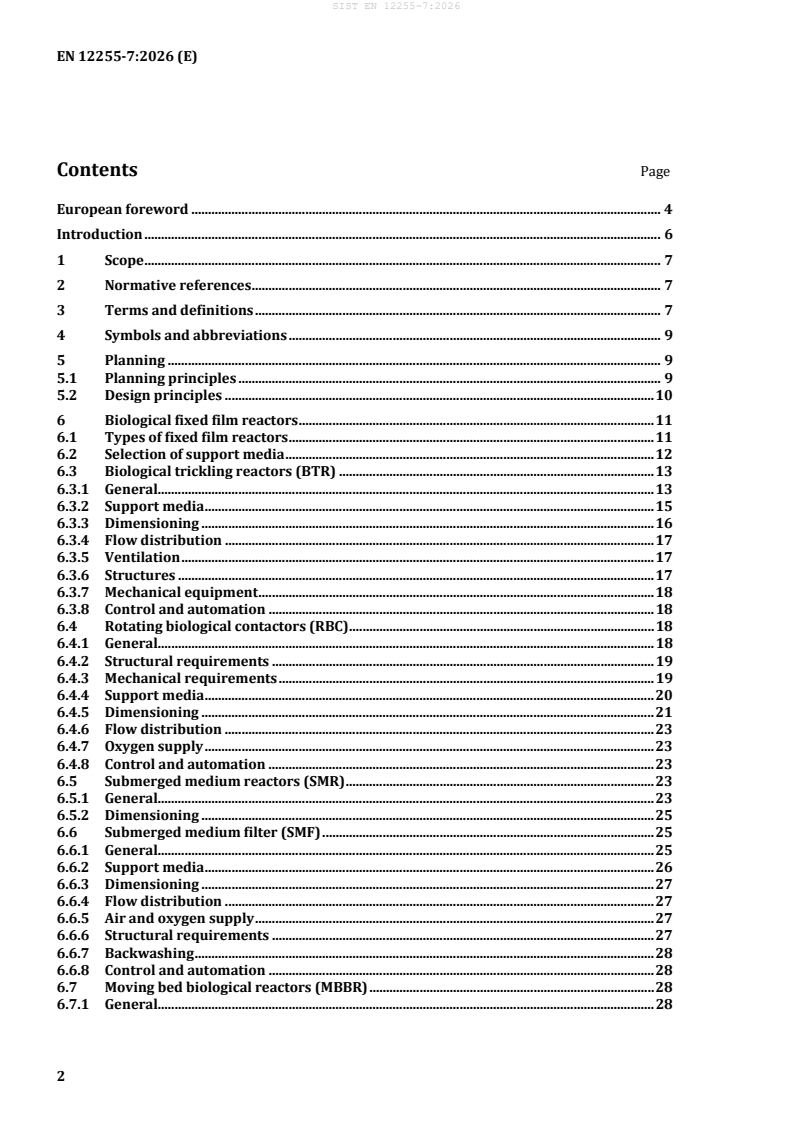
European foreword
This document (EN 12255-7:2026) has been prepared by Technical Committee CEN/TC 165
“Wastewater”, the secretariat of which is held by DIN.
This European Standard shall be given the status of a national standard, either by publication of an
identical text or by endorsement, at the latest by December 2026, and conflicting national standards shall
be withdrawn at the latest by December 2026.
Attention is drawn to the possibility that some of the elements of this document may be the subject of
patent rights. CEN shall not be held responsible for identifying any or all such patent rights.
This document supersedes EN 12255-7:2002.
a) comprehensive revision and additions in all sections;
b) addition of design recommendations;
c) addition of moving bed reactors (MBR);
d) adaptation to the current state of the art;
e) updating of the normative references.
It is the seventh part prepared by the Working Group CEN/TC 165/WG 40 relating to the general
requirements and processes for treatment plants for a total number of inhabitants and population
equivalents (PT) over 50. The EN 12255 series with the generic title Wastewater treatment plants
consists of the following parts:
— Part 1: General construction principles
— Part 2: Storm management systems
— Part 3: Preliminary treatment
— Part 4: Primary settlement
— Part 5: Lagooning processes
— Part 6: Activated sludge process
— Part 7: Biological fixed-film reactors
— Part 8: Sludge treatment and storage
— Part 9: Odour control and ventilation
— Part 10: Safety principles
— Part 11: General data required
— Part 12: Control and automation
— Part 13: Chemical treatment — Treatment of wastewater by precipitation/flocculation
— Part 14: Disinfection
— Part 15: Measurement of the oxygen transfer in clean water in aeration tanks of activated sludge plants
— Part 16: Physical (mechanical) filtration
NOTE 1 Part 2 is under preparation.
NOTE 2 For requirements on pumping installations at wastewater treatment plants see the EN 16932 series,
Drain and sewer systems outside buildings — Pumping systems.
Any feedback and questions on this document should be directed to the users’ national standards body.
A complete listing of these bodies can be found on the CEN website.
According to the CEN-CENELEC Internal Regulations, the national standards organisations of the
following countries are bound to implement this European Standard: Austria, Belgium, Bulgaria, Croatia,
Cyprus, Czech Republic, Denmark, Estonia, Finland, France, Germany, Greece, Hungary, Iceland, Ireland,
Italy, Latvia, Lithuania, Luxembourg, Malta, Netherlands, Norway, Poland, Portugal, Republic of North
Macedonia, Romania, Serbia, Slovakia, Slovenia, Spain, Sweden, Switzerland, Türkiye and the United
Kingdom.
Introduction
Differences in wastewater treatment throughout Europe have led to a variety of systems being developed.
This document gives fundamental information about the systems; this document has not attempted to
specify all available systems.
A generic arrangement of wastewater treatment plants is illustrated in Figure 1 below:
Key
1 preliminary treatment
2 primary treatment
3 secondary treatment
4 tertiary treatment
5 additional treatment (e.g. disinfection or removal of micropollutants)
6 sludge treatment
7 lagoons (as an alternative)
A raw wastewater
B effluent for re-use (e.g. irrigation)
C discharged effluent
D screenings and grit
E primary sludge
F secondary sludge
G tertiary sludge
H digested sludge
I digester gas
J returned water from dewatering
Figure 1 — Schematic diagram of wastewater treatment plants
Detailed information additional to that contained in this document can be obtained by referring to the
bibliography.
The primary application is for wastewater treatment plants designed for the treatment of domestic and
municipal wastewater.
1 Scope
This document of the EN 12255 series specifies design principles and performance requirements for
secondary and tertiary treatment of wastewater in biological fixed-film reactors at wastewater treatment
plants for more than 50 PT.
Its primary application is for wastewater treatment plants for the treatment of domestic and municipal
wastewater. It can also be applied for biodegradable industrial wastewater.
Biological fixed film reactors include rotating biological contactors (RBC), biological trickling reactors
(BTR), moving bed biological reactors (MBBR), submerged medium reactors (SMR) and submerged
media filters (SMF). Membrane bioreactors (MBR) and anaerobic processes are not within the scope.
Some of the systems using fixed film bacteria are enhanced activated sludge systems (hybrid systems).
For such systems, EN 12255-6 also applies.
This document specifies fundamental information about typical systems and does not provide
information about all available fixed film systems.
2 Normative references
The following documents are referred to in the text in such a way that some or all of their content
constitutes requirements of this document. For dated references, only the edition cited applies. For
undated references, the latest edition of the referenced document (including any amendments) applies.
EN 12255-1, Wastewater treatment plants — Part 1: General design and construction principles
EN 12255-3, Wastewater treatment plants — Part 3: Preliminary treatment
EN 12255-6, Wastewater treatment plants — Part 6: Activated sludge process
EN 12255-10, Wastewater treatment plants — Part 10: Safety principles
EN 12255-11, Wastewater treatment plants — Part 11: General data required
EN 16323:2014, Glossary of wastewater engineering terms
3 Terms and definitions
For the purposes of this document, the terms and definitions given in EN 16323 and the following apply.
ISO and IEC maintain terminology databases for use in standardization at the following addresses:
— ISO Online browsing platform: available at https://www.iso.org/obp
— IEC Electropedia: available at https://www.electropedia.org/
3.1
biofilm
layer consisting of microorganisms that forms on a support medium
Note 1 to entry: Biofilms consist of a complex agglomeration of microorganisms, immobilized in a matrix of
polymeric substances. Biofilms grow on the surface of fixed or moving support media or are able to form dense
agglomerates.
[SOURCE: EN 16323:2014, 2.3.3.3, modified – Note 1 to entry added]
3.2
biological fixed film reactor
reactor containing a support medium on which biomass grows to form a biofilm
3.3
biological trickling reactor
BTR
biological fixed film reactor with a bed of support medium through which wastewater percolates
Note 1 to entry: Biological trickling reactors are also called trickling filters but they are no filters.
[SOURCE: EN 16323:2014, 2.3.8.27, modified - “biological” and the abbreviation “BTR” added, Note 1 to
entry added]
3.4
flushing intensity
hydraulic surface loading rate onto a biological trickling reactor divided by the number of arms of a rotary
distributor and divided by the number of revolutions per hour
Note 1 to entry: This value gives information on the hydraulic forces to slough excess sludge from the bed.
3.5
moving bed biological reactor
MBBR
reactor with mobile support media, with a specific density close to that of the surrounding water
[SOURCE: EN 16323:2014, 2.3.5.32, modified – “biological” and the abbreviation “MBBR” added]
3.6
rotating biological contactor
RBC
biological contactor in which fixed film is immersed intermittently in the flow to be treated
[SOURCE: EN 16323:2014, 2.3.3.2, modified – abbreviation “RBC” added]
3.7
submerged medium filter
SMF
dense bed of support medium through which wastewater flows and wherein biofilms grow, which is
periodically backwashed to remove excess sludge
Note 1 to entry: The support medium can be granular (e.g. sand, anthracite or activated carbon) or spherical (e.g.
small plastic beads).
Note 2 to entry: See also EN 12255-16.
3.8
submerged medium reactor
SMR
biological reactor where support medium is submerged and aerated
3.9
support media
inert material of various types and specific surface on which an attached biofilm grows
[SOURCE: EN 16323:2014, 2.3.8.25, modified – “specific” deleted before “types” and added before
“surface”, “film” changed to “biofilm”]
4 Symbols and abbreviations
For the purposes of this document, the following symbols and abbreviations apply:
ATEX atmosphere explosible
BOD biochemical oxygen demand in 5 days
BTR biological trickling reactors
COD chemical oxygen demand
MBBR moving bed biological reactor
NH -N ammonium nitrogen
NO N nitrate nitrogen
3-
NO -N nitrate and nitrite nitrogen
x
TP total phosphorous
PT total population (total population is population plus population equivalents)
RBC rotating biological contactors
SBR sequencing batch reactor
SMF submerged medium filter
SMR submerged medium reactor
SS suspended solids
TKN total Kjeldahl nitrogen
VSS volatile suspended solids
5 Planning
5.1 Planning principles
The following factors shall be considered during the planning phase:
— maximum and minimum dry weather and wet weather inflows;
— pre-treatment requirements;
— effluent consent standards;
— type of reactor and post-treatment (e.g. secondary clarifiers or filters);
— specific surface area of the support medium;
— dimensions of biological fixed film reactors;
— requirements to ensure maintenance of units while the consent is still met;
— sludge quality;
— power consumption;
— measurement and control requirements.
Fixed film reactors require mechanical wastewater pre-treatment in primary clarifiers or with very fine
screens (see EN 12255-3) to avoid clogging of support media. Primary clarifiers should be designed for a
retention time of about 2 h at average dry weather flow. At peak flow their retention time should be
minimum 30 min and their surface loading rate maximum 4 m/h.
It shall be determined whether carbon (BOD and COD) removal is sufficient or whether additional
nitrification is required. Nitrogen removal requires additional denitrification.
It shall be noted peak ammonium concentrations in the effluent of fixed film reactors are usually higher
than those of activated sludge systems with their bigger reactor volumes. This applies particularly for
systems treating combined sewage.
Requirements in EN 12255-1, EN 12255-3, EN 12255-6, EN 12255-10 and EN 12255-11 shall be
considered.
5.2 Design principles
Where removal rates of primary clarifiers or very fine screens cannot be measured, estimates of
EN 12255-4 can be used.
The 85-percentiles of the daily COD or BOD , TKN, P and SS loads shall be determined over a period of
several months. Seasonal fluctuations shall be taken into account. For systems serving a total population
of maximum 500 the relevant flows and loads can be estimated.
Where two-hourly TKN peaks exceed double the daily TKN average, means for load balancing are usually
required.
Peak TKN and P return loads from sludge treatment shall be taken into account. Balancing of return flows
can be required.
The following design parameters shall be considered and shall be appropriate for the type of fixed film
reactor:
— volumetric loading of the reactor [kg/(m d)] as BOD , COD or TKN;
— active surface loading rate of support media [kg/(m d)] as BOD , COD or TKN;
2 3
— theoretical specific surface of support media (m /m );
— recirculation ratio where applicable;
3 2
— hydraulic surface loading rate[m /(m h)] of clarifiers and their required surface area, or the loading
of other sludge separation units (e.g. filters);
— required flush or wash water (usually effluent) in % of the wastewater flow;
— specific power consumption [kWh/m ].
All systems shall guarantee uniform flow distribution to parallel units and to the support media as far as
possible.
Sampling points shall be provided at the inlet and outlet of every reactor, such that samples with and
without recirculation can be taken.
Unless otherwise agreed, the design service life of the equipment shall be as defined in EN 12255-1:
— Class 3: for motors, geared engines;
— Class 4: for central bearings of rotating distributors on biological trickling reactors;
— Class 5: for bearings of rotating biological contactors.
The cyclic design life of the shaft of RBC units shall be minimum 20 years.
All structures shall be designed to withstand all potential mechanical stresses during operation and
maintenance for at least 50 years.
Tanks shall be hydraulically designed such that the build-up of sludge solids is prevented. They shall be
sufficiently rigid and sturdy to support the mechanical equipment.
6 Biological fixed film reactors
6.1 Types of fixed film reactors
Biological fixed film reactors in this part of the standard include, but are not limited to:
— biological trickling reactors (BTR);
— rotating biological contactors (RBC);
— submerged medium reactors (SMR);
— submerged medium filters (SMF);
— moving bed biological reactors (MBBR).
Biological fixed-film processes can treat the following types of influent:
— effluent from preliminary treatment where the screening is fine or very fine (see EN 12255-3);
— effluent from primary (mechanical) treatment (see EN 12255-4);
— effluent from secondary treatment (see EN 12255-6).
Biological fixed film reactors can be operated under aerobic or anoxic conditions based on their purpose.
Support media can be:
— in packages of fixed support medium installed in an activated sludge tank and providing surfaces for
fixed film biomass growth in addition to suspended biomass growth, increasing the activated sludge
system’s nitrification capacity (see EN 12255-6); such systems are called hybrid systems;
— a bed of support media through which wastewater percolates (BTR);
— a bed of support media through which wastewater flows (SMF) (see also EN 12255-16);
— suspended support media which are retained by a screen or another device at the effluent side and
returned to the influent side (MBBR), usually by using the hydro-pneumatic effects in the reactor
(e.g. aeration, mixing) or by additional components;
— submerged medium which is fixed or retained in a reactor and through which wastewater flows
(SMR); the reactor can be planned as a sequencing batch reactor (SBR).
6.2 Selection of support media
Support media shall have a large surface area to support the growth of biofilms. However, sufficient space
shall be provided between the surfaces of adjacent support media elements to prevent formation of
sludge bridging and clogging. The structure of support media shall permit removal of excessive biofilms
by scouring.
Support media can be made from the following materials:
— graded crushed minerals;
— mineral beads or granules;
— foamed plastic material (e.g. expanded polystyrene beads);
— other plastic materials in the form of beads, discs, etc.;
— randomly arranged plastic elements of regular size and shape;
— plastic sheets or tubes assembled as modules with an internal water volume of 90 % or higher.
Support media shall have the following properties:
— open structure to prevent clogging and cording;
— durability under the specific circumstances;
— large specific surface;
— resistance to structural deformation from applied loads and self-weight;
— resistance to abrasion (where required).
2 3
The specific surface area in m /m of support media is distinguished between:
— theoretical;
— effective (i.e. wetted); and
— active (i.e. biologically effective).
It should be noted that the requirements of open structure and large specific surface are conflicting. A
compromise needs to be achieved which depends on the characteristics of the wastewater to be treated,
e.g. the quality of prior screening, and on effluent requirements, e.g. carbon and or nitrogen removal. It is
recommended to select support media only after testing in pilot plants for at least half a year under typical
conditions, including a cold season. Some kinds of support media are proprietary, especially such for
MBBR and SMR systems.
6.3 Biological trickling reactors (BTR)
6.3.1 General
Treatment objectives can be:
— carbon (COD and BOD ) oxidation, which is achieved with highly loaded BTRs;
— nitrification, which can be achieved by operating the system either with a low loading rate or using
a second stage after a highly loaded first stage;
— nitrogen removal in a two-stage system. The first stage is used for anoxic denitrification (not aerated,
i.e. the louvers are closed if it is a biological trickling reactor) and the second stage for aerobic carbon
removal and nitrification. Recirculation of effluent from the second stage to the first stage is required.
Wastewater should be evenly distributed above the surface and percolates down through a bed of
support media, contacting the biological film growing on the surface of the support media. The bed shall
contain continuous open spaces between the support medium elements to permit natural or induced
ventilation. See Figure 2 for a typical configuration of biological trickling reactors.
The specific wastewater flow per surface area shall be high enough to provide sufficient scouring (i.e.
sloughing of the biofilm). Wastewater recirculation is required to achieve sufficient sloughing intensity.
Sloughing can be done intermittently by increasing the recirculation flow.
The support medium prevents rapid drainage of the percolating flow by providing offset surfaces
whereon the wastewater assumes a laminar and adhesive flow (Coanda effect).
The biocenosis of the fixed film depends on its level in the reactor. The upper levels consist decreasingly
of heterotrophic microorganisms removing carbon and the lower levels increasingly consist of
autotrophic nitrificants oxidizing ammonium. It can therefore be reasonable to install support media with
different characteristics in the upper and lower zones, whereby the specific surface increases in the
downward direction.
Depending on the temperature difference between wastewater and ambient air, air flows up or down
through the biological trickling reactor. To prevent excessive cooling during the cold season, it should be
possible to reduce the air flow via adjustable louvers. Because a certain air flow is required for sufficient
oxygen supply, biological trickling reactors are not recommended for regions with very cold seasonal
climate, unless the incoming air is warmed up.
Operating conditions should support the growth of larger organisms such as protozoa and macro-
invertebrates, often termed grazing organisms, to reduce the growth of the biological film.
Clarifiers, called humus tanks, are provided to remove sloughed off biofilm from the wastewater. Humus
3 3
(surplus) sludge usually settles well and achieves a solids concentration of 15 kg/m to 30 kg/m . It is
raw sludge which needs to be stabilized by sludge treatment (see EN 12255-8).
Biological trickling reactors usually provide sufficient BOD and COD removal and can achieve
nitrification if they are lowly loaded. Where nitrogen removal is required, another non-aerated BTR or
another type of reactor is required upstream to which nitrate rich effluent is recirculated.
The type of appropriate medium is dependent on the application (see Table 1).
Table 1 — Biological Trickling Reactor Application and Appropriate Media
Reactor media type
Treatment application
Mineral Plastic
Highly loaded reactors Yes Yes
Carbon oxidizing reactors Yes Yes
Combined carbon and TKN oxidizing reactors
Yes Yes
(nitrifying)
Tertiary nitrifying reactors Yes Yes
Denitrifying reactors No Yes
Key
1 primary effluent
2 recirculation
3 effluent to clarifier
4 underdrainage system
5 air
6 support grid
7 support medium
8 centre well
9 distributor arms
10 stay rod
11 pumping station
Figure 2 — Typical configuration of a biological trickling reactor
The system shall be configured in one of the following modes:
— single stage treatment in which the wastewater passes through a BTR followed by clarification;
— two or more stage treatment whereby the wastewater passes through two or more BTRs in sequence
and which can include clarification after any stage or only after the last stage;
— alternating flow sequence. Each of several BTR receives sequentially pre-treated raw wastewater or
effluent from another BTR. Excessive growth of the biological film is thus prevented.
Some biological phosphorus removal is achieved by its incorporation into the biofilm.
However, sufficient phosphorus removal can only be achieved by additional chemical precipitation. To
avoid accumulation of precipitates in the biofilm such precipitation should be done in a stage before or
after the BTR.
Recirculation of a portion of the effluent is required to:
— transfer biofilm growth from upper to lower levels in the medium bed;
— increase the hydraulic load to improve wetting and permit scouring.
6.3.2 Support media
Mineral media used for trickling filters should have a large surface area and high porosity, such as blast
furnace slag or volcanic clinker, and meet the following criteria:
— media for filter beds shall be washed, graded and screened;
— grading of crushed rock, blast furnace slag or volcanic rock as support media should be 40 mm to
2 3 2 3
80 mm providing a specific total surface of 95 m /m to 110 m /m , an active surface area of about
95 % of the total surface area, and a void ratio of about 50 %;
— further screening on a 20 mm mesh shall be undertaken on site as the medium is introduced. Material
passing the screen shall not be used.
Plastic support media provide more surface per volume and mass. Their specific total surface area is
2 3 2 3
dependent on the application between 100 m /m and 200 m /m . However, this does not mean that
their specific active surface area is that far larger. Suppliers of plastic media shall provide evidence about
their medium’s active specific surface based on practical experience.
The strength of plastic media shall be suitable for the thickness of the biofilm. It can be calculated with
Formula (1) (expressed in kN/m ) [1].
S= h× A× SF× w (1)
r
where
S is the required strength, in kN/m ;
r
h is the height of support medium, in m;
2 3
A is the specific surface of the support media, in m /m ;
SF is the safety factor of minimum 1,35;
w is the specific weight of the biofilm per surface, in kN/m .
The specific weight of the biofilm per surface area depends on the biofilm’s thickness. This is described
in Table 2.
Table 2 — Specific weight of the biofilm [1]
Thickness of the biofilm Specific weight of the biofilm
w
in mm in kN/m
1,5 0,015
2 0,02
≥ 3 ≥ 0,03
6.3.3 Dimensioning
For ease of flow distribution and reliability BTRs can be circular. Where the footprint is limited,
rectangular shapes with travelling distributers can be considered. Unless otherwise agreed, at least two
parallel BTRs are required to guarantee at least partial treatment in case of failure of one unit.
Maximum dimensions of BTRs are shown in Table 3.
The depth of the support media bed should be selected depending on site conditions and process
requirements, e.g. the available hydraulic head. It should not exceed 5 m for mineral media and 6 m for
plastic media.
Table 3 — Dimensioning of biological trickling reactors (at 12 °C)
Typical values
Biological trickling
Unit
reactor
mineral plastic
2 3
Specific active surface area m /m ≈ 95 100 – 150
Minimum number of units
- 2 2
(≥500 PT)
Diameter m 5 – 50 3,5 – 35
Height of support medium m 3 – 5 3 – 6
Surface flow rate (for
m/h ≥ 0,4 ≥ 0,8
minimum 6 h/d)
Wetting rate mm/event 4 – 8 4 – 8
COD surface loading (only
g/(m d) 8 – 10 8 – 10
carbon removal)
TKN surface loading
(carbon removal plus g/(m d) ≈ 0,45 ≈ 0,45
nitrification)
TKN surface loading (only
g/(m d) < 1 < 1
nitrification)
Table 3 applies for a COD/TKN ratio of about 8. If this ratio is higher, the maximum volumetric TKN
loading should be reduced, e.g. by 22 % for a ratio of 11.
Depending on the requirements and the loads, the designer shall calculate the required reactor volume
using the specific loads in Table 3. Depending on the selected medium height, the designer shall calculate
the required footprint and the diameter of the BTR.
Then the designer shall calculate the required flows for wetting and scouring. Finally, the designer shall
calculate the speed of the rotating distributer and to design its features (see 6.3.4).
The designer shall also make sure that the alkalinity does not decrease below 0,5 mmol/l. The alkalinity
is reduced by 0,14 mmol/l per mg/l of oxidation of ammonium nitrogen.
6.3.4 Flow distribution
Flow distribution can be achieved by static or usually moving distributors employing spray nozzles or
splash plates. Rotary distributors are used for circular reactors and travelling distributors are used for
rectangular reactors.
Rotary distributors can be mechanically driven or driven utilizing flow momentum. Travelling
distributers are mechanically driven. They shall be designed to give a uniform wetting rate to the reactor
surface. Because a rotating bar covers more surface area further away from the centre of rotation, the
specific outflow per meter shall increase in this direction. This requirement can be accommodated by
increasing the number of discharge points per unit length of the distributor arm at greater radii.
3 2
The normal surface loading rate shall be minimum 0,4 m /(m h) for mineral material and minimum
3 2
0,8 m /(m h) for plastic material.
The flow of the feed pumps can be kept constant, whereby the recirculation ratio is automatically
adjusted to the incoming flow. This can be achieved by maintaining the water level in the pump sump at
almost the same level as the outflow of the humus tank through an interconnecting recirculation pipe.
The less influent enters the pump sump, the more water is recirculated from the outflow.
While the load and flow are low, it is possible to reduce the water feeding in order to save energy.
2 2
The scouring intensity (wetting rate) shall be 0,4 l/m to 0,8 l/m while the distributor passes over the
surface. The scouring intensity shall increase with the height and specific surface of the support medium.
Sufficient scouring intensity can be achieved by reducing the distributer velocity or by increasing the
flow.
If the distributer is driven by a motor, its velocity is independent of the flow. The power consumption of
the motor is low if most of the driving force is generated by the momentum of the outflowing water; the
motor acts more as a brake than as a driver.
6.3.5 Ventilation
BTRs shall be provided with an underdrain system allowing unimpeded outflow of treated wastewater
and free access of air to the base of the support media for aeration. For high-rate (roughing) reactors, the
environmental impact arising from odours should be minimized by employing forced ventilation using a
fan, enclosing the reactors and ducting off the exhaust air to an odour treatment facility.
Natural aeration depends on temperature differences. If the wastewater is warmer than the ambient air,
the air flows upwards, otherwise it flows downwards. Adjustable louvers should be employed during cold
weather to limit the air flow and prevent excessive cooling of the wastewater which would reduce the
biological activity.
6.3.6 Structures
The structural design of the walls and the base shall withstand the complete water pressure in case that
the support medium should be entirely clogged. Instead, it is possible to provide horizontal overflow
pipes.
Where mineral media are used, stresses generated on the wall by expansion and contraction of the
structure resulting from temperature changes shall be taken into account. Prestressed concrete
reinforcement can be required.
6.3.7 Mechanical equipment
Distributors are driven hydraulically by the momentum of its horizontal wastewater outflow or by a
motor. Except where fine screening is employed, the holes in distributor arms should have a minimum
diameter of 20 mm to avoid blockage. Removable end caps should be provided at the ends of distributor
arms to facilitate clearing of blockages. Access and a working platform for removing the end caps and
rodding the distributor arms should be provided.
Dosing chambers with syphons can be used for small reactors to ensure that sufficient flow is
intermittently supplied to the flow distributor.
6.3.8 Control and automation
Incoming and recirculated flows should be measured and recorded.
The temperature of the wastewater and the ambient air shall also be measured and recorded. It can be
useful to adjust the air flow via adjustable louvers. It can also be useful to measure the oxygen or carbon
dioxide content of the exhaust air to control the air flow.
6.4 Rotating biological contactors (RBC)
6.4.1 General
A rotating biological contactor consists of discs or porous cylinders as support media, which are arranged
along a horizontal shaft and are partially immersed in wastewater and partially in contact with ambient
air. See Figure 3 for a typical configuration for an RBC. At least 40 % of the surface should be above water.
The shaft rotates, enabling the biological film on the disks to be alternately in contact with wastewater
and air.
There is a certain concentration of suspended biomass in the vessels. However, in comparison with the
biomass in the fixed film, its biological activity should be neglected.
The shapes of the vessels shall be designed such that the rotation of the support medium is sufficient to
prevent sludge deposits in the vessels.
RBCs should be installed in buildings or be covered to prevent operational problems during cold weather.
Sufficient air exchange is required. Means for odour control can be required especially for highly loaded
RBCs.
RBCs require a small volume, but upstream balancing of the loads can be required.
Two to four units are usually installed in sequence. The specific surface of the units can increase from the
first to the last unit. Recirculation of wastewater from the last to the first unit can be employed to balance
the load.
There are also systems where additional aeration of the wastewater in the tank is provided. The rise of
the diffused air bubbles assists sloughing off thick biofilm from the support medium. There are also
systems, where the support medium consists of tubular spirals; air is taken into the outer end of the tubes
and moves gradually to their inner end where it is released; on its way the air gets in contact with the
rotating biofilm in the tubes.
Key
1 primary effluent
2 effluent to clarifier
3 cascades
4 shaft
5 rotating discs
Figure 3 — Sideview of a typical rotating biological contactor (RBC) with two units (cascades)
6.4.2 Structural requirements
The design of the tank shall minimize the build-up of sludge solids and provide sufficient rigidity and
sturdiness to support the mechanical equipment during operation and maintenance.
6.4.3 Mechanical requirements
The discs or drums of the support media typically have diameters in the range of 1 m to 4 m and the shaft
length is up to 12 m. The shaft deflection considering complete loading with biomass and an empty tank,
shall not be greater than its length divided by 300.
The normal rotational speed should be between 0,7 rpm and 1,1 rpm and the peripheral speed should
not exceed 0,35 m/s. Where higher than normal loads are anticipated the maximum rotational speed can
be increased to 1,5 rpm.
Bearings shall be capable of sustaining bending of the shaft by 5 mm per m shaft length. The rotor
assembly shall withstand the maximum load generated when the void-space is filled with biological film
and the tank is drained. In addition, motors, gear boxes and bearings shall be able to withstand the forces
that can develop when a rotor and associated biological film is left stationary for any length of time in its
normal, partially-submerged state.
Motors and gearboxes should be located outside of the tank to reduce corrosion. ATEX requirements shall
be considered.
Jacking points on the rotor support frame shall be provided to enable the rotor to be raised so that
bearings can be easily replaced.
The bearings shall be:
— capable of being replaced in situ without the need for craneage and capable of being lifted in situ with
only slightly lifting of the rotor (this requires split bearings);
— designed to prevent water ingress;
— sited for easy access;
— s
...