

SIST EN 12255-12:2024
(Main)Wastewater treatment plants - Part 12: Control and automation
General Information
- Abstract
This document specifies general requirements for instrumentation and specific requirements for process control and automation systems on wastewater treatment plants for more than 50 PT.
NOTE 1 Because of the rapid rate of development of sensor and control equipment, this document is intended as an overview and uses examples and general requirements, not detailed equipment specifications. Detailed information additional to that contained in this document can be obtained by referring to the Bibliography.
NOTE 2 Although EC directives become matters of law in member states of the EU and some other situations, this standard is intended for wider use and hence those directives with clear technical guidance of a type that would generally be appropriate in a standard are referenced in the text and listed in the Bibliography. The alternative of listing requirements copied from directives would potentially create unacceptable conflict when directives are revised.
- Status
- Published
- Public Enquiry End Date
- 29-Apr-2022
- Publication Date
- 15-Apr-2024
- Technical Committee
- IOVO - Water supply and waste water engineering
- Current Stage
- 6060 - National Implementation/Publication (Adopted Project)
- Start Date
- 08-Apr-2024
- Due Date
- 13-Jun-2024
- Completion Date
- 16-Apr-2024

Overview
EN 12255-12:2024 - Wastewater treatment plants: Control and automation (CEN) defines general requirements for instrumentation and specific requirements for process control and automation on wastewater treatment plants (WWTPs) designed for more than 50 PT (population equivalents). The standard provides a modernised, high‑level framework (superseding EN 12255-12:2003) for selecting, designing, installing and commissioning sensing, control and telemetry systems - emphasising practical guidance rather than prescriptive equipment specs.
Key topics and technical requirements
- Scope and purpose
- Applies to instrumentation, measurement systems, process control (PLC, controllers) and supervisory systems (SCADA, telemetry) for municipal/domestic WWTPs.
- Intended as an overview; detailed device specs are referenced in the bibliography.
- Instrumentation requirements
- Electrical compliance (IEC/EN low‑voltage rules).
- Cyber‑security risk mitigation in line with NIS directives and national rules.
- Health & safety considerations during operation and maintenance.
- Certification for hazardous areas (ATEX) where applicable.
- Protection from surges and lightning in line with EN 62305-3.
- Instrumentation system design and installation
- Ensure monitoring is representative of the media (sampling and homogeneity).
- Install to minimize fouling, avoid interference with other instruments, and protect sensors from media and climatic damage.
- Ensure accessibility for maintenance and compatibility with operator telemetry systems.
- Process control and automation
- Guidance on control architectures: simple relay-based systems, PLC‑based control, SCADA and advanced control (Annex A).
- Concepts: process variables (PV), set points (SP), closed‑loop control, telemetry and remote data visualisation.
- Design lifecycle
- Covers initial design, detailed design, commissioning, testing and takeover; Annex A covers instrumentation life cycle and replacement planning.
Practical applications and who uses it
- Primary users
- WWTP designers and engineering consultants, process/control engineers, system integrators, equipment specifiers, plant operators and municipal authorities.
- Use cases
- Selecting instrumentation and control strategies for new or upgraded WWTPs (>50 PT).
- Specifying PLC/SCADA architectures, telemetry interfaces and maintenance access requirements.
- Incorporating cyber‑security, surge protection and hazardous‑area certification into procurement and commissioning.
- Informing training, lifecycle planning and cost/benefit assessment for automation solutions.
Related standards and references
- EN 16323 (glossary of wastewater engineering terms)
- EN 62305-3 (lightning protection)
- IEC 60364 (low‑voltage electrical installations)
- ATEX Directive 2014/34/EU (hazardous-area equipment)
- Network and Information Security (NIS) directives
EN 12255-12:2024 is SEO‑relevant for queries like “EN 12255-12:2024 control and automation”, “wastewater instrumentation standard”, “WWTP PLC SCADA guidance” and “wastewater treatment plant automation requirements”.
Relations
- Effective Date
- 25-Aug-2026
- Effective Date
- 09-Feb-2026
- Effective Date
- 28-Jan-2026
- Refers
SIST EN 1916:2003/AC:2004 - Concrete pipes and fittings, unreinforced, steel fibre and reinforced - Effective Date
- 28-Jan-2026
- Effective Date
- 28-Jan-2026
- Effective Date
- 28-Jan-2026
- Effective Date
- 28-Jan-2026
- Effective Date
- 28-Jan-2026
- Refers
SIST EN ISO 5360:2008 - Anaesthetic vaporizers - Agent-specific filling systems (ISO 5360:2006) - Effective Date
- 28-Jan-2026
- Effective Date
- 28-Jan-2026
- Effective Date
- 28-Jan-2026
- Effective Date
- 28-Jan-2026
- Effective Date
- 28-Jan-2026
- Effective Date
- 28-Jan-2026
- Effective Date
- 28-Jan-2026
Get Certified
Connect with accredited certification bodies for this standard

CIS Institut d.o.o.
Personal Protective Equipment (PPE) certification body. Notified Body NB-2890 for EU Regulation 2016/425 PPE.

Kiwa BDA Testing
Building and construction product certification.
Kmetijski inštitut Slovenije
Agricultural Institute of Slovenia. Soil testing, plant health, agricultural product analysis.
Sponsored listings
Frequently Asked Questions
SIST EN 12255-12:2024 is a standard published by the Slovenian Institute for Standardization (SIST). Its full title is "Wastewater treatment plants - Part 12: Control and automation". This standard covers: This document specifies general requirements for instrumentation and specific requirements for process control and automation systems on wastewater treatment plants for more than 50 PT. NOTE 1 Because of the rapid rate of development of sensor and control equipment, this document is intended as an overview and uses examples and general requirements, not detailed equipment specifications. Detailed information additional to that contained in this document can be obtained by referring to the Bibliography. NOTE 2 Although EC directives become matters of law in member states of the EU and some other situations, this standard is intended for wider use and hence those directives with clear technical guidance of a type that would generally be appropriate in a standard are referenced in the text and listed in the Bibliography. The alternative of listing requirements copied from directives would potentially create unacceptable conflict when directives are revised.
This document specifies general requirements for instrumentation and specific requirements for process control and automation systems on wastewater treatment plants for more than 50 PT. NOTE 1 Because of the rapid rate of development of sensor and control equipment, this document is intended as an overview and uses examples and general requirements, not detailed equipment specifications. Detailed information additional to that contained in this document can be obtained by referring to the Bibliography. NOTE 2 Although EC directives become matters of law in member states of the EU and some other situations, this standard is intended for wider use and hence those directives with clear technical guidance of a type that would generally be appropriate in a standard are referenced in the text and listed in the Bibliography. The alternative of listing requirements copied from directives would potentially create unacceptable conflict when directives are revised.
SIST EN 12255-12:2024 is classified under the following ICS (International Classification for Standards) categories: 13.060.30 - Sewage water. The ICS classification helps identify the subject area and facilitates finding related standards.
SIST EN 12255-12:2024 has the following relationships with other standards: It is inter standard links to oSIST IEC 60364-5-54:2010, SIST EN IEC 62305-3:2024, SIST EN ISO 8861:2000/AC:2000, SIST EN 1916:2003/AC:2004, SIST EN 2564:2001, SIST EN 201:2000/A2:2005, SIST EN 13230-5:2004, SIST EN 13255:2001/AC:2003, SIST EN ISO 5360:2008, SIST EN ISO 1666:1998, SIST EN ISO 4796-2:2000, SIST EN ISO 3834-5:2006, SIST EN 16323:2014, SIST EN 29692:1996, SIST ENV 12052:2003. Understanding these relationships helps ensure you are using the most current and applicable version of the standard.
SIST EN 12255-12:2024 is available in PDF format for immediate download after purchase. The document can be added to your cart and obtained through the secure checkout process. Digital delivery ensures instant access to the complete standard document.
Standards Content (Sample)
SLOVENSKI STANDARD
01-junij-2024
Čistilne naprave za odpadno vodo - 12. del: Krmiljenje in avtomatizacija
Wastewater treatment plants - Part 12: Control and automation
Kläranlagen - Teil 12: Steuerung und Automatisierung
Stations d'épuration - Partie 12: Régulation et automatisation
Ta slovenski standard je istoveten z: EN 12255-12:2024
ICS:
13.060.30 Odpadna voda Sewage water
2003-01.Slovenski inštitut za standardizacijo. Razmnoževanje celote ali delov tega standarda ni dovoljeno.
EN 12255-12
EUROPEAN STANDARD
NORME EUROPÉENNE
March 2024
EUROPÄISCHE NORM
ICS 13.060.30 Supersedes EN 12255-12:2003
English Version
Wastewater treatment plants - Part 12: Control and
automation
Stations d'épuration - Partie 12 : Régulation et Kläranlagen - Teil 12: Steuerung und Automatisierung
automatisation
This European Standard was approved by CEN on 29 January 2024.
CEN members are bound to comply with the CEN/CENELEC Internal Regulations which stipulate the conditions for giving this
European Standard the status of a national standard without any alteration. Up-to-date lists and bibliographical references
concerning such national standards may be obtained on application to the CEN-CENELEC Management Centre or to any CEN
member.
This European Standard exists in three official versions (English, French, German). A version in any other language made by
translation under the responsibility of a CEN member into its own language and notified to the CEN-CENELEC Management
Centre has the same status as the official versions.
CEN members are the national standards bodies of Austria, Belgium, Bulgaria, Croatia, Cyprus, Czech Republic, Denmark, Estonia,
Finland, France, Germany, Greece, Hungary, Iceland, Ireland, Italy, Latvia, Lithuania, Luxembourg, Malta, Netherlands, Norway,
Poland, Portugal, Republic of North Macedonia, Romania, Serbia, Slovakia, Slovenia, Spain, Sweden, Switzerland, Türkiye and
United Kingdom.
EUROPEAN COMMITTEE FOR STANDARDIZATION
COMITÉ EUROPÉEN DE NORMALISATION
EUROPÄISCHES KOMITEE FÜR NORMUNG
CEN-CENELEC Management Centre: Rue de la Science 23, B-1040 Brussels
© 2024 CEN All rights of exploitation in any form and by any means reserved Ref. No. EN 12255-12:2024 E
worldwide for CEN national Members.
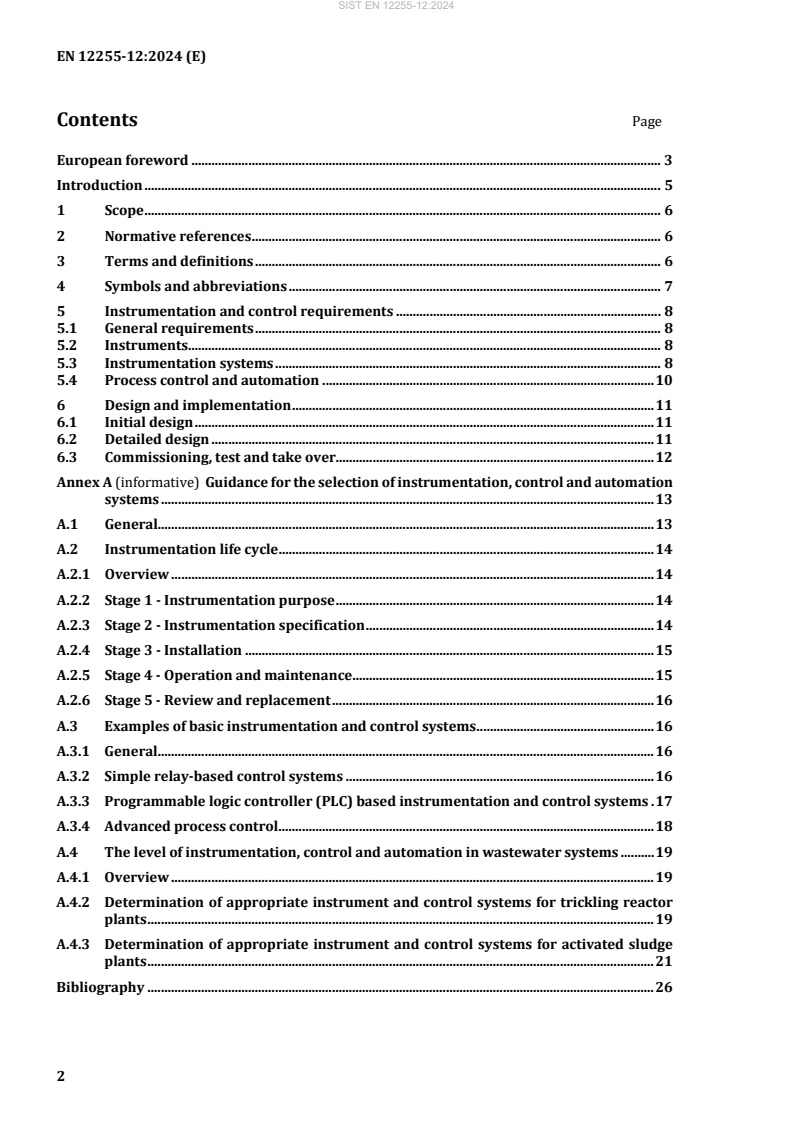
Contents Page
European foreword . 3
Introduction . 5
1 Scope . 6
2 Normative references . 6
3 Terms and definitions . 6
4 Symbols and abbreviations . 7
5 Instrumentation and control requirements . 8
5.1 General requirements . 8
5.2 Instruments. 8
5.3 Instrumentation systems . 8
5.4 Process control and automation . 10
6 Design and implementation . 11
6.1 Initial design . 11
6.2 Detailed design . 11
6.3 Commissioning, test and take over. 12
Annex A (informative) Guidance for the selection of instrumentation, control and automation
systems . 13
A.1 General. 13
A.2 Instrumentation life cycle . 14
A.2.1 Overview . 14
A.2.2 Stage 1 - Instrumentation purpose . 14
A.2.3 Stage 2 - Instrumentation specification . 14
A.2.4 Stage 3 - Installation . 15
A.2.5 Stage 4 - Operation and maintenance . 15
A.2.6 Stage 5 - Review and replacement . 16
A.3 Examples of basic instrumentation and control systems . 16
A.3.1 General. 16
A.3.2 Simple relay-based control systems . 16
A.3.3 Programmable logic controller (PLC) based instrumentation and control systems . 17
A.3.4 Advanced process control . 18
A.4 The level of instrumentation, control and automation in wastewater systems . 19
A.4.1 Overview . 19
A.4.2 Determination of appropriate instrument and control systems for trickling reactor
plants . 19
A.4.3 Determination of appropriate instrument and control systems for activated sludge
plants . 21
Bibliography . 26
European foreword
This document (EN 12255-12:2024) has been prepared by Technical Committee CEN/TC 165 “Waste
water engineering”, the secretariat of which is held by DIN.
This European Standard shall be given the status of a national standard, either by publication of an
identical text or by endorsement, at the latest by September 2024, and conflicting national standards shall
be withdrawn at the latest by September 2024.
Attention is drawn to the possibility that some of the elements of this document may be the subject of
patent rights. CEN shall not be held responsible for identifying any or all such patent rights.
This document supersedes EN 12255-12:2003.
EN 12255-12:2003:
a) comprehensive revision and addition in all sections;
b) adaption to the state of the art;
c) updating of the normative references.
This is the twelfth part prepared by Working Group CEN/TC 165/WG 40 relating to the general
requirements and processes for treatment plants for a total number of inhabitants and population
equivalents (PT) over 50.
The EN 12255 series with the generic title “Wastewater treatment plants” consists of the following parts:
• Part 1: General construction principles
• Part 2: Storm water management systems
• Part 3: Preliminary treatment
• Part 4: Primary settlement
• Part 5: Lagooning processes
• Part 6: Activated sludge process
• Part 7: Biological fixed-film reactors
• Part 8: Sludge treatment and storage
• Part 9: Odour control and ventilation
• Part 10: Safety principles
• Part 11: General data required
• Part 12: Control and automation
• Part 13: Chemical treatment — Treatment of wastewater by precipitation/flocculation
• Part 14: Disinfection
• Part 15: Measurement of the oxygen transfer in clean water in aeration tanks of activated sludge plants
• Part 16: Physical (mechanical) filtration
NOTE Part 2 is under preparation.
Any feedback and questions on this document should be directed to the users’ national standards body.
A complete listing of these bodies can be found on the CEN website.
According to the CEN-CENELEC Internal Regulations, the national standards organisations of the
following countries are bound to implement this European Standard: Austria, Belgium, Bulgaria, Croatia,
Cyprus, Czech Republic, Denmark, Estonia, Finland, France, Germany, Greece, Hungary, Iceland, Ireland,
Italy, Latvia, Lithuania, Luxembourg, Malta, Netherlands, Norway, Poland, Portugal, Republic of North
Macedonia, Romania, Serbia, Slovakia, Slovenia, Spain, Sweden, Switzerland, Türkiye and the United
Kingdom.
Introduction
Differences in wastewater treatment throughout Europe have led to a variety of systems being developed.
This document gives fundamental information about the systems; this document has not attempted to
specify all available systems. A generic arrangement of wastewater treatment plants is illustrated in
Figure 1:
Key
1 preliminary treatment C discharged effluent
2 primary treatment D screenings and grit
3 secondary treatment E primary sludge
4 tertiary treatment F secondary sludge
5 additional treatment (e.g. disinfection or removal of micropollutants) G tertiary sludge
6 sludge treatment H digested sludge
7 lagoons (as an alternative) I digester gas
A raw wastewater J returned water from dewatering
B effluent for re-use (e.g. irrigation)
Figure 1 — Schematic diagram of wastewater treatment plants
Detailed information additional to that contained in this document may be obtained by referring to the
bibliography.
The primary application is for wastewater treatment plants designed for the treatment of domestic and
municipal wastewater.
NOTE For requirements on pumping installations at wastewater treatment plants, see EN 752, Drain and sewer
systems outside buildings — Sewer system management, and EN 16932, Drain and sewer systems outside buildings —
Pumping systems:
— Part 1: General requirements;
— Part 2: Positive pressure systems;
— Part 3: Vacuum systems.
1 Scope
This document specifies general requirements for instrumentation and specific requirements for process
control and automation systems on wastewater treatment plants for more than 50 PT.
NOTE 1 Because of the rapid rate of development of sensor and control equipment, this document is intended as
an overview and uses examples and general requirements, not detailed equipment specifications. Detailed
information additional to that contained in this document can be obtained by referring to the Bibliography.
NOTE 2 Although EC directives become matters of law in member states of the EU and some other situations,
this standard is intended for wider use and hence those directives with clear technical guidance of a type that would
generally be appropriate in a standard are referenced in the text and listed in the Bibliography. The alternative of
listing requirements copied from directives would potentially create unacceptable conflict when directives are
revised.
2 Normative references
The following documents are referred to in the text in such a way that some or all of their content
constitutes requirements of this document. For dated references, only the edition cited applies. For
undated references, the latest edition of the referenced document (including any amendments) applies.
EN 16323:2014, Glossary of wastewater engineering terms
EN 62305-3, Protection against lightning — Part 3: Physical damage to structures and life hazard
(IEC 62305-3)
IEC 60364, Low voltage electrical installations
3 Terms and definitions
For the purposes of this document, the terms and definitions given in EN 16323:2014 and the following
apply.
ISO and IEC maintain terminology databases for use in standardization at the following addresses:
• ISO Online browsing platform: available at https://www.iso.org/obp
• IEC Electropedia: available at https://www.electropedia.org/
3.1
instrumentation
electronic or mechanical devices that are used to either sense or monitor process variables
Note 1 to entry: These can be split into sensors and monitors.
3.1.1
sensor
electrical or mechanical device that communicates the qualitative state of a process variable
Note 1 to entry: Examples of this include a contact probe or switch that outputs a 0 or 1 as an off/on state and
devices which transmit an electrical signal (usually a voltage) that is scalable to a process variable.
3.1.2
monitor
electrical or mechanical device that communicates the quantitative state of a process variable
Note 1 to entry: Examples of this include a contact probe and devices which transmit an electrical signal (usually a
current) that is scalable to a process variable.
3.1.3
measurement system
combination of a sensor and a monitor that together communicates the quantitative state of a process
variable
3.2
process control and automation
control device (such as a PLC, controller or relay) that takes inputs from the instrumentation system to
automatically change the state of the system to a specified set of control variables
Note 1 to entry: This can be a one-way system or if the control is a circular control this would be called closed-loop
control.
3.2.1
process variable
PV
quantity, quality, or condition of a process media or process object which value may be subject to change
and can usually be measured
[SOURCE: ISO 15519-2:2015, 3.1.8]
3.2.2
set point
SP
setting within the control system that is the target setting for the control system to change the process
variable
3.2.3
controller
device for regulation or management of a system or component
[SOURCE: ISO 16484-5:2022, 3.2.21]
3.2.4
telemetry system
communications system that receives data from instrumentation and control systems and transmits the
readings to a remote data visualisation and storage system
3.2.5
SCADA system
supervisory control and data acquisition system
combination of hardware and software used to send commands and acquire data for the purpose of
monitoring and control
Note 1 to entry: This is normally physically located on site.
4 Symbols and abbreviations
ASM activated sludge models
ATEX atmospheres explosible and regulation concerning potentially explosive atmospheres
HART highway addressable remote transducer (protocol)
PT total population
PLC programmable logic controller
PV process variable
RAS return activated sludge
SAS surplus activated sludge (also known as WAS or waste activated sludge)
SCADA supervisory control and data acquisition
SP set point
UV ultraviolet light (UV treatment system)
WWTP wastewater treatment plant
5 Instrumentation and control requirements
5.1 General requirements
The control system shall be considered at an early planning stage when designing for the overall process.
The costs, including the investment and operating expenses for the control system with respect to various
treatment alternatives should be estimated. Account shall be taken of the fact, that a sophisticated control
system requires skilled and trained personnel for maintenance. The decision, of whether a sophisticated
control system or simple controls are required, is dependent on the plant size and process complexity.
NOTE The relevant authority or national or local regulations can have requirements covering the nature of the
control system.
Guidance for the selection of instrumentation, control and automation systems is given in Annex A.
5.2 Instruments
All instruments shall:
a) comply with electrical guidelines as outlined in IEC 60364 (national or local regulations or the
relevant authority can specify more detailed requirements);
b) limit risks due to cyber-security as outlined in Network and Information Security (NIS) Directive [6]
(national or local regulations or the relevant authority can specify more detailed requirements);
c) ensure all risks due to health and safety, especially around instrumentation operation and
maintenance, are minimized;
d) have appropriate certifications for use in hazardous areas (see ATEX Directive 2014/34/EU [7] for
additional information) where the instrumentation and control systems are within a zoned area;
e) be suitably protected from energy surges and lightning strikes in line with EN 62305-3.
5.3 Instrumentation systems
5.3.1 Instrumentation systems
All instrumentation systems shall:
• ensure the results of any monitoring are representative of the media being monitored taking into
account differences in homogeneity;
• be currently capable of communicating with telemetry systems of the operator of the wastewater
treatment system.
All instrumentation systems should be installed:
• so that any sampling of the media being monitored does not adversely affect the media as to affect
the sample result;
• in such a way as to minimize the degree of fouling;
• in a way to be accessible so an appropriate maintenance regime can be undertaken;
• so that they do not affect the results of any other instruments that are installed in the media
measured;
• to protect the instrument from the media that is being measured so as to minimize damage to the
instruments;
• to protect the instrument from any damage to the display from climatic conditions including sun
damage to the display;
• to take into account the ease and safety of replacement.
Where enclosures are used then they should have adequate ventilation to prevent overheating.
Where enclosures are used in outdoor conditions where the temperature is likely to fall below 5 °C then
a condensation heater should be installed when required.
5.3.2 Instrumentation
Instrumentation shall be:
• appropriate to the application taking into account the nature of the media that is being measured and
its propensity to affect measurement through the fouling of the instrument and the subsequent
maintenance needs to keep the instrument recording accurately;
• suitably protected to ensure climatic conditions cannot adversely affect the results;
• installed so that if an instrument enters a fault state this shall be detectable through the telemetry
system.
5.3.3 Cabling, cable bracketry and cable conduits
Electrical conduit shall be suitably equipped to allow for pulling additional cables through in the future
(e.g. draw ropes in place and access points and space to utilize them).
Any electrical cable ladder installed should be suitably equipped to allow for attaching additional cables
in the future.
The extent of extra capacity required should be agreed between the parties at an early stage in the design.
Cable conduits and fixings should be of types and be installed to limit damage from foreseeable external
sources of degradation e.g. UV, animal interference.
All instrument and signalling connections shall be labelled to allow for ease of tracing and identification.
All underground electrical jointing should be installed so that it can be detected.
5.3.4 Operation and maintenance of instrumentation
An operational and maintenance strategy shall be put in place to ensure that instrumentation is
maintained and calibrated as appropriate to its operation.
5.4 Process control and automation
5.4.1 General requirements
Process control and automation systems shall be designed to operate and manage the wastewater
treatment system, including documentation and allowing for appropriate maintenance activities to be
conducted.
The design shall take into account the required management information system with which it should
integrate. In certain cases it can be advantageous to incorporate the control of the wastewater system
upstream. This includes consideration of the asset data and the maintenance needs.
The control and automation concept shall be specially designed for each wastewater treatment plant
depending on the treatment processes, manning levels and skills. It should also allow compliance with
the requirements for reliability and the operation in special situations, e.g. in case of failure of some
components.
The general requirements for control and automation are:
• all electrical components shall comply with electrical guidelines as outlined in IEC 60364 (national
or local regulations or requirements of the relevant authority can also apply);
• all mechanical components shall be accessible for operational and maintenance purposes;
• to take into account any system redundancy issues including software.
In addition, all control-based systems should comply with cyber security as per the Network and
Information Security (NIS) Directive. (National or local regulations or requirements of the relevant
authority can also apply.)
NOTE For operation in hazardous areas, attention is drawn to the ATEX Directive 2014/34/EU.
5.4.2 Specification and installation requirements for process control and automation systems
The control and automation system shall be designed to read process variables from instrumentation.
Typically, this is via a 4mA-20mA analogue loop but can be via a number of different communication
protocols or signal types (e.g. Modbus, HART, MQTT or OPC UA). Checks should be made in designing the
instrumentation, process control and automation system as to the communication compatibility between
the instrumentation, the control systems and the overall SCADA system.
Any automated process control system shall be designed to use the data/signals from the instruments to
adjust the treatment process using automated controls to achieve the desired result.
The periodicity of the measurement should be appropriate to the dynamic behaviour of the process to be
controlled. This is to allow the process control system to make changes to the mechanical automation
system in an appropriate timescale. The response times of instrument, process control and automation
systems shall be appropriate to their normal operating range and duty. The mechanical/electrical
automation system component should be sourced and installed correctly to achieve the desired process
outcome taking into account the torque and response time of the element that is being controlled (e.g. an
instrument controlling a penstock should not take the penstock control past its safe movement limit)
All electrical and mechanical elements of the automation system shall be, where possible, accessible to
allow maintenance and correct operation of the control and automation system and shall facilitate the
checking of the control loop signal.
An appropriate operation and maintenance strategy shall be put in place to ensure that the process
automation system operates correctly when needed. The minimum requirement is for this to be in line
with the manufacturer’s recommendations.
No instrumentation or process control system should limit the ability to use technologies from other
manufacturers. Unless otherwise agreed between the parties at an early stage in the design a non-
proprietary protocol should be used.
6 Design and implementation
6.1 Initial design
As part of the initial design of the instrumentation, control and automation systems the following should
be produced:
a) a complete list of instrumentation, the parameters to be measured and the sampling intervals
including:
1) the instrument types;
2) the range of each instrument;
3) the purpose of the instrument (e.g. monitoring, recording, controlling or switching);
b) a complete list of the control and automation components including:
1) all control and automation equipment;
2) the software and the current versions that can be used;
3) the settings and ranges of all of automation equipment (e.g. valves and penstocks etc.);
4) the information protocol for the site;
5) all signals and alarms for the site;
6) all data that are available for the site;
c) an explanation of the control and automation system for the site including:
1) the control system for normal operation;
2) the control system for specified stress or failure conditions.
6.2 Detailed design
As part of the detailed design process the following should be produced:
• process flow diagram for the site, complete with all instruments;
• piping and instrumentation diagram;
• site wiring diagrams (for instrumentation, control and automation system).
6.3 Commissioning, test and take over
A site instrumentation, process control and automation plan shall be provided. The commissioning
process and the acceptance criteria shall be specified in the tender documents.
Commissioning shall include:
a) production of:
1) a finalised list of all instrumentation on the site including the make, model and serial number of
every instrument that is installed on the site;
2) a complete signals list for the site including any connection points in telemetry;
3) a complete list of all process control and automation hardware including its settings;
4) a complete list of any new or changed alarms and alarms settings for the site;
5) a complete list of technical documentation for each instrument including any manufacturers’
calibration certification;
6) a complete list of all process control and automation software including its version number;
b) collection of:
1) all details of instrumentation settings for each instrument including the range and scaling;
2) details of all cables (e.g. sensor, power and telemetry cabling) which shall include the type of
cable and number of cores;
c) provision of:
1) any specialist equipment needed to help maintenance of the instrumentation in its place of use
or of the arrangements necessary for maintenance by a specialist;
2) details of all factory acceptance tests on the control and automation system;
3) an assurance from supplier to keep backup of technical documentation including the software
included in the delivery for a minimum of 10 years.
As part of the site acceptance testing procedure the instrumentation and control system shall be tested
to ensure that:
• all instrumentation is monitoring correctly, where appropriate against traceable standards;
• the control and automation system is operating as designed.
Annex A
(informative)
Guidance for the selection of instrumentation, control and automation
systems
A.1 General
The usefulness of instrumentation, control and automation systems within the water industry will
depend upon the size of the wastewater system being managed (both collection network and treatment
system), the treatment objectives and the rigidity of the environmental permit conditions. National or
local regulations or the relevant authority can set thresholds for the extent and type of instrumentation.
Where no such criteria have been set the following guidance can be helpful.
Energy saving and operational optimization (biogas production, for example) in WWTPs have been some
of the main drivers to use more efficient and modern control, instrumentation and automation systems.
It is very common for very small treatment works (e.g. < 250 PT) to have little or no instrumentation.
Above this size or where a challenging treatment standard exists, the use of instrumentation and control
become more viable. The extent of instrumentation and control
...